
By Dr. Pellumb Kabashi, DBA, MBA, EA, CFE, CES
Founder, Tax Expert Today LLC · Tax advisors, enrolled agents, CPAs, and attorneys · Serving clients in all 50 states
Quick Answer: Form 706-NA is the U.S. estate tax return for a person who was neither a U.S. citizen nor domiciled in the United States at death. It is required when U.S. situs assets, such as a Florida condo or U.S. stocks, plus certain lifetime gifts exceed $60,000. It is due nine months after death, and the estate gets only a $13,000 credit unless a treaty such as the Canada U.S. tax treaty provides more. Call (239) 441-2005 for a free consultation.
What is Form 706-NA?
Form 706-NA is the United States Estate (and Generation-Skipping Transfer) Tax Return for the estate of a nonresident who was not a U.S. citizen. It reports only the decedent’s property situated in the United States, computes the federal estate tax on that property, and is filed by the executor or by whoever holds the U.S. assets.
- Who it covers: a decedent who was neither a U.S. citizen nor domiciled in the United States at death.
- What it taxes: U.S. situs property only, such as U.S. real estate and stock of U.S. corporations.
- The filing trigger: U.S. situs assets plus certain lifetime gifts above $60,000.
- The credit: $13,000, which offsets the tax on the first $60,000 of taxable estate.
- The rates: the same 18 to 40 percent schedule that applies to citizens.
The Instructions for Form 706-NA describe the return as the form “used to compute estate and generation-skipping transfer (GST) tax liability” for a nonresident not a citizen, and they add a point that surprises many families: the tax is imposed on the transfer of the taxable estate, not on the heirs who receive it. A Canadian, German, or Brazilian heir does not pay the tax personally on receipt. The estate pays it, and the U.S. assets stay frozen until it is paid or shown not to be due.
The return was redesigned in 2025. The current revision dropped the old representation section (an executor now authorizes a representative on Form 2848 or Form 8821), added direct deposit lines for refunds, and points executors to the IRS payment page for electronic payment. The form itself is short, two pages of parts plus a continuation schedule, but it borrows heavily from the full Form 706. An executor who claims a marital deduction, a charitable deduction, a conservation easement exclusion, or a credit for tax on prior transfers must attach the matching Form 706 schedules, and the valuation rules for stocks and bonds come from the Form 706 instructions.
Southwest Florida sees this return far more often than most of the country. Naples, Bonita Springs, Marco Island, and Fort Myers have large populations of Canadian, European, and Latin American owners who hold a condominium or a house here while remaining citizens and domiciliaries of another country. When one of those owners dies, the Florida property is U.S. situs property, the $60,000 threshold is almost always exceeded, and the heirs discover that the title company, the brokerage, and the probate court all want something from the IRS before anything can move. This guide follows that sequence from the first question (does the estate have to file?) to the last (what happens when the heirs sell?).
| Feature | Form 706 (citizen or domiciliary) | Form 706-NA (nonresident not a citizen) |
|---|---|---|
| Property taxed | Worldwide gross estate | Only property situated in the United States |
| Filing threshold (2026 deaths) | $15,000,000 basic exclusion plus adjusted taxable gifts | $60,000 of U.S. situs assets plus adjusted taxable gifts |
| Unified credit | Tentative tax on the basic exclusion amount ($5,945,800 for 2026) | $13,000, or a prorated credit if a treaty requires it |
| Portability of unused exclusion | Available by election | Not available |
| Marital deduction | Unlimited for a citizen spouse; QDOT for a noncitizen spouse | Citizen spouse or QDOT only, unless a treaty allows otherwise |
| Deductions for debts and expenses | Full amount | Prorated by the U.S. share of the worldwide estate |
| Due date | 9 months after death | 9 months after death |
Who counts as a nonresident not a citizen for estate tax purposes?
For estate tax purposes a decedent is a nonresident not a citizen when, at death, the person was not a U.S. citizen and was not domiciled in the United States. Domicile means living in a place with no definite present intention of leaving. It is a different test from the substantial presence test used for income tax.
- Domicile, not days: intent to remain indefinitely decides estate tax residence.
- Income tax residence differs: a person can be a U.S. income tax resident and an estate tax nonresident.
- Territory citizens: citizenship that came only from a U.S. territory is not treated as U.S. citizenship here.
- Green card holders: often domiciled in the United States, though the facts decide.
- U.S. citizens abroad: never file Form 706-NA; their executors file Form 706 on the worldwide estate.
Treasury Regulations section 20.0-1(b) defines a resident decedent as one who had a domicile in the United States at death, and a nonresident decedent as one whose domicile was outside the United States under the same principles. The Form 706-NA instructions state the standard in plain terms: a person acquires domicile in a place by living there, even briefly, with no definite present intention of later moving. The instructions then add a note worth reading twice, that a decedent “may be a U.S. resident for income tax purposes yet be considered a nonresident for estate tax purposes.”
The two regimes measure different things. Income tax residence for a noncitizen turns on the green card test and the substantial presence test, which count days. A Canadian snowbird who spends five winter months in Naples each year can meet the substantial presence formula and then file Form 8840 to claim a closer connection to Canada. Domicile for estate tax ignores the day count and asks where the person intended to make a permanent home. Facts that usually matter include where the person’s principal home, family, doctors, driver’s license, voter registration, club memberships, religious affiliation, and burial plans were, what the will and declarations of domicile said, and where the person told immigration authorities they lived.
Most seasonal owners in Southwest Florida remain domiciled in their home country, and their estates fall under Form 706-NA. The harder cases are people who sold the home abroad, retired to Naples full time on a visa, or held a green card for years. A long-term green card holder who dies in Florida is often domiciled here, and that estate files Form 706 with the full $15,000,000 exclusion rather than Form 706-NA with $60,000. Because the gap between the two outcomes is so large, domicile is often the first question an executor should settle, with documents, before valuing anything.
| Situation at death | Income tax status (typical) | Estate tax status (typical) | Return |
|---|---|---|---|
| Canadian snowbird, home and family in Ontario, winters in Naples | Nonresident, often with Form 8840 | Nonresident not a citizen | Form 706-NA if over $60,000 |
| German citizen on a work visa living in Florida, planning to return home | Resident under substantial presence | Often nonresident (facts decide) | Form 706-NA if over $60,000 |
| Green card holder retired in Naples for ten years | Resident | Usually domiciled in the United States | Form 706 if over $15,000,000 |
| U.S. citizen living in London | Citizen, taxed on worldwide income | Citizen, taxed on worldwide estate | Form 706 |
| Former U.S. citizen who expatriated | Nonresident | Nonresident not a citizen, with special rules | Form 706-NA, see the expatriate section below |
When does an estate have to file Form 706-NA?
The executor must file Form 706-NA when the date of death value of the decedent’s U.S. situs assets, plus any gift tax specific exemption used in late 1976 and any adjusted taxable gifts made after 1976, exceeds $60,000. The threshold uses gross value, before debts, so a mortgaged Florida condo usually crosses it.
- The statute: 26 U.S.C. section 6018(a)(2) requires a return when the U.S. situs gross estate exceeds $60,000.
- Gifts count: adjusted taxable gifts after 1976 are added to the U.S. assets for the test.
- Gross, not net: the test looks at value before deductions.
- Who files: the executor, or every person in possession of U.S. property when no U.S. executor is acting.
- Below the threshold: no return, though a transfer certificate process may still apply.
Section 6018(a)(2) requires a return for the estate of every nonresident not a citizen when the part of the gross estate situated in the United States exceeds $60,000, and section 6018(a)(4) reduces that figure by adjusted taxable gifts and the old specific exemption. The Form 706-NA instructions restate the test as a single sum: U.S. situs assets at date of death value, plus the gift tax specific exemption (gifts made between September 9 and December 31, 1976), plus adjusted taxable gifts made after 1976. If the sum exceeds $60,000, the return is required.
Two features of the test catch executors off guard. First, it is a gross test. A $500,000 Naples condo with a $450,000 mortgage still contributes $500,000 to the threshold if the decedent was personally liable on the loan (the mortgage rules are covered in their own section below). Second, the $60,000 figure is not indexed. It has been $60,000 since 1977. A modest U.S. brokerage account, a car kept in a Florida garage, and the furniture in a condo can cross it together.
The instructions also define who the executor is for this purpose, and the definition is broader than a court appointment. If no executor is appointed, qualified, and acting in the United States, every person in actual or constructive possession of the decedent’s property is treated as an executor and must file. That reaches a surviving joint owner, a relative holding the keys to a condo, or a U.S. brokerage holding an account. When more than one person must file, the instructions say it is preferable to join in one complete return. The executor must also document the appointment, typically with a certified copy of the will or a court order; a bare statement is not enough.
| Hypothetical U.S. holdings at death | Value | Over $60,000? | Form 706-NA required? |
|---|---|---|---|
| U.S. bank deposit only (not used in a U.S. business) | $400,000 | Not counted, deposit is non-situs | No |
| Shares of U.S. companies in a U.S. brokerage | $75,000 | Yes | Yes |
| Naples condo, mortgage on which the decedent was personally liable | $500,000 value, $450,000 loan | Yes, gross value counts | Yes |
| Car and household contents in Florida | $45,000 | No | No (unless gifts push it over) |
| $45,000 of U.S. stock plus $20,000 of prior adjusted taxable gifts | $65,000 combined | Yes | Yes |
Which assets are U.S. situs property for Form 706-NA?
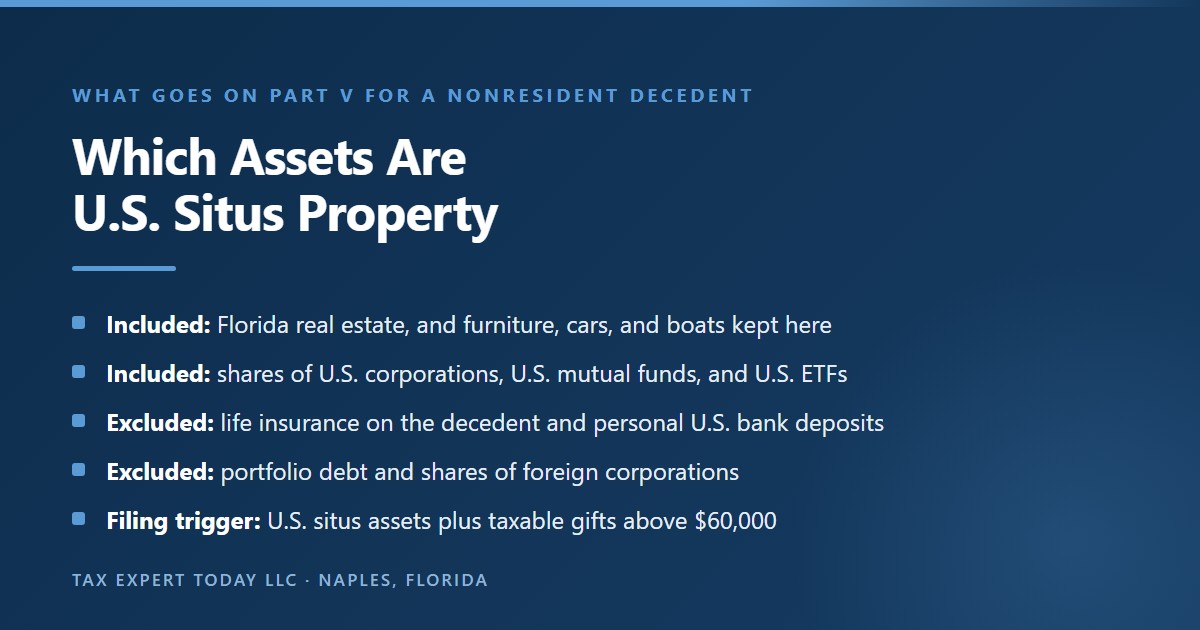
U.S. situs property includes real estate located in the United States, tangible personal property physically in the United States, stock of U.S. corporations wherever the certificates are held, and most debts owed by U.S. persons. Life insurance on the decedent’s life, most bank deposits, portfolio interest obligations, and stock of foreign corporations are treated as outside the United States.
- Always in: Florida real estate, furniture, cars, boats, art, and jewelry located in the United States.
- In by issuer: shares of U.S. corporations, regardless of where the certificate sits.
- Out by statute: life insurance proceeds, non-business bank deposits, and portfolio debt.
- Out by issuer: shares of foreign corporations, even if held in a U.S. account.
- Treaty override: a death tax treaty can move an asset in either direction.
The location rules sit in two places. Regulations section 20.2104-1 lists property considered situated in the United States: real property located here, tangible personal property located here (except certain works of art on loan for exhibition), shares of stock issued by a domestic corporation “irrespective of the location of the certificates,” and debt obligations whose primary obligor is a U.S. person or a U.S. government unit. Regulations section 20.2105-1 lists the property considered outside the United States, including shares of a foreign corporation regardless of where the certificates are and amounts receivable as insurance on the decedent’s life.
The statute then carves out several categories that would otherwise be U.S. situs. Section 2105(b) treats bank deposits whose interest would be exempt under section 871(i), deposits with a foreign branch of a U.S. bank, debt obligations that would produce portfolio interest under section 871(h), and certain short-term original issue discount obligations as property outside the United States. The Form 706-NA instructions add the practical list: deposits with a U.S. bank, deposits with a U.S. branch of a foreign bank, withdrawable accounts with a U.S. savings and loan, and amounts held by a U.S. insurance company under an agreement to pay interest are outside the United States if they are not effectively connected with a U.S. trade or business.
One rule reaches back in time. If an asset is pulled into the gross estate under the transfer provisions of sections 2035 through 2038 (for example, property the decedent gave away but kept the right to use), it is U.S. situs if it met the location rules either when transferred or at death. The instructions give the example of tangible property that was in the United States at the time of a section 2038 transfer and later moved abroad; it is still reported on the return.
| Asset | U.S. situs? | Authority |
|---|---|---|
| Florida condominium, house, or land | Yes | Reg. 20.2104-1(a)(1) |
| Furniture, art, jewelry, cars, and boats kept in Florida | Yes | Reg. 20.2104-1(a)(2) |
| Art imported only for public exhibition and on loan to a nonprofit museum | No | Section 2105(c) |
| Shares of a U.S. corporation (for example, a U.S. listed company) | Yes, wherever the certificates are | Reg. 20.2104-1(a)(5) |
| Shares of a foreign corporation held in a U.S. brokerage | No | Reg. 20.2105-1(f) |
| Deposit at a U.S. bank, not used in a U.S. business | No | Section 2105(b)(1) |
| Deposit used in a U.S. trade or business | Yes | Form 706-NA instructions |
| Bonds whose interest would be portfolio interest | No (contingent interest can change this) | Section 2105(b)(3) |
| Loan owed to the decedent by a U.S. person | Generally yes | Reg. 20.2104-1(a)(7) |
| Life insurance proceeds on the decedent’s life | No | Section 2105(a) |
Is a Florida condo or home U.S. situs property?
Yes. Real property located in the United States is U.S. situs property for a nonresident decedent, so a Naples condominium, a Marco Island house, or a lot in Cape Coral is included on Form 706-NA at fair market value on the date of death. The contents, the car in the garage, and a boat at the marina are included too.
- The structure: real property is reported at full value; the mortgage is handled separately.
- The contents: furniture, art, and jewelry kept in the unit are tangible U.S. situs property.
- The vehicles: a car or boat kept in Florida is included.
- Valuation: fair market value between a willing buyer and seller, not a forced sale or an assessed value.
- Joint title: the share included depends on how title was held and who paid.
Real property is the clearest situs rule in the estate tax. Regulations section 20.2104-1(a)(1) treats “real property located in the United States” as U.S. situs property without exceptions for size, use, or the owner’s ties. The value is fair market value at death, which the IRS frequently asked questions describe as the price at which the property would change hands between a willing buyer and a willing seller, neither under compulsion and both with reasonable knowledge of the facts. A county property appraiser’s just value is not the same thing. Most executors obtain a date of death appraisal from a Florida licensed appraiser, which also supports the heirs’ basis later.
Ownership form matters. If the decedent held title alone, the full value is included. If the decedent held title with a spouse or a child as joint tenants with right of survivorship, the Form 706-NA instructions say the full value is generally included, except that only half is included when the surviving spouse is a U.S. citizen and the property was held as joint tenants or tenants by the entirety. The contribution rule of section 2040 allows the estate to exclude the part attributable to the other owner’s own contribution, but the burden of showing that contribution falls on the estate. Records of who paid the purchase price, decades later, are often the difference between including all of a property and including half.
Property held through an entity follows the entity. Shares of a Florida corporation are U.S. situs stock. Shares of a foreign corporation that owns the condo are generally not U.S. situs property, which is why some foreign buyers use that structure (see the section on foreign corporations below). Interests in a Florida limited liability company taxed as a partnership raise situs questions that the code and regulations do not answer directly, and practitioners disagree on them; an estate holding real estate through a partnership interest should get specific advice before taking a position.
| How the Florida property was held | Amount generally included on Form 706-NA |
|---|---|
| In the decedent’s name alone | Full fair market value |
| Joint with right of survivorship, with someone other than a citizen spouse | Full value, less the part shown to come from the other owner’s contribution |
| Joint with a surviving spouse who is a U.S. citizen | One half |
| Tenants in common | The decedent’s fractional share, often with a valuation discount supported by appraisal |
| Through a Florida corporation | The value of the decedent’s U.S. corporate stock |
| Through a foreign corporation | Generally nothing, because foreign stock is not U.S. situs (subject to the look-through and retained-use risks discussed below) |
Are U.S. bank accounts and life insurance included on Form 706-NA?
Generally no. Section 2105 treats proceeds of insurance on a nonresident’s life as property outside the United States, and treats deposits with U.S. banks, savings associations, and insurers as outside the United States when they are not effectively connected with a U.S. trade or business. Both still count in the worldwide estate used for prorating deductions.
- Life insurance: excluded whether the insurer is U.S. or foreign.
- Personal bank deposits: excluded if not used in a U.S. trade or business.
- Business accounts: a rental or operating account used in a U.S. business can be included.
- Brokerage cash: the treatment depends on how the account holds it; money market fund shares are stock.
- Worldwide estate: excluded assets still go on Part IV, line 2 for the proration math.
Section 2105(a) says the amount receivable as insurance on the life of a nonresident not a citizen “shall not be deemed property within the United States.” That is one of the most generous rules in the nonresident regime: a $1,000,000 policy issued by a U.S. insurer on a German owner’s life is outside the U.S. estate. Section 2105(b)(1) does the same for deposits described in section 871(i)(3) whose interest would be exempt from U.S. income tax, which covers ordinary checking and savings accounts at U.S. banks.
The deposit exclusion has an important condition. The instructions say these deposits are outside the United States only “if they are not effectively connected with conducting a trade or business within the United States.” An account into which rental income from a Florida property is collected and from which the property’s expenses are paid can, depending on the facts, be connected with a U.S. trade or business, especially where the owner made the net basis election to treat rental income as effectively connected income. Families sometimes keep a single account for everything; separating a personal account from a rental operating account is a mechanism worth understanding, though whether a rental activity is a trade or business depends on its facts.
Cash held inside a U.S. brokerage account deserves a closer look. A sweep into a bank deposit program can look like a bank deposit. A sweep into a U.S. money market mutual fund is a holding of shares in a U.S. regulated investment company, which is U.S. corporate stock. The temporary look-through rule that once treated part of a fund as non-situs (section 2105(d)) applied only to decedents who died after 2004 and before 2012, and it has expired.
| Item | On Part V (U.S. gross estate)? | On Part IV, line 2 (outside the U.S.)? |
|---|---|---|
| Life insurance on the decedent, U.S. insurer | No | Yes, as part of the worldwide estate |
| Personal checking or savings at a Florida bank | No | Yes |
| Rental operating account used in a U.S. business | Possibly, depending on the facts | If not on Part V |
| Deposit at a foreign branch of a U.S. bank | No | Yes |
| U.S. money market fund shares | Yes (U.S. corporate stock) | No |
Are U.S. stocks, mutual funds, and ETFs included on Form 706-NA?
Yes, shares of U.S. corporations are U.S. situs property regardless of where the certificates or the brokerage account are located. That includes U.S. listed companies, U.S. mutual funds, and U.S. exchange traded funds organized as U.S. entities. Shares of a foreign corporation or a foreign domiciled fund are not U.S. situs, even when bought through a U.S. broker.
- The test is the issuer: a U.S. corporation’s stock is U.S. situs anywhere in the world.
- U.S. funds: U.S. mutual funds and U.S. ETFs are shares of U.S. entities.
- Foreign funds: a fund organized abroad is generally foreign stock.
- Bonds: many U.S. bonds qualify as portfolio debt and are excluded.
- A common surprise: a foreign brokerage account holding U.S. shares still holds U.S. situs property.
The Form 706-NA instructions put it directly: “no matter where stock certificates are physically located, stock of corporations organized in or under U.S. law is property located in the United States, and all other corporate stock is property located outside the United States.” A British investor holding shares of a large U.S. technology company through a London broker therefore owns U.S. situs property, and the U.S. transfer agent will ask for IRS clearance before re-registering those shares. This is the single most common reason foreign estates file Form 706-NA, ahead even of real estate.
The reverse is equally important. A Canadian who holds shares of Canadian banks in a Florida brokerage account holds foreign stock, which is outside the U.S. estate. A European investor who holds a fund domiciled in Ireland or Luxembourg that tracks the U.S. market generally holds foreign corporate stock, not U.S. stock, even though the fund’s own assets are U.S. shares. U.S. bonds are often excluded as well. Section 2105(b)(3) treats a debt obligation as outside the United States if its interest would qualify for the portfolio interest exemption of section 871(h), which covers most publicly issued corporate and Treasury debt held by a foreign investor, subject to an exception for contingent interest.
Describing securities correctly on the return is not a formality. The instructions require, for each stock, the corporation’s name, the number of shares, the class, the nine digit CUSIP number, and the quotation at which it is reported, and for each bond the obligor, maturity, rate, interest dates, and CUSIP. Values follow the Form 706 rules for stocks and bonds, generally the mean between the high and low quoted selling prices on the valuation date.
| Security | Typical situs for a nonresident |
|---|---|
| Shares of a U.S. listed company | U.S. situs |
| U.S. mutual fund or U.S. ETF shares | U.S. situs |
| U.S. Treasury bonds and most publicly issued U.S. corporate bonds | Generally outside the U.S. (portfolio debt) |
| Shares of a foreign company held in a U.S. account | Outside the U.S. |
| Shares of a fund organized outside the United States | Generally outside the U.S. |
| Private loan to a U.S. relative or U.S. company | Generally U.S. situs |
How much estate tax does a nonresident estate owe?
The tax uses the same unified rate schedule as citizens’ estates, rising from 18 percent to 40 percent on amounts over $1,000,000, applied to the U.S. taxable estate. The estate then subtracts a unified credit of only $13,000, which equals the tax on the first $60,000. A $500,000 taxable estate owes about $142,800 before any treaty relief.
- The rate schedule: section 2001(c), Table A in the Form 706 instructions.
- The credit: $13,000 under section 2102(b)(1).
- The top rate: 40 percent on taxable estate over $1,000,000.
- Prior gifts: adjusted taxable gifts are added to the base and the gift tax already paid is credited.
- Treaty relief: some treaties replace the $13,000 with a prorated share of the citizen credit.
Section 2101 imposes the tax on the transfer of the taxable estate of every nonresident not a citizen, computed under the section 2001(c) rate schedule. Section 2102(b)(1) then allows “a credit of $13,000,” limited to the tax itself. Because the tentative tax on exactly $60,000 under the schedule is $13,000, the credit works out to an exemption equivalent of $60,000, and every dollar above that is taxed starting at the 26 percent bracket.
The following figures apply the statutory schedule to round taxable estate amounts, with only the $13,000 credit. They are hypothetical illustrations of the math, before any treaty benefit, state tax deduction, or credit for prior transfers.
| U.S. taxable estate | Tentative tax (section 2001(c)) | Less $13,000 credit | Net federal estate tax | Effective rate |
|---|---|---|---|---|
| $60,000 | $13,000 | ($13,000) | $0 | 0% |
| $100,000 | $23,800 | ($13,000) | $10,800 | 10.8% |
| $250,000 | $70,800 | ($13,000) | $57,800 | 23.1% |
| $500,000 | $155,800 | ($13,000) | $142,800 | 28.6% |
| $750,000 | $248,300 | ($13,000) | $235,300 | 31.4% |
| $1,000,000 | $345,800 | ($13,000) | $332,800 | 33.3% |
| $2,000,000 | $745,800 | ($13,000) | $732,800 | 36.6% |
| $5,000,000 | $1,945,800 | ($13,000) | $1,932,800 | 38.7% |
Part II of the return runs the computation in a fixed order. The executor enters the taxable estate from Part IV, adds adjusted taxable gifts, computes the tentative tax on the total from Table A in the Form 706 instructions for the year of death, subtracts the tentative tax on the gifts alone, and then subtracts the unified credit, the credit for pre-1977 gift taxes, any Canadian marital credit, and any credit for tax on prior transfers. Any credit previously used against U.S. gift tax reduces the estate’s unified credit dollar for dollar under section 2102(b)(3)(B). Generation-skipping transfer tax, if any, is added on line 14, but only on transfers of property listed on Part V.
How does a nonresident’s estate tax compare with a U.S. citizen’s?
The difference is mostly the credit. A citizen or domiciliary who dies in 2026 has a $15,000,000 basic exclusion and can inherit a spouse’s unused exclusion through portability. A nonresident not a citizen has a $60,000 equivalent, cannot use portability, and gets a marital deduction only for a citizen spouse or through a QDOT.
- 2026 citizen exclusion: $15,000,000 under section 2010(c), as amended by Public Law 119-21.
- Nonresident equivalent: $60,000, unchanged since 1977.
- Portability: not available to a nonresident estate.
- Scope: the citizen is taxed on everything; the nonresident only on U.S. situs property.
- Treaty bridge: treaty countries can claim a share of the citizen credit.
The IRS page on recent estate and gift tax changes reports that Public Law 119-21, signed July 4, 2025, amended section 2010(c)(3) to set the basic exclusion amount at $15,000,000 for calendar year 2026. A citizen’s estate therefore pays nothing until the taxable estate plus adjusted taxable gifts exceeds $15,000,000. The IRS nonresident frequently asked questions add that the executor of a nonresident not a citizen “cannot make a portability election,” so a surviving spouse cannot inherit any unused nonresident credit.
The nonresident regime is narrower in scope, which is its one advantage. A citizen’s estate includes a family home in Toronto, a business in Munich, and a pension in Sao Paulo. A nonresident’s U.S. estate includes only the Naples condo, the U.S. stocks, and the other U.S. situs items. For a wealthy foreign family with a modest U.S. footprint, the U.S. tax can be small in absolute terms. For a foreign family whose main asset is U.S. real estate or a U.S. stock portfolio, it can be large. See our guide to the 2026 lifetime gift and estate tax exemption for the citizen side of the comparison.
| Rule | U.S. citizen or domiciliary (2026 death) | Nonresident not a citizen |
|---|---|---|
| Exclusion or exemption equivalent | $15,000,000 | $60,000 |
| Credit | $5,945,800 (tentative tax on $15,000,000) | $13,000 |
| Portability to surviving spouse | Yes, by election | No |
| Annual gift exclusion | $19,000 per donee | $19,000 per donee, on gifts subject to U.S. gift tax |
| Gift tax on gifts of U.S. stock | Yes | No, intangibles are exempt for nonresident donors |
| Return | Form 706 | Form 706-NA |
Which deductions can a nonresident estate claim on Form 706-NA?
A nonresident estate can deduct funeral expenses, administration expenses, claims, unpaid mortgages, and casualty losses, but only in the proportion that the U.S. gross estate bears to the worldwide gross estate. It can also deduct bequests to U.S. charities and qualifying transfers to a spouse, without proration. The worldwide estate must be documented to claim any of these.
- Prorated deductions: funeral, administration, claims, mortgages and liens, and casualty losses.
- The formula: U.S. gross estate divided by worldwide gross estate, times the total of these items.
- Charitable: bequests to U.S. charities or for use in the United States, unless a treaty allows more.
- Marital: a U.S. citizen spouse or a QDOT, unless a treaty allows otherwise.
- Proof required: a certified foreign death tax return or estate inventory supports the worldwide figure.
Section 2106(a)(1) allows “that proportion of the deductions specified in sections 2053 and 2054” which the value of the U.S. part of the gross estate bears to the value of the entire gross estate, wherever situated. The deductible items can be incurred anywhere. A funeral in Montreal, a probate lawyer in Hamburg, and a credit card balance in Sao Paulo all count toward the total that is then prorated. Part IV of the return walks through it: line 1 is the U.S. gross estate, line 2 is the value of everything outside the United States, line 3 is the total, line 4 is the total deductible expenses, and the allowed deduction on line 6 is line 4 multiplied by the line 1 to line 3 ratio.
The proration has a condition that matters in practice: the deduction is allowed only if lines 1 through 5 are completed and the amounts on lines 2 and 4 are documented. The instructions call for a certified copy of the foreign death tax return or, if none was filed, a certified copy of the estate inventory and schedule of debts filed with the foreign probate court, supplemented as needed. Families from countries without an estate or inheritance tax often have no such return, and assembling a credible worldwide inventory can take months. An executor who does not want to disclose the worldwide estate can choose to claim no prorated deduction at all, which is sometimes the practical choice for a small U.S. estate.
Charitable and marital deductions are not prorated. Section 2106(a)(2) allows a deduction for bequests to the United States, a state, or a domestic charity, and to certain trusts and fraternal societies for use within the United States. A bequest to a foreign charity does not qualify unless a treaty allows it. The marital deduction under section 2106(a)(3) follows the noncitizen spouse rules discussed below. Death taxes paid to a U.S. state on property listed on Part V are deductible on line 8 under a separate formula, though Florida currently imposes none.
| Deduction | Prorated? | Where it goes | Support required |
|---|---|---|---|
| Funeral expenses (anywhere) | Yes | Part IV, line 4 | Itemized schedule |
| Administration expenses (U.S. and foreign) | Yes | Part IV, line 4 | Itemized schedule with creditor names |
| Claims and debts against the estate | Yes | Part IV, line 4 | Itemized schedule |
| Unpaid mortgages and liens | Yes | Part IV, line 4 | Loan documents |
| Bequest to a U.S. charity | No | Part IV, line 7 | Schedule O (Form 706) |
| Transfer to a U.S. citizen spouse or a QDOT | No | Part IV, line 7 | Schedule M (Form 706) and computation |
| U.S. state death taxes on Part V property | No (own formula) | Part IV, line 8 | Certificate from the taxing state |
How is a mortgage on Florida property treated on Form 706-NA?
It depends on whether the decedent was personally liable. If the estate is liable on the loan, the full property value is included and the mortgage becomes a deduction that must be prorated. If the loan is nonrecourse, only the equity is included, so the full debt reduces the U.S. estate without proration.
- Recourse loan: full value in, mortgage deducted only in the U.S. ratio.
- Nonrecourse loan: only the net equity is reported.
- The regulation: Treasury Regulations section 20.2053-7.
- The documents decide: the note and mortgage show whether the borrower is personally liable.
- Bona fide debt only: a family loan must be for full consideration to count.
Regulations section 20.2053-7 sets the rule. If the decedent’s estate is liable for the mortgage, “the full value of the property subject to the mortgage or indebtedness must be included as part of the value of the gross estate,” and the mortgage is allowed as a deduction. If the estate is not liable, only the value of the equity of redemption, meaning the value less the debt, needs to be included. For a citizen the two methods usually produce the same result. For a nonresident they do not, because the deduction under section 2106 is prorated and the exclusion of debt from the gross value is not.
Most residential mortgages in Florida are recourse loans with a personal promissory note. Some lenders that specialize in foreign national buyers write different terms, and loans made through an entity or with an express nonrecourse clause exist. Whether a particular loan is nonrecourse is a question of its documents and Florida law, not of how the family describes it. The difference can be large, as this hypothetical shows.
| Hypothetical (worldwide estate $5,000,000; other worldwide expenses $150,000) | Recourse $300,000 mortgage | Nonrecourse $300,000 mortgage |
|---|---|---|
| Naples condo reported on Part V | $900,000 (full value) | $600,000 (equity only) |
| Other U.S. situs assets (contents, car, U.S. stocks) | $320,000 | $320,000 |
| U.S. gross estate | $1,220,000 | $920,000 |
| Worldwide gross estate | $5,000,000 | $4,700,000 |
| Deductions subject to proration | $450,000 (expenses plus mortgage) | $150,000 (expenses only) |
| Prorated deduction | $109,800 | $29,362 |
| U.S. taxable estate | $1,110,200 | $890,638 |
| Net estate tax after $13,000 credit (no treaty) | $376,880 | $290,149 |
In this hypothetical, identical property and an identical loan produce about $86,700 of difference in tax, purely because of who was liable on the note. The lesson is not that every foreign buyer should seek a nonrecourse loan, which brings its own costs and is not always available. It is that the executor should read the loan documents before preparing the return, and that an owner planning ahead should understand how the financing affects the estate.
Can a Florida property pass to a surviving spouse without estate tax?
A nonresident estate gets a marital deduction if the surviving spouse is a U.S. citizen, or if the property passes to a qualified domestic trust (QDOT) with a timely election. A Canadian resident estate can instead elect a treaty marital credit. Without one of these, property left to a noncitizen spouse is taxed at the first death.
- Citizen spouse: the marital deduction is available on Schedule M.
- Noncitizen spouse: the deduction generally requires a QDOT under section 2056A.
- Canadian marital credit: an alternative under Article XXIX B, paragraphs 3 and 4.
- Joint property: only half is included when the survivor is a citizen spouse.
- No portability: the survivor cannot inherit the decedent’s unused credit.
The Form 706-NA instructions say that, unless a treaty allows otherwise, the marital deduction is available only if the surviving spouse is a U.S. citizen or if the property passes to a QDOT described in section 2056A and the executor makes the election on Schedule M. A QDOT is a trust with at least one U.S. trustee that holds the property so that estate tax is collected when principal is distributed or when the surviving spouse dies. Our guide to the qualified domestic trust explains its requirements; that page covers the QDOT itself, and this one covers the nonresident decedent who might use it.
Canadian residents have a second route. Article XXIX B, paragraph 3 of the United States Canada Income Tax Convention allows a nonrefundable marital credit, in addition to the unified credit, for qualifying property passing to a surviving spouse, if the executor elects it and irrevocably waives the U.S. marital deduction. Paragraph 4 limits the credit to the lesser of the unified credit allowed to the estate and the U.S. estate tax that the qualifying property would otherwise generate. In effect, a Canadian estate can claim up to double its credit when the property goes to the spouse, without a QDOT. Line 10 of Part II is where it goes, with a statement showing the computation.
The spouse question also affects how a jointly owned home is reported. When a surviving spouse is a U.S. citizen and the couple held title as joint tenants with right of survivorship or tenants by the entirety, only half is included. When the survivor is not a citizen, the general rule includes the full value, less the part the estate can show came from the survivor’s own contributions. For couples where one spouse is a U.S. person and the other is not, our guide to the nonresident alien spouse covers the income tax side.
| Surviving spouse | Route to defer or reduce tax on property passing to the spouse | Key condition |
|---|---|---|
| U.S. citizen | Marital deduction | Qualifying transfer reported on Schedule M |
| Not a U.S. citizen | Marital deduction through a QDOT | U.S. trustee, QDOT terms, and a timely election |
| Not a U.S. citizen, decedent resident in Canada | Treaty marital credit | Election and irrevocable waiver of the marital deduction |
| Not a U.S. citizen, no QDOT, no treaty election | None | Property is taxed at the first death |
How do estate tax treaties change Form 706-NA?
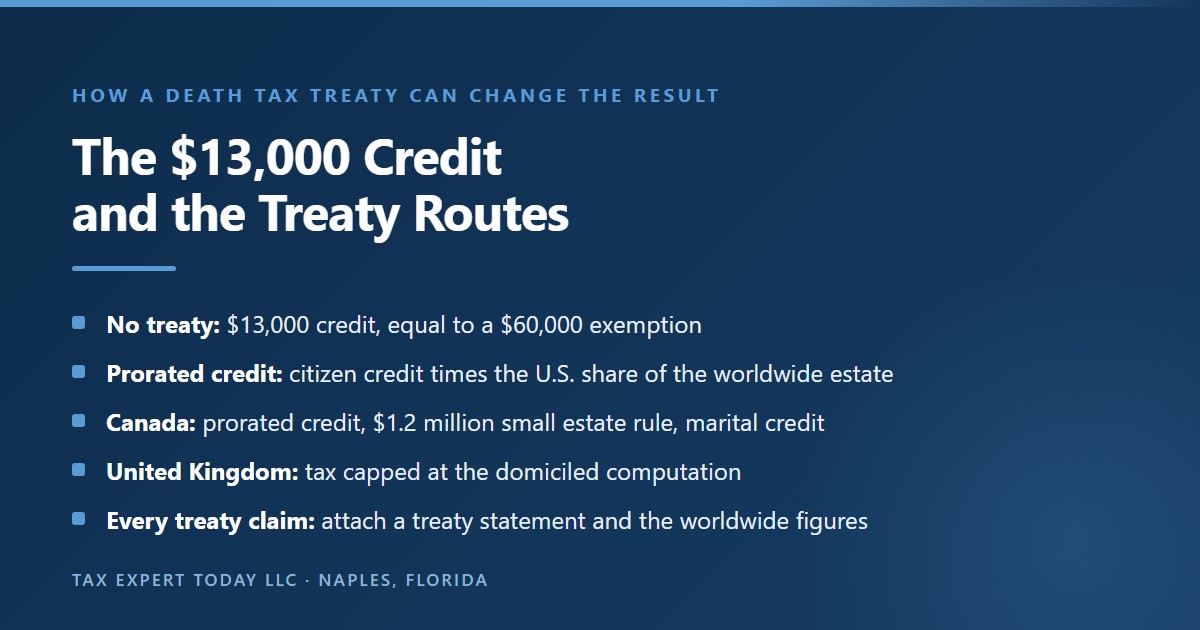
The United States has death tax treaty provisions with fifteen countries. Depending on the treaty, they can narrow which assets the United States may tax, replace the $13,000 credit with a prorated share of the citizen credit, allow a marital or charitable benefit, or cap the tax. Any treaty position must be disclosed in a statement attached to the return.
- The countries: Australia, Austria, Canada, Denmark, Finland, France, Germany, Greece, Ireland, Italy, Japan, the Netherlands, South Africa, Switzerland, and the United Kingdom.
- Prorated credit treaties: section 2102(b)(3)(A) applies where a treaty requires it.
- Situs limits: domicile based treaties often limit U.S. tax to real estate and business property.
- Disclosure: attach a treaty statement (Form 8833) under Regulations section 301.6114-1.
- Still file: a treaty can reduce the tax to zero but rarely removes the return.
The Form 706-NA instructions list the treaty countries and mark Canada as covered by Article XXIX B of the income tax treaty rather than a separate estate treaty. The IRS estate and gift tax treaties page adds which ones also cover gifts. Treaties work in two main ways. Older situs treaties redefine where assets are located. Newer domicile treaties, such as those with the United Kingdom and Germany, generally let the country of domicile tax everything and limit the other country to certain property, typically real estate and business assets, with a credit to prevent double tax.
Section 2102(b)(3)(A) provides the mechanism for the most valuable treaty benefit, the prorated unified credit. Where a treaty requires it, the credit equals the citizen applicable credit amount for the year of death multiplied by the ratio of U.S. situs gross estate to worldwide gross estate. The Form 706-NA instructions note that, when the form went to print, treaties with Australia, Canada, Finland, France, Germany, Greece, Italy, Japan, and Switzerland contained provisions to which section 2102(b)(3)(A) applies. For a 2026 death the citizen credit is $5,945,800, so a decedent with 20 percent of the worldwide estate in the United States would receive a credit of about $1,189,160 instead of $13,000.
The United Kingdom treaty works differently. The instructions explain that for a U.K. national who was neither domiciled in nor a national of the United States, paragraph 5 of Article 8 of the treaty caps the U.S. tax at the amount that would have been imposed on the worldwide estate had the decedent died domiciled in the United States. An executor claiming that cap attaches the alternate computation. The IRS frequently asked questions describe the mechanics for any treaty: list exempt assets on Part V with no value, attach Form 8833 stating the treaty position, attach the return filed with the treaty partner (or explain why none was due), and show the computation of any prorated credit.
| Treaty country | Estate | Gift | Listed for the section 2102(b)(3)(A) prorated credit |
|---|---|---|---|
| Australia | Yes | Yes | Yes |
| Austria | Yes | Yes | No |
| Canada (Article XXIX B) | Yes | No | Yes |
| Denmark | Yes | Yes | No |
| Finland | Yes | No | Yes |
| France | Yes | Yes | Yes |
| Germany | Yes | Yes | Yes |
| Greece | Yes | No | Yes |
| Ireland | Yes | No | No |
| Italy | Yes | No | Yes |
| Japan | Yes | Yes | Yes |
| Netherlands | Yes | No | No |
| South Africa | Yes | No | No |
| Switzerland | Yes | No | Yes |
| United Kingdom | Yes | Yes | No (separate tax cap under Article 8(5)) |
Treaty coverage and article numbers can change through protocols, and each treaty has its own definitions of domicile and tie-breaker rules. The table reflects the IRS list and the Form 706-NA instructions as published; the treaty text itself controls.
How does the Canada U.S. treaty apply to a Canadian owner of Naples property?
A Canadian resident’s estate gets the greater of the $13,000 credit or a share of the U.S. citizen credit equal to the U.S. part of the worldwide estate. If the worldwide estate is $1,200,000 or less, the United States may tax only property such as U.S. real estate. A treaty marital credit is also available.
- Paragraph 2: the prorated unified credit, which requires full worldwide disclosure.
- Paragraph 8: the small estate rule at a $1,200,000 worldwide estate.
- Paragraphs 3 and 4: the marital credit for property passing to a spouse.
- Paragraph 6: Canada allows U.S. estate tax as a deduction from Canadian tax on U.S. gains at death.
- The filing: a return is still generally needed to claim these benefits.
Paragraph 2 of Article XXIX B gives the estate of a Canadian resident who was not a U.S. citizen a unified credit equal to the greater of the citizen credit multiplied by the ratio of U.S. situs gross estate to worldwide gross estate, and the $13,000 credit. The paragraph adds a condition that matters in practice: the prorated credit “shall be allowed only if all information necessary for the verification and computation of the credit is provided.” Executors who hope to report only the Florida condo and skip the worldwide inventory lose the prorated credit.
Paragraph 8 is the small estate rule. If the worldwide gross estate of a Canadian resident (other than a U.S. citizen) does not exceed $1,200,000, the United States may impose estate tax only on property whose sale would have produced gain taxable by the United States under Article XIII of the treaty. That generally leaves U.S. real property in the U.S. estate and takes ordinary U.S. stocks out. The Form 706-NA instructions describe the reporting: do not list the exempt assets on Part V, list them in an attached statement that relies on the treaty, and include them in the worldwide estate on Part IV.
Paragraph 6 addresses double taxation from the Canadian side. Canada does not have an estate tax, but it taxes a deemed disposition of capital property at death. The treaty allows U.S. federal and state estate taxes on U.S. situs property as a deduction from the Canadian tax otherwise payable on income and gains arising in the United States in the year of death, and, where the worldwide estate exceeds $1,200,000, on gains from U.S. situs property. The interaction is technical, and it is one reason a Canadian executor usually wants the U.S. and Canadian returns prepared together. Our Canada U.S. tax treaty guide covers the income tax articles.
| Hypothetical Canadian resident decedent | Worldwide estate | U.S. situs property taxable | Tentative U.S. tax | Prorated treaty credit (2026) | Net U.S. estate tax |
|---|---|---|---|---|---|
| Naples condo $600,000 and U.S. stocks $200,000 | $1,100,000 | $600,000 condo only (paragraph 8 removes the stocks); $578,182 after prorated deductions | $184,727 | $3,243,164 | $0 |
| Naples condo $900,000, contents and car $70,000, U.S. stocks $250,000, recourse mortgage | $5,000,000 | $1,220,000; $1,110,200 taxable | $389,880 | $1,450,775 | $0 |
| U.S. real estate and stocks totaling $10,000,000, no deductions | $30,000,000 | $10,000,000 | $3,945,800 | $1,981,933 | $1,963,867 |
The table shows why the treaty matters and why it is not a blanket exemption. For most Canadian snowbirds the prorated credit eliminates the U.S. tax, but the estate still files to prove it, and the executor still needs a transfer certificate to clear the U.S. assets. For a Canadian family with a large share of its wealth in the United States, real tax remains. All three rows are hypothetical illustrations of the treaty formula with simplified figures.
What does a worked Form 706-NA computation look like?
Start with U.S. situs assets at date of death value, subtract the prorated share of worldwide expenses and debts, apply the rate schedule, and subtract the credit. For a hypothetical resident of a non-treaty country with $1,220,000 of U.S. situs property in a $5,000,000 worldwide estate, the federal estate tax is about $376,880.
- Step 1: list U.S. situs assets on Part V.
- Step 2: report the worldwide estate and expenses on Part IV.
- Step 3: prorate the deductions and compute the taxable estate.
- Step 4: apply Table A and the $13,000 credit (or a treaty credit) on Part II.
- Step 5: pay by the nine month due date.
Consider a hypothetical owner domiciled in Brazil, a country with no U.S. estate tax treaty, who dies owning a Naples condo worth $900,000 with a $300,000 recourse mortgage, $40,000 of furniture and art in the condo, a $30,000 car kept in Florida, $250,000 of U.S. listed stocks in a U.S. brokerage account, a $180,000 personal deposit at a Florida bank, and a $500,000 life insurance policy issued by a U.S. insurer. The worldwide estate, including property in Brazil, is $5,000,000. Funeral, administration, and other worldwide expenses total $150,000.
| Line | Item | Amount |
|---|---|---|
| Part V | Naples condo (recourse mortgage, so full value) | $900,000 |
| Part V | Furniture and art in the condo | $40,000 |
| Part V | Car kept in Florida | $30,000 |
| Part V | U.S. listed stocks | $250,000 |
| Not on Part V | Florida bank deposit (section 2105(b)) and life insurance (section 2105(a)) | $680,000 counted only in the worldwide estate |
| Part IV, line 1 | U.S. gross estate | $1,220,000 |
| Part IV, line 2 | Gross estate outside the United States | $3,780,000 |
| Part IV, line 3 | Entire gross estate | $5,000,000 |
| Part IV, line 4 | Expenses, claims, and the $300,000 mortgage | $450,000 |
| Part IV, line 6 | Prorated deduction ($450,000 x 1,220,000 / 5,000,000) | $109,800 |
| Part IV | U.S. taxable estate | $1,110,200 |
| Part II | Tentative tax ($345,800 plus 40% of $110,200) | $389,880 |
| Part II, line 7 | Unified credit | ($13,000) |
| Part II | Net estate tax due | $376,880 |
The same facts for a Canadian resident produce no tax, because the prorated credit of $1,450,775 exceeds the $389,880 tentative tax. For a German or French domiciliary, the result would depend on the specific treaty’s situs and credit rules. For the Brazilian owner, the $376,880 must be paid within nine months of death, usually before the condo can be sold, which is why liquidity for the tax is often the practical problem.
When is Form 706-NA due, and how does an estate get more time?
Form 706-NA and any tax are due nine months after the date of death. Form 4768 gives an automatic six month extension of time to file, and a second extension is possible for an executor who is out of the country. Time to pay is extended separately, and interest runs from the original due date.
- Return due: 9 months after death, under section 6075(a).
- Automatic filing extension: 6 months on Form 4768, checking the Form 706-NA box.
- Executor abroad: a second Form 4768 with a written explanation may be filed.
- Payment extension: up to 12 months for reasonable cause, longer for undue hardship.
- Not available: the section 6166 closely held business installment election requires a citizen or resident decedent.
Section 6075(a) requires estate tax returns to be filed within nine months after the date of death. The Form 706-NA instructions direct executors to Form 4768 for an automatic six month extension of time to file, and they allow an executor who is out of the country, having already received the first extension, to request an additional extension on a second Form 4768 with an attached explanation. Both requests check the Form 706-NA box in Part II.
An extension of time to file is not an extension of time to pay. Section 6161(a)(1) allows the IRS to extend the time for payment for a reasonable period, up to 12 months in the case of estate tax, and section 6161(a)(2) allows longer periods, up to ten years, for reasonable cause. The request is made on Form 4768 Part III and must explain why the estate cannot pay, commonly that the only significant U.S. asset is real estate that cannot be sold quickly without loss. Interest accrues from the original due date regardless. The five year deferral and ten year installment plan of section 6166 for closely held businesses applies by its terms only to a decedent who was a citizen or resident, so it is not a tool for a nonresident estate.
| Event | Deadline (hypothetical death on March 1, 2026) | Authority or form |
|---|---|---|
| Form 706-NA and tax due | December 1, 2026 | Section 6075(a); instructions |
| Extended due date to file | June 1, 2027 | Form 4768, Part II |
| Possible second extension, executor abroad | As granted | Second Form 4768 with explanation |
| Extension of time to pay | Up to 12 months, longer for reasonable cause | Section 6161; Form 4768, Part III |
| Form 8971 basis statements | 30 days after Form 706-NA is filed | Form 8971 instructions |
| Estate tax closing letter request | At least 9 months after filing | Pay.gov, $56 fee |
Where and how is Form 706-NA filed and paid?
Form 706-NA is a paper return mailed to the Internal Revenue Service Center in Kansas City, Missouri, with the death certificate, a certified copy of the will, any foreign death tax return, appraisals, and English translations. The tax can be paid by EFTPS, same-day wire, or check payable to the United States Treasury.
- Postal address: Department of the Treasury, Internal Revenue Service Center, Kansas City, MO 64999.
- Private delivery address: Internal Revenue Submission Processing Center, 333 W. Pershing, Kansas City, MO 64108.
- Attachments: death certificate, certified will, appraisals, prior gift tax returns, and translations.
- Representation: Form 2848 or Form 8821, since the form no longer contains a representation section.
- Identification: the decedent’s SSN or a previously used ITIN; otherwise the IRS assigns a number.
The instructions set out the filing mechanics in detail. The return goes to Kansas City, Missouri at the postal or private delivery service address above. A certified copy of the will must be attached if the decedent died with a will (or a copy with an explanation of why it could not be certified), along with a copy of the death certificate. Closely held stock requires balance sheets and five years of earnings and dividend history. Copies of any U.S. gift tax returns the decedent filed must be attached. Every document in another language needs an English translation.
Identification is a frequent stumbling point for foreign decedents. Line 2 asks for the decedent’s Social Security number, or an ITIN only if the decedent had already used it on other U.S. returns. If neither exists, the instructions say to leave the line blank and the IRS will assign an Internal Revenue Service Number. Executors who need their own taxpayer number to deal with the IRS or with a FIRPTA sale may need one; our Form W-7 guide explains the ITIN process.
Payment options include EFTPS, a same-day wire from a financial institution, or a check payable to “United States Treasury” in U.S. dollars with the decedent’s identifying number and “Form 706-NA” written on it. Overpayments can now be refunded by direct deposit to a U.S. account using lines 18b through 18d. A supplemental or amended Form 706-NA goes to a different address, the IRS office in Florence, Kentucky, with the line 12 box checked, a statement of what changed, and a copy of the original return.
| Item to attach or prepare | Required when |
|---|---|
| Death certificate (with translation) | Always |
| Certified copy of the will and codicils | The decedent died with a will |
| Certified foreign death tax return or estate inventory | Claiming prorated deductions or a prorated treaty credit |
| Itemized schedule of expenses and debts | Claiming deductions on Part IV, line 4 |
| Appraisals of real estate and closely held interests | Generally, to support Part V values |
| Form 706 Schedules M, O, R, U as applicable | Marital, charitable, GST, or conservation easement items |
| Treaty statement (Form 8833) | Any treaty based position |
| Copies of U.S. gift tax returns (Form 709) | The decedent filed any |
| Form 2848 or Form 8821 | A representative will deal with the IRS |
What is an IRS transfer certificate, and when is one required?
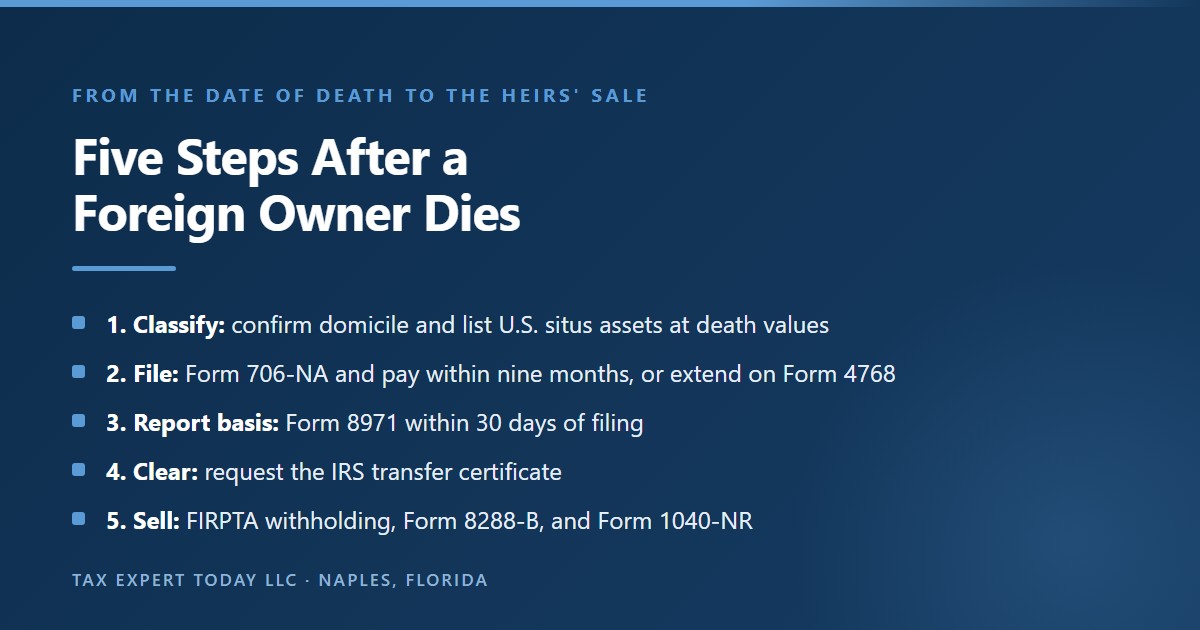
A transfer certificate is an IRS document confirming that the estate tax on a nonresident’s U.S. assets has been paid or provided for, so a U.S. corporation, transfer agent, bank, or custodian can release them without liability. It is generally required unless the U.S. situs estate is $60,000 or less, or the property is administered by a U.S. appointed executor.
- The regulation: Treasury Regulations section 20.6325-1.
- Who asks: transfer agents, brokerages, banks, and custodians holding the decedent’s U.S. property.
- Exception, small estates: U.S. situs estate of $60,000 or less, supported by the executor’s statement.
- Exception, U.S. administration: property administered by an executor appointed and acting in the United States.
- Timing: issued after the tax is fully discharged or provided for.
Regulations section 20.6325-1(a) defines a transfer certificate as “a certificate permitting the transfer of property of a nonresident decedent without liability.” It instructs domestic corporations and their transfer agents not to transfer stock registered in a nonresident decedent’s name without one, unless the shares are presented by an executor appointed and acting in the United States, and it says that banks, trust companies, and other custodians “can insure avoidance of liability for taxes and penalties only by demanding and receiving transfer certificates.” That language explains why U.S. institutions are so firm about the requirement: their own liability is at stake.
Two exceptions do real work. Under paragraph (b)(1)(i), no transfer certificate is required for a nonresident not a citizen who died after 1976 if the U.S. situs gross estate did not exceed $60,000, reduced for certain prior gifts, and paragraph (b)(3) protects the institution if it first receives a statement of the facts from the executor showing the estate is under that figure. Under paragraph (c), no certificate is required for property “being administered by an executor or administrator appointed, qualified, and acting within the United States.” A Florida ancillary personal representative is such an executor for the Florida property it administers, although the estate still owes any tax, and institutions apply their own policies on what they will accept.
The IRS transfer certificate page describes two tracks. Under Part A, where Form 706-NA was required, the executor faxes a copy of the filed Form 706-NA and its Schedule A pages to the IRS. Under Part B, where no return was required, the executor faxes the will and codicils, any foreign death tax returns, the death certificate, and a notarized affidavit listing the decedent’s birth date and country, naturalization status, citizenship and residence at death, every U.S. asset with its date of death value and account numbers, and whether any U.S. bank account was used in a U.S. business. The IRS states that the processing time for the affidavit route is 12 to 18 months after it receives all documents, and it warns that filing an unnecessary Form 706-NA in a Part B case delays the certificate. The fax numbers on the IRS page are 855-201-8011 within the United States and 304-707-9970 from abroad.
| Situation | Transfer certificate route | What the executor sends |
|---|---|---|
| U.S. situs estate over $60,000, Form 706-NA filed | Part A | Copy of the filed Form 706-NA and its Schedule A pages, by fax |
| U.S. situs estate $60,000 or less (with adjustments) | Part B, or institution relies on executor’s statement under Reg. 20.6325-1(b)(3) | Will, foreign death tax returns, death certificate, notarized affidavit |
| Property administered by a U.S. appointed executor (for example, a Florida ancillary personal representative) | Not required for that property under Reg. 20.6325-1(c) | Letters of administration; the estate still files and pays any tax |
| Estate selected for examination | Certificate after the examination and payment | Responses to the examiner; tax and any deficiency |
What does Florida probate require when a nonresident owner dies?
Florida real estate of a nonresident decedent usually passes through ancillary administration in the circuit court of the county where it sits, led by a personal representative qualified to act in Florida. A testate estate with Florida property of $50,000 or less may use a shorter procedure. Florida imposes no estate tax on deaths after 2004.
- Ancillary administration: Florida Statutes section 734.102.
- Small testate estates: section 734.1025 for Florida property of $50,000 or less, within two years.
- Creditors: a notice to creditors is served and published under chapter 733.
- Who serves: a personal representative qualified under Florida law.
- No Florida estate tax: confirmed by the Florida Department of Revenue.
Florida Statutes section 734.102 provides that when a nonresident of Florida dies leaving assets in the state, a personal representative named in the will to administer the Florida property, or otherwise the foreign personal representative, is entitled to ancillary letters “if qualified to act in Florida.” If the foreign representative is not qualified, the statute moves to an alternate named in the will or to a representative selected by those entitled to a majority interest in the Florida property. The ancillary representative gives bond, serves and publishes a notice to creditors, and has the same powers as any Florida personal representative to sell, lease, or mortgage the property. After expenses and claims are paid, the court may order the remaining property transferred to the foreign representative or distributed to the beneficiaries.
For a small testate estate, section 734.1025 allows the foreign personal representative, within two years after death, to file an authenticated transcript of the foreign proceedings showing the will and beneficiaries in the circuit court where the property is located, when the gross value of the Florida property does not exceed $50,000. A Naples condo almost never qualifies, but a car or a small bank account might. Questions about who is qualified to serve, bond, and the probate rules are matters for a Florida probate attorney; the tax and probate tracks run side by side and should be coordinated.
On the tax side, the Florida Department of Revenue states that a federal change eliminated Florida’s estate tax for people who died after December 31, 2004, and that since July 1, 2023 personal representatives do not have to file the Affidavit of No Florida Estate Tax Due. The only death tax on a Florida property owned by a foreign decedent is therefore the federal one, plus whatever the home country imposes. Our guide to Florida estate planning for new residents covers the state rules for families who move here.
| Florida probate route | When it fits | Source |
|---|---|---|
| Ancillary administration | Nonresident decedent leaving Florida assets | Fla. Stat. 734.102 |
| Short form for small testate estates | Florida property of $50,000 or less, will exists, filed within 2 years | Fla. Stat. 734.1025 |
| No Florida probate for that asset | Property passing by survivorship or beneficiary designation | Title or account terms |
| Florida estate tax | None for deaths after 2004 | Florida Department of Revenue |
How does the federal estate tax lien affect selling Florida property?
Unpaid federal estate tax is a lien on the entire gross estate for ten years from the date of death, arising automatically without any filing. Title insurers and buyers’ closing agents therefore ask for evidence that the tax has been paid or that none is due before insuring a sale of a foreign decedent’s Florida property.
- The statute: 26 U.S.C. section 6324(a).
- Duration: ten years from the date of death, unless paid sooner.
- Automatic: the lien does not need to be recorded.
- Administration expenses: property used to pay court allowed charges is freed from the lien.
- Practical proof: the transfer certificate, a closing letter, or an account transcript.
Section 6324(a)(1) provides that unless the estate tax is paid in full sooner or becomes unenforceable, “it shall be a lien upon the gross estate of the decedent for 10 years from the date of death,” except for property used to pay court allowed charges and administration expenses. Because the lien is a special estate tax lien that exists without public notice, a title underwriter cannot see it in the county records and cannot rule it out from the record alone. That is why the closing on an inherited Naples condo often waits for an IRS document rather than for the probate court.
The documents that typically satisfy a title company are the transfer certificate, an estate tax closing letter, or an IRS account transcript showing the return accepted. Under the current Form 706-NA instructions, an estate tax closing letter is issued only on request through Pay.gov, with a $56 fee for requests received on or after May 21, 2025, and the IRS asks executors to wait at least nine months after filing before requesting it. An account transcript, available to authorized representatives through the Transcript Delivery System or by Form 4506-T, can serve in place of the letter. Each institution sets its own requirements, so the executor should ask the title company early what it will accept.
| Document | What it shows | How it is obtained |
|---|---|---|
| Transfer certificate | U.S. assets may be transferred without liability | IRS Part A or Part B request by fax |
| Estate tax closing letter (Letter 627) | The IRS accepted the return or completed its examination | Pay.gov request, $56 fee, at least 9 months after filing |
| Account transcript | Transactions on the estate tax account, including acceptance | Transcript Delivery System or Form 4506-T |
| Discharge of property from the lien | A specific property is released before the tax is fully settled | Application to the IRS, often with payment or security |
What basis do heirs receive, and what is Form 8971?
Heirs of a nonresident generally receive a basis equal to fair market value at the date of death under section 1014, the same step-up that applies to a citizen’s heirs. When Form 706-NA is required, the executor must report those values to the IRS and to each beneficiary on Form 8971 within 30 days of filing the return.
- Basis rule: 26 U.S.C. section 1014, fair market value at death (or the alternate valuation date).
- Consistency: the heir’s basis must match the value finally determined for estate tax.
- Form 8971: filed with the IRS, with a Schedule A to each beneficiary.
- Deadline: 30 days after Form 706-NA is filed, or earlier if the return is late.
- Why it matters: the heirs’ gain on a later sale is measured from this value.
Section 1014 gives property acquired from a decedent a basis equal to its fair market value at death. The rule does not depend on the decedent’s citizenship, so a condo bought in 2009 for $350,000 and worth $900,000 at the owner’s death takes a $900,000 basis in the hands of the heirs. The IRS nonresident frequently asked questions make the point that, because of this rule, there is usually little or no gain to report if inherited property is sold soon after death.
The basis step-up comes with a reporting duty. The Form 706-NA instructions state that estates are required to report the estate tax value of each asset to the IRS and to the recipient “within 30 days of filing Form 706-NA, or earlier if the return is filed late,” using Form 8971. A beneficiary’s basis for a later sale must be consistent with that reported value. For foreign heirs who will sell Florida real estate, the Form 8971 statement and the appraisal behind it become the documents that support the cost basis on the eventual FIRPTA computation.
The alternate valuation date is available to a nonresident estate, but only if it reduces both the gross estate and the net tax. If elected, it applies to all property: assets sold within six months after death are valued at the sale date, and the rest are valued six months after death. In a falling market it can lower the estate tax, and it also lowers the heirs’ basis.
| Hypothetical | Amount |
|---|---|
| Decedent’s original purchase price of the Naples condo | $350,000 |
| Fair market value at death (appraised) | $900,000 |
| Heirs’ basis under section 1014 | $900,000 |
| Heirs’ sale price eight months later | $920,000 |
| Selling costs | $55,000 |
| Gain or (loss) on the heirs’ sale | ($35,000) |
What happens when the estate or the heirs sell the Florida property?
A sale of U.S. real property by a foreign estate or foreign heirs is subject to FIRPTA. The buyer generally withholds 15 percent of the amount realized, even when there is little gain. The seller can apply for a reduced withholding certificate on Form 8288-B and claims credit for the withholding on a U.S. income tax return.
- Withholding rate: generally 15 percent of the amount realized.
- Buyer’s filing: Form 8288, due by the 20th day after the transfer.
- Reducing it: a withholding certificate application on Form 8288-B.
- Getting it back: the estate files Form 1040-NR and attaches Form 8288-A.
- Residence exception: no withholding at $300,000 or less when the buyer will live there.
The IRS FIRPTA withholding page explains that persons buying U.S. real property interests from foreign persons are required to withhold 15 percent of the amount realized, with exceptions. The nonresident estate tax frequently asked questions apply the rule directly to an estate: if a nonresident not a citizen’s estate sells a U.S. real property interest, the buyer withholds 15 percent, reports it on Form 8288 by the 20th day after the transfer, and the estate must file Form 1040-NR and attach Form 8288-A to receive credit. Our FIRPTA withholding guide covers the buyer’s side, and our Form 1040-NR guide covers the return.
The interaction with the estate tax is where families lose money and time. Because section 1014 steps the basis up to the date of death value, a sale soon after death often produces little gain, yet 15 percent of the gross price is withheld at closing. On a $920,000 sale that is $138,000 held for months until the 1040-NR is processed. A Form 8288-B withholding certificate application, filed before or at closing, asks the IRS to reduce withholding to the maximum tax actually due, and the stepped-up basis supported by the estate tax appraisal and Form 8971 is the core evidence. The estate tax itself and the FIRPTA withholding are separate: paying one does not satisfy the other.
| Step in the sale | Who acts | Form |
|---|---|---|
| Estate tax cleared or provided for | Executor | Form 706-NA, transfer certificate |
| Withholding certificate requested (optional) | Seller (estate or heirs) | Form 8288-B |
| Withholding at closing | Buyer or closing agent | Form 8288 and Form 8288-A |
| Gain or loss reported, withholding credited | Seller | Form 1040-NR (estate or individual heirs) |
| Taxpayer identification for the seller | Seller | ITIN through Form W-7 if needed |
What penalties apply to a late or understated Form 706-NA?
Section 6651 imposes penalties for filing late and paying late unless there is reasonable cause, and section 6662 adds a 20 percent penalty for underpayments caused by negligence or by substantial or gross valuation understatements. Interest runs from the original due date. A reasonable cause explanation is sent after a penalty notice, not attached to the return.
- Late filing and payment: section 6651, unless reasonable cause is shown.
- Substantial valuation understatement: value reported at 65 percent or less of the correct value.
- Gross valuation understatement: value reported at 40 percent or less of the correct value.
- Small amount exception: no valuation penalty if the related underpayment is $5,000 or less.
- Timing of reasonable cause: explanations attached to the original return are not considered.
The Form 706-NA instructions summarize the penalty framework. Section 6651 provides penalties for late filing and late payment “unless there is reasonable cause for the delay,” and there are separate penalties for willful attempts to evade tax. Section 6662 imposes a 20 percent penalty on underpayments of estate tax due to negligence, disregard of rules, or a substantial or gross valuation understatement, defined as a reported value of 65 percent or less, or 40 percent or less, of the actual value. No valuation penalty applies if the underpayment attributable to the understatement does not exceed $5,000.
The instructions contain a procedural point that differs from many other returns: if the estate receives a penalty notice, it sends an explanation and the IRS decides whether reasonable cause criteria are met, but “explanations attached to the return at the time of filing will not be considered.” Executors who discover the filing requirement late, often when a brokerage freezes an account a year or more after death, should understand that the reasonable cause standard looks at the facts and the executor’s conduct, and that relief is not automatic. Paid preparers face their own penalties under section 6694 for unreasonable positions.
| Penalty | Trigger | Relief standard |
|---|---|---|
| Failure to file (section 6651(a)(1)) | Return filed after the due date, including extensions | Reasonable cause, not willful neglect |
| Failure to pay (section 6651(a)(2)) | Tax paid after the due date without a payment extension | Reasonable cause, not willful neglect |
| Accuracy related, valuation (section 6662) | Reported value 65% or less (substantial) or 40% or less (gross) of correct value | Reasonable cause and good faith; $5,000 threshold |
| Interest | Any tax unpaid after the original due date | Not a penalty; generally not abated for reasonable cause |
| Preparer penalty (section 6694) | Unreasonable or willful positions on the return | Applies to the preparer, not the estate |
Do lifetime gifts by a nonresident change the estate tax?
Taxable gifts made after 1976 are added to the U.S. assets for the $60,000 filing test and to the base on which the estate tax is computed. And the gift tax rules for nonresidents differ: gifts of U.S. intangibles such as U.S. stock are exempt, but gifts of Florida real estate or tangible property located here are taxable.
- Intangibles exempt: a nonresident’s gift of U.S. stock is not subject to U.S. gift tax under section 2501(a)(2).
- Real property taxable: a gift of a Florida condo is subject to U.S. gift tax.
- Annual exclusion: $19,000 per donee for 2026 on gifts that are subject to the tax.
- No lifetime credit: the section 2505 gift tax credit is limited to citizens and residents.
- Retained use: giving property away while keeping the use of it can pull it back into the estate.
The IRS page on gift tax for nonresidents states that for a nonresident not a citizen, transfers subject to gift tax include real and tangible personal property situated in the United States, while gifts of U.S. situs intangible property, including stock of U.S. corporations, are not subject to gift tax under section 2501(a)(2). The section 2505 unified gift tax credit applies “in the case of a citizen or resident of the United States,” so a nonresident donor has no lifetime exemption to shelter a taxable gift beyond the annual exclusion, which the IRS lists as $19,000 per donee for 2026.
These rules mean that the asset type determines whether lifetime transfers are a realistic way to reduce U.S. exposure. A nonresident can generally give U.S. shares to children during life without U.S. gift tax, which removes them from the future U.S. estate. A gift of the Florida condo itself is a taxable gift. And any transfer where the donor keeps living in the property, or keeps control, risks inclusion under sections 2036 through 2038 regardless of the gift tax result; the situs look-back rule described earlier applies to those transfers. Large gifts from a foreign person to a U.S. person also carry a reporting duty for the recipient on Form 3520. These are mechanisms to understand, and any plan built on them needs advice on both countries’ laws.
| Lifetime transfer by a nonresident not a citizen | U.S. gift tax? | Effect on later Form 706-NA |
|---|---|---|
| Gift of U.S. listed stock to a child | No (intangible) | Removed from the U.S. estate, unless retained interests apply |
| Gift of a Florida condo to a child | Yes, above the $19,000 annual exclusion | Adjusted taxable gift added to the estate tax base |
| Gift of cash from a Florida bank account | Depends on the facts; cash located in the U.S. can be tangible property | Get advice before relying on the intangible rule |
| Gift of the condo while the donor keeps living in it | Yes | Risk of inclusion under section 2036 at death |
Why do some foreign buyers hold U.S. property through a foreign corporation?
Because shares of a foreign corporation are not U.S. situs property, a nonresident who owns a Florida property through a properly formed and operated foreign company may have no U.S. situs asset at death. The structure has costs, including corporate income tax, FIRPTA rules on sale, and the risk that the IRS disregards it.
- The mechanism: Regulations section 20.2105-1(f) treats foreign corporate stock as outside the United States.
- Income tax cost: the corporation pays U.S. corporate tax on Florida rental income and gains, without the individual capital gain rates.
- Filing burden: the foreign corporation files Form 1120-F.
- Risk areas: personal use without rent, commingled funds, and missing formalities.
- Home country tax: the structure must also work under the owner’s own country’s rules.
The estate tax logic is simple. Regulations section 20.2105-1(f) treats “shares of stock issued by a corporation which is not a domestic corporation, regardless of the location of the certificates” as property outside the United States. A Canadian or European owner whose company owns the Naples condo owns foreign shares at death, and the U.S. estate tax on the condo generally does not arise. This is a widely described mechanism, not a recommendation.
The trade-offs are significant. A foreign corporation owning U.S. real estate pays U.S. corporate income tax on its rental income and on any gain when it sells, files Form 1120-F, and may face branch profits tax, and the individual long-term capital gain rates that a person would enjoy are not available. If the owner uses the property personally without paying fair rent, if the company is not respected as a separate entity, or if the arrangement amounts to the owner keeping the beneficial enjoyment of the property, the IRS may argue that the property should be included in the estate anyway. The home country may also tax the structure in ways that offset the benefit. Whether such a structure suits any particular family is a question for qualified legal counsel in both countries; this guide describes how the rules operate and does not recommend drafting or adopting any structure.
| Feature | Direct individual ownership | Ownership through a foreign corporation |
|---|---|---|
| U.S. estate tax at the owner’s death | Florida property is U.S. situs | Shares generally not U.S. situs |
| Tax on rental income | Individual rates (often with the net basis election) | Corporate rate, possible branch profits tax |
| Tax on sale | Individual capital gain rates; FIRPTA withholding | Corporate rate on gain; FIRPTA rules for the corporation |
| Basis step-up at death | Yes, under section 1014 | No step-up inside the corporation |
| Annual filings | Form 1040-NR if there is income | Form 1120-F and corporate formalities |
| Main risk | Estate tax and transfer certificate delay | Structure disregarded, home country tax, and higher income tax |
What if the decedent was a former U.S. citizen or green card holder?
A former citizen or long-term green card holder who expatriated and later died as a nonresident generally files Form 706-NA like any other nonresident. Two special regimes can apply: section 2107 for those who expatriated between June 2004 and June 2008, and the section 2801 tax on U.S. heirs who receive bequests from a covered expatriate.
- After June 16, 2008: generally taxed like other nonresidents for estate tax.
- Section 2801: a U.S. citizen or resident heir of a covered expatriate may owe tax on receipt.
- Timely filing helps: filing the required Form 706-NA on time can avoid double tax under section 2801(e)(2)(B).
- June 4, 2004 to June 16, 2008: the section 2107 alternative regime may apply.
- Long-term resident: a green card holder in at least 8 of the last 15 tax years.
The Form 706-NA instructions explain that a decedent who expatriated on or after June 17, 2008 “generally” is subject to estate tax in the same manner as other nonresident decedents. If the decedent was a covered expatriate under section 877A, however, bequests to U.S. citizen or resident beneficiaries may subject those beneficiaries to the section 2801 tax on receipt. To avoid both estate tax and section 2801 tax on the same property, the instructions say any required Form 706-NA “should be timely filed,” citing section 2801(e)(2)(B) and Regulations section 28.2801-3(c)(2).
For decedents who expatriated after June 3, 2004 and before June 17, 2008 and met one of the section 877 tests (an income tax liability or net worth test, or a failure to certify compliance), section 2107 can apply for ten years, including a rule treating the decedent as owning a share of U.S. property held by certain controlled foreign corporations. Part III, lines 6a and 6b of the return ask about expatriation. Our guide to Form 8854 and expatriation covers the covered expatriate tests.
| Decedent’s history | Estate return | Special rule to check |
|---|---|---|
| Never a U.S. citizen or long-term resident | Form 706-NA | None beyond the general rules |
| Expatriated on or after June 17, 2008, not a covered expatriate | Form 706-NA | None beyond the general rules |
| Expatriated on or after June 17, 2008, covered expatriate | Form 706-NA | Section 2801 tax on U.S. heirs; timely filing matters |
| Expatriated June 4, 2004 to June 16, 2008, meeting a section 877 test | Form 706-NA | Section 2107 alternative regime |
| Green card holder who never abandoned status and was domiciled here | Form 706 | Treated as a resident decedent |
What records should an executor gather for Form 706-NA?
An executor should gather proof of death and authority, evidence of domicile, a complete inventory of worldwide assets with date of death values, appraisals of U.S. real estate, brokerage statements with CUSIP numbers, loan documents, records of who paid for jointly held property, prior gift tax returns, and any foreign death tax return, all with translations.
- Authority: death certificate, certified will, and court letters or orders.
- Domicile: residence, immigration, and tax filings showing where the decedent lived and intended to stay.
- Values: appraisals and date of death statements for every U.S. asset.
- Worldwide picture: the foreign inventory or death tax return to support prorated deductions or a treaty credit.
- History: gift tax returns, purchase records, and loan documents.
Most delays in a nonresident estate come from documents, not from the tax computation. The IRS transfer certificate page warns that the Part B affidavit route takes 12 to 18 months after all documents are received, and the Form 706-NA instructions say that more proof will be requested if the worldwide figures are not supported. Collecting the full file before filing usually shortens the time the Florida property and U.S. accounts stay frozen. Executors who live abroad should also plan for how they will receive IRS correspondence, which comes by mail to the address on the return.
| Record | Used for |
|---|---|
| Death certificate and English translation | Return, transfer certificate, probate |
| Certified will, codicils, and court appointment | Executor authority, return, ancillary probate |
| Passport, immigration records, and home country tax filings | Domicile and citizenship |
| Date of death appraisal of the Florida property | Part V value, heirs’ basis, Form 8971, FIRPTA |
| Brokerage and bank statements at date of death | Part V securities with CUSIPs; non-situs deposits |
| Mortgage note and loan agreement | Recourse or nonrecourse treatment |
| Purchase closing statements and payment records | Joint ownership contributions |
| Prior U.S. gift tax returns (Form 709) | Adjusted taxable gifts and credits |
| Foreign death tax return or estate inventory | Worldwide estate, prorated deductions, treaty credit |
| Life insurance and foreign account statements | Worldwide estate on Part IV, line 2 |
Form 706-NA Help in Naples & Southwest Florida
Tax Expert Today LLC works with the families and executors of foreign owners of Southwest Florida property from an office in Naples, Florida and serves clients in all 50 states. Collier and Lee counties are home to many Canadian, European, and Latin American seasonal owners, and when one of them dies the estate usually needs a U.S. estate tax return, a transfer certificate, and a FIRPTA plan for the eventual sale, while working alongside a Florida probate attorney and the family’s advisers at home. We help executors determine whether Form 706-NA is required, value and classify U.S. situs assets, document the worldwide estate, claim treaty credits and the Canadian marital credit, prepare Form 4768 and Form 8971, request the transfer certificate, and coordinate the Form 8288-B application and Form 1040-NR when the heirs sell.
- Form 706-NA help Naples: filing determinations, Part V situs classification, prorated deductions, and treaty statements.
- International tax Naples FL: Canada U.S. treaty estate provisions, domicile questions, and expatriate estates.
- Foreign tax Naples: FIRPTA sales of inherited condos, withholding certificates, and nonresident income tax returns.
- FBAR Naples: foreign account reporting for U.S. heirs who inherit accounts abroad.
Our international and expat tax services page explains how we work with foreign owners of U.S. property and U.S. families with foreign assets, our estate and trust planning page covers the estate side, and the international tax Naples FL guide covers the wider picture for Southwest Florida residents with foreign income, accounts, and property. Heirs who inherit foreign accounts should also read our guide on whether they need to file an FBAR.
Office: 11983 Tamiami Trail N, Naples FL 34110
Phone: (239) 441-2005
Hours: Monday through Friday, 10:00 to 5:00 ET
Frequently Asked Questions
My Canadian parent owned a condo in Naples, Florida and died this year. Do we have to file Form 706-NA even if the treaty means no tax is due?
Usually yes. If the U.S. situs assets exceed $60,000, the return is required, and the treaty credit and small estate rule are claimed on that return with a treaty statement and worldwide estate information. Filing is also the route to the transfer certificate that title companies and brokerages ask for.
Is a U.S. bank account included on Form 706-NA?
Generally no. Deposits with U.S. banks, savings associations, and insurers are treated as outside the United States under section 2105(b) if they are not effectively connected with a U.S. trade or business. They still count in the worldwide estate used to prorate deductions, and a bank may still ask for a transfer certificate or a statement before releasing funds.
Can the heirs sell the Florida property before the IRS issues a transfer certificate?
Sometimes, but it is often difficult. The federal estate tax lien attaches to the gross estate for ten years, so title insurers usually want evidence that the tax is paid or provided for. A Florida ancillary personal representative can sell under court authority, and the IRS can discharge specific property from the lien, but the estate still owes any tax.
How long does the IRS take to issue a transfer certificate?
The IRS states that the affidavit route used when no return is required takes 12 to 18 months after it receives all necessary documents. When a Form 706-NA is required, the certificate generally follows acceptance of the return and payment of the tax. Incomplete documents and examinations extend the time.
Do nonresident estates get the $15,000,000 exemption?
No. The $15,000,000 basic exclusion for 2026 applies to citizens and domiciliaries. A nonresident not a citizen receives a $13,000 credit, equal to a $60,000 exemption, unless a treaty provides a prorated share of the citizen credit.
Does Florida have its own estate tax on a foreign owner’s property?
No. The Florida Department of Revenue states that Florida’s estate tax was eliminated for deaths after December 31, 2004. The federal estate tax and the home country’s death taxes are the ones to plan for.
When to Engage a Professional
Form 706-NA looks short, but the decisions behind it carry large amounts of tax and long delays: whether the decedent was domiciled in the United States, which assets are U.S. situs, whether a loan was recourse, how to document a worldwide estate, which treaty provisions apply and how to claim them, when to request the transfer certificate, and how to sell the property without overpaying FIRPTA withholding. Many of these choices are made once and are difficult to revisit after the return is filed.
A professional review is worth considering when a foreign owner of Florida real estate or U.S. securities has died, when a brokerage or transfer agent has frozen an account and asked for IRS clearance, when the estate may qualify for a treaty credit or the Canadian marital credit, when the decedent held a green card or expatriated, when the U.S. property has a mortgage or joint owners, or when heirs plan to sell. A Florida probate attorney and the family’s home country advisers are usually part of the team, and the tax work should be coordinated with them.
Tax Expert Today LLC is a tax advisory firm in Naples, Florida serving clients in all 50 states. Call (239) 441-2005 to discuss your facts.
This article is general information, not legal or tax advice for any particular taxpayer or estate, and does not create a client relationship. The examples are hypothetical illustrations only, do not describe any client, and use simplified figures. Domicile, situs, treaty eligibility, and the treatment of particular loans, accounts, and entities depend on the facts and on the specific treaty text. Probate questions should be directed to a Florida probate attorney, and decisions about wills or holding structures to qualified legal counsel. The rules described here reflect 26 U.S.C. sections 1014, 2001, 2010, 2040, 2101 through 2107, 2501, 2505, 2801, 6018, 6075, 6161, 6166, 6324, 6651, and 6662, Treasury Regulations sections 20.0-1, 20.2053-7, 20.2104-1, 20.2105-1, and 20.6325-1, the Instructions for Form 706-NA (Rev. 09/2025), IRS guidance on transfer certificates and nonresident estates, Article XXIX B of the United States Canada Income Tax Convention, and Florida Statutes sections 734.102 and 734.1025, as published when this article was written. Confirm current guidance before filing.
Published November 4, 2026 by Dr. Pellumb Kabashi « Back to Learning Center
Have a question this article touches on?
Tax Expert Today LLC, based in Naples, Florida and serving clients across the United States.
Schedule a Consultation (239) 441-2005