
By Dr. Pellumb Kabashi, DBA, MBA, CES, CFE, EA · Founder, Tax Expert Today LLC · Tax advisors, enrolled agents, CPAs, and attorneys · Serving clients in all 50 states · Published May 19, 2026.
Quick Answer: Reasonable cause penalty abatement is the IRS relief, defined in IRC §6664(c)(1) and Treasury Regulation §1.6664-4, that removes failure-to-file, failure-to-pay, and accuracy-related penalties when the taxpayer proves they exercised ordinary business care and prudence but a circumstance beyond their control prevented timely compliance. Approval requires three things: a written statement, dated third-party documentation, and a direct causal link between the event and the missed deadline. The request is filed on Form 843 or in response to the penalty notice, with a typical IRS decision time of 3 to 6 months. Call (239) 441-2005 for a free consultation.
What is reasonable cause for an IRS penalty?
Reasonable cause is a legal standard that allows the IRS to abate a penalty when the taxpayer exercised ordinary business care and prudence but still could not file or pay on time. The authority is IRC §6664(c), with the operative regulations at Treasury Reg. §1.6664-4, and the procedural guidance at Internal Revenue Manual 20.1.1.
Reasonable cause is one of five grounds on which the IRS may abate a penalty, so agency wide abatement figures are not a measure of how often reasonable cause requests succeed. Our research report on IRS civil penalties assessed and abated sets out the FY2015 to FY2025 series and explains what the published rates do and do not show.
The standard does not demand perfection. It requires a good-faith effort to comply, plus an event the taxpayer could not have reasonably anticipated or controlled. Per IRM 20.1.1.3.2, the IRS reviewer is instructed to consider all facts and circumstances of the specific case, not a rigid checklist.
Categories the IRS routinely recognizes as reasonable cause include serious illness, death of an immediate family member, fire, casualty, natural disaster, inability to obtain records, erroneous written advice from the IRS, and, in limited circumstances, reliance on a qualified tax professional for substantive tax advice. Categories that almost never qualify include “I forgot,” “I was traveling,” “I did not have the money,” reliance on oral IRS advice, and blaming tax software.
Which life events qualify as reasonable cause?
The IRS most frequently approves reasonable cause for documented serious illness, death of an immediate family member, casualty losses, federally declared natural disasters, and circumstances that physically prevented access to tax records, when the event directly caused the late filing or late payment.
Serious illness or incapacity. The illness must affect the taxpayer, the spouse, or an immediate family member with a direct caregiving relationship. Acceptable evidence: hospitalization records, signed physician statements with dates of treatment, prescriptions, and dated medical bills. The IRS evaluates the severity, the timing relative to the deadline, and whether the taxpayer was capable of delegating the filing.
Death of an immediate family member. A certified death certificate plus a written explanation of how the death prevented compliance is the standard evidence. Recency matters. A death three weeks before the filing deadline is treated very differently from a death 14 months earlier.
Casualty, natural disaster, or theft. A FEMA disaster declaration covering the taxpayer’s county is the strongest evidence. Insurance claims, dated photographs, fire department reports, and police theft reports also count. The taxpayer must show the records or ability to file were directly affected.
Records unavailable. Documentation must show why records could not be obtained, what steps the taxpayer took to get replacements, and the date the records were finally available. A statement from a bookkeeper, accountant, or third-party custodian is far stronger than the taxpayer’s own claim.
Reliance on a tax professional. The leading case is United States v. Boyle, 469 U.S. 241 (1985). Reliance is a valid defense for substantive tax advice, such as whether an income item is taxable or a deduction is allowable. Reliance is generally not a defense for the ministerial act of filing on time. The taxpayer cannot delegate the duty to know the deadline.
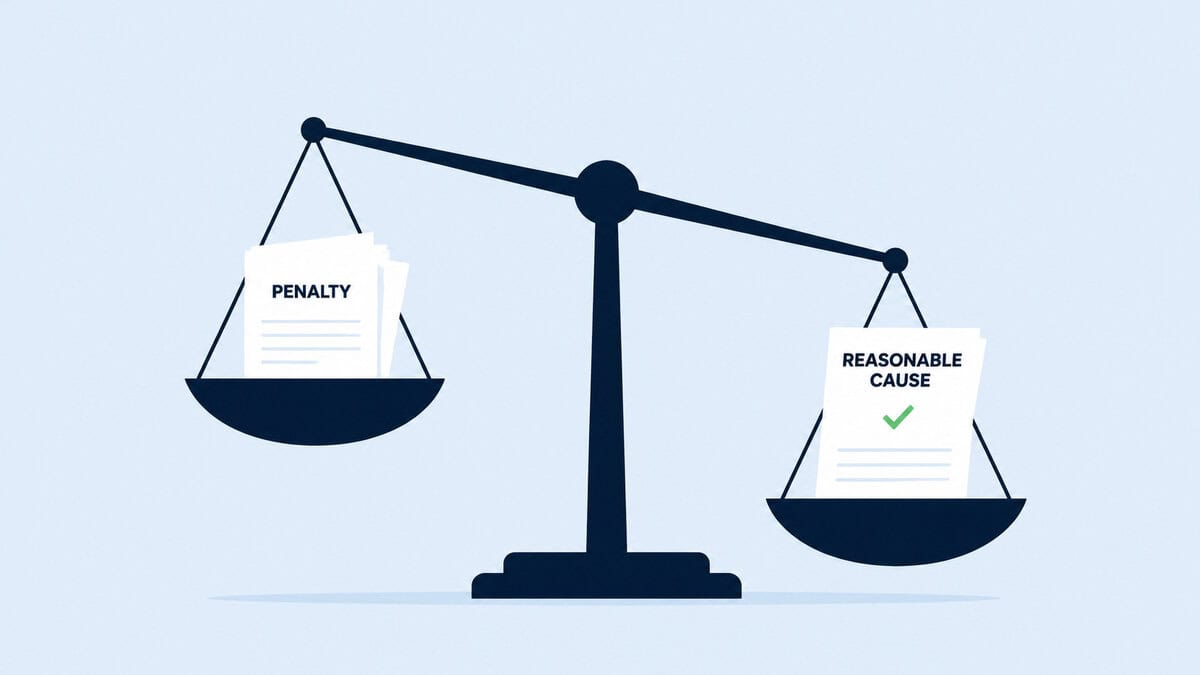
How do you prove a reasonable cause penalty abatement?
To prove reasonable cause, the taxpayer submits a written statement, attaches dated third-party evidence, and demonstrates a direct causal link between the event and the specific tax period and penalty in question. The submission goes on Form 843, Claim for Refund and Request for Abatement, or as a written response to the penalty notice.
The IRS gives far greater weight to outside, dated documentation than to taxpayer self-statements. Six steps produce the strongest submission:
- Identify the exact penalty. Pull the IRS notice (CP14, CP501, CP504, LT11, CP215, or the Statement of Account) and note the penalty amount, the tax form, and the tax year. Each penalty for each year is treated as a separate request.
- Build a written timeline. Date of the event, original return due date, date of any extension, date the return was actually filed, date payment was made. The gap between event and deadline is the heart of the case.
- Gather third-party documentation. Medical records, death certificates, FEMA disaster letters, court orders, insurance claims, employer letters. Self-statements alone almost never win.
- Write the reasonable cause statement. Three to five paragraphs. What happened. Why it prevented compliance. What the taxpayer did to remedy as soon as possible. Avoid emotional language. Stick to dated facts.
- File Form 843. Mail to the IRS Service Center listed in the form instructions, or attach the statement to a response to the penalty notice. Use certified mail with return receipt requested.
- Keep complete copies. The IRS regularly loses correspondence. A complete file with mailing receipts is what protects the request in appeals.
One practical note from working penalty files: the IRS reviewer reads the first paragraph of the statement, looks at the attached evidence, and makes an initial judgment in under two minutes. The statement should lead with the strongest fact, not build to it.
How long does the IRS take to decide a reasonable cause request?
A reasonable cause penalty abatement request typically receives an IRS decision within 3 to 6 months. Complex cases involving large penalty amounts, multiple tax years, or appeals consideration can extend to 9 to 12 months. The initial response usually arrives as a CP210 or CP220 notice confirming the abatement, or as a denial letter that explains the reasoning. A denial is not the end. The taxpayer has 60 days from the denial date to request consideration by the IRS Office of Appeals, which applies the same legal standard but tends to be more receptive to nuanced facts than the initial reviewer.
One statute of limitations rule matters here. Per IRC §6511, a claim for refund or abatement must be filed within 3 years from the return due date, or 2 years from the date the penalty was paid, whichever is later. Penalties that have already been collected can still be refunded if the request is timely.

Can reasonable cause be combined with First-Time Penalty Abatement?
Yes. In most multi-year penalty situations the strategic approach is to request First-Time Penalty Abatement for the eligible year first, then submit a reasonable cause request for the remaining years. The two reliefs are governed by different rules and stack rather than compete.
First-Time Abatement, per IRM 20.1.1.3.3.2.1, is an administrative waiver that requires a clean compliance history (no unreversed penalties other than an estimated tax penalty in the 3 prior tax years) and applies to one tax period only. It does not require any explanation. A reasonable cause penalty abatement request has no clean-history requirement, can apply across multiple years, and turns on documented facts.
The order is set by the IRS rather than chosen by the taxpayer. IRM 20.1.1.3.3.2.1 directs that administrative waivers, including First-Time Abatement, are considered before reasonable cause, and the IRS states on its reasonable cause guidance that a caller who asks for reasonable cause but qualifies for first-time abate receives first-time abate. In a multi-year case the waiver therefore generally lands on the earliest qualifying period, and each later year needs a documented reasonable cause case of its own. For the full strategic framework, see the parent guide on how to get IRS penalties removed.
Can you request reasonable cause penalty abatement by phone?
Yes, for many penalties. The IRS says it may reduce or remove some penalties over the phone: call the toll-free number in the top right corner of your notice, explain what prevented timely filing or payment, and have the supporting documents ready. If relief cannot be approved on the call, the request goes in writing on Form 843. Call (239) 441-2005 for a free consultation.
The phone route is described on the IRS page on penalty relief for reasonable cause. It suits a single penalty with a simple, well documented event. A written request suits a larger penalty, several tax years, or facts that need a timeline to be understood, because the reviewer then has the whole file in front of them rather than a summary given over the phone.
| Route | Best suited to | What to have ready |
|---|---|---|
| Phone call to the number on the notice | One penalty, one period, a short and well documented event | The notice, the dates of the event and the deadline, and the documents you would otherwise attach |
| Written response to the notice | A penalty that has just been assessed and has not been paid | A dated statement, third-party evidence, and a copy of the notice |
| Form 843 | A refund of a penalty already paid, several periods, or a request refused by phone | The same statement and evidence, filed within the IRC section 6511 claim period |
Whichever route is used, the IRS first checks whether the first-time penalty abatement waiver applies, so a clean three-year history can make the reasonable cause narrative unnecessary for that period.
What does not qualify as reasonable cause?
The IRS names four categories that do not generally establish reasonable cause on their own: reliance on a tax professional, lack of knowledge of the rules, mistakes and oversights, and lack of funds. Each fails for the same reason, which is that the taxpayer retained the ability to comply. Reasonable cause also does not apply to some penalties at all, including the estimated tax penalty.
Knowing the exclusions matters more than knowing the qualifying list, because most denied requests are denied on one of these four grounds rather than on a dispute about the underlying facts. The IRS reasonable cause guidance sets them out directly.
| Circumstance | IRS treatment | What changes the answer |
|---|---|---|
| Fire, natural disaster, or civil disturbance | Generally qualifies | A dated declaration or third-party record tying the event to the missed deadline |
| Inability to obtain records | Generally qualifies | Evidence of what was requested, from whom, and when the records finally arrived |
| Death, serious illness, or unavoidable absence of the taxpayer or immediate family | Generally qualifies | Medical or court records covering the period of the deadline itself |
| System issues that delayed timely electronic filing or payment | Generally qualifies | Confirmation numbers, rejection notices, or provider records showing the attempt |
| Reliance on a tax professional | Does not generally qualify | Substantive advice on whether an item is taxable can qualify, while the ministerial act of filing on time does not, under United States v. Boyle, 469 U.S. 241 (1985) |
| Lack of knowledge of the filing requirement | Does not generally qualify | Rarely. The taxpayer is responsible for knowing or obtaining advice on deadlines and amounts |
| Mistakes and oversights | Does not generally qualify | Additional facts showing a genuine attempt to comply can bring a mistake back into reasonable cause |
| Lack of funds | Does not qualify by itself | The reason behind the lack of funds can qualify, so the argument has to be built on the underlying event |
- Some penalties are outside the doctrine. The IRS states that reasonable cause does not apply to certain penalties such as the estimated tax penalty. A request aimed at an underpayment penalty is answered under the waiver rules for that penalty rather than under IRC section 6664.
- The statutory hooks differ by penalty. Failure to file and failure to pay run through IRC section 6651, which carries its own reasonable cause language, while the accuracy-related penalty runs through section 6664(c) and Treasury Regulation section 1.6664-4.
- For a business, the test looks at the responsible person. The IRS applies the reasons to the person with authority to submit the return, deposit, or tax, which is why an entity request has to identify who that person was and what happened to them.
- The internal manual is the reviewer playbook. IRM 20.1.1, Penalty Handbook, is what the person reading your request is working from, and writing to its structure is more productive than writing a narrative letter.
- Administrative relief is a separate route. Where reasonable cause is weak, administrative penalty relief may still apply on a clean compliance history, and it is evaluated on different criteria.
What does a strong reasonable cause submission look like?
Consider an illustration rather than a client file. Suppose a small-business owner in Southwest Florida misses the March 15 S-corporation filing deadline because a hurricane destroys the storage unit holding the prior year general ledger and source documents. The penalty under IRC §6699 would be approximately $3,060 ($255 per shareholder per month for a return required to be filed in 2026 under Rev. Proc. 2024-40, three shareholders, four months late).
A well built submission on those facts would include the FEMA disaster declaration for the county, dated photographs of the damaged storage unit, an insurance claim showing the loss, a written statement from the bookkeeper confirming that records were unavailable until reconstruction was complete, and a corrected return filed promptly once records became available. A submission built that way addresses each element the reviewer is required to weigh. Results depend on the specific facts and on the reviewer, and no particular outcome can be promised.
The decisive factor was not the disaster itself. It was the documented chain: declaration, damage evidence, third-party confirmation of records loss, and prompt filing once compliance was possible. That documented chain is what a reviewer is looking for.
One sequencing point applies to this illustration. The late S corporation return penalty under IRC section 6699(a)(1) is also eligible for the first-time abatement waiver, so the IRS would test the corporation’s three-year history first. The documented chain carries the request when that history is not clean, or when the waiver has already been used on an earlier period.
Reasonable cause penalty abatement help in Naples, Florida
Penalty abatement Naples and tax resolution Naples enquiries reaching our office usually arrive the same way: a notice has landed, the penalty is already assessed, and the underlying event happened months earlier. Our office in Naples, Florida works reasonable cause requests for individuals and closely held businesses across Southwest Florida, including Bonita Springs, Estero, Fort Myers, and Marco Island, and for clients in other states who are represented remotely.
The work is mostly evidentiary rather than argumentative. Building the dated chain that connects the event to the missed deadline is what a reviewer can act on, and that chain has to be assembled before the request is filed rather than after a denial. Where the compliance history is clean, we also test whether first-time penalty abatement reaches the same result with a shorter path, and where the penalty sits on an unfiled year we look at unfiled tax returns first, because abatement of a penalty on a return that was never filed is not available.
Tax Expert Today LLC
11983 Tamiami Trail N, Naples, FL 34110
Phone: (239) 441-2005
Hours: Monday through Friday, 10:00 to 5:00 ET
When to Engage a Professional
A reasonable cause request is worth professional review when the amount is material or the facts are mixed. Consider engaging an advisor when the penalty spans more than one year, when the responsible person for an entity is not the person who signed the return, when the event and the deadline are separated by several months and the causal link has to be argued, when a prior request has already been denied and the 60 day window to reach the Office of Appeals is running, or when the penalty is an information return penalty rather than a failure to file or pay penalty. Outcomes depend on the specific facts, and the analysis needs the notice, the compliance history, and the underlying documentation rather than a general rule.
Frequently Asked Questions
What is the IRS standard for reasonable cause?
The IRS standard, set in IRC §6664(c) and Treasury Reg. §1.6664-4, is whether the taxpayer exercised ordinary business care and prudence but was unable to comply due to circumstances beyond their control. The reviewer weighs all facts and circumstances, not a checklist.
What documents do I need to prove reasonable cause?
The strongest submissions include dated third-party evidence such as hospitalization records, death certificates, FEMA disaster letters, insurance claims, court orders, or written statements from professionals. Taxpayer self-statements alone are rarely sufficient.
Can I claim reasonable cause if I just forgot to file?
No. Forgetting, being busy, or being unaware of the filing deadline does not qualify as reasonable cause. The standard requires a circumstance the taxpayer could not have reasonably anticipated or controlled, supported by evidence.
Does reliance on my CPA count as reasonable cause?
Reliance on a tax professional qualifies for substantive tax advice (such as whether an item is taxable) but generally does not qualify for the ministerial act of filing on time. The controlling case is United States v. Boyle, 469 U.S. 241 (1985).
What form do I file for reasonable cause penalty abatement?
File IRS Form 843, Claim for Refund and Request for Abatement, with the reasonable cause statement and supporting documents attached. Alternatively, respond directly to the penalty notice with the same documentation.
How long do I have to file a reasonable cause request?
Per IRC §6511, the request must be filed within 3 years of the return due date or 2 years of the date the penalty was paid, whichever is later. Penalties already paid can be refunded if the claim is timely.
Does reasonable cause remove the estimated tax penalty?
No. The IRS states that reasonable cause does not apply to certain penalties, and the estimated tax penalty is the example it gives. Relief from an underpayment penalty is sought under the waiver provisions for that penalty instead, which turn on narrower grounds such as casualty, disaster, retirement after age 62, or disability.
Does lack of money count as reasonable cause for failing to pay?
Not by itself. The IRS treats lack of funds as insufficient on its own. What can qualify is the event that produced it, so a request built on a documented illness, business interruption, or disaster that caused the shortfall is materially stronger than one built on the shortfall alone.
What if the IRS denies my reasonable cause request?
The taxpayer has 60 days from the denial date to request review by the IRS Office of Appeals. Appeals applies the same legal standard but is often more receptive to nuanced facts than the initial reviewer.
Related Reading from Dr. Pellumb Kabashi, DBA, MBA, CES, CFE, EA
- How to Get IRS Penalties Removed: 2026 Abatement Guide — the overview of all penalty relief strategies, including reasonable cause, First-Time Abatement, and Offer in Compromise.
- First-Time Penalty Abatement 2026 — when to use the administrative waiver instead of reasonable cause.
- IRS Penalty Interest Calculator — see exactly how much your penalty is growing each day.
Facing IRS penalties? Get a free penalty review.
Reasonable cause submissions live or die on documentation. We review your notice, identify which strategy applies (First-Time Abatement, reasonable cause, or both), and prepare the Form 843 package. IRS interest accrues daily, so every week of delay costs money.
Schedule a Consultation or call (239) 441-2005
Published May 19, 2026 by Dr. Pellumb Kabashi « Back to Learning Center
Have a question this article touches on?
Tax Expert Today LLC, based in Naples, Florida and serving clients across the United States.
Schedule a Consultation (239) 441-2005