
By Dr. Pellumb Kabashi, DBA, MBA, EA, CFE, CES
Founder, Tax Expert Today LLC · Tax advisors, enrolled agents, CPAs, and attorneys · Serving clients in all 50 states
Quick Answer: Effectively connected income is income a nonresident alien or foreign corporation earns from a U.S. trade or business. It is taxed on a net basis at the graduated rates on Form 1040-NR or Form 1120-F, while passive U.S. income such as rent is taxed at a flat 30 percent of the gross. Deductions are lost if the return is not filed on time. Call (239) 441-2005 for a free consultation.
What is effectively connected income?
Effectively connected income is income, gain, or loss that a nonresident alien individual or a foreign corporation earns from conducting a trade or business within the United States. It is taxed on the net amount, after allowable deductions, at the same graduated rates that apply to U.S. citizens and domestic corporations, and it is reported on a U.S. return.
- Who it applies to: nonresident aliens and foreign corporations, including foreign partners of a U.S. partnership.
- How it is taxed: net of deductions, at the graduated rates of section 1 for individuals or section 11 for corporations.
- The alternative: passive U.S. income that is not effectively connected is taxed at a flat 30 percent of the gross amount, or a lower treaty rate.
- Where it is reported: Form 1040-NR for individuals and Form 1120-F for foreign corporations.
A U.S. citizen or resident is taxed on worldwide income, so the question of whether income is connected with a business rarely matters for the rate. A nonresident is different. Under 26 U.S.C. section 871, the United States taxes a nonresident alien on only two kinds of income, and it taxes them in two completely different ways. Section 871(a) imposes a flat 30 percent tax on the gross amount of U.S. source fixed, determinable, annual, or periodical income, usually shortened to FDAP income. Section 871(b) taxes income that is effectively connected with a U.S. trade or business on a net basis at the graduated rates. Foreign corporations follow the same split under sections 881 and 882.
Which bucket an item lands in changes almost everything about it: whether tax is withheld at the source or paid with a return, whether expenses can be deducted, which rate applies, and whether a return is required at all. The IRS summarizes the concept on its effectively connected income page, and Publication 519 devotes a chapter to the two categories. Both start from the same point: a nonresident generally has effectively connected income only if the nonresident is engaged in a trade or business in the United States during the tax year.
The term is a federal one. Florida has no personal income tax, so a nonresident who owns a condominium in Naples, Florida deals with the federal rules described here. This guide is written for that reader: the foreign individual, often a Canadian who winters in Southwest Florida, who rents out U.S. property, works or does business in the United States for part of the year, or holds an interest in a U.S. partnership. Whether someone is a nonresident in the first place is a separate question, covered in our guide to the substantial presence test.
What is the difference between effectively connected income and FDAP income?
Effectively connected income comes from a U.S. trade or business and is taxed on the net amount at graduated rates with a return. FDAP income is passive U.S. source income such as interest, dividends, rents, and royalties that is not connected with a business, and it is taxed at a flat 30 percent of the gross amount, usually through withholding.
- Base: effectively connected income is taxed after deductions; FDAP income is taxed on the gross amount with no deductions.
- Rate: graduated rates for effectively connected income; 30 percent or a lower treaty rate for FDAP income.
- Collection: estimated payments and a return for effectively connected income; withholding by the payer for FDAP income.
- Return: required for effectively connected income; often not required for FDAP income if the full tax was withheld.
The IRS FDAP income page describes FDAP income as all income other than gains from the sale of property, and the list in Publication 519 includes interest, dividends, rents, premiums, annuities, salaries, wages, and other compensation. Income is fixed when it is paid in amounts known ahead of time and determinable when there is a basis for figuring the amount. The same type of payment can fall on either side of the line. Wages for work performed in the United States are FDAP in form, but performing services in the United States is itself a U.S. trade or business, so the wages are effectively connected income. Rent is FDAP in form, but rent from an active rental business, or rent covered by the election discussed later, is effectively connected income.
| Feature | Effectively connected income | FDAP income not effectively connected |
|---|---|---|
| Code section (individuals) | Section 871(b) | Section 871(a) |
| Code section (corporations) | Section 882 | Section 881 |
| Tax base | Net income after allowable deductions | Gross amount, no deductions |
| Rate | Graduated rates (individuals) or 21 percent (corporations) | 30 percent, or a lower treaty rate |
| How the tax is collected | Estimated tax and the annual return | Withholding by the payer under chapter 3 |
| Return required | Yes, Form 1040-NR or Form 1120-F | Often no, if the correct tax was withheld |
| Where it goes on Form 1040-NR | Page 1 and the regular schedules (for example Schedule E) | Schedule NEC |
| Withholding certificate given to the payer | Form W-8ECI | Form W-8BEN (to claim a treaty rate) |
| Typical examples | Business profits, wages, active rental income, FIRPTA gain | Portfolio dividends, passive net-lease rent, royalties |
The practical consequence is easy to miss. Thirty percent of the gross can be far more than the tax on the net, or far less. A foreign owner with a rental that breaks even after expenses and depreciation owes nothing on a net basis but owes 30 percent of every dollar of rent on a gross basis. A foreign author with a royalty stream and no expenses may be better off under the flat treaty rate. The rules do not let a taxpayer pick freely between the two, but they do provide one important election for real estate, described below.
When is a foreign person engaged in a U.S. trade or business?
A foreign person is engaged in a U.S. trade or business when its activities in the United States are considerable, continuous, and regular, directly or through a dependent agent. Performing personal services in the United States at any time during the year is a U.S. trade or business by statute, subject to a narrow exception for small amounts of work.
- Personal services: section 864(b) treats work performed in the United States as a U.S. trade or business, at any time during the tax year.
- Selling goods or services: owning and operating a business in the United States generally qualifies, according to the IRS.
- Agents: the activities of a dependent agent can be attributed to the foreign principal; an independent broker generally is not.
- Partnerships: a partner is treated as engaged in any trade or business the partnership conducts in the United States, under section 875.
The Internal Revenue Code never fully defines a U.S. trade or business, although Treas. Reg. section 1.864-2 fills in the statutory exceptions. Section 864(b) says only that the term includes the performance of personal services within the United States at any time within the taxable year, and then lists what it does not include. Everything else comes from case law and IRS guidance, which look at the nature, extent, and regularity of the activity. The IRS puts it this way on its page: the business activities must be considerable, continuous, and regular. A one-time sale of property, an isolated transaction, or the passive collection of investment income is generally not enough.
A few patterns come up often for foreign owners in Southwest Florida. A Canadian who owns one Naples condominium, rents it through a management company for a few months a year, and does nothing else in the United States is usually not engaged in a U.S. trade or business, because a single passive rental with a net lease or a hands-off arrangement looks like an investment. A foreign owner who holds several rental properties, hires staff or a manager acting under the owner’s direction, negotiates leases, and handles repairs and tenant turnover can cross the line into an active rental business. A foreign consultant who spends two months in the United States serving clients is engaged in a U.S. trade or business for those services. A foreign investor who is a limited partner in a U.S. operating partnership is engaged in that partnership’s business by attribution.
There is no bright-line test for rental property, and the answer depends on facts that change from year to year. That uncertainty is one reason the real property election in section 871(d) matters so much: it lets a foreign owner treat rental income as effectively connected without having to prove that the rental rises to the level of a business.
What activities do not count as a U.S. trade or business?
Section 864(b) excludes two main categories. Short work for a foreign employer by a nonresident present 90 days or less and paid $3,000 or less is not a U.S. trade or business. Trading stocks, securities, or commodities for one’s own account, or through an independent broker, is also excluded, unless the taxpayer is a dealer.
- The $3,000 and 90 day exception: applies only where the employer is a foreign person not engaged in a U.S. business, or a foreign office of a U.S. person.
- The trading safe harbor: protects investors who trade for their own account, even through a U.S. broker with discretionary authority.
- Dealers excluded: a dealer in stocks, securities, or commodities does not get the own-account safe harbor.
- Commodities limit: the commodities rule applies only to commodities of a kind customarily dealt in on an organized exchange.
The first exception is narrow and specific. Under section 864(b)(1), the performance of personal services is not a U.S. trade or business if the services are performed for a nonresident alien, foreign partnership, or foreign corporation not engaged in a U.S. trade or business, or for a foreign office of a U.S. person, by a nonresident alien temporarily present in the United States for no more than 90 days in total during the year, whose compensation for those services does not exceed $3,000 in total. Both limits must be met. A Canadian employee who attends a two-week conference in Florida on behalf of a Canadian employer can fit; a consultant who bills a U.S. client directly does not, because the services are not performed for a foreign employer.
The second exception, the trading safe harbor in section 864(b)(2), is what lets a foreign individual hold a U.S. brokerage account without becoming engaged in a U.S. trade or business. Trading in stocks or securities for the taxpayer’s own account, whether by the taxpayer, employees, or a resident broker or other agent, and whether or not the agent has discretionary authority, is not a U.S. trade or business. The dividends and interest from that account are FDAP income, typically reported on Form 1042-S, and capital gains of a nonresident who is not present in the United States for 183 days or more are generally not taxed at all under section 871(a)(2).
| Activity | Usually a U.S. trade or business? | Rule |
|---|---|---|
| Work performed in the United States for a U.S. client | Yes | Section 864(b), personal services at any time in the year |
| Short visit working for a foreign employer, 90 days or less and $3,000 or less | No | Section 864(b)(1) |
| Trading stocks for one’s own account through a U.S. broker | No (unless a dealer) | Section 864(b)(2)(A)(ii) |
| One rented Naples condominium with a hands-off arrangement | Often no, fact dependent | Case law; consider the section 871(d) election |
| Several rentals actively managed by the owner or a dependent agent | Often yes, fact dependent | Considerable, continuous, and regular activity |
| Partner in a U.S. operating partnership | Yes, by attribution | Section 875 |
| Selling U.S. real estate | Gain treated as connected regardless | Section 897(a), FIRPTA |
How do the asset-use and business-activities tests work?
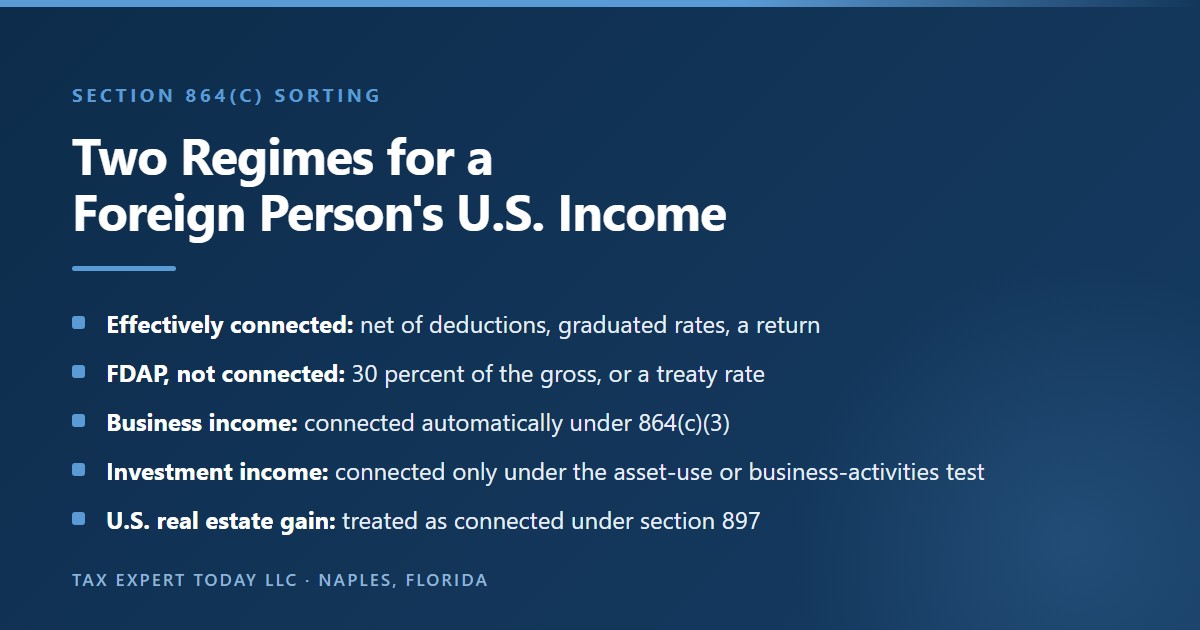
When a foreign person is engaged in a U.S. trade or business, U.S. source FDAP income and capital gains are effectively connected only if they pass one of two tests in section 864(c)(2): the income comes from assets used or held for use in the business, or the business activities were a material factor in producing it.
- Asset-use test: asks whether the income comes from an asset used in, or held for use in, the U.S. business, such as working capital interest.
- Business-activities test: asks whether the U.S. business activities were a material factor in realizing the income, such as fees earned by the business.
- Accounting weight: whether the asset or income was accounted for through the business is taken into account.
- Everything else: other U.S. source income of a business is treated as effectively connected under section 864(c)(3).
Section 864(c) is the sorting machine. Once a foreign person is engaged in a U.S. trade or business during the year, the statute sorts its U.S. source income into three groups. Business income that is not FDAP in nature, such as profit from selling inventory or providing services, is effectively connected automatically under section 864(c)(3), which the IRS describes by saying that the income is effectively connected whether or not there is a factual connection to the business. FDAP-type income and capital gains are effectively connected only if they pass the asset-use or business-activities test of section 864(c)(2), which Treas. Reg. section 1.864-4 develops in detail. Foreign source income is generally not effectively connected, with the narrow office exception in section 864(c)(4) discussed later.
A hypothetical example shows the difference. A foreign individual operates a small U.S. consulting business and keeps a U.S. bank account to pay the business’s expenses. The interest on that operating account is FDAP in form, but the account is held for use in the business, so the interest passes the asset-use test and is effectively connected. The same individual also holds a separate U.S. brokerage account with personal investments unrelated to the business. Those dividends fail both tests and remain FDAP income taxed at 30 percent or the treaty rate. Keeping business and personal assets separate, and recording them separately in the business’s books, is what makes the result defensible.
How is effectively connected income taxed on Form 1040-NR?
A nonresident alien reports effectively connected income on page 1 of Form 1040-NR and the regular schedules, subtracts deductions connected with that income, and pays tax at the same graduated rates as a U.S. citizen. A nonresident generally cannot claim the standard deduction, so taxable income often starts at the first dollar of net income.
- Rates: the section 1 graduated rates, from 10 percent up to 37 percent for 2026.
- Deductions: only those connected with effectively connected income, plus a few allowed by statute, under section 873.
- No standard deduction: Publication 519 says nonresident aliens cannot claim it, with an exception for certain students and apprentices from India.
- Credits: tax withheld at source and on Form 8288-A is credited against the tax shown on the return.
The return itself is covered in our Form 1040-NR guide. The key point here is that the two categories are computed separately on the same return. Effectively connected income goes through the regular computation, with deductions, the tax rate schedules, and any credits. FDAP income that is not effectively connected goes on Schedule NEC and is taxed at 30 percent or the treaty rate, with no deductions. The two taxes are added together. A loss in one category does not offset income in the other.
Deductions are where most of the value lies, and they come with conditions. Section 873 allows a nonresident alien deductions only to the extent they are connected with effectively connected income, with limited exceptions such as certain charitable contributions and casualty losses. And section 874(a) allows those deductions only if the nonresident files a true and accurate return. The timing of that return, under Treas. Reg. section 1.874-1, is the single most expensive trap in this area and has its own section below.
The due date also depends on wages. The Instructions for Form 1040-NR set the dates. A nonresident who received wages subject to U.S. income tax withholding generally files by April 15 of the following year. A nonresident without such wages, which describes most foreign owners of rental property, generally files by June 15. An extension of time to file is available on Form 4868, but an extension of time to file is not an extension of time to pay.
Is rental income from U.S. property effectively connected income?
Rental income from U.S. real estate is effectively connected income only if the rental activity is a U.S. trade or business or the owner makes the section 871(d) election. Otherwise it is FDAP income, and the tenant or property manager must withhold 30 percent of the gross rent, with no deduction for expenses or depreciation.
- Default for a passive rental: 30 percent of gross rent, withheld at the source and reported on Form 1042-S.
- Active rental business: net rent is effectively connected income and taxed at graduated rates.
- The election: section 871(d) lets the owner treat all U.S. real property income as effectively connected, whether or not a business exists.
- The withholding agent: usually the property manager or the tenant, who relies on Form W-8ECI to stop the 30 percent withholding.
Publication 519 walks through a simple example. A nonresident alien who is not engaged in a U.S. trade or business owns a single-family house in the United States and rents it out for $10,000 a year. That rent is the only U.S. source income. Under the default rule, the tenant withholds 30 percent, the nonresident receives a Form 1042-S, and no Form 1040-NR is required, because the withholding satisfied the tax. If the owner makes the election, the owner can offset the rent with rental expenses, report the rental on Schedule E attached to Form 1040-NR, and pay tax only on any net income at the graduated rates.
The default rule rarely produces the right answer for a condominium or house in Southwest Florida. Rent on a Naples property has real costs against it: association fees, property tax, insurance, management fees, repairs, utilities, mortgage interest where there is a loan, and depreciation on the building. Taxed on the gross, the owner pays 30 percent of revenue even in a year when the property loses money. Taxed on the net, the same owner may owe little or nothing.
The withholding mechanics matter as much as the rate. A U.S. property manager who collects rent for a foreign owner is a withholding agent under chapter 3 of the Code, as described in IRS Publication 515. Unless the owner gives the manager a valid Form W-8ECI, the manager must withhold 30 percent of the gross rent, deposit it, file Form 1042, and issue Form 1042-S to the owner. The Instructions for Form W-8ECI state that a foreign person making the real property election should give the form to the withholding agent, attach a copy of the election, and, if the election has not yet been made but is intended for the current year, attach a statement indicating that intent.
What is the section 871(d) net basis election?
The section 871(d) election lets a nonresident alien treat all income from U.S. real property held for the production of income as effectively connected income. The owner then reports the rent net of expenses and depreciation at graduated rates. The election covers all such property and stays in effect for later years unless revoked.
- Scope: all income from U.S. real property held for the production of income, including rents and gains, not one property at a time.
- Duration: once made, it applies to all later years unless revoked with IRS consent.
- After revocation: a new election generally cannot be made before the fifth tax year after the revocation, without consent.
- Corporations: section 882(d) gives foreign corporations a parallel election.
The text of section 871(d)(1) allows a nonresident alien who derives income from real property held for the production of income and located in the United States, and which would not otherwise be effectively connected, to elect to treat all such income as effectively connected. The income is then taxed under section 871(b)(1) whether or not the individual is engaged in a U.S. trade or business during the year. Publication 519 adds the important caveat that the election does not treat a nonresident who is not otherwise engaged in a U.S. trade or business as being engaged in one. It changes how the real property income is taxed, nothing else.
The election is made under Treas. Reg. section 1.871-10 by attaching a statement to the return for the first year it applies. The statement must include a complete schedule of all U.S. real property, or interests in real property, of which the taxpayer is the titular or beneficial owner, the extent of ownership in each, the location, a description of any substantial improvements, and the identification of any year in which a revocation or new election previously occurred. The regulation allows the initial election to be made at any time before the refund statute for that year expires, and allows it to be revoked without IRS consent within that same window, with amended returns for the affected years.
Three consequences follow from the scope. First, the election is all or nothing for real property income. A nonresident who owns two U.S. rentals cannot elect for one and leave the other on the 30 percent gross regime. Second, the election stays in effect. A later year in which the gross regime would have been cheaper does not let the owner switch back without the formal revocation. Third, because the election puts the rental on a net basis, depreciation becomes part of the computation. Depreciation that is allowed or allowable reduces the building’s basis, which increases the gain on a later sale. That is why the sale of an elected rental usually carries an unrecaptured section 1250 layer, a point covered in our Form 8288-B guide.
| Election point | Rule | Source |
|---|---|---|
| Who may elect | A nonresident alien with U.S. real property income not otherwise effectively connected | Section 871(d)(1) |
| What it covers | All income from U.S. real property held for the production of income, including gains | Section 871(d)(1); Reg. 1.871-10(b) |
| How it is made | A statement attached to the return listing every U.S. real property interest | Reg. 1.871-10(d)(1)(ii) |
| Deadline for the initial election | Before the refund period for that year expires under section 6511 | Reg. 1.871-10(d)(1)(i) |
| How long it lasts | All later years, unless revoked with IRS consent | Section 871(d)(1) |
| New election after revocation | Not before the fifth tax year after the revocation, without consent | Section 871(d)(2) |
| Effect on business status | Does not make the owner engaged in a U.S. trade or business | Publication 519 |
| Form given to the property manager | Form W-8ECI with a copy of the election or a statement of intent | Instructions for Form W-8ECI |
How does a Naples condominium rental compare with and without the 871(d) election?
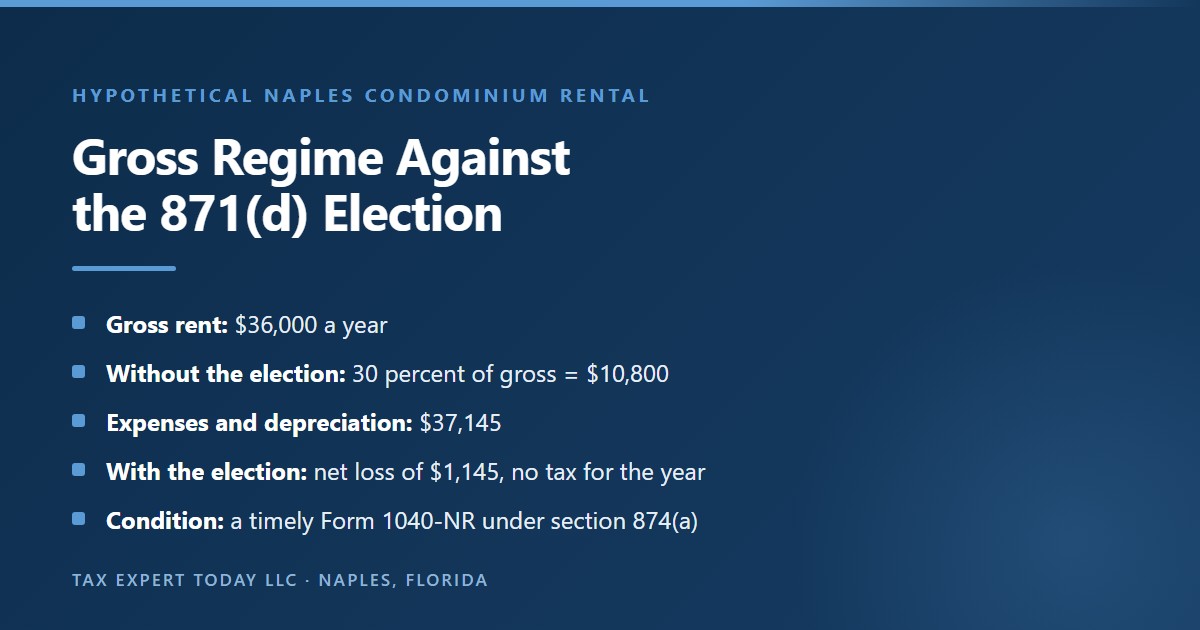
In a hypothetical Naples condominium that rents for $36,000 a year, the 30 percent gross regime produces $10,800 of tax even though expenses and depreciation exceed the rent. With the 871(d) election and a timely return, the same rental shows a small net loss and no regular income tax for the year.
- Gross regime: 30 percent of $36,000 is $10,800, withheld from the rent.
- Net regime: $36,000 of rent less $37,145 of expenses and depreciation is a net loss of $1,145.
- The cost of the election: a Form 1040-NR each year, and depreciation that increases the gain on a later sale.
- The condition: the deductions are allowed only if the return is filed on time under section 874(a).
The figures below are a hypothetical illustration, not a client and not a projection. Assume a foreign owner, not engaged in any other U.S. business, owns a Naples condominium that rents for $3,000 a month through a local management company. The building portion of the cost basis is $400,000, depreciated over 27.5 years for residential rental property. There is no mortgage.
| Line | Without the election (30 percent of gross) | With the 871(d) election (net basis) |
|---|---|---|
| Gross rent | $36,000 | $36,000 |
| Association fees | Not deductible | ($7,200) |
| Property tax | Not deductible | ($6,400) |
| Insurance | Not deductible | ($3,600) |
| Management fee (10 percent) | Not deductible | ($3,600) |
| Repairs | Not deductible | ($1,800) |
| Depreciation ($400,000 over 27.5 years) | Not deductible | ($14,545) |
| Taxable amount | $36,000 | ($1,145) net loss |
| Federal tax on the rental for the year | $10,800 | $0 |
| Return required | No, if the full 30 percent was withheld | Yes, a timely Form 1040-NR with Schedule E |
In this hypothetical, the election is worth $10,800 for the year. The net loss is not wasted either; it is generally carried forward under the passive activity rules, which are outside the scope of this article, and may offset rental income in later years or gain on the eventual sale. The trade-off is that the owner files a Form 1040-NR every year and keeps the records to support every deduction.
The comparison changes when expenses are low. A paid-off property with low association fees and a high rent may show a large net profit, and at higher brackets the graduated tax on the net can approach or exceed 30 percent of a smaller gross. Because the election covers all real property income and stays in effect, it is a decision to model over several years, including the year of sale, and not a single-year calculation. A Canadian owner also needs to know how the U.S. figure flows into the Canadian return, where the U.S. tax is generally claimed as a foreign tax credit; our Canada US tax treaty guide covers that interaction.
What is the section 874(a) timely return rule?
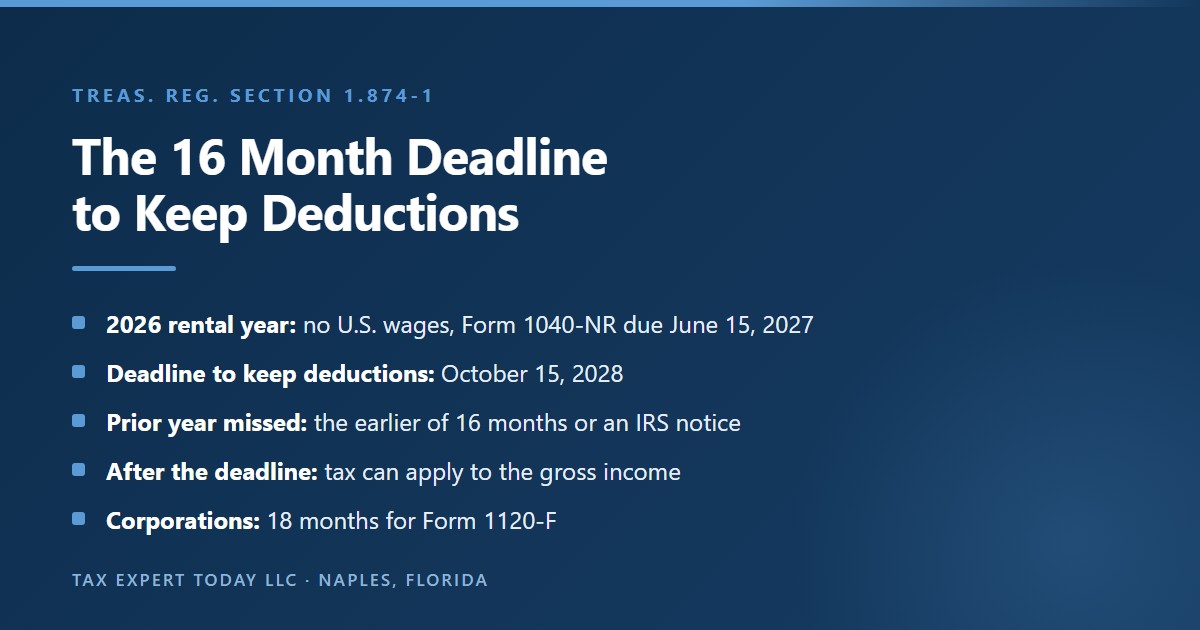
Section 874(a) allows a nonresident alien deductions and credits only if a true and accurate return is filed. Under Treas. Reg. section 1.874-1, the return generally must be filed within 16 months of its due date. If it is late, the IRS can tax the effectively connected income on the gross amount, with no deductions.
- General deadline: 16 months after the due date of the return for that year.
- Prior year rule: if no return was filed for the immediately preceding year, the deadline is the earlier of 16 months or the date the IRS mails a notice that the return has not been filed.
- Waiver: the IRS may waive the deadline if the nonresident acted reasonably and in good faith, but not if the nonresident knew a return was required and chose not to file.
- Withholding credits survive: section 874(a) does not deny the credit for tax withheld at source.
This is the rule that turns an attractive election into a costly one. The statute says a nonresident alien receives the benefit of deductions and credits only by filing a true and accurate return. The regulation adds a timing requirement. For a nonresident who filed a return for the immediately preceding year, or for the first year a return is required, the current year return must be filed within 16 months of its due date. A rental owner without U.S. wages has a June 15 due date, so the 2026 return is due June 15, 2027, and the 16 month deadline falls on October 15, 2028.
The deadline tightens if the prior year was missed. If no return was filed for the immediately preceding year, and the current year is not the first year a return is required, the current year return must be filed by the earlier of the 16 month date or the date the IRS mails a notice advising the nonresident that the return has not been filed and that no deductions or credits may be claimed. In other words, a nonresident who skipped last year can lose this year’s deductions the moment an IRS notice is mailed, even if the 16 months have not run.
| Tax year (rental, no U.S. wages) | Form 1040-NR due date | 16 month deadline to keep deductions | If the prior year return was not filed |
|---|---|---|---|
| 2025 | June 15, 2026 | October 15, 2027 | Earlier of that date or the IRS notice date |
| 2026 | June 15, 2027 | October 15, 2028 | Earlier of that date or the IRS notice date |
| First year a return is required | The normal due date | 16 months after the due date | The prior year rule does not apply |
The dates in the table assume the June 15 due date for a nonresident without wages subject to withholding. When a due date falls on a weekend or legal holiday the filing date moves to the next business day, so confirm the exact date for any particular year before relying on it.
Consider the hypothetical owner in the table above, who made the election on the first return but then stopped filing for three years while the manager, holding a Form W-8ECI, withheld nothing. If those returns are filed after the deadline, the IRS can disallow the deductions and assess tax on the full $36,000 of gross rent each year at the graduated rates, plus penalties and interest. That can be worse than the 30 percent gross regime the election was meant to replace.
The waiver in Treas. Reg. section 1.874-1(b)(2) is real but limited. The nonresident must establish, based on the facts and circumstances, that the nonresident acted reasonably and in good faith in failing to file, and must cooperate in determining the liability. A nonresident who knew a return was required and chose not to file is not considered to have acted in good faith. The factors the IRS considers include whether the nonresident came forward voluntarily before the IRS discovered the failure, whether the nonresident was aware of the filing requirement, and whether the nonresident had previously filed U.S. returns. A waiver request is a fact-intensive submission, not a form, and the outcome is up to the IRS. The broader late filing penalties follow the separate rules discussed in our reasonable cause penalty abatement guide.
What is a protective Form 1040-NR?
A protective Form 1040-NR is a timely return filed by a nonresident who believes no effectively connected income exists, or that a treaty exempts it, so that deductions are preserved if the IRS later disagrees. It is filed on time with a statement that it is protective, and generally reports no income.
- Purpose: to start the clock and preserve deductions under section 874(a) if the position is later rejected.
- Typical case: a nonresident whose rental or business activity may or may not rise to a U.S. trade or business.
- Treaty case: a nonresident claiming that business profits are exempt because there is no permanent establishment.
- Corporate twin: a protective Form 1120-F serves the same purpose for foreign corporations under Treas. Reg. section 1.882-4.
The regulation expressly contemplates protective returns. Where a nonresident conducts limited activities in the United States and determines in good faith that it has no effectively connected income, or that a treaty exempts the income, the nonresident may file a return on time that reports no income and states that it is a protective return. If the IRS later concludes that some income was effectively connected, the protective return satisfies the timely filing requirement and the related deductions remain available.
A protective return is especially useful where the business status of a rental is uncertain and the owner has decided not to make the 871(d) election. If the IRS later treats the rental as an active business, a protective return filed on time preserves the deductions. Without one, the owner risks the worst of both regimes: gross basis taxation of income that the owner believed was outside the effectively connected rules.
Is gain on selling U.S. real estate effectively connected income?
Yes. Under section 897(a), gain or loss of a nonresident alien or foreign corporation from disposing of a U.S. real property interest is taxed as if it were effectively connected with a U.S. trade or business, even if no business exists. The buyer generally withholds 15 percent of the amount realized under FIRPTA.
- Deemed connection: section 897 treats the gain as effectively connected regardless of the owner’s activities.
- Rates: the graduated capital gain rates, including the 25 percent maximum rate on unrecaptured section 1250 gain from depreciation.
- Withholding: 15 percent of the amount realized under section 1445, with reduced rates or exceptions for certain residential sales.
- Reduction: a withholding certificate on Form 8288-B can reduce the withholding to the expected tax.
The Foreign Investment in Real Property Tax Act closed what had been a gap. Before it, a foreign investor not engaged in a U.S. business could sell U.S. real estate and pay no U.S. tax on the gain, because capital gains of a nonresident are generally not FDAP income subject to the 30 percent tax. Section 897(a) now provides that gain or loss from the disposition of a U.S. real property interest is taken into account under section 871(b)(1) for individuals, or section 882(a)(1) for corporations, as if the taxpayer were engaged in a U.S. trade or business and as if the gain were effectively connected.
The withholding itself comes from section 1445. Because the sale is effectively connected income, it goes on the regular part of Form 1040-NR and is taxed at the capital gain rates that apply to U.S. citizens, with depreciation taken during the rental years taxed at up to 25 percent. The collection side is covered in our FIRPTA withholding guide, and the procedure to reduce the withholding before closing is covered in the Form 8288-B guide. The point for this article is the link between the two: a rental that was on the net basis under the 871(d) election, with depreciation claimed, carries that depreciation into the gain computation on sale.
Net investment income tax does not apply to a nonresident alien, because section 1411(e)(1) excludes nonresident aliens. A foreign corporation is taxed on the gain at the corporate rate and may also face the branch profits tax discussed below.
What does section 864(c)(8) do to the sale of a partnership interest?
Section 864(c)(8) treats gain or loss a foreign partner realizes on selling a partnership interest as effectively connected income to the extent the partner’s share of a deemed sale of the partnership’s assets would have been effectively connected. The buyer generally must withhold 10 percent of the amount realized under section 1446(f).
- Look-through rule: the partnership is treated as selling all its assets at fair market value on the date the interest is sold.
- Cap: only the portion of gain that would have been effectively connected on that deemed sale is taxed as effectively connected.
- Withholding: section 1446(f) requires the transferee to withhold 10 percent of the amount realized, subject to exceptions.
- Real estate partnerships: where the partnership holds U.S. real property, section 897 rules can also apply.
Before 2018, whether a foreign partner’s gain on selling a partnership interest was taxable in the United States was disputed, and the Tax Court sided with the taxpayer in Grecian Magnesite. Congress responded by adding section 864(c)(8). If a nonresident alien or foreign corporation owns, directly or indirectly, an interest in a partnership engaged in a U.S. trade or business, gain or loss on the sale or exchange of that interest is treated as effectively connected to the extent it does not exceed the partner’s distributive share of the gain that would have been effectively connected had the partnership sold all its assets at fair market value on the date of the sale.
The collection rule sits in section 1446(f). If any portion of the gain would be treated as effectively connected under section 864(c)(8), the transferee must withhold 10 percent of the amount realized on the disposition, unless an exception applies, such as a certification of non-foreign status. For a foreign member of a Florida LLC taxed as a partnership that owns rental property, both the annual allocation of rental income and the eventual sale of the membership interest fall inside the effectively connected rules.
How does partnership withholding apply to effectively connected income?
A partnership with effectively connected income allocable to foreign partners must pay a withholding tax under section 1446 on that share during the year, at the highest individual rate for noncorporate partners and the corporate rate for corporate partners. It reports the tax on Form 8804 and gives each foreign partner a Form 8805.
- Rate for individuals: the highest rate in section 1, which is 37 percent for 2026.
- Rate for corporations: the highest rate in section 11(b), which is 21 percent.
- Base: the partnership’s effectively connected taxable income allocable to foreign partners, not the cash distributed.
- Partner’s credit: each foreign partner claims the withholding on its own Form 1040-NR or Form 1120-F.
Section 1446(a) and (b) require a partnership with effectively connected taxable income allocable under section 704 to foreign partners to pay a withholding tax on that amount, at the highest section 1 rate for partners who are not corporations and the highest section 11(b) rate for corporate partners. The withholding is due in installments during the year and is reported annually. The filing cycle, including Form 8813 installments, Form 8804, Form 8805, and partner certificates on Form 8804-C, is covered in our Form 8804 partnership withholding guide.
The partnership withholding is a prepayment, not the final tax. Each foreign partner still files a U.S. return reporting its share of the effectively connected income, computes the tax at its own rates with its own deductions, and claims the withholding as a credit. A foreign individual whose share of a rental partnership’s net income is modest may be entitled to a substantial refund, but only if the return is filed, and on time.
Can foreign source income be effectively connected income?
Foreign source income is generally not effectively connected. Section 864(c)(4) makes an exception for certain rents, royalties, dividends, interest, and sales income attributable to an office or other fixed place of business the foreign person maintains in the United States. The exception is narrow and depends on where the income is actually earned.
- The office requirement: the foreign person must have an office or fixed place of business in the United States.
- Attribution: the income must be attributable to that office, which generally means the office was a material factor in producing it.
- Listed items: rents and royalties for intangibles, certain banking and financing income, and certain sales of goods through the U.S. office.
- Exclusions: income of a controlled foreign corporation and certain other items are carved out.
Most foreign owners of U.S. property do not meet this rule, because they do not keep a U.S. office through which they earn foreign income. It matters more for foreign businesses that run sales or financing operations from a U.S. location. The statute and the regulations under section 864(c)(4) set the conditions. For a foreign individual whose only U.S. connection is a rental condominium or a few months of work, the practical answer is that income earned abroad stays outside the U.S. effectively connected rules.
What happens to income received after a U.S. business ends?
Income or gain received in a later year but attributable to a sale or services in an earlier year is tested as of that earlier year under section 864(c)(6). Under section 864(c)(7), gain on property disposed of within 10 years after it stopped being used in a U.S. business is also treated as effectively connected.
- Deferred payments: an installment payment or deferred compensation for U.S. work keeps its effectively connected character in the year it is received.
- Ten year look-back: property removed from a U.S. business and sold within 10 years produces effectively connected gain to the extent of the earlier connection.
- No business needed in the later year: both rules apply even if the foreign person has no U.S. business when the income arrives.
- Planning point: ending a U.S. business does not by itself end U.S. tax on income it produced.
These two rules stop a foreign person from avoiding tax by timing. Under section 864(c)(6), if income or gain is taken into account in one year but is attributable to a sale, services, or another transaction in a different year, the question of whether it is taxable under section 871(b) or 882 is answered as if it were taken into account in that other year, without requiring a U.S. business in the year of receipt. A consultant who worked in the United States in 2026 and is paid in 2027 after returning home has effectively connected income in 2027.
Section 864(c)(7) applies the same logic to property. If property stops being used or held for use in a U.S. trade or business and is disposed of within 10 years after that, gain attributable to the disposition is determined as if the sale occurred immediately before the property stopped being used in the business. Equipment a foreign owner takes out of a U.S. business and sells years later can still produce effectively connected gain.
How do tax treaties change effectively connected income?
Most U.S. income tax treaties let the United States tax a resident of the other country on business profits only if the profits are attributable to a permanent establishment in the United States. Treaties generally do not prevent the United States from taxing rent from, or gain on, U.S. real property. A treaty position is usually disclosed on Form 8833.
- Business profits: taxed in the United States only through a permanent establishment, such as a fixed place of business or a dependent agent.
- Real property: the real property article, Article VI in the Canada treaty, preserves U.S. taxing rights over U.S. real estate income.
- Independent services: some treaties have specific rules for personal services and a fixed base.
- Disclosure: a treaty-based return position that overrides the Code is generally reported on Form 8833.
A treaty can override the Code’s effectively connected rules in one important direction: business profits. Under the business profits article of most U.S. treaties, a foreign enterprise’s profits are taxable in the United States only to the extent they are attributable to a permanent establishment in the United States. A foreign consultant who is engaged in a U.S. trade or business under section 864(b) but has no fixed place of business in the United States may be exempt under the treaty, provided the treaty applies and the position is properly claimed. Our Form 8833 guide explains when that disclosure is required and what happens if it is omitted.
Real property is the exception that matters most in Southwest Florida, and the IRS page on nonresident aliens and U.S. real property summarizes the default and elective regimes. Treaties generally let the country where the property sits tax the income from it. Under the Canada US income tax convention, rent from a Naples condominium remains taxable in the United States, and the 30 percent gross regime or the 871(d) net regime applies in the usual way. Gain on the sale remains taxable under section 897. The treaty’s role is mainly on the Canadian side, where it allows a foreign tax credit for the U.S. tax, and in specific items such as pensions and Social Security. Where a protective return is filed because a treaty exemption is claimed, the return should carry the Form 8833 disclosure.
How does a foreign corporation pay tax on effectively connected income?
A foreign corporation pays tax on its effectively connected taxable income at the 21 percent corporate rate under section 882, reported on Form 1120-F. It may also owe the 30 percent branch profits tax under section 884 on earnings treated as repatriated, and it loses its deductions if Form 1120-F is not filed within 18 months of its due date.
- Regular tax: 21 percent of effectively connected taxable income, after allowable deductions.
- Branch profits tax: 30 percent of the dividend equivalent amount under section 884, which a treaty may reduce.
- Timely return: Treas. Reg. section 1.882-4 uses an 18 month deadline, compared with 16 months for individuals.
- Real property election: section 882(d) mirrors the individual election in section 871(d).
Many foreign owners hold U.S. real estate through a foreign company rather than personally, and that choice moves the property into the corporate regime. Under section 882, a foreign corporation engaged in a U.S. trade or business, or one that elects under section 882(d) for its real property income, is taxed on its effectively connected taxable income at the section 11 rate. Deductions are allowed only if a true and accurate return is filed, and Treas. Reg. section 1.882-4 sets the deadline at 18 months after the due date, with the same prior year rule and notice trigger as the individual regulation.
The branch profits tax is the second layer, and the Instructions for Form 1120-F walk through its computation. Section 884(a) imposes, in addition to the regular tax, a tax equal to 30 percent of the foreign corporation’s dividend equivalent amount for the year, which is broadly its effectively connected earnings and profits that are not reinvested in the U.S. business. The tax approximates the dividend withholding that would apply if the U.S. business were run through a U.S. subsidiary. Many treaties reduce the rate, and the treaty’s terms decide whether and how. A foreign corporation that owns a U.S. disregarded LLC may also have Form 5472 reporting obligations for the LLC, which are separate from the income tax.
Which forms report effectively connected income?
Effectively connected income is reported by the foreign person on Form 1040-NR or Form 1120-F. Payers and partnerships use Form W-8ECI, Forms 8804 and 8805, and the FIRPTA Forms 8288 and 8288-A. Passive income that is not effectively connected appears on Form 1042-S and on Schedule NEC of Form 1040-NR.
- The foreign person’s return: Form 1040-NR for individuals, Form 1120-F for corporations.
- To the payer: Form W-8ECI tells a withholding agent that the income is effectively connected and should not be withheld at 30 percent.
- From a partnership: Form 8805 shows the foreign partner’s share and the section 1446 tax paid.
- From a real estate sale: Form 8288-A shows the FIRPTA tax withheld and is attached to the seller’s return.
| Form | Filed or given by | Role for effectively connected income |
|---|---|---|
| Form 1040-NR | Nonresident alien individual | Reports effectively connected income on the regular pages and FDAP income on Schedule NEC |
| Schedule E with Schedule 1 | Attached to Form 1040-NR | Reports net rental income under the section 871(d) election |
| Form 1120-F | Foreign corporation | Reports effectively connected taxable income and the branch profits tax |
| Form W-8ECI | Foreign person, to the withholding agent | Certifies that the income is effectively connected so 30 percent is not withheld |
| Form W-8BEN | Foreign individual, to the payer | Claims foreign status and a treaty rate on FDAP income |
| Form 1042-S | Withholding agent, to the foreign person | Reports FDAP income paid and tax withheld at 30 percent or a treaty rate |
| Forms 8804, 8805, 8813 | Partnership with foreign partners | Reports and pays section 1446 withholding on effectively connected income |
| Forms 8288, 8288-A, 8288-B | Buyer of U.S. real property, or the seller applying for a certificate | FIRPTA withholding on gain treated as effectively connected under section 897 |
| Form 8833 | Attached to the return | Discloses a treaty position, such as the permanent establishment rule |
| Form 4868 | Nonresident alien individual | Extends the time to file Form 1040-NR, but not the time to pay |
How does Form W-8ECI work for a rental owner?
Form W-8ECI is the certificate a foreign person gives to a withholding agent, such as a property manager, to show that the income is effectively connected and should not be subject to 30 percent withholding. A rental owner using the 871(d) election attaches a copy of the election, or a statement of intent for the current year.
- Not filed with the IRS: the form goes to the person paying or crediting the income, not to the IRS.
- Taxpayer identification number: the form requires a U.S. TIN, which for most foreign individuals is an ITIN.
- Election attachment: a copy of the 871(d) election, or a statement that the owner intends to make it for the current year.
- Consequence: with no withholding, the owner must pay the tax through estimated payments and the return.
The IRS page for Form W-8ECI describes it as the certificate of a foreign person’s claim that income is effectively connected with the conduct of a trade or business in the United States. The instructions tell the foreign person not to send it to the IRS and to give it to the person requesting it, generally the person from whom the payment is received. A property manager who receives a valid Form W-8ECI from a foreign owner generally does not withhold the 30 percent on the rent.
That shift has two consequences. The owner must have a U.S. taxpayer identification number, so a foreign individual without a Social Security number generally needs an ITIN, applied for on Form W-7. And once the withholding stops, the owner becomes responsible for paying the tax on any net income directly, through estimated tax and the annual Form 1040-NR. A Form W-8ECI with no return behind it is how the timely return trap begins: the manager stops withholding, the owner assumes the matter is handled, and the deadline in section 1.874-1 passes.
How does a Canadian owner of a Florida rental handle effectively connected income?
A Canadian who rents out Florida property is generally taxed in the United States on that rent, either at 30 percent of the gross or on the net under the 871(d) election with a timely Form 1040-NR. Canada also taxes the rent, and the U.S. tax is generally claimed as a foreign tax credit on the Canadian return.
- U.S. taxing right: the Canada US treaty leaves the United States free to tax U.S. real property income.
- Typical U.S. choice: the 871(d) election with Form W-8ECI, Schedule E, and a Form 1040-NR every year.
- Canadian side: worldwide income reporting, with a foreign tax credit for the U.S. tax, confirmed with a Canadian adviser.
- On sale: FIRPTA withholding, a Form 1040-NR for the year of sale, and the Canadian treatment of the same gain.
The Canadian winter resident is a common example of this fact pattern in Southwest Florida. A typical fact pattern, described here only as an illustration, is a retired couple from Ontario who own a condominium in Naples, Florida, use it from January to March, and rent it out the rest of the year through a local manager. The couple are nonresident aliens for U.S. purposes if they stay under the substantial presence threshold or file Form 8840, and the rent is U.S. source real property income.
For that couple, the decisions run in a sequence. Is the rental a business? Usually not, so the default is 30 percent of the gross. Does the net regime produce less tax over several years? Usually yes, once association fees, taxes, insurance, management, and depreciation are counted. If so, each owner makes the 871(d) election on a timely Form 1040-NR, gives the manager a Form W-8ECI, and files every year on time. Each co-owner reports a share of the rent and expenses on that owner’s own return. When the condominium is sold, the buyer withholds under FIRPTA, the couple may apply for a withholding certificate, and the gain, including the depreciation layer, goes on the Form 1040-NR for the year of sale.
The Canadian return is a separate exercise. Canada taxes its residents on worldwide income, so the same rent and gain are reported in Canada, generally in Canadian dollars, with a foreign tax credit for the U.S. tax actually paid. Depreciation and the timing of income may differ between the two systems. This article covers the U.S. side; the Canadian figures should be confirmed with a Canadian adviser.
What are the most common effectively connected income mistakes?
The most common mistakes are leaving a profitable or break-even rental on the 30 percent gross regime, giving a property manager Form W-8ECI and then not filing a return, filing late and losing deductions under section 874(a), and forgetting that depreciation from net basis years increases the gain on a later sale.
- No election, no return: paying 30 percent of the gross rent on a property that loses money on a net basis.
- Form W-8ECI without a return: withholding stops, no return is filed, and the deadline passes.
- Late returns: filing years later and finding the deductions disallowed under the 16 month rule.
- Ignoring the sale: treating the rental years and the sale as separate when the depreciation links them.
| Mistake | What happens | How it is usually avoided |
|---|---|---|
| Staying on the 30 percent gross regime by default | Tax on revenue even in a loss year | Compare gross and net results over several years before deciding |
| Making the election for one property only | Not permitted; the election covers all U.S. real property income | List every U.S. real property interest in the election statement |
| Form W-8ECI given, no Form 1040-NR filed | No withholding and no return, with deductions at risk | File every year on time and make estimated payments where needed |
| Return filed after the 16 month deadline | Deductions may be disallowed and tax assessed on the gross | Calendar the deadline; consider a waiver request only on genuine good faith facts |
| Skipping a year | The next year’s deadline can be cut short by an IRS notice | File each year, including loss years |
| No depreciation claimed | Basis is still reduced by depreciation allowable | Claim depreciation each year and keep the schedule |
| Assuming a treaty exempts the rent | U.S. real property income generally remains taxable | Read the real property article of the applicable treaty |
| Treating wages for U.S. work as foreign income | Unreported effectively connected income | Source wages by where the work is performed |
Effectively Connected Income Help in Naples & Southwest Florida
Tax Expert Today LLC works with international clients from an office in Naples, Florida and serves clients in all 50 states. Foreign owners rent and sell condominiums and homes across Naples, Bonita Springs, Fort Myers, and Marco Island, and the effectively connected income rules decide how that rent is taxed, which return is required, and when it is due. We model the gross and net regimes, prepare the 871(d) election and Form W-8ECI package, and prepare the Form 1040-NR for each year and for the year of sale.
- Effectively connected income help Naples: gross versus net modeling for rental property and the section 871(d) election statement.
- Nonresident rental tax Naples FL: Form W-8ECI for the property manager, Schedule E, and a timely Form 1040-NR.
- International tax Naples FL: late return reviews under the 16 month rule and protective returns.
- Foreign tax Naples: U.S. side coordination for Canadian and other foreign owners with their home country adviser.
Our international and expat tax services page explains how we approach cross-border work for foreign owners of Florida property, including nonresident rental returns and the real property election. The international tax Naples FL guide and the Naples tax planning page cover the wider picture for residents and seasonal residents of Southwest Florida.
Office: 11983 Tamiami Trail N, Naples FL 34110
Phone: (239) 441-2005
Hours: Monday through Friday, 10:00 to 5:00 ET
Frequently Asked Questions
I am a Canadian who rents out a condominium in Naples, Florida. Is the rent effectively connected income?
Usually not by default, because a single hands-off rental is generally an investment rather than a business. The rent is then taxed at 30 percent of the gross. You can elect under section 871(d) to treat it as effectively connected, deduct expenses and depreciation, and pay tax on the net with a timely Form 1040-NR.
What is the difference between effectively connected income and FDAP income?
Effectively connected income comes from a U.S. trade or business and is taxed on the net amount at graduated rates with a return. FDAP income is passive U.S. source income such as dividends, interest, and passive rent, taxed at 30 percent of the gross or a lower treaty rate, usually through withholding.
Can I make the 871(d) election for only one of my U.S. properties?
No. The election covers all income from U.S. real property held for the production of income, and the election statement must list every U.S. real property interest you own. It stays in effect for later years unless revoked, and a new election after revocation generally waits until the fifth tax year.
What happens if I file my Form 1040-NR late?
Under section 874(a) and Treas. Reg. section 1.874-1, deductions are allowed only if the return is filed within 16 months of its due date, or earlier if a prior year was missed and the IRS mails a notice. A late return can mean tax on the gross income. A waiver is possible only on reasonable, good faith facts.
Is gain on selling U.S. real estate effectively connected income?
Yes. Section 897 treats gain on a U.S. real property interest as effectively connected, even if the seller has no U.S. business. The buyer generally withholds 15 percent of the amount realized under FIRPTA, and the seller reports the actual gain on Form 1040-NR or Form 1120-F.
Does a tax treaty exempt effectively connected income?
A treaty may exempt business profits that are not attributable to a permanent establishment in the United States, and the position is generally disclosed on Form 8833. Treaties generally do not exempt rent from or gain on U.S. real property, which remains taxable in the United States.
When to Engage a Professional
Effectively connected income is a classification question with large consequences. The same rent can be taxed at 30 percent of the gross or at graduated rates on the net, and the difference depends on an election, a properly completed Form W-8ECI, and a return filed within a deadline most foreign owners have never heard of. The cost of getting it wrong is usually discovered years later, when a return is filed late or a property is sold.
A professional review is worth considering when a foreign owner first rents out U.S. property, when a property manager asks for Form W-8ECI, when returns for past rental years were not filed, when the owner works in the United States for part of the year, when the property is held through an LLC, partnership, or foreign corporation, when a sale is planned, or when the owner also files in Canada or another country and needs the U.S. figures to support a foreign tax credit there.
Tax Expert Today LLC is a tax advisory firm in Naples, Florida serving clients in all 50 states. Call (239) 441-2005 to discuss your facts.
This article is general information, not advice for any particular taxpayer, and does not create a client relationship. The examples are hypothetical illustrations only and do not describe any client. The rules described here reflect 26 U.S.C. sections 864, 871, 873, 874, 875, 882, 884, 897, 1411, 1445, and 1446, Treasury Regulations sections 1.864-4, 1.871-10, 1.874-1, and 1.882-4, the Instructions for Form W-8ECI, and IRS Publication 519, as of the date of writing. Canadian and other foreign tax rules are outside the scope of this article and should be confirmed with an adviser in that country. Verify current rules and confirm your own facts with a qualified tax professional before filing or making a decision.
Published October 16, 2026 by Dr. Pellumb Kabashi « Back to Learning Center
Have a question this article touches on?
Tax Expert Today LLC, based in Naples, Florida and serving clients across the United States.
Schedule a Consultation (239) 441-2005