
By Dr. Pellumb Kabashi, DBA, MBA, EA, CFE, CES
Founder, Tax Expert Today LLC · Tax advisors, enrolled agents, CPAs, and attorneys · Serving clients in all 50 states
Quick Answer: Form 5471 is the information return a United States person files to report an interest in a foreign corporation. Nine categories of filers exist, and the form attaches to your income tax return rather than standing alone. Missing it carries a $10,000 penalty for each year for each corporation, plus a separate reduction of your foreign tax credit, and it holds the audit window open. Call (239) 441-2005 for a free consultation.
Published: August 4, 2026
What Is Form 5471 and Who Must File It?
Form 5471, the Information Return of U.S. Persons With Respect To Certain Foreign Corporations, is an information return filed by United States citizens, residents, and domestic entities who are officers, directors, or shareholders of certain foreign corporations. It reports ownership, financial results, and transactions with related parties. It does not by itself create a tax liability. It creates a reporting duty, and the penalties attach to the failure to report rather than to any unpaid tax.
Two separate statutes drive the requirement. Section 6038 of the Internal Revenue Code requires information about foreign business entities that a United States person controls or holds a substantial interest in. Section 6046 requires a return on the acquisition, disposition, or organization of stock in a foreign corporation. Form 5471 satisfies both, which is why the categories of filers read as a list of unrelated situations rather than a single test. Some categories turn on how much you own, some on what changed during the year, and one on nothing more than serving as an officer or director while somebody else crossed a threshold. The mirror image of this runs inbound under sections 6038A and 6038C, where a United States entity with foreign owners reports its related party transactions on Form 5472 instead. When a foreign entity owned by a United States person is disregarded rather than treated as a corporation, or the business abroad is run as a branch, the reporting moves to a different form, explained in our guide to Form 8858 for foreign disregarded entities and foreign branches.
The threshold most people encounter is 10 percent. A United States shareholder for these purposes generally means a person owning 10 percent or more of the total combined voting power or value of the foreign corporation. Control, which drives the most demanding category, means more than 50 percent of voting power or value held for an uninterrupted period of at least 30 days during the annual accounting period. Ownership is measured with attribution rules, so stock held by family members or related entities can be counted as yours even when you never held a certificate. A smaller stake in a foreign investment company can still require a separate annual filing if that company is a passive foreign investment company, covered in our guide to Form 8621 and PFIC reporting.
What Are the Nine Categories of Form 5471 Filers?
The current instructions list nine filer categories, not five. Categories 1 and 5 are each split into three sub-categories, which is the detail most summaries omit. Your category determines which schedules you complete, and a single person can fall into more than one category for the same corporation in the same year. When that happens, you file one Form 5471 and complete the schedules required by every category that applies.
| Category | Who it captures |
|---|---|
| 1a | A United States shareholder of a section 965 specified foreign corporation that does not fall into 1b or 1c |
| 1b | An unrelated section 958(a) shareholder of a foreign-controlled section 965 specified foreign corporation |
| 1c | A related constructive shareholder of a foreign-controlled section 965 specified foreign corporation |
| 2 | A United States citizen or resident who is an officer or director of a foreign corporation in which any United States person acquires 10 percent or more of the stock |
| 3 | A person who acquires stock reaching the 10 percent threshold, disposes of stock dropping below it, or becomes a United States person while holding 10 percent or more |
| 4 | A United States person who had control, meaning more than 50 percent of vote or value, for an uninterrupted period of at least 30 days during the annual accounting period |
| 5a | A United States shareholder of a controlled foreign corporation that does not fall into 5b or 5c |
| 5b | An unrelated section 958(a) shareholder of a foreign-controlled controlled foreign corporation |
| 5c | A related constructive shareholder of a foreign-controlled controlled foreign corporation |
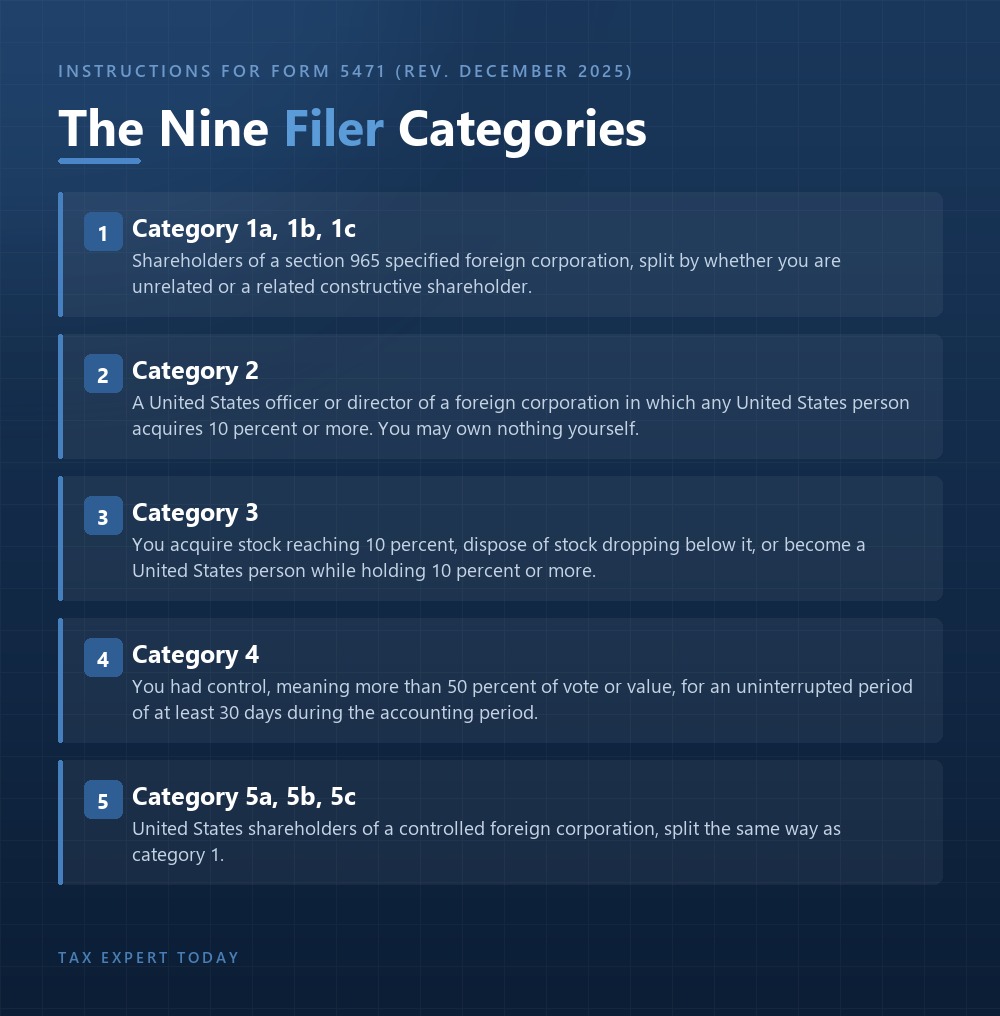
Category 2 deserves particular attention because it catches people who own nothing at all. If you serve as an officer or director of a foreign corporation and an unrelated investor buys in at 10 percent, your filing obligation is triggered by that investor’s purchase. Executives who accepted a board seat at a foreign subsidiary or a friend’s overseas venture routinely discover this years later, and the fact that they held no equity is not a defense to the filing requirement.
When Is Form 5471 Due and How Do You File It?
Form 5471 is not a stand-alone filing. You attach it to your income tax return, whether that is a Form 1040, 1120, 1065, or another return, and it is due when that return is due, including extensions. Filing an extension for your income tax return therefore extends the Form 5471 as well. A separate Form 5471 is required for each foreign corporation, so three corporations means three forms.
Because the form travels with the return, a common failure mode is filing the income tax return on time while omitting the Form 5471 that belonged with it. In that situation the return is timely but the information return is delinquent, and the penalty provisions discussed below operate on the missing form rather than on the return. The reverse also matters. Filing Form 5471 as a loose document without the associated return does not satisfy the requirement. For a United States shareholder of a controlled foreign corporation, the same gap can also leave the annual inclusion of the company’s profits unreported, a separate tax question explained in our guide to GILTI for individual shareholders.
What Is the Penalty for Not Filing Form 5471?
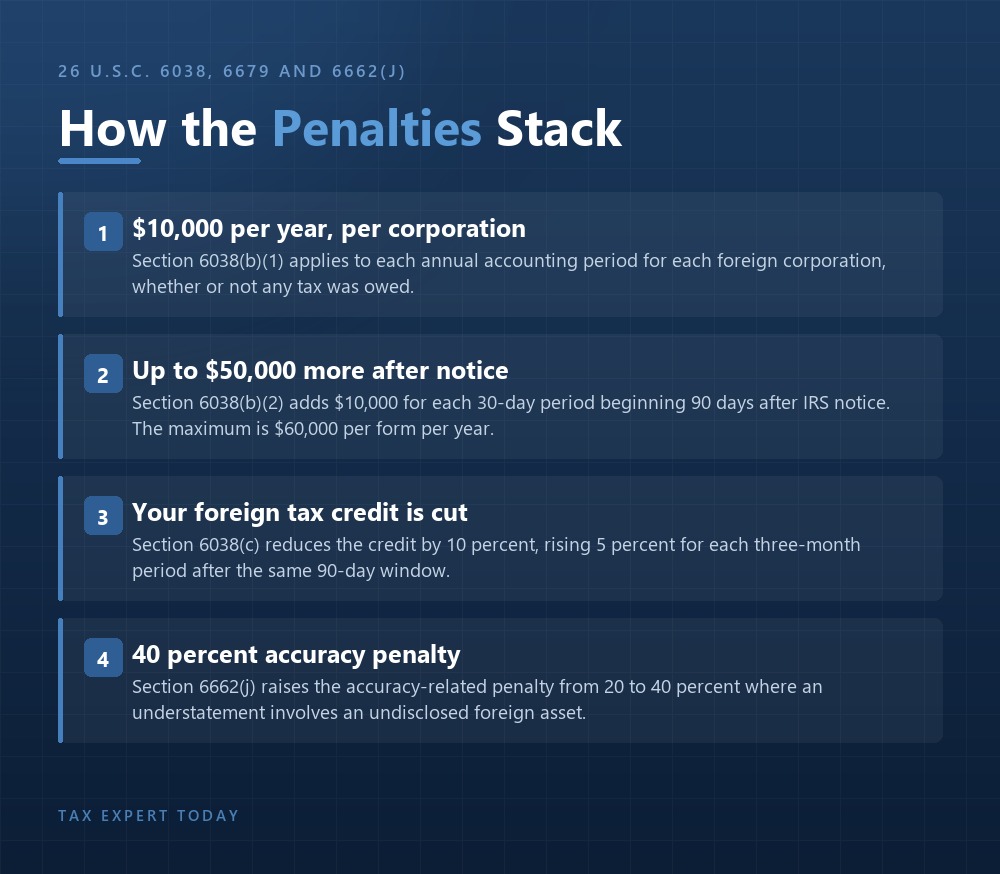
The headline penalty is $10,000 for each annual accounting period for each foreign corporation under 26 U.S.C. §6038(b)(1). If the failure continues for more than 90 days after the IRS mails notice, section 6038(b)(2) adds $10,000 for each 30-day period or fraction of one, and that continuation amount is capped at $50,000. The maximum under this subsection is therefore $60,000 per form per year, not $50,000 as it is frequently summarized.
The dollar penalty is only the first layer. Section 6038(c) imposes a separate consequence by reducing your foreign tax credit by 10 percent, rising by an additional 5 percent for each three-month period after the same 90-day notice window expires. That reduction is capped at the greater of $10,000 or the income of the foreign entity for the period, and section 6038(c)(3) coordinates the two provisions by reducing the credit haircut by the dollar penalty already imposed. For a taxpayer relying on foreign tax credits to avoid double taxation, this second layer can exceed the first. That reduction bites hardest on a taxpayer who was relying on the credit in the first place, which is why the choice between the foreign earned income exclusion and the foreign tax credit is worth settling before a reporting failure ever arises.
Categories 2 and 3 rest on section 6046 rather than section 6038, and their penalty lives in 26 U.S.C. §6679. The structure is parallel, $10,000 with a $50,000 continuation cap, but the text differs in one respect worth knowing. Section 6679(a)(1) states the penalty applies “unless it is shown that such failure is due to reasonable cause,” placing the defense directly in the operative sentence. Section 6038 addresses reasonable cause differently, at section 6038(c)(4)(B), by treating the time to furnish information as beginning no earlier than the last day reasonable cause existed.
A third layer applies where the omission also understated tax. Under 26 U.S.C. §6662(j), an understatement attributable to an undisclosed foreign financial asset carries a 40 percent accuracy-related penalty rather than the usual 20 percent, and section 6662(j)(2) expressly lists section 6038 among the provisions that create the disclosure duty.
| Exposure | Authority | Amount |
|---|---|---|
| Initial failure to furnish | §6038(b)(1) | $10,000 per year per corporation |
| Continued failure after notice | §6038(b)(2) | $10,000 per 30 days, capped at $50,000 |
| Foreign tax credit reduction | §6038(c) | 10 percent, plus 5 percent per 3 months after notice |
| Category 2 and 3 failures | §6679(a) | $10,000, plus $10,000 per 30 days capped at $50,000 |
| Understatement of tax | §6662(j) | 40 percent of the underpayment |
To see how the arithmetic compounds, consider a hypothetical. A taxpayer who controlled two foreign corporations and missed five years of filings faces ten separate $10,000 penalties before any continuation amounts, which is $100,000 in initial exposure on returns that may have reported no additional tax at all. That figure illustrates the mechanism rather than predicting any particular result, and the reasonable-cause defense discussed below exists precisely because the statute produces numbers of that size on facts that are sometimes entirely innocent.
Can the IRS Assess Form 5471 Penalties After Farhy and Safdieh?
This question was genuinely unsettled between 2023 and 2026, and the answer has moved. The dispute is narrow but consequential. The IRS may either assess a penalty administratively, which lets it move directly to collection, or it must sue in federal district court to collect. Section 6038(b) does not say which, and taxpayers argued the omission meant the IRS lacked assessment authority.
In Farhy v. Commissioner the Tax Court agreed with the taxpayer in 2023. The D.C. Circuit reversed in 2024, holding at 100 F.4th 223 that Congress implicitly authorized administrative assessment. On February 27, 2026 the Second Circuit reached the same conclusion in Safdieh v. Commissioner, No. 25-501-cv, reasoning that requiring a full federal lawsuit to collect a fixed $10,000 penalty would undermine the congressional goal of efficient enforcement.
Two circuits have now held these penalties assessable. The Tax Court has indicated it will adhere to its contrary view in cases appealable to circuits that have not ruled, which is the ordinary operation of the Golsen rule under which the Tax Court follows the precedent of the circuit to which a case would be appealed. The practical consequence is that the availability of this argument now depends on where you live, and in the Second and D.C. Circuits it is no longer available. Anyone who has been relying on the assessment-authority position should have it reassessed against current law rather than against the 2023 decision, and the substantive reasonable-cause defense has become the more durable ground.
How Long Does the IRS Have to Audit a Return With a Missing Form 5471?
Longer than most taxpayers expect. Under 26 U.S.C. §6501(c)(8), when information required under section 6038 or section 6046 is not furnished, the time for assessing any tax on the return to which that information relates does not expire until three years after the information is finally provided. A return from a decade ago that should have carried a Form 5471 is generally still open, and the clock does not begin until the form is filed.
The reach of that extension is where precision matters. Section 6501(c)(8)(A) suspends the period for the entire return. Section 6501(c)(8)(B) narrows it: where the failure was due to reasonable cause and not willful neglect, the extension applies only to the items related to the failure rather than to everything on the return. That distinction is often flattened into a claim that the whole return stays open forever, which overstates the rule in the reasonable-cause case and understates the importance of establishing reasonable cause contemporaneously.
Do You Have to File If Someone Else Already Filed?
Sometimes not. The instructions provide relief where multiple people would otherwise report the same corporation, and they provide a reduced filing for corporations that did nothing during the year. These exceptions are conditional rather than automatic, and relying on one without confirming that its conditions were met is a frequent source of delinquency.
| Relief | What it does | Condition to watch |
|---|---|---|
| Multiple filer exception | One person files on behalf of others | The filer must have the same or greater filing requirements, and the others must be identified |
| Constructive ownership exception | Removes the duty for certain indirect owners | You hold no direct interest, you are a filer only by attribution, and another United States person reports everything required |
| Rev. Proc. 92-70 summary filing | Page one only for a dormant foreign corporation | The corporation must be dormant under the revenue procedure, and the return must carry the prescribed label |
The dormant corporation procedure is the most commonly missed of the three. A foreign entity that was formed and then never operated still requires a Form 5471 from anyone in a filing category. Rev. Proc. 92-70 reduces that to a summary return consisting of page one, labeled “Filed Pursuant to Rev. Proc. 92-70 for Dormant Foreign Corporation,” filed with the regular return. Doing nothing at all is not an option the procedure provides, and an inactive shell company is one of the most common fact patterns behind an unexpected $10,000 notice.
How Do You Fix a Missed Form 5471?
The route for a late international information return is the Delinquent International Information Return Submission Procedures, which remain available in 2026. You file the delinquent forms with an amended return where one is needed and attach a reasonable-cause statement to each form. What the procedure does not do is promise abatement. The IRS states that penalties may be assessed in accordance with existing procedures, and that during processing a penalty may be assessed without the attached reasonable-cause statement being considered, which can require responding to correspondence afterward to have the statement reviewed.
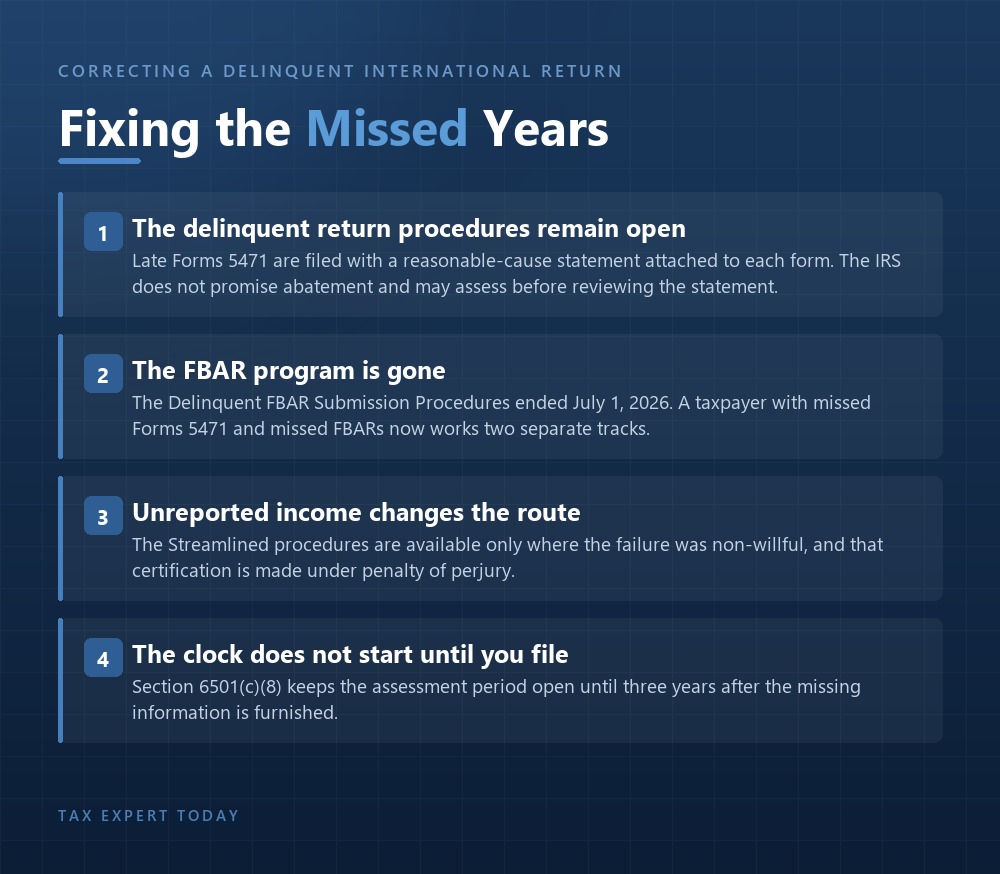
That caveat matters more than it used to, because the surrounding landscape changed this summer. The Delinquent FBAR Submission Procedures, the parallel penalty-free route for a missed FinCEN Form 114, were eliminated effective July 1, 2026, as covered in our guide to filing a late or delinquent FBAR. The two programs are frequently confused. The information-return procedures for Form 5471 survived that change; the FBAR program did not. A taxpayer with both a missed Form 5471 and missed FBARs is now working two different tracks in the same catch-up project.
Where income went unreported as well as forms, the analysis shifts. The Streamlined Filing Compliance Procedures are available only to taxpayers whose failure to file was non-willful, and certifying non-willfulness is done under penalty of perjury, so it is a determination to make deliberately with the facts documented. Our guide to the Streamlined Filing Compliance Procedures sets out how that program works and who qualifies. Where the facts do not support a non-willful certification, neither program is the answer and the matter should be evaluated before anything is filed.
Building the reasonable-cause narrative is the substantive work in nearly every one of these cases, particularly now that the assessment-authority argument has narrowed. Reliance on a professional who was given complete information, a genuine ambiguity about whether a category applied, or an ownership interest acquired by inheritance without notice of the reporting duty are the kinds of facts that support the defense. Whether any of them succeeds depends on the record, and the record is far easier to build before a notice arrives than after.
Form 5471 Help in Naples and Southwest Florida
Tax Expert Today LLC advises individuals and business owners in Naples, Florida and across Southwest Florida on foreign corporation reporting. Southwest Florida has a substantial population of dual citizens, retirees with businesses left behind abroad, and owners of holding companies formed overseas years ago, and those are exactly the fact patterns that produce a surprise Form 5471 question. That work generally begins by identifying every foreign entity you hold an interest in, testing each against the nine categories, and determining which years were actually required before deciding how to correct them.
International tax Naples FL, foreign corporation reporting, and Form 5471 catch-up filings: the firm is multidisciplinary, with enrolled agents, CPAs, and attorneys, and represents taxpayers before the IRS nationwide through its international and expat tax services. Dr. Pellumb Kabashi is the founder of Tax Expert Today LLC. The office is at 11983 Tamiami Trail N, Naples, FL 34110, and the team can be reached at (239) 441-2005, Monday through Friday, 10am to 5pm ET.
Frequently Asked Questions
Who must file Form 5471?
United States citizens, residents, and domestic entities who are officers, directors, or shareholders in certain foreign corporations must file Form 5471. Nine filer categories exist, covering United States shareholders of controlled foreign corporations and section 965 specified foreign corporations, officers and directors when another United States person acquires 10 percent, people who acquire or dispose of stock at the 10 percent threshold, and anyone holding more than 50 percent of vote or value for at least 30 days during the accounting period.
What is the penalty for not filing Form 5471?
The penalty is $10,000 for each annual accounting period for each foreign corporation under section 6038(b)(1). If the failure continues more than 90 days after IRS notice, an additional $10,000 accrues for each 30-day period, capped at $50,000, for a maximum of $60,000 per form per year. Section 6038(c) separately reduces your foreign tax credit by 10 percent, increasing by 5 percent for each three-month period after that notice window.
Do I have to file Form 5471 every year?
You file for every year in which you fall into a filing category, and the form attaches to that year’s income tax return. The obligation is tested annually rather than once, so a category 4 filer who drops below control mid-year may still file for that year and not the next. A dormant foreign corporation still requires a filing, though Rev. Proc. 92-70 permits a summary return consisting of page one with the prescribed label.
Can the IRS still assess Form 5471 penalties after Farhy?
In the D.C. and Second Circuits, yes. The D.C. Circuit held in Farhy v. Commissioner, 100 F.4th 223 (2024), that section 6038(b) penalties are assessable, and the Second Circuit agreed in Safdieh v. Commissioner on February 27, 2026. The Tax Court has maintained its contrary position for cases appealable to circuits that have not yet ruled, so the answer currently depends on where an appeal would lie.
How far back can the IRS go if I never filed Form 5471?
Under section 6501(c)(8), the assessment period for the related return does not expire until three years after the missing information is furnished, so old years generally remain open indefinitely until the form is filed. Where the failure was due to reasonable cause and not willful neglect, section 6501(c)(8)(B) limits that extension to the items related to the failure rather than the entire return.
Where can I get help with Form 5471 in Naples, FL?
Tax Expert Today LLC, at 11983 Tamiami Trail N, Naples, FL 34110, assists individuals and businesses in Naples and across Southwest Florida with identifying foreign corporation filing obligations, preparing current-year Forms 5471, and correcting missed years through the delinquent international information return procedures. The firm can be reached at (239) 441-2005, Monday through Friday, 10am to 5pm ET, and works with clients in all 50 states.
When to Engage a Professional
Many Form 5471 filings are mechanical once the category is settled. The difficulty is almost always in the categorization and in the years nobody asked about. Three situations tend to warrant a professional review. The first is an ownership structure involving attribution, where stock held by family members or related entities may make you a filer even though you hold nothing directly. The second is a history of missed years, where the choice between the delinquent information return procedures and the Streamlined procedures depends on whether income was unreported and on a willfulness assessment that should be made deliberately. The third is any inherited or dormant foreign entity, which combines an easily overlooked filing duty with an open statute of limitations.
Outcomes in this area depend on the specific facts, including why the filings were missed and what the record shows about your awareness of the requirement. Nothing above is a prediction about any particular case. If you hold an interest in a foreign corporation and are not certain whether it has been reported correctly, a review before filing is generally more productive than a correction afterward. Tax Expert Today LLC can be reached at (239) 441-2005 or through its international and expat tax practice.
Published August 4, 2026 by Dr. Pellumb Kabashi « Back to Learning Center
Have a question this article touches on?
Tax Expert Today LLC, based in Naples, Florida and serving clients across the United States.
Schedule a Consultation (239) 441-2005