
By Dr. Pellumb Kabashi, DBA, MBA, CES, CFE, EA
Founder, Tax Expert Today LLC · Tax advisors, enrolled agents, CPAs, and attorneys · Serving clients in all 50 states
Quick Answer: The DC estate tax applies to taxable estates above $4,988,400 for 2026 deaths, at rates from 11.2 to 16 percent, and there is no portability between spouses. After a genuine move to Florida, the District taxes only real estate and tangible property located in DC, but it computes the tax on the whole estate and then multiplies by the DC share. Call (239) 441-2005 for a free consultation.
What Is the DC Estate Tax in 2026?
The DC estate tax is a District of Columbia death tax on the transfer of a decedent’s taxable estate. For 2026 deaths, the first $4,988,400 of taxable estate falls in a zero bracket. The excess is taxed at graduated rates from 11.2 to 16 percent, and a Florida resident owes it only on property located in DC.
- 2026 exclusion: $4,988,400, called the zero bracket amount, for decedents dying January 1 through December 31, 2026.
- Rates above it: 11.2 percent on the first slice, rising in $1,000,000 steps to 16 percent above $10,000,000.
- No portability: a surviving spouse cannot use a deceased spouse’s unused DC exclusion.
- Due date: 10 months after death, filed and paid through MyTax.DC.gov.
The tax is imposed on residents by D.C. Code §47-3702(a-1) and on nonresidents by D.C. Code §47-3703(b-1). The exclusion is defined in D.C. Code §47-3701(14)(D) as $4,000,000 for deaths after December 31, 2020, increased each year by a cost of living adjustment. The Office of Tax and Revenue announced the 2026 figure in its notice of October 1, 2025 tax changes, and the 2026 D-76 instructions repeat it: estates of decedents who die in 2026 have an exclusion amount of $4,988,400.
The people this guide is written for are a specific group. They lived in the District, or in Maryland or Northern Virginia while owning a place in the city, and they now live in Naples, Florida or elsewhere in Southwest Florida. Many kept the Capitol Hill rowhouse, the Georgetown townhouse, the Kalorama condominium or the Cleveland Park house, because a family member lives there, because it is rented, or because they still spend part of the year in Washington. Florida has no estate tax and no inheritance tax, and the federal exclusion for 2026 is $15,000,000 per person according to the IRS estate tax page. That combination leads many movers to assume that death taxes are behind them. The DC townhouse is the exception, because the District keeps the right to tax DC real estate no matter where the owner lives.
Most of what ranks for this topic is either a general state roundup, a policy brief, a life insurance sales page, or an older page that still quotes the 2016 figure of $1,000,000 or the 2020 figure of $5,762,400. None of it shows the Florida resident how the District actually computes the bill on a single DC property. That computation, worked through with current figures, is what follows.
| Feature | DC estate tax, 2026 deaths | Where it comes from |
|---|---|---|
| Exclusion (zero bracket amount) | $4,988,400 | D.C. Code §47-3701(14)(D); OTR 2026 D-76 instructions |
| First rate above the exclusion | 11.2 percent, up to $5,000,000 | D.C. Code §47-3702(a-1)(1)(G) |
| Top rate | 16 percent above $10,000,000 | D.C. Code §47-3702(a-1)(1) |
| Portability between spouses | None | No portability provision in Chapter 37 of Title 47 |
| Filing and payment date | 10 months after death | D.C. Code §47-3705(a) and (c) |
| Nonresident computation | Full tax times DC share of gross estate | D.C. Code §47-3703(b-1) |
| Separate DC gift tax | None | Chapter 37 taxes transfers at death only |
How Is the DC Estate Tax Calculated Step by Step?
The DC estate tax is calculated in four steps. Start with the federal gross estate, subtract allowable deductions to reach the tentative taxable estate, apply the DC rate table, then multiply by the percent of the gross estate located in DC. A DC resident uses a similar method, reduced for real property outside the District.
- Step one: total the gross estate from the federal Form 706 schedules, even when no federal return is required.
- Step two: subtract funeral and administration expenses, debts, mortgages, the marital deduction and the charitable deduction.
- Step three: apply the 2026 table to the tentative taxable estate.
- Step four: multiply by the DC percentage, rounded to four decimal places.
The 2026 D-76 instructions describe the worksheet that MyTax.DC.gov uses. Line 1 is the tentative taxable estate. Line 2 is the tentative tax from the computation table. Line 3 is the gross value of property located in DC. Line 4 is the total gross estate. Line 5 is the percent of property in DC, which the instructions say to round to the nearest ten thousandth, meaning four decimal places. Line 6 is the DC estate tax due, which is line 5 multiplied by line 2.
Two features of the definitions matter here. First, the taxable estate is defined in D.C. Code §47-3701(12)(C) by reference to IRC §2051, but without the deduction for state death taxes in IRC §2058. That keeps the computation from going in circles, since the DC tax cannot reduce itself. Second, the same paragraph says the taxable estate is computed as if federal estate tax law recognized a domestic partner in the same manner as a spouse, which matters for registered domestic partners who would otherwise have no marital deduction.
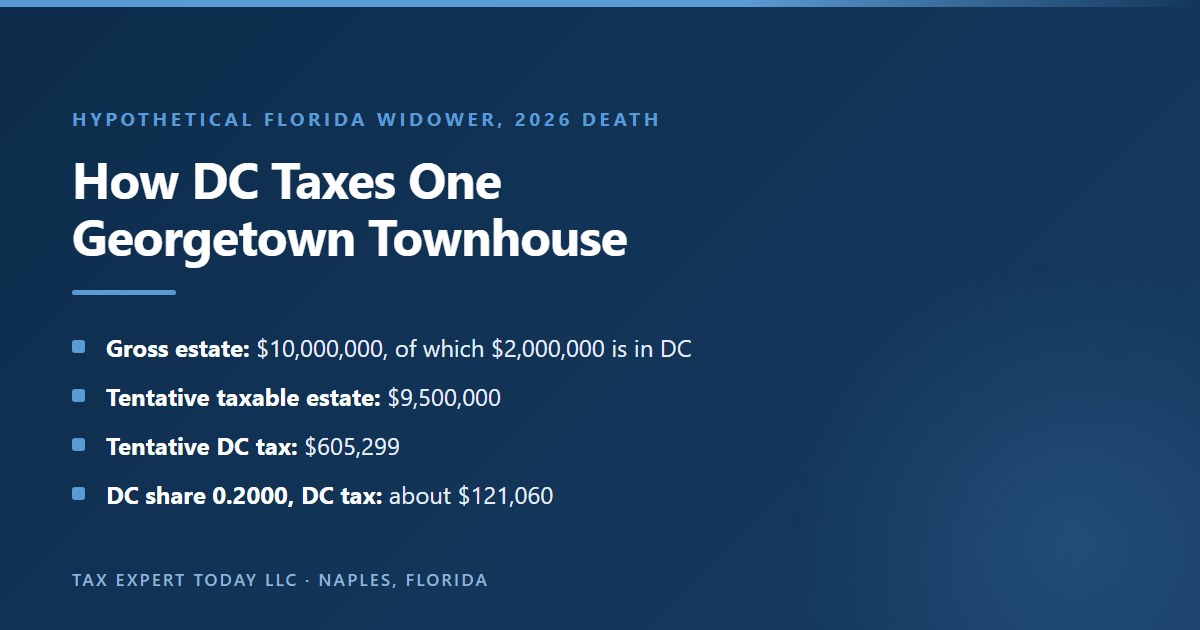
Here is the whole method on one hypothetical estate. A widowed Florida resident dies in 2026 owning a Georgetown townhouse worth $2,000,000, a Naples home worth $2,500,000 and a brokerage account of $5,500,000. The gross estate is $10,000,000. Funeral costs, administration expenses and final debts total $500,000.
| Worksheet line | Hypothetical amount | How it is found |
|---|---|---|
| 1. Tentative taxable estate | $9,500,000 | $10,000,000 gross estate minus $500,000 of deductions |
| 2. DC tentative tax | $605,299 | $529,299 plus 15.2 percent of the $500,000 above $9,000,000 |
| 3. Gross value of DC property | $2,000,000 | The Georgetown townhouse only |
| 4. Total gross estate | $10,000,000 | Everything, wherever located |
| 5. Percent of property in DC | 0.2000 | $2,000,000 divided by $10,000,000 |
| 6. DC estate tax due | $121,060 | 0.2000 times $605,299, rounded |
Illustrative only. The federal estate tax on the same estate is zero, because $9,500,000 is well under the $15,000,000 federal exclusion. The entire death tax bill in this example belongs to the District, and it exists because of one townhouse.
What Are the DC Estate Tax Rates Above the Exclusion?
Above the $4,988,400 exclusion, DC estate tax rates start at 11.2 percent and rise by 0.8 percentage points for each additional $1,000,000, reaching 15.2 percent between $9,000,000 and $10,000,000 and 16 percent on everything above $10,000,000. The rates apply only to the slice of estate inside each band, not to the whole estate.
- 11.2 percent: from $4,988,400 to $5,000,000 for 2026 deaths.
- 12 to 15.2 percent: the $1,000,000 bands from $5,000,000 to $10,000,000.
- 16 percent: every dollar above $10,000,000.
- Bands below the exclusion: the 6.4 to 10.4 percent bands in the statute are absorbed by the zero bracket.
The statute in §47-3702(a-1)(1) lists bands beginning at $1,000,000, with rates of 6.4, 7.2, 8, 8.8, 9.6 and 10.4 percent on the lower slices. Because the zero bracket now exceeds $4,000,000, every one of those lower bands sits inside the zero bracket and produces no tax. In practice the first dollar of DC estate tax for a 2026 death is taxed at 11.2 percent. The OTR computation table for 2026 deaths shows exactly that.
| Taxable estate over | But not over | Tax on the lower amount | Rate on the excess |
|---|---|---|---|
| $4,988,400 | $5,000,000 | $0 | 11.2% |
| $5,000,000 | $6,000,000 | $1,299 | 12.0% |
| $6,000,000 | $7,000,000 | $121,299 | 12.8% |
| $7,000,000 | $8,000,000 | $249,299 | 13.6% |
| $8,000,000 | $9,000,000 | $385,299 | 14.4% |
| $9,000,000 | $10,000,000 | $529,299 | 15.2% |
| $10,000,000 | and above | $681,299 | 16.0% |
Source: OTR computation worksheet for estates of individuals who died on January 1, 2026 or after, in the 2026 D-76 instructions. The table gives the tentative tax for a resident or the starting point for a nonresident, before the DC percentage is applied.
Effective rates on the whole estate are far below the marginal rates, which is why headline figures can mislead in both directions. The following illustrations use the 2026 table on the full tentative taxable estate, before any nonresident fraction.
| Tentative taxable estate | Tentative DC tax | Effective rate on the whole estate |
|---|---|---|
| $5,000,000 | $1,299 | 0.03% |
| $6,000,000 | $121,299 | 2.02% |
| $7,500,000 | $317,299 | 4.23% |
| $10,000,000 | $681,299 | 6.81% |
| $12,000,000 | $1,001,299 | 8.34% |
| $15,000,000 | $1,481,299 | 9.88% |
| $20,000,000 | $2,281,299 | 11.41% |
Hypothetical amounts, computed from the 2026 table. For a resident these are the tax. For a Florida resident they are only line 2 of the worksheet, and the actual bill is this figure times the DC share.
Is the DC Estate Tax a Cliff?
No. The DC estate tax is not a cliff. An estate at or below the $4,988,400 exclusion owes nothing, and an estate slightly above it owes tax only on the excess, starting at 11.2 percent. A taxable estate of $5,000,000 owes about $1,299 in tentative tax, not a tax on the full $5,000,000.
- Zero bracket, not a credit that vanishes: the excluded amount stays excluded no matter how large the estate grows.
- Gradual entry: the first $11,600 above the 2026 line costs 11.2 percent of that slice.
- Contrast with New York: the New York exclusion phases out above the basic exclusion amount, which is why that tax is called a cliff.
The phrase “cliff” comes up because Florida movers often hear about the New York estate tax cliff, where an estate that exceeds the New York exclusion by more than five percent loses the exclusion entirely. The District does not work that way. The zero bracket amount in §47-3701(14) is taxed at zero percent under §47-3702(a-1)(1) regardless of the size of the estate, and only the incremental value above it is taxed.
The jump from zero to 11.2 percent is still steep. In a hypothetical estate where the taxable estate rises from $4,988,400 to $5,100,000, the tentative tax goes from zero to $13,299. If that estate belongs to a Florida resident with a $1,500,000 DC condominium in a $5,100,000 gross estate, the DC share is 0.2941 and the DC tax is about $3,911. Small, but not zero, and a return is required because the gross estate exceeds the filing line.
The practical point is that estates near the line deserve a careful valuation. A certified appraisal of the DC property is required with the return, and the 2026 instructions say the value must be based on fair market value appraisals. A conservative but supportable appraisal near the line can move an estate in or out of the tax altogether.
Why Does the DC Exclusion Change Every January?
The DC exclusion changes every January because §47-3701(14)(D) sets it at $4,000,000 for deaths after 2020 and increases it each year by a cost of living adjustment based on the Washington-Baltimore consumer price index. The year of death fixes the amount, so a 2025 death uses $4,873,200 and a 2026 death uses $4,988,400.
- Base: $4,000,000 for decedents dying after December 31, 2020.
- Index: CPI for the Washington-Baltimore area, measured for the 12 months ending July 31, against a 2017 base year.
- Announcement: OTR publishes the next year’s amount each autumn.
- Old figures: pages quoting $1,000,000, $5,600,000 or $5,762,400 describe earlier years.
The history explains why search results are so inconsistent. The District cut the exclusion from $5,762,400 for 2020 deaths to $4,000,000 for 2021 deaths, then resumed indexing. A law firm alert from 2020 that warned of the cut still ranks, and so do pages from 2016 when the line was $1,000,000. The OTR estate page and the 2026 instructions list each year’s filing threshold:
| Year of death | DC filing threshold and zero bracket |
|---|---|
| 2003 through 2016 | $1,000,000 |
| 2017 | $2,000,000 |
| 2018 | $5,600,000 |
| 2019 | $5,681,760 |
| 2020 | $5,762,400 |
| 2021 | $4,000,000 |
| 2022 | $4,254,800 |
| 2023 | $4,528,800 |
| 2024 | $4,715,600 |
| 2025 | $4,873,200 |
| 2026 | $4,988,400 |
Source: OTR, DC Estate, Inheritance and Fiduciary Tax Information, and the 2026 D-76 instructions. Before 2016 the District computed its tax differently, as a share of the old federal state death tax credit, so pre-2016 figures are not comparable.
The District also changes this law through its annual Budget Support Acts rather than standalone estate tax bills. The fiscal impact statement for the Fiscal Year 2027 Budget Support Act of 2026 contains no estate tax subtitle as circulated in July 2026, but the 2027 exclusion is set by the indexing formula and will be announced separately. Anyone planning around a specific number should confirm the figure for the year in question.
Does the DC Estate Tax Apply After You Move to Florida?
Yes, but only to property with a DC taxable situs. Once you are domiciled in Florida, the District cannot tax your brokerage accounts, retirement accounts or Florida home. It can tax DC real estate and tangible property kept in DC, using the full rate schedule on your whole estate multiplied by the DC share of the gross estate.
- Still taxable: a DC house, condominium, rental building or land you own in your own name or through a revocable trust.
- Still taxable: furniture, art and other tangibles customarily kept in the DC property.
- Not taxable: stocks, bonds, bank accounts and other intangibles of a Florida domiciliary, unless used in a DC business.
- The threshold test uses the whole estate: a $1,500,000 townhouse in a $4,000,000 estate owes nothing.
Under §47-3701(8), a nonresident is a decedent who was domiciled outside the District at death. The statute taxes a nonresident’s taxable estate having its taxable situs in the District, and the computation in §47-3703(b-1) is the tax determined under the resident schedule multiplied by a fraction: DC situs gross estate over the whole gross estate.
The filing line works on the whole estate, not just the DC part. Section 47-3705(a)(2) says no return is required if the gross estate does not exceed $1,000,000 or the zero bracket amount, whichever is higher. A Florida resident with a $1,500,000 DC rowhouse and $2,500,000 of other assets has a $4,000,000 gross estate, below the 2026 line, so there is no DC return and no DC tax. Add $1,000,000 of portfolio growth and the same rowhouse is now inside a taxable estate.
The move itself has to be real for any of this to work. The domicile question is covered below and in depth in our guides to establishing Florida residency and defending a Florida residency audit. If the District could show the decedent was still domiciled in DC at death, the whole estate would be taxed, with only a reduction for real and tangible property located elsewhere.
What Property Has a DC Tax Situs for a Florida Resident?
For a Florida resident, DC tax situs covers real property located in the District and tangible personal property customarily kept there at death. Intangible property, such as securities, bank accounts and notes, follows the owner’s domicile and is outside the DC tax, unless it is used in a trade or business carried on in the District.
- Real property: situs is where the property sits, under §47-3701(12A)(A).
- Tangible personal property: situs is where it is customarily located at death, under §47-3701(12A)(B).
- Intangibles: situs is the decedent’s domicile, under §47-3701(12A)(C).
- Business exception: intangibles used in a DC trade or business have DC situs regardless of domicile.
The definitions in D.C. Code §47-3701(12A) are short, and the 2026 D-76 instructions add practical guidance. The instructions say the physical location of bank accounts, certificates of deposit, notes, securities and bonds is not controlling, so a checking account at a branch on Wisconsin Avenue is a Florida asset for a Florida domiciliary. They also address three ownership structures that come up constantly for DC property owners.
| Asset of a Florida domiciliary | DC taxable situs? | Basis in the OTR guidance |
|---|---|---|
| DC townhouse owned in your own name | Yes | Real property is taxed where situated |
| DC condominium held in a revocable trust | Yes | Trust entity is disregarded; generally accepted situs rules apply |
| Furniture, art and wine kept in the DC townhouse | Yes | Tangibles are taxed where customarily located |
| Brokerage account with a DC branch office | No | Intangibles are taxed at domicile; physical location is not controlling |
| Partnership interest in an entity owning DC real estate | Generally no, subject to the business situs rule | Partnership property is treated as intangible |
| Interest in a business operating in DC | Possibly yes | Intangibles used in a DC trade or business have DC situs |
| Location of the trustee | Not decisive | Trustee residence does not determine situs of trust assets |
Tangible property is the overlooked item. A townhouse full of antiques, a piano, paintings or a wine collection can add meaningfully to the DC numerator. If items were moved to Naples before death, they are customarily located in Florida. If they stayed in DC, they count. Families who intend to keep the DC home as a family base should know which contents sit where and why.
Retirement accounts deserve a word because they are often the largest asset. An IRA or 401(k) is intangible property, so for a Florida domiciliary it has no DC situs. It still counts in the gross estate, which means it enlarges the denominator of the DC fraction and, as the next sections show, raises the tentative tax that the fraction is applied to.
How Does the DC Nonresident Fraction Work?
The DC nonresident fraction is the value of gross estate property with a DC taxable situs divided by the value of the whole gross estate, rounded to four decimal places. The District applies that fraction to the tax computed on the entire tentative taxable estate, so deductions reduce the tax but do not change the fraction itself.
- Numerator: gross value of DC real estate and DC tangibles.
- Denominator: total gross estate, including Florida property, accounts and life insurance.
- Applied to: the tentative tax on the full tentative taxable estate, after deductions.
- Rounding: four decimal places, per the 2026 instructions.
The rule is in §47-3703(b-1): the tax is the amount determined under §47-3702(a-1) multiplied by a fraction, the numerator of which is the value of that part of the gross estate with a DC taxable situs and the denominator of which is the nonresident decedent’s gross estate. Both parts of the fraction are gross figures. Deductions lower the tentative tax in the multiplication, not the share.
That structure has three consequences that are easy to miss.
First, the District effectively taxes the DC property at the marginal rate of the whole estate, not at the rate the DC property would bear alone. A $2,000,000 townhouse would never produce DC tax standing alone, because $2,000,000 is below the exclusion. Inside a $10,000,000 estate, it bears one fifth of a tax computed at rates reaching 15.2 percent.
Second, a deduction that relates only to the DC property, such as a mortgage on the townhouse, reduces the DC tax only by its share. A recourse mortgage of $800,000 lowers the tentative taxable estate by $800,000, but only 20 percent of the resulting tax saving reaches the DC bill if DC property is one fifth of the estate.
Third, the marital and charitable deductions work the same way. A bequest of everything to a surviving spouse produces a zero tentative taxable estate and therefore zero DC tax, regardless of the fraction. A partial charitable bequest of Florida assets still reduces the DC tax, because it lowers line 1 of the worksheet even though none of the donated property was in DC.
| Change to the estate | Effect on DC fraction | Effect on DC tax |
|---|---|---|
| More Florida or intangible assets | Smaller | Usually larger, because the tentative tax rises faster than the fraction falls |
| Recourse mortgage on the DC home | None | Smaller, by the DC share of the tax saving |
| Charitable bequest of Florida assets | None | Smaller, by the DC share of the tax saving |
| Marital deduction for everything | None | Zero at the first death |
| Selling the DC home and holding cash | Zero | Zero, though the cash raises nothing in DC |
Why Does a Larger Florida Portfolio Raise the Tax on a DC Townhouse?
A larger Florida portfolio raises the DC tax on a DC townhouse because the tentative tax is computed on the whole estate at graduated rates, so it grows faster than the DC fraction shrinks. In the 2026 illustrations, one $2,000,000 townhouse owes nothing in a $4,000,000 estate and about $246,504 in a $25,000,000 estate.
- Below the line: a $2,000,000 townhouse in a $4,000,000 estate owes nothing.
- Mid estates: the tax climbs steeply between $5,000,000 and $10,000,000.
- Large estates: growth continues, more slowly, as the fraction falls.
- Planning lesson: the DC tax on one property depends on assets the District cannot tax directly.
The table below holds the townhouse at $2,000,000 and assumes no deductions, so the tentative taxable estate equals the gross estate. Only the size of the rest of the estate changes.
| Gross estate | Tentative DC tax | DC fraction | DC tax on the townhouse |
|---|---|---|---|
| $4,000,000 | $0 (below the line) | 0.5000 | $0 |
| $5,000,000 | $1,299 | 0.4000 | $520 |
| $6,000,000 | $121,299 | 0.3333 | $40,429 |
| $8,000,000 | $385,299 | 0.2500 | $96,325 |
| $10,000,000 | $681,299 | 0.2000 | $136,260 |
| $15,000,000 | $1,481,299 | 0.1333 | $197,457 |
| $25,000,000 | $3,081,299 | 0.0800 | $246,504 |
Hypothetical illustrations using the 2026 table, rounded to the dollar. Real estates have deductions, and values change, so actual figures differ.
Read across the table, the effective DC rate on the townhouse itself runs from zero to about 12.3 percent of its value. That is the number that matters when a family is deciding whether to keep, sell, give away or restructure the property. It is also why a recent inheritance, a business sale or a strong market year can change the DC answer without anything happening to the townhouse. Our guide to moving to Florida before selling a business covers the income tax side of a liquidity event; the estate side is that the proceeds, once in a Florida account, enlarge the base the DC fraction is applied to.

How Do Mortgages, Deductions and Life Insurance Change the DC Result?
Mortgages, deductions and life insurance change the DC result differently. A recourse mortgage is a deduction that lowers the tentative tax but not the fraction. A nonrecourse mortgage may reduce the DC property’s gross value and so the fraction. Owned life insurance enlarges the gross estate and raises the tentative tax while lowering the fraction.
- Recourse debt: full property value in the numerator, debt deducted from the taxable estate.
- Nonrecourse debt: generally only the equity is included, so the numerator falls.
- Owned life insurance: an intangible with no DC situs that still enlarges the estate.
- Insurance trust: a policy owned by an irrevocable trust is generally outside the gross estate.
The difference between recourse and nonrecourse debt comes from federal estate tax practice. Where the decedent was personally liable on a mortgage, the full value of the property is reported on Schedule A of Form 706 and the mortgage is deducted on Schedule K. Where the decedent was not personally liable, generally only the equity is reported. Because the District builds its computation from the federal schedules, the same distinction flows into the DC fraction. The 2026 D-76 instructions list “Schedule K, Mortgages and Liens” as a deduction line.
| Hypothetical: $8,000,000 of Florida assets plus a $2,000,000 DC townhouse with an $800,000 mortgage | Recourse mortgage | Nonrecourse mortgage |
|---|---|---|
| Gross estate | $10,000,000 | $9,200,000 |
| DC property in the numerator | $2,000,000 | $1,200,000 |
| Tentative taxable estate | $9,200,000 | $9,200,000 |
| Tentative DC tax | $559,699 | $559,699 |
| DC fraction | 0.2000 | 0.1304 |
| DC estate tax | $111,940 | $72,985 |
Illustrative only; whether a particular loan is nonrecourse depends on the loan documents and state law, and residential mortgages are commonly recourse. Refinancing solely for a DC estate tax result is rarely sensible on its own, but when a family is already considering financing, the form of the debt is worth reviewing.
Life insurance pulls the other way. A policy owned by the decedent is included in the gross estate under federal rules. For a Florida domiciliary it is an intangible with no DC situs, so it lowers the fraction, but it also raises the tentative tax. In the core example above, adding a $2,000,000 owned policy raises the gross estate to $12,000,000 and the tentative taxable estate to $11,500,000. The tentative tax becomes $921,299, the fraction becomes 0.1667, and the DC tax rises from $121,060 to about $153,581. Moving the policy into an irrevocable life insurance trust well before death would generally remove it from the estate, subject to the federal three year rule for transferred policies. Insurance sales pages tend to present life insurance as the way to pay a DC bill; the computation shows that insurance owned in the wrong way can also enlarge it.
How Does DC Decide Where You Were Domiciled at Death?
For the DC estate tax, the only question is domicile at death: the place you intended to make your permanent home. The 183 day statutory residency rule that applies to DC income tax does not decide estate tax residence. A Florida domicile is proven by conduct and records, and a DC home kept and used heavily invites a challenge.
- Estate tax test: a resident is a decedent domiciled in DC at death, under §47-3701(10).
- Income tax test: domicile or a DC place of abode for 183 days or more in the year, under §47-1801.04(42).
- Florida evidence: declaration of domicile, homestead, driver license, voter registration, vehicle, doctors, will.
- DC evidence against you: DC homestead deduction, DC voter registration, a DC income tax return filed as a resident.
The estate tax definitions in §47-3701(8) and (10) turn on domicile alone. The income tax definition in §47-1801.04(42) is broader: a resident is anyone domiciled in DC during the year and anyone who maintains a place of abode in DC for an aggregate of 183 days or more. A Florida domiciliary who spends 190 days in a DC townhouse can therefore be a DC income tax resident for that year while remaining a nonresident for estate tax purposes. That gap is not a planning opportunity; heavy DC presence is also evidence in any later domicile dispute, and a DC resident income tax return filed in the final years is a document the District can point to.
If the District showed the decedent was still domiciled in DC, the resident computation in §47-3702(a-1)(2) applies: the tax on the whole estate is reduced only by the proportion that real and tangible property outside DC bears to the gross estate. Brokerage accounts would be fully in.
| Core hypothetical: $10,000,000 gross estate, $500,000 of deductions | Florida domicile proven | DC domicile found |
|---|---|---|
| Tentative DC tax | $605,299 | $605,299 |
| What reduces it | Fraction limited to DC situs property (0.2000) | Reduction for out of DC real property only (Naples home, 25 percent) |
| DC estate tax | $121,060 | $453,974 |
| Difference | About $332,914 turns on the domicile record | |
Hypothetical. The Florida side of the record is built with the tools in our Florida residency guide, including a declaration of domicile under Fla. Stat. §222.17 and the permanent residence factors in Fla. Stat. §196.015. Our Florida 183 day rule calculator helps track where the days actually go, and our guide to the dual state residency trap explains why day counts and domicile are separate tests.
Can the DC Homestead Deduction Undercut a Florida Move?
Yes. The DC homestead deduction is available only for a residence of an owner who is domiciled in the District, so continuing to receive it after a Florida move is a statement on the property tax rolls that you still live in DC. It also conflicts with a Florida homestead exemption, which requires Florida permanent residence.
- DC definition: “residence” means the principal place of residence of an individual who is domiciled in the District.
- Application: certified under penalty of perjury, under §47-850(b).
- Florida side: the Florida homestead exemption requires the property to be the owner’s permanent residence.
- Action: notify OTR when the DC home stops qualifying, and keep the confirmation.
The definition is in D.C. Code §47-849(1), which defines a residence for the homestead program as the principal place of residence within the District of an individual who is domiciled in the District. The deduction itself is in §47-850, and the application is certified under penalty of perjury. A homestead deduction left in place for years after the move is the kind of record that an estate tax examiner can find without asking anyone.
The same logic applies to senior citizen property tax relief and other DC programs tied to owner occupancy, to DC voter registration, and to a DC driver license. None of these alone decides domicile, but each is a public statement about where the owner lives. The Florida record should be consistent, and the DC record should stop contradicting it on the date of the move.
| Record | What to do after a genuine move |
|---|---|
| DC homestead deduction | End it once the DC home is no longer your domiciliary residence |
| DC voter registration | Cancel it and register in your Florida county |
| DC driver license and vehicle registration | Replace with Florida within the Florida deadlines |
| DC income tax filing status | Part year resident in the move year, then nonresident if under 183 days of DC abode |
| Florida declaration of domicile | File under Fla. Stat. §222.17 with the clerk of your county |
| Will and trust | Re-sign under Florida law naming Florida as domicile |
What Happens if DC and Another State Both Claim Your Domicile?
If the District claims a decedent was domiciled in DC and another state makes the same claim, D.C. Code §47-3704 lets the Mayor compromise the DC tax. Florida has no estate tax, so a Florida claim rarely produces a dispute, but DMV families who also owned a Maryland home can face competing domicile claims from two taxing jurisdictions.
- Compromise authority: §47-3704 applies where DC and another state both claim domicile.
- Florida estates: Florida does not tax the estate, so the contest is usually DC against the Florida record, not against Florida.
- DMV overlap: a decedent with DC and Maryland homes can be claimed by both.
- Best defense: a clean, documented move made well before death.
The text of §47-3704 is short: where the Mayor claims a decedent was domiciled in the District and the taxing authorities of another state make a similar claim, the Mayor may compromise the tax. The provision exists because domicile disputes between taxing states can otherwise lead to the same estate being taxed twice.
For a Florida mover the more common pattern is a family that lived in Chevy Chase, Maryland or Bethesda, owned a DC condominium for a child or for work, and then moved to Naples. Maryland has its own estate tax and its own inheritance tax, explained in our guide to the Maryland estate tax for Florida residents. Each jurisdiction taxes its own real estate after a genuine move, and each would tax far more if it established domicile. The planning work is the same in both places: make the Florida domicile clear, and decide deliberately what to do with each property left behind. Where both a Maryland house and a DC condominium remain, the estate faces two separate nonresident computations, each using the whole estate as its base.
Does Holding DC Real Estate in an LLC or Trust Change the DC Estate Tax?
A revocable trust does not change the DC estate tax, because the District disregards the trust. A partnership is different: the OTR instructions treat real estate held by a partnership as intangible property taxed at the owner’s domicile, which can remove DC situs for a Florida resident, subject to the business situs rule.
- Revocable trust: the trust entity is disregarded, so the DC townhouse stays DC property.
- Partnership or multi member LLC: OTR treats partnership property as intangible, taxable at domicile.
- Business situs exception: intangibles used in a DC trade or business keep DC situs.
- Costs: transfer and recordation taxes, lost homestead treatment, valuation questions and loan consent.
The 2026 D-76 instructions are explicit on both points. Under the heading for personal trusts, they say assets held in a personal trust have a taxable situs in accordance with generally accepted situs rules and that the trust entity is disregarded. Under partnership property, they say partnership property is treated as intangible personal property regardless of the character of the property, and they give the example that real estate held by a partnership is intangible personal property taxable at the decedent’s domicile.
That second sentence is the most significant planning statement in the DC guidance for a Florida domiciliary, and it needs to be read with the sentence that follows it. Intangible personal property used in a trade or business in DC has a DC taxable situs regardless of the domicile of the owner, under §47-3701(12A)(C). A partnership that operates DC rental property as a business may raise the argument that its interests are used in a DC trade or business. How the District applies that exception to a particular rental entity is a question to confirm with DC counsel before relying on any structure.
| Ownership of a $2,000,000 DC townhouse, core hypothetical estate | DC situs under the OTR guidance | Hypothetical DC tax | Main issues to weigh |
|---|---|---|---|
| Individual name | Yes | $121,060 | Simple; DC ancillary probate is commonly needed |
| Revocable trust | Yes, trust disregarded | $121,060 | Avoids DC probate, does not avoid the tax |
| Partnership or multi member LLC, personal use | Generally no | $0 if respected | Substance, transfer taxes, valuation, homestead loss |
| Partnership or LLC operating a DC rental business | Uncertain; business situs rule | $0 to $121,060 | Whether interests are used in a DC trade or business |
Illustrative only. Single member limited liability companies raise an additional question, because an entity that is disregarded for federal income tax purposes is still a separate legal entity under state property law, and the OTR guidance speaks to partnerships specifically. A structure put in place close to death, with no purpose other than avoiding DC estate tax, or one in which the decedent kept living in the house without paying rent, invites scrutiny. Transfers of DC real property, and of controlling interests in entities that own DC real property, can also trigger DC recordation and transfer taxes, and a lender may need to consent. The transfer may change income tax basis planning as well, so the estate tax saving should be compared against all of these costs, not looked at alone.
Revocable trusts still have a role. Holding the townhouse in a revocable trust generally avoids an ancillary probate in the District for that property, which can save the family time and cost. It just does not change the DC estate tax. Our guide to Florida estate planning for new residents covers how a Florida revocable trust is usually set up after the move.
Should You Sell the DC Townhouse Before You Die?
Selling the DC townhouse before death removes it from the DC estate tax, because a Florida domiciliary’s cash proceeds have no DC situs. The trade is that a lifetime sale triggers capital gain, while property held until death generally receives a stepped up basis under IRC §1014, which often matters more for older owners.
- Sell now: DC estate tax on the property becomes zero; federal capital gains tax applies to the gain.
- Hold until death: DC estate tax applies; heirs generally take a basis equal to value at death.
- Home sale exclusion: IRC §121 may shelter up to $250,000 or $500,000 if the townhouse was your main home for two of the last five years.
- DC income tax: the District cannot tax a nonresident individual’s personal income, including generally the gain on the sale.
Consider a hypothetical Florida couple whose townhouse is worth $2,000,000 and was bought decades ago for $600,000, leaving a $1,400,000 gain. Their combined estate puts the townhouse inside a DC computation that produces about $121,060 of DC tax, as in the core example.
| Hypothetical choice | Federal capital gains cost now (20% plus 3.8% NIIT) | DC estate tax later | Basis for heirs |
|---|---|---|---|
| Sell after the §121 window has closed | About $333,200 on a $1,400,000 gain | $0 on the townhouse | Not applicable; cash |
| Sell within the §121 window, joint exclusion of $500,000 | About $214,200 on $900,000 of taxable gain | $0 on the townhouse | Not applicable; cash |
| Hold until death | $0 | About $121,060 | Stepped up to value at death under §1014 |
Illustrative only, assuming the gain is fully taxed at the top federal rates; actual rates depend on income, depreciation recapture if the property was rented, and state rules. The federal rules are in IRC §121 and IRC §1014.
On the DC side, the Home Rule Act in D.C. Code §1-206.02(a)(5) bars the Council from imposing any tax on the personal income of an individual who is not a DC resident, using the income tax definition of resident. A genuine Florida domiciliary who did not keep a DC place of abode for 183 days or more in the year of sale is therefore generally outside DC income tax on the gain, though DC recordation and transfer taxes on the deed still apply in the ordinary way.
The answer depends heavily on the gain, the owner’s age and health, the size of the rest of the estate and whether the family wants to keep the property. The window for the home sale exclusion is time sensitive: under §121, the townhouse must have been owned and used as the main home for two of the five years before the sale, so a sale soon after the move to Florida may preserve the exclusion and a sale several years later will not. Our guide to selling your home after moving to Florida works through that window in detail.
Does DC Have a Gift Tax or Add Back Lifetime Gifts?
The District does not impose a gift tax, and the DC estate tax is computed on the taxable estate at death without adding back lifetime gifts. A DC townhouse given away during life is generally outside the DC estate, unless federal rules such as retained use pull it back, and the recipient takes the donor’s basis.
- No DC gift tax: Chapter 37 of Title 47 taxes transfers at death.
- No add back: the worksheet starts from the taxable estate, not from taxable estate plus adjusted taxable gifts.
- Retained use: keep living in a gifted house rent free and IRC §2036 can pull it back into the estate.
- Basis cost: a gift carries over the donor’s basis, so the built in gain moves to the recipient.
The DC computation starts from the tentative taxable estate on line 1 of the worksheet, which the statute defines by reference to IRC §2051, the federal taxable estate. Adjusted taxable gifts are added only in the separate federal tax computation under IRC §2001(b), and the DC worksheet does not include them. A gift of the townhouse therefore takes it out of both the numerator and the denominator, and it shrinks the tentative tax as well.
| Hypothetical: gift of the $2,000,000 townhouse to the children in a $10,000,000 estate | Before the gift | After the gift, if respected |
|---|---|---|
| Gross estate at death | $10,000,000 | $8,000,000 |
| DC property in the estate | $2,000,000 | $0 |
| DC estate tax | About $121,060 | $0 |
| Federal gift tax | None | None owed if within the $15,000,000 lifetime exclusion, but a federal gift tax return is required |
| Children’s basis | Value at death if inherited | Parents’ original basis, $600,000 in this example |
Illustrative only. The retained use problem is real for DMV families. Under IRC §2036, property transferred while the transferor keeps possession or enjoyment is included in the gross estate. A parent who gives the townhouse to the children and then continues to stay there for months each year without paying fair rent risks inclusion at full value, which would bring the DC tax back. A qualified personal residence trust, explained in our guide to the qualified personal residence trust, is one structure built to allow continued use for a term. Families weighing larger lifetime transfers of Florida assets, which lower the whole estate base the DC fraction is applied to, often compare a grantor retained annuity trust, an intentionally defective grantor trust and a dynasty trust.
One further caution. The DC definitions in §47-3701(6) tie “Internal Revenue Code” to the Code in effect for federal estate tax purposes on January 1, 2001, unless a different meaning is clearly required. Most of the inclusion rules that matter here predate 2001, but any plan that relies on a newer federal provision should be checked against that definition before it is relied on for DC purposes.
Can Married Couples Use Portability for the DC Estate Tax?
No. The DC estate tax has no portability. Each spouse has his or her own $4,988,400 zero bracket for 2026 deaths, and an amount unused at the first death is lost for DC purposes. Federal portability of a deceased spouse’s unused exclusion does not carry over to the District computation.
- Federal law: a timely filed Form 706 can pass the unused federal exclusion to the survivor.
- DC law: the zero bracket applies per decedent with no transfer provision.
- The trap: everything to the spouse outright wastes the first spouse’s DC zero bracket.
- The usual fix: a credit shelter or bypass trust funded at the first death.
The federal rule is described on the IRS estate tax page: estates of decedents survived by a spouse may elect to pass any unused exemption to the surviving spouse. Chapter 37 of Title 47 contains no equivalent. The zero bracket in §47-3701(14) is applied in each decedent’s computation, and the marital deduction under IRC §2056 defers tax to the survivor rather than using the first spouse’s bracket.
For a couple whose combined estate sits well above $15,000,000, federal planning already pushes toward using both exclusions. For a couple in the $5,000,000 to $15,000,000 range, federal tax may be zero either way, and that is exactly where the DC tax catches families who relied on federal portability alone.
| Feature | Federal estate tax | DC estate tax |
|---|---|---|
| 2026 exclusion per person | $15,000,000 | $4,988,400 |
| Portability to surviving spouse | Yes, by election on a timely Form 706 | No |
| Top rate | 40 percent | 16 percent |
| Marital deduction | Yes | Yes, and extended to registered domestic partners |
| Lifetime gifts added back | Yes, adjusted taxable gifts | No |
| Return due | 9 months after death | 10 months after death |
The federal top rate of 40 percent is in IRC §2001(c). The DC extension of the marital deduction to domestic partners comes from §47-3701(5)(B) and (12)(C).
How Should a Florida Couple Plan Around a DC Property?
A Florida couple with a DC property can often eliminate the DC estate tax at both deaths by passing the DC property, or the first spouse’s share, into a credit shelter trust at the first death. The trust uses the first spouse’s DC zero bracket, and the property stays outside the survivor’s estate.
- Outright to spouse: zero DC tax at the first death, full exposure at the second.
- Credit shelter trust holding the DC property: zero at the first death if the trust stays within the zero bracket, and the property is outside the survivor’s estate.
- Joint ownership: spouses’ joint property is generally half included at the first death under IRC §2040(b).
- Trade off: trust assets do not receive a second basis step up at the survivor’s death.
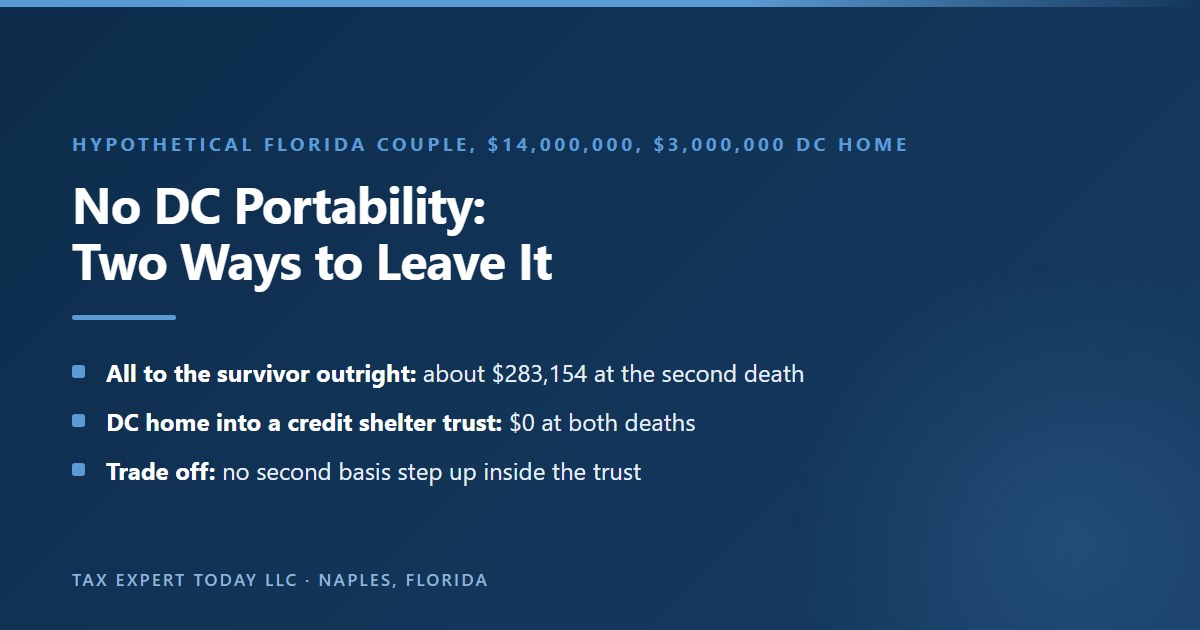
Consider a hypothetical Florida couple with a combined estate of $14,000,000, including a $3,000,000 Capitol Hill townhouse owned by one spouse. Assume no growth and no deductions to keep the comparison clean.
| Hypothetical plan | DC tax at first death | DC tax at survivor’s death | Total DC tax |
|---|---|---|---|
| Everything to the survivor outright | $0 (marital deduction) | $1,321,299 tentative tax times 0.2143 = about $283,154 | About $283,154 |
| Townhouse into a credit shelter trust, rest to the survivor | $0 ($3,000,000 is inside the zero bracket) | $0 (survivor holds no DC property) | $0 |
Illustrative only. At the first death the estate still files a D-76 if the gross estate meets the filing line, even when the tax is zero. The D-76EZ is available only when the estate passes entirely to the surviving spouse, to charity or a combination producing a zero taxable estate. At the survivor’s death, the federal estate tax on $11,000,000 is zero, and the survivor’s estate has no DC situs property, so no DC computation produces tax.
Joint ownership changes the arithmetic. Under IRC §2040(b), property held jointly by spouses with right of survivorship is generally half included in the first spouse’s estate, and the whole property then belongs to the survivor. Tenancy by the entirety, common for married DC homeowners, therefore puts the full townhouse into the survivor’s estate unless the plan does something about it. Retitling the property, or using a disclaimer into a trust at the first death, are tools to discuss with counsel; each has income tax and creditor protection consequences that need to be weighed.
The credit shelter approach has a cost: property in the trust receives a basis step up at the first death but not at the second. For a townhouse expected to appreciate substantially after the first death, the lost second step up can partly offset the DC saving. That comparison belongs in the plan, using the family’s own figures. Couples where one spouse is not a United States citizen should also read our guide to the qualified domestic trust, because the federal marital deduction rules differ.
How Does the DC Estate Tax Interact With the Federal Estate Tax?
The DC estate tax and the federal estate tax are separate taxes computed on the same gross estate. For 2026 deaths, most estates that owe DC tax owe no federal tax, because the federal exclusion is $15,000,000 per person. Where both apply, the DC tax paid is generally deductible on the federal return under IRC §2058.
- Under $4,988,400: no DC tax and no federal tax.
- Between $4,988,400 and $15,000,000: DC tax possible, federal tax generally zero for a single decedent.
- Above $15,000,000: both taxes may apply; the DC tax is a federal deduction.
- Form 706 schedules: required for the DC return even when no federal return is filed.
The overlap between the two systems is mostly in paperwork. The 2026 D-76 instructions say certain schedules from the current IRS Form 706 must be prepared before completing the DC return, whether or not a federal return is filed, and that pages 1 through 3 and Schedules A through O are uploaded with the D-76. A personal representative of a $7,000,000 Florida estate with a DC condominium may file no federal estate tax return at all, apart from any portability election, yet still prepare most of a Form 706 to file in the District.
Where both taxes apply, IRC §2058 allows a federal deduction for estate taxes actually paid to a state or the District. The DC computation, as noted, does not allow the reverse deduction. If the federal return is later amended or adjusted, D.C. Code §47-3708 requires an amended DC return within 30 days after the amended federal return is filed, and written notice to the District within 30 days of a final federal deficiency determination.
| Gross estate of a single Florida decedent with DC property | DC estate tax | Federal estate tax, 2026 |
|---|---|---|
| Below $4,988,400 | None, no DC return | None |
| $4,988,400 to $15,000,000 | Possible, depending on DC share | Generally none |
| Above $15,000,000 | Likely | Possible on the excess, with a deduction for DC tax paid |
When Is the DC Estate Tax Return Due and What Happens If It Is Late?
The DC estate tax return and payment are due 10 months after death. A six month extension to file is available on Form D-77, but interest runs from the original due date at 10 percent a year, compounded daily. Late filing or payment carries a penalty of 5 percent a month, up to 25 percent.
- Due date: 10 months after death, under §47-3705(a) and (c).
- Extension to file: Form D-77 for six months, filed and paid electronically by the original due date.
- Federal extension rule: with a federal extension, the DC due date runs to 30 days after the federal extended date.
- Refund claims: within 3 years of payment, under §47-3705(d).
The statute in D.C. Code §47-3705 requires the personal representative to file within 10 months after death and to pay by the date the return is required to be filed. Ten months is longer than the nine months used by the federal return and by most states, which gives a Florida personal representative a little more time to obtain the DC appraisal and complete the Form 706 schedules.
The 2026 D-76 instructions set out the extension and penalty rules. A D-77 must be submitted on or before 10 months after death. An additional six month extension may be granted only if the personal representative is outside the United States or in an extreme emergency. The penalty for failure to file or pay on time is 5 percent of the unpaid tax for each month or fraction of a month, up to 25 percent, and it applies without regard to an extension of time to file. Interest is charged at 10 percent a year, compounded daily, from the original due date. The exception is where the personal representative has obtained a federal extension, in which case the tax is not due until the DC return is required to be filed. The OTR page notes that the District does not accept federal Form 4768 in place of its own extension form, though a copy is attached to the D-77 when a federal extension was obtained.
| Hypothetical: $121,060 of DC tax paid five months late with no valid extension | Approximate amount |
|---|---|
| Penalty at 5 percent a month for five months (capped at 25 percent) | $30,265 |
| Interest at 10 percent a year, compounded daily, for about 152 days | $5,147 |
| Total additions to tax | About $35,412 |
Illustrative only. The personal representative also carries a duty under D.C. Code §47-3713 to pay the tax, penalties and interest before distributing the estate, to the extent of assets under his or her control. A Florida executor who distributes the Naples accounts to the children before dealing with the DC return can end up personally exposed for a tax that the remaining assets cannot cover.
Which Estates Must File Form D-76, and What Must Be Attached?
A DC estate tax return is required when the gross estate reaches the zero bracket amount, $4,988,400 for 2026 deaths, and the estate is subject to DC tax, including a Florida resident’s estate with DC real estate. It is filed on MyTax.DC.gov with Form 706 schedules, an appraisal, the will and the death certificate.
- Form D-76: the standard return for estates with DC tax exposure.
- Form D-76EZ: for estates passing entirely to a spouse, to charity or a combination producing a zero taxable estate.
- Electronic only: returns for deaths in 2017 and later are filed and paid through MyTax.DC.gov.
- Payments over $5,000: must be made electronically.
The 2026 instructions say a D-76 or D-76EZ must be filed for a decedent’s gross estate of $4,988,400 or more, even if a federal estate tax return is not required. The OTR estate tax information page lists the documents generally attached.
| Document | Why the District asks for it |
|---|---|
| Pages 1 through 3 and Schedules A through O of Form 706, with attachments | The DC computation is built from the federal schedules |
| Certified appraisal of property | DC requires fair market value appraisals |
| Letters of administration | Shows who is authorized to act for the estate |
| Copy of the will | Shows who receives the DC property and any marital or charitable bequest |
| Death certificate | Fixes the date of death and the applicable year’s exclusion |
| Form D-77 and federal Form 4768, if applicable | Supports any extension claimed |
| Power of attorney, if applicable | Lets a representative deal with OTR |
The personal representative is defined broadly in §47-3701(9). If no personal representative is appointed and acting in the District, any person in actual or constructive possession of DC situs property included in the federal gross estate is treated as a personal representative to the extent of that property and the DC tax on it. A child living in the parents’ DC townhouse after their death can therefore be treated as responsible for the return on that property. The instructions also note that if the property was rental property during the decedent’s life, a D-30 unincorporated business franchise tax return should have been filed and any tax paid.
Florida families sometimes discover the DC requirement only when a buyer’s title company asks how the DC estate tax was resolved. Starting the DC return as soon as the Florida estate is opened avoids that delay.
Does DC Tax a Florida Resident’s Income From the Townhouse?
Generally, the District cannot tax a nonresident individual’s personal income, so a genuine Florida domiciliary who does not keep a DC place of abode for 183 days or more is outside DC individual income tax. DC rental activity can still bring a D-30 unincorporated business franchise tax filing, and DC real property tax continues regardless of residence.
- Home Rule Act bar: no DC tax on the personal income of nonresidents, under §1-206.02(a)(5).
- 183 day rule: a DC place of abode for 183 days or more makes you a DC income tax resident for that year.
- Rentals: OTR points rental owners to Form D-30, the unincorporated business franchise tax return.
- Property tax: owed on the DC property, without the homestead deduction once you leave.
The bar in D.C. Code §1-206.02(a)(5) is a limit Congress placed on the Council: it may not impose any tax on the whole or any portion of the personal income of an individual not a resident of the District, using the definitions in §47-1801.04. That makes the 183 day test unusually important. A Florida domiciliary who keeps the townhouse available and spends most of the year in Washington becomes a DC income tax resident for that year and is taxed on all income, not just DC income.
Rental income is the main exception in practice. The OTR estate guidance tells personal representatives that a D-30 should have been filed for rental property, and its fiduciary guidance uses a $12,000 gross income line for trusts outside DC with DC rental income. Whether a particular individual’s rental must file, and how much franchise tax results, depends on the facts and is worth confirming each year. Our guide to the nonresident state tax return covers the general rules for filing in a state you have left.
| DC tax | Florida domiciliary under 183 days of DC abode | Florida domiciliary with 183 days or more of DC abode |
|---|---|---|
| Individual income tax | Generally none | Resident for the year, taxed on all income |
| Unincorporated business franchise tax on rental activity | Possible, Form D-30 | Possible, Form D-30 |
| Real property tax | Yes, without homestead deduction | Yes; homestead eligibility still requires DC domicile |
| Estate tax at death | On DC situs property only | On DC situs property only, if Florida domicile holds |
How Does DC Compare With Maryland and Other States Florida Movers Leave?
DC is one of a small group of jurisdictions that still tax estates, and its 2026 exclusion of $4,988,400 sits between the low thresholds of Massachusetts and Rhode Island and the higher New York line. Every estate tax state shares the core rule: after a genuine move, only property located there is taxed, computed on the whole estate.
- Common structure: a whole estate computation multiplied by an in state share for nonresidents.
- DC specifics: no cliff, no portability, no gift tax, 10 month due date.
- DMV overlap: Maryland has both an estate tax and an inheritance tax; Virginia has neither.
- Check each property: one estate can face separate nonresident computations in two or three places.
Each of our state guides works through the nonresident computation for that state with current figures: Maryland, New York, Connecticut, Rhode Island, Vermont, Maine and Minnesota. Rather than restate their rules here, the table compares the features that most often surprise DC movers.
| Feature | District of Columbia | What to check in another state you left |
|---|---|---|
| Threshold structure | Zero bracket of $4,988,400, no cliff | Whether the exclusion phases out or is a credit |
| Portability | None | Whether a survivor can use a deceased spouse’s amount |
| Gift tax or gift add back | Neither | Whether lifetime gifts are taxed or added back |
| Inheritance tax | None for current deaths | Maryland, for example, has one in addition to its estate tax |
| Due date | 10 months | Most use 9 months |
| Partnership held real estate | OTR treats it as intangible, taxed at domicile | Each state’s own situs rules |
Florida itself has no estate or inheritance tax, and its old intangibles tax is gone too, as our note on the Florida intangible tax explains, which is why the departure state’s rules matter so much. The family that keeps one property in DC and one in Maryland should run both computations together, because each uses the same whole estate as its base.
What Do DMV Movers Get Wrong About the DC Estate Tax?
DMV movers most often assume that a Florida move ends all DC exposure, rely on federal portability, quote an old exclusion, keep the DC homestead deduction, or hold the townhouse in a revocable trust believing it avoids the tax. Each of these can leave a DC bill that planning would have reduced or removed.
- “Florida means no death tax”: true for Florida, not for DC real estate.
- “Portability protects us”: it does federally, not in DC.
- “The line is $5.7 million”: that was 2020; 2026 is $4,988,400.
- “The trust handles it”: a revocable trust avoids DC probate, not the DC tax.
Five more errors come up repeatedly. First, judging exposure by the townhouse value alone: a $1,800,000 condominium looks safely under the line until the whole estate is counted. Second, forgetting the contents: art and furniture customarily kept in DC are DC tangibles. Third, owning a large life insurance policy personally, which raises the tentative tax. Fourth, gifting the townhouse to children and then continuing to use it without paying rent, which can bring it back under §2036. Fifth, a Florida executor distributing assets before the DC return is settled, exposing himself or herself under §47-3713.
A related income tax error is treating the DC home as a place to spend most of the year after the move. Every month in Washington adds to the 183 day count under §47-1801.04(42) and, more importantly for the estate, adds to the evidence that the move to Florida was not a real change of domicile. The Florida residency audit guide explains what records a taxing authority typically asks for.
| Common assumption | What the DC rules actually say |
|---|---|
| A Florida move ends DC estate tax | DC still taxes DC real estate and tangibles, computed on the whole estate |
| Federal portability covers both spouses | DC has no portability |
| The townhouse alone is below the line, so no tax | The filing line and rates use the whole gross estate |
| A revocable trust removes DC situs | OTR disregards the trust |
| Life insurance always helps pay the DC tax | Owned insurance also raises the DC tax |
| Interest stops with an extension | Interest runs from the original due date |
What Should a DC Mover Check Before and After the Move?
Before and after the move, a DC owner should complete the Florida domicile record, end the DC homestead deduction, estimate the DC estate tax at current values, decide whether to keep, sell, give or restructure the DC property, update spousal planning for the lack of portability, and leave the personal representative clear instructions about the DC return.
- Domicile: declaration of domicile, Florida homestead, license, voter registration, re-signed estate documents.
- DC records: homestead deduction ended, voter registration cancelled, nonresident status for income tax.
- Numbers: a current DC computation on the whole estate, refreshed when values change.
- Executor: a file with deeds, appraisals, the DC property contents and the 10 month date.
| Timing | Action | Why it matters for the DC estate tax |
|---|---|---|
| Before the move | Decide the future of the DC property: keep, sell, give, or restructure | A sale within the §121 window may cost less income tax than one made later |
| Move year | File the Florida declaration of domicile and claim Florida homestead | Builds the record that limits DC to situs property |
| Move year | End the DC homestead deduction and DC voter registration | Removes records that say you are still domiciled in DC |
| First year after | Re-sign wills and trusts under Florida law; consider a credit shelter trust for the DC property | Uses both spouses’ DC zero brackets |
| Every year | Track DC days and keep them well under 183 | Avoids DC income tax residence and supports the Florida domicile |
| When values change | Rerun the DC computation on the whole estate | Portfolio growth raises the DC tax on the same property |
| At death | Personal representative calendars 10 months and orders a certified DC appraisal | Avoids the 5 percent a month penalty and interest |
Our guides to Florida domicile for executives and Florida asset protection for new residents cover the parts of the move that interact with this checklist, including deferred compensation and homestead protection, and retiring to Florida covers how pensions and retirement accounts are treated after the move.
DC Estate Tax Help in Naples & Southwest Florida
Tax Expert Today LLC works with families who have moved, or are moving, from Washington, DC and the surrounding region to Naples, Florida and across Southwest Florida on the tax side of the relocation, including the DC estate tax that can still reach a townhouse, condominium, rental or the contents of a home kept in the city. The firm is multidisciplinary, with enrolled agents, CPAs and attorneys, and it handles residency and tax matters nationwide, coordinating with DC and Florida estate counsel when documents need to change. Our office is at 11983 Tamiami Trail N, Naples, FL 34110, open Monday through Friday, 10 a.m. to 5 p.m. ET, and reachable at (239) 441-2005.
- DC estate tax help Naples: modeling of the DC fraction at current values for a townhouse, condominium, rental or contents.
- Transfer and spouse planning: comparing a sale, a gift, a residence trust, a partnership structure and a credit shelter trust against the income tax cost of each.
- Domicile and filings: the residency record, the day count, and coordination of the D-76 return for a Florida personal representative.
Our Naples tax planning practice and our Florida tax services page describe the wider planning work, and our estate and trust planning team handles the drafting side alongside your attorneys.
When to Engage a Professional
A Florida resident whose whole estate is comfortably under $4,988,400, or who owns nothing in the District, rarely needs DC estate tax advice beyond confirming that nothing has changed. Professional help earns its cost when the estate exceeds that line and includes a DC house, condominium, rental building or valuable tangibles; when a sale, gift or entity transfer of the property is being considered; when a spouse has died and the survivor holds the DC property; when both DC and Maryland property remain in the family; or when a personal representative needs to file a D-76 and pay within 10 months. It is also worth a conversation when the move itself is recent and the domicile record is still being built, because that record decides whether the District taxes a share of the estate or nearly all of it. Tax Expert Today LLC’s enrolled agents, CPAs and attorneys can model the computation, coordinate with counsel in both jurisdictions, and help document the change of domicile. Call (239) 441-2005 to schedule a consultation.
Frequently Asked Questions
What is the DC estate tax exemption for 2026?
For decedents dying in 2026, the DC exclusion, called the zero bracket amount, is $4,988,400. A return is required when the gross estate reaches that figure, and tax applies only to the taxable estate above it, at rates from 11.2 to 16 percent. The amount is indexed each year, so the year of death determines which figure applies.
Does DC tax a Florida resident on a DC townhouse?
Yes, if the whole estate is large enough to produce a tax. The District computes the tax on the entire taxable estate and multiplies it by the DC share of the gross estate. Brokerage accounts, retirement accounts and other intangibles of a genuine Florida domiciliary are outside that share, but they still raise the tax the share is applied to.
Is there portability for the DC estate tax?
No. Each decedent has a separate DC zero bracket, and a surviving spouse cannot use a deceased spouse’s unused amount, even when a federal portability election is made. Couples who want to use both DC brackets generally plan through a credit shelter trust, often funded with the DC property itself.
When is the DC estate tax due?
The return and the tax are due 10 months after the date of death and are filed and paid through MyTax.DC.gov. A six month extension to file is available on Form D-77, but interest runs from the original due date at 10 percent a year, compounded daily, and late filing or payment carries a penalty of up to 25 percent.
Does putting a DC home in a revocable trust avoid the DC estate tax?
No. The DC Office of Tax and Revenue disregards a personal trust and applies the normal situs rules, so a DC home held in a revocable trust is still DC property. The trust can avoid a DC probate for that home, but not the tax. Partnership held real estate is treated differently and should be reviewed with counsel.
Can a Naples firm help with a DC estate tax return?
Yes. The return is filed electronically, so location is not a barrier. Tax Expert Today LLC, at 11983 Tamiami Trail N in Naples, Florida, works with Southwest Florida families on the DC computation, the Form 706 schedules the District requires, and the Florida domicile record, coordinating with DC counsel where a deed, trust or probate matter is involved.
Published November 14, 2026 by Dr. Pellumb Kabashi « Back to Learning Center
Have a question this article touches on?
Tax Expert Today LLC, based in Naples, Florida and serving clients across the United States.
Schedule a Consultation (239) 441-2005