
By Dr. Pellumb Kabashi, DBA, MBA, CES, CFE, EA
Founder, Tax Expert Today LLC · Tax advisors, enrolled agents, CPAs, and attorneys · Serving clients in all 50 states
Quick Answer: Moving to Florida ends Minnesota estate tax on your stocks, retirement accounts and other intangible assets, but not on Minnesota real estate or tangible property. A Florida resident who dies owning a Minnesota cabin, directly or through an LLC, owes a prorated share of the tax when the whole estate exceeds $3 million, and taxable gifts made within three years of death are added back. Call (239) 441-2005 for a free consultation.
Published: October 2026
Most people who leave the Twin Cities, Rochester or Duluth for Naples have heard that Florida has no estate tax, and that is correct. What fewer of them have heard is that Minnesota does not need you to be a resident to tax part of your estate. The Minnesota estate tax reaches two groups of people: those who were domiciled in Minnesota when they died, and those who were domiciled somewhere else but still owned Minnesota real estate or tangible property. The lake place up north, the townhouse kept for summer visits with grandchildren, and the farmland that has been in the family for three generations all keep a Minnesota address after the owner’s driver license changes.
The Minnesota estate tax is also unusual in two ways that matter specifically to people who move. First, its exclusion is $3,000,000, a small fraction of the 2026 federal basic exclusion of $15,000,000, so an estate that will never owe a dollar of federal tax can still owe Minnesota. Second, Minnesota has no gift tax but it pulls taxable gifts made within three years of death back into the estate, and the location of a gifted asset is fixed on the day of the gift. That second rule produces a result that surprises most families: a large gift made while you are still a Minnesota resident can raise the Minnesota tax owed by a Florida estate several years later.
This guide is written for the person who has moved from Minnesota to Florida, or is planning to. It explains who owes the tax after the move, how the nonresident apportionment fraction works with worked numbers, why holding Minnesota property inside an LLC does not change the answer, how the three year gift add-back interacts with the move, what married couples lose because Minnesota has no portability, and when a Minnesota estate tax return is due. The rules were checked against the current text of Minnesota Statutes chapters 289A, 290 and 291 and the Minnesota Department of Revenue’s published guidance on the date of publication. The examples are hypothetical illustrations of the statutory arithmetic and assume no deductions unless stated, so they are not a projection for any particular family. If you are still building the residency side of the move, start with our guide on how to establish Florida residency; this page covers the Minnesota estate tax only.
What Is the Minnesota Estate Tax?
The Minnesota estate tax is a state tax on the transfer of a decedent’s estate, imposed under Minnesota Statutes chapter 291. It applies to residents on their worldwide estate and to nonresidents on Minnesota real and tangible property. The exclusion is $3,000,000 for deaths in 2020 and later, and rates run from 13 to 16 percent.
- Who it reaches: Minnesota domiciliaries at death, and nonresidents who own Minnesota real estate or tangible property, directly or through a pass-through entity
- Exclusion: $3,000,000 per person for deaths in 2020 and after under Minn. Stat. §291.016, subd. 3, not indexed for inflation
- Rates: 13 percent on the first $7,100,000 of Minnesota taxable estate, rising to 16 percent above $10,100,000
- Who pays: the estate, through the personal representative, not the beneficiaries
The tax starts from the federal computation. Under Minn. Stat. §291.016, subd. 1, the Minnesota taxable estate equals the federal taxable estate under section 2051 of the Internal Revenue Code, computed whether or not the estate actually owes federal tax. Three items are added back: the federal deduction for state death taxes, the federal deduction for foreign death taxes, and the aggregate taxable gifts the decedent made within three years of death. Then a subtraction is allowed for the $3,000,000 exclusion and, where the strict conditions are met, for qualified small business and farm property. Deductions that remove property from the federal taxable estate, such as the marital deduction for transfers to a surviving spouse and the charitable deduction, generally carry through to the Minnesota figure.
The exclusion is a subtraction from the taxable estate, not a credit against tax. That distinction matters for the rate math. Once an estate is over $3,000,000, the 13 percent rate applies to the first dollar above the exclusion, so a resident estate of $4,000,000 with no deductions owes $130,000. The Minnesota House Research Department notes that very few estates actually pay the tax because of the exclusion and the deduction for bequests to a spouse; it reported that 318 estates of decedents who died in 2023 paid it. The families who do pay are disproportionately the ones with real estate, a closely held business, or farmland, which is exactly the profile of many people who retire to Southwest Florida.
Who Owes Minnesota Estate Tax After Moving to Florida?
After a genuine move, a Florida domiciliary owes Minnesota estate tax only if the estate includes property with a Minnesota situs, which means Minnesota real estate or tangible property normally kept in Minnesota, and the federal gross estate plus taxable gifts within three years exceeds $3,000,000. Brokerage accounts, retirement accounts and life insurance follow your Florida domicile.
- Owes on everything: a decedent still domiciled in Minnesota at death, wherever the assets sit
- Owes a prorated share: a Florida domiciliary with a Minnesota cabin, rental, farmland or business real estate
- Owes nothing to Minnesota: a Florida domiciliary whose only Minnesota connection is family, bank accounts or a Minnesota adviser
- Owes nothing at all: an estate whose federal gross estate plus three year gifts is $3,000,000 or less
The dividing line is domicile at death. Minn. Stat. §291.005 defines a resident decedent as an individual whose domicile at the time of death was in Minnesota, and a nonresident decedent as one whose domicile was elsewhere. The estate tax looks at domicile only. The income tax rule that treats someone with a Minnesota abode who spends more than half the year in the state as a statutory resident does not, by its terms, convert a Florida domiciliary into a Minnesota resident decedent. Domicile is still a facts and circumstances question, and an estate whose decedent kept a Minnesota home, family ties and a pattern of long summers there may face an argument that the move never happened. That is the scenario where the stakes are largest, because a resident decedent is taxed on the entire estate rather than a prorated slice.
For a Florida domiciliary, the Department of Revenue states the rule plainly in Revenue Notice 17-05: estates of nonresident decedents must file and pay when the decedent owned real or tangible property with a Minnesota situs and had a federal gross estate, counting property both inside and outside Minnesota, above the exclusion amount. In other words, the threshold test uses the whole estate, while the tax itself is apportioned to the Minnesota property. A Florida resident with a $9,000,000 estate and a $400,000 cabin on a Minnesota lake is inside the system. A Florida resident with a $2,800,000 estate and the same cabin is not.
Florida itself imposes no estate or inheritance tax, as our guide to Florida estate planning for new residents explains. The Minnesota exposure therefore comes entirely from what you leave behind in Minnesota and from the timing of what you give away.
What Are the Minnesota Estate Tax Rates and Exclusion in 2026?
For a death in 2026, the Minnesota exclusion is $3,000,000 and the rate schedule in Minn. Stat. §291.03 applies to the taxable estate after that subtraction: 13 percent up to $7,100,000, then 13.6, 14.4 and 15.2 percent bands, and 16 percent above $10,100,000. The schedule has been unchanged for deaths since 2018.
- Exclusion: $3,000,000, fixed by statute since 2020 with no inflation adjustment
- Bottom rate: 13 percent, starting on the first dollar of Minnesota taxable estate
- Top rate: 16 percent on Minnesota taxable estate above $10,100,000
- Federal comparison: the 2026 federal basic exclusion is $15,000,000, per the IRS estate tax page
The rate schedule for estates of decedents dying in 2018 and later, from Minn. Stat. §291.03, subd. 1(b), is reproduced below. The brackets apply to the Minnesota taxable estate, which is the figure after the $3,000,000 exclusion has already been subtracted.
| Minnesota taxable estate (after the exclusion) | Tax |
|---|---|
| Not over $7,100,000 | 13 percent |
| Over $7,100,000, not over $8,100,000 | $923,000 plus 13.6 percent of the excess over $7,100,000 |
| Over $8,100,000, not over $9,100,000 | $1,059,000 plus 14.4 percent of the excess over $8,100,000 |
| Over $9,100,000, not over $10,100,000 | $1,203,000 plus 15.2 percent of the excess over $9,100,000 |
| Over $10,100,000 | $1,355,000 plus 16 percent of the excess over $10,100,000 |
Because the exclusion is subtracted first, the effective tax on an estate that is only slightly above the threshold is modest, and the tax grows quickly from there. The next table shows the tentative tax for a resident decedent dying in 2026 with no deductions, no taxable gifts in the prior three years and no qualified business or farm property. For a nonresident, the same tentative tax is then multiplied by the apportionment fraction explained in the next section.
| Estate (no deductions) | Minnesota taxable estate | Tentative Minnesota estate tax | Federal estate tax, 2026 |
|---|---|---|---|
| $3,000,000 | $0 | $0 | $0 |
| $4,000,000 | $1,000,000 | $130,000 | $0 |
| $5,000,000 | $2,000,000 | $260,000 | $0 |
| $6,000,000 | $3,000,000 | $390,000 | $0 |
| $8,000,000 | $5,000,000 | $650,000 | $0 |
| $10,000,000 | $7,000,000 | $910,000 | $0 |
| $12,000,000 | $9,000,000 | $1,188,600 | $0 |
| $15,000,000 | $12,000,000 | $1,659,000 | $0 |
Two lines are worth checking by hand. At $12,000,000, the Minnesota taxable estate of $9,000,000 sits $900,000 into the 14.4 percent band, so the tax is $1,059,000 plus $129,600, or $1,188,600. At $15,000,000, the taxable estate of $12,000,000 is $1,900,000 above the top threshold, so the tax is $1,355,000 plus $304,000, or $1,659,000. Every estate in the table is at or below the 2026 federal basic exclusion, which is why the federal column is zero for an unmarried decedent who made no prior taxable gifts. The gap between the two systems is the reason the Minnesota estate tax deserves its own planning conversation even for families who have stopped worrying about federal estate tax.
How Is the Minnesota Estate Tax Computed for a Nonresident?
For a nonresident, Minnesota computes the tax on the entire estate as if the decedent were a resident, then multiplies it by a fraction. The numerator is the Minnesota gross estate plus Minnesota situs gifts within three years; the denominator is the federal gross estate plus all such gifts. A Florida estate pays only the Minnesota share.
- Step one: compute the Minnesota taxable estate on the whole estate, worldwide, and apply the full rate schedule
- Step two: divide Minnesota situs property, plus Minnesota situs gifts, by the federal gross estate plus all three year gifts
- Step three: multiply the tentative tax by that fraction, which can never exceed one
- Consequence: the size of the Florida estate drives the rate applied to the Minnesota cabin
The apportionment rule sits in the first sentence of Minn. Stat. §291.03, subd. 1. The tax is computed by applying the rate schedule to the Minnesota taxable estate “and then the resulting amount multiplied by a fraction, not greater than one.” That structure has a practical consequence that many families miss. Minnesota does not tax the cabin as if it were a small estate on its own. It taxes the whole estate at whatever bracket the whole estate reaches, and then keeps the share that corresponds to the Minnesota property. The $3,000,000 exclusion is applied to the whole estate too, so a large Florida portfolio uses up the exclusion before the cabin is ever reached.
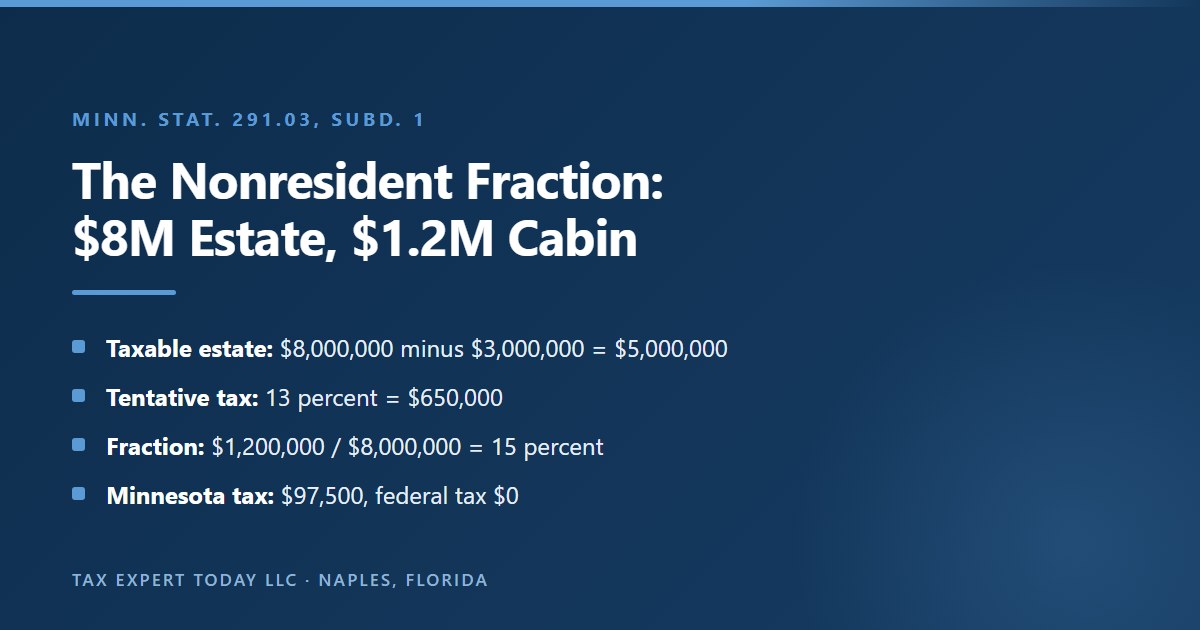
Consider a hypothetical widow domiciled in Naples, Florida who dies in 2026 with a federal gross estate of $8,000,000 and no deductions. Her estate includes a lake home in Crow Wing County worth $1,200,000; everything else is a brokerage account, IRAs and her Naples condominium. The computation runs as follows.
| Step | Amount |
|---|---|
| Federal taxable estate (no deductions) | $8,000,000 |
| Less Minnesota exclusion | ($3,000,000) |
| Minnesota taxable estate | $5,000,000 |
| Tentative tax at 13 percent | $650,000 |
| Apportionment fraction: $1,200,000 ÷ $8,000,000 | 15 percent |
| Minnesota estate tax due | $97,500 |
| Federal estate tax due (2026 exclusion $15,000,000) | $0 |
The $97,500 is roughly 8.1 percent of the value of the lake home, payable by an estate that owes nothing to the federal government and nothing to Florida. Change the size of the Florida side and the answer moves. With the same cabin and a total estate of $4,000,000, the Minnesota taxable estate is $1,000,000, the tentative tax is $130,000, the fraction is 30 percent, and the Minnesota tax is $39,000. With the same cabin and a total estate of $2,900,000, the estate is under the threshold and no Minnesota return or tax is required at all.
The next table holds the estate at $8,000,000 and varies the value of the Minnesota property, which is the comparison most families find useful when deciding whether to keep, sell or restructure the place up north.
| Minnesota situs property | Apportionment fraction | Minnesota estate tax ($8,000,000 estate) |
|---|---|---|
| $0 | 0 percent | $0, and no Minnesota return |
| $500,000 | 6.25 percent | $40,625 |
| $1,200,000 | 15 percent | $97,500 |
| $2,000,000 | 25 percent | $162,500 |
| $3,000,000 | 37.5 percent | $243,750 |
What Property Has a Minnesota Situs for a Florida Resident?
Under Minn. Stat. §291.005, real property has its situs where it is located, tangible personal property where it is normally kept, and intangible property in the state of domicile at death. For a Florida domiciliary, Minnesota land, buildings, boats, vehicles and contents kept in Minnesota count; stocks, bonds, bank accounts and retirement accounts do not.
- Real property: the state where it sits, regardless of where the owner lives
- Tangible personal property: the state where it was normally kept at death, so the boat and furniture at the lake count
- Intangible property: the state of domicile at death, which for a mover is Florida
- Exception: real and tangible property held through a pass-through entity is looked through to the decedent
The situs definitions in Minn. Stat. §291.005, subd. 1(8), are what turn a change of domicile into a change in Minnesota exposure. Intangible property follows the owner, so the moment domicile moves to Florida, the brokerage account at a Minneapolis firm, the 401(k) from a Minnesota employer, the certificate of deposit at a Minnesota bank and the cash value of a life insurance policy all acquire a Florida situs for Minnesota estate tax purposes. Real property never moves. Tangible property is assigned to the place it was normally kept, which is why the pontoon boat, the snowmobiles, the art on the walls and the contents of the cabin are part of the Minnesota numerator even if the deed to the cabin itself has been dealt with.
| Asset owned by a Florida domiciliary | Situs for the Minnesota estate tax | In the Minnesota numerator? |
|---|---|---|
| Lake home or cabin in Minnesota, held in your name | Minnesota | Yes |
| Lake home held in a single-member LLC | Minnesota, looked through | Yes |
| Minnesota rental property in a partnership, your share | Minnesota, in proportion to capital share | Yes |
| Boat, vehicles and furnishings normally kept at the Minnesota cabin | Minnesota | Yes |
| Minnesota farmland | Minnesota | Yes |
| Brokerage account or bank account at a Minnesota institution | Florida (domicile) | No |
| IRA, 401(k) or pension from a Minnesota employer | Florida (domicile) | No |
| Shares of a publicly traded REIT owning Minnesota buildings | Florida, no look-through for exchange-traded entities | No |
| Naples, Florida home | Florida | No (but counted in the denominator) |
Every asset in the federal gross estate appears in the denominator, including the Florida assets. That is why the Florida side of the estate matters even though Minnesota cannot tax it directly: it sets the bracket and it dilutes the fraction. A table like this is a starting inventory, not a conclusion. Retitling, trust ownership and joint ownership with a spouse can each change what is in a particular decedent’s gross estate, and the answer for a specific asset should come from the deed, the account titling and the governing documents.
Does Putting a Minnesota Cabin in an LLC Avoid the Tax?
No. Since 2013, Minnesota disregards pass-through entities when assigning situs for a nonresident decedent. Real or tangible property held through an S corporation, partnership, single-member LLC or includible trust is treated as owned directly, in proportion to the decedent’s capital share. Only entities whose interests trade on a national securities exchange are excluded.
- Entities looked through: S corporations, partnerships, single-member LLCs whether disregarded or not, and trusts to the extent includible in the gross estate
- Entity excluded: one whose ownership interests trade on an SEC-regulated national exchange
- Effective date: estates of nonresident decedents dying after January 1, 2013
- Department position: stated in Revenue Notice 17-05, published September 5, 2017
The older planning idea was simple. A membership interest in an LLC is intangible personal property, intangible property follows the owner’s domicile, and so a Florida resident who held the Minnesota cabin inside an LLC owned an asset with a Florida situs. The 2013 Legislature closed that route. The last two sentences of Minn. Stat. §291.005, subd. 1(8), now provide that for a nonresident decedent with an interest in a pass-through entity holding real or tangible personal property, situs is determined “as if the pass-through entity does not exist,” and that ownership by more than one person is attributed in proportion to the decedent’s capital ownership share. Subdivision 1(9) defines the entities broadly enough to cover the structures families actually use, including a revocable trust, since revocable trust property is includible in the grantor’s gross estate.
The Department’s position in Revenue Notice 17-05 confirms the mechanics: a nonresident estate must include in the Minnesota gross estate its pro rata share of Minnesota real property and Minnesota tangible property owned through a pass-through entity. The notice also makes a distinction that runs the other way for residents. A resident decedent’s estate includes all intangible property, including interests in pass-through entities regardless of what they hold, so the look-through is a nonresident rule only. The Department’s pass-through entities page for nonresidents summarizes the same rule in two sentences.
An LLC can still be useful for liability protection, for managing a family cabin among several siblings, or for orderly succession, and those are legitimate reasons to form one. It is not, on its own, a Minnesota estate tax strategy for a Florida resident. Using our hypothetical widow again, moving the $1,200,000 lake home into a single-member LLC before her death leaves the Minnesota tax at $97,500. If she and two adult children each held one third of the capital in a family LLC that owned the cabin, the look-through would attribute $400,000 to her, and her estate’s fraction would fall to 5 percent of an estate that would itself be smaller by the value of the interests transferred. Whether those transfers were taxable gifts, and when they were made, then becomes the controlling question, which is the subject of the next two sections.
What Is the Minnesota Three Year Gift Add-Back?
Minnesota has had no gift tax since 2014, but Minn. Stat. §291.016 adds back taxable gifts made within three years of death when computing the Minnesota taxable estate. Only gifts that are taxable for federal purposes count, meaning amounts above the $19,000 annual exclusion that are not sheltered by the marital or charitable deduction.
- What is added: taxable gifts as defined in IRC section 2503, made by the decedent within three years of death
- Value used: the gift’s value under IRC section 2512 on the date of the gift, not at death
- Not added twice: any value already included in the federal gross estate is excluded
- Annual exclusion: $19,000 per donee for 2026, per the IRS gift tax FAQ
The rule is in Minn. Stat. §291.016, subd. 2(3). According to the House Research summary, the 2013 Legislature enacted a gift tax along with the three year rule, and the 2014 Legislature repealed the gift tax while leaving the three year rule in place. The Department’s gift tax page states the current position: there is no Minnesota gift tax, but Minnesota taxable gifts made after June 30, 2013 and within three years of death are added to the Minnesota adjusted taxable estate, and federal adjusted taxable gifts made within three years of death count toward the filing threshold.
The add-back is narrower than it first sounds. Gifts within the annual exclusion are not taxable gifts, so a pattern of $19,000 gifts to each child and grandchild is not pulled back. Outright gifts to a United States citizen spouse qualify for the unlimited marital deduction and are not taxable gifts. Charitable gifts are deducted. Tuition paid directly to a school and medical expenses paid directly to a provider are excluded from gift treatment under federal law. What remains are the large transfers people make when they are trying to shrink an estate: a block of appreciated stock to a trust for the children, a share of the family cabin to the next generation, a down payment on a child’s house well above the annual exclusion. Those are the gifts that come back if the donor dies within three years.
For a resident, the add-back simply means that a deathbed gift program does not work against the Minnesota estate tax the way it might once have. For someone moving to Florida, the add-back has a second dimension, because the situs of a gift is fixed when the gift is made, and that is where the timing of the move and the timing of the gift collide.
Why Can a Gift Made Before the Move Raise the Tax After It?
Because situs is fixed on the gift date. Under Minn. Stat. §291.005, a gift of intangible property within three years of death takes the situs of the donor’s domicile when the gift was made. Stock given while a Minnesota resident lands in the Minnesota numerator of a later Florida estate; the same gift made after the move does not.
- Intangible gift: situs is the donor’s domicile on the gift date, not at death
- Tangible gift: situs is where the property was normally kept when the gift was executed
- Real property gift: situs remains where the land sits
- Practical rule: large gifts of securities generally belong after the change of domicile is complete, not before
The language is in Minn. Stat. §291.005, subd. 1(8)(iv): the situs of intangible personal property is the state of domicile at death “or for a gift of intangible personal property within three years of death, the state or country in which the decedent was domiciled when the gift was executed.” Read together with the apportionment fraction in §291.03, which puts “gifts under section 291.016, subdivision 2, clause (3), with a Minnesota situs” into the numerator, the result is that a gift of securities made by a Minnesota resident carries a Minnesota label for the following three years, even after the donor becomes a Floridian.
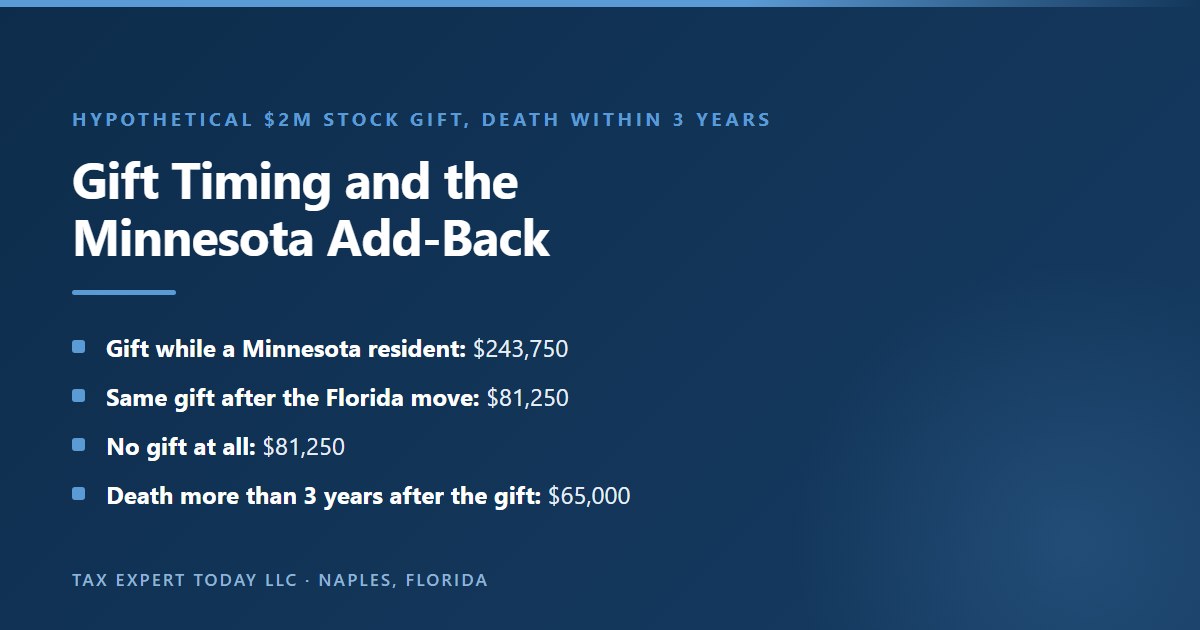
Take a hypothetical Minnesota retiree who, in March 2026, gives $2,038,000 of appreciated stock to her two children while she is still domiciled in Edina. After the $19,000 annual exclusion for each child, the taxable gifts total $2,000,000. She completes her move to Naples, Florida in June 2026 and dies in 2028, within three years of the gift, owning a $6,000,000 estate that includes a $1,000,000 Minnesota cabin. The table compares that sequence with three alternatives.
| Scenario | Minnesota taxable estate | Fraction | Minnesota estate tax |
|---|---|---|---|
| Gift made while a Minnesota resident, death within three years | $6,000,000 + $2,000,000 − $3,000,000 = $5,000,000 | ($1,000,000 + $2,000,000) ÷ $8,000,000 = 37.5 percent | $650,000 × 37.5% = $243,750 |
| Same gift made after domicile moved to Florida, death within three years | $5,000,000 | $1,000,000 ÷ $8,000,000 = 12.5 percent | $650,000 × 12.5% = $81,250 |
| No gift, $8,000,000 estate with the same cabin | $5,000,000 | 12.5 percent | $81,250 |
| Gift made while a Minnesota resident, death more than three years later | $6,000,000 − $3,000,000 = $3,000,000 | $1,000,000 ÷ $6,000,000 = 16.67 percent | $390,000 × 16.67% = $65,000 |
The first row is the trap. Making the gift before the move tripled the Minnesota tax compared with making the identical gift a few months later, and it did so for an estate whose decedent was unquestionably a Florida resident at death. The second and third rows show that a gift made after the move did no harm for Minnesota purposes within the three year window: the gift raised the taxable estate but sat only in the denominator, so the result matched the no-gift case. The fourth row shows the add-back expiring. Once three years pass, the gift drops out of the computation entirely.
The numbers are hypothetical and the pattern depends on the facts. A gift of the cabin itself is real property with a Minnesota situs whenever it is made, so moving first does not change the treatment of a gift of Minnesota land within three years of death. Where a family has no Minnesota situs property at death at all, whether a return is still required because of a pre-move gift is a question to resolve with counsel, since the return requirement in Minn. Stat. §289A.10 is keyed to a decedent who has an interest in property with a Minnesota situs. The safer planning assumption is the one the table illustrates: sequence the move first, document the change of domicile, and make the large gifts of securities afterward.
Does Minnesota Have a Gift Tax or an Inheritance Tax?
Minnesota has neither. Its gift tax was enacted in 2013 and repealed in 2014, and it has never had an inheritance tax on beneficiaries. The only Minnesota transfer tax is the estate tax, paid by the estate, with taxable gifts made within three years of death added back into its base.
- Gift tax: repealed in 2014, with no annual Minnesota gift tax return
- Inheritance tax: none, so heirs in Minnesota do not pay a tax on what they receive
- Estate tax: imposed on the estate, computed by the personal representative on Form M706
- Federal gift reporting: still required on Form 709 for gifts above the annual exclusion
The difference between an estate tax and an inheritance tax matters when families compare notes across states. In an inheritance tax state such as Pennsylvania or New Jersey, the tax depends on who receives the property and the rate can vary by relationship; our guides to the Pennsylvania inheritance tax for Florida residents and the New Jersey inheritance tax for nonresidents walk through those rules. In Minnesota, the tax is computed on the estate as a whole and does not change with the identity of the heir, other than through the marital and charitable deductions. A child, a niece and a family friend who each inherit a share of a Minnesota cabin bear the same Minnesota estate tax burden, which the will or trust allocates among them.
The absence of a gift tax is what makes lifetime gifting attractive for Minnesota families, and the three year add-back is the legislature’s limit on that attraction. Gifts that are completed, documented and survived by three years are outside the Minnesota estate tax base. For a Florida domiciliary, gifts of intangible property made after the move are outside the numerator even within the three year window. Gifts of Minnesota real estate are the hardest to plan, because they carry Minnesota situs whenever they occur.
Can Married Couples Use Portability for the Minnesota Estate Tax?
No. Minnesota does not allow portability of a deceased spouse’s unused exclusion. Each spouse has a separate $3,000,000 exclusion, and if the first spouse leaves everything outright to the survivor, the first exclusion is lost for Minnesota purposes even if federal portability is elected. A credit shelter trust or a state-only QTIP election is the usual response.
- Federal rule: a surviving spouse may use the deceased spouse’s unused federal exclusion if the election is made on a timely Form 706
- Minnesota rule: chapter 291 has no portability provision, so each exclusion is use it or lose it
- State-only QTIP: Minn. Stat. §291.03, subd. 1d allows a QTIP election for Minnesota purposes regardless of the federal election
- Planning tool: a credit shelter or bypass trust funded at the first death preserves the first exclusion
The federal portability election described on the IRS estate tax page lets a surviving spouse carry forward the deceased spouse’s unused federal exclusion. Minnesota adopted nothing comparable. The House Research summary describes the exclusion as a per-person amount and the statute provides no mechanism to transfer it. For a couple with Minnesota situs property, the planning question is therefore not only how much each spouse owns, but which spouse owns the Minnesota property and what the first spouse’s documents do with it.
A hypothetical Florida couple illustrates the stakes. They own a combined $10,000,000, and the $1,500,000 Minnesota lake home is titled to the husband, whose half of the estate is $5,000,000. He dies first.
- Everything outright to the wife: his estate owes no Minnesota tax because the marital deduction reduces his taxable estate to zero. She later dies with $10,000,000, including the lake home. Her Minnesota taxable estate is $7,000,000, the tentative tax is $910,000, the fraction is 15 percent, and her estate owes $136,500. His $3,000,000 exclusion was never used.
- A credit shelter trust funded with $3,000,000, including the lake home: his federal taxable estate is $3,000,000 after the marital deduction on the remaining $2,000,000, and the $3,000,000 Minnesota exclusion reduces his Minnesota taxable estate to zero. Her later estate of $7,000,000 holds no Minnesota situs property, so her estate has no Minnesota exposure. The illustrative Minnesota tax across both deaths falls from $136,500 to $0.
The second outcome depends on several assumptions: that the trust is drafted so it is not included in the survivor’s estate, that values hold steady, and that a Minnesota return is filed for the first estate if its federal gross estate exceeds $3,000,000 with Minnesota property in it, even though no tax is due. The state-only QTIP election under §291.03, subd. 1d is a further tool for estates that want to defer Minnesota tax at the first death without giving up the federal benefits of a different election, and it requires careful coordination with the federal return. Couples who moved from Minnesota with wills and trusts drafted for a Minnesota resident should have them reviewed with Florida counsel, which our estate and trust planning services coordinate. Questions about where a family trust is administered after the move are covered in our guide to trust situs after moving to Florida.
How Does the Qualified Small Business and Farm Deduction Work?
Minnesota allows an extra subtraction for qualified small business property and qualified farm property, limited so that it plus the $3,000,000 exclusion cannot exceed $5,000,000. The property must have been owned for three years before death, and heirs must keep it in qualifying use for three years after, or a 16 percent recapture tax applies.
- Maximum extra subtraction: the lesser of the qualified property’s value or $2,000,000 for deaths in 2020 and after
- Small business tests: gross annual sales of $10,000,000 or less, material participation, not publicly traded, and no cash or investment assets in the value
- Farm tests: Minnesota agricultural land classified as an agricultural homestead, owned three years before death
- Recapture: a 16 percent tax on the property’s value if the heir disposes of it or stops qualifying use within three years
The subtraction is defined in §291.016, subd. 3(a)(2), and the qualification rules are in §291.03, subds. 8 through 11. For a small business, the decedent or the spouse must have materially participated in a trade or business that was not a passive activity during the taxable year that ended before death, the business must have had gross annual sales of $10,000,000 or less for its last taxable year before death, and the value counted excludes cash, cash equivalents, publicly traded securities and assets not used in the business. After death, a family member must materially participate for three years. For farm property, the land must be Minnesota agricultural land in compliance with the corporate farm law and classified as agricultural homestead for the year of death. The Department’s filing requirement page lists the maximum deduction by year, with $2,000,000 shown for 2020 to the present.
For people who have moved to Florida, the tests are harder to meet than they appear. A retired owner who has stepped back from the business may no longer materially participate in the year before death. Farmland that was the owner’s homestead may lose that classification once the owner’s home is in Naples, unless it qualifies under one of the relative homestead rules for a family member who lives and farms there. The heirs then carry a three year obligation, and if a sale or a change in use triggers recapture, the qualified heir must file a recapture return within six months under Minn. Stat. §289A.18, subd. 3a. The deduction can be valuable, but it should be modeled with the family’s actual succession plan rather than assumed.
Does a Minnesota Business Interest Count After You Move?
Partly. An interest in an S corporation or partnership is intangible property that would normally follow a Florida domicile, but the pass-through look-through assigns the entity’s Minnesota real estate and tangible equipment to the owner’s Minnesota numerator. Receivables, cash, goodwill and other intangible business assets are not looked through.
- Looked through: the entity’s Minnesota land, buildings, machinery, vehicles and inventory normally kept in Minnesota
- Not looked through: the entity’s cash, receivables, intellectual property and goodwill
- Attribution: in proportion to the decedent’s capital ownership share
- Interaction: the small business subtraction may still apply if every qualification test is met
Business owners are the group most likely to be surprised by the look-through, because the advice they received when they moved was often limited to income tax. A hypothetical Naples resident who still owns 100 percent of a Minnesota manufacturing company organized as an S corporation, valued at $5,000,000, illustrates the computation. The company’s Minnesota plant and equipment are worth $3,000,000, and the rest of its value is receivables, cash and goodwill. His federal gross estate is $12,000,000 with no deductions.
- Without the small business subtraction: the Minnesota taxable estate is $9,000,000, the tentative tax is $1,188,600, the look-through puts $3,000,000 in the numerator for a fraction of 25 percent, and the Minnesota tax is $297,150.
- If the $2,000,000 small business subtraction is available: the Minnesota taxable estate falls to $7,000,000, the tentative tax to $910,000, and the Minnesota tax to $227,500 at the same 25 percent fraction.
A sale of the company before death changes the analysis entirely, because the proceeds are intangible property that follows the Florida domicile, although the income tax on the sale is a separate question our guide to moving to Florida before selling a business addresses. Executives with deferred compensation and equity awards from a Minnesota employer face different, income tax driven questions that are covered in our guide to Florida domicile for executives. For rental real estate that a family plans to sell rather than hold until death, our guide to selling rental property after a move covers the income tax side.
How Does Minnesota Decide Where You Were Domiciled at Death?
Domicile is your true, fixed home, the place you intend to return to. For the estate tax, Minnesota applies the domicile rules in Minn. Stat. §290.01, subd. 7, which bar the commissioner and the courts from weighing charitable gifts, the location of your attorney, CPA or financial adviser, or where you bank. Everything else about your life remains in play.
- Not considered: charitable contributions in or out of Minnesota
- Not considered: the location of your attorney, certified public accountant or financial adviser
- Not considered: the financial institution where you open accounts or apply for credit
- Still considered: homes, time spent, family, social and religious ties, voter registration, licenses and where you keep the things you care about
Minn. Stat. §291.005, subd. 1(7), applies the provisions of §290.01, subd. 7, paragraphs (c) and (d), to domicile determinations for the estate tax. Those paragraphs are helpful to movers. A Florida resident can keep a long relationship with a Minneapolis estate attorney, a Minnesota CPA and a Minnesota bank, continue giving to Minnesota charities, and none of that may be used to argue that domicile never left. The remaining factors are the familiar ones: where the primary home is, how time is divided, where the family and the community ties are, where the person is registered to vote and licensed to drive, where the near and dear items are kept, and what the person has said and filed about residence.
The estate tax domicile question is decided after death, by a personal representative who cannot testify about intent from personal knowledge and by a record that the decedent built during life. That makes the residency record more important for estate tax purposes than it is for income tax. A Florida declaration of domicile under Fla. Stat. §222.17, voter registration in Collier County, a Florida driver license, a Florida will, and a pattern of days that shows Florida as the base all help. Our guides on the Florida residency audit and the dual state residency trap explain how former states test a move, and our Florida 183 day rule calculator helps document time. Snowbirds in their first year should also read our snowbird taxes first year guide, because the move-year Minnesota income tax return is often the first document the Department sees about the change of domicile.
When Must a Minnesota Estate Tax Return Be Filed?
A Minnesota return on Form M706 is required when the decedent had property with a Minnesota situs and either a federal estate tax return is required or the federal gross estate plus adjusted taxable gifts within three years exceeds $3,000,000. It is due nine months after death, and an extension of time to file is available.
- Threshold: federal gross estate plus three year adjusted taxable gifts above $3,000,000, under Minn. Stat. §289A.10
- Due date: nine months after the date of death, under Minn. Stat. §289A.18, subd. 3
- Extension to file: six months or the federal extension period, whichever is longer, under Minn. Stat. §289A.19, subd. 4
- Form: Minnesota Form M706, which the Department says is completed together with federal Form 706
The filing threshold uses the gross estate, before deductions, so an estate can be required to file even when the marital deduction, a charitable bequest or the small business subtraction reduces the tax to zero. That catches many surviving spouses of couples where the first spouse owned the Minnesota property. The Department’s filing requirement page lists the Minnesota threshold as $3,000,000 for deaths from 2020 to the present and the federal filing threshold as $15,000,000 for 2026. Its estate tax rates page notes that the federal Form 706 and Minnesota Form M706 must both be completed to compute the tax correctly, which in practice means a Minnesota estate below the federal filing threshold often prepares a pro forma federal computation to support the Minnesota return.
Treat the time to file and the time to pay as separate questions. The extension in §289A.19 is an extension to file the return, and interest and penalties on unpaid tax are governed by their own rules, so the personal representative should confirm the payment position with the Department before relying on an extension. Minnesota’s general estate tax page links the forms, calculators, installment payment information and the process for requesting a closing letter, which buyers and title companies sometimes ask for before a Minnesota property can be sold out of an estate. A Florida personal representative handling a Minnesota cabin will usually also need an ancillary probate in the Minnesota county where the property sits unless the property passes outside probate.
How Does the Minnesota Estate Tax Interact With the Federal Estate Tax in 2026?
The two taxes are computed separately. The federal estate tax exempts $15,000,000 per person in 2026, while Minnesota exempts $3,000,000 and does not allow portability. Minnesota builds from the federal taxable estate, adds back the federal state death tax deduction, and references the Internal Revenue Code as amended through May 1, 2023.
- Federal exclusion, 2026: $15,000,000, with portability for a surviving spouse
- Minnesota exclusion: $3,000,000, with no portability
- State death tax deduction: the federal deduction for Minnesota tax under IRC section 2058 is added back for the Minnesota computation
- Conformity date: chapter 291 incorporates the federal code as amended through May 1, 2023, per Minn. Stat. §291.005
The IRS page reports the 2026 federal basic exclusion at $15,000,000, and the IRS gift tax FAQ describes the 2025 federal legislation that set it. For a Minnesota family, the larger federal exclusion means the federal tax has receded for most estates while the Minnesota tax has not moved. An estate of $10,000,000 is $5,000,000 below the 2026 federal exclusion for a single decedent and $7,000,000 above the Minnesota exclusion.
Where both taxes do apply, the federal estate tax allows a deduction for state estate tax paid under IRC section 2058, and Minn. Stat. §291.016, subd. 2(1), adds that deduction back so the Minnesota tax is not computed on a base already reduced by itself. The conformity date in §291.005, subd. 1(3), means federal amendments enacted after May 1, 2023 do not automatically flow into the Minnesota definitions. In most estates that has little practical effect, because the larger federal exclusion operates as a credit against federal tax and does not change the federal taxable estate that Minnesota starts from. In an estate with unusual deductions or elections, the conformity date is one more reason to prepare the Minnesota computation on its own terms rather than copying numbers from the federal return.
What Can a Florida Resident Do About Minnesota Situs Property?
The options are to sell the Minnesota property during life, give it away more than three years before death, place it with a spouse or trust so it falls outside a large estate, keep it and plan liquidity for the tax, or keep the overall estate under $3,000,000. An LLC alone does not work, because the look-through reaches through it.
- Sell during life: the proceeds become intangible property that follows the Florida domicile
- Gift early: a completed gift survived by three years leaves the base, though the gift of Minnesota land itself always carries Minnesota situs
- Use the first spouse’s exclusion: a credit shelter trust that holds the Minnesota property at the first death
- Plan for liquidity: know the likely tax and where the cash to pay it will come from within nine months
Each option carries tradeoffs that have nothing to do with Minnesota. Selling a cabin that has been in the family for decades may trigger federal capital gains tax on a low basis that would otherwise be stepped up at death. Gifting a share of the cabin to children carries over the parent’s basis and requires a federal gift tax return on Form 709 for amounts above the annual exclusion. Funding a credit shelter trust with the Minnesota property only works if the property is titled to the spouse who dies first, which no one can predict, so documents often give the personal representative flexibility through disclaimers or formula clauses. Keeping the property and planning for the tax is a reasonable choice for many families, particularly when the Minnesota share is modest relative to the estate, as long as the heirs know the bill is coming.
The approaches that do not work are just as important to recognize. Retitling the cabin into an LLC or a revocable trust does not change the Minnesota numerator for a nonresident. Changing domicile to Florida while keeping the Minnesota home as the real center of family life invites a domicile dispute that, if lost, puts the entire estate in the Minnesota base. And a gift of securities made in the months before the move, with the intention of reducing the estate, can increase the Minnesota tax for three years, as the earlier table shows. None of these choices calls for avoiding a tax that is properly owed. The aim is to make sure the estate pays what the statute requires on the property that is actually in Minnesota, and no more.
What Do Minnesota Movers Get Wrong About the Estate Tax?
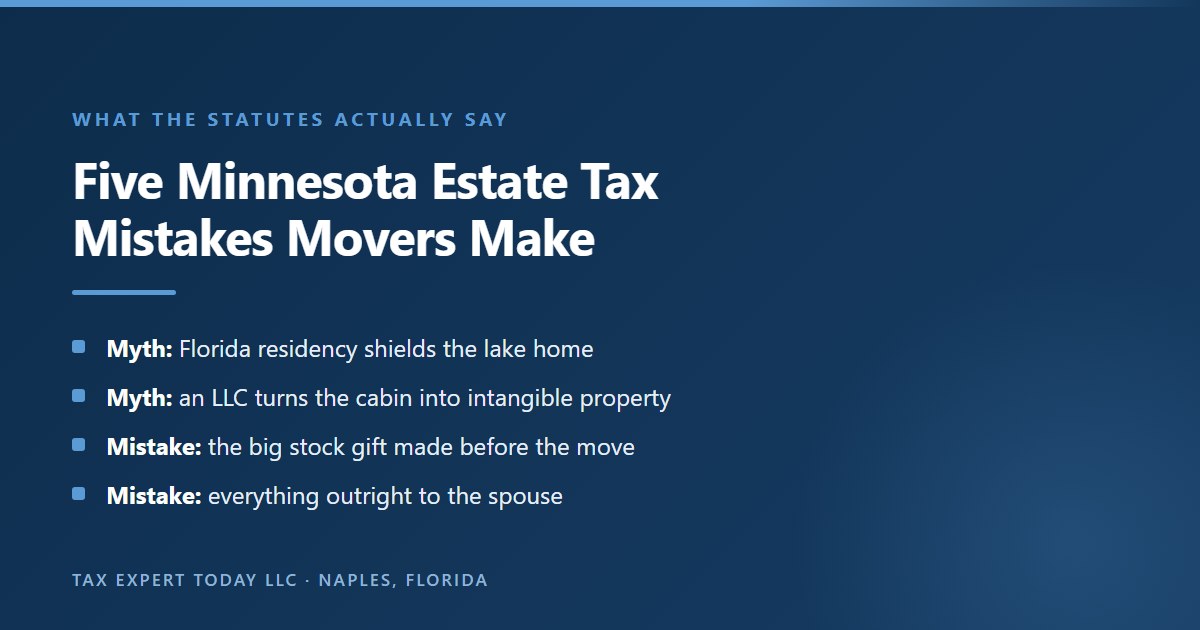
The common mistakes are assuming Florida residency ends all Minnesota exposure, relying on an LLC to convert the cabin to intangible property, making large securities gifts before the move, leaving everything outright to a spouse, and treating the federal $15,000,000 exclusion as if it applied in Minnesota. Each one is visible in the statutes.
- Mistake one: believing a Florida domicile shields the Minnesota lake home
- Mistake two: believing a single-member LLC changes the situs of Minnesota real estate
- Mistake three: making the big gift of stock while still a Minnesota resident
- Mistake four: losing the first spouse’s $3,000,000 exclusion by leaving everything outright
- Mistake five: skipping the Minnesota return because no federal return was needed
Most of these come from advice that was correct for a different question. The income tax answer for a Florida resident is that Minnesota generally cannot tax investment income after domicile changes, and families sometimes assume the estate tax answer is the same. The LLC idea was effective before 2013 and still circulates in older articles that predate the look-through. The gifting idea is sound in principle, because Minnesota has no gift tax, and the trap lies only in the timing. The spousal bequest is the default in many simple wills, and it works well for federal purposes because of portability. The filing assumption follows naturally from a federal filing threshold that is five times the Minnesota one.
A sixth mistake is less common but more expensive: assuming that because the decedent died in Florida, the Minnesota Department of Revenue will not notice the Minnesota property. Real estate records are public, Minnesota property passes through Minnesota title and probate systems, and the personal representative is the person exposed when a required return is not filed. The estate is better served by a timely, accurate return, even when the tax is modest or zero, than by a later inquiry.
What Should a Minnesota Mover Check Before and After the Move?
Before the move, inventory Minnesota real and tangible property, hold large securities gifts until after the change of domicile, and review wills and trusts for the first spouse’s exclusion. After the move, document domicile, decide what to do with the Minnesota property, and have the Minnesota estate tax modeled at current values every few years.
- Inventory: list every Minnesota parcel, entity interest holding Minnesota property, and tangible asset kept in Minnesota
- Sequence: complete the move and the domicile record before large gifts of securities
- Documents: update wills, trusts and powers of attorney under Florida law with the Minnesota rules in mind
- Model: rerun the computation when values change, when a spouse dies, or when a gift is made
The checklist is short because the Minnesota rules are mechanical once the facts are known. The questions that take judgment are the ones about family: who will want the cabin, whether the business will stay in the family, and how a surviving spouse will live. The tax computation should serve those answers rather than drive them. For families arriving from Minnesota alongside other high tax states, our guides to the Connecticut estate tax after a Florida move, the Massachusetts estate tax for Florida residents, the Maryland estate tax for Florida residents and the New York exit tax cover the parallel rules. Retirees comparing their full picture should also read our guide to retiring to Florida taxes, and families whose plans include moving a trust should read about decanting a trust and its tax consequences.
Minnesota Estate Tax Help in Naples & Southwest Florida
Tax Expert Today LLC works with families who have moved, or are moving, from Minnesota to Naples, Florida and across Southwest Florida on the tax side of the relocation, including the estate tax that Minnesota can still apply to a cabin, farmland or business real estate left behind. The firm is multidisciplinary, with enrolled agents, CPAs and attorneys, and it handles residency and tax matters nationwide, coordinating with Minnesota and Florida estate counsel when documents need to change. Our office is at 11983 Tamiami Trail N, Naples, FL 34110, open Monday through Friday, 10 a.m. to 5 p.m. ET, and reachable at (239) 441-2005.
- Minnesota estate tax help Naples: modeling of the nonresident fraction for a Minnesota cabin, rental or business real estate at current values.
- Gift timing: review of planned gifts against the three year add-back and the gift-date situs rule before and after the move.
- Domicile and filings: the residency record, the move-year Minnesota return, and Form M706 coordination for a Florida personal representative.
Our Naples tax planning practice and our Florida tax services page describe the wider planning work, and our guide to Florida asset protection for new residents covers the protective side of Florida ownership. For a recent closing on a Naples home, our guide to the Florida intangible tax explains the one-time charges on the closing statement.
We spend summers at our Minnesota lake home and winters in Naples. Will Minnesota tax our whole estate?
Not if your domicile is genuinely in Florida. Minnesota then taxes only the share of the estate that corresponds to the lake home and its contents, using the nonresident fraction. The risk is a domicile dispute: if the summer home remains the center of family life, Minnesota may argue you never left, so the residency record you build in Collier County matters.
When to Engage a Professional
A Florida resident whose estate is comfortably under $3,000,000, or who owns nothing in Minnesota, rarely needs Minnesota estate tax advice at all. Professional help earns its cost when the estate is above the threshold and includes a Minnesota cabin, farmland, rental property or a business with Minnesota real estate or equipment; when large gifts are planned in the year of the move; when a spouse has died and the survivor holds the Minnesota property; when a family LLC or partnership owns the Minnesota property among several relatives; or when a personal representative needs to determine whether a Form M706 is required. It is also worth a conversation when the move itself is recent and the domicile record is still being built, because that record decides whether Minnesota taxes a slice of the estate or all of it. Tax Expert Today LLC’s enrolled agents, CPAs and attorneys can model the computation, coordinate with your estate counsel in both states, and help document the change of domicile. Call (239) 441-2005 to schedule a consultation.
Frequently Asked Questions
Does Minnesota have an estate tax in 2026?
Yes. Minnesota imposes an estate tax on estates above a $3,000,000 exclusion, with rates from 13 to 16 percent under Minn. Stat. section 291.03. It applies to Minnesota domiciliaries on their whole estate and to nonresidents on Minnesota real estate and tangible property. Minnesota has no gift tax and no inheritance tax.
Do I owe Minnesota estate tax if I move to Florida?
Only if you still own Minnesota real estate or tangible property normally kept in Minnesota, directly or through a pass-through entity, and your federal gross estate plus taxable gifts within three years exceeds $3,000,000. Minnesota then taxes a prorated share of the estate. Stocks, bank accounts and retirement accounts follow your Florida domicile.
Does an LLC protect a Minnesota cabin from Minnesota estate tax?
No. For nonresident decedents, Minn. Stat. section 291.005 disregards pass-through entities, including single-member LLCs, partnerships, S corporations and includible trusts, and treats Minnesota real and tangible property inside them as owned directly in proportion to the decedent’s capital share. Revenue Notice 17-05 confirms the Department applies this rule.
What is the Minnesota three year gift rule?
Taxable gifts made within three years of death are added back to the Minnesota taxable estate under Minn. Stat. section 291.016. Only gifts above the federal annual exclusion, $19,000 per donee for 2026, that are not covered by the marital or charitable deduction count. A gift of securities made while you were a Minnesota resident keeps a Minnesota situs.
Is the Minnesota estate tax exemption portable between spouses?
No. Minnesota does not allow portability, so each spouse has a separate $3,000,000 exclusion. If the first spouse leaves everything outright to the survivor, the first exclusion is lost for Minnesota purposes. A credit shelter trust, or the state-only QTIP election in Minn. Stat. section 291.03, subdivision 1d, is the usual planning response.
When is a Minnesota estate tax return due?
Form M706 is due nine months after the date of death under Minn. Stat. section 289A.18. A return is required when the decedent had Minnesota situs property and the federal gross estate plus adjusted taxable gifts within three years exceeds $3,000,000, even if deductions reduce the tax to zero. An extension of time to file is available.
Published October 24, 2026 by Dr. Pellumb Kabashi « Back to Learning Center
Have a question this article touches on?
Tax Expert Today LLC, based in Naples, Florida and serving clients across the United States.
Schedule a Consultation (239) 441-2005