
By Dr. Pellumb Kabashi, DBA, MBA, CES, CFE, EA
Founder, Tax Expert Today LLC · Tax advisors, enrolled agents, CPAs, and attorneys · Serving clients in all 50 states
Quick Answer
An intentionally defective grantor trust is an irrevocable trust that is treated as owned by the grantor for income tax but not for estate tax. The grantor pays the trust’s income tax, and an asset sold to the trust for a note at the applicable federal rate (4.61 percent mid-term for October 2026) can grow outside the estate. Call (239) 441-2005 for a free consultation.
What is an intentionally defective grantor trust?
An intentionally defective grantor trust, often called an IDGT, is an irrevocable trust drafted so that transfers to it are completed gifts for gift and estate tax purposes, while the grantor is still treated as the owner of the trust for federal income tax purposes. The trust’s income is taxed on the grantor’s own Form 1040.
- Estate tax side: the trust is built to stay out of the grantor’s gross estate under IRC 2036 and 2038.
- Income tax side: one or more powers under IRC 671 to 677 make the grantor the income tax owner.
- Practical result: the grantor pays the trust’s income tax, and the trust keeps its full return.
- Common uses: holding gifted assets and buying assets from the grantor for a promissory note.
The phrase sounds like a drafting error, but it describes a design choice. Two separate parts of the Internal Revenue Code decide whether a trust “belongs” to the person who created it. The estate and gift tax rules ask whether the grantor kept enough control or benefit that the trust property should still be counted in the grantor’s estate at death. The income tax rules, found in subpart E of the Code at IRC sections 671 through 679, ask a different question: whether the grantor kept powers or interests that make it appropriate to tax the trust’s income to the grantor. The two sets of rules do not line up exactly. An intentionally defective grantor trust lives in the gap between them.
In a typical intentionally defective grantor trust, the grantor makes a completed gift, so the trust assets are removed from the gross estate. At the same time, the trust instrument gives the grantor, or another person acting in a nonfiduciary capacity, a power that triggers grantor trust status under the income tax rules. The trust is “defective” only in the sense that it fails to be a separate income tax payer. For many families that failure is the point.
The trust is irrevocable. The grantor cannot take the property back, change the beneficiaries at will, or treat the trust account as personal savings. Beneficiaries are usually children, grandchildren, or a trust for their benefit, and the document often allows the trust to continue for many years. A trust built for multiple generations, with the GST exemption allocated to it, overlaps with the planning described in our guide to the dynasty trust. This guide focuses on the income tax and estate tax mechanics that make a trust an IDGT, and on the sale of an asset to the trust in exchange for a note, which is the technique most closely associated with the name.
| Feature | General treatment | Where it comes from |
|---|---|---|
| Income tax owner | The grantor, who reports trust income, deductions, and credits | IRC 671; IRC 672 to 677 |
| Estate tax inclusion | Generally excluded if the grantor kept no prohibited interest or power | IRC 2036; IRC 2038 |
| Gift tax on funding | A completed gift, reported on Form 709 to the extent it exceeds the annual exclusion | IRC 2501; IRC 2511; Form 709 instructions |
| Sale by grantor to trust | Generally not a taxable sale for income tax purposes | Rev. Rul. 85-13 |
| Grantor pays the trust’s tax | Not treated as an additional gift | Rev. Rul. 2004-64 |
| Basis at grantor’s death | No step-up for assets outside the gross estate | IRC 1014; Rev. Rul. 2023-2 |
Why is it called an intentionally defective grantor trust?
It is called intentionally defective because the drafter deliberately includes a power that causes the grantor trust rules to apply, so the trust “fails” to be a separate taxpayer for income tax. The defect is intentional, limited to income tax, and chosen so that it does not cause the assets to be counted in the grantor’s estate.
- “Grantor trust”: a trust whose income is taxed to the grantor under subpart E.
- “Defective”: the trust does not achieve separate income tax status.
- “Intentionally”: the drafter chose a power known to trigger grantor status.
- Related name: some advisors use IDIT, for intentionally defective irrevocable trust, for the same structure.
Before the grantor trust rules were codified, wealthy taxpayers used trusts to split income among several taxpayers and lower the total income tax. Congress responded with subpart E, which taxes the grantor on trust income whenever the grantor keeps certain powers or interests. For decades, drafters tried hard to avoid those powers so that the trust would be taxed on its own. Once trust income tax brackets were compressed in the 1980s, the calculation flipped. Today, a trust reaches the highest federal income tax bracket at a far lower income level than an individual does, so a separate trust taxpayer is usually more expensive, not less.
Planners then began including the powers on purpose. The result is a trust that the estate tax rules treat as a separate, completed transfer, and that the income tax rules treat as the grantor’s own pocket. The “defect” is a term of art. It does not mean the document is broken or that the IRS can disregard the trust. It means the grantor trust rules apply exactly as written.
Readers will also see the abbreviation IDIT, for intentionally defective irrevocable trust. The two names are generally used for the same structure. The Private Trust Company’s discussion, which ranks for this search, uses the IDIT label. What matters is not the label but the specific power in the document, who holds it, and in what capacity, because those details decide both the income tax result and the estate tax result.
| Question | Separate trust taxpayer | Intentionally defective grantor trust |
|---|---|---|
| Who pays income tax on trust income? | The trust, at compressed trust rates | The grantor, at individual rates |
| Does the trust’s balance shrink for income tax? | Yes, taxes come out of trust assets | No, the grantor pays from personal funds |
| Can the grantor sell assets to the trust without gain? | No, a sale is generally a taxable event | Generally yes, under Rev. Rul. 85-13 |
| Separate Form 1041 return? | Generally yes | Often an optional method applies |
Which grantor trust powers make an IDGT defective for income tax?
Grantor trust status comes from powers or interests listed in IRC 673 through 677. The powers most often used in an intentionally defective grantor trust are the nonfiduciary power to substitute assets under IRC 675(4)(C), a power to borrow without adequate security under 675(2), and a power to add beneficiaries held by a nonadverse party under 674.
- IRC 673: a reversionary interest worth more than 5 percent of the trust.
- IRC 674: certain powers to control beneficial enjoyment held by the grantor or a nonadverse party.
- IRC 675: administrative powers, including the swap power and borrowing powers.
- IRC 677: income that may be paid to or accumulated for the grantor or the grantor’s spouse.
Each grantor trust section has its own tests, and the trust instrument has to be read against all of them. The general rule in IRC section 674(a) treats the grantor as owner of any portion of a trust whose beneficial enjoyment is subject to a power of disposition exercisable by the grantor or a nonadverse party without the approval or consent of an adverse party. Section 674 then lists many exceptions, and planners must avoid falling inside an exception by accident if grantor status is the goal.
IRC section 677(a) treats the grantor as owner of any portion whose income, without the consent of an adverse party, is or may be distributed to the grantor or the grantor’s spouse, held or accumulated for future distribution to them, or applied to pay premiums on insurance on either of their lives. That spousal rule is why a trust for a spouse, such as the spousal lifetime access trust, is usually a grantor trust by its design.
For a trust whose beneficiaries are children and grandchildren, the most common trigger is in IRC section 675. Section 675(4) treats a “power of administration” exercisable in a nonfiduciary capacity, without the approval of a fiduciary, as a grantor trust power. Subparagraph (C) defines one such power as “a power to reacquire the trust corpus by substituting other property of an equivalent value.” Many drafters include it because the IRS addressed its estate tax effect directly in Rev. Rul. 2008-22, discussed below. Planners often include more than one trigger, so that grantor status does not hinge on a single clause whose capacity could later be questioned.
| Power or interest | Code section | Typical holder | Main drafting concern |
|---|---|---|---|
| Substitute assets of equivalent value | IRC 675(4)(C) | Grantor, in a nonfiduciary capacity | Whether the capacity is truly nonfiduciary; trustee duties under Rev. Rul. 2008-22 |
| Borrow without adequate interest or security | IRC 675(2) | Grantor | The power must be real, and actual loans raise separate issues |
| Add charitable or other beneficiaries | IRC 674(a) | Nonadverse third party | Avoiding the 674(b) and (c) exceptions |
| Income payable to spouse | IRC 677(a) | Trustee, for a spouse beneficiary | Divorce and death of the spouse can change the result |
| Pay premiums on the grantor’s life insurance | IRC 677(a)(3) | Trustee | Coordinating with the ILIT rules on incidents of ownership |
How does the IRC 675(4)(C) swap power work?
The swap power lets the grantor take an asset out of the trust by putting in other property of equal value. Held in a nonfiduciary capacity, it makes the trust a grantor trust under IRC 675(4)(C). Rev. Rul. 2008-22 holds that the power does not, by itself, cause estate inclusion if the trustee must confirm equivalent value.
- Equal value both ways: the trust must receive property worth what it gives up.
- Trustee safeguard: the trustee has a fiduciary duty to confirm the values are equivalent.
- No benefit shifting: the power cannot be used to move value among beneficiaries.
- Later use: the same power can bring low-basis assets back to the grantor before death.
The swap power, also called a substitution power, does double duty. First, it creates grantor trust status. Second, because it lets the grantor pull specific assets back in exchange for assets of equal value, it is the main tool for managing basis before the grantor dies. That second use is covered later in this guide.
The estate tax concern was that a power to reacquire trust assets might look like a retained right that brings the trust back into the estate under IRC 2036 or IRC 2038. In Rev. Rul. 2008-22, the IRS held that a grantor’s retained power, exercisable in a nonfiduciary capacity, to acquire property held in trust by substituting property of equivalent value will not, by itself, cause the value of the trust corpus to be includible in the grantor’s gross estate under section 2036 or 2038. The ruling attaches two conditions. The trustee must have a fiduciary obligation, under local law or the trust instrument, to ensure that the properties acquired and substituted are in fact of equivalent value. And the substitution power cannot be exercised in a manner that can shift benefits among the trust beneficiaries.
Those conditions shape how the power is used in practice. A swap is not a casual transfer. It generally calls for a current valuation of both the asset leaving the trust and the asset coming in, a written exercise of the power, and a trustee who reviews and documents the values. Closely held business interests and real estate usually need a qualified appraisal. Cash and publicly traded securities are easier to value, which is one reason grantors often swap cash or a note for a low-basis asset.
| Condition | What the ruling says | Practical step |
|---|---|---|
| Nonfiduciary capacity | The power is held by the grantor in a nonfiduciary capacity | Trust instrument states the capacity clearly |
| Equivalent value | The trustee must ensure the properties are in fact of equivalent value | Current valuations of both sides of the swap |
| No shifting of benefits | The power cannot shift benefits among beneficiaries | Trustee has power to reinvest and a duty of impartiality |
| Documentation | Not stated as a separate test, but needed to prove the conditions | Written exercise, trustee acknowledgment, appraisal file |
How does an intentionally defective grantor trust stay out of the grantor’s estate?
The trust stays out of the gross estate if the grantor makes a completed gift and keeps no interest or power that IRC 2036, 2038, or 2042 would reach. That generally means no right to income, no power to control who benefits, no incidents of ownership in insurance, and a trustee other than the grantor.
- IRC 2036: retained enjoyment or the right to designate who enjoys the property.
- IRC 2038: a power to alter, amend, revoke, or terminate the transfer.
- IRC 2042: incidents of ownership in life insurance on the grantor’s life.
- IRC 2035: certain powers released within three years of death.
The estate tax test is the half of the design that makes the strategy worth doing. IRC section 2036(a) includes property in the gross estate if the decedent made a transfer and kept, for life or for a period that does not end before death, the possession or enjoyment of the property or the right to its income, or the right, alone or with anyone, to designate who will possess or enjoy the property or its income. IRC section 2038 includes property if the decedent held, at death, a power to alter, amend, revoke, or terminate the enjoyment of the transferred property.
Drafters therefore avoid powers that look like control over beneficial enjoyment in the grantor’s hands, even if those same powers would also create grantor trust status. That is why the swap power and a nonadverse party’s power to add beneficiaries are favored triggers: the IRS has said the swap power, properly conditioned, is not an estate inclusion power, and a power held by someone other than the grantor is not the grantor’s retained power.
Life insurance needs separate care. If the trust will own a policy on the grantor’s life, IRC section 2042 includes the proceeds in the gross estate if the grantor holds any incident of ownership. A trust designed to hold insurance is discussed in our guide to the irrevocable life insurance trust. And under IRC section 2035, releasing certain powers, including a 2042 incident of ownership, within three years of death can still bring the property back. The trustee choice matters too. A grantor who serves as trustee with discretion over distributions may hold exactly the kind of power 2036 and 2038 describe, so an independent trustee is common.
| Risk | Code section | Typical design response |
|---|---|---|
| Grantor keeps a right to trust income | IRC 2036(a)(1) | Grantor is not a beneficiary; no mandatory reimbursement of the grantor’s taxes |
| Grantor controls who benefits | IRC 2036(a)(2); IRC 2038 | Independent trustee holds distribution discretion |
| Grantor can revoke or amend | IRC 2038 | Trust is irrevocable |
| Insurance on grantor’s life with incidents of ownership | IRC 2042 | Trustee, not grantor, owns and controls the policy |
| Release of a power shortly before death | IRC 2035 | Plan any release well in advance; review annually |
How is an intentionally defective grantor trust funded?
An intentionally defective grantor trust is funded by gift, by sale, or by both. A gift uses the annual exclusion or the lifetime exemption and is reported on Form 709. A sale exchanges an appreciating asset for a promissory note bearing at least the applicable federal rate, which generally moves future growth without a further gift.
- Gift only: simple, but each dollar uses exemption or annual exclusion.
- Sale for a note: moves growth above the note rate without using more exemption.
- Seed gift plus sale: the common combination, with the gift giving the trust equity.
- Later swaps: change what the trust holds without changing its value.
A direct gift is the plain version. The grantor transfers cash, securities, or business interests to the trust, files a gift tax return, and applies the gift against the lifetime gift tax exemption. Under Rev. Proc. 2025-32, the basic exclusion amount for 2026 is $15,000,000 per person, and the annual exclusion is $19,000 per donee. A transfer in trust is a gift under IRC section 2511, and a gift to a trust is usually a gift of a future interest, which does not qualify for the annual exclusion unless the trust grants a withdrawal right, often called a Crummey power, so most gifts to an IDGT use lifetime exemption.
The sale is what sets the IDGT apart from most other trusts. The grantor sells an asset expected to grow, such as an interest in a family company or a family limited partnership, to the trust. In return the trust signs a promissory note for the full fair market value, with interest at no less than the applicable federal rate. If the asset grows faster than the note rate, the excess growth stays in the trust and outside the estate. The grantor’s estate holds the note, whose value is generally fixed at principal plus accrued interest.
The two methods are usually combined. A trust that owns nothing has no credible way to pay a large note, so planners have the grantor first make a “seed” gift of cash or other assets to the trust, and then sell the larger asset. The next section covers the seed gift in detail.
| Method | Uses lifetime exemption? | Income tax on transfer | What moves outside the estate |
|---|---|---|---|
| Gift only | Yes, for the full value given | None; the trust takes carryover basis | The gift and all of its future growth |
| Sale for a note | Generally no, if the price equals fair market value | Generally none under Rev. Rul. 85-13 | Growth above the note’s interest rate |
| Seed gift plus sale | Yes, for the seed gift only | Generally none | The seed and its growth, plus growth above the note rate |
| Swap of assets | No, if values are equivalent | Generally none between grantor and grantor trust | No change in value; changes which assets are held |
What is a seed gift and how large should it be?
A seed gift is cash or other property the grantor gives to the trust before a sale, so the trust has its own assets to support the note. Planners often aim for trust equity of about 10 percent of the total, a convention drawn from practice and not from any statute, regulation, or published IRS ruling on this point.
- Purpose: shows the trust is a real buyer that can pay, not just a nominee.
- Common size: about 10 percent of the combined trust assets after the sale.
- Tax reporting: a taxable gift reported on Form 709, usually using lifetime exemption.
- Timing: made before the sale, and documented as a separate step.
The concern behind the seed gift is that a trust with no assets, buying a valuable asset entirely on credit, might be seen as not having bought anything at all. If the trust’s only source of payment is the asset it bought, the IRS could argue that the grantor in substance kept the income of the asset, which is the kind of retained interest IRC 2036 reaches, or that the note is not genuine debt. A meaningful amount of trust equity, provided by an earlier gift, supports the view that the trust is a buyer with its own credit.
The 10 percent figure is widely cited in professional literature, but it is a rule of thumb. No Code section, regulation, or published IRS ruling on this point sets a minimum. Some planners prefer more equity, especially when the asset is volatile or produces little cash flow. Others ask beneficiaries to pledge their own assets to support part of the note, which raises its own gift tax questions. The right figure depends on the asset, the cash flow, the note terms, and the risk tolerance of the family.
The seed gift itself is a taxable gift. In the example used throughout this guide, a $500,000 seed gift is made before a $5,000,000 sale, so the trust’s equity after the sale is $500,000 out of $5,500,000, or about 9.1 percent. If the grantor has not used any lifetime exemption, the $500,000 gift is reported on Form 709 and uses that much of the $15,000,000 basic exclusion amount for 2026, with no gift tax due. If the trust will benefit grandchildren, the grantor may also allocate GST exemption to the seed gift on the same return.
| Seed gift | Trust assets after sale | Trust equity as share of total | Lifetime exemption used |
|---|---|---|---|
| $250,000 | $5,250,000 | About 4.8 percent | $250,000 |
| $500,000 | $5,500,000 | About 9.1 percent | $500,000 |
| $555,556 | $5,555,556 | About 10.0 percent | $555,556 |
| $1,000,000 | $6,000,000 | About 16.7 percent | $1,000,000 |
How does a sale to an intentionally defective grantor trust work?
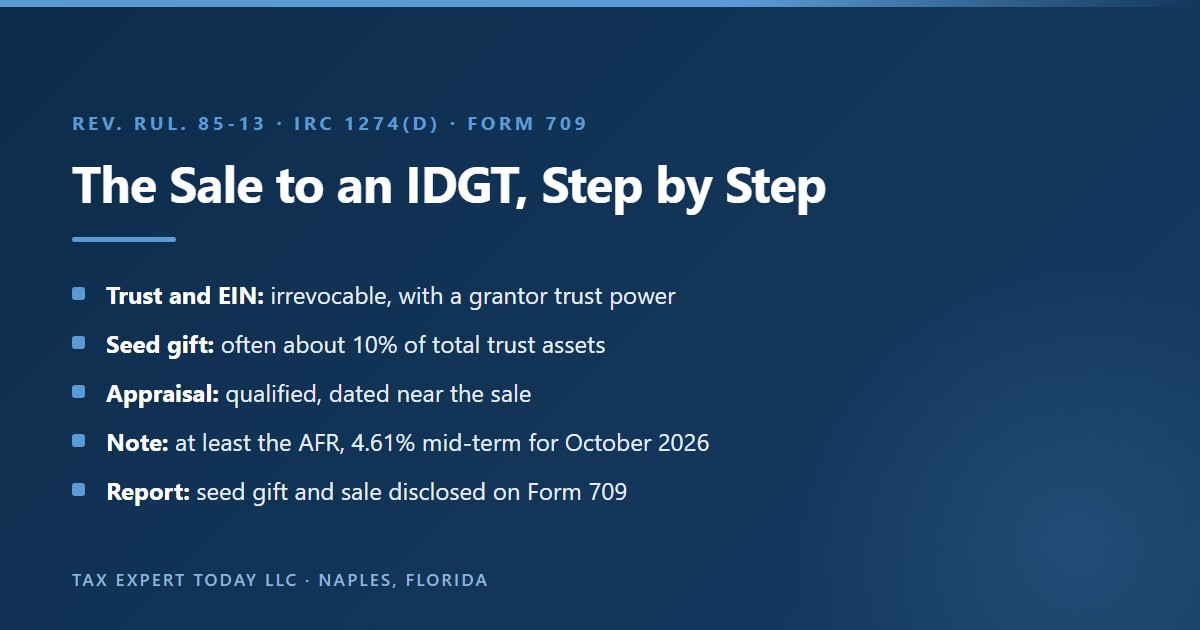
In a sale to an intentionally defective grantor trust, the grantor first makes a seed gift, then sells an appreciating asset to the trust at appraised fair market value in exchange for a promissory note. The note pays interest at least at the applicable federal rate, and the trust pays it from the asset’s cash flow.
- Step one: sign the trust, obtain an EIN, and fund the seed gift.
- Step two: obtain a qualified appraisal of the asset to be sold.
- Step three: sign the purchase agreement and the note at the current AFR.
- Step four: pay interest on schedule and report the transactions on Form 709.
The order of steps matters because each step supports the next. The trust instrument should exist and the seed gift should be completed before the sale, so that the trust is a buyer with its own assets on the day it signs the note. Planners often let some time pass between the seed gift and the sale, so the two do not look like a single prearranged transaction, although no rule sets a waiting period.
The valuation is the center of the sale. The price must equal fair market value, the measure of a gift under IRC section 2512, because if the grantor sells for less, the difference is a gift. Under Treas. Reg. section 25.2512-8, transfers reached by the gift tax include sales and exchanges for a consideration “to the extent that the value of the property transferred” exceeds the value of the consideration. For a closely held business, real estate, or a partnership interest, that means a qualified appraisal by an independent appraiser, dated close to the sale.
The note itself is a commercial document. It typically states the principal, the interest rate, the payment schedule, the maturity date, the right to prepay, and the consequences of default. It may be secured by the purchased asset. Many notes call for annual interest only, with all principal due at maturity, which is called a balloon note. Others amortize principal over the term. The choice affects the trust’s cash flow, which is covered below.
After closing, the parties need to act as a real lender and borrower would. The trust pays interest on time, the grantor reports nothing as income from those payments because the trust is a grantor trust, and the trustee keeps records showing that payments were made. Missed payments, payments that come back to the trust as gifts, or a note that is quietly forgiven can all support an argument that the note was not real debt.
| Step | What happens | Key document or authority |
|---|---|---|
| 1. Create the trust | Irrevocable trust with a grantor trust power and an independent trustee | Trust instrument; IRC 671 to 677 |
| 2. Obtain an EIN | The trust gets its own taxpayer identification number | Form SS-4; Form 1041 instructions |
| 3. Seed gift | Grantor gives cash or other assets to the trust | Form 709 for the year of the gift |
| 4. Appraisal | Qualified appraiser values the asset to be sold | Treas. Reg. 25.2512-8; 301.6501(c)-1(f) |
| 5. Sale and note | Trust buys the asset for a note at least at the AFR | IRC 1274(d); IRC 7872; current AFR ruling |
| 6. Administration | Interest paid on schedule; records kept; annual review | Note terms; trust accounting |
Why does a sale to an intentionally defective grantor trust not trigger capital gain?
Because the grantor is treated as the owner of the trust’s assets for income tax, a sale between the grantor and the trust is generally treated as a transaction with oneself. Under Rev. Rul. 85-13, the IRS does not recognize it as a sale, so no gain is reported and interest paid on the note is not income.
- No gain on the sale: the grantor does not report capital gain on the asset sold.
- No interest income: note interest paid by the trust is not taxable to the grantor.
- No deduction: the trust gets no interest deduction for the same reason.
- Carryover basis: the trust takes the grantor’s basis in the asset.
In IRC section 671, when a grantor is treated as the owner of any portion of a trust, the items of income, deduction, and credit of that portion are taken into account in computing the grantor’s own tax. Rev. Rul. 85-13, 1985-1 C.B. 184, applied that rule to a transaction between a grantor and a wholly owned grantor trust and concluded that the grantor is treated as the owner of the trust’s assets for federal income tax purposes, so a transfer between them is not a sale or exchange. That ruling is published in the 1985 Cumulative Bulletin and is not hosted as a separate page on irs.gov, so readers should obtain the text through a tax research service or counsel. Its holding is widely relied on for this technique.
The ruling is the reason the sale technique works for income tax. A grantor who sold the same $5,000,000 business interest, with a $1,000,000 basis, to an unrelated buyer for a note would report a $4,000,000 gain, perhaps using the installment method under IRC section 453. A sale to the grantor’s own grantor trust is ignored instead. The interest payments on the note are ignored too: the grantor does not report them as income, and the trust does not deduct them.
The flip side is basis. Because no sale is recognized, the trust does not get a cost basis equal to the price it paid. It steps into the grantor’s basis. That carryover basis becomes important at the grantor’s death, when the assets in the trust do not receive a step-up, a point the IRS confirmed in Rev. Rul. 2023-2.
The income tax result also depends on the trust staying a grantor trust while the note is outstanding. If grantor trust status ends during the grantor’s life, for example because the swap power is released, the trust becomes a separate taxpayer, and the remaining note can raise gain recognition questions under the general rules of IRC section 1001 and Treas. Reg. section 1.1001-2. That is one reason planners usually keep grantor trust status in place until the note is paid.
| Item | Sale to unrelated buyer for a note | Sale to the grantor’s own IDGT |
|---|---|---|
| Capital gain on the sale | Recognized, often on the installment method | Generally not recognized |
| Interest received on the note | Taxable interest income | Generally disregarded |
| Buyer’s interest deduction | Depends on the buyer’s use of the asset | Generally disregarded |
| Buyer’s basis in the asset | Cost, equal to the purchase price | Carryover of the grantor’s basis |
| Main authority | IRC 453; IRC 1001 | IRC 671; Rev. Rul. 85-13 |
What interest rate must the note to an intentionally defective grantor trust carry?
The note should carry interest at least equal to the applicable federal rate for its term under IRC 1274(d). A note over three years and up to nine years uses the mid-term rate. Under Rev. Rul. 2026-19, the October 2026 annual mid-term AFR is 4.61 percent; the short-term rate is 4.25 percent and the long-term rate is 5.22 percent.
- Short-term AFR: notes of three years or less.
- Mid-term AFR: notes over three years but not over nine years.
- Long-term AFR: notes over nine years.
- Rate is set at signing: the AFR for the month of the sale generally applies for the life of the note.
The applicable federal rate exists to prevent disguised gifts and disguised interest. IRC section 7872 treats a below-market loan between family members as a gift of the forgone interest, and IRC section 1274(d) defines the rates by term. Under section 1274(d)(1)(A), a debt instrument with a term of not over 3 years uses the Federal short-term rate, a term over 3 years but not over 9 years uses the Federal mid-term rate, and a term over 9 years uses the Federal long-term rate. The Treasury publishes the rates each month in a revenue ruling.
This is why the nine-year note is so common in IDGT planning. Nine years is the longest term that still uses the mid-term rate, which is usually lower than the long-term rate. In Rev. Rul. 2026-19, the annual-compounding rates for October 2026 are 4.25 percent short-term, 4.61 percent mid-term, and 5.22 percent long-term. On a $5,000,000 note, the difference between the mid-term and long-term rate is about $30,500 of interest a year, which is growth that stays with the grantor instead of the trust.
The applicable rate is the one in effect for the month the note is signed. The IRS publishes the following month’s rates during the current month, so the November 2026 rates will be released in a new revenue ruling. A sale that closes in a later month uses that month’s table. Readers should not rely on the October figures for a sale that closes later.
The AFR is also lower than the section 7520 rate used for annuity trusts. Rev. Rul. 2026-19 sets the October 2026 section 7520 rate at 5.60 percent. A grantor retained annuity trust must outperform the 7520 rate to move value, while an IDGT sale must outperform the AFR on its note. That difference is one reason families compare the two techniques.
| Note term | Rate category under IRC 1274(d) | October 2026 annual rate | Hypothetical annual interest on $5,000,000 |
|---|---|---|---|
| 3 years or less | Short-term AFR | 4.25 percent | $212,500 |
| Over 3 years, not over 9 years | Mid-term AFR | 4.61 percent | $230,500 |
| Over 9 years | Long-term AFR | 5.22 percent | $261,000 |
| For comparison only | Section 7520 rate (used by GRATs, not by notes) | 5.60 percent | Not applicable |
Should the note be interest-only or amortizing?
An interest-only note with a balloon payment of principal at maturity keeps more value working inside the trust, because the trust pays only interest each year. An amortizing note pays principal down sooner, which lowers risk if the grantor dies early but often forces the trust to pay part of the debt in kind.
- Interest-only: lower annual payments; principal is due in one balloon at maturity.
- Amortizing: level payments of interest and principal over the term.
- In-kind payments: the trust may return part of the asset to pay the note.
- Prepayment: most notes allow the trust to pay early without penalty.
The difference is cash flow. In the example below, the business interest distributes about $250,000 to $317,000 a year to the trust, under the assumptions shown. Annual interest on a $5,000,000 note at 4.61 percent is $230,500, so an interest-only note can be paid from cash flow with a small margin left over. An amortizing nine-year note at the same rate requires a level payment of about $691,285 a year, more than double the trust’s projected cash flow, so the trust would have to transfer part of the business interest back to the grantor each year to make the payments.
Paying in kind is generally not a taxable event between a grantor and the grantor’s own trust, for the same reason the original sale is not. But each in-kind payment returns part of the appreciating asset to the grantor’s estate earlier. Under the assumptions used here, the amortizing schedule leaves the trust with about $2,362,000 at the end of nine years, compared with about $3,116,000 under the interest-only schedule. The amortizing note does reduce the amount still owed if the grantor dies during the term, which may matter for an older grantor.
| Feature | Interest-only with balloon | Level amortizing payments |
|---|---|---|
| Annual payment | $230,500 | About $691,285 |
| Total payments over nine years | $7,074,500 | About $6,221,564 |
| Can the trust pay from cash flow? | Yes, with a small margin under these assumptions | No; in-kind payments needed each year |
| Approximate trust value at year nine | About $3,116,000 | About $2,362,000 |
| Note balance if the grantor dies in year five | $5,000,000 | Lower, because principal was repaid |
How does a hypothetical $5,000,000 sale to an intentionally defective grantor trust work out?
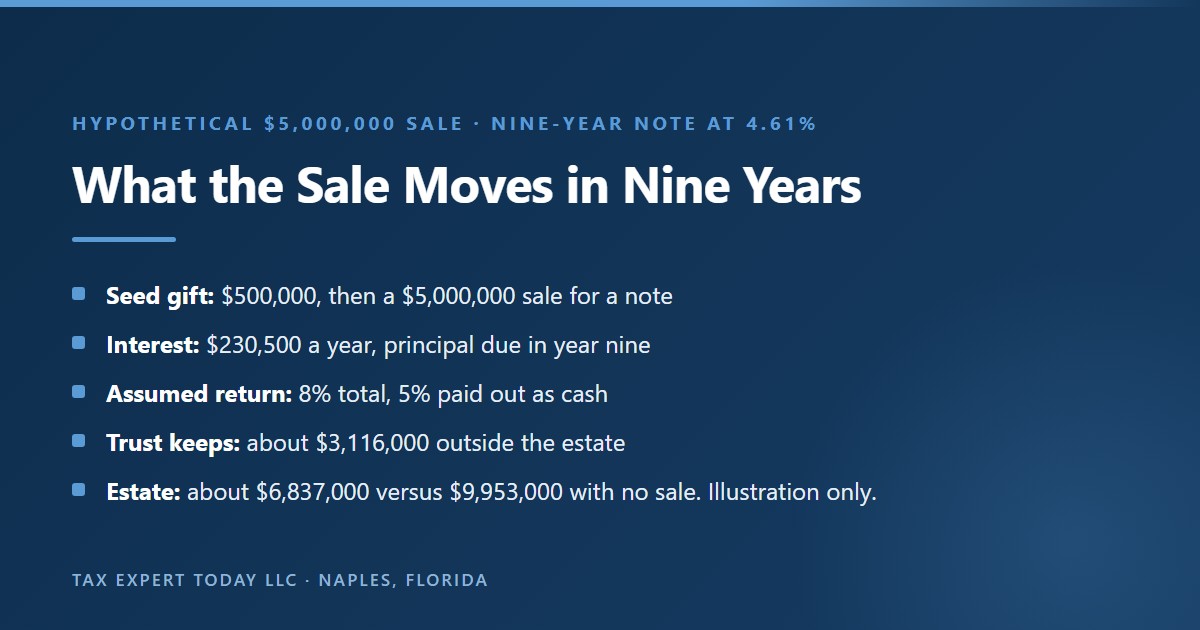
In this hypothetical, a grantor gives $500,000, then sells a $5,000,000 business interest to the trust for a nine-year, interest-only note at 4.61 percent. If the business returns an assumed 8 percent a year, the trust holds about $3,116,000 after repaying the note, value that would otherwise sit in the grantor’s estate.
- Seed gift: $500,000 in cash, reported on Form 709.
- Sale: a $5,000,000 nonvoting interest in a family business, basis $1,000,000.
- Note: nine years, 4.61 percent annual interest, principal due at maturity.
- Assumed return: 8 percent total, of which 5 percent is distributed as cash.
The example is a model, not a forecast. It assumes that the business interest grows by a total of 8 percent a year, that 5 percent of its value is distributed to the owner each year as cash, that the trust invests its own cash at the same 8 percent, and that the grantor pays income tax on the business’s pass-through income at an assumed combined rate of 30 percent. Real businesses do not grow in straight lines, and appraisers, distributions, and tax rates all vary.
Each year, the trust receives distributions from the business and pays $230,500 of interest to the grantor. Because the trust is a grantor trust, the grantor reports the business income on the grantor’s own return and pays the income tax, about $75,000 in year one and about $95,000 in year nine under these assumptions. At maturity, the trust has about $1,592,000 in cash. It pays that cash to the grantor and transfers the rest of the $5,000,000 principal, about $3,408,000, in the form of part of the business interest. The trust keeps the remaining part of the business interest, worth about $3,116,000.
The comparison case is a grantor who keeps the business interest and the $500,000 cash, receives the same distributions, pays the same income tax, and invests what is left at 8 percent. Under the same assumptions, that grantor’s estate would hold about $9,953,000 at the end of year nine. The grantor who completed the sale would hold about $6,837,000: the note principal received and the accumulated interest, less the income tax paid. The difference, about $3,116,000, is the value the sale moved outside the estate.
| Year | Business interest value at year end | Cash distributed to trust | Interest paid to grantor | Trust cash at year end | Income tax paid by grantor on trust income |
|---|---|---|---|---|---|
| 1 | $5,150,000 | $250,000 | $230,500 | $559,500 | $75,000 |
| 2 | $5,304,500 | $257,500 | $230,500 | $631,260 | $77,250 |
| 3 | $5,463,635 | $265,225 | $230,500 | $716,486 | $79,568 |
| 4 | $5,627,544 | $273,182 | $230,500 | $816,486 | $81,955 |
| 5 | $5,796,370 | $281,377 | $230,500 | $932,683 | $84,413 |
| 6 | $5,970,261 | $289,819 | $230,500 | $1,066,616 | $86,946 |
| 7 | $6,149,369 | $298,513 | $230,500 | $1,219,958 | $89,554 |
| 8 | $6,333,850 | $307,468 | $230,500 | $1,394,523 | $92,241 |
| 9 | $6,523,866 | $316,693 | $230,500 | $1,592,277 | $95,008 |
| Measure | No sale: grantor keeps the asset and the $500,000 | Seed gift plus sale to the IDGT |
|---|---|---|
| Value in the grantor’s estate | About $9,953,000 | About $6,837,000 |
| Value held by the trust outside the estate | $0 | About $3,116,000 |
| Lifetime exemption used | $0 | $500,000 (the seed gift) |
| Hypothetical estate tax at 40 percent on the moved value, if exemption is otherwise fully used | Not applicable | About $1,246,000 avoided |
| Basis of the business interest held by the trust | Not applicable | Carryover, about $478,000 for the share the trust keeps |
How does the growth rate change the result of a sale to an IDGT?
The sale moves value only to the extent the asset’s return beats the note rate. Under the same assumptions, a return equal to the 4.61 percent AFR leaves the trust about $750,000, mostly the seed gift’s growth. An 8 percent return leaves about $3,116,000, and a 10 percent return leaves about $4,839,000.
- Hurdle rate: the note’s interest rate, here 4.61 percent.
- Below the hurdle: the trust can lose its seed equity paying the note.
- Above the hurdle: the excess growth accumulates in the trust.
- The seed gift: its own growth stays in the trust in every case.
The core economics are simple. The grantor’s estate is “frozen” at the note’s principal plus interest. Everything the asset earns above that amount belongs to the trust. If the asset earns less than the note rate, the trust uses its seed equity to make up the difference, and in a poor enough outcome the trust can return the asset to the grantor and be left with little or nothing. The grantor has then used the lifetime exemption on the seed gift but has not moved much value. That downside is one reason many families do not sell their most volatile assets to an IDGT.
Because the note rate is fixed for the life of the note, a sale made when rates are low locks in a low hurdle. A sale made when rates are higher, as in 2026 compared with 2020 and 2021, requires stronger expected growth to be worth the cost. The table below holds every other assumption constant and changes only the total return.
| Assumed total return | Value in grantor’s estate at year nine, no sale | Value in grantor’s estate at year nine, with sale | Value held by the trust |
|---|---|---|---|
| 4.61 percent (equal to the AFR) | About $7,449,000 | About $6,699,000 | About $750,000 |
| 6 percent | About $8,398,000 | About $6,755,000 | About $1,643,000 |
| 8 percent | About $9,953,000 | About $6,837,000 | About $3,116,000 |
| 10 percent | About $11,759,000 | About $6,920,000 | About $4,839,000 |
What is the tax burn in an intentionally defective grantor trust?
The tax burn is the effect of the grantor paying income tax on trust income from personal funds. Under Rev. Rul. 2004-64, that payment is not a gift to the beneficiaries. Each payment lowers the grantor’s taxable estate while the trust keeps its full pre-tax return, so value shifts without using exemption.
- Not a gift: the grantor is paying the grantor’s own tax liability.
- Estate shrinks: the tax dollars leave the grantor’s estate.
- Trust grows faster: the trust compounds without paying income tax.
- Cash flow need: the grantor must have liquidity to pay the tax each year.
The authority for the tax burn is Rev. Rul. 2004-64. The ruling holds that “when the grantor of a trust, who is treated as the owner of the trust under subpart E, pays the income tax attributable to the inclusion of the trust’s income in the grantor’s taxable income, the grantor is not treated as making a gift of the amount of the tax to the trust beneficiaries.” The logic is that the grantor is legally liable for that tax, so paying it is satisfying the grantor’s own obligation, not making a transfer to anyone else.
In the hypothetical above, the grantor pays roughly $762,000 of income tax over nine years on income that the trust receives. A grantor who kept the asset would pay similar tax on the same income, so the tax burn is built into the comparison. What changes is where the after-tax growth sits. In the sale case, the trust receives the income and keeps it, while the grantor’s estate bears the tax.
The tax burn is a benefit only for as long as the grantor can afford it. A trust that holds a fast-growing pass-through business can produce a large income tax bill in a good year, without distributing enough cash to the grantor to pay it. Grantors who are already near retirement, or whose wealth is mostly in the business being sold, should model several years of tax liability before relying on the tax burn. If the burden becomes too heavy, the trust may allow grantor trust status to be turned off, which is covered later in this guide.
| Item | Amount under the assumptions | Tax treatment |
|---|---|---|
| Trust business income taxed to the grantor, year one | About $250,000 | Reported on the grantor’s Form 1040 |
| Income tax paid by grantor, year one | About $75,000 | Not a gift under Rev. Rul. 2004-64 |
| Income tax paid by grantor over nine years | About $762,000 | Reduces the grantor’s estate; no exemption used |
| Income tax paid by the trust | $0 | The trust is not a separate income taxpayer while a grantor trust |
Can an intentionally defective grantor trust reimburse the grantor’s income tax?
A trust may give an independent trustee discretion to reimburse the grantor for income tax on trust income. Under Rev. Rul. 2004-64, that discretion alone generally does not cause estate inclusion. A mandatory reimbursement, required by the trust or by state law, causes the full trust to be included under IRC 2036(a)(1).
- Situation 1: no reimbursement provision; the payment is not a gift.
- Situation 2: mandatory reimbursement; the trust is included in the estate.
- Situation 3: discretionary reimbursement; inclusion is not caused by the discretion alone.
- Creditor rule: state law that lets the grantor’s creditors reach the trust can change the result.
The three situations in Rev. Rul. 2004-64 are the template for every tax reimbursement clause. In the ruling’s words, “if, pursuant to the trust’s governing instrument or applicable local law, the grantor must be reimbursed by the trust for the income tax payable by the grantor that is attributable to the trust’s income, the full value of the trust’s assets is includible in the grantor’s gross estate under [section] 2036(a)(1).” If instead the instrument or local law “gives the trustee the discretion to reimburse the grantor,” the existence of that discretion, by itself, whether or not exercised, will not cause inclusion.
The ruling also notes that the answer may change if there is an understanding or pre-existing arrangement between the trustee and the grantor about reimbursement, if the grantor keeps a power to remove the trustee and name the grantor as successor trustee, or if the discretion permits the grantor’s creditors to reach the trust under applicable state law. For that reason, a discretionary reimbursement clause is usually paired with an independent trustee and a review of the governing state’s law on self-settled trusts and creditor rights. Readers whose trust has moved, or whose trustee has changed states, may find our discussion of trust situs after moving to Florida useful.
The ruling applies the Situation 2 estate tax holding prospectively. The IRS stated it would not apply that holding adversely to a grantor’s estate for a trust created before October 4, 2004. Trusts drafted since then are fully subject to it.
| Situation | Reimbursement provision | Gift tax result | Estate tax result |
|---|---|---|---|
| 1 | None; grantor pays the tax from personal funds | No gift | No inclusion from the payment |
| 2 | Trustee must reimburse the grantor | No gift | Full trust value included under IRC 2036(a)(1) |
| 3 | Independent trustee may reimburse, in its discretion | No gift | Discretion alone does not cause inclusion, absent an understanding or creditor access |
Do assets in an intentionally defective grantor trust get a step-up in basis at death?
Generally no. Rev. Rul. 2023-2 holds that when a grantor trust’s assets are not included in the grantor’s gross estate, their basis is not adjusted to fair market value under IRC 1014 at the grantor’s death. The trust keeps the grantor’s carryover basis, and a later sale by the trust can produce capital gain.
- IRC 1014(a): basis steps up only for property acquired from or passing from a decedent.
- Rev. Rul. 2023-2: a completed gift to a grantor trust outside the estate is not such property.
- Result: basis immediately after death equals basis immediately before death.
- Tradeoff: estate tax saved on growth versus capital gain tax on that growth.
Under IRC section 1014(a), the basis of property “in the hands of a person acquiring the property from a decedent or to whom the property passed from a decedent” is generally its fair market value at the date of death. Section 1014(b) lists the kinds of property treated as acquired from a decedent. For years, some commentators argued that assets in a grantor trust might qualify because the grantor was treated as their owner for income tax. In Rev. Rul. 2023-2, the IRS rejected that view.
The ruling’s facts describe an irrevocable trust over which the grantor retained a power that made the grantor the owner of the entire trust for income tax purposes but did not cause the assets to be included in the gross estate. The grantor funded the trust in a completed gift. The holding states that “the basis of Asset is not adjusted to its fair market value on the date of A’s death under [section] 1014 because Asset was not acquired or passed from a decedent as defined in [section] 1014(b),” so the basis immediately after death “is the same as the basis of Asset immediately prior to A’s death.”
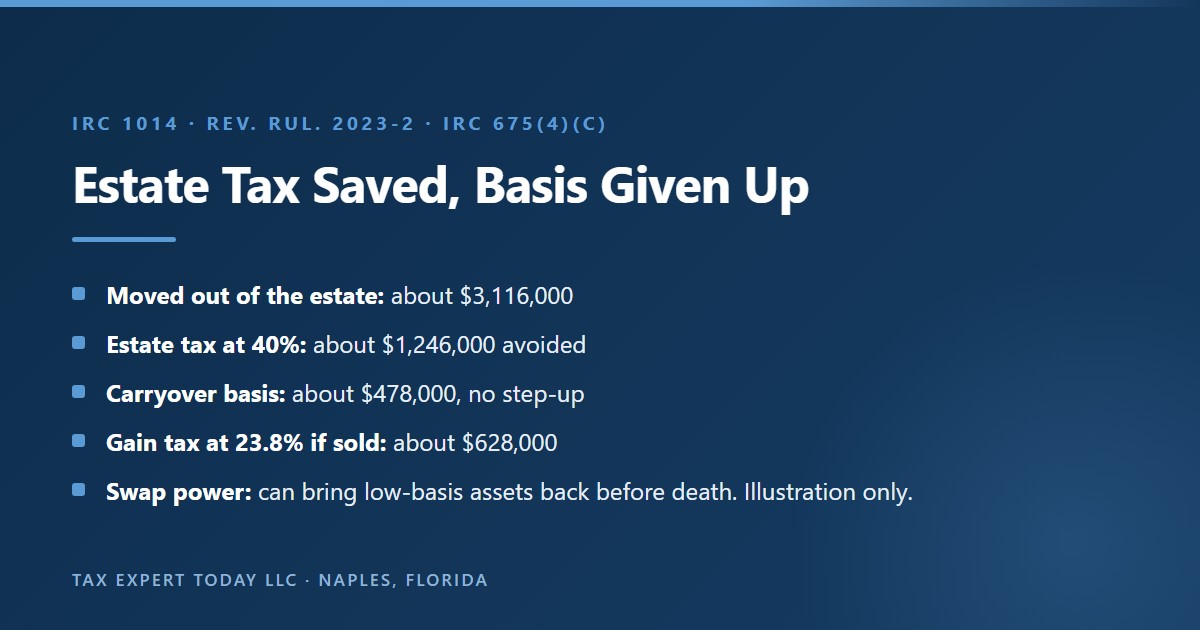
For a sale to an IDGT, that means the trust holds the business interest with the grantor’s original basis, not with the price the trust paid. In the hypothetical, the trust keeps a share of the business worth about $3,116,000 at year nine, with a carryover basis of about $478,000 for that share. If the grantor died at that point and the trust then sold the interest for its value, the trust or its beneficiaries would report a gain of about $2,638,000. At an assumed 23.8 percent combined federal rate on long-term gain (the 20 percent maximum capital gain rate plus the 3.8 percent net investment income tax of IRC section 1411), the tax would be about $628,000.
That number belongs next to the estate tax saving. Moving about $3,116,000 out of a taxable estate saves about $1,246,000 at the 40 percent maximum rate in IRC section 2001(c), if the grantor’s exemption is otherwise used up. Losing the step-up costs about $628,000 if the asset is sold soon after death. Under these assumptions the sale still comes out ahead, but by much less than the headline estate tax saving suggests, and for a grantor whose estate is below the exemption, the sale may only cost basis. A full discussion of what does and does not step up at death, including community property, is a separate topic from the IDGT technique itself.
| Measure | Amount under the assumptions | Authority |
|---|---|---|
| Value moved outside the estate | About $3,116,000 | IRC 2036; IRC 2038 (no inclusion) |
| Estate tax avoided at 40 percent | About $1,246,000 | IRC 2001; IRC 2010 |
| Trust’s carryover basis in that value | About $478,000 | Rev. Rul. 2023-2 |
| Built-in gain if sold after death | About $2,638,000 | IRC 1001 |
| Capital gain tax at 23.8 percent | About $628,000 | IRC 1(h); IRC 1411 |
| Net difference under these assumptions | About $618,000 in favor of the sale | Before swaps, discounts, or state tax |
How can a swap power restore the step-up in basis before death?
Before death, the grantor can use the IRC 675(4)(C) swap power to take low-basis assets back from the trust and give the trust cash or high-basis assets of equal value. The low-basis assets are then in the grantor’s estate and may receive a step-up under IRC 1014, while the trust holds assets with little built-in gain.
- Value neutral: the trust’s value does not change if the swap is at fair market value.
- Basis shift: low-basis property moves into the estate; high-basis property moves out.
- No gain on the swap: generally disregarded between grantor and grantor trust.
- Needs liquidity: the grantor must own assets of equal value to swap in.
The swap is the planning answer to Rev. Rul. 2023-2. Because the trust is still a grantor trust, an exchange between the grantor and the trust is disregarded for income tax under the same reasoning as the original sale. The grantor gives the trust, for example, $3,116,000 of cash or recently purchased securities, and takes back the business interest worth $3,116,000 with a basis of about $478,000. The trust’s value is unchanged. The grantor’s estate is unchanged in value too, but it now holds the low-basis business interest, which is property acquired from a decedent under IRC 1014(b) and may receive a basis equal to its fair market value at death.
The swap has to satisfy the conditions in Rev. Rul. 2008-22: equivalent value, a trustee who confirms it, and no shifting of benefits among beneficiaries. It also has to happen while the grantor is alive and has capacity. A swap planned for the last months of life can fail if the grantor becomes incapacitated, if the business interest cannot be appraised in time, or if the grantor does not have enough cash or high-basis assets to swap in. Some families borrow from a lender to fund the swap and repay the loan from the estate after death, which adds cost and risk.
A swap does not change the estate tax result. The value moved to the trust stays moved; only the identity of the assets changes. Swapping in cash means the trust gives up the growth asset in exchange for cash, so a swap is usually considered when the grantor’s health or age suggests death is not far off, or when the trust plans to sell the asset soon in any case.
| Item | Before the swap | After the swap |
|---|---|---|
| Trust holds | Business interest worth $3,116,000, basis $478,000 | Cash of $3,116,000, basis $3,116,000 |
| Grantor holds | Cash of $3,116,000 | Business interest worth $3,116,000, basis $478,000 |
| Trust’s built-in gain | About $2,638,000 | $0 |
| Grantor’s estate value | Unchanged | Unchanged |
| Basis of business interest after the grantor’s death | No step-up (Rev. Rul. 2023-2) | Generally fair market value at death (IRC 1014(a)) |
What happens if the grantor dies before the note is paid?
If the grantor dies with the note unpaid, the note is an asset of the estate, presumed worth its unpaid principal plus accrued interest under Treas. Reg. 20.2031-4. The trust keeps whatever growth has accumulated. The income tax result of the grantor trust status ending with a note outstanding is not settled by any published ruling.
- Estate tax: the note, not the business interest, is included in the estate.
- Value of the note: presumed at face plus accrued interest unless shown to be lower.
- Grantor status ends: the trust becomes a separate taxpayer at death.
- Open question: whether any gain is recognized on the outstanding note.
For estate tax, the result is straightforward. The estate owns a note receivable. Under Treas. Reg. section 20.2031-4, “the fair market value of notes, secured or unsecured, is presumed to be the amount of unpaid principal, plus interest accrued to the date of death, unless the executor establishes that the value is lower or that the notes are worthless.” The gift tax regulation, Treas. Reg. section 25.2512-4, applies the same presumption to notes valued for gift tax. In the hypothetical, if the grantor died at the end of year five, the estate would include the $5,000,000 note, and the trust would keep the business interest and cash, worth about $6,729,000 together, or about $1,729,000 above the note.
For income tax, the result is less certain. At death, the grantor stops being the owner of the trust for income tax, and the trust becomes a separate taxpayer that owes money on a note to the grantor’s estate. Commentators have taken different positions on whether the estate recognizes gain at that moment, whether the note takes a basis equal to its value under IRC 1014, and how the remaining payments are taxed. The IRS has not issued a published ruling resolving these questions. Families who use a long note with an older grantor should discuss with counsel how the trust instrument and the note address this risk, and whether to prepay or shorten the note.
Interest on the note after death is also different. Once the trust is a separate taxpayer, interest it pays to the estate is generally interest income to the estate and may be deductible by the trust, subject to the usual rules. The estate’s executor and the trustee should coordinate those returns.
| Item | Amount or treatment | Authority or status |
|---|---|---|
| Note included in the estate | $5,000,000 plus any accrued interest | Treas. Reg. 20.2031-4 presumption |
| Business interest value held by the trust | About $5,796,000 | Not included under IRC 2036 or 2038 |
| Cash held by the trust | About $933,000 | Not included |
| Trust value above the note | About $1,729,000 | Moved outside the estate |
| Income tax result of grantor status ending | Uncertain | No published ruling; positions differ |
How do valuation discounts affect a sale to an intentionally defective grantor trust?
When the asset sold is a minority or nonvoting interest in a business or partnership, an appraiser may apply discounts for lack of control and lack of marketability. A lower appraised value means a smaller note. The IRS can challenge discounts, and a value set too low turns part of the sale into a gift.
- Lack of control: a minority holder cannot direct distributions or a sale.
- Lack of marketability: there is no ready market for a private interest.
- Appraisal quality: discounts must be supported by a qualified appraisal.
- Risk: an undervalued sale price creates a gift equal to the shortfall.
The fair market value standard is what a willing buyer would pay a willing seller, neither under compulsion and both with reasonable knowledge of the facts. A buyer of a 20 percent nonvoting interest in a family company would generally pay less than 20 percent of the company’s total value, because the buyer cannot control decisions and cannot easily resell. Appraisers express those effects as discounts. This is the same principle behind many family limited partnership plans, and FLP interests are a common asset to sell to an IDGT.
Discounts are not automatic and they are not a number chosen for convenience. They depend on the entity’s governing documents, the specific rights of the interest being sold, the entity’s assets and history of distributions, and market data. The IRS reviews them closely. Under the Form 709 instructions, a substantial valuation understatement occurs when the reported value is 65 percent or less of the actual value, and a gross valuation understatement occurs at 40 percent or less, each of which can bring penalties.
Some sale agreements include a formula or defined value clause that adjusts the share transferred if the IRS later finds a higher value. Those clauses have been litigated and are drafted carefully by counsel. They are beyond the scope of this guide, but their existence shows how seriously valuation risk is treated in this technique.
| Hypothetical combined discount | Appraised sale price and note principal | Annual interest at 4.61 percent | Main risk |
|---|---|---|---|
| None | $5,000,000 | $230,500 | Larger note to service |
| 20 percent | $4,000,000 | $184,400 | IRS may argue a smaller discount |
| 30 percent | $3,500,000 | $161,350 | Greater audit attention and gift exposure if challenged |
How is a sale to an intentionally defective grantor trust reported on Form 709?
The seed gift is reported on Form 709 for the year it is made. The sale itself is not a gift if the price equals fair market value, but reporting it on Form 709 as a non-gift transaction, with the disclosure the regulations require, can start the three-year assessment period for the sale too.
- Seed gift: reported as a gift, with GST allocation if the trust may benefit grandchildren.
- Sale: disclosed as a transfer reported as not constituting a gift.
- Adequate disclosure: description, parties, trust EIN, terms, and the valuation method.
- Due date: generally April 15 of the year after the transfer, with extension available.
Form 709 is the gift tax return. A seed gift to an IDGT is a gift of a future interest unless the trust grants withdrawal rights, so it is generally reported in full. According to the Form 709 instructions, the return is due by April 15 of the year after the gift, moving to the next business day if April 15 falls on a weekend or legal holiday. An extension of time to file is available, but it does not extend the time to pay any gift tax due.
The sale is not a gift if the price is right, so there is no requirement to report it as one. Many advisors disclose it anyway. Under Treas. Reg. section 301.6501(c)-1(f)(4), a completed transfer “that is reported, in its entirety, as not constituting a transfer by gift will be considered adequately disclosed” if the disclosure requirements are met. Adequate disclosure starts the period in which the IRS can assess gift tax, generally three years. Without disclosure, the IRS can generally challenge the value of the sale at any time, including after the grantor’s death.
The Form 709 instructions list what adequate disclosure includes: a full and complete Form 709; a description of the transferred property and any consideration received by the donor; the identity of, and relationship between, the donor and each donee; for a transfer in trust, the trust’s EIN and a brief description of its terms or a copy of the trust instrument; and either a qualified appraisal or a detailed description of the method used to determine the fair market value. For a sale for a note, the “consideration received” is the note, so its terms belong in the disclosure.
| Transaction | Reported as | Disclosure items | Main benefit of reporting |
|---|---|---|---|
| Seed gift of cash | A gift | Amount, donee trust, EIN, trust terms | Required; uses exemption; GST allocation |
| Seed gift of a business interest | A gift | Same, plus a qualified appraisal | Required; starts the assessment period |
| Sale for a note at fair market value | A non-gift transaction | Property, note terms, parties, EIN, appraisal or method | Starts the assessment period on the sale value |
| Later swap of equal value | Often disclosed as a non-gift transaction | Both assets, values, method | Supports the value used if questioned later |
Does an intentionally defective grantor trust file its own tax return?
An IDGT obtains its own EIN, but while it is wholly a grantor trust its income is reported by the grantor. The Form 1041 instructions and Treas. Reg. 1.671-4 allow optional methods, such as giving payers the grantor’s taxpayer number, so a full Form 1041 may not be needed each year.
- EIN: generally obtained, because the trust holds assets and signs a note.
- Grantor’s return: trust income, deductions, and credits are reported on the grantor’s Form 1040.
- Optional methods: available for many trusts treated as owned by one grantor.
- After death: the trust generally becomes a separate filer.
The Form 1041 instructions include a section on grantor type trusts and on optional filing methods for certain grantor type trusts. Under the traditional method, the trustee files a Form 1041 with only the entity information completed and attaches a statement showing the income, deductions, and credits that the grantor reports. Under the optional methods described in Treas. Reg. section 1.671-4, a trust treated as owned by one grantor can instead furnish the grantor’s name and taxpayer identification number to payers, or file Forms 1099 itself, and skip the Form 1041.
The choice of method is mostly administrative. It does not change who pays the tax. If the trust owns an interest in a partnership or S corporation, the Schedule K-1 is generally issued in the name of the trust, and the grantor reports the items on the grantor’s own return. Readers who own the business through an S corporation should also note that a grantor trust is generally a permitted S corporation shareholder while the grantor is alive, and that the rules change after the grantor’s death. That transition needs advance planning so the S election is not lost.
After the grantor’s death, the trust is no longer a grantor trust, and it generally files Form 1041 as a separate taxpayer. Trust income tax brackets are compressed, so the trust may reach the highest federal rate at a much lower income level than an individual would. Distribution planning after death is a separate topic, but it is one reason families review the trust before death rather than after.
| Period | Who reports trust income | Filing method |
|---|---|---|
| Grantor alive, grantor trust status in effect | Grantor | Traditional Form 1041 with grantor statement, or an optional method under Reg. 1.671-4 |
| Grantor trust status turned off during life | Trust, and beneficiaries for distributions | Form 1041 as a separate trust |
| After grantor’s death | Trust, and beneficiaries for distributions | Form 1041 as a separate trust |
Can grantor trust status be turned off in an intentionally defective grantor trust?
Many trusts let the grantor release the swap power, or let a trustee or other person remove the power that creates grantor trust status. Turning it off ends the tax burn and makes the trust a separate taxpayer. Doing so while a note is unpaid can raise income tax questions, so timing matters.
- Release: the grantor gives up the 675(4)(C) power in writing.
- Removal: a third party may be authorized to cancel a grantor trust power.
- Effect: the trust begins paying its own income tax at trust rates.
- Caution: turning status off with a note outstanding may cause gain recognition.
Planners often call this “toggling.” The ability to turn grantor trust status off protects a grantor who can no longer afford the tax burn, for example after a large liquidity event inside the trust or a change in the grantor’s own finances. Some trusts also allow status to be turned back on, although whether a power can be reinstated depends on the instrument and on who holds it.
The main risk is turning status off too early. While the note is outstanding, the grantor and the trust are treated as one taxpayer for income tax. If that ends during the grantor’s life, the trust becomes a separate buyer that owes money to the grantor. Commentators have pointed to the rules on liabilities in Treas. Reg. 1.1001-2 to suggest that gain may be recognized to the extent the note exceeds the basis of the trust’s assets. Families generally plan to pay the note, or swap it out, before turning status off.
Releasing a power can also have estate tax consequences under IRC 2035 if the power itself was one that would have caused inclusion. A properly drafted swap power is not, under Rev. Rul. 2008-22, but other powers might be. Any release should be reviewed against the instrument.
| Reason to turn off | Typical method | Caution |
|---|---|---|
| Grantor can no longer afford the tax | Release of the swap power | Pay or restructure the note first |
| Large gain expected inside the trust | Third party removes the grantor trust power | Trust rates may be higher than the grantor’s |
| Grantor is moving into retirement income | Planned release on a set date | Coordinate with any S corporation stock held by the trust |
| Change in law or family goals | Instrument-specific provisions | Review IRC 2035 and state law before any release |
How does an intentionally defective grantor trust compare with a GRAT?
Both techniques move growth above a hurdle rate out of the estate. A GRAT returns annuity payments to the grantor at the section 7520 rate and uses little or no exemption. An IDGT sale uses a note at the lower AFR, can be allocated GST exemption, and avoids the GRAT’s mortality risk, but it requires a seed gift.
- Hurdle: GRAT uses the 7520 rate (5.60 percent in October 2026); an IDGT note uses the AFR (4.61 percent mid-term).
- Exemption: a zeroed-out GRAT uses almost none; an IDGT uses exemption for the seed gift.
- Death during term: GRAT assets generally return to the estate; IDGT growth generally stays out.
- Generation-skipping: GST exemption is more practical to allocate to an IDGT.
The grantor retained annuity trust is a statutory technique under IRC section 2702. The grantor keeps an annuity for a fixed term and the remainder passes to the beneficiaries. If the annuity is set so the remainder’s value is close to zero, the GRAT uses almost no exemption, and growth above the section 7520 rate passes free of gift tax. Our GRAT guide covers that technique and the 7520 rate in detail. Here the relevant point is how the two compare.
An IDGT sale has three main advantages. Its hurdle is the AFR, which is generally lower than the 7520 rate. Its result does not depend on the grantor surviving a term, because the note is the only estate asset if the grantor dies early. And because the seed gift is a completed gift at the outset, GST exemption can be allocated to it, which is difficult with a GRAT because of the estate tax inclusion period. The IDGT’s disadvantages are that it uses exemption for the seed, that it has no statutory safe harbor like section 2702, and that valuation errors in a sale can create a gift. GRATs commonly include a formula annuity that adjusts for revaluation, while a sale needs a defined value clause or other protection.
| Feature | Sale to an IDGT | Grantor retained annuity trust |
|---|---|---|
| Hurdle rate | AFR on the note (4.61 percent mid-term) | Section 7520 rate (5.60 percent) |
| Statutory basis | Grantor trust rules; revenue rulings | IRC 2702 |
| Exemption used at funding | The seed gift | Little or none if zeroed out |
| If grantor dies during the term | Note included; growth generally stays out | Generally much or all included |
| GST exemption allocation | Practical at the seed gift | Limited by the estate tax inclusion period |
| Valuation risk | Underpricing can create a gift | Formula annuity can absorb revaluation |
| Grantor trust tax burn | Yes | Yes, during the term |
How does an intentionally defective grantor trust compare with a SLAT or a dynasty trust?
A spousal lifetime access trust and a dynasty trust are usually grantor trusts too, so they can serve as the buyer in an IDGT sale. The difference is the beneficiary design. A SLAT names the grantor’s spouse, a dynasty trust is built for several generations, and a classic IDGT benefits children without spousal access.
- IDGT: the term usually describes the sale technique and a trust for descendants.
- SLAT: grantor trust status comes from the spouse’s interest under IRC 677.
- Dynasty trust: grantor trust status during life, GST exemption for later generations.
- Overlap: one trust can be all three if the document is written that way.
The labels describe different features. “Intentionally defective grantor trust” describes how the trust is taxed for income tax and, in common use, the sale for a note. “Spousal lifetime access trust” describes who can receive distributions. “Dynasty trust” describes how long the trust lasts and how it uses the GST exemption. A trust can be grantor for income tax, include a spouse as a beneficiary, and last for generations, all at once.
A spousal lifetime access trust is often chosen by a married grantor who wants to use exemption but keep indirect access to the assets through the spouse. Because income may be distributed to the spouse, IRC 677(a) makes it a grantor trust without any added power. The tradeoff is that divorce or the spouse’s death can cut off that indirect access. A dynasty trust is designed to hold assets for children, grandchildren, and later descendants without estate or GST tax at each generation, if GST exemption is allocated. Our guides to each cover those designs. A sale for a note can be made to any of them, provided the trust is a grantor trust and has enough equity.
| Trust | Main beneficiaries | Usual source of grantor trust status | Can buy assets for a note? |
|---|---|---|---|
| Intentionally defective grantor trust | Children or other descendants | IRC 675(4)(C) swap power or IRC 674 power | Yes, the classic use |
| Spousal lifetime access trust | Spouse, then descendants | IRC 677(a) spousal interest | Yes, if it has equity |
| Dynasty trust | Several generations of descendants | Any grantor trust power during life | Yes, often with GST exemption allocated |
| Irrevocable life insurance trust | Descendants, sometimes spouse | IRC 677(a)(3) premium power | Possible, but usually holds insurance |
Which assets fit an intentionally defective grantor trust?
The assets that fit an intentionally defective grantor trust sale are those expected to grow faster than the note rate and to produce enough cash to pay interest: interests in a closely held business, family limited partnership units, and income-producing real estate. Volatile assets with no cash flow are harder to fit.
- Closely held business interests: growth potential and possible appraisal discounts.
- Family limited partnership units: a common vehicle for pooled family assets.
- Rental real estate: steady cash flow to pay interest.
- Pre-sale company stock: high growth potential, but valuation is closely examined.
The asset choice drives the result more than any other factor. The asset needs a credible appraisal, a reasonable expectation of growth above the AFR, and enough distributable cash to pay the note without constant in-kind payments. A business that distributes cash to its owners each year, such as an S corporation or a partnership, fits that profile. So do rental properties with stable rents. Assets that pay nothing, such as raw land or early-stage company stock, can still be sold to an IDGT, but the trust must service the note from the seed gift or from other assets.
A company headed for a sale is a frequent candidate, because the appraised value before a deal is generally lower than the price a buyer later pays. That gap also draws IRS attention, so the appraisal must reflect what was known on the valuation date. Families considering both an IDGT and a later sale may find our guides to selling a business and qualified small business stock useful. QSBS has its own rules for transfers by gift, which must be reviewed before stock moves to any trust.
Some assets are poor fits. Retirement accounts cannot be sold or given to a trust during life without a taxable distribution. Assets with large debt can create the liability issues discussed above. Residential property the grantor plans to keep using raises retained-enjoyment questions under IRC 2036; a qualified personal residence trust is the technique built for a home.
| Asset | Growth potential | Cash flow for interest | Main issue |
|---|---|---|---|
| Nonvoting S corporation or LLC interest | Often high | Often good | Appraisal and S corporation eligibility after death |
| Family limited partnership units | Depends on underlying assets | Varies | Discounts and IRC 2036 risk in the partnership itself |
| Rental real estate in an LLC | Moderate | Good | Debt on the property |
| Company stock before a sale | High | Often none | Valuation date and known deal terms |
| Retirement accounts | Not applicable | Not applicable | Cannot be transferred without a taxable distribution |
| Personal residence | Moderate | None | Retained use; a QPRT is the usual tool |
How does the 2026 $15,000,000 exemption affect intentionally defective grantor trust planning?
For 2026, the basic exclusion amount is $15,000,000 per person and the annual exclusion is $19,000, under Rev. Proc. 2025-32. With exemption that large, some families can use a direct gift instead of a sale. A sale still helps when the asset’s expected value exceeds the exemption, or when exemption should be saved.
- Basic exclusion amount: $15,000,000 per person for 2026, indexed after 2026.
- GST exemption: also $15,000,000 for 2026.
- Annual exclusion: $19,000 per donee for present-interest gifts.
- Maximum rate: 40 percent on taxable transfers above the exemption.
Rev. Proc. 2025-32 states that section 70106 of the One Big Beautiful Bill Act amends IRC 2010(c)(3) “by increasing the basic exclusion amount to $15,000,000 for calendar year 2026,” and that the GST exemption under IRC 2631(c) is equal to $15,000,000 for 2026. It also sets the annual exclusion under IRC section 2503(b) at $19,000. Those figures change how many families think about an IDGT. Our lifetime gift tax exemption guide covers the exemption itself, and the IRS describes the taxes on its estate tax and gift tax pages.
When the entire estate is well under the exemption, a sale to an IDGT may add complexity without saving estate tax, and it gives up the basis step-up on the assets moved. When the estate is, or is expected to become, larger than the exemption, a sale lets the family move future growth while keeping most of the exemption in reserve. A grantor with a $30,000,000 business, for example, could not give it all away within a $15,000,000 exemption without gift tax, but could give a seed and sell the rest for a note.
The exemption for a married couple is effectively $30,000,000 in 2026 if both spouses use their own. A couple can split gifts on Form 709, and each spouse can create a trust. When both spouses fund trusts for each other, the reciprocal trust doctrine can undo the plan, which is one reason SLATs for each spouse are drafted to differ in meaningful ways.
| Item | 2026 figure | Authority |
|---|---|---|
| Basic exclusion amount per person | $15,000,000 | IRC 2010(c)(3); Rev. Proc. 2025-32 |
| GST exemption per person | $15,000,000 | IRC 2631(c); Rev. Proc. 2025-32 |
| Annual exclusion per donee | $19,000 | IRC 2503(b); Rev. Proc. 2025-32 section 4.42 |
| Annual exclusion for gifts to a non-citizen spouse | $194,000 | IRC 2523(i); Rev. Proc. 2025-32 section 4.42 |
| Maximum estate and gift tax rate | 40 percent | IRC 2001(c) |
How does the GST exemption apply to an intentionally defective grantor trust?
If the trust may benefit grandchildren or later generations, the grantor can allocate GST exemption to the seed gift on Form 709. Because the sale is for full value, it adds no GST exposure if the price is right. Growth in an exempt trust can then pass to later generations without GST tax.
- Allocation: made on Form 709, often for the seed gift only.
- Inclusion ratio: zero if exemption equals the trust’s value at funding.
- Leverage: a small exempt seed can support a large exempt trust after the sale.
- Automatic rules: IRC 2632 may allocate exemption automatically unless the donor elects out.
The generation-skipping transfer tax applies a 40 percent tax to transfers that skip a generation, such as gifts to grandchildren, beyond the GST exemption. Under IRC section 2631, each individual has a GST exemption, $15,000,000 for 2026, that can be allocated to transfers. Under IRC section 2642, the trust’s inclusion ratio is set by how much exemption is allocated relative to the value transferred. A trust with an inclusion ratio of zero is fully exempt.
The IDGT is an efficient place for GST exemption because only the seed gift needs to be covered. If $500,000 of exemption is allocated to a $500,000 seed gift, the trust starts with an inclusion ratio of zero. The sale for full value does not change the ratio, because the trust paid for what it received. Under the hypothetical, the trust could hold about $3,116,000 after nine years, all GST exempt, having used only $500,000 of GST exemption. That leverage is why the IDGT sale is so often paired with a dynasty design. Because the automatic allocation rules of IRC section 2632 can apply exemption to some transfers unless the donor elects otherwise, the Form 709 should state the intended allocation clearly.
| Item | Amount | Note |
|---|---|---|
| Seed gift and GST exemption allocated | $500,000 | Reported on Form 709 for the year of the gift |
| Inclusion ratio after funding | Zero | Exemption equals the value transferred by gift |
| Sale for a note at fair market value | $5,000,000 | No additional gift if correctly valued |
| Hypothetical trust value at year nine | About $3,116,000 | Fully GST exempt if the ratio stays zero |
Does Florida tax an intentionally defective grantor trust?
Florida does not tax individual income, has no separate trust income tax, and has no estate tax in effect for current deaths, so a Florida grantor generally pays only federal income tax on an IDGT’s income. Florida Statutes section 736.0505(1)(c) also protects trusts from the grantor’s creditors because of a discretionary tax reimbursement power.
- No personal income tax: barred for natural persons by Article VII, section 5 of the Florida Constitution.
- No current estate tax: Florida’s estate tax is tied to a federal credit that no longer applies.
- Reimbursement clause: section 736.0505(1)(c) addresses the creditor concern in Rev. Rul. 2004-64.
- Other states: a grantor or trustee in another state may face that state’s rules.
For a grantor who lives in Naples, Florida or elsewhere in the state, the state tax picture is simple compared with most of the country. The Florida Constitution, in Article VII, section 5, generally prohibits an income tax on natural persons. Florida’s estate tax under Chapter 198 of the Florida Statutes is tied to the federal credit for state death taxes, which was phased out, so no Florida estate tax is generally due for current deaths. Because the trust’s income is taxed to the grantor, the tax burn is a federal cost only.
Florida law also addresses the reimbursement question from Rev. Rul. 2004-64. That ruling warned that a discretionary reimbursement power could still cause estate inclusion if state law let the grantor’s creditors reach the trust. Under Florida Statutes section 736.0505(1)(c), the assets of an irrevocable trust “may not be subject to the claims of an existing or subsequent creditor or assignee of the settlor, in whole or in part, solely because of the existence of a discretionary power granted to the trustee” to pay the taxing authorities or to reimburse the settlor for tax on trust income. That provision is one reason Florida is often chosen as the governing law for a trust with a reimbursement clause.
Grantors who moved to Florida from a state with an income tax should confirm how their former state treats any trust created while they lived there, and whether a trustee in another state brings that state’s tax rules into play. Our guides to Florida estate planning for new residents and moving from California to Florida cover the residency side of that question.
| Tax | Florida treatment | Source |
|---|---|---|
| Income tax on the grantor | None on natural persons | Florida Constitution, Article VII, section 5 |
| Income tax on the trust | No separate trust income tax; the grantor is taxed federally while a grantor trust | Florida law; IRC 671 |
| Estate tax at death | Generally none for current deaths | Florida Statutes Chapter 198 |
| Creditor access through a reimbursement power | Not allowed solely because of the discretionary power | Florida Statutes section 736.0505(1)(c) |
What are the risks of an intentionally defective grantor trust?
The main risks are valuation, estate inclusion, the cost of the tax burn, the lost basis step-up, and the death of the grantor with the note outstanding. Each can reduce or erase the benefit. Most of them are managed by drafting, appraisal, annual administration, and a plan for the final years of the grantor’s life.
- Valuation: a price below fair market value makes part of the sale a gift.
- Estate inclusion: retained interests, mandatory reimbursement, or a sham note.
- Tax burn: the grantor must pay tax on income the grantor does not receive.
- Basis: no step-up under Rev. Rul. 2023-2 unless assets are swapped back.
No single rule governs the whole technique. The IRS has published rulings that support important pieces of it, including Rev. Rul. 85-13 on the sale, Rev. Rul. 2004-64 on the tax burn, Rev. Rul. 2008-22 on the swap power, and Rev. Rul. 2023-2 on basis, but there is no statutory safe harbor like the one Congress wrote for GRATs. The structure works because each piece is done correctly, and the risk is concentrated where a piece is done poorly.
Underperformance is a different kind of risk. If the asset grows more slowly than the note rate, the trust pays more interest than the asset earns, and the seed gift absorbs the shortfall. The grantor has then used exemption without moving much value. Legislative risk exists too. Proposals to change grantor trust rules have been made in past years, and any future change could affect trusts differently depending on when they were created. This guide describes the law as of its review date.
| Risk | What can go wrong | Common response |
|---|---|---|
| Valuation | IRS finds a higher value; the shortfall is a gift | Qualified appraisal; adequate disclosure; defined value clause |
| Thin equity | The note is recharacterized; IRC 2036 applies | Seed gift of meaningful size |
| Note not respected | Missed payments or forgiveness undermine the debt | Pay on schedule; keep records |
| Mandatory reimbursement | Full trust included under IRC 2036(a)(1) | Discretionary clause; independent trustee |
| Tax burn too heavy | Grantor runs short of cash | Toggle power; tax distribution policy in the business |
| Lost step-up | Capital gain when heirs sell | Swap before death; hold assets long term |
| Grantor dies during the note | Uncertain income tax result | Shorter note; prepayment; plan for it in the documents |
| Underperformance | Seed equity used to pay the note | Choose growth assets; consider a GRAT for volatile assets |
Who is a candidate for an intentionally defective grantor trust?
An intentionally defective grantor trust generally fits a person whose estate is expected to exceed the exemption, who owns an asset likely to grow faster than the AFR, who can pay the trust’s income tax for years, and who is willing to give up control and the basis step-up on the assets moved. Others may prefer simpler gifts.
- Estate size: projected to exceed $15,000,000 per person, or $30,000,000 for a couple.
- Asset profile: a business or real estate expected to grow and pay cash.
- Liquidity: other assets to pay the tax burn and, later, to fund swaps.
- Time horizon: a grantor in good health who expects to outlive the note.
The candidate profile follows from the mechanics. A sale moves value only if growth beats the note rate, so the asset matters. The tax burn requires liquidity outside the trust, so the grantor’s other wealth matters. A note outstanding at death raises open questions, so health and age matter. And because the trust gives up the step-up, estate size matters: a family whose estate will never owe estate tax may gain little and lose basis.
Business owners who expect a liquidity event, families who own appreciating real estate, and individuals who have already used part of their exemption are common candidates. People who want to keep using an asset, who need its income for their own living expenses, or who may need the assets back later may prefer other approaches, such as a SLAT for indirect access or by keeping assets in the estate for the step-up. Charitably inclined families may compare an IDGT with a charitable lead trust, which can also be built as a grantor trust.
| Profile | Fit for an IDGT sale | Reason |
|---|---|---|
| Owner of a growing business, estate over the exemption | Often strong | Growth above the AFR moves out without more exemption |
| Retiree living on the asset’s income | Often weak | Income is needed personally; trust pays only note interest |
| Estate well under the exemption | Often weak | Little estate tax to save; basis step-up lost |
| Grantor in poor health | Mixed | Note at death raises open questions; a swap may be preferred |
| Family planning for grandchildren | Often strong | GST exemption leverage on the seed gift |
Does an intentionally defective grantor trust protect assets from creditors?
Assets in a properly funded IDGT generally belong to the trust, not the grantor, so the grantor’s later creditors usually cannot reach them, and a spendthrift clause can protect beneficiaries’ interests. Protection is not absolute. Transfers made to hinder existing creditors can be undone, and the note the grantor holds remains reachable.
- Grantor’s creditors: generally cannot reach completed gifts made in good faith.
- Fraudulent transfer law: transfers to avoid known creditors can be reversed.
- The note: is the grantor’s asset and can be reached by the grantor’s creditors.
- Beneficiaries: a spendthrift provision can protect their interests from their own creditors.
Asset protection is a side benefit of the technique, not its purpose. Once the grantor makes a completed gift to an irrevocable trust in which the grantor has no beneficial interest, the property generally belongs to the trust. Under Florida Statutes section 736.0505(1)(b), a creditor of the settlor of an irrevocable trust may reach the maximum amount that can be distributed to or for the settlor’s benefit, which in a typical IDGT is nothing, and section 736.0505(1)(c) adds that a discretionary tax reimbursement power alone does not open the trust to the settlor’s creditors.
The sale side is different. The grantor sold the asset for a note, so the grantor still owns a valuable receivable. A creditor of the grantor can generally pursue that note. And state fraudulent transfer laws allow creditors to undo transfers made with intent to hinder, delay, or defraud them, or made while the transferor was insolvent. A grantor facing a known claim should not expect an IDGT to shield assets from it. Business owners who want protection from future business risks generally plan well before any claim is on the horizon.
| Asset or interest | Owner | Generally reachable by the grantor’s creditors? |
|---|---|---|
| Assets gifted to the trust in good faith | Trust | Generally no |
| Assets bought by the trust for a note | Trust | Generally no, if the sale was for fair value |
| Promissory note received by the grantor | Grantor | Yes |
| Transfers made to avoid an existing claim | Trust, subject to challenge | Possibly, under fraudulent transfer law |
| Beneficiary’s interest with a spendthrift clause | Beneficiary | Generally protected from the beneficiary’s creditors, with exceptions |
What happens to an intentionally defective grantor trust after the grantor dies?
At the grantor’s death, grantor trust status ends and the trust becomes a separate taxpayer that files Form 1041. The assets stay outside the estate, keep their carryover basis under Rev. Rul. 2023-2, and continue under the trust’s terms for the beneficiaries. Any unpaid note is collected by the estate.
- Income tax: the trust pays its own tax or passes income out to beneficiaries.
- Estate tax: trust assets are not included; the note is.
- Basis: no step-up for trust assets outside the estate.
- Administration: the trustee follows the distribution and continuation terms.
The trust’s character changes on the date of death. Before then, the grantor reported the trust’s income. After, the trust reports it on Form 1041 and may deduct distributions to beneficiaries, who then report that income. Trust income tax brackets are compressed, so trustees often review whether distributions, or holding assets that produce less current income, would lower the family’s combined tax.
If the trust holds S corporation stock, the trustee must act promptly. A grantor trust is a permitted shareholder under IRC section 1361 while the grantor is alive, and the Code generally allows it to continue as a shareholder for a limited period after death, during which the trust may need to become a qualified subchapter S trust or an electing small business trust. Missing that step can end the company’s S election. The executor of the grantor’s estate, meanwhile, collects any unpaid note and reports it on Form 706, and the trustee and executor coordinate the remaining payments.
| Item | Before death | After death |
|---|---|---|
| Income tax owner | Grantor | Trust and beneficiaries |
| Return | Grantor’s Form 1040; optional Form 1041 methods | Form 1041 |
| Unpaid note | Disregarded between grantor and trust | Asset of the estate; trust is the debtor |
| Basis of trust assets | Carryover | Still carryover under Rev. Rul. 2023-2 |
| S corporation stock | Permitted grantor trust shareholder | Limited period, then QSST or ESBT election needed |
What should be in place before a sale to an intentionally defective grantor trust?
Before a sale, the family should have a signed trust with a tested grantor trust power, an EIN, a completed and documented seed gift, a qualified appraisal dated near the sale, a note at the current month’s AFR, a payment plan the trust can meet, and a Form 709 disclosure plan for both transactions.
- Documents: trust instrument, purchase agreement, promissory note, and any security agreement.
- Valuation: qualified appraisal for the asset sold and for any non-cash seed gift.
- Rates: the AFR for the month of the sale from the current revenue ruling.
- Cash flow: a model of interest payments and the grantor’s tax burn.
A sale is a coordinated transaction among the grantor, the trustee, the appraiser, counsel, and the tax preparer. Each has a role, and gaps between them are where problems start. The appraiser needs the entity documents and financial statements. Counsel needs the appraisal before the purchase price is set. The tax preparer needs the trust’s EIN, the note terms, and the appraisal to prepare Form 709. The trustee needs a plan for collecting distributions and paying interest.
A practical step is to run the cash flow model before signing. The model should show the asset’s expected distributions, the note payments, the grantor’s projected income tax on the trust’s income, and how the trust would pay principal at maturity. A Form 709 plan should state which transfers will be reported as gifts, which as non-gift transactions, and how GST exemption will be allocated. The trust’s EIN is obtained with Form SS-4.
| Item | Why it matters |
|---|---|
| Signed irrevocable trust with a grantor trust power | Creates income tax grantor status without estate inclusion |
| Independent trustee who accepts the role in writing | Supports the 2036 and 2038 analysis and the swap conditions |
| Trust EIN from Form SS-4 | Needed for accounts, the note, and Form 709 disclosure |
| Seed gift completed and documented | Gives the trust equity before the sale |
| Qualified appraisal near the sale date | Sets fair market value; supports adequate disclosure |
| Note at the AFR for the month of sale | Avoids a below-market loan under IRC 7872 |
| Cash flow and tax burn model | Shows the trust can pay and the grantor can afford the tax |
| Form 709 reporting and GST allocation plan | Starts the assessment period and sets the inclusion ratio |
What are the most common intentionally defective grantor trust mistakes?
Common mistakes include selling without a seed gift, using an informal or outdated valuation, setting interest below the AFR, missing note payments, including a mandatory tax reimbursement clause, failing to disclose the sale on Form 709, and never revisiting basis before the grantor’s death.
- No seed gift: a trust with no equity weakens the note.
- Weak valuation: no qualified appraisal, or one dated long before the sale.
- Rate error: using the wrong month or the wrong term category.
- Poor administration: late payments, forgiven interest, or commingled accounts.
Most problems with an IDGT come from execution, not from the concept. A note that is never paid, or that the grantor forgives each year in a pattern that looks prearranged, invites the IRS to treat the sale as a gift with a retained interest. A rate taken from the wrong month’s ruling, or from the long-term column for a nine-year note, can either create a below-market loan or move less value than intended. A mandatory reimbursement clause, which Rev. Rul. 2004-64 treats as a retained interest, can bring the whole trust back into the estate.
The basis mistake is quieter. Families sometimes complete the sale, pay the note, and then never look at the trust again. When the grantor dies, the trust holds assets with very low basis that could have been swapped for cash or high-basis assets years earlier. An annual review that lists each trust asset, its value, and its basis makes the swap decision visible while there is still time.
| Mistake | Rule involved | Possible consequence |
|---|---|---|
| Sale with no seed gift | IRC 2036; debt versus equity principles | Note recharacterized; estate inclusion argued |
| Price set without a qualified appraisal | Treas. Reg. 25.2512-8 | Underpricing treated as a gift |
| Interest below the AFR | IRC 7872; IRC 1274(d) | Forgone interest treated as a gift |
| Missed or forgiven payments | Respect for the note as genuine debt | Sale treated as a disguised gift |
| Mandatory tax reimbursement | Rev. Rul. 2004-64, Situation 2 | Full trust included under IRC 2036(a)(1) |
| Sale not disclosed on Form 709 | Treas. Reg. 301.6501(c)-1(f)(4) | Assessment period does not start |
| Grantor trust status turned off with note unpaid | IRC 1001; Treas. Reg. 1.1001-2 | Possible gain recognition |
| No basis review before death | IRC 1014; Rev. Rul. 2023-2 | Avoidable capital gain for heirs |
Intentionally Defective Grantor Trust Help in Naples & Southwest Florida
Tax Expert Today LLC, based in Naples, Florida, helps families and business owners understand intentionally defective grantor trusts: modeling a seed gift and sale for a note, checking the AFR and note terms, preparing Form 709 disclosure, projecting the grantor’s tax burn, and reviewing basis and swap decisions with each family’s estate planning attorney.
- IDGT planning Naples: modeling the sale, the note, and the tax burn before documents are signed.
- Gift tax return preparation: Form 709 reporting of the seed gift and disclosure of the sale.
- Grantor trust income reporting: optional Form 1041 methods and the grantor’s Form 1040.
- Basis review: annual tracking of trust assets to support swap decisions.
Southwest Florida is home to many business owners and retirees whose estates are large enough to make the federal estate tax a real planning question, even though Florida itself has no estate tax for current deaths. Families in Naples, Bonita Springs, Fort Myers, and Marco Island often hold closely held companies, real estate, and partnership interests, which are the assets most often sold to an intentionally defective grantor trust. The firm’s Naples tax planning practice and its estate and trust planning services work on these questions alongside each client’s attorney, appraiser, and trustee. Families with an existing trust that needs to be updated may also find our guide to decanting a trust useful.
Tax Expert Today LLC
11983 Tamiami Trail N, Naples FL 34110
Phone: (239) 441-2005
Hours: Monday to Friday, 10:00 to 5:00 ET
Where can I get help with an intentionally defective grantor trust in Naples, FL? Tax Expert Today LLC, at 11983 Tamiami Trail N in Naples, Florida, helps families and business owners model a sale to an intentionally defective grantor trust, review note terms and the applicable federal rate, prepare Form 709 reporting, and track basis for future swap decisions, working with each client’s estate planning attorney. The firm includes tax advisors, enrolled agents, CPAs, and attorneys, and serves clients in all 50 states. Results depend on each person’s facts and documents.
| Item | Why it helps |
|---|---|
| Current estate plan and any existing trust instruments | Shows what already exists and how trusts are taxed |
| Prior Forms 709 | Shows exemption and GST exemption already used |
| Entity documents and recent financial statements for the asset | Needed for appraisal and cash flow modeling |
| Any prior appraisals | Shows valuation history and methods used |
| Basis records for the asset | Needed to measure the step-up tradeoff |
| Last two years of federal returns | Supports the tax burn projection |
| Family goals and beneficiaries | Shapes the trust design and GST planning |
When to Engage a Professional
An intentionally defective grantor trust combines income tax, gift tax, estate tax, valuation, and state trust law, and mistakes can be hard to fix once the sale closes. A professional review is worthwhile before drafting, before any seed gift or sale, each year while the note is outstanding, and whenever the grantor’s health or finances change.
- Before drafting, to decide whether a gift, a sale, a GRAT, or no transfer fits the family.
- Before the sale, to confirm the appraisal, the AFR, and the note terms.
- By April 15 after the year of the transfer, to file Form 709 with adequate disclosure.
- Each year, to confirm payments, project the tax burn, and review basis.
- When health changes, to consider a swap or prepayment of the note.
- When toggling status is considered, to review the note and the income tax effect first.
Tax Expert Today LLC is a multidisciplinary practice of tax advisors, enrolled agents, certified public accountants, and attorneys serving clients in all 50 states. To discuss how an intentionally defective grantor trust fits within a broader estate plan, contact our Naples, Florida tax planning team or review our estate and trust planning services, or call (239) 441-2005. Families comparing techniques may also find our guides to the grantor retained annuity trust, the family limited partnership, the dynasty trust, and the irrevocable life insurance trust useful.
This article is general information about federal and Florida tax provisions affecting intentionally defective grantor trusts and is not tax, legal, or investment advice for any specific person or family, and it is not a recommendation to create a trust or to make any gift or sale. Statutory and regulatory references were checked against the text of IRC sections 671, 674, 675, 677, 1001, 1014, 1274, 2035, 2036, 2038, 2042, 2631, 2642, and 7872, Treasury Regulation sections 1.671-4, 1.1001-2, 20.2031-4, 25.2512-4, 25.2512-8, and 301.6501(c)-1, Rev. Rul. 2004-64, Rev. Rul. 2008-22, Rev. Rul. 2023-2, Rev. Rul. 2026-19, Rev. Proc. 2025-32, the Instructions for Form 709 and Form 1041, the Florida Constitution, and Florida Statutes Chapter 198 and section 736.0505 on October 29, 2026. Rev. Rul. 85-13 is cited from its published holding in the 1985 Cumulative Bulletin. Applicable federal rates change monthly; a sale uses the rate for the month it closes. All dollar examples, including asset values, growth rates, cash yields, tax rates, discounts, and note terms, are hypothetical illustrations, not client outcomes and not predictions for any person. Tax laws apply differently to each person’s facts. Consult a qualified professional about your situation before taking any action.
Published October 29, 2026 by Dr. Pellumb Kabashi « Back to Learning Center
Have a question this article touches on?
Tax Expert Today LLC, based in Naples, Florida and serving clients across the United States.
Schedule a Consultation (239) 441-2005