
By Dr. Pellumb Kabashi, DBA, MBA, CES, CFE, EA
Founder, Tax Expert Today LLC · Tax advisors, enrolled agents, CPAs, and attorneys · Serving clients in all 50 states
Quick Answer: Moving to Florida ends Maine estate tax on your stocks, bank accounts and retirement accounts, but not on Maine real estate or tangible property. A Florida resident who dies owning a Maine cottage owes a prorated share of the tax when the whole estate exceeds the $7,160,000 exclusion for 2026, and taxable gifts made within one year of death are added back. Call (239) 441-2005 for a free consultation.
Published: October 2026
Many families who winter in Naples spent decades in Portland, Bangor, Kennebunkport or Bar Harbor, and many of them keep the place on the water when they change their legal home to Florida. They have usually heard that Florida has no estate tax, and that is true. What fewer of them know is that the Maine estate tax does not stop at the state line of residency. Maine taxes two groups of people: those who were domiciled in Maine when they died, and those who were domiciled somewhere else but still owned Maine real estate or tangible property. The coastal cottage, the camp on the lake, the boat in the yard at the marina and the furniture and art inside the summer house all keep a Maine address after the owner’s driver license changes.
The Maine estate tax has a higher threshold than most state death taxes. Its exclusion is $7,160,000 for deaths in 2026, so many Florida families will never pay it. But the threshold is less than half of the 2026 federal basic exclusion of $15,000,000, Maine does not allow a surviving spouse to use the unused exclusion of the first spouse, and the test for whether a nonresident must file looks at the entire estate, not just the Maine property. A Florida couple with a substantial investment portfolio and a valuable Maine cottage can therefore owe Maine tax even though they owe no federal tax and live in a state with no estate tax of its own.
This guide is written for the person who has moved from Maine to Florida, or who lives in Florida and owns a second home in Maine. It explains who owes the tax after the move, how the nonresident fraction works with worked numbers, when holding the cottage in an LLC changes the answer and when it does not, how the one year gift add-back and the gift-date sourcing rule interact with the move, what married couples lose without portability, how the Maine QTIP election behaves when the surviving spouse lives in Florida, and how the automatic Maine estate tax lien affects a later sale of the property. The rules were checked against the current text of Title 36, chapter 577 of the Maine Revised Statutes, Maine Revenue Services Rule 603 and the Maine Revenue Services estate tax pages on the date of publication. The examples are hypothetical illustrations of the statutory arithmetic and assume no deductions unless stated, so they are not a projection for any particular family. If you are still building the residency side of the move, start with our guide on how to establish Florida residency; this page covers the Maine estate tax only.
What Is the Maine Estate Tax?
The Maine estate tax is a state tax on the transfer of a decedent’s Maine taxable estate, imposed under Title 36, chapter 577 of the Maine Revised Statutes. It applies to residents on their whole estate and to nonresidents on Maine real and tangible property. The exclusion is $7,160,000 for 2026 deaths, and rates run from 8 to 12 percent.
- Who it reaches: people domiciled in Maine at death, and nonresidents who own Maine real estate or tangible personal property
- Exclusion: $5,600,000 set by 36 M.R.S. §4102, subsection 5, for 2018, indexed each year under section 4119 to $7,160,000 for 2026
- Rates: 8 percent on the first $3,000,000 above the exclusion, 10 percent on the next $3,000,000, 12 percent above that
- Gifts: no Maine gift tax, but taxable gifts made within one year of death are added back to the Maine taxable estate
- Spouses: no portability of the unused exclusion, but a Maine-only QTIP election is available
The tax begins with the federal computation and then adjusts it. Under section 4102, subsection 7, the Maine taxable estate is the federal taxable estate, decreased by any Maine qualified terminable interest property, increased by any Maine elective property carried over from a predeceased spouse, and increased by all taxable gifts made during the one year period ending on the date of death. The federal taxable estate is measured as of the date of death, and the federal deduction for state death taxes in Internal Revenue Code section 2058 is disregarded, so the Maine tax cannot be deducted in computing itself.
Because Maine starts from federal values, the inventory, appraisals and deductions that go into a federal Form 706 also drive the Maine number. For an estate that is too small to file a federal return, the Maine Revenue Services FAQ explains that the State Tax Assessor determines the value in accordance with federal tax principles, and in practice the estate prepares a pro forma federal return to support the Maine Form 706ME. That is worth remembering for a Florida estate that has no federal filing obligation: the Maine return can still require federal-style valuation work on every asset, not only on the Maine cottage.
Maine has had a stand-alone estate tax since it decoupled from the old federal state death tax credit, and the current structure applies to estates of decedents dying on or after January 1, 2013. The exclusion was $2,000,000 from 2013 through 2015, tracked the federal basic exclusion for 2016 and 2017, and was then reset to $5,600,000 for 2018 with annual inflation indexing. Proposals to lower the exclusion have been introduced in recent legislative sessions, which is one reason to recheck the figure each year rather than relying on a number from a past plan.
Who Owes Maine Estate Tax After Moving to Florida?
A Florida resident owes Maine estate tax only if, at death, the estate includes Maine real estate or tangible personal property and the Maine taxable estate exceeds the $7,160,000 exclusion. The tax is then prorated by the share of the estate located in Maine. Stocks, bonds and bank accounts follow Florida domicile and are outside Maine’s reach.
- Owes nothing: a Florida domiciliary with no Maine real estate and no tangible property kept in Maine
- Owes nothing: a Florida domiciliary whose Maine taxable estate is $7,160,000 or less, even with a Maine cottage
- May owe: a Florida domiciliary with a Maine cottage and a Maine taxable estate above $7,160,000
- Owes on everything: a person Maine treats as still domiciled in Maine at death
The dividing line is domicile. Section 4102 defines a resident as a natural person domiciled in Maine at the time of death, and a nonresident as a natural person domiciled in a jurisdiction other than Maine at the time of death. The tax on a resident in 36 M.R.S. §4103 applies a fraction whose numerator includes Maine real and tangible property plus all intangible personal property, so for a Maine domiciliary the fraction is close to 100 percent. The tax on a nonresident in 36 M.R.S. §4104 applies a fraction whose numerator includes only real and tangible personal property located in Maine.
The practical effect of a completed move is therefore large. Take a hypothetical $10,000,000 estate that includes a $1,500,000 cottage in Maine, with no deductions. As a Maine resident, the owner’s estate would owe $227,200 of Maine tax. As a Florida domiciliary who keeps the same cottage, the estate would owe $34,080. The cottage did not change, and neither did the size of the estate. What changed is that the brokerage accounts, the retirement accounts and the cash dropped out of the numerator because intangible property is sourced to the state of domicile.
Two things do not change with the move. First, the computation still starts with the whole estate. The nonresident tax is computed as if the decedent were a resident, using the entire Maine taxable estate to set the bracket, and only then multiplied by the Maine fraction. Second, the filing test still uses the whole estate. A Florida estate with a modest Maine cottage and a large portfolio can be required to file Form 706ME even when the fraction is small. For the residency mechanics of the move itself, our guide to a Florida residency audit covers the record a former high tax state may ask for.
What Are the Maine Estate Tax Rates and Exclusion in 2026?
For deaths in 2026, the Maine exclusion is $7,160,000. The Maine taxable estate above that amount is taxed at 8 percent on the first $3,000,000, 10 percent on the next $3,000,000, and 12 percent above $13,160,000. The rates apply only to the excess over the exclusion, so there is no cliff at the threshold.
- Up to $7,160,000: no tax
- $7,160,000 to $10,160,000: 8 percent of the excess over $7,160,000
- $10,160,000 to $13,160,000: $240,000 plus 10 percent of the excess over $10,160,000
- Above $13,160,000: $540,000 plus 12 percent of the excess over $13,160,000
The schedule is written into section 4103 in terms of the Maine exclusion amount, so the brackets move each year with the exclusion. Maine Revenue Services publishes the dollar table for each year of death on its Estate Tax (706ME) page. The 2026 table is reproduced below.
| Maine taxable estate more than | But not more than | Tax |
|---|---|---|
| $0 | $7,160,000 | $0 |
| $7,160,000 | $10,160,000 | 8% of the excess over $7,160,000 |
| $10,160,000 | $13,160,000 | $240,000 plus 10% of the excess over $10,160,000 |
| $13,160,000 | No limit | $540,000 plus 12% of the excess over $13,160,000 |
Unlike New York, Maine does not phase out the exclusion for estates that exceed it. An estate of $7,200,000 pays 8 percent only on the $40,000 above the line, or $3,200. That makes the Maine schedule gentler at the threshold than some neighboring states, but the effective rate climbs quickly for larger estates because the exclusion is fixed and the top rate reaches 12 percent. The figures below show the tentative tax before any nonresident fraction is applied, which is the full tax a Maine domiciliary would pay.
| Maine taxable estate | Tentative Maine tax (2026) | Effective rate on the whole estate |
|---|---|---|
| $7,000,000 | $0 | 0.0% |
| $8,000,000 | $67,200 | 0.8% |
| $10,000,000 | $227,200 | 2.3% |
| $12,000,000 | $424,000 | 3.5% |
| $15,000,000 | $760,800 | 5.1% |
| $20,000,000 | $1,360,800 | 6.8% |
| $25,000,000 | $1,960,800 | 7.8% |
The exclusion history matters when an older plan was drafted around a different number. The Maine Revenue Services FAQ lists the exclusion as $6,410,000 for 2023, $6,800,000 for 2024, $7,000,000 for 2025 and $7,160,000 for 2026. Under section 4119, the State Tax Assessor computes the next year’s figure on or about September 15 using the chained consumer price index, rounded to the nearest $10,000. A will or trust that divides property by reference to “the largest amount that can pass free of Maine estate tax” will fund differently each year, which is usually intended but should be checked against the current figure and the federal formula clauses in the same document.
How Is the Maine Estate Tax Computed for a Nonresident?
The nonresident tax is computed in two steps under 36 M.R.S. section 4104. First, compute the tax on the whole Maine taxable estate as if the decedent were a resident. Second, multiply it by the value of Maine real and tangible property divided by the adjusted federal gross estate. The result is the Maine tax.
- Step one: start with the federal taxable estate and make the Maine adjustments for gifts, QTIP and elective property
- Step two: apply the 2026 rate schedule to the whole Maine taxable estate
- Step three: build the fraction, Maine real and tangible property over the adjusted federal gross estate
- Step four: multiply the tentative tax by the fraction
The denominator of the fraction is the adjusted federal gross estate, which section 4102, subsection 1, defines as the federal gross estate as modified by Maine elective property and the value of taxable gifts made during the one year period ending on the date of death. It is a gross figure, before debts, expenses and the marital and charitable deductions, while the rate schedule applies to a net figure, the Maine taxable estate. The mismatch is deliberate: the deductions reduce the tax through the bracket, and the fraction then measures what share of the gross estate sits in Maine.
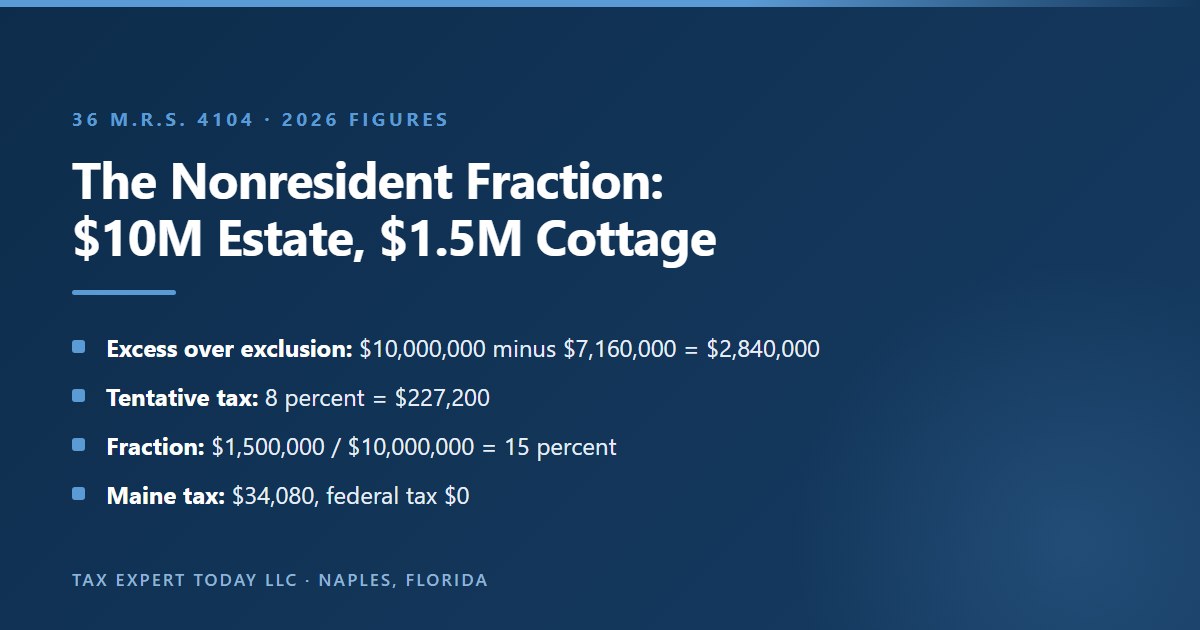
The worked example below follows a hypothetical Florida domiciliary who dies in 2026 with a $10,000,000 estate, including a $1,500,000 cottage in Maine, and no debts, deductions or lifetime gifts.
| Step | Computation | Result |
|---|---|---|
| Maine taxable estate | $10,000,000 federal taxable estate, no adjustments | $10,000,000 |
| Excess over exclusion | $10,000,000 minus $7,160,000 | $2,840,000 |
| Tentative tax | 8% of $2,840,000 | $227,200 |
| Maine fraction | $1,500,000 divided by $10,000,000 | 15% |
| Maine estate tax | $227,200 multiplied by 15% | $34,080 |
| Federal estate tax | Estate below the $15,000,000 basic exclusion | $0 |
The size of the rest of the estate affects the Maine tax even though Maine cannot tax it directly. Holding the cottage constant and increasing the portfolio raises the bracket on the whole estate and lowers the fraction at the same time, and because the rates are progressive the bracket effect wins. At a $12,000,000 estate, the same kind of computation produces a tentative tax of $424,000, and the Maine tax depends on how much of that estate sits in Maine.
| Maine cottage value in a $12,000,000 estate | Maine fraction | Maine estate tax |
|---|---|---|
| $1,000,000 | 8.3% | $35,333 |
| $2,000,000 | 16.7% | $70,667 |
| $3,000,000 | 25.0% | $106,000 |
A smaller estate produces a cleaner result. If the same Florida domiciliary had a $7,000,000 estate that included a $2,000,000 cottage, the Maine taxable estate would be below the $7,160,000 exclusion and the tentative tax would be zero, so the Maine tax is zero no matter how large the fraction is. That estate still has Maine paperwork to complete, because the automatic estate tax lien attaches to the cottage at death, as explained below.
What Property Has a Maine Situs for a Florida Resident?
For a Florida domiciliary, only Maine real estate and tangible personal property physically located in Maine at death count in the numerator of the Maine fraction. Intangible property, including stocks, bonds, brokerage accounts and bank accounts, is sourced to the state of domicile under MRS Rule 603, so it follows the Florida domicile and stays outside the Maine numerator.
- Real property: sourced where it is physically located, whether the decedent was a resident or not
- Tangible personal property: sourced where it was situated at death, with an exception for items temporarily elsewhere for repair
- Intangible property: sourced to the decedent’s domicile at death
- Gifts within one year of death: sourced under the same rules on the date the gift was made
The sourcing rules are set out in section .07 of MRS Rule 603. Real property is straightforward: the cottage, the camp, the undeveloped land on the point and the commercial building in Portland are all Maine property. Tangible personal property is the category that surprises people. The furniture, art and collections kept at the Maine house, a boat stored at a Maine boatyard, and vehicles kept in Maine at the date of death are sourced to Maine. Rule 603 adds that an item temporarily in a state for repair or another temporary purpose is sourced to the place it is intended to be after the repair, which helps the owner whose boat is in a Maine yard for a refit before heading south, but not the owner whose boat simply lives in Maine.
| Asset of a Florida domiciliary | Maine numerator? | Why |
|---|---|---|
| Coastal cottage or lake camp in Maine | Yes | Real property sourced where located |
| Furniture, art and collections kept at the Maine house | Yes | Tangible property situated in Maine at death |
| Boat kept at a Maine marina or boatyard | Yes, unless there only temporarily | Tangible property; temporary repair exception |
| Brokerage account held with a Maine custodian | No | Intangible property follows Florida domicile |
| IRA, 401(k) or annuity | No | Intangible property |
| Maine bank account | No | Intangible property |
| Maine cottage held in a passive family LLC | Yes | Entity disregarded under section 4104 |
| Interest in an operating Maine business entity with a valid business purpose | Usually no | Entity respected; the interest is intangible |
Tangible property is worth a short inventory before and after the move. In the hypothetical $10,000,000 estate above, adding $500,000 of art, furnishings and a boat that live at the Maine cottage raises the Maine numerator from $1,500,000 to $2,000,000 and the Maine tax from $34,080 to $45,440. Moving valuable art to the Florida home, where it is enjoyed for most of the year anyway, changes the sourcing of that art without changing anything else in the plan. The decision should be made for real reasons and documented, because a shipment the week before a death is the kind of fact an auditor will notice.
The location of the custodian does not matter for intangible property. A brokerage account at a Portland firm or a deposit account at a Maine bank is still intangible property sourced to the Florida domicile. Families sometimes close Maine accounts on the theory that they create Maine estate tax exposure. They do not, although consolidating accounts can still simplify estate administration and the domicile record.
Does Holding a Maine Cottage in an LLC Avoid the Tax?
Usually not for a family cottage. Section 4104 disregards a pass-through entity and treats its Maine real and tangible property as owned directly if the entity does not actively carry on a business for profit, if it holds the property without a valid business purpose, or if the decedent retained an interest that brings the property into the estate.
- Test one: the entity does not actively carry on a business for the purpose of profit and gain
- Test two: the ownership of the property in the entity was not for a valid business purpose
- Test three: the property was not acquired in a bona fide sale for full value, and the decedent kept a power or interest that brings it into the estate
- Any one is enough: meeting any of the three causes the entity to be disregarded
The rule appears in the second paragraph of section 4104 and is repeated in section .07(E) of Rule 603, which adds two sentences that settle most family cases: the State Tax Assessor determines whether there was a valid business purpose by looking at the economic realities of the transfer, and tax avoidance is not considered a valid business purpose. Rule 603 defines a pass-through entity broadly to include trusts, S corporations, general and limited partnerships, limited liability partnerships and limited liability companies that are not taxed as C corporations.
A family LLC formed to hold the summer cottage, which the family uses and does not rent as a business, fails the first test because it does not actively carry on a business for profit. If it was formed in the year of the move with the stated goal of converting the cottage into an intangible asset, it also fails the second test. The cottage is then treated as owned by the decedent in proportion to his or her interest, and it goes into the numerator exactly as if the deed were in the decedent’s own name. In the hypothetical $12,000,000 estate, a $3,000,000 cottage held this way produces the same $106,000 Maine tax as a cottage held outright.
The Maine rule is narrower than some states’ rules, and that matters for business owners. Minnesota, for example, looks through pass-through entities without a business purpose test, as our guide to the Minnesota estate tax after a Florida move explains. Maine’s three part test means that an entity that genuinely operates a business for profit, holds Maine real estate for that business, and was formed for a valid business reason can be respected, so the decedent’s interest is an intangible asset sourced to Florida. A Florida resident who owns a membership interest in a family company that runs a working inn, a boatyard or a commercial property portfolio in Maine is in a different position from a family that holds its vacation house in an LLC.
The line is drawn on facts, not labels, so it is not a planning shortcut. Rental activity can be a business, but occasional rentals of a family cottage that the owners use every summer look more like personal use than an active business for profit. An operating company that was capitalized with the cottage in the year of the move invites the second and third tests. Before relying on an entity to keep Maine property out of the numerator, the facts should be reviewed with counsel against the statute and Rule 603, and the entity should be operated consistently with its stated purpose.
What Is the Maine One Year Gift Rule?
Maine has no gift tax, but under 36 M.R.S. section 4102 it adds back to the Maine taxable estate all taxable gifts the decedent made during the one year period ending on the date of death. Gifts made more than one year before death are not added back, so lifetime gifts can reduce the Maine tax if made early enough.
- What is added back: taxable gifts as defined in Internal Revenue Code section 2503, made in the year before death
- What is not: gifts within the federal annual exclusion, $19,000 per donee for 2026, and gifts covered by the marital or charitable deduction
- Where it applies: both the Maine taxable estate and the adjusted federal gross estate used in the fraction
- Retained interests: gifts that are incomplete or where control was kept are disregarded and the property is treated as still owned
The add-back is written “notwithstanding the Code, Section 2035,” which means it applies to all taxable gifts in the one year window, not only to the narrow categories of transfers that federal law pulls back into the gross estate. Section .05 of Rule 603 adds that the Assessor will disregard a gift and treat the decedent as the owner where the gift was not completed, incidents of ownership were retained, or the gift would otherwise be disregarded under federal law. A deed of the cottage to the children with a side understanding that the parents keep using it as before is the kind of transfer federal and Maine law can both look through.
The one year window is short compared with Minnesota’s three years and Connecticut’s lifetime cumulative system, both covered in our guides to the Minnesota estate tax and the Connecticut estate tax after a Florida move. That makes lifetime giving an effective Maine planning tool for families who can afford it. A gift completed and more than one year behind the donor at death is outside the Maine taxable estate and outside the denominator. The federal side has to be watched at the same time: taxable gifts use up the federal lifetime exclusion, and the gifted asset does not receive a basis adjustment at death under Internal Revenue Code section 1014, which can cost the family more in income tax than the estate tax saved.
A gift of the Maine cottage itself is a special case. If the parents give the cottage to the children and survive by more than one year, the cottage is out of the estate and out of the numerator, and the children take the parents’ basis. If the parents keep using the cottage as before, the gift may be disregarded or pulled back into the federal gross estate under section 2036. A sale or lease at fair rent, a qualified personal residence trust, or another structure can address that problem, but each has its own federal rules and should be designed with counsel. Our guide to Florida estate planning for new residents covers the documents that usually change with the move.
Why Can a Gift Made Before the Move Raise the Maine Tax?
Under MRS Rule 603, taxable gifts made within one year of death are sourced on the date of the gift. A gift of securities made while you were still a Maine domiciliary is Maine intangible property, so it lands in the numerator of a later nonresident fraction. The same gift made after the Florida move does not.
- Before the move: the gifted securities are sourced to Maine because the donor was a Maine domiciliary on the gift date
- After the move: the gifted securities are sourced to Florida and stay out of the numerator
- More than one year before death: the gift is not added back at all
- The window is short: the trap applies only when death follows the pre-move gift within one year
Section .07(D) of Rule 603 provides that taxable gifts made within one year prior to death are sourced consistently with the real, tangible and intangible rules “on the date the gift was made.” For a resident who makes a large gift of stock and then dies as a Maine resident, the timing makes no difference because everything is in the numerator anyway. For a family that makes the gift in Maine during the year of the move, and then suffers a death within twelve months, the rule converts part of a Florida estate’s portfolio into Maine property for the fraction.
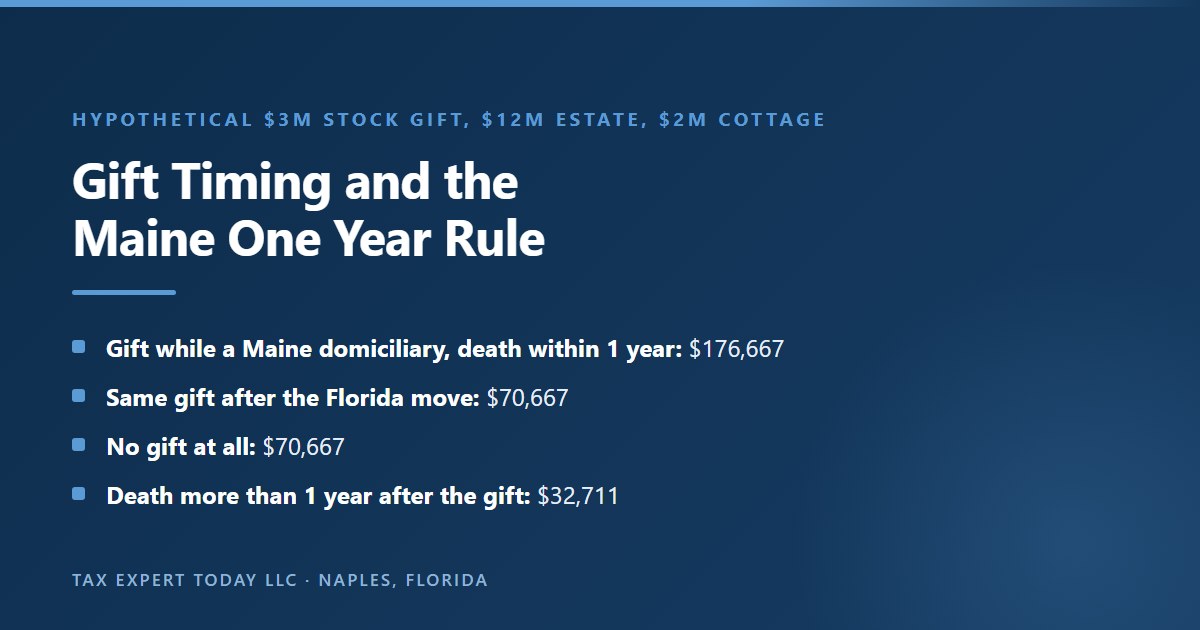
The table below follows a hypothetical Florida domiciliary who dies in 2026 owning a $2,000,000 Maine cottage, after making $3,000,000 of taxable gifts of securities to the children (after the annual exclusion). Before the gifts the estate was $12,000,000. There are no other deductions.
| Scenario | Maine taxable estate | Fraction | Maine tax |
|---|---|---|---|
| Gift made while a Maine domiciliary, death within one year | $9,000,000 plus $3,000,000 add-back = $12,000,000 | $5,000,000 / $12,000,000 | $176,667 |
| Gift made after the Florida move, death within one year | $12,000,000 | $2,000,000 / $12,000,000 | $70,667 |
| No gift | $12,000,000 | $2,000,000 / $12,000,000 | $70,667 |
| Gift made more than one year before death | $9,000,000 | $2,000,000 / $9,000,000 | $32,711 |
Three lessons follow from the arithmetic. First, a gift made after the move and within a year of death changes nothing, because the add-back restores the bracket and the gift is outside the numerator. Second, a gift made before the move and within a year of death more than doubles the Maine tax in this example, because $3,000,000 of securities becomes Maine property for the fraction. Third, a gift that survives the one year window reduces the Maine tax substantially, because it lowers the bracket and the denominator together. For families with the capacity to make large gifts, the general direction is to make them after the domicile change is complete and early enough to clear the one year window, while weighing the loss of basis step-up on appreciated assets.
These rules apply only to taxable gifts. Gifts within the $19,000 per donee annual exclusion for 2026, tuition and medical payments made directly to the provider, and gifts to a spouse that qualify for the marital deduction are not taxable gifts and are not added back. A family that spreads annual exclusion gifts across children and grandchildren over several years does not trigger the Maine add-back at all.
Does Maine Have a Gift Tax or an Inheritance Tax?
No. Maine does not impose a gift tax or an inheritance tax. Lifetime gifts are reached only through the one year add-back in the estate tax, and beneficiaries do not pay a separate tax on what they inherit. The estate tax is paid by the personal representative from the estate, not by heirs in Maine.
- Gift tax: none in Maine; federal gift tax rules still apply
- Inheritance tax: none in Maine; contrast Pennsylvania and New Jersey
- Who pays: the personal representative, from assets under his or her control, under 36 M.R.S. section 4105
- Credit for prior transfers: none; Maine does not credit Maine tax paid on recently inherited property
The absence of an inheritance tax distinguishes Maine from states that tax the beneficiary by relationship, such as those covered in our guides to the Pennsylvania inheritance tax for Florida residents and the New Jersey inheritance tax for nonresidents. In Maine, the tax is on the estate as a whole, and the will or trust decides which beneficiaries bear it. A tax apportionment clause that charges the Maine tax to the person who receives the Maine cottage, rather than to the residue, can make a large difference to how a blended family’s shares come out.
Maine also does not have a credit like the federal credit for tax on prior transfers. The Maine Revenue Services FAQ confirms that Maine law provides no credit for Maine estate tax previously paid by another estate on the same property. If one spouse dies a Maine resident and pays Maine tax on the cottage, and the surviving spouse dies two years later still owning it, the cottage can bear Maine tax twice. That is one more reason the ownership of a Maine second home between spouses deserves attention.
Personal liability is the last practical point. Section 4105 makes the personal representative responsible for paying the tax to the extent of assets under his or her control, and a Maine probate court will not allow the final account of a Maine personal representative without a certificate from the Assessor that the tax is paid, secured or not due. A Florida personal representative handling a Florida probate still has to deal with Maine for the Maine property, often through an ancillary proceeding in the Maine county where the cottage is located unless the property is held in a revocable trust.
Can Married Couples Use Portability for the Maine Estate Tax?
No. Maine has no portability of a deceased spouse’s unused exclusion, so each spouse has a separate $7,160,000 exclusion for 2026. If the first spouse leaves everything outright to the survivor, the first exclusion is lost for Maine purposes. A credit shelter trust or the Maine QTIP election is the usual response.
- Federal rule: a surviving spouse can use the deceased spouse’s unused federal exclusion through a timely portability election
- Maine rule: no equivalent; the deceased spouse’s unused federal exclusion is expressly excluded from the Maine QTIP calculation
- Outright to spouse: no Maine tax at the first death, but the survivor’s estate carries everything
- Credit shelter trust: uses the first exclusion and keeps the trust out of the survivor’s estate
The lost exclusion is easiest to see with numbers. The table below follows a hypothetical Florida couple with a combined $14,000,000 of assets, each spouse owning $7,000,000, with the $2,000,000 Maine cottage titled in the name of the first spouse to die. The first spouse dies in 2026 and the second dies later, both as Florida domiciliaries, with 2026 figures used throughout for comparison.
| Plan at the first death | Maine tax at first death | Maine tax at second death | Total Maine tax |
|---|---|---|---|
| Everything outright to the surviving spouse | $0 (marital deduction) | $640,800 tentative on $14,000,000, multiplied by $2,000,000 / $14,000,000 = $91,543 | $91,543 |
| First spouse’s $7,000,000, including the cottage, to a credit shelter trust | $0 (below the exclusion) | $0 (survivor owns no Maine property and has $7,000,000) | $0 |
The credit shelter result depends on its assumptions: the trust is drafted so that it is not included in the survivor’s estate, the cottage is in the trust rather than held by the survivor, and the survivor’s own estate stays below the exclusion. The trust also keeps the cottage itself out of the survivor’s Maine fraction, which is valuable when the survivor’s own estate later grows past the exclusion. The federal side works differently, since a portability election can preserve the first spouse’s federal exclusion even without a trust, and the trust gives up a second basis adjustment on the cottage at the survivor’s death. Those trade-offs are why the credit shelter decision is usually revisited after a move.
Joint ownership raises a separate question. Property held by spouses as joint tenants passes to the survivor by operation of law and qualifies for the marital deduction, so it produces no Maine tax at the first death but leaves the whole cottage in the survivor’s estate. Section 4112 provides that the Maine estate tax lien does not attach to property passing by right of survivorship to a surviving joint tenant who was the decedent’s spouse, which simplifies the first death administratively, but it does nothing about the second.
How Does the Maine QTIP Election Work After a Move?
The Maine QTIP election lets the first estate deduct, for Maine purposes only, property that qualifies for QTIP treatment but is not elected for federal QTIP. It defers Maine tax to the surviving spouse’s death, when the remaining property is included as Maine elective property. A survivor who dies in Florida may face a smaller Maine fraction.
- Cap: the federal applicable exclusion amount minus the Maine exclusion amount, without any federal portability amount
- 2026 ceiling: $15,000,000 minus $7,160,000, or $7,840,000
- Timing: the election must be made on an original, timely filed Form 706ME, including extensions
- Second death: the remaining property is Maine elective property in the surviving spouse’s estate
The election solves a mismatch between the federal and Maine exclusions. A plan that funds a credit shelter trust with the full federal exclusion, $15,000,000 for 2026, would shelter that trust from federal tax but would exceed the Maine exclusion by $7,840,000, producing Maine tax at the first death. Section 4102, subsection 6, allows the estate to treat qualifying property in that trust, if it meets the requirements of Internal Revenue Code section 2056(b)(7) but is not elected as federal QTIP, as Maine QTIP property and deduct it for Maine purposes. Section .09 of Rule 603 says the Maine QTIP property is tax-deferred until the death of the surviving spouse, and that the election cannot be added on a late amended return.
At the surviving spouse’s death, section 4102, subsection 4, includes the remaining property in the survivor’s Maine taxable estate as Maine elective property, valued at the survivor’s death. Maine elective property is also part of the adjusted federal gross estate, which is the denominator of the fraction. For a survivor who is still a Maine domiciliary, the inclusion simply restores the deferred tax. For a survivor who has moved to Florida, the computation is different: the elective property raises the bracket and the denominator, but the numerator of the nonresident fraction counts only Maine real and tangible property. If the Maine QTIP trust holds securities rather than the Maine cottage, a Florida survivor’s Maine tax can be much lower than the tax that was deferred.
That outcome follows from the statutory text, but it is the kind of result an auditor will examine closely, especially when the survivor moved shortly after the first death. The survivor’s change of domicile has to be genuine and well documented, and the trust’s holdings should be reviewed, because Maine real estate or tangible property held inside a Maine QTIP trust is still Maine property for the numerator. A surviving spouse considering a move after a Maine QTIP election should model the second death both ways with counsel before relying on the deferral becoming a reduction.
How Does Maine Decide Where You Were Domiciled at Death?
Maine uses the common law test: domicile is the place where a person resides and intends to remain and, whenever absent, to return. Under MRS Rule 603, a Maine domicile continues until a new one is established, and the person alleging the change bears the burden of proving it. Facts outweigh statements of intent.
- Two parts: physical residence plus the intent to remain or return
- Burden: on the estate claiming the Florida move
- Future plans: the intent to move later is not enough
- Factors: the income tax domicile factors in MRS Rule 807, plus the location of close relatives, health care and financial agents, and care facilities
Section .08 of Rule 603 lists the factors Maine Revenue Services considers for estate tax domicile. They include the factors used for income tax domicile in Rule 807, the locations of significant relatives, the location of an appointed attorney-in-fact for health care or financial decisions, where the decedent qualified for financial assistance for health care, where the decedent had a contract for residence or care in a residential living facility, and whether the decedent qualified as a statutory resident for income tax purposes. The rule states that an individual’s statement of intent is not necessarily determinative, and that evidence of intent may be found in many decisions the person made.
The income tax rules are relevant even though the estate tax keys only to domicile. Under 36 M.R.S. §5102, subsection 5, a person who is not domiciled in Maine but maintains a permanent place of abode in Maine and spends more than 183 days of the year there is a Maine resident for income tax. Statutory residency does not by itself make a person a Maine domiciliary for estate tax, but Rule 603 lists it as a factor. A Florida resident who keeps the Maine house year round and drifts past 183 days in Maine during a long summer and fall gives Maine a fact to argue with. Our Florida 183 day rule calculator helps track the day count, and our guide to the dual state residency tax trap explains how two states can each claim the same person.
Late-life facts deserve particular care. Rule 603 notes that where a guardian has been appointed and chooses the incapacitated person’s place of abode, the guardian’s intent becomes a factor, and that a person’s ability to decide his or her domicile can survive incapacity in other respects. A Florida retiree who returns to Maine to be near children for care in the last years of life, signs a contract with a Maine continuing care community, and names a Maine child as health care agent may have reestablished a Maine domicile at death, which would bring the whole estate into the Maine numerator. When care needs change, the domicile question should be considered alongside the medical and family decisions.
What Is the Maine Estate Tax Lien and How Is It Released?
When someone dies owning Maine real estate or tangible property, an automatic lien for Maine estate tax attaches to it under 36 M.R.S. section 4112. The estate requests a release by filing a Certificate of Discharge of Estate Tax Lien with Form 706ME or, when no tax is due, Form 700-SOV, the Statement of Value.
- Attaches: to all Maine property subject to the tax, at death, without any filing
- Exception: property passing by survivorship to a surviving spouse who was a joint tenant
- Released: on a sale for value by the personal representative, trustee or surviving joint tenant acting as fiduciary, or automatically after ten years
- Discharge: recorded at the county Registry of Deeds after the Assessor signs it
The lien matters to Florida families even when the estate owes no Maine tax. The Maine Revenue Services FAQ says that if no Form 706ME is required but the decedent owned Maine real or tangible property, the estate should submit Form 700-SOV with a completed Certificate of Discharge of Estate Tax Lien to request a release. The signed certificate is mailed back and recorded at the Registry of Deeds for the county where the property sits. A family that later wants to sell the cottage, refinance it or transfer it to a child will usually find that a buyer’s title examiner or lender asks about the estate tax lien, and the recorded discharge answers the question.
Section 4112 and section .12 of Rule 603 explain when the lien falls away without a discharge. It is released by operation of law when the personal representative, the trustee of a trust or a surviving joint tenant, acting as a fiduciary of the estate, transfers the property for value. It continues to attach to property transferred for less than full value or transferred by anyone else. And it is released automatically ten years after the date of death. A cottage that passes quietly to the children through a trust and is never sold can sit under an unreleased lien for a decade, which can surface as a title problem long after the estate was closed.
The paperwork is not heavy, but it is easy to forget when the main administration is happening in Florida. The FAQ lists the steps: complete the appropriate Certificate of Discharge with the deed book and page, complete Form 706ME or Form 700-SOV, file through the Maine Tax Portal with any documentation of value required, include any payment due, and record the signed certificate. Making Maine property part of the estate administration checklist from the start avoids the problem.
When Must a Maine Estate Tax Return Be Filed?
A nonresident’s estate must file Form 706ME if the decedent owned Maine real or tangible property and either a federal estate tax return is required or the federal gross estate plus taxable gifts within one year plus Maine elective property exceeds the $7,160,000 threshold. The return is due nine months after death.
- Test A: is a federal Form 706 required?
- Test B: does the whole federal gross estate, plus taxable gifts within one year, plus Maine elective property exceed $7,160,000?
- Nonresidents: must use the total federal gross estate for Test B, not only the Maine property
- Neither test met, Maine property owned: file Form 700-SOV with the lien discharge request
The filing test uses gross figures, so an estate can be required to file even when deductions bring the tax to zero. The Maine Revenue Services FAQ confirms this for the marital deduction specifically: a nonresident decedent who owns Maine property that qualifies for the marital deduction must still file Form 706ME if the federal gross estate plus one year gifts plus Maine elective property is at or above the exclusion amount, regardless of the marital deduction. A Florida spouse who leaves everything to the survivor, with a $9,000,000 gross estate including a Maine cottage, owes no Maine tax but still files.
| Florida domiciliary at death (2026) | Maine filing |
|---|---|
| No Maine real or tangible property | None |
| Maine cottage, $6,000,000 gross estate, no federal return required | Form 700-SOV and lien discharge request |
| Maine cottage, $9,000,000 gross estate, everything to spouse | Form 706ME required; Maine tax $0 |
| Maine cottage, $12,000,000 gross estate | Form 706ME required; Maine tax due on the fraction |
| Maine cottage, $16,000,000 gross estate | Federal Form 706 and Form 706ME required |
The return is due nine months after the date of death. According to the FAQ, Maine allows an automatic extension of time to file equal to any federal extension or six months, whichever is longer, and a longer extension must be requested in writing before the automatic period ends, with the total generally capped at eight months. An extension to file is not an extension to pay. Interest runs on unpaid tax from the original due date, and penalties can apply, although the Assessor waives penalties on a showing of reasonable cause under 36 M.R.S. section 187-B. Returns and payments can be filed on the Maine Tax Portal without creating an account, and the estate attaches a copy of the federal return or a pro forma federal return.
Maine generally follows federal determinations. Under section 4111, a final federal determination of whether an item is included in the gross estate or whether a deduction is allowed also determines the issue for Maine, unless the Assessor decides the issue for Maine within one year after the return was filed or due. Maine also accepts the federal alternate valuation date, as the FAQ confirms, but the election must be made on the federal return. For an estate with no federal filing, the Maine values depend on the appraisals the estate produces, so a qualified appraisal of the cottage at the date of death is worth commissioning early.
Can the Estate Get More Time to Pay Maine Estate Tax?
Yes. Under 36 M.R.S. section 4108, the Assessor may extend the time to pay for up to one year at a time, with successive extensions totaling no more than ten years, and may require a bond or other security. Estates consisting largely of a closely held business can also elect installment payments under section 4109.
- Discretionary extension: up to one year per extension, ten years in aggregate
- Security: a bond to the Treasurer of State or a deposit of government obligations may be required
- Closely held business: a deferral similar to Internal Revenue Code section 6166, elected on a timely return
- Interest: runs on deferred amounts under 36 M.R.S. section 186
The payment extension matters most to estates that are rich in property and short of cash, which describes many families whose largest Maine asset is a cottage the heirs want to keep. Under section 4108, the Assessor may extend the payment date for a reasonable period of up to one year and grant successive extensions, but the aggregate cannot exceed ten years unless a longer period is called for by a section 4109 arrangement. Maine Revenue Services also publishes estate tax escrow agreements, including one for an estate with real property, which are used to secure payment while property is sold or financed.
Section 4109 lets a personal representative elect a deferred installment arrangement for Maine tax when the IRS has approved a federal deferral under section 6166, and the Assessor may approve a similar arrangement for an estate that owes no federal tax. The election is attached to a timely filed return with the supporting federal documentation, and it is treated as accepted unless the Assessor rejects it in writing within 60 days. For a Florida resident, this generally matters only when the business interest itself is in the Maine numerator, which brings back the pass-through entity question discussed above.
Liquidity planning is usually cheaper than an extension. Life insurance owned by an irrevocable trust, a cash reserve held in Florida, or an agreement among the heirs about who buys out whom can each provide the money to pay the Maine tax without forcing a sale. Because the Maine tax on a Florida domiciliary’s estate is driven by the cottage, the heir who wants the cottage is often the natural person to bear its share of the tax.
How Does the Maine Estate Tax Interact With the Federal Estate Tax in 2026?
The two taxes are computed separately. For 2026 the federal basic exclusion is $15,000,000 per person with portability, while the Maine exclusion is $7,160,000 with no portability. Many Florida estates owe Maine tax and no federal tax, and the Maine tax cannot be deducted in computing itself.
- Federal exclusion: $15,000,000 for 2026, per the IRS estate tax page
- Federal annual gift exclusion: $19,000 per donee for 2026, per the IRS gift tax FAQ
- State death tax deduction: a taxable estate can deduct state estate tax paid federally under section 2058, but Maine disregards that deduction
- Gap estates: Rule 603 calls an estate between the two exclusions a gap estate and requires a pro forma federal Form 706
The gap between the two exclusions is where Maine tax lives for most Florida families. An estate between $7,160,000 and $15,000,000 owes no federal tax but can owe Maine tax if it includes Maine property. For estates above $15,000,000, the Maine tax paid is deductible on the federal return under section 2058, which softens its net cost, while Maine computes its own tax without regard to that deduction. Because the federal exclusion is now set at $15,000,000 for 2026 with inflation adjustments after that, the gap is wide and likely to remain so unless Maine raises its own figure.
Federal portability does not carry into Maine. A surviving spouse who elects portability federally can shelter up to $30,000,000 of the couple’s assets from federal tax, but section 4102 expressly removes the deceased spousal unused exclusion amount from the Maine QTIP calculation, and Maine has no separate portability rule. Plans that were simplified to “everything to the spouse, elect portability” after federal portability became available may have reintroduced Maine tax that a credit shelter trust used to avoid. Our estate and trust planning services include reviewing older plans for that change.
What Can a Florida Resident Do About Maine Property?
The main levers are completing the domicile change, reducing Maine real and tangible property in the estate at death, keeping the Maine taxable estate below the exclusion, and using both spouses’ exclusions. Each has trade-offs, especially the loss of basis step-up when property leaves the estate, so they should be modeled before acting.
- Domicile: make the Florida move genuine and documented so only Maine property is in the numerator
- Maine property: sell, gift early, or restructure the cottage only for reasons that survive scrutiny
- Tangibles: keep art and valuables where they are actually used and enjoyed
- Spouses: use a credit shelter trust or the Maine QTIP election rather than everything outright
- Gifts: make large gifts after the move and more than one year before death, weighing basis
Selling the cottage during life removes it from the numerator entirely, and for a Florida domiciliary the proceeds become intangible property sourced to Florida. That is rarely the right answer for a family that loves the place, but it is the right comparison for one that uses it less each year. A sale also has income tax consequences in both states: Maine taxes a nonresident’s gain on Maine real property, and the Maine real estate withholding rules apply to sales by nonresidents. Our guide to selling rental property after moving covers the income tax side of a post-move sale.
Gifting the cottage to the next generation more than one year before death removes it from the Maine estate, but the federal rules on retained use mean the parents usually have to stop treating it as their own or pay fair rent. Trust structures can address the retained use problem, and some families use a revocable trust simply to avoid an ancillary Maine probate without changing the estate tax result at all. A trust also matters for the situs of the trust itself, which our guide to trust situs after moving to Florida explains.
Keeping the Maine taxable estate below the exclusion is often achievable for a married couple through the credit shelter design, charitable bequests and lifetime gifts that clear the one year window. The Maine tax schedule rewards these steps because it has no cliff: every dollar removed from the top bracket saves 8 to 12 cents of tentative tax, multiplied by the Maine fraction. For a Florida domiciliary, a smaller estate also means a higher fraction, so the savings from reducing the estate are smaller than the bracket alone suggests, which is why the computation should be run with actual numbers.
What Do Maine Movers Get Wrong About the Estate Tax?
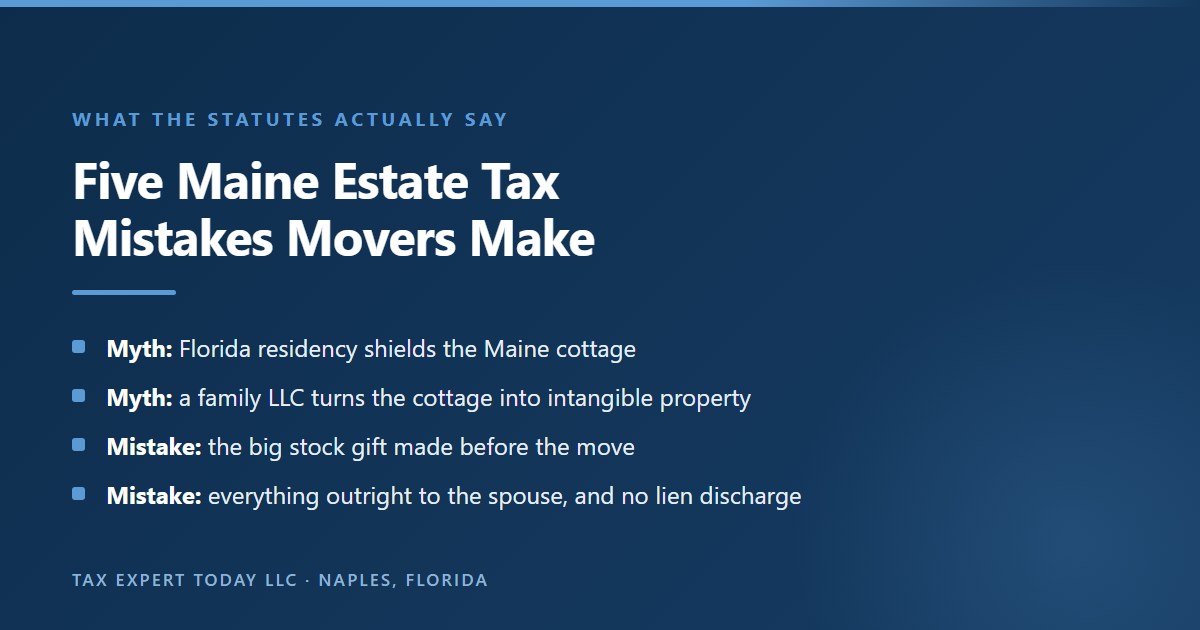
The most common mistakes are assuming Florida residency protects the Maine cottage, assuming an LLC turns the cottage into intangible property, making a large gift in Maine just before the move, leaving everything outright to a spouse, and forgetting the automatic lien. Each rests on a rule that is clear in the statute.
- Myth: a Florida domicile ends all Maine estate tax
- Myth: a family LLC converts the cottage into intangible property
- Mistake: the large stock gift made while still a Maine domiciliary
- Mistake: everything outright to the spouse with no Maine plan
- Mistake: no lien discharge because no tax was due
The first myth comes from a correct idea, that Florida has no estate tax, applied to the wrong question. Florida’s law decides what Florida taxes. Maine’s law decides what Maine taxes, and section 4104 taxes nonresidents who own Maine real and tangible property. The move removes the portfolio from the Maine numerator, which is a large benefit, but it does not remove the cottage.
The LLC myth comes from states and older planning advice in which holding real estate through an entity converted it into intangible personal property. Maine closed that door for passive holding entities in section 4104, and Rule 603 adds that tax avoidance is not a valid business purpose. An operating business with a genuine purpose is different, but a family cottage LLC does not become an operating business merely because it has a lease agreement among siblings.
The pre-move gift problem is narrower than it is in Minnesota because the Maine window is one year rather than three, but the gift-date sourcing rule is the same in kind. A family that wants to make a large gift around the time of the move should generally make it after the domicile change is complete. Leaving everything outright to a spouse, finally, gives up a $7,160,000 exclusion and can cost a Florida couple with a Maine cottage tens of thousands of dollars or more at the second death, as the married couple table shows.
What Should a Maine Mover Check Before and After the Move?
Before and after the move, a Maine mover should confirm the Florida domicile record, list Maine real and tangible property at current values, review how each spouse’s estate plan uses the Maine exclusion, check the timing of any large gifts, and plan for the Maine lien and Form 706ME or Form 700-SOV filing at death.
- Domicile: Florida homestead, declaration of domicile, driver license, voter registration, and a day count kept below Maine’s 183 day statutory residency line
- Inventory: each Maine parcel and the valuable tangible property kept in Maine, with current values
- Entities: any LLC, partnership or trust holding Maine property, tested against the section 4104 conditions
- Spouses: credit shelter or Maine QTIP design in both spouses’ documents
- Gifts: large taxable gifts timed after the move and more than one year before death where possible
- Administration: a note in the estate file that Maine property requires a lien discharge and possibly an ancillary probate
The domicile record is the foundation. Florida’s declaration of domicile under Florida Statutes section 222.17, the homestead exemption, a Florida driver license and voter registration, and moving the professional relationships that tie a life to a place all support the change. The Maine side matters too: Rule 603 points to the location of relatives, agents and care arrangements, so the documents naming health care and financial agents should be updated under Florida law, and the Maine house should be treated and described as the second home it has become.
The estate plan should then be reviewed for the Maine numbers. A will or trust drafted in Maine may already include a Maine QTIP provision and a formula keyed to the Maine exclusion, which is valuable, but the formulas should be checked against the 2026 figures and against the federal exclusion that has since risen to $15,000,000. Documents drafted in Florida for a Florida family may not mention Maine at all, which is a common gap for families who bought the Maine property after the move. For families arriving from Maine alongside other high tax states, our guides to the Massachusetts estate tax for Florida residents, the Maryland estate tax for Florida residents and the New York exit tax cover the parallel rules, and retirees comparing their full picture should read our guide to retiring to Florida taxes. Snowbirds in their first year should also read our guide to snowbird taxes in year one.
The final step is to recheck the computation whenever something changes: the cottage is appraised higher, a spouse dies, a large gift is made, or the Maine exclusion moves. The Maine rules are mechanical once the facts are known. The questions that take judgment are the family ones, such as who will want the cottage and how it will be shared, and the tax computation should serve those answers rather than drive them.
Maine Estate Tax Help in Naples & Southwest Florida
Tax Expert Today LLC works with families who have moved, or are moving, from Maine to Naples, Florida and across Southwest Florida on the tax side of the relocation, including the estate tax that Maine can still apply to a coastal cottage, a lake camp or the property kept in them. The firm is multidisciplinary, with enrolled agents, CPAs and attorneys, and it handles residency and tax matters nationwide, coordinating with Maine and Florida estate counsel when documents need to change. Our office is at 11983 Tamiami Trail N, Naples, FL 34110, open Monday through Friday, 10 a.m. to 5 p.m. ET, and reachable at (239) 441-2005.
- Maine estate tax help Naples: modeling of the nonresident fraction for a Maine cottage, camp or rental at current values.
- Gift and spouse planning: review of planned gifts against the one year add-back and the gift-date sourcing rule, and of credit shelter and Maine QTIP design.
- Domicile and filings: the residency record, the 183 day count, and Form 706ME, Form 700-SOV and lien discharge coordination for a Florida personal representative.
Our Naples tax planning practice and our Florida tax services page describe the wider planning work, and our guide to Florida asset protection for new residents covers the protective side of Florida ownership. For a recent closing on a Naples home, our guide to the Florida intangible tax explains the one-time charges on the closing statement, and executives still drawing deferred compensation should read our guide to Florida domicile for executives.
We summer at our cottage in Maine and winter in Naples. Will Maine tax our whole estate?
Not if your domicile is genuinely in Florida. Maine then taxes only the share of the estate that corresponds to the cottage and the property kept in it, and only if your whole Maine taxable estate exceeds $7,160,000. The risk is a domicile dispute: if the cottage remains the center of family life, Maine may argue you never left, so the record you build in Collier County matters.
When to Engage a Professional
A Florida resident whose estate is comfortably under $7,160,000, or who owns nothing in Maine, rarely needs Maine estate tax advice beyond making sure the lien on any Maine property is discharged at death. Professional help earns its cost when the estate is above the threshold and includes a Maine cottage, camp, rental or business real estate; when large gifts are planned in the year of the move; when a spouse has died and the survivor holds the Maine property or a Maine QTIP trust; when a family LLC or partnership owns the Maine property among several relatives; or when a personal representative needs to decide between Form 706ME and Form 700-SOV. It is also worth a conversation when the move itself is recent and the domicile record is still being built, because that record decides whether Maine taxes a slice of the estate or all of it. Tax Expert Today LLC’s enrolled agents, CPAs and attorneys can model the computation, coordinate with your estate counsel in both states, and help document the change of domicile. Call (239) 441-2005 to schedule a consultation.
Frequently Asked Questions
Does Maine have an estate tax in 2026?
Yes. Maine imposes an estate tax on Maine taxable estates above a $7,160,000 exclusion for 2026 deaths, with rates of 8, 10 and 12 percent on the excess under 36 M.R.S. section 4103. It applies to Maine domiciliaries on their whole estate and to nonresidents on Maine real estate and tangible property. Maine has no gift tax and no inheritance tax.
Do I owe Maine estate tax if I move to Florida?
Only if you still own Maine real estate or tangible property kept in Maine and your Maine taxable estate, measured on the whole estate, exceeds $7,160,000. Maine then taxes a prorated share under 36 M.R.S. section 4104, based on the Maine property divided by the adjusted federal gross estate. Stocks, bank accounts and retirement accounts follow your Florida domicile.
Does an LLC protect a Maine cottage from Maine estate tax?
Usually not. Under 36 M.R.S. section 4104, a pass-through entity is disregarded and its Maine real and tangible property is treated as owned directly if the entity does not actively carry on a business for profit, lacks a valid business purpose, or holds property in which the decedent kept an interest. MRS Rule 603 says tax avoidance is not a valid business purpose.
What is the Maine one year gift rule?
Taxable gifts made during the one year period ending on the date of death are added back to the Maine taxable estate under 36 M.R.S. section 4102. Gifts within the federal annual exclusion, $19,000 per donee for 2026, are not taxable gifts. Under MRS Rule 603, gifts in the window are sourced on the gift date, so securities given while a Maine domiciliary count as Maine property.
Is the Maine estate tax exclusion portable between spouses?
No. Maine does not allow portability, so each spouse has a separate $7,160,000 exclusion for 2026. If the first spouse leaves everything outright to the survivor, the first exclusion is lost for Maine purposes. A credit shelter trust, or the Maine QTIP election under 36 M.R.S. section 4102, subsection 6, is the usual planning response.
When is a Maine estate tax return due?
Form 706ME is due nine months after the date of death. A nonresident’s estate must file if the decedent owned Maine real or tangible property and either a federal return is required or the federal gross estate plus one year gifts plus Maine elective property exceeds $7,160,000. Otherwise, Form 700-SOV with a lien discharge request releases the automatic lien.
Published October 25, 2026 by Dr. Pellumb Kabashi « Back to Learning Center
Have a question this article touches on?
Tax Expert Today LLC, based in Naples, Florida and serving clients across the United States.
Schedule a Consultation (239) 441-2005