
By Dr. Pellumb Kabashi, DBA, MBA, CES, CFE, EA
Founder, Tax Expert Today LLC · Tax advisors, enrolled agents, CPAs, and attorneys · Serving clients in all 50 states
Quick Answer
A grantor retained annuity trust is an irrevocable trust that pays the grantor a fixed annuity for a set term and passes whatever is left to the beneficiaries. It transfers wealth only to the extent the assets outgrow the Section 7520 hurdle rate, which is 5.4 percent for September 2026. A higher hurdle makes the strategy harder to justify, which is the reverse of how a residence trust behaves. Call (239) 441-2005 for a free consultation.
What is a grantor retained annuity trust?
A grantor retained annuity trust, usually called a GRAT, is an irrevocable trust funded with assets the grantor expects to appreciate. The grantor keeps the right to a fixed annuity payment for a stated term of years. Whatever remains in the trust when the term ends passes to the beneficiaries, and the gift is measured only once, at the front end.
- The gift is the remainder, not the property. The reportable gift equals the value transferred minus the actuarial value of the annuity the grantor keeps.
- The annuity is fixed at funding. It is a stated dollar amount or a stated percentage of the initial value, and it does not float with investment results.
- The term is chosen in advance and is commonly two to ten years, though nothing in the statute sets an outer limit.
- Only the excess growth moves. If the assets merely match the assumed rate, the annuity payments consume the trust and the beneficiaries receive nothing.
The mechanism is a valuation arbitrage rather than a deduction. Nothing about a GRAT reduces income tax, and nothing about it makes an asset cheaper. It works, when it works, because the government values the grantor’s retained annuity using a prescribed interest rate, and real assets sometimes outperform that rate. The difference between actual performance and the assumed rate is what reaches the next generation without consuming exclusion.
That framing matters because it sets the honest expectation. A GRAT is not a way to avoid estate tax on a fortune already built. It is a way to move the future growth of a specific asset, and it produces nothing at all in a year when that asset underperforms the assumed rate.
How does a GRAT actually move wealth to heirs?
The grantor transfers assets to the trust and takes back an annuity whose present value, computed under Section 7520, absorbs most or all of the transferred value. The trust then pays that annuity out of income and principal. Anything the assets earn above the assumed rate stays behind and passes to the beneficiaries free of further gift tax.
- Step one, funding. The grantor irrevocably transfers property and the trust becomes the owner.
- Step two, valuation. The retained annuity is valued using the Section 7520 rate for the month of the transfer, and the excess is a taxable gift reported on Form 709.
- Step three, payments. The trust pays the annuity at least annually, in cash or in kind, for the full term.
- Step four, termination. Whatever is left after the final payment passes to the beneficiaries or to a continuing trust for them.
The payments may be satisfied by distributing assets in kind rather than cash, which avoids forcing a sale in a down market. What the payments may not be satisfied with is a promissory note. Treas. Reg. 25.2702-3(b)(1)(i) states that issuance of a note, other debt instrument, option, or other similar financial arrangement in satisfaction of the annuity amount does not constitute payment. A trustee who papers over a liquidity problem with an IOU has not made the payment, and the consequences of that reach back to the qualification of the whole structure.
What is the Section 7520 hurdle rate and why does it decide the outcome?
The Section 7520 rate is the interest rate the IRS prescribes each month for valuing annuities, life interests, terms of years, and remainders. It equals 120 percent of the applicable federal midterm rate, rounded to the nearest two tenths of a percent. Inside a GRAT it functions as a hurdle, because only performance above it produces anything for the beneficiaries.
- It is reset monthly by revenue ruling and locked in for the life of the GRAT at the month of funding.
- It is not negotiable and it does not depend on what the trust actually invests in.
- A lower rate is better for a GRAT, because a lower bar is easier for the assets to clear.
- A higher rate is better for a residence trust, which is the exact inverse and the reason these two vehicles should never be evaluated in the same market conditions.
The rate has climbed steadily through 2026. The table below is taken from the IRS Section 7520 rate table and each figure was confirmed against the governing revenue ruling. The same rate history works against a charitable lead trust, which also benefits from a low rate because the charity takes a fixed annuity ahead of the family.
| Valuation month | 120 percent of midterm AFR | Section 7520 rate | Governing ruling |
|---|---|---|---|
| January 2026 | 4.57 | 4.6 percent | Rev. Rul. 2026-2 |
| February 2026 | 4.63 | 4.6 percent | Rev. Rul. 2026-3 |
| March 2026 | 4.72 | 4.8 percent | Rev. Rul. 2026-6 |
| April 2026 | 4.59 | 4.6 percent | Rev. Rul. 2026-7 |
| May 2026 | 4.91 | 5.0 percent | Rev. Rul. 2026-9 |
| June 2026 | 4.97 | 5.0 percent | Rev. Rul. 2026-11 |
| July 2026 | 5.23 | 5.2 percent | Rev. Rul. 2026-12 |
| August 2026 | 5.23 | 5.2 percent | Rev. Rul. 2026-13 |
| September 2026 | 5.40 | 5.4 percent | Rev. Rul. 2026-17 |
A GRAT funded in September 2026 carries a hurdle eight tenths of a point higher than one funded in January 2026. That sounds small. Over a five year term on a meaningful sum it is not, and the next section prices it.
One practical warning is worth recording, because it cost real accuracy earlier this month. In early September 2026 the IRS summary page for Section 7520 rates had not yet been updated and still ended at the August figure of 5.2 percent, even though the September ruling had already been released. The rate was recoverable only by opening Rev. Rul. 2026-17 and reading Table 5 directly. The summary page has since caught up and now shows 5.4 percent, but anyone relying on it alone during that window would have used the wrong rate. Read the ruling, not the summary.
How does the September 2026 rate of 5.4 percent change the GRAT math?
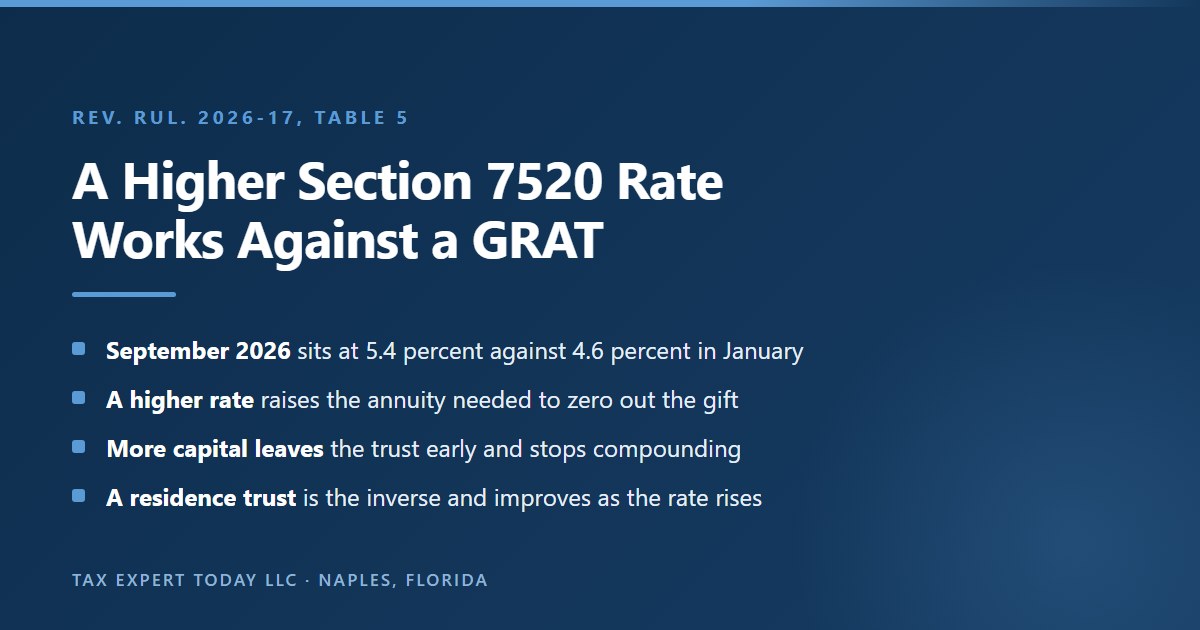
A higher Section 7520 rate raises the annuity the grantor must take back in order to zero out the gift, which pulls more value out of the trust each year and leaves less behind to compound. On identical assets and an identical term, a GRAT funded at 5.4 percent delivers materially less to the beneficiaries than the same GRAT funded at 4.6 percent.
- The required annuity rises with the rate, because a higher discount rate shrinks the present value of each payment.
- More capital leaves the trust earlier, so less remains invested to generate the excess return the strategy depends on.
- The breakeven growth rate rises, and assets that would have produced a transfer in January produce nothing in September.
- The effect compounds with term length, so a longer GRAT amplifies both the benefit of a low rate and the penalty of a high one.
Consider a hypothetical transfer of $5,000,000 into a five year GRAT, structured so that the reported gift is approximately zero. The annuity required to reach that result depends entirely on the rate in the month of funding.
| Month of funding | Section 7520 rate | Annual annuity to zero out the gift | Total returned to the grantor over five years |
|---|---|---|---|
| January 2026 | 4.6 percent | approximately $1,142,134 | approximately $5,710,670 |
| May 2026 | 5.0 percent | approximately $1,154,874 | approximately $5,774,370 |
| August 2026 | 5.2 percent | approximately $1,161,266 | approximately $5,806,331 |
| September 2026 | 5.4 percent | approximately $1,167,673 | approximately $5,838,366 |
The September grantor must take back roughly $127,696 more in total than the January grantor on the same $5,000,000. That money is not lost, since it returns to the grantor and stays in the estate, but every dollar of it is a dollar that stopped compounding inside the trust. The consequence shows up at the end of the term.
The second table holds the September structure constant and varies only what the assets actually do. This is the table that answers the question a client is really asking, which is whether the exercise is worth the legal cost and the administrative burden.
| Total annual return on trust assets | Assets at end of year five | Annuity payments returned to grantor | Remainder passing to beneficiaries |
|---|---|---|---|
| 3.0 percent | approximately $5,796,370 | approximately $6,199,336 | nothing, the trust is exhausted |
| 4.6 percent | approximately $6,260,780 | approximately $6,400,777 | nothing, the trust is exhausted |
| 5.4 percent | approximately $6,503,888 | approximately $6,503,888 | approximately zero, exactly at the hurdle |
| 7.0 percent | approximately $7,012,759 | approximately $6,714,984 | approximately $297,775 |
| 10.0 percent | approximately $8,052,550 | approximately $7,128,762 | approximately $923,788 |
| 12.0 percent | approximately $8,811,708 | approximately $7,418,050 | approximately $1,393,659 |
| 15.0 percent | approximately $10,056,786 | approximately $7,872,898 | approximately $2,183,888 |
Where the trust is exhausted the beneficiaries simply receive nothing. A GRAT cannot produce a negative result for them, and it cannot produce a negative result for the grantor either, who has received back everything the trust was able to pay. The downside is the cost of drafting and administration and the opportunity cost of the exercise, not a tax loss.
Now compare the same 10 percent growth assumption at the two different hurdles. A GRAT zeroed out in January at 4.6 percent would have delivered approximately $1,079,708 to the beneficiaries. The identical GRAT zeroed out in September at 5.4 percent delivers approximately $923,788. The difference of roughly $155,920 is attributable to nothing except the month of funding. At 5.4 percent growth the contrast is starker still, because the January structure still moves approximately $142,253 while the September structure moves nothing at all.
This is the finding that should govern the conversation. The strategy is not broken at 5.4 percent, but it now requires a genuinely higher conviction about the asset. A diversified public portfolio expected to return somewhere near a long run market average is a much weaker GRAT candidate today than it was nine months ago. A concentrated position in a business the family believes will re-rate sharply is a different question entirely. These figures are hypothetical illustrations that assume a level annuity paid at the end of each year and ignore trustee fees, transaction costs, and the valuation adjustments that apply to payment timing. Actual results depend on the trust terms and on the actual performance of the assets.
What is a zeroed-out GRAT?
A zeroed-out GRAT sets the annuity high enough that the actuarial value of the retained interest equals the value of the property transferred, so the reported gift is approximately zero. The structure lets a family attempt a transfer without consuming any lifetime exclusion, which is why it became the dominant design.
- No exclusion is used when the computed gift rounds to nothing, so the strategy costs relatively little if it fails.
- The design was validated in litigation rather than by statute, in the Tax Court decision in Walton v. Commissioner, 115 T.C. 589 (2000).
- The regulatory example that blocked it was held invalid, and the IRS subsequently acquiesced in the result.
- A small deliberate gift is sometimes preferred so that the transfer is unambiguously reportable and the limitations period begins to run.
Before Walton, the regulations valued the retained annuity as though it ended at the earlier of the term or the grantor’s death, which reduced the retained value and made a true zero-out impossible. The Tax Court held that the example imposing that treatment was an invalid interpretation of Section 2702, and that the annuity may instead be valued as a fixed term interest payable to the grantor or the grantor’s estate. The practical consequence is a drafting requirement. The trust document must direct any remaining annuity payments to the grantor’s estate if the grantor dies inside the term. A GRAT drafted without that provision is not a Walton GRAT and will not zero out.
Many practitioners deliberately leave a small taxable gift in place rather than aiming for a literal zero. Reporting a modest gift on a return that adequately discloses the transaction starts the limitations period under the adequate disclosure rules at Treas. Reg. 25.6019-4, after which the IRS may no longer revalue the transfer. Whether that trade is worth the exclusion consumed is a drafting judgment that depends on how aggressive the underlying valuation is.
What makes the retained annuity a qualified interest under Section 2702?
Section 2702 applies whenever a person transfers an interest in trust to a family member and keeps an interest back. Under Section 2702(a)(2)(A), the value of any retained interest that is not a qualified interest is treated as being zero. If the annuity fails to qualify, the entire transfer becomes a taxable gift with no offset at all.
- The penalty is total, not proportional. A defective annuity is valued at zero, not at a reduced amount.
- A qualified annuity interest is an irrevocable right to receive a fixed amount payable at least annually.
- A right of withdrawal is never qualified, whether or not it is cumulative and however the instrument describes it.
- Section 7520 supplies the value only once the interest has cleared the qualification hurdle.
This is the single most consequential point in the structure and it is almost never stated plainly. The downside of a poorly drafted GRAT is not that it works less well. It is that a $5,000,000 funding becomes a $5,000,000 reported gift, consuming a third of a person’s lifetime exclusion in exchange for nothing at all. The statutory language at IRC Section 2702 is unambiguous on the point, and the requirements that determine qualification live in the regulation rather than in the statute.
What must the GRAT document say?
Treas. Reg. 25.2702-3 imposes a specific list of governing instrument requirements. These are drafting mandates rather than operational preferences, and failing any one of them can push the retained interest outside the qualified interest definition and trigger the zero valuation rule.
- Additional contributions must be prohibited. The instrument itself has to forbid them, which is why a second GRAT is required rather than an addition to the first.
- Commutation must be prohibited. The holder may not prepay or accelerate the interest.
- The term must be fixed and ascertainable at creation, for the life of the holder, a specified term of years, or the shorter of the two.
- The annuity must be payable at least annually, and payment cannot be deferred past the date the trust return would be due without extensions.
- Notes and options may not satisfy the payment, so the trustee must have assets available to distribute in cash or in kind.
The prohibition on additional contributions deserves emphasis because it explains a structure that otherwise looks like a preference. Rolling GRATs, in which a family funds a new short term GRAT each year using the annuity payments returned from the prior one, are not merely a way to diversify across interest rate environments. They are the only available response to a rule that forbids adding to an existing trust. A family that wants continuing exposure to this strategy has no choice but to create a series of trusts, and each new one locks in the Section 7520 rate for the month it is funded.
Can the annuity payments increase during the term?
Yes, within a limit. Treas. Reg. 25.2702-3(b)(1)(ii) permits the stated annuity to increase each year, but only to the extent the amount does not exceed 120 percent of the amount payable in the preceding year. Back-loading the payments in this way leaves more capital inside the trust in the early years, where it has the longest time to compound.
- The ceiling is 120 percent of the prior year, applied to a stated dollar amount or to a stated fraction of the initial value.
- The present value must still equal the target, so the first year payment is substantially lower than a level payment would be.
- The benefit is time, not arithmetic. The actuarial value is identical, but the assets stay invested longer.
- The mortality exposure grows, because more value remains in the trust in the later years of the term.
The size of the effect is worth quantifying, because it is available at no cost. Using the same $5,000,000 five year GRAT zeroed out at 5.4 percent, a schedule that increases by the full 20 percent each year starts at approximately $799,607 rather than approximately $1,167,673.
| Year | Level annuity | Increasing annuity at the 120 percent ceiling |
|---|---|---|
| 1 | approximately $1,167,673 | approximately $799,607 |
| 2 | approximately $1,167,673 | approximately $959,529 |
| 3 | approximately $1,167,673 | approximately $1,151,435 |
| 4 | approximately $1,167,673 | approximately $1,381,722 |
| 5 | approximately $1,167,673 | approximately $1,658,066 |
| Remainder at 10 percent growth | approximately $923,788 | approximately $1,033,516 |
The increasing schedule moves approximately $109,728 more on identical assets, an improvement of roughly 12 percent, purely from the timing of the payments. Both structures report the same gift and both use the same rate. The trade is that the grantor waits longer for the money and that a death in year four or year five now captures a larger trust, which is the subject of the next section. These figures are illustrative and assume payments at the end of each year.
What happens if the grantor dies during the GRAT term?
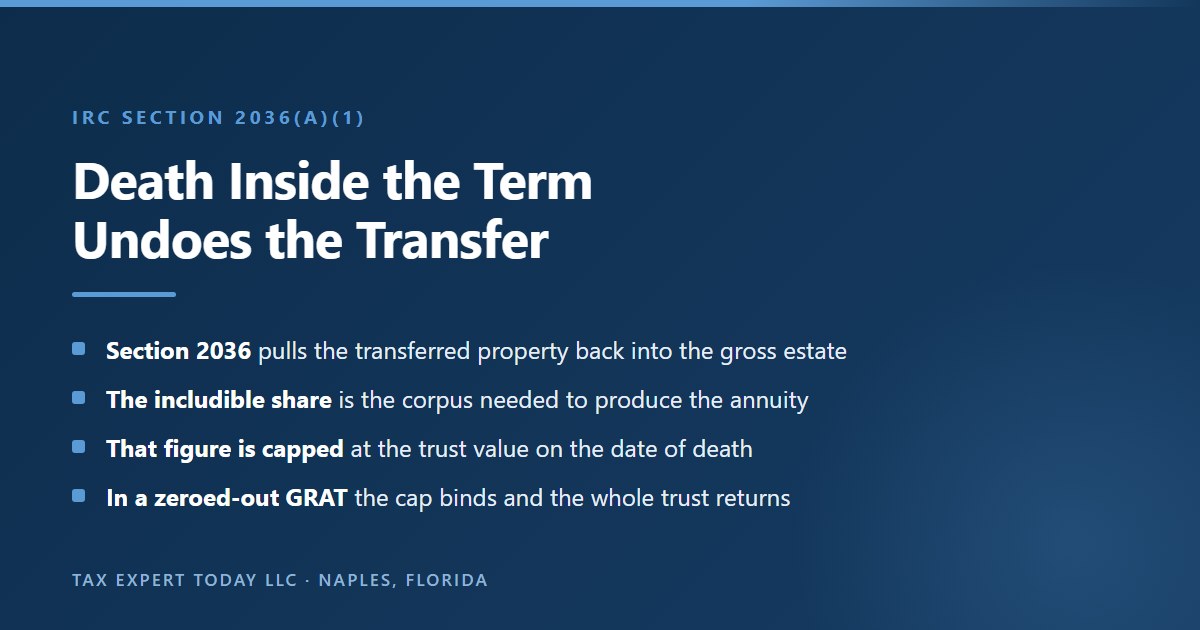
Death inside the term is the principal risk. Under IRC Section 2036(a)(1), property transferred with a retained right to income or enjoyment for a period that does not in fact end before death is pulled back into the gross estate. For a short term zeroed-out GRAT the practical result is usually that essentially the whole trust returns to the estate.
- The includible portion is computed, not assumed. Treas. Reg. 20.2036-1(c)(2) includes the corpus necessary to generate the annuity without invading principal, using the Section 7520 rate in effect at death.
- That amount is capped at the fair market value of the trust corpus on the date of death.
- The cap almost always binds in a zeroed-out GRAT, because the required annuity is large relative to the corpus.
- The family is not much worse off in tax terms, since the assets return to the estate roughly where they would have been, but the exercise produced nothing.
The arithmetic makes the point. On the September structure the annuity is approximately $1,167,673. Dividing that by a Section 7520 rate of 5.4 percent at the date of death produces approximately $21,623,578, which is more than four times the amount originally funded. Because the regulation caps the inclusion at the value of the trust corpus, the entire trust is included. Even at a materially higher rate at the date of death the formula still exceeds the corpus. There is no partial escape for a short term zeroed-out GRAT.
| Section 7520 rate at date of death | Annuity divided by the rate | Trust corpus at death, illustrative | Amount includible in the gross estate |
|---|---|---|---|
| 4.6 percent | approximately $25,384,200 | approximately $6,000,000 | approximately $6,000,000, the full corpus |
| 5.4 percent | approximately $21,623,578 | approximately $6,000,000 | approximately $6,000,000, the full corpus |
| 6.0 percent | approximately $19,461,220 | approximately $6,000,000 | approximately $6,000,000, the full corpus |
This is why short terms and rolling structures dominate in practice. A two year GRAT carries far less mortality exposure than a ten year GRAT, and a family that renews annually is repeatedly betting on surviving a short window rather than once on surviving a long one. Health and life expectancy are legitimate inputs to the term decision, and a grantor in poor health is a poor candidate for a long GRAT regardless of how attractive the asset looks. Some families address the exposure by directing remaining annuity payments to a surviving spouse, which can defer the estate tax consequence, though it does not restore the transfer the structure was meant to accomplish.
Who pays the income tax on a GRAT?
The grantor does. A GRAT is a grantor trust for income tax purposes, so all of the trust income, deductions, and credits are reported on the grantor personal return under the rules at IRC Section 671 and following. The trust does not pay its own income tax on that income, and the annuity payments themselves are not separately taxable to the grantor.
- The retained annuity causes grantor trust status, generally through the income provisions at IRC Section 677.
- Payments in kind are not sales. Distributing appreciated stock to satisfy the annuity does not trigger gain, because the grantor is treated as the owner throughout.
- The grantor payment of the tax is not an additional gift, which the IRS confirmed in Rev. Rul. 2004-64.
- That tax payment is an efficient transfer, since it lets the trust assets grow undiminished by income tax while shrinking the grantor own estate.
The point in Rev. Rul. 2004-64, published at page 7 of Internal Revenue Bulletin 2004-27, is quietly one of the most valuable features of the whole arrangement. The grantor pays income tax on income that will ultimately benefit someone else, and that payment is not treated as a gift to the beneficiaries. It reduces the taxable estate dollar for dollar while leaving the trust whole. The same ruling addresses the estate tax consequence where the trust may or must reimburse the grantor for that tax, and a mandatory reimbursement clause raises inclusion questions that a discretionary one generally does not.
Two cautions follow. First, the grantor needs liquidity outside the trust to pay a tax bill generated by assets the grantor no longer owns economically. Second, grantor trust status ends when the term ends, after which a continuing trust becomes a separate taxpayer with its own compressed rate brackets. Our tax planning services team runs that cash flow projection alongside the transfer analysis rather than after it.
What are the disadvantages of a grantor retained annuity trust?
The main disadvantages are that the structure produces nothing when the assets underperform the hurdle, that death inside the term generally undoes it, that the assets receive no basis step-up, and that the arrangement is irrevocable and administratively demanding for as long as it runs.
- Underperformance yields nothing and the drafting and administration costs are still incurred.
- Mortality risk is real and it rises with the length of the term.
- No basis step-up applies to what passes, which is a genuine and often decisive cost.
- Irrevocability is absolute. The grantor cannot change the terms or take more or less than the schedule provides.
- Administration is ongoing, including annual valuations where the assets are not publicly traded.
Valuation is a practical burden that deserves more attention than it usually gets. A GRAT funded with marketable securities is straightforward. A GRAT funded with an interest in a closely held business requires a defensible appraisal at funding, and where the annuity is expressed as a percentage of the initial value the instrument must contain the adjustment provisions the regulation requires for an incorrect determination of that value. Families sometimes discover the appraisal cost only after committing to the strategy.
What does a GRAT cost in lost basis step-up?
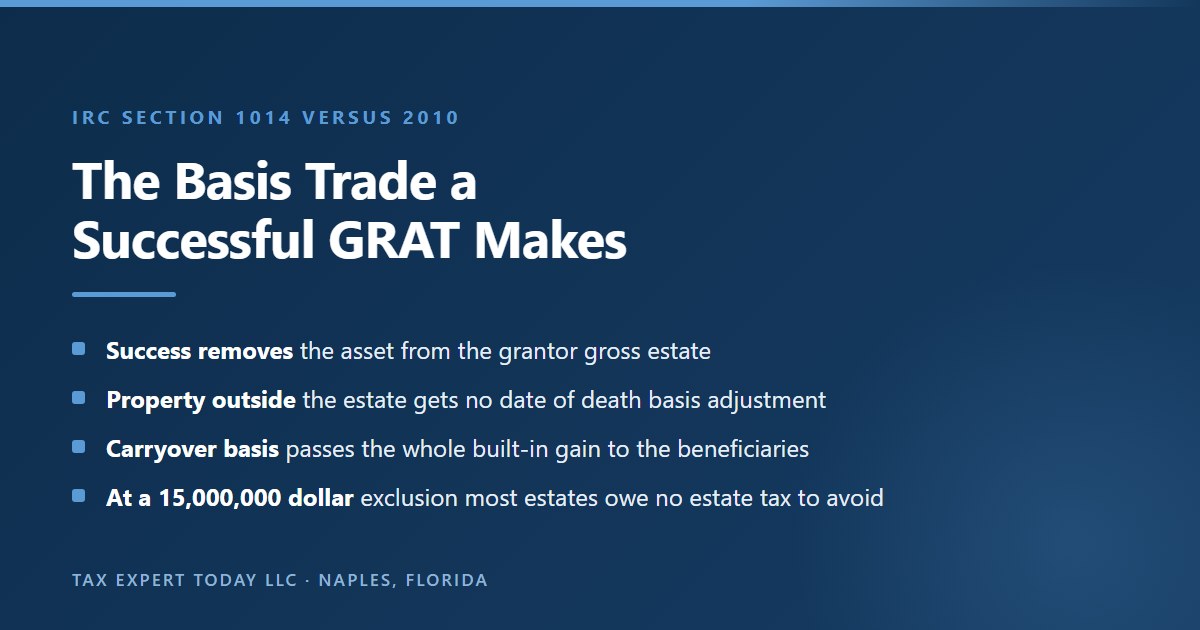
Property that successfully passes through a GRAT is not in the gross estate, so it receives no adjustment to fair market value at death under IRC Section 1014. The beneficiaries take the grantor basis instead. That forfeited step-up is a real capital gains cost, and it has to be weighed against estate tax the family would actually have paid.
- Success removes the asset from the estate, and Section 1014 applies only to property that is in it.
- Carryover basis follows the asset into the hands of the beneficiaries along with the whole built-in gain.
- The gain is taxed when they sell, at long term capital gain rates plus the net investment income tax where it applies.
- The comparison is not automatic. Below the exclusion there is no estate tax to save, so the trade can be all cost and no benefit.
Take the September structure that delivered approximately $923,788 to the beneficiaries. Assume the original basis was 20 percent of the funded value, so the carryover basis attributable to that remainder is approximately $184,758 and the built-in gain is approximately $739,030.
| Measure | Estate below the $15,000,000 exclusion | Estate fully taxable at 40 percent |
|---|---|---|
| Remainder passing to beneficiaries | approximately $923,788 | approximately $923,788 |
| Carryover basis carried over | approximately $184,758 | approximately $184,758 |
| Built-in gain with no step-up | approximately $739,030 | approximately $739,030 |
| Capital gains cost at 23.8 percent | approximately $175,889 | approximately $175,889 |
| Estate tax avoided | approximately $0 | approximately $369,515 |
| Net result | a cost of approximately $175,889 | a benefit of approximately $193,626 |
The table shows the decision that most GRAT content skips entirely. For a family whose estate will not exceed the exclusion, a successful GRAT may leave the next generation worse off than doing nothing, because it converts an asset that would have received a free basis adjustment into an asset carrying an embedded gain. The 23.8 percent figure combines the top long term capital gain rate with the net investment income tax under IRC Section 1411 and will not apply to every taxpayer. Our discussion of the lifetime gift tax exemption for 2026 works through the same trade in the context of outright gifting, and our analysis of net unrealized appreciation covers a parallel situation in which an election forfeits a step-up on the appreciation.
Does a GRAT still make sense with a $15,000,000 exclusion?
For most families, no. Rev. Proc. 2025-32 confirms that Section 70106 of P.L. 119-21 increased the basic exclusion amount under IRC Section 2010(c) to $15,000,000 for calendar year 2026 and removed the scheduled sunset, with inflation adjustments beginning for 2027. A married couple with proper planning may shelter roughly twice that, which places the great majority of estates outside federal estate tax entirely.
- The scheduled 2026 sunset was removed, so the deadline that drove a decade of urgency marketing no longer exists.
- The generation-skipping transfer exemption is likewise $15,000,000 for 2026 under IRC Section 2631(c).
- The annual exclusion is $19,000 per donee for 2026 under IRC Section 2503(b), which handles ordinary gifting without any trust at all.
- Below the exclusion the basis step-up usually wins, and the better answer is often to hold appreciated assets until death.
The families for whom a GRAT continues to make sense are narrower and identifiable. They have already used their exclusion, or they hold a concentrated position with a credible case for sharp appreciation, or they face a specific liquidity event such as a pending sale or a public offering. Even then a GRAT competes against alternatives, and a family that expects to sell a business should read our analysis of the tax treatment of selling a business before locking assets into an irrevocable structure.
Anyone who was told between 2018 and 2025 that a trust had to be funded before the exemption fell should revisit that advice. The premise has changed. That does not automatically mean the plan was wrong, but it does mean the urgency argument that supported it is gone, and a structure already in place may deserve a fresh look. Where an existing irrevocable trust no longer fits the family circumstances, decanting the trust is sometimes available as a correction.
How does a GRAT compare with a QPRT and a charitable remainder trust?
These three split-interest vehicles all use the same Section 7520 rate, but they do not respond to it in the same direction. A GRAT wants the rate low, because it is a hurdle to be cleared. A qualified personal residence trust and a charitable remainder trust both improve as the rate rises, because a higher rate enlarges the interest the grantor keeps or the deduction the donor claims.
- A GRAT is hurt by a high rate, so September 2026 at 5.4 percent is an unfavorable month to fund one.
- A QPRT is helped by a high rate, because the larger retained term interest shrinks the reportable gift.
- A CRT is helped by a high rate, because the charitable remainder is worth more and the deduction is larger.
- The same market conditions therefore favor two of these vehicles and disfavor the third at the very same moment.
| Vehicle | What the grantor keeps | Effect of a higher Section 7520 rate | September 2026 assessment |
|---|---|---|---|
| Grantor retained annuity trust | A fixed annuity for a term | Unfavorable, the hurdle rises | Harder to justify than earlier in 2026 |
| Qualified personal residence trust | The right to occupy for a term | Favorable, the retained interest grows | Relatively more attractive now |
| Charitable remainder trust | An income stream for life or a term | Favorable, the charitable deduction grows | Relatively more attractive now |
A family evaluating more than one of these should sequence them rather than treat the choice as fixed. The detailed mechanics of the residence vehicle are covered in our guide to the qualified personal residence trust, and the income and deduction mechanics of the charitable vehicle are covered in our guide to the charitable remainder trust. Reading all three together gives a clearer picture than any one of them alone, because the rate that makes one attractive is the same rate that makes another difficult.
How is a GRAT reported on Form 709?
The transfer to the GRAT is a reportable gift and belongs on Form 709 for the year of funding, even where the computed gift is approximately zero. Reporting is what starts the limitations period, and a zeroed-out GRAT that is never reported leaves the valuation open indefinitely.
- File for the year of the transfer, generally by the individual income tax return due date for that year.
- Adequate disclosure matters, and Treas. Reg. 25.6019-4 sets out what a return must contain to start the clock.
- Attach the valuation support, including the appraisal for any asset that is not publicly traded.
- Describe the retained interest and the method used to value it, including the Section 7520 rate applied.
The generation-skipping transfer tax deserves separate thought where the remainder is destined for grandchildren. Allocating GST exemption to a GRAT is complicated by the estate tax inclusion period, during which an allocation generally cannot be made effective, and a premature allocation can be wasted. That interaction is one of the more common technical errors we see, and it is worth resolving before the trust is signed rather than at the first return. The same timing rule applies when a GRAT remainder pours into a dynasty trust, because the exemption is measured only when the annuity term ends.
Grantor Retained Annuity Trust Help in Naples & Southwest Florida
Tax Expert Today LLC works with Naples, Florida families and their attorneys on transfer planning that depends on the Section 7520 rate, including whether a grantor retained annuity trust is the right vehicle at all in the month it is being considered. Our team includes tax advisors, enrolled agents, CPAs, and attorneys, and we coordinate with the drafting attorney rather than replacing that relationship. Southwest Florida holds a concentration of business owners approaching a sale and families that relocated carrying substantial unrealized gain, and for both groups the basis question and the hurdle question have to be answered together before anything is signed. Clients searching for estate tax planning Naples or trust planning Naples FL are usually asking a narrower question than the search itself suggests, which is whether their estate will ever owe federal estate tax at all, and that is where the analysis should start.
Tax Expert Today LLC
11983 Tamiami Trail N, Naples, FL 34110
Phone: (239) 441-2005
Hours: Monday through Friday, 10:00 to 5:00 ET
We serve Naples, Bonita Springs, Estero, Fort Myers, Marco Island, and the wider Collier and Lee County area, and we work with clients in all 50 states. Our Naples tax planning practice and our estate and trust planning services cover the transfer side of this work.
Does moving to Florida change whether a GRAT makes sense? Florida imposes no state estate tax and no state income tax, which removes a layer of the analysis but does not change the federal arithmetic at all. The hurdle rate, the Section 2036 inclusion on death inside the term, and the loss of the basis step-up are identical in Naples and in New York. What Florida residency does change is the value of the alternative, because a family that simply holds appreciated assets until death pays no state level tax on the eventual sale either. That tends to strengthen the case for doing nothing and to weaken the case for an irrevocable transfer. Families who have recently relocated should also confirm that residency is properly established, and our guide to establishing Florida residency and our overview of Florida estate planning cover the documentation that supports it. Where an existing out of state trust is being moved, trust situs after a move to Florida is a separate question from the federal transfer analysis.
When to Engage a Professional
A grantor retained annuity trust is not a form to be filled in. It requires a drafting attorney, a defensible valuation where the asset is not publicly traded, and a preparer who will report the transfer correctly and track basis for the beneficiaries afterward. The decision that precedes all of that is whether the family will ever owe federal estate tax, and at a permanent $15,000,000 exclusion the answer for most people is no.
Consider a professional review if any of the following apply. You hold a concentrated position you expect to appreciate sharply. You have already used a substantial portion of your lifetime exclusion. You are approaching a business sale or another liquidity event. You were advised to fund an irrevocable trust before an exemption sunset that no longer exists. You have an existing GRAT approaching the end of its term and no plan for what happens next.
Tax Expert Today LLC runs the actuarial calculation at the current month rate, sets the estate tax actually at risk against the basis step-up that would be forfeited, and gives a direct answer about whether the structure earns its cost. Where the answer is no, we say so. Call (239) 441-2005 for a free consultation, or read more about how our business consulting services support owners planning around a sale.
This article is general information and not tax or legal advice for any specific person. Interest rates, exclusion amounts, and thresholds change, and the results of any planning strategy depend entirely on individual facts. All figures shown are hypothetical illustrations. Consult a qualified advisor about your own circumstances before acting.
Frequently Asked Questions
What is the purpose of a grantor retained annuity trust?
The purpose is to transfer future appreciation on an asset to beneficiaries without using lifetime gift and estate tax exclusion. The grantor keeps a fixed annuity for a term, and only growth above the Section 7520 rate passes to the beneficiaries.
Who pays taxes on a GRAT?
The grantor does. A GRAT is a grantor trust, so all trust income is reported on the grantor personal return. Rev. Rul. 2004-64 confirms that the grantor payment of that income tax is not an additional gift to the beneficiaries.
What are the disadvantages of a grantor retained annuity trust?
It produces nothing if the assets do not outperform the hurdle rate, death during the term generally pulls the trust back into the estate, the assets receive no basis step-up, and the trust is irrevocable and requires ongoing administration and valuation.
What is the Section 7520 rate for September 2026?
The Section 7520 rate for September 2026 is 5.4 percent, set by Rev. Rul. 2026-17, Table 5. That is up from 5.2 percent in July and August and 4.6 percent in January 2026.
How long should a GRAT term be?
Terms are commonly two to ten years. Shorter terms reduce the risk that the grantor dies during the term, while longer terms give the assets more time to outperform the hurdle rate. The right answer depends on the asset and on the health of the grantor.
Can you add assets to an existing GRAT?
No. Treas. Reg. 25.2702-3(b)(5) requires the governing instrument to prohibit additional contributions. A family that wants continued exposure must create a new GRAT, which is why rolling GRAT structures exist.
Is a GRAT still worth doing with a $15,000,000 exclusion?
For most families, no. With the exclusion permanent at $15,000,000 for 2026, most estates will owe no federal estate tax, and holding appreciated assets until death to obtain a basis step-up is often the better result.
Published September 8, 2026 by Dr. Pellumb Kabashi « Back to Learning Center
Have a question this article touches on?
Tax Expert Today LLC, based in Naples, Florida and serving clients across the United States.
Schedule a Consultation (239) 441-2005