
By Dr. Pellumb Kabashi, DBA, MBA, CES, CFE, EA
Founder, Tax Expert Today LLC · Tax advisors, enrolled agents, CPAs, and attorneys · Serving clients in all 50 states
Quick Answer: Maryland estate tax still applies after you move to Florida if you keep Maryland real estate or tangible property there. A return is required when your worldwide estate reaches $5 million, and the tax is apportioned by the Maryland share of that estate. Separately, a 10 percent Maryland inheritance tax can reach that property when it passes to a niece, nephew or friend. Call (239) 441-2005 for a free consultation.
Published: October 2026
Moving from Maryland to Florida ends Maryland income tax on your future earnings and, for most families, ends Maryland’s claim on the investment portfolio at death. It does not end Maryland’s claim on what you leave behind in Maryland. Plenty of people who retire to Naples, Bonita Springs or Marco Island keep something in the state they left: a condominium in Ocean City, a waterfront house on the Eastern Shore or the Severn, a rowhouse in Baltimore that is now a rental, a townhouse in Bethesda near the grandchildren, or a boat that never came south. Each of those is Maryland real estate or tangible personal property, and each one keeps Maryland in your estate plan.
Maryland is also unusual. It is the only state that still imposes both an estate tax and a separate inheritance tax, and the two follow different rules for a person who has moved away. The estate tax looks at the size of your whole estate, wherever it sits, to decide whether a return is due and how much of the tax Maryland keeps. The inheritance tax ignores the size of the estate entirely and looks at who receives the Maryland property. This guide explains how the Maryland estate tax works for a Florida domiciliary, how the nonresident apportionment on Form MET-1 actually computes the bill, when the 10 percent inheritance tax applies, how the two taxes offset each other, and what can be done about it while you are still alive.
The figures in this guide were checked against the Maryland Code, the 2026 revision of Form MET-1, the Comptroller’s guidance, the Register of Wills and the IRS on the date of publication. The worked examples are illustrations of the published method, not a substitute for a return prepared on the actual facts of an estate.
Does Maryland Estate Tax Apply After You Move to Florida?
Yes, if you still own Maryland real estate or tangible property. Under Tax-General §7-302, Maryland taxes the estate of a nonresident whose estate includes Maryland real property or tangible personal property with a Maryland situs. A return is due only if the worldwide estate reaches $5 million, and Maryland keeps a share of the tax proportional to its property.
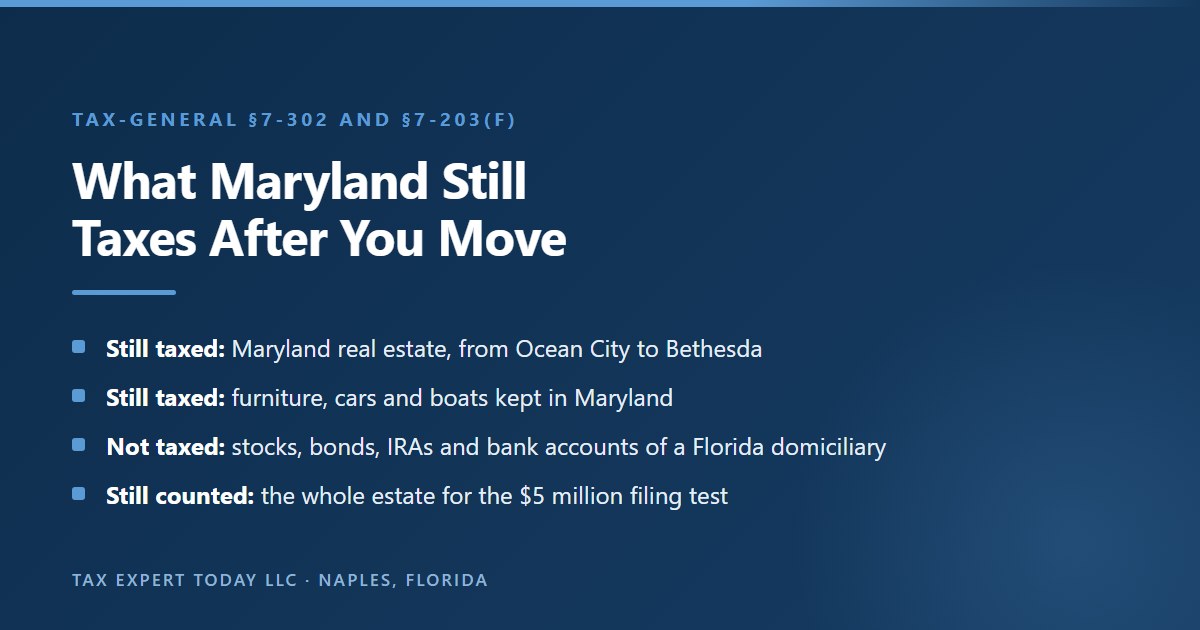
- Still reached: an Ocean City or Eastern Shore condominium, a Baltimore or Montgomery County house, Maryland farmland, and the furniture, cars and boats kept in Maryland.
- Not reached by the estate tax: brokerage accounts, bonds, IRAs, 401(k) plans, bank deposits and life insurance of a Florida domiciliary.
- Counted for the filing test anyway: everything you own worldwide, including the Florida home, plus adjusted taxable gifts.
- The condition: you must actually have been domiciled in Florida at death, not merely wintering there.
Section 7-302 imposes the tax on the transfer of the Maryland estate of a decedent who was either a resident of Maryland or a nonresident whose estate includes an interest in real property permanently located in Maryland or tangible personal property that has a taxable situs in Maryland. The phrase “Maryland estate” is defined in §7-301 as the part of the estate that Maryland has the power to tax. For a Florida domiciliary that is the Maryland real estate and the tangible property kept there, and nothing else.
That is a much smaller target than a resident estate, but it is not a small tax. Maryland does not tax the Maryland property as if it stood alone. It computes a tax on the whole estate and then keeps the fraction that the Maryland property represents. The result is that a Florida family with a large portfolio and a modest Maryland condominium can owe Maryland a meaningful amount even though the condominium alone is worth far less than the $5 million exclusion. The sections below show exactly how that happens.
What Maryland Property Is Still Taxed for a Florida Resident?
Maryland real estate and tangible personal property located in Maryland. Section 7-302 reaches real property permanently located in Maryland and tangible personal property with a Maryland taxable situs. Intangible property of a Florida domiciliary, including stocks, bonds, retirement accounts, bank deposits and, under the Comptroller’s own reading, an interest in an LLC, sits outside the Maryland estate.
- Real property: houses, condominiums, rental buildings, vacant land and farmland physically located in Maryland.
- Tangible personal property: furniture, art, vehicles and boats that are kept in Maryland at death.
- Intangible property: outside the Maryland estate for a nonresident, wherever the account is held.
- Entity interests: treated by Maryland as intangible, which matters for planning and is discussed below.
The practical inventory for most former Marylanders is short: the house or condominium they kept, its contents, and perhaps a car or a boat left at the shore. A rental property bought years ago in Baltimore or Prince George’s County counts the same way as a vacation home. So does a share of a family beach house held as tenants in common with siblings, to the extent of the decedent’s share.
Location is what matters, not where the owner banks or where the deed was signed. A sailboat kept at a marina in Annapolis at death has a Maryland situs. The same boat moved to a Florida marina before death does not. Furniture that was shipped to the Florida home is Florida property. Furniture left behind in the Ocean City condominium is Maryland property. These are small items in most estates, but an appraiser will be asked to sort them, and a family that is deciding what to move south can sort them in advance.
What Is the Maryland Estate Tax Exemption and Rate in 2026?
The Maryland exclusion is $5,000,000 for any death on or after January 1, 2019, under Tax-General §7-309(b)(3), and it is not indexed for inflation. The tax is capped at 16 percent of the taxable estate above that amount. A surviving spouse can add a predeceased spouse’s unused Maryland exclusion through Maryland portability.
- Maryland exclusion: $5,000,000 per person, fixed since 2019.
- Federal exclusion for 2026: $15,000,000 per person, so many estates owe Maryland and not the IRS.
- Ceiling: 16 percent of the taxable estate above the Maryland exclusion.
- Portability: available, but only through a timely Maryland election.
The Maryland estate tax is built on the old federal credit for state death taxes under former IRC §2011. Section 7-309 keeps that credit alive for Maryland purposes, limits the unified credit to the amount corresponding to a $5,000,000 exclusion, and caps the result at 16 percent of the taxable estate above $5,000,000 plus any deceased spousal unused exclusion amount. The Comptroller describes the tax in the same terms in its estate tax FAQs.
Two points trip up readers of the published summaries. First, the 16 percent figure is a ceiling, not a bracket. The actual computation on Form MET-1 compares 16 percent of the excess over $5,000,000 against a credit figure drawn from the old federal Table B, which runs from 0.8 percent up to 16 percent, and takes the lower number. Second, the Maryland exclusion does not move with the federal one. The IRS confirms a $15,000,000 basic exclusion amount for 2026 after the 2025 federal legislation, which means an estate between $5 million and $15 million can owe Maryland while owing nothing federally.
Bills to change the Maryland tax are introduced regularly. A 2025 bill (HB 1153) would have tied the Maryland exclusion to the federal amount, and a 2026 bill (SB 211) would have repealed the Maryland estate tax for deaths after June 30, 2026. The General Assembly’s records show each received a committee hearing; neither changed §7-309, which as published still sets the exclusion at $5,000,000. Any estate should confirm the law in force on the actual date of death.
| Item | Maryland | Federal (2026) |
|---|---|---|
| Exclusion per person | $5,000,000, not indexed | $15,000,000 |
| Maximum rate | 16 percent ceiling on the excess | 40 percent |
| Portability | Yes, by election on a Maryland return | Yes, by election on Form 706 |
| Gift tax | None | Yes, unified with the estate tax |
| Return | Form MET-1, filed with the Comptroller | Form 706, filed with the IRS |
| Due date | Nine months after death | Nine months after death |
When Must a Nonresident Estate File Form MET-1?
When the decedent owned Maryland real or tangible property and the federal gross estate, plus adjusted taxable gifts, plus any prior Maryland QTIP property, equals or exceeds $5,000,000. The test uses the worldwide estate, not the Maryland property alone, so a Florida estate can be required to file even when the Maryland tax turns out to be small.
- Worldwide test: the Florida home, the portfolio and the retirement accounts all count toward the $5,000,000 threshold.
- Gifts count: adjusted taxable gifts reported on the federal return are added back for the test.
- Federal return not required: the estate prepares a pro forma Form 706 anyway and attaches it.
- Deadline: nine months after death, with up to six months more by extension on Form MET-1E.
The instructions to the 2026 revision of Form MET-1 state the requirement directly: a return must be filed where the federal gross estate plus adjusted taxable gifts plus prior Maryland QTIP property equals or exceeds $5,000,000 and the decedent was either a Maryland resident or a nonresident whose estate includes Maryland real property or tangible personal property with a Maryland situs. Tax-General §7-305(b) produces the same result by requiring a Maryland return whenever a federal return would be required if the federal exclusion were no greater than the Maryland exclusion.
The worldwide test surprises families who reason that a $900,000 condominium is nowhere near $5 million. It does not matter. If the decedent’s total estate, including the Florida house and everything else, reaches $5,000,000, the personal representative files Form MET-1, attaches a complete federal Form 706 (a pro forma one if the IRS does not require it), and computes the Maryland tax through Schedule A. The MET-1 is filed directly with the Comptroller’s Estate Tax Unit in Annapolis, and the Comptroller sends it to the Register of Wills for certification.
The attachments are not trivial. The instructions call for the death certificate, the will and codicils, trust instruments where the decedent was a grantor or held a power, appraisals of the real property and of personal property collections over $3,000, Form 712 for life insurance, date of death account statements, and Schedule F of the federal return. A Florida estate whose federal return would otherwise not be filed should budget for preparing that pro forma return in full, because the Maryland computation is built on it.
The Comptroller can extend the time to file by up to six months on Form MET-1E, or up to a year if the person filing is outside the United States, but the request must be filed by the original due date and must include a remittance of the estimated tax unless the estimate shows none is due. Interest runs on any tax not paid by the nine month date, and the Comptroller’s FAQs describe a late payment penalty of up to 10 percent that is waived only for reasonable cause, which the Comptroller says is a high bar.
How Is Maryland Estate Tax Computed for a Nonresident?
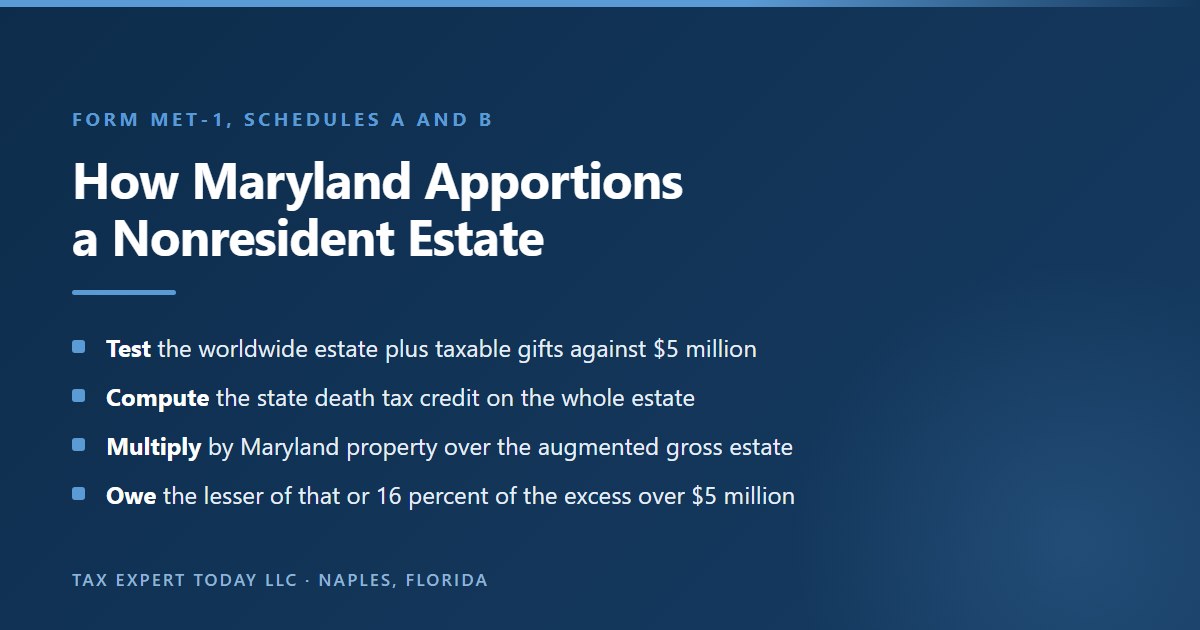
Form MET-1 computes a tax on the whole estate and then apportions it. Schedule A divides Maryland real and tangible property by the augmented gross estate. That percentage is applied to the state death tax credit from Schedule B, and the tax is the lesser of that figure or 16 percent of the excess over $5 million.
- Step one: start with the federal gross estate and subtract allowable deductions to reach the Maryland estate tax base.
- Step two: compute the allowable state death tax credit on Schedule B using the old federal Table B.
- Step three: multiply that credit by the Maryland percentage from Schedule A, Maryland property over the whole estate.
- Step four: compare the result with 16 percent of the base above $5,000,000 and owe the lower figure.
The apportionment comes straight from the statute. Tax-General §7-304(a) defines the federal credit used for the Maryland tax as the maximum §2011 credit “as reduced by the proportion that the amount of the estate not included in the Maryland estate bears to the amount of the entire estate.” Form MET-1 implements that through Schedule A. For a nonresident, Schedule A lists the real and tangible personal property with a Maryland situs, subtracts it from the augmented gross estate to find the portion not subject to Maryland tax, and divides the Maryland estate by the augmented gross estate, rounded to two decimal places. That percentage goes on line 11 of the return, is multiplied by the credit on line 10, and the lesser of line 9 (16 percent of the excess over the exclusion) and line 12 (the apportioned credit) becomes the gross Maryland estate tax on line 13.
Schedule B is where the Table B credit is computed. It reduces the Maryland base by a fixed $60,000 adjustment, applies Table B to the result, separately computes a tentative federal tax using a unified credit of $1,945,800 (the credit that corresponds to a $5,000,000 exclusion), and takes the lesser of the two. That is the allowable maximum credit carried to line 10.
The table below runs the published method on simple facts. It assumes no deductions, no adjusted taxable gifts, no prior Maryland QTIP property and no Maryland portability, and it shows estate tax before any inheritance tax credit. These are illustrations of the form’s arithmetic, not projections for any real estate.
| Worldwide estate | Maryland property | Maryland percentage | Line 10 credit | Line 9 ceiling | Maryland estate tax |
|---|---|---|---|---|---|
| $4,900,000 | $1,000,000 | Not reached | Not reached | Not reached | $0, no return required |
| $5,200,000 | $1,000,000 | 19.23% | $80,000 | $32,000 | $15,384 |
| $6,000,000 | $1,000,000 | 16.67% | $400,000 | $160,000 | $66,680 |
| $10,000,000 | $1,500,000 | 15.00% | $1,067,600 | $800,000 | $160,140 |
| $10,000,000 | $3,000,000 | 30.00% | $1,067,600 | $800,000 | $320,280 |
| $15,000,000 | $2,000,000 | 13.33% | $1,866,800 | $1,600,000 | $248,844 |
Three things stand out. First, the size of the rest of the estate drives the Maryland bill. The same $1,000,000 condominium produces $15,384 of tax in a $5.2 million estate and $66,680 in a $6 million estate, because a bigger estate produces a bigger credit before apportionment. Second, the last row is an estate that owes no federal estate tax at all under the 2026 federal exclusion, yet owes Maryland nearly $250,000 because of a $2 million Maryland property. Third, the apportioned figure is usually far below the 16 percent ceiling for a nonresident, so the ceiling rarely binds. It is the Schedule A percentage that does the work.
Deductions change the picture. A marital deduction for property passing to a surviving spouse, a charitable deduction, debts and administration expenses all reduce the Maryland base on line 7. Because the marital deduction can bring the base below $5,000,000, a married couple often owes no Maryland tax at the first death and faces the question at the second, which is why the portability and QTIP rules discussed later matter.
How Does the Maryland Inheritance Tax Apply to a Florida Decedent?
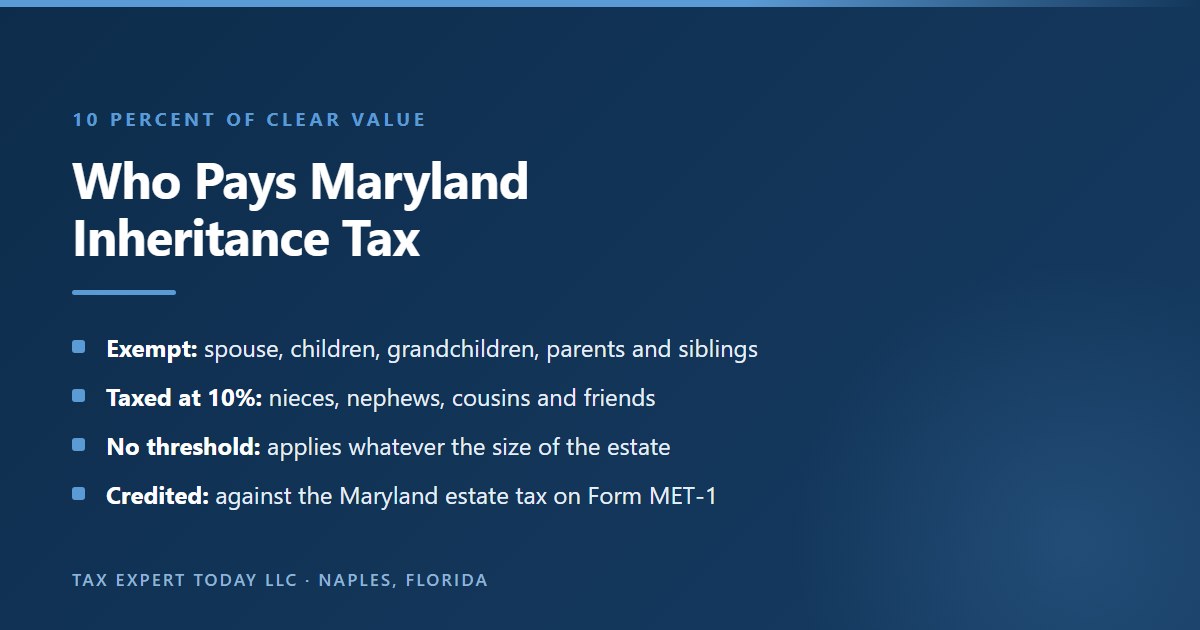
It reaches Maryland real estate and Maryland tangible property passing to a taxable beneficiary, at a flat 10 percent of clear value under Tax-General §7-204. Size is irrelevant: there is no $5 million threshold. Section 7-203(f) exempts a nonresident’s other personal property when the home state imposes no reciprocal death tax, which describes Florida.
- Rate: 10 percent of clear value, meaning fair market value minus expenses.
- No size threshold: a $400,000 condominium left to a nephew can be taxed.
- Florida intangibles: exempt for a Florida decedent under the reciprocity rule in §7-203(f).
- Maryland tangibles: not covered by that exemption, so contents and boats kept in Maryland remain taxable.
The inheritance tax is a different kind of tax. Tax-General §7-202 imposes it on the privilege of receiving property that passes from a decedent and has a taxable situs in Maryland. It is collected by the Register of Wills in the county where the decedent lived or owned property, not by the Comptroller, and it applies whether the property passes by will, by intestacy, by joint ownership, by a payable on death designation or through a revocable trust.
For a decedent domiciled in Florida, §7-203(f) does most of the work. It exempts personal property that passes from a nonresident decedent when the decedent’s home state does not impose death taxes on similar property of a Maryland resident, or grants a reciprocal exemption, and it expressly carves tangible personal property with a Maryland situs out of that exemption. Florida has no estate tax and no inheritance tax, so a Florida decedent’s brokerage account or bank deposit is outside the Maryland inheritance tax. The Register of Wills states the same rule as “personal property of a non-resident with the exception of tangible property located in Maryland.” The Maryland real estate and the contents kept with it remain fully within reach.
The relevant question is therefore who receives the Maryland property. A Florida widow who leaves the Eastern Shore house to her children owes no Maryland inheritance tax on it. The same house left to a niece, a longtime partner who was not a registered domestic partner, or a friend is taxed at 10 percent of its clear value, with no exclusion amount. That is the single most common Maryland surprise for families whose plan was drafted with Florida, not Maryland, in mind.
Who Is Exempt From the Maryland Inheritance Tax?
Close family. Section 7-203(b) exempts property passing to a spouse, parent, grandparent, child or other lineal descendant, a stepchild or stepparent, a spouse of a child or descendant, a brother or sister, and certain family-owned entities. Nieces, nephews, aunts, uncles, cousins and friends are taxed at 10 percent unless another exemption applies.
- Exempt: spouse, children, grandchildren, stepchildren, parents, grandparents, siblings and in-laws in the child’s line.
- Taxable: nieces, nephews, aunts, uncles, cousins, friends and unmarried partners who are not registered.
- Charities: exempt if they qualify under the rules in §7-203(e).
- Small items: transfers of $1,000 or less to any one person and small estates are exempt.
| Beneficiary of the Maryland property | Maryland inheritance tax | Authority |
|---|---|---|
| Surviving spouse | Exempt | §7-203(b)(2)(iii) |
| Child, grandchild or other lineal descendant | Exempt | §7-203(b)(2)(iv) |
| Stepchild or former stepchild | Exempt | §7-203(b)(1)(ii) |
| Parent or grandparent | Exempt | §7-203(b)(2)(i) and (ii) |
| Brother or sister | Exempt | §7-203(b)(2)(vii) |
| Spouse of a child | Exempt | §7-203(b)(2)(v) |
| Registered domestic partner | Exempt | §7-203(l)(3) |
| Niece, nephew, aunt, uncle or cousin | 10 percent of clear value | §7-204 |
| Friend or unrelated partner | 10 percent of clear value | §7-204 |
| Qualifying charity | Exempt | §7-203(e) |
Heirs who live in another state do not change the answer, because the tax follows the decedent and the property rather than the heir, a point the Georgia inheritance tax guide works through for heirs in a state with no tax of its own. Two of the exemptions deserve a closer look. The entity exemption in §7-203(b)(2)(viii) covers a corporation, partnership or LLC whose owners are all exempt family members, so property passing to a family company owned only by the children is treated like property passing to the children. Separately, real property under a perpetual farming conservation easement that passes to a niece or nephew is exempt under §7-203(m), subject to recapture if farming stops.
Life insurance payable to a named beneficiary other than the estate is exempt under §7-203(d), and a retirement plan payment that is not subject to federal estate tax is exempt under §7-203(a). For a Florida decedent, the reciprocity exemption usually covers those assets anyway, but the specific exemptions matter when the beneficiary designation names the estate.
How Do the Maryland Estate and Inheritance Taxes Interact?
Inheritance tax paid is a credit against the Maryland estate tax. Line 14a of Form MET-1 subtracts Maryland inheritance tax paid from the gross Maryland estate tax, and if the inheritance tax equals or exceeds the estate tax, no estate tax is due. The estate tax remains due, with interest, until the inheritance tax is actually paid.
- Credit, not double tax: the two taxes are combined, and the larger one generally sets the total.
- Timing matters: inheritance tax paid after the nine month date leaves interest on the estate tax in the meantime.
- Different collectors: the Register of Wills collects inheritance tax, the Comptroller collects estate tax.
- Other states: line 14b allows a credit for another state’s death tax on property also in the Maryland estate.
Take the $6,000,000 Florida estate from the table above, with a $1,000,000 Ocean City condominium. If the condominium passes to the decedent’s children, there is no inheritance tax and the Maryland estate tax is $66,680. If the condominium instead passes to a nephew, the Register of Wills assesses 10 percent of its clear value, roughly $100,000 if there are no expenses to subtract. That $100,000 is credited on line 14a against the $66,680 of estate tax, which reduces the estate tax to zero. Maryland’s total take in that case is the $100,000 of inheritance tax.
The Comptroller’s FAQs explain the timing trap with reference to Comptroller of the Treasury v. Jameson, 332 Md. 723 (1993). The estate tax is owed on the nine month due date until enough inheritance tax has actually been paid to cover it. If the inheritance tax on the condominium is paid only when the personal representative files an administration account months later, interest runs on the uncovered estate tax from the due date until the inheritance tax payment lands. Coordinating the inheritance tax payment with the estate tax due date avoids that cost.
The Register of Wills also sets its own clock. Inheritance tax on probate property is paid with the administration account that shows the distribution. Tax on non-probate property, such as a house in a revocable trust, is due when the Register issues an invoice based on the information report or an application to fix the tax. If that invoice is not paid within 30 days, the Register states that a 10 percent penalty and interest are charged, and the balance is eventually referred to the State’s Central Collection Unit.
Does Holding the Property in an LLC or Trust Change the Result?
A revocable trust does not. Property in a revocable trust is still in the federal gross estate and still has a Maryland situs. An LLC is different: Maryland treats an LLC interest as intangible property, which for a Florida domiciliary falls outside both Maryland taxes. That treatment is real, but it is not automatic and must be done carefully.
- Revocable trust: avoids ancillary Maryland probate but not Maryland estate or inheritance tax.
- Joint ownership: the decedent’s share remains in the estate and passes as a taxable transfer to a non-exempt joint owner.
- LLC or partnership: the Comptroller’s MET-1 instructions treat an LLC interest as Maryland intangible property.
- Caution: an entity formed late, with no business purpose, invites a challenge.
A funded revocable trust is still the right tool for a Florida resident with Maryland real estate, alongside the protections in the asset protection guide for new residents, because it can spare the family an ancillary probate proceeding in the Maryland county where the property sits. It does not change the tax. The property is in the federal gross estate under the retained powers rules, so it stays in the augmented gross estate on Form MET-1, and the inheritance tax definition in §7-201(d) expressly includes property over which the decedent retained a power of revocation.
Entity ownership works differently because the asset in the estate changes from real property to an ownership interest. The 2026 MET-1 instructions use an example of a Maryland decedent who owns an LLC interest where the LLC owns real property in another state, and say the LLC interest is considered Maryland intangible property. For a Florida decedent the mirror image follows: the asset in the estate is an intangible interest, and intangible property of a nonresident is outside the Maryland estate in §7-302 and outside the inheritance tax under the reciprocity exemption in §7-203(f).
We did not find a Maryland statute or published Comptroller ruling that looks through a family LLC holding a single residence for a nonresident decedent, and we did not find one that blesses the structure either. A transfer of the house into an LLC shortly before death, with no business activity and the owner continuing to use the property personally, is the kind of arrangement a taxing authority may challenge under general substance principles, and the federal estate tax rules on retained use under IRC §2036 apply regardless. Anyone considering this should have Maryland counsel review the structure, the title work, the operating agreement and the transfer tax consequences of the deed before acting.
The trust situs guide covers the related question of moving an irrevocable trust’s administration to Florida, which affects income tax on the trust rather than the Maryland death taxes on real property, and the guide to decanting a trust covers changing the terms of an irrevocable trust that holds Maryland property.
Can You Gift the Maryland Property Before Death?
Yes, and Maryland has no gift tax, but three rules limit the benefit. Taxable gifts still count toward the $5 million filing test and Schedule B, a gift of a material part of your property within two years of death is presumed made in contemplation of death for inheritance tax, and gifted property loses the basis step-up.
- No Maryland gift tax: a completed lifetime gift removes the property from the Maryland estate.
- Two year rule: under §7-201(d)(1)(iii), a final disposition of a material part of your property within two years of death can still be taxed as an inheritance.
- Gifts are added back: taxable gifts still count toward the worldwide filing test and the tentative tax on Schedule B.
- Basis cost: the recipient takes your carryover basis under IRC §1015 instead of a stepped-up basis under §1014.
Because Maryland does not tax gifts, giving the Maryland property away during life removes it from the Maryland estate entirely. For a nonresident whose only Maryland exposure is that property, that can eliminate the Maryland estate tax and, for a non-exempt recipient, the inheritance tax. The federal gift is reported on Form 709 and uses part of the federal exclusion, which at $15,000,000 in 2026 leaves room for most families.
The inheritance tax has its own reach back. Section 7-201(d)(1)(iii) treats as passing from the decedent any transfer of a material part of the decedent’s property in the nature of a final disposition made within two years before death unless it is shown not to have been made in contemplation of death, and any transfer under which the decedent retained a beneficial interest. A parent who deeds the Ocean City condominium to a nephew and keeps using it every summer has not escaped the inheritance tax.
The income tax cost is often the larger one. Property held at death receives a basis equal to its fair market value under IRC §1014. Property received by gift keeps the donor’s basis under IRC §1015. A condominium bought in 1995 for $180,000 and worth $1,000,000 today carries a large built-in gain, and a gift passes that gain to the recipient. When the recipient sells, the gain on Maryland real property is Maryland source income, and the recipient faces Maryland income tax as a nonresident and files the kind of nonresident state tax return that follows a move. The guide to selling the northern home after a move and the guide to selling rental property after a move cover that side of the decision.
A sale during life is the other option. Selling the Maryland property and reinvesting in intangible assets converts a Maryland situs asset into one Maryland cannot reach at death, at the cost of the income tax on the gain and the Maryland nonresident withholding at closing. Whether that trade makes sense depends on the gain, the family’s plans for the property and the Maryland tax the property would otherwise produce, which is a computation worth running before any decision. The same timing logic applies to a business sale, covered in the guide to moving to Florida before selling a business.
How Does Maryland Decide Whether You Were Still Domiciled There?
Domicile at death controls. A Maryland domiciliary’s entire estate is in the Maryland estate, except real and tangible property located elsewhere, and the inheritance tax then reaches intangibles too. The question is your permanent home, proven by where you live, vote, register cars, keep your doctors and file taxes, not by a day count alone.
- Florida domicile: Maryland reaches only Maryland real and tangible property.
- Maryland domicile: Maryland reaches the whole estate, and the Schedule A apportionment largely disappears.
- Evidence: a Florida declaration of domicile, homestead, driver license, voter registration and an updated will.
- Weak spots: a Maryland house still used as the family center, Maryland doctors, and Maryland income tax returns filed as a resident.
The estate tax does not define residence separately, and in practice the inquiry is domicile: the place the decedent regarded as the permanent home at death. The Maryland income tax uses a broader definition in Tax-General §10-101(k), under which a person is a resident either by domicile or by maintaining a place of abode in Maryland for more than six months of the year. A former Marylander who keeps a Maryland home and spends much of the year in it can face a residency question for income tax during life, the same dual state residency trap that catches snowbirds from other states, and the estate will face the domicile question at death.
The stakes are large. Using the table above, the $10,000,000 estate with a $1,500,000 Maryland condominium owes $160,140 of Maryland estate tax if the decedent was domiciled in Florida. If the Comptroller established that the decedent was still a Maryland domiciliary, the Florida home would leave the Maryland estate as out of state real property, but the portfolio would come back in, the Maryland percentage would jump, and the bill could approach the 16 percent ceiling of $800,000 on a $10,000,000 estate held almost entirely in intangibles. The inheritance tax would also reach intangibles left to non-exempt beneficiaries.
Florida’s side of the record is straightforward. A sworn declaration of domicile under Fla. Stat. §222.17, a homestead exemption, a Florida driver license and vehicle registrations, Florida voter registration, a will that recites Florida domicile, and final part year Maryland returns, covered in the first year snowbird filing guide, all point the same way. The Florida residency guide sets out the full checklist, and the residency audit guide explains how an old state builds the opposite case. The 183 day calculator helps track the day count that an auditor will ask about first.
What About Portability and a Maryland QTIP for a Surviving Spouse?
Both exist in Maryland and both require an election on a Maryland return. Under §7-309(b)(9), a surviving spouse can add the first spouse’s unused Maryland exclusion only if it was elected on a timely Maryland return, or for a nonresident first spouse with no Maryland property, on the federal return. A Maryland-only QTIP election is also available.
- Maryland portability: the deceased spouse’s unused Maryland exclusion, up to $5,000,000, carries to the survivor if elected.
- Nonresident first spouse: if the first spouse had no Maryland situs property, the federal portability election on Form 706 is what counts.
- Late portability filing: the Comptroller’s FAQs say the window now matches the federal period, currently five years.
- Maryland QTIP: elected on Schedule D of Form MET-1, even if the federal election differs.
For a Florida couple the sequence matters. Suppose the first spouse dies owning a half interest in the Maryland condominium. If the estate reaches the $5,000,000 filing test, the Maryland return is required and the portability election is made on it. If the first spouse’s estate is under the threshold but the couple’s combined estate is larger, filing a Maryland return solely to elect portability can preserve up to $5,000,000 of additional Maryland exclusion for the survivor. Under §7-309(b)(9)(ii), a first spouse who was not a Maryland resident and held no Maryland situs property can transfer the unused amount through the federal election instead, which is one more reason to file a federal portability return at the first death even when no federal tax is due.
The Maryland QTIP election under §7-309(b)(5) lets an estate claim a marital deduction for Maryland purposes on property in a qualifying trust for the surviving spouse, and it is recognized even if the federal election is made differently. The property is then included in the surviving spouse’s Maryland estate under §7-309(b)(6), which appears on line 2 of the survivor’s MET-1. For a survivor who has since moved to Florida, the location of the QTIP trust’s assets at the second death determines how much of that inclusion is Maryland property for apportionment. The estate planning guide for new Florida residents covers the federal portability and trust choices that sit alongside this.
What Should a Former Maryland Resident Do Now?
Inventory what Maryland can still reach, run the MET-1 arithmetic on today’s numbers, and check who receives the Maryland property. Then decide whether to keep, sell, gift or restructure it, keep the Florida domicile record clean, and make sure the will and beneficiary designations reflect the Maryland inheritance tax exemptions.
- Inventory: list every Maryland parcel and the contents, vehicles and boats kept there.
- Estimate: compute the Schedule A percentage and the apportioned tax on the current worldwide estate.
- Beneficiaries: identify any non-exempt recipient of the Maryland property, and the 10 percent cost of that choice.
- Documents: fund a revocable trust to avoid ancillary probate and confirm the tax clause in the will.
The checklist below is the order we would work through for a client who has moved to Southwest Florida and kept Maryland property.
| Step | What to do | Why it matters |
|---|---|---|
| 1 | List Maryland real estate, contents, vehicles and boats with current values | This is the Maryland estate in the Schedule A numerator |
| 2 | Total the worldwide estate including the Florida home and lifetime taxable gifts | The $5,000,000 filing test and the credit both use this number |
| 3 | Run the MET-1 computation on today’s numbers | Shows whether the Maryland tax is material enough to act on |
| 4 | Check who inherits the Maryland property under the will, trust and deed | A niece, nephew or friend triggers 10 percent inheritance tax |
| 5 | Compare keeping, selling, gifting and entity ownership | Each trades Maryland death tax against income tax and legal risk |
| 6 | Fund a revocable trust for the Maryland property | Avoids an ancillary Maryland probate proceeding |
| 7 | Review the Florida domicile record | Keeps the portfolio outside the Maryland estate |
| 8 | Plan the first death return for portability and any Maryland QTIP | Preserves the first spouse’s unused Maryland exclusion |
The tax clause in the will deserves a specific look. The Register of Wills notes that most wills direct death taxes to be paid from the residue, which means the children who receive the portfolio may end up paying the 10 percent inheritance tax on the condominium left to a nephew. That may be what the decedent wanted, or it may not. Drafting the tax clause to say who bears the Maryland tax avoids an argument among beneficiaries later.
Families with property in more than one old state face the same exercise for each one, and the New York exit tax guide and New Jersey exit tax guide cover the income tax side of leaving those states. The Massachusetts estate tax guide, the Pennsylvania inheritance tax guide and the New Jersey inheritance tax guide cover the other Northeast states that most often follow a Florida client south, and each uses a different method from Maryland’s.
How Does the Maryland Tax Interact With the Federal Estate Tax?
The Maryland return is built on the federal Form 706, and Maryland tax paid is deductible on the federal return under IRC §2058. But Maryland computes its own tax without that deduction, and with a $15 million federal exclusion in 2026, most Florida estates with Maryland exposure will owe Maryland without owing any federal estate tax.
- Same starting point: line 1 of Form MET-1 is the federal total gross estate from Form 706.
- Different exclusion: $5,000,000 for Maryland against $15,000,000 federally for 2026.
- Federal deduction: Maryland death taxes paid reduce the federal taxable estate under §2058.
- Consistency: Maryland generally follows federal valuation and alternate valuation elections.
Section 7-309(b)(3)(ii) directs that the Maryland tax be determined without regard to the federal deduction for state death taxes in IRC §2058, which prevents a circular computation. On the federal side, an estate large enough to owe federal tax deducts the Maryland estate and inheritance taxes it paid. For the much larger number of estates under the federal exclusion, the Maryland return is the only death tax return that produces a bill, and the federal Form 706 is prepared largely to support it.
Valuation is shared. Section 7-309(b)(4) requires a federal alternate valuation election to carry over to Maryland, and permits a Maryland-only election when no federal return is required, but only if it reduces both the gross estate and the Maryland tax. Appraisals of the Maryland real property should be prepared once, by a certified appraiser, for use on both returns. The MET-1 instructions also impose a 25 percent penalty on an underpayment over $5,000 caused by a substantial valuation understatement.
Maryland Estate Tax Help in Naples & Southwest Florida
Tax Expert Today works with families in Naples, Florida, and across Southwest Florida who moved from Maryland, Virginia, the District of Columbia and the rest of the Mid-Atlantic and kept property behind. Our team of tax advisors, enrolled agents, CPAs and attorneys handles residency and tax matters nationwide, and we coordinate with Maryland estates counsel on the Maryland side when a probate or title question needs a Maryland lawyer. For readers searching for Maryland estate tax help Naples or MD inheritance tax Naples FL, this is the work we do: running the MET-1 numbers on the current estate, identifying inheritance tax exposure by beneficiary, and building a plan that fits the family’s retirement income picture and broader Naples tax planning.
Our office is at 11983 Tamiami Trail N, Naples FL 34110, and we are available by phone at (239) 441-2005, Monday through Friday, 10 a.m. to 5 p.m. Eastern. We work with clients in person in Naples and remotely in all 50 states, and our estate and trust planning and Florida tax services pages describe the broader engagement.
Can a Naples firm help with a Maryland estate tax return?
Yes. Form MET-1 is filed with the Comptroller of Maryland by mail and built on the federal Form 706, so the computation, the federal return and the Schedule A apportionment can be prepared from Naples. Where the estate needs an ancillary Maryland probate or a Register of Wills filing, a Maryland attorney handles the court side and we coordinate the tax side with them.
When to Engage a Professional
A Maryland estate tax question is worth a professional review when the worldwide estate is near or above $5,000,000 and includes any Maryland real estate, when Maryland property is left to anyone other than a spouse, descendant, parent, sibling or other exempt relative, when one spouse has already died and the Maryland portability or QTIP election may be in play, when an LLC or other entity holds Maryland property, or when the Florida domicile record has gaps. It is also worth a review before selling or gifting Maryland property, because the death tax savings have to be weighed against the income tax cost.
Our multidisciplinary team of enrolled agents, CPAs and attorneys works on residency and tax matters nationwide. We can run the MET-1 computation on your current numbers, model the inheritance tax by beneficiary, compare keeping, selling and gifting the Maryland property, and coordinate the documents with your estate planning attorney. Call (239) 441-2005 to schedule a consultation, or learn more about our estate and trust planning services.
This article provides general information about Maryland and federal estate and inheritance taxes as of its publication date and is not legal or tax advice for any specific situation. The worked examples are illustrations of the published computation under stated assumptions. Tax law and Maryland forms change, and the result for any estate depends on its facts and on the law in effect at the date of death. Consult a qualified advisor before acting.
Published October 3, 2026 by Dr. Pellumb Kabashi « Back to Learning Center
Have a question this article touches on?
Tax Expert Today LLC, based in Naples, Florida and serving clients across the United States.
Schedule a Consultation (239) 441-2005