
By Dr. Pellumb Kabashi, DBA, MBA, CES, CFE, EA
Founder, Tax Expert Today LLC · Tax advisors, enrolled agents, CPAs, and attorneys · Serving clients in all 50 states
Quick Answer: The Maryland exit tax is not a tax on leaving. It is a withholding of 8.75 percent for individuals and 8.25 percent for entities, taken at closing when a nonresident sells Maryland real property. It is a prepayment, not the final bill. Form 505, filed after year end, settles the real tax and refunds any excess. Call (239) 441-2005 for a free consultation.
What Is the Maryland Exit Tax, and Is It Real?
The Maryland exit tax is a nickname, not a statute. Maryland does not tax anyone for moving away. What sellers meet is a withholding at closing when a nonresident sells Maryland real estate, set by Tax-General §10-912 at 8.75 percent for individuals and 8.25 percent for entities, which is later credited against the actual Maryland income tax.
- No departure tax: a Florida move by itself creates no Maryland tax, no filing and no payment.
- What people mean: the amount the settlement agent holds back from a nonresident seller’s proceeds so the deed can be recorded.
- Why it feels like a tax: the money leaves the closing table, and recovering any excess can take months.
- What actually decides the bill: the gain on the sale, reported on a Maryland nonresident return.
The Maryland exit tax phrase spreads every spring when Maryland homeowners start talking with realtors and title companies about a move south. The confusion is understandable, because the statute works by blocking the deed. Under Tax-General §10-912(c), a deed for real property owned by a nonresident or a nonresident entity may not be recorded with the clerk of the circuit court unless a payment accompanies it. The same section then says, in subsection (h), that it does not impose any tax on a transferor or affect any liability of the transferor for any tax. Subsection (f) treats the money as paid on behalf of the seller and credits it for the taxable year of the sale.
So the honest answer to “is there a Maryland exit tax” is two part. There is no tax on leaving. There is a prepayment of Maryland income tax that follows a Maryland property sale for as long as the seller is a nonresident, and in 2026 that prepayment is larger than it used to be, harder to refund early on expensive properties, and sometimes smaller than the real tax for high income sellers. This Maryland exit tax guide is written for people who already live in Naples, Florida or elsewhere in Southwest Florida and still own a house, condominium, rental or lot in Maryland.
Most of the pages that rank for this phrase are a title company page that still quotes the old 8 percent rate, a realtor explainer, a social media reel and opinion pieces about the political history of the rumour. They stop at the closing table. None of them follows the seller through the three forms that actually move money, MW506AE before closing, MW506NRS at closing and MW506R after closing, and then into Form 505, the nonresident return that settles the tax. That sequence, with current figures, is what follows.
| What people call it | What it legally is | Where it comes from |
|---|---|---|
| “Maryland exit tax” | Income tax withholding on a nonresident sale of Maryland real property | Tax-General §10-912 |
| “The 8.75 percent” | The lowest county rate of 2.25 percent plus the 6.50 percent top State rate | §10-912(c)(1), §10-106.1, §10-105(a) |
| “The 8.25 percent” | The corporate income tax rate, applied to a nonresident entity | §10-912(c)(2), §10-105(b) |
| “Getting it back” | A credit on Form 505, or a tentative refund on Form MW506R where eligible | §10-912(f) and (i)(3) |
| “The exit tax on capital gains” | The additional 2 percent tax on net capital gain when federal AGI exceeds $350,000 | §10-105(a)(3) and (4) |
How Much Does Maryland Withhold When a Nonresident Sells?
For sales after June 30, 2025, Maryland withholds 8.75 percent of the total payment to a nonresident individual and 8.25 percent of the total payment to a nonresident entity. The total payment is the net proceeds the seller actually receives, not the contract price, so a large mortgage payoff reduces the Maryland exit tax withholding.
- Individuals, estates and trusts: 8.75 percent, the 2.25 percent special nonresident rate plus the 6.50 percent top State rate.
- Nonresident entities: 8.25 percent, equal to the corporate rate.
- Base: sales price less the seller’s secured debt paid at closing and the seller’s settlement expenses.
- Effective date: every sale occurring after June 30, 2025, per the Comptroller’s tax alert.
The rate is built from two other sections of the Tax-General Article. Section 10-912(c)(1) sets the individual rate as the sum of the tax imposed under §10-106.1, which is the special nonresident tax equal to the lowest county income tax rate, and the top marginal State rate under §10-105(a). The 2025 Form 505 instructions use 2.25 percent for the special nonresident tax, and the Budget Reconciliation and Financing Act of 2025 added two new top brackets, 6.25 percent and 6.50 percent. When the top bracket rose to 6.50 percent, the Maryland exit tax withholding rate rose with it, from 8 percent to 8.75 percent.
The Comptroller’s tax alert, effective April 13, 2026, confirms the result: 8.75 percent for nonresident individuals and 8.25 percent for nonresident entities, for all sales occurring after June 30, 2025, and the new rate appears on Forms MW506AE, MW506NRS and MW506R. Some title company and realtor pages still quote 8 percent. A seller who budgets with the old figure is short by three quarters of a percent of the net proceeds.
| Seller type | Withholding rate | How the rate is built |
|---|---|---|
| Nonresident individual (including a Florida domiciliary) | 8.75% | 2.25% special nonresident tax plus 6.50% top State rate |
| Nonresident estate or trust filing as an individual | 8.75% | Same individual computation on Forms MW506AE and MW506R |
| Nonresident entity (not formed in Maryland and not registered with SDAT) | 8.25% | Maryland corporate income tax rate |
| Resident individual or resident entity | None | Exempt with a residency certification on the deed or an affidavit |
| Sales on or before June 30, 2025 | 8.00% individual, 8.25% entity | Prior top State rate of 5.75% |
What Counts as the Total Payment Maryland Applies the Rate To?
Section 10-912 applies the rate to the total payment, defined as the net proceeds actually paid to the seller. Net proceeds means the total sales price less the seller’s mortgages and liens paid off at closing and the seller’s other expenses shown on the settlement statement. Credits in the seller’s favour on the settlement statement are not added back.
- Subtracted: mortgage and lien payoffs, commissions, transfer and recordation taxes paid by the seller, and other seller expenses on the settlement statement.
- Not subtracted: the seller’s original cost, improvements, or depreciation; those matter only on the exemption and refund forms.
- Included: the fair market value of any property the seller receives in the exchange.
- Result: a seller with little debt can see withholding far larger than the tax the gain will produce.
The definitions sit in §10-912(a)(2) and (a)(5), and they are the core of the Maryland exit tax computation. This detail explains most of the anger behind the “exit tax” label. Withholding on net proceeds is not withholding on profit. A Florida resident who bought a Silver Spring condominium for $410,000 and sells it for $440,000 with no mortgage has a modest gain, but the Maryland exit tax withholding is computed on the cash that reaches the seller after costs, which can be over $400,000. At 8.75 percent that is more than $35,000 held back on a sale that may produce a Maryland tax in the low thousands.
The Maryland exit tax statute anticipates this. Subsection (d)(2) lets the seller present a certificate from the Comptroller stating that no tax, or a reduced amount of tax, is due, and subsection (i)(3) requires the Comptroller to provide an early refund procedure where the seller shows that less tax will be owed. Those two mechanisms are Forms MW506AE and MW506R, covered below. The important point at this stage is that the Maryland exit tax withholding is not a measure of what Maryland believes the seller owes. It is a deposit, sized to be safe for the State, and the seller’s own paperwork is what brings it down to the real number.
Why Does a Florida Domicile Not Stop Maryland From Taxing the Sale?
Maryland taxes nonresidents on income from Maryland sources, and gain on Maryland real property is Maryland source income wherever the owner lives. A Florida domicile ends Maryland tax on wages earned in Florida, investment income and most other income, but it never removes Maryland’s right to tax a gain on land located in Maryland.
- Domicile decides residence: it settles whether Maryland can tax all of your income or only Maryland source income.
- Location decides source: real property is taxed by the state where it sits.
- Florida offers no credit: Florida has no personal income tax, so there is nothing to offset at home.
- Federal tax still applies: the same gain also appears on the federal return, with the §121 exclusion where it qualifies.
The Form 505 instructions describe the result in practical terms. A nonresident who sold real property in Maryland must attach a copy of the federal return, the settlement statement for the sale and Form MW506NRS to the Maryland nonresident return. That is the State telling you that the sale is reportable in Maryland whether or not you live there.
Many Florida movers find this counterintuitive, because the main reason for the move was to stop paying a state income tax. The move does accomplish that for nearly everything else. Brokerage gains, dividends, interest, pensions, IRA distributions and wages for work performed in Florida become Florida income, and Florida does not tax them. The Maryland property is the exception that follows the owner, in the same way that New Jersey real estate, New York real estate and California real estate follow their owners south. Our page on filing a nonresident state tax return after a move explains the general rule; this page covers how Maryland applies it at the closing table.
Where the domicile record does matter is in the move year and for people who keep a Maryland home. If the Comptroller concludes that the seller never actually changed domicile, or was a statutory resident under the abode and 183 day test, the sale is taxed as a resident sale, with county tax instead of the special nonresident tax, and everything else the person earned that year may become taxable in Maryland too. Our guides to establishing Florida residency and defending a residency audit cover that record.
Who Counts as a Nonresident Seller at Closing?
A seller is a nonresident if domiciled outside Maryland on the last day of the tax year and not a statutory resident. Under Tax-General §10-101(k), a statutory resident maintained a Maryland place of abode for more than six months of the year, and the Form 505 instructions add physical presence of 183 days or more.
- Domicile: the permanent home you intend to return to; a Florida declaration of domicile under Fla. Stat. §222.17 is part of that record.
- Statutory residency: a Maryland abode kept more than six months plus 183 or more days present.
- Part-year residents: taxed as residents for the part of the year before the move.
- Entities: resident if formed in Maryland or registered with the State Department of Assessments and Taxation.
The residency definition is in Tax-General §10-101(k). An individual is a resident if domiciled in Maryland on the last day of the taxable year, or if, for more than six months of the taxable year, the individual maintained a place of abode in Maryland. The 2025 nonresident booklet explains the Comptroller’s reading: a person whose home is outside Maryland is a statutory resident if a place of abode was maintained in Maryland for more than six months and the person was physically present in Maryland for 183 days or more.
For the Maryland exit tax withholding statute, residence is handled by certification. Under §10-912(d)(1), the Maryland exit tax withholding does not apply when each seller certifies under penalties of perjury, in the deed recitals or in a recorded affidavit, that the seller is a Maryland resident or a resident entity. Executives who still receive Maryland sourced compensation after the move face a separate allocation question, covered in our guide to Florida domicile for executives. A Florida domiciliary cannot honestly sign that certification, and should not, because it is made under penalties of perjury and the Comptroller can match it against the seller’s returns. The practical result is that anyone who has moved to Naples and files as a Florida resident will be a nonresident seller unless the property qualifies for another exemption.
The entity definition matters for people who hold a rental in an LLC. Section 10-912(a)(3) defines a nonresident entity as one that is not formed under Maryland law and is not qualified by or registered with the State Department of Assessments and Taxation. A Maryland LLC, or a Florida or Delaware LLC that is registered to do business in Maryland, is a resident entity for this purpose even if every member now lives in Florida. That distinction is covered further in the section on entities below.
| Your situation at closing | Likely status under §10-912 | Withholding result |
|---|---|---|
| Moved to Naples in 2025, Florida domicile, no Maryland home kept | Nonresident individual | 8.75% unless an exemption or certificate applies |
| Closing before the move, still domiciled in Maryland | Resident individual | None, with a residency certification |
| Florida domicile but a Maryland home kept and 183 or more Maryland days | Statutory resident for the year | Residency certification may be accurate; resident tax applies to all income |
| Rental held in a Maryland LLC, members in Florida | Resident entity | None at the entity level; owners still report the gain |
| Rental held in an unregistered Florida LLC | Nonresident entity | 8.25% of the total payment |
Is a Former Maryland Home Exempt From the Withholding?
Often yes. Section 10-912(d)(5) exempts a sale when each seller certifies that the property is the seller’s principal residence. The Comptroller reads principal residence as defined in IRC §121, meaning you owned and used it as your main home for two of the last five years, so a former home sold soon after the move can qualify.
- The test: two of the five years immediately before the closing, the same window as the federal §121 exclusion.
- How it is claimed: a certification in the deed recitals or a recorded affidavit, signed by each seller.
- The Comptroller’s condition: resident Maryland returns must have been filed for the period you claim the house as your residence.
- The clock: roughly three years after moving out, the two of five test is no longer met.
The 2026 Form MW506AE instructions describe the principal residence situation directly: a transfer of your principal residence as defined in §121 of the Internal Revenue Code, which means it has been your principal residence for two of the last five years, and resident income tax returns for that period must have been filed to claim it. The Comptroller states that this will be verified. The Form MW506R eligibility box uses the same wording, principal residence for two of the five years immediately preceding closing.
This is the most useful Maryland exit tax exemption for Florida movers, and it is time limited in a way people miss. Suppose a couple lived in their Bethesda house from 2009 until they moved to Naples in August 2025. If they sell in 2026, they used the house as their main home for far more than two of the five years before the sale, and they can certify principal residence at closing. If they wait until late 2028 or 2029, the two of five years window closes, the house is treated like any other nonresident sale, and 8.75 percent of the net proceeds is withheld unless they obtain a certificate.
Two cautions apply. The exemption from withholding is not an exemption from tax. Gain above the federal §121 exclusion, which is $250,000 for a single filer and $500,000 for a joint return under IRC §121, flows into federal adjusted gross income, and a nonresident still reports that Maryland source gain on Form 505. And if the house was rented after the move, the rental period brings depreciation recapture, nonqualified use rules and Maryland rental filing obligations into the picture. Our guide to selling your home after moving to Florida owns the federal §121 analysis, and IRS Publication 523 explains the federal ownership and use tests; this page stays with the Maryland mechanics.
How Does the Withholding Work on a Maryland Rental or Second Home?
A rental, vacation home or second home owned by a Florida resident is a standard nonresident sale. No principal residence certification is available, so 8.75 percent of the net proceeds is withheld unless the seller obtains a Form MW506AE certificate before closing, and the Comptroller expects the seller’s Maryland nonresident returns reporting the rental income to be on file.
- Typical properties: a Montgomery County condominium kept as a rental, an Ocean City or Eastern Shore vacation home, an Annapolis waterfront house, or inherited family property.
- Depreciation counts: the forms subtract depreciation from basis, which raises the gain.
- Prior rental returns: an MW506AE application is denied if rental income was never reported on Maryland nonresident returns.
- Annual filing: rental income itself is Maryland source income every year the property is rented.
The Maryland exit tax rules are strictest for rentals, and the MW506AE instructions are blunt about them. Maryland law requires nonresidents who own Maryland real property to file a nonresident income tax return reporting any rental income or loss. If the seller checks the rental box on the application and did not file returns reporting that income or loss, the application will be denied, and the seller is told to file all appropriate returns before applying. A Florida owner who has been renting a Maryland condominium without filing Form 505 each year therefore has a two step problem: the back returns come first, and only then does the closing withholding become negotiable.
The rental case is also where the gap between withholding and tax is widest, because rental owners often carry a mortgage close to the property’s value or have a gain that has been reduced by years of expenses. On the other hand, depreciation claimed on the federal return reduces adjusted basis on Line 5 of both Form MW506AE and Form MW506R, so a long held rental can have a larger gain than the owner expects. Our separate guide to selling rental property after a move covers the federal side, including unrecaptured §1250 gain and passive loss release. Depreciation on a rental sale is reported on IRS Form 4797 and the capital gain flows to Schedule D.
Worked example: a Bethesda rental condominium
Consider a hypothetical Florida resident, single, who bought a Bethesda condominium in 2016 for $700,000, spent $20,000 on documented improvements, paid $10,000 in purchase settlement costs, and claimed $90,000 of depreciation while renting it after the move. In 2026 the condominium sells for $850,000, with a $400,000 mortgage payoff and $51,000 of seller settlement costs.
| Line | Amount | Note |
|---|---|---|
| Contract sales price | $850,000 | Settlement statement |
| Less mortgage payoff and seller costs | ($451,000) | §10-912(a)(2) |
| Total payment to the seller | $399,000 | Base for the default withholding |
| Default withholding at 8.75% | $34,912.50 | Collected with the deed |
| Adjusted basis on MW506AE (700,000 + 20,000 + 10,000 + 51,000 − 90,000) | $691,000 | Lines 1 through 6 |
| Amount subject to tax | $159,000 | Line 8a |
| Tentative withholding on an approved MW506AE | $13,912.50 | $159,000 × 8.75% |
| Cash kept at closing because of the certificate | $21,000 | Difference between the two withholdings |
The figures are illustrative and assume the Comptroller accepts every documented amount. The Comptroller recalculates the certificate from the documents it receives, and only substantiated improvements are credited. The example continues in the Form 505 section, where the real Maryland tax on the $159,000 gain is computed.
What Is Form MW506AE and When Should a Seller File It?
Form MW506AE is the application for a Certificate of Full or Partial Exemption from the withholding. The seller computes the expected gain, attaches the purchase and pending sale settlement statements, the contract and proof of improvements, and the Comptroller must receive the complete package no later than 21 days before closing. The decision is final and cannot be appealed.
- Who files: each nonresident seller, except spouses filing a joint Maryland return, who may file together.
- Deadline: received at least 21 days before the closing date; an application with no closing date is not processed.
- Result: a certificate showing no withholding or a reduced amount, mailed to the settlement agent.
- No appeal: a denial or a smaller reduction than requested simply leaves the excess for Form 505.
The 2026 MW506AE is a ten line worksheet. Line 1 is the purchase price or inherited value, supported by the settlement statement or a death certificate and appraisal. Line 2 is capital improvements, which are optional and credited only with paid invoices or receipts and cancelled checks showing the property address and the work. Line 3 adds the settlement costs from the original purchase and the pending sale. Line 5 subtracts depreciation deducted on the federal return. Line 7 is the contract price, and Line 8a is the amount subject to tax. The seller applies the ownership percentage and multiplies by 8.75 percent for an individual or 8.25 percent for a business to reach the tentative withholding on Line 10.
The regulation behind the form, COMAR 03.04.12.04, requires the application at least 21 days before settlement, the reason for the exemption, and supporting documentation, and it states that the Comptroller’s decision to issue or deny the certificate and the amount withheld under a partial exemption are final. In practice the 21 day rule means the application should go in when the contract is signed, not when the closing date is confirmed. A seller who is closing in three weeks or less has, for practical purposes, already lost the chance to reduce the Maryland exit tax withholding at the table, and the remaining routes are the MW506R tentative refund or the Form 505 return.
Florida movers who want to reduce the Maryland exit tax at closing should also plan for the paper trail. A purchase made in the 1990s or 2000s may need the original settlement statement from a title company or a deed and land records printout, and improvements need proof of payment, not just a contractor estimate. Gathering these records from Naples while the Maryland house is on the market is the most common reason applications arrive late.
What Special Situations Does MW506AE Recognize?
Beyond the gain worksheet, MW506AE lists special situations that support a full or partial exemption: a principal residence under §121, a §1031 exchange through a qualified intermediary, an installment sale under §453, inherited property sold within one year of death, a seller receiving zero proceeds, an IRA custodian seller, and certain military and government moves.
- §1031 exchange: a letter from the qualified intermediary, with any boot stated as the taxable amount.
- Installment sale: the contract and the buyer’s promissory note, with the part of the total payment received at or within 60 days of settlement stated as the taxable amount.
- Inherited within one year: the death certificate and an estimated settlement sheet.
- Zero proceeds: all proceeds go to a co-owner, documented by a letter.
| Special situation on MW506AE | What the Comptroller asks for | Who it helps |
|---|---|---|
| Principal residence under IRC §121 | Proof of two of five years of use; resident Maryland returns filed for that period | Movers selling the former Maryland home within about three years |
| Principal residence, active-duty military or certain government employees | Transfer orders and proof of residency | Sellers whose move was required by government orders |
| Tax-free exchange under §1031 | Letter from the qualified intermediary stating any boot | Rental owners buying replacement property, including in Florida |
| Installment sale under §453, reported on Form 6252 | Contract or settlement sheet and the promissory note; the payment received at or within 60 days of settlement is the taxable amount | Sellers financing the buyer |
| Inherited property sold within one year of death | Death certificate and estimated settlement sheet | Heirs and estates selling a parent’s Maryland home |
| Seller receives zero proceeds | Letter showing all proceeds go to another owner | Co-signers and nominal title holders |
| Seller is the custodian of an IRA | Custodian good standing certificate and title company letter | Self-directed IRA real estate |
The §1031 situation deserves a note for Florida movers facing the Maryland exit tax on a rental. A Maryland rental can be exchanged for Florida rental property under IRC §1031, reported on IRS Form 8824, and Maryland follows the federal deferral, so there is no Maryland gain to tax in the year of the exchange when no boot is received. The MW506AE instructions ask for a letter from the qualified intermediary identifying that it will act for the seller, whether there will be boot and the amount of any boot. The boot is entered as the taxable amount. What the form does not say, and many sellers do not consider, is that the deferred gain is still Maryland source gain. When the Florida replacement property is later sold, the question of whether Maryland can reach the deferred portion is a separate and fact specific issue worth reviewing before the exchange. California takes an aggressive view of exactly this question, explained in our guide to the California 1031 exchange clawback, and our page on a 1031 exchange in Georgia shows how another state handles withholding on an exchange.
Inherited property is the other common case. When a parent in Maryland dies and the Florida children sell the house within a year, the inherited value is usually close to the sale price because of the basis step up under IRC §1014, so the expected gain is small. The special situation lets the heirs document that before closing. If the Maryland estate or inheritance tax also applies to that estate, it is a separate tax with a separate return; our guide to the Maryland estate tax for Florida residents covers it.
What Is Form MW506NRS and Who Files It?
Form MW506NRS is the Maryland return of income tax withholding for a nonresident sale of real property. The settlement agent completes it at closing, files it with the clerk of the circuit court along with the withholding payment, and gives the seller Copy C, which the seller later attaches to Form 505 or to Form MW506R to claim credit.
- Four copies: one each for the clerk, the Comptroller, the seller and the settlement records.
- Copy C: the seller’s record copy; keep it with the settlement statement.
- Timing: the clerk pays the amount over to the Comptroller within 30 business days under §10-912(e)(2).
- Liability: buyers, title companies, lenders and agents are not liable for the Maryland exit tax withholding under §10-912(g).
The 2026 Form MW506NRS is a closing document, and most Florida sellers never see it until the settlement package arrives by courier or email. It records the seller’s identity, the property, the total payment and the amount withheld, and the settlement agent attaches the check when the deed goes to the clerk for recording. The form’s own instructions tell the settlement agent to give Copy C to the seller at closing and not to submit Copy C to the Comptroller with the return.
The federal government runs a comparable deposit system for foreign sellers under FIRPTA, where a withholding certificate plays the role MW506AE plays in Maryland; our Form 8288-B guide explains it. For the seller, Copy C is the Maryland exit tax receipt. It is the document the Form 505 instructions require to be attached to the nonresident return, and it is the document MW506R Line 12 asks for when claiming a tentative refund. A Florida seller who closes remotely, signs through a mobile notary, and receives proceeds by wire should ask the settlement agent for Copy C before the file is closed. Recovering it a year later from a title company that has changed hands is a slow process, and without it the Comptroller has to match the payment from its own records before the credit is applied.
Section 10-912(g) is worth knowing when a closing goes wrong. The transferee, title insurance producer, title insurer, settlement agent, closing attorney, lending institution and real estate agent or broker are not liable for the amounts the statute requires to be collected. The obligation is the seller’s, and the money is credited to the seller. That is why title companies tend to withhold the full amount when in doubt; they have no reason to take a risk with the recording.
How Does the MW506R Tentative Refund Work in 2026?
Form MW506R lets an eligible nonresident ask for a refund of excess withholding before filing the annual return. For 2026 closings it may be filed no sooner than 60 days after the withholding was paid and no later than December 1, 2026, and only if the sale price was under $1,500,000 and the property was the seller’s only Maryland income.
- Optional: the form is not required, and Form 505 is still due after year end.
- Six eligibility questions: a 2026 sale, only Maryland income, 60 days elapsed, filed before December 1, 2026, not a pass-through entity or owner of one, and a price under $1,500,000.
- Late 2026 closings: a closing on or after October 1, 2026 cannot meet both the 60 day and December 1 rules.
- Decision final: any amount not refunded is claimed on the annual return.
The 2026 Form MW506R opens with six yes or no questions, and a single no means the seller is not eligible and must file the year end income tax return in the next calendar year to claim any refund. The calculation then follows the same shape as MW506AE: purchase price or inherited value, settlement expenses for both the purchase and the 2026 sale, documented improvements, less depreciation, which gives adjusted basis. The contract price less adjusted basis, multiplied by the ownership share and by 8.75 or 8.25 percent, is the estimated tax. The amount withheld at closing, from Copy C of MW506NRS, less the estimated tax is the tentative refund.
Because this Maryland exit tax guide is published in mid November 2026, the December 1 date is close. A Florida seller whose Maryland sale closed between roughly June and the end of September 2026, who was not eligible for or did not file MW506AE, and who meets the other five conditions has a short window to file MW506R and recover the excess months before a Form 505 refund would arrive. A seller who closed in October, November or December 2026 cannot use the form at all and will recover the excess on the 2026 Form 505, which can be filed starting in early 2027.
The form’s instructions add an important reminder: even after an MW506R refund, the seller must still file the Maryland income tax return for the year, report the entire income for the year, and pay any additional tax or request any additional refund. The tentative refund is an advance on the annual result, not a substitute for it.
What Changed in 2025 and 2026 for Maryland Sellers?
The Budget Reconciliation and Financing Act of 2025 raised the top State rate to 6.50 percent, which lifted the individual withholding rate to 8.75 percent, and added a 2 percent tax on net capital gain for filers with federal AGI over $350,000. A 2026 tax alert then barred tentative refunds on sales of $1,500,000 or more.
- Rate: individual withholding up from 8 percent to 8.75 percent; entity rate unchanged at 8.25 percent.
- Surtax: 2 percent of net capital gain included in Maryland adjusted gross income, for tax years after 2024.
- Refund limit: no MW506R tentative refund when the sale price is $1,500,000 or more.
- New schedule: Form 502CG computes the additional capital gain tax on the annual return.
The tax alert explains the reason for the refund limit. Because individuals with federal AGI above $350,000 owe an additional 2 percent on net capital gain, including gain on all real property except a primary dwelling sold for under $1,500,000, the Comptroller wants the correct amount determined on a complete annual return. A nonresident who sells for $1,500,000 or more must file the full return, with Form 502CG if required, to recover any excess. The Comptroller’s legal library entry for the April 2026 alert carries the same text.
| Item | Before the 2025 changes | For 2026 Maryland sales |
|---|---|---|
| Top State rate, single filer | 5.75% | 6.25% above $500,000 and 6.50% above $1,000,000 |
| Top State rate, joint filers | 5.75% | 6.25% above $600,000 and 6.50% above $1,200,000 |
| Individual nonresident withholding | 8.00% | 8.75% |
| Entity nonresident withholding | 8.25% | 8.25% |
| Additional tax on net capital gain | None | 2% when federal AGI exceeds $350,000 |
| MW506R tentative refund | Available under the general eligibility rules | Not available when the sale price is $1,500,000 or more |
The bracket figures come from the current text of Tax-General §10-105(a). The Maryland exit tax withholding rate is a flat 8.75 percent regardless of the seller’s actual bracket, which is why many sellers are over withheld. The surtax, however, is not part of the 8.75 percent, and that creates the opposite problem for high income sellers, shown in the second worked example below.
How Does the 2 Percent Capital Gains Surtax Reach a Florida Seller?
Tax-General §10-105(a)(3) adds 2 percent of the net capital gain included in Maryland adjusted gross income when federal adjusted gross income exceeds $350,000. For a Florida resident, Maryland AGI is mostly the Maryland property gain, but the $350,000 test uses federal AGI, which counts income from everywhere, including Florida.
- Threshold: federal AGI above $350,000, the same figure for single and joint filers under §10-105(a)(4).
- Base: only the net capital gain that is included in Maryland AGI, so Florida brokerage gains are not surtaxed.
- Residence carve out: gain on a primary residence sold for less than $1,500,000 is excluded.
- Schedule: computed on Form 502CG, attached to the Maryland return.
The statute reads, in substance, that if the Maryland adjusted gross income of an individual includes any amount of net capital gain, as defined under IRC §1(h) and summarized in IRS Topic 409, the State tax is the regular rates applied to Maryland taxable income plus an additional 2 percent of the net capital gain included in Maryland AGI. Paragraph (4) limits the rule to individuals with federal adjusted gross income in excess of $350,000. Paragraph (3)(ii) then excludes gain on certain assets, the first of which is a residential dwelling sold for less than $1,500,000 that is the individual’s primary residence, including the land and any accessory dwelling unit, if it is a single family home, town house, row home, residential condominium or cooperative unit.
This structure produces a Maryland exit tax outcome that surprises many movers. A Florida resident with large Florida income, for example $600,000 of Florida sourced investment income and pension distributions, can sell a modest Maryland rental with a $100,000 gain and still cross the federal AGI threshold. Maryland never taxes the Florida income, but it uses that income to decide whether the 2 percent applies to the Maryland gain. The reverse is also true: a seller whose only large income in the year is the Maryland sale may cross $350,000 because of that sale alone. Sellers who control the timing of other gains sometimes plan around the threshold year, an idea discussed in our tax gain harvesting guide, and Massachusetts reaches high earners through a different surtax, covered in our guide to Massachusetts capital gains tax after a move.
The residence exclusion is written in the present tense, “that is the individual’s primary residence.” For a seller who has already moved to Naples, whether a former Maryland home still counts as a primary residence for this exclusion, as it does for the §121 two of five years test, is a question the statute does not answer in so many words. The Comptroller’s tax alert points readers to Technical Bulletin No. 58 for other exceptions. A seller with a former home near or above the $1,500,000 line, and federal AGI near or above $350,000, should have the position reviewed before filing rather than assuming either result.
| Gain on the Maryland sale | Federal AGI above $350,000? | Additional 2% applies? |
|---|---|---|
| Rental condominium, $159,000 gain | No, $260,000 | No |
| Rental condominium, $159,000 gain | Yes, because of $500,000 of Florida income | Yes, about $3,180 on the Maryland gain |
| Vacation home, $900,000 gain | Yes | Yes, $18,000 |
| Primary residence sold for $1,350,000 | Either | No, if it qualifies as the primary residence under the carve out |
| Primary residence sold for $1,600,000 | Yes | Yes on the gain included in Maryland AGI |
How Does Form 505 Turn the Withholding Into the Tax Actually Owed?
Form 505 is the Maryland nonresident income tax return. The seller reports the Maryland property gain in the Maryland column, figures the State tax plus the 2.25 percent special nonresident tax, adds the 2 percent surtax on Form 502CG where it applies, and claims the MW506NRS withholding as a payment. The difference is a refund or a balance due.
- Due date: April 15 of the year after the sale, so April 15, 2027 for 2026 closings.
- Attachments for a property sale: the federal return with all schedules, the settlement statement and Form MW506NRS.
- Deductions: prorated by the Maryland share of federal AGI.
- Refund window: generally three years from the original due date.
The 2025 nonresident booklet is the current published set of Form 505 instructions, and the 2026 version will follow the same structure. A nonresident reports federal income in one column and the portion from Maryland sources in another. The standard or itemized deduction and the exemption allowance are prorated by the factor that the Maryland income bears to federal AGI. Maryland taxable income is then taxed under the §10-105(a) rate schedule, and because a nonresident pays no county tax, the special nonresident tax under §10-106.1 is added at 2.25 percent. The booklet uses the same pairing, the 6.50 percent rate plus the 2.25 percent special nonresident tax, when it describes how a nonresident pass-through member’s tax is calculated.
Two administrative points matter for Florida filers reconciling the Maryland exit tax. The booklet instructs anyone who sold Maryland real property while a nonresident to attach the federal return, the settlement statement and Form MW506NRS, so an electronic return should carry those as attachments or the paper return should include them. And the booklet states that a refund claim must be filed within three years of the original due date. A seller who closed in 2026 and forgot about the Maryland exit tax withholding still has time, but not unlimited time.
The key idea is that the Maryland exit tax of 8.75 percent at closing is not the tax, and the tax is not 8.75 percent. The actual Maryland tax on a nonresident’s gain is graduated, starting at 2 percent on the first dollars and reaching 6.50 percent only above $1,000,000 for a single filer or $1,200,000 for joint filers, plus 2.25 percent. Most Florida sellers of an ordinary Maryland property end up with an effective Maryland rate on the gain of roughly 7 to 8 percent of the gain, which is usually far less than 8.75 percent of the net proceeds.
Worked Example: How Much of the Rental Withholding Comes Back?
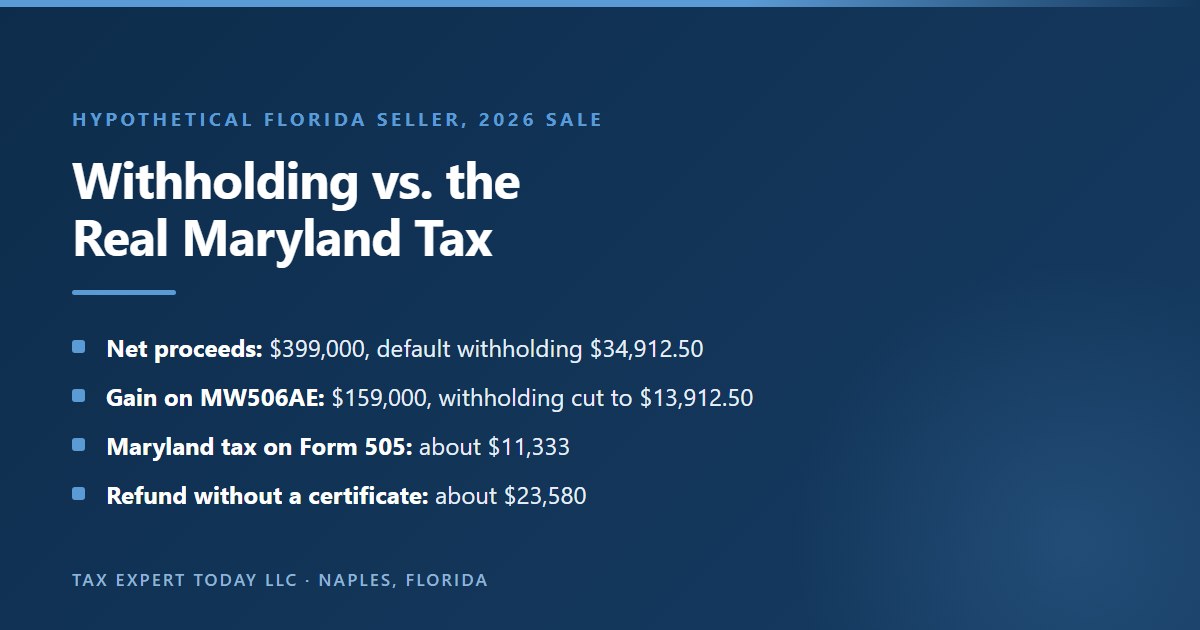
In the Bethesda rental example, a $159,000 gain produces about $11,333 of Maryland tax before deductions, compared with $34,912.50 of default withholding. The single Florida seller would recover about $23,580 on Form 505, or about $2,580 if an MW506AE certificate had already cut the Maryland exit tax withholding to $13,912.50.
- State tax on $159,000, single schedule: about $7,755.
- Special nonresident tax at 2.25%: about $3,578.
- No surtax: federal AGI of $260,000 is under $350,000.
- Deductions: the prorated standard deduction and exemption would reduce the tax slightly further.
| Step | Without MW506AE | With an approved MW506AE |
|---|---|---|
| Withheld at closing | $34,912.50 | $13,912.50 |
| Maryland gain reported on Form 505 | $159,000 | $159,000 |
| State tax under §10-105(a)(1), before deductions | $7,755.00 | $7,755.00 |
| Special nonresident tax, 2.25% | $3,577.50 | $3,577.50 |
| Total Maryland tax, before deductions | $11,332.50 | $11,332.50 |
| Refund on Form 505 | About $23,580 | About $2,580 |
| When the cash returns | After the 2026 return is processed in 2027, or earlier through MW506R if eligible | At closing, for the $21,000 difference |
The example is hypothetical, uses the 2026 single rate schedule in §10-105(a)(1), and ignores deductions, credits and any other Maryland income. It shows why MW506AE is worth the paperwork on a rental with a mortgage. The tax is identical in both columns; what changes is whether more than $20,000 sits with the State for most of a year. For a seller who sold in the summer of 2026 and missed the MW506AE window, the MW506R route described above can still bring that money back before the return is filed, provided the request is made by December 1, 2026.
Worked Example: When Can the Withholding Be Too Low?
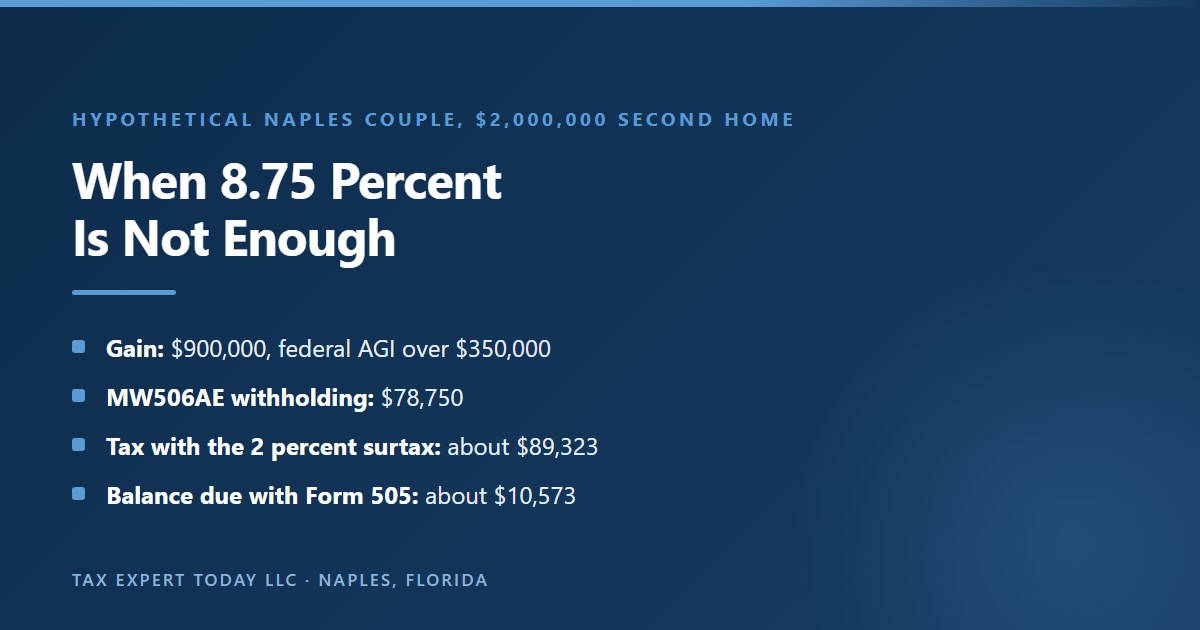
The 8.75 percent rate does not include the 2 percent surtax. A Florida couple with federal AGI over $350,000 who sell a $2,000,000 Maryland vacation home with a $900,000 gain would owe about $89,323, while an MW506AE certificate would withhold only $78,750, leaving a balance of about $10,573 due with Form 505.
- State tax on $900,000, joint schedule: about $51,073.
- Special nonresident tax: $20,250.
- Additional 2% on net capital gain: $18,000.
- No MW506R: the $2,000,000 price is above the $1,500,000 limit.
Consider a hypothetical Naples couple who kept a waterfront house in Anne Arundel County as a second home. They sell it in 2026 for $2,000,000 with no mortgage and $110,000 of seller costs. Their adjusted basis, including both sets of settlement costs and documented improvements, is $1,100,000. Their federal AGI, counting Florida investment income, is well over $350,000, and the house was never their primary residence.
| Item | Amount | Source of the figure |
|---|---|---|
| Total payment (2,000,000 − 110,000) | $1,890,000 | §10-912(a)(2) |
| Default withholding at 8.75% | $165,375.00 | §10-912(c)(1) |
| Gain on MW506AE (2,000,000 − 1,100,000) | $900,000 | MW506AE Line 8a |
| Withholding on an approved MW506AE | $78,750.00 | $900,000 × 8.75% |
| State tax, joint schedule, before deductions | $51,072.50 | §10-105(a)(2) |
| Special nonresident tax, 2.25% | $20,250.00 | §10-106.1 |
| Additional 2% on net capital gain | $18,000.00 | §10-105(a)(3), Form 502CG |
| Total Maryland tax, before deductions | $89,322.50 | Form 505 |
| Balance due if MW506AE was used | About $10,573 | Paid with Form 505 by April 15, 2027 |
| Refund if the default amount was withheld | About $76,053 | Only through Form 505, not MW506R |
Two Maryland exit tax lessons follow. First, a certificate that reduces withholding to 8.75 percent of the gain is not the same as the tax for a seller in the surtax range; the couple should plan for the balance, and in some cases an estimated payment, rather than treating the certificate as the end of the matter. Second, without the certificate the couple would have about $76,000 of excess held by the State until their 2026 return is processed, because the $1,500,000 rule removes the tentative refund route entirely. For a sale at this price, MW506AE is the only way to shrink the deposit at the table. The figures are illustrative; whether the whole gain is net capital gain, and how depreciation or other items change it, depends on the facts.
Worked Example: What Happens When the Former Home Sells After the Move?
A couple who moved to Naples in 2025 and sell their Potomac home in 2026 for $1,350,000 can certify principal residence and avoid withholding entirely. Their $619,000 gain is reduced by the $500,000 §121 exclusion, and about $8,278 of Maryland tax is due on the remaining $119,000 with Form 505.
- Withholding avoided: about $84,788 on $969,000 of net proceeds.
- Federal exclusion: $500,000 for a joint return that meets §121.
- Surtax: excluded if the home qualifies under the under $1,500,000 primary residence carve out.
- Filing still required: the taxable gain is Maryland source income on Form 505.
In this hypothetical, the couple bought the Potomac house in 2008 for $650,000 including improvements and purchase costs, lived in it until August 2025, and sell it in May 2026 for $1,350,000 with $81,000 of seller costs and a $300,000 mortgage payoff. They filed resident Maryland returns through 2024 and a part-year return for 2025.
| Item | Amount | Note |
|---|---|---|
| Net proceeds (1,350,000 − 81,000 − 300,000) | $969,000 | Total payment under §10-912 |
| Withholding if no certification were given | $84,787.50 | 8.75% of the total payment |
| Withholding with a principal residence certification | $0 | §10-912(d)(5) |
| Gain (1,350,000 − 81,000 − 650,000) | $619,000 | Federal computation |
| §121 exclusion, joint | ($500,000) | IRC §121(b)(2) |
| Maryland source gain | $119,000 | Reported on Form 505 |
| State tax, joint schedule, plus 2.25% | About $8,278 before deductions | $5,600 plus $2,677.50 |
The point of the example is the order of events in a Maryland exit tax case. The certification removes the deposit, not the filing. Because no money was withheld, the full tax is due with Form 505, and a couple who assumed the “exit tax” was avoided entirely can be surprised by a balance due and, if the amount is large, by an underpayment charge. Some sellers in this position make a Maryland estimated payment after closing for that reason.
What If the Seller Is an LLC, Partnership or Trust?
An entity seller is a nonresident entity, withheld at 8.25 percent, only if it is not formed in Maryland and not registered with the State Department of Assessments and Taxation. A Maryland LLC or a registered foreign LLC is a resident entity with no withholding, but its Florida owners still report their share of the gain.
- Resident entity: formed in Maryland, or formed elsewhere and qualified or registered with SDAT.
- Nonresident entity rate: 8.25 percent of the total payment, the corporate rate under §10-105(b).
- Tentative refund: not available to a pass-through entity or its partners, members or shareholders.
- Trusts and estates: file as individuals on the Maryland exit tax withholding forms, at 8.75 percent.
Many Florida movers who own Maryland rentals hold them in an LLC, the Maryland exit tax treats entities differently, and the choice of state can change the closing. Under §10-912(a)(3) and (a)(4), an LLC organized under Maryland law, or a Florida or Delaware LLC that is registered with the State Department of Assessments and Taxation, is a resident entity and can certify that status on the deed. An unregistered out-of-state LLC is a nonresident entity, and 8.25 percent of the total payment is withheld.
Resident entity status is not a tax exemption. A multi-member LLC taxed as a partnership passes the gain through to its members, and a Florida member is a nonresident who reports a Maryland source distributive share. The 2025 nonresident booklet adds a rule that matters for property sales: beginning with tax year 2025, nonresident individual members to whom net capital gain subject to Maryland tax was distributed may not participate in the composite return. In other words, the year a Maryland LLC sells its building, the Florida members may need to file individual Form 505 returns rather than relying on the entity’s composite filing.
The MW506R eligibility questions also exclude anyone filing as a pass-through entity or as a partner, member or shareholder of one, so entity owners recover excess withholding only through the annual returns. Converting or moving an entity just before a sale to change its status raises its own Maryland and federal questions and should be reviewed with counsel before any filing. Our Florida tax services team handles the tax side of those reviews, and owners selling an operating business along with its real estate should also read our guide to moving to Florida before selling a business.
How Does the Move Year Change Which Maryland Return You File?
In the year of the move, a seller is usually a part-year resident. A sale that closes before the move date is a resident sale, reported on the resident return with county tax and no withholding. A sale that closes after the move is a nonresident sale, withheld at closing and reported in the nonresident portion of the year.
- Before the move: a residency certification on the deed, and county tax instead of the 2.25 percent special nonresident tax.
- After the move: nonresident withholding unless an exemption or certificate applies.
- Part-year rule: the booklet requires a resident filing for the portion of the year Maryland residence was kept, even if under six months.
- The move date: must be supported by the domicile record, not just a mailing address change.
The Form 505 instructions draw the line clearly. A taxpayer who began or ended legal residence in Maryland during the tax year must file as a resident for the portion of the year during which Maryland residence was maintained, even if less than six months. The return for the remainder of the year is a nonresident return to the extent the taxpayer has Maryland source income, such as a later property sale or rental income. Our guide to first year snowbird filing walks through the part-year mechanics in general.
Sequencing the sale and the move is sometimes a real Maryland exit tax planning choice. A seller who closes on the Maryland home after becoming a Florida domiciliary avoids county tax on the gain, which in many Maryland counties is 3 percent or more, and pays the 2.25 percent special nonresident tax instead. A seller who closes before the move pays the county rate but avoids the Maryland exit tax withholding and the paperwork. Neither choice changes federal tax, and neither changes the fact that Maryland taxes the gain. What matters is that the chosen move date is real. If the Comptroller later concludes that the domicile change happened after the closing, a sale reported as nonresident can be reassessed as resident, and a sale made while the seller was a statutory resident under the abode and 183 day test is a resident sale regardless of the Florida paperwork. New York runs the same kind of review, described in our guide to the New York residency audit.
For people who are still deciding where the year will land, the Florida 183 day rule calculator is a quick way to see how many days are already used, and our guide to the dual state residency trap explains how keeping a home in the old state can make a mover a resident of both.
How Does Maryland Compare With Other States Florida Movers Leave?
Several states collect tax on nonresident real estate sales at closing, but they measure it differently. Maryland withholds 8.75 percent of net proceeds, New Jersey collects the greater of 2 percent of consideration or a percentage of gain, California withholds 3 1/3 percent of the sales price by default, and New York collects an estimated payment on the gain.
- Maryland: the base is net proceeds after mortgage payoffs, which helps leveraged sellers and hurts debt free ones.
- New Jersey: the GIT/REP forms and an estimated payment, covered on our New Jersey page.
- California: Form 593 withholding, with elections based on gain.
- New York: Form IT-2663 estimated tax on the gain, paid before the deed is recorded.
| State | What is collected at closing | Base | How the excess comes back |
|---|---|---|---|
| Maryland | 8.75% individual, 8.25% entity | Net proceeds to the seller | MW506AE before, MW506R after if eligible, Form 505 at year end |
| New Jersey | Estimated gross income tax payment | The greater of a percentage of gain or 2% of consideration | Form NJ-1040NR |
| California | Real estate withholding | 3 1/3% of the sales price, or an elected rate on gain | Form 540NR |
| New York | Estimated personal income tax payment | Gain, at the top State rate | Form IT-203 |
California sets its default on Form 593 and New York collects its payment on Form IT-2663. The comparison of the Maryland exit tax with other states is a summary for orientation, not a substitute for each state’s own forms, and rates change. The structural parallel to Maryland that Florida movers ask about most is New Jersey, which our guide to the New Jersey exit tax covers in full. Washington, DC has no comparable withholding on income tax for individual sellers, but it does have an estate tax that reaches DC real estate owned by a Florida resident; our page on the DC estate tax after a Florida move explains that separate tax for families with property in both Maryland and the District.
The practical Maryland exit tax message is that the method is the most sensitive to debt. Two sellers with the same gain can have very different withholding, because the rate applies to the cash that actually reaches the seller. That makes the MW506AE worksheet more valuable in Maryland than in a state that already measures by gain.
What Do Florida Movers Get Wrong About the Maryland Exit Tax?
The most common mistakes are believing Maryland taxes the act of moving, budgeting with the old 8 percent rate, treating the withholding as the final tax, assuming the former home is exempt forever, missing the 21 day MW506AE deadline and the December 1 MW506R cutoff, and forgetting that the 2 percent surtax sits outside the withholding.
- “There is a 6 percent exit tax”: there is not; the figure circulates from older social media posts.
- “The Maryland exit tax withholding is what I owe”: it is a deposit; Form 505 decides the tax.
- “My old house is always exempt”: only while the §121 two of five years test is met.
- “The refund is automatic”: it requires a filed return or an eligible MW506R.
| Belief | What the law and forms say |
|---|---|
| Maryland charges a tax for leaving | No such tax exists; §10-912(h) says the Maryland exit tax withholding does not impose any tax |
| The rate is 8 percent | 8.75 percent for individuals for sales after June 30, 2025 |
| The Maryland exit tax withholding is the tax | The tax is computed on Form 505 and is often lower, sometimes higher |
| A former home is exempt no matter when it sells | The principal residence exemption follows the §121 two of five years test |
| I can apply for a reduction a week before closing | MW506AE must be received at least 21 days before closing |
| I can always get a quick refund | MW506R is barred at $1,500,000 or more, for pass-through owners, and after December 1, 2026 |
| The Maryland exit tax withholding covers everything | The 2 percent surtax is not part of the 8.75 percent rate |
| Rental income from earlier years does not matter | MW506AE is denied if required Maryland rental returns were not filed |
A related misconception is that a residency certification is a formality. It is made under penalties of perjury, and it is checked against the seller’s filing history. A Florida mover who signs a resident certification at closing to avoid the Maryland exit tax withholding is making a sworn statement inconsistent with a Florida declaration of domicile under Fla. Stat. §222.17, and the inconsistency can become evidence in a later residency review in either direction.
Does the Maryland Estate Tax Still Apply After the Move?
Yes, for Maryland real estate and tangible property. Maryland’s estate tax and inheritance tax are separate from the income tax withholding and can still reach Maryland property owned by a Florida resident at death. Selling the Maryland property removes it from that tax; keeping it keeps the exposure.
- Different tax: the Maryland exit tax withholding concerns income tax on a sale; the estate tax concerns a transfer at death.
- Same property: the Maryland house or rental is the link between the two.
- Planning link: the decision to sell or keep affects both.
- Where to read more: our dedicated Maryland estate tax page.
Families sometimes keep the Maryland home specifically to avoid the closing withholding and the income tax on a sale, only to leave it exposed to the Maryland estate tax and, for some heirs, the inheritance tax. Our guide to the Maryland estate tax for Florida residents explains how Maryland taxes a nonresident’s Maryland property, The same keep or sell question arises in other states with death taxes, including Rhode Island, Vermont and the New Jersey inheritance tax, and our estate and trust planning team coordinates that analysis with the income tax side described here.
What Should a Seller Do Before and After a Maryland Closing?
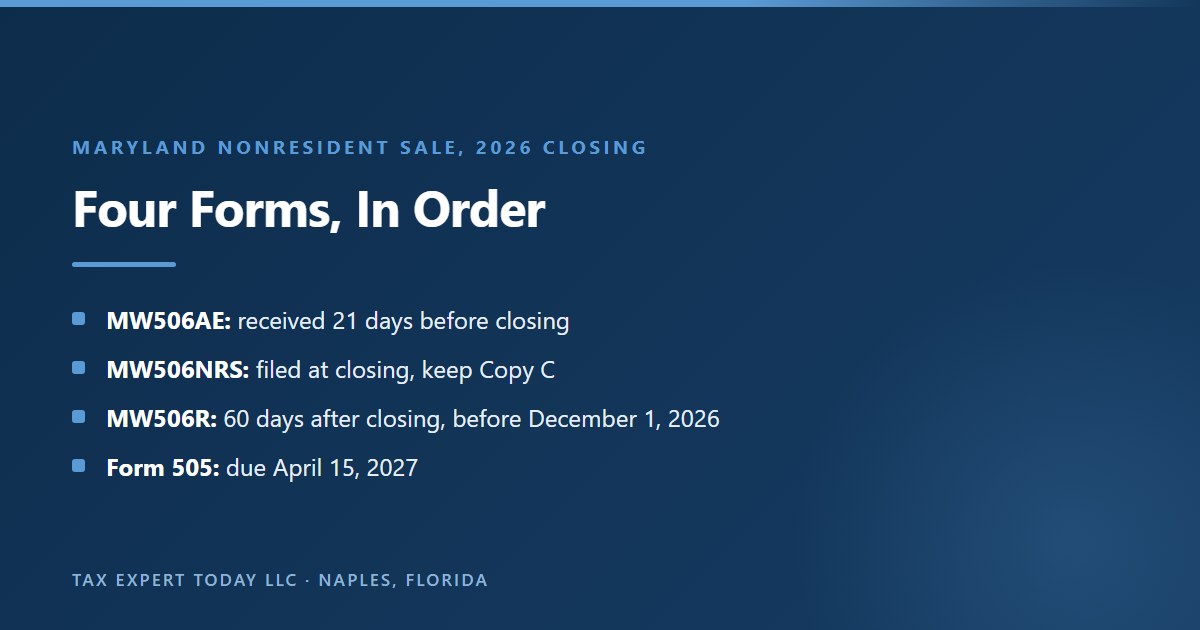
Before closing, confirm residency status, decide whether a principal residence certification or MW506AE applies, and file MW506AE at least 21 days before settlement. At closing, keep Copy C of MW506NRS and the settlement statement. After closing, file MW506R if eligible before December 1, then file Form 505 by April 15 of the next year.
- At contract: gather the purchase settlement statement, improvement receipts and depreciation schedules.
- 21 days before: MW506AE received by the Comptroller.
- At closing: Copy C of MW506NRS and the final settlement statement.
- After closing: MW506R where eligible, estimated tax where the surtax or a certification leaves a balance, and Form 505.
| When | Step | Form or record |
|---|---|---|
| Before listing | Confirm domicile and the expected move date; check the §121 two of five years window | Florida declaration of domicile, prior Maryland returns |
| At contract signing | Estimate the gain and the Maryland exit tax withholding; collect basis records | Original settlement statement, improvement receipts, Schedule E depreciation |
| At least 21 days before closing | Apply for a full or partial exemption where the gain is low | Form MW506AE with attachments |
| Closing day | Principal residence or residency certification if accurate; otherwise withholding is paid | Deed recitals or affidavit; Form MW506NRS Copy C |
| 60 days after closing to December 1, 2026 | Tentative refund if all six questions are answered yes | Form MW506R |
| Early 2027 | Report the sale and claim the Maryland exit tax withholding | Form 505, Form 502CG if required, federal return, settlement statement, MW506NRS |
| April 15, 2027 | Filing and payment deadline for 2026 sales | Form 505 |
The single most useful Maryland exit tax step is the earliest one. Estimating the gain and the Maryland exit tax withholding when the listing goes up turns every later step into a routine filing rather than a scramble. It also shows whether the seller is in the surtax range, which affects how much cash should be set aside from the proceeds for April.
Frequently Asked Questions
Is there really a Maryland exit tax?
No. Maryland does not tax anyone for moving away. The term refers to the income tax withholding that Tax-General section 10-912 requires when a nonresident sells Maryland real property: 8.75 percent of the net proceeds for an individual and 8.25 percent for a nonresident entity. It is a prepayment credited against the seller’s Maryland income tax on Form 505.
What is the Maryland nonresident withholding rate in 2026?
For sales after June 30, 2025, the rate is 8.75 percent for nonresident individuals, estates and trusts and 8.25 percent for nonresident entities. The individual rate is the 2.25 percent special nonresident tax plus the 6.50 percent top State rate. Pages quoting 8 percent are using the rate that applied before the 2025 changes.
Do I pay the Maryland withholding when I sell my former home after moving to Florida?
Usually not, if the house was your principal residence for two of the five years before closing under IRC section 121 and you filed resident Maryland returns for that period. Each seller certifies principal residence in the deed or a recorded affidavit. Gain above the federal exclusion is still reported on Form 505.
How do I get the Maryland withholding back?
Before closing, Form MW506AE can reduce or eliminate it if filed at least 21 days ahead. After closing, Form MW506R can produce a tentative refund for eligible 2026 sales under $1,500,000 if filed 60 days after closing and before December 1, 2026. Otherwise, the withholding is credited on Form 505, filed after year end.
Does the 2 percent Maryland capital gains surtax apply to Florida residents?
It can. The additional 2 percent applies to net capital gain included in Maryland adjusted gross income when federal adjusted gross income exceeds $350,000. For a Florida resident, that usually means the Maryland property gain, but the threshold counts all federal income. A primary residence sold for under $1,500,000 is excluded.
Can a Naples firm help with a Maryland property sale?
Yes. The Maryland forms are filed by mail or electronically, so location is not a barrier. Tax Expert Today LLC, at 11983 Tamiami Trail N in Naples, Florida, helps Southwest Florida residents estimate the withholding, prepare Forms MW506AE, MW506R and 505, and align the move date with the Florida domicile record.
Maryland Exit Tax Help in Naples & Southwest Florida
Tax Expert Today LLC works with families who have moved, or are moving, from Maryland to Naples, Florida and across Southwest Florida on the tax side of selling the property they left behind, including the closing withholding, the exemption and refund forms, and the Maryland nonresident return. The firm is multidisciplinary, with enrolled agents, CPAs and attorneys, and it handles residency and tax matters nationwide, coordinating with Maryland settlement agents and counsel when a deed, entity or trust is involved. Our office is at 11983 Tamiami Trail N, Naples, FL 34110, open Monday through Friday, 10 a.m. to 5 p.m. ET, and reachable at (239) 441-2005.
- Maryland exit tax help Naples: estimating the Maryland exit tax withholding and the real Maryland tax before a property is listed.
- Before closing: preparing Form MW506AE with the basis, improvement and depreciation records the Comptroller requires.
- After closing: Form MW506R where eligible, and Form 505 with Form 502CG for sellers in the surtax range.
- Domicile record: aligning the move date, the Florida declaration of domicile and the Maryland filings.
Our Naples tax planning practice describes the wider relocation planning work, and our Florida tax services page covers the ongoing filings that follow a move.
When to Engage a Professional
A Florida resident selling a Maryland property with a small gain and no mortgage complications may be able to handle the closing with the settlement agent and file a simple Form 505. Professional help earns its cost when the gap between withholding and tax is large enough to justify an MW506AE application, when the sale price is $1,500,000 or more and the tentative refund is unavailable, when federal AGI is near or above $350,000 and the 2 percent surtax may apply, when the property was rented and prior Maryland returns are missing, when the seller is an LLC, partnership or trust, or when the sale falls in the move year and the move date needs to be supported. It is also worth a conversation for anyone who closed in 2026 and has until December 1, 2026 to request a tentative refund. Tax Expert Today LLC’s enrolled agents, CPAs and attorneys can model the numbers, prepare the Maryland forms and coordinate with your settlement agent. Call (239) 441-2005 to schedule a consultation.
Published November 15, 2026 by Dr. Pellumb Kabashi « Back to Learning Center
Have a question this article touches on?
Tax Expert Today LLC, based in Naples, Florida and serving clients across the United States.
Schedule a Consultation (239) 441-2005