
By Dr. Pellumb Kabashi, DBA, MBA, EA, CFE, CES
Founder, Tax Expert Today LLC · Tax advisors, enrolled agents, CPAs, and attorneys · Serving clients in all 50 states
Quick Answer: A certified letter from the IRS is usually a notice the IRS needs to be able to prove it mailed, such as a final levy notice, a lien notice, or a notice of deficiency. Deadlines generally run from the notice or mailing date, even if the envelope is never picked up, so identify the letter quickly. Call (239) 441-2005 for a free consultation.
What is a certified letter from the IRS?
A certified letter from the IRS is an IRS notice sent through USPS Certified Mail, which creates a record that the piece was mailed and an attempt was made to deliver it. The IRS uses it mainly for notices that carry legal consequences, so the envelope is a reason to act quickly, although it does not tell you which notice is inside.
Most IRS correspondence travels by ordinary mail. Balance due reminders, refund adjustments, and requests for more information usually arrive in a plain window envelope. A certified letter from the IRS is different because somebody at the agency, or a computer system following a legal rule, decided that this particular mailing needed a paper trail. That trail matters later if there is a dispute about whether a deadline ever started.
The USPS slip in your mailbox or the alert on your phone rarely tells you much. It generally shows that an accountable item is waiting and who to contact to receive it. It usually does not show the notice number, the tax year, or the amount. That gap between knowing something is coming and knowing what it says is where most of the anxiety sits, and it is also where people lose days they cannot afford to lose.
- What certified mail proves: that the IRS handed a specific item to the Postal Service on a specific date, addressed to a specific place.
- What it does not prove: that you owe the amount shown, or that the IRS got the facts right.
- What it usually signals: a deadline tied to appeal, hearing, or Tax Court rights.
- What it does not automatically mean: that a levy has already happened, or that the IRS has opened a criminal case.
This guide is a router. Its job is to help you figure out which letter you have, how the clock works, and what happens if the envelope sits at the post office. Each section points to a dedicated page for the specific notice, because the response to a final levy notice looks nothing like the response to a notice of deficiency.
Why does the IRS send certified mail for some letters and not others?
The IRS sends certified mail when a statute requires it or when the agency wants proof of mailing for a notice that cuts off rights. Ordinary bills do not need that proof, because the law only requires that notice and demand be left at your home or business or sent by mail to your last known address.
Compare two sections of the Internal Revenue Code. IRC §6303(a) covers the first bill after a tax is assessed. It says notice shall be left at your dwelling or usual place of business or “sent by mail” to your last known address. That is why a CP14 balance due notice normally arrives by regular mail. IRC §6212(a), by contrast, authorizes the IRS to send a notice of deficiency “by certified mail or registered mail,” and that notice opens a limited window to go to Tax Court.
The pattern is consistent across the Code. Congress tends to specify certified or registered mail where a mailing starts a countdown that can end a right. Where a notice is more of a reminder, ordinary mail is enough. The IRS also uses certified mail by practice for some letters where the statute only says “by mail,” because a certified record is easier to defend later.
- Legal requirement: deficiency notices, levy hearing notices, lien hearing notices, and a few others name certified or registered mail, or list it as a permitted delivery method.
- Agency practice: some letters are mailed certified because the IRS wants the record, even where the statute is less specific.
- Registered mail abroad: IRM 5.11.1 notes that registered mail is used for taxpayers outside the United States because there is no international certified mail.
- Other delivery methods: several statutes also allow notice in person or left at your home or usual place of business, so a revenue officer may hand deliver the same notice.
Which letters does the law require the IRS to send by certified mail?
The Internal Revenue Code names certified or registered mail for notices of deficiency, levy and lien hearing notices, intent to levy notices, innocent spouse determinations that start a 90 day clock, and service of certain summonses. Some of these sections also allow in person delivery. Other certified letters are sent by IRS practice.
This distinction is more useful than it sounds. When the statute itself names the mailing class, the method of mailing can become part of whether the notice was effective. When certified mail is only a matter of IRS practice, a defect in the mailing class is much less likely to help you.
| Notice | Code section | What the statute says about delivery | Clock the notice starts |
|---|---|---|---|
| Notice of deficiency | §6212(a), (b) | Certified or registered mail, sufficient if mailed to last known address | 90 days to petition Tax Court (150 if addressed outside the United States) |
| Levy hearing notice (LT11, Letter 1058, CP90) | §6330(a)(2) | In person, left at home or business, or certified or registered mail, return receipt requested | 30 days to request a Collection Due Process hearing |
| Lien hearing notice (Letter 3172) | §6320(a)(2) | In person, left at home or business, or certified or registered mail, within 5 business days after the lien is filed | 30 days, beginning after the 5 business day period |
| Notice of intent to levy (CP504, CP504B) | §6331(d)(2) | In person, left at home or business, or certified or registered mail, at least 30 days before levy | 30 days before certain levies may follow |
| Final determination on innocent spouse relief | §6015(e)(1)(A) | Certified or registered mail to last known address | 90 days to petition Tax Court |
| IRS summons (certain service) | §7603(a), (b) | In hand or left at last and usual place of abode; a summons to a third-party recordkeeper may also go by certified or registered mail | Date to appear or produce records stated in the summons |
Two details are easy to miss. Section 6330 adds “return receipt requested,” while section 6331(d) does not, and section 6320 does not. Second, IRC §6672(b) says only that the proposed trust fund penalty notice goes “by mail to an address as determined under section 6212(b)” or in person. The IRS still treats that letter as a certified mailing in its own procedures, and IRM 8.22.9 refers to a Letter 1153 “timely issued by certified mail” when it tells Appeals what to check.
- Statute names the mail class: the mailing method can matter to whether a deadline started.
- Statute says only “by mail”: certified handling is a safeguard for the IRS, not a right you can enforce.
- Either way: treat the deadline printed in the letter as real until a professional has reviewed the mailing facts.
What kinds of certified letter from the IRS arrive most often?
The most common certified letter from the IRS is a collection notice, such as an LT11, Letter 1058, CP90, CP504, or Letter 3172. Notices of deficiency, such as CP3219A and Letter 3219, are the other large group. Audit letters and proposed trust fund penalties can also arrive certified, depending on the IRS function that sent them.
Use this table to find the likely category once you can see the notice number. The number normally appears in the upper right corner of the first page, according to the IRS notice page. Follow the link in the right column for the full procedure on that notice.
| Notice number | What it is | Typical deadline language | Where to read more |
|---|---|---|---|
| LT11, Letter 1058 | Final notice of intent to levy with hearing rights | 30 days to request a CDP hearing | LT11 and Letter 1058 guide |
| CP90, CP297 | Final notice of intent to levy, generally issued through automated programs | 30 days to request a CDP hearing | Collection Due Process hearing guide |
| CP504 | Individual notice of intent to levy, including a state refund levy | Pay or respond by the date shown | CP504 guide |
| CP504B | Business notice of intent to levy | 30 days, with Collection Appeals Program rights | CP504B guide |
| Letter 3172 | Notice that a federal tax lien was filed, with hearing rights | Last date to request a hearing is printed in the letter | Lien withdrawal guide |
| CP3219A, CP3219N, Letter 3219, Letter 531 | Notice of deficiency, also called a 90 day letter | Last day to petition Tax Court is printed on the notice | Notice of deficiency guide |
| Letter 1153 | Proposed Trust Fund Recovery Penalty against a responsible person | Response date printed in the letter, generally about 60 days | Trust fund penalty guide |
| Letter 2205, Letter 3572 and similar | Audit contact or appointment letters, when sent certified | Date to respond or appear stated in the letter | Audit stages guide |
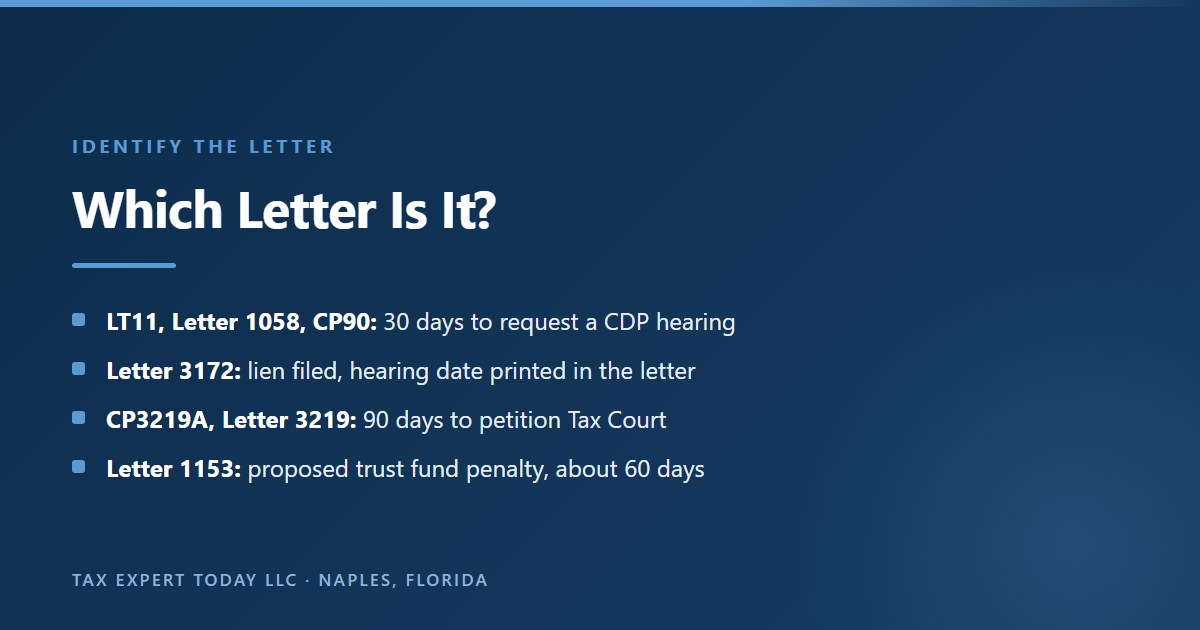
Notice numbers change, and the IRS sometimes uses a different number for the same legal step. What decides your next move is the sentence in the letter that describes your rights. Look for the phrases “notice of intent to levy,” “right to a hearing,” “notice of deficiency,” or “last day to file a petition.” Those words tell you more than the number at the top of the page.
- “Right to a hearing”: you are almost certainly looking at a CDP notice.
- “Last day to file a petition”: this is a notice of deficiency or a similar Tax Court ticket.
- “Proposed assessment” with a named business: consider whether it is a Letter 1153.
- “We selected your return”: this is an examination contact, and the response path runs through the auditor.
How can you tell which letter it is before you sign for it?
You usually cannot read the letter before receiving it, but you can narrow it down. Check your IRS online account for digital notices, review your account transcript for recent entries, look at USPS Informed Delivery images, and ask a representative with a signed authorization to pull your records and tell you what posted.
The slip itself will not identify the notice, so use the tools that sit outside the envelope. None of these replaces reading the original, and an empty online account does not prove that nothing is on the way. The goal is to get a head start, and to confirm whether the amount and the tax years match what you were expecting.
| Tool | What it can show | Limits |
|---|---|---|
| IRS online account | Balances, payment history, and digital copies of select notices | Only select notices appear, and a business uses a separate account |
| IRS account transcript | Posted assessments, penalties, and collection or examination entries by year | Entries use codes, can lag the mailing, and do not reproduce the letter |
| USPS Informed Delivery | Grayscale images of the address side of incoming letter mail | Shows the outside of the envelope, never the contents |
| USPS tracking on the slip | Mailing and delivery attempt history for that article number | Does not identify the notice type or the tax year |
| Representative with Form 2848 | Transcripts and account status through IRS practitioner channels | Requires a signed authorization covering the right tax years and forms |
Timing can provide another clue. If you have received a CP501 and a CP503 over the last few months and did not pay, the certified item is likely a levy notice. If you recently answered a CP2000 and the IRS did not accept the response, or you never replied, a notice of deficiency is more likely. If you were a manager or owner of a business that fell behind on payroll deposits, a Letter 1153 belongs on the list.
- Recent collection notices: lean toward LT11, Letter 1058, CP90, or CP504.
- Recent CP2000 or audit correspondence: lean toward a notice of deficiency.
- Unfiled years: consider a CP3219N based on a substitute for return.
- Payroll problems: consider a Letter 1153 or a business notice.
- Nothing obvious: pick up the letter the same day and read it, because guessing costs time.
Should you sign for a certified letter from the IRS?
In nearly every situation, yes. Signing only confirms that you received the envelope. It does not admit that you owe the tax, does not waive any appeal right, and does not start a deadline that was not already running. Declining to sign can cost you time and, in some cases, the right to dispute the tax.
A common myth holds that if you never sign, the IRS cannot prove you were notified. That is backward. For the notices that matter most, the law asks whether the IRS properly sent the notice, and your signature is not part of that test. The CDP regulation answers the question directly at Q&A-A9: notification properly sent to the last known address is sufficient to start the 30 day period, and “actual receipt is not a prerequisite to the validity of the CDP Notice.”
Signing also gives you something useful, which is the letter itself. Everything you need to protect your rights is inside it: the tax years, the amount, the deadline, the form to use, and the address or fax number for your response. If you are away, the Postal Service rules in Domestic Mail Manual section 508 allow for delivery to an authorized agent, and a slip can usually be scheduled for redelivery.
- Signing confirms: the envelope reached you on that date.
- Signing does not confirm: agreement with anything inside it.
- Keep: the envelope, the slip, and any USPS tracking print out, because the postmark and class of mail can matter later.
- Write down: the date you actually received the item, in case there is a later dispute.
What happens if you refuse or do not pick up a certified letter from the IRS?
The deadline generally keeps running. USPS normally returns an unclaimed item to the sender after 15 days, and the IRS treats unclaimed or refused notices as generally deliverable. You lose reading time and possibly hearing rights. A deliberate refusal can also prevent you from disputing the underlying tax at a later collection hearing.
The postal rule alone explains how much damage a delayed pickup can do. Under DMM 508, an addressee receives a notice for a piece that cannot be delivered, and if the piece is not called for or redelivery is not requested, it goes back to the sender after 15 days unless the sender specifies fewer. On a 30 day hearing window, that alone uses up half the time.
The IRS does not treat a returned envelope as the end of the matter. IRM 4.8.9.23 states that a notice of deficiency returned stamped “unclaimed” or “refused” is generally not considered undeliverable. If you later ask for a copy, IRM 4.8.9.23.4 says one will be mailed by regular mail with a cover letter, and the suggested language warns that there is “no provision in law” for suspending the 90 or 150 day petition period. The copy does not restart the clock.
| What happened to the envelope | How the IRS generally treats it | Practical effect |
|---|---|---|
| You signed for it | Delivered | Full remaining time to respond, measured from the notice or mailing date |
| Left unclaimed at the post office | Generally not undeliverable | Deadline keeps running while the item sits and returns to the IRS |
| You refused it | Generally not undeliverable | Deadline keeps running, and refusal may limit a later liability dispute |
| Returned because you moved with no forwarding address | Undeliverable, and the IRS should look for another address | Validity still turns on whether the IRS used your last known address |
| Sent to the wrong address | May be invalid unless you actually received it in time to act | Worth a professional review of the address history and mailing records |
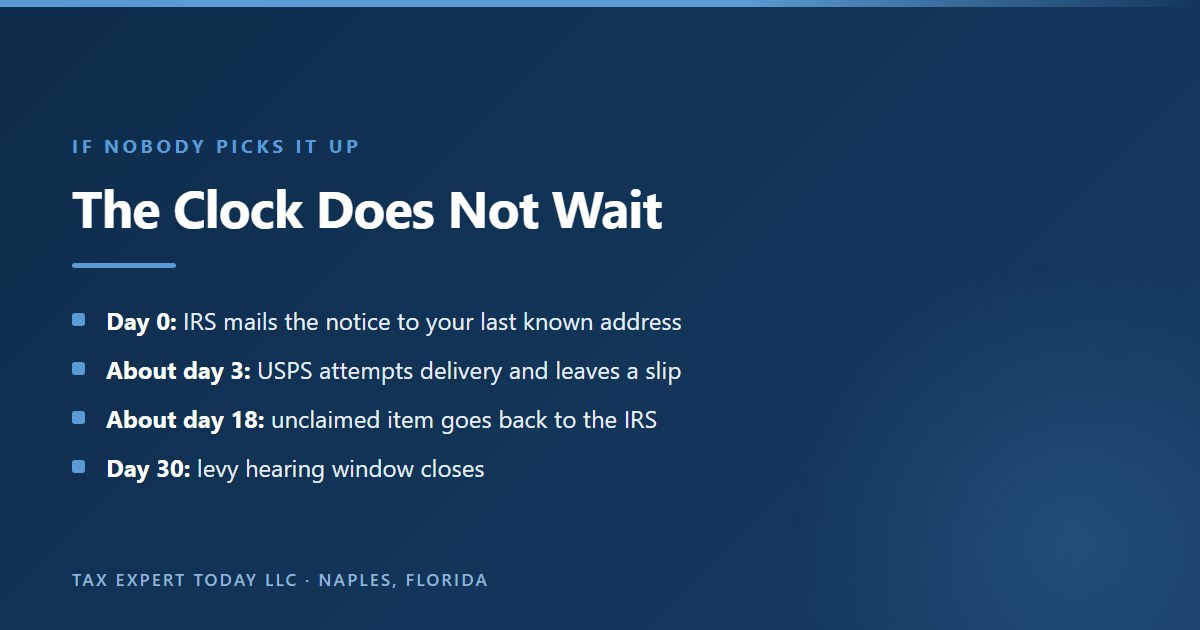
There is a further cost for people who refuse delivery on purpose. IRC §6330(c)(2)(B) lets a taxpayer challenge the underlying liability at a CDP hearing only if the person “did not receive any statutory notice of deficiency” or did not otherwise have an opportunity to dispute it. In Sego v. Commissioner, 114 T.C. 604 (2000), the Tax Court held that taxpayers cannot defeat actual notice by deliberately refusing delivery of a statutory notice of deficiency. Later opinions look closely at the facts, including how many delivery attempts were made, so a single unclaimed envelope is not treated the same way as a deliberate refusal.
- Refusing is not a strategy: it can remove one of the few remaining ways to contest the tax itself.
- Traveling is not a defense: arrange for mail handling or a representative if you will be away.
- A late copy helps only partly: you get the information, but not more time.
- A slip you already ignored: call the post office today, and if the item is gone, pull your transcript and contact the IRS or a representative.
Does the deadline start when the IRS mails the letter or when you sign for it?
Generally it starts from the mailing date or the date on the notice, and it does not depend on when you sign. A notice of deficiency gives 90 days after mailing and prints a last date to petition. A levy hearing request is due within 30 days beginning the day after the notice date.
The rule is stated slightly differently for each notice, so read the specific language. Under IRC §6213(a), the petition period is measured after the notice “is mailed,” and a petition filed on or before the last date specified in the notice is treated as timely. For a levy notice, the regulation at Q&A-C3 says the 30 day period commences the day after the date of the CDP notice. For a lien, the parallel regulation begins the 30 days after the five business day period following the lien filing.
The table below shows how these clocks would run on one hypothetical set of facts. The dates are for illustration only, and the notice you receive controls. In this example, the IRS mails a letter on Monday, March 1, 2027, USPS first attempts delivery on Thursday, March 4, and nobody collects it.
| Hypothetical event | Date | Why it matters |
|---|---|---|
| Notice dated and mailed | Monday, March 1, 2027 | The legal clock is tied to this date, not to pickup |
| First USPS delivery attempt, slip left | Thursday, March 4, 2027 | Three days have already passed |
| Item returned to the IRS if not claimed (15 days) | On or about March 19, 2027 | The letter is gone, with about 12 days left on a levy hearing window |
| Last day for a levy hearing request (LT11 type notice) | Wednesday, March 31, 2027 | 30 days beginning the day after the notice date |
| Last day for a lien hearing request, if the lien was filed March 1 | Wednesday, April 7, 2027 | 30 days beginning after the 5 business day period |
| Last day to petition on a notice of deficiency | Tuesday, June 1, 2027 | Day 90 is a Sunday, the next day is Memorial Day, so the date rolls forward |
Always work from the date printed on the notice. The IRS prints a last day to petition on a notice of deficiency, and it prints a response date on most collection letters. If the date printed is later than your own count, the statute protects a petition filed by the date shown. If you cannot find a date or the numbers do not add up, assume the earliest possible deadline until someone has reviewed it.
- Weekends and DC holidays: the Tax Court petition period does not end on a Saturday, Sunday, or legal holiday in the District of Columbia.
- Addresses outside the United States: a notice of deficiency addressed abroad generally carries 150 days.
- Florida taxpayers: treat the printed Tax Court date as absolute. The notice of deficiency guide explains why a late petition should not be counted on.
- No date on your slip: the slip is a postal document and has nothing to do with the tax deadline.
What is the last known address rule, and what if you moved?
Your last known address is generally the address on your most recently filed and properly processed return, unless you gave the IRS clear and concise notice of a different one. A notice mailed there is generally sufficient even if you never see it, so an old address can quietly cost you appeal rights.
The definition comes from Treas. Reg. §301.6212-2. The same regulation has an important exception for the Postal Service. The IRS updates addresses using the USPS National Change of Address database, which retains change of address information for 36 months. If your name and last known address match the old address in that database, the new address on file becomes your last known address unless you give the IRS clear and concise notice of a different one.
Information you give to someone else generally does not count. The regulation states that change of address information provided to a third party, such as a payor or another government agency, is not clear and concise notification. Updating your employer, your bank, or your state driver license does not update the IRS. A return does, once it has been properly processed, and Rev. Proc. 2010-16 describes a 45 day processing period, measured from the day after receipt or the day after the due date if the return arrives early.
The IRS lists the methods for changing your address on its address change page. Form 8822 covers individuals, and Form 8822-B covers businesses and changes of responsible party. You can also use the new address on your next return, send a signed written statement, or tell the IRS in person or by telephone after verifying your identity. A written statement needs your full name, your old and new addresses, and your Social Security number, ITIN, or EIN, and it goes to the address where you filed your last return. Spouses who filed jointly and still live together should both provide their names and signatures, and spouses who now live apart should each notify the IRS of a separate address.
Treat the Postal Service as a backstop and not as your notice to the IRS. Rev. Proc. 2010-16 tells taxpayers to notify the USPS facility at the old address so that mail can be forwarded, and it also advises them to notify the IRS directly so the address of record is updated in a timely and accurate way. A forwarding order that covers only a season may never reach the National Change of Address data the IRS relies on, so a part-year move deserves a direct update whenever the IRS could be writing to you.
- Joint filers who have separated: under §6212(b)(2), a single joint notice may be used unless either spouse has told the IRS that separate residences have been established, in which case a duplicate goes to each.
- Deceased or incapacitated taxpayers: the statute says a notice mailed to the last known address is sufficient even if the taxpayer has died or is under a legal disability.
- Dissolved companies: the same rule applies to a corporation that has terminated its existence, so a closed company can still receive a binding notice at an old address.
- Representatives: a notice is sent to the taxpayer, and copies to a representative on Form 2848 do not replace the mailing to the taxpayer.
The address question is one of the first things a representative checks when a client says “I never got it.” The answer can open a door. If the IRS did not use your last known address and you did not receive the notice in time, a notice of deficiency may be invalid, and a later assessment can be challenged on that ground. If the IRS did use the correct address, your remaining options are narrower, and they are covered later in this guide.
What if the certified letter from the IRS warns of a levy?
A certified letter from the IRS that warns of a levy is either a notice of intent to levy, such as a CP504, or a final notice with hearing rights, such as an LT11, Letter 1058, or CP90. Only the final notice opens the 30 day Collection Due Process hearing, which is your strongest early protection.
Under IRC §6330, the IRS generally cannot levy until it has notified you of the right to a hearing, and it must do so only once per tax period. The IRS page on the LT11 and Letter 1058 confirms that you may request a hearing by following the letter’s instructions, and the CP90 page says the same. The request goes on Form 12153. The LT11 and Letter 1058 guide walks through what happens next, and this page will not repeat it. Because the statute requires this notice only once for each taxable period, a letter that goes unclaimed may be the only levy hearing notice you ever get for those years. A later levy on the same period does not bring a fresh 30 day window.
A CP504 sits one step earlier. It is the section 6331(d) notice of intent to levy. According to the IRS page on the CP504, the IRS can levy a state tax refund after it, and if a balance remains it may send a notice with hearing rights before reaching other property. Businesses receive the CP504B instead, and for a business certain levies can come before the hearing notice.
- Mark the date: count 30 days from the notice date and aim to file the hearing request at least a week early.
- Check wages and bank exposure: the bank levy guide and the wage garnishment guide explain how those levies operate.
- Consider alternatives: a request for an installment agreement or a processable offer in compromise can restrict most levy action while it is pending, subject to exceptions.
- Do not confuse letters: Publication 1660 explains that CDP and the Collection Appeals Program are separate, with different deadlines and different court access.
What if the certified letter from the IRS is a notice of deficiency?
A notice of deficiency, often a CP3219A or Letter 3219, is the IRS’s formal determination that you owe more tax. It gives you 90 days to petition the Tax Court before paying. If no petition is filed on time, the IRS can assess the tax, and your remaining dispute options become narrower and slower.
The IRS page on the CP3219A tells readers to respond by the date listed and warns that the IRS cannot extend the time to file a petition with the Tax Court. Sending documents to the IRS does not stop that clock. That is one of the most frequent and most expensive misunderstandings at this stage: a taxpayer mails the records to the address on the letter, assumes the matter is on hold, and finds out later that the petition date has passed.
This letter usually follows an examination or an automated matching program, so it may come after a CP2000 or an audit report. The notice of deficiency guide covers the petition process in detail, including the small case option, and the audit statute of limitations guide explains whether the IRS issued the notice in time.
- Find the last day to petition: it is printed on the notice, and it is the date that counts.
- Do not rely on the auditor: a pending conversation with the IRS does not extend the Tax Court deadline.
- Calendar a filing date: petitions can be filed electronically with the Tax Court, and leaving it to the final day adds risk.
- If you agree: follow the waiver instructions in the notice, and keep a copy of everything.
What if the certified letter from the IRS is about a tax lien?
A Letter 3172 tells you the IRS has filed a Notice of Federal Tax Lien and gives you a limited window to request a hearing. The lien is effective on filing, and it can affect credit, property sales, and refinancing. The last date to request a hearing is printed in the letter.
Under IRC §6320, the IRS has to notify you within five business days after filing. The hearing window then runs for 30 days after that five business day period. The regulation makes one distinction clear: the validity and priority of the lien do not depend on the notice. So even if the letter never reached you, the lien stays on record. A failure to notify gives you a right to a substitute notice and a hearing, and does not remove the lien by itself.
The Taxpayer Advocate Service page on Letter 3172 gives a plain language overview. If your concern is a property transaction, the lien discharge guide covers selling or refinancing while a lien is in place, and the lien withdrawal guide covers removing the public filing in qualifying cases.
- Who else sees it: a filed lien is a public record.
- What the hearing can address: withdrawal, payment arrangements, and whether filing was appropriate.
- What to check first: whether the tax years and amounts match your own records.
What if the certified letter from the IRS is about payroll taxes or an audit?
Payroll related certified mail is often a Letter 1153 proposing the Trust Fund Recovery Penalty against a person responsible for unpaid withheld taxes. Audit related certified mail is an examination contact or appointment letter. Both carry response dates, and both reward getting a representative involved before you make statements or hand over records.
A Letter 1153 is personal. Section 6672 lets the IRS assess unpaid trust fund taxes against individuals who were responsible for paying them and willfully did not. The statute requires that the preliminary notice precede notice and demand by at least 60 days. The letter gives the date for filing a protest, and the Trust Fund Recovery Penalty guide explains how responsibility and willfulness are analyzed. An owner, officer, or bookkeeper who receives one should not assume the corporation will handle it.
Audit letters vary widely. Many travel by regular mail, while some examination functions send them certified, particularly when earlier contact attempts failed. The letter will state what the IRS wants to look at and by when. The audit stages guide describes what to expect. If the item is an IRS summons, the legal posture is different and more serious, and it deserves professional attention right away.
- Before any interview: the IRS must generally allow you to consult a representative when you ask.
- Protest deadlines: a missed Letter 1153 protest date generally leads to assessment.
- Multiple people: several individuals at one business can each receive their own letter.
- Audit reconsideration: if an audit closed without your input, an audit reconsideration may be available in qualifying cases.
What if a certified letter from the IRS is addressed to a business, trust, or estate?
The same deadlines apply, but the mail often lands with the wrong person. A notice to a business generally goes to its address of record, which may be a former bookkeeper or a registered agent. For an estate or trust, the IRS relies on the address it has unless a fiduciary has given notice of the relationship.
Business certified mail tends to get lost in ordinary ways. The envelope goes to the office the company left two years ago, to the home of a former partner, or to a registered agent whose job is receiving state legal papers and who may not forward an IRS notice promptly. Form 8822-B covers both a change of business mailing address and a change of responsible party, and keeping it current is one of the simplest protections a company has. A business that receives a CP504B or a payroll related letter should also check whether the owners have received anything separately, because the personal exposure under section 6672 follows a different mailing path.
Death and incapacity raise the same problem. IRC §6212(b)(1) says that, absent notice of a fiduciary relationship under section 6903, a deficiency notice mailed to the last known address is sufficient even if the taxpayer has died, is under a legal disability, or, for a corporation, has terminated its existence. A personal representative or trustee who has not told the IRS about the appointment may therefore find that a deadline ran against mail delivered to an empty house. Form 56 is the form used to give that notice.
- Former addresses: ask the current occupant, the old landlord, or the registered agent whether a slip or envelope has arrived.
- Responsible party changes: file Form 8822-B when ownership or control changes, so notices reach someone with authority to act.
- Executors and trustees: file Form 56 early and redirect the decedent’s mail through the Postal Service.
- Closed companies: dissolving an entity does not stop notices, and it does not necessarily end the personal exposure of the people who ran it.
- Separate accounts: a business and its owner have separate IRS records, so an address change for one does not update the other.
Can the IRS prove it really sent the letter by certified mail?
Usually yes. The IRS records certified mailings on PS Form 3877, a list stamped by the Postal Service that courts accept as evidence of the date and fact of mailing. When those records are missing or inconsistent and the statute requires certified mail, the IRS may be unable to prove that a deadline ever started.
IRM 4.8.9 describes the process. The record of certified and registered mailing is kept on PS Form 3877, together with the certified numbers, and Postal Service staff sign and postmark the form. If a dispute reaches court, the IRS generally has the burden of showing proper mailing once a taxpayer contests it, and a completed Form 3877 is its usual evidence.
A 2026 memorandum opinion shows what can go wrong. As reported in published commentary on Wales v. Commissioner, T.C. Memo. 2026-82, the IRS tried to dismiss an innocent spouse petition as late based on a final determination it said it had sent by certified mail. The notice carried a tracking number and the words “certified mail.” The envelope, however, showed presorted first-class mail, and the IRS could not produce a Form 3877. The court reportedly stated that the tracking number by itself did not show certified or registered mailing, so the 90 day clock in section 6015(e) was not shown to have started.
The takeaway has limits. A memorandum opinion is fact specific, and the outcome depended on a statute that names certified or registered mail. It also gave the taxpayer access to the court, not relief on the merits. Most IRS mailings are documented properly. Still, if you are told you missed a deadline on a letter you never received, it is reasonable to ask a representative to request the mailing record and to look at the envelope if the IRS has one.
- Keep every envelope: the class of mail printed on it can matter.
- Request the mailing record: PS Form 3877 or its electronic equivalent is the usual proof.
- Check the address on the mailing: compare it with your returns and with any change of address you filed.
- Do not build a plan on this: a mailing defect is a fallback argument, and responding on time is much safer.
Is a certified letter from the IRS real or a scam?
Take the letter seriously, but check it before you pay or share information. Confirm the notice number on IRS.gov, compare the balance with your online account, and call a number you find on IRS.gov. Be wary of demands for gift cards, cryptocurrency, wire transfers, or immediate payment.
The IRS says on its tax scam page that impersonators try to look like the agency and use demands or threats. A printed letter can be forged, even if the mailing itself is genuine certified mail, because anyone can buy certified postage. The notice number, the tax years, and the amount are what you can test.
A legitimate IRS letter generally identifies a tax form and a period, tells you what your rights are, and directs payment to the United States Treasury. It does not ask for payment on a gift card. If the letter refers you to a private company, remember that the IRS does use a small group of private debt collection agencies on certain accounts. That program has its own notice sequence, and the IRS notifies you first.
- Verify the number: search the notice number on IRS.gov.
- Verify the balance: log in to your own IRS account directly, not through a link or QR code in the letter.
- Verify the phone number: a real letter generally shows one, but look up the IRS number independently.
- Payment: make payments through IRS.gov or to the United States Treasury, as the IRS instructs.
What should you do in the first 48 hours after a certified letter from the IRS arrives?
Open it the day it arrives, find the notice number and date, write down the deadline, compare the tax years and amounts with your records, and decide who will respond. Then pull your account transcript. If it involves a levy, a Tax Court deadline, or a personal penalty, contact a representative right away.
The first two days are for reading and sorting. The aim is to avoid reacting to fear, and to avoid the opposite mistake of putting it in a drawer. IRS guidance on what to do when mail arrives stresses reading the letter carefully and taking prompt action, because that can minimize interest and penalties. The notice page adds that replying by the due date protects your appeal rights.
| Step | What to do | Why it matters |
|---|---|---|
| 1. Identify | Find the notice number in the upper right corner and the date on the first page | Tells you which procedure and deadline apply |
| 2. Calendar | Enter the response date, then set a working deadline a week earlier | Leaves room for mail delays and missing documents |
| 3. Compare | Check tax years, forms, and amounts against your returns and bank records | Catches misapplied payments and wrong years |
| 4. Pull records | Request an account transcript for each year listed | Shows what else has posted, including earlier notices |
| 5. Preserve | Keep the envelope, slip, and tracking history with the letter | May matter in a later mailing dispute |
| 6. Decide | Choose whether to pay, propose a resolution, appeal, or hire help | Some choices, such as a CDP request, disappear after the deadline |

Do not call the IRS before you have read the whole letter and gathered the facts. Calls can be helpful, and they can also lead you to volunteer information before you understand your position. If you decide to pay, even partly, Publication 594 explains how the collection process continues until the balance is resolved. Interest continues to accrue in the meantime.
- If you cannot pay in full: respond anyway, because a payment plan or other arrangement requires engagement with the IRS.
- If you disagree: respond in writing by the date given and include copies, never originals.
- If you agree: the IRS says you do not need to reply unless the letter asks you to.
- If unfiled returns are involved: many resolution options require filing compliance first.
How should you send your response to the IRS?
Send time sensitive responses by certified mail with return receipt, or use a filing method the letter specifically allows, such as fax or the Document Upload Tool. Keep a complete copy and the mailing receipt. A properly postmarked mailing is generally treated as filed on the postmark date under IRC section 7502.
The timely mailing rule in IRC §7502 is the reason this works. Registered mail is prima facie evidence of delivery, and the registration date is deemed the postmark date. The statute authorizes regulations extending similar treatment to certified mail, and the regulations do so. If you ever need to prove you met a deadline, a certified mail receipt with a legible postmark is far better than a memory of dropping an envelope in a mailbox.
Follow the delivery method stated in the letter. Some notices provide an upload code; the CP90 page mentions submitting documents through the Document Upload Tool using the access code on the notice. A Tax Court petition is filed with the court, not with the IRS. A CDP request goes on Form 12153 to the address listed in the notice, and sending it elsewhere can cause a dispute about whether it was timely.
- Use the address in the letter: different notices route to different IRS campuses.
- Include your identifying information: name, taxpayer identification number, tax years, and notice number on each page.
- Send copies: keep original documents in your own file.
- Save proof: the certified receipt, return receipt, and a scan of what you sent.
- Allow margin: try to mail a week before the deadline, and use a private delivery service only if it is IRS designated and the rules allow it.
What if you already missed the deadline on a certified letter from the IRS?
You may still have options, but they are usually weaker. A late levy or lien hearing request can often become an equivalent hearing within one year. After a missed Tax Court date, audit reconsideration, a refund claim after paying, or an offer based on doubt as to liability may apply, depending on the facts.
For collection notices, the regulations provide a second chance with less protection. Under Q&A-I7, an equivalent hearing request for a levy notice is due within one year commencing the day after the date of the CDP notice. For a lien notice, the one year period begins after the five business day period following the filing. An equivalent hearing gets you Appeals review, but as Publication 1660 explains, it does not carry the same protections as a timely CDP hearing, including access to Tax Court review of the result.
| Missed event | Possible next step | What you give up |
|---|---|---|
| 30 day levy hearing window | Equivalent hearing within one year, or Collection Appeals Program | Statutory levy suspension and Tax Court review |
| Lien hearing window | Equivalent hearing within one year, or lien withdrawal request | Tax Court review of the determination |
| Tax Court petition date | Audit reconsideration, or pay and file a refund claim | Prepayment access to Tax Court on that deficiency |
| Letter 1153 protest date | Pay the divisible portion and claim a refund, or raise available defenses later | Pre-assessment Appeals consideration |
| Notice never received, wrong address | Review the mailing, and ask the IRS for a substitute CDP notice where it applies | Depends on what the records show |
Non-receipt deserves a separate look. The CDP regulation at Q&A-A10 says that when the IRS determines it failed properly to provide a CDP notice, it will promptly provide a substitute notice and an opportunity to request a hearing. If you truly did not receive a notice of deficiency in time to petition, section 6330(c)(2)(B) may also let you contest the underlying tax in a later CDP hearing. Those arguments turn on specific facts, and they work better when raised early.
- Do not wait out the year: the equivalent hearing window closes too.
- Audit reconsideration has limits: the reconsideration guide explains when the IRS will reopen a closed audit.
- Keep the collection clock in mind: some actions you take can pause the period the IRS has to collect.
- Know the limits of relief: options depend on the facts, and none of them can be promised in advance.
Certified letter from the IRS help Naples: tax resolution Naples and Southwest Florida
Tax Expert Today LLC provides IRS tax resolution from its Naples, Florida office: back taxes and IRS tax debt, payment plans and installment agreements, offers in compromise, wage garnishment and bank levy release, federal tax lien withdrawal, penalty abatement, unfiled returns, and audit representation. The firm is led by Dr. Pellumb Kabashi, an Enrolled Agent with unlimited rights to represent taxpayers before the IRS, a Certified Fraud Examiner, and a Certified Estate and Trust Specialist, with a team of enrolled agents, CPAs, and tax attorneys.
Certified mail creates particular problems for Southwest Florida households. Seasonal residents may have a northern address on their last return and spend months in Collier or Lee County, so a certified item may sit at a post office hundreds of miles away while the deadline runs. Hurricane displacement can have the same effect, and any IRS disaster relief applies only to the areas and deadlines the IRS has announced. A Naples business that uses a registered agent or a former bookkeeper’s address may have a similar gap between where the IRS mails and where someone actually reads the mail.
Our Naples tax resolution team can review a certified letter with you, identify the notice and its deadline, and check whether the IRS used the correct address. If the letter involves a balance due or a pending levy, IRS tax debt help Naples residents can use covers the payment and appeal options. For examinations, see IRS audit help Naples. Our IRS resolution and audit support service handles the response from first review through closing.
- Address: 11983 Tamiami Trail N, Naples FL 34110
- Phone: (239) 441-2005
- Hours: Monday through Friday, 10 a.m. to 5 p.m. Eastern
- Service area: Southwest Florida clients at the Naples office, and federal IRS matters in all 50 states
Frequently Asked Questions About a Certified Letter From the IRS
What does a certified letter from the IRS usually mean?
It usually means the IRS is sending a notice with legal consequences and wants a record of mailing. Common examples are final levy notices, lien notices, and notices of deficiency. The letter inside controls what you need to do, so read it the day you receive it.
Is a certified letter from the IRS always bad news?
It is rarely routine, but it does not always mean the IRS is about to take money. Some certified letters simply start an appeal window or request a response. Many also give you rights that are valuable if you act before the deadline.
Can I ignore a certified letter from the IRS if I did not sign for it?
No. For most important notices, the question is whether the IRS properly sent the notice to your last known address, and actual receipt is not required. The deadline generally keeps running whether or not you sign.
How long will USPS hold a certified letter from the IRS?
USPS rules generally return an unclaimed item to the sender after 15 days unless the sender specifies fewer. Contact the post office listed on your slip as soon as possible, because that time counts against your IRS deadline.
Can someone else sign for my certified letter from the IRS?
USPS rules allow delivery to an authorized agent in many circumstances, and mail addressed to several people may be delivered to any one of them. Whoever signs should hand the letter over the same day, because the deadline is not affected by who signed.
Does the IRS send certified letters for audits?
Sometimes. Many audit letters travel by regular mail, while some examination contacts are sent certified. A certified notice of deficiency after an audit is much more common, and it carries a firm Tax Court deadline.
Will the IRS send a certified letter before levying my bank account?
In most cases the IRS must first send a notice of intent to levy and a final notice with hearing rights, which may be delivered in person, left at your home or business, or sent by certified or registered mail. Exceptions exist, including jeopardy situations and some state refund and business levies.
What if a certified letter from the IRS went to my old address?
If the IRS used your last known address, the notice is generally valid even if you moved. If it did not, and you did not receive the notice in time to act, the notice may be open to challenge. Have the address history reviewed quickly.
Do I need to respond to a certified letter from the IRS if I agree with it?
The IRS says you generally do not need to reply unless the letter specifically asks you to. If there is a balance due, pay by the due date or arrange a payment plan, and follow any instructions in the letter about signing a waiver.
Can I get another copy of a certified letter from the IRS?
Yes, you can usually check your online account for select notices, call the number for the relevant IRS function, or have a representative request one. A copy does not extend the deadline, which still runs from the original date.
Can a certified letter from the IRS be a scam?
The certified mailing can be real even if the sender is not. Verify the notice number on IRS.gov, compare the balance to your online account, and never pay with gift cards, cryptocurrency, or by wiring money to an individual.
Where can I get help with a certified letter from the IRS in Naples, FL?
Tax Expert Today LLC reviews IRS certified letters from its office at 11983 Tamiami Trail N, Naples FL 34110, Monday through Friday, 10 a.m. to 5 p.m. Eastern. Call (239) 441-2005 for a free consultation about the notice, its deadline, and your options.
When to Engage a Professional
A certified letter from the IRS is often the point where the cost of a wrong step goes up. Consider professional help if the letter mentions a levy, a hearing, or a petition, if the deadline is within two weeks, if you never received the original and only discovered it later, if a business or payroll balance is involved, or if the tax years include returns you did not file.
A representative can pull your transcripts, confirm which notice was issued and when, check whether the IRS used your last known address, file a timely hearing request or coordinate a Tax Court petition with counsel, and pursue collection alternatives where they are available. Enrolled agents, CPAs, and attorneys can all represent taxpayers before the IRS with a signed Form 2848, although only those admitted to practice before the Tax Court can sign a petition for someone else. Results depend on individual facts, and no outcome can be promised in advance.
If you have received a certified letter from the IRS, our Naples tax resolution team can review it with you, and our IRS resolution and audit support service can handle the response. Call (239) 441-2005, Monday through Friday, 10 a.m. to 5 p.m. Eastern.
This article provides general educational information about federal tax notices and procedures and is not legal or tax advice for any specific situation. Tax laws and IRS procedures change, and results depend on individual facts. Consult a qualified tax professional about your circumstances.
Published November 9, 2026 by Dr. Pellumb Kabashi « Back to Learning Center
Have a question this article touches on?
Tax Expert Today LLC, based in Naples, Florida and serving clients across the United States.
Schedule a Consultation (239) 441-2005