
By Dr. Pellumb Kabashi, DBA, MBA, CES, CFE, EA
Founder, Tax Expert Today LLC · Tax advisors, enrolled agents, CPAs, and attorneys · Serving clients in all 50 states
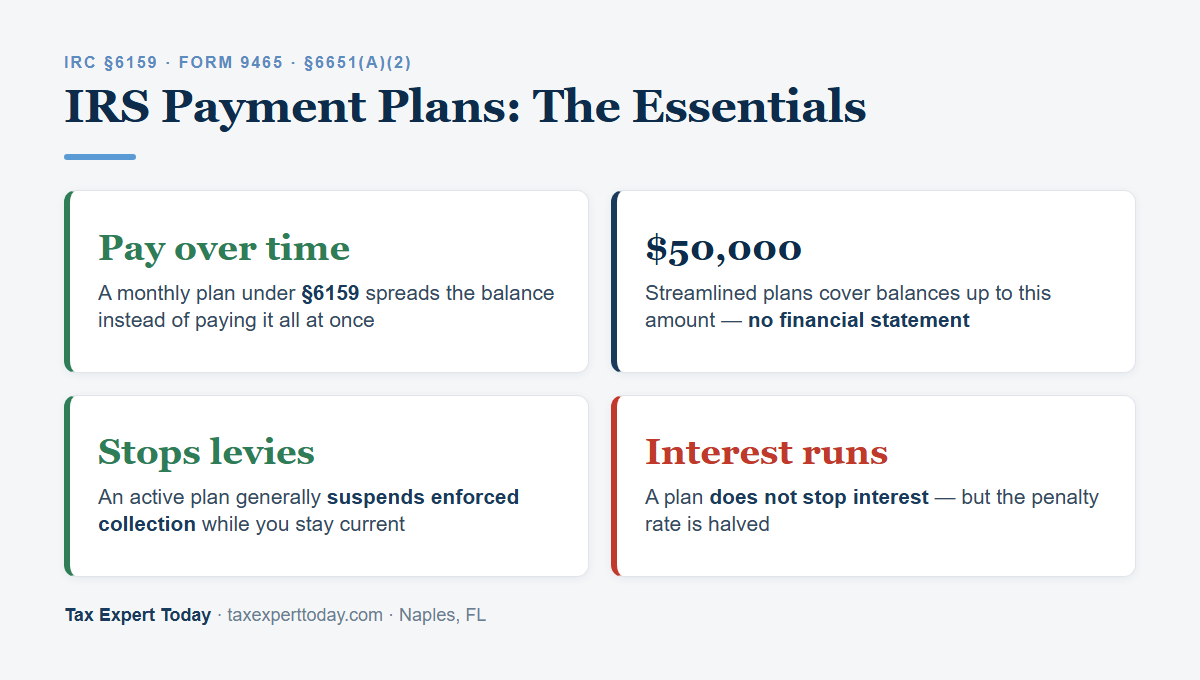
Quick Answer: An IRS installment agreement is a payment plan that lets you pay a tax balance in monthly amounts under IRC Section 6159 instead of all at once. The main types are the guaranteed agreement, the simple payment plan for balances of $50,000 or less, which must full pay by the collection statute expiration date, and the partial-pay agreement for taxpayers who cannot afford the full amount. You can apply with Form 9465 or, for most balances, through the IRS Online Payment Agreement tool. An approved plan also lowers the failure-to-pay penalty rate on a timely-filed return, though interest keeps running until the balance is paid.
Published: June 2026
If you owe the IRS more than you can pay at once, a payment plan is usually the most accessible way to resolve the balance and stop the collection process from escalating. The IRS offers several plans under one umbrella, and choosing the right one depends on how much you owe, how quickly you can pay, and whether you can afford the full amount at all. This 2026 guide explains how an IRS installment agreement works, the types of plans available, how to apply with Form 9465 or the Online Payment Agreement, what the setup fees are, and how a plan affects the penalties and interest on your account.
What Is an IRS Installment Agreement?
An IRS installment agreement is a formal arrangement to pay a tax debt in monthly payments over time, authorized under IRC Section 6159. Once an agreement is in place and you stay current on it, the IRS generally suspends active collection enforcement such as levies, so a payment plan is one of the most common ways to resolve a balance you cannot pay in full.
The rules behind these plans were rewritten in July 2026, when the Internal Revenue Manual replaced the streamlined installment agreement with the Simple Payment Plan, a change explained in our guide to the IRS Fresh Start program. A payment plan does not reduce the amount of tax you owe. It changes the schedule, not the total, and interest continues to accrue on the unpaid balance. What it does provide is a structured, IRS-approved path that keeps the account out of enforced collection — the CP504 notice, levies, and the final notice of intent to levy — while you pay the balance down. If a plan is the right tool but you have already received collection notices, it often makes sense to set up the agreement before the next stage of the notice sequence that begins with the CP14 arrives.
What Types of Payment Plans Does the IRS Offer?
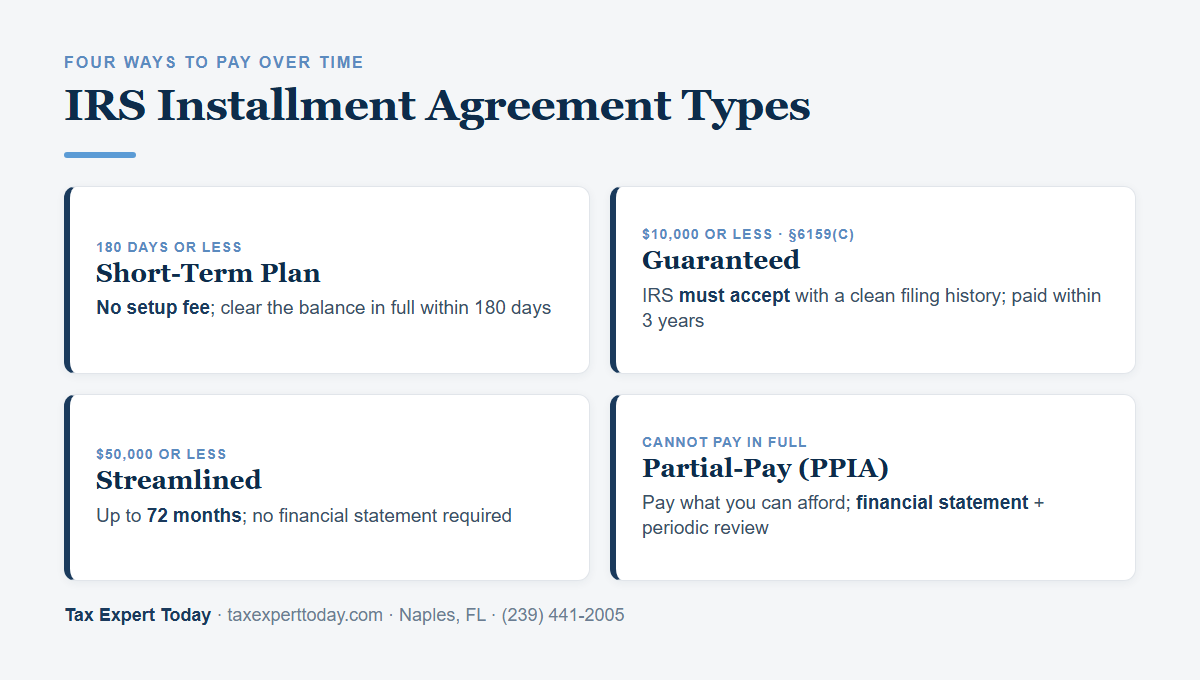
The IRS offers several installment agreement types, and the one you qualify for depends mainly on how much you owe and whether you can pay the full balance within the allowed period. The main categories are the guaranteed agreement, the simple payment plan, and the partial-pay agreement, plus a short-term plan for balances you can clear within 180 days.
| Plan type | Who it fits | Key conditions |
|---|---|---|
| Short-term payment plan | Can pay in full within 180 days | No setup fee; interest and any penalties still accrue until paid |
| Guaranteed agreement | Balance of $10,000 or less (tax only) | IRS must accept under §6159(c) if filing/payment history is clean and the balance is paid within 3 years |
| Simple payment plan | Balance of $50,000 or less | Must full pay the balance by the collection statute expiration date (CSED); no financial statement required |
| Partial-pay agreement (PPIA) | Cannot afford payments that clear the full balance | Pay what your finances support; requires a financial statement and periodic review |
A few distinctions are worth understanding. The guaranteed agreement is the only one the IRS is required by statute to accept: under IRC Section 6159(c), if you owe $10,000 or less in tax, have filed and paid on time for the past five years, have not had an installment agreement in that period, and agree to pay the balance within three years and stay compliant going forward, the IRS must grant the plan. The streamlined agreement is an administrative option for balances up to $50,000 that does not require you to submit detailed financial information, which makes it the most common plan for individual taxpayers. The partial-pay agreement is for taxpayers whose finances cannot support payments large enough to clear the balance; you pay what you can afford based on a collection information statement, the IRS reviews the arrangement periodically, and any balance still unpaid when the collection period expires generally is no longer collected. If even a partial payment is not feasible, an offer in compromise or currently not collectible status may be a better fit.
How Do I Apply — Form 9465 vs Online Payment Agreement?
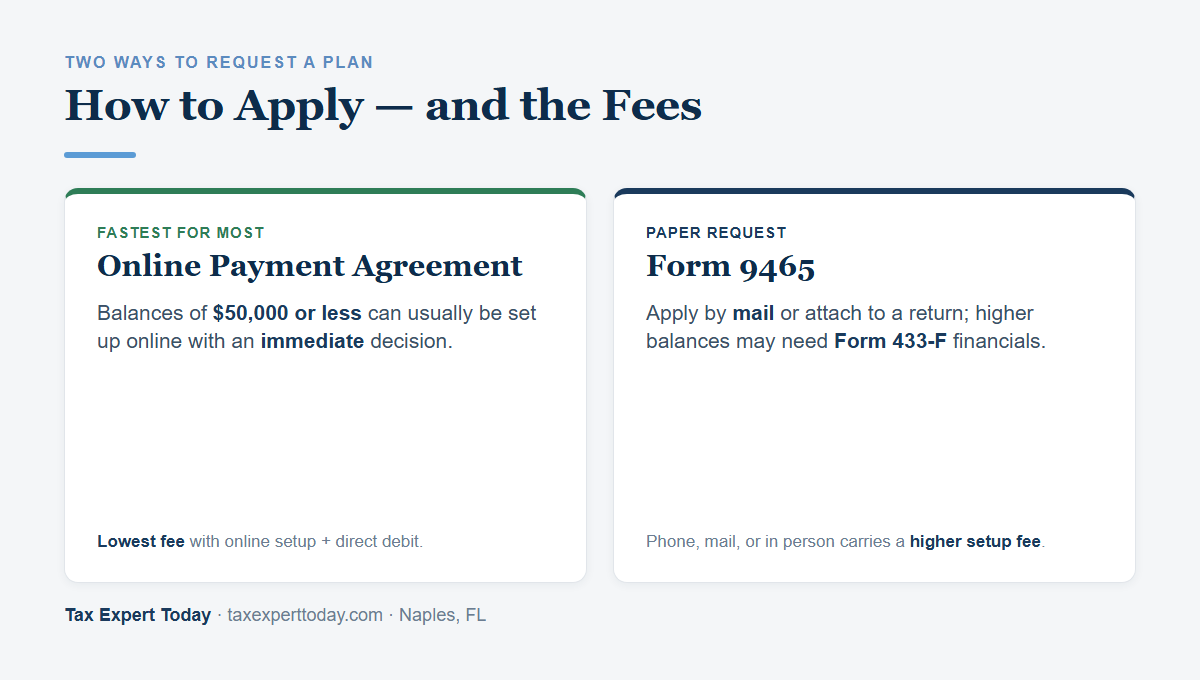
There are two main ways to request an IRS installment agreement: the online tool or a paper request. For most individual balances, the fastest route is the IRS Online Payment Agreement application, which gives an immediate determination. The alternative is Form 9465, the Installment Agreement Request, which you can mail or attach to a return.
- Online Payment Agreement (fastest for most)
- If you owe $50,000 or less in combined tax, penalties, and interest, you can usually set up a long-term plan online and receive immediate approval, often without speaking to anyone. Choosing direct debit from a bank account both lowers the setup fee and reduces the chance of default. A Direct Debit Installment Agreement can also support a later federal tax lien withdrawal under the IRS Fresh Start program.
- Form 9465 (paper request)
- Form 9465 is used when you prefer to apply by mail, when you are attaching the request to a paper return, or when the balance or circumstances fall outside what the online tool will process. Higher balances may also require Form 433-F, the Collection Information Statement, with supporting financial detail.
- By phone
- You can also request an agreement by calling the number on your IRS notice. Applying by phone, mail, or in person generally carries a higher setup fee than applying online for the same type of plan.
Whichever method you use, the IRS expects you to be current on filing before it will approve an agreement, so any unfiled returns should be filed first. If you are unsure which plan to request or whether to provide a financial statement, that is one of the points where professional guidance helps you avoid asking for the wrong plan and having to start over.
How Much Are the Setup Fees?
The setup fee for an IRS installment agreement depends on how you apply and how you pay. Applying online costs less than applying by phone, mail, or in person, and setting up direct debit costs less than other payment methods. A short-term plan paid within 180 days has no setup fee at all, and low-income taxpayers may qualify for a reduced fee or a waiver.
| How you set it up | Relative setup fee |
|---|---|
| Short-term plan (180 days or less) | No setup fee |
| Long-term, online, direct debit | Lowest long-term fee |
| Long-term, online, non-direct-debit | Higher than direct debit |
| Long-term by phone, mail, or in person | Highest setup fee |
| Low-income taxpayer | Reduced fee, and the fee may be waived or reimbursed with direct debit |
Because the IRS adjusts these amounts from time to time, the current dollar figures are published on the IRS Payment Plans (Installment Agreements) page. The practical takeaway is consistent year to year: the least expensive way to set up a long-term plan is online with direct debit, and the setup fee is separate from the penalties and interest that continue to accrue on the balance itself.
Does a Payment Plan Reduce Penalties and Interest?
A payment plan reduces the failure-to-pay penalty rate but does not stop interest. While an installment agreement is in effect on a return that was filed on time, the failure-to-pay penalty under IRC Section 6651(a)(2) is cut in half, from 0.5% per month to 0.25% per month. Interest under IRC Section 6601 continues at the regular rate until the balance is paid in full.
That distinction matters when you weigh how aggressively to pay. The reduced penalty rate is a real saving, but because interest keeps compounding, a longer plan costs more in total than a shorter one. You can estimate the running cost of penalties and interest on a balance with our IRS penalty and interest calculator, and the mechanics of the penalty itself are covered in our guide to the failure-to-pay penalty. If the total a payment plan would cost looks unmanageable, that is often the signal to evaluate whether an offer in compromise or another alternative fits your facts better. An offer in compromise has also grown harder to secure. According to our research report on IRS Data Book figures, the IRS accepted only 14.1 percent of offers in fiscal year 2025, the lowest share in at least a decade, so a payment plan remains the more predictable route for many taxpayers who can afford monthly payments.
IRS Installment Agreement Help in Naples and Southwest Florida
Tax Expert Today LLC helps individuals and businesses in Naples and across Southwest Florida set up IRS payment plans — confirming the balance, choosing between a guaranteed, streamlined, or partial-pay agreement, preparing any financial statement the IRS requires, and applying through the route that fits the situation. The firm is multidisciplinary, with enrolled agents, CPAs, and attorneys, and Dr. Kabashi is an Enrolled Agent authorized to represent taxpayers before the IRS in all 50 states. The office is at 11983 Tamiami Trail N, Naples, FL 34110, and the team can be reached at (239) 441-2005, Monday through Friday, 10am to 5pm ET.
Staying current on an approved installment agreement also keeps a debt out of seriously delinquent status, which is how many taxpayers avoid or reverse IRS passport revocation.
Frequently Asked Questions
What is the maximum balance for an IRS installment agreement?
There is no fixed maximum, but the simplest plans have thresholds. A simple payment plan, called a streamlined installment agreement before the July 21, 2026 revision of IRM 5.14.5, is available for combined balances of $50,000 or less. The balance must be fully paid by the collection statute expiration date rather than within a fixed 72 month term, and no financial statement is required. Larger balances can still be paid through an installment agreement, but the IRS generally requires a collection information statement, such as Form 433-F, documenting income, expenses, and assets before it will approve the plan.
Will an IRS installment agreement stop a levy?
In most cases, yes. Once an installment agreement under IRC Section 6159 is in place and you stay current on the payments, the IRS generally releases an active levy and suspends new enforced collection because the balance is being addressed. A pending request also typically pauses levy action while the IRS considers it. If a levy is already in progress, our guides on the IRS wage garnishment and the bank levy explain how a payment plan fits into getting it released.
Does an installment agreement stop interest from accruing?
No. Interest under IRC Section 6601 continues to accrue on the unpaid balance for the entire time a payment plan is in effect. What the agreement does change is the failure-to-pay penalty: on a return filed on time, the penalty rate under IRC Section 6651(a)(2) drops from 0.5% to 0.25% per month while the agreement is active. Because interest keeps compounding, paying the balance off faster lowers the total cost.
What happens if I default on an IRS payment plan?
An installment agreement can default if you miss a payment, fail to file or pay a future return, or provide inaccurate financial information. The IRS usually sends a notice (CP523) before terminating the agreement, which gives you a window to reinstate it. Once an agreement is terminated, collection enforcement can resume, so it is important to contact the IRS or request a new arrangement before that happens rather than after.
A rejection, modification, or termination of an installment agreement can also be appealed through the Collection Appeals Program on Form 9423, generally within 30 days of the letter. Our guide to the collection due process hearing and CAP explains which appeal reaches which action and the short business-day clocks that apply once a revenue officer is assigned.
Where can I get help with an IRS installment agreement in Naples, FL?
Tax Expert Today LLC, located at 11983 Tamiami Trail N, Naples, FL 34110, assists individuals and businesses in Naples and across Southwest Florida with IRS payment plans, choosing the right agreement type, preparing any required financial statement, and applying through Form 9465 or the Online Payment Agreement. The firm is multidisciplinary, with enrolled agents, CPAs, and attorneys, and represents taxpayers before the IRS nationwide. Consultations can be arranged at (239) 441-2005.
When to Engage a Professional for a Payment Plan
For a small balance you can clear within a few years, setting up a plan online is straightforward. The judgment calls come with larger balances, partial-pay situations, which are covered in full in our guide to the IRS partial payment installment agreement, and cases where a financial statement is required: choosing the plan that the IRS will actually approve, deciding whether to provide financials, and weighing a payment plan against an offer in compromise or currently not collectible status. Those are the points where experience prevents a rejected request and a restart. A business owner assessed a trust fund recovery penalty on unpaid payroll taxes can request an installment agreement on that personal balance as well. Tax Expert Today LLC represents individuals and businesses in IRS collection matters nationwide. Dr. Kabashi is an Enrolled Agent authorized to represent taxpayers before the IRS in all 50 states. Where the balance is a California one rather than a federal one, the Franchise Tax Board applies its own statute and its own approval standard, which our guide to the FTB installment agreement works through in detail.
Call (239) 441-2005 or schedule a consultation to review your balance, compare the installment agreement options, and set up the plan that fits your facts. Tax advisors, enrolled agents, CPAs, and attorneys serving clients in all 50 states. The financial statement behind a payment plan has its own rules, and our guide to Form 433-A and Form 433-F explains how the IRS scores the figures you report.
Published June 22, 2026 by Dr. Pellumb Kabashi « Back to Learning Center
Have a question this article touches on?
Tax Expert Today LLC, based in Naples, Florida and serving clients across the United States.
Schedule a Consultation (239) 441-2005