
By Dr. Pellumb Kabashi, DBA, MBA, EA, CFE, CES
Founder, Tax Expert Today LLC · Tax advisors, enrolled agents, CPAs, and attorneys · Serving clients in all 50 states
Quick Answer: IRS tax debt help Naples taxpayers can use starts with the transcript: what is owed, for which years, and how close the IRS is to a levy. From there the options are a payment plan, an offer in compromise, currently not collectible status, penalty relief, or a levy release. Tax Expert Today LLC handles each of them from Naples, Florida under a Form 2848 power of attorney. Call (239) 441-2005 for a free consultation.
IRS Tax Debt Help Naples FL: Where a Back Tax Balance Goes From Here
Owing the IRS is not one problem. It is a balance, a set of penalties and interest that keep growing, a sequence of notices that ends in enforcement, and a deadline that is usually closer than the taxpayer thinks. Getting help with IRS tax debt means dealing with all of those at once: stopping the next enforcement step, choosing the resolution program that fits the actual numbers, and keeping the account in compliance so the agreement holds. This page explains how that work is done from our office in Naples, Florida, what each option requires, and what the 2026 rules say about payment plans, settlements, and penalties.
The page sits alongside our Naples FL tax resolution overview, which covers the full practice, and our IRS audit help Naples FL page, which covers the examination that often comes before a balance. Here the focus is narrower and more practical: you owe back taxes, and you want to know what can be done about it.
What Happens If You Owe Back Taxes and Do Nothing?
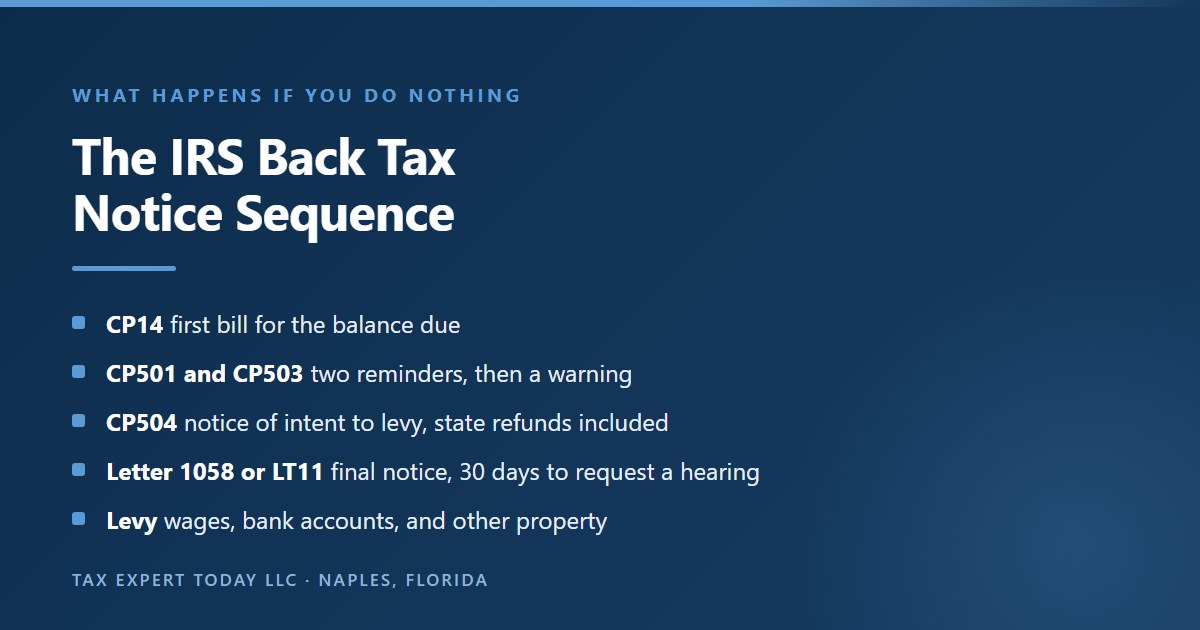
An unpaid federal balance moves through a fixed notice sequence: a first bill, two reminders, a notice of intent to levy, and a final notice that opens a 30-day window for a Collection Due Process hearing. After that window, the IRS may levy wages, bank accounts, and other property under IRC §6331, while penalties and interest continue to accrue.
- Penalties grow monthly: the failure to pay penalty under IRC §6651 is 0.5 percent of the unpaid tax for each month or part of a month, up to 25 percent.
- The rate rises after a levy notice: the IRS states the penalty becomes 1 percent per month if the tax is not paid within 10 days after a notice of intent to levy.
- Interest compounds daily: interest runs on tax, penalties, and prior interest until the balance is paid in full.
- Enforcement follows the paper trail: a levy requires a notice and demand, a refusal to pay, and a final levy notice sent at least 30 days in advance.
| Notice | What it means | What to do at this stage |
|---|---|---|
| CP14 | First bill for a balance due | Confirm the balance against the transcript; pay, or set up a plan before penalties build |
| CP501 | First reminder that the balance is unpaid | Same options remain open; this is the cheapest point to resolve |
| CP503 | Second reminder, with a warning of further action | Engage a representative if the balance cannot be paid soon |
| CP504 | Notice of intent to levy, including state tax refunds | Choose a resolution option now; the next notice is the final one |
| Letter 1058 or LT11 | Final notice of intent to levy and of your right to a hearing | File Form 12153 within 30 days to preserve a Collection Due Process hearing |
| Levy | Wages, bank accounts, or other property are seized | Request a levy release under IRC §6343 and put a resolution in place |
Which IRS Tax Debt Option Fits Your Situation?
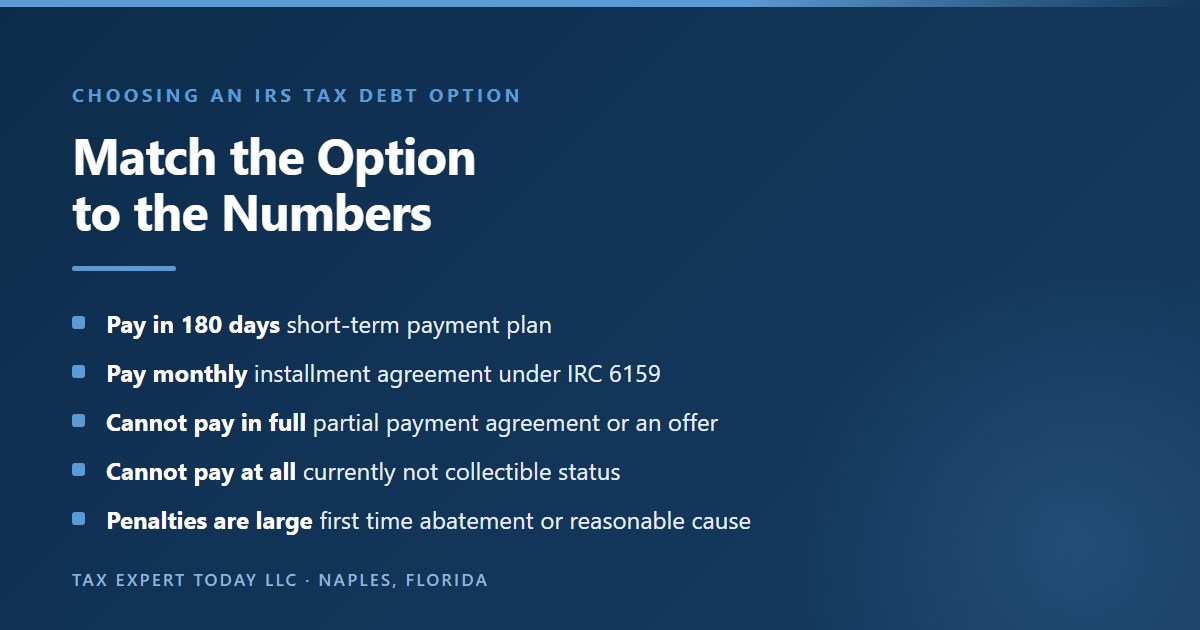
The right option depends on three numbers: the total balance, what you can pay each month after allowable living expenses, and how many years remain on the ten-year collection period. A payment plan fits most balances. An offer in compromise fits only when the IRS cannot expect to collect the full amount. Currently not collectible status fits genuine hardship.
| Option | Best fit | Key requirement | What stays true |
|---|---|---|---|
| Short-term payment plan | Balance you can clear in 180 days or less | Individuals owing less than $100,000 may apply online | No setup fee; penalties and interest continue until paid |
| Long-term installment agreement | Balance paid monthly over time | Online for individuals owing $50,000 or less with all returns filed; larger balances need financial disclosure | Setup fee applies; the failure to pay penalty drops to 0.25 percent per month for timely filers |
| Partial payment installment agreement | Ability to pay is less than the balance before the collection period ends | Full financial statement on Form 433-A or 433-F | The unpaid remainder may expire with the collection period |
| Offer in compromise | The IRS cannot reasonably collect the full balance | All returns filed, estimated payments current, $205 fee and first payment unless low income | Accepted offers carry five years of compliance obligations |
| Currently not collectible | Income does not cover allowable living expenses | Financial information showing hardship | Debt is not forgiven; penalties and interest keep accruing |
| Penalty relief | Penalties make up a large share of the balance | First time abatement history, or reasonable cause | Removes penalties, not the tax itself |
Two programs are often confused with these options. The IRS Fresh Start program is not a separate application; it is the 2011 set of policy changes behind today’s payment plan thresholds and lien withdrawal rules. And the IRS ten-year rule under IRC §6502 limits how long the IRS can collect, but several events suspend that clock, so the expiration date has to be computed from the transcript rather than assumed.
How Do IRS Payment Plans Work in 2026?
An installment agreement under IRC §6159 lets you pay a balance monthly while the IRS holds off on levy. Individuals owing $50,000 or less in combined tax, penalties, and interest can apply online once every required return is filed. The setup fee depends on how you apply and how you pay, and low-income taxpayers pay less.
| Plan and payment method | Apply online | Apply by phone, mail, or in person | Low income |
|---|---|---|---|
| Short-term plan, 180 days or less | $0 | $0 | $0 |
| Long-term plan, direct debit | $29 | $107 | Waived |
| Long-term plan, other payment methods | $69 | $178 | $43, may be reimbursed |
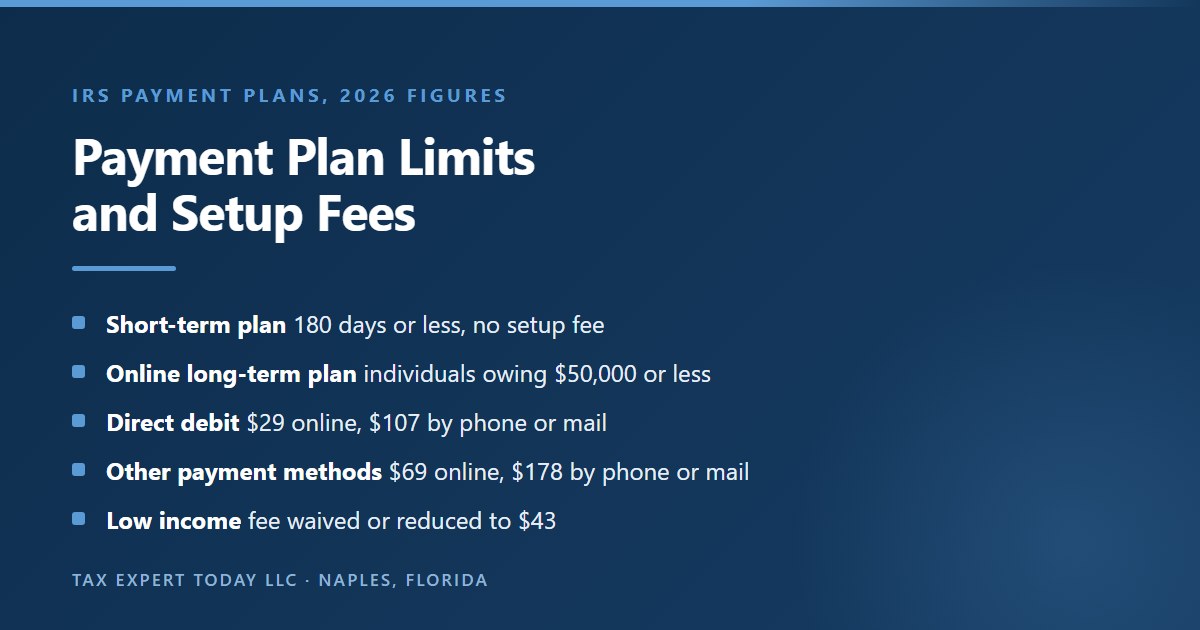
Figures are from the IRS payment plans page as updated March 3, 2026. A direct debit plan also opens a path to lien withdrawal: the IRS federal tax lien page explains that taxpayers owing $25,000 or less whose direct debit agreement pays the balance within 60 months, or before the collection period ends, may ask for the public lien notice to be withdrawn. Our guide to tax lien withdrawal on Form 12277 covers that request.
Above $50,000, a plan is still available, but the IRS generally asks for a collection information statement and measures the monthly payment against the IRS allowable living expenses. That is where representation earns its keep: the statement decides the payment, and an expense category left off or misclassified raises it.
Can You Settle IRS Tax Debt for Less Than You Owe?
Sometimes. An offer in compromise under IRC §7122 settles a balance for less than the full amount when the IRS concludes it cannot collect more, based on your income, expenses, and equity in assets. Every application requires a $205 fee and a first payment unless you meet the low-income qualification, and most offers are not accepted.
- Eligibility first: the IRS requires every required return filed, current estimated payments, and no open bankruptcy before it will consider an offer.
- Lump sum offer: 20 percent of the offer amount is paid with the application, and the rest in five or fewer payments after acceptance.
- Periodic payment offer: the first payment is made with the application, and payments continue while the IRS reviews it.
- The math decides: the offer amount is built from reasonable collection potential, so an offer below that figure is likely to be returned or rejected.
Our research report on the offer in compromise acceptance rate shows how many offers the IRS actually accepts each year, which is the honest starting point for deciding whether to file one. When the numbers do not support an offer, a payment plan or a partial payment agreement often achieves a similar result with less risk.
How Do You Stop an IRS Wage Garnishment or Bank Levy?
A levy is released when the taxpayer pays, enters an installment agreement, shows the levy creates economic hardship, or shows the collection period has expired, under IRC §6343. Speed matters: a bank holds levied funds for 21 days before sending them to the IRS, and a wage levy continues every pay period until it is released.
- Before the levy: a timely Collection Due Process request under IRC §6330, filed within 30 days of the final notice, generally suspends levy while the hearing is pending.
- Bank accounts: the 21-day hold under IRC §6332(c) is the window to resolve the account and request the return of funds; see our IRS bank levy release guide.
- Wages: a continuing wage levy leaves only an exempt amount based on filing status and dependents; our guide on how to stop an IRS wage garnishment walks through the release.
- Hardship: when a levy leaves a taxpayer unable to meet basic living expenses, the IRS is required to release it, although the balance remains.
What If You Also Have Unfiled Tax Returns?
Unfiled years come first. Every IRS resolution program requires all required returns to be filed, and where a return is missing the IRS may prepare a substitute for return under IRC §6020(b) without the deductions, credits, and filing status you are entitled to. Filing accurate returns usually reduces the balance before any negotiation begins.
The practical sequence is to pull wage and income transcripts for the open years, prepare the missing returns, and only then choose the payment option, because the balance the plan is built on changes once the real returns replace the IRS estimates. Our page on unfiled tax returns covers how far back the IRS generally asks taxpayers to file and what happens to penalties on late returns.
What About Penalties, Liens, and Your Passport?
Penalties can often be reduced through first time abatement or reasonable cause. A recorded federal tax lien can sometimes be withdrawn under a direct debit plan. And a seriously delinquent balance above $66,000 for 2026, with a lien filed or a levy issued, can be certified to the State Department under IRC §7345, which can block a passport.
- Penalties: the IRS penalty relief page lists first time abatement, reasonable cause, and statutory exceptions; our IRS penalty and interest calculator estimates how much of a balance is penalty.
- Liens: a lien attaches to all property once tax is assessed and unpaid; withdrawal removes the public notice but not the debt.
- Passports: the 2026 threshold is $66,000 on the IRS passport certification page, and an installment agreement or a pending offer generally prevents or reverses certification; see our IRS passport revocation guide.
Why Naples Taxpayers Choose Tax Expert Today for IRS Tax Debt
Tax Expert Today LLC is a Naples, Florida firm led by Dr. Pellumb Kabashi, an Enrolled Agent with unlimited rights to represent taxpayers before the IRS, a Certified Fraud Examiner, and a Certified Estate and Trust Specialist, who holds a DBA and an MBA with a concentration in taxation. The team includes enrolled agents, CPAs, and tax attorneys.
- Federal credentials: enrolled agents are licensed by the IRS itself under 31 CFR §10.3, and an EA’s status can be checked on the IRS enrolled agent verification page.
- Fifteen years of practice: Dr. Kabashi founded the firm after 15 years across a family office, top tax and law firms, and his own ventures, as described on our firm background page.
- Senior attention: the firm is a boutique by design, so clients reach a senior advisor and receive a response within one business day.
- The whole case in one place: unfiled returns, penalty relief, payment plans, offers in compromise, levy releases, lien withdrawals, and the audit that may have created the balance.
- Transcript first: every engagement starts from the IRS account, wage and income, and return transcripts, not from the last notice alone.
IRS tax debt help Naples: what local cases look like
Back tax cases reach our office in Naples, Florida in a few recurring shapes. A self-employed Collier County business owner who fell behind on estimated payments during a slow season and now has two or three years of balances. A retiree or snowbird whose required minimum distribution or brokerage sale was underwithheld, producing a balance the year after the move. A couple with an unfiled year from a divorce or an illness, where the substitute return overstated the tax. And a small employer in Lee or Collier County with payroll tax arrears, where the trust fund recovery penalty can reach the owners personally.
Florida changes one layer and not the other. Florida has no state individual income tax, so a Naples resident’s back tax problem is federal. The federal collection process does not change by location: the notices, the deadlines, and the programs are the same in Naples, Bonita Springs, Estero, Marco Island, and Fort Myers. Taxpayers who moved here from a state with an income tax may still owe that state for the years they lived there, and that balance follows its own rules.
How to Avoid Tax Debt Relief Scams
Be cautious of any company that promises to settle IRS debt for pennies on the dollar before reviewing your transcripts and finances. The IRS warns that some tax relief companies charge large upfront fees and leave taxpayers worse off. A legitimate representative is an attorney, CPA, or enrolled agent, explains your options in writing, and does not promise a particular outcome.
- Check the credential: only attorneys, CPAs, and enrolled agents have unlimited representation rights before the IRS.
- Ask who does the work: confirm the person who signs the Form 2848 is the person who handles your case.
- Know the free options: many payment plans can be set up directly with the IRS online, and the Taxpayer Advocate Service and Low Income Taxpayer Clinics help eligible taxpayers.
- No promised results: federal practice rules prohibit promising a result; the honest answer before the review is that the result depends on the facts.
Naples and Southwest Florida IRS Tax Debt Help
Tax Expert Today LLC
11983 Tamiami Trail N, Naples, FL 34110
Phone: (239) 441-2005
Hours: Monday through Friday, 10:00 to 5:00 ET
IRS tax debt help Naples residents can get in person is available at the office, and we serve Bonita Springs, Estero, Marco Island, Fort Myers, and all of Collier and Lee County the same way, with clients nationwide served remotely. The full engagement, from the power of attorney through the final agreement, is described on our IRS resolution and audit support service page, and our tax resolution Naples page covers the complete practice. Taxpayers who want to keep a new balance from forming can read about our Naples tax planning practice.
Frequently Asked Questions
Can I get IRS tax debt help in Naples if I cannot pay anything right now?
Yes. If your income does not cover allowable living expenses, the IRS may place the account in currently not collectible status, which suspends most collection. The debt is not forgiven and penalties and interest continue, so the status is reviewed as finances change. A financial statement supports the request.
Will the IRS stop collection while I apply for a payment plan or an offer?
Generally, yes. The IRS usually does not levy while an installment agreement request or an offer in compromise is pending, and a timely Collection Due Process request suspends levy during the hearing. A notice of federal tax lien may still be filed, and refunds may still be applied to the balance.
How long can the IRS collect back taxes?
Generally ten years from the date the tax was assessed, under IRC section 6502. Bankruptcy, a pending offer, a Collection Due Process hearing, and some other events suspend that period, so the actual expiration date for each year has to be computed from the account transcript.
Does an installment agreement reduce penalties?
It reduces one of them. For an individual who filed on time, the failure to pay penalty drops from 0.5 percent to 0.25 percent per month while an approved payment plan is in effect. Interest continues at the regular rate, and penalties already assessed may qualify for separate relief.
Do I need to live in Naples to work with Tax Expert Today?
No. Representation before the IRS is federal, so the firm works with taxpayers in all 50 states by phone, video, and secure document exchange. Naples, Florida clients can also meet at the office on Tamiami Trail North.
What should I bring to the first consultation?
Bring every IRS notice with its envelope, the last return filed, recent pay stubs or business income records, bank statements, and a list of monthly expenses. If records are missing, that is normal; we pull IRS transcripts directly once a power of attorney is signed.
When to Engage a Professional
The cheapest point to resolve a balance is before the final notice of intent to levy, because every option is still open and the 30-day hearing window has not started running. Representation is worth considering when a CP504 or Letter 1058 has arrived, when wages or a bank account have been levied, when the balance exceeds $50,000, when unfiled years are part of the picture, when a business owes payroll taxes, or when an offer in compromise is under consideration. Tax Expert Today LLC provides IRS tax debt help from Naples, Florida and in all 50 states. Call (239) 441-2005 or use the contact page for a free consultation; bring the latest notice, and we will identify the stage, the deadline, and the options that remain open.