
By Dr. Pellumb Kabashi, DBA, MBA, EA, CFE, CES
Founder, Tax Expert Today LLC · Tax advisors, enrolled agents, CPAs, and attorneys · Serving clients in all 50 states
Quick Answer: Georgia Form G-7 is the quarterly return employers use to report Georgia income tax withheld and paid. It comes in monthly payer, quarterly payer, and semi-weekly versions, and it is due by the last day of the month after each quarter, even with zero withholding. The fourth quarter 2026 return is due February 1, 2027. Call (239) 441-2005 for a free consultation.
What Is Georgia Form G-7?
Georgia Form G-7 is the quarterly withholding return an employer files with the Georgia Department of Revenue. It reports the Georgia income tax withheld from wages for the quarter and the payments made against that liability, and it is separate from the federal Form 941 and from the unemployment wage report.
- What it reports: Georgia income tax withheld, adjustments, tax due, and tax paid.
- What it omits: wages, federal tax, Social Security, Medicare, and other states.
- How often: four times a year for most employers, once a year for approved annual payers.
- Who receives it: the Georgia Department of Revenue, usually through the Georgia Tax Center.
Employers often treat the return as a payment coupon, and the confusion is understandable because the quarterly version can travel with a check. Its legal function is broader. Under O.C.G.A. 48-7-103 and Regulation 560-7-8-.33, the G-7 is the return that states the employer’s liability for the period. Deposits made during the quarter are credits against that liability, and the return is the document that matches the two.
That distinction matters when something goes wrong. An employer can pay every dollar on time and still be late on the return. The Department computes the late filing penalty on the tax withheld before payments are applied, which we cover in detail below. For the wider picture, including how much to withhold from each paycheck, see our guide to Georgia withholding tax. This article stays with the return itself: which version applies, how each line works, when it is due, and how to correct it.
The form also has a very narrow scope. It asks for Georgia income tax only. Payroll systems that combine state totals can produce a figure that includes Alabama, Florida, or South Carolina activity, and that figure does not belong on a Georgia return. The state withholding column for Georgia, the amount that later appears on the W-2 with a Georgia state code, is the number that matters.
Which Version of Georgia Form G-7 Do You File?
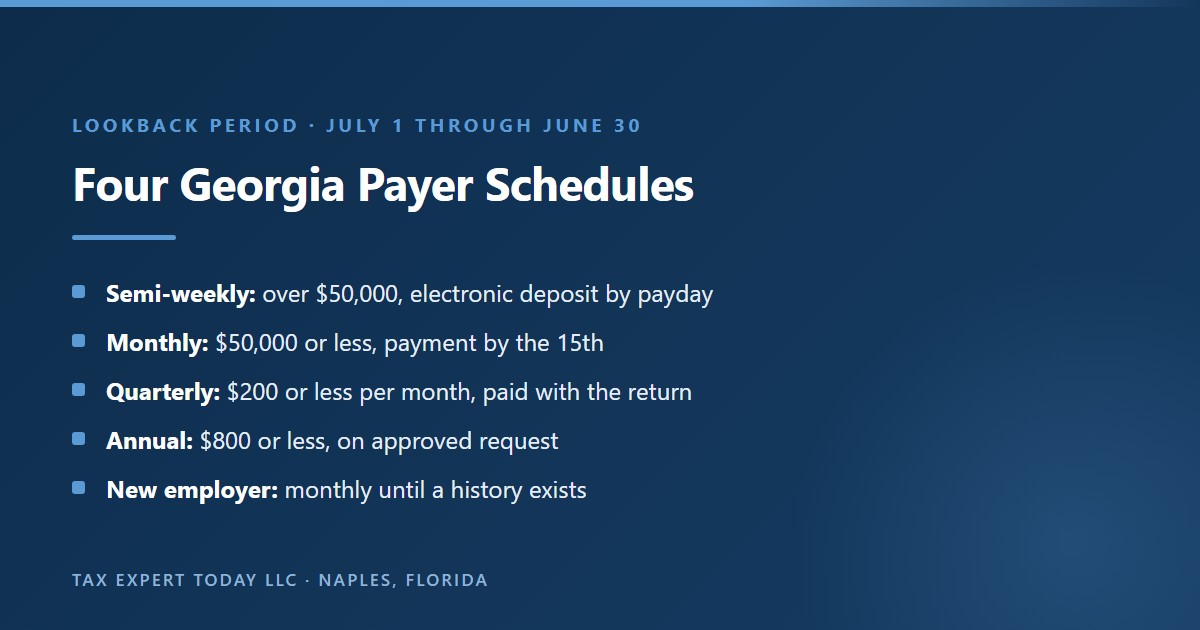
The version depends on your payer status. Semi-weekly payers file Form G-7 with Schedule B, monthly payers file the G-7 for monthly payers, and quarterly and annual payers file the G-7 for quarterly payers. The Department assigns status from the withholding reported during the lookback period, not from the employer’s preference.
- Semi-weekly payer: more than $50,000 in the lookback period.
- Monthly payer: $50,000 or less, and not a quarterly or annual payer.
- Quarterly payer: $200 or less per month, and not an annual payer.
- Annual payer: $800 or less in the lookback period, on approved request.
- New employer: monthly until a withholding history exists.
| Payer status | Lookback test | When tax is paid | Return to file |
|---|---|---|---|
| Semi-weekly | More than $50,000 | By electronic funds transfer, the Wednesday or Friday after payday | Form G-7 with Schedule B, quarterly |
| Monthly | $50,000 or less, and not quarterly or annual | By the 15th of the following month | Form G-7 for monthly payers, quarterly |
| Quarterly | $200 or less per month | With the return | Form G-7 for quarterly payers |
| Annual | $800 or less, on approved request | By January 31 of the next year | Fourth quarter Form G-7 for quarterly payers |
| New employer, no history | Not applicable | By the 15th of the following month | Form G-7 for monthly payers |
| Any payer, payday over $100,000 | Per payday | By electronic funds transfer, the next banking day | The return for the usual status |
The table reflects the definitions in Regulation 560-7-8-.33 and the summary in the 2026 Employer’s Tax Guide. Three details are easy to miss. First, a new employer does not get to pick the smallest schedule. The regulation requires a business with no Georgia withholding history to file monthly until it has one, even if the first year’s payroll is small.
Second, the status is measured per federal employer identification number, not per Georgia account. A business with five locations and five Georgia withholding numbers under one FEIN must combine all five when it tests the $50,000 line. A group that looks at each location alone can believe it is a monthly payer when the regulation treats it as semi-weekly.
Third, the annual schedule is not automatic. An employer that qualifies must request annual filing through the Georgia Tax Center before the first quarter due date, or by mail to the Taxpayer Services Division with payroll records showing that it meets the test. Without the request, the quarterly returns remain due. Annual payers file the fourth quarter version of the G-7 for quarterly payers by January 31 of the next year, which for 2026 means February 1, 2027.
How Does the Lookback Period Set Your Georgia Form G-7 Schedule?
The lookback period is the 12 months that ended June 30 of the preceding calendar year. For calendar year 2027, it runs from July 1, 2025, through June 30, 2026. The Department totals the liabilities reported or required to be reported on the four Forms G-7 covering that period.
- Calendar 2026 status: uses July 1, 2024, through June 30, 2025.
- Calendar 2027 status: uses July 1, 2025, through June 30, 2026.
- Job tax credits: the test uses the liability before credits.
- Late corrections: a corrected G-7 filed after its due date does not change the total.
- The one-day rule: does not change the filing frequency by itself.
A business can therefore outgrow its schedule without knowing it. Payroll that jumped during the second half of 2025 and the first half of 2026 sets the 2027 schedule, even if payroll has since fallen. Review the four quarterly returns for that window now, because a semi-weekly deposit schedule that begins January 1 requires bank and payroll settings to be in place before the first payday of the year.
The treatment of credits catches employers that use the Georgia job, quality jobs, or research credits against payroll withholding. The Employer’s Tax Guide gives the case of an employer with $100,000 of liability that applied $75,000 of credits and paid only $25,000. The employer’s status is still measured at $100,000. If you claim a Georgia quality jobs tax credit or a Georgia R&D tax credit against withholding, the amount actually paid is the wrong number to test.
The regulation also limits how corrections affect the calculation. Adjustments on a corrected return filed after the due date are not counted, although adjustments reported on a return filed by its due date are. In practice, a large overstatement discovered a year later may reduce the tax but may not reduce the lookback figure. An employer pushed into semi-weekly status by an error should raise the issue with the Department rather than assuming that the amended return fixed the schedule.
When Is Georgia Form G-7 Due?
Georgia Form G-7 is due by the last day of the month after the quarter ends. When that day falls on a weekend or a Georgia or Federal Reserve holiday, the deadline moves to the next banking day. The fourth quarter 2026 return is due February 1, 2027, because January 31 is a Sunday.
- Return date: the same for monthly, quarterly, and semi-weekly payers.
- Payment date: different for each schedule.
- Annual payers: one return and one payment after year end.
- Weekend rule: applies to both payments and returns.
| Quarter | Form G-7 due | Payment for quarterly payers | Why this date |
|---|---|---|---|
| Fourth quarter 2026 | February 1, 2027 | February 1, 2027 | January 31, 2027 is a Sunday |
| First quarter 2027 | April 30, 2027 | April 30, 2027 | Regular date |
| Second quarter 2027 | August 2, 2027 | August 2, 2027 | July 31, 2027 is a Saturday |
| Third quarter 2027 | November 1, 2027 | November 1, 2027 | October 31, 2027 is a Sunday |
| Fourth quarter 2027 | January 31, 2028 | January 31, 2028 | Regular date |
These dates come from the Department’s withholding due date page, confirmed on November 10, 2026. The third quarter 2026 return was due November 2, 2026. An employer that missed that date should file now, because the statutory penalty increases with each additional month or fraction of a month.
Monthly payers should watch two separate calendars. The payment for a month is due on the 15th of the following month. The October 2026 payment is due November 16, 2026, because November 15 is a Sunday. The November payment is due December 15, 2026, and the December payment is due January 15, 2027. The return for the fourth quarter then follows on February 1, 2027.
Semi-weekly payers deposit by payday. Paydays on Wednesday, Thursday, or Friday are remitted by the following Wednesday, and paydays on Saturday, Sunday, Monday, or Tuesday by the following Friday. A supplemental check issued between scheduled paydays is treated as issued on the next scheduled payday under the regulation.
The one-day rule overrides all of these schedules. Under O.C.G.A. 48-7-103(b)(3), when withholding exceeds $100,000 for a payday, the tax must be remitted by the next banking day. The Employer’s Tax Guide also uses “more than $100,000”, while the Department’s due date page and its HB 43 summary say “$100,000 or more”. An employer with a payday of exactly $100,000 should treat the rule as applying.
Who Must File Georgia Form G-7?
Any employer with an active Georgia withholding number must file Georgia Form G-7 for each period assigned to that account. The duty follows the account, so it continues through periods with no payroll until the number is deactivated. Payers of certain non-wage amounts that are subject to Georgia withholding can also have a filing duty.
- Georgia employers: wages paid to residents and taxable nonresidents.
- Out of state employers: wages for services performed in Georgia.
- Single member LLCs: file their own employment tax reports.
- Payroll providers: file for clients but need each client’s account number.
Georgia requires withholding on the wages of residents for services performed in or outside the state, unless another state requires withholding on work performed there, and on the wages of taxable nonresidents for services performed in Georgia. Our Georgia Form G-4 guide explains the employee certificate that feeds that calculation. A remote employee in Georgia can create a filing obligation for an employer with no Georgia office, because the location of the work drives the analysis.
Filing starts with a withholding number. The Department’s Filing Tips say an employer without a number cannot simply mail in a payment. It must first register through the Georgia Tax Center, and the guide indicates the number is generally issued within 15 minutes. Tax withheld before the number arrives is still due on the normal schedule. Our guide to the Georgia tax ID number explains which number is which.
A purchase or a change in structure deserves particular care. The Filing Tips say a new withholding number is required when an employer buys an ongoing business or changes its structure, and an employer should call the Department before making payments under a number that was previously deactivated. A single member LLC that is disregarded for income tax purposes must still file employment tax reports in its own name, which means the owner’s personal account is not the right place for the LLC’s payroll. Our article on Georgia LLC taxes walks through the entity side.
How Do You Complete Georgia Form G-7 Line by Line?
The quarterly payer worksheet asks for account and contact details on lines 1 through 9, an amended return indicator on line 10, the period on line 11, and the tax figures on lines 12 through 16. Line 17 holds the explanation for any adjustment. The worksheet then generates the return you sign and mail.
- Lines 1 and 2: Georgia withholding ID and federal employer number.
- Line 10: check only when replacing a filed return.
- Line 12: Georgia tax actually withheld for the period.
- Line 13: a plus or minus adjustment.
- Line 17: 99 characters to explain that adjustment.
| Worksheet line | What goes there | Practical note |
|---|---|---|
| 1 and 2 | Georgia withholding ID and FEI number | Match the Georgia Tax Center account exactly |
| 3 through 9 | Name, address, telephone | Report address changes separately in GTC |
| 10 | Amended return indicator | Leave blank on an original return |
| 11 | Tax period | Confirm the quarter before printing |
| 12 | Tax withheld this period | Georgia income tax only |
| 13 | Adjustment to tax, plus or minus | Use for a credit from a prior period |
| 14 | Tax due, line 12 plus or minus line 13 | Calculated on the worksheet |
| 15 | Tax paid | Should agree with your payment records |
| 16 | Amount enclosed | For a check mailed with the return |
| 17 | Explanation for adjustment | Limit of 99 characters |
The fillable PDF from the Department is a worksheet, and it is not itself the return. After you complete it and click Print, the program produces a G-7 at the bottom of the page. The instructions say to sign and date that return, cut along the dotted line, and mail only the return with any payment. The worksheet stays in your records. The Department also asks that you not fold, staple, or paper clip anything.
The instructions state that the “Tax Withheld,” “Tax Due,” and “Tax Paid” blocks must all be completed. Before mailing, the Filing Tips suggest confirming the withholding number, tax period, tax due, and tax paid. Those four fields are where a paper return is most likely to be applied to the wrong account or period. A return with the correct numbers and the wrong quarter can generate a notice for one period and a credit in another.
Consider a hypothetical quarterly payer with $540 of Georgia income tax withheld in a quarter. Line 12 would show $540, line 13 would be blank, and line 14 would show $540. If the employer had made no earlier payment for the quarter, line 15 would reflect the amount paid and line 16 the amount enclosed if it is paying by check. As we explain below, a figure above $500 also changes how that employer must pay and file from then on.
How Does the Monthly Payer Version of Georgia Form G-7 Work?
The monthly payer version has three columns, one for each month of the quarter. Each column shows tax withheld, any adjustment, tax due, and tax paid. The return is filed once, after the quarter closes, and it lists payments that were already made by the 15th of each following month.
- Monthly payment: Form GA-V or electronic payment, by the 15th.
- Quarterly return: one G-7, after the quarter ends.
- Quarterly Total: the sum of tax withheld for the three months.
- Explanation field: 115 characters on this version.
| Hypothetical quarter | Month 1 | Month 2 | Month 3 |
|---|---|---|---|
| Tax withheld this period | $2,800 | $3,100 | $3,100 |
| Adjustment to tax | $0 | $0 | ($150) |
| Tax due | $2,800 | $3,100 | $2,950 |
| Tax paid | $2,800 | $3,100 | $2,950 |
| Quarterly Total, tax withheld | $9,000 |
In this hypothetical, the employer overpaid $150 in an earlier period of the same year and took the credit in the third month. The adjustment appears in month three, the tax due for that month falls to $2,950, and the explanation field states the reason. The Quarterly Total still reports the $9,000 that was withheld. An employer who enters the net amount in the withheld line understates what the return is meant to report.
The instructions warn against a common mistake: “Payers should not file a Form G-7 with every payment.” Monthly payments go with Form GA-V, or electronically with no voucher, and the G-7 comes once at the end of the quarter. Filing a G-7 every month creates duplicate returns that may need to be sorted out later. The same instructions say a payment received after the 15th of the following month is subject to late charges, so check-writers should not mail on the due date without considering how timely mailing would be proved. Our guide to where to mail a Georgia state tax return explains the proof of timely filing rules.
Both the monthly and quarterly forms direct payments to Form GA-V in one instruction, but the guide and the regulation have quarterly payers remit with the return itself. The Form GA-V page identifies the voucher as a monthly payment document. A quarterly payer paying by check should follow the regulation and enclose the payment with the G-7, unless the Department tells that employer otherwise.
What Goes on G-7 Schedule B for Semi-Weekly Payers?
Semi-weekly payers report on Form G-7 with Schedule B, which lists the tax withheld for each pay date in the quarter. One return covers all payroll groups, even when employees are paid on different days. Any balance shown on the return must be paid by electronic funds transfer by the return due date.
- Basis of reporting: tax withheld for each pay date in the quarter.
- Payment method: electronic funds transfer only.
- Multiple payrolls: separate deposits, one return.
- Form GA-V: not used by semi-weekly payers.
The Employer’s Tax Guide gives the example of an employer that pays one group weekly and another group semi-monthly. Each group has its own remittance deadline, yet all wages for the quarter go on the same Form G-7 and Schedule B. The regulation’s example shows why the deadlines can diverge. When the salaried payday is a Friday, it can share a deposit date with the hourly payroll, and when it falls on a Tuesday, it may require a second deposit that week.
The Schedule B is where payday data and deposit data meet. The pay date is the date on the employee’s check or the first day the employee is able to tender it, whichever is earlier. A system that records the processing date or the bank settlement date can place wages in the wrong line and make an on-time deposit look late. It is worth testing a sample of paydays around each quarter end against the payroll register.
A semi-weekly employer has little practical use for a paper return. Every semi-weekly payer must pay by electronic funds transfer, and the guide says an employer required to pay that way must file its withholding returns electronically. The Department still lists a post office box for G-7 Schedule B, but a mandated employer that mails the form instead may be treated as not having filed.
When Must Georgia Form G-7 Be Filed Electronically?
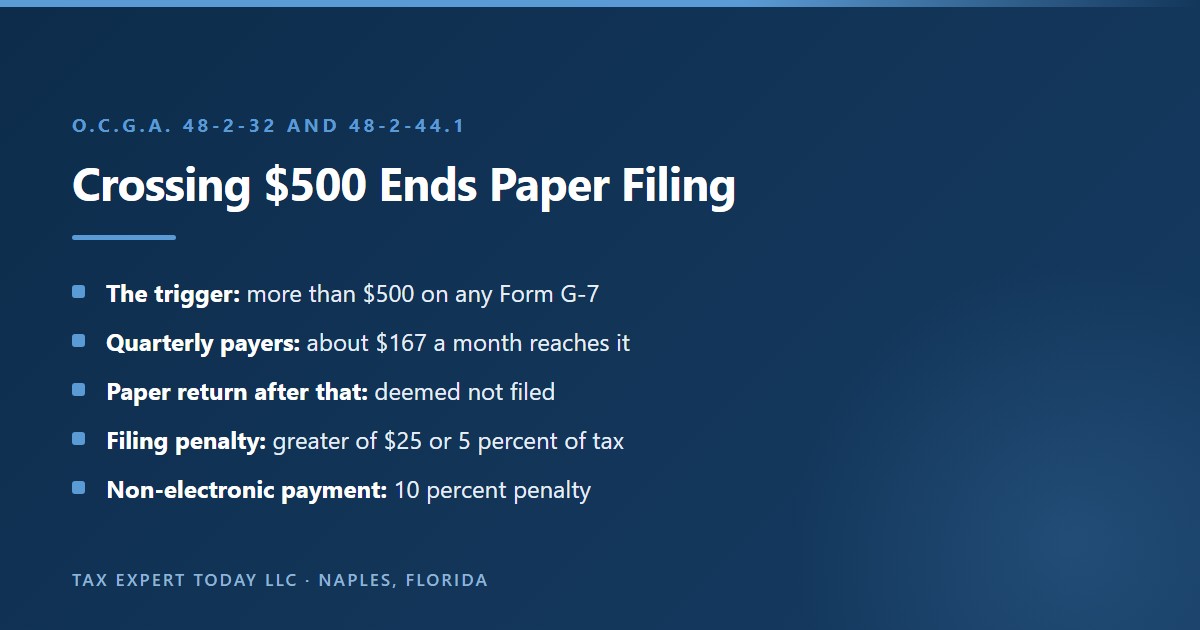
Electronic payment becomes mandatory once the tax withheld or required to be withheld on a Form G-7 exceeds $500, and it applies to every payment and return after that. An employer required to pay electronically must also file electronically. A paper return from a mandated employer is treated as not filed.
- The trigger: more than $500 on any Form G-7.
- The effect: electronic payments and returns from then on.
- Credit claims: returns with series 100 tax credits must be electronic.
- Refund claims: mandated employers must file them through GTC.
- Payment penalty: 10 percent of a timely payment not made electronically.
This threshold is smaller than many small employers expect. A quarterly payer can withhold as much as $200 a month, or $600 a quarter. Any quarterly payer withholding more than about $167 a month crosses $500 on the return. An annual payer can also cross it, because a single annual return can report up to $800. The employer may still think of itself as a small paper filer when the rule has already moved it to electronic reporting.
The consequences stack. Under O.C.G.A. 48-2-44.1, a taxpayer who fails to file electronically when required is deemed to have failed to file, and the penalty is the greater of $25 per return or 5 percent of the tax due on the return before payments or credits. Separately, a timely payment that should have been made by electronic funds transfer can carry a 10 percent penalty under O.C.G.A. 48-2-32. Both are in addition to any other penalty and interest that apply.
Relief is available in limited cases. A return that was first transmitted by the due date and then rejected can be perfected under rules consistent with the federal rejection rules. The electronic filing penalty is not imposed when the failure was due to reasonable cause and not gross or willful neglect, and the statute allows waivers for undue hardship. Those are fact-specific requests, and an employer should keep the rejection notice and any evidence of the attempted filing.
How Do You File Georgia Form G-7 in the Georgia Tax Center?
Log in to the Georgia Tax Center, select the withholding payroll account, choose the return period, and enter or import the figures. Filing is free, the return generally posts within one to two business days, and a return can be canceled while pending. Once processed, corrections require an amended return.
- Cost: no charge to file through GTC.
- Posting: one to two business days.
- Forms covered: original and amended G-7s for all payer types.
- Import option: an Excel template or CSV file.
- Video help: the Department posts a monthly return walkthrough.
An employer with a single payroll can usually key the return directly. The Department’s withholding videos include a walkthrough for filing a monthly G-7. Larger employers and payroll offices can use the Department’s withholding templates. The Department’s instructions are specific: complete the G-7 template, save it as an Excel 97-2003 Workbook, log in, click the withholding number, select the period, and import it. The current template applies to periods from the fourth quarter of 2015 forward.
Save the confirmation each quarter. A confirmation number, along with the filed return and the payment record, is the employer’s evidence that it met the deadline. It also helps during an ownership change, a lender review, or a new bookkeeper’s first quarter. Access is worth reviewing too. When the person who controls the GTC login leaves, the employer may lose sight of notices and filing history unless a second authorized user is in place.
Third-party payroll providers have their own rule. A provider cannot mail a payment for a client that has not supplied its withholding number. Either the client or a valid power of attorney must obtain the number by calling the Department at 1-877-423-6711. A third-party provider with more than 250 employers must pay by electronic funds transfer, under the guide’s reading of O.C.G.A. 48-2-32. Using a payroll company also does not remove the employer’s own responsibility, so an employer should confirm periodically that returns were actually filed under its account.
Where Do You Mail a Paper Georgia Form G-7?
Each version has its own post office box. The monthly payer G-7 goes to PO Box 105482, the quarterly payer G-7 and G-7NRW go to PO Box 105544, Schedule B goes to PO Box 105678, and Form GA-V goes to PO Box 740387, all in Atlanta, according to the Department.
- Payable to: Georgia Department of Revenue.
- Write on the check: your withholding number.
- Certified mail: the Department says it will not speed processing.
- Electronic filers: do not mail a duplicate.
| Form | Mailing address |
|---|---|
| G-7 for monthly payers | Georgia Dept. of Revenue, PO Box 105482, Atlanta, GA 30348-5482 |
| G-7 for quarterly payers and G-7NRW | Georgia Dept. of Revenue, PO Box 105544, Atlanta, GA 30348-5544 |
| G-7 Schedule B | Georgia Dept. of Revenue, PO Box 105678, Atlanta, GA 30348-5678 |
| GA-V payment voucher | Georgia Dept. of Revenue, PO Box 740387, Atlanta, GA 30374-0387 |
| G-1003 transmittal | Georgia Dept. of Revenue, PO Box 105685, Atlanta, GA 30348-5685 |
Addresses come from the Department’s withholding mailing page and match the addresses printed on the current return instructions. Mailing a return to the wrong box can delay posting. The Department notes that certified mail or courier service will not speed processing, and that postal handling of certified mail can itself slow processing, although certified mail can still be useful as proof of the date mailed.
How Do You Pay the Tax Reported on Georgia Form G-7?
Employers can pay through the Georgia Tax Center by ACH debit at no charge, by approved ACH credit, or by check when electronic payment is not required. Card and digital wallet payments carry a processor fee. The Department does not accept Fedwire payments for withholding tax, so a bank wire is not an available option.
- ACH debit: initiated in GTC and must be completed by the due date.
- ACH credit: requires Form EFT-002 and must be received by the due date.
- Card, PayPal, or Venmo: 2.31 percent with a $1.00 minimum fee.
- Fedwire: not accepted.
- Check: only for employers not required to pay electronically.
The difference between debit and credit matters on deadline day. An ACH debit is one the employer initiates through GTC, and it must be completed on or before the due date. An ACH credit is originated through the employer’s bank and must be received by the due date, so banks’ cutoff times need to be built into the calendar. An employer requesting credit status sends Form EFT-002 to the Department’s electronic funds transfer unit.
Scheduled and canceled payments deserve a quick review each quarter. The guide says a payment can be canceled while pending, but once it has processed, the only way back is a refund request. If you overpay, the Department will not refund the money automatically. A refund claim goes through GTC when the employer is required to use it, and otherwise can be made on Form IT-550 with the amended return and any corrected wage statements.
If the employer cannot pay the full amount, file the return anyway. Filing separates the late filing penalty from the payment problem and starts the assessment period. A balance that cannot be paid at once raises different questions. Our article on the Georgia Department of Revenue payment plan explains the options, and withheld tax is treated differently from many other balances because it was collected from employees.
Do You File Georgia Form G-7 When No Tax Was Withheld?
Yes. While a withholding account is active, Georgia Form G-7 must be filed for each period even when no tax was withheld. The return shows zero, Form GA-V is not needed, and a late zero return can still draw a penalty. Filing stops only when the account has been deactivated.
- Seasonal businesses: file for the quarters with no payroll.
- Dormant companies: close the account or keep filing.
- No payroll yet: a newly registered account can owe zero returns.
- Minimum penalty: the statute sets a floor of $25.
A zero return is a small task with an outsized nuisance value when it is ignored. Because O.C.G.A. 48-7-126(c) says the penalty shall not be less than $25, a dormant account that misses four quarterly zero returns could see $100 of penalties in a year with no tax at all, along with notices that may go to an outdated address. The amount is modest, but those notices can be a problem when the company later seeks a clearance letter or begins selling assets.
The Filing Tips address this directly: continue to file while the number is active, and deactivate it when you no longer meet the withholding requirements. A business that hires only for a few months each year has a judgment call. Keeping one account and filing zero returns for the off-season quarters is usually simpler than repeatedly closing and reopening, and it preserves the filing history. The Department asks employers to call before making payments under a number that was previously deactivated.
There is also a less obvious reason to file. Under O.C.G.A. 48-2-49, tax can generally be assessed within three years after a return is filed, while a failure to file leaves the period open. A filed zero return creates a record, and it is the event that starts that clock for the quarter.
How Do You Use the Adjustment to Tax Line on Georgia Form G-7?
The Adjustment to Tax line reports a plus or minus change to the current return, and the form instructions say it should be used when applying a credit from a prior period. Any adjustment needs an explanation in the space provided. The instructions tell employers not to use it to report additional tax for an earlier period.
- Credit from a prior period: belongs on this line.
- Additional tax for a past period: the form calls for an amended return.
- Explanation: required; 99 or 115 characters by version.
- Same calendar year: the statutory adjustment window.
The instructions read more narrowly than the statute. O.C.G.A. 48-7-104 allows a proper adjustment without interest in any later period of the same calendar year when more or less than the correct amount was withheld or paid. It also allows an undercollection to be corrected by adjustment on a later return in that year, with payment at the time prescribed for that later period.
The Employer’s Tax Guide adds a third formulation. It says corrections can be made by submitting a copy of the original return marked “Amended” with an explanation, or in GTC when electronic filing applies, and that when a copy is unavailable, changes can be reported by letter or on the “Adjustment to Tax” line. It also says amendments will not be allowed if no reason is given. The three sources do not line up perfectly.
The conservative approach follows the form. Use the adjustment line for an overpayment credit within the same year, and use an amended return for an underreported amount. Where the statutory right to an interest-free adjustment would matter, such as a larger undercollection discovered during the year, get advice before choosing a method. The statute has limits as well. No adjustment can be made for an underpayment after the Department issues a notice and demand based on an assessment, and none can be made for an overpayment after a refund claim is filed.
When Do You Amend Georgia Form G-7 Instead?
Amend Georgia Form G-7 when you need to report additional tax for a closed period, when an error crosses into another calendar year, or when you want the original period itself corrected. In GTC, select the amendment option and the period. On paper, check the amended box and include the reason.
- Same year credit: usually the adjustment line.
- Additional tax owed: an amended return for that period.
- Prior year error: amended G-7 plus corrected wage statements.
- Refund: a separate claim is needed.
| Situation | Usual fix | Authority |
|---|---|---|
| Overpaid an earlier period in the same year | Credit on the Adjustment to Tax line, with explanation | Form instructions; O.C.G.A. 48-7-104(a) |
| Additional tax owed for a filed period | Amended return with the amended box checked | Form instructions |
| Undercollection found later in the same year | Amended return under the form, or a statutory adjustment after advice | Form instructions; O.C.G.A. 48-7-104(b) |
| Error found after year end | Amended G-7s, Forms W-2c, and amended G-1003 | Employer’s Tax Guide |
| Overpayment to be returned | Refund claim in GTC or on Form IT-550 | Employer’s Tax Guide; O.C.G.A. 48-2-35 |
| Assessment already issued | Pay or protest; no adjustment is available | O.C.G.A. 48-7-104(a) |
Across calendar years, the fix involves more than the G-7. A prior year correction generally calls for amended Forms G-7 for the affected quarters, Forms W-2c, and an amended Form G-1003. When the amended return produces an overpayment, a mandated electronic filer makes the refund request in GTC after the amendment is processed and the credit appears on the account. Other employers can use GTC or mail Form IT-550 with copies of the amended return and corrected statements to the Withholding Tax Unit at PO Box 105665.
Timing matters on refunds. O.C.G.A. 48-2-35 generally gives three years from the date of payment to claim a refund of tax erroneously or illegally collected. A mandated employer that sends a paper claim faces a harsher result. The guide says the claim is deemed not filed for all purposes, including the statute of limitations, although it may be refiled electronically within that period.
Before amending, confirm whose money it is. If the employer withheld too much from an employee, the statute’s overcollection rules look to whether the employee has been repaid and whether the employer holds the employee’s receipt or endorsed check. Our withholding tax guide covers employee repayment and deductions for undercollections.
What Are the Georgia Form G-7 Late Filing Penalties?
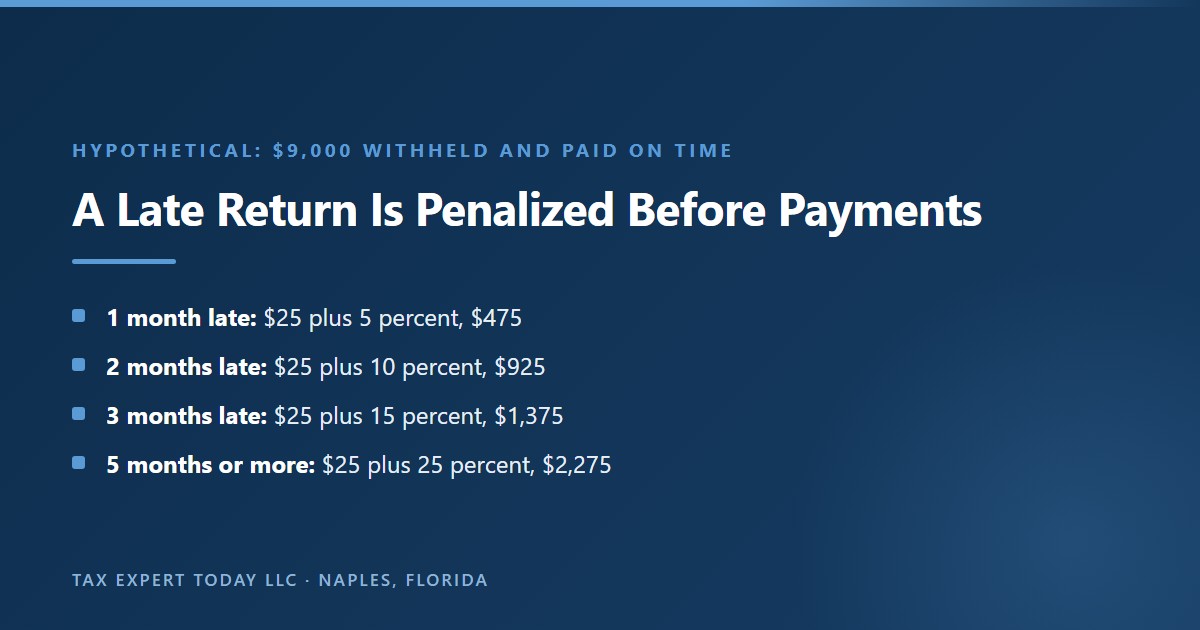
A late Georgia Form G-7 can carry a $25 penalty plus 5 percent of the tax withheld for each month or fraction of a month, up to $25 plus 25 percent. The Department computes the percentage before payments or credits, so a return can be penalized even when all tax was paid on time.
- Late filing: $25 plus 5 percent per month or partial month.
- Late payment: $25 plus 5 percent per month, minimum $25.
- Combined cap per quarter: $25 plus 25 percent.
- Interest: Federal Reserve prime plus 3 percent, reset each January.
- Reasonable cause: can remove the penalty, on the facts.
| Return filed late by | Percent | Percent of $9,000 withheld | Flat amount | Penalty |
|---|---|---|---|---|
| 1 month | 5 percent | $450 | $25 | $475 |
| 2 months | 10 percent | $900 | $25 | $925 |
| 3 months | 15 percent | $1,350 | $25 | $1,375 |
| 4 months | 20 percent | $1,800 | $25 | $1,825 |
| 5 or more months | 25 percent | $2,250 | $25 | $2,275 |
The table is a hypothetical computation for a return reporting $9,000 withheld and paid in full on time, using the Department’s description on its penalty and interest page, which states that the base is the tax withheld before payments, credits, or adjustments. The statute, O.C.G.A. 48-7-126(c), refers to “the amount of the tax,” so an employer with a large fully paid return that receives this penalty has a reason to read the assessment closely. The form instructions and the guide use the before-payments approach, and an employer should expect the Department to apply it.
The month count works against procrastination. The penalty is 5 percent if the failure lasts not more than a month, plus 5 percent for each additional month or fraction of a month. A return that is filed a few days after the first month has ended has entered the second 5 percent tier. Once a return is late, every month boundary has a cost, so filing quickly is usually worthwhile even when the numbers still need a final review and a later amendment.
Other penalties can apply in the same quarter. A failure to withhold carries $10 per employee, limited to $10 per quarter for each employee. Wage statements that are late to employees or the Department carry $10, $20, or $50 per statement depending on how late they are. Fraudulent receipts carry $50 each, and a willful failure to comply is a misdemeanor according to the guide. A timely payment that should have been electronic can draw the 10 percent penalty described above.
How Does Georgia Form G-7 Reconcile With Form G-1003 and W-2s?
The four Georgia Forms G-7 for a year should agree with the Georgia withholding reported on the year’s W-2s and 1099s, which are submitted with Form G-1003. Differences usually point to a payroll correction, a posting error, or a missing wage statement, and they are easier to fix before the January filing.
- G-7s: quarterly liability and payments.
- G-1003: annual transmittal of wage statements.
- W-2 and 1099-NEC date: February 1, 2027, for 2026.
- Other 1099s: March 1, 2027, for 2026.
- Federal comparison: Form 941 uses a separate tax base.
A year-end tie-out is worth scheduling before the fourth quarter return. Add the withheld amounts from the first three G-7s, add the payroll system’s fourth quarter Georgia withholding, and compare the total to the Georgia amount expected on Forms W-2. If those figures disagree, the problem may sit in a voided check, a manual payroll, a late bonus, or a wage correction that never reached the state column. It is far easier to deal with those items while the fourth quarter G-7 is still open.
The Form G-7 also has no wage line, so it cannot be tested against wages the way a federal Form 941 can. The tie-out depends on the state withholding column in the payroll records. Employers also need to keep those records. O.C.G.A. 48-7-111, as cited in the guide, requires payroll records to be retained for at least four years after the tax is due or paid, whichever is later.
Multi-state payroll adds a separate check. Only amounts for Georgia should appear on the G-7. An employer with staff in several states should confirm that each employee’s state coding follows the location of the work and, for Georgia residents working elsewhere, whether the other state requires withholding. A coding mistake that places Georgia tax in another state’s column, or the reverse, generally appears as a mismatch on the W-2 and then on the employee’s individual return.
How Do Tax Credits Affect Georgia Form G-7?
Employers that apply Georgia business credits against payroll withholding must file those withholding returns electronically, because the Department requires electronic filing for any return that includes series 100 tax credits. The credit reduces cash paid, but the pre-credit liability still determines the employer’s payer status for the following year.
- Filing method: electronic, regardless of the amount.
- Lookback test: uses the liability before credits.
- Credit approval: credit programs have their own elections.
- Documentation: keep the credit approval with the quarterly file.
A credit against payroll withholding is available only after the underlying credit program’s requirements have been met. The return is where the benefit shows up, but the election, the Department approval where required, and the credit carryforward records all sit outside the form. Before applying a credit to a G-7, confirm the amount available for that account and period, and whether the approval relates to the same FEIN and withholding number.
Credit users should also examine their deposit schedule with care. An employer can pay very little cash and still be a semi-weekly payer, or it can trigger electronic filing because of the credit rule alone. If a credit will eliminate a quarter’s liability, the return is still due and the reporting of the credit needs to be correct.
What Changes on Georgia Form G-7 in 2027?
Starting in 2027, the Department says the G-7 forms will collect quarterly employer totals and employee counts for Georgia qualified overtime and cash tips. For tax year 2026, employers should not report those totals on the G-7. The existing reporting of tax withheld, adjustments, tax due, and tax paid continues unchanged.
- For 2026 returns: no tips or overtime totals on the G-7.
- For 2026 year end: report on Forms W-2 and 1099 with G-1003.
- For 2027 returns: quarterly totals and employee counts.
- Withholding: the reporting does not by itself reduce it.
- Law: House Bill 463, for taxable years through December 31, 2028.
| Item | Tax year 2026 | Beginning in 2027 |
|---|---|---|
| Tax withheld, adjustments, tax due, tax paid | Reported on Form G-7 | Reported on Form G-7 |
| Qualified overtime and cash-tip totals | Not reported on Form G-7 | Quarterly employer totals on Form G-7 |
| Employee counts | Not reported on Form G-7 | Reported on Form G-7 |
| Year-end wage statements | W-2 and 1099 with Form G-1003 | Continues, in addition to the quarterly data |
The September 2026 update of the Employer’s Tax Guide is the source for this change, and it postdates much of what is available on payroll vendor sites. As of November 10, 2026, the current forms on the Department’s site still carry the Rev. 05/12/25 date and we have not seen a published 2027 layout. The exact fields should be confirmed when the Department releases the updated return, likely before the first quarter 2027 filing on April 30, 2027.
The practical step is to start the data capture now. Employers with hourly overtime or tipped staff should ask their payroll provider whether the system can produce quarterly totals for qualified overtime and cash tips, along with the number of employees receiving them, starting with the first payroll of 2027. Waiting until the first return is due would force a quarter of manual reconstruction.
The change also does not alter how much tax employers withhold. The guide says reporting qualified amounts does not reduce Georgia income tax withholding or the Georgia wages in Form W-2, Box 16. Employees claim the subtraction on their own Georgia returns, subject to the limit in O.C.G.A. 48-7-27(a)(16) and (17). The current rate, formulas, and allowances are described in our Georgia withholding tax article and on the Department’s important tax updates page, which lists the 4.99 percent rate for 2026.
What Does Georgia Form G-7 Not Cover?
Georgia Form G-7 covers ordinary payroll and similar withholding. It does not report nonresident owner withholding, real estate sale withholding, lottery payment assignments, film withholding, or unemployment tax. Each of those items has its own form, and the form instructions specifically direct nonresident owner withholding to Form G-7NRW.
- Nonresident members: Form G-7NRW with Form G2-A.
- Real estate sales: Form G2-RP.
- Film production: Forms G2-FP and G2-FL.
- Unemployment tax: reported to the Georgia Department of Labor.
| Payment or situation | Form | Paid to |
|---|---|---|
| Payroll withholding | Form G-7 | Department of Revenue |
| Nonresident partners, members, shareholders | Form G-7NRW with Form G2-A | Department of Revenue |
| Sale of Georgia real estate by a nonresident | Form G2-RP | Department of Revenue |
| Assignment of lottery payments | Form G2-LP | Department of Revenue |
| Film production withholding | Forms G2-FP and G2-FL | Department of Revenue |
| Unemployment tax | Department of Labor wage and tax report | Georgia Department of Labor |
| Annual wage statement transmittal | Form G-1003 | Department of Revenue |
The name causes most of the confusion. Form G-7NRW shares a number with the payroll return, but it reports withholding on nonresident partners, members, and shareholders. An S corporation with nonresident owners and regular employees can file both, on separate forms, and the amounts do not combine. Our article on the Georgia composite return explains how an entity can address nonresident owners.
Unemployment tax is the other common mix-up. It is administered by a different agency, on a different wage base, and through a different system. Paying the Department of Revenue does not satisfy an unemployment obligation. Our Georgia unemployment tax guide covers that side of payroll.
How Do You File a Final Georgia Form G-7 When a Business Closes?
A business that closes or changes structure in a way that requires a new number must file a final Form G-7 and pay all tax due by the earlier of the regular due date or 30 days after the event. Wage statements and Form G-1003 are also due within 30 days.
- Return and payment: earlier of due date or 30 days after the event.
- W-2s and G-1003: within 30 days after the event.
- Account closure: report through the Georgia Tax Center.
- New entity: register before withholding under the new structure.
The regulation’s “earlier of” language is what most closing checklists miss. Consider a hypothetical company that stops payroll on February 10. The regular first quarter return would be due April 30, but 30 days after the close is March 12, and that earlier date controls. The guide’s summary simply says within 30 days, which reaches the same result in nearly every case, but the regulation is the safer statement to follow.
Closing the withholding number is a separate step from filing the final return. Regulation 560-7-8-.33 directs employers to report terminations and other changes through the Georgia Tax Center. The Filing Tips note that account changes can also be sent to withholding.issues@dor.ga.gov. An account left open keeps generating return requirements, which can turn into penalties and notices after the owners believe the business has ended.
Sales and conversions need attention too. A structure change that results in a new EIN or otherwise requires a new number means the old account should be closed and the new business registered before its first withholding. Buyers should ask for evidence that the seller’s G-7s have been filed and paid, and a tax clearance request can be a useful part of that diligence, because owners and officers can carry personal exposure for unpaid withheld tax under O.C.G.A. 48-2-52 when the failure is willful.
What Should You Do After a Georgia Form G-7 Penalty Notice?
Read the date and the deadline on the notice first. The Employer’s Tax Guide says an assessment becomes final unless a written appeal is filed within 45 days of the notice date. A protest can be made through GTC or on Form TSD-1, and a penalty waiver can be requested separately.
- Protest: through GTC or Form TSD-1.
- Penalty waiver: a written statement with a specific request.
- Interest waiver: limited to delays caused by the Department.
- Collection: the guide says attempts are suspended during a protest.
Use the deadline printed on the notice. The guide cites a 45 day appeal period under O.C.G.A. 48-2-45, while O.C.G.A. 48-2-46 speaks of a 30 day protest period or another limit specified in the notice. If the two appear to differ, treat the shorter period as the working deadline until the notice is reviewed.
A penalty waiver request should be specific. The guide requires a written explanation of the reason for lateness and a specific waiver request statement, under O.C.G.A. 48-2-43. The statutory standard for the penalty itself is reasonable cause and not willful neglect, so facts and documents carry the request: the date the problem occurred, what the employer did about it, and when it was corrected. Interest is harder to remove. Under O.C.G.A. 48-2-41, it can be waived only when the delay was caused by the action or inaction of the Department.
Where a dispute cannot be resolved with the Department, the Georgia Tax Tribunal may be available, and a business with a balance it cannot pay can review its options with the Department, including whether a compromise is possible at all. Our guide to the Georgia offer in compromise addresses that question for withholding liabilities.
What Are Common Georgia Form G-7 Mistakes?
The most frequent problems are filing the wrong version, missing zero returns, using paper after crossing the $500 electronic threshold, entering net instead of gross withholding, and treating a monthly payment as if it were the quarterly return. Each mistake is preventable with a simple quarterly close checklist and a current payroll calendar.
- Payment without a return: a paid quarter still needs a G-7.
- Wrong version: payer status changed after the lookback.
- Netting credits: the withheld line should show actual withholding.
- Stale account access: notices reach no one.
- Two accounts, one FEIN: combined for the lookback test.
| Mistake | What can follow | Better practice |
|---|---|---|
| Paying but never filing the G-7 | Late filing penalty on the full tax withheld | Calendar the return separately from deposits |
| Mailing after crossing $500 | Deemed failure to file, plus electronic payment penalty | Move to GTC as soon as the trigger is met |
| Ignoring a dormant account | $25 minimum penalties and notices | File zero returns or deactivate the account |
| Using the adjustment line for added tax | Processing problems or a notice | File an amended return as the form instructs |
| Testing status account by account | Deposits on the wrong schedule | Aggregate all accounts under one FEIN |
| Measuring status after credits | Deposits on the wrong schedule | Test the pre-credit liability |
A short quarterly routine catches most of these. Confirm payer status at the start of each year from the lookback figures. Compare the payroll register, deposits, and return before filing. Save each confirmation with the payroll records. Check the Georgia Tax Center for correspondence at the same time. Then calendar the next due date, using the Department’s table instead of assuming it falls on the last day of the month.
Georgia Form G-7 Help in Naples & Southwest Florida
Tax Expert Today LLC advises on Georgia payroll withholding questions from its office in Naples, Florida, and serves Georgia clients nationwide and remotely. We review payer status, delinquent or incorrect Form G-7 filings, penalty notices, closing returns, and the state tax issues that arise for employers operating across several states.
- Office: 11983 Tamiami Trail N, Naples FL 34110.
- Phone: (239) 441-2005.
- Hours: Monday through Friday, 10 a.m. to 5 p.m. Eastern.
- Georgia Form G-7 help Naples: Naples and Southwest Florida in person, Georgia and all 50 states remotely.
Many Florida business owners have Georgia employees, remote staff in metro Atlanta, or an interest in a Georgia company, and the withholding obligation can arrive before anyone has opened a Georgia account. We work as tax advisors on state tax matters nationwide, and a review of Georgia payroll filings often fits into a broader look at the owner’s Georgia nonresident return, entity structure, and Florida planning. For the full range of our Georgia work, see the Georgia tax services page. Clients in Florida who want to plan around multistate operations can begin with our Naples tax planning page.
When to Engage a Professional
Engage a tax professional if you have unfiled or incorrect quarters, received a Department of Revenue notice, crossed into a new payer status, operate under several withholding numbers, apply credits against payroll, are closing or buying a business, or need to correct Georgia withholding from a prior year. Early review can limit avoidable penalties.
- Unfiled periods: the assessment period may remain open.
- Prior year corrections: G-7s, W-2cs, and G-1003 must agree.
- Credit users: status and electronic filing rules both change.
- Ownership changes: final returns and new registrations overlap.
- Notices: deadlines run from the notice date.
Tax Expert Today LLC reviews Georgia withholding filings as part of our wider state and federal tax practice. Our Georgia tax help covers filing reviews, correction planning, and Department of Revenue correspondence. Call (239) 441-2005 for a free consultation. This guide is general information about Georgia rules as of November 10, 2026, and is not legal or tax advice for your situation. Results depend on the facts of each case.
Frequently Asked Questions About Georgia Form G-7
What is Georgia Form G-7 used for?
Georgia Form G-7 is the quarterly return employers use to report Georgia income tax withheld from wages, any adjustments, the tax due, and the tax paid. It is filed with the Georgia Department of Revenue, usually through the Georgia Tax Center.
When is Georgia Form G-7 due?
The return is due by the last day of the month following the end of each quarter, moving to the next banking day when that day falls on a weekend or holiday. The fourth quarter 2026 return is due February 1, 2027, and the 2027 returns are due April 30, August 2, November 1, and January 31, 2028.
Do I have to file Form G-7 if I had no employees this quarter?
Yes, if the Georgia withholding account is active. The Department requires a zero return for periods with no withholding, and a late zero return can draw a penalty. Filing stops only when the account has been deactivated through the Georgia Tax Center or by notice to the Department.
Can I file Georgia Form G-7 on paper?
Only if you are not required to pay electronically and the return does not include series 100 credits. Once the tax on a Form G-7 exceeds $500, electronic payment and electronic filing are required for later periods. Semi-weekly payers must always pay electronically, so they must file electronically as well.
What is the penalty for filing Form G-7 late in Georgia?
The Department applies $25 plus 5 percent of the tax withheld for each month or fraction of a month that the return is late, up to $25 plus 25 percent. The percentage is figured before payments or credits, so a return can be penalized even if the tax was paid on time. A reasonable cause waiver may be available.
How do I correct a mistake on Georgia Form G-7?
A credit from an earlier period in the same year generally goes on the Adjustment to Tax line with an explanation. To report additional tax for a past period, the form instructions call for an amended return. Errors that cross calendar years generally require amended G-7s, corrected wage statements, and an amended Form G-1003.
Is Form G-7 the same as Form G-7NRW?
No. Form G-7 reports payroll and similar withholding. Form G-7NRW reports withholding by partnerships, S corporations, and LLCs on the Georgia income of nonresident owners, and each form is filed separately even when one entity must file both.
Will Georgia Form G-7 change in 2027?
The Department says the G-7 forms will be updated beginning in 2027 to collect quarterly employer totals and employee counts for Georgia qualified overtime and cash tips. For tax year 2026, those totals stay off the G-7 and are reported on year-end wage statements instead.
I live in Naples, Florida, and have employees in Georgia. Can you help with Form G-7?
Yes. Tax Expert Today LLC reviews Georgia withholding accounts, Form G-7 filings, and penalty notices from its Naples, Florida office at 11983 Tamiami Trail N, Naples FL 34110, and serves Georgia clients nationwide. Call (239) 441-2005, Monday through Friday, 10 a.m. to 5 p.m. Eastern.
Published November 10, 2026 by Dr. Pellumb Kabashi « Back to Learning Center
Have a question this article touches on?
Tax Expert Today LLC, based in Naples, Florida and serving clients across the United States.
Schedule a Consultation (239) 441-2005