
By Dr. Pellumb Kabashi, DBA, MBA, EA, CFE, CES
Founder, Tax Expert Today LLC · Tax advisors, enrolled agents, CPAs, and attorneys · Serving clients in all 50 states
Quick Answer: An IRS summons is an administrative order, issued by an IRS employee under IRC §7602 without a judge, that compels a person to appear, testify under oath and produce records for an examination or a collection case. It is enforceable only through a federal district court. A summons also removes the usual right to pause an interview to consult a representative. Call (239) 441-2005 for a free consultation.
What is an IRS summons?
An IRS summons is a written administrative order that requires a named person to appear before an IRS employee at a set time and place, to give testimony under oath, and to produce books, papers, records or other data. It is issued under IRC §7602 by the IRS itself, not by a court, and it is used in both examinations and collection cases.
- Four statutory purposes. Section 7602(a) allows a summons to ascertain the correctness of a return, to make a return where none was filed, to determine a tax liability (including transferee or fiduciary liability), or to collect a liability.
- Anyone can be summoned. The statute reaches the person liable for the tax, that person’s officers and employees, anyone holding books of account relating to the business, and any other person the IRS deems proper.
- Criminal inquiries are included. Section 7602(b) adds that the purpose may include inquiring into any offense connected with the internal revenue laws.
- The standard form. The instrument most taxpayers see is Form 2039, Summons. Financial institution records are often requested on Form 6639, Financial Records Summons.
The practical point is that an IRS summons is a step up from an ordinary information request. During an examination the IRS usually asks for records informally, often on an Information Document Request, and the summons handbook at IRM 25.5.1 tells employees to seek voluntary cooperation first and to weigh the importance of the information against the time and expense of obtaining it. When a summons arrives, the IRS has decided that informal requests are not producing what it needs, or that it needs sworn testimony. Anyone reading this after receiving one should know that the audit process described in our guide to what happens if you get audited by the IRS is the usual backdrop, and the summons is the tool that converts a request into a legal obligation.
Is an IRS summons the same as a court subpoena?
No. A court subpoena is issued under the authority of a court in a pending case, while an IRS summons is issued by an IRS employee under the agency’s own statutory authority, with no judge involved at the issuance stage. A judge becomes involved only if the IRS asks a district court to enforce a summons that was not obeyed.
- No court approval to issue. A revenue agent or revenue officer prepares and serves an ordinary summons without asking a court first.
- One exception needs a court first. A John Doe summons, which does not name the taxpayer under investigation, may be served only after a court proceeding under section 7609(f).
- Not self-executing. The IRS cannot fine or jail anyone for ignoring a summons on its own authority. It must go to court under section 7604.
- Still a legal obligation. The absence of a judge does not make a summons optional, and section 7210 separately makes neglect to appear or produce a federal misdemeanor.
The comparison below lays out how a summons sits between the informal request that usually precedes it and the court process that can follow it.
| Instrument | Who issues it | Is compliance required | How it is enforced |
|---|---|---|---|
| Information Document Request (Form 4564) | The examiner | Requested, not compelled | Escalation, which may include a summons |
| IRS summons (Form 2039) | An authorized IRS employee under §7602 | Yes, a legal obligation to appear and produce | District court petition under §7604, then contempt |
| John Doe summons | The IRS, after a court proceeding under §7609(f) | Yes | District court |
| Grand jury or court subpoena | A court or grand jury, usually through the Department of Justice | Yes | The issuing court directly |
What can an IRS summons compel?
An IRS summons can compel three things: attendance at a named time and place, sworn testimony that may be relevant or material to the inquiry, and production of existing books, papers, records or other data described with reasonable certainty. It cannot compel a person to create documents that do not already exist.
- Appearance. The summoned person must appear personally. IRM 25.5.5.4.7 states that the witness’s representative cannot appear instead of the witness on the date set in the summons.
- Testimony under oath. Section 7602(a)(3) authorizes the IRS to take testimony under oath that may be relevant or material to the inquiry.
- Existing records. Section 7603(a) requires the records to be described with reasonable certainty, and the IRS may not use a summons to force a witness to prepare new documents or schedules.
- A reasonable date. Section 7605(a) requires the appearance date to be at least 10 days from the date of the summons, at a time and place that is reasonable under the circumstances.
The relevance threshold is deliberately low. The statute uses the phrase “may be relevant or material,” and the courts have read that to allow the IRS to request information that might throw light on the correctness of a return. It is not unlimited. IRM 25.5.4 tells employees that a summons should never be used for a fishing expedition unrelated to the taxpayer’s liability, and third-party witnesses are protected against requests that are overbroad. The summons must also be served properly: section 7603 requires an attested copy delivered by hand or left at the person’s last and usual place of abode, with certified or registered mail permitted for third-party recordkeepers such as banks, brokers, credit card issuers, attorneys, accountants and enrolled agents.
What does an IRS summons not compel?
An IRS summons does not override constitutional privileges, the attorney-client privilege or the section 7525 tax practitioner privilege, and it does not require a person to answer questions that would tend to incriminate them. It also cannot be issued once a Justice Department referral is in effect, and it cannot be used to harass a taxpayer or pressure a collateral dispute.
- The Fifth Amendment, asserted question by question. A summoned individual may decline to answer a question whose answer would tend to incriminate them, but the privilege must be asserted to each specific question or request, not as a blanket refusal to appear.
- Privileged communications. Communications made to an attorney to obtain legal advice are privileged, and section 7525 extends a similar confidentiality privilege to tax advice from a federally authorized tax practitioner in noncriminal matters.
- No summons after a criminal referral. Section 7602(d) bars any summons, and any enforcement action, once a Justice Department referral is in effect for that person.
- No improper purpose. A summons issued to harass, or to pressure settlement of a collateral dispute, fails the good-faith requirement described in the IRS’s own summons guidance at IRM 5.17.6.
The Fifth Amendment point is more nuanced than most summaries suggest. IRM 25.5.5.4.1 explains that a person has no privilege in the contents of voluntarily created, pre-existing documents, because the government did not compel their creation. The act of producing those documents can still be testimonial, because producing them tacitly admits that they exist, that the person has them, and that they are the documents described. Whether that act-of-production privilege applies depends on the facts, and it is personal, so it does not stop a third party such as a bank from producing its own records about the taxpayer. The privilege analysis is exactly the kind of judgment call that should be made before the appearance date rather than in the room. Section 7605(b) adds a separate protection: only one inspection of a taxpayer’s books of account is made for each taxable year unless the taxpayer requests otherwise or the IRS notifies the taxpayer in writing that an additional inspection is necessary.
Does the right to stop an interview and consult a representative apply to an IRS summons?
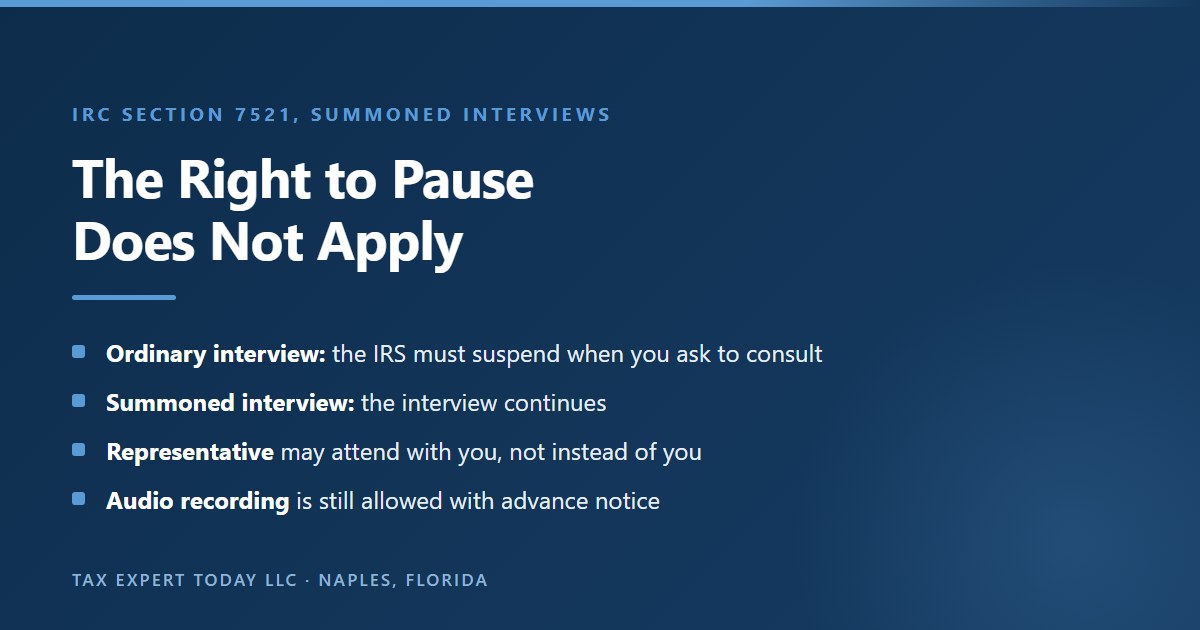
No. Section 7521(b)(2) requires an IRS employee to suspend an interview whenever the taxpayer clearly asks to consult an attorney, CPA, enrolled agent or other authorized representative, but the statute expressly excludes an interview initiated by an administrative summons. In a summoned interview, the IRS continues rather than suspending.
- The general rule is firm. Outside a summons, the employee “shall suspend” the interview, even if the taxpayer has already answered some questions.
- The carve-out is written into the statute. Section 7521(b)(2) excludes “an interview initiated by an administrative summons issued under subchapter A of chapter 78.”
- The IRM applies it directly. IRM 25.5.5.4.2 instructs employees that when a summoned taxpayer wishes to suspend to consult a representative, the interview continues.
- Attendance cannot be delegated. Section 7521(c) lets a representative with a power of attorney attend in the taxpayer’s place for an ordinary interview, but the IRS may require the taxpayer’s own attendance where an administrative summons has been issued to the taxpayer.
This is the exception our audit guide flags without developing, and it is the single most consequential difference between an ordinary examination interview and a summoned one. In an ordinary interview, a taxpayer who is surprised by a line of questioning can stop and call a representative, and the examiner must reschedule. In a summoned interview that safety valve is gone. The practical answer is to bring the representative to the summoned interview from the start. IRM 25.5.5.4.2 confirms that a witness appearing under a summons must be afforded the opportunity to be represented by an attorney and should be informed of that right, although counsel may not control, interfere with or delay the interview. Representation before the IRS for these purposes is established on Form 2848.
Two other interview safeguards do survive a summons. Under section 7521(a), a taxpayer may make an audio recording of an in-person interview at their own expense with advance notice, and IRM 5.17.6.18.2 applies that right to summons proceedings. Section 7521 does not apply at all to criminal investigations, which is one reason a summons issued by a special agent of IRS Criminal Investigation is a different situation from one issued by a revenue agent.
What is a third-party IRS summons, and what notice do you get?
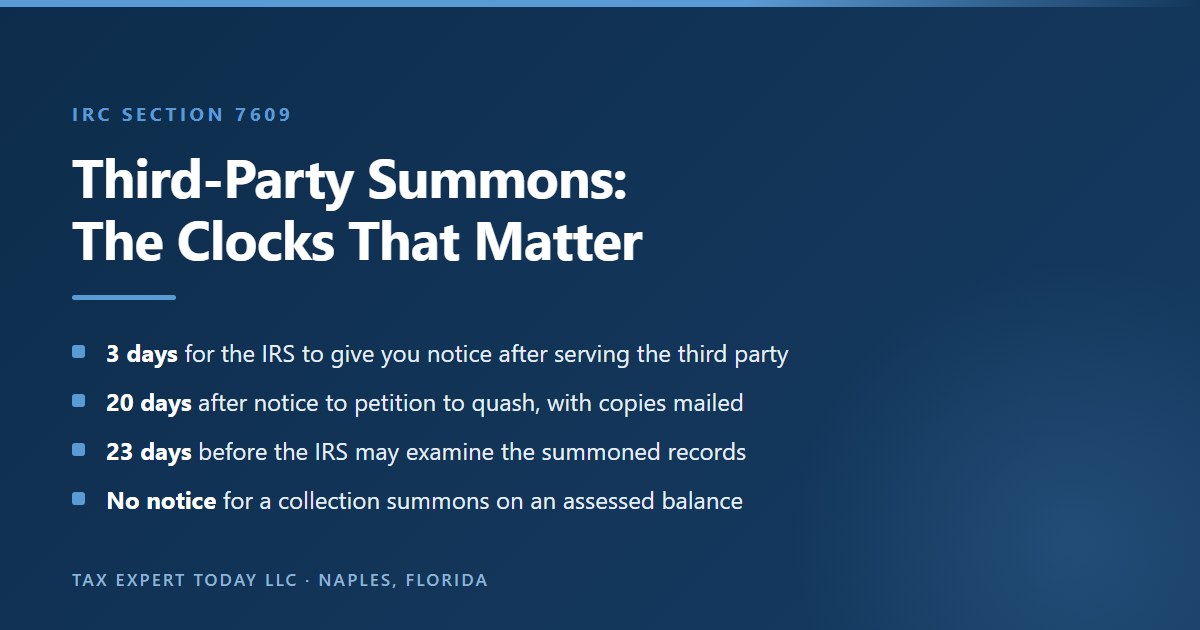
A third-party IRS summons is served on someone other than the taxpayer, such as a bank, broker, employer, customer, accountant or former spouse, and seeks records or testimony about the taxpayer. Unless an exception applies, section 7609(a) requires the IRS to notify the taxpayer within 3 days of service and no later than 23 days before the records are to be examined.
- What the notice contains. The notice includes a copy of the served summons and an explanation of the right to bring a proceeding to quash it. On Form 2039 this is Part D, served with a copy of the summons.
- How notice is given. Notice is sufficient if served in hand, left at the last and usual place of abode, or mailed by certified or registered mail to the last known address, according to section 7609(a)(2).
- A waiting period protects the taxpayer. Under section 7609(d), the IRS may not examine the summoned records before the close of the 23rd day after notice is given, and IRM 25.5.6 describes that as the 24th day.
- Advance warning of contacts. Separately, section 7602(c) generally requires the IRS to tell a taxpayer, at least 45 days in advance, that it intends to contact third parties during a period of up to one year. Revenue officers commonly use a version of Letter 3164 for that notice.
The distinction between first-party and third-party summonses matters because the notice and the right to quash attach only to the third-party kind. When the summons is served on the taxpayer, or on an officer or employee of the taxpayer, section 7609(c)(2)(A) removes the notice requirement entirely, because the taxpayer already knows. For third-party summonses, the summoned party has a duty under section 7609(i) to assemble the records and be ready to produce them on the examination date, and it is protected from liability to its customer when it discloses records in good-faith reliance on a court order or on an IRS certificate that no timely petition to quash was filed.
| Type of IRS summons | Notice to the taxpayer | Right to petition to quash | Court involvement before service |
|---|---|---|---|
| First-party (served on the taxpayer or its officers and employees) | Not required; the taxpayer is the one served | No §7609 petition; defenses are raised if the IRS seeks enforcement | None |
| Third-party in an examination (bank, broker, employer, customer) | Required within 3 days of service, at least 23 days before examination | Yes, within 20 days after notice | None |
| Collection summons for an assessed liability | Not required under §7609(c)(2)(D) | No §7609 petition | None |
| John Doe summons (taxpayer not named) | Not required under §7609(c)(3) | No §7609 petition | Yes, a court proceeding under §7609(f) |
| Criminal investigator summons to a person who is not a third-party recordkeeper | Not required under §7609(c)(2)(E) | No §7609 petition | None |
How do you petition to quash a third-party IRS summons, and how long do you have?
A taxpayer entitled to notice may begin a proceeding to quash a third-party IRS summons in the United States district court for the district where the summoned party resides or is found, no later than the 20th day after notice is given. Within the same 20 days, a copy of the petition must be mailed by registered or certified mail to the summoned party and to the IRS office named in the notice.
- The deadline is short and statutory. Section 7609(b)(2)(A) sets the 20-day window, and courts have generally applied it strictly, so a late petition is usually dismissed.
- The mailing requirement is separate. Section 7609(b)(2)(B) requires the petition to be mailed to both the summoned person and the IRS office within the 20 days.
- A timely petition freezes the records. Under section 7609(d)(2), no examination of the records may occur while a properly begun proceeding is pending, except by court order or the petitioner’s consent.
- The IRS can counter in the same case. The statute lets the IRS seek to compel compliance within the quash proceeding itself.
A petition to quash is not a vehicle for arguing that the tax is wrong. It is a challenge to the summons, and the grounds are the ones a court would weigh in any enforcement case: whether the IRS has a legitimate purpose, whether the information may be relevant, whether the IRS already has it, whether the required administrative steps were followed, and whether a privilege applies. Filing also carries a cost the taxpayer should weigh. Under section 7609(e)(1), when the taxpayer (or an agent or nominee) brings the proceeding, the assessment statute of limitations under section 6501 and the criminal statute under section 6531 are suspended while the proceeding and any appeals are pending. Our guide to the IRS audit statute of limitations explains why that suspension can matter more than the summons itself.
Can the IRS summon your bank without telling you when it is collecting a tax debt?
Yes, in many cases. Section 7609(c)(2)(D) exempts from the notice requirement a summons issued in aid of collecting an assessment or judgment against the person whose liability the summons concerns, and the Supreme Court held in Polselli v. IRS, 598 U.S. 432 (2023), that the exception applies even when the records belong to someone else.
- Assessment is the dividing line. IRM 5.17.6.6 applies the collection exception to assessed liabilities, transferee liabilities and liabilities reduced to judgment.
- Pre-assessment work does not qualify. The same IRM section states that summonses in a delinquent return investigation or a pre-assessment trust fund recovery penalty investigation are not collection summonses.
- Spouses are third parties. The IRM treats a summons served on the opposite spouse as a third-party summons, and where the liability is assessed it is a collection summons excepted from notice.
- What Polselli settled. The taxpayer in that case argued that notice was required because the delinquent taxpayer had no legal interest in the accounts summoned. The Court held that the statute contains no such condition.
For someone with an assessed balance, this means the absence of a notice is not evidence that no summons exists. A revenue officer working a balance due account can summon bank, brokerage and payment records to locate assets and income, including records held in a spouse’s or a business’s name, without the notice and waiting period that apply in an examination. That is usually the step before a levy, which is why taxpayers who have received a CP504 or a final notice of intent to levy should expect the IRS to know more about their accounts than they have told it. The Collection Due Process hearing offered with that final notice is the formal place to propose a collection alternative before a levy. Where trust fund taxes are involved, the rule runs the other way before assessment: IRM 25.5.6.4.1 requires the section 7609 notice procedures for third-party summonses issued to investigate persons who may be responsible for the trust fund recovery penalty.
What happens if you ignore an IRS summons?
If a summoned person does not comply, the IRS can refer the case to its counsel and the Department of Justice can petition the federal district court to enforce the summons under section 7604. A person who then disobeys a court order to comply can be held in civil or criminal contempt, and neglecting a summons is separately a misdemeanor under section 7210.
- A last chance letter usually comes first. Under IRM 25.5.10, a collection summons referred for enforcement typically produces a letter from Associate Area Counsel setting a new appearance date at least 15 days from the referral.
- Court enforcement is summary. The court hears whether the Powell standards are met, and the proceeding is designed to be quick rather than a full trial.
- Contempt is the real sanction. Section 7604(b) allows the court to issue an attachment for arrest and to punish disobedience; civil contempt coerces compliance, while criminal contempt punishes.
- The criminal statute is rarely the first tool. Section 7210 provides, on conviction, a fine of not more than $1,000, imprisonment of not more than one year, or both, together with costs of prosecution.
Ignoring a summons also has quieter consequences. Section 7609(e)(2) suspends the assessment and criminal limitations periods, beginning six months after service of a third-party summons, until the summoned party’s response is finally resolved, so a dispute that drags on can extend the time the IRS has to assess. And an examiner who cannot obtain records will generally proceed on the information available, which can mean a proposed adjustment that is harder to undo later through a notice of deficiency challenge or audit reconsideration. A missed appearance is rarely the end of the matter, but responding late is almost always more expensive than responding on time.
What must the IRS prove to enforce a summons in court?
Under United States v. Powell, 379 U.S. 48 (1964), the IRS must show that the investigation has a legitimate purpose, that the inquiry may be relevant to that purpose, that the information is not already in its possession, and that the administrative steps the Code requires have been followed. The burden is light, and it usually shifts quickly to the person resisting.
- A declaration usually suffices. United States v. Clarke, 573 U.S. 248 (2014), confirms that the IRS can ordinarily meet the Powell standards with a simple affidavit or declaration from the investigating agent.
- Questioning the agent requires evidence. Under Clarke, a taxpayer may examine the agent only after presenting credible evidence that plausibly raises an inference of bad faith.
- Bad faith is a recognized defense. IRM 5.17.6 lists harassment, pressure to settle a collateral dispute, and other purposes reflecting on the investigation’s good faith as improper.
- Procedural defects count. Missing section 7609 notice where it was required, or issuing a summons after a Justice Department referral, fails the administrative-steps element.
| Powell element | What the IRS typically shows | Where a challenge usually focuses |
|---|---|---|
| Legitimate purpose | An open examination or collection case for identified periods | Evidence of harassment or a collateral motive (Clarke threshold) |
| Possible relevance | The records may shed light on the liability | Overbreadth, periods or entities outside the inquiry |
| Not already possessed | The agent’s declaration that the IRS lacks the material | Proof the IRS already has the specific records |
| Administrative steps followed | Proper service, required notice, no referral in effect | Defective notice, late service, a §7602(d) referral bar |
The honest reading of this table is that most summons challenges do not succeed on the merits, because the standards were written to be easy for the government to meet. That does not make a challenge pointless. A narrowing negotiation over the scope of the requested records, the periods covered, or the entities included is often more productive than a petition, and it is only available before the appearance date. It also helps to know that section 7610 provides witness fees and mileage for summoned persons and reimbursement of search and reproduction costs for third parties, though not for the taxpayer or the taxpayer’s own agents.

Does an IRS summons mean a criminal investigation?
Not necessarily. Most IRS summonses are issued in civil examinations and collection cases by revenue agents and revenue officers. A summons can be used to inquire into a tax offense under section 7602(b), however, and a summons issued by a special agent of IRS Criminal Investigation signals a different and more serious posture.
- Look at who issued it. The issuing officer’s title appears on the summons. A revenue agent or revenue officer indicates a civil matter; a special agent indicates Criminal Investigation.
- Notice rules change in criminal cases. Section 7609(c)(2)(E) removes the third-party notice requirement for a criminal investigator’s summons served on someone who is not a third-party recordkeeper.
- Interview safeguards do not apply. Section 7521(d) states that the section does not apply to criminal investigations.
- The referral bar is a boundary. Once a Justice Department referral is in effect, section 7602(d) ends the administrative summons route and the grand jury process takes over.
A civil summons can still carry criminal risk where the underlying facts involve unreported income, false documents or years with no returns filed. Section 7602(e) limits the use of financial status or economic reality examination techniques to find unreported income unless the IRS has a reasonable indication that unreported income is likely, which is one reason bank records summonses tend to follow, rather than precede, some other indication. Anyone in that position should speak with qualified counsel before the appearance date, not after, because the choice between answering and asserting a privilege is made question by question in the room. Where the concern is simply years that were never filed, our guide to unfiled tax returns and the substitute for return process explains the civil path.
What are the key IRS summons deadlines?
The main IRS summons clocks are the 10-day minimum between the summons date and the appearance date, the 3-day window for the IRS to give third-party notice, the 20-day window for the taxpayer to petition to quash, and the 23-day waiting period before the IRS may examine third-party records. Each runs from a different starting point, so they should be calendared separately.
- Read the dates on the document. The summons shows the date of issuance and the date, time and place fixed for appearance.
- Count the quash period from notice. The 20 days run from the day notice is given in the manner the statute provides, not from the day the envelope is opened.
- Expect statute suspensions. Both a taxpayer’s quash proceeding and an unresolved third-party dispute can suspend the assessment period.
- Rescheduling is by agreement. IRM 25.5.5.4.7 allows a new fixed date by mutual agreement for a valid reason such as illness.
| Clock | Length | Starts from | Authority |
|---|---|---|---|
| Minimum time to appearance | At least 10 days | The date of the summons | §7605(a) |
| Third-party notice to the taxpayer | Within 3 days, and at least 23 days before examination | Service on the third party | §7609(a)(1) |
| Petition to quash, with mailed copies | No later than the 20th day | The day notice is given | §7609(b)(2) |
| Waiting period before records are examined | Until the close of the 23rd day | The day notice is given | §7609(d)(1) |
| Advance notice of third-party contacts | At least 45 days, for a period of up to 1 year | Before the contact period begins | §7602(c)(1) |
| Statute suspension for an unresolved third-party response | Until final resolution | 6 months after service | §7609(e)(2) |
How should you respond to an IRS summons?
Treat an IRS summons as a fixed legal deadline. Read who issued it, what periods and records it covers, and whether it is first-party, third-party or collection related, then gather the responsive records, identify any privilege issues, and arrange representation before the appearance date rather than at it.
- Confirm it is genuine. Check the issuing officer, the office address and the case details against prior correspondence, and verify by calling the IRS office through a number you locate independently.
- Map the request. List every category of records, the tax periods and entities covered, and anything that does not exist or is held by someone else.
- Screen for privilege. Identify attorney-client, section 7525 and Fifth Amendment issues before any record leaves your hands.
- Engage early. A representative can often agree a narrower scope, a document production in place of some testimony, or a new date, which is only possible before the deadline passes.
Two practical points are worth adding. First, producing what the summons asks for, organized and indexed, is usually the fastest way to move an examination forward, and a disorganized production invites follow-up requests. Second, a summons in a collection case is usually about finding assets and income, so it is often the right moment to put a collection alternative on the table. A complete Form 433-A collection information statement can support an installment agreement, an offer in compromise or currently not collectible status, and presenting one voluntarily can change the tone of a case that was heading toward a bank levy or a wage garnishment.
IRS summons help Naples: tax resolution Naples and Southwest Florida
Tax Expert Today LLC works with taxpayers in Naples, Florida and across Southwest Florida who have received an IRS summons, a third-party summons notice, or a last chance letter. In this region many summonses arise from examinations of self-employed individuals, real estate and seasonal businesses, and from collection cases where a revenue officer is locating accounts. Because the right to pause a summoned interview is not available, the most useful work happens before the appearance date: confirming the scope, organizing the production, and identifying any privilege questions.
People searching for IRS summons help in Naples usually want to know three things quickly: whether they have to appear, whether they can send someone in their place, and whether a notice about their bank means the IRS is about to levy. The short answers are that appearance is required, that a representative can attend with them but not instead of them, and that a collection summons often precedes enforcement. Our IRS resolution and audit support service and our Naples tax resolution page describe how these matters are handled, including coordination with counsel where a privilege or criminal exposure question arises.
Tax Expert Today LLC
11983 Tamiami Trail N, Naples, FL 34110
Phone: (239) 441-2005
Hours: Monday through Friday, 10:00 to 5:00 ET
Where would an IRS summons from a Naples or Fort Myers case be enforced? Section 7604(a) gives jurisdiction to the United States district court for the district in which the summoned person resides or is found. For a person residing in Collier or Lee County, that is the Middle District of Florida, whose Fort Myers Division covers Southwest Florida. A petition to quash a third-party summons is likewise filed in the district where the summoned party resides or is found, which may be a different district if the bank or other third party is located elsewhere.
When to Engage a Professional
Some summonses are routine, particularly a request for a limited set of records that already exist and raise no privilege question. Consider engaging a representative where the summons calls for testimony rather than only documents, where the issuing officer is a special agent or the facts involve unreported income or years with no returns filed, where a notice of a third-party summons arrives and the 20-day window to petition to quash is running, where the summons covers a business, a spouse or records held by an attorney or accountant, where a last chance letter has already been received, or where the summons is part of a collection case and a payment alternative should be presented before enforcement. Tax Expert Today LLC was founded by Dr. Pellumb Kabashi, and every engagement starts from the summons itself, the statute and the IRS’s own procedures rather than from assumptions about what the IRS wants.
This article is educational and general in nature. It does not constitute tax or legal advice for any particular taxpayer, and outcomes depend on individual facts and circumstances. A summons that may involve criminal exposure should be reviewed with qualified legal counsel. Statutory references are current as of the publication date and are subject to change.
Published September 21, 2026 by Dr. Pellumb Kabashi « Back to Learning Center
Have a question this article touches on?
Tax Expert Today LLC, based in Naples, Florida and serving clients across the United States.
Schedule a Consultation (239) 441-2005