
By Dr. Pellumb Kabashi, DBA, MBA, EA, CFE, CES
Founder, Tax Expert Today LLC · Tax advisors, enrolled agents, CPAs, and attorneys · Serving clients in all 50 states
Quick Answer: An IRS CP504B notice is the notice of intent to levy the IRS sends a business under section 6331(d) when a business tax balance stays unpaid. After 30 days the IRS may levy bank accounts, receivables, and business assets, usually after a separate hearing notice, but payroll and federal contractor levies can come first. Call (239) 441-2005 for a free consultation.
What is an IRS CP504B notice?
An IRS CP504B notice is a business notice of intent to levy. It tells a company, partnership, or other entity with an Employer Identification Number that a federal tax balance is still unpaid, that the amount is due immediately, and that the IRS may seize business property or rights to property if the balance is not paid or arranged within 30 days.
- It is a business notice. The B stands for business; the notice is addressed to the entity and shows its Employer ID number.
- It is a statutory levy warning. The IRS issues it to satisfy the written notice requirement in section 6331(d).
- It is late in the notice stream. Earlier balance due notices went unpaid before this one was generated.
- It is not usually the last step. For most balances, a separate hearing notice still comes before a levy.
The IRS describes the letter on its CP504B page (last reviewed January 27, 2026) in plain terms: the agency is providing a notice of intent to levy, as required by Internal Revenue Code section 6331(d), because it has not received payment for the amount owed. If the amount is not paid immediately, the IRS may seize or levy certain property or rights to property, and it may also file a federal tax lien if it has not done so already.
The sample letter the IRS publishes, a seven page CP504B addressed to a corporation with a Form 1120 balance, carries the title “Notice of intent to seize (levy) your property or rights to property” and a bold line reading “Amount due immediately.” The body says that if the business does not call to make payment arrangements, or if the IRS does not receive the amount due within 30 days from the date of the notice, the IRS may levy the business’s property or rights to property and apply it to the balance.
That is the whole message of an IRS CP504B notice in two sentences. Everything else on the letter, and everything in this guide, is about the details a business owner needs to act on it correctly: which levy can actually come next, how much time really exists, what happens to payroll balances, why the penalty rate just changed, and which response protects the business best for its specific facts.
Who receives an IRS CP504B notice instead of a CP504?
A CP504B goes to a business taxpayer, meaning an account kept under an Employer Identification Number for taxes such as corporate income tax, partnership filings, payroll taxes, unemployment tax, or excise tax. A CP504 goes to an individual account kept under a Social Security number. Sole proprietors with income tax debts usually receive the individual version.
- Corporations: C corporations with an unpaid Form 1120 balance, as in the IRS sample.
- Employers: any entity behind on Form 941, 940, 943, 944, or 945 balances.
- Partnerships and LLCs: entities with assessed penalties, payroll taxes, or other business level balances.
- Excise filers: businesses with unpaid Form 720 or similar balances.
The IRS keeps two master files. Individual accounts live on the Individual Master File, keyed to a Social Security number, and business accounts live on the Business Master File, keyed to an Employer Identification Number. The CP504 and the CP504B carry the same legal function, but each one is generated from its own file. If you are an individual with a personal income tax balance, the notice you need is the individual one, covered in our separate guide to the IRS CP504 notice for individuals. This page stays with the business version.
Single member LLCs deserve a short note, because the liable taxpayer can change by tax type. For employment taxes on wages paid on or after January 1, 2009, the Internal Revenue Manual states that the LLC is always the liable taxpayer, even if the LLC is disregarded for income tax purposes. So a single member LLC that runs payroll can receive an IRS CP504B notice in its own name for a Form 941 balance, while its owner receives individual notices for the owner’s Form 1040 balance. Each notice stands on its own, and each needs its own response.
| Feature | CP504 (individual) | CP504B (business) |
|---|---|---|
| Taxpayer identification | Social Security number | Employer Identification Number |
| Typical taxes | Form 1040 income tax and related penalties | Forms 1120, 941, 940, 943, 944, 945, 1065 penalties, 720 |
| Legal basis | IRC §6331(d) notice of intent to levy | IRC §6331(d) notice of intent to levy |
| Response window stated on notice | 30 days from notice date | 30 days from notice date |
| Levy that may follow without a prior hearing notice | State tax refund levy | Disqualified employment tax levy or federal contractor levy |
| Main business assets at risk | Wages, personal bank accounts | Business bank accounts, accounts receivable, business assets |
| Next notice in most cases | LT11 or Letter 1058 | LT11 or Letter 1058 issued to the entity |
Where does the CP504B fit in the business notice sequence?
The CP504B comes after the business has already received at least one balance due notice and has not paid or arranged the balance. It is the statutory notice of intent to levy. For most balances, the Collection Due Process notice, an LT11 or Letter 1058, comes next, and that later notice is the one that opens hearing rights.
- First notice: a balance due notice such as the CP161 for an unpaid business return.
- Adjustment notices: a CP220 when the IRS changes a business return and creates a balance.
- Intent to levy: the IRS CP504B notice itself.
- Hearing notice: the LT11 or Letter 1058 under section 6330, unless an exception applies.
Before the IRS can levy at all, three things have to happen under the Code. The tax must be assessed. The IRS must send notice and demand for payment under section 6303, and the taxpayer must neglect or refuse to pay within 10 days, which is the trigger in section 6331(a). Then the IRS must give written notice of its intention to levy at least 30 days before the levy under section 6331(d), either in person, left at the usual place of business, or by certified or registered mail to the last known address. The IRS CP504B notice is the document that performs that last step for a business account.
The exact number of reminder notices before a CP504B varies with the type of tax and the account history, so the safest assumption is that a CP504B means the earlier notices are behind you, not that you have missed some step you can still rely on. The internal IRS systems mark an account where the 504 notice has issued as being in a specific notice status (status 58 in the manual’s language), which is one of the facts a revenue officer checks before setting the penalty and interest date on the later hearing notice.
The notice that follows matters even more than the CP504B itself. Under section 6330(a), no levy may be made on any person’s property unless the IRS has notified that person in writing of the right to a hearing before the levy, at least 30 days before the first levy for that tax period. That notice is the LT11 when it comes from the Automated Collection System or Letter 1058 when it comes from a revenue officer. Our guide to the LT11 and Letter 1058 final notice explains how to request that hearing.
Is a CP504B the final notice before the IRS levies?
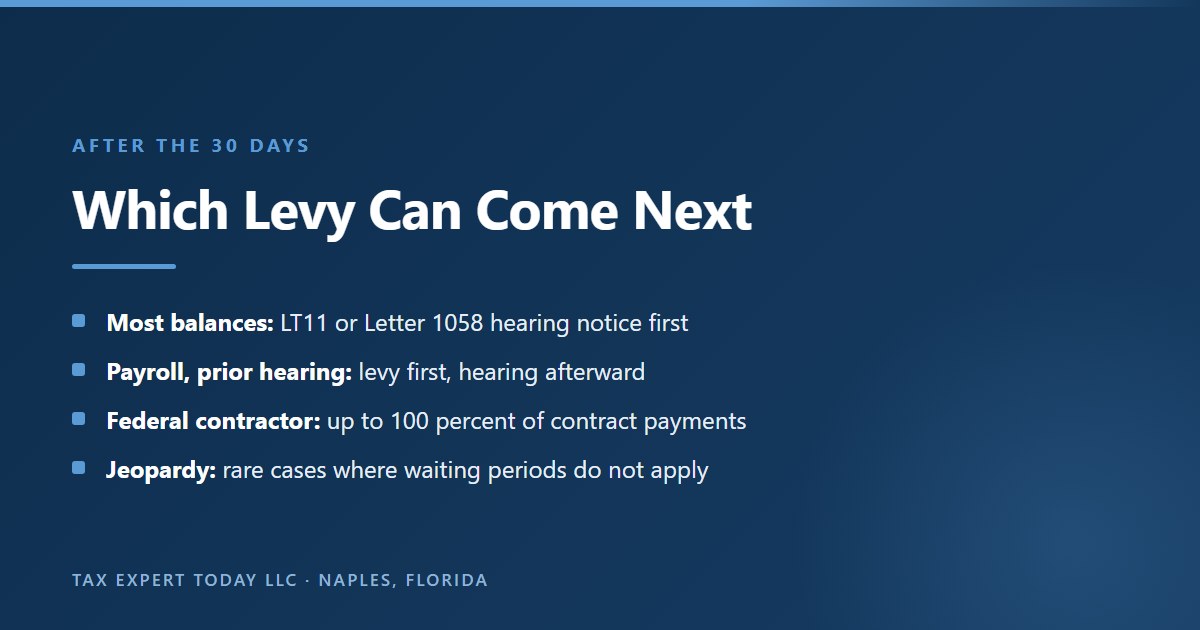
Usually not. For most business balances, the IRS still has to send a Collection Due Process notice, an LT11 or Letter 1058, before it levies. The CP504B itself warns, however, that after 30 days the IRS may serve a disqualified employment tax levy or a federal contractor levy without that later notice first.
- Most balances: CP504B, then the LT11 or Letter 1058, then a possible levy after another 30 days.
- Payroll with a prior hearing request: a levy can follow the CP504B with hearing rights given afterward.
- Federal contractors: a levy on government payments can come first, with hearing rights afterward.
- Jeopardy cases: rare situations where the usual waiting periods do not apply.
This is the point most published explanations get wrong, and it is the most useful fact on the letter. The sample IRS CP504B notice states, on page 2, that if the IRS does not receive the amount due within 30 days from the date of the notice, it may serve a Disqualified Employment Tax Levy or a Federal Contractor Levy, and that in most other situations the IRS will first send a notice giving the business the opportunity to request a Collection Due Process hearing, unless it has already issued one. The current IRS CP504B page repeats the same rule.
So the honest answer has three parts. For a corporation that owes Form 1120 tax and has never received a hearing notice for that period, the CP504B is a warning, and a Collection Due Process notice still has to come before a levy. For an employer that previously asked for a Collection Due Process hearing on payroll taxes within the last two years, the CP504B may be the last letter before a levy on new payroll periods. For a business that sells goods or services to the federal government, payments due under those contracts can be levied after the 30 days without the hearing notice first. The next two sections explain each exception.
Some online summaries tell readers to request a Collection Due Process hearing in response to an IRS CP504B notice. That advice confuses two different letters. The CP504B does not itself grant Collection Due Process hearing rights. What it does offer is a Collection Appeals Program appeal, covered later in this guide, and the chance to resolve the balance before the hearing notice issues.
What is a disqualified employment tax levy, and when can it skip the hearing notice?
A disqualified employment tax levy is a levy to collect payroll taxes from a business that, itself or through a predecessor, requested a Collection Due Process hearing on unpaid employment taxes from the two years before the period being collected. In that case the IRS may levy first and offer the hearing afterward, generally within about 10 days.
- Taxes covered: employment taxes under chapters 21 to 24, reported on Forms 941, 940, 943, 944, 945, and CT-1.
- Trigger: a prior hearing request on employment taxes, not simply owing payroll tax.
- Lookback: two years measured back from the start of the period being levied.
- Predecessors count: a new entity run by the same people can inherit the prior request.
Congress added this exception in 2007, and it lives in section 6330(f)(3) and (h)(1). The statute defines a disqualified employment tax levy as any levy in connection with the collection of employment taxes for a taxable period if the person subject to the levy, or any predecessor, requested a hearing under section 6330 with respect to unpaid employment taxes arising in the most recent two year period before the beginning of the taxable period for which the levy is served. When such a levy is served, section 6330 does not apply in advance, except that the taxpayer must be given the opportunity for the hearing within a reasonable period after the levy.
Many payroll tax articles shorten this to “payroll balances lose the pre-levy hearing,” which overstates it. Owing Form 941 tax does not, by itself, remove anything. The exception turns on history: the business, or a predecessor, must have asked for a Collection Due Process hearing on employment taxes for periods inside the lookback window. A first time payroll debtor with no prior hearing request is in the ordinary track, and the IRS CP504B notice is followed by the usual hearing notice.
The Internal Revenue Manual at 5.11.1.5.2 walks through the lookback with three examples. The window starts on the first day of the quarter being levied and runs back two years. A prior hearing request for the quarter ending December 31, 2018 falls inside the lookback for a new quarter that began April 1, 2019, so that new quarter qualifies. The same prior request does not reach back to a quarter that began January 1, 2018, because that quarter is earlier than the prior one, and a hearing for the quarter ending March 31, 2017 falls just outside a lookback that starts April 1, 2017.
| Prior hearing request covered quarter ending | New quarter being levied begins | Lookback window | Disqualified employment tax levy? |
|---|---|---|---|
| December 31, 2018 | April 1, 2019 | April 1, 2017 to April 1, 2019 | Yes |
| December 31, 2018 | January 1, 2018 | January 1, 2016 to January 1, 2018 | No |
| March 31, 2017 | April 1, 2019 | April 1, 2017 to April 1, 2019 | No |
The predecessor rule is what stops a business from closing one entity and opening another to reset the clock. The manual lists factors the IRS weighs: substantially the same owners and officers, the same people actively running the business, no arm’s length purchase for fair market value, the same products or services, the same customers, the same assets, and the same location or phone number. No single factor decides it. A genuine sale to an unrelated buyer for fair market value, where the old owner steps away, generally breaks the chain. A new corporation formed by the same owner or a family member who keeps running the same operation generally does not.
Two practical consequences follow. First, if your business requested a hearing on payroll taxes in the last two years and new quarters are now unpaid, treat the IRS CP504B notice as possibly the last letter before a bank or receivables levy, and act inside the 30 days. Second, the IRS keeps discretion: the manual says that when warranted, the IRS may still issue a pre-levy hearing notice for periods that meet the criteria. That is a reason to call, not a promise to rely on.
Can the IRS levy federal contract payments after an IRS CP504B notice?
Yes. If the business is a federal contractor, the IRS may serve a federal contractor levy after the 30 days on the CP504B without first sending the hearing notice, and the hearing is offered afterward. Payments to vendors of goods or services to the government can be levied at up to 100 percent through the Federal Payment Levy Program.
- Who is covered: any person, or predecessor, who is a federal contractor.
- What is reached: federal payments due to the business, matched through the Treasury payment system.
- Rate: up to 100 percent of a specified payment to a vendor or Medicare provider, 15 percent for most other federal payments.
- Notice: a post levy notice, CP 297C for a business, gives the hearing rights.
The authority is section 6330(f)(4) and (h)(2), added in 2010. A federal contractor levy is any levy if the person whose property is subject to the levy, or any predecessor, is a federal contractor. The continuous levy rules in section 6331(h) then let the IRS attach up to 15 percent of most specified federal payments, and section 6331(h)(3) substitutes 100 percent for payments due to a vendor of property, goods, or services sold or leased to the federal government, and for payments to Medicare providers and suppliers.
The IRS explains the mechanics on its Federal Payment Levy Program page. Delinquent accounts are matched against pending federal payments through the Bureau of the Fiscal Service. For an ordinary match, the IRS sends a final notice of intent to levy with hearing rights first, CP 90 for individuals or CP 297 for businesses. For a federal contractor, or for a business with a prior employment tax hearing request, the levy may be transmitted without that final notice, and a post levy notice follows. Section 6331(h) levies are continuous, so they keep attaching to each payment until released.
For a contractor, this is the single most important reason not to wait on an IRS CP504B notice. A 100 percent levy on a progress payment can stop payroll and supplier payments on the contract that would have paid the tax. Medical practices that bill Medicare face the same 100 percent rate on their Medicare reimbursements.
What property can the IRS levy after an IRS CP504B notice?
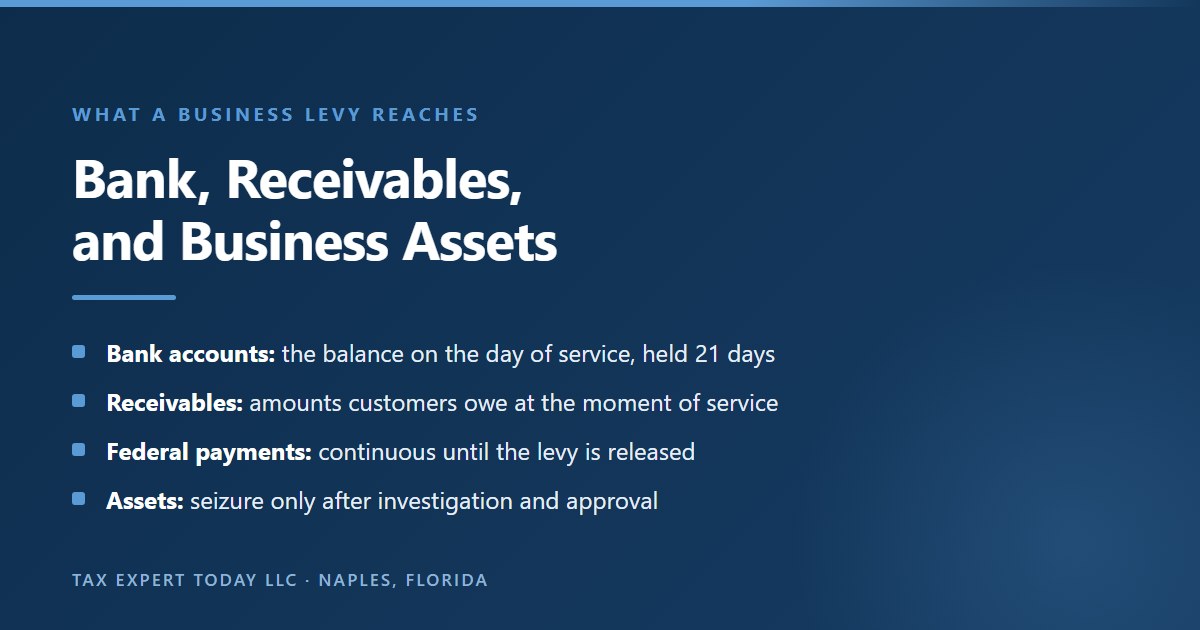
After the required notices, the IRS can levy almost any business property or right to property, including business bank accounts, accounts receivable owed by customers, other income, business equipment, vehicles, inventory, and real estate. A levy reaches what exists when it is served, except continuous levies on wages and certain federal payments.
- Bank accounts: the balance on hand when the bank receives the levy, held 21 days before release to the IRS.
- Receivables: amounts customers owe the business at the moment the levy reaches them.
- Business assets: equipment, vehicles, inventory, and real property, subject to seizure rules.
- Federal payments: continuous levies on contract and other federal payments.
The IRS CP504B page lists the property it has in mind: wages, real estate commissions, accounts receivable and other income; bank accounts; business assets; personal assets, including a car and home; and Social Security benefits. The list is written for every taxpayer type, so a corporation will not have Social Security benefits, but the business items are the ones that matter here. The page also notes that the State Income Tax Levy Program currently applies only to individual state tax refunds, though it may include business state tax refunds in the future.
The scope of a single levy is set by section 6331(b): except for continuous levies, a levy extends only to property possessed and obligations existing at the time it is made. That rule shapes how business levies work in practice. A bank levy freezes the balance on the day it arrives, and deposits made the next day are not caught unless the IRS serves another levy. A receivables levy served on a customer reaches what that customer owes the business on the day of service, so invoices that are already due are exposed, while work not yet billed generally is not. Section 6331(c) lets the IRS levy again, as often as necessary, until the balance is paid.
Accounts receivable levies surprise business owners more than any other kind. The IRS learns who your customers are from Forms 1099 the customers file, from bank deposits, and from your own records during a field contact. A notice of levy then goes directly to the customer, who must pay the IRS instead of you for amounts owed at the time. Besides the cash flow hit, the customer now knows your business has a tax problem. Our guide to an IRS bank levy release covers the 21 day hold on bank levies and the grounds for asking the IRS to release one.
| Levy target | What it reaches | Continuous? | Key rule |
|---|---|---|---|
| Business checking and savings | Balance on the day the bank receives the levy | No | Bank holds funds 21 days before paying (IRC §6332(c)) |
| Accounts receivable | Amounts the customer owes at the time of service | No | Levy reaches existing obligations only (IRC §6331(b)) |
| Federal contract payments | Each specified payment until release | Yes | Up to 100 percent for vendors (IRC §6331(h)(3)) |
| Equipment, vehicles, inventory | Physical assets seized and sold | No | Investigation and approval rules before sale (IRC §6331(j)) |
| Books and tools of the trade | Exempt up to an inflation adjusted limit | Not applicable | IRC §6334(a)(3) |
Seizing and selling physical assets is rarer and more heavily regulated than a bank or receivables levy. Section 6331(j) bars a levy on property to be sold until a thorough investigation is complete, including verification of the liability, a determination that there is enough equity to yield net proceeds, and a thorough consideration of alternative collection methods. Section 6334(a)(3) exempts books and tools necessary for the trade or business up to an inflation adjusted dollar limit. These protections are real, but they slow a seizure rather than prevent it.
What does an IRS CP504B notice show, and how do you read it?
An IRS CP504B notice shows the business name and Employer ID number, the tax form and period, the notice date, a billing summary of tax, failure to pay penalty, and interest, the amount due immediately, the 30 day deadline, the right to a Collection Appeals Program appeal, and payment instructions. Read the form number and tax period first.
- Header: notice code CP504B, tax period, notice date, Employer ID number, and a phone number.
- Billing summary: amount owed, failure to pay penalty, interest charges, and the total due.
- What you need to know: the section 6331(d) statement and the two levies that can follow directly.
- Appeal and payment pages: the CAP right, EFTPS instructions, and payment plan information.
The sample notice uses a Form 1120 for the 2018 tax year, a notice date of January 30, 2019, and an amount due immediately made up of the prior balance, a failure to pay penalty, and interest charges. Your letter will show your own figures, but the layout is the same. Four details on it deserve a careful look before you call anyone.
First, the form number and tax period. A CP504B can cover a single quarter of Form 941, a year of Form 940, a Form 1120 year, or a penalty assessed on a partnership return. If your records show the return was filed and paid, the issue may be a misapplied payment, a deposit posted to the wrong quarter, or a payment under a different Employer ID number, which is the territory of the CP60 notice on removed payments. Second, the notice date, because every deadline on the letter counts from it, not from the day the envelope arrived. Third, the billing summary, which tells you how much of the balance is tax and how much is penalty that may be removable. Fourth, the caller ID and phone number, which route your call to the unit holding the account.
The notice also tells you what the IRS will assume if you are silent: if you disagree with the amount, call to review the account, and if the IRS does not hear from you, it will assume you agree. That sentence is why silence is the most expensive response to an IRS CP504B notice.
How long do you have to respond to an IRS CP504B notice?
The notice gives 30 days from the date printed on it to pay or make arrangements before the IRS may levy. The practical window is shorter for two reasons: the failure to pay penalty rate doubles 10 days after the notice, and payroll or federal contractor levies can follow on day 31 without another letter.
- Day 0: the notice date printed on the IRS CP504B notice.
- Day 10: the failure to pay penalty rises from 0.5 to 1 percent per month on unpaid tax.
- Day 30: the end of the 30 day window for payment, arrangements, or a CAP appeal request.
- After day 30: a possible disqualified employment tax levy or federal contractor levy, or the hearing notice.
The 30 days come straight from section 6331(d)(2), which requires the notice no less than 30 days before the day of the levy. The IRS CP504B page tells businesses to pay or contact the IRS as soon as possible but no later than 30 days from the date of the notice. Mail takes time, and a letter dated the 1st that sits in a lockbox or an old business address until the 12th has already used more than a third of the window.
Last known address rules matter here. The statute lets the IRS mail the notice to the business’s last known address, and the notice is valid even if nobody opens it. A business that moved without filing Form 8822-B, or whose mail goes to a former bookkeeper or a closed office, can find its first notice of a problem is a frozen bank account. Updating the address does not reset a notice already sent, but it protects the next one.
Why did the penalty rate change after the IRS CP504B notice?
Because the Code doubles the failure to pay penalty once a notice of intent to levy is given. Under section 6651(d), for each month beginning more than 10 days after the section 6331(d) notice, the penalty rate rises from 0.5 percent to 1 percent of the unpaid tax per month, still subject to the overall 25 percent cap.
- Normal rate: 0.5 percent of unpaid tax for each month or part of a month.
- After the levy notice: 1 percent per month starting with the month after day 10.
- Cap: 25 percent of the unpaid tax in total.
- No business discount: the quarter percent rate during a payment plan applies only to individuals.
The step-up is in section 6651(d). It substitutes 1 percent for 0.5 percent for each month beginning after the earlier of the day 10 days after notice is given under section 6331(d), or the day notice and demand for immediate payment is given in a jeopardy case. The sample CP504B says the same thing in plain language: if the business does not pay within 10 days of the notice, the penalty for paying late increases to 1 percent per month.
Business owners sometimes read about the reduced quarter percent rate during an installment agreement and expect it to apply. It does not. Section 6651(h) limits that reduction to an individual who filed on time. A corporation or partnership on a payment plan keeps paying the full failure to pay rate until the tax is paid or the 25 percent cap is reached, and interest under section 6601 runs on top. That is one reason a business that can borrow or sell an idle asset to pay a CP504B balance in full often pays less than one that spreads it out.
| Hypothetical: $40,000 unpaid Form 1120 tax | Monthly failure to pay penalty | Basis |
|---|---|---|
| Before the IRS CP504B notice | $200 (0.5 percent) | IRC §6651(a)(2) or (a)(3) |
| Months beginning more than 10 days after the notice | $400 (1 percent) | IRC §6651(d) |
| Maximum total penalty | $10,000 (25 percent) | IRC §6651(a) |
| During an installment agreement (business) | $400 (1 percent, no reduction) | IRC §6651(h) applies to individuals only |
The figures above are hypothetical and simplified; the actual penalty is computed on the net unpaid tax at the start of each penalty month, so it falls as payments are made. Interest is separate and compounds daily.
Will the IRS file a federal tax lien after an IRS CP504B notice?
It may. A federal tax lien already arose by law when the tax was assessed and went unpaid. The CP504B warns that the IRS may file a public Notice of Federal Tax Lien, and the manual’s general guideline is to file when the total unpaid assessed balance is $10,000 or more, subject to exceptions.
- Statutory lien: arises automatically under section 6321 on assessment, notice and demand, and nonpayment.
- Notice of lien: the public filing that puts lenders and buyers on notice.
- General threshold: aggregate unpaid balance of assessments of $10,000 or more.
- Hearing right: a separate lien hearing notice under section 6320 within 5 business days after filing.
The sample notice is direct about it: if the business has not paid, a federal tax lien has arisen as a claim against all its property, and if it does not pay immediately or make arrangements, the IRS can file a Notice of Federal Tax Lien publicly establishing its priority with creditors. The Internal Revenue Manual at 5.12.2 lists the CP 504 among the notices that tell a taxpayer a lien notice may be filed, and its filing criteria say a lien notice should generally be filed when the aggregate unpaid balance of assessments is $10,000 or more, or when an installment agreement does not meet the criteria for one of the simplified agreement types, such as a streamlined or in-business trust fund express agreement.
For a business, a filed lien notice reaches beyond the IRS. It can trip loan covenants, freeze a line of credit renewal, appear in vendor credit checks, and complicate the sale of equipment or real estate. If the business needs to sell or refinance a specific property while the lien is in place, the tools are a certificate of discharge or subordination, and once the balance is resolved or on a qualifying direct debit plan, a lien withdrawal under Form 12277 may be available. A request to withhold the lien filing can be raised in a Collection Appeals Program appeal before it happens.
How do you stop a levy after an IRS CP504B notice?
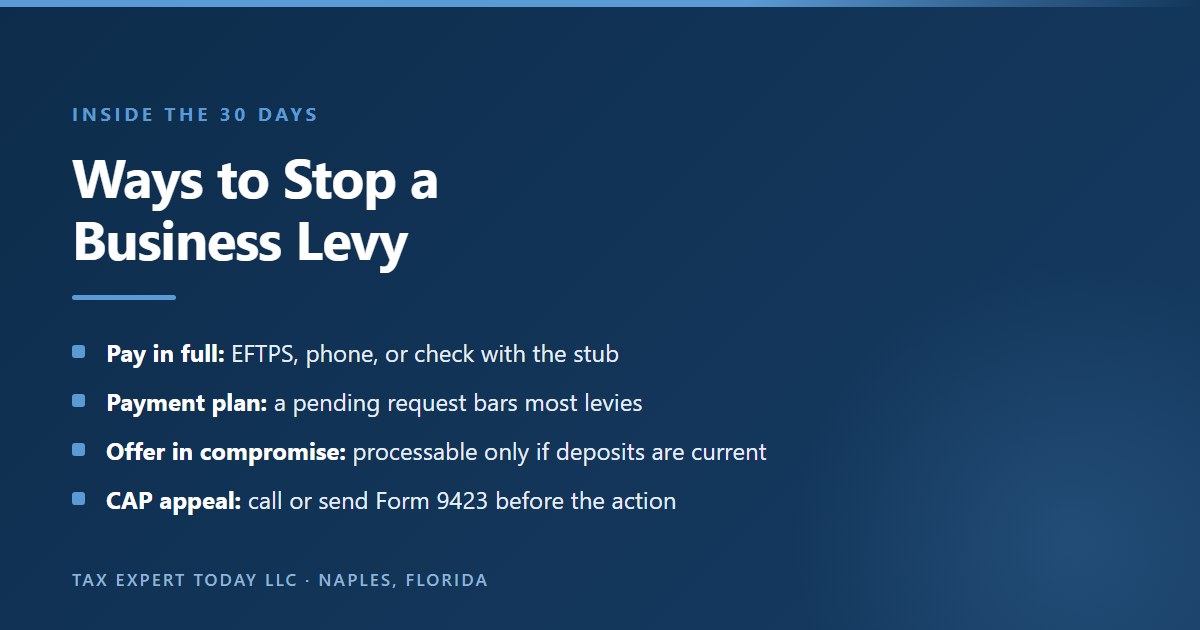
You stop a levy by paying in full, by getting an installment agreement or offer in compromise pending or approved, by showing the balance is wrong, or by appealing through the Collection Appeals Program inside the 30 days. Section 6331(k) bars most levies while a payment plan or processable offer is pending or in effect.
- Pay: through EFTPS, by phone, or by check with the payment stub.
- Arrange: request an installment agreement by phone at the number on the notice.
- Settle: submit a processable offer in compromise if the business qualifies.
- Dispute: call with proof if the balance is wrong, or file a CAP appeal.
The strongest legal protection on that list is in section 6331(k). No levy may be made while an offer in compromise is pending, for 30 days after a rejection, and during a timely appeal of that rejection. The same protections apply to an installment agreement request while it is pending, during the 30 days after a rejection, while the agreement is in effect, and for 30 days after a termination, again extended while an appeal is pending. A complete, processable request made within the 30 days on the IRS CP504B notice therefore does more than start a negotiation; it blocks most levies by law.
Paying in full is the simplest path when it is possible. The sample notice directs businesses to pay through the Electronic Federal Tax Payment System at eftps.gov, by phone, or by check or money order payable to the United States Treasury with the Employer ID number, the tax period, and the form number written on it. EFTPS enrollment can take up to 7 business days to take effect, so a business that is not already enrolled and is near the deadline should consider another payment channel. The notice also says that if the balance was paid in full within the past 21 days or arrangements were already made, the business can disregard it.
If the balance cannot be paid at once, a payment plan is the usual answer. The IRS payment plan page (updated March 3, 2026) directs business taxpayers to call the number on the notice or 800-829-4933, or to visit a Taxpayer Assistance Center. The sample CP504B describes an In-Business Trust Fund Express installment agreement for small businesses that owe $25,000 or less in assessed tax, penalties, and interest. Larger balances usually require financial disclosure on a collection information statement for businesses. Our guide to IRS installment agreement options compares the agreement types, and our Form 433-A guide explains how the IRS measures ability to pay for owners who are personally involved.
| Response | Stops a levy? | Best fit | Authority |
|---|---|---|---|
| Full payment | Yes, ends the balance | Business has or can raise the funds | IRC §6331(a) |
| Installment agreement request | Yes, while pending and in effect | Viable business that can pay over time and stay current | IRC §6331(k)(2), §6159 |
| Offer in compromise | Yes, while pending and 30 days after rejection | Balance exceeds what can realistically be collected | IRC §6331(k)(1), §7122 |
| Collection Appeals Program | Normally paused while Appeals considers it, except jeopardy and payroll levy cases | Disagreement with a proposed levy or lien filing | IRS Publication 1660 |
| Proof the balance is wrong | Yes, once the account is corrected | Payment posted elsewhere or return not processed | Account adjustment |
| Ignoring the notice | No | Never | Levy may follow after the required notices |
What is a Collection Appeals Program appeal on a CP504B, and how is it different from a CDP hearing?
A Collection Appeals Program appeal lets a business ask the IRS Independent Office of Appeals to review a proposed levy or lien filing before it happens. The CP504B offers it by phone or Form 9423 within 30 days. It is faster and broader than a Collection Due Process hearing, but the decision cannot be taken to court.
- How to request: call the number on the notice or send Form 9423 to the address on the notice.
- Timing: within 30 days from the date of the notice, before the action is taken.
- Scope: proposed levies, lien filings, and installment agreement rejections or terminations.
- Limit: no Tax Court review of a CAP decision.
The sample notice states the right in a dedicated section: if the business does not agree with the IRS intent to levy or file a Notice of Federal Tax Lien, it has the right to request an appeal under the Collection Appeals Program before the collection action takes place, by calling or sending Form 9423 within 30 days. The notice then adds a sentence many readers skip: the CAP is different from the Collection Due Process program.
Publication 1660 explains the difference. A Collection Due Process hearing is available only after a lien filing notice or a pre-levy hearing notice, it allows Tax Court review, and it lets the taxpayer raise collection alternatives and, in some cases, the underlying liability. CAP generally produces a quicker decision and covers a broader range of actions, but you cannot go to court if you disagree with the result. For a business holding an IRS CP504B notice, CAP is the appeal available now; the Collection Due Process hearing comes with the LT11 or Letter 1058. Our CDP versus CAP guide compares the two in detail.
Publication 1660 also describes how a CAP appeal starts when the only contact so far has been a notice. The business calls the number on the notice, explains which action it disagrees with and why, and offers a solution. If no agreement is reached, it asks to appeal; the employee must refer the request to a manager, who either speaks with the business then or returns the call within 24 hours. If the manager’s decision is still unacceptable, the case goes to Appeals, and no written request is required at that stage. Arriving with a concrete proposal, such as a monthly figure the business can actually pay, is what moves these calls forward.
While Appeals considers a CAP case, the publication says the IRS normally will not take action to collect the tax for the periods under review, unless it believes collection is at risk or the business meets the criteria for a disqualified employment tax levy. That second exception is worth reading twice. An employer with a prior payroll hearing request inside the two year lookback should not count on a CAP appeal to hold off a levy on new payroll quarters. Choosing CAP now does not waive Collection Due Process rights later; if the IRS sends the hearing notice after a CAP decision, the business can still request a timely hearing on that notice.
What should an employer do differently when the CP504B is for payroll taxes?
An employer with a payroll balance should stay current on new deposits first, then designate voluntary payments to the trust fund portion of the oldest quarters in writing, check whether any prior hearing request makes new quarters eligible for a payroll levy, and prepare for a possible Trust Fund Recovery Penalty review of the people who control payments.
- Stop the growth: make every current federal tax deposit on time, or no agreement will hold.
- Designate payments: written directions control how a voluntary payment is applied.
- Check the lookback: a prior employment tax hearing request changes the levy timeline.
- Expect personal exposure: responsible persons can be assessed the trust fund amount.
Payroll balances are different because part of the money belongs to employees. Income tax withheld and the employee share of Social Security and Medicare are held in trust for the government, and section 6672 lets the IRS assess a penalty equal to 100 percent of that trust fund amount against any person responsible for collecting and paying it who willfully fails to do so. Owners, officers, and anyone who decides which creditors get paid can be in scope. The full process, including Letter 1153 and the 60 day appeal window, is in our guide to the Trust Fund Recovery Penalty.
Payment designation is the tool most owners have never heard of. Under Rev. Proc. 2002-26, when a taxpayer voluntarily tenders a partial payment and gives specific written directions for applying it, the IRS applies it as directed. Without directions, the IRS applies the payment to periods in the order that serves its best interest, and within a period to tax, then penalty, then interest. In payroll cases, written designation is how a business aims a voluntary payment at the trust fund portion of a quarter, which reduces the amount that could later be assessed personally. Levy proceeds are not voluntary payments, so the business has no say in how money taken by levy is applied. That alone is a strong reason to act on an IRS CP504B notice before a levy arrives.
The rest of the payroll picture follows from the levy rules above. If the business or a predecessor asked for a Collection Due Process hearing on employment taxes for quarters within two years before the quarter now owed, the IRS can serve a disqualified employment tax levy after the 30 days and offer the hearing afterward. And no payment plan or offer will be accepted, or survive long, while new deposits are missed. The IRS employment tax and TFRP page describes the same priorities from the agency’s side.
One more statutory protection exists for payroll taxes and the trust fund penalty because they are divisible taxes. Section 6331(i) bars a levy for an unpaid divisible tax while a refund suit for a paid portion of that same tax is pending in a federal trial court, if the result would bind the unpaid balance. This is a litigation strategy rather than a quick fix, and it requires paying a divisible portion first and filing a refund claim, but it is a real limit on levy that applies only to these business taxes.
Can a business get an offer in compromise or hardship status after an IRS CP504B notice?
Sometimes. An operating business can submit an offer in compromise if it is current on filings and on federal tax deposits for the current quarter and the two preceding quarters, and a pending processable offer blocks most levies. Hardship status, called currently not collectible, is far less common for an operating business than for an individual.
- Offer in compromise: settles the balance for what the IRS calculates it can realistically collect.
- Deposit test: employers must be current on deposits for three quarters to be processable.
- Not collectible status: more typical for a business that has closed or has no equity or cash flow.
- Collection statute: balances generally expire 10 years after assessment unless suspended.
The Form 656 booklet requires a business owner with employees to make all required federal tax deposits for the current quarter and the two preceding quarters before the IRS will process an offer. Once an offer is pending, section 6331(k)(1) bars levy while it is pending, for 30 days after any rejection, and while a timely appeal of the rejection is pending. Our offer in compromise guide explains how the IRS values assets and future income. For a business, that calculation includes the equity in business assets and the business’s own cash flow, not only the owner’s.
Currently not collectible status suspends active collection when the IRS agrees a taxpayer cannot pay. For an operating business with revenue, the IRS usually looks for a payment plan or offer instead. A business that has ceased operations, with no remaining assets, is a more typical fit. Our guide to currently not collectible status covers the financial tests. In every case, the ten year collection statute in section 6502, explained in our IRS 10 year rule guide, keeps running unless an event such as a pending offer or a timely hearing request suspends it.
What if the CP504B balance is wrong or the penalties are unfair?
If the balance is wrong, call the number on the notice before the 30 days end with proof, such as EFTPS confirmations, cancelled checks, or proof a return was filed. If the tax is right but the penalties are not, ask for penalty relief under first time abatement or reasonable cause. Neither request alone stops the levy clock.
- Misapplied payments: deposits posted to the wrong quarter, form, or Employer ID number.
- Unprocessed returns: a filed return the IRS replaced with an estimate or never posted.
- First time abatement: administrative relief for a clean three year history.
- Reasonable cause: relief for events such as illness, disaster, or records loss.
The sample IRS CP504B notice says that if the business thinks the IRS made a mistake, it should call to review the account, and it lists what to have ready. The current IRS page adds the Document Upload Tool for sending records. For a payroll account, the EFTPS payment history is usually the fastest proof, because it shows each deposit’s date, amount, tax form, and period. A deposit coded to the wrong quarter can produce a CP504B on one quarter and a credit on another, and fixing the coding fixes both.
Penalties on a CP504B balance can be large: failure to file, failure to pay, and for employers the section 6656 failure to deposit penalty, which ranges from 2 to 15 percent of the underpayment depending on lateness. The sample notice invites a request to reduce or remove penalties for reasonable cause and mentions first time abate for a clean history. Our guides to first time penalty abatement and reasonable cause penalty abatement explain each standard. A pending penalty request is not one of the statutory levy bars in section 6331(k), so a business that disputes penalties should still pay the tax or request a payment arrangement within the 30 days.
What happens if a business ignores an IRS CP504B notice?
If a business ignores an IRS CP504B notice, the failure to pay penalty doubles, a lien notice may be filed, and the account moves to the hearing notice, an LT11 or Letter 1058, or to a revenue officer. For payroll accounts with a prior hearing request and for federal contractors, a levy can follow without another letter.
- Automated collection: the Automated Collection System issues the LT11 and can serve levies by mail.
- Field collection: larger or payroll balances are often assigned to a revenue officer.
- Information gathering: a summons can compel bank records and testimony.
- Personal exposure: a trust fund investigation of owners and officers in payroll cases.
For most balances, the next letter is the Collection Due Process notice. Under section 6330(a), that notice is required once per tax period and must arrive at least 30 days before the first levy for that period. The manual notes that a revenue officer often issues Letter 1058 at the first contact with a business taxpayer when a deadline is set for proof of payment, proof of federal tax deposits, or financial information. In other words, the revenue officer’s first visit may come with the final notice in hand.
The IRS Collection Process publication describes the remaining steps: levies on bank accounts and receivables, possible seizure of assets after the required investigation, and the lien filing. A Collection Due Process hearing requested within 30 days of the LT11 or Letter 1058 generally stops levy for the periods in the hearing and opens Tax Court review, so the hearing notice is the last ordinary checkpoint. A business that reaches that point without having used the 30 days on the IRS CP504B notice has given up time and penalty savings, but it has not yet lost its hearing rights.
| Stage | Notice | Main right at this stage | Levy possible? |
|---|---|---|---|
| First bill | CP161 or CP220 | Pay, dispute, or arrange | No |
| Intent to levy | CP504B | Collection Appeals Program appeal within 30 days | Only payroll levy (prior hearing) or federal contractor levy after 30 days |
| Hearing notice | LT11 or Letter 1058 | Collection Due Process hearing within 30 days, Tax Court review | Yes, after 30 days if no timely hearing request |
| Lien filed | Letter 3172 lien hearing notice | Lien hearing under section 6320 | Lien is not a levy |
| Enforcement | Notice of levy to bank or customer | Release request, CAP appeal, post levy hearing in exception cases | Yes |
How can a business keep from getting another CP504B?
A business avoids repeat CP504B notices by making every federal tax deposit on time through EFTPS, reconciling deposits to each filed quarter, keeping its mailing address current with Form 8822-B, responding to the first balance due notice instead of the fourth, and reviewing its IRS business account transcript at least once a quarter.
- Deposit discipline: payroll deposits on the schedule the business is assigned, not when cash allows.
- Reconcile quarterly: match EFTPS history to each Form 941 before filing.
- Current address: file Form 8822-B whenever the business moves or changes its responsible party.
- Early response: resolve the first notice while every option is still open.
Most CP504B notices are the end of a long run of earlier mail that went unanswered. A small business owner who handles the first notice, whether a CP161, a CP220 adjustment notice, or a deposit penalty notice, keeps the penalty at the lower rate, keeps the lien unfiled in many cases, and keeps every resolution option open. Watching the account directly, rather than waiting for mail, catches misapplied deposits before they become a balance.
CP504B notice help Naples: tax resolution Naples and Southwest Florida
Tax Expert Today LLC provides IRS tax resolution from its Naples, Florida office: back taxes and IRS tax debt, payment plans and installment agreements, offers in compromise, wage garnishment and bank levy release, federal tax lien withdrawal, penalty abatement, unfiled returns, and audit representation. The firm is led by Dr. Pellumb Kabashi, an Enrolled Agent with unlimited rights to represent taxpayers before the IRS, a Certified Fraud Examiner, and a Certified Estate and Trust Specialist, with a team of enrolled agents, CPAs, and tax attorneys.
Southwest Florida businesses face a familiar version of the CP504B problem. Restaurants, landscaping and pool companies, contractors, and hospitality businesses carry heavy seasonal payroll, and a slow summer can leave a Form 941 quarter short just as the IRS notice stream catches up. Florida has no personal income tax, but it does tax corporations, and the IRS page notes that its state refund levy program reaches only individual refunds for now. The levies that matter most for a Collier or Lee County business are the bank levy and the receivables levy on local customers.
Our office at 11983 Tamiami Trail N, Naples FL 34110 helps businesses review an IRS CP504B notice, check the account transcript and deposit history, confirm whether a payroll levy could come early, and prepare the payment plan, offer, CAP appeal, or penalty request that fits. Hours are Monday through Friday, 10 a.m. to 5 p.m. Eastern. Learn more about our tax resolution services in Naples, FL, our IRS resolution and audit support, and our IRS tax debt help Naples page, or call (239) 441-2005.
Frequently Asked Questions About the IRS CP504B Notice
What does an IRS CP504B notice mean?
An IRS CP504B notice means a business tax balance is unpaid and the IRS is giving the written notice of intent to levy required by section 6331(d). If the business does not pay or make arrangements within 30 days of the notice date, the IRS may levy business property, usually after a separate hearing notice.
How many days do I have after an IRS CP504B notice?
The notice gives 30 days from the date printed on it. The failure to pay penalty rate rises to 1 percent per month for months beginning more than 10 days after the notice, so acting early saves money even inside the 30 days.
Can the IRS take my business bank account after an IRS CP504B notice?
Yes, once the required notices are complete. For most balances, the IRS must first send an LT11 or Letter 1058 and wait 30 days. For payroll balances where the business made a prior employment tax hearing request within the lookback, or for federal contractors, a levy can follow the 30 days on the CP504B directly.
Is a CP504B the same as a final notice of intent to levy?
No. The IRS CP504B notice is the notice of intent to levy under section 6331(d). The final notice with Collection Due Process hearing rights is the LT11 or Letter 1058 under section 6330. The CP504B offers a Collection Appeals Program appeal instead.
Can I request a Collection Due Process hearing from a CP504B?
Generally no. The IRS CP504B notice does not grant Collection Due Process hearing rights. Those rights come with the LT11 or Letter 1058, or after the levy in the payroll and federal contractor exception cases. The IRS CP504B notice offers a Collection Appeals Program appeal by phone or Form 9423 within 30 days.
Will the IRS contact my customers after an IRS CP504B notice?
It can, after the required notices. An accounts receivable levy is served directly on a customer and reaches amounts that customer owes the business at the time of service. Customers then pay the IRS for those amounts instead of the business.
Does a payment plan stop a levy after an IRS CP504B notice?
Yes, under section 6331(k) most levies are barred while an installment agreement request is pending, while an agreement is in effect, and for 30 days after a rejection or termination. Business taxpayers request plans by calling the number on the notice or 800-829-4933.
Can owners be personally liable for a CP504B payroll balance?
The IRS CP504B notice is issued to the business, but for payroll taxes the IRS can assess the Trust Fund Recovery Penalty under section 6672 against responsible persons who willfully failed to pay the trust fund portion. That penalty is personal and is collected separately from the business balance.
Where can I get help with an IRS CP504B notice in Naples, FL?
Tax Expert Today LLC helps businesses respond to IRS CP504B notices from its office at 11983 Tamiami Trail N, Naples FL 34110, Monday through Friday, 10 a.m. to 5 p.m. Eastern. Call (239) 441-2005 for a free consultation about payment plans, offers, appeals, and levy prevention.
When to Engage a Professional
An IRS CP504B notice is a good moment to bring in a representative, because the next 30 days decide which tools are still available. Consider professional help if the balance includes payroll taxes, if the business or a related company has asked for a hearing on employment taxes before, if the business sells to the federal government or bills Medicare, if a bank or customer levy would interrupt payroll, or if the balance is large enough that a lien filing would affect financing.
A representative can pull the business account transcripts, confirm whether deposits posted correctly, check the lookback for a disqualified employment tax levy, request a payment plan or prepare an offer that is processable on the first submission, and file a Collection Appeals Program appeal if the IRS proposes a levy or lien the facts do not support. Enrolled agents, CPAs, and attorneys can all represent a business before the IRS with a signed Form 2848. Results depend on each business’s facts, and no outcome can be promised in advance.
If your business has received an IRS CP504B notice, our Naples tax resolution team can review it with you, and our IRS resolution and audit support service handles the response from first call to final agreement. Call (239) 441-2005, Monday through Friday, 10 a.m. to 5 p.m. Eastern.
This article provides general educational information about federal tax collection procedures and is not legal or tax advice for any specific situation. Tax laws and IRS procedures change, and results depend on individual facts. Consult a qualified tax professional about your circumstances.
Published November 5, 2026 by Dr. Pellumb Kabashi « Back to Learning Center
Have a question this article touches on?
Tax Expert Today LLC, based in Naples, Florida and serving clients across the United States.
Schedule a Consultation (239) 441-2005