
By Dr. Pellumb Kabashi, DBA, MBA, EA, CFE, CES
Founder, Tax Expert Today LLC · Tax advisors, enrolled agents, CPAs, and attorneys · Serving clients in all 50 states
Quick Answer: Georgia hotel tax is three charges, not one: a $5 per night state hotel-motel fee, state and local sales tax, and a city or county excise tax of up to 8 percent. A $200 night in Atlanta carries about $38.80. The state fee and the local excise stop after 30 continuous days, and sales tax ends at 90 continuous days. Call (239) 441-2005 for a free consultation.
What Is the Georgia Hotel Tax?
The Georgia hotel tax is a stack of three separate charges on a room rental: a flat $5 per night state hotel-motel fee, Georgia state and local sales tax, and a percentage excise tax set by the city or county. Each layer has its own law, its own exemptions, and its own collector.
- State hotel-motel fee: $5 per night, reported to the Georgia Department of Revenue.
- Sales tax: 4 percent state plus local sales taxes, reported to the Department of Revenue.
- Local excise tax: a percentage of the room charge, reported to the city or county.
- Different end dates: the three layers do not stop at the same point in a long stay.
People search for one Georgia hotel tax because the folio or booking page usually lumps the charges together under “taxes and fees.” Legally there is no single tax. The state fee comes from O.C.G.A. 48-13-50.3, the sales tax from the retail sale definition in O.C.G.A. 48-8-2, and the local excise tax from O.C.G.A. 48-13-51.
That structure is the reason most mistakes happen. An exemption that removes one layer often leaves the other two in place. A short-term rental host may be outside the state fee and still owe sales tax. A guest may pass the 30 day mark and still owe sales tax for two more months. This guide treats each layer separately and then puts them back together, because a hotel operator, a host, a corporate traveler, and a government employee each need a different answer.
This guide covers the tax side of lodging. It does not cover real estate assessments or county property bills. If you are a guest who only wants to know why your bill looks high, the next three sections answer that. If you collect these charges, the sections on innkeepers, returns, vendor compensation, and penalties are the ones that carry financial risk.
How Much Is the Georgia Hotel Tax in 2026?
In 2026, the Georgia hotel tax on a typical room is the $5 state fee plus a local sales tax rate of about 6 to 9 percent plus a local excise tax of up to 8 percent. Combined percentages commonly land between 14 and 17 percent of the room rate, before adding the flat $5.
- Flat piece: $5 per room per night, whatever the room rate.
- State sales tax: 4 percent, included in every local combined rate on the chart.
- Combined sales tax: most counties are 7 or 8 percent; Atlanta is 8.9 percent.
- Excise tax: up to 8 percent, and 8 percent is the most common rate on file.
| Layer | Amount | Legal source | Paid to |
|---|---|---|---|
| State hotel-motel fee | $5 per accommodation per night | O.C.G.A. 48-13-50.3 | Georgia Department of Revenue |
| State sales tax | 4 percent of the room charge | O.C.G.A. 48-8-2 and Rule 560-12-2-.51 | Georgia Department of Revenue |
| Local sales taxes | Varies; combined chart rates are generally 6 to 9 percent | Quarterly DOR rate chart | Georgia Department of Revenue |
| Local excise tax | Up to 8 percent of the room charge | O.C.G.A. 48-13-51 | City or county |
The Department of Revenue states the $5 per night fee in its FAQ, and the General Services Administration’s Georgia travel tax page, updated July 1, 2026, repeats the same figure for federal travelers. Sales tax rates come from the Department of Revenue’s quarterly rate chart, and the chart effective October 1, 2026 is the version used here. Those rates can change every quarter, so anyone building a rate table into a property management system should reload the chart each time it is reissued.
The income tax rate does not enter this calculation. Georgia’s flat rate of 4.99 percent for 2026, explained in our guide to Georgia state income tax, applies to the owner’s net rental profit. The lodging charges above are collected from guests and passed through to the state and local governments.
What Is the Georgia State Hotel-Motel Fee?
The Georgia state hotel-motel fee is a $5 excise tax on each night a room, lodging, or accommodation is rented or leased by an innkeeper. It applies per accommodation, not per guest, and stops once a rental becomes an extended stay. The money is intended for transportation purposes under state law.
- Who charges it: innkeepers and marketplace innkeepers.
- What it covers: accommodations furnished for value that provide physical shelter.
- Where it goes: reported on a separate monthly return to the Department of Revenue.
- What it replaced: the narrower 2015 fee, which reached only hotel rooms in larger buildings.
The fee started on July 1, 2015. Until June 30, 2021, it applied only to a “hotel room” in a “hotel,” which meant a building with five or more rooms under common ownership. That older test still appears on many web pages, and it is out of date. Department of Revenue Policy Bulletin FET-2021-01 explains that House Bill 317 extended the fee on July 1, 2021 to any accommodation providing physical shelter that is rented by an innkeeper, and added marketplace platforms as innkeepers.
The change matters most for operators who relied on the five room test. The Department’s 2015 letter ruling on vacation cabins concluded that free-standing units were outside the fee. That reasoning rested on the old definitions and should not be applied to a stay today. The 2021 bulletin’s own example treats the operator of yurts, which are tent-like structures, as an innkeeper when the operator pays local occupation taxes.
Statutory language exempts lodging that does not provide physical shelter. The rule does not define that phrase with a list of examples, so an open site for an RV or tent, where the operator supplies only the ground, deserves a specific review before the fee is dropped. Cabins, inns, and furnished short-term rentals are named in the Department’s FAQ as covered.
What Is the Local Hotel-Motel Excise Tax in Georgia?
The local hotel-motel excise tax is a percentage tax that Georgia cities and counties may levy on room charges under O.C.G.A. 48-13-51. Rates up to 5 percent can be adopted by local ordinance, while rates of 6 to 8 percent generally require a local Act of the General Assembly and spending commitments.
- Who may levy: municipalities, and counties only inside their unincorporated special district.
- Who owes it: imposed on the innkeeper and on the guest, who pays the innkeeper.
- Cap for newer levies: 8 percent under subsection (b).
- Timing of a change: no sooner than the first day of the second month after local action.
Geography decides which government collects. A hotel inside city limits pays the city. A hotel in an unincorporated area pays the county, because subsection (i) of the statute bars a county from levying outside its special district. Two properties a mile apart can therefore have different rates, different return forms, and different agencies.
The Department of Community Affairs rate report, updated August 8, 2025, lists 298 local governments with a rate on file. Of those, 122 are at 8 percent, 107 at 5 percent, 25 at 6 percent, 22 at 7 percent, 21 at 3 percent, and one at 2 percent. A December 2025 Department of Community Affairs presentation says a city or county can adopt a rate of up to 3 percent or 5 percent by ordinance, and that rates of 6 to 8 percent go through a resolution, a local Act, and an ordinance.
The percentage is applied to “lodging charges actually collected.” If the guest was charged more tax than should have been collected, the statute requires the operator to remit the larger amount actually collected. An innkeeper cannot keep an over-collection simply because the rate on the bill was wrong.
The rate is not the whole story in every location. Local press reported that Macon-Bibb County planned a $3 per night occupation tax on lodging starting in January 2026. Charges of that type are separate from the excise percentage and will not appear in the state rate report, so operators should confirm the current list with the local finance office.
What Are Georgia Hotel Tax Rates by City?
Georgia hotel tax rates by city start with the local excise percentage on file with the Department of Community Affairs and the sales tax rate on the Department of Revenue chart. Atlanta, Savannah, Columbus, and Macon-Bibb each list 8 percent excise, while Augusta lists 6 percent and Athens-Clarke 7 percent.
- Highest combined percentage below: Columbus at 17 percent.
- Atlanta: 16.9 percent, because the city carries MARTA and transportation levies.
- Tourism counties: mountain and coastal cities often sit at the 8 percent excise cap.
- Add the flat fee: every row also carries the $5 state fee.
| Location | Sales tax | Excise tax | Percent total | Tax on a $200 night, including $5 fee |
|---|---|---|---|---|
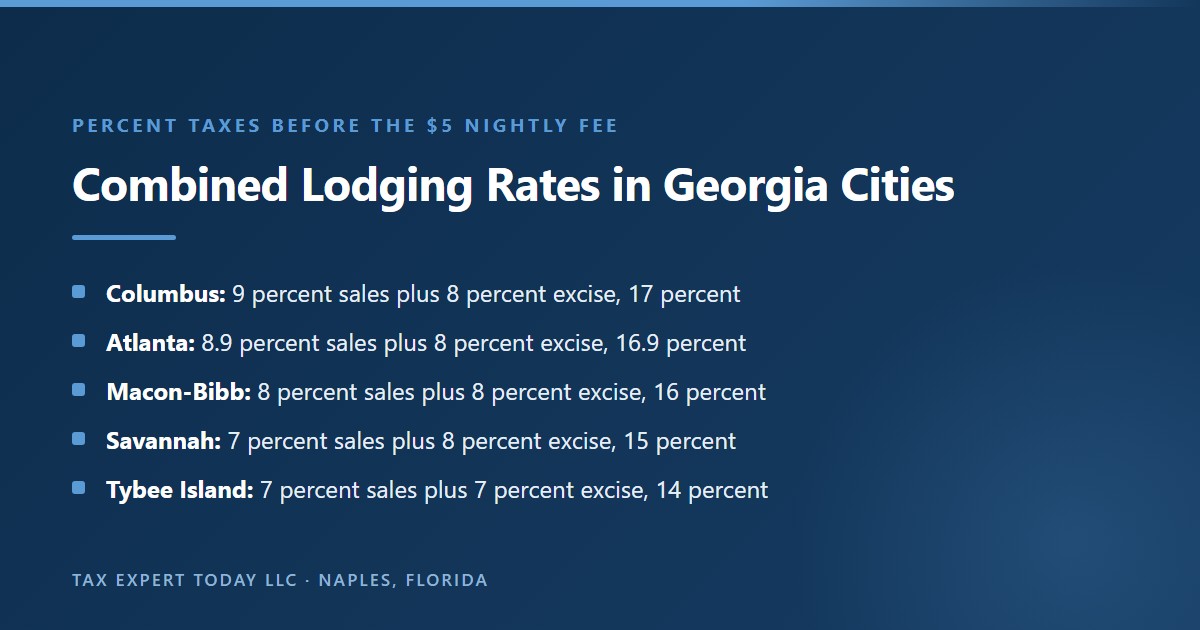
| Atlanta (Fulton) | 8.9 percent | 8 percent | 16.9 percent | $38.80 |
| Savannah | 7 percent | 8 percent | 15 percent | $35.00 |
| Tybee Island | 7 percent | 7 percent | 14 percent | $33.00 |
| Augusta-Richmond | 9 percent | 6 percent | 15 percent | $35.00 |
| Columbus-Muscogee | 9 percent | 8 percent | 17 percent | $39.00 |
| Macon-Bibb | 8 percent | 8 percent | 16 percent | $37.00 |
| Athens-Clarke | 8 percent | 7 percent | 15 percent | $35.00 |
| Helen (White County) | 8 percent | 8 percent | 16 percent | $37.00 |
| Blue Ridge (Fannin County) | 7 percent | 8 percent | 15 percent | $35.00 |
Sales tax rates in the table are from the chart effective October 1, 2026. Excise rates reflect the ordinance on file with the Department of Community Affairs as of its August 8, 2025 update, so a rate adopted after that date would not be shown. Excise rates also differ inside a county. Chatham County lists 6 percent for its unincorporated area, while the city of Savannah lists 8 percent and Tybee Island 7 percent.
The table uses a $200 room for comparison. The dollar figures are hypothetical calculations, not quotes from any property, and a hotel’s own resort fee, parking charge, or destination charge can be treated differently from the room rate.
How Do You Calculate Georgia Hotel Tax on a Room?
To calculate Georgia hotel tax, multiply the room charge by the combined sales tax rate, multiply it again by the local excise rate, and add $5 per night. If the fee is separately itemized, it stays out of the sales tax base. Cheaper rooms pay a higher effective percentage because the fee is flat.
- Step one: identify the room charge actually billed for the night.
- Step two: apply the local combined sales tax rate.
- Step three: apply the city or county excise rate.
- Step four: add $5 per accommodation per night.
Rule 560-13-2-.01(5) gives its own example: a $100 room with a separately itemized $5 fee in a 7 percent county carries $7 of sales tax, because the fee is left out of the sales price. Itemization is what produces that result, so an operator who folds the fee into the room rate invites a sales tax on the fee itself.
The local excise tax has a parallel argument. The sales price definition in O.C.G.A. 48-8-2 excludes taxes legally imposed directly on the consumer that are separately stated, and O.C.G.A. 48-13-51(a)(1)(B)(ii) imposes the excise on the guest as well as the innkeeper. A clean folio that shows each charge on its own line is the practical way to preserve both exclusions.
| Room rate | Sales tax | Excise tax | State fee | Total tax | Effective rate |
|---|---|---|---|---|---|
| $89 | $7.92 | $7.12 | $5.00 | $20.04 | 22.52 percent |
| $150 | $13.35 | $12.00 | $5.00 | $30.35 | 20.23 percent |
| $200 | $17.80 | $16.00 | $5.00 | $38.80 | 19.40 percent |
| $400 | $35.60 | $32.00 | $5.00 | $72.60 | 18.15 percent |
Each row uses Atlanta’s 8.9 percent sales tax and 8 percent excise. A traveler comparing a budget room with a luxury room should notice the last column: the flat $5 is worth 5.6 percent of an $89 rate and only 1.25 percent of a $400 rate. A group block of 20 rooms for three nights carries 60 room nights, and therefore $300 of state fee, before any percentage tax is added.
Who Counts as an Innkeeper Under Georgia Law?
A Georgia innkeeper is either a person that furnishes accommodations for value and is licensed by, or required to pay business or occupation taxes to, the city or county for doing so, or a marketplace innkeeper. The local licensing connection is the fact that most often decides whether a small operator owes the fee.
- Traditional operators: hotels, motels, inns, lodges, tourist camps, cabins, and campgrounds.
- Catch-all: any other place where accommodations are regularly furnished for value.
- Marketplace innkeepers: platforms that facilitate and collect on rentals, above a sales threshold.
- Government-owned hotels: treated as innkeepers under Policy Bulletin FET-2017-01.
The same two-part definition appears in O.C.G.A. 48-13-50.2 for the local excise and in Rule 560-13-2-.01(2)(e) for the state fee. Because the test looks at what the city or county requires, a homeowner’s obligation can depend on a local ordinance the homeowner has never read. A county that adopts an occupation tax for short-term rentals can bring its hosts inside the definition without any change in state law.
Government ownership does not help. Policy Bulletin FET-2017-01 says state or local government enterprises that furnish rooms to the public for value must charge the fee like their private counterparts, because operating a hotel is a proprietary activity.
A new operator also needs a Georgia tax ID number and a sales tax account before the fee account can be opened. Operators who run through an entity should read our guide to Georgia LLC taxes, because the entity’s income tax return is separate from every lodging return discussed here.
Do Airbnb and Vrbo Hosts Owe the Georgia Hotel Tax?
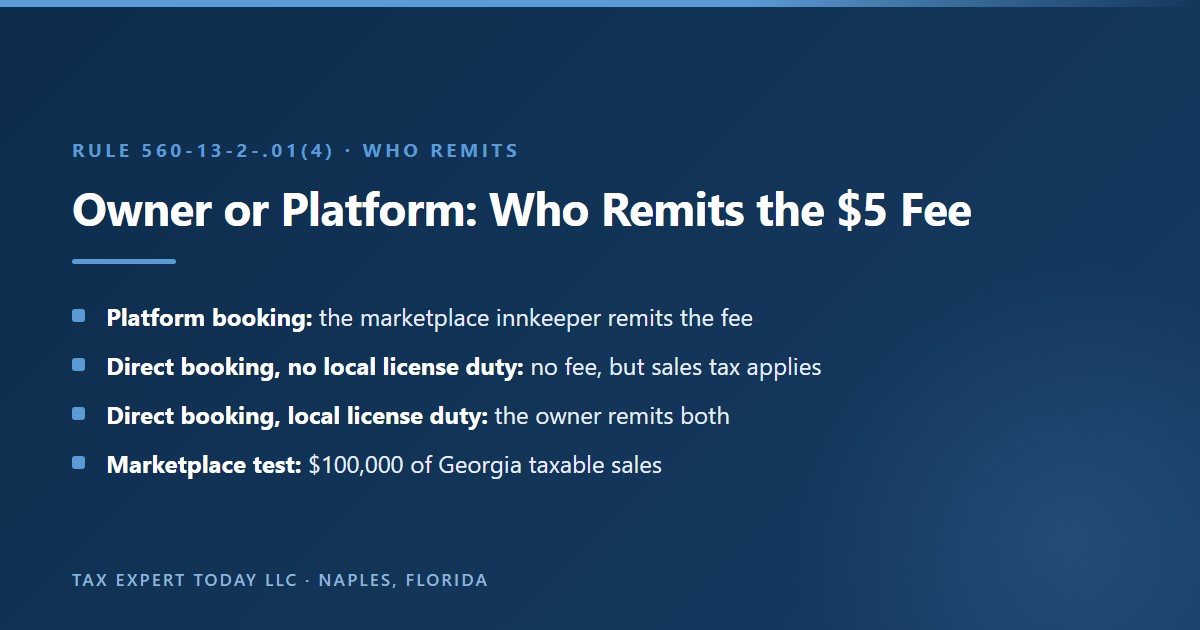
A Georgia host who books only through a marketplace platform generally does not collect the state fee, because the platform is the marketplace innkeeper. A host who rents directly may owe sales tax in every case, and owes the state fee only if local law requires a license or occupation tax for the activity.
- Platform bookings: the marketplace innkeeper collects and remits the fee.
- Direct bookings, no local license duty: no state fee, but sales tax still applies.
- Direct bookings, local license duty: the owner is an innkeeper and owes both.
- Local excise: the platform is the innkeeper for the transactions it facilitates.
The Department’s rule walks through this with three examples, and the table below tracks them. They are unusually direct guidance, and they are the part of Georgia hotel tax that most summaries leave out.
| Scenario from Rule 560-13-2-.01(4) | Who remits the $5 fee | Who remits sales tax |
|---|---|---|
| Owner rents through a local website; no local license or occupation tax required | No one; owner is not an innkeeper | Owner |
| Same owner rents through a marketplace platform that meets the $100,000 test | Marketplace platform | Marketplace platform |
| Owner rents directly; county requires occupation taxes for the activity | Owner, as innkeeper | Owner |
| Owner uses a platform for some nights and direct bookings for others | Platform for its nights; owner for direct nights, if an innkeeper | Platform for its nights; owner for direct nights |
A platform qualifies as a marketplace innkeeper when it collects or processes payment and provides the service that makes the rental available, and when its facilitated Georgia taxable sales combined with its own equal or exceed $100,000 in the previous or current calendar year. Merely processing payments is not enough. A property manager who lists, collects, and handles reservations on behalf of owners should analyze whether its own activity meets the test.
The platform is liable for the greater of the full fee due or the amount it collected. It is relieved to the extent the error came from insufficient or incorrect information from the host, the platform made a reasonable effort to get correct information, and the two are not related members. When that relief applies, the host becomes solely liable, even if the host is not otherwise an innkeeper. Hosts should therefore treat the address and property details they enter on a listing as tax information. O.C.G.A. 48-13-50.4 sets out the matching local excise rules, including a franchisor carve-out when a system’s annual United States gross sales reach at least $500 million and the franchisee contractually handles collection.
Mixed hosts carry the most risk. A host who uses a platform for most nights and takes repeat guests directly by text or a personal website is responsible for the direct nights. A platform’s remittance does not cover a stay it did not facilitate. Income from all of those nights also belongs on the owner’s income tax return, and active hosts should review the federal treatment in our guide to the short-term rental tax loophole. Owners with property in more than one state will find a different structure under the Texas hotel occupancy tax.
When Does Georgia Hotel Tax Stop on an Extended Stay?
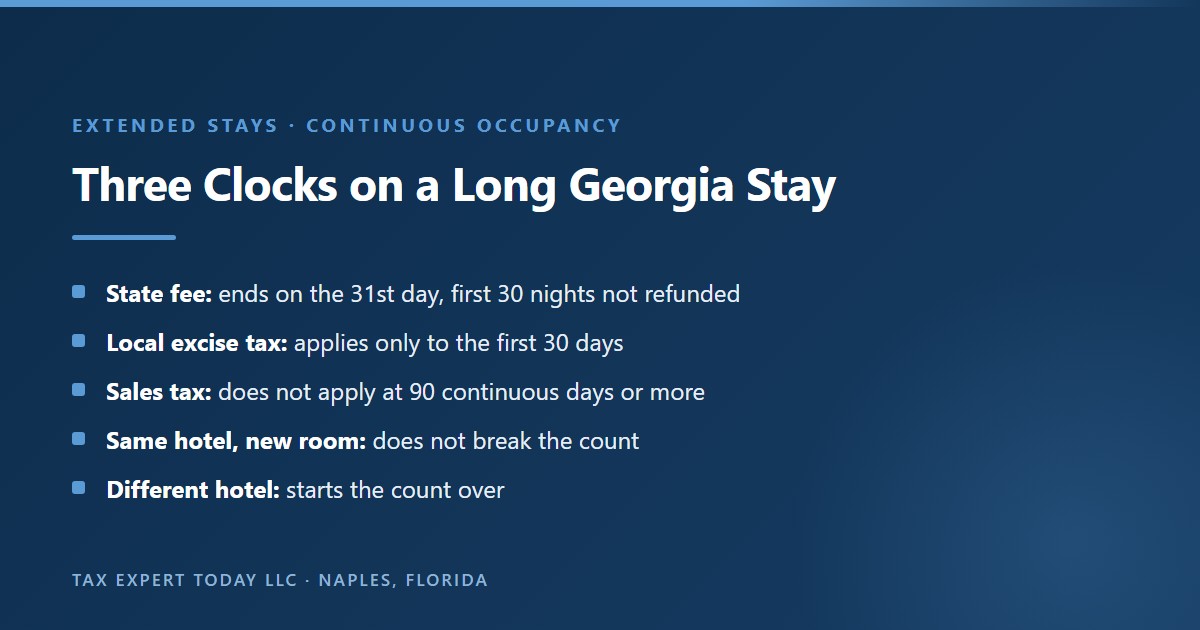
Georgia hotel tax stops on three different clocks. The $5 state fee ends on the 31st day of continuous occupancy, the local excise tax ends after the first 30 days of continuous occupancy, and sales tax does not apply to rooms supplied for 90 continuous days or more. The first 30 days stay taxable.
- State fee: no refund of the first 30 nights once the stay passes 30 days.
- Local excise: applies to the first 30 days and not to continued use afterward.
- Sales tax: the 90 day test is the longest of the three.
- Long contract at check-in: does not remove the fee at the start of the stay.
| Layer | Taxable period | When it ends | Source |
|---|---|---|---|
| State hotel-motel fee | First 30 days | On the 31st day of continuous occupancy | Rule 560-13-2-.01(7) |
| Local excise tax | First 30 days | After the first 30 days of continuous occupancy | O.C.G.A. 48-13-51(h)(4) |
| Sales tax | Stays under 90 continuous days | Does not apply to rooms supplied for 90 continuous days or more | Rule 560-12-2-.51 |
Under Rule 560-13-2-.01(7), an operator must collect the fee from the first night even if the contract promises more than 30 days, and those first 30 nights are not refunded later. Local excise follows a similar logic through subsection (h)(4), which excludes charges “after the first 30 days of continuous occupancy.” Sales tax is phrased differently. Both Rule 560-12-2-.51 and the statute say the tax does not apply to rooms “supplied for a period of 90 continuous days or more,” and neither says how to treat the first 89 days of a stay that reaches 90.
Operators and long-term guests should settle that treatment in writing before the stay starts. A contract for 90 days or more signed at check-in and a stay that grows to 90 days through renewals may not look the same on audit. We read the text as supporting an exclusion when the supply is for 90 continuous days, but the Department’s rule does not address how to handle tax already charged, so this is a question to confirm rather than assume.
What counts as continuous is defined closely for the state fee. Moving to a different room in the same hotel does not break the count. Moving to a different hotel does, even when the same operator runs both, so 20 days at each of two sister properties never reaches extended stay status. If the guest lets the hotel rent the room to someone else during an absence and has no right to another room, the count ends and a new 31 day period must be built.
Checking out on paper needs care, because Department guidance points in two directions. The current FAQ says that when a customer checks out and checks back in to the same facility, continuous occupancy is broken and the count begins again. A 2015 letter ruling, LR SUT-2015-06, concluded that a same-day paper check-out with no break in actual occupancy, and with the room not released to another customer, did not interrupt the period. A letter ruling is limited to its own facts and predates the current rule, while the current rule asks whether days of occupancy were interrupted. An operator using a same-day check-out routine to manage a long stay should get current written guidance before relying on either statement.
How Do Corporate and Crew Rentals Count Toward an Extended Stay?
A business can become the extended stay occupant of a room it rents continuously for its own people, even if different employees rotate through or the room sits empty. Days do not count for the business when the person staying pays or reimburses the business for the right to occupy the room.
- Employee rooms: count as occupied by the business if the employee does not reimburse.
- Empty rooms still rented: count as days of occupancy by the business.
- Client rooms paid back by the client: do not count for the business.
- Renewals: a continuing renewal does not interrupt the period.
Rule 560-13-2-.01(7)(f) gives an example with three rooms: one for an employee, one left empty, and one for a client who compensates the company. After 31 consecutive days, the company is an extended stay occupant of the employee room and the empty room, but not of the client room. Crew housing, construction contracts, relocation programs, and airline layover blocks can all be built around this distinction, and each needs records that tie the rental to the business and show who paid.
Using the same worked math as earlier sections, here is what the three clocks do to a hypothetical corporate rental at $120 per night in Atlanta.
| Stay at $120 per night in Atlanta | State fee | Local excise | Sales tax | Total lodging tax |
|---|---|---|---|---|
| 14 nights | $70.00 | $134.40 | $149.52 | $353.92 |
| 30 nights | $150.00 | $288.00 | $320.40 | $758.40 |
| 45 nights | $150.00 | $288.00 | $480.60 | $918.60 |
| 120 nights, under the 90 day exclusion | $150.00 | $288.00 | $0.00 | $438.00 |
The 120 day row shows no sales tax because the supply reaches 90 continuous days. It assumes the operator accepts that treatment for the whole stay, which is the open question described in the previous section. If an operator collected sales tax for the first 89 days and treated only later days as excluded, the sales tax would be $950.52 rather than zero, so the amount at stake is large enough to resolve before the first invoice.
Who Is Exempt From the Georgia Hotel Tax?
No single group is exempt from all Georgia hotel tax. Federal government payments escape the state fee only with an agency check, centrally billed card, or purchase order. Georgia state and local employees on official business escape local excise and, with the right payment and form, sales tax, but they still pay the $5 fee.
- Key rule: sales tax and local excise exemptions do not carry over to the state fee.
- Federal travelers: the payment method decides the result.
- Georgia government travelers: local excise exemption with any payment method.
- Displaced residents: the fire or casualty exemption reaches the local excise only.
The controlling line is Rule 560-13-2-.01(6)(a), which says exemptions under O.C.G.A. 48-8-3 and 48-13-51(h) do not apply to the state fee unless the rule itself says so. The Department’s FAQ puts it more simply: sales tax exemptions do not apply to the fee, although a few are shared. Treat each column of the table below as its own question.
| Who or what | $5 state fee | Local excise tax | Sales tax |
|---|---|---|---|
| Federal government paying by agency check, centrally billed card, or purchase order | Exempt | Not listed in subsection (h); confirm locally | Exempt with a centrally billed account, per GSA |
| Federal employee paying with an individually billed card | Charged | Charged | Charged, per GSA |
| Georgia state or local employee on official business | Charged | Exempt, any payment method | Exempt with ST-5 and a qualifying payment |
| Guest displaced by fire or other casualty, with a certification | Charged | Exempt | Not addressed in the sales tax rule |
| Foreign diplomats and related missions | Exempt to the extent exempt from sales tax | Not listed in subsection (h) | As provided under sales tax rules |
| Complimentary room, no consideration | Not subject | Not subject | No charge to tax |
The fee also falls away for some operators and facilities, regardless of who the guest is. Student housing provided under a contract with a school is outside the fee when the facility does not provide housekeeping, linen, or other customary hotel services. Licensed nursing homes, assisted living facilities, and similar special care facilities are not accommodations. Rooms used by the innkeeper in the regular course of business, for no consideration, such as a room for a weekend manager or a quality inspector, are excluded.
Nonprofits and churches are a frequent source of confusion. The Georgia sales tax exemption rules in our guide to the Georgia sales tax exemption are narrow on their own terms, and even a valid exemption certificate for sales tax would not remove the $5 fee.
How Does the Georgia Hotel Tax Exempt Form Work?
Georgia uses separate paperwork for each layer. A Georgia state or local traveler gives the hotel the Certificate of Exemption of Local Hotel/Motel Excise Tax for the local tax, and Form ST-5 for sales tax when paying with a state-issued card or direct billing. No form removes the $5 fee for these travelers.
- Local excise certificate: signed by the traveler, kept with the hotel’s tax records.
- Form ST-5: the sales tax exemption certificate for qualifying government purchases.
- Payment method: a personal card can still qualify for the local excise exemption.
- Government card: a state or local card is deemed official travel under the excise statute.
A commonly circulated version of the local hotel/motel excise tax certificate, used by Georgia College and State University, says operators are required to exempt the individual upon verification and must keep a copy with hotel tax records. The certificate requires the traveler’s name, title, agency, an accounting contact, the dates of lodging, and a signature. The same form notes that sales tax exemption through Form ST-5 is available when payment is by State of Georgia issued credit card or direct billing to the government.
An operator who skips the certificate has no documentation when the local tax office asks why tax was not collected. Subsection (h)(3) helps with one category: when payment is made with a state or local government credit or debit card, the room is deemed to be furnished for official business. School districts are expressly included as local government. Federal travelers follow a different path, and the GSA’s Georgia page points to the payment form as the deciding fact.
Which Hotel Charges Trigger the State Fee?
The state fee follows each night an accommodation is rented for value. It applies to free-night promotions, added nights in group deals, bartered rooms, and paid no-shows when the room was held. It does not apply to truly complimentary rooms where no rent or other consideration is paid at all.
- Buy four, get one free: every night of the stay carries the fee.
- Reward nights: subject to the fee when the hotel receives consideration from a fund or third party.
- Bartered rooms: rooms given to vendors as payment carry the fee.
- Employee rooms in taxable wages: carry the fee.
The rule’s group example is precise. A hotel charges $5,000 for 50 rooms for one night and adds a 51st room for free. Because the guest effectively rented 51 rooms, the fee applies to all 51, for a total of $255. The percentage taxes work differently, since they apply to the charge rather than the number of nights, so a free night does not by itself add to the sales tax or excise base.
No-shows depend on the agreement. Under Rule 560-13-2-.01(8), when the room will not be released or offered to anyone else even if the customer never appears, the operator must collect the fee for every night reserved and paid for. A cancellation charge on a room that was released is a different fact pattern, and operators should read their reservation terms with that distinction in mind.
Meeting rooms and space provided without charge fall outside the local excise under subsection (h)(2). Food, beverage, and other goods sold by the hotel are not hotel taxes at all. Under Rule 560-12-2-.51, sales tax applies to those sales in the usual way, and the operator’s own purchases of furniture, linens, and carpeting are taxable when bought. Owners who buy furnishings out of state may have exposure under the rules in our guide to Georgia use tax.
How Do Innkeepers Register and File the State Hotel-Motel Fee?
Innkeepers register for a state hotel-motel fee account through the Georgia Tax Center, which also requires a sales and use tax account. The return is filed electronically and paid by the 20th day of the month after collection, every month, including months with no rentals and for businesses with quarterly sales tax filings.
- Frequency: monthly, even if sales tax is filed quarterly or annually.
- Method: electronic only, even for a paper sales tax filer.
- Multiple locations: one return and one fee account number.
- Zero months: a return is still required.
The Department’s registration instructions require a sales and use tax account alongside the fee account, and at least one officer or responsible party must be named. That listing is not a formality, because responsible party liability can follow the people who control the funds. Our guide to Georgia withholding tax explains the same concept in the payroll setting.
If an innkeeper failed to collect the fee, the rule still requires it to report and remit the fee on or before the 20th day of the month following the accommodation. A failure to charge does not shift the debt away from the operator. The fee is a debt from the customer to the innkeeper, but the Department can look to the innkeeper who neglected to collect it.
Larger operators can upload their data through the Department’s state hotel-motel fee return import template. Whatever the method, the room nights on the return should reconcile to the property management system each month, with extended stay, exempt, and complimentary nights identified separately.
How Is the Local Hotel-Motel Excise Tax Filed?
The local hotel-motel excise tax is reported to the city or county that levies it, under that government’s own ordinance and return form. State law leaves the manner of payment and collection to each local government, so due dates differ, although many Georgia local returns are due by the 20th of the following month.
- Who receives it: the city, or the county for unincorporated locations.
- Governing rule: the local ordinance, under O.C.G.A. 48-13-53.
- Multiple properties: a separate return for each jurisdiction.
- Common due date: the 20th, but confirm it locally.
O.C.G.A. 48-13-53 says the rate, manner of imposition, payment, collection, and related procedures are as each county and municipality provides, unless the article says otherwise. In practice, an operator with hotels in five cities files five local returns and one state fee return. Banks County, for example, says its report is due on the 20th day of the month following the month reported.
Local returns should not be confused with the annual report that local governments file with the Department of Community Affairs. Under that requirement, the city or county reports its own receipts and spending within 180 days of its fiscal year end. An innkeeper does not file that report, and it is the data source behind the rate table above.
How Does Vendor Compensation Work on Georgia Lodging Taxes?
Timely filers keep a small collection allowance on both local and state lodging charges. The state fee allows 3 percent of the first $3,000 due per location and one-half of 1 percent above that, while the local excise allows 3 percent of the amount due if the payment is not delinquent.
- State fee: computed on the combined total reported for each location.
- Local excise: 3 percent under O.C.G.A. 48-13-52.
- Loss of allowance: a late return or late payment forfeits it.
- Sales tax: has its own vendor compensation, reported on the sales tax return.
The local allowance is in O.C.G.A. 48-13-52, and the state allowance is in Rule 560-13-2-.01(11). The hypothetical below uses a single location to show how the state calculation works.
| Fee reported for the month, one location | 3 percent of first $3,000 | One-half of 1 percent above $3,000 | Vendor compensation | Net fee remitted |
|---|---|---|---|---|
| $1,500 (300 room nights) | $45.00 | $0.00 | $45.00 | $1,455.00 |
| $3,000 (600 room nights) | $90.00 | $0.00 | $90.00 | $2,910.00 |
| $5,000 (1,000 room nights) | $90.00 | $10.00 | $100.00 | $4,900.00 |
| $10,000 (2,000 room nights) | $90.00 | $35.00 | $125.00 | $9,875.00 |
The allowance is modest, but it disappears for the entire return when the filing is late. Over a year, an operator who is routinely a few days late gives up the allowance and also picks up penalties, so a calendar reminder for the 20th has real value.
What Are the Penalties for Late Georgia Hotel Tax Returns?
Late or unpaid state hotel-motel fees carry a penalty of the greater of 5 percent or $5 for each 30 days or fraction, capped at the greater of 25 percent or $25, plus interest. Fraud or a willful failure to file carries a 50 percent penalty. The local excise statute uses a nearly identical structure.
- State waiver standard: reasonable cause, shown by affidavit, with payment within ten days.
- Local waiver standard: providential cause, shown by affidavit, with payment within ten days.
- Interest: under O.C.G.A. 48-2-40 for the state fee.
- Assessment period: generally three years from filing for the state fee.
| Item | State hotel-motel fee | Local excise tax |
|---|---|---|
| First 30 days late | Greater of 5 percent or $5 | Greater of 5 percent or $5 |
| Each additional 30 days or fraction | Another 5 percent or $5 | Another 5 percent or $5 |
| Cap for a single violation | Greater of 25 percent or $25 | Greater of 25 percent or $25 |
| False return or willful failure to file | 50 percent of the fee due | 50 percent of the tax due |
| Waiver with payment within 10 days and affidavit | Reasonable cause | Providential cause |
| Interest | O.C.G.A. 48-2-40 | Per local ordinance and law |
The state penalty rules are in Rule 560-13-2-.01(10), and the local rules in O.C.G.A. 48-13-58. Local ordinances may add their own terms, so read the return form as well as the statute. The Department’s FAQ says an innkeeper who neglects, fails, or refuses to collect is personally liable for the fee, which is why an operator should not treat these collections as ordinary working capital.
The three year assessment period runs from the date the return was filed, and an early return is treated as filed on the last filing day. A false return, or no return at all, removes that limit. For a host or small operator who only now realizes a fee account was required, every unfiled month remains open. Filing the delinquent periods may be the way to start those clocks.
Operators who cannot pay a full assessment have Department procedures to consider. Our guides to a Georgia Department of Revenue payment plan and a Georgia offer in compromise explain the options and their limits, and a disputed assessment may belong before the Georgia Tax Court. Eligibility depends on the facts and on the Department’s current practice.
Can a Guest Get a Georgia Hotel Tax Refund?
A guest charged Georgia hotel tax in error should ask the hotel to correct the folio first, since the operator collected the money and can adjust its return. A guest who stays past 30 days does not recover the fee for the first 30 nights, which the rule says is not refunded.
- Billing error: start with the front office or the hotel’s accounting team.
- Exempt traveler charged: present the certificate, ideally before checkout.
- Long stay: the fee ends going forward, with no refund of the first 30 nights.
- State refund claims: the general refund statute is O.C.G.A. 48-2-35.
Timing matters more than most travelers expect. Once a hotel has reported and remitted the tax, the correction becomes more difficult and the operator may ask for documentation. An exempt employee who checks out without leaving a form may be told to seek reimbursement from the employing agency, and a corporate traveler who was billed the fee after day 30 should show the folio dates and ask for a credit on the current bill.
When tax has reached the state, O.C.G.A. 48-2-35 provides the general process for taxes or fees erroneously or illegally collected. A refund claim has procedural requirements and time limits of its own. Local excise overcharges go to the local government, under its own procedures.
Where Does Georgia Hotel Tax Money Go, and What Changed in 2026?
State fee proceeds are directed toward transportation purposes, with up to 10 percent for transit projects, subject to appropriation. Local excise money is generally tied to tourism, conventions, and trade shows at higher rates. Senate Bill 430, effective July 1, 2026, changed how those funds are overseen rather than the rates guests pay.
- State fee: transportation purposes under O.C.G.A. 48-13-50.3(d).
- Local excise: spending requirements depend on the paragraph under which it is levied.
- SB 430: adds military museums to tourism product development.
- Rate effect: no statewide change to the $5 fee was reported.
The Association County Commissioners of Georgia 2026 legislative report says SB 430 revised the definition of tourism product development, changed procedures for designating private nonprofit tourism organizations, removed a $500,000 collection threshold from the review process, and requires the Hotel Motel Tax Performance Review Board to meet at least quarterly. None of that alters what a hotel must charge on a guest’s folio.
Local rates, on the other hand, can move during the year. Local Acts continue to authorize 8 percent levies in additional places, including Hancock County in 2026, and a local rate increase can take effect as early as the first day of the second month after adoption. A hotel with a stale rate in its billing software would be collecting the wrong amount from the effective date forward. The statutes quoted in this guide were read on FindLaw, which shows text current as of March 28, 2024, and the Department’s current FAQ and rule were used to confirm the state fee as of November 9, 2026. Check the current Georgia Code for any later amendment before relying on a citation in a filing.
Georgia Hotel Tax Mistakes to Avoid
Common Georgia hotel tax mistakes include applying the old five room test, treating one exemption as if it covered all three layers, stopping sales tax at 30 days, skipping zero returns, assuming a platform covers direct bookings, and folding the $5 fee into the room rate instead of itemizing it.
- Old five room test: repealed for stays from July 1, 2021.
- One exemption for everything: each layer has its own list.
- Stopping sales tax at day 31: the sales tax test is 90 continuous days.
- Skipping zero returns: the state fee return is due even with no rentals.
- Assuming platform coverage: direct bookings stay with the owner.
Two more errors cost money at audit. The first is keeping poor long-stay records. An operator claiming extended stay treatment should be able to show the guest, the room history, the absence of any re-rental, and who paid. The second is failing to track local rate changes across multiple properties. A central billing system that applies one rate across several cities can be wrong in each of them.
Georgia Hotel Tax Help in Naples & Southwest Florida
Tax Expert Today LLC advises on Georgia lodging tax questions from its office in Naples, Florida, and serves Georgia clients nationwide and remotely. We review state fee and local excise exposure, short-term rental operations, unfiled periods, responses to Department of Revenue notices, and the income tax side of lodging businesses.
- Office: 11983 Tamiami Trail N, Naples FL 34110.
- Phone: (239) 441-2005.
- Hours: Monday through Friday, 10 a.m. to 5 p.m. Eastern.
- Georgia hotel tax help Naples: Naples and Southwest Florida in person, Georgia and all 50 states remotely.
Many Florida residents own a cabin in north Georgia, a condominium near Savannah, or an interest in a Georgia hospitality company, and they may not learn about a Georgia lodging obligation until a notice arrives. We work as tax advisors on state tax matters nationwide, and a Georgia lodging review usually sits inside a wider look at the owner’s Georgia nonresident return, the federal return, and Florida planning. For our full range of Georgia work, see the Georgia tax services page, and planning clients in Florida can start with our Naples tax planning page.
When to Engage a Professional
Engage a tax professional if you operate lodging in more than one Georgia jurisdiction, have hosted without registering, take direct bookings alongside platform bookings, run long-term corporate or crew contracts, have received a Department of Revenue or local tax notice, or are buying or selling a hospitality business with unfiled periods.
- Unregistered hosts: the assessment period does not start without a return.
- Multi-property operators: each location has its own rate and local return.
- Long contracts: the 30 and 90 day rules affect pricing and billing.
- Buyers and sellers: unpaid lodging taxes can become a closing issue.
- Audit notices: folios and room histories need to be organized early.
Tax Expert Today LLC reviews Georgia lodging tax questions as part of our wider state and federal tax practice. Our Georgia tax help covers filing reviews, delinquent period planning, and Department of Revenue correspondence. Call (239) 441-2005 for a free consultation. This guide is general information about Georgia rules as of November 9, 2026, and is not legal or tax advice for your situation. Results depend on the facts of each case.
Frequently Asked Questions About the Georgia Hotel Tax
What is the Georgia hotel tax rate?
There is no single rate. A Georgia room generally carries a $5 per night state fee, a combined sales tax rate of about 6 to 9 percent, and a local excise tax of up to 8 percent. In Atlanta, the percentages total 16.9 percent, plus the $5 fee.
Is the Georgia $5 hotel fee per person or per room?
It is per accommodation per night, not per guest. A family of four in one room pays one $5 fee for each night. A group that rents ten rooms pays $50 per night.
Do you pay hotel tax after 30 days in Georgia?
The $5 state fee ends on the 31st day of continuous occupancy, and the local excise tax applies only to the first 30 days. Sales tax continues unless the room is supplied for 90 continuous days or more. The first 30 nights of the fee are not refunded.
Are government employees exempt from Georgia hotel tax?
Georgia state and local employees on official business are exempt from the local excise tax and can be exempt from sales tax with Form ST-5 and a qualifying payment method, but they still pay the $5 state fee. Federal payments are exempt from the fee only when paid by agency check, centrally billed card, or purchase order.
Do Airbnb hosts in Georgia have to collect hotel tax?
When the booking runs through a marketplace platform, the platform generally collects and remits the state fee and is treated as the innkeeper for the local excise tax. For direct bookings, the owner must remit sales tax and may owe the fee if the county or city requires a license or occupation tax.
How often do Georgia innkeepers file the state hotel-motel fee?
Monthly, by the 20th day of the month after collection, on an electronic return. A return is required even for a month with no rentals, and the monthly schedule applies even if sales tax is filed quarterly or annually.
Does the five room rule still apply to the Georgia hotel fee?
No. Before July 1, 2021, the fee reached only hotel rooms in buildings with five or more rooms under common ownership. House Bill 317 replaced that test, and the fee now applies to any accommodation providing physical shelter that is rented by an innkeeper.
Who pays Georgia hotel tax on a no-show?
If the agreement says the room will not be released or offered to anyone else even if the guest never arrives, the operator must collect the $5 fee for every night reserved and paid for. A room that was released stands on different facts.
I live in Naples, Florida, and rent out a cabin in Georgia. Can you help with hotel tax?
Yes. Tax Expert Today LLC reviews Georgia lodging tax obligations, nonresident returns, and short-term rental income from its Naples, Florida office at 11983 Tamiami Trail N, Naples FL 34110, and serves Georgia clients nationwide. Call (239) 441-2005, Monday through Friday, 10 a.m. to 5 p.m. Eastern.
Published November 9, 2026 by Dr. Pellumb Kabashi « Back to Learning Center
Have a question this article touches on?
Tax Expert Today LLC, based in Naples, Florida and serving clients across the United States.
Schedule a Consultation (239) 441-2005