
By Dr. Pellumb Kabashi, DBA, MBA, EA, CFE, CES
Founder, Tax Expert Today LLC · Tax advisors, enrolled agents, CPAs, and attorneys · Serving clients in all 50 states
Quick Answer: An IRS CP501 notice is a reminder that a balance remains unpaid on one of your tax accounts after an earlier bill went unanswered. It is a collection reminder, not a levy and not a lien filing. The liability has already been assessed and the statutory lien already exists, but no enforcement has begun. Call (239) 441-2005 for a free consultation.
What is an IRS CP501 notice?
An IRS CP501 notice is a computer generated reminder that a balance remains due on a single tax period. It follows an earlier notice and demand, restates the amount owed with penalty and interest accrued to the notice date, and gives a payment due date. It is a reminder, not an enforcement action.
- One tax period per notice. Each CP501 addresses a single year or quarter, so several open periods generate several separate notices.
- A restated balance. The figure combines the assessed tax, the failure to pay addition, and interest computed through the notice date.
- Its own due date. The notice states a payment date on its face rather than relying on a fixed statutory period.
- No new determination. Nothing about the underlying assessment changes because a reminder issued, so the merits of the liability are unaffected.
The Taxpayer Advocate Service describes the CP501 as the notice mailed when there is a balance due on one of your tax accounts. The IRS notice page itself is blunter: you received it because the agency has not received your payment or a response to the previous notice. Both descriptions point at the same operational fact, which is that the account has moved one step further into the automated collection stream.
Why does the IRS call CP501 the first notice when a CP14 came first?
The IRS labels the CP501 as the 1st Notice because it is the first notice in the reminder stream that follows the original bill. The original bill is the CP14, which is the statutory notice and demand issued under IRC §6303. The numbering describes the reminder sequence, not the account history.
- CP14 is the demand. IRC §6303(a) requires notice and demand within 60 days of assessment, and the CP14 is how that duty is satisfied for most individual balances.
- CP501 is the reminder. It repeats the demand without creating any new legal obligation and without granting any new right.
- The label confuses taxpayers. A person who reads 1st Notice on a CP501 often assumes the CP14 was junk mail, which is the wrong conclusion.
- The distinction matters for timing. The collection statute runs from assessment and demand, not from the reminder.
This sequencing drives everything else. If the CP14 was in fact received and set aside, the account is further along than the taxpayer believes. If the CP14 was never received, which happens after a move or an address change that was never reported to the IRS, then the CP501 is the first the taxpayer has heard of the balance, and the first practical question becomes whether the assessment itself is correct.
What has already happened to your account by the time a CP501 arrives?
Three things have already occurred. The liability has been assessed and posted to your account. Notice and demand for payment has been issued under IRC §6303. And a federal tax lien has arisen by operation of law under IRC §6321, attaching to all of your property and rights to property, without any document being filed anywhere.
- Assessment. The tax was recorded, either from your own return, from a math error adjustment, or from an examination or automated adjustment.
- Notice and demand. The CP14 satisfied §6303 and started the clock on the neglect or refusal language that §6321 depends on.
- The statutory lien. Once demand is made and payment does not follow, the lien exists automatically and relates back to the assessment date.
- The collection statute. The ten year period in IRC §6502 runs from the assessment date, which is why that date matters more than the date on the envelope.
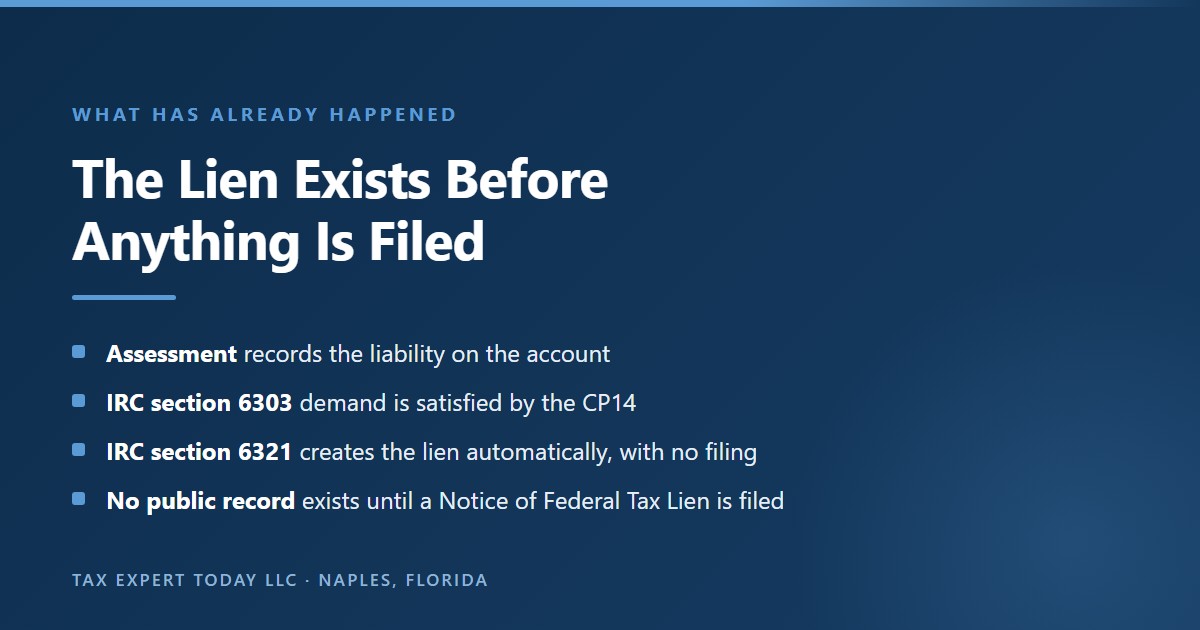
The statutory lien is the point most competing explanations of the CP501 leave out entirely. It is not the same thing as a filed Notice of Federal Tax Lien, which is a public document filed under IRC §6323 to establish priority against other creditors. The statutory lien is silent and unpublished. It does not appear in a title search and it does not show up on a credit report. It nevertheless exists, and understanding that it exists explains why the IRS treats a CP501 balance as a secured claim rather than as an ordinary unpaid invoice. For how the ten year clock is measured, see our guide to the IRS 10 year rule.
What has the IRS not yet done at the CP501 stage?
At the CP501 stage the IRS has not filed a Notice of Federal Tax Lien, has not issued a notice of intent to levy, and has not given you a Collection Due Process hearing right. Those events belong to later notices in the sequence. Recognizing what has not yet happened is what makes the CP501 window useful rather than alarming.
- No public lien filing. Nothing has been recorded with a county or a state office, so no third party has been put on notice.
- No levy authority yet. IRC §6331(d) requires 30 days written notice of intent to levy, and the CP501 is not that notice.
- No hearing right yet. The right under IRC §6330 attaches to the final notice, and the parallel right under IRC §6320 attaches to a lien filing.
- No assignment to a revenue officer. The account is still in the automated stream rather than in field collection.
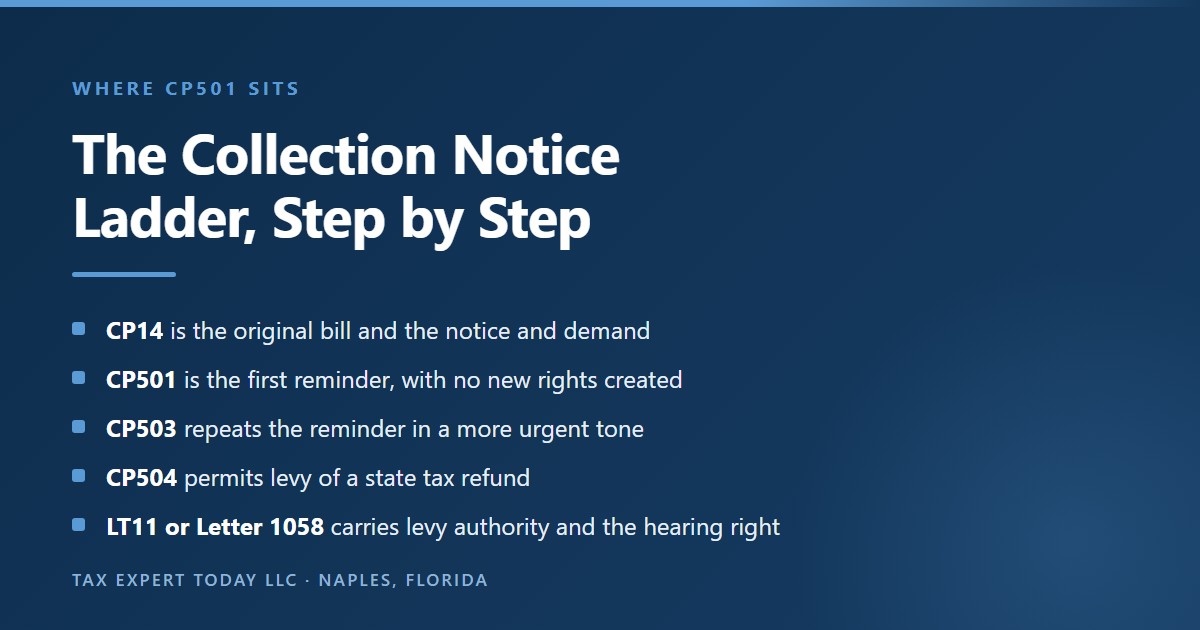
| Notice | What it is | What it triggers |
|---|---|---|
| CP14 | The original bill, notice and demand | Starts the §6303 demand and the §6321 statutory lien |
| CP501 | First reminder in the notice stream | No new rights, Collection Appeals Program available |
| CP503 | Second reminder, more urgent tone | No new rights, still before enforcement |
| CP504 | Notice of intent to levy a state tax refund | Levy of a state refund, and the 1 percent penalty posture |
| LT11 or Letter 1058 | Final Notice of Intent to Levy and notice of your right to a hearing | The §6330 Collection Due Process right, and general levy authority after 30 days |
Two of those rows already have full guides on this site. Our CP504 notice guide covers what the IRS can actually reach at that stage, and our LT11 and Letter 1058 guide covers the Collection Due Process hearing and the deadline that governs it.
How fast do penalties and interest grow on a CP501 balance?
The failure to pay addition under IRC §6651(a)(2) accrues at one half of one percent of the unpaid tax for each month or part of a month, capped at 25 percent in total. That rate is not fixed. It falls to one quarter of one percent while an approved installment agreement is in effect, and it rises to one percent once a notice of intent to levy has run.
- The base rate. 0.5 percent per month or part month on the unpaid tax, so a partial month counts as a full month.
- The statutory cap. The addition stops at 25 percent of the unpaid tax, but interest does not stop.
- The installment agreement reduction. IRC §6651(h) halves the rate to 0.25 percent per month for an individual whose return was timely filed and whose plan is approved.
- The levy escalation. IRC §6651(d) raises the rate to 1 percent once the IRS issues a notice of intent to levy and 10 days pass without payment.
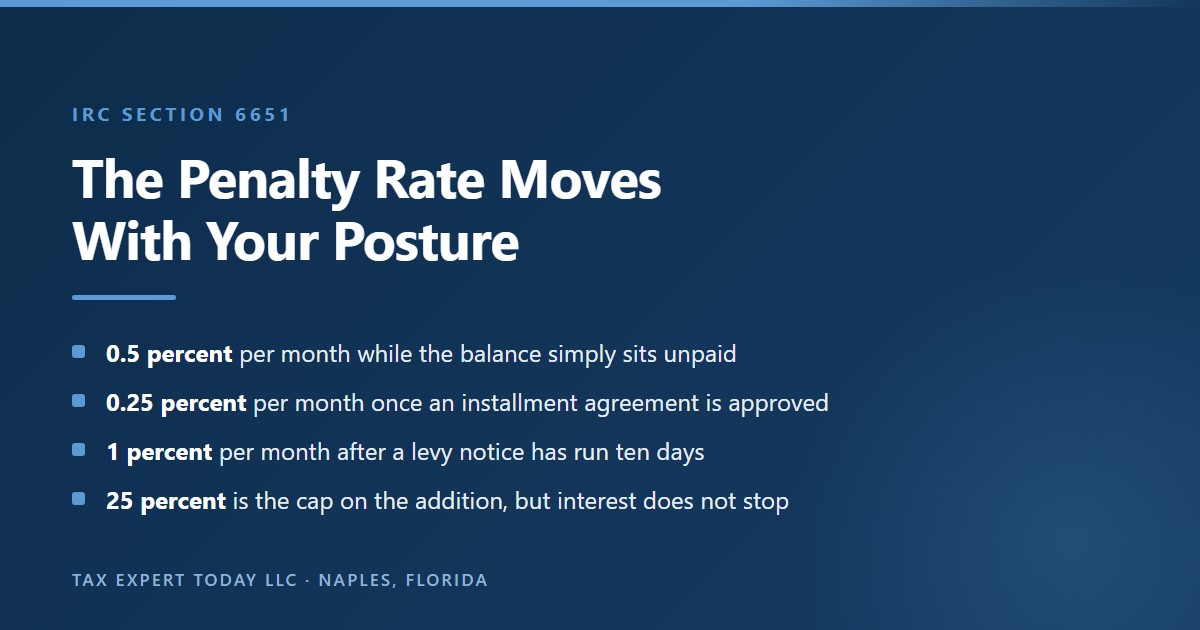
| Account posture | Failure to pay rate | Authority |
|---|---|---|
| Balance unpaid, no plan in place (the CP501 posture) | 0.5 percent per month, capped at 25 percent | IRC §6651(a)(2) |
| Approved installment agreement, return filed timely | 0.25 percent per month | IRC §6651(h) |
| 10 days past a notice of intent to levy | 1 percent per month | IRC §6651(d) |
The practical consequence is the part worth acting on. Entering an installment agreement while the account is still at the CP501 stage cuts the accruing addition in half, and it keeps the account out of the posture that would otherwise double that rate later. Interest is separate and continues regardless. It is charged under IRC §6621 at the federal short term rate plus three percentage points for individual underpayments, it is adjusted quarterly, and it compounds daily under IRC §6622. Because the rate changes every quarter, the current figure should be read from the IRS quarterly interest rates page rather than from any article, including this one.
What are your response options after an IRS CP501 notice?
Four responses are available, and the right one depends on whether you dispute the balance and whether you can pay it. You may pay in full, arrange an installment agreement, pursue a collection alternative such as an offer in compromise or hardship status, or dispute the assessment. Doing nothing is not a neutral choice, because it advances the notice stream.
- Pay in full. This stops the addition and the interest as of the payment date and closes the period.
- Set up a plan. An installment agreement halves the failure to pay rate and stops the notice stream while it remains in good standing.
- Ask for a collection alternative. An offer in compromise or currently not collectible status may fit where full payment is not realistic.
- Dispute the balance. Where the assessment is wrong, the argument belongs on the merits rather than in the collection channel.
| Response | Effect on the notice stream | Effect on the failure to pay rate | Effect on the collection statute |
|---|---|---|---|
| Pay in full | Ends it, the period closes | Stops accruing at the payment date | Becomes moot once the balance is satisfied |
| Installment agreement | Stops while the plan stays in good standing | Falls to 0.25 percent per month | Continues to run |
| Offer in compromise | Pauses while the offer is pending | Continues at 0.5 percent per month | Suspended while the offer is pending, plus 30 days |
| Currently not collectible | Stops while the status holds | Continues at 0.5 percent per month | Continues to run |
| Do nothing | Advances to CP503, then CP504, then the final notice | Continues, and rises to 1 percent after a levy notice | Continues to run |
The last column is the one taxpayers overlook. An offer in compromise suspends the ten year collection period while it is pending, so a rejected offer leaves the account with more time on the clock than it had before, not less. An installment agreement and hardship status do not suspend it, which is why time can work in a taxpayer favour under those alternatives in a way it does not under an offer.
The relief programs the agency groups under the Fresh Start heading are the same alternatives listed above rather than a separate application, which is a common misunderstanding among taxpayers who first encounter the term while holding a CP501. Where a monthly payment is realistic but the full balance is not, a partial payment installment agreement is the mechanism that pairs an affordable figure with the running collection statute.
Can you appeal an IRS CP501 notice?
Yes, in a limited sense. The IRS notice page for the CP501 states that you may request an appeal under the Collection Appeals Program before collection action takes place. That is not the Collection Due Process hearing, which arrives later with the final notice, and it does not reach the correctness of the assessment itself.
- What the Collection Appeals Program covers. Proposed or completed collection actions, and the terms of a plan, rather than whether the tax is owed.
- What it does not do. It does not suspend the collection statute and it does not open a path to the Tax Court.
- How the hearing right differs. The §6330 hearing arrives with the final notice, carries a 30 day deadline, and does provide judicial review.
- Where the merits belong. A wrong assessment is challenged through the channel that created it, such as audit reconsideration or an amended return.
How does the Collection Appeals Program differ from a Collection Due Process hearing?
They differ on four things that matter: when each becomes available, what each can decide, whether the collection statute is suspended, and whether a court can review the result. The Collection Appeals Program is fast and available now. The Collection Due Process hearing is slower, arrives later, and is the one with teeth.
- Availability. The appeals program is open at the CP501 stage, while the hearing right attaches only to a lien filing or a final notice.
- Scope. The appeals program reviews the collection action, and the hearing can also consider collection alternatives and, in narrow cases, the liability itself.
- The clock. A timely hearing request suspends the collection period, and an appeals program request does not.
- Review. A hearing determination can be petitioned to the Tax Court, and an appeals program decision cannot.
| Feature | Collection Appeals Program | Collection Due Process |
|---|---|---|
| Available at the CP501 stage | Yes | No |
| Triggered by | A proposed or completed collection action | A lien filing under §6320 or a final notice under §6330 |
| Request form | Form 9423 | Form 12153 |
| Suspends the collection statute | No | Yes, while the request is pending |
| Judicial review available | No | Yes, by petition to the Tax Court |
| Typical speed | Days to weeks | Months |
The practical reading is that the appeals program is a pressure valve rather than a remedy. It is useful where a specific action is wrong or premature and a quick answer is worth more than a preserved right. Where the real objective is a collection alternative or a challenge to the liability, the better course is usually to resolve the account directly at this stage and to keep the hearing right intact for the final notice. Our Collection Due Process hearing guide sets out how that later request works and the deadline that governs it.
What happens if you ignore an IRS CP501 notice?
The account continues down the notice stream toward enforcement. A CP503 typically follows, then a CP504 that permits levy of a state tax refund, then a final notice that carries general levy authority and the hearing right. The IRS notice page also states that a Notice of Federal Tax Lien may be filed, which is the first step that becomes a public record.
- The reminders escalate. Tone and urgency increase while the underlying balance continues to grow.
- A lien filing becomes public. A recorded Notice of Federal Tax Lien puts other creditors on notice and can complicate financing.
- The penalty posture worsens. Once a levy notice has run, the addition moves to 1 percent per month.
- The options narrow in practice. Alternatives remain available later, but they are negotiated under time pressure rather than at leisure.
None of this is instantaneous. The notice stream generally moves in intervals of several weeks, and accounts sometimes sit longer than that. That interval is the reason the CP501 stage is worth using rather than fearing. The same alternatives remain available at the final notice stage, but they are prepared better when there is time to assemble the financial information they require.
Does a CP501 notice affect your credit report or your passport?
Neither, at this stage. A CP501 is not reported to any credit bureau, and since the three nationwide bureaus stopped including tax liens on consumer reports, even a filed Notice of Federal Tax Lien does not appear there. Passport certification requires conditions that a CP501 account has not met.
- No credit reporting. The IRS does not furnish account data to consumer reporting agencies, and no notice in the stream is reported.
- Liens left consumer reports. The nationwide bureaus removed tax liens from consumer credit files, so a recorded lien affects lenders through public records rather than a score.
- Passport certification needs more. IRC §7345 requires a filed lien with administrative remedies exhausted, or an issued levy, neither of which exists at the CP501 stage.
- A dollar threshold applies too. The seriously delinquent figure is indexed annually and sits at $66,000 for 2026.
This matters because the fear attached to a CP501 is frequently borrowed from a different problem. A taxpayer who is worried about a mortgage application or an upcoming trip is usually reacting to what a recorded lien or a certification would do, and neither has happened. What a recorded lien does affect is priority against other creditors and the practical willingness of a lender to advance funds against encumbered property, which is a commercial consequence rather than a credit score consequence. Our guide to IRS passport revocation covers the certification and reversal mechanics for accounts that do reach that stage.
What if the CP501 covers a business or a payroll tax period?
Treat it as more urgent than an individual balance. A payroll tax period carries a personal exposure that an income tax period does not, because the trust fund portion of the liability can be assessed against individuals under IRC §6672. The reminder looks identical, and the consequences of letting it run are not.
- Check the form and period. A CP501 on a Form 941 quarter is a payroll matter, not an income tax matter.
- Separate the trust fund portion. Withheld income tax and the employee share of FICA are the amounts that can follow an individual personally.
- The exposure survives the entity. Closing or dissolving the business does not extinguish a trust fund recovery penalty already assessable against a responsible person.
- Current deposits come first. The IRS will generally not approve a collection alternative for a business that is not current on ongoing deposits.
That last point reshapes the sequence of work. For an individual, the CP501 stage is about choosing an alternative. For an employer, it is first about becoming compliant going forward, because no alternative is realistically available until current deposits and filings are in order. Our guide to the trust fund recovery penalty covers the responsibility and willfulness tests and the Form 4180 interview that decides who is assessed.
How do you confirm a CP501 balance is correct before you pay it?
Pull the account transcript for the period named on the notice and read the transaction codes. The transcript shows the assessment date, the source of the assessment, every payment and credit posted, and the additions charged. That record, rather than the notice, is what a representative works from, because it shows how the balance was built.
- Confirm the assessment date. It sets the start of the ten year collection period under IRC §6502.
- Identify the source. A self reported balance, a math error adjustment, and an examination assessment each carry different remedies.
- Trace payments and credits. Misapplied payments and credits posted to the wrong period are a routine cause of a balance that looks wrong.
- Separate tax from additions. Knowing how much of the balance is penalty tells you whether an abatement request is worth preparing.
Where the balance turns out to include penalties assessed on facts that do not support them, the abatement request is a separate matter from the collection notice and it runs on its own timetable. Our guide to IRS Form 843 covers that claim and the limitation period that governs it.
IRS CP501 notice help Naples: balance due notices in Naples and Southwest Florida
Taxpayers reach our office in Naples, Florida holding a CP501 in two recognizable situations. The first is a person who filed a return, could not pay the balance, and set the matter aside expecting to catch up later. For that person the whole question is which collection alternative fits the actual monthly numbers, and the answer usually arrives faster than expected once the financial picture is assembled. The second is a person who genuinely does not recognize the balance, often because a payment was applied to a different period or because a return was adjusted after filing. Tax resolution Naples clients in the second group are frequently surprised that the transcript, rather than the notice, is where the answer sits.
Tax Expert Today LLC
11983 Tamiami Trail N, Naples, FL 34110
Phone: (239) 441-2005
Hours: Monday through Friday, 10:00 to 5:00 ET
Does living in Florida change how an IRS CP501 notice works? The notice and the statutes behind it are federal, so the procedure is identical in Naples, Fort Myers, Bonita Springs, and Marco Island. Two local facts do bear on it. Florida imposes no state individual income tax, which means there is generally no state refund for the IRS to reach when the account later arrives at the CP504 stage, so that particular enforcement step is often empty for a Florida resident with no other state filing obligation. Florida also has a large seasonal population whose mail follows them north for part of the year, and a CP501 that sits unopened in a Naples mailbox until autumn is a common way for an account to reach the final notice stage without the taxpayer ever having read a reminder. Our IRS resolution and audit support service page and our Naples tax resolution page describe how these engagements are handled.
When to Engage a Professional
Many CP501 notices are resolved by the taxpayer alone, and where the balance is modest, the return was accurate, and full payment is possible, representation adds little. Consider engaging a representative where the balance is not recognized and the transcript needs to be read, where several periods are open and the assessment dates differ between them, where the amount is large enough that the choice between an installment agreement and an offer in compromise turns on a genuine financial analysis, where a business is involved and payroll tax periods are in the mix, or where an earlier notice was missed and the account may be closer to the final notice stage than the CP501 suggests. Tax Expert Today LLC was founded by Dr. Pellumb Kabashi, and every engagement is built on the actual transcripts and the actual financial facts rather than on any general timetable.
This article is educational and general in nature. It does not constitute tax advice for any particular taxpayer, and outcomes depend on individual facts and circumstances.
Published September 10, 2026 by Dr. Pellumb Kabashi « Back to Learning Center
Have a question this article touches on?
Tax Expert Today LLC, based in Naples, Florida and serving clients across the United States.
Schedule a Consultation (239) 441-2005