
By Dr. Pellumb Kabashi, DBA, MBA, EA, CFE, CES
Founder, Tax Expert Today LLC · Tax advisors, enrolled agents, CPAs, and attorneys · Serving clients in all 50 states
Quick Answer: An IRS tax lien withdrawal removes the public Notice of Federal Tax Lien from the record as if it had never been filed, under IRC Section 6323(j). You request it on Form 12277. A withdrawal is different from a release: a release ends the lien once the debt is paid, while a withdrawal takes the public notice down. Common qualifying paths include paying the balance in full or entering a Direct Debit Installment Agreement under the IRS Fresh Start program.
Published: July 2, 2026
A Notice of Federal Tax Lien is one of the more damaging steps in IRS collection, not because it takes property directly, but because it is public. Once filed with a county recorder or a state office, it becomes visible to lenders, title companies, and anyone who searches the record. A lien withdrawal is the remedy that actually takes that public notice down, and it is often available in situations where taxpayers assume they are stuck with the filing until it expires. This 2026 guide explains what a federal tax lien is, how it differs from a levy, and how an IRS tax lien withdrawal under Internal Revenue Code Section 6323(j) works through Form 12277. Lien work usually sits inside a wider case, which is covered on our IRS audit representation and resolution page.
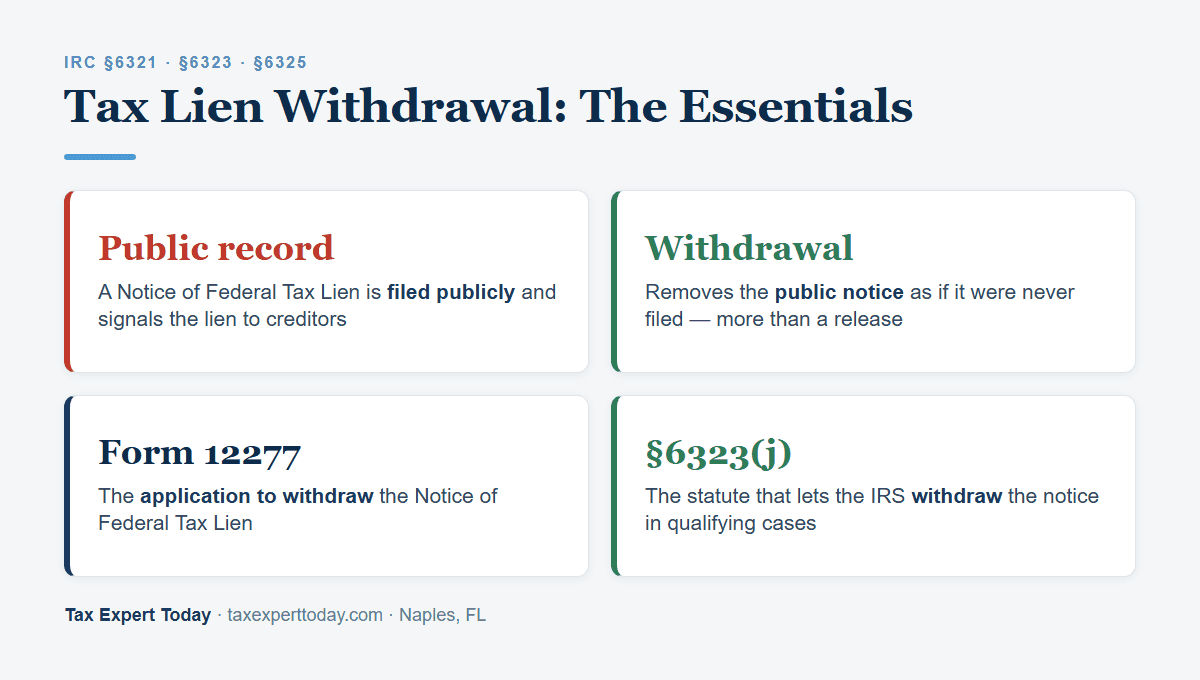
What Is a Federal Tax Lien (and How Is It Different From a Levy)?
A federal tax lien is the government’s legal claim against all of your property when a tax debt goes unpaid, and a levy is the separate act of actually seizing property to satisfy that debt. The lien arises automatically under IRC Section 6321 the moment the IRS assesses the tax, sends a notice and demand for payment, and the taxpayer does not pay. It attaches to everything you own and to property you acquire later, but at that stage it is silent and not on public record.
The lien becomes public only when the IRS files a Notice of Federal Tax Lien under IRC Section 6323. That filing is what protects the government’s priority against other creditors and what shows up in a title or credit search. A levy, by contrast, is governed by IRC Section 6331 and is the enforced collection that can freeze a bank account or garnish wages. A lien secures the debt; a levy collects it. Understanding that split matters, because a withdrawal deals with the lien notice, while stopping a seizure is a levy question covered in our guides on the IRS wage garnishment and the IRS bank levy release.
How Does a Tax Lien Affect Me?
A filed Notice of Federal Tax Lien affects you mainly through its visibility: it signals to lenders and buyers that the IRS has a secured claim ahead of them, which can complicate financing, refinancing, or selling property. Because the lien attaches to all property and rights to property under Section 6321, it reaches real estate, vehicles, financial accounts, and business assets, and it can follow assets you acquire while the debt is outstanding.
Two practical points often surprise taxpayers. First, the lien remains attached to specific property even after that property is sold, unless the lien is released, discharged, or subordinated. Second, the underlying lien generally lasts until the debt is satisfied or the ten-year collection period under IRC Section 6502 expires. Because the public notice is the part that causes day-to-day harm, the withdrawal remedy, which removes that notice, is frequently the most valuable tool available even when the balance is not yet fully resolved.
What Is the Difference Between Lien Release and Lien Withdrawal?
A lien release ends the lien itself, usually because the debt has been paid or has become legally unenforceable, but the record of the Notice of Federal Tax Lien and its later release both remain visible. A lien withdrawal removes the public Notice of Federal Tax Lien as though it had never been filed, which is a stronger outcome for your record even though it does not, by itself, erase the underlying tax debt. The two are governed by different statutes: release falls under IRC Section 6325, and withdrawal falls under IRC Section 6323(j).
There are actually four distinct lien remedies, and they are not interchangeable. The table below summarizes what each one does.
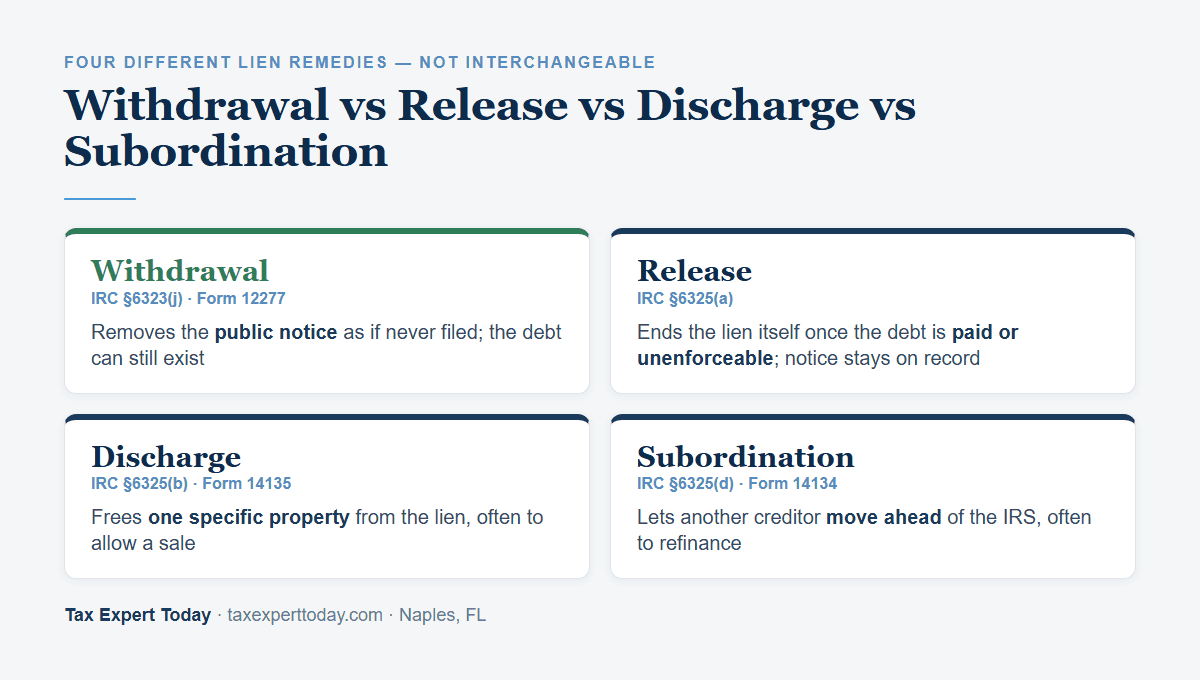
| Remedy | What it does | Authority & form |
|---|---|---|
| Withdrawal | Removes the public Notice of Federal Tax Lien as if never filed; the debt itself can still exist | IRC 6323(j) · Form 12277 |
| Release | Ends the lien once the debt is paid or becomes unenforceable; the notice and release stay on record | IRC 6325(a) |
| Discharge | Frees one specific piece of property from the lien, often so a sale can close | IRC 6325(b) · Form 14135 |
| Subordination | Lets another creditor move ahead of the IRS lien, often to allow a refinance | IRC 6325(d) · Form 14134 |
How Do I Request a Withdrawal With Form 12277?
You request a withdrawal by filing Form 12277, the Application for Withdrawal of Filed Notice of Federal Tax Lien, and identifying which statutory ground applies to your situation. Section 6323(j) gives the IRS authority to withdraw the notice, and the IRS Fresh Start program expanded the everyday paths that qualify. The most common qualifying grounds are below.
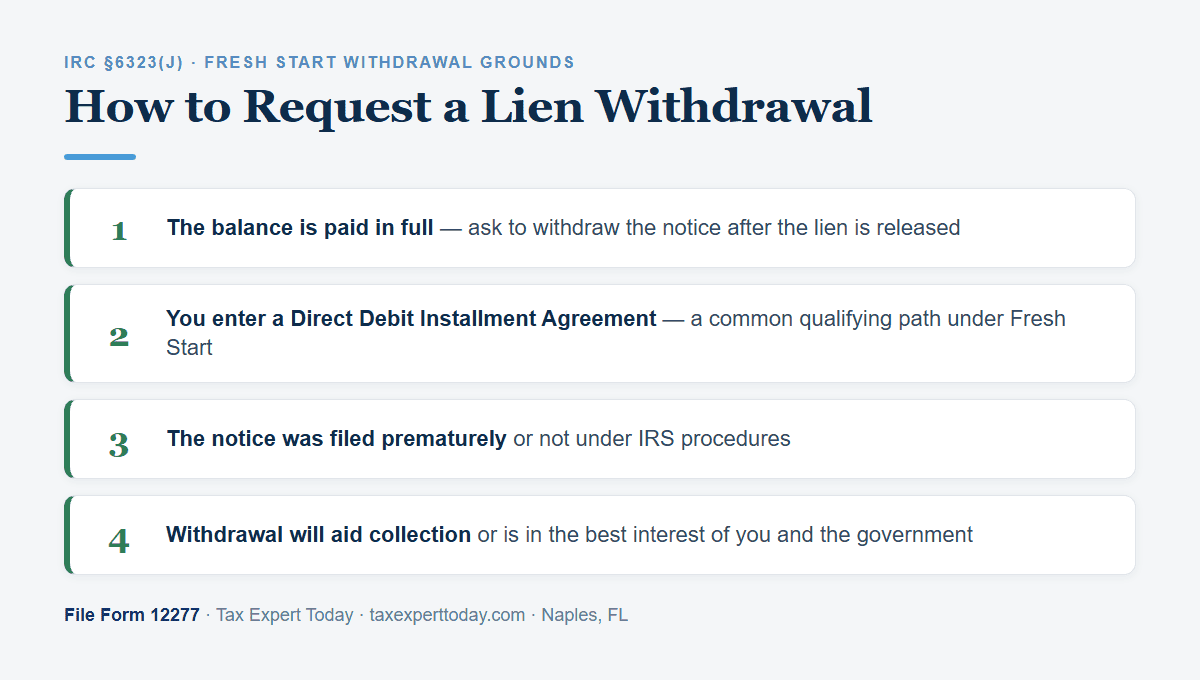
- The balance is paid in full
- Once the debt is satisfied and the lien is released, you can ask the IRS to withdraw the notice so that the resolved lien no longer appears as a filed public record. This is a distinct request from the automatic release.
- You enter a Direct Debit Installment Agreement
- Under Fresh Start, a taxpayer who sets up a qualifying Direct Debit Installment Agreement under IRC Section 6159 may request withdrawal after a few payments have posted, provided the account is in good standing and other conditions are met. Our guide to IRS installment agreement options explains how these plans are set up.
- The notice was filed prematurely or not under IRS procedures
- If the Notice of Federal Tax Lien was filed too early or without following the applicable rules, that procedural defect is a statutory ground for withdrawal under Section 6323(j)(1)(A).
- Withdrawal will help collection or is in everyone’s best interest
- The IRS can withdraw the notice when doing so will facilitate collection of the tax, or when the National Taxpayer Advocate and the IRS agree it is in the best interest of both the taxpayer and the government.
On the form, you attach a copy of the Notice of Federal Tax Lien if you have it, explain the ground you are relying on, and state whether you want the IRS to notify credit reporting agencies and financial institutions of the withdrawal. Keep in mind the sequencing: withdrawal addresses the public notice, but if you still owe the balance, you generally need a resolution such as full payment, an installment agreement, or an offer in compromise in place. If you cannot pay at all, currently not collectible status may pause collection while the account sits.
What Are the Discharge and Subordination Options?
Discharge and subordination do not remove the lien, but they solve specific transaction problems that a withdrawal does not. A discharge under IRC Section 6325(b) removes one specific piece of property from the lien, which is typically what allows a home or other asset to be sold with clear title when the lien would otherwise block the closing. A subordination under IRC Section 6325(d) does not remove the lien from anything; it allows a named creditor to take priority ahead of the federal tax lien, which is often what makes a refinance possible.
Choosing among withdrawal, discharge, and subordination depends on the goal. If the aim is to clean up the public record, withdrawal is the tool. If the aim is to sell a particular property, discharge is the tool. If the aim is to refinance and a new lender needs first position, subordination is the tool. Discharge is requested on Form 14135 and subordination on Form 14134, and each requires supporting documentation about the property and the transaction. For the underlying collection picture, these lien remedies work alongside the notice-stage rights explained in our guides to the CP504 notice and Letter 1058 / LT11 and CDP rights.
IRS Tax Lien Withdrawal Help in Naples and Southwest Florida
Tax Expert Today LLC helps individuals and businesses in Naples and across Southwest Florida address a Notice of Federal Tax Lien, request a withdrawal on Form 12277, and choose between withdrawal, release, discharge, and subordination based on the goal, whether that is repairing a public record, closing a property sale, or refinancing. The firm is multidisciplinary, with enrolled agents, CPAs, and attorneys, and it pairs the lien work with the underlying resolution, since a withdrawal usually depends on a payment plan or paid balance being in place. The office is at 11983 Tamiami Trail N, Naples, FL 34110, and the team can be reached at (239) 441-2005, Monday through Friday, 10am to 5pm ET.
Frequently Asked Questions
What is an IRS tax lien withdrawal?
An IRS tax lien withdrawal is the removal of a filed Notice of Federal Tax Lien from the public record under IRC Section 6323(j), so that the notice is treated as if it had never been filed. It is requested on Form 12277. A withdrawal is stronger than a release because it takes the public notice down rather than simply marking the lien as satisfied, though it does not by itself erase the underlying tax debt.
What is the difference between a lien release and a lien withdrawal?
A release ends the lien once the debt is paid or becomes legally unenforceable, but the Notice of Federal Tax Lien and its release both stay on the record. A withdrawal removes the public notice itself as though it were never filed. Release is governed by IRC Section 6325 and happens automatically after the debt is satisfied; withdrawal is governed by IRC Section 6323(j) and must be requested on Form 12277.
Can I get a lien withdrawal while I still owe the IRS?
In some cases, yes. Under the IRS Fresh Start program, a taxpayer who enters a qualifying Direct Debit Installment Agreement under IRC Section 6159 may request a withdrawal after a few payments have posted, provided the account is in good standing and the other conditions are met. Withdrawal can also apply when the notice was filed prematurely or when withdrawal would facilitate collection. Eligibility depends on your specific facts.
How do I request a lien withdrawal from the IRS?
File Form 12277, the Application for Withdrawal of Filed Notice of Federal Tax Lien. On it, you identify the Notice of Federal Tax Lien, state the statutory ground you are relying on, and indicate whether you want the IRS to notify credit reporting agencies and financial institutions of the withdrawal. Because withdrawal addresses the public notice and not the debt, you generally need a payment resolution in place as well.
Where can I get help with a tax lien withdrawal in Naples, FL?
Tax Expert Today LLC, located at 11983 Tamiami Trail N, Naples, FL 34110, assists individuals and businesses in Naples and across Southwest Florida with Notice of Federal Tax Lien issues, Form 12277 withdrawal requests, and discharge or subordination when a property sale or refinance is involved. The firm is multidisciplinary, with enrolled agents, CPAs, and attorneys, and represents taxpayers before the IRS nationwide. Consultations can be arranged at (239) 441-2005.
When to Engage a Professional for a Tax Lien Withdrawal
A lien withdrawal rewards choosing the right remedy for the right goal and having the underlying resolution lined up first. The judgment calls are which of the four remedies fits your situation, which statutory ground on Form 12277 the facts support, and how to sequence the withdrawal request with a payment plan, full payment, or other resolution so the application is not premature. Tax Expert Today LLC represents individuals and businesses in IRS lien and collection matters nationwide. Dr. Kabashi is an Enrolled Agent authorized to represent taxpayers before the IRS in all 50 states.
Call (239) 441-2005 or schedule a consultation to review a Notice of Federal Tax Lien and the withdrawal, release, discharge, and subordination options that fit your facts. Tax advisors, enrolled agents, CPAs, and attorneys serving clients in all 50 states.
Published July 2, 2026 by Dr. Pellumb Kabashi « Back to Learning Center
Have a question this article touches on?
Tax Expert Today LLC, based in Naples, Florida and serving clients across the United States.
Schedule a Consultation (239) 441-2005