
By Dr. Pellumb Kabashi, DBA, MBA, EA, CFE, CES
Founder, Tax Expert Today LLC · Tax advisors, enrolled agents, CPAs, and attorneys · Serving clients in all 50 states
Quick Answer: The trust fund recovery penalty is a civil penalty under IRC Section 6672 that makes a responsible person personally liable for the trust fund portion of a business’s unpaid payroll taxes, meaning the income tax and the employee share of Social Security and Medicare withheld from wages. The IRS can assess it against owners, officers, or anyone with authority over company finances who willfully failed to pay those withheld taxes over to the government.
Published: July 23, 2026
Few IRS collection tools reach as far as the trust fund recovery penalty. When a business withholds income tax and Social Security and Medicare from its employees’ paychecks but does not pay that money over to the government, the IRS can step past the business entity and assess the withheld amount personally against the people who controlled the money. A corporation or LLC normally shields its owners from company debts, but this penalty is a deliberate exception, and it survives the closing of the business and even personal bankruptcy. This 2026 guide explains what the penalty covers, who can be held responsible, what willfulness means, how the Form 4180 interview works, and how to respond to a proposed assessment. Because a business balance often begins with the same collection notices individuals receive, the story frequently starts with an IRS CP14 notice before it escalates to a personal assessment.
What Is the Trust Fund Recovery Penalty?
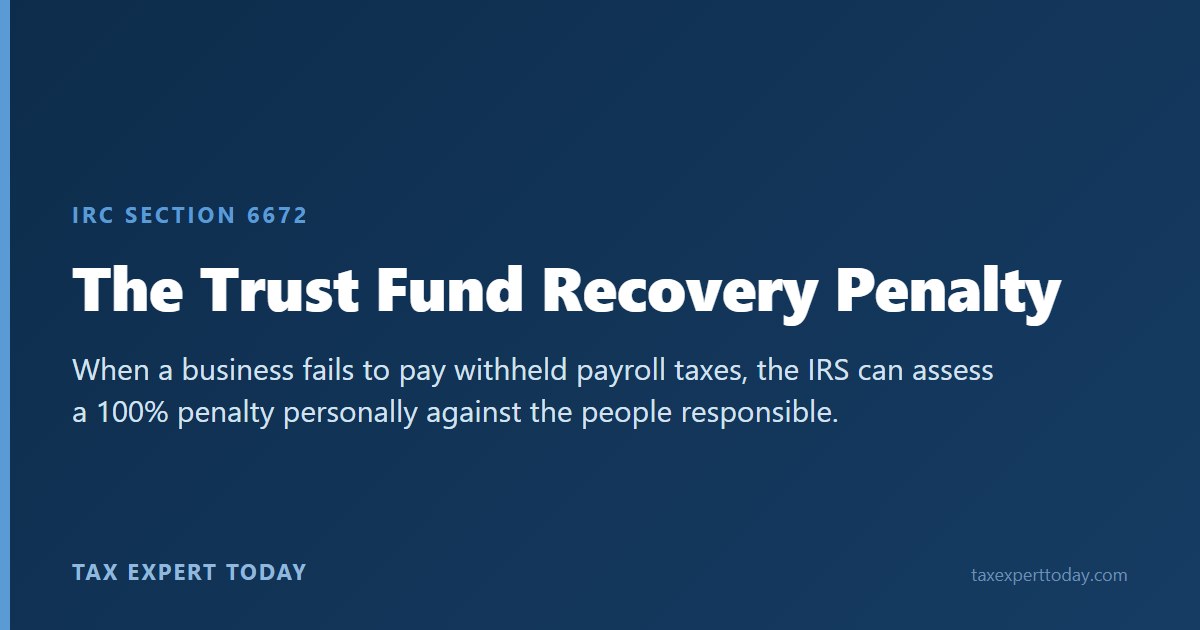
The trust fund recovery penalty is a personal assessment, equal to the unpaid trust fund taxes, that the IRS can impose on individuals who were responsible for paying a business’s withheld payroll taxes and willfully did not. The penalty amount equals the trust fund portion of the debt, not the entire payroll tax bill, which is why understanding the split matters so much.
When an employer runs payroll, it withholds federal income tax and the employee share of Social Security and Medicare from each paycheck. Those withheld amounts are called trust fund taxes because the employer holds them in trust for the government until they are deposited. The employer also owes its own matching share of Social Security and Medicare, which is not held in trust. Under IRC Section 6672, only the trust fund portion can be assessed against a responsible person personally. The employer matching share, along with any penalties and interest that accrued on the business account, remains a liability of the business itself. The table below shows how a typical payroll tax balance divides.
| Payroll tax component | Trust fund? | Can it be assessed personally under the TFRP? |
|---|---|---|
| Employee income tax withheld | Yes | Yes |
| Employee share of Social Security and Medicare | Yes | Yes |
| Employer matching share of Social Security and Medicare | No | No, it stays with the business |
| Penalties and interest on the business account | No | No |
The penalty is civil, not criminal, even though it is often described in alarming terms. It is designed to recover the withheld money, and the IRS explains on its employment taxes page that the amount of the penalty equals the unpaid trust fund tax. More than one person can be held liable for the same trust fund debt, though the government collects the underlying amount only once across all responsible parties.
Who Is a Responsible Person?
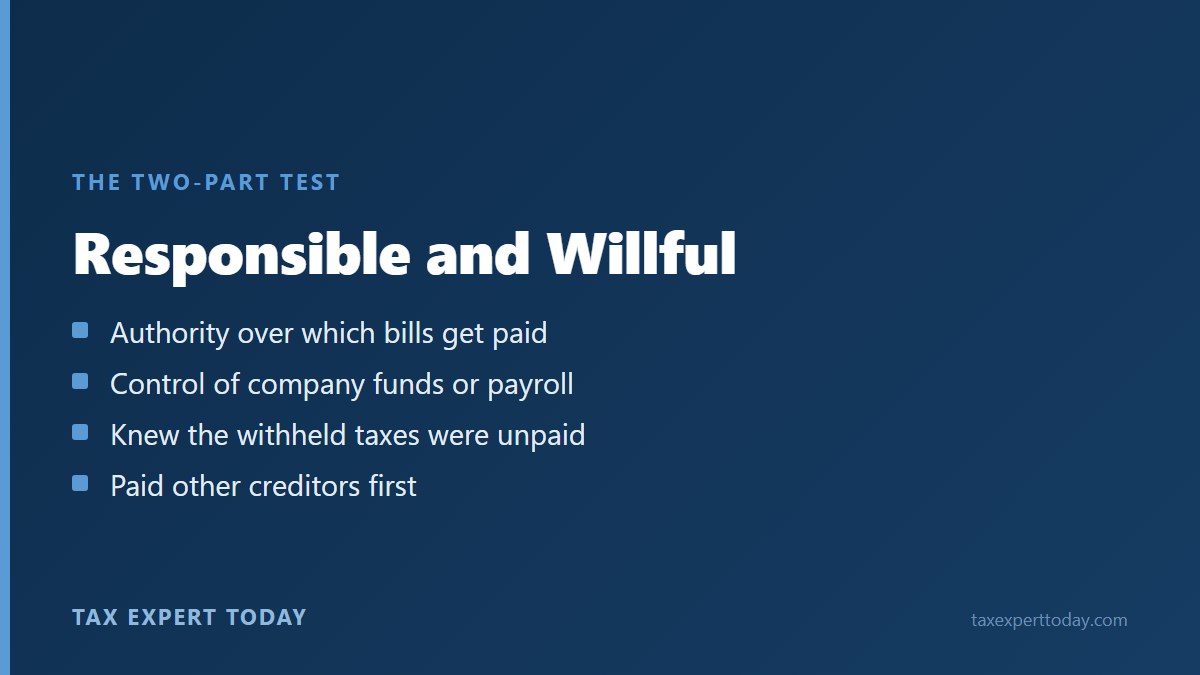
A responsible person is anyone who had the duty and the authority to collect, account for, or pay over the withheld taxes and the power to decide which of the business’s bills were paid. The label is about function, not job title, so it can reach owners, corporate officers, partners, bookkeepers, payroll managers, and sometimes outside parties who controlled the finances.
The IRS looks at practical control rather than an organizational chart. Someone who signs checks, approves payments, has authority over the bank accounts, hires and fires employees, or directs which creditors get paid can be treated as responsible, and several people can hold that status at the same time. According to Internal Revenue Manual 5.7.3, responsibility turns on the individual’s actual authority over the funds, not merely a formal position. A minority owner with no check-signing authority may not be responsible, while a non-owner office manager who controlled payroll and chose which bills to pay may be. Because the analysis is fact-specific, two people in seemingly similar roles can reach opposite outcomes, which is exactly why the interview and documentation discussed below carry so much weight.
What Counts as Willful Failure to Pay?
Willfulness means the responsible person knew the withheld taxes were due and either chose not to pay them or recklessly disregarded an obvious risk that they would not be paid. It does not require any intent to defraud the government or any bad motive, which is a point many business owners misunderstand.
The most common form of willfulness is paying other creditors while the trust fund taxes go unpaid. When a business is short on cash and the person in control uses available funds to pay suppliers, rent, or net wages instead of remitting the withheld taxes, that choice generally satisfies the willfulness standard, because the trust fund money belonged to the government rather than the business. As IRM 5.7.3 frames it, a responsible person acts willfully by using funds to pay other creditors with knowledge that the taxes are unpaid. Genuine and reasonable belief that the taxes had been paid can rebut willfulness, but relying on someone else to handle it, without verifying, usually does not. This is why willfulness so often accompanies responsibility: the same person who controlled the money typically knew the deposits were not being made.
What Is the Form 4180 Interview?
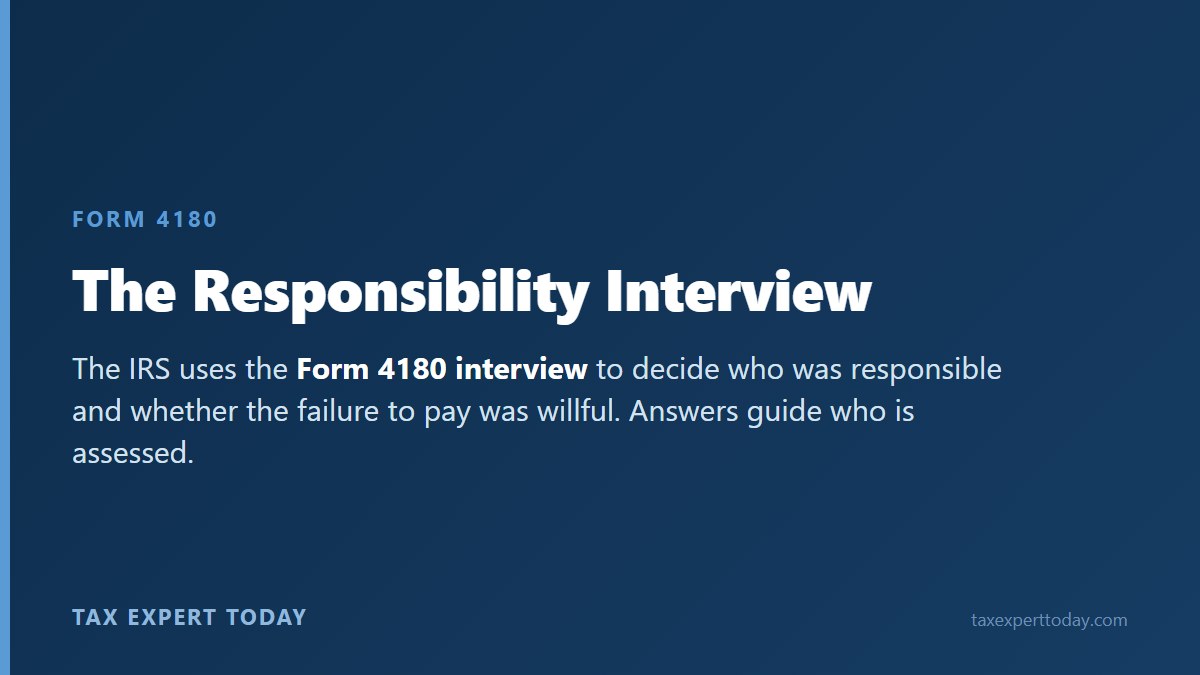
The Form 4180 interview is a structured questionnaire the IRS uses to determine who was responsible and whether the failure to pay was willful. A revenue officer conducts it with each potentially responsible person, and the answers become the factual record the IRS relies on to decide whom to assess.
The form, titled Report of Interview with Individual Relative to Trust Fund Recovery Penalty, asks detailed questions about check-signing authority, control of the bank accounts, who prepared and signed payroll tax returns, who decided which bills were paid, and what the person knew about the unpaid taxes and when. The investigation process described in IRM 5.7.4 directs revenue officers to secure the interview from all potentially responsible people. Because the responses can establish both prongs of the penalty at once, this interview is the point at which many taxpayers benefit most from representation. An enrolled agent, CPA, or attorney can attend, help the client answer accurately and completely, and make sure the record reflects the true division of authority rather than an offhand answer that overstates the person’s control. The interview is generally best approached carefully and with advice, not treated as a casual conversation.
How Do I Appeal a Proposed Trust Fund Recovery Penalty?
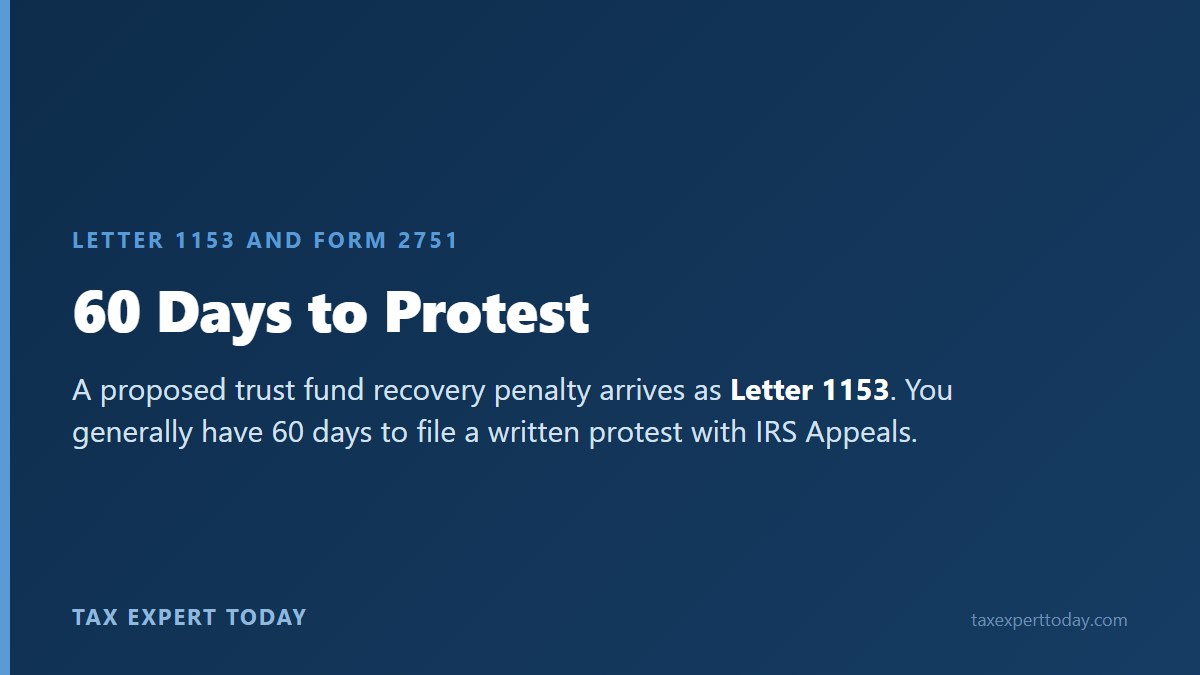
You appeal a proposed trust fund recovery penalty by filing a written protest with IRS Appeals within the deadline stated on Letter 1153, which is generally 60 days from the date of the letter, or 75 days if it is addressed to a person outside the United States. Ignoring the letter lets the proposed penalty become a formal assessment.
The IRS proposes the penalty by sending Letter 1153 together with Form 2751, which lists the periods and the trust fund amounts it intends to assess against you. If you agree, you can sign Form 2751 to consent to the assessment. If you disagree, the written protest is the path to Appeals, where an independent officer reviews whether you were truly a responsible person and whether your failure to pay was willful. The steps and deadlines are summarized below.
| Stage | What happens | Timing |
|---|---|---|
| Form 4180 interview | Revenue officer gathers facts on responsibility and willfulness | During the investigation |
| Letter 1153 and Form 2751 | IRS proposes the penalty and lists the amounts | Issued after the investigation |
| Written protest to Appeals | You dispute responsibility or willfulness | Within 60 days (75 if outside the U.S.) |
| Assessment | Penalty becomes a personal liability if unprotested or upheld | After the protest window or Appeals |
How Long Does the IRS Have to Assess the Penalty?
The IRS generally must assess the trust fund recovery penalty within three years after the employment tax return for the period was filed, measured from April 15 of the year after the return was due for returns filed early. Once the penalty is assessed, a separate ten-year collection clock begins.
The assessment deadline comes from IRC Section 6501, the same statute that limits how long the IRS has to assess most taxes. For payroll tax returns, the trust fund recovery penalty must generally be proposed and assessed within that three-year window, which is why a business owner may receive a Letter 1153 well after the payroll periods in question. This assessment clock is different from the ten-year period the IRS has to collect a balance once it exists. If you also want to understand how long a debt can be pursued after it is assessed, our guide to the IRS 10-year rule explains the collection statute in detail. A late-filed or unfiled employment tax return can push the assessment window later, in the same way that unfiled tax returns extend the clock on the individual side.
Can the TFRP Be Resolved Once It Is Assessed?
Yes. Once the trust fund recovery penalty is assessed against you personally, it is treated much like any other individual tax debt for collection purposes, so the standard resolution options apply, including an installment agreement, an offer in compromise, and currently not collectible status. What it cannot do is disappear easily, because it is generally not dischargeable in bankruptcy. One remedy that does not apply here is innocent spouse relief, because relief from joint and several liability under IRC Section 6015 does not extend to the trust fund recovery penalty.
If you cannot pay the assessed penalty in full, you can request an installment agreement to pay it over time, or explore an offer in compromise if you qualify to settle for less than the full amount based on your ability to pay. When paying anything would create genuine hardship, currently not collectible status can pause active collection, though interest continues to accrue. If the penalty follows a final notice of intent to levy, a Collection Due Process hearing may also be available to raise collection alternatives. Where the underlying facts show you were not a responsible person, the stronger route is often to contest the assessment itself rather than simply arrange to pay it, which again points back to the value of responding early. Where the penalty has already been assessed and the plan is to contest it through a refund claim, the instructions to IRS Form 843 require the portion attributable to a single employee to be paid for each period before that claim is filed. For penalties that were correctly assessed, our overview of how to get IRS penalties removed explains the abatement avenues that may apply to related account penalties. Each of these paths depends on the specific facts, and no single option fits every situation.
Trust Fund Recovery Penalty Help in Naples and Southwest Florida
Tax Expert Today LLC helps business owners, officers, and bookkeepers in Naples and across Southwest Florida respond to a proposed or assessed trust fund recovery penalty, from preparing for the Form 4180 interview to filing a written protest with IRS Appeals and evaluating resolution options once a penalty is final. The firm works to establish who actually controlled the funds and whether the willfulness standard is truly met, because a correct answer at the responsibility stage often changes the outcome. The office is at 11983 Tamiami Trail N, Naples, FL 34110, and the team can be reached at (239) 441-2005, Monday through Friday, 10am to 5pm ET.
Frequently Asked Questions
How much is the trust fund recovery penalty?
The penalty equals the unpaid trust fund portion of the payroll taxes, which is the income tax and the employee share of Social Security and Medicare withheld from wages. It does not include the employer’s matching share of Social Security and Medicare or the penalties and interest on the business account, because those amounts are not held in trust and stay with the business rather than becoming a personal assessment.
Who can be held personally liable for the TFRP?
Any responsible person who had authority over the business’s finances and willfully failed to pay the withheld taxes can be held liable. That can include owners, corporate officers, partners, bookkeepers, and payroll managers, and more than one person can be assessed for the same trust fund debt. The test is practical control over which bills were paid, not a job title, so the analysis turns on the specific facts of each person’s role.
Is the trust fund recovery penalty a criminal charge?
No. The trust fund recovery penalty is a civil penalty under IRC Section 6672, not a criminal charge. Willfulness in this context means the responsible person knew the taxes were unpaid and chose to pay other creditors instead, not that they intended to defraud the government. Separate criminal statutes exist for deliberate payroll tax evasion, but the TFRP itself is a civil collection tool designed to recover the withheld money.
What is the deadline to appeal a Letter 1153?
You generally have 60 days from the date of Letter 1153 to file a written protest with IRS Appeals, or 75 days if the letter is addressed to you at an address outside the United States. If you do not respond within that window, the proposed penalty is assessed and becomes a personal liability. Because the protest is where responsibility and willfulness are contested, it is best not to let the deadline pass without advice.
Can the trust fund recovery penalty be discharged in bankruptcy?
Generally no. The trust fund recovery penalty is treated as a priority tax obligation and is usually not dischargeable in bankruptcy, which is one reason it is considered among the most durable IRS collection tools. Once assessed, it can still be addressed through an installment agreement, an offer in compromise if you qualify, or currently not collectible status, but it does not simply wash away in a typical bankruptcy the way some other debts might.
Where can I get help with a TFRP in Naples, FL?
Tax Expert Today LLC, located at 11983 Tamiami Trail N, Naples, FL 34110, helps business owners and other potentially responsible people in Naples and across Southwest Florida prepare for the Form 4180 interview, protest a proposed penalty, and resolve an assessed one. The firm is multidisciplinary, with enrolled agents, CPAs, and attorneys, and represents taxpayers before the IRS nationwide. Consultations can be arranged at (239) 441-2005.
When to Engage a Professional for a Trust Fund Recovery Penalty
The trust fund recovery penalty is one of the few situations where the personal stakes and the technical standards both run high, which makes early representation especially valuable. The outcome frequently turns on the responsibility and willfulness analysis, and that analysis is shaped by the Form 4180 interview and the written protest, both of which reward careful preparation over improvisation. An experienced representative can help establish who genuinely controlled the funds, respond to Letter 1153 on time, and evaluate whether to contest the assessment or arrange a resolution once it is final. Acting before the protest deadline, rather than after the penalty is assessed, is what most often preserves the strongest options. Tax Expert Today LLC, founded by Dr. Pellumb Kabashi, represents individuals and businesses in IRS collection matters nationwide.
Call (239) 441-2005 or schedule a consultation to review a Letter 1153 or an assessed trust fund recovery penalty and build a plan around your specific facts. Tax advisors, enrolled agents, CPAs, and attorneys serving clients in all 50 states.
Published July 23, 2026 by Dr. Pellumb Kabashi « Back to Learning Center
Have a question this article touches on?
Tax Expert Today LLC, based in Naples, Florida and serving clients across the United States.
Schedule a Consultation (239) 441-2005