
By Dr. Pellumb Kabashi, DBA, MBA, EA, CFE, CES
Founder, Tax Expert Today LLC · Tax advisors, enrolled agents, CPAs, and attorneys · Serving clients in all 50 states
Quick Answer: An IRS lien discharge removes the federal tax lien from one specific property so it can be sold, while a subordination leaves the lien in place but lets a lender move ahead of the IRS so you can refinance. Neither one erases the tax debt. You apply on Form 14135 for a discharge or Form 14134 for a subordination, ideally at least 45 days before closing, and the IRS decides under section 6325(b) or 6325(d). Call (239) 441-2005 for a free consultation.
What is an IRS lien discharge?
An IRS lien discharge is a certificate issued under section 6325(b) of the Internal Revenue Code that removes the federal tax lien from one specific piece of property, usually so the property can be sold or transferred with clear title. The lien stays on everything else the taxpayer owns, and the tax debt itself does not go away.
- It is property specific. The certificate names one parcel, vehicle, or asset and frees only that item.
- It is not a payoff. Any balance left after the sale stays on the account.
- It is not automatic. You apply, the IRS investigates, and an Advisory group manager decides.
- It usually comes with a closing. Most discharge certificates are issued at or right after a sale.
A federal tax lien arises under IRC §6321 when the IRS assesses a tax, sends a demand for payment, and the balance is not paid. From that moment the lien attaches to all of the taxpayer’s property and rights to property. When the IRS files a Notice of Federal Tax Lien in the public records, title companies see it, and no careful buyer or lender will close until the lien is dealt with. The filing usually follows the balance due notices that begin with the CP14 notice and escalate to the CP504 notice. That is where an IRS lien discharge comes in.
The IRS page on federal tax liens puts it in one line: a discharge “removes the lien from specific property.” The Internal Revenue Manual adds the part that most guides skip. IRM 5.12.10.3 states that a discharge request must meet one of the specified conditions of section 6325(b) to be approved, and that any agreement that does not meet one of those conditions would exceed the IRS’s discharge authority. In other words, an IRS lien discharge is not a negotiation from scratch. It is a fit between your closing and one of five statutory grounds, which this guide walks through one at a time.
The IRS also does not have to be paid in full for an IRS lien discharge. Depending on the ground, the IRS may take the part of the sale proceeds that its lien actually reaches, nothing at all when its interest is worthless, or a fund held in escrow while a dispute is sorted out. That flexibility is why an IRS lien discharge is so often the tool that saves a sale that would otherwise collapse at the title desk.
What is the difference between an IRS lien discharge, subordination, withdrawal, and release?
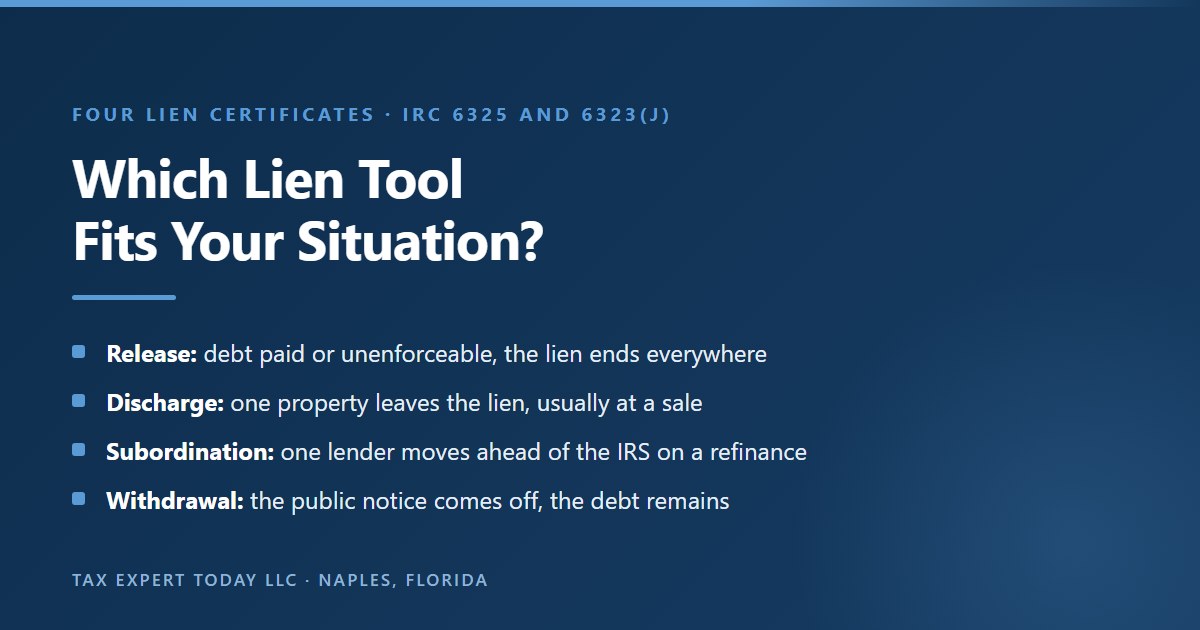
A release ends the lien entirely after the debt is paid or becomes unenforceable. A discharge removes the lien from one property. A subordination keeps the lien but lets a specific lender go first. A withdrawal removes the public notice of the lien while the debt and the lien itself remain. Each one solves a different problem.
- Release: the debt is gone or legally uncollectible, so the lien ends everywhere.
- Discharge: one asset leaves the lien, usually at a sale.
- Subordination: one lender moves ahead of the IRS, usually at a refinance.
- Withdrawal: the public notice comes off the record; the debt does not.
People mix these four up constantly, and the confusion costs time at closing. A title officer who asks for “a release” when the seller still owes the IRS is asking for something the IRS cannot issue, because section 6325(a) requires a release only when the liability is fully satisfied or legally unenforceable, or a bond is accepted. What that seller needs is an IRS lien discharge on the property being sold.
| Certificate | Code section | What it does | Typical use | IRS form or publication |
|---|---|---|---|---|
| Release | 6325(a) | Ends the lien on all property | Balance paid in full, or the collection statute expired | Publication 1450 |
| Discharge | 6325(b) | Removes the lien from one named property | Selling a house, land, or business asset | Form 14135 and Publication 783 |
| Subordination | 6325(d) | Lets a named creditor take priority over the IRS on one property | Refinancing or a new secured loan | Form 14134 and Publication 784 |
| Withdrawal | 6323(j) | Removes the public Notice of Federal Tax Lien | Direct debit installment agreement, or after release | Form 12277 |
| Nonattachment | 6325(e) | States the lien does not attach to a different person with a similar name | Mistaken identity on a title search | Publication 1024 |
Withdrawal has its own rules, and we cover them separately in our IRS tax lien withdrawal guide on Form 12277. The short version is that a withdrawal changes what the public record shows, while a discharge and a subordination change who gets paid from a particular piece of property. The withdrawal options that came out of the 2011 initiative are summarized in our IRS Fresh Start program guide. Release on full payment is the simplest of the four: under section 6325(a) the IRS must issue a certificate of release within 30 days after the liability is satisfied, and the Publication 1450 instructions explain how to ask for one if it does not arrive.
When do you need an IRS lien discharge to sell property?
You need an IRS lien discharge when a Notice of Federal Tax Lien attaches to property you are selling and the sale proceeds will not pay the full tax balance, or when you need clear title before the IRS has been paid. If the proceeds will pay every lien in full, a payoff and release usually work instead.
- Short of a full payoff: the net proceeds will not clear the entire IRS balance.
- No equity: senior mortgages eat the whole sale price.
- Disputed amount: you need to close while the balance is still being contested.
- Third party owner: a co-owner or buyer who does not owe the tax needs the lien off.
The decision tree is simpler than it looks. Start with the payoff. The Centralized Lien Operation provides lien payoff amounts at 800-913-6050, according to Publication 4235. If the sale nets enough to pay the IRS in full at closing, the title company can pay the payoff figure, and the IRS then issues a release under section 6325(a). No IRS lien discharge is needed in that case, although some title companies still prefer the certainty of a discharge certificate when the release will not be recorded until after closing.
If the sale will not pay the IRS in full, an IRS lien discharge is the only way to deliver the property free of the federal lien. The lien follows the property into the buyer’s hands otherwise, which is why a buyer’s title insurer will refuse to insure over a recorded notice. The IRS designed the discharge process for exactly this situation, and Publication 783 walks through it step by step.
Timing matters more than most sellers expect. Publication 783 asks applicants to “submit your application at least 45 days before the transaction date” so the IRS has time for review, determination, notification, and paperwork. A contract with a 30 day closing and a lien discovered on the title commitment is the classic setup for a delayed or failed closing. If you know there is a lien, raise it with your agent and title company before you sign a contract, not after.
What are the five grounds for an IRS lien discharge under section 6325(b)?
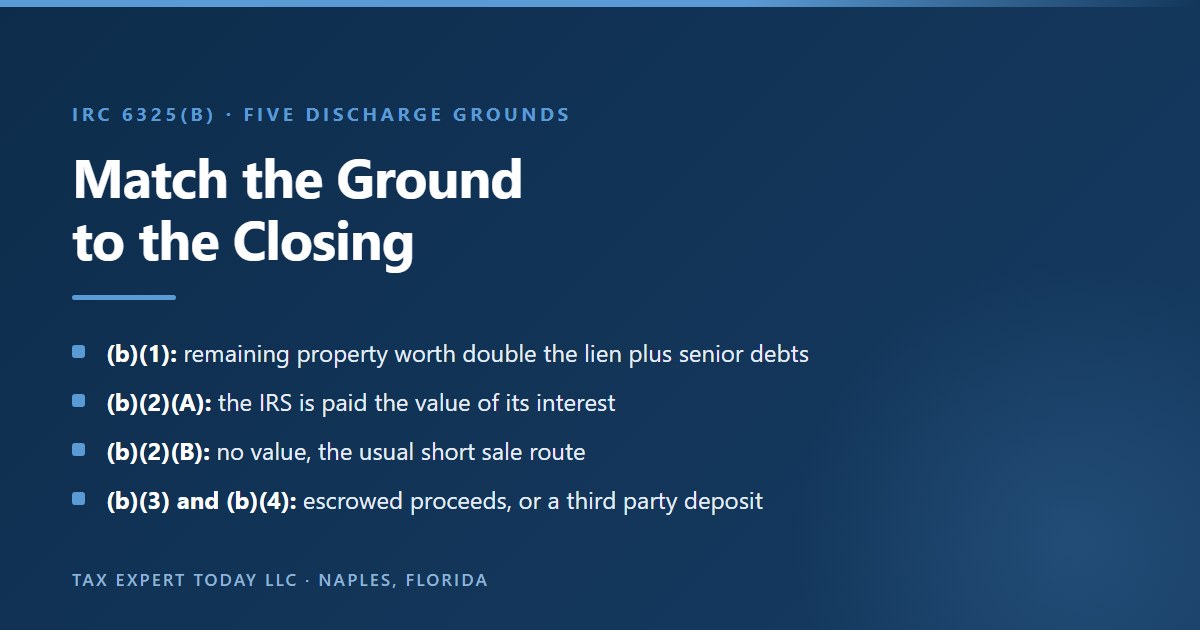
Section 6325(b) allows an IRS lien discharge when the remaining property is worth at least double the lien plus senior debts, when the IRS is paid the value of its interest, when its interest has no value, when sale proceeds are held in escrow, or when a third party owner deposits the value of the government’s interest or posts a bond.
- 6325(b)(1): plenty of other property still secures the debt.
- 6325(b)(2)(A): the IRS receives what its lien would have captured.
- 6325(b)(2)(B): senior debts leave nothing for the IRS.
- 6325(b)(3): proceeds wait in escrow under an IRS agreement.
- 6325(b)(4): a non-liable owner deposits or bonds the IRS’s interest.
Every IRS lien discharge fits one of these boxes. Form 14135, Section 7, asks the applicant to pick the one that applies, and Publication 783 notes that if the IRS does not agree with the selection, it will explain why. Picking the right IRS lien discharge ground at the start avoids a round of back and forth while a closing date slips. The table below maps each ground to the closing scenario it fits and to the paperwork the IRS issues.
| Ground | Closing scenario it fits | Payment to the IRS | Commitment letter and certificate |
|---|---|---|---|
| 6325(b)(1), double value | Selling one property while other property worth at least twice the lien plus senior debts stays encumbered | None required | Form 669-A |
| 6325(b)(2)(A), part payment | Ordinary sale with equity, where net proceeds will not cover the full balance | The value of the government’s interest, paid at closing | Letter 403, then Form 669-B |
| 6325(b)(2)(B), no value | Short sale, underwater sale, or a foreclosure where senior liens exceed the value | None required | Letter 402, then Form 669-C |
| 6325(b)(3), escrow | Sale where the amount or priority of claims is disputed and the closing cannot wait | Proceeds held in an approved escrow fund | Form 669-H |
| 6325(b)(4), substitution of value | A co-owner, heir, or buyer who does not owe the tax needs the lien off | Deposit or bond equal to the government’s interest | Form 669-G |
The certificate and letter numbers come from the chart in IRM 5.12.10.3. They matter in practice because title companies sometimes ask which certificate they will receive, and a Letter 402 or 403 conditional commitment is the document most closings are built around.
Ground one: the remaining property is worth double the debt
Section 6325(b)(1) lets the IRS release one asset when the fair market value of what remains under the lien is at least double the sum of the unpaid liability and all liens with priority over it. Publication 783 gives a worked example: add the tax liability and the senior debts, multiply by two, and the property left behind must be worth at least that figure. No payment is required. This ground suits taxpayers with substantial real estate who are selling one parcel and keeping others.
There is a condition the statute does not mention. IRM 5.12.10.3.1 states that an application under 6325(b)(1) is not considered unless the taxpayer is in filing compliance, is current on federal tax deposits or estimated payments, and has addressed the balance due, for example with a payment plan, a pending offer in compromise, or a hardship determination. You must also attach deeds and valuations for the property that stays behind, not just the property being sold.
Ground two: the IRS is paid the value of its interest
Section 6325(b)(2)(A) is the workhorse. The IRS issues the discharge when it receives, in partial satisfaction of the liability, an amount not less than the value of its interest in the property. The statute tells the IRS to consider the value of the property and the liens that have priority over its own. In plain terms, the IRS takes the equity its lien actually reaches, and the rest of the balance stays on the account. The taxpayer must be divested of all interest in the property, so this ground is for real sales, not paper transfers to relatives who keep the seller in the home.
Ground three: the IRS interest has no value
Section 6325(b)(2)(B) allows an IRS lien discharge when the IRS determines that its interest in the property has no value. That happens when mortgages and other senior liens are larger than what the property will bring. No payment is required, and this is the ground the IRM directs for short sales. It is covered in more detail below.
Ground four: the proceeds go into escrow
Section 6325(b)(3) lets the sale close while the proceeds sit in a fund that is subject to the IRS’s liens and claims “in the same manner and with the same priority” as the property. This is the tool when the parties agree the sale should happen but disagree about who gets paid.
Ground five: a third party owner substitutes value
Section 6325(b)(4) gives an owner who is not the taxpayer a right, not just a request, to an IRS lien discharge if that owner deposits the value of the government’s interest or furnishes an acceptable bond. Section 6325(b)(4)(D) excludes the taxpayer from using it. This ground carries a court remedy that the others lack.
How does the IRS calculate its interest for an IRS lien discharge?
The IRS starts with the property’s fair market value, usually supported by a disinterested third party appraisal, and subtracts liens that are senior to the federal tax lien and reasonable costs of sale. What remains is the government’s interest, which is the amount it generally expects to receive for a part payment discharge.
- Start with value: appraisal plus one other valuation, such as the county value or the contract price.
- Subtract senior liens: first mortgages, property taxes, and other debts ahead of the IRS.
- Subtract allowable costs: commissions, title, recording, and required transfer charges.
- Junior creditors wait: debts behind the IRS are not paid from the IRS’s share.
The math is the same subtraction a title company runs on any closing, with one rule that surprises people. IRM 5.12.10.3.2 states that “under no circumstances” will the IRS reduce its determined interest to allow payment to a creditor that is junior to the federal tax lien. A second mortgage recorded after the Notice of Federal Tax Lien, a contractor’s lien that arose later, or a credit card judgment does not come out of the IRS’s share. Priority under IRC §6323 decides who is senior, and the title report is where that order shows up.
Here is a simplified hypothetical, using round numbers for illustration only. Actual figures depend on the property, the title report, and the IRS’s own review.
| Line item (hypothetical) | Amount |
|---|---|
| Contract sale price, supported by an appraisal | $420,000 |
| Less first mortgage recorded before the Notice of Federal Tax Lien | ($250,000) |
| Less current year property taxes (senior by statute) | ($6,000) |
| Less real estate commission | ($25,200) |
| Less title, recording, and required transfer charges | ($6,800) |
| Government’s interest in the property | $132,000 |
| Federal tax lien balance | $185,000 |
| Balance remaining on the account after the discharge payment | $53,000 |
In that hypothetical, the IRS would generally look for about $132,000 at closing under section 6325(b)(2)(A), issue the discharge, and continue to collect the remaining $53,000 through its normal tools. If a home equity line or a later judgment sat behind the IRS, it would be paid only from whatever the IRS did not reach, which here is nothing.
What counts as an allowable expense
IRM 5.12.10.7.4 lists the kinds of costs the IRS treats as reasonable and necessary: fees for the application itself, such as the title report and appraisal; fees inherent to the transaction, such as the realtor commission or a loan origination fee; costs of administering the proceeds; recording fees; and transfer charges such as ad valorem taxes and “document stamp fees” when the jurisdiction requires them on all sales of that type. The same section disallows any expense if money is going to the taxpayer, if the fee is not required by local law, if it is not applied to all similar sales, or if it is excessive. Reasonable attorney fees for the transaction are allowed; fees for unrelated tax work are not. Staging costs are allowed when they hastened the sale or raised the price.
One caution for commercial property. IRM 5.12.10.7.4.1 explains that a state real estate transfer tax imposed as a percentage of certain commercial transactions has no priority over the federal tax lien and is not treated as an expense of sale. How a particular state or county charge is classified can change the government’s interest, so it is worth confirming with the Advisory employee before the closing statement is final.
Forced sale value and spouses who own property together
Two more valuation rules can move the number. First, the IRM allows Advisory to consider “forced sale value” rather than full fair market value in some situations, particularly when market conditions have depressed comparable sales. An applicant can suggest it, but Advisory decides. Second, when property is held as tenants by the entirety and only one spouse owes the tax, IRM 5.12.10.3.6 states that the government’s interest is generally one half of the value, so a part payment discharge generally asks for one half of the net proceeds. The Supreme Court held in United States v. Craft, 535 U.S. 274 (2002) that the federal tax lien can attach to a debtor spouse’s interest in entireties property, which is why that one half rule exists. Whether the other spouse is liable at all is a separate question; when a joint return created the debt, innocent spouse relief may be worth examining.
Can you get an IRS lien discharge on a short sale or in a foreclosure?
Yes. When the senior lender agrees to take less than it is owed, the IRS generally treats its own interest as having no value and considers the application under section 6325(b)(2)(B), which requires no payment. Foreclosing lenders can also use the discharge process instead of naming the United States in a judicial foreclosure.
- Short sale: generally a no value discharge, with no payment to the IRS.
- Lender carve-outs: money the senior lender gives up for closing costs is not IRS money.
- Foreclosure: a faster 14 day recommendation target once the application is complete.
- Redemption: a separate IRS right that has its own release process.
IRM 5.12.10.3.3.1 addresses short sales directly. It explains that because the senior lien attaches to all the equity, “generally the lien interest of the United States in short sale properties is valueless.” It goes further. When the senior lender agrees to pay certain expenses out of its own settlement amount, including a homeowners association balance or a transfer charge that would otherwise rank behind the IRS, the IRS “has no authority to require payment” of those sums as a condition of the discharge, provided there is nothing fraudulent about the distribution. That is an important point for sellers whose short sale is being held up by a junior creditor.
The same section adds a caution. If the senior lender lets part of its proceeds go to the seller as an incentive, that payment does not change the no value determination, but it is an asset the IRS could levy, subject to the usual notice of intent to levy rules. The IRM tells employees that any decision to levy should be made judiciously and that it should not hold up the discharge.
For foreclosures, Publication 783 explains that the application is made under 6325(b)(2)(A) or 6325(b)(2)(B), and that the applicant should receive a conditional commitment letter within 30 days of a complete and approved application. Internally, IRM 5.12.10.7.1 sets a target of 14 calendar days for a recommendation when a foreclosure sale is pending, against 30 days in other cases. The IRS also holds a separate right to redeem real property after certain foreclosure sales under 28 U.S.C. 2410(c); releasing that right is a different application, explained in Publication 487.
If the property is your home and the outlook is a forced sale, our guide on whether the IRS can take your house explains the separate, much more restricted rules for an IRS seizure of a principal residence. A short sale with an IRS lien discharge is a voluntary transaction you control; a seizure is not.
How does the escrow route under section 6325(b)(3) work?
Under section 6325(b)(3), the property is sold, and the IRS agrees that the proceeds will be held in an escrow fund subject to its liens and claims in the same priority they had against the property. The IRS issues the discharge once its share is in the approved escrow account, so the sale can close while the dispute is resolved.
- Use it when timing and money conflict: the buyer will not wait, but the payout is contested.
- The escrow agreement does the work: account type, depositary, payout conditions, and costs.
- The IRS signs too: the Advisory group manager must approve and sign the agreement.
- Third parties have a deadline: a court claim to the fund must be brought within nine months.
Publication 783 describes the order of operations. The applicant submits a draft escrow agreement with Form 14135. The Advisory group manager approves the escrow agent, any reasonable sale expenses, the claim amounts and priorities, and the timing of distributions. The agreement is then signed by all parties, including the Advisory group manager, before the discharge issues. The escrow account must be funded before any claim is paid. Form 14135, Section 15, lists what the agreement must specify: the type of account, the name of the account and the depositary, the conditions for payment, the cost of escrow, and the name and address of every party.
Publication 783’s own example shows how the waterfall works: two senior mortgages are paid first, then the government’s interest, then three junior liens in order. The point of the escrow route is that the waterfall is fixed at closing, while the precise amounts can still be argued later. IRM 5.12.10.3.4 adds that a third party who claims an interest in the fund may bring suit in federal district court under section 7426(a)(3) within nine months after the date of the agreement, and that IRS Counsel reviews proposed escrow agreements.
The escrow route takes more coordination than a straightforward part payment IRS lien discharge, but it can be the only way to save a sale when a lien amount is wrong, when a penalty abatement request or audit reconsideration is pending, or when two creditors dispute priority.
What if you own the property but do not owe the tax?
A co-owner, heir, or buyer who is not liable for the tax can demand an IRS lien discharge under section 6325(b)(4) by depositing the value of the government’s interest or posting a bond. That owner then has 120 days to sue in federal district court under section 7426(a)(4) to recover any amount the IRS overvalued.
- It is a right: the statute says the IRS “shall issue” the certificate on deposit or bond.
- Only non-liable owners qualify: the taxpayer cannot use this ground.
- 120 days to sue: the court action is the exclusive remedy for getting money back.
- Waiver trap: paying under 6325(b)(2)(A) instead gives that remedy up.
This ground exists for people caught in someone else’s tax problem: a parent whose adult child is on the deed, a former spouse who still co-owns a house, a buyer who discovers after closing that the seller’s lien attached, or an estate beneficiary. Section 6325(b)(4)(A) directs the IRS to issue the certificate if the owner deposits money equal to the value of the government’s interest, as the IRS determines it, or furnishes an acceptable bond in that amount. Publication 783 notes that Treasury Circular 570 lists surety companies whose bonds are acceptable, and that for entireties property the deposit or bond is one half of the government’s interest.
The remedy is the important part. Under IRC §7426(a)(4), the owner may file a civil action within 120 days after the certificate issues to have a court decide whether the IRS valued its interest too high. If no suit is filed, section 6325(b)(4)(C) gives the IRS 60 days after that period to apply the deposit to the tax and refund any excess with interest. Publication 783 is blunt that the court action “is the exclusive remedy” for the third party; an administrative refund claim is not available. IRM 5.12.10.3.5.1 also requires IRS Area Counsel approval for every 6325(b)(4) discharge, which can add time.
There is a trap in the form. Form 14135, Section 16, asks a non-liable owner who applies under 6325(b)(2)(A) to sign a waiver. By checking “Waive,” the owner gives up the right to treat the payment as a deposit and gives up the section 7426(a)(4) lawsuit. If the owner does not waive, the IRS treats the application as a 6325(b)(4) deposit. A third party owner should decide that box deliberately, ideally with advice, because it determines whether there is any way to get money back later. For the taxpayer whose debt it is, IRM 5.12.10.3.5.5 notes that the collection statute is suspended under IRC §6503(f) for the period a deposit or bond is held, as to the amount of the government’s interest.
How do you apply for an IRS lien discharge with Form 14135?
Complete Form 14135, attach the appraisal, a second valuation, the title report, the sales contract, and the proposed closing statement, and submit the package to the IRS Advisory Consolidated Receipts unit by mail, fax, or through your IRS Online Account, at least 45 days before closing. Do not send payment with the application.
- Pick the ground: Section 7 of the form, matched to your closing.
- Prove value: a professional appraisal plus one additional valuation.
- Prove priority: a current title report listing every senior lien.
- Prove the money: the proposed settlement statement with every cost itemized.
- Wait for the number: the IRS tells you what to pay and when.
For an IRS lien discharge, the current Form 14135 (Rev. 11-2024) has 17 sections. Most are identification: the taxpayer as named on the lien, the applicant if different, the buyer, any representative, and the lender or escrow company. The sections that decide the outcome are the monetary information, the basis for discharge, the property description, the appraisal and valuations, the title report, and the closing statement.
| Document | Discharge (Form 14135) | Subordination (Form 14134) |
|---|---|---|
| Copy of the Notice of Federal Tax Lien | If the applicant is not the taxpayer | If the applicant is not the taxpayer |
| Deed or title with legal description | Required for real estate | Requested for real estate |
| Professional appraisal by a disinterested third party | Required, plus one additional valuation | Not required; one valuation such as the county value is acceptable |
| Sales contract or loan agreement | Sales contract or purchase agreement | Proposed loan agreement and why subordination helps the IRS |
| Current title report | Requested, or list senior encumbrances | Required |
| Proposed closing or settlement statement | Requested, or itemize costs | Requested, or itemize costs |
| Escrow agreement | Only for 6325(b)(3) | Not applicable |
| Form 2848 or Form 8821 | If a representative is involved | If a representative is involved |
The appraisal standard is specific. Publication 783 describes a professional appraisal with neighborhood analysis, a description of the site and improvements, a cost approach, comparable sales, interior and exterior photos, a comparable sales map, a sketch, a flood map, and the appraiser’s qualifications. A broker price opinion alone usually will not carry the application, although IRM 5.12.10.7.1 lets the Advisory group manager waive the appraisal when other acceptable evidence of value is submitted.
Where to send it is the one detail most likely to be out of date in older guides. Publication 783 (Rev. 12-2022) lists a mailing address at Advisory Consolidated Receipts in Florence, Kentucky, and a phone number for questions, 859-594-6090. The more recent Publication 4235 (Rev. 7-2025) states that applications for discharge, subordination, or withdrawal may be submitted through Your Online Account on IRS.gov or by mail to Advisory Consolidated Receipts, 7940 Kentucky Drive, Stop 2850A, Florence, KY 41042-2915, and lists a fax number of 844-201-8382. Because those details change, check the current Publication 4235 on the day you submit.
Payment comes last. Publication 783 says a discharge under 6325(b)(2)(A) “requires a payment, but do not send a payment with the application.” The Advisory group manager sets the amount, and payment is made in certified funds, a cashier’s or treasurer’s check, or a money order. A personal check delays the certificate until it clears.
How long does an IRS lien discharge take?
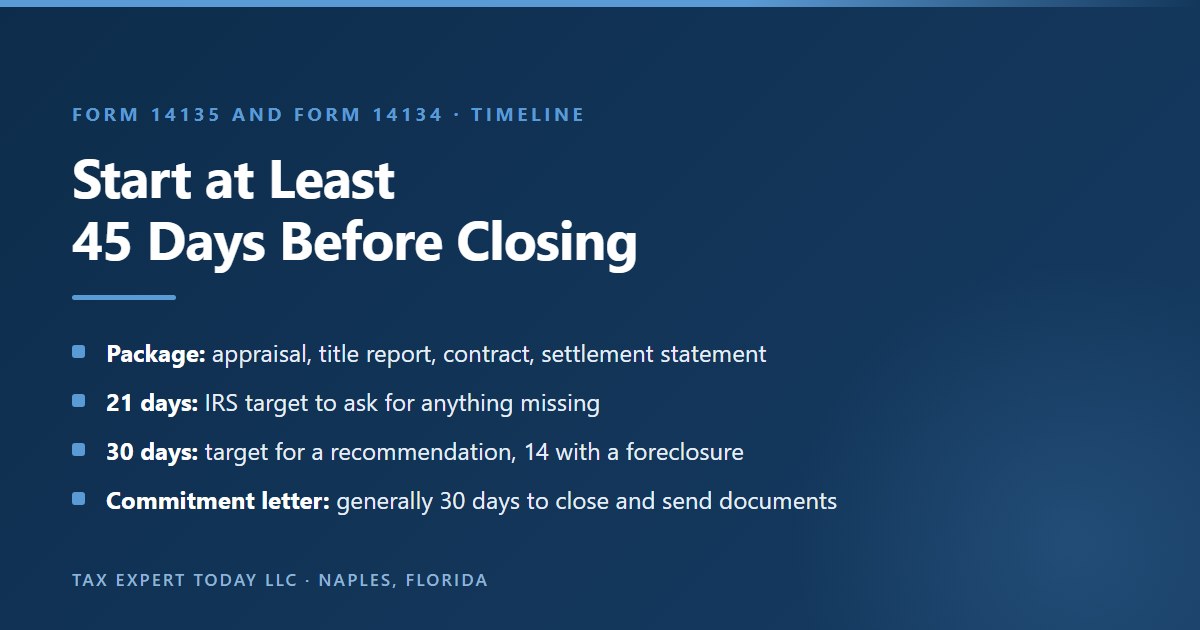
Plan for at least 45 days. The IRS asks for the application 45 days before closing; its internal targets call for contact about missing items within 21 days and a recommendation within 30 days of a complete package, or 14 days with a foreclosure pending. After approval, a conditional commitment letter gives you 30 days to close and send the final documents.
- Day 0: complete application received by Advisory.
- Within 7 days: the case is opened and assigned.
- Within 21 days: the IRS asks for anything missing.
- Within 30 days: a recommendation to approve or deny.
- Then 30 days: to close under the commitment letter.
These are internal targets from IRM 5.12.10.7.1 and 5.12.10.8, not commitments to any particular applicant. Actual timing depends on how complete the package is, whether a field investigation is needed, and workload. The fastest applications are the ones that arrive with every document already attached, because the 21 day request for information and a 30 day response window can add weeks.
| Step | IRM target or rule | What you do |
|---|---|---|
| Submit the application | Publication 783 asks for at least 45 days before the transaction | Send the complete package with all attachments |
| Case opened | Within 7 calendar days of receipt in the group | Nothing; confirm receipt if you have not heard back |
| Request for missing information | No later than 21 calendar days from receipt | Respond by the stated deadline, generally 30 days |
| Recommendation | 14 days with a foreclosure pending, 30 days otherwise | Answer valuation and expense questions quickly |
| Conditional commitment letter | Letter 402, 403, or 4053, generally with a 30 day window | Close the sale or loan; extensions generally no more than 30 more days |
| Certificate issued | After payment, recorded deed, and final settlement statement are received | Record the certificate in the county records |
Two details at the end of an IRS lien discharge catch people. The commitment letter is conditional, so the final settlement statement must match what the IRS approved; IRM 5.12.10.9 directs the employee to reconcile any differences from the preliminary statement. And the applicant, not the IRS, is generally responsible for recording the certificate. An IRS lien discharge that is never recorded leaves the title record looking exactly as it did before. Under section 6325(f)(1), a certificate is conclusive once it is filed in the same office as the notice of lien.
What is an IRS lien subordination?
An IRS lien subordination is a certificate under section 6325(d) that lets a named creditor move ahead of the federal tax lien on a specific property. The IRS lien stays on the property, but the new lender gets paid first, which is what most refinances and new secured loans require.
- The lien stays: nothing comes off the title.
- Priority changes: one lender, one loan, one property moves up.
- It is discretionary: the IRS may issue it when it serves the government’s interest.
- It is narrow: it applies only to the instrument and amount named.
Lenders generally will not refinance a property if a recorded federal tax lien would sit ahead of their new mortgage. When a homeowner refinances, the old mortgage is paid off and a new one is recorded, and the new mortgage would normally rank behind a Notice of Federal Tax Lien filed in between. A subordination fixes that by making the new lender senior to the IRS on that property. Publication 784 describes it as allowing “a named creditor to move their junior creditor position ahead of the United States’ position.”
The distinction from an IRS lien discharge is the whole point. An IRS lien discharge is for leaving the property; a subordination is for staying and borrowing against it. IRM 5.12.10.6.2.2 makes the narrowness explicit: the federal tax lien “remains on the property, subordinated only in the amount specified by the subordination, and subordinated only to the instrument specified in the subordination certificate.” Under IRM 5.12.10.6.3, subordination “is a discretionary act” and is generally issued only when it is in the government’s best interest.
When does the IRS agree to subordinate its lien for a refinance?
The IRS subordinates under section 6325(d)(1) when it is paid an amount equal to the interest it is subordinating, often the cash out from a refinance, or under section 6325(d)(2) when it believes subordination will ultimately increase what it collects and make collection easier, such as a lower rate refinance that frees money for a payment plan.
- (d)(1), cash to the IRS: the new equity drawn out is paid toward the tax.
- (d)(2), better collection: no immediate payment, but a documented collection benefit.
- Rate and term refinance: usually a (d)(2) case that must still show a benefit.
- Cash to pay other debts: generally not allowed unless it helps collection.
Publication 784 gives a worked (d)(1) example. A home is worth $200,000, the lender will lend 80 percent, or $160,000, the existing loan is $145,000, and closing costs are about 3 percent of the new loan, or $4,800. The potential equity of $15,000 less the $4,800 of costs leaves $10,200, and the IRS would ask for that $10,200 in exchange for subordinating to the new loan. The lien remains, but the refinanced loan has priority. IRM 5.12.10.6.1 adds that if a taxpayer wants a home equity loan to get cash or pay unsecured debts, the (d)(1) rules apply, and payment of junior or unsecured debts is generally not allowed unless it ultimately enhances collection.
The (d)(2) ground is judgment based. IRM 5.12.10.6.2 says it is meant for situations where “an ordinary, prudent businessman would subordinate rights in a debtor’s property in order to secure long-run benefits,” and that the IRS applies it to dollar for dollar refinances of a senior lien, which “must still demonstrate a benefit to the government.” The IRM’s example is a homeowner struggling with mortgage payments who refinances to a lower rate, keeps the equity intact, and can then pay more on the tax. Form 14134 requires a signed and dated statement explaining how the subordination will increase what the IRS realizes and make collection easier. That statement is where a (d)(2) application is won or lost, so it should connect the refinance to a specific payment plan, such as one of the IRS installment agreement options.
| Situation | Likely ground | What the IRS looks for |
|---|---|---|
| Cash-out refinance with money going to the IRS | 6325(d)(1) | Payment equal to the equity subordinated |
| Rate and term refinance with no new cash | 6325(d)(2) | Lower payments that support a payment plan or preserve equity |
| Home equity loan or second mortgage | 6325(d)(1) | Proceeds applied to the tax, not to unsecured debts |
| Reverse mortgage | 6325(d)(2), limited | Payments sent to the IRS, a signed installment agreement, no variable rate |
| Business receivables financing or factoring | 6325(d)(1) or (d)(2) | A limited period, generally no longer than one year |
Home equity lines of credit
A home equity line can create a hidden priority problem. Publication 784 explains that the Notice of Federal Tax Lien takes priority over advances made on a HELOC starting the 46th day after the notice is filed, because the protection for later advances under section 6323(d) runs for 45 days. Draws taken after that point sit behind the IRS and count as equity the lien reaches. Publication 784 asks applicants to document every HELOC advance from the 46th day through the application date, plus expected advances through the certificate date, to avoid delays.
Reverse mortgages and business financing
IRM 5.12.10.6.2.2 allows subordination to a reverse mortgage in limited cases. The IRS first considers whether the taxpayer could borrow the maximum equity and pay it under (d)(1). If that is not possible, a reverse mortgage subordination may be approved, but all payments from the lender must go to the IRS, a signed installment agreement on Form 433-D is required, and variable rate reverse mortgages “should not be approved.” For businesses, IRM 5.12.10.6.1.1 permits subordination of the lien on accounts receivable to a factoring or lending agreement for a period no longer than one year, or no longer than 90 days if an operating business has not paid its preceding quarter’s trust fund taxes.
How do you apply for a certificate of subordination with Form 14134?
Complete Form 14134, attach a current title report, a valuation, the proposed loan agreement, and the proposed closing statement, explain how the subordination serves the government’s interest, and submit it to Advisory Consolidated Receipts at least 45 days before the loan closes. A (d)(1) payment is made only after the IRS sets the amount.
- Lender details: name, contact, and the type of transaction, such as a refinance.
- The numbers: existing loan, new loan, and any amount to the IRS.
- Title report: required for a subordination.
- The explanation: why the IRS comes out ahead.
The Form 14134 package is lighter than a discharge package in one respect: Publication 784 states that a full professional appraisal is “not required for a certificate of subordination,” and a county valuation or an informal valuation by a disinterested third party may be used instead. It is heavier in another: a current title report is required, and Section 11 asks the applicant to describe how subordination is in the best interests of the United States. A lender’s appraisal ordered for the refinance often serves both purposes.
Publication 784 says the certificate under (d)(1) issues when the IRS receives the amount it determined, and under (d)(2) after the application has been investigated and verified, with the Advisory group manager giving a projected mailing date. The IRM uses Letter 4053 as the conditional commitment and Form 669-D as the certificate.
Do you need a subordination to buy a new home with a federal tax lien on file?
Usually not. Under Revenue Ruling 68-57, a purchase money mortgage given in good faith to buy property has priority over an already recorded Notice of Federal Tax Lien, so the IRS says a subordination certificate is not needed and will not be provided for that loan, provided state law requirements are met.
- Purchase money only: the loan proceeds must be used to buy the property.
- State law controls: the mortgage must be valid and properly recorded.
- Equity is still reachable: the lien attaches to the buyer’s equity in the new home.
The IRS addresses this in Publication 785, which explains that it is “not necessary” for the IRS to issue a certificate of subordination for a purchase money mortgage or purchase money security interest to have priority, as long as the requirements of state law are met and the loan proceeds are used to buy the property. IRM 5.12.10.6 instructs IRS employees to provide Publication 785 to anyone who asks for a subordination in that situation. Lenders who are unfamiliar with the rule sometimes ask for a certificate anyway, and Publication 785 is the document to give them. The tax lien still attaches to the buyer’s equity in the new property, so it does not end the debt.
Does an IRS lien discharge remove the tax debt or the lien on other property?
No. An IRS lien discharge removes the lien from the property named in the certificate only. The tax debt remains, the lien continues on all other property and rights to property, the public notice stays on record, and if the taxpayer later reacquires the discharged property, the lien attaches to it again.
- The debt survives: the IRS keeps collecting any balance after the closing.
- Other property stays liened: bank accounts, other real estate, and future assets.
- The public notice stays: a withdrawal is a separate request.
- Reacquisition voids it: buying the property back brings the lien back.
IRM 5.12.10.3 states that after a discharge, “the lien continues in full force and effect on all other property or rights to property of the taxpayer.” Section 6325(f)(3) adds that the lien attaches again to any discharged property that the taxpayer reacquires. That rule closes the obvious loophole of selling to a friendly buyer and buying the property back later.
Because the debt survives, an IRS lien discharge is usually one step in a larger plan, and the remaining balance keeps accruing interest and the failure to pay penalty until it is resolved; our IRS penalty and interest calculator shows how quickly that adds up. The sale may pay part of the balance, and the rest is resolved through a payment plan, a partial payment installment agreement, an offer in compromise, or a period of currently not collectible status. It is also worth knowing how long the IRS has left to collect. Our guide to the IRS 10 year rule on tax debt explains the collection statute; once it runs out, the liability becomes legally unenforceable and section 6325(a) calls for a release.
Can you appeal a denied IRS lien discharge or subordination?
Yes, through the Collection Appeals Program. A denial is sent on Letter 4025 for a discharge or Letter 4027 for a subordination, with Publication 1660, and the applicant can request an appeal on Form 9423. A denied application does not by itself give rise to a collection due process hearing.
- Denial in writing: Letter 4025 or Letter 4027 with the reason.
- Appeal form: Form 9423, Collection Appeal Request.
- Fix discrepancies first: most denials are about the amount of the government’s interest.
- Reapplying is allowed: a closed application can be reopened with new information.
IRM 5.12.10.12 explains that when a complete application cannot be agreed, usually over the amount of the government’s interest, the application “must be denied,” the decision must be in writing, and the denial letter must include Publication 1660, Collection Appeal Rights. Publication 783 says the applicant will receive Form 9423 with the denial. The IRM also tells employees to try to resolve discrepancies before issuing a decision, because failing to do so “could impede the taxpayer’s appeal rights.”
The Collection Appeals Program is fast and informal compared with a collection due process hearing, which is tied to the notice of lien filing and the notice of intent to levy, not to a certificate request. If a closing date is at stake, the practical move is usually to find out exactly where the IRS’s valuation differs from yours, supply the missing appraisal, comparable sale, or expense documentation, and ask for reconsideration before the deadline passes.
How do an IRS lien discharge and a payment plan or offer in compromise fit together?
The proceeds from an IRS lien discharge are applied to the tax debt, and the IRS will usually look at your overall compliance and your plan for the remaining balance. If an offer in compromise is pending, the proceeds are generally credited toward the offer amount, and the equity in the sold property no longer belongs in the offer.
- Compliance check: the IRS reviews filing and payment status on taxpayer applications.
- Remaining balance: a payment plan or other resolution is usually expected.
- Pending offer: discharge proceeds count toward the offer amount.
- Relocation allowance: limited funds may be allowed from a home sale.
For an IRS lien discharge, IRM 5.12.10.3.6 tells employees to run a full compliance check when a taxpayer applies and to request missing returns and payments, but to process the discharge “regardless of compliance check outcomes” unless the discharge itself would hurt the government. The exception is the double value ground, which requires compliance. For subordinations, IRM 5.12.10.6.3 makes noncompliance a factor in the best interest decision. Getting current on filings before applying is almost always the better order of operations, and having a current Form 433-A or 433-F financial statement ready speeds the conversation about the remaining balance.
When an offer in compromise is in the picture, IRM 5.12.10.11 states that all discharge or subordination proceeds are applied to the tax liability, never to the offer application fee. If the discharge comes first and the offer later relies on equity that is now gone, the IRS will tell the taxpayer to reduce the offer to exclude that equity. If they happen at the same time, Advisory and the offer unit coordinate, and the proceeds may be credited toward the offer amount.
For a principal residence sold under a part payment IRS lien discharge, Publication 783 describes a relocation expense allowance requested on Form 12451. IRM 5.12.10.7.5 limits it to taxpayers who show an inability to pay moving costs, requires that the IRS receive some partial payment, excludes no value discharges, and generally caps it at 2.5 times the local standard for housing and utilities at the new location. The allowance comes out of the government’s share, not out of any junior creditor’s.
Lien discharge help Naples: tax resolution Naples and Southwest Florida
Tax Expert Today LLC provides IRS tax resolution from its Naples, Florida office: back taxes and IRS tax debt, payment plans and installment agreements, offers in compromise, wage garnishment and bank levy release, federal tax lien withdrawal, penalty abatement, unfiled returns, and audit representation. The firm is led by Dr. Pellumb Kabashi, an Enrolled Agent with unlimited rights to represent taxpayers before the IRS, a Certified Fraud Examiner, and a Certified Estate and Trust Specialist, with a team of enrolled agents, CPAs, and tax attorneys.
- Address: 11983 Tamiami Trail N, Naples, FL 34110.
- Phone: (239) 441-2005.
- Hours: Monday through Friday, 10 a.m. to 5 p.m. Eastern Time.
- Representation: on Form 2848, which lets us speak with the IRS on your behalf.
Real estate is where federal tax liens meet daily life in Southwest Florida. Collier and Lee Counties have a large market in second homes, condominiums, and investment property, and many owners sell or refinance on a seasonal calendar. Florida is also a tenancy by the entireties state, so a married couple’s home where only one spouse owes the IRS raises the one half valuation rule described above. Florida deeds carry documentary stamp tax, one of the transfer charges the IRM treats as an allowable expense when it is required on all such sales. Each of those details changes the government’s interest, and each is the kind of thing that turns up late on a title commitment.
Our Naples tax resolution services cover IRS lien discharge and IRS lien subordination applications alongside the payment plans and offers that usually follow a sale, and our IRS resolution and audit support covers the cases where a lien sits on top of an open audit or a disputed assessment. If the balance behind the lien is the bigger problem, our IRS tax debt help Naples page explains the options for the debt itself.
Most of the work is coordination. With a Form 2848 on file, a representative can confirm the lien payoff, identify which section 6325 ground fits the closing, assemble the appraisal, title report, and settlement statement into a complete Form 14135 or Form 14134 package, work through valuation questions with the Advisory employee, and keep the title company and lender informed against the closing date. Owners outside Florida can work with the office remotely; representation before the IRS is not limited by state.
Frequently Asked Questions About IRS Lien Discharge and Subordination
What is an IRS lien discharge?
An IRS lien discharge is a certificate under IRC section 6325(b) that removes the federal tax lien from one specific property, usually so it can be sold with clear title. The lien remains on all other property, the public notice stays on record, and any unpaid balance remains owed.
What is the difference between lien discharge and subordination?
A discharge removes the lien from a property, typically for a sale. A subordination leaves the lien on the property but lets a named lender take priority over the IRS, typically for a refinance or new loan. Discharge uses Form 14135 and subordination uses Form 14134.
Do I have to pay the IRS to get a lien discharge?
It depends on the ground. A discharge under section 6325(b)(2)(A) requires payment of the value of the government’s interest, usually from the sale proceeds. Discharges under 6325(b)(1) and 6325(b)(2)(B), the no value ground used for short sales, require no payment. Do not send payment with the application.
How far ahead should I apply for an IRS lien discharge?
Publication 783 asks applicants to submit Form 14135 at least 45 days before the date the certificate is needed. That allows time for review, any request for missing documents, the conditional commitment letter, and the closing paperwork.
Can I get an IRS lien discharge on a short sale?
Generally yes. The IRM directs short sale applications to section 6325(b)(2)(B), because the senior lender’s claim usually exceeds the value, leaving the IRS interest valueless. The IRS generally cannot demand amounts the senior lender chooses to pay from its own share, such as association dues.
Where do I send Form 14135 or Form 14134?
Publication 4235 (Rev. 7-2025) states that discharge and subordination applications may be submitted through Your Online Account on IRS.gov or mailed to IRS Advisory Consolidated Receipts in Florence, Kentucky, with a listed fax option. Check the current Publication 4235 before submitting, because addresses and routes change.
Does a lien discharge remove the lien from my credit or public record?
No. A discharge frees only the named property. The Notice of Federal Tax Lien remains in the public records for everything else. Removing the public notice requires a withdrawal on Form 12277 or a release after the debt is paid or the collection period ends.
Do I need IRS approval to refinance with a tax lien?
Usually, yes, because most lenders require priority over the federal tax lien. A certificate of subordination under section 6325(d) provides that priority. A purchase money mortgage used to buy a new property generally does not need one, as explained in Publication 785.
I co-own a house with someone who owes the IRS. What are my options?
A non-liable owner can request a discharge under section 6325(b)(4) by depositing the value of the government’s interest or posting a bond, then has 120 days to sue under section 7426(a)(4) if the IRS overvalued its interest. Applying under 6325(b)(2)(A) instead requires waiving that remedy.
Where can I get help with an IRS lien discharge in Naples, FL?
Tax Expert Today LLC, 11983 Tamiami Trail N, Naples, FL 34110, (239) 441-2005, helps property owners in Collier and Lee Counties and nationwide identify the right section 6325 ground, prepare Form 14135 or Form 14134 packages, and coordinate with title companies and lenders. A representative authorized on Form 2848 can work with the IRS on your behalf.
When to Engage a Professional
Many sellers can handle a straightforward IRS lien discharge with the help of a capable title company, especially when the proceeds clearly cover the government’s interest and every document is ready. Consider engaging a representative when the closing date is less than 45 days away, when the sale is a short sale or foreclosure, when the IRS valuation and yours differ, when junior creditors or a homeowners association are fighting over proceeds, when a co-owner who does not owe the tax is involved and the section 16 waiver is on the table, when a refinance depends on a section 6325(d)(2) argument, or when a denial has already arrived. Those are the cases where the choice of statutory ground, the documentation of value and expenses, and the plan for the remaining balance decide whether the transaction closes. You can review our IRS resolution and audit support services, or start with our tax resolution Naples page. Dr. Kabashi is an Enrolled Agent authorized to represent taxpayers before the IRS in all 50 states, and every engagement starts from the statute, the regulations, and the IRS’s own procedures rather than assumptions about what the IRS will approve. Outcomes depend on each taxpayer’s facts.
This article is educational and general in nature. It does not constitute tax, legal, or real estate advice for any particular taxpayer, and outcomes depend on individual facts and circumstances. All dollar figures are hypothetical illustrations. IRS addresses, forms, and procedures are current as of the publication date and are subject to change.
Published October 26, 2026 by Dr. Pellumb Kabashi « Back to Learning Center
Have a question this article touches on?
Tax Expert Today LLC, based in Naples, Florida and serving clients across the United States.
Schedule a Consultation (239) 441-2005