
By Dr. Pellumb Kabashi, DBA, MBA, EA, CFE, CES
Founder, Tax Expert Today LLC · Tax advisors, enrolled agents, CPAs, and attorneys · Serving clients in all 50 states
Quick Answer: What happens if you get audited by the IRS is a sequence, not a single event. A letter arrives by mail, an Information Document Request asks for specific records, Form 4549 proposes the changes, a 30-day letter opens the appeal window, and a 90-day letter closes it and sends the case toward Tax Court. Each stage carries its own deadline. Call (239) 441-2005 for a free consultation.
What happens if you get audited by the IRS?
What happens if you get audited by the IRS is that a letter arrives in the mail identifying the year and the items under review, the IRS requests specific records in writing, an examiner proposes adjustments on Form 4549, and you then receive a 30 day letter offering an appeal. If that window closes without resolution, a 90 day letter follows and the dispute moves toward the Tax Court.
- Notification is always by mail. The IRS states plainly that it will not initiate an audit by telephone, so an unexpected call claiming to open an examination is a warning sign rather than a first contact.
- Selection is often statistical. Returns are commonly picked by computer screening against statistical norms, or because they involve transactions with another taxpayer whose return was selected.
- Each artifact carries a deadline. The response date on the letter, the 30 days on the appeal letter, and the 90 days on the notice of deficiency are separate clocks, and the last one is jurisdictional.
- Most examinations are narrow. A correspondence examination usually questions a small number of line items rather than reopening the entire return.
The practical difficulty for most taxpayers is not the tax law. It is knowing which stage the file is actually in, because the remedies available at each stage are different and several of them expire. A reader holding a letter should first identify the document in hand, then read the deadline printed on it, and only then consider the substantive issue. The sections below follow the artifacts in the order they arrive.
Correspondence, office, or field: which kind of audit is this?
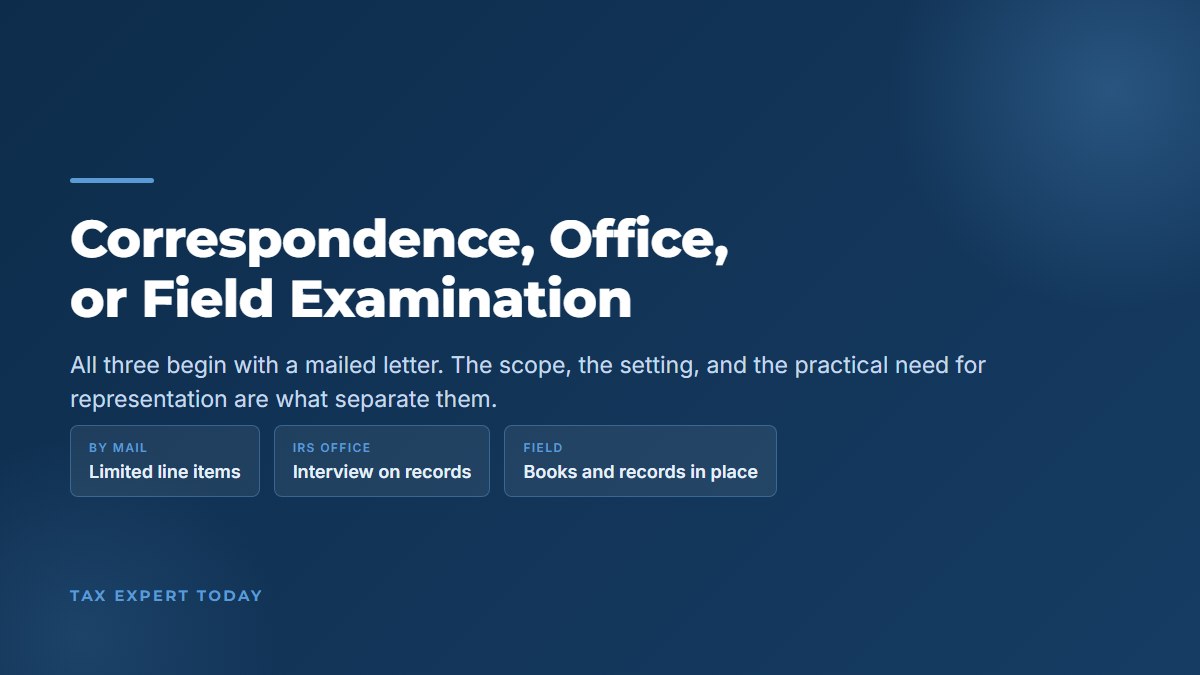
The IRS conducts examinations either by mail or through an in person interview. A correspondence examination is handled entirely through mailed documents. An office examination brings the taxpayer to an IRS office, and a field examination takes place at the home, the place of business, or the representative’s office. All three begin with a mailed letter.
The distinction matters because the scope, the intrusiveness, and the practical need for representation differ sharply across the three. The following comparison reflects how the IRS itself describes the conduct of an examination. Correspondence audits made up 81.0 percent of all examinations the IRS closed in fiscal year 2025, according to the IRS Data Book, and our research on IRS audit rates by income sets out how often each income level is examined.
| Type | Where it happens | Typical scope | What it usually signals |
|---|---|---|---|
| Correspondence examination | Entirely by mail | A limited set of line items such as income, expenses, itemized deductions, or a specific credit | A documentation gap the IRS believes can be closed with paper |
| Office examination | At an IRS office | Several related issues, often requiring an interview about how records were kept | Issues the IRS considers too involved to resolve by mail alone |
| Field examination | At the home, the business, or the representative’s office | The broadest, frequently involving business books and records | A return with business activity or complexity that the IRS wants to examine in place |
One point is worth emphasizing because it is a genuine taxpayer option rather than a courtesy. If an examination is being conducted by mail and the volume of books or records is too large to send, a taxpayer may request a face to face examination instead. The reverse accommodation also exists in practice: if the time or place proposed for an in person examination is not convenient, the examiner is expected to try to arrange something more suitable.
How does the IRS tell you the audit has started?
The IRS notifies a taxpayer of an examination by mail and by no other method. The letter identifies the tax year under review, the items being questioned, the records the IRS wants, and a date by which to respond. The specific letter number varies by the type of examination and by the function within the IRS that opened it.
- The letter names a person and a response date. Publication 3498 directs a taxpayer with questions about a specific examination to contact the person named on the letter received, which is the fastest route to a factual answer.
- A refund is not a trigger. The IRS states directly that receiving a refund is not necessarily a trigger for an audit.
- Amending does not undo selection. Filing an amended return does not affect the selection process for the original return, and the amended return itself goes through screening.
- Third party documents drive many cases. A return may be selected because Forms W-2 or 1099 furnished by third parties do not match what the return reported.
That last category deserves a separate note, because it frequently is not an examination at all. When the mismatch is purely a document matching issue, the IRS often issues a notice proposing an adjustment rather than opening an examination. Our guide to the IRS CP2000 notice covers that path, and confusing the two is one of the more common reasons a taxpayer responds to the wrong address on the wrong form.
What is an Information Document Request?
An Information Document Request, issued on Form 4564, is the written request the IRS uses to ask for specific books, records, and supporting documents during an examination. The IRS commits to providing a written request for the documents it wants to see, so a request for records should be on paper and should identify the items with reasonable specificity.
- Respond to what was asked. A request is item specific, and volunteering records outside its scope can widen an examination that was otherwise narrow.
- Send copies rather than originals. Documents sent to the IRS are not reliably returned, and the taxpayer bears the burden of substantiation later.
- Electronic records may be acceptable. The IRS accepts some electronic records in lieu of or in addition to other formats, and the examiner assigned to the case determines what will be accepted.
- Confirm delivery. The IRS advises requesting delivery confirmation from whatever service is used, which is the only practical proof that a response met its deadline.
The record retention rule sits underneath all of this. The law requires a taxpayer to keep the records used to prepare a return for at least three years from the date the return was filed, which aligns with the ordinary assessment period. Where that period is longer, the practical retention period is longer too, and our guide to the IRS audit statute of limitations explains when the three year window stretches to six years or does not close at all.
Can you stop the interview and bring in a representative?
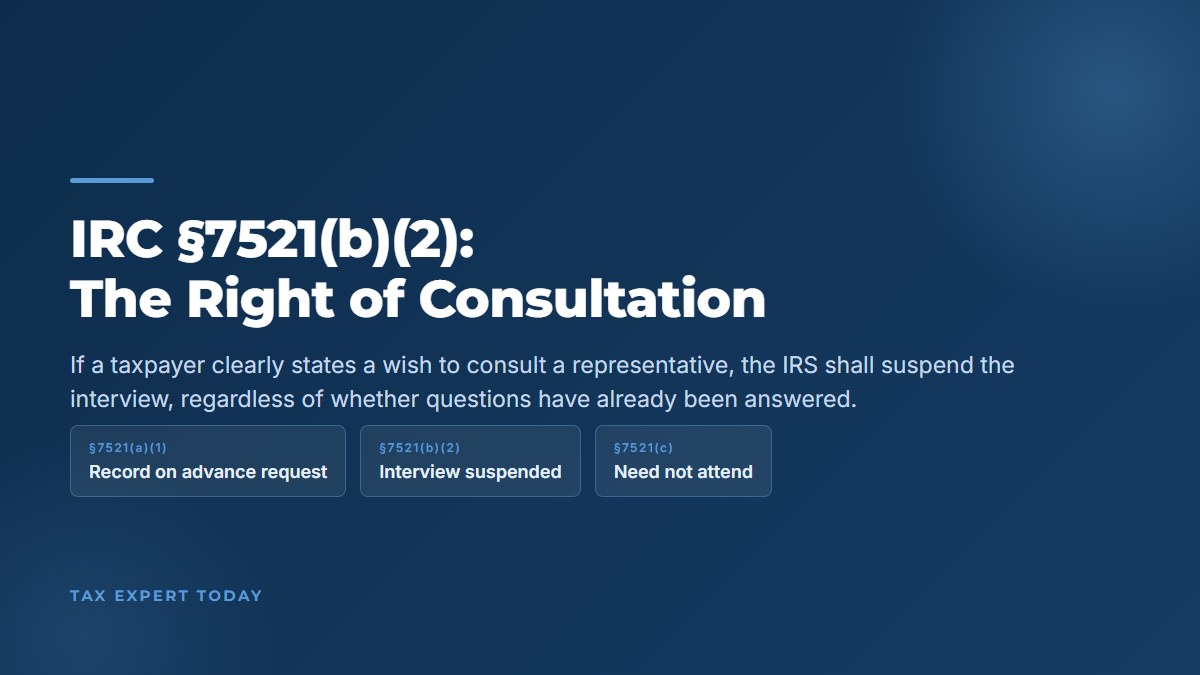
Yes. Under IRC section 7521(b)(2), if a taxpayer clearly states at any time during an interview that they wish to consult an attorney, certified public accountant, enrolled agent, or other authorized representative, the IRS officer or employee shall suspend the interview. That obligation applies regardless of whether the taxpayer has already answered one or more questions.
This is the single most useful provision in the examination process that most published guidance omits, and the statutory language is unusually firm. The verb is shall, not may, and the right is not forfeited by having started to answer. The one carve out is an interview initiated by an administrative summons issued under subchapter A of chapter 78, which legally compels attendance and testimony. Publication 3498 states the same rule in the IRS’s own words, confirming that the examination will be suspended and rescheduled and that the exception is a summons.
Two neighboring provisions in the same section are worth knowing before any in person meeting.
- You may record the interview. Section 7521(a)(1) requires the IRS to allow a taxpayer to make an audio recording of an in person interview, but only upon advance request, at the taxpayer’s own expense, and with the taxpayer’s own equipment. The advance request is the operative condition, so this is arranged before the meeting rather than at the door.
- The IRS may record as well. An IRS employee may record the interview if the taxpayer is informed beforehand, and must furnish a transcript or copy on request if the taxpayer reimburses the cost of transcription and reproduction.
- You generally do not have to attend alongside your representative. Section 7521(c) provides that an IRS officer or employee may not require a taxpayer to accompany a representative holding a valid written power of attorney, absent an administrative summons issued to the taxpayer.
- Authorization must be in writing. Representation is established on Form 2848. Form 8821 permits someone to receive confidential information but does not authorize them to speak for or represent the taxpayer.
The combined effect of section 7521(b)(2) and section 7521(c) is that a taxpayer who receives an in person examination notice is not obliged to sit through an interview unrepresented, and is not obliged to attend at all once a representative is properly authorized. Whether stepping back is the right choice depends on the facts, but it is a choice the statute makes available.
What is Form 4549 and what does signing it do?
Form 4549 is the examination report. It sets out the adjustments the IRS proposes, the resulting tax, and any penalties. Signing the agreement form ends the examination as agreed, permits the additional tax to be assessed without a notice of deficiency, and gives up the right to petition the Tax Court on the issues covered.
Publication 3498 describes three ways an examination concludes, and the report is where that determination is recorded.
- No change. The taxpayer substantiated the items reviewed and the return is accepted as filed. A letter confirming no change is issued and should be kept with the tax records.
- Agreed. The IRS proposed changes and the taxpayer understands and agrees with them. Signing the agreement form and paying follows.
- Unagreed. The IRS proposed changes and the taxpayer understands them but disagrees, which opens the appeal path described in the next section.
There is a timing rule attached to the agreed outcome that is worth reading carefully, because it is a real opportunity to avoid further interest. If the amount due including interest and applicable penalties is less than $100,000 and it is paid within 21 calendar days, the IRS will not charge more interest or penalties. If the amount is $100,000 or more, that period is reduced to 10 business days. A taxpayer who signs an agreement and then lets the bill sit gives up the benefit of that rule. The audit penalty and interest calculator shows how those amounts compound while an examination is open.
Where the proposed adjustment carries an accuracy related penalty, the penalty is a separate question from the tax and is frequently contestable on its own terms. Our guides to the accuracy related penalty and to reasonable cause penalty abatement address that separately, and a penalty should not be conceded simply because the underlying adjustment is accepted.
What is the 30-day letter and how do you appeal?
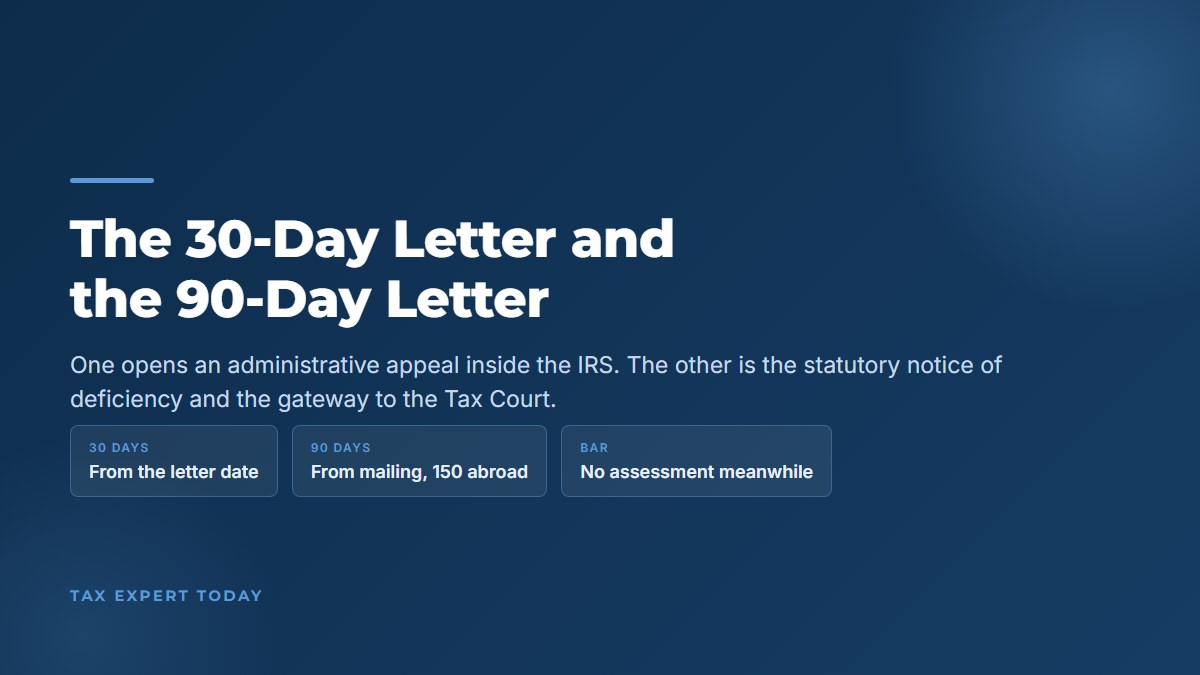
The 30-day letter notifies a taxpayer of the right to appeal the proposed changes to the IRS Independent Office of Appeals. A taxpayer generally has 30 days from the date of the letter, not from the date it was received, to accept the proposed changes or to appeal them. The response is a written protest sent to the IRS address on the letter.
The form the protest takes depends on the dollar amount at issue, and using the wrong route slows the case down.
| Amount proposed per tax period | What to file | Where to send it |
|---|---|---|
| $25,000 or less | A Small Case Request: either Form 12203, Request for Appeals Review, or a brief written statement listing each disputed item and the reason for disagreeing | The IRS address on the letter explaining appeal rights |
| More than $25,000 | A formal written protest, prepared following Publication 5 | The IRS address on the letter explaining appeal rights |
| Any amount, employee plans, exempt organizations, S corporations, and partnerships | A formal written protest; these entities are not eligible for Small Case Requests | The IRS address on the letter explaining appeal rights |
Three procedural points govern whether Appeals will take the case at all.
- Do not mail the protest to Appeals. The IRS states that sending a protest directly to the Independent Office of Appeals will only delay the process and may prevent Appeals from considering the case. It goes to the address on the letter, and the originating office forwards it.
- There must be time left on the assessment statute. Generally at least 365 days must remain on the assessment statute expiration date when Appeals receives the case. If less remains the IRS will ask for an extension, and if the taxpayer declines to extend, Appeals will not consider the case. For estate tax cases the threshold is 270 days on a non extendable period.
- The grounds must be legal ones. A case cannot be appealed on moral, religious, political, constitutional, conscientious, or similar grounds.
Fast Track Settlement is a separate and earlier option that runs during the examination rather than after it. It is voluntary, both the taxpayer and the IRS must agree to participate, the issues must be fully developed, and the process carries a 60 day goal. Withdrawal is permitted at any time and otherwise applicable appeal rights are retained.
What is the 90-day letter?
The 90-day letter is the statutory notice of deficiency. Under IRC section 6213(a), a taxpayer has 90 days from the date the notice is mailed, or 150 days if it is addressed to a person outside the United States, to file a petition with the Tax Court. During that period, and while any petition is pending, the IRS generally may not assess the deficiency or begin collection.
Several features of this deadline separate it from every earlier one in the examination, and they are set out in full in our guide to the IRS notice of deficiency and the 90 day letter.
- The clock runs from mailing. The period is measured from the date the notice is mailed rather than from receipt, which is why an unopened notice is still a running deadline.
- Weekends and District of Columbia holidays are protected only at the end. The statute excludes Saturday, Sunday, or a legal holiday in the District of Columbia from being counted as the last day.
- Assessment is barred in the interim. No assessment, levy, or court collection proceeding may be made or begun until the notice has been mailed and the 90 day or 150 day period has expired, and if a petition is filed, not until the Tax Court decision becomes final.
- It is the prepayment forum. Petitioning the Tax Court is the route that does not require paying the deficiency first, which is the practical reason the deadline matters so much.
If no petition is filed, the deficiency is assessed and a bill follows. At that point the matter has left the examination process and become a collection matter, where the relevant clock is the ten year collection period rather than the assessment period. Our guide to the IRS 10 year rule explains how that second clock is calculated.
What happens if you do nothing at each stage?
Doing nothing does not stop the examination. It advances it. Each unanswered document moves the case to the next stage automatically, and the consequences compound because the remedies available at each stage are lost when its deadline passes rather than carried forward.
| Stage | Deadline | What happens if there is no response |
|---|---|---|
| Initial examination letter and Information Document Request | The response date printed on the letter | The examiner proceeds on the information available, and unsubstantiated items are generally disallowed |
| Examination report, Form 4549 | As stated in the transmitting letter | The case is treated as unagreed and moves toward the 30 day letter |
| 30-day letter | Generally 30 days from the date of the letter | The administrative appeal is forgone and the IRS issues a 90 day letter |
| 90-day letter, notice of deficiency | 90 days from mailing, or 150 days if addressed outside the United States | The deficiency is assessed and a bill is issued; the prepayment Tax Court forum is no longer available |
| Bill after assessment | As stated on the notice | The matter becomes a collection case and enforced collection action may follow |
The asymmetry here is what makes silence expensive. Responding preserves options without conceding anything, while missing a date removes a forum permanently. That is true even when the taxpayer believes the proposed adjustment is wrong, because being right is not a substitute for being timely.
Can you stop interest from running while the audit is open?
Yes, at least in part. A taxpayer who expects to owe additional tax at the conclusion of an examination may stop interest from accumulating by making an advance payment on the deficiency or a deposit under IRC section 6603. Interest stops accruing on the amount paid or deposited when the IRS receives the money.
- A deposit is not the same as a payment. The section 6603 deposit mechanism exists specifically so a taxpayer can stop the interest clock without conceding that the tax is owed.
- Partial amounts still help. The interest suspension applies to the part paid or deposited, so a taxpayer need not fund the entire proposed deficiency to get the benefit.
- Compounding continues on the rest. Publication 3498 cautions that because of the compounding rules, interest continues to accrue on accrued interest even where the underlying tax has been paid.
- Extension consents are a separate decision. An examiner may ask a taxpayer to sign a consent extending the assessment statute expiration date. That request should be evaluated on its own merits, since declining and agreeing both carry consequences.
If the concluded liability cannot be paid in full, the examination outcome and the payment arrangement are separate matters. An IRS installment agreement or, where the facts support it, an offer in compromise is addressed after the deficiency is determined rather than during the examination itself.
What if the audit closed and you disagree after the deadline?
A closed examination is not always final. Audit reconsideration is the administrative process for asking the IRS to reexamine a closed case, and it is most often used where the taxpayer did not appear, did not receive the correspondence, or now has documentation that was not previously submitted.
It is important to be candid about what this remedy is and is not. Audit reconsideration is discretionary rather than a matter of right, it does not restore a lapsed Tax Court petition period, and it generally requires new information rather than a restatement of arguments already considered. It is nonetheless the practical route for a taxpayer who never engaged with the examination because the letters went to a former address. Our guide to IRS audit reconsideration sets out how the request is assembled and what accompanies it.
IRS audit help Naples: examinations in Naples and Southwest Florida
Taxpayers reach our office in Naples, Florida most often at one of two moments: immediately after the first letter arrives, or immediately after a 30 day letter makes the deadline feel real. The first conversation is usually about identifying the document and the date rather than about the tax position, because the available remedies follow from the stage the file is in. Tax resolution Naples clients frequently discover that the letter in hand is not the letter they assumed it was.
Tax Expert Today LLC
11983 Tamiami Trail N, Naples, FL 34110
Phone: (239) 441-2005
Hours: Monday through Friday, 10:00 to 5:00 ET
Does living in Florida change what happens if you get audited by the IRS? No. The examination process is federal and runs identically in Naples, Fort Myers, Bonita Springs, and Marco Island as it does anywhere else in the country. Florida residency does remove one complication, because Florida imposes no state individual income tax and there is therefore no parallel state examination running alongside the federal one. Taxpayers who moved to Southwest Florida from another state should keep in mind that a federal adjustment can still flow through to a former state of residence for the years they lived there, since many states adjust their own assessments off federal changes. Our IRS resolution and audit support service page and our Naples tax resolution page describe how these engagements are handled.
When to Engage a Professional
Representation is worth considering well before the examination reaches its final stages, because the earliest documents are the ones that shape the record. Consider engaging a representative when an in person interview has been scheduled, when an Information Document Request reaches beyond the items originally questioned, when an examiner asks for a consent extending the assessment period, when business books and records are involved, when a penalty has been proposed alongside the tax, or when a 30 day or 90 day letter has been issued and the deadline is approaching. Where the years under examination include an unfiled return or a suspected omission of income, the scope question should be settled before documents are produced. Every examination turns on its own record, and the dates printed on the specific letters in a taxpayer’s file govern the options actually available.
This article is educational and general in nature. It does not constitute tax advice for any particular taxpayer, and outcomes depend on individual facts and circumstances.
Published August 27, 2026 by Dr. Pellumb Kabashi « Back to Learning Center
Have a question this article touches on?
Tax Expert Today LLC, based in Naples, Florida and serving clients across the United States.
Schedule a Consultation (239) 441-2005