
By Dr. Pellumb Kabashi, DBA, MBA, EA, CFE, CES
Founder, Tax Expert Today LLC · Tax advisors, enrolled agents, CPAs, and attorneys · Serving clients in all 50 states
Quick Answer: An IRS CP503 notice is the second reminder in the automated collection stream, sent when a balance remains unpaid and an earlier notice went unanswered. It is a reminder rather than a levy notice, and it carries no new enforcement rights. No statute requires the IRS to send it, so the account can move toward enforcement whether or not a CP503 notice ever arrives. Call (239) 441-2005 for a free consultation.
What is an IRS CP503 notice?
An IRS CP503 notice is a computer generated second reminder that a balance remains unpaid on one tax period. It restates the amount owed with penalty and interest accrued through the notice date, sets a payment date on its face, and warns that a Notice of Federal Tax Lien may be filed. It creates no new liability and begins no enforcement action.
- One period per notice. Each CP503 notice addresses a single tax year or a single quarter, so a taxpayer with several open periods receives several separate notices rather than one combined bill.
- A restated balance. The figure on the notice combines the assessed tax, the failure to pay addition, and interest computed through the notice date, which is why the number is larger than the one on the earlier notice.
- An explicit lien warning. The IRS notice page states that if payment or a response is not received, the agency may file a Notice of Federal Tax Lien if it has not already done so.
- No change to the assessment. Nothing about the underlying liability is altered because a reminder issued, so the merits of the tax remain exactly where they were.
The Taxpayer Advocate Service describes the same document as the 2nd Notice, mailed because the IRS still has not heard from the taxpayer and a balance remains due. Both descriptions point at one operational fact. The account has moved a step further into the automated notice stream, and the tone has sharpened, but the legal position has not changed since the original bill.
Is the IRS required to send a CP503 notice?
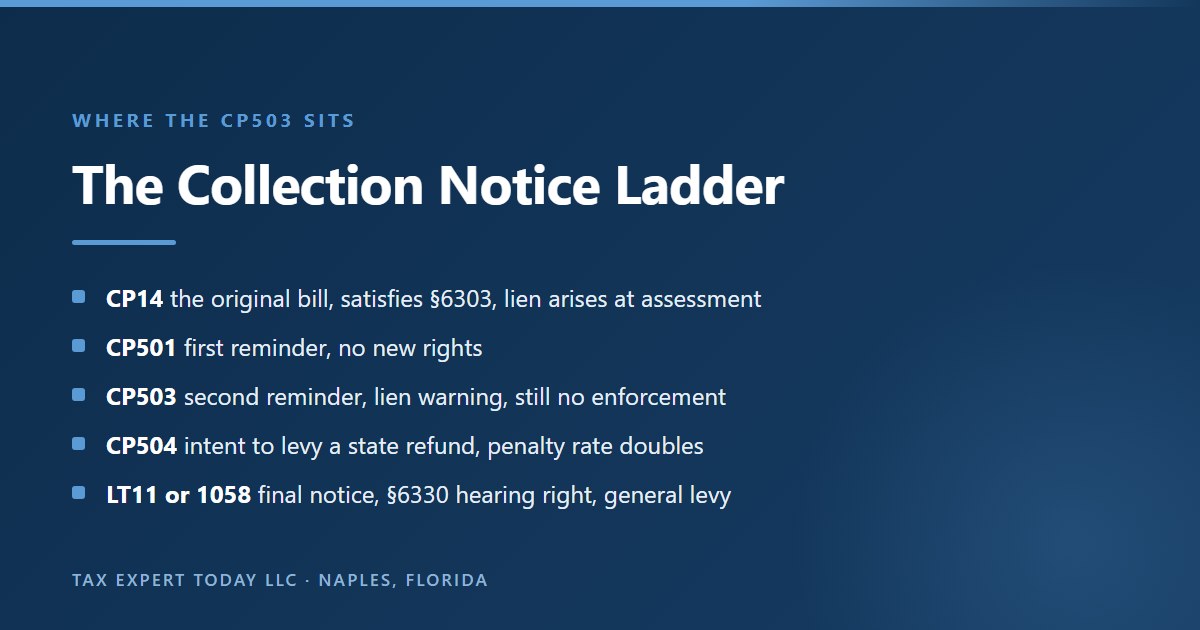
No. The only notice the Internal Revenue Code requires is the notice and demand under IRC §6303, which is issued as the CP14. Every reminder after that is administrative practice governed by the Internal Revenue Manual, not by statute. The IRS can delay a CP503 notice, accelerate past it, or skip it entirely, and the absence of one invalidates nothing that follows.
- Section 6303 is the whole statutory requirement. It directs the Secretary to give notice stating the amount and demanding payment within 60 days after an assessment is made. It says nothing about reminders.
- The reminder stream is manual guidance. IRM 5.19.1 governs balance due processing, and it treats the notice sequence as a routine that IRS employees can interrupt.
- The manual says so directly. IRM 5.19.1 instructs employees to use command code STAUP to interrupt the normal notice routine by delaying, accelerating or skipping notices.
- Waiting is not a strategy. A taxpayer who assumes there is a fixed number of reminders left before anything serious happens is relying on a sequence the IRS is free to shorten.
This is the single most consequential fact about the CP503 notice, and it is the point the competing explanations of this notice almost uniformly omit. Popular guides present the collection stream as a fixed ladder with a predictable number of rungs, which encourages the belief that a CP503 notice means there is still plenty of runway. The manual does not describe a fixed ladder. It describes a default routine with an override built into it.
The practical consequence runs in both directions. An account can move faster than the standard sequence suggests, which is why a taxpayer should never plan around the reminders they expect to receive next. An account can also stall, which is why a long silence after a CP503 notice is not evidence that the balance resolved itself. The ten year collection statute continues to run in the background either way, and the notice stream has no bearing on it.
What has already happened to your account when a CP503 notice arrives?
By the time a CP503 notice is mailed, the tax has been assessed, the statutory notice and demand has been satisfied by the CP14, and a federal tax lien has already arisen automatically under IRC §6321. That lien attaches to all property and rights to property. It is silent and unrecorded, so it does not yet appear anywhere a third party can see it.
- The assessment is recorded. The liability was posted to the account, and the assessment date is what starts the collection statute under IRC §6502.
- Notice and demand is complete. The CP14 satisfied IRC §6303, which is the step that makes the statutory lien possible in the first place.
- The lien already exists. IRC §6322 provides that the lien imposed by section 6321 arises at the time the assessment is made and continues until the liability is satisfied or becomes unenforceable by lapse of time.
- Nothing is public yet. The statutory lien is not recorded anywhere, so it does not show in a title search, and no public filing has been made unless a Notice of Federal Tax Lien was filed separately.
The distinction between the statutory lien and the recorded notice of it is where most explanations of the CP503 notice go wrong. Guides commonly say that ignoring the notice may cause the IRS to place a lien on your property, which suggests the lien is a future event. It is not. The lien arose by operation of law when the assessment posted, and it has been attached to everything the taxpayer owns since that moment. What the IRS may do next is file a public notice of a lien that already exists, which is a separate act with separate consequences for creditor priority. Our guide to lien withdrawal on Form 12277 covers what a filed notice does and how it can be removed from the public record.
| Status at the CP503 stage | Exists | Authority |
|---|---|---|
| Assessment recorded on the account | Yes | IRC §6203, and §6502 starts from this date |
| Statutory notice and demand satisfied | Yes | IRC §6303, satisfied by the CP14 |
| Federal tax lien attached to property | Yes, silently | IRC §6321 and §6322, arises at assessment |
| Notice of Federal Tax Lien on public record | Not necessarily, and warned of | Separate filing, not automatic |
| Notice of intent to levy | No | IRC §6331(d) requires 30 days written notice |
| Collection Due Process hearing right | No | IRC §6330, attaches to the final notice |
| Passport certification exposure | No | IRC §7345 requires a filed lien notice or a levy |
What has the IRS still not done at the CP503 stage?
At the CP503 stage the IRS has not issued a notice of intent to levy, has not obtained general levy authority, and has not given the Collection Due Process hearing notice under IRC §6330. No wage garnishment, bank levy or asset seizure can lawfully proceed on the strength of a CP503 notice alone.
- No levy notice has issued. IRC §6331(d) permits a levy on wages or other property only after the Secretary has notified the person in writing of the intention to make that levy, and the notice must be given not less than 30 days before the levy.
- No hearing right has attached. IRC §6330(a) requires written notice of the right to a hearing before the first levy, and that notice arrives later as an LT11 or a Letter 1058.
- No state refund levy is authorized. That step belongs to the CP504, which is the notice that permits the IRS to reach a state tax refund.
- No passport certification is possible. Certification of a seriously delinquent debt under IRC §7345 requires a filed lien notice with remedies lapsed or exhausted, or an issued levy, and neither exists here.
Recognising what has not happened is what makes the CP503 stage useful. Every collection alternative remains available, nothing has been filed publicly, no employer or bank has been contacted, and the penalty is still accruing at its lower rate. A taxpayer at this stage has more room than at any later point in the sequence, and less room than they had at the CP14 or the CP501.
| Notice | What it is | What it triggers |
|---|---|---|
| CP14 | The original bill and statutory notice and demand | Satisfies §6303, and the §6321 lien arises at assessment |
| CP501 | First reminder in the notice stream | No new rights, Collection Appeals Program available |
| CP503 | Second reminder, sharper tone, explicit lien warning | No new rights, still before enforcement, penalty still at 0.5 percent |
| CP504 | Notice of intent to levy a state tax refund | State refund levy, and the 1 percent penalty posture begins |
| LT11 or Letter 1058 | Final Notice of Intent to Levy and notice of the right to a hearing | The §6330 Collection Due Process right, general levy authority after 30 days |
How much does a CP503 balance grow each month?
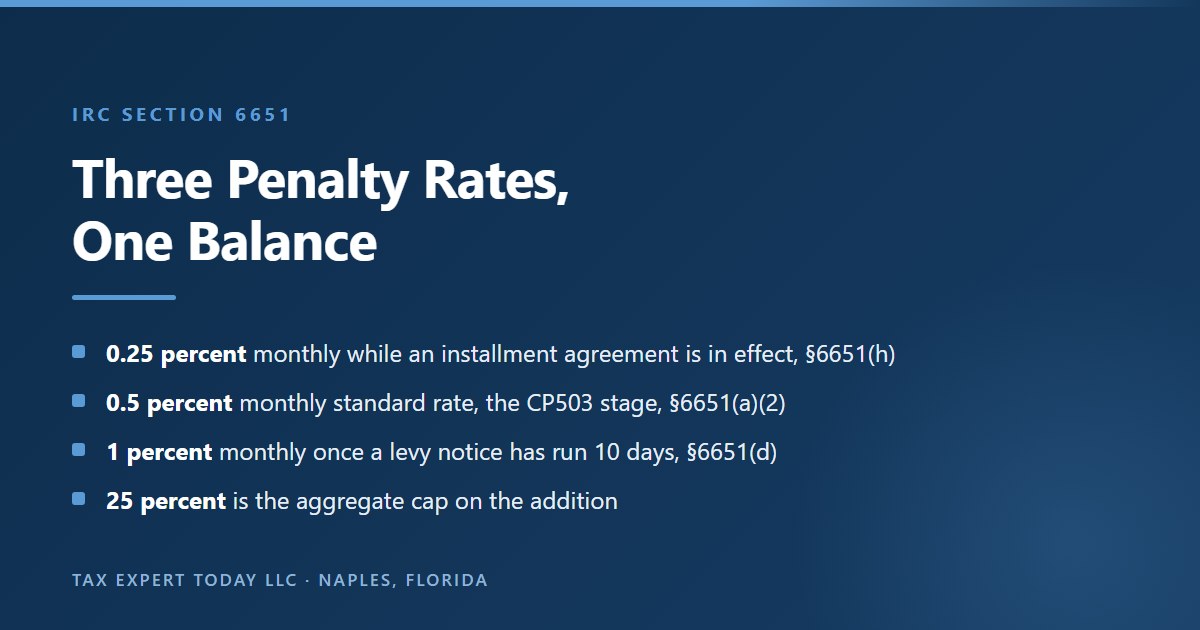
The failure to pay addition accrues at 0.5 percent of the unpaid tax for each month or part of a month under IRC §6651(a)(2), capped at 25 percent in the aggregate. Interest compounds daily under IRC §6621 at a rate reset quarterly. At the CP503 stage the penalty is still at the 0.5 percent rate, and that is the reason the stage matters financially.
- The standard rate is 0.5 percent monthly. A part of a month counts as a full month, so a payment made on the second day of a month carries the same charge as one made on the thirtieth.
- The rate doubles later, not now. IRC §6651(d) substitutes 1 percent for 0.5 percent beginning after the day 10 days after notice is given under section 6331(d), which is the notice of intent to levy.
- An installment agreement cuts the rate in half. IRC §6651(h) substitutes 0.25 percent for 0.5 percent for any month during which an installment agreement under section 6159 is in effect, provided the return was filed on time including extensions.
- Interest is separate and does not stop. Interest runs on the tax and on the additions, and it is not suspended by a payment plan.
Those three rate postures are the most practical reason not to let a CP503 notice sit. The gap between the 0.25 percent rate available under an approved agreement and the 1 percent rate that begins after the levy notice has run for 10 days is a factor of four on the same balance. A taxpayer who enters an agreement while the account is still in the reminder stage captures the lower rate for every month that follows. A taxpayer who waits until after the final notice pays quadruple the monthly addition on the same debt for the same delay.
| Penalty posture | Monthly rate | Statutory trigger |
|---|---|---|
| Installment agreement in effect | 0.25 percent | IRC §6651(h), return filed on time |
| Standard, including the CP503 stage | 0.5 percent | IRC §6651(a)(2), capped at 25 percent |
| After a notice of intent to levy | 1 percent | IRC §6651(d), 10 days after §6331(d) notice |
The failure to pay addition is also abatable in the right circumstances, which the running total on the notice does not disclose. Relief may be available through first time penalty abatement where the compliance history supports it, or on reasonable cause grounds under the statutory exception in section 6651 itself, which applies where the failure is due to reasonable cause and not to willful neglect. Our detailed treatment of the failure to pay penalty sets out how the addition is computed and when it can be challenged.
What is the deadline on a CP503 notice, and what happens after it?
A CP503 notice states its own payment date on the face of the document rather than relying on a fixed statutory period. Missing that date does not itself trigger a levy. It advances the account toward the CP504 and then the final notice, and it exposes the taxpayer to the filing of a Notice of Federal Tax Lien, which the CP503 expressly warns about.
- Read the date off the notice. The period is set administratively and it varies, so a number quoted from a general article is not a substitute for the date printed on the document.
- The date is not a levy date. Levy requires the separate 30 day written notice under IRC §6331(d), which has not been given at this stage.
- The lien filing is the real near term exposure. A filed Notice of Federal Tax Lien establishes priority against other creditors and becomes a public record, which affects refinancing and business credit.
- Partial payment still helps. The addition and the interest both run on the unpaid balance, so reducing the principal reduces the monthly charge even when full payment is impossible.
One structural point is worth stating plainly. A taxpayer may receive more than one CP503 notice on the same account, because the reminder can repeat, and repetition should not be read as a sign that the account is stuck. It should be read as remaining time that has not yet been used.
What are your response options after a CP503 notice?
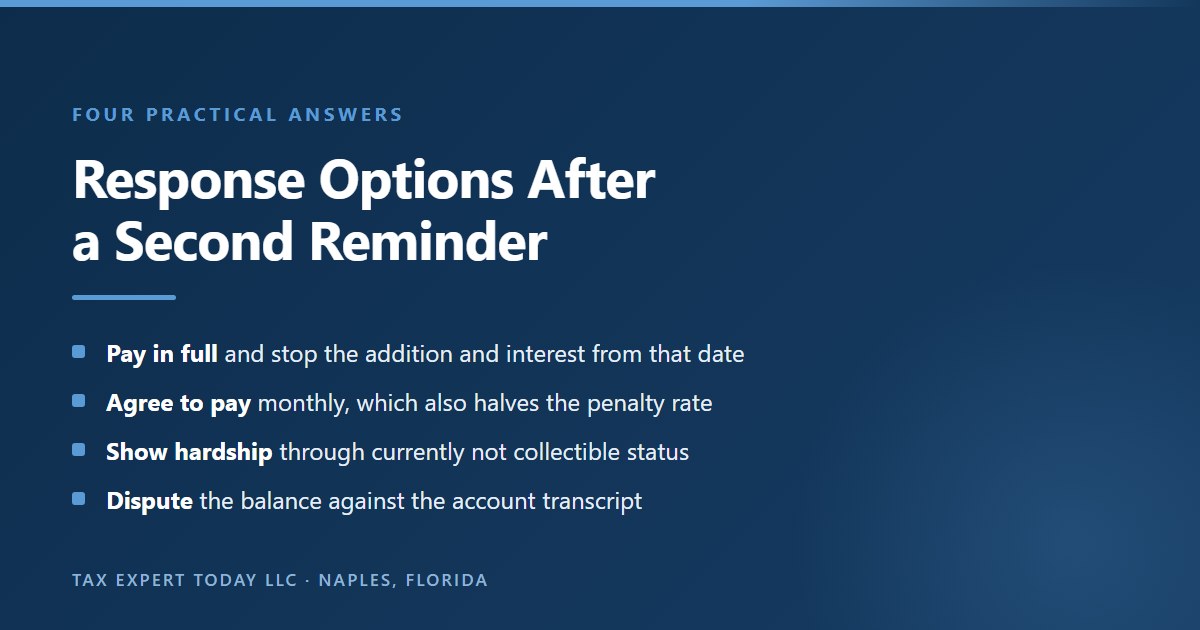
There are four practical responses to a CP503 notice. Pay the balance in full, enter a payment arrangement, establish that collection is not currently possible, or dispute the balance. The right answer turns on the actual financial facts and on whether the assessment itself is correct, not on the urgency of the notice.
- Full payment. This stops the failure to pay addition and the interest from the payment date forward and closes the period.
- An installment agreement. Monthly payment against the balance, which also drops the penalty rate to 0.25 percent per month for a taxpayer who filed on time.
- A partial payment installment agreement. A payment lower than what would retire the balance within the collection period, used where the full amount is beyond reach.
- Currently not collectible status. Collection is suspended where the financial analysis shows payment would prevent meeting basic living expenses.
- An offer in compromise. Settlement for less than the assessed amount where the statutory grounds are met, which requires a full financial submission and is not available to everyone.
- Dispute. Where the balance is not recognized, the question is factual and belongs on the transcript rather than in a phone call about the notice.
| Response | What it requires | Effect on the penalty rate |
|---|---|---|
| Full payment | Funds available now | Addition and interest stop from the payment date |
| Installment agreement | Filing compliance, and terms the IRS accepts | Falls to 0.25 percent monthly under §6651(h) if filed on time |
| Partial payment installment agreement | Full financial disclosure on a collection information statement | Same 0.25 percent posture while the agreement is in effect |
| Currently not collectible | Financial analysis showing payment prevents basic living expenses | No change, the addition continues to accrue |
| Offer in compromise | Statutory grounds, full financial submission, filing compliance | No change while pending, resolved on acceptance |
| Dispute the balance | Account transcript review, and the correct procedural route | Depends on what the transcript shows |
The choice between an agreement, a partial payment agreement, an offer and a hardship suspension is a financial analysis, and it rests on the same underlying figures in every case. The collection information statement is the document that drives it, and in most cases the answer becomes apparent as soon as the income, the allowable expenses and the equity in assets are assembled honestly.
Can you appeal a CP503 notice?
The IRS notice page states that a taxpayer may request an appeal under the Collection Appeals Program before collection action takes place. That program reviews collection actions and plan terms rather than whether the tax is owed. It does not suspend the collection statute and it provides no route to court. The Collection Due Process hearing arrives later with the final notice.
- What the Collection Appeals Program covers. Proposed or taken collection actions, and the terms or rejection of a payment arrangement.
- What it does not cover. Whether the underlying tax is correct, which is a different question handled through the examination or the refund claim route.
- No judicial review. The determination in that program is final within the agency and cannot be taken to the Tax Court.
- No suspension of the collection statute. Unlike a timely Collection Due Process request, it does not toll the ten year period.
The contrast matters because the two routes are frequently conflated. A Collection Due Process hearing under IRC §6330 carries the right to raise collection alternatives before an independent officer, suspends levy action while it is pending, suspends the collection statute, and can be petitioned to the Tax Court. None of that is available at the CP503 stage, because the right attaches to the final notice issued as an LT11 or Letter 1058. A taxpayer who wants that hearing has to wait for the notice that carries it, and then act within the 30 day window it opens.
What comes after a CP503 notice?
In the standard sequence the CP503 notice is followed by the CP504, which is a notice of intent to levy a state tax refund and which begins the 1 percent penalty posture, and then by the final notice issued as an LT11 or a Letter 1058, which carries general levy authority and the Collection Due Process hearing right. The sequence is an administrative default, and it is not fixed.
- The CP504 is a real escalation. It is the first notice in the stream that authorizes any levy, although the levy it authorizes immediately reaches a state tax refund rather than wages or accounts.
- The final notice is the decisive one. It opens the 30 day window under IRC §6331(d) and the hearing right under IRC §6330, and after it expires the IRS may levy generally.
- Enforcement follows from there. That is where wage garnishment and a bank levy become possible.
- Passport certification is a later branch. Certification under IRC §7345 requires a filed lien notice with remedies exhausted or an issued levy, plus a debt above the indexed threshold.
For a Florida resident one step in that sequence is often empty. Florida imposes no state individual income tax, so where the taxpayer has no filing obligation in another state there is generally no state refund for the CP504 to reach. The notice still issues and it still marks the point at which the penalty rate doubles, but its immediate enforcement content is frequently nothing at all. That can create a false sense of security in exactly the period when the account is closest to the notice that does carry teeth.
How do you confirm a CP503 notice is genuine and the balance is correct?
Verify a CP503 notice against the account transcript for the tax period named on it rather than against the notice itself. The transcript shows the assessment date, the source of the assessment, every payment and credit posted to the period, and each addition charged. A notice that does not match the transcript is either a misapplied payment or not a genuine IRS notice.
- Pull the account transcript. It is the authoritative record of the period, and it is available through the taxpayer online account or by request.
- Check where payments landed. A payment applied to the wrong year is a routine cause of a balance that the taxpayer is certain was paid.
- Confirm the assessment source. A balance that arose from an adjustment after filing, rather than from the return as filed, points to a different response than simple nonpayment.
- Watch for impersonation. The IRS initiates collection contact by mail, does not demand payment to a third party or by gift card, and does not threaten immediate arrest.
The verification step is not a formality. Where an adjustment produced the balance, the correct response may be a challenge to the adjustment rather than a payment arrangement, and that route has its own deadlines. Where the balance followed an examination, the notice of deficiency that preceded it governs what can still be contested. Where tax was assessed correctly but a penalty or an interest charge is wrong, a refund claim on Form 843 is a separate route with its own limitation period.
Does a CP503 notice work differently for a business or a payroll tax period?
The mechanics of a CP503 notice are the same for a business account, but the stakes are different. Payroll tax periods carry the trust fund recovery penalty exposure under IRC §6672, which can reach responsible individuals personally, and business accounts frequently move through the notice stream faster than individual accounts.
- Separate notices per quarter. Employment tax liabilities are assessed quarterly, so an employer behind for a year receives four separate streams.
- Personal exposure through the trust fund portion. The withheld employee share can be asserted against responsible persons who willfully failed to pay it over.
- The rate relief in §6651(h) is narrower. The reduced 0.25 percent rate during an installment agreement is written for an individual who filed on time.
- Ongoing compliance is a condition. Collection alternatives for a business generally require current deposits and current filings before any arrangement is approved.
An employer holding a CP503 notice on a payroll period should treat it as materially more urgent than an individual holding one on an income tax year, because the trust fund recovery penalty develops on its own track and is not governed by the notice stream at all.
CP503 notice help Naples: tax resolution Naples and Southwest Florida
Taxpayers reach our office in Naples, Florida holding a CP503 notice in two recurring situations. The first is a person who knows the balance is real, could not pay it when the return was filed, and has been waiting to see how serious the letters become. For that person the whole question is which collection alternative the actual monthly numbers support, and the answer usually arrives quickly once the financial picture is assembled. The second is a person who does not recognize the balance at all, which in our experience is most often a misapplied payment or a post filing adjustment rather than an error in the return. Tax resolution Naples clients in that second group are regularly surprised that the account transcript, and not the notice, is where the explanation sits.
Tax Expert Today LLC
11983 Tamiami Trail N, Naples, FL 34110
Phone: (239) 441-2005
Hours: Monday through Friday, 10:00 to 5:00 ET
Does living in Florida change how a CP503 notice works? The notice and the statutes behind it are federal, so the procedure is identical in Naples, Fort Myers, Bonita Springs and Marco Island. Two local facts bear on it. Florida imposes no state individual income tax, so the CP504 that follows a CP503 notice often has no state refund to reach, which removes the visible consequence from a step that still doubles the penalty rate. Florida also has a large seasonal population whose mail follows them north for part of the year, and a CP503 notice that sits unopened in a Naples mailbox through the summer is a common way for an account to arrive at the final notice stage without the taxpayer having read a single reminder. Our IRS resolution and audit support service page and our Naples tax resolution page describe how these engagements are handled.
When to Engage a Professional
Many CP503 notices are resolved by the taxpayer without help, and where the balance is modest, the return was accurate and payment is possible, representation adds little. Consider engaging a representative where the balance is not recognized and the transcript needs to be read properly, where several periods are open and the assessment dates differ between them, where the amount is large enough that the choice between an installment agreement and an offer in compromise turns on a genuine financial analysis, where a business or a payroll tax period is involved and trust fund exposure is possible, or where earlier notices were missed and the account may be closer to the final notice stage than a CP503 notice suggests. Tax Expert Today LLC was founded by Dr. Pellumb Kabashi, and every engagement is built on the actual transcripts and the actual financial facts rather than on any assumed timetable.
This article is educational and general in nature. It does not constitute tax advice for any particular taxpayer, and outcomes depend on individual facts and circumstances.
Published September 14, 2026 by Dr. Pellumb Kabashi « Back to Learning Center
Have a question this article touches on?
Tax Expert Today LLC, based in Naples, Florida and serving clients across the United States.
Schedule a Consultation (239) 441-2005