
By Dr. Pellumb Kabashi, DBA, MBA, EA, CFE, CES
Founder, Tax Expert Today LLC · Tax advisors, enrolled agents, CPAs, and attorneys · Serving clients in all 50 states
Quick Answer: IRS audit help Naples FL means representation under a Form 2848 power of attorney from the first examination letter through the examiner’s report, the Independent Office of Appeals, and, where needed, the Tax Court petition window. Tax Expert Today LLC handles correspondence, office, and field audits from its Naples, Florida office for Collier and Lee County taxpayers and for clients in all 50 states. Call (239) 441-2005 for a free consultation.
IRS Audit Help Naples FL: From the First Letter to Appeals
An IRS examination letter is a request for a conversation the IRS intends to control: which records it sees, in what order, and on what deadline. Audit representation changes who is on the other side of that conversation. Under a signed Form 2848, the IRS corresponds with the representative, the representative decides what is produced and how each request is scoped, and the taxpayer is no longer answering questions in real time. This page explains what that engagement looks like from our Naples, Florida office, which kinds of audits it covers, what the law lets you insist on, and what happens at each stage if the examiner and the taxpayer do not agree.
Audit representation sits one step earlier than tax resolution. Resolution addresses a balance the IRS has already assessed, through the programs described on our Naples FL tax resolution page. An examination is the IRS deciding whether the reported tax was correct in the first place. The same power of attorney covers both, and a case that starts as an audit often becomes a collection matter once the report is final, which is why the two practices run out of the same office. For the odds themselves, our research report on IRS audit rates by income measures how often the IRS examines returns at each income level, from 0.51 percent under $25,000 to 6.59 percent at $10 million or more for tax year 2021.
What Does IRS Audit Representation Actually Do?
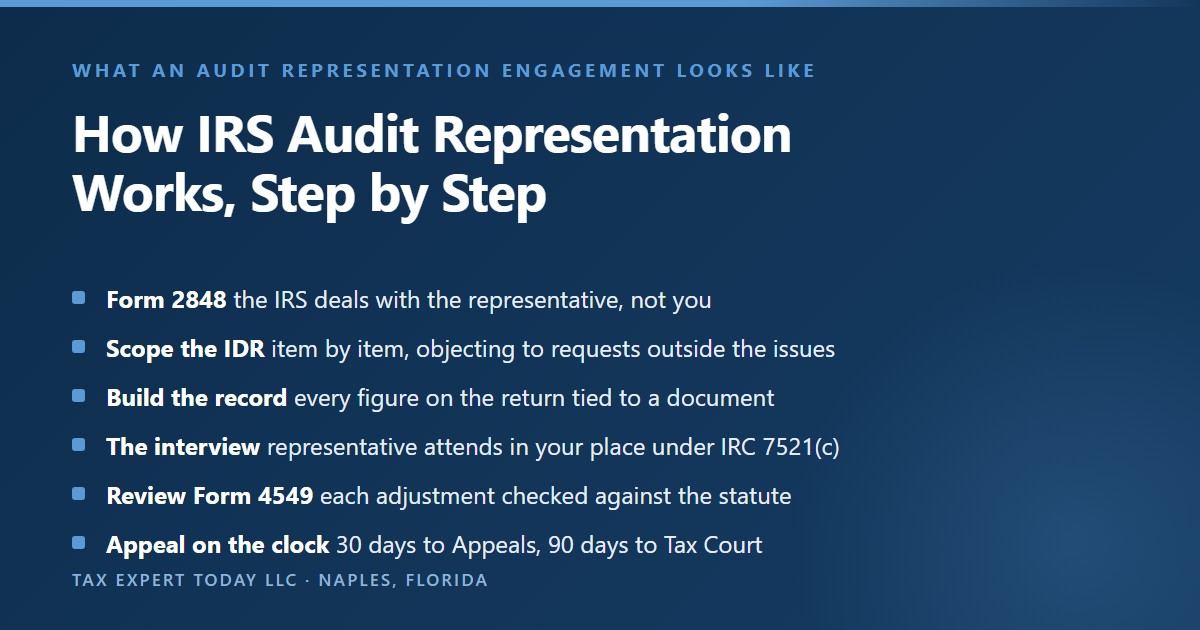
IRS audit representation places a licensed practitioner between you and the examiner for the life of the examination. The representative receives the notices, controls the document production, prepares you for or attends any interview, reviews the examiner’s report line by line, and files the protest or Tax Court petition if the result is wrong. You stop dealing with the IRS directly.
- Power of attorney first: Form 2848 names the representative and the tax years covered, and the IRS must then deal with that person under IRC §7521(c).
- Scoped production: an Information Document Request is answered item by item, with the record organized so each figure on the return ties to a document.
- Interview control: under IRC §7521(b)(2) an interview stops when the taxpayer asks to consult a representative, and a representative may appear without the taxpayer unless the IRS issues an administrative summons.
- Report review: proposed adjustments on Form 4549 are checked against the statute, the regulations, and the examiner’s own workpapers before anything is signed.
- Appeal on the clock: an unagreed report goes to the Independent Office of Appeals within the 30-day window, and a notice of deficiency goes to the Tax Court within 90 days.
Which Kind of IRS Audit Are You Facing?
The IRS conducts three kinds of examinations. A correspondence audit is handled by mail on one or two narrow items. An office audit brings the representative to an IRS office for an interview on several issues. A field audit sends a revenue agent to the business to examine the books in full. Each carries different stakes and a different preparation plan.
A fourth letter is often mistaken for an audit. A CP2000 notice is the Automated Underreporter program matching third-party forms against the return; the IRS says plainly that it is not an examination, and it does not trigger the IRC §7605(b) protection against a second inspection of the same year. It still has a 30-day response deadline and it can still become a notice of deficiency, so it is handled with the same discipline.
| Examination type | How it starts | Where it happens | What the IRS is usually testing | What representation adds |
|---|---|---|---|---|
| Correspondence audit | Letter listing one or two items, often a CP75 for credits or a request for substantiation of a single deduction | By mail, through a campus examination unit | Documentation of a specific credit, deduction, or filing status | A complete, indexed response on the first try, so the file closes instead of escalating |
| Office audit | Letter scheduling an interview and listing the records to bring | Local IRS office, or by phone and secure upload | Schedule C income and expenses, rental activity, itemized deductions, basis | Representative attends in place of the taxpayer under IRC §7521(c) and limits the interview to the listed issues |
| Field audit | Revenue agent contact and a broad initial Information Document Request | Business premises, or the representative’s office by agreement | The full return, books and records, related entities, and sometimes prior and later years | Control of the site, the scope, the pace of production, and any consent to extend the assessment period |
| CP2000 (not an audit) | Computer match of Forms W-2, 1099, and 1098 against the return | By mail | Income or withholding the IRS believes was omitted or misreported | A response showing the item was reported, or a corrected computation, within 30 days |
What Are Your Rights During an IRS Examination?
The Taxpayer Bill of Rights in IRC §7803(a)(3) and the interview rules in IRC §7521 give every taxpayer the right to representation, to stop an interview to obtain it, to record the interview on advance notice, to written notice before the IRS contacts third parties, and to be free of a second examination of the same year without written notice.
- Representation: 31 CFR §10.3 limits practice before the IRS to attorneys, CPAs, enrolled agents, and a few narrow categories; a preparer holding only a PTIN cannot represent you in an examination of a return that preparer did not sign.
- Recording: IRC §7521(a) allows the taxpayer to record an in-person interview on ten days’ advance notice, and the IRS may record on the same terms.
- Third-party contacts: IRC §7602(c) requires advance written notice before the IRS contacts a bank, customer, or employer about your liability, and a periodic list of the contacts made.
- One inspection per year: IRC §7605(b) bars a second inspection of the same year’s books unless the taxpayer requests it or the IRS gives written notice that an additional inspection is necessary.
- Burden of proof: under IRC §7491(a), a taxpayer who produces credible evidence, keeps the records IRC §6001 requires, and cooperates with reasonable requests shifts the burden on a factual issue to the IRS in any later court proceeding.
The IRS restates most of these in Publication 1, which accompanies every examination letter, and in the Taxpayer Bill of Rights page. The right that matters most in practice is the first one: once a representative is on file, an examiner who wants to speak to the taxpayer directly must go through the representative, and an interview cannot proceed over a request to consult.
How Does an IRS Audit Unfold, Stage by Stage?
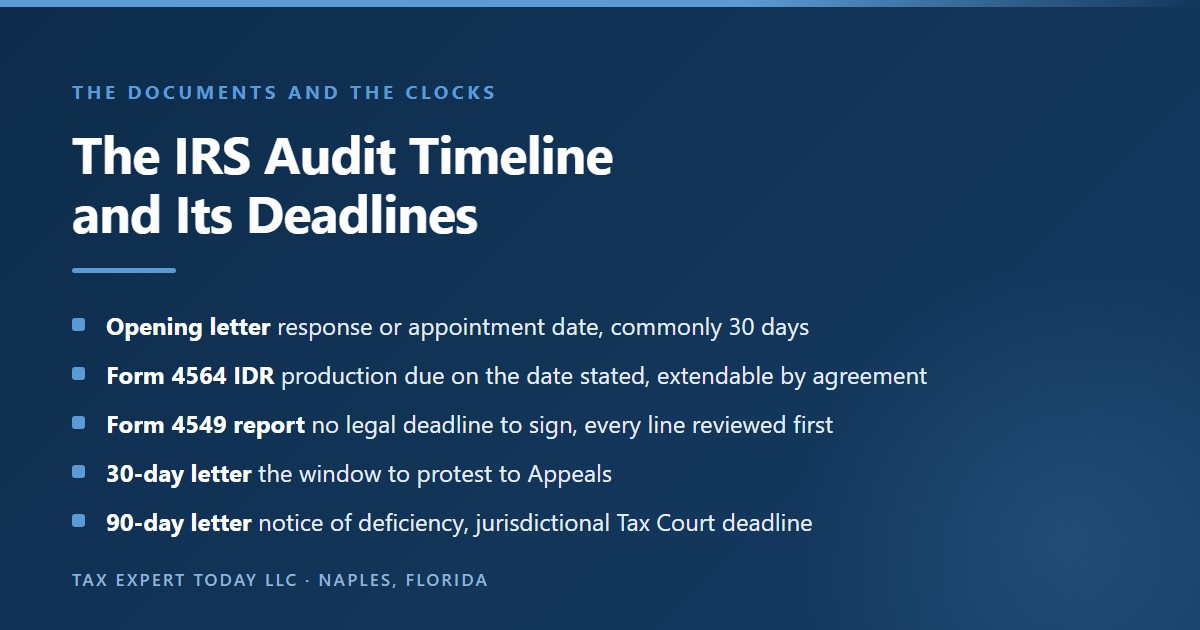
An IRS examination runs through a fixed sequence of documents, each with its own deadline: the opening letter, the Information Document Request, the interview, the examiner’s report on Form 4549, a 30-day letter opening the appeal window, and a notice of deficiency giving 90 days to petition the Tax Court. The stage the file is in decides which remedies remain open.
| Stage | The document | The clock | What the representative does |
|---|---|---|---|
| 1. Opening | Examination letter identifying the year and the issues, with Publication 1 enclosed | Response or appointment date stated in the letter, commonly 30 days | Files Form 2848, pulls account and wage transcripts, confirms the assessment period under IRC §6501 is still open |
| 2. Production | Form 4564, Information Document Request | Date stated on the IDR, extendable by agreement | Scopes each item, assembles a tied-out response, and objects in writing to requests outside the identified issues |
| 3. Examination | Interview, correspondence exchange, or field work under the techniques in IRM 4.10.3 | Runs until the examiner closes the issues | Attends in place of the taxpayer, keeps the interview to the listed issues, and tracks every commitment made |
| 4. Report | Form 4549, Income Tax Examination Changes, prepared under IRM 4.10.8 | Signature requested; no legal deadline to sign | Reviews each adjustment against the statute and the workpapers, and negotiates unresolved items under IRM 4.10.7 before anything is signed |
| 5. Unagreed | 30-day letter with the report and Publication 5 | 30 days to request Appeals | Files a written protest, or a small case request on Form 12203 when the amount for any period is within the small case limit |
| 6. Deficiency | Notice of deficiency, the 90-day letter, under IRC §6212 | 90 days to petition the Tax Court under IRC §6213(a), 150 days if the notice is addressed outside the United States | Files the petition in time, or evaluates paying and claiming a refund; the deadline is jurisdictional and cannot be extended |
| 7. Closed | Assessment and first collection notice | Collection notices begin | Requests audit reconsideration where new information exists, or moves the case to resolution |
Our guide to what happens if you get audited by the IRS walks through each of these documents in detail, including what signing Form 4549 does and what happens if nothing is done at each stage.
How Far Back Can the IRS Audit a Naples Taxpayer?
Under IRC §6501(a) the IRS generally has three years from the later of the due date or the filing date to assess additional tax. The period extends to six years under §6501(e) when the return omits more than 25 percent of gross income, and it never closes under §6501(c) for a fraudulent or unfiled return. Where you live does not change the clock.
- Three years: the default for a timely, complete return; most examinations open in the second or third year of the window.
- Six years: a substantial omission of gross income, including certain overstatements of basis, and unreported foreign assets above the §6501(e)(1)(A)(ii) threshold.
- No limit: a fraudulent return, a willful attempt to evade, or a return that was never filed.
- Consents: an examiner who is running out of time asks for a Form 872 consent to extend; whether to sign, and on what terms, is a decision made with the representative, not at the interview.
The assessment period is a different clock from the ten-year collection statute that governs an assessed balance. Our article on the IRS audit statute of limitations covers the exceptions, the foreign-form rules that keep a year open, and the Form 872 decision in depth.
What Records Should You Gather Before the First Meeting?
Bring every IRS letter with its envelope, the returns for the years named and the years on either side, and the source records behind each questioned item: bank and brokerage statements, invoices, receipts, mileage logs, closing statements, and the prior preparer’s workpapers. IRC §6001 makes the taxpayer responsible for records that establish each figure, so the review starts with what exists.
- The letters: the notice number, date, and response deadline decide the stage and the remedies.
- The returns: the examined year plus the adjacent years, because an adjustment to basis, a carryover, or depreciation ripples forward and backward.
- The substantiation: the IRS lists what it accepts for common items on its audit records request page; a bank statement alone rarely proves a deduction.
- What is missing: gaps are normal and are part of the plan, not a reason to delay the engagement; reconstruction from third-party records is a recognized method.
We pull IRS account, wage and income, and return transcripts directly, so a taxpayer who cannot find a form is not a taxpayer who cannot start.
IRS audit representation Naples: what a local engagement looks like
Examinations reach our office in Naples, Florida in three common shapes. The first is the correspondence audit of an individual return, often a snowbird or a retiree with a mix of pension, brokerage, and rental income, where a single 1099 or a basis figure does not match. The second is the office or field examination of a Collier or Lee County small business, a Schedule C or an S corporation, where the issues are gross receipts, owner compensation, vehicle and travel expense, and the line between personal and business. The third is the examination that arrives after a move to Southwest Florida, where the federal adjustment matters to a former state as well.
Florida changes one thing and not another. Florida imposes no state individual income tax under Article VII, Section 5 of the Florida Constitution, so there is no parallel state examination running alongside the federal one. Florida does not change the federal process at all: the letters, the deadlines, and the rights are identical in Naples, Fort Myers, Bonita Springs, Estero, and Marco Island. Taxpayers who relocated from a state with an income tax should keep in mind that many of those states adjust their own assessments off a federal change for the years the taxpayer lived there, so a closed federal audit can produce a state notice months later. A state residency examination of the move itself is a separate matter, covered on our Florida residency audit page.
Naples clients meet at the office on Tamiami Trail North. Everyone else, in Florida or in any other state, works with the same team by phone, video, and secure document exchange, because practice rights before the IRS are federal and do not depend on the state where the taxpayer or the practitioner sits.
What Happens If the Audit Ends With Changes You Disagree With?
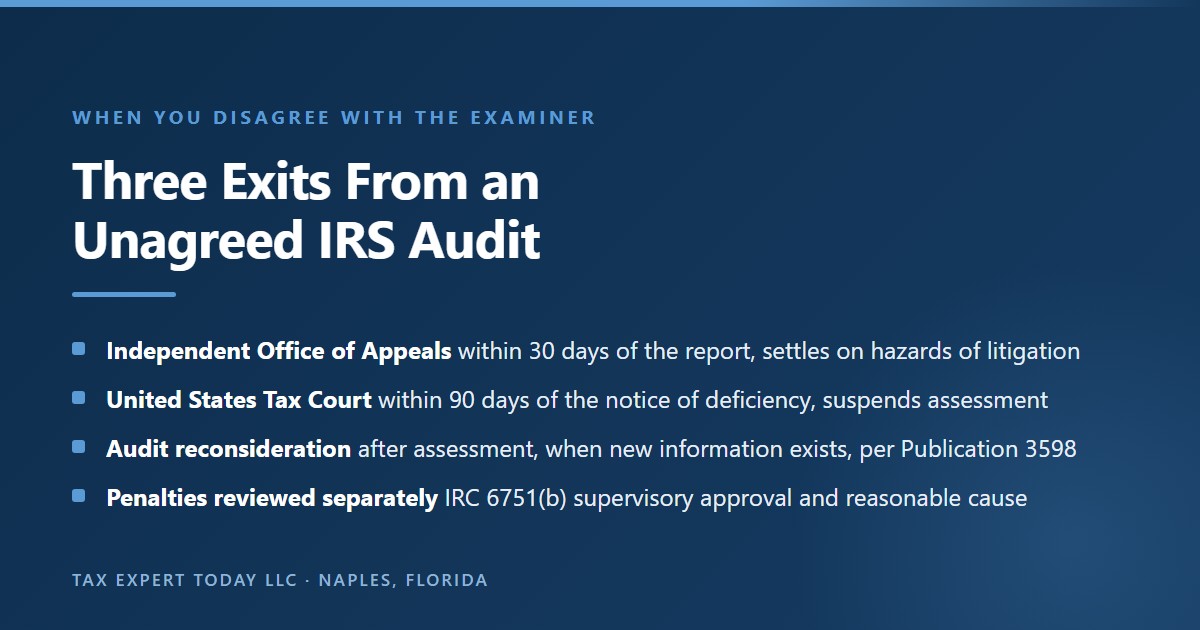
An unagreed examination has three exits. Within 30 days of the examiner’s report you may protest to the Independent Office of Appeals, which settles on the hazards of litigation. After a notice of deficiency you have 90 days to petition the Tax Court, where smaller cases use the simplified procedure of IRC §7463. After assessment, audit reconsideration reopens the file when new information exists.
| Exit | When it is available | How it is started | What it can and cannot do |
|---|---|---|---|
| Independent Office of Appeals | Within 30 days of the 30-day letter, or at any time before the 90-day period runs | Written protest under IRS Appeals procedures, or Form 12203 for smaller amounts; Fast Track mediation may be available while the case is still in examination | Can settle on the hazards of litigation and consider arguments the examiner could not; cannot reopen the facts for a second examination |
| United States Tax Court | Within 90 days of the notice of deficiency under IRC §6213(a) | Petition filed with the Tax Court; small case election under IRC §7463 where the amount in dispute for a year is within the statutory limit | Suspends assessment and collection while the case is pending; the 90-day deadline is jurisdictional, and a late petition ends the prepayment forum |
| Audit reconsideration | After assessment, when the taxpayer did not appear, moved, or has new information, per Publication 3598 | Written request with the new documentation to the examining office | Can reduce or remove the assessment; discretionary, and it does not stop collection by itself |
The penalty side of the report gets its own review. An accuracy-related penalty under IRC §6662 requires written supervisory approval under IRC §6751(b) before it is asserted, and the reasonable cause exception in §6664(c) is argued on the facts. Where the IRS position was not substantially justified, IRC §7430 allows a prevailing taxpayer who meets its net worth limits to seek recovery of reasonable administrative and litigation costs. Our notice of deficiency guide and our audit reconsideration guide cover the second and third exits in detail.
How to Choose IRS Audit Help in Naples
Four tests apply to any firm offering IRS audit help Naples FL taxpayers can rely on, and to any firm anywhere else. First, confirm the credential carries unlimited representation rights under 31 CFR §10.3; an enrolled agent’s standing can be checked through the IRS enrolled agent verification page, and a CPA or attorney through the state licensing board. Second, ask whether the person who signs the Form 2848 is the person who will attend the examination, or whether the file goes to a case manager. Third, ask whether the same firm handles Appeals and the Tax Court petition if the examination closes unfavorably, because the 30-day and 90-day clocks do not pause for a handoff. Fourth, be wary of any promise about the outcome; federal practice rules prohibit guarantees, and the honest answer before the transcripts and the records are reviewed is that the result depends on the facts.
Tax Expert Today LLC is built around those four tests: a multidisciplinary team of tax advisors, enrolled agents, CPAs, and attorneys, the same practitioner from the power of attorney through Appeals, transcript-driven case work, and advice framed as what the law allows rather than what a client hopes to hear.
Naples and Southwest Florida IRS Audit Help
Tax Expert Today LLC
11983 Tamiami Trail N, Naples, FL 34110
Phone: (239) 441-2005
Hours: Monday through Friday, 10:00 to 5:00 ET
IRS audit help Naples FL residents need in person is available at the office, and we serve Bonita Springs, Estero, Marco Island, Fort Myers, and all of Collier and Lee County the same way, with clients nationwide served remotely. An examination that closes with a balance moves to our Naples tax resolution practice for installment agreements, offers in compromise, and penalty abatement. Our IRS resolution and audit support service page describes the full engagement, and taxpayers who want to prevent the next examination can read about our Naples tax planning practice.
Frequently Asked Questions
Do I have to attend the IRS audit interview myself?
Generally, no. Under IRC §7521(c) the IRS may not require a taxpayer to accompany a representative who holds a valid power of attorney, unless it issues an administrative summons. Most office and field examinations are conducted with the representative alone, and the examiner’s questions are answered from the record rather than from memory.
What is the difference between an IRS audit and a CP2000 notice?
A CP2000 is an automated proposal based on a mismatch between the return and third-party forms; the IRS states it is not an examination. An audit is an examination of the books and records by a tax examiner or revenue agent. Both carry deadlines, and both can end in a notice of deficiency if ignored, so both are handled with a written, documented response.
Can the IRS audit the same year twice?
Only in limited circumstances. IRC §7605(b) bars a second inspection of the same year’s books unless the taxpayer requests it or the IRS gives written notice that an additional inspection is necessary. A CP2000 or a math error notice does not count as an inspection of the books, so it does not use up that protection.
Will an audit of one year spread to other years?
It can. Examiners are instructed to consider prior and later years when the same issue recurs, and an adjustment to basis, depreciation, or a carryover reaches into other years by its nature. Part of representation is anticipating that reach and confirming which years remain open under IRC §6501 before the examiner asks.
Does living in Naples, Florida change how an IRS audit works?
No. The examination process is federal and identical everywhere. Florida adds no state income tax examination, which removes one layer. Taxpayers who moved from a state with an income tax should expect that state to adjust its own assessment for the years they lived there once the federal change is final.
What should I do the day the IRS letter arrives?
Read the notice number and the response date, keep the envelope, and do not call the number on the letter to explain your position before a representative has seen the file. The first call sets the tone of the record, and statements made without the return and the documents in hand are difficult to walk back.
When to Engage a Professional
The earliest documents shape the record, so the useful moment to engage is when the first letter arrives, not when the report does. Representation is worth considering as soon as an interview has been scheduled, when an Information Document Request reaches beyond the items the letter named, when an examiner asks for a consent extending the assessment period, when business or rental income is involved, or when the year under examination is one where the records are incomplete. Tax Expert Today LLC represents individuals and businesses before the IRS from Naples, Florida and in all 50 states. Call (239) 441-2005 or use the contact page for a free consultation; bring the letter, and we will identify the stage, the deadline, and the options that remain open.