
By Dr. Pellumb Kabashi, DBA, MBA, EA, CFE, CES
Founder, Tax Expert Today LLC · Tax advisors, enrolled agents, CPAs, and attorneys · Serving clients in all 50 states
Quick Answer: An IRS debt collector is one of three private collection agencies, CBE, Coast Professional or ConServe, that the law requires the IRS to use for certain old, inactive tax debts. You get an IRS Notice CP40 first, then a letter from the agency. It can arrange payment plans, but it cannot levy, file a lien or settle for less, and every payment goes to the IRS. Call (239) 441-2005 for a free consultation.
What is an IRS debt collector?
An IRS debt collector is a private company working under a qualified tax collection contract with the IRS. Congress requires the IRS to hand certain inactive tax debts to these contractors. They contact you, ask for full payment and, if you cannot pay in full, offer a payment plan. They work for the IRS, but they are not IRS employees.
- It is required by statute. IRC section 6306(c)(1) says the Secretary shall enter into qualified tax collection contracts for the collection of all outstanding inactive tax receivables.
- The program dates from 2015. The Fixing America’s Surface Transportation (FAST) Act, signed on December 4, 2015, made private collection mandatory, as IRS Publication 4518 explains.
- Three agencies hold the contracts. Since September 23, 2021, the IRS lists CBE Group, Coast Professional and ConServe on its private debt collection page.
- The debt is still owed to the United States. Every payment is made to the IRS or the United States Treasury, never to the agency itself.
The phrase IRS debt collector causes confusion because the IRS spent years warning taxpayers that it does not call people demanding money. Both statements are true. IRS employees still work active collection cases, and the private debt collection program handles a different group of accounts: older balances the IRS is not actively working. When your account lands in that group, an outside company is allowed to call you about it, but only after two letters reach you by mail. The program has a narrow job. A private collection agency (PCA) locates the taxpayer, asks for payment, sets up an installment agreement that pays the balance in full, and monitors it. Everything with legal force, including levies, liens, offers in compromise and hardship decisions, stays with the IRS. That split is the most useful thing to understand about an IRS debt collector, because it tells you which requests to make of the agency and which to take back to the IRS.
Why was my IRS debt sent to a private collection agency?
Your balance was assigned because it met the statutory definition of an inactive tax receivable: the IRS removed it from active inventory for lack of resources or because it could not locate you, more than two years passed after assessment without assignment to an IRS employee, or a year passed with no interaction on an assigned case.
- Lack of resources or no location. Under IRC section 6306(c)(2)(A)(i), a receivable qualifies once the IRS removes it from the active inventory for lack of resources or inability to locate the taxpayer.
- Two years with no collector. Section 6306(c)(2)(A)(ii) covers balances where more than 2 years have passed since assessment and no IRS employee was assigned.
- A year of silence on an open case. Section 6306(c)(2)(A)(iii) covers assigned cases where more than 365 days passed without interaction with the taxpayer or a third party.
- Not a punishment. The IRS FAQs describe the assignment as a result of these criteria, not a judgment about the taxpayer.
In practical terms, most people who hear from an IRS debt collector owe a balance from several years back. They received the usual notice sequence at the time, starting with a CP14 balance due notice and often continuing through a CP504 notice of intent to levy, and then the account went quiet. Some moved and stopped receiving mail. Some had a payment plan that defaulted. Others simply never responded and the IRS never assigned a revenue officer. A recent thread on a public tax forum described a ten year old balance arriving at a private agency, which matches the statutory pattern: the debts that reach the program are usually old and untouched. The age of the debt matters for two reasons covered later in this guide. First, interest and penalties have kept running the whole time. Second, the 10 year collection statute may be close to expiring, which changes how a payment plan should be structured.
What is an IRS CP40 notice?
Notice CP40 is the IRS letter telling you that your unpaid balance has been assigned to a private collection agency. It names the agency, gives its contact details and includes a taxpayer authentication number. It always comes from the IRS before the agency contacts you, so it is the anchor for checking that any later call is genuine.
- It names your one agency. The IRS CP40 page says the notice contains the name and contact information of the agency assigned to your account.
- It carries the authentication number. The number is used for two-party verification, so you and the agency can confirm each other.
- It arrives with Publication 4518. The Michigan State University tax clinic notes that the CP40 mailing includes Publication 4518, which explains the program in plain terms.
- It also goes to your representative. The IRS sends written notice of the transfer to the taxpayer and to any representative on file.
The CP40 is a short notice. It does not demand payment by a date the way a CP14 or a CP501 does, and it does not carry appeal rights of its own. Its job is to announce the transfer and give you the tools to recognize the agency. Read it for four things: the tax years and balance it covers, the name of the agency, the authentication number, and whether your address is current. Keep it with the agency’s own letter that follows. If you never received a CP40 but someone calls claiming to be an IRS debt collector, that is a reason to stop the call and check your account, as explained below. Because the CP40 is folded into this guide, there is no separate page for it on this site; the same rules apply whether you searched for the notice number or for the agency’s name.
Which private collection agencies does the IRS use in 2026?
The IRS lists three agencies under contract: CBE Group in Waterloo, Iowa; Coast Professional in Geneseo, New York; and ConServe in Fairport, New York. This list has been in effect since September 23, 2021. Your account is assigned to only one of them, and the CP40 tells you which one.
| Agency | Mailing address listed by the IRS | Phone listed by the IRS |
|---|---|---|
| CBE Group Inc. | P.O. Box 2217, Waterloo, IA 50704 | 800-910-5837 |
| Coast Professional, Inc. | P.O. Box 425, Geneseo, NY 14454 | 888-928-0510 |
| ConServe | P.O. Box 307, Fairport, NY 14450 | 844-853-4875 |
- Use the IRS list, not a search result. The addresses above come from the IRS private debt collection page, last reviewed in August 2026.
- Older pages name other firms. The IRS FAQs say Performant and Pioneer were under contract before September 23, 2021, along with CBE and ConServe.
- Third-party pages disagree on details. Some sites still say the IRS uses four agencies, and at least one clinic page lists a different post office box for Coast Professional. When sources conflict, the IRS page controls.
- Only one agency works your file. A call from a second agency about the same balance is a warning sign.
The difference between a current list and a stale one matters more here than in most tax topics, because scammers rely on taxpayers not knowing which companies are real. A caller who names Performant or Pioneer today is describing a contract that ended years ago. A caller who names one of the three current agencies but cannot complete the authentication exchange is no better. Treat the agency name as a necessary condition, not a sufficient one. When you want to call the agency yourself, use the number printed on your CP40 or on the IRS page above, not a number given to you by a caller or found in an unsolicited text message.
How do I verify an IRS debt collector is legitimate?
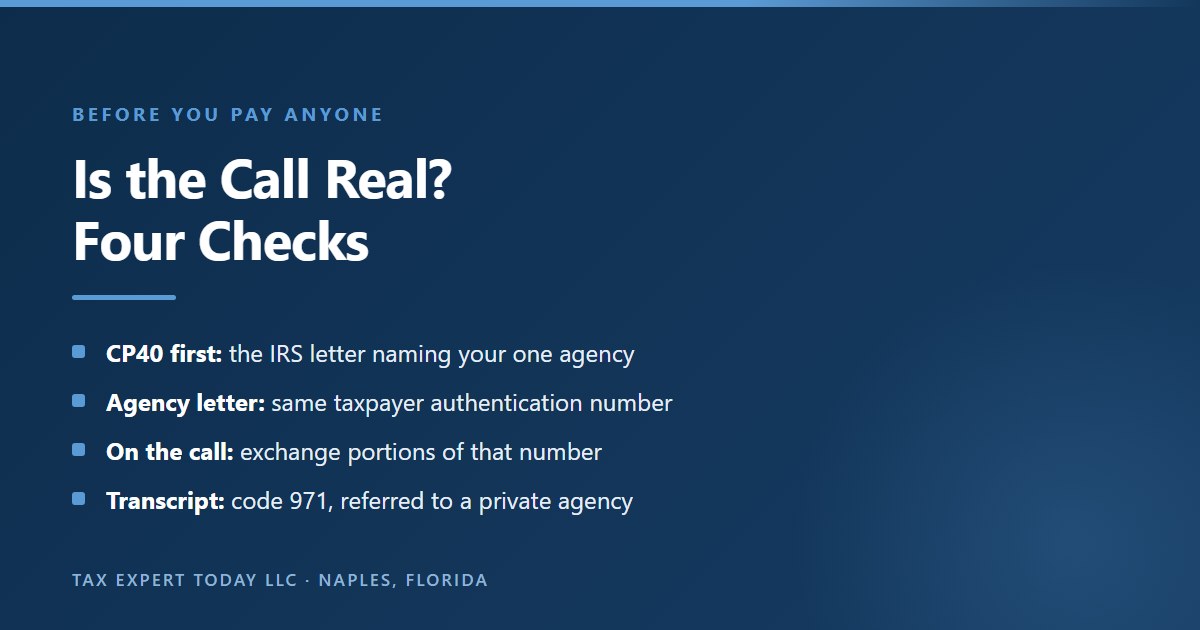
Verify in three steps. Confirm you received a CP40 from the IRS and a separate letter from the agency, both showing the same taxpayer authentication number. Confirm the agency is one of the three on the IRS list. Then exchange portions of the authentication number on the call. A caller who skips any step should be treated as a scam.
- Two letters come before any call. The IRS FAQs say the agency will not contact you by telephone before sending its confirmation letter.
- The number is exchanged, not recited. The IRS says you and the agency representative exchange portions of the authentication number to validate each other’s identity.
- Your transcript confirms the transfer. An account transcript from Get Transcript shows transaction code 971 with the explanation “Collection referred to a private debt collection agency,” along with a 971 entry for the CP40.
- Your online account shows the balance. If your IRS online account shows a zero balance, a genuine collection contact is unlikely.
| Signal | Consistent with a genuine IRS debt collector | Consistent with a scam |
|---|---|---|
| First contact | Letter after an IRS CP40 | Unexpected call, text, email or social media message |
| Identity check | Two-party exchange of the authentication number | Asks you to read out your full number or Social Security number first |
| Payment method | To the IRS or the United States Treasury | Gift card, prepaid debit card, wire, crypto or payment to the caller |
| Tone | Explains options, no threats | Threatens arrest, deportation or immediate seizure |
| Agency named | CBE, Coast Professional or ConServe, matching your CP40 | Any other company, or an agency that does not match your notice |
The authentication process is the heart of the program’s scam protection, and it only works if you keep both letters. ConServe states on its own site that it contacts taxpayers by mail and by phone and does not reach out through email, text messages or social media. A legitimate agency will also ask you questions to confirm it is speaking with the right person, such as your name and address of record. That is normal. What is not normal is a demand for immediate payment through a method that bypasses the Treasury. If you are unsure, end the call, pull your transcript and call the agency back at the number on the IRS page. Our CP501 notice guide covers the broader pattern of verifying any IRS balance before you pay it.
What can an IRS debt collector do and not do?
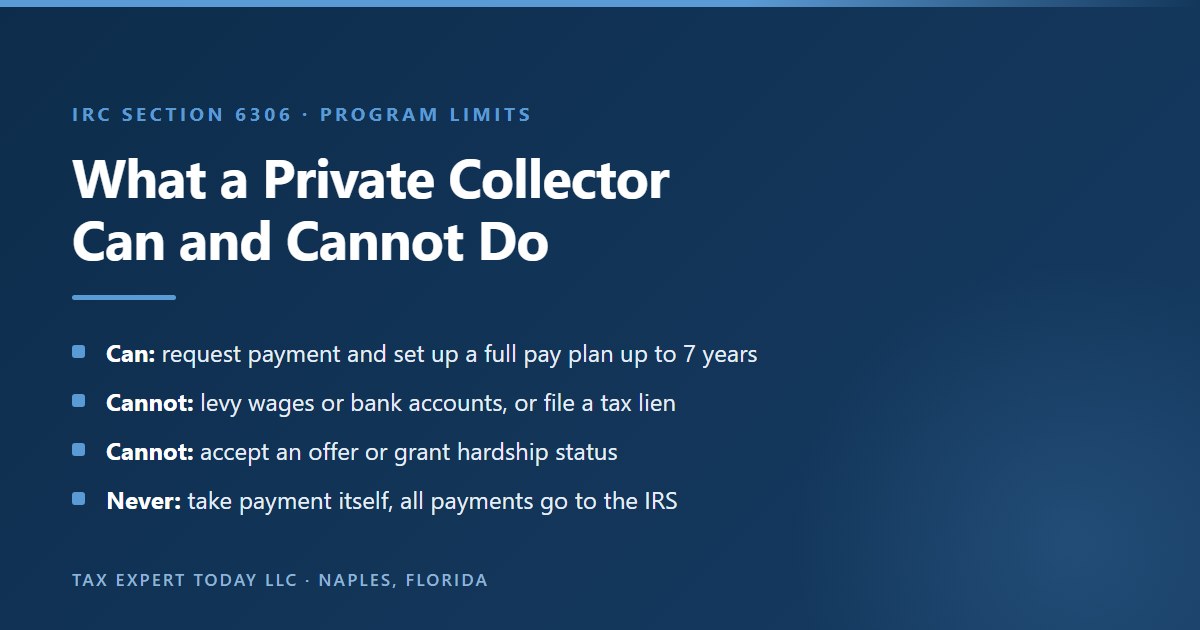
A private collection agency can contact you, request full payment, set up and monitor an installment agreement. It cannot levy wages or bank accounts, file a federal tax lien, accept an offer in compromise, declare your account currently not collectible, collect financial statements or charge a fee for a payment plan.
| Action | Private collection agency | IRS | Source |
|---|---|---|---|
| Contact you and request full payment | Yes | Yes | IRC 6306(b)(1)(A) and (B) |
| Installment agreement that full pays | Yes, up to 7 years or the collection expiration date | Yes | IRC 6306(b)(1)(B); IRS FAQs |
| Partial payment installment agreement | No | Yes | IRC 6306(b)(1)(B) limits contracts to full payment |
| Levy or Notice of Federal Tax Lien | No | Yes | IRS FAQs; Publication 4518 |
| Offer in compromise decision | No | Yes | IRS FAQs |
| Currently not collectible status | No | Yes | IRS FAQs |
| Penalty abatement decision | No | Yes | Program scope; IRC 6306(b) |
| Receive your payment | No, payments go to the IRS | Yes | IRS FAQs; Publication 4518 |
- No enforcement power. The IRS FAQs say an agency will not take any type of enforcement action such as issuing a levy or Notice of Federal Tax Lien.
- No financial statements. The statute allows contracts to cover financial information the Secretary specifies, but the IRS FAQs say its agencies will not collect financial information.
- No resolution decisions. Agencies do not make determinations to accept or reject offers in compromise or report accounts as currently not collectible.
- No plan setup fee. The IRS FAQs say an agency will not charge a fee for setting up a payment agreement.
The line in that table about partial payment plans is the one the ranking pages tend to skip. Section 6306(b)(1)(B) describes a contract to request full payment and, if that cannot be met, to offer an installment agreement “providing for full payment” within 7 years. A private agency is therefore built to do one thing: collect the whole balance over time. If your finances cannot support full payment before the collection statute runs out, the tools that reduce what you pay, such as a partial payment installment agreement, an offer in compromise or currently not collectible status, sit with the IRS. That is not a criticism of the agencies. It is the structure Congress wrote, and knowing it keeps you from signing up for a plan you cannot sustain when another route may fit your facts better.
Which accounts can the IRS not send to private debt collection?
The law bars private collection for balances tied to a pending or active offer in compromise or installment agreement, innocent spouse cases, open examinations, litigation, criminal investigations, levies and appeals, and for taxpayers who are deceased, under 18, in a combat zone, identity theft victims, SSDI or SSI recipients, or at or below 200 percent of the poverty level.
| Exclusion | Statutory basis |
|---|---|
| Pending or active offer in compromise or installment agreement | IRC 6306(d)(1) |
| Innocent spouse case | IRC 6306(d)(2) |
| Taxpayer deceased, under 18 or in a designated combat zone | IRC 6306(d)(3)(A) to (C) |
| Victim of tax-related identity theft | IRC 6306(d)(3)(D) |
| Substantially all income from SSDI or SSI | IRC 6306(d)(3)(E) |
| Adjusted gross income at or below 200 percent of the poverty level | IRC 6306(d)(3)(F) |
| Under examination, litigation, criminal investigation or levy | IRC 6306(d)(4) |
| Subject to a proper exercise of a right of appeal | IRC 6306(d)(5) |
| Federally declared disaster, on request | IRC 6306(i); IRS accounts page |
- The low income and disability exclusions came in 2019. The Taxpayer First Act, Public Law 116-25, section 1205, added the SSDI, SSI and 200 percent of poverty exclusions to section 6306, as the statute’s amendment notes record.
- The IRS publishes the same list. Its accounts assigned page repeats these exclusions in plain language.
- The income test uses the most recent year available. Section 6306(d)(3)(F) measures adjusted gross income for the most recent taxable year for which the information is available.
- Disaster relief is by request. Section 6306(i) lets an affected taxpayer ask for relief from immediate collection by contractors and for return of the account to the IRS.
The exclusions are applied by IRS systems using the information the IRS has, and that information can be out of date. A taxpayer who started receiving Social Security disability benefits after the last return on file, or whose income dropped sharply but who has not filed since, may be assigned even though the statute would exclude them now. If you believe an exclusion applies, say so in writing to the agency and ask that the account be returned to the IRS, and keep a copy. If you live in Southwest Florida, the disaster provision is also worth knowing. Collier and Lee Counties have been covered by federal disaster declarations after recent hurricanes, and section 6306(i) allows a request for relief from contractor collection in that situation.
How do I pay an IRS private collection agency?
You do not pay the agency. Every payment goes to the IRS: IRS Direct Pay, EFTPS, a debit or credit card through an IRS payment processor, a check or money order payable to the United States Treasury, or a preauthorized direct debit that you sign and that is drawn payable to the Treasury.
- Direct Pay is free. The IRS FAQs list IRS Direct Pay from a checking or savings account at no cost.
- EFTPS is free. The Electronic Federal Tax Payment System works online or by phone.
- Cards carry a processor fee. Debit and credit card payments go through an IRS-authorized payment service provider for a fee.
- Checks go to the Treasury. Make them payable to the United States Treasury with your name, Social Security number and tax year, and mail them to the IRS address the agency provides.
The preauthorized direct debit option is the one most people have not seen before. The IRS describes it as a written authorization that lets the agency draft a check, or a series of checks, on your behalf. The checks are always payable to the United States Treasury and can be changed or canceled up to one business day before the scheduled payment. That is a reasonable convenience for a long plan, but read the authorization form before you sign and keep a copy. Whichever method you use, save the confirmation number and the date. A common problem on older accounts is a payment that was made but applied to the wrong year or not applied at all, and a confirmation number is what resolves it. The IRS accounts assigned page is direct on the scam point: an agency will not ask for payment on a prepaid debit, iTunes or gift card.
Can an IRS debt collector set up a payment plan?
Yes. An IRS debt collector can set up and monitor an installment agreement, but only one that pays the balance in full within seven years or by the collection statute expiration date, whichever comes first. Agencies do not charge a setup fee. Plans that pay less than the full balance must come from the IRS itself.
- Seven years is the outer limit. IRC section 6306(b)(1)(B) caps a contractor installment agreement at 7 years.
- The collection date can shorten it. The IRS FAQs say agencies set up arrangements to pay in full within seven years or the collection expiration date.
- The CP40 page confirms plans. The IRS CP40 page says the agency will work with you to set up a payment plan if you cannot pay in full.
- Interest keeps running on the plan. Interest and the failure-to-pay penalty continue to accrue on the unpaid balance until it is paid.
| Hypothetical balance and term | Simplified monthly amount, before interest and penalties |
|---|---|
| $8,400 over 84 months (7 years) | $100 |
| $8,400 over 36 months (collection date 3 years away) | about $233 |
| $21,000 over 84 months | $250 |
| $21,000 over 24 months (collection date 2 years away) | $875 |
The table is hypothetical and simplified. It ignores interest and penalties, which add to every figure, and it is only meant to show how the collection expiration date changes the math. On a young debt, the seven year ceiling controls and the payment can be modest. On an old debt, the remaining statute period controls, and the required payment can jump. That is where people get into trouble: an agency plan that full pays before the statute expires may require a payment that does not fit the budget, and a defaulted plan helps no one. Our guide to IRS installment agreement options explains how IRS plans work, including the online thresholds and user fees, so you can compare them with what the agency offers before you commit.
Does private debt collection stop interest, penalties or the 10-year clock?
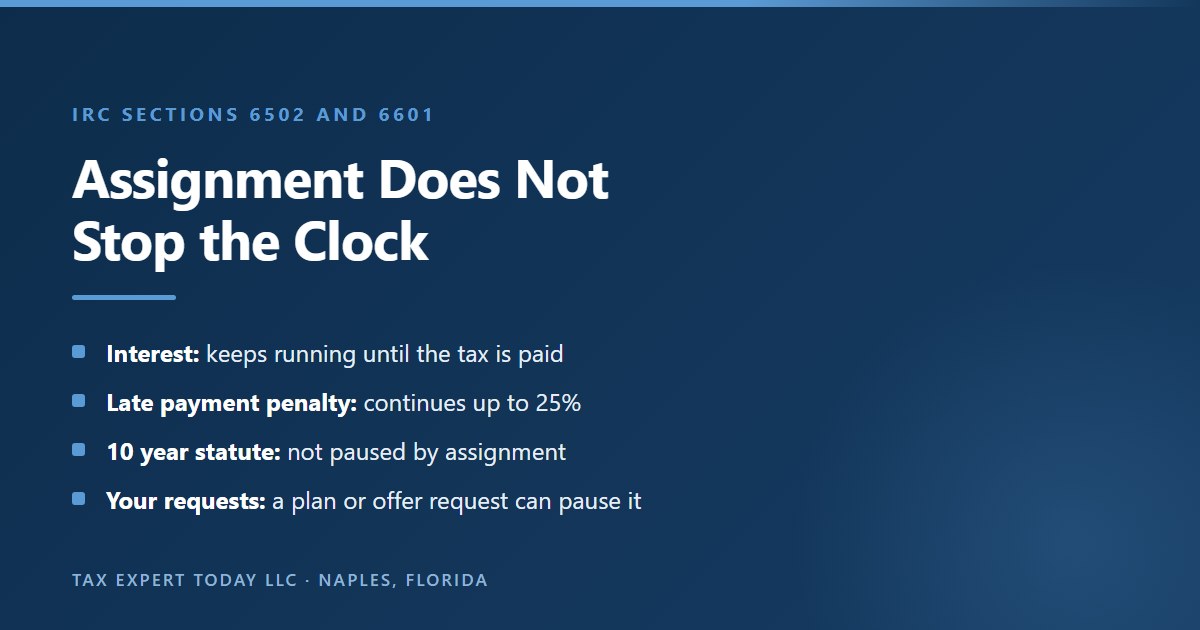
No. Assignment to a private collection agency does not stop interest, does not stop the failure-to-pay penalty and is not one of the events that suspend the 10-year collection statute. The balance keeps growing until it is paid, and the collection expiration date keeps approaching while the agency works the account.
- Interest runs until payment. IRC section 6601(a) charges interest from the last date prescribed for payment until the tax is paid.
- The late payment penalty continues. The failure-to-pay addition under IRC section 6651 accrues monthly up to 25 percent of the unpaid tax, and on very old debts it may already be at that cap.
- The statute runs 10 years from assessment. IRC section 6502 allows collection by levy or court proceeding within 10 years after assessment.
- Suspensions are listed elsewhere. Events that pause the statute, such as a pending offer, a pending installment request, a Collection Due Process hearing or a period outside the United States, appear in sections 6331 and 6503. Private assignment is not among them.
This is the second point the competing pages tend to leave out, and it cuts both ways. Because assignment does not pause the clock, an account that sits with an agency for years without payment can reach its collection expiration date like any other, as our IRS 10-year rule guide explains in detail. But actions you take while the account is assigned can pause the clock. Requesting an installment agreement or submitting an offer in compromise generally suspends the statute while the request is pending and for set periods after a rejection, and agreeing to an extension of the collection period does the same. Before you agree to anything on an old balance, find your collection statute expiration date on your account transcript or ask a representative to calculate it. A taxpayer two years from the expiration date and a taxpayer eight years from it should not make the same choice.
Can I ask to have my account returned to the IRS?
Yes. The IRS says that if you do not wish to work with your assigned private collection agency, you must submit that request in writing to the agency. Doing so does not erase the debt. It moves the account back toward IRS inventory, where the IRS can still collect it with its full enforcement powers.
- The request must be written. Both the IRS FAQs and Publication 4518 say the request goes to the agency in writing.
- Send it to the agency’s address of record. Use the address on your CP40 or on the IRS agency list, and keep proof of mailing.
- A pending offer or plan with the IRS also ends eligibility. Under section 6306(d)(1), a receivable subject to a pending or active offer in compromise or installment agreement is not eligible for private collection.
- Disaster victims have a separate route. Section 6306(i) allows a request to return the receivable to IRS inventory after a federally declared disaster.
Whether you should ask for the account back depends on what you need. If you can full pay over a period the agency can offer, the agency route is often simple and carries no setup fee. If you need a solution the agency cannot provide, such as hardship status, a partial payment plan, an offer or a penalty abatement request, the IRS is where that work happens, and a return request is the first step. Be realistic about what comes next. An account back in IRS inventory is again exposed to the IRS’s own collection tools, including liens and, after the required notices, levies. Our Letter 1058 and LT11 guide and our Collection Due Process hearing guide explain the protections that apply before an IRS levy. The decision should be made with a plan ready, not as a way to make the calls stop.
What if I already paid or the debt is not mine?
If you already paid, give the agency the payment date, amount, method and confirmation number so the IRS can trace and apply it. If the debt is not yours or you suspect identity theft, say so, request the account be returned to the IRS, and check your transcript. Identity theft victims are excluded from private collection by statute.
- Missing payments are researched. The IRS FAQs say to work with the agency to find out why your payment was not applied and to provide the payment information requested.
- Check the transcript first. The account transcript shows every payment the IRS credited and the year it went to.
- Identity theft is an exclusion. Section 6306(d)(3)(D) bars private collection for victims of tax-related identity theft.
- Disputed amounts belong with the IRS. An agency cannot change the assessment. Errors in the tax itself are corrected through the IRS, for example through audit reconsideration.
A related situation shows up often on public tax forums: a taxpayer mailed a check, the check cleared, and the account went to collections anyway. The usual cause is a payment applied to a different tax year or a different account, or a payment that covered tax but not the interest and penalty that accrued afterward. The fix is documentation. Pull the account transcript for each year listed on the CP40, match every payment you made against the credits shown, and send the agency a short written summary with copies of cancelled checks or bank records. If the balance itself is wrong because the original assessment was wrong, the agency has no authority to change it, and the conversation has to move to the IRS. If you never filed for the year and the IRS created the balance through a substitute for return, filing an original return is often the most direct way to correct it, as our unfiled tax returns guide explains.
Can a private collection agency settle for less or mark me hardship?
No. A private collection agency cannot accept an offer in compromise, cannot place your account in currently not collectible status and cannot set up a partial payment installment agreement. Those decisions belong to the IRS. If your finances call for one of them, the work has to be done with the IRS, not the agency.
- Offers are an IRS decision. The IRS FAQs say agencies will not make determinations to accept or reject offers in compromise.
- Hardship status is an IRS decision. The same FAQs say agencies will not report accounts as currently not collectible.
- Financial statements go to the IRS. Because agencies do not collect financial information, a Form 433-A collection information statement is reviewed by the IRS.
- A filed offer changes eligibility. A pending offer in compromise makes the receivable ineligible for private collection under section 6306(d)(1).
This is where the IRS debt collector program and the IRS’s own relief programs meet. The Fresh Start tools that people read about, including streamlined plans, offers and hardship status, still exist for assigned accounts, but the agency is not the place to request most of them. For a taxpayer whose income and assets cannot support full payment, the usual path is to prepare a collection information statement using the IRS allowable living expense standards, decide which program the numbers support, and then take the request to the IRS, with a written notice to the agency if needed. Penalty relief is similar. If the balance includes failure-to-file or failure-to-pay penalties, first time penalty abatement or reasonable cause relief is requested from the IRS, and any relief granted reduces what the agency then collects. Results in each of these programs depend on individual facts, and none is automatic.
What are my rights if a private collector acts improperly?
Private collectors must follow the Fair Debt Collection Practices Act, except where tax law supersedes it, and may not do anything IRS employees are prohibited from doing. You can report misconduct to the IRS, ask the Taxpayer Advocate Service for help, and in some cases sue the contractor for damages under IRC section 7433A.
- The FDCPA applies. IRC section 6306(g) applies the Fair Debt Collection Practices Act to these contracts, except to the extent superseded by sections 6304 and 7602(c) or other provisions of the Code.
- IRS employee rules apply. Section 6306(b)(2) prohibits contractors from any act or omission IRS employees are prohibited from committing.
- Damages run against the contractor. IRC section 7433A applies the section 7433 damages remedy to contractor conduct, with the suit brought against the contracting company rather than the United States.
- Taxpayer Assistance Orders reach contractors. Section 6306(k) cross-references section 7811(g), which applies Taxpayer Assistance Orders to persons performing services under these contracts.
Most taxpayers will never need these remedies, but they shape what a legitimate agency can say. A contractor cannot threaten arrest, cannot misstate what the IRS will do and cannot pressure you to pay by a method outside the Treasury. The Taxpayer Bill of Rights applies to the account as it would with an IRS employee, including the right to be informed, the right to pay no more than the correct amount and the right to retain representation. If you have a representative, the agency should work through that person once a valid Form 2848 is on file. If something on a call feels wrong, write down the date, time, name and what was said, and report it through the IRS private debt collection page. If the call involved a request for gift cards, a wire or payment to the caller, treat it as a scam and report it as one.
What happens if I ignore an IRS debt collector?
Ignoring an IRS debt collector does not make the debt go away. Interest and penalties keep growing, the IRS can recall the account and use its own enforcement tools, and refunds in later years can be applied to the balance. The agency itself cannot levy or file a lien, but the IRS can.
- The IRS keeps its powers. The IRS FAQs say the IRS has the legal authority to file a Notice of Federal Tax Lien or issue a levy on an overdue account.
- The balance keeps growing. Interest under section 6601 continues on unpaid tax, penalties and accrued interest until payment.
- Refunds can be offset. Overpayments on later returns are generally applied to outstanding federal tax balances.
- Serious debts carry passport risk. A balance large enough to be certified as seriously delinquent can affect a passport, as our IRS passport revocation guide explains.
Some taxpayers decide that letting an old account sit with an agency is a strategy, because the agency cannot levy and the collection statute keeps running. That reasoning has real limits. The IRS can pull an account back at any time, the debt does not stop growing in the meantime, and the decision ignores the possibility that a program such as hardship status or an offer might resolve the account on better terms. If your collection expiration date is close and your finances are thin, the right answer may well be not to sign a long plan, but that is a decision to make deliberately, with the transcript in hand and the IRS options compared, not by leaving the letters unopened. A short written response that preserves your position is almost always better than silence.
How does private debt collection fit with other IRS notices?
Private collection usually comes late in the life of a balance. The account was assessed, billed through the CP14 and reminder notices, often reached a CP504 or a final notice, and then went inactive. The CP40 marks the transfer to an agency. If the IRS recalls the account, IRS collection notices and enforcement can resume.
| Stage | Typical notice | What it means |
|---|---|---|
| First bill | CP14 | Balance due after assessment |
| Reminders | CP501, CP503 | Balance still unpaid, interest and penalties growing |
| Intent to levy | CP504 | State refund levy possible, IRS levy warning |
| Final notice before levy | LT11 or Letter 1058 | Collection Due Process hearing rights |
| Assignment to an agency | CP40 | Inactive account transferred to CBE, Coast Professional or ConServe |
- Not every account goes through every step. Some balances become inactive earlier, for example when mail is returned undeliverable.
- Earlier notices explain the balance. The CP503 guide covers the second reminder, and the CP504 guide covers the intent to levy stage.
- A recalled account restarts IRS contact. Once back with the IRS, a revenue officer or automated collection may contact you directly.
- Hearing rights are tied to IRS notices. Collection Due Process rights attach to IRS levy and lien notices, not to agency letters.
Seeing the CP40 in this sequence helps explain why the program exists. By the time an account reaches an agency, the IRS has usually sent several notices and taken no further action, often for years. The agency is a way to make contact again on balances that would otherwise sit untouched. For the taxpayer, the CP40 is a prompt to reassess an old problem with current information: how much is owed today, how much time remains on the collection statute, what the household can afford, and whether any penalty relief is available. Our tax lien withdrawal guide is also relevant if a lien was filed before the account went inactive, because a lien can remain on record while the agency works the balance.
IRS debt collector help Naples: tax resolution Naples and Southwest Florida
Our office in Naples, Florida works with taxpayers who have received a CP40 notice or a call from CBE, Coast Professional or ConServe and want to understand their position before they agree to anything. The first step is usually the same: pull the account transcripts for every year on the notice, confirm the assignment and the balance, calculate the collection statute expiration date, and check whether any statutory exclusion or penalty relief applies. From there the choice is between a full pay plan through the agency and an IRS solution, and the transcript usually makes that choice clear.
People searching for IRS debt collector help in Naples tend to ask whether the call is real, whether they must work with the agency, and whether the agency can take their wages or bank account. The short answers are that a genuine agency contact follows a CP40 and a letter with matching authentication numbers, that you can ask in writing to have the account returned to the IRS, and that the agency itself cannot levy or file a lien. Our IRS resolution and audit support service and our Naples tax resolution page describe how these matters are handled, from transcript review and statute calculations to installment agreements, hardship requests and penalty relief.
Tax Expert Today LLC
11983 Tamiami Trail N, Naples, FL 34110
Phone: (239) 441-2005
Hours: Monday through Friday, 10:00 to 5:00 ET
Where can I get help with an IRS debt collector in Naples, FL? Private collection accounts are handled by phone and mail with the agency and the IRS, so help does not depend on a local IRS office. A representative authorized on Form 2848 can confirm the assignment, speak with the agency, request that the account be returned to the IRS where that makes sense, and pursue IRS programs the agency cannot offer. Tax Expert Today LLC is located at 11983 Tamiami Trail N in Naples and works with taxpayers in Collier and Lee Counties and nationwide. Because Florida has no personal income tax, a Naples resident with an IRS debt collector account is dealing with a federal balance only.
When to Engage a Professional
Many taxpayers can work with an IRS debt collector directly, especially when the balance is modest and can be paid in full over a few years. Consider engaging a representative where the balance is large, where the collection statute expiration date is near, where you cannot afford a full pay plan, where you believe an exclusion such as disability benefits, low income or identity theft applies, where a payment you made is missing, where a lien is already on record, or where you are unsure whether a call is genuine. Those are the situations in which choosing between an agency plan and an IRS program matters most. Dr. Kabashi is an Enrolled Agent authorized to represent taxpayers before the IRS in all 50 states, and every engagement starts from the statute, the regulations and the IRS’s own procedures rather than assumptions about what the IRS will do.
This article is educational and general in nature. It does not constitute tax or legal advice for any particular taxpayer, and outcomes depend on individual facts and circumstances. The list of private collection agencies, program procedures, payment options and relief programs are current as of the publication date and are subject to change.
Published October 5, 2026 by Dr. Pellumb Kabashi « Back to Learning Center
Have a question this article touches on?
Tax Expert Today LLC, based in Naples, Florida and serving clients across the United States.
Schedule a Consultation (239) 441-2005