
By Dr. Pellumb Kabashi, DBA, MBA, CES, CFE, EA
Founder, Tax Expert Today LLC · Tax advisors, enrolled agents, CPAs, and attorneys · Serving clients in all 50 states
Quick Answer: In the SEP IRA vs solo 401k choice for 2026, both plans share a $72,000 limit, but a solo 401(k) adds a $24,500 employee deferral, so it usually holds more below about $376,000 of net profit. A SEP IRA fits owners with employees or simple needs. Call (239) 441-2005 for a free consultation.
SEP IRA vs solo 401k: what is the difference?
A SEP IRA accepts employer contributions only, while a solo 401(k) accepts both employee deferrals and employer contributions. Both share the $72,000 annual limit for 2026, but the solo 401(k) usually reaches it at a much lower income. It also requires an owner with no employees other than a spouse.
- Contribution types: a SEP IRA has one contribution type, and a solo 401(k) has two that stack.
- Who can use it: a SEP IRA fits a business of any size, and a solo 401(k) fits only an owner with no common law employees.
- Paperwork: a SEP IRA has no annual federal return, and a solo 401(k) can require Form 5500-EZ.
- Backdoor Roth effect: a SEP IRA balance counts in the pro rata rule, and a solo 401(k) balance does not.
The IRS describes a SEP plan as an arrangement under which an employer contributes to an individual retirement account set up for each eligible person. The statute behind it is IRC section 408(k). The IRS describes a one-participant 401(k) plan as a traditional 401(k) plan covering a business owner with no employees, or that person and a spouse. The IRS adds that these plans have the same rules and requirements as any other 401(k) plan. The label solo 401(k) is a marketing term, and it does not appear in the Internal Revenue Code.
Owners who search for SEP IRA vs solo 401k usually want one answer: which plan lets me put away more money? That answer is a formula rather than an opinion, and this guide works it through at ten income levels. A second question matters almost as much. Which plan creates a problem later? A SEP IRA can quietly spoil a backdoor Roth strategy, and a solo 401(k) can quietly stop being available the moment a first employee becomes eligible.
This guide is written for sole proprietors, single member LLC owners, partners, and S corporation shareholders who are deciding before a year end or a filing deadline. It is part of the planning material used by our Naples, Florida tax planning team, and our tax planning services page describes the broader work. All examples are hypothetical.
| Feature | SEP IRA | Solo 401(k) |
|---|---|---|
| Authority | IRC 408(k) | IRC 401(a) and 401(k) |
| Employee deferral | None for a new SEP | Up to $24,500 |
| Employer contribution | Up to 25 percent of pay, 20 percent of net earnings if self-employed | Up to 25 percent of pay, 20 percent of net earnings if self-employed |
| Annual additions limit | $72,000 | $72,000, before catch-up |
| Catch-up, age 50 or older | None | $8,000, or $11,250 at ages 60 to 63 |
| Roth option | Allowed if the custodian offers it | Allowed if the plan document permits it |
| Participant loans | Not permitted | Permitted if the plan allows them |
| Annual federal return | None | Form 5500-EZ once assets exceed $250,000 |
| Employees | Must cover those who qualify | Plan is unavailable as a solo design |
| Counted in the pro rata rule | Yes | No |
What are the 2026 contribution limits for each plan?
For 2026, the annual additions limit is $72,000 for both plans, and the compensation that can be counted is capped at $360,000. The solo 401(k) employee deferral limit is $24,500. Catch-up contributions add $8,000 at age 50 or older and $11,250 at ages 60 to 63, in the solo 401(k) only.
- Annual additions: $72,000 under section 415(c), up from $70,000 for 2025.
- Compensation cap: $360,000 under section 401(a)(17) and section 408(k)(3)(C).
- Elective deferral: $24,500 under section 402(g).
- SEP eligibility pay floor: $800 of compensation for 2026, up from $750.
These figures come from IRS Notice 2025-67 and the IRS table of cost of living adjustments, which were checked on the publication date of this guide. Limits for 2027 had not been reviewed here, so any plan for 2027 should use the figures then in effect. The limit that applies to a person depends on the year of the contribution, which can differ from the year in which it is deposited.
Catch-up contributions sit outside the $72,000 figure. An owner age 52 who maximizes a solo 401(k) can reach $80,000 for 2026, and an owner age 61 can reach $83,250, according to the IRS 401(k) contribution limits page. A SEP IRA has no catch-up for a new arrangement. Older owners therefore have a permanent reason to prefer the 401(k) structure, even at income levels where the base limits are equal.
| Item | 2026 amount | 2025 amount | Authority |
|---|---|---|---|
| Annual additions, section 415(c) | $72,000 | $70,000 | Notice 2025-67 |
| Compensation limit, section 401(a)(17) | $360,000 | $350,000 | Notice 2025-67 |
| Elective deferral, section 402(g) | $24,500 | $23,500 | Notice 2025-67 |
| Catch-up, age 50 or older | $8,000 | $7,500 | Notice 2025-67 |
| Higher catch-up, ages 60 to 63 | $11,250 | $11,250 | Notice 2025-67 |
| SEP minimum compensation | $800 | $750 | IRS COLA table |
| Roth catch-up wage threshold | $150,000 | $145,000 | Notice 2025-67 |
| Traditional or Roth IRA limit | $7,500 | $7,000 | Notice 2025-67 |
| Social Security wage base | $184,500 | Not used here | IRS Topic 751 |
Which plan holds more money at the same income?
At nearly every income level below about $376,000 of net profit, a solo 401(k) holds more than a SEP IRA, usually $24,500 more for an owner under age 50. Above that point both reach the $72,000 limit, and only the solo 401(k) can add catch-up contributions for an older owner.
- Below about $252,000 of profit: the gap is the full $24,500 deferral.
- Between about $252,000 and $376,000: the gap shrinks as the SEP approaches the limit.
- Above about $376,000: the two plans match for an owner under age 50.
- At low income: the deferral can shelter almost all net earnings.
The table below uses a hypothetical sole proprietor under age 50 with no other earned income and no other retirement plan. The self-employment tax column uses the 2026 Social Security wage base of $184,500 and the 92.35 percent net earnings factor in IRC section 1402(a)(12). Net earnings are net profit less the deduction for one half of self-employment tax. The SEP column is 20 percent of net earnings, and the solo 401(k) column adds the $24,500 deferral, subject to the $72,000 limit and to total net earnings.
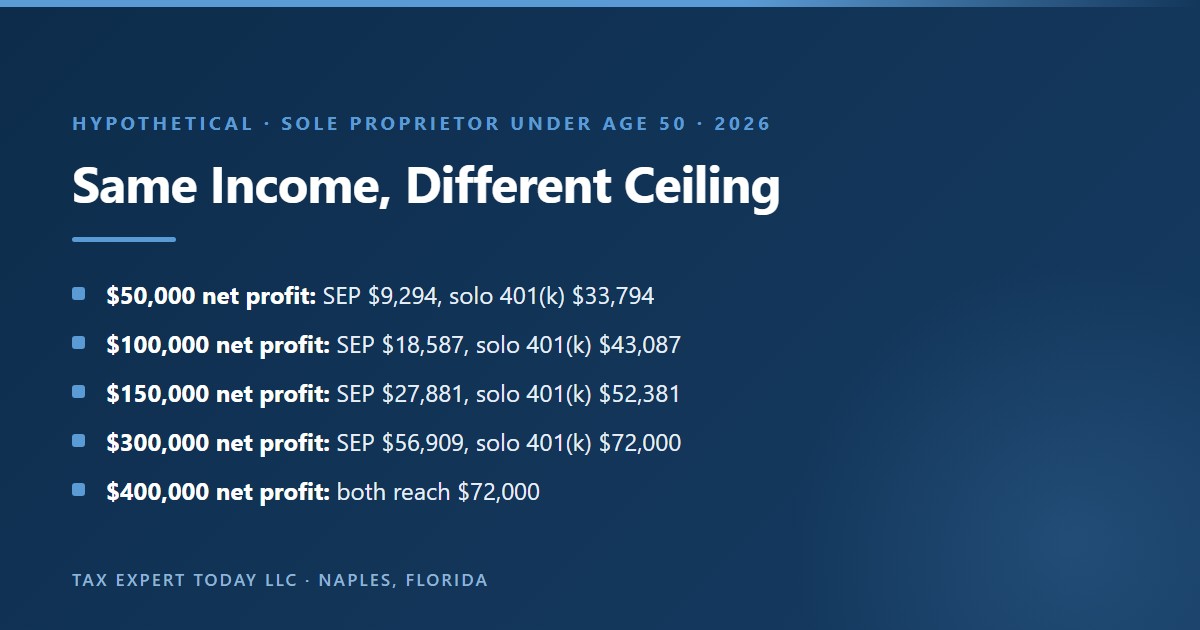
| Net profit | Half of SE tax | Net earnings | SEP IRA maximum | Solo 401(k) maximum | Difference |
|---|---|---|---|---|---|
| $30,000 | $2,119 | $27,881 | $5,576 | $27,881 | $22,304 |
| $50,000 | $3,532 | $46,468 | $9,294 | $33,794 | $24,500 |
| $75,000 | $5,299 | $69,701 | $13,940 | $38,440 | $24,500 |
| $100,000 | $7,065 | $92,935 | $18,587 | $43,087 | $24,500 |
| $150,000 | $10,597 | $139,403 | $27,881 | $52,381 | $24,500 |
| $200,000 | $14,117 | $185,883 | $37,177 | $61,677 | $24,500 |
| $250,000 | $14,787 | $235,213 | $47,043 | $71,543 | $24,500 |
| $300,000 | $15,456 | $284,544 | $56,909 | $72,000 | $15,091 |
| $400,000 | $16,795 | $383,205 | $72,000 | $72,000 | $0 |
| $500,000 | $18,134 | $481,866 | $72,000 | $72,000 | $0 |
The $30,000 row shows the design difference most clearly. The SEP IRA is limited to 20 percent of net earnings. The solo 401(k) is limited by the deferral and the employer amount, and the sum in that row is capped at the owner’s total net earnings. These are ceilings, and neither plan requires any contribution in a given year. The figures are illustrations and should be recomputed on actual return data. Our self-employment tax calculator can help estimate the starting figure.
How do you compute net earnings for a sole proprietor?
Net earnings for plan purposes generally equal Schedule C net profit less the deduction for one half of self-employment tax. The contribution itself also reduces the base, which is why the 25 percent plan rate becomes a 20 percent effective rate. Publication 560 provides the worksheet that performs this calculation for owners.
- Step one: start with net profit from Schedule C or the partnership equivalent.
- Step two: compute self-employment tax and subtract one half.
- Step three: apply the reduced 20 percent rate to the result.
- Step four: compare the answer with the dollar limit.
The definition comes from IRC section 401(c)(2), which determines earned income after the deduction allowed for contributions to the plan. Because the deduction is part of its own base, the calculation is circular. IRS Publication 560 solves the circle with a rate table and a deduction worksheet for the self-employed. Owners who use the 25 percent figure directly on net profit will overstate the allowed contribution.
The worked example below follows the Publication 560 approach for a hypothetical sole proprietor with $150,000 of net profit in 2026. Income below the Social Security wage base is subject to the full 15.3 percent rate on 92.35 percent of net profit.
| Line | Computation | Amount |
|---|---|---|
| Net profit | Schedule C | $150,000 |
| Net earnings subject to SE tax | $150,000 x 92.35% | $138,525 |
| Self-employment tax | $138,525 x 15.3% | $21,194 |
| Deduction for half of SE tax | $21,194 / 2 | $10,597 |
| Net earnings for plan purposes | $150,000 less $10,597 | $139,403 |
| Employer contribution | $139,403 x 20% | $27,881 |
| Employee deferral, solo 401(k) only | 2026 limit | $24,500 |
| SEP IRA total | Employer only | $27,881 |
| Solo 401(k) total | $27,881 plus $24,500 | $52,381 |
Why is the self-employed rate 20 percent instead of 25 percent?
A plan rate of 25 percent is measured on compensation after the contribution is subtracted, so the equivalent rate on net earnings before the contribution is 25 percent divided by 1.25, which is 20 percent. The reduction applies to self-employed owners only. An S corporation shareholder uses the full 25 percent on W-2 wages.
- Formula: plan rate divided by one plus the plan rate.
- Result: 25 percent becomes 0.200000 in the Publication 560 rate table.
- Applies to: sole proprietors, single member LLCs, and partners.
- Does not apply to: S corporation or C corporation employees paid on a W-2.
A W-2 employee has compensation that is fixed before any employer contribution, so no circularity exists. A self-employed person is both the employer and the employee, and the plan contribution is deducted in reaching the compensation it is measured against. The same rule applies to a SEP IRA and to the employer portion of a solo 401(k), so the 20 percent figure does not favor either plan.
| Plan contribution rate | Reduced rate for the self-employed | Contribution on $100,000 of net earnings |
|---|---|---|
| 10 percent | 9.0909 percent | $9,091 |
| 15 percent | 13.0435 percent | $13,043 |
| 20 percent | 16.6667 percent | $16,667 |
| 25 percent | 20.0000 percent | $20,000 |
Rates and dollar results are arithmetic illustrations that follow the Publication 560 rate table. The employee deferral in a solo 401(k) is outside this calculation, and section 404(n) keeps deferrals out of the 25 percent deduction limit.
At what income does a SEP IRA catch up to a solo 401(k)?
A SEP IRA reaches the $72,000 limit when net earnings reach $360,000, about $376,500 of net profit for a sole proprietor in 2026. A solo 401(k) reaches the same limit at net earnings of $237,500, about $252,300 of net profit. An S corporation owner reaches those points at $288,000 and $190,000 of wages.
- SEP breakpoint, self-employed: 20 percent x $360,000 of net earnings equals $72,000.
- Solo breakpoint, self-employed: $24,500 plus 20 percent x $237,500 equals $72,000.
- SEP breakpoint, S corporation: 25 percent x $288,000 of wages equals $72,000.
- Solo breakpoint, S corporation: $24,500 plus 25 percent x $190,000 equals $72,000.
Those four numbers are the most useful figures in the SEP IRA vs solo 401k comparison, because they show how much income each plan needs to fill the same limit. An owner whose profit will not approach the SEP breakpoint is usually leaving capacity unused in a SEP IRA. An owner well above it gives up nothing on the base limit by choosing the simpler plan, and the decision then turns on catch-up contributions, Roth access, loans, and the pro rata rule.
| Owner type | SEP IRA needs | Solo 401(k) needs | Income difference |
|---|---|---|---|
| Sole proprietor, net earnings | $360,000 | $237,500 | $122,500 |
| Sole proprietor, approximate net profit | $376,480 | $252,317 | $124,163 |
| S corporation, W-2 wages | $288,000 | $190,000 | $98,000 |
How do catch-up contributions change the comparison?
Catch-up contributions apply to the solo 401(k) only, so they widen the gap for an owner age 50 or older. For 2026, an owner age 52 can add $8,000 and an owner age 61 can add $11,250. At high income, the catch-up becomes the only remaining difference in dollar capacity between the two plans.
- Age 50 to 59 and 64 or older: $8,000 for 2026.
- Age 60 to 63: $11,250 for 2026, under section 414(v)(2)(E).
- Not part of the $72,000 limit: catch-up amounts are excluded from section 415(c).
- SEP IRA: no catch-up for a SEP arrangement set up today.
The age is measured by the year in which the participant attains it. An owner who turns 60 during 2026 is treated as age 60 for the year. The owner must have enough earned income to support the extra amount, because deferrals are limited by compensation.
| Net profit | SEP IRA, any age | Solo 401(k), age 52 | Solo 401(k), age 61 | Gap at age 61 |
|---|---|---|---|---|
| $100,000 | $18,587 | $51,087 | $54,337 | $35,750 |
| $150,000 | $27,881 | $60,381 | $63,631 | $35,750 |
| $300,000 | $56,909 | $80,000 | $83,250 | $26,341 |
These ceilings assume the owner has not used any part of the deferral limit in another employer’s plan. Owners with a W-2 job should read the later section on outside deferrals, since the $24,500 limit is personal rather than per employer.
How does the 2026 Roth catch-up rule affect owners?
For 2026, a catch-up eligible participant whose 2025 wages from the plan sponsor exceeded $150,000 must make catch-up contributions as Roth. The test uses Form W-2 style wages, so an S corporation owner can be caught by it. A sole proprietor with only self-employment income has no such wages from the plan sponsor.
- Who is tested: participants with wages under section 3121(a) from the employer sponsoring the plan.
- Threshold: $150,000 of 2025 wages for 2026 contributions.
- Plan requirement: the plan needs a Roth option for catch-up to remain available.
- SEP IRA: the rule does not matter, since a SEP has no catch-up contributions.
IRC section 414(v)(7) carries the requirement, and Notice 2025-67 sets the 2026 threshold. The rule refers to wages as defined in section 3121(a), and Treasury Regulation section 1.414(v)-2 confirms that definition. Net earnings from self-employment are a different concept. The regulation does contain a plan level option related to highly compensated participants with self-employment earnings, so the plan document should be read.
An S corporation owner paid $200,000 in 2025 who wishes to make a catch-up contribution in 2026 should expect that contribution to be a designated Roth contribution. It will not reduce current taxable income. That is a real cost difference from what older commentary describes, and the plan must offer Roth deferrals at all for the owner to keep the catch-up.
| Owner | 2025 wages from the sponsor | Is catch-up required to be Roth? |
|---|---|---|
| Sole proprietor | None, self-employment income only | Generally no, subject to the plan document |
| S corporation owner, lower wages | $120,000 | No |
| S corporation owner, higher wages | $200,000 | Yes |
| Partner | Generally no section 3121(a) wages | Generally no, subject to the plan document |
How does S corporation W-2 pay change the comparison?
An S corporation owner’s plan contributions are based on W-2 wages only, and distributions are excluded. The SEP IRA is limited to 25 percent of wages, while the solo 401(k) allows 25 percent of wages plus the $24,500 deferral. Lower wages therefore make the plan difference larger, in relative terms, for most owners.
- Wages count: Form W-2 pay is the base for both plans.
- Distributions do not count: S corporation distributions are not compensation.
- No 20 percent adjustment: the full 25 percent applies to W-2 wages.
- Deferrals stay in the base: elective deferrals are included in compensation.
An owner of an S corporation who takes $100,000 in salary and $200,000 in distributions has compensation of $100,000 for plan purposes, regardless of how much the business earned. Section 404(a)(12) and section 415(c)(3)(D) include elective deferrals in compensation, so a deferral does not reduce the employer contribution base. The employer portion is deductible by the corporation on Form 1120-S.
Most comparison pages treat S corporation owners as an afterthought, yet this is where the decision often has the largest effect. A salary set for payroll tax reasons often leaves a SEP IRA with a small contribution. A solo 401(k) can absorb the shortfall through the deferral.
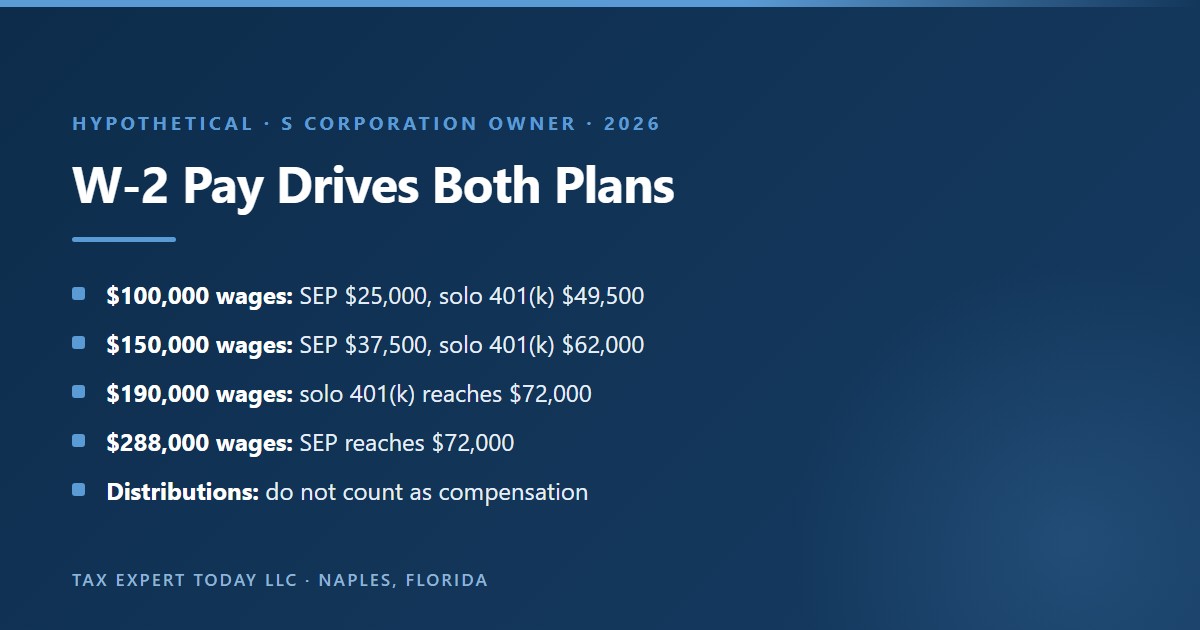
| W-2 wages | SEP IRA maximum | Solo 401(k) maximum | Difference |
|---|---|---|---|
| $50,000 | $12,500 | $37,000 | $24,500 |
| $80,000 | $20,000 | $44,500 | $24,500 |
| $100,000 | $25,000 | $49,500 | $24,500 |
| $120,000 | $30,000 | $54,500 | $24,500 |
| $150,000 | $37,500 | $62,000 | $24,500 |
| $190,000 | $47,500 | $72,000 | $24,500 |
| $240,000 | $60,000 | $72,000 | $12,000 |
| $288,000 | $72,000 | $72,000 | $0 |
These figures assume the wages are reasonable for the services performed and the corporation has the cash. Elective deferrals must be withheld through payroll from wages actually paid.
How much salary does each plan need for the same funding?
To fund $60,000 in 2026, an S corporation owner under age 50 would need about $240,000 of wages with a SEP IRA, compared with about $142,000 with a solo 401(k). That difference can change Social Security and Medicare tax by a meaningful amount, depending on the owner’s wages and on what compensation is reasonable.
- Reason for the difference: the deferral removes $24,500 from the amount the 25 percent must produce.
- Payroll tax effect: wages below $184,500 are subject to the full 15.3 percent combined rate.
- Above the wage base: only the 2.9 percent combined Medicare rate applies, before any additional Medicare tax.
- Limit: salary must still reflect reasonable compensation for the services.
The table below computes combined employer and employee Social Security and Medicare tax on each wage level. Additional Medicare tax and state unemployment taxes are ignored, and so is the small deduction effect of the employer share. The table does not suggest setting salary by plan funding, because salary must be justified by the work performed.
| Funding target | SEP wages | FICA on SEP wages | Solo wages | FICA on solo wages | FICA difference |
|---|---|---|---|---|---|
| $40,000 | $160,000 | $24,480 | $62,000 | $9,486 | $14,994 |
| $50,000 | $200,000 | $28,678 | $102,000 | $15,606 | $13,072 |
| $60,000 | $240,000 | $29,838 | $142,000 | $21,726 | $8,112 |
| $72,000 | $288,000 | $31,230 | $190,000 | $28,388 | $2,842 |
Wages drive more than payroll tax. They affect the qualified business income deduction, and they can affect benefits later. An owner looking at any of these figures should first read our guide to S corporation reasonable compensation and confirm what the facts support.
Can an S corporation owner lower pay to fund a plan?
An S corporation owner generally must receive reasonable compensation for services before taking distributions, and a retirement plan does not change that. Pay set below a defensible level can be recharacterized by the IRS as wages. A plan should be sized around a supportable salary, and the salary should never be selected only to fit the plan.
- Starting point: determine what the role would pay in the market.
- Then model: the plan funding that salary allows.
- Do not reverse the order: a salary chosen for plan funding is hard to defend.
- Keep records: support for the salary decision should be kept each year.
Reasonable compensation is a facts and circumstances question. Factors usually include duties, time spent, comparable pay, and the distributions taken. The answer can differ widely between a physician, a contractor, and an online seller. A low salary reduces the contribution in both plans, but the effect is more severe in a SEP IRA because the SEP has nothing to fall back on.
| Decision | SEP IRA effect | Solo 401(k) effect |
|---|---|---|
| Salary rises by $10,000 | Limit rises by $2,500 | Limit rises by $2,500 until the $72,000 cap |
| Salary falls by $10,000 | Limit falls by $2,500 | Limit falls by $2,500, deferral unchanged |
| Salary below the deferral limit | 25 percent of a small base | Deferral limited to wages |
| Salary paid only after year end | Compensation counted in the year paid | Deferral requires wages actually paid |
How do partners and LLC owners compute their contributions?
The tax classification of the entity decides the compensation base, not the legal form. A single member LLC taxed as a disregarded entity uses net earnings from Schedule C. A partner uses net earnings from self-employment on the partnership share. An LLC that elected S corporation treatment uses W-2 wages only for both plans.
- Disregarded LLC: treated as a sole proprietorship for plan purposes.
- Partnership: contributions are generally made by the partnership.
- S corporation election: W-2 wages only.
- C corporation: W-2 wages, and the corporation deducts the employer amount.
A partnership adopts the plan and each partner generally participates, so a single partner cannot simply open a personal SEP or solo 401(k) for partnership income. A partnership with two owners can use a solo 401(k) design because the plan covers only owners. Section 401(c) treats a self-employed individual as an employee for these purposes, and section 401(c)(4) treats a sole owner as that person’s own employer.
Partners deduct the contributions made for themselves on Schedule 1 (Form 1040), using the amounts shown on the Schedule K-1, as described in Publication 560. Section 707(c) payments, the character of a partner’s income, and any special allocations can each change the compensation base, so the partnership agreement should be reviewed.
| Entity classification | Compensation base | Rate on the base | Where the employer amount is deducted |
|---|---|---|---|
| Sole proprietor | Net earnings after half of SE tax | 20 percent | Schedule 1, line 16 |
| Single member LLC, disregarded | Net earnings after half of SE tax | 20 percent | Schedule 1, line 16 |
| Partnership | Partner’s net earnings from self-employment | 20 percent | Schedule 1, line 16, per K-1 |
| S corporation | W-2 wages | 25 percent | Form 1120-S, line 17 |
| C corporation | W-2 wages | 25 percent | Corporate return |
Who qualifies for a solo 401(k)?
A solo 401(k) is generally available to a business owner with no employees, or an owner and spouse. The plan may stop qualifying as a one-participant design once a common law employee meets the eligibility rules. Independent contractors who are correctly classified do not count, and correct classification should be confirmed before relying on it.
- Fits: a single owner or a married couple working in the business.
- Also fits: a partnership whose only participants are partners.
- May not fit: a business with a part-time employee who meets the plan rules.
- Does not fit: a member of a controlled group with employees.
The IRS one-participant 401(k) page notes that a plan covering only the owner does not need nondiscrimination testing because there are no employees who could have received different benefits. The same page warns that the advantage vanishes if the employer hires employees. IRC section 410(a) sets outer limits for excluding workers, such as age 21 and one year of service.
A business with a true independent contractor generally has no employee to count. A contractor who is actually an employee under common law standards is a different matter, and misclassification can undermine the whole plan. The Department of Labor treats a plan covering only an owner and spouse as outside Title I of ERISA under 29 CFR 2510.3-3, which is a separate question from the tax rules.
| Situation | Likely status | Note |
|---|---|---|
| Sole owner, no workers | Eligible | The core design |
| Owner and spouse employed in the business | Eligible | Each may participate with real pay |
| Two partners, no employees | Generally eligible | The plan covers owners only |
| Owner with a worker under age 21 | Depends on plan terms | Exclusions under section 410(a) may apply |
| Owner with an employee who completed a year of service | Generally not eligible | Coverage rules apply |
| Owner with a long-term part-time employee | Review required | See section 401(k)(2)(D) |
| Owner in a controlled group with employees | Generally not eligible | See section 414(b) and (c) |
What happens to a solo 401(k) if you hire an employee?
Hiring does not immediately terminate a solo 401(k), but once an employee satisfies the plan’s eligibility rules, coverage testing applies and the employee generally must be allowed in. The plan then behaves like an ordinary 401(k), which brings administrative work and may require a safe harbor design or a different plan altogether.
- Waiting period: plans can generally require one year of service and age 21.
- Part-time workers: two consecutive years with 500 or more hours can create eligibility.
- Testing: nondiscrimination testing applies once the plan covers staff.
- Options: amend the plan, adopt a different design, or end the plan.
Owners often overlook the part-time rule. Section 401(k)(2)(D) requires that a plan with an elective deferral feature allow a long-term part-time employee to defer after two consecutive 12-month periods with at least 500 hours of service. A business that hires one person for 15 hours a week could find that the employee becomes eligible even though the employee never reached 1,000 hours.
If the business expects to add staff, the owner might plan for the transition now. A safe harbor 401(k) design can remove certain testing obligations but requires an employer contribution to staff. A profit sharing plan can use a formula that directs a different share to the owner. Each design depends on the employee census, and the correct answer is rarely clear until the numbers are run.
| Event | Effect on a solo 401(k) | Effect on a SEP IRA |
|---|---|---|
| Hire under age 21 | Usually none yet | Usually none yet |
| Employee completes one year, 1,000 hours | Generally must be covered | Not yet eligible if the 3 of 5 rule applies |
| Employee reaches 500 hours for two consecutive years | May be eligible to defer | Service counted under the plan terms |
| Employee works part of 3 of the last 5 years | Already covered in most cases | Must receive the uniform contribution |
| Employee is a spouse with real wages | May participate as an owner spouse | Must be covered if eligible |
What does a SEP IRA require for employees?
A SEP IRA must cover each employee who is at least age 21, has worked for the employer in at least 3 of the last 5 years, and received at least $800 of compensation in 2026. An employer can use easier conditions. Every eligible person receives the same percentage of pay as the owner.
- Age: 21, or a lower age if the plan chooses.
- Service: 3 of the immediately preceding 5 years, or a shorter period.
- Pay: at least $800 for 2026.
- Excludable groups: certain union employees and nonresident aliens with no U.S. source income.
These conditions come from IRC section 408(k)(2), with the dollar amount indexed by Notice 2025-67. Part-time status does not excuse an employee from coverage, because the test looks at whether the employee performed any service in a year and earned at least the floor amount. An employee who works one week each summer can satisfy the 3 of 5 test over time.
Every contribution must bear a uniform relationship to compensation under section 408(k)(3)(C), which is why the owner cannot give only himself or herself a contribution. Contributions belong to the employee immediately. Section 408(k)(4) prohibits conditions that keep an employee from withdrawing the money, so an employee who leaves takes the entire account. A SEP has no vesting schedule to protect an employer that contributes for short tenured staff.
| Rule | Statutory standard | Can the employer ease it? |
|---|---|---|
| Minimum age | 21 | Yes, a lower age |
| Service | 3 of the immediately preceding 5 years | Yes, a shorter period |
| Minimum pay | $800 for 2026 | Yes, a lower amount |
| Uniform contribution | Same percentage of pay | Permitted disparity is available under section 408(k)(3)(D) |
| Vesting | Immediately 100 percent | No |
How much does covering an employee cost under a SEP IRA?
A SEP IRA requires the same percentage for every eligible person, so an owner who contributes 25 percent of pay must contribute 25 percent for each eligible employee. For an employee paid $60,000, that is $15,000 at the 25 percent rate. The cost grows quickly, which is why owners with staff often compare other plan designs.
- Uniform rate: the owner’s percentage drives the employee’s percentage.
- No employee deferral offset: employees receive the contribution regardless of what they save.
- Immediate vesting: employees keep the full amount when they leave.
- Flexibility remains: the employer can skip a year entirely.
The hypothetical below shows a business whose owner receives $200,000 in W-2 pay and two employees who have met the eligibility rules. The percentage is chosen by the owner each year, including zero, but whatever percentage is chosen applies to everyone.
| Rate | Owner on $200,000 | Employee on $60,000 | Employee on $40,000 | Total deposit | Owner share |
|---|---|---|---|---|---|
| 10 percent | $20,000 | $6,000 | $4,000 | $30,000 | 66.7 percent |
| 15 percent | $30,000 | $9,000 | $6,000 | $45,000 | 66.7 percent |
| 20 percent | $40,000 | $12,000 | $8,000 | $60,000 | 66.7 percent |
| 25 percent | $50,000 | $15,000 | $10,000 | $75,000 | 66.7 percent |
The owner share never changes because the rate is uniform. Plans that use a different allocation formula can change that share, subject to testing. Our guides to cash balance plans for business owners and the profit sharing plan design explain how formulas can differ. Any such design should be tested on the actual census before it is adopted.
Can a spouse participate in either plan?
A spouse who performs real work for the business and receives real compensation can participate in either plan. In a solo 401(k), each spouse has a separate $24,500 deferral limit, so a couple can defer up to $49,000 for 2026 if each has enough pay. In a SEP IRA, the spouse receives only the uniform employer percentage.
- Real work required: pay should reflect services actually performed.
- Deferrals are personal: each spouse has a separate limit.
- Payroll cost: wages to a spouse are generally subject to employment taxes.
- One-participant status: a spouse does not spoil the solo design.
The IRS includes a spouse in its description of a one-participant plan. Under 29 CFR 2510.3-3(c)(1), an individual and spouse are not deemed employees of a business wholly owned by them for the purpose of ERISA Title I coverage.
In a hypothetical where a spouse earns $40,000 in W-2 wages from an S corporation, the solo 401(k) employer portion could be 25 percent, or $10,000, and the deferral could be up to $24,500, for $34,500 in total. The same employee under a SEP IRA would receive only the $10,000 employer amount. The owner should weigh those amounts against the employment taxes and consider whether the pay is justified by the work. A paper salary to a spouse who does not work in the business is a serious compliance risk.
| Spouse W-2 pay | SEP IRA at 25 percent | Solo 401(k) deferral | Solo 401(k) employer | Solo 401(k) total |
|---|---|---|---|---|
| $24,500 | $6,125 | $24,500 | $6,125 | $24,500, limited to pay |
| $40,000 | $10,000 | $24,500 | $10,000 | $34,500 |
| $75,000 | $18,750 | $24,500 | $18,750 | $43,250 |
Do controlled groups and other businesses affect eligibility?
Yes. Related businesses are generally treated as a single employer, so an owner with a second company that has employees may be unable to use a solo 401(k), and a SEP IRA may need to cover the workers of both companies. Controlled group and affiliated service group rules are technical and can surprise owners.
- Controlled groups: section 414(b) and (c) combine commonly owned businesses.
- Affiliated service groups: section 414(m) can link service firms.
- Family attribution: ownership by a spouse or child may be counted.
- Do not assume: the rules should be tested before a plan is adopted.
IRC section 414 treats employees of certain related businesses as employed by one employer. Under section 415(f), all defined contribution plans of an employer are combined for the annual additions limit. An owner cannot generally avoid the $72,000 limit by opening a plan at each commonly owned company. Publication 560 lists several conditions under which Form 5305-SEP cannot be used, including membership in a related group unless all eligible employees of all members participate.
A common pattern is an owner of a medical practice who also owns a billing company with staff. The combination rules may make the staff eligible for coverage in a plan the owner assumed covered only one entity. An owner with multiple companies should ask a professional to map the ownership before relying on either plan.
| Situation | Effect on a solo 401(k) | Effect on a SEP IRA |
|---|---|---|
| Owner has one company, no employees | Available | Available |
| Owner has a second company with employees, common ownership | Likely unavailable | May need to cover those employees |
| Owner and spouse each own a company, with employees in one | Review attribution | Review attribution |
| Two unrelated companies, each with no employees | A separate limit may apply to each | A separate limit may apply to each |
What if you also have a W-2 job with a 401(k)?
The $24,500 deferral limit is personal and applies across all employers, so deferrals at a W-2 job reduce what can be deferred to a solo 401(k). The employer contribution limit is generally separate for unrelated employers. An owner who already maximizes deferrals at a job may gain little from a solo 401(k) compared with a SEP IRA.
- Deferral limit: shared across all employers under section 402(g).
- Annual additions limit: generally separate for unrelated employers.
- Practical effect: a full deferral at a job removes the solo 401(k) advantage.
- Partial deferral: leaves room for side business deferrals.
IRC section 402(g) applies to the individual, and it is one of the most overlooked rules in side business planning. The table below shows a hypothetical person under age 50 with $100,000 of side business net profit, which produces $92,935 of net earnings and a maximum employer amount of $18,587.
| Deferrals at the W-2 job | Deferral room left | SEP IRA maximum | Solo 401(k) maximum |
|---|---|---|---|
| $0 | $24,500 | $18,587 | $43,087 |
| $10,000 | $14,500 | $18,587 | $33,087 |
| $24,500 | $0 | $18,587 | $18,587 |
An owner in the last row might reasonably prefer the simpler SEP IRA, because the solo 401(k) adds nothing in contribution room for that year. The pro rata rule, loans, and Roth access might still favor the solo 401(k), so those factors should be considered together. The IRS confirms in its SEP FAQ that a person can establish a SEP for self-employment income while participating in an employer’s plan.
Can you have both a SEP IRA and a solo 401(k)?
An employer can maintain a SEP and another plan at the same time, but the contributions are combined for the annual additions limit and the deduction limit, and the IRS model Form 5305-SEP cannot be used alongside another plan. In most cases, a solo owner gains little by running both plans in the same year.
- Combined limit: all defined contribution plans of an employer are treated as one.
- Deduction limit: SEP deductions reduce the deduction limit for the other plan.
- Form restriction: Form 5305-SEP is unavailable if another plan is maintained.
- Practical result: choose one plan per year in most cases.
The IRS SEP FAQ states the rule directly: a SEP and another plan can coexist, but the employer must adopt a prototype or individually designed SEP in that case. Section 404(h)(2) reduces the otherwise applicable deduction limit for the other plan by the SEP deduction, and section 415(k)(1) treats a SEP as a defined contribution plan for the combined limit.
The most common way this arises is a transition year in which an owner made a SEP contribution and then adopts a solo 401(k). An owner in that position should compute the combined limit before funding anything further.
| Design | Employer amount | Deferral | Total |
|---|---|---|---|
| SEP IRA alone | $37,500 | None | $37,500 |
| Solo 401(k) alone | $37,500 | $24,500 | $62,000 |
| Both, with the SEP funded first | $37,500 combined, in the SEP | $24,500 | $62,000, with added complexity |
How does a SEP IRA balance affect a backdoor Roth?
A SEP IRA counts in the pro rata calculation for a Roth conversion, so a pretax SEP balance can make most of a backdoor Roth contribution taxable. All traditional, SEP, and SIMPLE IRA balances at the end of the year are combined. A balance held in a solo 401(k) is not included in that calculation.
- Aggregation: all IRAs of the taxpayer are treated as one contract.
- Measurement date: value at the close of the calendar year.
- Form: nondeductible contributions and basis are tracked on Form 8606.
- Spouse: each spouse’s IRAs are measured separately.
IRC section 408(d)(2) requires that all individual retirement plans be treated as one contract and that the value be computed as of the close of the calendar year. The Form 8606 instructions state that the term traditional IRA includes traditional SEP IRAs. A nondeductible contribution followed by a conversion is taxed in proportion to pretax money across all of those accounts.
This is the single most costly trap in a plan choice for a high income owner. An owner who plans a backdoor Roth IRA each year and also funds a SEP IRA may lose most of the benefit. In the table below, a hypothetical owner contributes $7,500 of nondeductible money and converts it. The pretax column is the SEP balance on December 31.
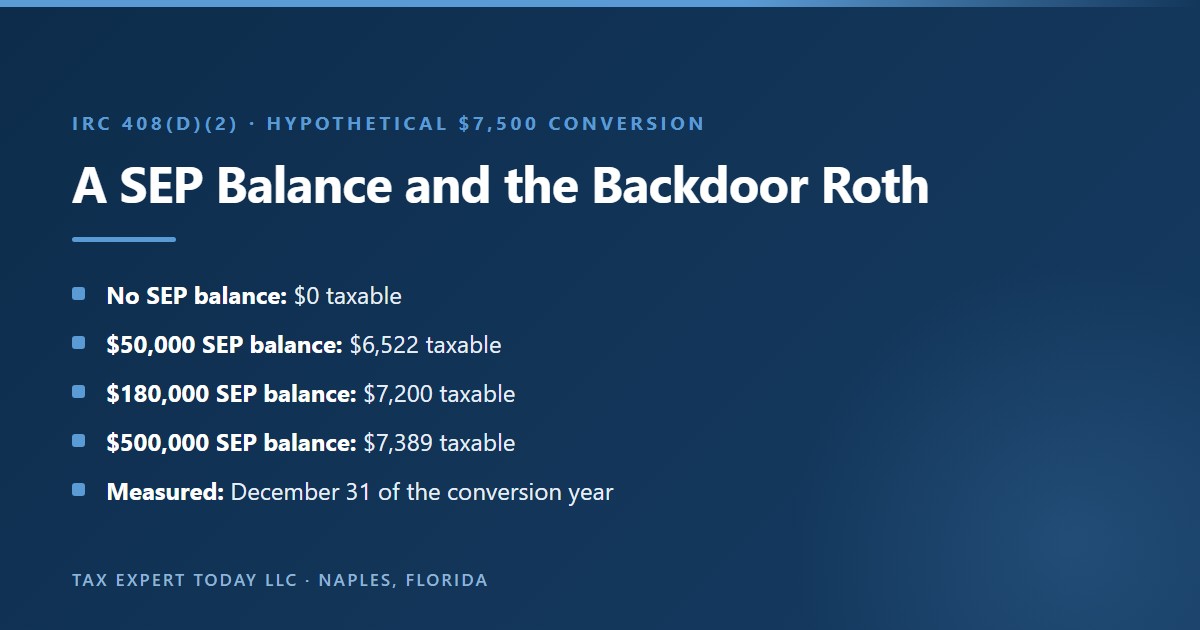
| SEP IRA balance on December 31 | Nontaxable percentage | Nontaxable amount | Taxable amount |
|---|---|---|---|
| $0 | 100 percent | $7,500 | $0 |
| $50,000 | 13.04 percent | $978 | $6,522 |
| $180,000 | 4.00 percent | $300 | $7,200 |
| $500,000 | 1.48 percent | $111 | $7,389 |
How can a SEP balance be moved to clear the pro rata rule?
If the plan accepts rollovers, a SEP IRA balance can generally be rolled into a solo 401(k) before the end of the year, removing it from the December 31 pro rata calculation. The rollover must be complete by December 31 and the plan document must allow it. Only pretax amounts can generally move this way.
- Plan must accept rollovers: not every provider document does.
- Timing: the balance must be out of the IRA by December 31.
- Pretax only: after-tax basis generally stays in the IRA.
- Trustee to trustee: a direct transfer reduces the risk of errors.
Section 408(d)(3) permits a rollover from an IRA to an eligible employer plan, and it treats an amount rolled to a plan as coming from income on the contract, so the pretax amount leaves first. That mechanism is the reason a rollover can isolate after-tax basis in the IRA. Publication 590-B describes the IRA distribution rules.
A December planning trap deserves attention. A SEP contribution for 2026 can be made as late as the extended due date in 2027. That money sits in the SEP on December 31, 2027 unless it is moved again, so a conversion in 2027 would be measured against it. Sequencing therefore matters as much as the plan itself.
| Date | Step | Why it matters |
|---|---|---|
| Before December | Confirm the solo 401(k) accepts IRA rollovers | The plan document controls |
| By early December | Request a direct rollover of the SEP balance | Transfers can take time |
| By December 31, 2026 | Confirm the SEP and other pretax IRAs show zero | The value at year end drives the calculation |
| After the rollover | Make the nondeductible contribution and convert | The conversion is then largely nontaxable |
| When filing | Complete Form 8606 | Basis must be reported |
Which plan offers Roth contributions?
Both can. A solo 401(k) can offer designated Roth deferrals, and SECURE 2.0 also permits Roth treatment for SEP contributions, if the custodian supports it. Many comparison pages still describe a SEP IRA as pretax only, which is outdated. Availability in practice depends on the plan document or custodian an owner actually selects.
- Solo 401(k) deferrals: can be designated Roth if the plan permits.
- SEP Roth: authorized by SECURE 2.0 section 601, optional for the employer.
- Tax effect: a Roth SEP contribution is included in the employee’s income.
- Employer Roth in a 401(k): SECURE 2.0 section 604 permits it if the plan offers it.
SECURE 2.0 section 601 struck the former rule in section 408A(f) that barred Roth SEP accounts, and the IRS SEP page now says an employer may choose to accept Roth contributions but is not required to. IRS Notice 2024-2 provides that a Roth employer contribution to a Roth IRA is reported on Form 1099-R. Practical availability still varies across custodians, so an owner should confirm that an account can actually accept such a contribution before relying on it.
Roth treatment means tax now and potential tax free growth later. It is not automatically better. Owners who expect a lower tax rate in retirement may prefer the pretax deduction, and owners in low income years may prefer Roth. The table below shows the tradeoff for a hypothetical $20,000 contribution.
| Assumption | Pretax result | Roth result |
|---|---|---|
| Current year tax effect at an assumed 32 percent rate | Reduces tax by $6,400 | No current deduction |
| Tax on the future balance | Ordinary income when withdrawn | Generally none if qualified |
| Effect on the pro rata rule, SEP | Increases the pretax balance | Roth SEP funds are not pretax money |
| Effect on QBI | Reduces QBI | No deduction, so no QBI reduction |
Can a solo 401(k) support a mega backdoor Roth?
A solo 401(k) can support after-tax contributions if the plan document allows them, and those amounts can sometimes be converted to Roth. A SEP IRA has no comparable after-tax feature. Many off the shelf solo 401(k) documents do not include this option, so an owner should read the document before assuming it is available.
- Plan feature: after-tax contributions must be written into the plan.
- Total limit: after-tax money counts toward the $72,000 limit.
- Conversion: in-service distribution or in-plan conversion provisions are needed.
- SEP IRA: no after-tax employee contribution feature.
Our guide to the mega backdoor Roth covers the mechanics in more depth. For a solo owner, the question is usually whether a provider’s document allows after-tax contributions and how the conversion works. The after-tax amount is limited by the space that remains under the $72,000 limit after deferrals and employer contributions. An owner at $150,000 of net profit in a solo 401(k) has $19,619 of remaining room if deferrals and the employer amount are maximized, but earnings must support the addition.
| Net profit | Deferral plus employer amount | Room under $72,000 | Note |
|---|---|---|---|
| $100,000 | $43,087 | $28,913 | Limited in practice by total net earnings |
| $150,000 | $52,381 | $19,619 | Limited in practice by total net earnings |
| $250,000 | $71,543 | $457 | Very little room |
| $300,000 | $72,000 | $0 | No room |
An after-tax contribution is limited by the participant’s compensation under section 415(c), so a low earner might have nominal room but no practical capacity. Whether the plan document permits the feature should be confirmed first.
How does each plan affect the qualified business income deduction?
For a sole proprietor, pretax contributions to either plan generally reduce qualified business income, which also reduces the section 199A deduction. Roth deferrals produce no deduction and no QBI reduction. For an S corporation owner, the employer contribution reduces QBI, while the employee deferral does not because the wages were already deducted.
- Self-employed: SEP and plan deductions reduce QBI.
- Roth deferrals: no deduction, so no reduction in QBI.
- S corporation employer amount: deducted by the entity, so QBI falls.
- S corporation deferrals: part of wages already deducted.
The IRS states in its section 199A FAQ that items such as the deductible portion of self-employment tax, self-employed health insurance, and self-employed SEP, SIMPLE, and qualified plan deductions reduce QBI. Treasury Regulation section 1.199A-3(b)(1)(vi) provides the same. This is rarely mentioned in comparison articles, even though the effect can be substantial.
The table below shows a hypothetical sole proprietor with $150,000 of net profit, assuming taxable income under the threshold and no other adjustments beyond half of self-employment tax. Self-employed health insurance is ignored for simplicity. Our guide to the qualified business income deduction explains the thresholds and limits, and our self-employed health insurance deduction guide covers that separate item.
| Scenario | Plan deduction | QBI | 20 percent QBI deduction |
|---|---|---|---|
| No plan | $0 | $139,403 | $27,881 |
| SEP IRA at maximum | $27,881 | $111,522 | $22,304 |
| Solo 401(k), traditional deferral plus employer | $52,381 | $87,022 | $17,404 |
| Solo 401(k), Roth deferral plus employer | $27,881 | $111,522 | $22,304 |
The result is hypothetical and depends on taxable income limits, other deductions, and the deduction limit based on taxable income under IRC section 199A.
How does the plan choice interact with self-employment tax?
Neither a SEP contribution nor a solo 401(k) employer contribution reduces self-employment tax, because the plan deduction is taken after net earnings are computed. Plan contributions reduce income tax. An S corporation owner’s employer contribution is not wages for FICA, while the owner’s own deferrals remain wages and are subject to FICA.
- Self-employed: self-employment tax is computed before the plan deduction.
- Elective deferrals: remain subject to FICA for W-2 employees.
- Employer contributions: generally not FICA wages.
- Income tax: the principal benefit of a pretax contribution.
This explains why S corporation owners should compare the payroll tax effect of wages rather than only the plan amount. A deferral of $24,500 does not lower Social Security and Medicare tax. A SEP contribution by the employer for a W-2 employee is not subject to federal income tax withholding, Social Security, Medicare, or FUTA, according to the IRS, so the employer can contribute that amount without incurring payroll tax on it.
| Contribution | Income tax | Social Security and Medicare |
|---|---|---|
| Self-employed SEP or employer amount | Deductible on Schedule 1 | Not reduced |
| S corporation employer amount | Deductible by the corporation | Not wages |
| S corporation traditional deferral | Excluded from Box 1 wages | Subject to FICA |
| S corporation Roth deferral | Included in Box 1 wages | Subject to FICA |
Owners can estimate the effect on quarterly payments with our quarterly estimated tax calculator. A retirement deduction taken at the end of the year does not by itself change estimates that were already due.
How are the contributions reported on the tax return?
A sole proprietor or partner deducts personal contributions on Schedule 1 of Form 1040, line 16. An S corporation deducts employer contributions on Form 1120-S, line 17, and reports deferrals through payroll on Form W-2, Box 12. Forms 8606 and 5500-EZ can also apply, depending on Roth activity and plan assets.
- Sole proprietor: Schedule 1, line 16, for the owner’s own contributions.
- Partnership: contributions for partners are shown on Schedule K-1.
- S corporation: Form 1120-S, line 17, and Form W-2, Box 12.
- Roth SEP: reported on Form 1099-R under IRS guidance.
The IRS explains in Publication 560 that sole proprietors and partners deduct contributions for themselves on line 16 of Schedule 1 (Form 1040). Line numbers can change from year to year, so the current form instructions should be used. Employer contributions made for employees of a sole proprietor are generally deducted on Schedule C instead.
Owners who file through payroll software should confirm that Box 12 entries are correct. Code D identifies traditional elective deferrals to a 401(k), and Code AA identifies designated Roth contributions.
| Item | Form | Line or box |
|---|---|---|
| Self-employed plan contribution | Schedule 1 (Form 1040) | Line 16 |
| Employer contribution for a sole proprietor’s employee | Schedule C | Pension and profit-sharing plans line |
| Employer contribution, S corporation | Form 1120-S | Line 17 |
| Traditional deferral | Form W-2 | Box 12, code D |
| Roth deferral | Form W-2 | Box 12, code AA |
| Nondeductible IRA basis | Form 8606 | Part I |
| Plan assets over $250,000 | Form 5500-EZ | Annual filing |
What are the deadlines to set up each plan?
A SEP IRA can be established as late as the extended due date of the return for the year. A solo 401(k) can generally be adopted by the employer’s return due date, including extensions, for employer contributions, but the employee deferral has stricter timing. The sole owner of an unincorporated business has a special first-year rule.
- SEP IRA: by the due date, including extensions.
- Solo 401(k), employer amount: by the due date, including extensions.
- Solo 401(k), deferral: generally requires an election by year end.
- Sole owner first year: deferrals allowed by the unextended filing date.
Publication 560 states that a SEP can be set up for any year as late as the due date, including extensions, of the income tax return for that year. Section 401(b)(2), amended by the SECURE Act and SECURE 2.0, permits an employer to treat a plan adopted by the extended return date as adopted on the last day of the year. Without that change, a December 31 adoption deadline would have applied.
| Plan and owner | Latest adoption date | Authority |
|---|---|---|
| SEP IRA, sole proprietor, with extension | October 15, 2027 | Publication 560 |
| SEP IRA, S corporation, with extension | September 15, 2027 | Publication 560 |
| Solo 401(k), sole proprietor, employer amount, with extension | October 15, 2027 | IRC 401(b)(2) |
| Solo 401(k), S corporation, employer amount, with extension | September 15, 2027 | IRC 401(b)(2) |
| Solo 401(k), deferrals by a sole owner in the first plan year | Generally April 15, 2027, without extensions | IRC 401(b)(2) |
Dates assume calendar year filers and timely filed extensions. Dates that fall on a weekend or holiday generally move to the next business day.
What is the first-year deferral rule for a sole owner?
Under section 401(b)(2), an individual who owns the entire interest in an unincorporated business and is its only employee can make first-year elective deferrals by the unextended due date of the personal return. The rule is narrow. It does not extend to an S corporation owner or to a later plan year.
- Applies to: a sole owner of an unincorporated business.
- Limited to: the first plan year of the plan.
- Deadline: unextended return due date, generally April 15.
- Excludes: S corporations and businesses with other employees.
Before SECURE 2.0, even a plan adopted after year end could not accept elective deferrals for the prior year in most cases, because a deferral election had to be in place before the compensation was available. Section 317 of SECURE 2.0 added the sentence now found in IRC section 401(b)(2), which treats a deferral made by the unextended return date as made before the end of the first plan year.
This rule changes the December question. A qualifying sole proprietor who has not adopted a plan by year end can still get a first-year deferral, while an S corporation owner generally cannot, because deferrals must come from wages actually paid. In later years, a sole owner’s deferral election must be in place by the last day of the taxable year under Treasury Regulation section 1.401(k)-1(a)(6)(iii).
| Owner | Eligible? | Reason |
|---|---|---|
| Sole proprietor, no employees | Yes | Owns the entire interest in an unincorporated business |
| Single member LLC, disregarded | Generally yes | Treated as unincorporated |
| Partnership with two partners | No | Not a sole owner |
| S corporation owner | No | Incorporated, and deferrals require wages |
| Sole proprietor with an employee | No | Not the only employee |
What are the contribution deadlines for the 2026 tax year?
SEP and employer contributions for 2026 are generally deductible if made by the due date of the return, including extensions. A sole proprietor’s deferral election for an established solo 401(k) generally must be made by December 31, 2026. S corporation deferrals must come out of wages paid during the year.
- SEP deposit: by the extended due date.
- Employer amount in a solo 401(k): by the extended due date.
- Sole proprietor deferral election: by December 31, for later plan years.
- S corporation deferrals: through payroll.
Section 404(h)(1)(B) allows a SEP contribution made by the extended due date of the return to be treated as made for the prior year, and section 404(a)(6) provides the same for qualified plans. A filing extension should be in place for the extended date to apply.
Owners sometimes confuse the deposit deadline with the election deadline. A contribution can often be deposited months after the end of the year, but the decision to make a deferral must generally have been made by the end of that year.
| Item | Date |
|---|---|
| Sole proprietor deferral election, established plan | December 31, 2026 |
| S corporation deferrals from wages | Paid through 2026 payroll |
| S corporation return, unextended | March 15, 2027 |
| Individual return, unextended | April 15, 2027 |
| S corporation return, extended | September 15, 2027 |
| Individual return, extended | October 15, 2027 |
| Form 5500-EZ for 2026, if required | August 2, 2027, because July 31 falls on a Saturday |
What can an owner still do before December 31?
Before December 31, an owner can often still adopt a solo 401(k), make deferral elections, run payroll for an S corporation deferral, and move a SEP balance into a plan that accepts rollovers. A SEP IRA can usually wait until the following year, which is why the year end decision usually starts with the 401(k).
- Adopt a plan: providers need processing time.
- S corporation payroll: deferrals need wages paid before year end.
- Sole proprietor: elect deferrals on time for established plans.
- SEP balance: move it before the backdoor Roth measurement date.
Decisions made in December can affect a tax return due many months later. An owner should begin with the items that truly expire on December 31, and then address the items that can wait. Any provider’s processing time should be confirmed, since some documents and rollovers cannot be completed quickly at the end of the year.
| Task | Who needs it | Timing |
|---|---|---|
| Estimate net earnings or wages | All owners | Early December |
| Adopt a solo 401(k) for S corporation deferrals | S corporation owners | Before the last payroll |
| Elect deferrals in writing | Self-employed owners | By December 31 |
| Run payroll for deferrals | S corporation owners | By the last payroll date |
| Roll SEP balance to a plan | Owners planning a backdoor Roth | By December 31 |
| Confirm extension and deposit plan | All owners | Before the return is due |
What annual filing does each plan require?
A SEP IRA generally requires no annual return from the employer. A solo 401(k) requires Form 5500-EZ once the total assets of all the employer’s one-participant plans exceed $250,000 at year end, and in the final plan year regardless of the balance. A late Form 5500-EZ can carry serious penalties.
- Threshold: more than $250,000 in total one-participant plan assets.
- Due date: the last day of the seventh month after the plan year ends.
- Final year: a return is required even at a low balance.
- Penalty: $250 per day, up to $150,000, absent reasonable cause.
The Form 5500-EZ instructions provide that a return is required if the total assets of the plan, alone or combined with other one-participant plans of the employer, exceed $250,000 at the end of the plan year. All one-participant plans of the employer must be counted. The IRS Form 5500-EZ page gives the current form. The penalty appears in IRC section 6652(e).
The IRS operates a penalty relief program for late Form 5500-EZ filers. The fee is $500 per delinquent return, up to $1,500 per submission for the same plan, and the IRS page explains that electronically filed delinquent returns are not eligible. An owner who has missed a filing should read the program terms carefully.
| Item | SEP IRA | Solo 401(k) |
|---|---|---|
| Annual federal return | Generally none | Form 5500-EZ over $250,000 in total assets |
| Due date | Not applicable | Last day of the seventh month after year end |
| Final return | Not applicable | Required in the final plan year |
| Plan document | Form 5305-SEP or prototype | Written plan document |
| Penalty for missing a return | Not applicable | $250 per day, up to $150,000 |
What administrative work does each plan require?
A SEP IRA is usually simpler because the employer signs an agreement and deposits money into an IRA the participant owns. A solo 401(k) needs a written plan document, tracking of deferrals and employer amounts, plan amendments when the law changes, and in some cases Form 5500-EZ. The tradeoff is more capacity for more work.
- SEP setup: a written agreement, often IRS Form 5305-SEP.
- Solo setup: a plan document, an adoption agreement, and a trust or custodial account.
- Solo ongoing: track contribution types and keep the plan document current.
- Both: compute contributions correctly and retain records.
The IRS SEP FAQ lists the basic steps: adopt a formal written agreement, give employees the required information, and set up an IRA for each eligible employee. The form itself, Form 5305-SEP, is retained by the employer. A solo 401(k) requires more upkeep, because a qualified plan must be operated according to its written terms. Provider fees vary and this guide does not compare or recommend any provider.
| Task | SEP IRA | Solo 401(k) |
|---|---|---|
| Signing an agreement | Yes | Yes, a plan document |
| Annual return | No | When assets exceed $250,000 |
| Plan amendments | Limited, usually custodian driven | Required when the law changes |
| Deferral elections | None | Must be documented |
| Tracking contribution types | Single type | Deferrals, employer amounts, Roth, catch-up |
| Employee notices | Required if employees are covered | Required if employees are covered |
Can you borrow from either plan?
A solo 401(k) can allow loans if the plan document includes that feature, generally up to the lesser of $50,000 or the greater of $10,000 or 50 percent of the vested balance. A SEP IRA cannot make loans, because borrowing from an IRA is a prohibited transaction that can end the account’s tax-favored status.
- Solo 401(k) loan: only if the plan permits it.
- Repayment: generally within five years, with level payments.
- SEP IRA: no loan feature.
- Pledging an IRA: treated as a distribution of the pledged amount.
IRC section 72(p) sets the loan limits, and the IRS retirement plan loan FAQ summarizes them. An IRA that lends money to its owner, or is otherwise involved in a section 4975 prohibited transaction, ceases to be an IRA under section 408(e)(2), and pledging an IRA as security is treated as a distribution of the pledged amount under section 408(e)(4). Those are serious consequences, and owners should not treat a SEP IRA as a source of credit.
A loan from a solo 401(k) should be weighed carefully even when it is allowed. A default can trigger a taxable distribution, and funds taken out of the plan lose their growth potential. Using plan money for the business can raise prohibited transaction questions as well.
| Feature | SEP IRA | Solo 401(k) |
|---|---|---|
| Loans permitted | No | If the plan permits |
| Dollar limit | Not applicable | Lesser of $50,000 or the greater of $10,000 or 50 percent of the vested balance |
| Repayment term | Not applicable | Generally 5 years |
| Default treatment | Not applicable | Deemed distribution |
| Consequence of a loan attempt | Account can lose IRA status | Plan terms and section 72(p) control |
How do early withdrawal rules differ?
A SEP IRA can be accessed at any time, but a distribution before age 59 and a half is generally subject to the 10 percent additional tax unless an exception applies. A solo 401(k) can restrict withdrawals. The age 55 separation exception applies to a qualified plan but not to an IRA, including a SEP IRA.
- SEP IRA access: withdrawals permitted at any time.
- Solo 401(k) access: limited by the plan and by distribution restrictions.
- Age 55 rule: available from a qualified plan but not from an IRA.
- Additional tax: generally 10 percent before age 59 and a half.
Section 408(k)(4) requires that employer contributions to a SEP may not be conditioned on keeping money in the account. Section 72(t)(2)(A)(v) provides the exception for separation from service after age 55, and section 72(t)(3)(A) says that exception does not apply to individual retirement plans. An owner who may retire before 59 and a half should consider this point.
| Situation | SEP IRA | Solo 401(k) |
|---|---|---|
| Withdrawal while working | Permitted, generally taxable | Restricted by plan rules |
| Age 55 separation exception | Not available | Available if requirements are met |
| Hardship withdrawal | Not a plan feature, any withdrawal is allowed | Only if the plan permits |
| Periodic payments exception | Available if requirements are met | Available after separation |
How do required minimum distributions compare?
Both plans generally require distributions starting at the applicable age, currently 73 for many owners. A 5 percent owner cannot delay 401(k) distributions by continuing to work, and neither can a SEP IRA owner. Designated Roth accounts in a 401(k) are not subject to lifetime minimum distributions, under the current law.
- SEP IRA: required at the applicable age regardless of working status.
- Solo 401(k) owner: the still working exception is unavailable to 5 percent owners.
- Designated Roth: exempt from lifetime distributions.
- Roth SEP: follows Roth IRA treatment.
Section 401(a)(9)(C) allows some employees to delay distributions until retirement but excludes 5 percent owners and IRAs. Section 402A(d)(5) excludes designated Roth accounts from the section 401(a)(9)(A) requirement during the owner’s life. Publication 560 notes that participants age 73 or over must take required minimum distributions. An owner who continues to run the business can usually continue to contribute to either plan while also taking distributions.
| Account | Lifetime RMD | Still working exception for an owner |
|---|---|---|
| Traditional SEP IRA | Yes | No |
| Roth SEP IRA | No | Not applicable |
| Traditional solo 401(k) | Yes | No, for a 5 percent owner |
| Designated Roth in a solo 401(k) | No | Not applicable |
Which plan gives better creditor protection?
Protection depends on federal bankruptcy law, state law, and whether the plan is covered by ERISA. A SEP IRA is outside the federal dollar cap for IRAs in bankruptcy. In Florida, section 222.21 generally exempts qualifying retirement accounts. An owner-only 401(k) may not have the ERISA protections that a plan with employees has.
- Bankruptcy: SEP IRAs are excluded from the IRA cap in section 522(n).
- Florida: section 222.21 generally protects qualifying accounts.
- Owner-only plans: Title I of ERISA generally does not apply.
- Exceptions: fraud and certain family support obligations can matter.
11 U.S.C. section 522(n) caps the exemption for certain individual retirement accounts but expressly excludes a simplified employee pension under section 408(k). Retirement funds in an exempt account are addressed in section 522(b)(3)(C) and (d)(12). Florida provides its own exemption in Florida Statutes section 222.21, which has its own exceptions.
Because state law varies widely, this is a question for an attorney in the owner’s state. A plan that later covers employees might receive different treatment than one that covers only the owner, which is another reason to evaluate the plan in light of hiring plans.
| Point | SEP IRA | Solo 401(k) |
|---|---|---|
| Federal bankruptcy treatment | Retirement funds exemption, outside the IRA dollar cap | Retirement funds exemption |
| Florida treatment | Generally exempt, with exceptions | Generally exempt, with exceptions |
| ERISA Title I | Depends on arrangement | Generally not applicable if owner only |
| Legal review recommended | Yes | Yes |
Can either plan hold alternative investments?
Either account can hold many investments that a custodian or plan permits, but both are subject to prohibited transaction rules. Collectibles are restricted in an IRA and in individually directed plan accounts. Dealing with the plan on a personal basis can cause serious tax consequences, so alternative investments should be reviewed before any money moves.
- Custodian limits: many custodians allow only listed securities.
- Prohibited transactions: dealing with a disqualified person is restricted.
- Collectibles: restricted under section 408(m).
- Unrelated business income: can arise in some investments.
Section 4975 defines prohibited transactions, and section 408(m) restricts collectibles in an IRA or in an individually directed account under a plan described in section 401(a). A prohibited transaction involving an IRA can end the account’s exempt status. Section 408(e)(1) also notes that the account remains subject to tax on unrelated business income.
| Issue | SEP IRA | Solo 401(k) |
|---|---|---|
| Investment menu | Set by the custodian | Set by the plan and provider |
| Self-dealing | Prohibited | Prohibited |
| Collectibles | Generally treated as distributions | Treated as distributions if individually directed |
| Unrelated business income | Possible | Possible |
How does a traditional IRA deduction change if I participate in a plan?
Participation in either a SEP IRA or a solo 401(k) makes an owner an active participant for the purposes of the traditional IRA deduction, so the deduction may phase out at certain income levels. This is another reason that high income owners often use nondeductible contributions and a Roth conversion, which brings the pro rata rule into play.
- Active participant: both plans count.
- Phaseout: a traditional IRA deduction may be limited.
- Nondeductible contributions: remain allowed subject to the limit.
- Separate issue: Roth IRA eligibility depends on modified AGI.
IRC section 219(g)(5) lists a section 401(a) plan and a SEP among the plans that make a person an active participant. An owner who funds either plan and also wishes to take a traditional IRA deduction should run the phaseout numbers.
| Plan | Active participant? | Likely follow on question |
|---|---|---|
| SEP IRA | Yes | Deduction phaseout and pro rata rule |
| Solo 401(k) | Yes | Deduction phaseout |
| No plan | No | Spouse’s coverage may still matter |
How do you move from a SEP IRA to a solo 401(k)?
An owner generally adopts the new plan, stops or coordinates further SEP contributions, and rolls the SEP balance into the plan if the plan accepts rollovers. The owner should confirm how the plan handles the current year, since SEP contributions and solo 401(k) amounts for the same employer share one annual additions limit.
- Check eligibility: no employees other than a spouse.
- Adopt the plan: within the deadlines described above.
- Coordinate the year: count SEP contributions against the limit.
- Roll over: if and when the plan accepts it.
A SEP arrangement that uses the IRS model form cannot be maintained together with another qualified plan, according to Publication 560. An owner who has been using Form 5305-SEP should consider ending that arrangement for the year in which a 401(k) is adopted, rather than attempting to maintain both. The old IRA balance can then be moved if the new plan accepts rollovers.
| Step | Action | Common problem |
|---|---|---|
| 1 | Confirm no employees or controlled group issue | Overlooked part-time worker or related business |
| 2 | Compute the current year’s limits | Using the wrong compensation figure |
| 3 | Adopt the plan and open the account | Starting too late in December |
| 4 | Make deferrals and employer deposits | Payroll not set up for an S corporation |
| 5 | Roll over the SEP balance | Plan does not accept rollovers |
| 6 | Calendar the Form 5500-EZ test | Forgetting to total all plan assets |
Can you close a solo 401(k) or return to a SEP IRA?
A solo 401(k) can be terminated, and assets are generally distributed or rolled to an IRA. A final Form 5500-EZ is generally required for the last plan year, even if assets are below the usual threshold. An owner who hires staff might move to a SEP IRA or a different plan, depending on the census and the funding goals.
- Termination: adopt a resolution and distribute assets.
- Final return: required even with a low balance.
- Moving back to a SEP: possible, with attention to overlapping years.
- New employees: may change which plan fits.
The Form 5500-EZ instructions require a return for the final plan year whatever the balance. Rolling the funds to an IRA can restart the pro rata exposure described above, which matters if the owner still uses a backdoor Roth. A plan terminated close to a contribution deadline should be reviewed carefully, because the deadline and the plan year may not align with the owner’s assumptions.
| Path | Result | What to watch |
|---|---|---|
| Terminate and roll to an IRA | Plan ends | Pro rata exposure returns |
| Terminate and roll to a new employer plan | Plan ends | New plan must accept the rollover |
| Amend into a full 401(k) | Plan continues for employees | Testing and notices |
| Adopt a SEP after termination | Simpler funding | Overlap with the plan’s final year |
Which owner profiles tend to fit each plan?
An owner with no employees whose income is below the SEP breakpoint often finds a solo 401(k) holds more. An owner with employees, or an owner who wants the simplest arrangement and has high income, often finds a SEP IRA easier. Age, Roth goals, and backdoor Roth plans can shift the answer in either direction.
- Lower income solo owner: the deferral usually matters most.
- High income solo owner: base limits can match, so age and Roth goals decide.
- Owner with staff: the uniform SEP cost should be compared with other designs.
- Backdoor Roth user: a SEP balance can create a recurring cost.
The SEP IRA vs solo 401k decision depends on more than one number. No single plan fits everyone, and the profiles below are general illustrations. They assume the owner is able to fund the plan and does not need the money for operations. Our business advisory services page describes how plan choices tie into broader decisions about entity structure and cash flow.
| Profile | Often fits | Key reason |
|---|---|---|
| Sole proprietor, $150,000 profit, no staff, age 40 | Solo 401(k) | $24,500 more capacity |
| S corporation owner, $120,000 salary, no staff | Solo 401(k) | $24,500 deferral over a small base |
| Solo owner with high income, no backdoor Roth, wants simplicity | SEP IRA may be reasonable | Same base limit at high income |
| Owner age 61, no staff | Solo 401(k) | $11,250 higher catch-up |
| Owner planning a yearly backdoor Roth | Solo 401(k) | No pro rata effect |
| Owner with several employees | Neither solo design, compare SEP and other plans | Staff must be covered |
| W-2 worker with a maxed 401(k) and a side business | SEP IRA may be reasonable | No deferral room left |
What mistakes commonly cause problems with these plans?
Common mistakes include using 25 percent directly on net profit, missing a Form 5500-EZ, adding an eligible employee without changing the plan, funding a SEP IRA while relying on a backdoor Roth, and exceeding the deferral limit across multiple employers. Most of these can be avoided with a short annual review of the numbers and the facts.
- Wrong base: using net profit without the 20 percent adjustment.
- Missed filing: assets crossing the $250,000 line without a return.
- Hidden employee: an eligible worker in a solo plan.
- Stacked deferrals: exceeding $24,500 across employers.
A SEP IRA vs solo 401k decision is only as good as the numbers behind it. Publication 560 explains the tax treatment of excess contributions, and some corrections can be time sensitive. An owner who discovers an error should seek professional guidance promptly, since correction programs have conditions and the facts can change the available relief.
| Error | General effect | Reference |
|---|---|---|
| 25 percent applied to net profit | Possible excess contribution | Publication 560 |
| Form 5500-EZ not filed | Penalty exposure | IRC 6652(e) |
| Employee excluded in error | Possible plan failure | IRS one-participant page |
| SEP plus backdoor Roth | Taxable conversion | IRC 408(d)(2) |
| Deferrals across employers over the limit | Tax on the excess | IRC 402(g) |
| Form 5305-SEP used with another plan | Form not available | IRS SEP FAQ |
What are the disadvantages of a solo 401(k)?
A solo 401(k) has more paperwork than a SEP IRA, it can require Form 5500-EZ, and it stops working as a solo design once an eligible employee appears. Deferral elections carry tighter deadlines, provider documents vary widely, and an S corporation owner needs payroll to make deferrals. None of these rules out the plan, but each deserves weight.
- Eligibility is fragile: one eligible employee changes the plan.
- Tighter deadlines: deferral elections generally cannot wait for the extended due date.
- Filing exposure: a missed Form 5500-EZ can carry heavy penalties.
- Document differences: Roth, loan, rollover, and after-tax features are not universal.
Owners often select a solo 401(k) for the larger limit and discover the operational side later. The plan is a qualified plan, so it must follow its written terms. A provider’s free or low cost document may leave out a feature the owner assumed was included, such as Roth deferrals or the ability to accept a SEP rollover. The right time to read the adoption agreement is before signing it.
An S corporation adds a layer. Deferrals must be withheld from wages actually paid, which means payroll has to be running and the amount has to be processed before the year ends. An owner who pays a single bonus in late December should confirm that the payroll provider can process it and that the deposit can be made into the plan.
| Drawback | Who feels it most | Typical response |
|---|---|---|
| Becomes unavailable with an eligible employee | Growing businesses | Plan the transition before hiring |
| Form 5500-EZ once assets exceed $250,000 | Long-term savers | Calendar the threshold test each year |
| Deferral deadlines | Owners who decide late | Elect by December 31 |
| Payroll needed for deferrals | S corporation owners | Set up payroll early in the year |
| Feature gaps in the document | Roth and backdoor Roth users | Read the plan before adopting |
What are the disadvantages of a SEP IRA?
A SEP IRA has no employee deferral, so it usually holds less at incomes below the breakpoint. It has no catch-up contributions and no loans, and a SEP balance counts in the pro rata calculation for a backdoor Roth. If the business has staff, the owner must contribute the same percentage for every eligible employee.
- Lower capacity: no $24,500 deferral at most incomes.
- No catch-up: older owners lose up to $11,250 of capacity.
- Pro rata exposure: the balance is counted in every Roth conversion.
- Uniform staff cost: the owner cannot skip eligible employees.
The simplicity of a SEP IRA is real, and it may be the deciding factor for an owner who dislikes administration. The cost of that simplicity depends on the facts. An owner under age 50 with $100,000 of net profit gives up as much as $24,500 of annual contribution room, and a person who plans a Roth conversion ladder should consider how a growing pretax SEP balance interacts with later conversions.
Immediate vesting can also be a real cost. An employer that contributes for an employee who leaves after a short period cannot recover that money, since section 408(k)(4) prevents restrictions on withdrawal.
| Drawback | Who feels it most | Typical response |
|---|---|---|
| No deferral | Owners below the breakpoint | Compare a solo 401(k) if eligible |
| No catch-up | Owners age 50 and older | Compare a solo 401(k) if eligible |
| Pro rata exposure | Backdoor Roth users | Roll to a plan before year end if available |
| Uniform employee contribution | Owners with staff | Model the staff cost at each rate |
| Immediate vesting | Businesses with turnover | Compare plans with vesting schedules |
How do these plans compare with a SIMPLE IRA?
A SIMPLE IRA generally has a lower employee limit than a solo 401(k), at $17,000 for 2026 in most cases, plus a required employer match or nonelective contribution. A SEP IRA has no employee deferral at all. A SIMPLE IRA can fit a business with employees that wants deferrals with less testing than a 401(k).
- Employee limit: $17,000 for 2026, or $18,100 for certain plans.
- Employer requirement: a match of up to 3 percent, or a 2 percent nonelective contribution, generally applies.
- Catch-up: $4,000 for 2026 in most cases.
- Mandatory cost: a SIMPLE IRA requires an employer contribution each year.
The IRS cost of living table and Notice 2025-67 give the 2026 SIMPLE figures, and Publication 560 describes the matching and nonelective alternatives. A SIMPLE IRA also has its own restriction on maintaining another plan, along with a special early withdrawal penalty during the first two years of participation. Because it requires a contribution every year, a business with uneven income may prefer the discretion of a SEP IRA.
An owner with larger funding goals might look beyond all three. A cash balance plan can permit much larger deductible contributions for some owners, at the cost of required funding and actuarial work.
| Feature | SEP IRA | Solo 401(k) | SIMPLE IRA |
|---|---|---|---|
| Employee deferral | None | $24,500 | $17,000 in most cases |
| Catch-up, age 50 or older | None | $8,000 | $4,000 in most cases |
| Employer contribution | Discretionary | Discretionary | Generally required |
| Works with employees | Yes | Not as a solo design | Yes |
| Annual filing | None | Form 5500-EZ over $250,000 | None |
Does the maximum matter if an owner will not contribute that much?
If an owner plans to contribute less than the SEP IRA maximum, the extra capacity of a solo 401(k) may not matter in that year. Plan choice then turns on administration, Roth access, loans, and the pro rata rule. An owner who expects income to rise may still prefer the plan that leaves more room later.
- Below the SEP ceiling: both plans can accept the planned amount.
- Administration: the SEP IRA is simpler at the same dollar amount.
- Pro rata effect: still applies to the SEP balance.
- Growth: future income may change the answer.
Search results tend to focus on the maximum, yet many owners contribute well below it. Consider a hypothetical owner with $150,000 of net profit who plans to fund $15,000. A SEP IRA can accept up to $27,881, so there is no capacity reason to choose a solo 401(k). If the same owner wants the backdoor Roth or expects to add a Roth deferral, the analysis changes for reasons unrelated to the limit.
| Planned contribution | Fits within SEP ceiling of $27,881? | Fits within solo ceiling of $52,381? | Main remaining question |
|---|---|---|---|
| $15,000 | Yes | Yes | Administration and pro rata effect |
| $27,881 | Yes, at the maximum | Yes | Administration and pro rata effect |
| $40,000 | No | Yes | Capacity favors the solo 401(k) |
| $52,381 | No | Yes, at the maximum | Cash flow and Roth choice |
How does the extra capacity compound over time?
A larger annual contribution can compound over many years, but the amount depends entirely on the assumed return and on whether the owner can actually fund it. As an illustration only, an extra $24,500 each year for 10 years would grow to about $323,000 at an assumed 6 percent return, before taxes and fees.
- Illustration only: returns are not predictable.
- Assumes funding: the owner must have the cash each year.
- Taxes differ: pretax and Roth balances are taxed differently.
- Fees reduce the result: any plan or investment fee lowers the growth.
The table below calculates the future value of a level contribution made at the end of each year for 10 years. The rates are assumptions chosen to show how the math works, and they are not predictions of what any investment will earn. Investment choices and risk tolerance are outside the scope of this guide.
| Assumed annual return | Total contributed | Illustrative value after 10 years |
|---|---|---|
| 4 percent | $245,000 | $294,150 |
| 6 percent | $245,000 | $322,929 |
| 8 percent | $245,000 | $354,921 |
Whether that contribution belongs in a retirement plan at all depends on the owner’s cash needs, other debts, and the business itself. An owner with excess business losses or uneven income might reasonably put cash flow ahead of maximum contributions.
What happens in a year with a loss or very low income?
Neither plan requires a contribution in a loss year. A self-employed owner with no net earnings generally has no compensation for plan purposes and cannot contribute. An S corporation owner with wages can still defer in a solo 401(k) and receive an employer amount, even if the business reported a loss.
- Self-employed loss: no compensation, so no contribution.
- S corporation loss: wages can still support contributions.
- Discretion: employer contributions can be zero.
- Multiple businesses: a loss from one can reduce the earned income base.
Compensation for a self-employed person is based on net earnings, so a loss year removes the base entirely. The answer can be different for an owner with more than one activity. Earned income from one business may be reduced by a loss from another, depending on how the activities are reported, so each should be reviewed.
Discretion over funding is one of the reasons owners value both of these plans. Unlike a SIMPLE IRA or a safe harbor 401(k) with staff, neither plan compels an employer deposit in a poor year for a solo owner.
| Situation | SEP IRA | Solo 401(k) |
|---|---|---|
| Sole proprietor with a net loss | No contribution | No contribution |
| Sole proprietor with $5,000 net profit | About 20 percent of net earnings | Up to net earnings |
| S corporation with wages of $30,000, loss at the entity level | Up to $7,500 | Up to $30,000, limited by wages |
| Second business offsets the first | Review the combined earned income | Review the combined earned income |
How does a business started mid-year affect the calculation?
A business started partway through the year uses its actual net earnings or wages for that year, and the annual dollar limits are generally not reduced simply because the business was open for less than 12 months. Plan year rules and the adoption date should still be confirmed with the provider or plan administrator.
- Compensation: actual earnings from the business for the year.
- Dollar limits: generally the full annual limit for a calendar year plan.
- Sole owner first year: the deferral rule may help a late start.
- S corporation: wages must actually have been paid.
A new sole proprietor who opens in July and earns $80,000 has the same plan math as any sole proprietor with $80,000 of net profit. An S corporation election that takes effect midyear is more complicated, because the base is limited to W-2 wages paid after the election. An owner converting from a sole proprietorship during the year may have two compensation streams to review. Our business advisory services page describes how entity changes are coordinated.
| Facts | Base used | Note |
|---|---|---|
| Sole proprietor opens in July with $80,000 net profit | Net earnings of the business | Full annual limits apply |
| S corporation election effective July 1 | W-2 wages after the election | Earlier income is treated separately |
| Sole owner adopts a plan in early 2027 for 2026 | 2026 net earnings | First-year deferral rule may apply |
What happens to these accounts in divorce or at death?
A SEP IRA can generally be divided in divorce by a transfer incident to a divorce or separation instrument. A solo 401(k) is divided under a qualified domestic relations order or the plan terms. At death, both are subject to required distribution rules for beneficiaries, and beneficiary designations should be reviewed after any major life change.
- SEP IRA in divorce: transfer under section 408(d)(6).
- Solo 401(k) in divorce: generally a qualified domestic relations order.
- Spouse rights: a plan may give a surviving spouse certain benefit rights.
- Beneficiaries: forms control and should be kept current.
IRC section 408(d)(6) provides that a transfer of an IRA interest under a divorce instrument is not treated as a taxable transfer. Section 414(p) defines a qualified domestic relations order for employer plans. Owners going through a divorce should also review our Roth IRA divorce guide and coordinate with counsel. Publication 590-B covers inherited IRA rules, and a plan’s document and beneficiary form control many of the details.
| Event | SEP IRA | Solo 401(k) |
|---|---|---|
| Divorce transfer | Incident to a divorce instrument | Qualified domestic relations order |
| Beneficiary form | Held with the custodian | Held with the plan |
| Surviving spouse | Options under IRA rules | Plan terms and federal rules |
| Non-spouse beneficiary | Generally distribution rules apply | Generally distribution rules apply |
Do state income taxes treat these contributions the same way?
Florida has no personal income tax, so an owner living in Florida generally has no state income tax effect from these contributions. Owners in other states should confirm conformity, because some states do not fully follow federal treatment for Roth items or self-employment adjustments. Our guide covers federal rules, and state rules can change the numbers.
- Florida: no personal income tax.
- Other states: conformity varies.
- Move during the year: state treatment can be split.
- Multistate owners: confirm where the income is taxed.
An owner who relocates to Florida during the year might still have a state tax effect from a contribution made while a resident elsewhere. Planning across states is one area where general guidance runs out quickly. Our Naples tax planning page describes how the firm approaches residency and tax planning together.
| Owner location | State income tax on a pretax contribution | Next step |
|---|---|---|
| Florida resident | None | No state adjustment expected |
| Resident of an income tax state | Depends on conformity | Check the state rules |
| Moved during 2026 | May be split | Review the part-year return |
Which plan works after an unexpectedly large income year?
When a large year is discovered after December 31, a SEP IRA is often still available until the extended due date. A qualifying sole owner may also adopt a new solo 401(k) and defer until the unextended filing date. An S corporation owner is limited to the wages that were actually paid during that year.
- SEP IRA: can be opened and funded by the extended due date.
- Sole owner, new solo 401(k): first-year deferral by the unextended date.
- Sole owner, existing solo 401(k): deferral election was due by year end.
- S corporation: wages for the closed year cannot be increased after the fact.
Timing explains why a SEP IRA keeps its popularity with owners who learn their results late. An S corporation owner who finishes a strong year with a salary of $90,000 can generally make a SEP contribution of only $22,500 for that year, however large the profit. A solo 401(k) adopted after year end would not rescue the deferral, because the deferral would have had to come from wages already paid.
A sole proprietor is in a better position. Under section 401(b)(2), a sole owner who adopts a new plan in early 2027 can make a deferral for 2026 by the unextended due date, and the employer portion can be funded through the extended date. An owner should watch estimated payments in a year like this, and our quarterly estimated tax calculator can help with a rough figure. The qualified business income deduction can also shift when a late contribution changes taxable income.
| Owner | SEP IRA | New solo 401(k) deferral for 2026 | New solo 401(k) employer amount for 2026 |
|---|---|---|---|
| Sole proprietor, no employees | Available until the extended due date | Available until April 15, 2027 | Available until the extended due date |
| S corporation owner | Available, based on 2026 wages | Generally not available | Available, based on 2026 wages |
| Partnership with two partners | Available, by partnership action | Generally not available | Available, by partnership action |
| Sole proprietor with an eligible employee | Available, employee must be covered | Solo design unavailable | Solo design unavailable |
A strong year can also produce a question about the plan’s future. An owner who expects several high income years might use the late SEP contribution for the current year and adopt a solo 401(k) for the next one, while watching the combined limit and the pro rata calculation during the transition.
Is there a tax credit for starting either plan?
The small employer startup credit under section 45E generally requires at least one eligible employee who is not highly compensated, so an owner-only solo 401(k) or SEP IRA usually cannot claim it. An employer with real staff may qualify. The credit should be checked before an owner includes it in any comparison of plan costs.
- Requirement: at least one eligible non-highly compensated employee.
- Owner-only plans: generally do not meet that requirement.
- Businesses with staff: may qualify for part of the startup cost.
- Comparison value: a business with employees has a different calculation.
IRC section 45E provides a credit for qualified startup costs, and it excludes costs for a plan that does not have at least one eligible employee who is not highly compensated. Some marketing material treats the credit as if it applied to every new plan, which is not what the statute says. IRS Notice 2024-2 also addresses a related employer contributions credit for small employers.
This point often reverses the analysis for a business about to hire. An employer that adopts a plan covering staff might claim a credit, while the same owner operating a solo design could not. Our guide to the safe harbor 401(k) addresses a design that some employers consider when staff are covered, and our business advisory services page describes how those decisions tie into hiring plans. Credit amounts depend on the employer’s facts, and this guide does not estimate them.
| Plan situation | Eligible non-highly compensated employee? | Section 45E credit likely? |
|---|---|---|
| Solo 401(k), owner only | No | Generally no |
| Solo 401(k), owner and spouse | No | Generally no |
| SEP IRA, owner only | No | Generally no |
| SEP IRA with an eligible staff member | Yes | May be available |
| New 401(k) covering staff | Yes | May be available |
SEP IRA vs Solo 401(k) Help in Naples & Southwest Florida
Tax Expert Today LLC works with self-employed owners and S corporation shareholders in Naples, Florida and across Southwest Florida on choosing and coordinating retirement plans. That work can include modeling each plan against actual income, reviewing compensation, and coordinating contributions with a return. Results depend on each owner’s facts and on the plan.
- SEP IRA vs solo 401k help Naples: tax modeling for owners of closely held businesses in Collier and Lee counties.
- Coordination: working with a plan provider or administrator where one is engaged.
- Scope: tax planning and return treatment, with plan documents provided by the plan provider.
- Service area: an office in Naples, with clients served in all 50 states.
Our office is at 11983 Tamiami Trail N, Naples FL 34110. Call (239) 441-2005, Monday through Friday, 10 a.m. to 5 p.m. ET. Our Naples tax planning page and our tax planning services page describe how the firm works with owners, and our business advisory services page covers entity level questions that often arise at the same time.
Where can I get help choosing between a SEP IRA and a solo 401(k) in Naples, FL? Tax Expert Today LLC is based at 11983 Tamiami Trail N in Naples and works with owners on the tax modeling, contribution timing, and return treatment of these plans. The firm does not recommend any particular provider or promise any particular tax result, and results depend on the facts of each business.
When to Engage a Professional
Consider professional help before a plan is adopted when the business has any employee, when an owner has more than one company, when a backdoor Roth is part of the plan, or when the year end deadline is close. A mistake in setup or funding can create penalties or lost tax benefits that are expensive to fix.
- Before adoption: confirm the plan fits the facts.
- Before funding: compute the contribution with the correct base.
- When hiring: review the plan before the first eligibility date.
- Each year: test the Form 5500-EZ threshold and the limits.
Tax Expert Today LLC is a Naples, Florida firm of tax advisors, enrolled agents, CPAs, and attorneys serving clients in all 50 states. To discuss a SEP IRA, a solo 401(k), or how a plan fits a broader plan for your business, contact our Naples, Florida tax planning team, review our tax planning services, or call (239) 441-2005. Readers may also find our guides to the backdoor Roth IRA, mega backdoor Roth, Roth conversion ladder, cash balance plan for business owners, excess business loss limitation, S corporation reasonable compensation, and qualified business income deduction useful, along with the full learning center.
This article is general information about federal retirement plan rules and is not tax, legal, or investment advice for any specific business or person. It does not recommend any plan provider, custodian, or investment. Statutory and regulatory references were checked against the text of IRC sections 72, 199A, 219, 401, 402, 402A, 404, 408, 408A, 410, 414, 415, 1402, 4975, and 6652, 11 U.S.C. section 522, Florida Statutes section 222.21, Treasury Regulation sections 1.199A-3, 1.401(k)-1, and 1.414(v)-2, 29 CFR 2510.3-3, IRS Notices 2024-2 and 2025-67, IRS Publication 560, the Form 5500-EZ and Form 8606 instructions, and published IRS guidance on November 10, 2026. All dollar examples, including ages, income, wages, and tax amounts, are hypothetical illustrations prepared for this guide and are not client outcomes or predictions for any taxpayer. Tax laws apply differently to each person’s facts. Consult a qualified professional about your situation before taking any action.
Published November 10, 2026 by Dr. Pellumb Kabashi « Back to Learning Center
Have a question this article touches on?
Tax Expert Today LLC, based in Naples, Florida and serving clients across the United States.
Schedule a Consultation (239) 441-2005