
By Dr. Pellumb Kabashi, DBA, MBA, EA, CFE, CES
Founder, Tax Expert Today LLC · Tax advisors, enrolled agents, CPAs, and attorneys · Serving clients in all 50 states
Quick Answer
A collection due process hearing is the appeal you request on Form 12153 within 30 days of a qualifying IRS lien or levy notice. Filed on time, it stops levy action, suspends the ten-year collection clock, and preserves your right to petition the Tax Court. The Collection Appeals Program is faster and broader but offers no court review. Call (239) 441-2005 for a free consultation.
What Is a Collection Due Process Hearing?
A collection due process hearing is an independent review by the IRS Independent Office of Appeals of a proposed or completed lien filing or levy. It is created by IRC §6330 for levies and IRC §6320 for liens. The hearing is conducted by a settlement officer who has had no prior involvement with the account, a point the Taxpayer Advocate Service also emphasizes in its own description of the process.
What separates this hearing from every other conversation a taxpayer has with the IRS is that it carries statutory consequences the moment a timely request is postmarked. Levy action on the tax and periods at issue is generally barred while the matter is pending. The ten-year period the government has to collect is suspended. And the determination that ends the hearing is reviewable by a court. No other collection appeal carries all three.
The hearing itself is not a trial. It is usually held by telephone or correspondence, and a face-to-face conference at the Appeals office nearest the taxpayer is available where the request raises no frivolous issues. Publication 1660 confirms that a taxpayer may appear personally or be represented by an attorney, a certified public accountant, or a person enrolled to practice before the IRS.
Which IRS Notices Create CDP Rights?
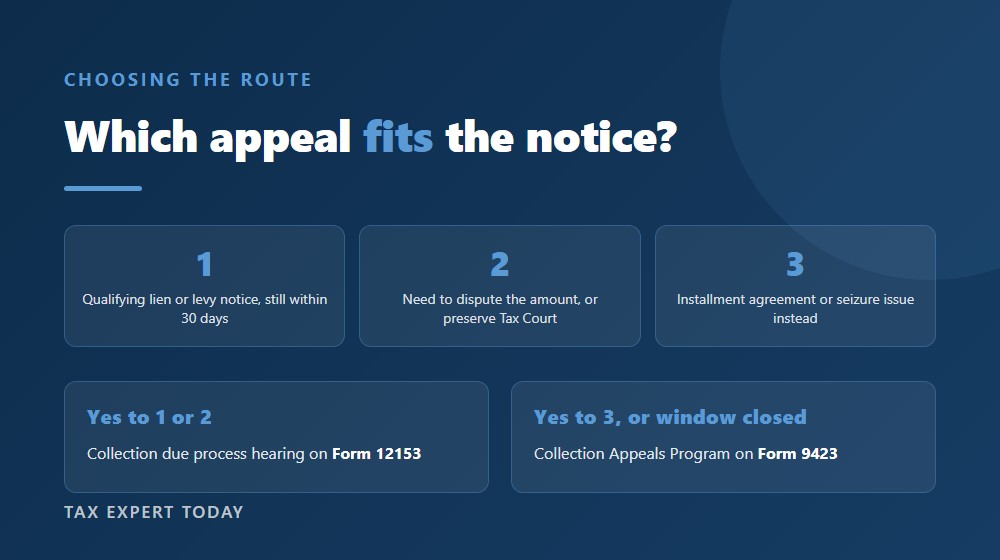
Only specific notices open the collection due process window, and receiving a bill is not enough. Publication 1660 lists five: the Notice of Federal Tax Lien filing notice under §6320, the Final Notice of Intent to Levy and Notice of Your Right to a Hearing, the Notice of Jeopardy Levy and Right of Appeal, the Notice of Levy on Your State Tax Refund, and the Post Levy CDP Notice.
The practical trap sits one step earlier in the notice sequence. The CP504 notice is titled as a notice of intent to levy and reads like a final warning, but it does not carry collection due process rights. The IRS states in its CDP FAQs that it cannot levy on that notice alone and must first issue a formal final notice of intent to levy and right to a hearing. Taxpayers who treat the CP504 as their appeal trigger sometimes conclude that they have already used a right they never received.
The notices that do carry the right are Letter 1058 and the LT11, along with Letter 3172 for a filed lien. Each one states the deadline on its face. That printed date, not a general rule of thumb, is the date to work from.
What Is the Collection Appeals Program?
The Collection Appeals Program, known as CAP, is a separate and faster administrative appeal available for a wider range of collection actions than the collection due process hearing reaches. Publication 1660 states that CAP generally produces a quicker Appeals decision and covers more actions, but that a taxpayer cannot go to court after an adverse CAP decision.
CAP is available before or after the IRS files a Notice of Federal Tax Lien, before or after the IRS levies or seizes property, and on the rejection, modification, or termination of an installment agreement, including proposed modifications and proposed terminations. It also reaches denied requests to withdraw a lien and denied discharges, subordinations, and non-attachments.
Two further categories matter in practice. Third parties may bring a CAP appeal against a lien filed on alter ego or nominee property, and Publication 1660 notes that no collection due process rights exist for persons determined to be nominees or alter egos, although transferees assessed under IRC §6901 do receive CDP rights. Separately, a person whose property was wrongfully levied may appeal the denial of a request to release the levy or return the property, subject to the claim periods in IRC §6343: two years from the date of a levy made on or after March 23, 2017, and nine months for a levy made on or before March 22, 2017.
The critical limitation is scope. Publication 1660 is explicit that, unlike a collection due process hearing, a taxpayer may not challenge the existence or amount of the tax liability in CAP. CAP tests whether a collection action was appropriate, not whether the underlying tax is correct.
CDP vs CAP: Which Appeal Should You Use?
The choice turns on three questions: whether you still hold an unexpired CDP notice, whether you need to preserve court review, and whether the action you want to challenge is even within CDP’s reach. An installment agreement rejection, for example, is a CAP matter, because no lien or levy notice is involved.
| Feature | Collection due process (CDP) | Collection Appeals Program (CAP) |
|---|---|---|
| Form used | Form 12153 | Form 9423 |
| Authority | IRC §6320 and §6330 | Administrative, described in Publication 1660 |
| What it reaches | Qualifying lien and levy notices only | Liens, levies, seizures, and installment agreement rejection, modification, or termination |
| Challenge the amount owed | Yes, but only in the limited circumstances in §6330(c)(2)(B) | No |
| Levy barred while pending | Generally yes, for the tax and periods at issue | No statutory bar |
| Ten-year collection clock | Suspended | Not suspended |
| Judicial review | Yes, Tax Court petition under §6330(d)(1) | None |
| Relative speed | Slower | Generally quicker |
| Collection alternatives considered | Yes, including installment agreement and offer in compromise | Yes, within the action being appealed |
Read the table as a sequence rather than a menu. Where a timely CDP right exists and the balance is genuinely disputed, or where the taxpayer may eventually need a court, the collection due process hearing is the stronger instrument even though it takes longer. Where the CDP window has closed, or the dispute is about an installment agreement rather than a lien or levy notice, CAP is frequently the only route that remains open.
What Deadlines Apply to Each Appeal?
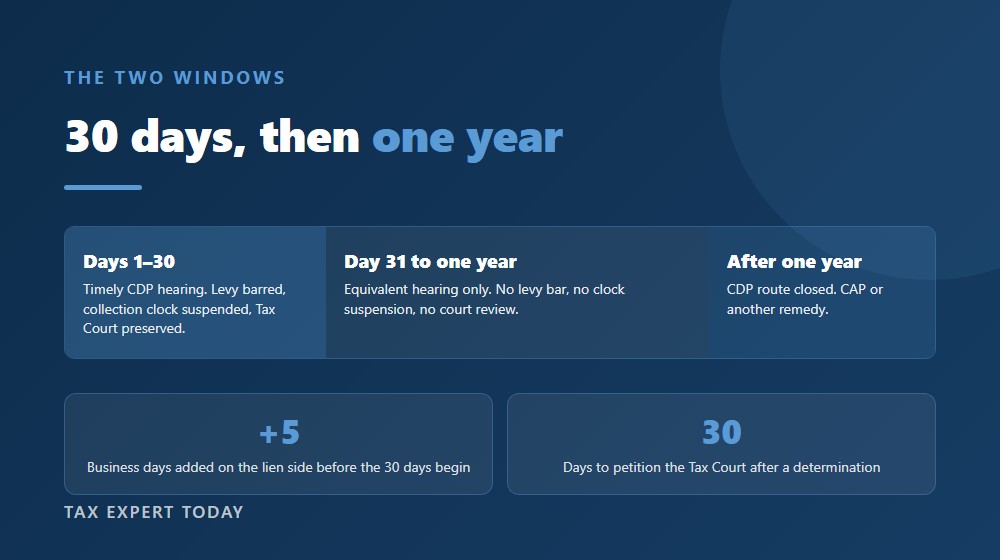
Every deadline below is short, and most are counted from the date printed on the notice rather than the date it arrived. Publication 1660 warns that calling the telephone number on a notice to discuss a disagreement does not extend the 30-day period for making a written CDP request.
| Action | Deadline | Source |
|---|---|---|
| CDP request after a levy notice | Postmarked on or before the 30th day after the date of the levy notice | §6330(a)(3)(B); Pub 1660 |
| CDP request after a lien filing notice | The 30-day period beginning the day after the 5-business-day period following the lien filing, per the date shown on the notice | §6320(a)(2) and (a)(3)(B) |
| Equivalent hearing, levy notice | One year from the date of the CDP levy notice | Form 12153 instructions |
| Equivalent hearing, lien notice | One year plus five business days from the lien filing date | Form 12153 instructions |
| Tax Court petition after a CDP determination | Within 30 days of the determination | §6330(d)(1) |
| CAP after a seizure | Appeal to the Collection manager within 10 business days after the Notice of Seizure is given or left | Pub 1660 |
| CAP, installment agreement rejection | On or before the 30th day after the date of the rejection letter | Pub 1660 |
| CAP, installment agreement termination | 30 days from the notice of intent to terminate, plus an additional 30 days after termination | Pub 1660 |
One detail on the lien side is worth stating precisely, because it is where general guidance tends to go wrong. The IRS must send the lien notice not more than five business days after the lien is filed, and the 30-day request period begins the day after that five-day period closes. The result is a window keyed to the filing date rather than to the day the envelope was opened, which is exactly why the date printed on Letter 3172 controls.
How Does a CAP Appeal Work After a Revenue Officer Contact?
CAP has two procedural tracks, and the one that applies depends on who has been working the case. Where the only contact has been a notice or a telephone call, the process is informal and oral. Where a revenue officer is assigned, the process is written, and it runs on business-day clocks that are far shorter than most taxpayers expect.
If the contact has been a notice or a call, Publication 1660 directs the taxpayer to call the number shown, explain which action is disputed and why, and offer a solution. If no agreement is reached, the taxpayer tells the employee that an appeal is wanted. The employee must honor the request and refer the matter to a manager, who will either speak with the taxpayer then or return the call within 24 hours. If the manager’s decision is unacceptable, the case goes to Appeals, and no written request is required.
Where a revenue officer is assigned, the taxpayer must first request a conference with the Collection manager, and the following clocks then apply.
| Step | Clock |
|---|---|
| Tell the revenue officer or manager that you intend to appeal under CAP | Within 2 business days after the conference with the Collection manager, or collection action resumes |
| Postmark Form 9423 to prevent resumption of collection | Within 3 business days after the date of the conference |
| No manager contact after you request a conference | Contact Collection again, or send Form 9423 received or postmarked within 4 business days of the conference request, noting the request date in Block 15 |
| Appeal following a seizure | Appeal to the Collection manager within 10 business days after the Notice of Seizure |
These clocks are the single most overlooked feature of the program. A CAP appeal filed late is not necessarily refused, but the protection that makes it worth filing quickly, the pause in collection activity, is what the two-day and three-day rules preserve. Publication 1660 also requires the taxpayer to offer a solution rather than simply object, on Form 9423 and in the oral track alike.
What Is an Equivalent Hearing?
An equivalent hearing is the fallback when a collection due process request is filed after the 30-day window has closed. It is requested on the same Form 12153 by checking the equivalent hearing box in item 2, and the Appeals conference itself looks much the same. What differs is everything that gives a CDP hearing its force.
The Form 12153 instructions state the position plainly. An equivalent hearing does not prohibit levy, does not suspend the ten-year collection period, and does not permit the taxpayer to go to court to contest the Appeals decision. Publication 1660 repeats the same three points. A taxpayer who misses the CDP deadline by a week therefore keeps the conversation and loses the leverage.
This is also where a widespread error appears on otherwise reputable pages. An equivalent hearing is not the Collection Appeals Program. They are separate procedures using different forms, reaching different actions, and arising from different sources of authority. Requesting one is not requesting the other, and a taxpayer who conflates them can lose an appeal right that remained available.
Can You Challenge the Amount You Owe?
Sometimes, and the conditions are narrow. Under IRC §6330(c)(2)(B) a taxpayer may raise the existence or amount of the underlying liability at a CDP hearing only if that person did not receive a statutory notice of deficiency for the liability and did not otherwise have an opportunity to dispute it. If a notice of deficiency was issued and delivered, that door is closed in the hearing.
Two further restrictions apply. Publication 1660 states that an issue already raised and considered at a prior administrative or judicial hearing may not be raised again where the taxpayer or the representative participated meaningfully in the earlier proceeding, and that the existence or amount of an assessment based on court-ordered restitution may not be challenged. A taxpayer is also entitled to only one hearing for a lien notice and one for a levy notice for each taxable period.
Where the liability itself is the real dispute and the CDP door is closed, the IRS points to other routes: paying the tax and filing a refund claim, requesting audit reconsideration, or submitting an offer in compromise based on doubt as to liability. What a CDP hearing does welcome is the full range of collection alternatives, including an installment agreement, an offer in compromise, lien subordination, discharge, or withdrawal of the lien notice, spousal defenses, and economic hardship.
Can You Take the Case to Tax Court?
Only from a collection due process determination. IRC §6330(d)(1) permits a person to petition the Tax Court within 30 days of a determination under that section. There is no judicial review of a CAP decision, and none of an equivalent hearing decision, which is the structural difference that should drive the choice of procedure whenever both are available.
Preserving that review requires care during the hearing rather than after it. Publication 1660 cautions that a taxpayer may be unable to raise issues in the Tax Court that were not raised during the Appeals hearing, and that the court may limit the evidence to what was submitted to Appeals. Every argument and every document should therefore go into the administrative record while the hearing is open.
Appeals also retains jurisdiction over its own determination. Where the Collection function does not carry out a determination as written, or where circumstances change in a way that affects it, the taxpayer may return to Appeals, although Publication 1660 requires an attempt to resolve the problem with Collection first.
How Does a CDP Request Affect the Ten-Year Collection Clock?
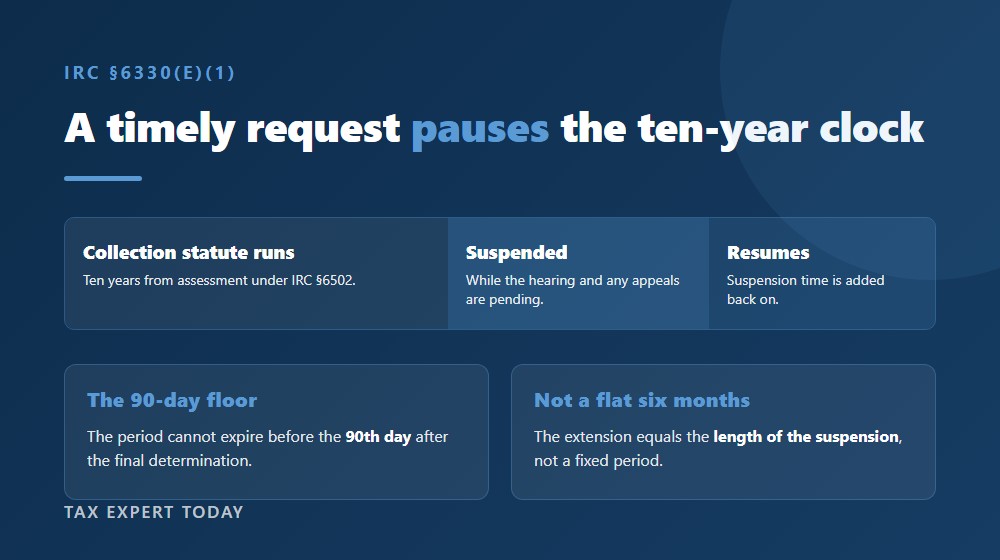
A timely collection due process request suspends the collection statute. IRC §6330(e)(1) suspends the levy actions at issue and the running of the limitations period under IRC §6502 for the period during which the hearing and any appeals are pending, and provides that in no event shall the period expire before the 90th day after the day of the final determination.
The mechanics are additive rather than fixed. The Form 12153 instructions explain that the amount of time the suspension is in effect is added to the time remaining in the ten-year period, and use a six-month suspension producing a six-month extension purely as an illustration. It is not a flat six-month rule, and treating it as one will misstate a client’s collection statute expiration date.
That trade-off deserves to be made deliberately. A CDP request buys a levy bar and a court option at the price of a longer collection window, and where a balance is close to expiring, the arithmetic can favor a different approach entirely. An equivalent hearing and a CAP appeal both leave the ten-year clock running, which is occasionally the reason to prefer one.
Collection Appeal Help in Naples & Southwest Florida
Tax resolution Naples: Tax Expert Today LLC represents taxpayers in Naples, Florida and across all fifty states in collection appeals, including wage garnishments and bank levies already in progress. These matters are won or lost on the calendar as much as on the merits, because a 30-day window and a three-business-day window behave very differently under pressure. Our IRS resolution and audit support practice handles lien, levy, and appeals work, and our Naples tax resolution page describes how local engagements are structured.
The firm is located at 11983 Tamiami Trail N, Naples, FL 34110. Call (239) 441-2005, Monday through Friday, 10am to 5pm ET.
Does a Florida taxpayer appeal to a local IRS office?
Not necessarily. The request goes to the address printed on the lien or levy notice, which is frequently a campus outside Florida, and the Appeals conference is usually held by telephone or correspondence. Where a taxpayer qualifies for a face-to-face conference, it is held at the Appeals office nearest the home, school, or place of business. Representation is federal, so a Naples engagement can handle a case controlled by any campus.
When to Engage a Professional
The first decision in a collection appeal is procedural, and it is the one most often made incorrectly without help. Choosing between a collection due process hearing, an equivalent hearing, and a CAP appeal determines whether levy action pauses, whether the ten-year clock keeps running, and whether a court will ever see the case. Those consequences follow from the form filed and the date it is postmarked, not from the strength of the underlying position.
The second decision is what to put in the record. Because the Tax Court may be limited to the issues raised and the evidence submitted to Appeals, a hearing handled casually can foreclose arguments that were available. Where a collection alternative is the realistic destination, the financial substantiation generally has to be assembled before the conference rather than promised during it.
Tax Expert Today LLC is a multidisciplinary firm of tax advisors, enrolled agents, CPAs, and attorneys, founded by Dr. Pellumb Kabashi. Outcomes in collection appeals depend on the notice received, the deadlines still open, the taxpayer’s financial circumstances, and the law applicable to the periods at issue. To discuss a lien or levy notice, contact our office or call (239) 441-2005.
Published August 6, 2026 by Dr. Pellumb Kabashi « Back to Learning Center
Have a question this article touches on?
Tax Expert Today LLC, based in Naples, Florida and serving clients across the United States.
Schedule a Consultation (239) 441-2005