
By Dr. Pellumb Kabashi, DBA, MBA, CES, CFE, EA
Founder, Tax Expert Today LLC · Tax advisors, enrolled agents, CPAs, and attorneys · Serving clients in all 50 states
Quick Answer
A Roth conversion ladder moves pre-tax IRA money into a Roth IRA in yearly slices. Each slice is taxed as ordinary income in the year converted and, under IRC section 408A(d)(3)(F), can be withdrawn without the 10 percent penalty once its own five-year period ends. In 2026, conversion size also sets premium tax credit eligibility. Call (239) 441-2005 for a free consultation.
What is a Roth conversion ladder?
A Roth conversion ladder is a multi-year plan for early retirees in which part of a traditional IRA is converted to a Roth IRA every year. Each conversion is taxed when made, then becomes available without the 10 percent early distribution penalty after its own five-year period, creating a staggered stream of accessible money before age 59½.
- Source account: a traditional IRA, often funded by rolling over a 401(k) or 403(b) after leaving work.
- Destination account: a Roth IRA held by the same person.
- Tax event: the taxable part of each conversion is ordinary income in the conversion year.
- Payoff: each converted amount can be withdrawn without the penalty once its five-year period ends, at any age.
The phrase “Roth conversion ladder” is not found in the Internal Revenue Code. It is a planning label, popularized in early retirement communities, for a sequence built from two statutory rules. The first is that a conversion is taxed but not penalized when it happens, because IRC section 408A(d)(3)(A) includes the converted amount in gross income and states that section 72(t) “shall not apply” to the conversion itself. The second is that a later withdrawal of that converted amount is penalized only if it happens within the five-taxable-year period that begins with the year of the conversion, under section 408A(d)(3)(F).
Put those two rules together and a person who stops working at 50 can convert a slice every year from 50 onward, then from 55 onward withdraw the slice converted five years earlier, with no 10 percent additional tax and no further income tax on the converted principal. Each slice is a rung. Most published explanations stop at that picture. This guide treats each rung as a tax-year decision with three moving parts that the early retirement blogs ranking for the phrase rarely discuss: how much to convert under the 2026 brackets, how the conversion sets eligibility for the premium tax credit now that the 400 percent poverty line limit has returned for 2026, and how Form 8606 proves that each withdrawal was penalty-free.
| Element | What the law provides | Where it comes from |
|---|---|---|
| Conversion | Taxable part is ordinary income in the year converted; no 10 percent tax on the conversion itself | IRC 408A(d)(3)(A) and (C) |
| Five-year period | Begins January 1 of the conversion year and runs five taxable years, separately for each conversion | IRC 408A(d)(3)(F); Reg. 1.408A-6, Q&A-5 |
| Withdrawal order | Regular contributions first, then conversions oldest first, then earnings | IRC 408A(d)(4)(B); Reg. 1.408A-6, Q&A-8 |
| Penalty if early | 10 percent additional tax on the taxable part of a conversion withdrawn within its five-year period | IRC 72(t)(1) as applied by 408A(d)(3)(F) |
| Reporting | Form 8606 Part II in the conversion year, Part III in a withdrawal year | IRS Instructions for Form 8606 |
| Undo option | None; recharacterization of conversions was repealed for 2018 and later | IRC 408A(d)(6)(B)(iii) |
How does a Roth conversion ladder work, step by step?
A Roth conversion ladder usually runs in four stages: move workplace plan money into a traditional IRA, convert a planned amount to a Roth IRA each year, live on other funds for the first five years, then withdraw each converted amount once its five-year period has ended, repeating until age 59½ or until the money is no longer needed.
- Stage one: roll the 401(k) or 403(b) into a traditional IRA, ideally by direct trustee-to-trustee transfer.
- Stage two: convert a measured amount each calendar year, sized against brackets and health coverage costs.
- Stage three: fund living costs for roughly five years from taxable savings, cash, or Roth contributions.
- Stage four: from year six onward, withdraw the conversion made five years earlier while continuing to convert.
The order matters because a conversion has to happen by December 31 to count for that year, and the five-year period is measured in tax years, not in 60 month blocks. A conversion completed on December 30, 2026 starts its period on January 1, 2026, the same as one completed on January 2, 2026. Under Regulation 1.408A-6, Q&A-5(b), the period “ends on the last day of the individual’s fifth consecutive taxable year.” For a calendar year taxpayer, a 2026 conversion is therefore free of the 10 percent tax for withdrawals made on or after January 1, 2031. That timing makes late year conversions efficient, because they carry the same clock as January conversions while letting the person see most of the year’s income before choosing the amount.
The Roth conversion ladder is also not a one-time setup. Each year’s conversion is a fresh decision. A year with an unexpected consulting check, a large capital gain, or a change in health coverage may call for a smaller conversion, and a year with unusually low income may justify a larger one. Treating the Roth conversion ladder as a fixed annual number ignores the two variables that move the most money: the bracket the conversion lands in and the health insurance credit it can switch off.
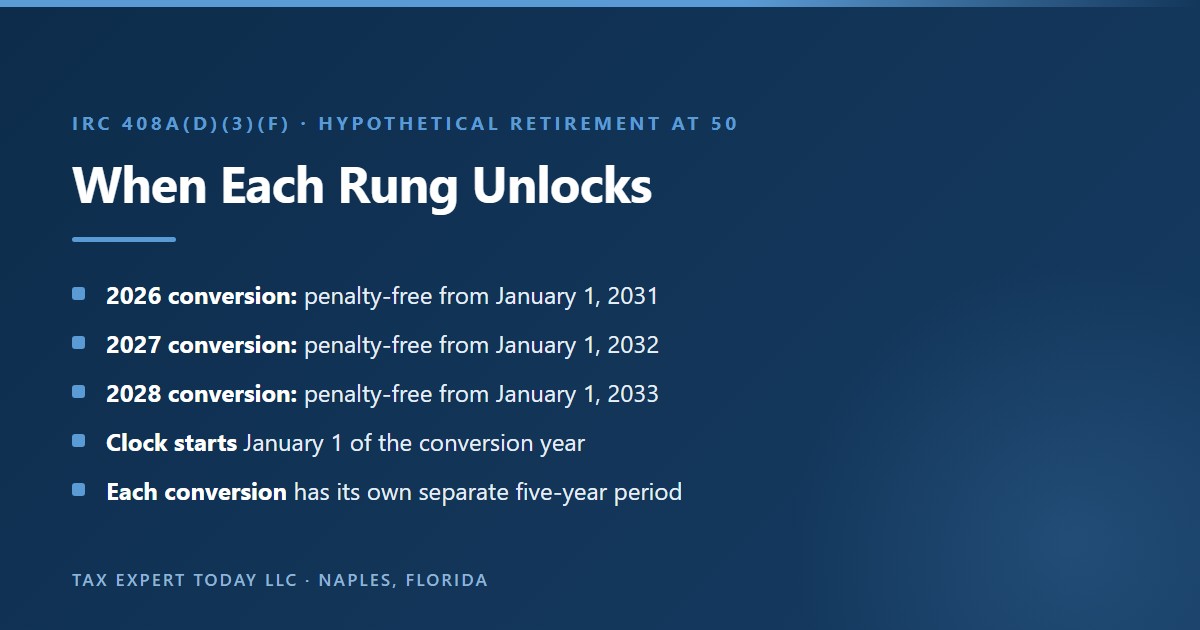
| Conversion year | Age in conversion year | Five-year period ends | Penalty-free from | Age when available |
|---|---|---|---|---|
| 2026 | 50 | December 31, 2030 | January 1, 2031 | 55 |
| 2027 | 51 | December 31, 2031 | January 1, 2032 | 56 |
| 2028 | 52 | December 31, 2032 | January 1, 2033 | 57 |
| 2029 | 53 | December 31, 2033 | January 1, 2034 | 58 |
| 2030 | 54 | December 31, 2034 | January 1, 2035 | 59 |
The table shows why the Roth conversion ladder is usually described as needing a five-year bridge: nothing converted after leaving work becomes penalty-free until year six. It also shows the Roth conversion ladder’s natural end. Once the person reaches 59½, the 10 percent tax no longer applies to Roth distributions under section 72(t)(2)(A)(i), so rungs converted in the last few years before that age may never need their own five-year period to run out.
Why does the five-year rule decide when each rung can be used?
The five-year rule decides timing because section 408A(d)(3)(F) applies the 10 percent early distribution tax to any withdrawal allocated to a conversion made within the previous five taxable years. Each conversion has its own separate period, so a ladder is really a series of independent five-year clocks, one for every year’s conversion.
- Separate clocks: Regulation 1.408A-6, Q&A-5(c) says the period is “separately determined for each conversion contribution.”
- Tax-year count: the clock starts January 1 of the conversion year, whatever the actual date.
- Taxable part only: the penalty reaches only the portion of the conversion that was included in income.
- Exceptions still apply: age 59½, disability, and other section 72(t) exceptions override the clock.
Two different five-year rules are often confused. The first, in section 408A(d)(2)(B), decides whether a Roth distribution is a qualified distribution, which makes earnings tax free. That clock starts with the first taxable year for which the person made any Roth IRA contribution and runs once for life. The second, in section 408A(d)(3)(F), is the conversion clock that this guide is about. It does not make earnings tax free. It only removes the 10 percent additional tax from the withdrawal of a particular conversion. Regulation 1.408A-6, Q&A-5(c) states that the conversion period “need not be the same as the 5-taxable-year period used for purposes of determining whether a distribution is a qualified distribution.”
For a Roth conversion ladder the distinction is practical. An early retiree withdrawing converted principal before 59½ does not need a qualified distribution, because converted principal already came out of the traditional IRA taxed and is not taxed again when it leaves the Roth. What that person needs is for the specific conversion being withdrawn to be outside its own five-year window. Earnings inside the Roth are a different matter and are discussed below, because they come out last and are taxable and penalized if withdrawn early in a nonqualified distribution.
| Feature | Qualified distribution clock | Conversion clock |
|---|---|---|
| Statute | IRC 408A(d)(2)(B) | IRC 408A(d)(3)(F) |
| When it starts | First taxable year of any Roth IRA contribution | Taxable year of each conversion |
| How many clocks | One per person | One per conversion year |
| What it unlocks | Tax free earnings, if age 59½, death, disability, or first home also applies | No 10 percent tax on withdrawing that conversion’s taxable amount |
| Matters to a ladder before 59½? | Rarely, because earnings are withdrawn last | Always, because it sets when each rung is usable |
In what order does money come out of a Roth IRA?
Roth IRA withdrawals follow a fixed statutory order: regular contributions first, then conversions on a first-in, first-out basis, and earnings last. Within each conversion, the taxable portion comes out before any nontaxable portion. The order is applied across all of a person’s Roth IRAs together, as of the end of the year.
- First: regular annual contributions, always tax free and penalty free.
- Second: conversions, oldest year first, taxable part of each conversion before its basis part.
- Third: earnings, taxable and generally penalized if withdrawn early in a nonqualified distribution.
- Aggregation: all Roth IRAs and all distributions in a year are combined for this purpose.
The ordering rule is written into the statute at section 408A(d)(4)(B), which says a distribution is treated as coming first from contributions other than qualified rollover contributions, then from qualified rollover contributions “on a first-in, first-out basis,” and that any amount allocated to a conversion “shall be allocated first to the portion of such contribution required to be included in gross income.” Regulation 1.408A-6, Q&A-8 adds that the ordering is “determined as of the end of a taxable year and exhausting each category before moving to the following category,” and Q&A-9 aggregates all of an individual’s Roth IRAs and all distributions made during the year.
This order is what makes the Roth conversion ladder work. The account holder cannot choose to withdraw a matured 2026 rung while leaving an unmatured 2029 rung untouched in the same account and then claim the withdrawal came from somewhere else; the law assigns it. Because the oldest conversion is always used first, withdrawals naturally consume matured rungs before newer ones. The risk runs the other way: a person who withdraws more than the total of regular contributions and matured conversions reaches into an unmatured conversion, and that slice carries the 10 percent tax.
| Layer in the Roth IRA | Amount in layer | Amount of the withdrawal drawn from it | Income tax | 10 percent additional tax |
|---|---|---|---|---|
| Regular contributions made while working | $60,000 | $60,000 | None | None |
| 2026 conversion (period runs through 2030) | $84,600 | $40,000 | None, already taxed in 2026 | $4,000 |
| 2027 conversion (period runs through 2031) | $84,600 | $0 | None | None |
| Earnings | Varies | $0 | Not reached | Not reached |
| Total | $100,000 | $0 | $4,000 |
In the hypothetical, a person aged 52 in 2028 has $60,000 of regular contributions, a 2026 conversion of $84,600, and a 2027 conversion of $84,600. A $100,000 withdrawal uses the contributions first and then $40,000 of the 2026 rung, which is still inside its period. The arithmetic illustration is $40,000 times 10 percent, or $4,000 of additional tax that waiting until 2031 would have avoided. The same withdrawal limited to $60,000 would have cost nothing.
Is the converted amount taxed, and at what rate?
Yes. The taxable part of each conversion is ordinary income in the year of the conversion, taxed at the person’s regular federal rates and usually by the state of residence. It is not a capital gain and is not penalized when converted. The rate depends on where the conversion lands in the 2026 brackets after the standard deduction.
- Character: ordinary income, reported on Form 1040 lines 4a and 4b.
- Federal rate: marginal rates from 10 to 37 percent under the 2026 tables in Revenue Procedure 2025-32.
- Nontaxable part: any nondeductible IRA basis converts tax free, but only in proportion under section 408(d)(2).
- No net investment income tax: section 1411(c)(5) excludes IRA and Roth IRA distributions from net investment income.
Because section 408A(d)(3)(A)(i) includes in gross income “any amount which would be includible were it not part of a qualified rollover contribution,” a conversion of fully pre-tax money is taxed exactly as an ordinary IRA distribution would be. The 2026 brackets come from Revenue Procedure 2025-32, section 4.01, and the standard deduction from section 4.14: $32,200 for married couples filing jointly and $16,100 for single filers. Those deductions matter to a Roth conversion ladder, because an early retiree with little other income can convert an amount equal to the standard deduction and pay no federal income tax on it.
A conversion is not net investment income. Section 1411(c)(5) says net investment income “shall not include any distribution from a plan or arrangement described in section 401(a), 403(a), 403(b), 408, 408A, or 457(b).” A large conversion can still raise modified adjusted gross income above the section 1411 thresholds and so expose other investment income, such as dividends and capital gains in a taxable account, to the 3.8 percent tax. For most ladder sized conversions that threshold is far away, but for a person converting a large balance in a single year it is part of the calculation.
| Rate | Married filing jointly, taxable income | Single, taxable income |
|---|---|---|
| 10 percent | Up to $24,800 | Up to $12,400 |
| 12 percent | $24,800 to $100,800 | $12,400 to $50,400 |
| 22 percent | $100,800 to $211,400 | $50,400 to $105,700 |
| 24 percent | $211,400 to $403,550 | $105,700 to $201,775 |
| 32 percent | $403,550 to $512,450 | $201,775 to $256,225 |
| 35 percent | $512,450 to $768,700 | $256,225 to $640,600 |
| 37 percent | Over $768,700 | Over $640,600 |
How much should you convert each year under the 2026 brackets?
Many early retirees size each conversion to fill a chosen bracket. With no other income in 2026, a married couple can convert $32,200 with no federal tax, $57,000 to fill the 10 percent bracket, or $133,000 to fill the 12 percent bracket. Health coverage costs, however, often set a lower practical ceiling than the brackets do.
- Zero tax amount: the standard deduction, $32,200 joint or $16,100 single, if there is no other income.
- Bracket fill: gross conversion equals bracket top plus the standard deduction.
- Other income first: dividends, interest, and gains use up bracket room before the conversion does.
- Health cap: premium tax credit eligibility can make a smaller conversion cheaper overall.
The arithmetic is simple once other income is known. Take the top of the bracket to be filled, add the standard deduction, and subtract any other income. For a married couple with no other income, the table below shows the gross conversion that reaches each bracket’s top in 2026 and the federal tax on that amount, computed from the Revenue Procedure 2025-32 tables. All figures are hypothetical illustrations of the published tables, not projections for any particular household.
The common planning instinct is to fill the 12 percent bracket every year, because the 22 percent rate is a large step up. That instinct ignores what the conversion does to other parts of the return. In 2026, an early retiree buying coverage through the Health Insurance Marketplace who pushes household income above 400 percent of the poverty line loses the premium tax credit entirely, and that loss can exceed the income tax on the conversion. The section on the premium tax credit below works through the same couple at several conversion sizes. The short version is that for many Marketplace households the efficient conversion is the largest amount that stays at or under the 400 percent line, not the amount that fills the 12 percent bracket.
| Bracket filled | Taxable income at top | Gross conversion needed | Federal income tax | Average rate on the conversion |
|---|---|---|---|---|
| None (standard deduction only) | $0 | $32,200 | $0 | 0.0 percent |
| 10 percent | $24,800 | $57,000 | $2,480 | 4.4 percent |
| 12 percent | $100,800 | $133,000 | $11,600 | 8.7 percent |
| 22 percent | $211,400 | $243,600 | $35,932 | 14.8 percent |
| 24 percent | $403,550 | $435,750 | $82,048 | 18.8 percent |
For a single filer with no other income the same method gives $16,100 with no federal tax, $28,500 to fill the 10 percent bracket with $1,240 of tax, and $66,500 to fill the 12 percent bracket with $5,800 of tax. A single person relying on Marketplace coverage, however, reaches the 400 percent line at $62,600 of household income in 2026, which is below the 12 percent fill point. That is one of several places where the bracket rule of thumb and the actual cost of a conversion part ways.
Who is a Roth conversion ladder built for?
A Roth conversion ladder generally fits people who stop working well before 59½, hold most of their savings in pre-tax retirement accounts, expect several low income years, and have enough taxable savings or Roth contributions to cover about five years of spending. It fits less well for people who still have high earned income or need money right away.
- Good fit: early retirees with large 401(k) or IRA balances and modest spending.
- Good fit: people expecting a gap of several years before Social Security or pension income starts.
- Weaker fit: people who need full access immediately and lack a five-year bridge.
- Weaker fit: people still in high brackets, where conversion tax may exceed the later benefit.
The Roth conversion ladder is a tool for turning low income years into cheap conversions. Its value comes from the difference between the rate paid on the way into the Roth and the rate that would otherwise apply when the same money comes out of a traditional IRA later, through withdrawals or required minimum distributions. Someone who retires at 50 with $1,200,000 in a rolled-over 401(k) and spends $80,000 a year may have a decade of years in which taxable income can be steered almost wherever the plan wants it. That control is the asset. A ladder simply uses it on purpose.
The same person who expects to keep earning a high salary until 60 has little use for a Roth conversion ladder, because the conversions would stack on top of wages in the 24 percent bracket or higher, and penalty-free access before 59½ is not needed. A business owner considering a large deductible plan contribution, such as through a cash balance plan, is usually doing the opposite of a ladder in the working years and may plan a Roth conversion ladder later for the years after a sale or retirement. Owners preparing for that kind of event may also find our guide to selling a business taxes useful, because the sale year is usually the worst year to convert.
| Fact pattern | Tends to favor a ladder | Tends to weigh against it |
|---|---|---|
| Age at leaving work | Mid 40s to mid 50s | 58 or older, when 59½ is close |
| Where savings sit | Mostly traditional 401(k) or IRA | Mostly taxable or already Roth |
| Income after leaving work | Low and controllable | High pension, rental, or consulting income |
| Bridge money | Five years of spending outside the IRA | Little outside savings |
| Health coverage | Planned around the conversion amount | Ignored until the credit is lost |
| State of residence | No income tax, or a planned move to one | High tax state with no plan to leave |
How do you fund the first five years before the first rung matures?
The first five years are usually funded from money outside the traditional IRA: taxable brokerage accounts, cash savings, Roth IRA regular contributions, or after-tax 401(k) basis. Because no conversion made after leaving work matures until year six, the size of this bridge often determines whether a ladder is realistic at all.
- Taxable brokerage: sales can produce long-term gains that may fall in the 0 percent capital gains band.
- Cash and bonds: simple, though interest adds to income and to premium tax credit household income.
- Roth contributions: regular contributions can be withdrawn at any time, tax and penalty free.
- Earlier conversions: conversions made while still working start their clocks sooner.
A household spending $80,000 a year needs about $400,000 of accessible money for the first five years in a simple hypothetical that ignores inflation and investment returns. That money does not have to sit in cash. Many ladders draw from a taxable account during the bridge, harvesting long-term gains in years when taxable income is low. The interaction between those gains and the conversion is covered in the capital gains section below, because the two compete for the same low bracket room.
A less discussed bridge is to start the Roth conversion ladder before leaving work. A person who expects to retire in 2031 can convert in 2026 through 2030 while still employed, so that the first rung matures in the first year of retirement. The cost is that those conversions stack on top of wages and are usually taxed at a higher rate. That tradeoff is worth testing year by year rather than assuming in either direction, and it often works well for a smaller amount converted in a year with an unusually low salary, such as a sabbatical year or the final partial year of employment.
| Source | Hypothetical amount | Tax effect when used | Effect on household income for health credits |
|---|---|---|---|
| Cash savings | $60,000 | None on withdrawal; interest taxable as earned | Interest counts |
| Taxable brokerage sales | $220,000 | Only the gain is taxed, often at 0 or 15 percent | Realized gain counts |
| Roth IRA regular contributions | $60,000 | None | None |
| Conversions made while working (matured) | $60,000 | None on withdrawal; taxed when converted | None in the withdrawal year |
| Total bridge | $400,000 |
Can Roth IRA contributions be withdrawn during the bridge years?
Yes. Regular Roth IRA contributions come out first under the ordering rules and can be withdrawn at any age without income tax or the 10 percent penalty. For someone who contributed to a Roth IRA for many years while working, that basis can cover a meaningful part of the five-year bridge.
- No waiting period: regular contributions are not subject to the conversion five-year clock.
- Tracked on Form 8606: basis in regular contributions is reported on Part III, line 22.
- Uses up the first layer: once contributions are gone, the next dollar comes from the oldest conversion.
- Records matter: the IRS does not track Roth basis for the taxpayer; old statements prove it.
The 2026 Roth IRA contribution limit is $7,500, with an additional $1,100 catch-up for people 50 or older, under Notice 2025-67. A couple who each contributed for fifteen or twenty years before retiring may have well over $100,000 of combined basis. Each spouse’s basis belongs to that spouse’s own Roth IRA, and the ordering rules apply person by person.
Using contribution basis during the bridge has a side effect worth planning for. Because contributions are always the first layer, spending them early means every later withdrawal starts at the conversion layer. If the plan later needs an emergency withdrawal in a year when the most recent rungs are still inside their periods, there is no contribution cushion left. Some households keep part of the contribution basis untouched as a reserve and lean more heavily on taxable assets during the bridge for exactly that reason. The Form 8606 instructions say the line 22 figure is the total of regular contributions for 1998 through the current year, adjusted for recharacterizations and earlier distributions, so the household needs a running total from the start.
| Item | 2025 | 2026 |
|---|---|---|
| IRA contribution limit, under age 50 | $7,000 | $7,500 |
| Additional catch-up, age 50 or older | $1,000 | $1,100 |
| Total for a person 50 or older | $8,000 | $8,600 |
| Requirement | Taxable compensation at least equal to the contribution, which early retirees often lack | |
That last row is easy to miss. A Roth IRA contribution requires earned income. Once a person stops working, new regular contributions generally stop too, unless a working spouse supports a spousal contribution. Conversions, by contrast, have no income limit and no dollar cap, which is why they are the engine of the Roth conversion ladder after work ends.
How does a Roth conversion ladder compare with 72(t) payments?
Both reach pre-tax money before 59½ without the 10 percent penalty. A 72(t) plan of substantially equal periodic payments starts immediately but locks in a fixed annual withdrawal for at least five years or until 59½, whichever is later. A ladder offers flexibility and lower tax years but needs a five-year bridge first.
- 72(t) payments: available at once, but rigid, and a modification triggers retroactive penalties plus interest.
- Ladder: flexible amounts each year, but nothing new matures for five years.
- Combination: some people run a modest 72(t) series from one IRA and a ladder from another.
- Rate cap: Notice 2022-6 allows an interest rate up to the greater of 5 percent or 120 percent of the federal mid-term rate.
Section 72(t)(2)(A)(iv) excepts distributions that are “part of a series of substantially equal periodic payments (not less frequently than annually) made for the life (or life expectancy) of the taxpayer.” The catch is section 72(t)(4). If the series is modified before the later of five years from the first payment or age 59½, other than by death or disability, the tax that would have applied to every earlier payment is added back in the year of the change, with interest. Notice 2022-6 sets the permitted methods and states that the interest rate may be “not more than the greater of (i) 5% or (ii) 120% of the federal mid-term rate.” The IRS page on substantially equal periodic payments summarizes the same methods.
For a 50 year old with $1,200,000, the Single Life Table in Publication 590-B gives a life expectancy of 36.2 years. Using the fixed amortization method at 5 percent, the arithmetic illustration produces a payment of about $72,375 a year. At 4 percent it is about $63,305. The required minimum distribution method gives about $33,149 in the first year and changes annually. Those payments are fully taxable when received. The Roth conversion ladder, by contrast, lets the same person choose a different conversion each year, which is what makes the premium tax credit and bracket planning described in this guide possible.
| Feature | Roth conversion ladder | 72(t) substantially equal payments |
|---|---|---|
| Access to new money | After a five-year wait for each rung | Immediately |
| Annual flexibility | Full; any amount can be converted each year | None; fixed under the chosen method |
| Hypothetical annual amount on $1,200,000 at age 50 | Chosen by the plan, for example $84,600 | About $72,375 (amortization at 5 percent) or about $33,149 (RMD method) |
| Cost of a mistake | 10 percent on the early slice only | 10 percent on every prior payment plus interest |
| Tax when the money is spent | None on converted principal | Ordinary income on each payment |
| Main legal authority | IRC 408A(d)(3)(F) | IRC 72(t)(2)(A)(iv) and (t)(4); Notice 2022-6 |
When does the rule of 55 beat a Roth conversion ladder?
The rule of 55 can beat a ladder for someone who leaves an employer in or after the year they turn 55 and keeps the money in that employer’s plan. Distributions from that plan avoid the 10 percent penalty with no five-year wait. The exception does not apply to IRAs, so rolling the plan to an IRA gives it up.
- Statute: section 72(t)(2)(A)(v) covers distributions after separation from service after attaining age 55.
- Plans only: section 72(t)(3)(A) says the exception does not apply to an individual retirement plan.
- Same employer: it reaches the plan of the employer the person left, not older plans.
- Combination: leave part in the plan for the rule of 55 and roll part to an IRA for the ladder.
Section 72(t)(2)(A)(v) excepts distributions “made to an employee after separation from service after attainment of age 55,” and section 72(t)(3)(A) states that subparagraph (A)(v) “shall not apply to distributions from an individual retirement plan.” The IRS table of exceptions to the early distribution tax lists the same limits. For someone who leaves work at 56, a rule of 55 plan can deliver penalty-free money right away and makes a Roth conversion ladder’s five-year wait largely irrelevant. For someone who leaves at 50, the rule does not help until a later separation that may never come.
Many people roll every workplace account to an IRA on retirement as a matter of habit. That step is irreversible for this purpose. A sensible sequence for someone retiring at 55 or later may be to leave enough in the last employer’s plan to cover the years until 59½, and roll the rest to an IRA that feeds conversions. The plan’s own distribution options matter too, because some plans allow only a full lump sum after separation, which would make the rule of 55 less useful. Plan documents, not general rules, answer that question.
| Age when leaving the employer | Rule of 55 available? | Ladder five-year wait relevant? | Common pattern |
|---|---|---|---|
| Under 50 | No | Yes, fully | Ladder with a five-year bridge, sometimes with 72(t) |
| 50 to 54 | No | Yes | Ladder; bridge from taxable savings and Roth basis |
| 55 to 58 | Yes, from that employer’s plan | Partly | Rule of 55 for spending, conversions for tax planning |
| 59 or later | Not needed | No, penalty ends at 59½ | Conversions for bracket management only |
Should you roll a 401(k) to an IRA before starting the ladder?
Often, but not always. Most ladders convert from a traditional IRA, so a rollover is the usual first step. Before rolling, check whether the plan permits in-plan Roth conversions, whether the rule of 55 applies, whether the plan offers creditor protection that matters in the person’s state, and whether after-tax money in the plan can be separated.
- Direct rollover: a trustee-to-trustee transfer avoids the 20 percent mandatory withholding on plan distributions.
- In-plan conversion: some plans convert inside the plan, which keeps the plan’s investment menu.
- Rule of 55: lost for any amount moved to an IRA.
- After-tax money: may be routed directly to a Roth IRA, separately from pre-tax money.
A rollover from a qualified plan to an IRA is governed by section 402(c). A direct transfer keeps the full balance moving. An indirect rollover, where a check is paid to the participant, is subject to mandatory withholding and must be completed within 60 days, and any shortfall becomes a taxable distribution that may also be penalized before 59½. For a Roth conversion ladder there is rarely a reason to take an indirect rollover.
Conversions can also be done directly from a plan to a Roth IRA, which section 408A(d)(3)(B) treats as a qualified rollover contribution from an eligible retirement plan. Many plans, however, allow distributions only in limited forms after separation, so the practical route is usually a full rollover to a traditional IRA followed by yearly IRA conversions. The choice of custodian also matters: the conversion is easier to document when the traditional IRA and the Roth IRA are at the same institution and each conversion appears as a separate, dated transaction.
| Choice | Main advantage | Main drawback |
|---|---|---|
| Keep money in the old plan | Rule of 55 if eligible; plan level creditor protection | Plan may not allow partial distributions or conversions |
| Direct rollover to traditional IRA | Full flexibility for yearly conversions | Loses rule of 55 for the rolled amount |
| In-plan Roth conversion | Keeps plan investments and structure | Not every plan offers it; timing set by plan |
| Indirect rollover by check | None for a ladder | Mandatory withholding and a 60 day deadline |
What happens if you have other pre-tax IRA money or nondeductible basis?
If a person holds nondeductible basis in any traditional, SEP, or SIMPLE IRA, the pro-rata rule treats every conversion as part taxable and part tax free, in proportion to basis over the combined year-end value of all those IRAs. A ladder cannot convert only the basis. Form 8606 Part I and Part II compute the split each year.
- Aggregation: section 408(d)(2) treats all non-Roth IRAs as one contract for this purpose.
- Year-end value: the ratio uses the December 31 value plus distributions and conversions during the year.
- Plan money excluded: balances still in a 401(k) are not part of the IRA aggregation.
- Deeper treatment: our backdoor Roth guide covers the pro-rata mechanics line by line.
The pro-rata rule comes from section 408(d)(2), which section 408A(d)(4)(A) applies “separately with respect to Roth IRAs and other individual retirement plans.” This guide does not re-derive it, because our backdoor Roth IRA guide walks through the Form 8606 lines in detail. For a Roth conversion ladder, the practical point is narrower. Basis from old nondeductible contributions is not lost; it is spread across the conversions, each of which is slightly less taxable than its gross amount. Because only the taxable part of a conversion is subject to the 10 percent tax when withdrawn early, that basis also slightly reduces the cost of any early withdrawal.
The interaction with the ordering rules is precise. Under Regulation 1.408A-6, Q&A-8(b), a withdrawal allocated to a particular conversion comes “first from the portion, if any, that was includible in gross income.” So the basis portion of each rung is the last part of that rung to come out. The hypothetical below shows a person with $40,000 of basis among $1,000,000 of total IRA value converting $84,600.
| Step | Calculation | Result |
|---|---|---|
| Basis ratio | $40,000 divided by $1,000,000 | 4.0 percent |
| Nontaxable part of conversion | $84,600 times 4.0 percent | $3,384 |
| Taxable part of conversion | $84,600 minus $3,384 | $81,216 |
| Basis carried forward | $40,000 minus $3,384 | $36,616 |
| Amount exposed to 10 percent if withdrawn early | Taxable part only | $81,216 |
Can after-tax 401(k) money shorten the ladder?
It can. After-tax contributions in a 401(k) are basis, and when the plan pays them out they can be rolled directly to a Roth IRA. Under Notice 2014-54 the pre-tax and after-tax parts of a single distribution can be split between a traditional IRA and a Roth IRA, giving the Roth IRA basis that may be easier to reach early.
- Basis, not income: after-tax contributions were taxed when earned.
- Split rollover: Notice 2014-54 allows pre-tax money to a traditional IRA and after-tax money to a Roth IRA.
- Earnings are separate: earnings on after-tax contributions are pre-tax and follow the pre-tax money.
- Related strategy: our mega backdoor Roth guide covers the in-service version while still working.
The IRS Notice 2014-54 addresses how a distribution from a plan that contains both pre-tax and after-tax amounts can be allocated among multiple destinations. When after-tax money is rolled to a Roth IRA as part of a rollover from a plan, it becomes a qualified rollover contribution under section 408A(d)(3), but because the after-tax portion was not includible in income, it is not the part of the rollover exposed to the 10 percent tax under section 408A(d)(3)(F). That can give an early retiree a Roth layer usable during the bridge years, subject to the ordering rules and good records.
Employees who are still working and whose plans permit after-tax contributions plus in-plan conversions or in-service rollovers may be able to build that layer well before retirement. That route has its own reporting and nondiscrimination testing issues, which are covered in our mega backdoor Roth guide. Here the point is only that after-tax plan money and a Roth conversion ladder work together: one supplies early Roth basis, the other converts the pre-tax balance over time.
| Component | Amount | Destination | Taxed on rollover? |
|---|---|---|---|
| Pre-tax contributions and all earnings | $820,000 | Traditional IRA, then converted over time by the ladder | No, until converted |
| After-tax contributions (basis) | $80,000 | Roth IRA directly | No |
| Total distribution | $900,000 |
How does a Roth conversion affect the premium tax credit in 2026?
A Roth conversion adds to adjusted gross income, and the premium tax credit is based on household income built from that figure. For 2026 coverage, the credit is generally unavailable above 400 percent of the federal poverty line, so a conversion can shrink the credit gradually and then remove it entirely at the cliff.
- Household income: modified adjusted gross income under section 36B(d)(2)(B), which starts from AGI.
- Conversion counts: the taxable part of the conversion is in AGI, so it is in household income.
- Roth withdrawals usually do not: withdrawing contributions or matured conversions adds nothing to AGI.
- Repayment exposure: for tax years after 2025, the IRS says there is no repayment cap on excess advance credit.
The premium tax credit in section 36B helps pay for coverage bought through the Health Insurance Marketplace. Household income is modified adjusted gross income, which section 36B(d)(2)(B) defines as adjusted gross income increased by excluded foreign earned income, tax-exempt interest, and the untaxed portion of Social Security benefits. A Roth conversion raises adjusted gross income dollar for dollar by its taxable amount. That is why, for an early retiree buying Marketplace coverage, the conversion is not only an income tax decision; it is the main lever on what health insurance costs that year.
For tax years 2021 through 2025, Congress temporarily removed the 400 percent upper limit. The IRS questions and answers on the premium tax credit state that individuals and families may generally be eligible if household income is “at least 100 percent but no more than 400 percent of the federal poverty line,” describe the 2021 through 2025 expansion in the past tense, and add that “for tax years after 2025,” if the allowable credit is less than the advance payments, “there is no repayment cap.” Taken together, those two changes make 2026 the first year in several where an oversized conversion can cost a Marketplace household its entire credit and require repayment of every advance dollar received.
| Cash flow | In AGI? | In household income? |
|---|---|---|
| Taxable part of a Roth conversion | Yes | Yes |
| Withdrawal of Roth regular contributions | No | No |
| Withdrawal of a matured conversion | No | No |
| Long-term capital gain from a taxable account | Yes | Yes |
| Return of basis on a taxable account sale | No | No |
| Tax-exempt municipal bond interest | No | Yes, added back by section 36B(d)(2)(B) |
| 72(t) payments from a traditional IRA | Yes | Yes |
What is the 400 percent poverty line cliff and why does it matter for conversions?
The cliff is the point at which household income passes 400 percent of the federal poverty line and the premium tax credit drops to zero. For 2026 coverage, using the 2025 poverty guidelines, that is $62,600 for a single person and $84,600 for a household of two. One dollar of conversion above the line can cost the whole credit.
- Poverty line used: 2026 coverage uses the 2025 guidelines, $15,650 for one person and $21,150 for two.
- Cliff amounts: four times those figures, $62,600 single and $84,600 for two.
- Required share below the cliff: 9.96 percent of household income from 300 to 400 percent in 2026.
- Above the cliff: no credit, regardless of how high the premium is.
The poverty line figures come from HealthCare.gov, which explains that the previous year’s guidelines are used to calculate Marketplace savings for the next year and lists 2025 income amounts of $15,650 for one person and $21,150 for a family of two. The applicable percentage table for 2026 comes from Revenue Procedure 2025-25, which runs from 2.10 percent of income below 133 percent of the poverty line to 9.96 percent at 300 to 400 percent. The credit equals the benchmark silver premium minus that required share, so as income rises the household pays more, until the credit ends entirely above 400 percent.
The table below runs a hypothetical couple through several 2026 conversion sizes. The couple has no other income, files jointly, and faces a hypothetical benchmark silver premium of $22,800 for the year. The premium is an assumption for illustration only; actual premiums vary widely by age, county, and plan, and the credit cannot exceed the premium for the plan actually chosen. Federal tax is computed from the Revenue Procedure 2025-32 tables after the $32,200 standard deduction.

| Conversion | Percent of poverty line | Federal income tax | Premium tax credit | Tax plus credit lost versus a $21,150 conversion |
|---|---|---|---|---|
| $21,150 | 100 percent | $0 | $22,356 | $0 |
| $40,000 | 189 percent | $780 | $20,370 | $2,766 |
| $60,000 | 284 percent | $2,840 | $17,122 | $8,074 |
| $84,600 | 400 percent | $5,792 | $14,374 | $13,774 |
| $84,601 | Just over 400 percent | $5,792 | $0 | $28,148 |
| $100,000 | 473 percent | $7,640 | $0 | $29,996 |
| $133,000 (fills 12 percent bracket) | 629 percent | $11,600 | $0 | $33,956 |
Read the fourth and fifth rows together. Moving the conversion from $84,600 to $84,601 adds essentially no income tax but, in this hypothetical, removes a $14,374 credit. Filling the 12 percent bracket with a $133,000 conversion converts $48,400 more than the cliff amount, and the combined cost of that extra conversion in the hypothetical is $20,182 of additional tax and lost credit, an effective cost of about 42 percent on those extra dollars. That is higher than the 22 percent bracket the household was trying to avoid. These are arithmetic illustrations of the published tables using an assumed premium, not predictions for any household.
What happens below 100 percent of the poverty line?
Below 100 percent of the poverty line, household income is generally too low for the premium tax credit. In a state that has expanded Medicaid, the person may qualify for Medicaid instead; in a state that has not, there may be no subsidy at all. A modest conversion can lift income above 100 percent and restore eligibility for the credit.
- Floor: section 36B(c)(1)(A) sets eligibility at household income of at least 100 percent of the poverty line.
- 2026 floor amounts: $15,650 for one person and $21,150 for two, using the 2025 guidelines.
- Conversion as a tool: converting up to the floor can cost little or no federal income tax.
- State check: Medicaid expansion status differs by state and should be confirmed for the year.
Early retirees living on Roth contributions and taxable account basis can report very low adjusted gross income. That looks efficient until health coverage is priced. Under section 36B(c)(1)(A), an applicable taxpayer is one whose household income is at least 100 percent and not more than 400 percent of the poverty line, with a narrow exception for certain lawfully present noncitizens. A couple reporting $15,000 of income in 2026 may find the Marketplace offers no credit, while the same couple reporting $21,150, all from a conversion within the standard deduction, may qualify for the largest credit available.
The Roth conversion ladder therefore has a floor as well as a ceiling. In the couple’s hypothetical, a $21,150 conversion is entirely sheltered by the $32,200 standard deduction, costs no federal income tax, and lifts household income to exactly 100 percent of the poverty line, where the required contribution is 2.10 percent of income. Converting less would save nothing in federal tax and could forfeit the credit. Because the Marketplace estimates the credit in advance from projected income, the household also needs to report the projected conversion when enrolling or updating its application, as the IRS premium tax credit basics page explains in describing advance payments.
| Point on the scale | One person | Two people | Required share of income |
|---|---|---|---|
| 100 percent (eligibility floor) | $15,650 | $21,150 | 2.10 percent |
| 150 percent | $23,475 | $31,725 | 4.19 percent |
| 200 percent | $31,300 | $42,300 | 6.60 percent |
| 300 percent | $46,950 | $63,450 | 9.96 percent |
| 400 percent (cliff) | $62,600 | $84,600 | 9.96 percent |
| Above 400 percent | Over $62,600 | Over $84,600 | No credit |
How should you size a conversion around the premium tax credit?
A common approach is to project every other source of household income for the year, then size the conversion so total household income lands just under 400 percent of the poverty line, leaving a margin for surprises. Many households convert late in the year, after dividends and interest are mostly known, to reduce the risk of crossing the cliff.
- Project first: interest, dividends, capital gain distributions, realized gains, and any side income.
- Leave a margin: mutual fund year-end distributions can add unexpected income in December.
- Convert late: a December conversion carries the same five-year clock as a January one.
- Update the Marketplace: report income changes so advance payments track the final number.
The margin is not a formality. In the hypothetical, a couple that converts exactly $84,600 and then receives $3,000 of taxable interest it forgot to project ends the year at $87,600 of household income, above the cliff, and loses the full $14,374 credit. Because the repayment cap no longer applies for tax years after 2025, every dollar of advance credit received that year must be repaid on the return. That is a five-figure error caused by a three-figure item, which is why the conversion is usually the last income decision of the year rather than the first.
Because recharacterization of conversions was repealed, there is no way to reverse a conversion that turned out too large. The only correction tool is the sizing itself. Some households split the year’s conversion into two steps: a base amount earlier in the year that is safely under the cliff, and a top-up in December once the year’s other income is known. Either approach depends on a reliable projection, which is the same work a tax professional does in a year-end tax planning review.
| Line | Item | Hypothetical amount |
|---|---|---|
| 1 | 2026 cliff for two people (400 percent of $21,150) | $84,600 |
| 2 | Interest and ordinary dividends received or expected | $4,200 |
| 3 | Realized capital gains and fund distributions | $9,500 |
| 4 | Tax-exempt interest (added back for household income) | $800 |
| 5 | Safety margin chosen by the household | $2,500 |
| 6 | Maximum conversion (line 1 minus lines 2 through 5) | $67,600 |
Does a conversion change long-term capital gains taxes?
It can. Long-term gains are taxed at 0 percent only up to a taxable income threshold, $98,900 for married couples and $49,450 for single filers in 2026. A conversion is ordinary income that fills that space first, so a large conversion can push gains from a taxable account out of the 0 percent band into the 15 percent band.
- Stacking order: ordinary income, including conversions, sits below capital gains in the calculation.
- 2026 thresholds: $98,900 joint and $49,450 single for the top of the 0 percent band.
- Hidden marginal rate: each conversion dollar can move a dollar of gain from 0 to 15 percent.
- Competing uses: the bridge years often harvest gains, which compete with conversions for the same room.
The thresholds come from Revenue Procedure 2025-32, section 4.03, which lists maximum zero rate amounts of $98,900 for joint filers and $49,450 for most other individuals for 2026. Under the structure of section 1(h), net capital gain is taxed at the 0 percent rate only to the extent taxable income, including the gain, stays under that amount, after ordinary income has been placed first.
The hypothetical below compares a couple realizing $60,000 of long-term gains during the bridge years with and without an $84,600 conversion in the same year. Without the conversion, the gain is partly absorbed by the standard deduction and the rest sits in the 0 percent band. With the conversion, ordinary taxable income is $52,400, leaving $46,500 of 0 percent room, and the remaining $13,500 of gain is taxed at 15 percent, or $2,025. That $2,025 is a cost of the conversion that does not show up in the bracket table. A household juggling both may decide to alternate, harvesting gains in some years and converting more in others, or to accept the 15 percent rate because it is still lower than the rate expected on later traditional IRA withdrawals.
| Item | No conversion | With $84,600 conversion |
|---|---|---|
| Ordinary income | $0 | $84,600 |
| Long-term capital gains | $60,000 | $60,000 |
| Standard deduction | $32,200 | $32,200 |
| Taxable income | $27,800 | $112,400 |
| Gain taxed at 0 percent | $27,800 (rest offset by deduction) | $46,500 |
| Gain taxed at 15 percent | $0 | $13,500 |
| Tax on the gains | $0 | $2,025 |
| Tax on the conversion itself | Not applicable | $5,792 |
Do conversions affect Social Security taxation or Medicare premiums later?
They can, in opposite directions over time. A conversion in a year when Social Security is already being received can make more of the benefit taxable. Conversions completed before benefits start shrink future traditional IRA withdrawals, which can reduce taxable benefits later. Medicare income-related premiums use income from two years earlier, so conversions near 63 deserve care.
- Benefit taxation: section 86 counts adjusted gross income plus half of benefits when deciding how much is taxable.
- Before benefits: early retirement conversions do not affect benefit taxation in that year.
- Later years: a smaller traditional IRA means smaller required withdrawals once benefits start.
- Medicare lookback: income-related premium adjustments generally look back two years.
Section 86 includes part of Social Security benefits in income once modified adjusted gross income plus half the benefits passes fixed base amounts that are not indexed for inflation. A conversion is ordinary income, so in a year when benefits are being received it can increase the taxable share of those benefits as well as being taxed itself. That is one reason many ladders are front loaded into the years between leaving work and claiming Social Security, when neither benefits nor required minimum distributions are present.
Medicare Part B and Part D premiums include an income-related adjustment for higher income beneficiaries, based on the tax return from two years before the premium year, as the Social Security Administration and Medicare explain in their premium notices. A large conversion at 63 or 64 can therefore raise premiums at 65 or 66. Because the brackets for those adjustments change annually, this guide does not quote them; a planner checks the current year’s figures before recommending a conversion in that window. For most people running a Roth conversion ladder in their late 40s and 50s, this is a future consideration rather than a current one.
| Stage | Premium tax credit | Social Security taxation | Medicare premiums |
|---|---|---|---|
| Leaving work to 62 | Main constraint if on the Marketplace | Not relevant if benefits not claimed | Not relevant |
| Ages 63 and 64 | Still relevant until Medicare | Relevant if benefits claimed early | Income may affect premiums two years later |
| Age 65 onward | Generally not relevant on Medicare | Relevant once benefits are received | Relevant every year |
| Required distribution years | Not relevant | Smaller IRA can mean less taxable benefit | Smaller IRA can mean lower adjustments |
Does the net investment income tax apply to a Roth conversion?
No. Section 1411(c)(5) excludes distributions from IRAs, Roth IRAs, and qualified plans from net investment income, so a conversion is never subject to the 3.8 percent tax itself. A conversion does raise modified adjusted gross income, however, which can expose a taxpayer’s other investment income to the tax once the statutory threshold is passed.
- Exclusion: section 1411(c)(5) names plans under sections 401(a), 403(a), 403(b), 408, 408A, and 457(b).
- Thresholds: $250,000 for joint filers and $200,000 for single filers, fixed by statute and not indexed.
- Indirect effect: the conversion can push other dividends, interest, and gains over the threshold.
- Ladder sized conversions: usually far below the thresholds for early retirees.
The exclusion in section 1411(c)(5) is explicit, and the thresholds in section 1411(b) are fixed amounts set in the statute. The 3.8 percent tax applies to the lesser of net investment income or the excess of modified adjusted gross income over the threshold. A large one-time conversion, for example in a year when someone converts a substantial balance after a business sale, can push modified adjusted gross income above $250,000 and pull that year’s dividends and gains into the tax. That is another reason the sale year described in our selling a business taxes guide is rarely a good conversion year.
For the typical early retiree converting within the 12 percent bracket or below the premium tax credit cliff, the net investment income tax is not in play. It appears here because many online summaries state that conversions are “not investment income” and stop, without explaining the indirect effect through modified adjusted gross income, which is the part that occasionally matters.
| Conversion | Modified AGI | Excess over $250,000 | Base for 3.8 percent (lesser of NII or excess) | Net investment income tax |
|---|---|---|---|---|
| $84,600 | $114,600 | $0 | $0 | $0 |
| $230,000 | $260,000 | $10,000 | $10,000 | $380 |
| $400,000 | $430,000 | $180,000 | $30,000 | $1,140 |
How is a Roth conversion ladder reported on Form 8606?
Each conversion year is reported in Form 8606 Part II, which computes the taxable amount of that year’s conversions, and the taxable amount flows to Form 1040 line 4b. The custodian also issues Form 1099-R for the traditional IRA distribution. In any year a Roth withdrawal is taken before a qualified distribution is possible, Part III is completed too.
- Part I: nondeductible contributions and the basis ratio, if the person has IRA basis.
- Part II, lines 16 to 18: the year’s conversion amount, the basis allocated to it, and the taxable amount.
- Form 1099-R: issued by the traditional IRA custodian for the converted amount.
- Form 5498: issued by the Roth custodian showing the conversion received.
The Instructions for Form 8606 direct taxpayers to complete Part II for any year in which part or all of a traditional IRA was converted to a Roth IRA. Line 16 carries the amount converted, line 17 the basis allocated to it, and line 18 the taxable result. If a person has no basis at all, the conversion is fully taxable and the form is short, but it should still be filed, because the Part II history is what later supports the Part III figures for each rung. Saving each year’s Form 8606 with the return is the single most useful record keeping habit for a Roth conversion ladder.
The custodian’s Form 1099-R reports the distribution from the traditional IRA. For a conversion, box 7 typically carries code 2 for an early distribution with a known exception or code 7 for a normal distribution, depending on age and custodian practice, and the IRA box is checked. Mismatches between the 1099-R, the 5498, and Form 8606 are a common source of IRS notices. Our guide to getting IRS penalties removed covers what to do if a notice proposes a penalty that the records show should not apply.
| Form | Who prepares it | What it shows | When |
|---|---|---|---|
| Form 1099-R | Traditional IRA custodian | Gross distribution converted and distribution code | Early in the following year |
| Form 5498 | Roth IRA custodian | Conversion amount received by the Roth | By late May of the following year |
| Form 8606, Part II | Taxpayer or preparer | Taxable part of the conversion | With the return for the conversion year |
| Form 1040, lines 4a and 4b | Taxpayer or preparer | Gross and taxable IRA distributions | With the return for the conversion year |
How do Form 8606 Part III lines prove a withdrawal is penalty-free?
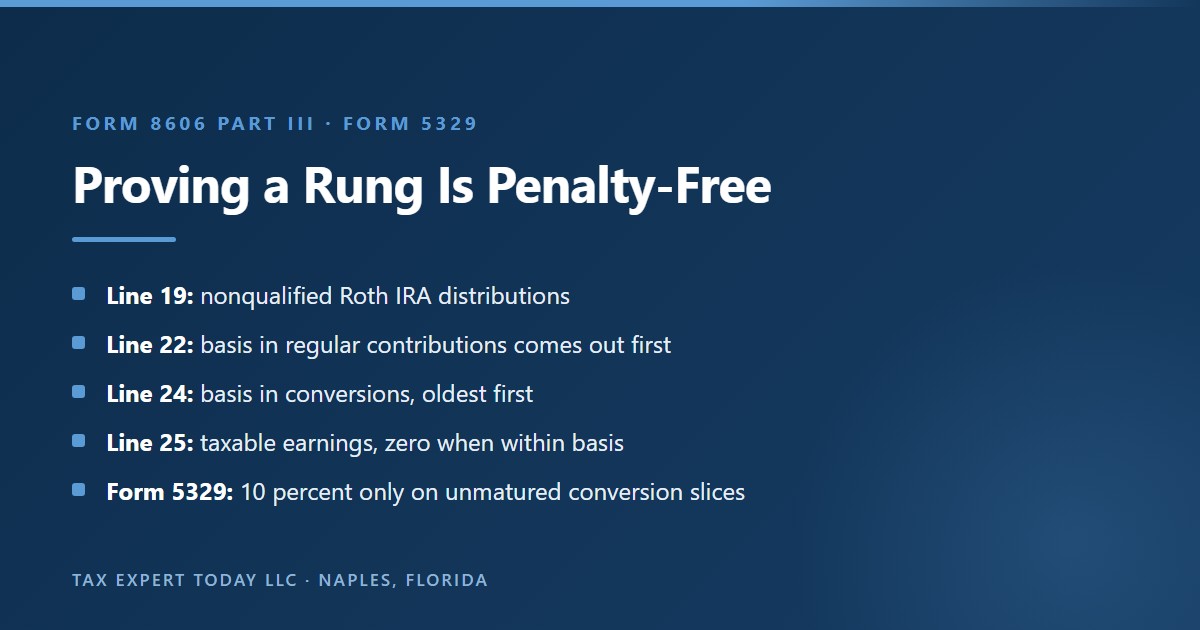
Part III of Form 8606 traces a nonqualified Roth withdrawal through the ordering layers. Line 19 reports the distribution, line 22 subtracts basis in regular contributions, line 24 subtracts basis in conversions, and line 25 shows any taxable earnings. Form 5329 then decides whether any conversion slice withdrawn falls inside its five-year period.
- Line 19: total nonqualified Roth distributions for the year, after listed exclusions.
- Line 22: basis in regular contributions, the first layer under the ordering rules.
- Line 24: basis in conversions and qualified plan rollovers, the second layer.
- Line 25: the taxable amount, which is zero when the withdrawal stays within basis.
The Part III instructions say to complete it “to figure the taxable part, if any,” of the year’s Roth IRA distributions. For line 22, a person who took no earlier Roth distributions enters “the total of all your regular contributions to Roth IRAs” since 1998, adjusted as described. For line 24, a person who took no distributions beyond contribution basis enters the total of all conversions and qualified plan rollovers. Those basis figures are lifetime running totals, which is why a Roth conversion ladder needs a record of every conversion since the first one.
Line 23 of Form 8606 is where the five-year rule surfaces. The instructions state that “generally, there is an additional 10% tax” on distributions shown on line 23, and direct the taxpayer to complete lines 1 through 4 of Form 5329 to determine the amount subject to the tax. In practice, the taxpayer allocates the amount on line 23 among conversion years under the first-in, first-out rule and identifies any part that comes from a conversion still inside its period. If every dollar comes from regular contributions or matured conversions, the result on Form 5329 is zero.
| Line | Description (simplified) | Hypothetical amount |
|---|---|---|
| 19 | Nonqualified Roth IRA distributions | $90,000 |
| 22 | Basis in regular contributions remaining | $0 |
| 23 | Line 19 minus line 22 (amount allocated to conversions or earnings) | $90,000 |
| 24 | Basis in conversions remaining ($84,600 times 5, minus earlier withdrawals) | $423,000 |
| 25a | Line 23 minus line 24, if more than zero (taxable earnings) | $0 |
| Form 5329 | Portion of line 23 from conversions inside their five-year period | $5,400 from the 2027 rung, unless an exception applies |
The last row is the point of the example. In 2031, only the 2026 rung has matured. A $90,000 withdrawal uses all $84,600 of the 2026 conversion and then $5,400 of the 2027 conversion, whose period runs through 2031. The arithmetic illustration is $5,400 times 10 percent, or $540 of additional tax, which a withdrawal capped at $84,600 would have avoided. Form 8606 shows the withdrawal is not taxable; Form 5329 shows whether it was penalty-free. Both are needed.
When is Form 5329 required for a ladder withdrawal?
Form 5329 Part I is generally required when a Roth withdrawal before age 59½ includes any amount allocated to a conversion still inside its five-year period, or any taxable earnings, unless the custodian’s Form 1099-R coding fully reflects an exception. It computes the 10 percent additional tax and records any exception claimed.
- Trigger: an amount from Form 8606 line 23 that is subject to the additional tax.
- Exceptions: listed by number in the Form 5329 instructions, such as disability or substantially equal payments.
- No exception: the 10 percent applies to the taxable part of the conversion slice withdrawn early.
- Filed with the return: or separately if no return is otherwise required.
The Instructions for Form 5329 explain the additional tax on early distributions and list the exception numbers used on line 2. The 10 percent rate itself comes from section 72(t)(1), and section 408A(d)(3)(F) applies it to an early conversion slice “as if such portion were includible in gross income,” limited to the amount of the conversion that was in fact includible. That limitation means the basis portion of a conversion, if any, is never penalized.
Many early retirees running a clean ladder never file Form 5329 at all, because every withdrawal stays inside contribution basis and matured rungs. The form becomes necessary when the plan slips: a larger than planned withdrawal, a medical emergency, or a home purchase. Each of those can sometimes fit a statutory exception. Medical expenses above the section 213 floor, for example, are an exception under section 72(t)(2)(B), and the IRS exceptions table lists which exceptions apply to IRAs.
| Exception | Applies to IRAs? | Relevance to a ladder |
|---|---|---|
| Age 59½ | Yes | Ends the need for matured rungs |
| Disability | Yes | Overrides the five-year period |
| Substantially equal periodic payments | Yes | An alternative or companion bridge |
| Unreimbursed medical expenses above the floor | Yes | Can rescue an emergency withdrawal |
| Health insurance premiums while unemployed | Yes, if conditions are met | Narrow; requires unemployment compensation |
| Separation from service at 55 or later | No | Plan accounts only |
What records should you keep for each rung?
Keep every year’s Form 8606, Forms 1099-R and 5498, custodian statements showing each conversion’s date and amount, a running total of regular Roth contributions, and a ladder schedule listing each conversion year and the date it matures. The IRS does not track Roth basis for taxpayers, so the burden of proof rests with the account owner.
- Annual Form 8606: the Part II history supports every later Part III.
- Custodian confirmations: show dates, which fix the conversion year.
- Contribution ledger: regular Roth contributions by year, including any spousal contributions.
- Ladder schedule: one row per conversion year, with taxable amount and maturity date.
Records for a Roth conversion ladder are needed for decades, not the usual three years. A conversion made in 2026 may be withdrawn in 2034, and the basis figure on that year’s Form 8606 depends on every conversion and withdrawal since the first. The Form 8606 instructions include a section titled “What Records Must I Keep” and note that a taxpayer does not have to file Form 8606 solely to report regular Roth contributions, which is exactly why a separate contribution ledger matters. Without it, there is no IRS form that holds the running total.
Custodian changes are the most common way records are lost. When a Roth IRA moves to a new institution, the new custodian usually knows the balance but not the history of contributions and conversions. A one-page ladder schedule, updated each year and filed with the return, keeps that history in one place. It also makes the year’s conversion decision faster, because the planner can see at a glance which rungs mature next and how much contribution basis remains.
| Conversion year | Gross converted | Taxable part (Form 8606 line 18) | Matures | Withdrawn to date | Remaining basis |
|---|---|---|---|---|---|
| 2026 | $84,600 | $84,600 | January 1, 2031 | $0 | $84,600 |
| 2027 | $67,600 | $67,600 | January 1, 2032 | $0 | $67,600 |
| 2028 | $84,600 | $84,600 | January 1, 2033 | $0 | $84,600 |
| Regular contributions | $60,000 cumulative through 2025 | Always available | $60,000 | $0 | |
Do you need to make estimated tax payments on a conversion?
Often, yes. A conversion creates taxable income with no withholding unless withholding is elected, and early retirees usually have no wages to absorb the tax. Estimated payments, or a safe harbor based on the prior year’s tax, may be needed to avoid an underpayment penalty under section 6654.
- Safe harbor: pay at least 100 percent of the prior year’s tax, or 110 percent if prior year AGI exceeded $150,000.
- Current year option: pay at least 90 percent of the current year’s tax.
- Annualization: a December conversion can use the annualized method to avoid earlier quarter penalties.
- State payments: states with income tax often have their own estimated payment rules.
The underpayment penalty is in section 6654. The required annual payment is generally the lesser of 90 percent of the current year’s tax or 100 percent of the prior year’s tax, and section 6654(d)(1)(C) substitutes 110 percent for 100 percent if the prior year’s adjusted gross income exceeded $150,000. For a person in the first year of retirement, the prior year was likely a high income working year, which can make the 110 percent safe harbor expensive. For a person in the third or fourth year of a Roth conversion ladder, the prior year’s tax may itself be small, which makes the safe harbor easy to meet.
Late year conversions raise a timing question. A conversion in December produces income that, without adjustment, the penalty calculation spreads evenly across all four quarters, so earlier quarters may appear underpaid. The annualized income installment method on Form 2210 allows the income to be matched to the quarter in which it was received. Our quarterly estimated tax calculator can help with a first estimate, and a preparer can confirm whether annualization is worth the extra schedule.
| Scenario | Prior year (2025) tax | 2026 tax on conversion | Safe harbor result |
|---|---|---|---|
| First year of retirement; 2025 AGI over $150,000; 2025 tax $38,000 | $38,000 | $5,792 | Paying 90 percent of the 2026 tax, about $5,213, is the lower requirement |
| Third year of ladder; 2025 tax $5,792 | $5,792 | $5,792 | Either 90 percent of current tax or 100 percent of prior tax |
| Conversion made in December only | Any | $5,792 | Annualized method may reduce penalties for earlier quarters |
Should taxes on the conversion be withheld from the IRA?
Usually not before 59½. Tax withheld from a conversion is treated as a distribution that was not converted, so it is taxable and, before 59½, generally subject to the 10 percent additional tax. Paying the tax from outside money keeps the full amount in the Roth and avoids that penalty, though it requires bridge funds.
- Withheld amount: a regular IRA distribution, not part of the conversion.
- Penalty exposure: 10 percent on the withheld amount if under 59½ and no exception applies.
- Lost growth: withheld dollars no longer grow tax free in the Roth.
- Alternative: estimated tax payments from a taxable account or cash.
Custodians commonly offer federal withholding on IRA distributions, including those being converted. When an election is made, the custodian sends part of the distribution to the IRS and deposits only the remainder in the Roth IRA. The withheld portion was distributed from the traditional IRA but not rolled into the Roth, so it is an ordinary distribution under section 408(d)(1), taxable and subject to section 72(t) if the person is under 59½. The IRS IRA distribution FAQs address the general rules for withdrawals before 59½.
In the hypothetical, a 52 year old converts $84,600 and elects 10 percent withholding. The Roth receives $76,140 and the IRS receives $8,460. The full $84,600 is still taxable, but the $8,460 also carries a $846 additional tax. Paying the same $8,460 from a taxable account would avoid the $846 and leave $84,600, not $76,140, compounding tax free. Over a five-rung ladder, that difference compounds. Withholding becomes more reasonable after 59½, when the penalty no longer applies and withholding can be a convenient way to meet the estimated tax rules.
| Item | 10 percent withheld | Tax paid from taxable account |
|---|---|---|
| Amount reaching the Roth IRA | $76,140 | $84,600 |
| Amount sent to the IRS from the IRA | $8,460 | $0 |
| Taxable income from the IRA | $84,600 | $84,600 |
| 10 percent additional tax on the withheld amount | $846 | $0 |
| Roth basis available for the ladder in 2031 | $76,140 | $84,600 |
Can a Roth conversion be undone?
No. Since 2018, a conversion to a Roth IRA cannot be recharacterized back to a traditional IRA. Section 408A(d)(6)(B)(iii) removes conversions from the recharacterization rule, and the Form 8606 instructions state there are no recharacterizations of conversions made in 2018 or later. Each conversion is final when made.
- Repealed: by the Tax Cuts and Jobs Act for conversions in 2018 and later years.
- Still allowed: recharacterizing a regular annual contribution, by the return due date.
- Consequence: an oversized conversion cannot be trimmed after the fact.
- Planning response: convert late in the year, in measured steps, after income is known.
Before 2018, a taxpayer who converted too much, or who converted just before a market decline, could undo the conversion by the extended due date of the return. That safety valve is gone. Section 408A(d)(6)(B)(iii) now provides that the recharacterization rule “shall not apply in the case of a qualified rollover contribution to which subsection (d)(3) applies.” The Form 8606 instructions state the same rule in plain terms.
For a Roth conversion ladder, the repeal changes behavior more than any other rule. Every conversion decision now has to be made with the information available on the day of the conversion, which is why the premium tax credit sizing and the December top-up approach described above matter. A household that converts an estimated amount in March, then has a larger than expected year, cannot fix the result by reversing part of the conversion. It can only adjust the next year’s conversion.
| Transaction | Before 2018 | 2018 and later |
|---|---|---|
| Roth conversion | Could be recharacterized by the extended due date | Cannot be recharacterized |
| Regular Roth IRA contribution | Could be recharacterized to a traditional IRA | Still can be recharacterized by the due date |
| Regular traditional IRA contribution | Could be recharacterized to a Roth IRA | Still can be recharacterized by the due date |
Does state income tax apply to a Roth conversion?
In most states with an income tax, yes. A state that taxes its residents’ income generally taxes the taxable part of a conversion made while the person is a resident, often at ordinary rates. A handful of states have no broad personal income tax, and some offer retirement income exclusions that may or may not reach conversions.
- Residence controls: the state of residence on the conversion date usually has the right to tax it.
- Conformity varies: most states start from federal adjusted gross income, which includes the conversion.
- Exclusions differ: some state retirement exclusions have age limits or exclude conversions.
- Five-rung cost: a state tax repeats every year of the ladder.
A ladder is a series of five or more taxable years, so a state income tax applies to every rung, not once. In a hypothetical state with a flat 5 percent tax, a couple converting $84,600 a year pays about $4,230 of state tax per rung, or about $21,150 over five rungs, before considering any state deductions or exemptions. That figure is an arithmetic illustration only; actual state rules vary widely and many states use graduated brackets and their own standard deductions.
Some states also offer exclusions for retirement income. Those exclusions often depend on age, cap the amount, or treat a conversion differently from a periodic retirement payment. Our state guides, including the one on the Georgia retirement income exclusion, show how specific those rules can be. The general point for a Roth conversion ladder is that the state tax cost should be modeled for each rung under that state’s rules, and that it is often the largest single variable a household can change, by changing where it lives.
| Hypothetical state rate | State tax per rung | State tax over five rungs |
|---|---|---|
| 0 percent (no personal income tax) | $0 | $0 |
| 3 percent | $2,538 | $12,690 |
| 5 percent | $4,230 | $21,150 |
| 7 percent | $5,922 | $29,610 |
| 9 percent | $7,614 | $38,070 |
Does moving to Florida before converting change the tax?
It can. Florida’s constitution bars a state tax on the income of natural persons who are residents, and federal law at 4 U.S.C. section 114 bars any state from taxing the retirement income, including IRA distributions, of a person who is not a resident. A conversion made after a genuine move to Florida is generally outside the former state’s reach.
- Florida rule: Article VII, section 5 of the Florida Constitution limits taxes on residents’ income.
- Federal shield: 4 U.S.C. section 114 covers income from individual retirement plans for nonresidents.
- Timing matters: residence is tested on the date of each conversion, under the former state’s law.
- Proof matters: a former state can audit whether the move was real and complete.
4 U.S.C. section 114(a) states that “no State may impose an income tax on any retirement income of an individual who is not a resident or domiciliary of such State (as determined under the laws of such State).” Subsection (b)(1)(E) includes income from “an individual retirement plan described in section 7701(a)(37),” which covers traditional IRAs. Florida’s own rule is in Article VII, section 5 of the Florida Constitution, which provides that no tax upon the income of natural persons who are residents or citizens of the state shall be levied in excess of amounts creditable against a similar federal tax. Together, those rules mean a Roth conversion ladder run entirely after a completed move to Florida generally carries no state income tax at either end.
The words “as determined under the laws of such State” carry the risk. A former state decides under its own law whether the person had actually stopped being a resident on the conversion date. States with high income taxes examine part-year moves closely. Our guides on moving from California to Florida, establishing Florida residency, and the Florida residency audit cover what those reviews look for. A common planning pattern is to complete the move, establish domicile clearly, and begin the Roth conversion ladder in the first full calendar year as a Florida resident, rather than converting in the year of the move.
| Timing of the $84,600 conversion | Likely state of residence on the conversion date | Hypothetical state tax | Main risk |
|---|---|---|---|
| Before the move, same year | Former state | $7,614 | None; tax clearly due |
| After the move, same year | Florida, if the move is complete | $0 | Part-year audit of the move date |
| First full year as a Florida resident | Florida | $0 | Lower; domicile already established |
| Five rungs, all after the move | Florida | $0 compared with $38,070 | Maintaining Florida domicile throughout |
What happens to the ladder if you return to work or income spikes?
The ladder simply pauses or shrinks. Because each year’s conversion is a separate decision, a year with wages, a bonus, a large capital gain, or an inheritance of income producing assets usually calls for a smaller conversion or none at all. Earlier rungs keep maturing on schedule regardless of later years.
- Skip a year: nothing in the law requires a conversion every year.
- Earlier rungs unaffected: each conversion’s five-year period runs on its own.
- Coverage changes: employer health coverage can make the premium tax credit irrelevant for that year.
- Roth contributions: earned income may allow new regular contributions, adding to basis.
The flexibility that distinguishes a Roth conversion ladder from a 72(t) series shows here. A person who takes a two year consulting role at 53 can stop converting while the role lasts, continue withdrawing matured rungs if needed, and resume conversions when the role ends. The only cost is that the gap creates a matching gap five years later, when no rung matures. If that later gap would leave the household short, a slightly larger conversion in the years before or after the job can smooth it, although that larger conversion has its own bracket and premium tax credit cost.
A return to work also changes health coverage. While covered by an employer plan that is affordable and meets minimum value, a person is generally not eligible for the premium tax credit, so the cliff stops constraining the conversion size. For a high earning year that matters little, because the conversion would be expensive anyway. For a part-time job with employer coverage and modest wages, it can open a window where a conversion up to the 12 percent bracket costs less than it would in a Marketplace year.
| Year | Age | Wages | Conversion | Rung maturing that year |
|---|---|---|---|---|
| 2026 | 50 | $0 | $84,600 | None |
| 2027 | 51 | $0 | $84,600 | None |
| 2028 | 52 | $0 | $84,600 | None |
| 2029 | 53 | $90,000 | $0 | None |
| 2030 | 54 | $90,000 | $0 | None |
| 2031 to 2033 | 55 to 57 | $0 | Resumes | 2026, 2027, and 2028 rungs in turn |
| 2034 and 2035 | 58 and 59 | $0 | Continues | No rung from 2029 or 2030; bridge or 59½ needed |
What happens to an unfinished ladder at death?
At death, the Roth IRA passes to beneficiaries, and distributions to them are exempt from the 10 percent additional tax. Converted amounts already taxed are not taxed again. Any traditional IRA balance not yet converted passes as pre-tax money, taxed to beneficiaries at their own rates when withdrawn under the required distribution rules.
- No penalty after death: section 72(t)(2)(A)(ii) excepts distributions to a beneficiary after the owner’s death.
- No owner RMDs: section 408A(c)(5) turns off lifetime required distributions for the Roth owner.
- Beneficiary timing: many non-spouse beneficiaries must empty the account under the 10-year rule in Publication 590-B.
- Spouse options: a surviving spouse can often treat the Roth IRA as their own.
Under section 408A(c)(5), the lifetime required minimum distribution rules “shall not apply to any Roth IRA.” A partially completed ladder therefore leaves a Roth IRA that can keep growing for the owner’s lifetime, and a traditional IRA that remains subject to required distributions. After death, Publication 590-B describes the beneficiary rules, including the 10-year rule that applies to many designated beneficiaries who are not eligible designated beneficiaries. For a Roth IRA, those withdrawals are generally tax free once the owner’s original qualified distribution period has been met.
The Roth conversion ladder thus has an estate planning effect. Every dollar converted is a dollar on which the income tax has already been paid by the owner, often at a low rate, instead of by the heirs, possibly at a higher rate during their own peak earning years. That is part of why some families continue converting after 59½, long after penalty-free access is no longer the goal. For larger estates, the conversion also reduces the taxable estate by the amount of tax paid, a point that connects to our guide on the lifetime gift tax exemption for 2026. Beneficiary designations, not wills, control who receives an IRA, so they should be reviewed when the Roth conversion ladder begins.
| Account at death | Hypothetical balance | Income tax to heirs on withdrawal | 10 percent additional tax |
|---|---|---|---|
| Roth IRA (contributions, conversions, earnings) | $560,000 | Generally none if the five-year qualified period is met | None after death |
| Traditional IRA not yet converted | $700,000 | Ordinary income at each heir’s rates | None after death |
| Taxable brokerage account | $150,000 | Basis generally adjusted at death under section 1014 | Not applicable |
What are the most common Roth conversion ladder mistakes?
The most frequent mistakes are crossing the premium tax credit cliff, withdrawing a rung before its five-year period ends, withholding tax from the conversion before 59½, rolling a plan to an IRA and losing the rule of 55, converting in the year of a move from a high tax state, and failing to keep Form 8606 records for every year.
- Cliff errors: forgetting dividends or fund distributions that push income above 400 percent.
- Clock errors: counting 60 months instead of five taxable years, or confusing the two Roth clocks.
- Withholding: turning part of each conversion into a penalized distribution.
- Record gaps: losing basis history after a custodian change.
Most of these mistakes come from treating the Roth conversion ladder as a fixed recipe instead of a sequence of tax-year decisions. The ordering rules, the five-year periods, and the premium tax credit thresholds are not difficult individually, but they interact. A late December mutual fund distribution can push a carefully sized conversion over the cliff. A withdrawal sized to cover a home repair can reach one dollar into an unmatured rung. A move to Florida can save a five-figure state tax bill only if the conversion waits until the move is complete.
The other recurring mistake is skipping the comparison at the start. A ladder is valuable when the tax paid on the way in is lower than the tax that would be paid on the way out. For a household that expects to be in the same or a lower bracket later, or that would lose a large premium tax credit to convert, the arithmetic may favor converting less, or not at all. The decision deserves a projection, not a rule of thumb.
| Mistake | Rule involved | Typical cost |
|---|---|---|
| Household income just over 400 percent of the poverty line | IRC 36B; no repayment cap after 2025 | Entire premium tax credit for the year |
| Withdrawing a conversion inside its period | IRC 408A(d)(3)(F); Reg. 1.408A-6, Q&A-5 | 10 percent on the early slice |
| Withholding from the conversion before 59½ | IRC 408(d)(1) and 72(t) | 10 percent on the withheld amount plus lost Roth growth |
| Rolling over and losing the rule of 55 | IRC 72(t)(3)(A) | Earlier penalty-free access |
| Converting before a move is complete | 4 U.S.C. 114; state residency law | State tax on the conversion |
| Missing Form 8606 history | Form 8606 instructions | Difficulty proving basis and penalty-free status |
Roth Conversion Ladder Help in Naples & Southwest Florida
Roth conversion ladder help Naples retirees ask for usually starts with three questions: how much to convert this year without losing the premium tax credit, when each rung can be withdrawn without penalty, and whether a recent move to Florida keeps the conversion free of state tax. Our office in Naples, Florida reviews those questions each year.
Southwest Florida draws early retirees and people relocating from high tax states, often with large balances in rolled-over 401(k) plans and a few years before Medicare or Social Security begins. That combination is exactly where a Roth conversion ladder is most useful and where its errors are most expensive. A ladder review is usually part of a broader Naples tax planning engagement that also covers the move, health coverage, and the income tax picture after the move. Readers comparing the overall cost of a relocation may also find our guide to retiring to Florida taxes helpful.
- Annual conversion sizing. Projected income, the 2026 brackets, and the premium tax credit cliff.
- Five-year schedule. A ladder table showing each rung’s maturity date and remaining basis.
- Form 8606 and 5329. Preparation and review so each withdrawal is reported correctly.
- Move timing. Coordinating the first conversion with a completed change of domicile.
- Estimated taxes. Safe harbor planning so a December conversion does not trigger penalties.
Tax Expert Today LLC
11983 Tamiami Trail N, Naples FL 34110
Phone: (239) 441-2005
Hours: Monday to Friday, 10:00 to 5:00 ET
Where can I get help with a Roth conversion ladder in Naples, FL? Tax Expert Today LLC, at 11983 Tamiami Trail N in Naples, Florida, helps early retirees plan and report a Roth conversion ladder: sizing each year’s conversion against the 2026 brackets and the premium tax credit, scheduling each rung’s five-year period, preparing Forms 8606 and 5329, timing conversions around a move to Florida, and planning estimated tax payments. The firm includes tax advisors, enrolled agents, CPAs, and attorneys, and serves clients in all 50 states. Results depend on each household’s facts.
| Item | Why it helps |
|---|---|
| Recent statements for every IRA, Roth IRA, and workplace plan | Shows balances, basis, and where conversions would come from |
| All prior Forms 8606 and recent tax returns | Shows basis in contributions and conversions |
| Marketplace enrollment and premium details, if any | Shows how the conversion affects the premium tax credit |
| Expected interest, dividends, and capital gains for the year | Sets the room left for a conversion |
| Dates and records of any move to Florida | Supports conversions as a Florida resident |
When to Engage a Professional
A Roth conversion ladder combines income tax, health insurance credits, penalty rules, and state residency rules that cannot be undone once a conversion is made. A professional review is worthwhile before leaving work, before rolling a 401(k), before each year’s conversion, before any early withdrawal, and before and after a move to another state.
- Before leaving work, to decide between a ladder, the rule of 55, and 72(t) payments.
- Before rolling over a plan, to keep the rule of 55 and after-tax options open.
- Before each conversion, to size it against brackets and the premium tax credit cliff.
- Before an early withdrawal, to check the ordering rules and five-year periods.
- Around a move, to time conversions after domicile has changed.
- At filing time, to prepare Forms 8606 and 5329 and keep the ladder schedule current.
Tax Expert Today LLC is a multidisciplinary practice of tax advisors, enrolled agents, certified public accountants, and attorneys serving clients in all 50 states. To discuss how a Roth conversion ladder fits within a broader Naples tax planning approach or our tax planning services, call (239) 441-2005. Readers working through related decisions may also find our guides to the backdoor Roth IRA, the mega backdoor Roth, Roth IRAs in divorce, and the self-employed health insurance deduction useful.
This article is general information about federal and state tax provisions and is not tax, legal, investment, or health insurance advice for any specific person. Statutory figures were verified against the text of IRC sections 408A, 408, 72, 36B, 1411, 6654, and 86, Treasury Regulation section 1.408A-6, Revenue Procedures 2025-32 and 2025-25, Notices 2025-67 and 2022-6, the IRS Instructions for Forms 8606 and 5329, IRS premium tax credit guidance, HealthCare.gov poverty guideline figures, 4 U.S.C. section 114, and Article VII, section 5 of the Florida Constitution on October 20, 2026. All dollar examples, including the benchmark premiums, balances, and state tax rates, are hypothetical illustrations, not client outcomes and not predictions for any household. Tax laws apply differently to each person’s facts, and results always vary. Consult a qualified professional about your situation before taking any action.
Published October 20, 2026 by Dr. Pellumb Kabashi « Back to Learning Center
Have a question this article touches on?
Tax Expert Today LLC, based in Naples, Florida and serving clients across the United States.
Schedule a Consultation (239) 441-2005