
By Dr. Pellumb Kabashi, DBA, MBA, CES, CFE, EA
Founder, Tax Expert Today LLC · Tax advisors, enrolled agents, CPAs, and attorneys · Serving clients in all 50 states
Quick Answer: The donor advised fund tax deduction is claimed in the year you fund the account, not in the years the sponsoring organization grants the money out. For 2026, cash is deductible up to 60 percent of your contribution base and long-term appreciated securities up to 30 percent at fair market value. Two new rules now apply: a 0.5 percent floor and a value cap for top bracket donors. Call (239) 441-2005 for a free consultation.
What Is the Donor Advised Fund Tax Deduction and When Do You Claim It?
The donor advised fund tax deduction is an itemized charitable deduction you claim in the tax year you irrevocably transfer money or property to the sponsoring organization. Because the sponsoring organization is itself a public charity, the gift is complete on funding. The grants that later flow from the account to operating charities are not separate deductions and produce no further tax benefit.
That single timing point is what makes the donor advised fund tax deduction a planning instrument rather than a mere convenience. Section 4966(d)(2) defines a donor advised fund as a fund that is separately identified by reference to contributions of a particular donor, is owned and controlled by a sponsoring organization, and with respect to which the donor holds advisory privileges over distributions or investments. The word advisory is doing real work. Legal control passes on funding, and Section 170(f)(18) conditions the deduction on obtaining a written acknowledgment from the sponsoring organization confirming exactly that exclusive legal control.
- Deduction year: the year of the transfer to the sponsor, regardless of when grants are recommended.
- Grant year: no additional deduction, because the money already left your control.
- Control: advisory only, which is the price of the front loaded deduction.
- Deadline: the transfer must be complete by December 31 to count for that year.
The separation between the deduction year and the giving year is the entire reason donors use a donor advised fund tax deduction to concentrate several years of intended giving into one high income year. It is also why the 2026 rule changes discussed below matter more here than they do for ordinary check writing.
How Much Can You Deduct for a Donor Advised Fund Contribution in 2026?
Cash contributions to a donor advised fund are deductible up to 60 percent of your contribution base under Section 170(b)(1)(G), and long-term appreciated capital gain property is deductible at fair market value up to 30 percent under Section 170(b)(1)(C). Amounts above either ceiling carry forward for five succeeding years. Both ceilings now sit on top of a new floor.
One precision point that most published summaries of the donor advised fund tax deduction skip: Section 170 does not measure these ceilings against adjusted gross income as such. Section 170(b)(1)(H) defines the contribution base as adjusted gross income computed without regard to any net operating loss carryback. For most donors the two figures are identical, but for a taxpayer with a carryback in play they are not, and the distinction changes the ceiling.
| What you give | 2026 ceiling | Carryforward | Authority |
|---|---|---|---|
| Cash | 60 percent of contribution base | 5 years | 170(b)(1)(G) |
| Long-term appreciated securities at fair market value | 30 percent of contribution base | 5 years | 170(b)(1)(C) |
| Floor applied before either ceiling | First 0.5 percent of contribution base is not deductible | Not applicable | 170(b)(1)(I) |
| Value cap for top bracket donors | Itemized deductions reduced by 2/37 above the 37 percent threshold | Not applicable | Section 68 |
| Non-itemizer deduction | Not available for donor advised fund gifts | Not applicable | 170(p)(2) |
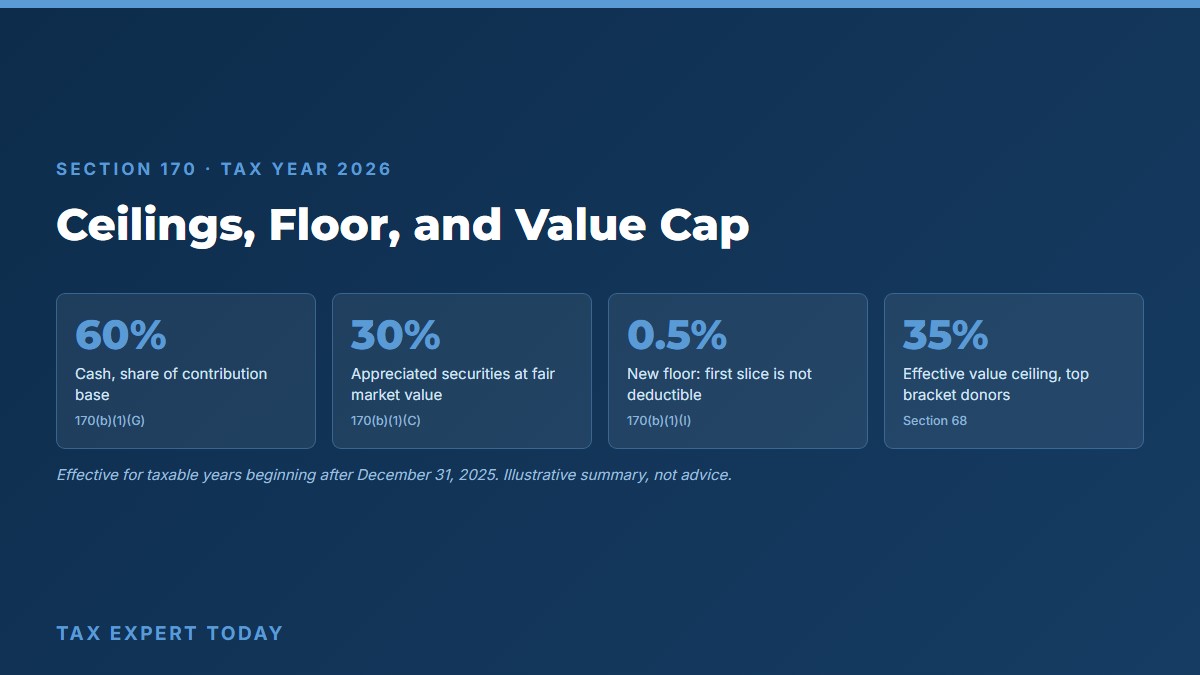
The 60 percent cash ceiling deserves a footnote of its own. Before the legislation enacted on July 4, 2025, that ceiling was scheduled to lapse after 2025, and clause (i) of Section 170(b)(1)(G) read as applying only to years beginning before January 1, 2026. That sunset was struck, so the 60 percent figure is now a permanent feature rather than a temporary one. Donors who deferred giving on the assumption the ceiling would drop back to 50 percent were planning against a rule that no longer exists.
What Is the New 0.5 Percent Floor and What Does It Cost?
Section 170(b)(1)(I) allows a charitable contribution only to the extent your aggregate contributions exceed 0.5 percent of your contribution base. The first slice of giving each year now produces no deduction at all. The provision applies to taxable years beginning after December 31, 2025, so 2026 is the first year any donor feels it.
This is the single largest gap between what the law now says about the donor advised fund tax deduction and what most published guidance still says. A donor with a $500,000 contribution base who moves $50,000 into a donor advised fund is comfortably under the 60 percent cash ceiling, so under the old rules the entire amount was deductible. Under the floor, the first $2,500 is absorbed and disappears.
| Step | Hypothetical figure |
|---|---|
| Contribution base | $500,000 |
| Cash contributed to the fund | $50,000 |
| 60 percent ceiling | $300,000 (not binding) |
| 0.5 percent floor absorbed | $2,500 |
| Deductible amount | $47,500 |
The figures above are illustrative and assume no other charitable giving during the year. The floor is measured against total charitable contributions, not against each gift separately, so a donor who also writes checks to a church or a university absorbs the floor once across everything rather than once per recipient.
Section 170(b)(1)(I) also sets an ordering rule that practitioners should read closely. The floor is applied first against contributions governed by subparagraph (D), then (C), then (B), then (E), then (A), and only last against the 60 percent cash category in subparagraph (G). In a year with a mixed giving profile, the floor therefore consumes the categories with the tighter ceilings before it touches cash. That ordering can preserve cash deduction room that a simpler reading of the statute would assume is lost.
Does the New $1,000 and $2,000 Charitable Deduction Cover a Donor Advised Fund?
No. Section 170(p) creates a deduction of up to $1,000, or $2,000 on a joint return, for taxpayers who do not itemize, but paragraph (2) expressly excludes any contribution made for the establishment of a new, or the maintenance of an existing, donor advised fund. A non-itemizer who funds a donor advised fund receives no deduction whatsoever.
This is the trap that most directly affects the donor advised fund tax deduction. The new non-itemizer deduction under Section 170(p) is the most widely publicized charitable change to take effect in 2026, and searches for it are climbing. Yet the statute carves donor advised funds out by name, cross referencing the Section 4966(d)(2) definition. It also excludes contributions to Section 509(a)(3) supporting organizations, and it reaches only cash.
- Who qualifies: taxpayers who claim the standard deduction, for cash gifts only.
- Amount: up to $1,000, or $2,000 on a joint return.
- Excluded: donor advised funds and supporting organizations, by statutory cross reference.
- Practical effect: the account is useful only to donors who itemize, or who bunch in order to itemize.
For a household that gives modestly and takes the standard deduction, this changes the recommendation. Giving $2,000 directly to an operating charity may produce a deduction where routing the same $2,000 through a donor advised fund produces none. The account is not the default answer for every donor, and the statute now says so explicitly.
How Does Bunching Work Under the 2026 Floor?
Bunching means concentrating several years of intended giving into one tax year so total itemized deductions clear the standard deduction, which is $32,200 for a married couple filing jointly in 2026. The 0.5 percent floor strengthens the case for bunching, because the floor is charged once in a single large year instead of once in each of several small years.
That second effect is new and is largely absent from current commentary. Consider a married couple with a $300,000 contribution base, $18,000 of other itemized deductions, and $12,000 of annual charitable intent.
| Approach | Year 1 | Year 2 | Year 3 | Three year total |
|---|---|---|---|---|
| Give $12,000 each year | $32,200 standard | $32,200 standard | $32,200 standard | $96,600 |
| Bunch $36,000 into the fund in year 1 | $52,500 itemized | $32,200 standard | $32,200 standard | $116,900 |
| Additional deductions | $20,300 |
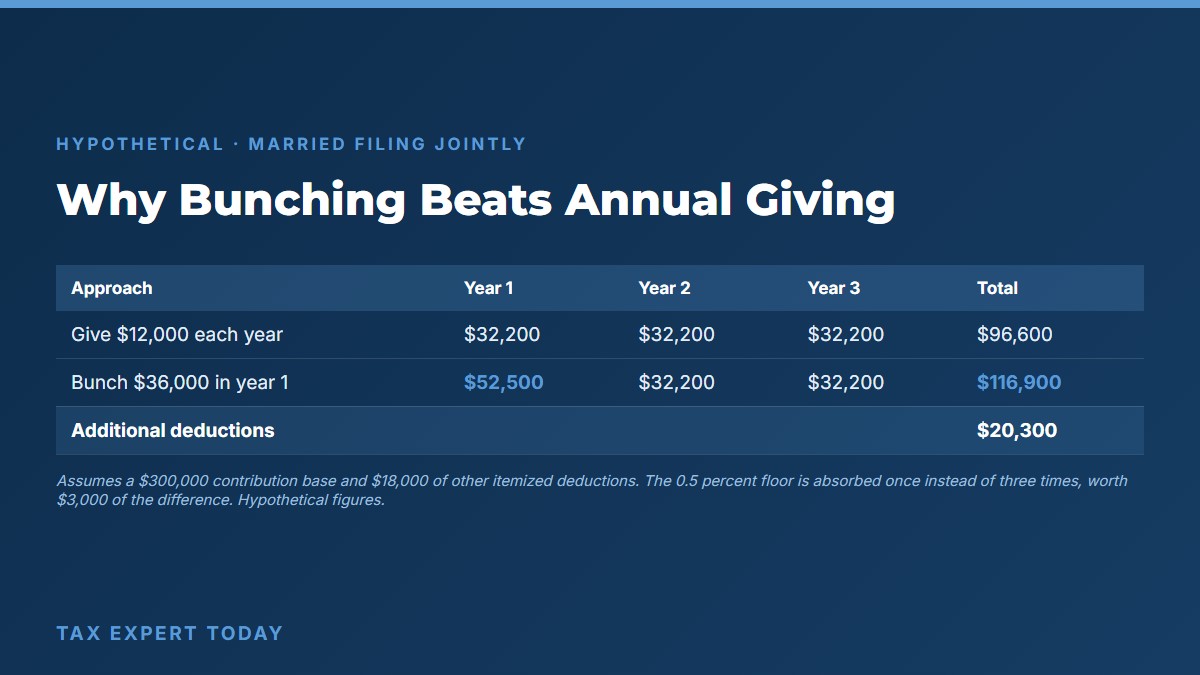
Walking the arithmetic: giving annually, the floor absorbs $1,500 each year, leaving $10,500 of allowable charitable deduction. Added to $18,000 of other itemized deductions that is $28,500, which is less than the $32,200 standard deduction, so the couple takes the standard deduction and the giving produces no incremental federal benefit in any of the three years. Bunching instead moves $36,000 into the account in year 1. The floor absorbs $1,500 once, leaving $34,500, which combined with $18,000 of other deductions gives $52,500 of itemized deductions in year 1, followed by the standard deduction in years 2 and 3.
The floor alone accounts for $3,000 of that improvement, because it is absorbed one time rather than three. All figures are hypothetical, assume the couple keeps recommending the same grants out of the account across the three years, and would change with different income, different state facts, or different deduction profiles.
Why Is a Top Bracket Donor’s Deduction Effectively Capped at 35 Percent?
Section 68 was rewritten entirely and now reduces otherwise allowable itemized deductions by 2/37 of the lesser of total itemized deductions or the taxable income above the level where the 37 percent bracket begins. Because 37 percent multiplied by 35/37 equals 35 percent, the practical ceiling on the value of any itemized deduction for a top bracket donor is 35 cents per dollar.
Section 68 reaches the donor advised fund tax deduction the same way it reaches every other itemized deduction. For 2026 the 37 percent bracket begins at $640,600 for single filers and $768,700 for married couples filing jointly. A donor below those thresholds is unaffected. A donor above them gives up roughly two percentage points of value on every deductible dollar, including charitable dollars.
| Step | Hypothetical figure |
|---|---|
| Contribution base | $1,200,000 |
| Cash to the donor advised fund | $100,000 |
| Less 0.5 percent floor | ($6,000) |
| Allowable before Section 68 | $94,000 |
| Section 68 reduction, 2/37 of that amount | ($5,081) |
| Deduction after the haircut | $88,919 |
| Value at a 37 percent marginal rate | $32,900 |
| Value without the haircut, for comparison | $34,780 |
The $32,900 result is exactly 35 percent of the $94,000 allowable amount, which is the arithmetic identity the provision was designed to produce. The figures are illustrative and assume the donor is well above the threshold so the reduction is measured against itemized deductions rather than against the smaller taxable income excess. Section 68(b) directs that the reduction is applied after every other limitation, so the floor comes first and the haircut second, in that order.
One planning implication follows directly. A donor who expects to be above the 37 percent threshold this year and below it in a future year is comparing a 35 percent benefit now against a potentially higher percentage benefit later, which is the opposite of the usual accelerate-the-deduction instinct. The comparison is fact specific and worth modeling before a large contribution is made.
Should You Give Appreciated Stock Instead of Cash?
Contributing long-term appreciated securities directly to the sponsoring organization generally produces two benefits at once: a deduction at fair market value under Section 170(b)(1)(C), and no recognition of the built in capital gain. Selling first and donating the proceeds produces a smaller gift and a smaller deduction, because the capital gains tax is paid along the way.
| Item | Give the stock | Sell first, then give the cash |
|---|---|---|
| Fair market value | $100,000 | $100,000 |
| Basis | $20,000 | $20,000 |
| Capital gains tax at 23.8 percent | $0 | $19,040 |
| Amount the charity receives | $100,000 | $80,960 |
| Less 0.5 percent floor | ($2,000) | ($2,000) |
| Deductible amount | $98,000 | $78,960 |
The 23.8 percent rate combines the top long-term capital gain rate with the 3.8 percent net investment income tax imposed by IRC Section 1411. The figures assume a $400,000 contribution base, so the 30 percent fair market value ceiling of $120,000 is not binding, and they assume the securities were held more than one year. Short-term holdings are a different analysis entirely, because Section 170(e)(1)(A) reduces the deduction to basis for property that would not have produced long-term gain.
Two cautions belong with this table. First, the fair market value treatment depends on the property being capital gain property to which Section 170(e)(1)(B) does not apply, which excludes certain tangible personal property put to an unrelated use. Second, a concentrated low basis position is often the very asset a donor is reluctant to part with, and the charitable answer should be weighed against other strategies for a concentrated holding. Our guide to charitable remainder trust tax rules covers the alternative that keeps an income stream, and the analysis in selling a business and the taxes that follow covers the liquidity event case. Owners planning a sale often coordinate this with our business consulting team.
Donor Advised Fund vs Private Foundation: Which Deduction Is Better?
On the deduction alone the donor advised fund wins, because the sponsoring organization is a public charity and attracts the higher percentage ceilings. A private foundation is limited to 30 percent of contribution base for cash under Section 170(b)(1)(B) and 20 percent for appreciated capital gain property under Section 170(b)(1)(D). Control and permanence are what a foundation buys in exchange.
| Feature | Donor advised fund | Private foundation |
|---|---|---|
| Cash deduction ceiling | 60 percent of contribution base | 30 percent |
| Appreciated securities ceiling | 30 percent at fair market value | 20 percent |
| Excise tax on net investment income | None at the donor level | 1.39 percent under Section 4940 |
| Annual distribution requirement | None imposed on the account itself | Broadly 5 percent under Section 4942 |
| Annual information return | Filed by the sponsoring organization | Form 990-PF, publicly available |
| Donor role | Advisory privileges only | Legal control through the board |
| Anonymity of grants | Generally available | Grants are disclosed |
The honest framing is that these are not competitors so much as different instruments, and the donor advised fund tax deduction is only one input into the choice. Families that want to employ family members, run their own programs, or control investments indefinitely accept the tighter ceilings and the compliance load of a foundation. Families that want the largest current deduction and minimal administration use the fund. A number of families use both, funding a foundation for program work and a donor advised fund for the years when a large deduction is needed. The Section 4942 payout rules and the Section 4940 excise tax are the two ongoing costs that most often surprise first time foundation founders.
What Substantiation Does a Donor Advised Fund Tax Deduction Require?
Section 170(f)(18) imposes a requirement unique to these accounts. Beyond the ordinary contemporaneous written acknowledgment, the donor must obtain a written acknowledgment from the sponsoring organization stating that the organization has exclusive legal control over the assets contributed. Without that specific statement the deduction is denied outright.
- The exclusive legal control statement: required by 170(f)(18)(B) and specific to donor advised funds.
- Sponsor eligibility: 170(f)(18)(A) denies the deduction if the sponsor is a non-functionally integrated Type III supporting organization.
- Form 8283: required for non-cash contributions where the claimed deduction exceeds $500.
- Qualified appraisal: required for property above the statutory threshold, but Section 170(f)(11)(A)(ii)(I) exempts publicly traded securities.
That last exemption is worth emphasizing because it is a frequent source of unnecessary expense when a donor advised fund tax deduction is being substantiated. Donating publicly traded stock to a sponsoring organization does not require a qualified appraisal. Donating an interest in a closely held business, real estate, or a partnership interest does, and the appraisal has to be obtained before the return is filed. The IRS instructions for Form 8283 set out which section of the form applies at which dollar level, and IRS Publication 526 covers the general substantiation framework for charitable contributions.
What Breaks a Donor Advised Fund Tax Deduction?
The donor advised fund tax deduction is generally lost or penalized when the donor receives something back, when the account is used to satisfy a personal obligation, or when a grant reaches an individual. Section 4967 imposes a tax equal to 125 percent of the benefit on a donor or advisor who recommends a distribution producing a more than incidental benefit, and Section 4966 taxes the sponsoring organization on taxable distributions.
- Grants to individuals: Section 4966(c)(1)(A) makes any distribution to a natural person a taxable distribution, carrying a 20 percent tax on the sponsoring organization and 5 percent on a knowing fund manager, capped at $10,000 per distribution.
- Benefits flowing back: tickets, tables at a gala, memberships, or preferred seating obtained through a grant can trigger the Section 4967 tax of 125 percent of the benefit.
- Bifurcated event gifts: splitting a ticket price into a deductible portion and a benefit portion is generally not available through these accounts.
- Personal pledges: using the account to satisfy a legally binding personal pledge raises a more than incidental benefit question and should be reviewed before the grant is recommended.
- Missing the acknowledgment: failing to obtain the exclusive legal control statement denies the deduction under Section 170(f)(18) even where everything else is correct.
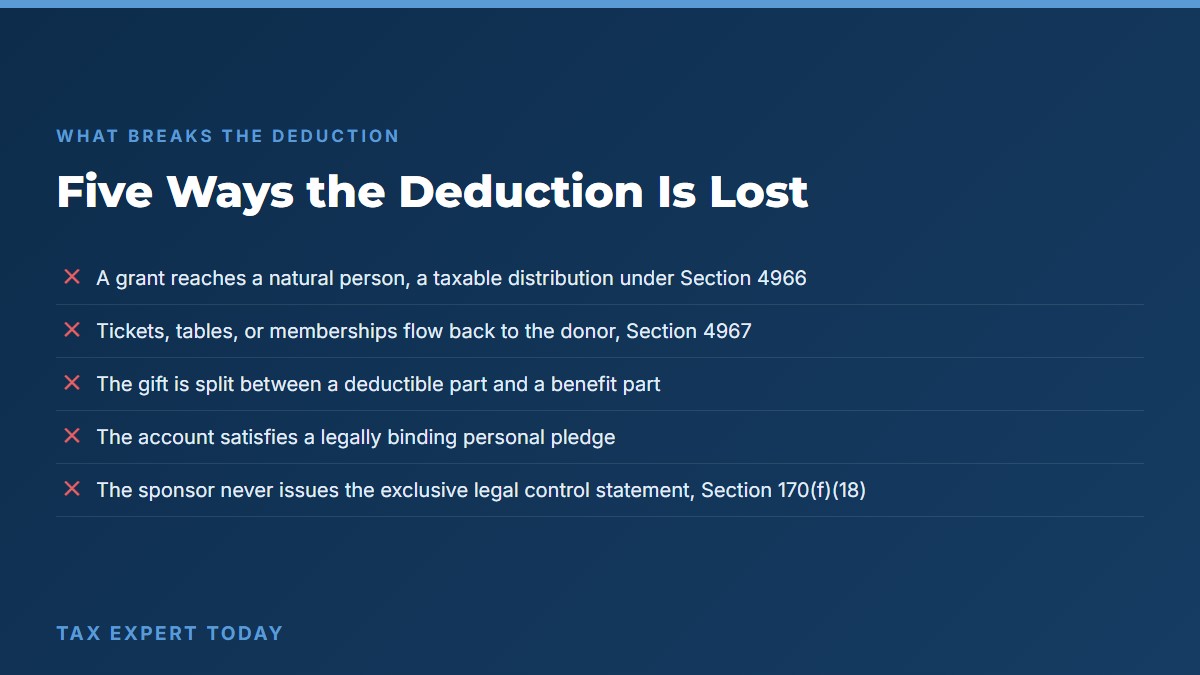
None of these ways of losing a donor advised fund tax deduction are exotic. The gala ticket and the pledge are the two that arise most often in practice, and both are usually solvable if the question is asked before the grant recommendation rather than after. The IRS overview of donor advised funds describes the excise tax regime the agency applies in this area. Both issues recur with a qualified charitable distribution, where the consequences are harsher, because a donor advised fund cannot receive one at all and a benefit accepted in return voids the entire exclusion rather than reducing it.
Donor Advised Fund Tax Deduction Naples: Help in Southwest Florida
The donor advised fund tax deduction comes up in a recognizable Southwest Florida fact pattern. A household sells a business or a long held property, has one unusually high income year, holds appreciated securities with very low basis, and has genuine charitable intent that has never been formalized. That combination is precisely where the front loaded deduction, the appreciated stock route, and bunching all point in the same direction.
Florida changes the analysis in one specific way. Because Florida imposes no personal income tax, the entire benefit of the deduction is federal, and there is no state charitable deduction to layer on top. For a donor relocating from a state that does tax income, the sequence matters, since the year of the contribution and the year residency changes may not be the same. Our guides to establishing Florida residency and to moving to Florida before selling a business work through that sequencing problem in detail.
Tax Expert Today LLC works with clients in Naples, Florida on modeling the floor and the Section 68 haircut before a contribution is made, on choosing between cash and appreciated securities, on sizing a bunched contribution against the standard deduction, on coordinating the gift with a high income year created by a cash balance plan contribution, and on confirming that the sponsoring organization will issue the exclusive legal control acknowledgment the statute requires. Our team includes tax advisors, enrolled agents, CPAs, and attorneys, so the charitable design and the tax modeling happen in the same conversation. For broader planning work see our Naples tax planning page and our estate and trust planning services.
Our office is at 11983 Tamiami Trail N, Naples, FL 34110. Call (239) 441-2005. Office hours are Monday through Friday, 10:00 to 5:00 Eastern Time. We serve Naples, Bonita Springs, Estero, Fort Myers, Marco Island, and the surrounding communities, and we work with clients in all 50 states.
Does Florida give a state deduction for a donor advised fund contribution? No. Florida imposes no personal income tax on individuals, so there is no state level charitable deduction to claim. The entire benefit of a donor advised fund tax deduction for a Florida resident is federal, which also means the 0.5 percent floor and the Section 68 haircut are the only two reductions that apply.
When to Engage a Professional
A contribution that generates a donor advised fund tax deduction is irrevocable. That single feature is why the analysis belongs before the transfer rather than after it. Professional review is generally warranted when the contribution is large relative to your contribution base, when you expect to cross or fall below the 37 percent bracket threshold, when the asset is anything other than cash or publicly traded stock, or when the account is being funded in the same year as a business sale or another liquidity event.
The questions worth answering in advance are concrete. How much of the contribution survives the floor. Whether the 60 percent or the 30 percent ceiling binds, and what carries forward if it does. Whether the Section 68 reduction applies this year. Whether bunching two or three years clears the standard deduction. Whether the sponsoring organization will provide the acknowledgment Section 170(f)(18) requires. Whether a charitable remainder trust or a direct gift serves the goal better than a fund account.
If you are weighing a contribution this year, our team can model the outcome before anything becomes irrevocable. Call (239) 441-2005 or visit our tax planning services page to arrange a consultation. Scope and fees are quoted after a consultation, once the facts are understood.
Frequently Asked Questions
What is the new $2,000 charitable deduction, and does it cover a donor advised fund?
Section 170(p) allows taxpayers who do not itemize to deduct up to $1,000, or $2,000 on a joint return, for cash contributions. Paragraph (2) expressly excludes contributions made to establish or maintain a donor advised fund. A non-itemizer who funds one of these accounts therefore receives no deduction at all, and should consider giving directly to an operating charity instead.
Can you claim a donor advised fund tax deduction if you take the standard deduction?
No. The charitable deduction for these accounts is an itemized deduction, and the new non-itemizer deduction excludes them by name. This is why bunching several years of giving into one year matters. It is the mechanism that lets a household clear the $32,200 joint standard deduction in 2026 and actually use the contribution.
How long can you carry forward an unused donor advised fund tax deduction?
Five succeeding taxable years, in order of time, under Section 170(b)(1)(C)(ii) for appreciated property and Section 170(b)(1)(G)(ii) for cash. The carryforward preserves amounts blocked by the percentage ceilings. Amounts absorbed by the 0.5 percent floor are not carried forward, because the floor removes them from the allowable amount rather than deferring them.
What is the downside to a donor advised fund?
The contribution is irrevocable and you hold advisory privileges rather than control, so the sponsoring organization is not legally obligated to follow a recommendation. There is no deduction in the years grants are actually made, the 0.5 percent floor applies, and non-itemizers get nothing. Sponsoring organizations also charge administrative and investment fees that reduce the amount ultimately granted.
What are the IRS rules for donor advised funds?
The core rules sit in Section 4966, which defines the account and taxes taxable distributions at 20 percent, Section 4967, which taxes a more than incidental benefit at 125 percent, and Section 170(f)(18), which conditions the deduction on a written acknowledgment of exclusive legal control. Distributions to individuals are prohibited, and grants that return a benefit to the donor are penalized.
This article is educational and general in nature. It is not tax, legal, or investment advice, and it does not create a client relationship. The donor advised fund tax deduction depends on your specific facts, and the rules discussed here took effect for taxable years beginning after December 31, 2025. All figures shown are hypothetical illustrations. Consult a qualified advisor before acting.
Published August 21, 2026 by Dr. Pellumb Kabashi « Back to Learning Center
Have a question this article touches on?
Tax Expert Today LLC, based in Naples, Florida and serving clients across the United States.
Schedule a Consultation (239) 441-2005