
By Dr. Pellumb Kabashi, DBA, MBA, CES, CFE, EA
Founder, Tax Expert Today LLC · Tax advisors, enrolled agents, CPAs, and attorneys · Serving clients in all 50 states
Quick Answer
Net unrealized appreciation is the growth in employer stock while it sat inside a qualified plan. Under IRC Section 402(e)(4)(B), a lump-sum distribution of that stock leaves the appreciation out of gross income in the distribution year, so only the plan cost basis is taxed as ordinary income and the appreciation is later taxed as long-term capital gain. The election is easy to void and it is not always the better answer. Call (239) 441-2005 for a free consultation.
What is net unrealized appreciation?
Net unrealized appreciation is the excess of the market value of employer securities at the moment they leave a qualified plan over the cost or other basis of those securities to the trust. Treas. Reg. 1.402(a)-1(b)(2)(i) states the measurement that way, against basis to the trust rather than anything the participant paid, and the figure is fixed permanently on the distribution date.
- It is a net figure. The same regulation provides that where a distribution includes both appreciated and depreciated securities, the amount is the net increase in value across all of them.
- It is measured against the trust. The relevant cost is what the plan paid, not what the employee contributed.
- It is frozen at distribution. Movement in the share price afterward is ordinary capital gain or loss, not additional net unrealized appreciation.
- It applies only to securities. Section 402(e)(4)(E)(i) limits the term to shares of stock and to bonds or debentures issued by a corporation with interest coupons or in registered form.
- Parent and subsidiary stock counts. Section 402(e)(4)(E)(ii) extends the definition to securities of a parent or subsidiary corporation as defined in Section 424(e) and (f).
The practical consequence is a split. When the shares come out in kind, the plan cost basis is ordinary income immediately, and the appreciation rides along untaxed until the shares are sold, at which point it is long-term capital gain. Treas. Reg. 1.402(a)-1(b)(2)(i) adds a rule that catches people out: two or more distributions made by a trust to the same distributee in a single taxable year are treated as one distribution.
Which distributions qualify for net unrealized appreciation treatment?
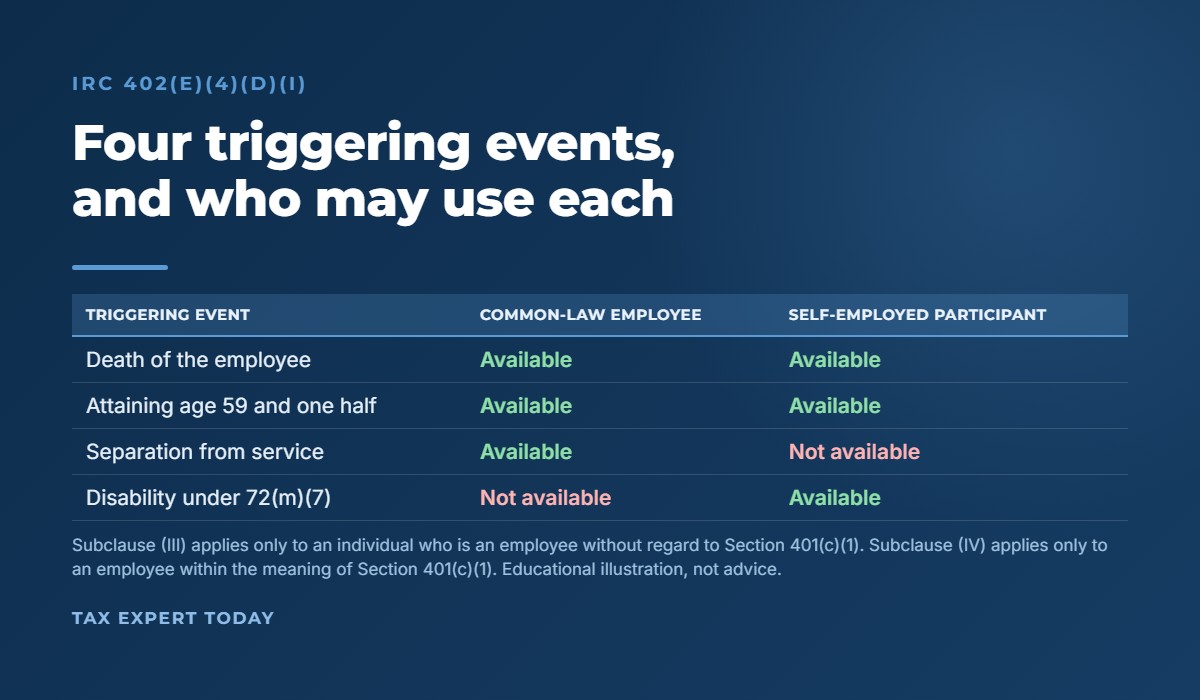
Only a lump-sum distribution qualifies for full treatment. Section 402(e)(4)(D)(i) defines that as the payment, within one taxable year, of the balance to the credit of the employee, becoming payable on account of one of exactly four events. Miss the definition and the exclusion shrinks to the portion attributable to employee contributions under Section 402(e)(4)(A).
- Death of the employee, under subclause (I).
- Attainment of age 59 and one half, under subclause (II).
- Separation from service, under subclause (III).
- Disability within the meaning of Section 72(m)(7), under subclause (IV).
The aggregation rule in Section 402(e)(4)(D)(ii)(I) is where planning actually happens. All trusts within a plan count as a single trust, all pension plans of the employer count as one plan, all profit-sharing plans count as one plan, and all stock bonus plans count as one plan. Publication 575 restates this as the balance from all of an employer qualified plans of one kind. An employer running both a 401(k), which is a profit-sharing plan, and a separate employee stock ownership plan, which is a stock bonus plan, therefore presents two independent categories. Emptying one does not require emptying the other.
| Triggering event | Statutory cite | Available to a common-law employee | Available to a self-employed participant |
|---|---|---|---|
| Death of the employee | 402(e)(4)(D)(i)(I) | Yes | Yes |
| Attaining age 59 and one half | 402(e)(4)(D)(i)(II) | Yes | Yes |
| Separation from service | 402(e)(4)(D)(i)(III) | Yes | No |
| Disability under 72(m)(7) | 402(e)(4)(D)(i)(IV) | No | Yes |
Two further limits sit in the same subparagraph and are worth knowing. Clause (iii) provides that the paragraph is applied without regard to community property laws, and clause (v) removes from the balance to the credit any amount payable to an alternate payee under a qualified domestic relations order.
Why does the triggering event depend on employment status?
Because the statute says so, in a sentence most published guidance omits. Section 402(e)(4)(D)(i) provides that subclause (III), separation from service, applies only to an individual who is an employee without regard to Section 401(c)(1), while subclause (IV), disability, applies only to an employee within the meaning of Section 401(c)(1), meaning a self-employed individual.
- A common-law employee cannot use disability as the triggering event, however severe the disability is.
- A self-employed participant cannot use separation from service, because there is no service to separate from in the statutory sense.
- Publication 575 mirrors the split, conditioning separation on the participant being an employee and disability on the participant being a self-employed individual.
- Death and age 59 and one half are open to both, which is why a self-employed owner holding appreciated company stock usually waits for the age trigger.
This matters most for owner-participants in a closely held business whose plan holds stock of that business. A partner or sole proprietor who winds down operations has not separated from service in the statutory sense, so the plan for the distribution has to be built around age 59 and one half instead. Reaching the wrong conclusion here does not produce a smaller benefit. It produces no lump-sum distribution at all, and with it no exclusion for the appreciation.
How is the amount computed, and what does the plan report?
The plan computes it and reports it in Box 6 of Form 1099-R. The Instructions for Form 1099-R direct the payer to enter all the net unrealized appreciation when the payment is a lump-sum distribution, to include that amount in Box 1 but not in Box 2a, and to look to Treas. Reg. 1.402(a)-1(b) and Notice 89-25 for the determination.
- Box 1 carries the full market value of the securities on the distribution date.
- Box 2a carries only the plan cost basis, which is the amount that becomes ordinary income this year.
- Box 6 carries the appreciation, which is excluded now and taxed later as long-term capital gain.
- Box 2a plus Box 6 should reconcile to Box 1 where the entire position is employer stock, and a distribution that fails to reconcile is worth querying before the return is filed.
- The payer is not required to complete Box 6 for a direct rollover, which is a quiet trap discussed further below.
Treas. Reg. 1.402(a)-1(b)(2)(ii) sets out how the trust determines its own basis in a distributed share, and the method drives the result. Where a security was earmarked to a particular employee account when it was acquired, that actual cost is used. Where the trust allocates acquisitions among participant accounts at the close of each period not exceeding twelve months, average cost for that allocation period is used. A third method applies where the fund or a specified portion of it is invested exclusively in one type of employer security. Plans that have held stock for decades frequently carry very different per-share costs across lots, which is what makes selective distribution worth modeling.
The worked figures throughout this article use one hypothetical participant, filing jointly, with 20,000 shares of employer stock in a former employer 401(k). The shares are worth $85.00 each on the distribution date and carry a plan cost of $17.00 each. The plan also holds $700,000 of other assets, and the household has $180,000 of other taxable income. These are illustrative assumptions, not a projection, and every figure changes with different facts.
| Form 1099-R line | Contents | Amount | Tax character this year |
|---|---|---|---|
| Box 1 | Gross distribution, market value of 20,000 shares at $85.00 | $1,700,000 | Reported, not all taxable |
| Box 2a | Taxable amount, plan cost at $17.00 per share | $340,000 | Ordinary income |
| Box 6 | Net unrealized appreciation | $1,360,000 | Excluded under 402(e)(4)(B) |
| Check | Box 2a plus Box 6 | $1,700,000 | Reconciles to Box 1 |
| Ratio | Appreciation as a share of the position | 80.0 percent | The variable that decides the case |
What does the election look like in actual numbers?
On these facts the election converts $1,360,000 that would otherwise have been ordinary income into long-term capital gain. Against an immediate full rollover and withdrawal, the modeled federal tax falls from roughly $662,700 to roughly $437,500, a difference of about $225,300, which is close to 13 percent of the position at distribution.
- Year one cost is real. The $340,000 of basis is ordinary income immediately, producing about $90,500 of incremental federal tax on these assumptions.
- The other plan assets can still roll. Moving the $700,000 of non-stock assets by direct rollover is itself a distribution from the plan, so it does not defeat the requirement that the balance leave within one taxable year.
- The appreciation is taxed only on sale. Nothing is due on the $1,360,000 until the shares are actually sold.
- The 3.8 percent surtax appears later, not now. Section 1411(c)(5) excludes plan distributions from net investment income, so the year-one ordinary income escapes the surtax while the eventual gain does not.
Assume the shares are sold three years later at $95.00. Total gain is $1,560,000, of which $1,360,000 is the appreciation taxed as long-term capital gain by statute regardless of holding period, and $200,000 is post-distribution growth that is long-term because the shares were held more than a year.
| Item | Election under 402(e)(4)(B) | Roll everything to an IRA, withdraw in one year |
|---|---|---|
| Ordinary income in the distribution year | $340,000 | None |
| Federal tax in the distribution year | $90,514 | None |
| Amount recognized on sale or withdrawal | $1,560,000 capital gain | $1,900,000 ordinary income |
| Tax on that amount | $290,315 | $662,740 |
| Net investment income tax at 3.8 percent | $56,620 | $0 |
| Total modeled federal tax | $437,450 | $662,740 |
| Effective rate on the position | 23.0 percent | 34.9 percent |
Figures use the 2026 rate tables and capital gain breakpoints published in Rev. Proc. 2025-32, under which the 15 percent capital gain rate runs to $613,700 of taxable income for a joint return and the 20 percent rate applies above it. Results depend entirely on the assumed facts and on rates remaining as enacted.
When does a plain rollover beat net unrealized appreciation?
More often than the comparison above suggests, because withdrawing an entire IRA in one year is the worst case for the rollover and nobody plans that way. Modeled against a patient ten-year drawdown of the same value, the election on these facts wins by only about $12,300, and the advantage disappears entirely once the plan cost basis rises above roughly 26 percent of market value.
- Spreading withdrawals lowers the ordinary rate. Ten annual withdrawals of $190,000 carry an incremental rate near 23.7 percent rather than 34.9 percent.
- Basis is the deciding variable. Low basis favors the election, because little is taxed now and a great deal is converted.
- High basis favors the rollover. A large ordinary-income hit today buys a shrinking amount of conversion.
- Concentration risk sits outside the tax math. Holding a single stock to protect a tax result is an investment decision that belongs alongside the tax one.
| Plan cost basis as a share of market value | Basis per share | Appreciation | Modeled tax, election | Modeled tax, ten-year drawdown | Better route |
|---|---|---|---|---|---|
| 5 percent | $4.25 | $1,615,000 | $427,397 | $449,720 | Election |
| 10 percent | $8.50 | $1,530,000 | $427,567 | $449,720 | Election |
| 20 percent | $17.00 | $1,360,000 | $437,450 | $449,720 | Election |
| 25 percent | $21.25 | $1,275,000 | $446,970 | $449,720 | Election |
| 26.4 percent | $22.48 | $1,251,200 | Breakeven on these facts | Neither | |
| 30 percent | $25.50 | $1,190,000 | $456,490 | $449,720 | Rollover |
| 50 percent | $42.50 | $850,000 | $499,796 | $449,720 | Rollover |
| 80 percent | $68.00 | $340,000 | $567,116 | $449,720 | Rollover |
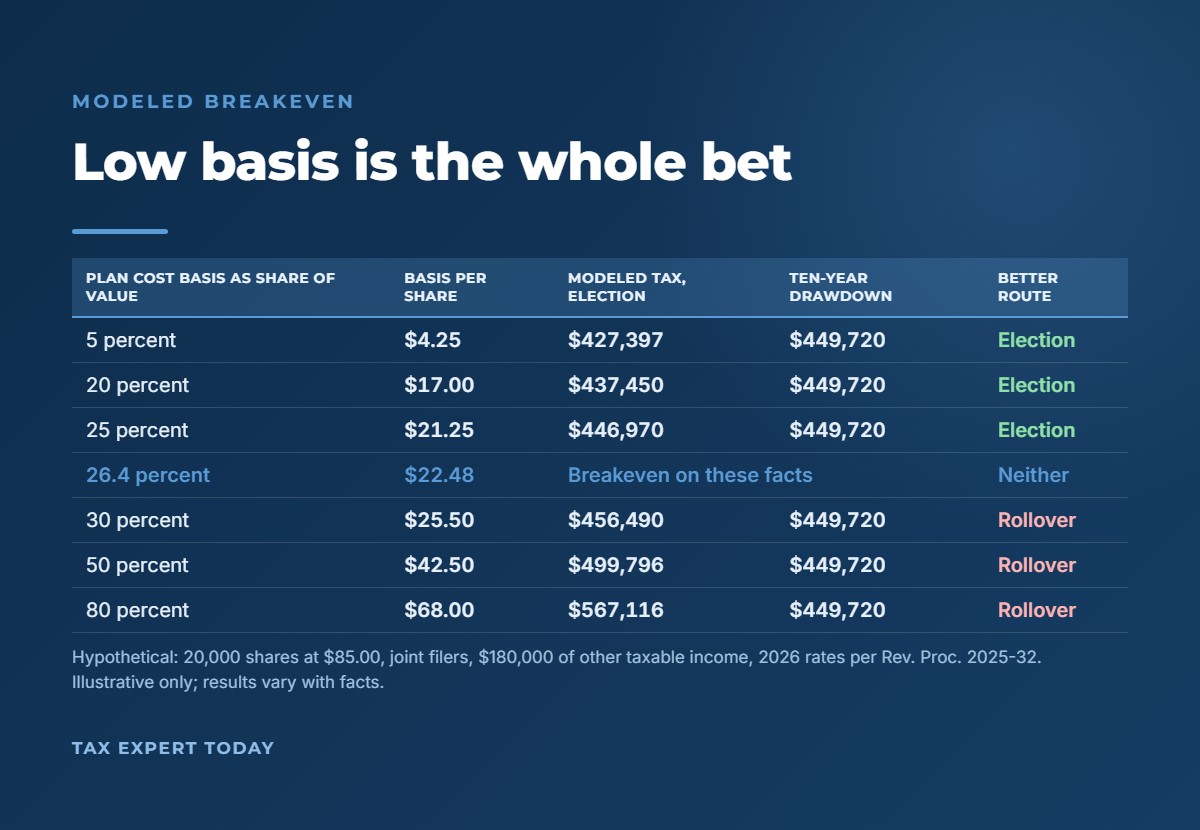
The breakeven is the number worth carrying into a meeting. On this set of assumptions the election stops paying once the plan cost basis reaches about 26 percent of market value, or roughly $22.48 on an $85.00 share. That figure moves with the household ordinary rate, with the number of years the drawdown is spread across, with state residence, and with the assumed sale price, so it should be recomputed for the actual plan rather than borrowed. What does not move is the shape of the answer: the election is a bet on low basis, and a plan that bought most of its shares recently rarely offers one.
Does the 10 percent early distribution penalty apply?
It applies, but only to the cost basis, never to the appreciation. Section 72(t)(1) increases the tax by 10 percent of the portion of a distribution which is includible in gross income. Because Section 402(e)(4)(B) excludes the appreciation from gross income, the penalty base is the Box 2a figure alone.
- The exposure is bounded. On the running example the penalty base is $340,000, not $1,700,000, so the maximum charge is $34,000.
- Separation at or after 55 removes it. Section 72(t)(2)(A)(v) excepts distributions made to an employee after separation from service after attainment of age 55.
- Age 59 and one half removes it. Section 72(t)(2)(A)(i) provides the general age exception.
- Death and disability remove it. Clauses (ii) and (iii) cover distributions to a beneficiary after death and distributions attributable to disability.
- Separating before 55 is the exposed case. The exception in clause (v) turns on the age at separation, not the age at distribution, so separating at 54 and distributing at 56 does not qualify.
| Age at separation from service | Age at distribution | Applicable exception | Penalty on $340,000 of basis |
|---|---|---|---|
| 51 | 52 | None available | $34,000 |
| 54 | 56 | None: separation occurred before 55 | $34,000 |
| 55 | 56 | 72(t)(2)(A)(v), separation at or after 55 | $0 |
| 58 | 58 | 72(t)(2)(A)(v), separation at or after 55 | $0 |
| 60 | 60 | 72(t)(2)(A)(i), age 59 and one half | $0 |
The planning point is narrow and useful. Where an executive is separating in the two or three years before turning 55, the timing of the separation itself, rather than the timing of the distribution, may decide whether the penalty applies at all. The general guidance at IRS Topic 558 collects the exceptions.
What silently disqualifies the election?
Four things, and all of them are procedural rather than substantive. The election is lost not because the taxpayer fails a test of merit but because the balance did not leave the plan the way Section 402(e)(4)(D)(i) requires, or because the shares landed in the wrong account.
- Rolling the stock itself into an IRA. The appreciation disappears permanently into the IRA and every later dollar comes out as ordinary income.
- Leaving a balance behind. The statute requires the balance to the credit to be paid within one taxable year, so a residual position in the same category of plan defeats the definition.
- An intervening distribution after the triggering event. Where a partial distribution is taken in a year after the event and before the intended lump-sum year, the balance has not been paid within one taxable year with respect to that event, and a fresh triggering event is generally needed.
- Assuming the plan will compute Box 6. The Instructions for Form 1099-R state that the payer does not have to complete Box 6 for a direct rollover, so the figure has to be requested and confirmed in advance on the form itself.
The fourth item is the one that turns a good plan into a bad outcome quietly. A participant who instructs a direct rollover of everything, intending to sort the stock out afterward, may receive a Form 1099-R with no Box 6 amount at all and no practical way to reconstruct the plan basis years later. The sequence matters: confirm the per-share plan basis in writing, decide which lots are distributed in kind, and only then instruct the transfer of the remainder.
Does the appreciation get a step-up in basis at death?
No. Rev. Rul. 75-125 holds that net unrealized appreciation is a right to receive an item of income in respect of a decedent under Section 691(a), and Section 1014(c) provides that the ordinary date-of-death basis rule does not apply to such property. The heir inherits the shares with basis reduced by the entire appreciation.
- The character survives. Section 691(a)(3) treats the item as having the same character it would have had for the decedent, so the appreciation remains long-term capital gain.
- The basis computation is subtraction. Rev. Rul. 75-125 computes the heir basis as date-of-death value less the appreciation carried over from the original distribution.
- Post-death growth does step up. Only the frozen appreciation is denied the step-up; growth after death is treated normally.
- Section 691(c) offers partial relief. A deduction is allowed for the federal estate tax attributable to including the right to that income in the estate, where estate tax was actually paid.
| Step | Amount | Authority |
|---|---|---|
| Market value at death, 20,000 shares at $110.00 | $2,200,000 | 1014(a) |
| Less appreciation frozen at the original distribution | ($1,360,000) | 1014(c) and Rev. Rul. 75-125 |
| Basis in the hands of the heir | $840,000 | Rev. Rul. 75-125 |
| Heir sells at $115.00 per share | $2,300,000 | |
| Gain attributable to the appreciation, long-term | $1,360,000 | 691(a)(3) |
| Gain attributable to growth after death | $100,000 | 1014(a) |
| Total taxable gain to the heir | $1,460,000 | |
| Tax a full step-up would have erased, at 20 percent | $272,000 | Illustrative |
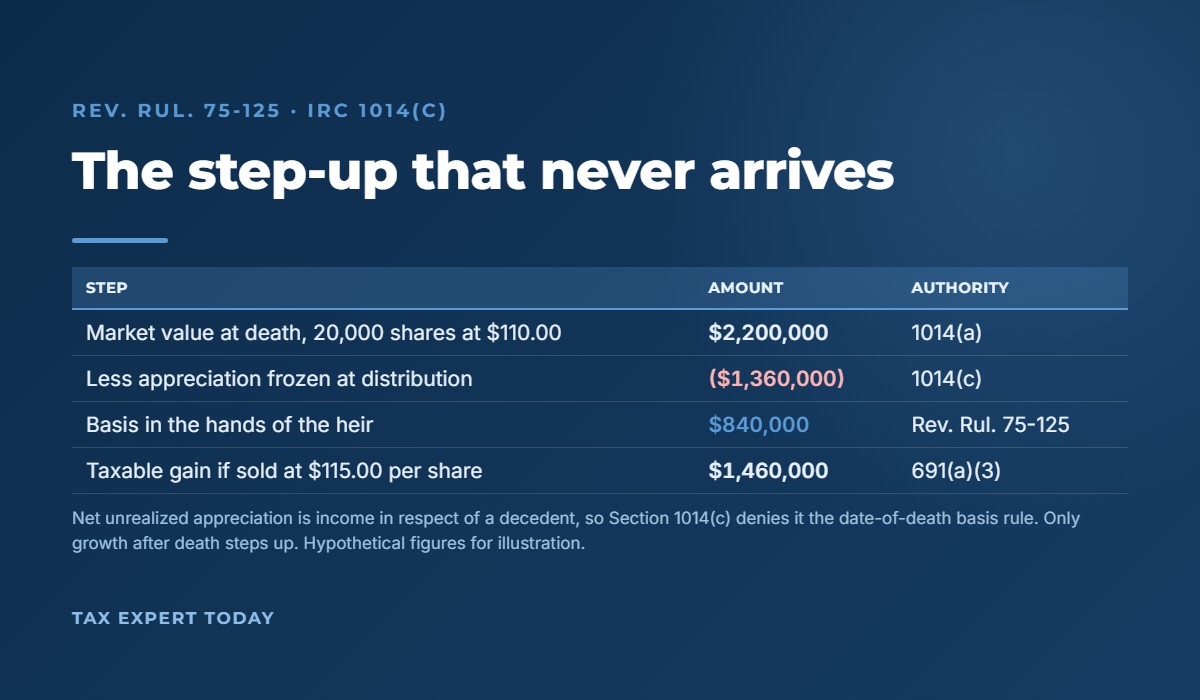
This is the single most expensive thing families discover late. An heir who assumes a clean step-up, sells promptly, and spends the proceeds can face a capital gain bill on appreciation that accrued inside a retirement plan decades earlier. Where the intention is to leave concentrated low-basis stock to heirs rather than to spend it, the case for taking the distribution at all weakens considerably, and a charitable structure may serve better. A charitable remainder trust and a donor-advised fund both address concentrated appreciated positions through different mechanisms.
How does the net investment income tax interact with the election?
The two halves of the transaction are treated differently. Section 1411(c)(5) excludes any distribution from a Section 401(a) plan from net investment income, so the ordinary income recognized on the cost basis escapes the 3.8 percent surtax. The later capital gain on the shares, realized in a taxable account, does not.
- Year one is outside the surtax. The $340,000 of basis income is a plan distribution and therefore excluded.
- The sale year is inside it. The $1,560,000 gain is net gain from the disposition of property and counts in full.
- Thresholds are not indexed. Section 1411(b) sets $250,000 for a joint return and $200,000 in most other cases, and those figures do not adjust for inflation.
- The basis income still does damage indirectly. It raises modified adjusted gross income, which can pull other investment income above the threshold in the distribution year even though the distribution itself is exempt.
On the running example the surtax adds $56,620 in the sale year. That is a real cost of the election, and it is one of the reasons the advantage over a patient drawdown is narrower than the headline comparison implies. An IRA distribution taken slowly carries no surtax at all under the same exclusion.
What happens to the shares after the distribution?
They sit in a taxable brokerage account with a basis equal to the amount already taxed. Treas. Reg. 1.402(a)-1(b)(1)(i) provides that the excluded appreciation is not included in basis, is treated as long-term capital gain to the extent realized in a later taxable transaction, and that any gain beyond it takes its character from the holding period in the hands of the distributee.
- The appreciation is always long-term. Selling the day after distribution does not make that portion short-term.
- Growth beyond it is not. A sale within twelve months makes the excess short-term capital gain.
- Basis has three components. Publication 575 lists participant contributions attributable to the securities, employer contributions already taxed, and any appreciation the participant elected to include in income.
- A loss is possible. Where the shares fall below the taxed basis, the difference is a capital loss subject to the ordinary limitations.
The asymmetry deserves emphasis because it points at the exit strategy. Selling immediately captures the statutory long-term rate on the entire appreciation with no holding period risk. Holding on adds concentration risk to capture nothing extra on that portion, and exposes any further growth to short-term rates for the first year.
Can a former spouse use net unrealized appreciation?
Yes, in the right circumstances. Section 402(e)(4)(D)(vii) provides that where a distribution of the balance to the credit of the employee would be treated as a lump-sum distribution, a payment under a qualified domestic relations order of the balance to the credit of an alternate payee who is the spouse or former spouse is itself treated as a lump-sum distribution.
- The alternate payee gets an independent test. The balance to the credit of the alternate payee excludes any amount still payable to the employee.
- The order has to be qualified. Section 414(p) governs, and a domestic relations order that does not meet it does not reach this rule.
- The employee side is reduced. Clause (v) removes the alternate payee amount from the employee balance to the credit, which can help the employee satisfy the one-year requirement.
- Community property is disregarded. Clause (iii) applies the whole paragraph without regard to community property laws.
Divorce settlements that divide a plan holding appreciated employer stock therefore carry a tax question that the property division alone does not answer. The interaction between the order, the plan basis records, and the timing of each side distribution is worth modeling before the order is drafted rather than after, and it sits alongside the wider set of QDRO tax consequences.
Is Form 4972 still relevant to this analysis?
Almost never in 2026. Form 4972 offers ten-year averaging and a 20 percent capital gain election on lump-sum distributions, but Part I limits it to plan participants born before January 2, 1936. Anyone meeting that condition reaches age 90 during 2026, so the provision now touches a very small population.
- The birth-date limit is absolute. Lines 3 and 4 of Part I end the form for anyone born later.
- It is a once-only election. Line 5a bars the form where it was used for a previous distribution from the same participant plan after 1986.
- Any rollover ends it. Line 2 disqualifies a distribution where any part was rolled over.
- It is a separate decision. Publication 575 notes that a participant may instead elect to include the appreciation in income at distribution, in which case the entire value is ordinary income and none of it qualifies for capital gain treatment under these rules.
This matters mainly as a reading warning. A large amount of published material on this topic was written when ten-year averaging was widely available and treats it as a live alternative. Guidance that leans on Form 4972 without stating the birth-date limit should be checked against the current form before it is relied on.
Net unrealized appreciation Naples: help in Southwest Florida
Tax Expert Today LLC advises retiring executives and plan participants in Naples, Florida and across Southwest Florida on the lump-sum qualification test, the plan basis records, the breakeven against a rollover, and the estate consequences of a frozen appreciation figure. The firm serves clients in all 50 states under federal practice authority.
Florida imposes no personal income tax, which changes this analysis more than it changes most. The ordinary income on the plan cost basis and the later capital gain on the shares both escape a state layer entirely for a Florida resident. The timing question is the interesting one, because the distribution frequently follows a move. Under 4 U.S.C. Section 114(a), no state may impose an income tax on the retirement income of an individual who is not a resident or domiciliary of that state, and subsection (b)(1)(A) defines retirement income to include income from a qualified trust under Section 401(a). A participant who has genuinely established Florida residency before taking the distribution is therefore protected from the former state taxing the ordinary income portion, whatever that state might prefer. Residency has to be real and documented, which is a separate exercise from the tax election and one worth completing first. Participants often review this alongside the wider question of retiring to Florida and the practical steps for establishing Florida residency.
Our office is at 11983 Tamiami Trail N, Naples, FL 34110. Call (239) 441-2005, Monday through Friday, 10am to 5pm ET. Clients in Naples, Bonita Springs, Estero, Fort Myers, Marco Island, and the surrounding communities work with us in person or remotely.
Does moving to Naples before the distribution change the state tax result?
It can, substantially, and the federal protection is stronger than many participants expect. Where residency has genuinely changed before the distribution is taken, 4 U.S.C. Section 114(a) bars the former state from taxing the plan income, and Florida imposes no tax of its own. The protection turns on residency and domicile as determined under the former state law, so a move that is documented, complete, and not contradicted by continuing ties is what carries it. A distribution taken in the same year as a partial or contested move is a different and more difficult question, and it should be reviewed before the distribution is requested rather than at filing.
When to engage a professional
The decision has to be made once, in a narrow window, using records that get harder to obtain over time. The work worth paying for happens before the distribution form is signed, not on the return afterward. Consider engaging an adviser when any of the following is true.
- The per-share plan basis has never been confirmed in writing, since the whole comparison turns on it and Treas. Reg. 1.402(a)-1(b)(2)(ii) allows more than one method.
- Separation from service is happening near age 55, where the timing of the separation itself decides whether the 10 percent charge applies.
- The participant is self-employed, where separation from service is not an available trigger at all.
- The plan holds more than one kind of plan, since pension, profit-sharing, and stock bonus categories are aggregated separately.
- A distribution has already been taken in a year after the triggering event, which may require a new event before a lump-sum distribution is possible.
- The intention is to leave the shares to heirs, where the absence of a step-up on the appreciation can reverse the answer.
- A qualified domestic relations order is in play, where each side has an independent test.
Tax Expert Today LLC works as a multidisciplinary firm of tax advisors, enrolled agents, CPAs, and attorneys, which matters here because the question spans retirement plan qualification, capital gains, the estate result, and often a state residency change in the same year. Our tax planning services cover the modeling and the breakeven work, and our Naples tax planning practice handles the residency timing alongside it. Where the position is destined for heirs or for charity, the analysis moves into estate and trust planning. Owners weighing this against other retirement structures often review it next to a cash balance plan, and participants whose stock came from an ownership stake usually need the business sale tax rules considered in the same conversation. Fees are scoped and quoted after a consultation.
Frequently asked questions
What is net unrealized appreciation?
Net unrealized appreciation is the excess of the market value of employer securities when they are distributed from a qualified plan over the cost or other basis of those securities to the trust, as defined in Treas. Reg. 1.402(a)-1(b)(2)(i). Under IRC Section 402(e)(4)(B) that amount is excluded from gross income when it is part of a lump-sum distribution, so only the plan cost basis is taxed as ordinary income in the year of distribution.
Do I have to sell the shares immediately?
No. The appreciation is taxed only when the shares are sold, and it is long-term capital gain whenever that happens, regardless of how long the shares were held after distribution. Any growth beyond the frozen appreciation figure is long-term or short-term depending on the holding period in the hands of the distributee, so a sale within twelve months makes that excess short-term.
Does the 10 percent penalty apply to the whole distribution?
No. Section 72(t)(1) applies the 10 percent additional tax only to the portion includible in gross income, and Section 402(e)(4)(B) excludes the appreciation from gross income. The penalty base is therefore the plan cost basis alone. Separation from service at or after age 55 removes the charge entirely under Section 72(t)(2)(A)(v), as does reaching age 59 and one half.
Can I roll part of the plan to an IRA and still elect this treatment?
Yes, and this is the standard approach. The requirement in Section 402(e)(4)(D)(i) is that the balance to the credit leaves the plan within one taxable year, and a direct rollover of the non-stock assets is itself a distribution from the plan, as the IRS guidance on rollovers of retirement plan distributions describes. Rolling the employer stock into an IRA is the move that destroys the treatment for those shares, because the appreciation is absorbed into the IRA and later emerges as ordinary income. Moving money the other way, from an individual retirement account into an employer plan, is the standard cure for the pro rata problem in a backdoor Roth IRA, so the two decisions are better sequenced together than separately.
Do my heirs get a step-up in basis on the appreciation?
No. Rev. Rul. 75-125 treats the appreciation as income in respect of a decedent under Section 691(a), and Section 1014(c) denies the date-of-death basis rule to such property. The heir basis is date-of-death value less the frozen appreciation, and the appreciation retains its long-term capital gain character under Section 691(a)(3). A deduction may be available under Section 691(c) for federal estate tax attributable to that item where estate tax was paid.
Is the election always worth making?
No, and that is the most common misconception. The advantage depends on how low the plan cost basis is relative to market value. Modeled against a patient ten-year drawdown of a rolled-over IRA rather than a single-year withdrawal, the illustrative facts in this article show the election ceasing to pay once the plan cost basis exceeds roughly 26 percent of market value. That breakeven shifts with the household ordinary rate, the drawdown period, the state of residence, and the assumed sale price, so it should be recomputed for the actual plan.
Does the 3.8 percent net investment income tax apply?
To the sale, not to the distribution. Section 1411(c)(5) excludes distributions from a Section 401(a) plan from net investment income, so the ordinary income on the cost basis is outside the surtax. Once the shares sit in a taxable account, the gain on sale is net gain from the disposition of property and is inside it. The distribution income can still raise modified adjusted gross income enough to expose other investment income to the surtax in that year.
Published August 31, 2026 by Dr. Pellumb Kabashi « Back to Learning Center
Have a question this article touches on?
Tax Expert Today LLC, based in Naples, Florida and serving clients across the United States.
Schedule a Consultation (239) 441-2005