
By Dr. Pellumb Kabashi, DBA, MBA, EA, CFE, CES
Founder, Tax Expert Today LLC · Tax advisors, enrolled agents, CPAs, and attorneys · Serving clients in all 50 states
Quick Answer: Where to mail Georgia state tax return forms depends on whether a payment is enclosed. Mail Form 500 with no payment, or with a refund due, to PO Box 740392, Atlanta, GA 30374-0392. Mail Form 500 with a check to PO Box 740399, Atlanta, GA 30374-0399. A 525-TV voucher sent after e-filing goes to PO Box 740323. Call (239) 441-2005 for a free consultation.
Search for where to mail Georgia state tax return forms and page one gives you an AI summary, two tax software help pages, a list of state addresses from an online filing company, a Reddit thread from someone paying online who did not know which box to use, a 2019 TurboTax community question, and three Department of Revenue contact pages. The addresses are easy to find. What none of those pages explains is which address applies to your envelope, what has to go inside it, how to prove it was mailed on time, and when mailing is the wrong choice altogether.
This guide answers where to mail Georgia state tax return forms of every individual type, then covers the rest of the filing logistics: the separate box for the 525-TV payment voucher, amended returns, estimated and extension payments, fiduciary and business returns, the pages and attachments the Department expects, how to assemble and pay, why certified mail slows things down, the postmark rule, due dates and penalties, the cases where electronic filing is mandatory, hand delivery, and what happens after the envelope leaves your hands. Every address and rule below was checked against the Georgia Department of Revenue on November 5, 2026. If you work with us from Naples, Florida, or anywhere else, the same rules apply, because Georgia filing rules follow the return, not the preparer.
Where to Mail Georgia State Tax Return Forms in 2026
Where to mail Georgia state tax return forms depends on the form and on whether a payment is enclosed. An individual Form 500 with no payment goes to PO Box 740392, a Form 500 with a check goes to PO Box 740399, and amended, estimated, extension, voucher, and fiduciary filings each have their own box.
- Form 500, refund or no balance due: Georgia Dept. of Revenue, PO Box 740392, Atlanta, GA 30374-0392.
- Form 500 with payment: Georgia Dept. of Revenue, PO Box 740399, Atlanta, GA 30374-0399.
- Payments without a return: separate boxes for Form 525-TV, Form 500-ES, and Form IT-560.
- Corrections and trusts: separate boxes for Form 500X and Form 501.
The Department of Revenue publishes these boxes on its individual and fiduciary mailing address page, and the 2025 IT-511 booklet repeats them on page 7 with the first line of each address reading “Processing Center, Georgia Department of Revenue.” Both sources agree on every box for tax year 2025. The table below collects them in one place.
| Form or situation | Mail to | Notes |
|---|---|---|
| Form 500, refund or no balance due | Georgia Dept. of Revenue, PO Box 740392, Atlanta, GA 30374-0392 | Booklet label: Form 500 without payment |
| Form 500 with a payment | Georgia Dept. of Revenue, PO Box 740399, Atlanta, GA 30374-0399 | Enclose the 525-TV voucher and check |
| Form 525-TV after an e-filed return | Georgia Dept. of Revenue, PO Box 740323, Atlanta, GA 30374-0323 | Voucher and check only, no return |
| Form 500X amended return | Georgia Dept. of Revenue, PO Box 740318, Atlanta, GA 30374-0318 | No copy of the original needed |
| Form 500-ES estimated tax | Georgia Dept. of Revenue, PO Box 740319, Atlanta, GA 30374-0319 | Payment without a return |
| Form IT-560 extension payment | Georgia Dept. of Revenue, PO Box 105198, Atlanta, GA 30348-5198 | Note the 30348 ZIP code |
| Form 501 and 501X fiduciary | Georgia Dept. of Revenue, PO Box 740316, Atlanta, GA 30374-0316 | Trusts and estates |
Two notes on the table. First, the Department’s web page still lists “500 and 500 EZ,” but the 2025 IT-511 booklet states that Form 500EZ was discontinued and is no longer accepted for tax years beginning on or after January 1, 2025. Anyone filing a 2025 or later return uses Form 500. Second, the Department’s own filing tips tell you to mail the return “to the appropriate address listed on the return.” The address printed on the form for the year you are filing controls. If a later booklet changes a box, follow the form for that year rather than an old list, including this one.
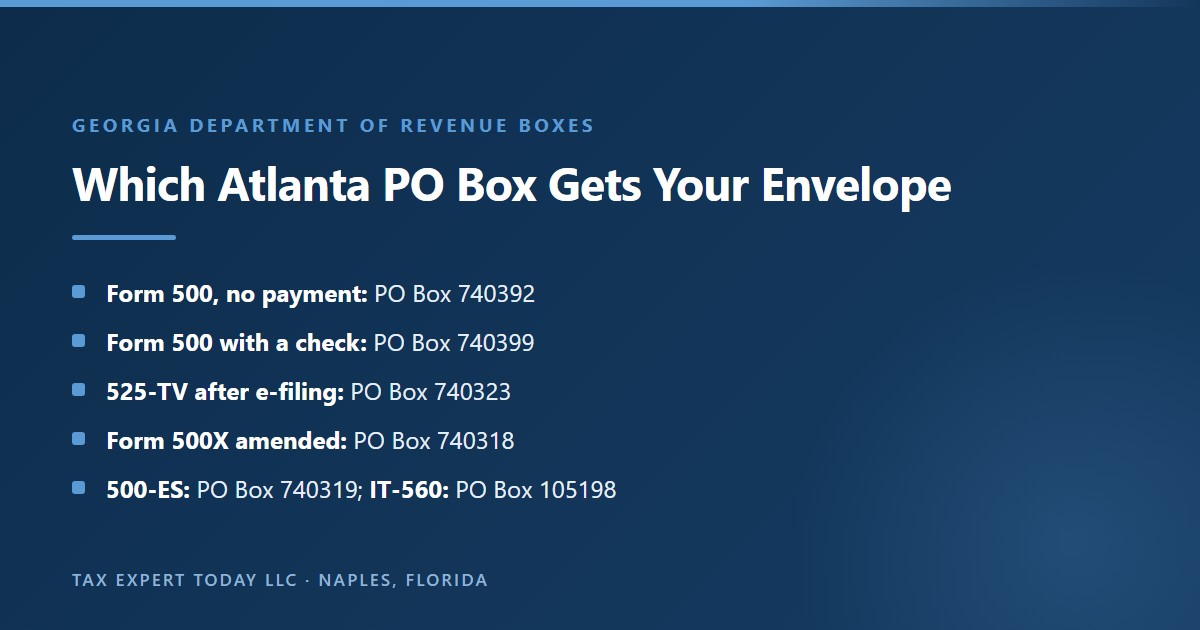
The single most common question behind a search for where to mail Georgia state tax return papers is simply which of the two Form 500 boxes to use. The answer turns on what is physically in the envelope, which the next section covers in detail.
Where to Mail Georgia State Tax Return Payments if You Owe
If you owe Georgia tax and are mailing a check with your Form 500, use PO Box 740399, Atlanta, GA 30374-0399, and include the 525-TV voucher with the check. If you are due a refund, owe nothing, or already paid the balance electronically, the booklet’s labels point to PO Box 740392.
- Check in the envelope: PO Box 740399 with the return, the 525-TV voucher, and the payment.
- Refund or zero balance: PO Box 740392.
- Balance already paid on GTC: no check enclosed, so the “without payment” box fits the booklet’s wording.
- Payable to: Georgia Department of Revenue, never to a person or a processing center name.
The IT-511 booklet labels the two boxes “Form 500 without payment” and “Form 500 with payment.” The Department’s web page labels them “refunds and no balance due” and “payments.” The labels describe the contents of the envelope. The instruction for Line 45, the amount due line on Form 500, reads: “Mail your return, 525-TV payment voucher, and payment to the address on the Form 500.” So when a check travels with the return, the payment box is the right one.
The harder case is the one the Reddit thread on page one asks about: a taxpayer who owes, pays through the Georgia Tax Center or by electronic check, and mails a paper return with no check inside. The Department does not publish a rule that names a box for that exact situation. Reading the booklet’s own labels, a return that travels “without payment” fits PO Box 740392, and nothing in the instructions tells you to send a payment voucher when no paper payment is being made. If you want certainty for an unusual case, call Taxpayer Services at 1-877-423-6711 before you mail. Either way, keep the electronic payment confirmation with your copy of the return.
Paying electronically has a separate advantage. The IT-511 booklet says the Department accepts Visa, American Express, MasterCard, Discover, PayPal, and electronic check for current year individual income tax on original Forms 500 and 500-ES. Card and PayPal payments carry a convenience fee paid to the processing company, while electronic checks do not. Electronic check payments can be made without a GTC login, and the other methods require a GTC account. The Department’s payment page lists the current options.
Where Do You Mail Georgia Form 525-TV After E-Filing?
If you filed your Georgia return electronically and are paying the balance by check, mail the 525-TV voucher and the check to Processing Center, Georgia Department of Revenue, PO Box 740323, Atlanta, GA 30374-0323. Do not mail a copy of the electronic return with it, and do not mail the worksheet page.
- Voucher box: PO Box 740323, Atlanta, GA 30374-0323, for e-filed returns only.
- Paper filers: the voucher travels with the return to the address on the return instead.
- Only if you owe: the Department says to complete the voucher only when tax is due.
- Keep: the worksheet and instructions page with your records.
This is the box most lists of where to mail Georgia state tax return payments leave out. The AI summary on the search page and several software help pages give the two Form 500 boxes, the amended box, the estimated tax box, and the extension box, but not the voucher box. Yet the 2025 Form 525-TV (Rev. 05/20/25) prints PO Box 740323 directly on the voucher, and its checklist says: “Mail your voucher and payment to the address listed below if your return was filed electronically.” For paper filers the same checklist says to “mail your return, payment voucher and payment to the address that appears on the return.”
The Department’s Individual Electronic Filing FAQ confirms the point from the other direction. Asked whether an e-filer has to mail anything, it answers that after e-filing “you may mail payments for any balance due to the Department of Revenue using Form 525-TV,” and that otherwise you keep your W-2s, W-2Gs, 1099-Rs, IND-CR schedules, and other state returns. The FAQ also says an e-filer does not mail a copy of the federal forms, because the federal information is transmitted with the Georgia return.
Use a voucher generated for the right tax year. The 525-TV instructions say to use a voucher with a valid scanline and to complete it in its entirety, and the Department’s filing tips say to use current year vouchers for the current tax year. The voucher’s scanline is what ties the check to your account and tax year, so a voucher printed for the wrong year works against you.
Where Do You Mail a Georgia Amended Return?
Mail a Georgia amended individual return, Form 500X, to Processing Center, Georgia Department of Revenue, PO Box 740318, Atlanta, GA 30374-0318. The Department says you do not need to send a copy of the original return, and Form 500X can also be filed electronically.
- Form 500X box: PO Box 740318, Atlanta, GA 30374-0318.
- No copy of the original: the Department’s filing tips say it is not required.
- Do not use Form 500: a Form 500 cannot correct a return already filed.
- E-file option: the electronic filing FAQ confirms amended returns can be e-filed.
The IT-511 booklet is direct on the form choice: “File Form 500X to correct information reported on Form 500. Do not use Form 500 to correct a previously filed return or use Form 500X as an original return.” Using Form 500 to correct a previously filed return appears on the Department’s own list of things not to do, because a second Form 500 is an original return, not a correction.
The deadline to amend, the documents that must go with Form 500X, and how a federal change triggers a Georgia amendment are covered in our guide to the Georgia amended tax return. On the question of where to mail Georgia state tax return corrections, the key points are the separate box, no copy of the original, and the same proof of mailing practices described later in this guide.
Where Do You Mail Georgia Estimated Tax and Extension Payments?
Mail Georgia estimated tax vouchers, Form 500-ES, to PO Box 740319, Atlanta, GA 30374-0319, and extension payment vouchers, Form IT-560, to PO Box 105198, Atlanta, GA 30348-5198. Note the different ZIP code on the extension box. Both payments can also be made electronically through the Georgia Tax Center.
- Form 500-ES: PO Box 740319, Atlanta, GA 30374-0319.
- Form IT-560: PO Box 105198, Atlanta, GA 30348-5198.
- Different ZIP: 30348 for the extension box, 30374 for most individual boxes.
- Extension is not a payment delay: tax is still due on the original date.
Both of these are payments without a return, which is why they have their own boxes, apart from where to mail Georgia state tax return filings themselves. Sending each voucher to its own box, with its own year printed on it, keeps the payment tied to the right period. The booklet’s “Do” list includes using GTC or Form IT-560 to make an extension payment.
Our guide to Georgia Form 500-ES explains who must pay estimated tax and the quarterly dates, and our guide to Georgia Form IT-303 explains when Georgia accepts the federal extension and when its own form is needed. The IT-511 booklet states the rule that matters most at the mailbox: “An extension of time for filing the return does not extend the date for making the payment.”
Where Do Trusts, Estates, and Businesses Mail Georgia Returns?
Georgia fiduciary returns, Forms 501 and 501X, go to PO Box 740316, Atlanta, GA 30374-0316. Business returns use separate boxes: Form 600 and 600-T go to PO Box 740397, Form 600S to PO Box 740391, and partnership Form 700 to PO Box 740315, all in Atlanta, GA.
- Fiduciary: Form 501 and 501X to PO Box 740316.
- C corporation: Form 600 and 600-T to PO Box 740397, refunds and payments alike.
- S corporation: Form 600S to PO Box 740391.
- Partnership: Form 700 to PO Box 740315.
- Payroll and sales tax: each return type has its own box, listed below.
Unlike the individual Form 500, the corporate and S corporation boxes do not split by refund versus payment: the Department’s corporate and partnership mailing page lists one box for “refunds and payments” on each. The same page lists the corporate extension voucher and estimated tax boxes. The withholding mailing page and the sales tax mailing page cover payroll and sales returns.
| Form | Mail to | Covers |
|---|---|---|
| 600 and 600-T | Georgia Dept. of Revenue, PO Box 740397, Atlanta, GA 30374-0397 | C corporation returns, refunds and payments |
| 600S | Georgia Dept. of Revenue, PO Box 740391, Atlanta, GA 30374-0391 | S corporation returns, refunds and payments |
| 700 | Georgia Dept. of Revenue, PO Box 740315, Atlanta, GA 30374-0315 | Partnership returns |
| IT-560-C | Georgia Dept. of Revenue, PO Box 740239, Atlanta, GA 30374-0239 | Corporate extension payment |
| 602 ES | Georgia Dept. of Revenue, PO Box 105136, Atlanta, GA 30348-5136 | Corporate estimated tax |
| G-7 monthly | Georgia Dept. of Revenue, PO Box 105482, Atlanta, GA 30348-5482 | Withholding, monthly filers |
| G-7 quarterly and G-7NRW | Georgia Dept. of Revenue, PO Box 105544, Atlanta, GA 30348-5544 | Withholding, quarterly and nonresident |
| G-1003 | Georgia Dept. of Revenue, PO Box 105685, Atlanta, GA 30348-5685 | Annual withholding reconciliation |
| ST-3 | Georgia Dept. of Revenue, PO Box 105408, Atlanta, GA 30348-5408 | Sales and use tax return and amended return |
Many business filers never mail these returns at all, because they file and pay through tax software or the Georgia Tax Center, and some business payment methods require electronic filing of the related return. Our guides to Georgia Form 501, Georgia Form 600S, Georgia Form 700, and Georgia withholding tax cover the filing method for each return in more depth. The point here is narrower: the answer to where to mail Georgia state tax return filings for an individual is the wrong answer for a business or fiduciary return.
What Must You Include When You Mail a Georgia Form 500?
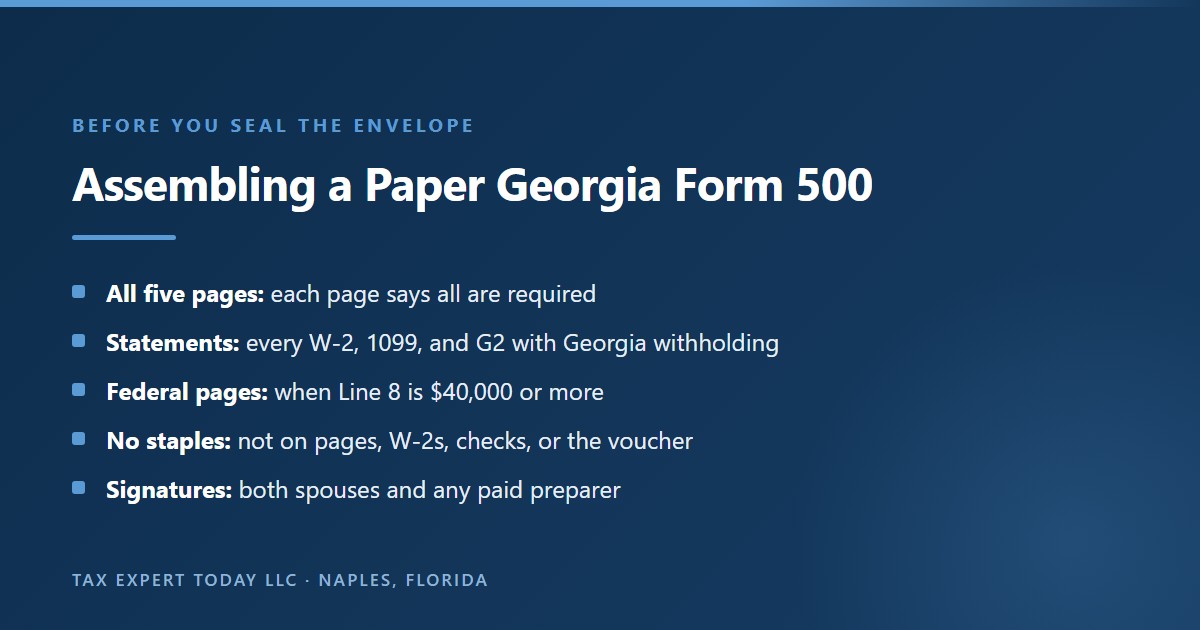
A mailed Georgia Form 500 must include all five pages of the return, every W-2, 1099, and G2 statement showing Georgia withholding, any applicable schedules and IND-CR credit forms, and, when required, copies of federal pages. Knowing where to mail Georgia state tax return pages matters less if the envelope is incomplete.
- Form 500 pages 1 to 5: each page says all five are required for processing.
- Withholding statements: W-2s, 1099s, G2-RPs, G2-LPs, G2-As, and G2-FLs where Georgia tax was withheld.
- Federal pages: Form 1040 pages 1 and 2 plus Schedule 1 when the $40,000 test or the W-2 test is met.
- Schedule A: a copy if you itemize deductions.
- Other states: a copy of another state’s return when you claim credit for tax paid to it.
The supporting documents rule in the 2025 IT-511 booklet says that, in addition to withholding statements, you must include pages 1 and 2 and Schedule 1 of the federal return when “the amount on Form 500, Line 8 is $40,000 or more, or less than the total income on your W-2(s).” The booklet’s own checklist phrases the dollar test as federal adjusted gross income “higher than $40,000.” The practical answer is to include the federal pages at $40,000 exactly, because the stricter wording requires it and the extra pages cost nothing.
| Item | When to include it | Source |
|---|---|---|
| Form 500 pages 1 through 5 | Always | Form 500 footer and IT-511 checklist |
| W-2, 1099, G2-RP, G2-LP, G2-A, G2-FL | When Georgia tax was withheld | IT-511 checklist |
| Federal Form 1040 pages 1 and 2 and Schedule 1 | Line 8 is $40,000 or more, or less than total W-2 income | IT-511 supporting documents rule |
| Federal Schedule A | When you itemize deductions | IT-511 supporting documents rule |
| Schedule 3 | Part-year residents and nonresidents | IT-511 and Department filing tips |
| Another state’s return | When claiming credit for tax paid to another state | Department filing tips |
| Federal Form 4868 or IRS confirmation letter | When filing under the federal extension | IT-511 extension rule |
| 525-TV voucher and check | When a balance is paid by check | Form 500 Line 45 instruction |
The booklet adds a rule many paper filers miss: Schedule 2 credits must be filed electronically. More broadly, the booklet and the electronic filing FAQ say a return that generates, allocates, claims, uses, or includes a series 100 tax credit must be e-filed. If your return carries one of those credits, mailing it is not an option under the Department’s own rules.
The Income Statement Details section on Form 500 also matters for mail. The Department asks you to enter only income on which Georgia tax was withheld, and to complete that section for each statement. The booklet’s filing checklist lists it alongside attaching the forms themselves. A paper return that claims withholding with no statement behind it leaves the Department nothing to match the claim against, and the booklet warns that the Department will request information to support the amounts on a return when necessary.
How Should You Assemble a Paper Georgia Return?
Assemble a paper Georgia return with all pages in order, unstapled, printed on the correct year’s form, signed and dated by every taxpayer and any paid preparer. Do not staple or clip W-2s, checks, or the voucher to the return, round amounts to whole dollars, and use black or blue ink.
- No staples or clips: the Department opens and scans every page it receives.
- Correct year: forms differ by tax year, and the 2D barcode encodes that year’s data.
- Signatures: both spouses on a joint return, even if only one had income.
- Whole dollars: the booklet says not to include cents.
The Department’s filing tips page is written as a pre-mailing checklist. It asks you to submit all pages, use black or blue ink if handwritten, avoid stapling or attaching your check, W-2s, or other documents to the return, use the correct form for the tax type and year, review personal information and math, and sign. Paid preparers must also sign. The Form 500 itself says at the bottom of each page that all pages one through five are required for processing, and the last page tells filers: “Mail pages 1-5 and any applicable schedules, forms, documentation. DO NOT staple pages.”
The 2D barcode deserves a word. The IT-511 booklet explains that the barcode on a printed return encodes the information you entered, reduces errors, and saves processing time, and it appears only after the return is printed. Before you decide where to mail Georgia state tax return pages, that is a reason to complete the return using the Department’s online fillable form or software and print it, rather than handwriting a blank form. The Department’s electronic filing page says handwritten returns take the longest to process.
If you are filing for a deceased taxpayer, the booklet asks the filer to provide the date of death in the signature section and check the deceased checkbox on page 1, Line 1. A part-year resident or nonresident must include Schedule 3 with Form 500; the Department lists incorrectly completing or omitting Schedule 3 as a common mistake. Our guide to the Georgia part-year resident tax return walks through that schedule.
How Do You Pay When You Mail a Georgia Return?
When you mail a Georgia return with a balance due, enclose a check or money order payable to the Georgia Department of Revenue, with your Social Security number and the tax year written on it, plus a 525-TV voucher. Do not staple, clip, or fold the check and voucher, and remove the check stub.
- Payee: Georgia Department of Revenue.
- On the check: taxpayer names, address, Social Security number or FEIN, and tax year.
- Amounts: the written and numeric amounts must match.
- Handling: cut the voucher on the dotted line; no staples, clips, or folds.
- Box: PO Box 740399 with a paper return, PO Box 740323 after an e-filed return.
The Department’s filing tips and the 525-TV checklist give the same instructions: make the check or money order payable to the Georgia Department of Revenue, fill it out so the written and numerical amounts agree, include the taxpayer names, address, account number or Social Security number, and tax year, cut the voucher along the dotted line, do not staple the payment to the voucher or fold the voucher and check, and keep the check stub with your records. The 525-TV form also cites O.C.G.A. 48-2-31, which provides that taxes are paid in lawful money of the United States, free of any expense to the State of Georgia.
Paying by mail is not the only route. As noted above, the Department accepts electronic check, card, and PayPal payments through the Georgia Tax Center for current year individual tax. If the balance is large, or if you cannot pay it all, our guide to the Georgia Department of Revenue payment plan explains the agreement criteria the booklet lists: all returns filed, terms of up to 60 months, automatic bank debit, and a setup cost. File the return on time even if you cannot pay, because the late filing penalty runs separately from the late payment penalty.
Should You Send a Georgia Tax Return by Certified Mail?
No, in most cases. The Georgia Department of Revenue says certified mail or courier delivery will not speed up processing and that special handling for certified mail may delay your return. Its preferred method is First Class or Priority Mail with a Certificate of Mailing, which proves the date you mailed it.
- Preferred: First Class or Priority Mail with a USPS Certificate of Mailing.
- Also accepted: Express Mail through the Postal Service.
- If you want delivery proof: First Class Mail with Delivery Confirmation, or Certified Mail with an electronic return receipt.
- Strongly discouraged: Certified Mail with the green return receipt card by mail.
This surprises many filers, because certified mail is the habit for anything sent to a tax agency. The Department’s page titled Mail Return Using Certified Mail answers the question with a flat “No” and gives the reason: the Postal Service imposes special handling on certified mail that may delay processing. Every Department mailing address page carries the same note, and the IT-511 booklet repeats it twice, once on the mailing page and once in its list of things not to do.
Whatever the answer to where to mail Georgia state tax return paperwork, the delivery method matters too. The reasoning is set out in more detail in Policy Statement 2008-02-05, Proof of Timely Filing of Return, Remittance, or Other Document. It explains that because taxpayers do not have to prove the Department received a document, there is no need for delivery methods that require a signature or special handling, and that certified mail with a paper return receipt requested by mail “actually result[s] in a significant increase in the amount of time and labor required to receive and process documents.” The policy says removing and handling the green postcards causes significant processing delays.
The Certificate of Mailing is the tool most people have never used. It is a Postal Service receipt, bought at the counter at the time of mailing, that records the date the envelope was presented for mailing. The Department calls it its preferred method of proving timely filing because it gives the taxpayer an official record and does not add handling at the Department. If you want to know the envelope arrived as well, the policy points to First Class Mail with Delivery Confirmation, which shows the date and time of delivery without a signature, or certified mail with an electronic return receipt delivered as a PDF.
How Do You Prove a Georgia Return Was Mailed on Time?
For a return sent by the Postal Service, Georgia treats the post office cancellation date on the envelope as the filing date. If the Department has no record of receiving it, you need only prove the return was presented to the Postal Service on time, which a Certificate of Mailing or Express Mail receipt does.
- Postal Service: the cancellation date on the envelope is the filing date.
- Burden in a dispute: the Department must prove a document was not timely filed.
- Your proof: evidence you presented the return to the Postal Service in time.
- Private carriers: the carrier’s tracking information is accepted as proof of the filing date.
- Hand delivery: two identical copies, both date stamped by the Department.
The rule comes from Ga. Comp. R. & Regs. 560-12-1-.22(6)(b), which says that when a return and remittance are forwarded by United States mail, “the post office cancellation date on the envelope shall be considered the date the return was filed.” That regulation sits in the sales and use tax rules, but Policy Statement 2008-02-05 applies it to any “return, remittance, or other document” sent to the Department, and the Department’s tax due dates page states that Georgia individual income tax returns “must be received or postmarked by” the due date.
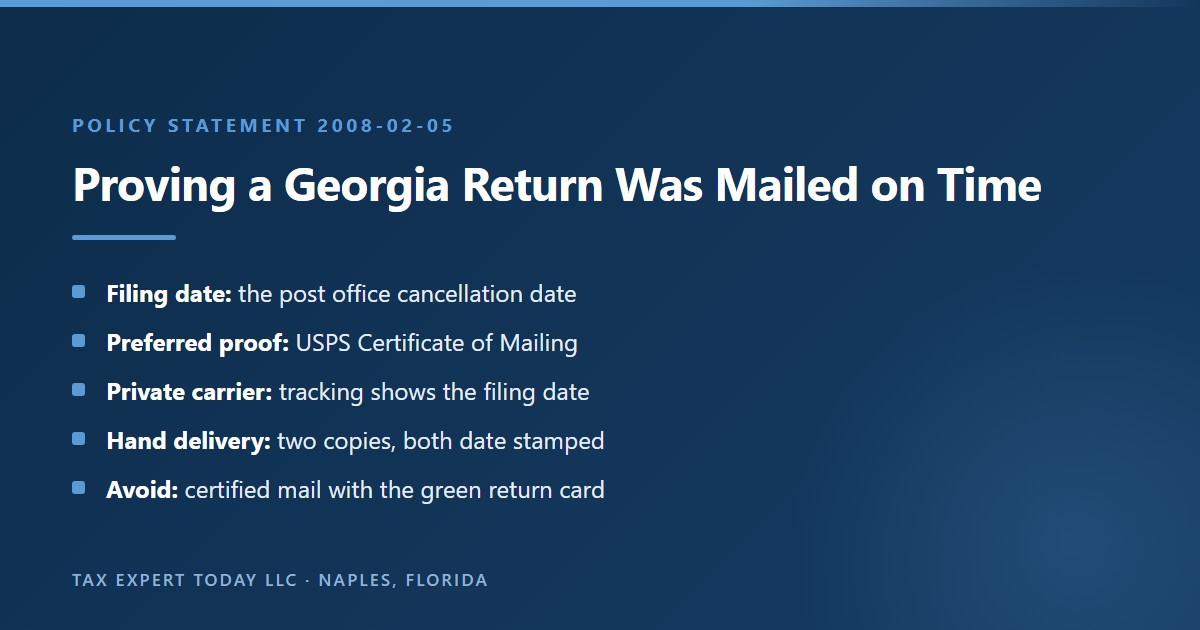
The policy statement also explains what happens inside the Department. When a paper document arrives by any physical delivery method, an employee stamps the receipt date on the envelope, opens it, and prepares the contents for scanning; the envelope and everything inside are scanned, assigned a document locator number, and saved. In a dispute about timely filing, the Department’s proof that a mailed document was late is the cancellation date on the envelope or the scanned image of it. When the Department has no record of receiving a document at all, the policy says the taxpayer “is not required to prove that the Department actually received the document,” only that it was presented to the Postal Service for mailing in time.
Proof of mailing is the other half of knowing where to mail Georgia state tax return filings. Two cautions keep this in proportion. First, the policy statement says on its face that it provides procedural guidance, does not have the force of law, and is not binding on the public, although it binds Department personnel until superseded. Second, the regulation refers to a post office cancellation date, so a date printed by a private postage meter or a home printed label may not carry the same weight, and the policy’s preferred proof is a receipt from the counter. For a return that is close to a deadline, or that carries a large balance or refund claim, spend the small fee on a Certificate of Mailing and keep it with your copy of the return.
| Delivery method | What proves the filing date | Department view |
|---|---|---|
| First Class or Priority Mail with a Certificate of Mailing | The Certificate of Mailing receipt | Preferred method |
| Express Mail through the Postal Service | The proof of mailing receipt | Preferred |
| First Class Mail with Delivery Confirmation | Cancellation date, plus delivery date and time | Encouraged for added assurance |
| Certified Mail with electronic return receipt | Cancellation date, plus PDF proof of delivery | Encouraged over the green card |
| Certified Mail with return receipt by mail | Cancellation date and green postcard | Strongly discouraged |
| UPS, FedEx, or other package service | The carrier’s tracking information | Accepted as proof of filing date |
| Hand delivery or courier | Your date stamped duplicate copy | Bring two identical copies |
Electronic filings follow different timing rules under the same policy. A payment made by ACH debit is deemed filed when the taxpayer receives a confirmation number from the Department’s designated agent, an ACH credit payment is deemed filed when the bank issues a trace number, and a return and payment filed at different times are deemed filed when both have been received. Keep those confirmation numbers the way you would keep a Certificate of Mailing.
When Is a Mailed Georgia State Tax Return Due?
Georgia individual returns for tax year 2025 were due April 15, 2026. The Department’s due dates page says tax year 2026 returns must be received or postmarked by April 15, 2027. If a due date falls on a weekend or holiday, the return is due the next business day. An extension delays filing, not payment.
- Tax year 2025: due April 15, 2026, per the Department’s Important Tax Updates page.
- Tax year 2026: received or postmarked by April 15, 2027.
- Weekend or holiday: due the next day that is not a weekend or holiday.
- Extension: to the extended federal due date, with no extra time to pay.
The Department’s tax due dates page gives the “received or postmarked” wording for the 2027 deadline, and the Important Tax Updates page confirms that the deadline for 2025 returns without an extension was April 15, 2026, and that the Department began processing 2025 returns on February 2, 2026. The 525-TV checklist states the weekend and holiday rule.
The IT-511 booklet says an extended Georgia return must be filed, with a copy of federal Form 4868 or the IRS confirmation letter, by the extended federal due date, which for 2025 calendar year returns was October 15, 2026. Anyone mailing a 2025 Georgia return now, in November 2026, is past that date, so the return is late and penalties and interest apply to any unpaid tax. That does not make filing pointless. The booklet’s penalty structure means the sooner a late return is filed, the less the late filing penalty grows, and a late return that claims a refund is still subject to the three year refund claim window.
| Charge | Rate or amount | Applies to |
|---|---|---|
| Late payment penalty | 0.5 percent per month or fraction of a month | Tax not paid by the statutory due date |
| Late filing penalty | 5 percent per month | Tax not paid by the original due date |
| Combined cap | 25 percent | Late filing plus late payment penalties together |
| Interest | Accrues until paid in full | Unpaid tax |
| Frivolous return penalty | $1,000 | Returns with incorrect or insufficient information |
The IT-511 booklet sets out the penalties. Tax not paid by the statutory due date carries interest and a late payment penalty of 0.5 percent per month or fraction of a month. A monthly late filing penalty of 5 percent of the tax not paid by the original due date also applies. The combined late filing and late payment penalty cannot exceed 25 percent of the tax not paid by the original due date, and interest accrues until the tax is paid in full. The booklet also lists a $1,000 frivolous return penalty. Our Georgia estimated tax penalty calculator covers the separate underpayment of estimated tax charge.
Should You E-File Instead of Mailing a Georgia Return?
For most people, yes. The Department says most electronic refunds are issued within two to three weeks, handwritten returns take the longest, and e-filers do not mail anything unless they pay by check. Mailing still makes sense for some late, prior year, or unusual returns, but it is slower and easier to get wrong.
- Speed: most e-filed refunds within two to three weeks; processing can take up to 12 weeks.
- Nothing to mail: federal forms travel electronically with the Georgia return.
- Coverage: full year, part-year, nonresident, and amended returns can be e-filed.
- Prior years: e-file accepted for up to two years before the current tax year.
- Cost: Georgia charges no e-file fee; software or preparer fees may apply.
The Department’s page Why Should I File Electronically? says taxpayers who file electronically get their refunds the fastest, most refunds are issued within two to three weeks of receipt, the process may take up to 12 weeks, and handwritten returns take the longest. Qualifying taxpayers can file free through the Free File Alliance, and others can use approved software or a preparer.
One limit catches people: the Department’s electronic filing FAQ says it “currently does not provide a way to file income tax returns electronically through its website or the Georgia Tax Center.” The online fillable Form 500 on the Department’s site is a typed paper return; you fill it in, print it, sign it, and mail it. That is still better than a handwritten form, because it prints the 2D barcode, but it is not e-filing.
| Point | Mailed paper return | Electronic return |
|---|---|---|
| Refund timing | Slower; handwritten returns take the longest | Most within two to three weeks; up to 12 weeks |
| What you mail | The return, attachments, and any payment | Nothing, unless paying by check with 525-TV |
| Federal pages | Copies required in some cases | Transmitted with the return |
| Proof of filing | Postmark or Certificate of Mailing | Acceptance and confirmation records |
| Series 100 or Schedule 2 credits | Not allowed | Required |
| Prior years | Any year | Up to two years before the current tax year |
Mailing remains the route for some returns, and for them the question of where to mail Georgia state tax return forms still matters. Because the e-file window covers only two years before the current tax year, an older delinquent return generally goes on paper, and some filers simply prefer paper. For those cases, the rest of this guide applies in full: right box, all pages, attachments, no staples, and proof of mailing.
When Must a Georgia Return Be Filed Electronically?
Georgia requires electronic filing in three situations: when a taxpayer pays by electronic funds transfer, mandatory or voluntary, all related returns must be e-filed; when a paid preparer’s federal counterpart return must be e-filed; and when a return generates, allocates, claims, uses, or includes a series 100 tax credit.
- EFT payers: all associated returns must be filed electronically.
- Paid preparers: must e-file when the federal counterpart must be e-filed under federal rules.
- Series 100 credits: any return that touches one must be e-filed.
- Schedule 2 credits: the booklet’s checklist says these must be filed electronically.
These rules appear in both the Individual Electronic Filing FAQ and the 2025 IT-511 booklet under “When is Electronic Filing Required?” The preparer rule matters for anyone who hires help: a preparer who must e-file the federal return generally must also e-file the Georgia return, so a paper Georgia return prepared by a paid preparer is unusual. The FAQ adds that a tax practitioner participates in Georgia electronic filing by being approved by the IRS to file electronically, with no separate Georgia application.
The credit rule matters for households and businesses that claim Georgia credits such as those in the series 100 list referenced in the booklet. If you are unsure whether a credit you claim falls in that series, the safer course is to e-file, because a mailed return that should have been electronic does not satisfy the requirement.
Can You Hand Deliver a Georgia Tax Return?
Yes. The Department’s proof of filing policy addresses hand delivery directly: bring two identical copies and have both date stamped by an authorized Department representative, then keep the stamped duplicate as your proof. Department headquarters is at 2595 Century Parkway NE, Atlanta, GA 30345-3173, and regional offices also serve taxpayers.
- Two identical copies: one for the Department, one stamped copy for you.
- Proof: the date stamped duplicate is your proof of timely filing.
- Couriers: the same rule applies when a courier delivers by hand.
- Before you go: check the Department’s locations and appointment pages.
Policy Statement 2008-02-05 says that when a taxpayer or a courier hand delivers a document, the taxpayer “should provide two identical documents and have both documents date stamped at the time of delivery by an authorized representative of the Department.” The Department’s locations page lists the headquarters, regional offices, and a page for scheduling an appointment. Office services and hours change, so check before you travel rather than assume a walk-in counter will accept a return that day.
For most filers asking where to mail Georgia state tax return forms from outside metro Atlanta, including the many Florida residents with a Georgia filing obligation, hand delivery is impractical, and First Class Mail with a Certificate of Mailing gives the same protection for the price of a stamp and a receipt.
What Happens After You Mail a Georgia Return?
After you mail a Georgia return, the Department stamps, opens, and scans it, then processes it. Refunds can take up to 12 weeks. First-time Georgia filers, and anyone who has not filed in five or more years, receive a paper refund check. You can track status on the Georgia Tax Center.
- Refund timing: allow up to 12 weeks, with paper returns slower than e-filed ones.
- Paper check rule: first-time filers and those who have not filed in five or more years.
- Status: gtc.dor.ga.gov or 1-877-423-6711.
- Verification letters: answered through GTC with Verify my Return or the ID Verification Quiz.
The IT-511 booklet says to allow 12 weeks to receive refunds and explains that the Department is taking additional fraud prevention measures. It also says a first-time Georgia filer, or a taxpayer who has not filed Georgia taxes in five or more years, will receive the refund by paper check, whether the return was e-filed or mailed. A claim for refund must be made within three years from the later of the date the tax was paid or the due date of the return, including extensions.
Some taxpayers receive a letter asking them to verify the return or take an identity quiz before a refund is released. The Department’s return verification page sends those taxpayers to the Georgia Tax Center, where the Refunds section has a Verify my Return option and the Individuals section has the ID Verification Quiz. Respond through the method the letter names; mailing a second copy of the return does not answer a verification letter.
If you owed tax and a check is cashed, your bank record is evidence of payment. If you followed the rules on where to mail Georgia state tax return forms, are due a refund, and nothing has happened after the processing window, check status on GTC before calling, and have the return, the mailing receipt, and the date you mailed it in front of you.
What if You Mailed a Georgia Return to the Wrong Address?
If you mailed a Georgia return to the wrong Department of Revenue box, do not send a second original right away. The Department publishes no specific procedure for misdirected returns. Keep your proof of mailing, watch your account on the Georgia Tax Center, and call Taxpayer Services if the return does not appear after the normal processing window.
- Do not duplicate: a second original can look like a duplicate filing.
- Keep proof: the Certificate of Mailing or receipt is your timely filing evidence.
- Check GTC: look for the return and any payment on your account.
- Call: Taxpayer Services at 1-877-423-6711 if nothing posts.
Every box in this guide on where to mail Georgia state tax return filings is a Department of Revenue processing box in Atlanta, and the proof of filing policy speaks of documents sent “to the Department” without conditioning timely filing on a particular box number. That reading suggests a return sent to the wrong Department box is still a filed return, but the Department has not published a rule that says so, and a wrong box may slow handling. A return sent to a different agency, such as the IRS, is a different problem; it has not been sent to the Department at all, and it should be refiled with Georgia promptly.
If a notice arrives saying no return was filed, respond with a copy of the return and your proof of mailing. Under the policy statement, the question in a dispute is whether you presented the return to the Postal Service on time, not whether the Department can find it.
Where to Mail Georgia State Tax Return Mistakes to Avoid
The most common mistakes in choosing where to mail Georgia state tax return envelopes are using the payment box with no payment, sending a voucher to the Form 500 box after e-filing, stapling, leaving out pages or W-2s, using Form 500EZ, using certified mail, and mailing a return that had to be e-filed.
- Wrong box: match the box to what is physically in the envelope.
- Missing pages: all five Form 500 pages, every time.
- Old forms: Form 500EZ is gone for 2025 and later; forms differ by year.
- Certified mail: slower, with no added legal protection under the postmark rule.
- No proof: a Certificate of Mailing costs little and settles timing disputes.
The Department’s own list of common mistakes adds several that have nothing to do with the envelope but still delay a mailed return: failing to list a spouse’s Social Security number on a separate return, errors in exemptions, dependents, income, and deductions, entering both an amount owed and a refund, and mistakes on or omission of Schedule 3. The Department’s electronic filing FAQ says completing a form online helps reduce errors and speeds processing compared with handwritten returns, which is one more reason not to handwrite a return.
If you are unsure whether a Georgia return is required at all, start with our overview of Georgia state income tax, which covers who must file, the rates by year, and how residents, part-year residents, and nonresidents are taxed.
Georgia Tax Return Help in Naples & Southwest Florida
Tax Expert Today LLC prepares and files Georgia returns from its office in Naples, Florida, and serves Georgia clients nationwide and remotely. We handle original, late, amended, part-year, and nonresident Georgia returns, payment vouchers, and Department of Revenue notices, and we e-file wherever the rules allow.
- Office: 11983 Tamiami Trail N, Naples FL 34110.
- Phone: (239) 441-2005.
- Hours: Monday through Friday, 10 a.m. to 5 p.m. Eastern.
- Georgia tax return help Naples: Naples and Southwest Florida in person, Georgia and all 50 states remotely.
Many of our clients moved from Georgia to Florida, own Georgia rental property, or earn Georgia source income while living elsewhere, and each of those situations can leave a Georgia return to file long after the move. We work as tax advisors on state tax matters nationwide, and a Georgia filing is often one piece of a wider picture that includes the federal return and Florida planning. If you are unsure where to mail Georgia state tax return forms for a past year, we can sort that out as part of the filing. For our wider Georgia services, see the Georgia tax services page, and for planning work in Florida, our Naples tax planning page.
When to Engage a Professional
Engage a tax professional if you have unfiled Georgia returns for more than one year, received a Department notice saying a mailed return was never filed, need to file a year outside the e-file window, claim credits that require electronic filing, or are unsure whether you owe Georgia tax after a move. These problems are cheaper to fix early.
- Several years unfiled: returns, payments, and penalties need to be sequenced.
- Proof of filing dispute: the postmark evidence has to be assembled and presented.
- Credit returns: series 100 and Schedule 2 credits require electronic filing.
- Residency questions: a move can change whether, and how, you file.
Tax Expert Today LLC handles Georgia filing and notice work as part of our wider state and federal tax practice. Our Georgia tax help covers returns, amendments, and Department of Revenue correspondence. Call (239) 441-2005 for a free consultation. This guide is general information about Georgia rules as of November 5, 2026, and is not legal or tax advice for your situation. Results depend on the facts of each case.
Frequently Asked Questions About Where to Mail Georgia State Tax Return Forms
Where to mail Georgia state tax return forms: which box do I use?
Mail Form 500 with no payment, or with a refund due, to Georgia Dept. of Revenue, PO Box 740392, Atlanta, GA 30374-0392. Mail Form 500 with a check to PO Box 740399, Atlanta, GA 30374-0399. Use the address printed on the form for the year you are filing.
Where do I mail a Georgia payment if I already e-filed?
Mail the 525-TV payment voucher and your check to Processing Center, Georgia Department of Revenue, PO Box 740323, Atlanta, GA 30374-0323. Do not include a copy of the return. You can also pay through the Georgia Tax Center instead of mailing a check.
Where do I mail a Georgia amended tax return?
Mail Form 500X to Georgia Dept. of Revenue, PO Box 740318, Atlanta, GA 30374-0318. The Department says you do not need to send a copy of the original return, and Form 500X can also be filed electronically.
Should I send my Georgia tax return by certified mail?
The Department of Revenue says no. Certified mail does not speed processing and its special handling may cause delays. The Department prefers First Class or Priority Mail with a USPS Certificate of Mailing, which proves the date you mailed the return.
Does Georgia use the postmark date as the filing date?
Yes for returns sent by the Postal Service. Under Ga. Comp. R. & Regs. 560-12-1-.22(6)(b) and Policy Statement 2008-02-05, the post office cancellation date is the filing date, and the Department’s due dates page says individual returns must be received or postmarked by the due date.
What do I attach to a mailed Georgia Form 500?
Include all five pages, every W-2, 1099, and G2 statement showing Georgia withholding, and applicable schedules. Include federal Form 1040 pages 1 and 2 and Schedule 1 if Line 8 is $40,000 or more or less than your W-2 total, and Schedule A if you itemize. Do not staple.
Can I still use Georgia Form 500EZ?
No. The 2025 IT-511 booklet says Form 500EZ was discontinued and is not accepted for tax years beginning on or after January 1, 2025. Use Form 500 for all individual returns from tax year 2025 forward.
I live in Naples, Florida, and still have to file a Georgia return. Can you help?
Yes. Tax Expert Today LLC prepares and files Georgia returns, including late, amended, part-year, and nonresident returns, from its Naples, Florida office at 11983 Tamiami Trail N, Naples FL 34110, and serves Georgia clients nationwide. Call (239) 441-2005, Monday through Friday, 10 a.m. to 5 p.m. Eastern.
Published November 5, 2026 by Dr. Pellumb Kabashi « Back to Learning Center
Have a question this article touches on?
Tax Expert Today LLC, based in Naples, Florida and serving clients across the United States.
Schedule a Consultation (239) 441-2005