
By Dr. Pellumb Kabashi, DBA, MBA, CES, CFE, EA
Founder, Tax Expert Today LLC · Tax advisors, enrolled agents, CPAs, and attorneys · Serving clients in all 50 states
Quick Answer
A mega backdoor Roth is an after-tax contribution to a 401(k) above the $24,500 deferral limit, moved into a Roth account through an in-plan conversion or an in-service rollover. In 2026 the overall plan ceiling is $72,000, so up to $47,500 can go in when no employer money is used. Call (239) 441-2005 for a free consultation.
What is a mega backdoor Roth?
A mega backdoor Roth is a two-step strategy inside an employer plan. The employee makes voluntary after-tax contributions to a 401(k) on top of regular deferrals, then moves that money into a Roth account, either a designated Roth account in the same plan or a Roth IRA, so future growth can come out tax free.
The name is informal. Nothing in the Internal Revenue Code says “mega backdoor Roth.” The strategy is assembled from three separate rules. The first is IRC section 415(c), which caps the total annual additions to a participant’s account in a defined contribution plan and counts employee contributions inside that cap. The second is the rule that after-tax employee contributions are already taxed, so they come back out tax free as basis. The third is IRC section 402A(c)(4), which lets a plan roll non-Roth money into a designated Roth account in the same plan, together with section 408A(e), which lets an eligible distribution from a plan be rolled into a Roth IRA.
Put together, those rules let a participant whose plan allows it place far more money into a Roth than the $7,500 individual retirement arrangement limit for 2026 set in Notice 2025-67. The only tax cost, if the conversion is done promptly, is ordinary income tax on whatever small amount of earnings built up between the contribution and the conversion.
- Step one, after-tax contribution. Payroll contributions above the $24,500 deferral limit, designated by the plan as after-tax, not Roth.
- Step two, conversion. An in-plan Roth rollover or an in-service distribution rolled to a Roth IRA.
- The ceiling. The $72,000 section 415(c) limit for 2026, less deferrals and employer contributions.
- The tax. Basis converts tax free; earnings before conversion are ordinary income.
- The gatekeeper. The plan document, which must permit both steps.
How much can go through a mega backdoor Roth in 2026?
For 2026, the annual additions limit is $72,000 and the elective deferral limit is $24,500, both confirmed in IRS Notice 2025-67. A participant under age 50 with no employer contributions could therefore add up to $47,500 of after-tax money. Catch-up contributions sit outside the $72,000 limit and do not reduce the after-tax room.
Notice 2025-67 raised the section 415(c)(1)(A) limit from $70,000 to $72,000 and the section 402(g) deferral limit from $23,500 to $24,500. The age 50 catch-up rose from $7,500 to $8,000, and the higher catch-up for participants who are age 60, 61, 62, or 63 during the year stays at $11,250. Under IRC section 414(v)(3)(A), catch-up contributions are not subject to the section 415(c) limit, which is why the after-tax room is the same at every age.
| Age during 2026 | Elective deferral | Catch-up | Section 415(c) limit | Total possible | After-tax room |
|---|---|---|---|---|---|
| Under 50 | $24,500 | $0 | $72,000 | $72,000 | $47,500 |
| 50 to 59, or 64 and older | $24,500 | $8,000 | $72,000 | $80,000 | $47,500 |
| 60 to 63 | $24,500 | $11,250 | $72,000 | $83,250 | $47,500 |
The $47,500 figure that appears across the internet is a ceiling, not a typical amount. It assumes the employer contributes nothing. In most plans the employer does contribute, and every employer dollar takes a dollar of after-tax room away. It also assumes the participant actually defers the full $24,500. A participant who defers less does not gain after-tax room, because the plan’s own design usually caps after-tax contributions as a percentage of pay, and the participant still has to fund the deferral side first to make the math worthwhile.
How does employer money shrink the after-tax room?
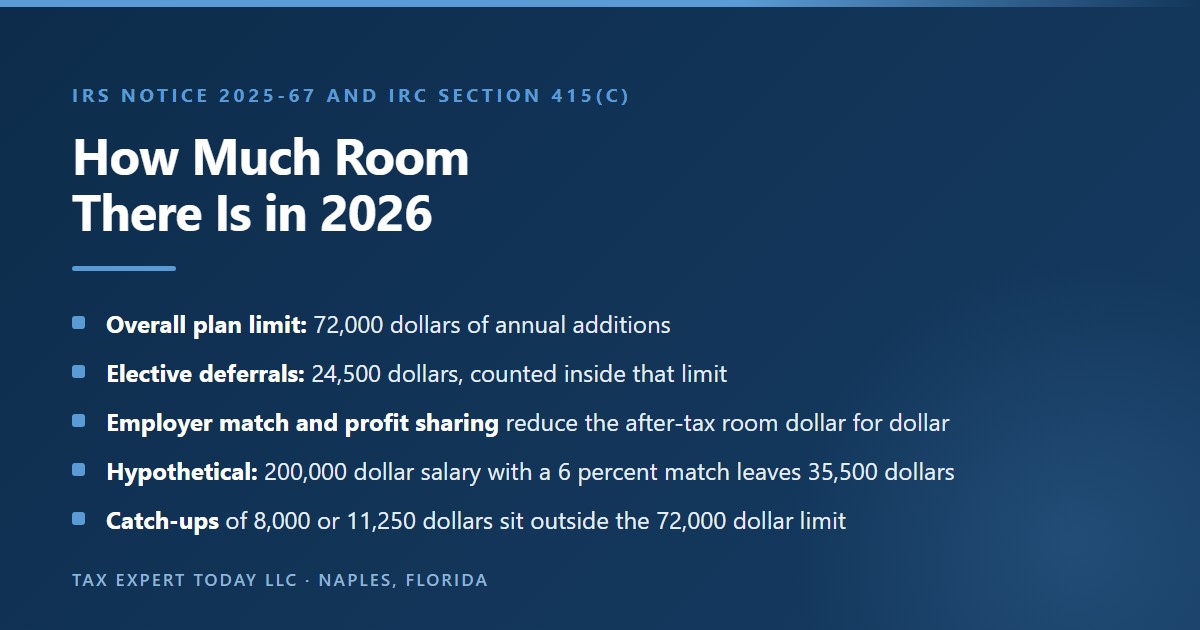
Employer matching and profit sharing contributions count toward the same $72,000 section 415(c) limit as the employee’s after-tax money. The after-tax room is $72,000 minus elective deferrals minus everything the employer adds. A hypothetical $200,000 earner with a 6 percent match has $35,500 of room, not $47,500.
Section 415(c)(2) defines an annual addition as the sum of employer contributions, employee contributions, and forfeitures. Elective deferrals are employer contributions for this purpose because they are made through salary reduction, so they count too. That leaves the after-tax bucket as whatever is left over. The table below runs the same hypothetical $200,000 salary through four common employer designs.
| Employer design | Employer dollars | Deferral | After-tax room |
|---|---|---|---|
| No employer contribution | $0 | $24,500 | $47,500 |
| 4 percent safe harbor match | $8,000 | $24,500 | $39,500 |
| 6 percent match | $12,000 | $24,500 | $35,500 |
| 6 percent match plus 3 percent profit sharing | $18,000 | $24,500 | $29,500 |
Two further limits matter for higher earners. First, the compensation that a plan may consider for allocating employer money is capped under section 401(a)(17) at $360,000 for 2026, according to Notice 2025-67. A hypothetical participant paid $400,000 with a 6 percent match receives a match on $360,000, which is $21,600, leaving $25,900 of after-tax room. Second, section 415(c)(1)(B) caps annual additions at 100 percent of compensation, which only bites for lower paid participants. A hypothetical $50,000 earner could never reach $72,000; the cap for that person is $50,000.
| Compensation | Employer match | Section 415(c) cap that applies | After-tax room after a $24,500 deferral |
|---|---|---|---|
| $50,000 | 3 percent, $1,500 | $50,000 (100 percent of pay) | $24,000 |
| $200,000 | 6 percent, $12,000 | $72,000 | $35,500 |
| $400,000 | 6 percent of $360,000, $21,600 | $72,000 | $25,900 |
What two plan features does a mega backdoor Roth need?
The plan must allow voluntary after-tax employee contributions, and it must offer a way to move that money into a Roth while the participant is still working, either an in-plan Roth rollover to a designated Roth account or an in-service distribution that can be rolled to a Roth IRA. Without both features the strategy does not work.
After-tax contributions are optional for employers. Many plans never adopted them, and some that once did have removed them, often because of the nondiscrimination testing problem covered later in this guide. The second feature is just as important. After-tax money that sits in the plan without being converted grows tax deferred, not tax free, and the growth is taxed as ordinary income when it eventually comes out. That is a weaker result than an ordinary taxable brokerage account for many investors.
| Feature | In-plan Roth rollover | In-service distribution to a Roth IRA |
|---|---|---|
| Where the money lands | Designated Roth account in the same plan | Roth IRA at any custodian |
| Legal basis | IRC 402A(c)(4), expanded by 402A(c)(4)(E) | IRC 402(c) and 408A(e) |
| Can be done on money not otherwise distributable | Yes, under 402A(c)(4)(E) | No, the plan must permit the in-service withdrawal |
| Mandatory 20 percent withholding | None on a direct in-plan rollover | None on a direct rollover |
| Five-year clock for qualified distributions | The plan’s designated Roth account clock | The Roth IRA clock |
| Investment menu afterward | Plan menu only | Whatever the IRA custodian offers |
The IRS FAQs on designated Roth accounts describe how in-plan Roth rollovers work in general. Some recordkeepers now offer automatic in-plan conversion, where every after-tax payroll contribution is converted within a day or so of being deposited. That is the cleanest version of the strategy because almost no earnings accrue before the conversion. Plans without an automatic feature usually allow conversions on request, sometimes limited to a set number per year.
Is the mega backdoor Roth still allowed in 2026?
Yes. As of October 4, 2026, the Code sections that make the strategy work, section 415(c), section 402A(c)(4), and section 408A(e), remain in force, and nothing in the 2026 limits guidance restricts it. Proposals to restrict after-tax conversions have appeared in past legislative drafts, so the rule should be checked again before each plan year.
The strategy is not a loophole in the sense of exploiting a drafting error. Section 402A(c)(4)(E), which allows in-plan Roth rollovers of amounts that are not otherwise distributable, was added by the American Taxpayer Relief Act of 2012 and explained in Notice 2013-74. Notice 2014-54 then confirmed that after-tax amounts in a single distribution can be directed to a Roth IRA while pretax amounts go elsewhere. The IRS has written the guidance that makes the strategy run.
What can change is the plan. An employer can amend the plan to remove after-tax contributions or the in-plan conversion feature at any time, usually with advance notice. A participant who relies on the strategy should read the summary plan description every year rather than assume last year’s features still exist.
Can I make a mega backdoor Roth if I make $500,000 a year?
Yes. Unlike a direct Roth IRA contribution, a mega backdoor Roth has no income limit. The 2026 Roth IRA phase-out ranges in Notice 2025-67 of $153,000 to $168,000 for single filers and $242,000 to $252,000 for joint filers do not apply to after-tax 401(k) contributions or to in-plan Roth rollovers.
Income does still matter in three indirect ways. First, the section 401(a)(17) compensation cap of $360,000 limits how much employer money is calculated on, which can actually increase the after-tax room for a very high earner whose match would otherwise be larger. Second, under section 414(q), anyone with 2025 compensation above $160,000 is generally a highly compensated employee for 2026 testing, and after-tax contributions by highly compensated employees are exactly what the actual contribution percentage test measures. Third, higher earners usually face a higher marginal rate on whatever earnings are taxed at conversion, which is a reason to convert quickly.
| Rule | 2026 figure | Applies to a mega backdoor Roth? |
|---|---|---|
| Roth IRA contribution phase-out, single | $153,000 to $168,000 | No |
| Roth IRA contribution phase-out, married filing jointly | $242,000 to $252,000 | No |
| Compensation limit, section 401(a)(17) | $360,000 | Indirectly, through employer contributions |
| Highly compensated employee threshold, section 414(q) | $160,000 | Yes, for the actual contribution percentage test |
| Roth catch-up wage threshold, section 414(v)(7) | $150,000 of 2025 FICA wages | No effect on after-tax room; catch-ups sit outside section 415(c) |
How is a mega backdoor Roth different from a backdoor Roth IRA?
A backdoor Roth IRA is a nondeductible contribution to a traditional IRA converted to a Roth IRA, limited to $7,500 in 2026 and governed by the IRA aggregation rules. A mega backdoor Roth runs through an employer plan, is limited by section 415(c), and never touches the IRA pro-rata calculation on Form 8606.
The two strategies share a reader more often than they share rules. A high earner who already does a backdoor Roth IRA every January is the natural candidate for the mega version, and the two can be done in the same year without interfering with each other. Our backdoor Roth IRA guide covers the IRA route, the pro-rata rule, and Form 8606 in detail. This guide stays on the plan side.
| Feature | Backdoor Roth IRA | Mega backdoor Roth |
|---|---|---|
| Where the money starts | Traditional IRA | After-tax subaccount inside a 401(k) or similar plan |
| 2026 annual amount | $7,500, or $8,600 at 50 and older | Up to $47,500, less employer contributions |
| Who controls access | Anyone with earned income | The employer, through the plan document |
| Pro-rata rule that applies | Section 408(d)(2), all IRAs aggregated | Section 72 within the plan’s after-tax subaccount only |
| Reported on | Form 8606 plus Form 1099-R code 2 or 7 | Form 1099-R code G, Form 1040 lines 5a and 5b |
| Nondiscrimination testing | None | Actual contribution percentage test, section 401(m) |
Does the pro-rata rule apply to a mega backdoor Roth?
The IRA pro-rata rule does not. Pretax balances in traditional, SEP, or SIMPLE IRAs have no effect on a mega backdoor Roth. A separate pro-rata rule inside the plan does apply: any distribution from the after-tax subaccount carries a proportional share of that subaccount’s basis and earnings under section 72.
This is the single most common confusion between the two strategies, and it cuts both ways. A participant with a large rollover IRA who has been told that the backdoor Roth IRA is off limits can still use the mega route, because the IRA aggregation rule in section 408(d)(2) reaches only IRAs. But a participant who assumes the plan route has no pro-rata rule at all can be surprised by a taxable amount on the Form 1099-R.
The plan-level rule comes from IRC section 72. Section 72(e)(8) makes each distribution a pro rata mix of basis and earnings. Section 72(d)(2) allows employee contributions under a defined contribution plan, together with the income allocable to them, to be treated as a separate contract. Most recordkeepers track after-tax money in its own subaccount for that reason. The practical effect is that the pro-rata mix is measured against the after-tax subaccount, not against the whole pretax 401(k) balance.
- IRA balances. Irrelevant to the mega backdoor Roth.
- Pretax 401(k) deferrals and match. Generally outside the after-tax subaccount when the plan separately accounts for it.
- After-tax contributions. Basis, recovered tax free.
- Earnings on after-tax contributions. Pretax, taxed when converted or distributed.
- Fast conversion. Keeps the earnings slice close to zero, which keeps the pro-rata effect small.
What does Notice 2014-54 let you do with the after-tax money?
Notice 2014-54 lets a participant split one distribution so that the pretax portion goes in a direct rollover to a traditional IRA or plan and the after-tax portion goes to a Roth IRA, with no tax on either piece. It is the rule that makes a clean separation possible at retirement or job change.
Before 2014, some plan providers treated a split distribution as two separate distributions, each carrying a pro rata share of basis. That made it hard to put all the basis into a Roth IRA. Notice 2014-54 changed the approach. All disbursements scheduled at the same time are treated as one distribution, and when the pretax amount is less than the amount directly rolled over, the entire pretax amount is assigned to the direct rollover. If the direct rollover goes to more than one plan or IRA, the participant chooses how the pretax amount is allocated, but must tell the plan administrator before the rollovers are made.
| Piece | Amount | Destination | Taxable |
|---|---|---|---|
| After-tax contributions (basis) | $120,000 | Roth IRA, direct rollover | $0 |
| Earnings on those contributions | $30,000 | Traditional IRA, direct rollover | $0 |
| Total distributed | $150,000 | Two destinations, one distribution | $0 |
The example assumes the participant never converted along the way, which is the worst way to run the strategy because the $30,000 of growth remains pretax. It shows that Notice 2014-54 rescues the basis even so. The earnings stay pretax in the traditional IRA, which can matter later: that traditional IRA balance now counts in the IRA pro-rata calculation for any future backdoor Roth IRA. A participant who plans to keep doing a backdoor Roth IRA may prefer to roll the earnings into a new employer’s plan instead, if that plan accepts rollovers.
What happens with a partial in-service withdrawal?
A partial in-service withdrawal from an after-tax subaccount generally carries a pro rata share of basis and earnings. In a hypothetical subaccount of $120,000 basis and $30,000 earnings, a $20,000 withdrawal is $16,000 basis and $4,000 earnings. If all $20,000 goes to a Roth IRA, the $4,000 is taxable.
The same Notice 2014-54 allocation helps here too, if the plan allows the withdrawal to be split. Directing the $4,000 of earnings in a direct rollover to a traditional IRA and the $16,000 of basis to a Roth IRA leaves nothing taxable. Not every recordkeeper supports a split in-service distribution, and some only allow the full subaccount to be withdrawn. That is a question for the plan administrator before the request is made, not after the Form 1099-R arrives.
| Approach | To Roth IRA | To traditional IRA | Taxable amount | Tax at a hypothetical 32 percent rate |
|---|---|---|---|---|
| All to Roth IRA | $20,000 | $0 | $4,000 | $1,280 |
| Split under Notice 2014-54 | $16,000 | $4,000 | $0 | $0 |
| Taken in cash, not rolled | $0 | $0 | $4,000, plus a possible 10 percent additional tax before 59½ | $1,280 plus any additional tax |
The third row is a reminder that the earnings portion of a cash withdrawal before age 59½ can also be exposed to the section 72(t) additional tax unless an exception applies. The basis portion is not, because it is not includible in income.
How fast should the after-tax money be converted?
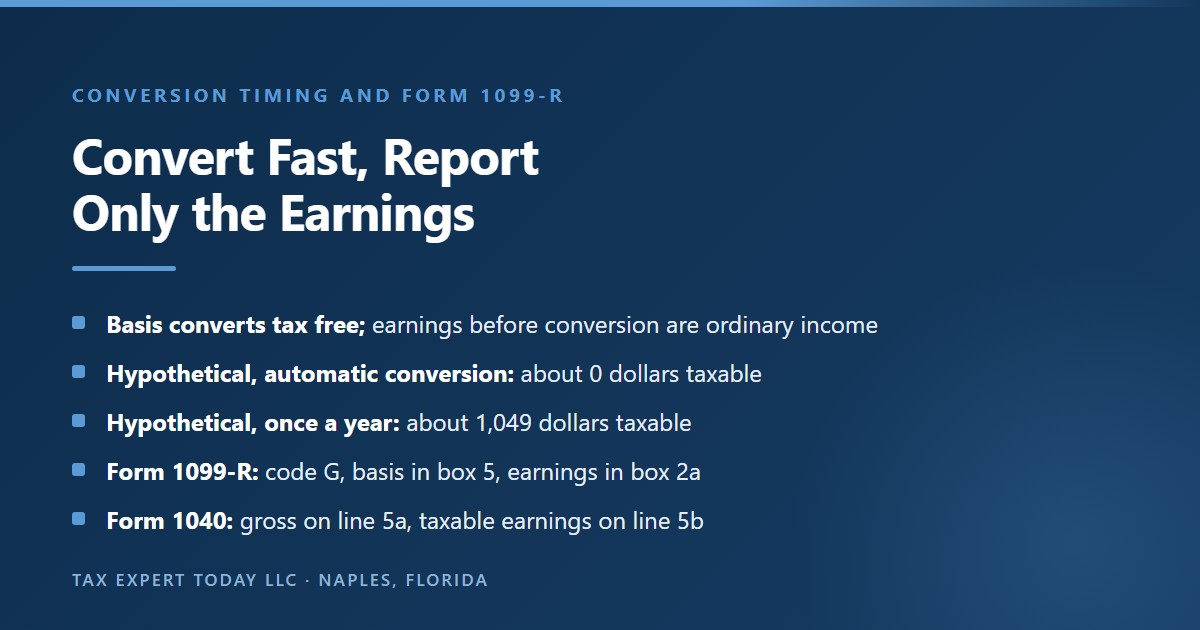
As fast as the plan allows. Every day the after-tax contribution sits unconverted, any growth becomes pretax earnings that will be taxed as ordinary income at conversion. Same-day automatic conversion leaves essentially nothing to tax, while a once-a-year conversion can leave hundreds or thousands of dollars of taxable earnings.
The table below takes a hypothetical $35,500 of annual after-tax contributions and a hypothetical 6 percent annual return, and shows the approximate taxable earnings at each conversion lag. The figures are illustrations only; actual returns can be negative, in which case there may be nothing to tax at all.
| Conversion pattern | Average days unconverted | Approximate taxable earnings | Approximate federal tax |
|---|---|---|---|
| Automatic in-plan conversion | About 0 | About $0 | About $0 |
| Monthly conversion request | About 15 | $85 | $27 |
| Quarterly conversion request | About 45 | $256 | $82 |
| Once a year in December | About 182 | $1,049 | $336 |
| Left for three years, then converted | About 1,095 | $6,781 | $2,170 |
The tax in the last row is not a penalty, but it is a cost the strategy was designed to avoid. Worse, the three-year delay also loses three years of tax-free compounding on the earnings that would otherwise have grown inside the Roth.
Is tax withheld when after-tax money is converted?
Generally not. An in-plan Roth rollover of money that is not otherwise distributable must be made as a direct rollover, and Notice 2013-74 confirms that no mandatory or voluntary withholding applies to it. The participant may need to raise paycheck withholding or make estimated tax payments to cover the tax on any earnings.
Publication 575 explains the general rules for taxing plan distributions and rollovers. For most participants who convert quickly, the taxable amount is small enough that it disappears into normal withholding. The exception is a participant who converts a large, long-held after-tax balance in one step. A conversion that triggers several thousand dollars of ordinary income with nothing withheld can create an underpayment. The usual fixes are a higher W-4 withholding amount for the rest of the year, because withholding is treated as paid evenly through the year, or a quarterly estimated payment. Our quarterly estimated tax calculator and underpayment penalty calculator can help size either option.
- In-plan Roth rollover of nondistributable money. No withholding under Notice 2013-74, Q&A-4.
- Direct rollover to a Roth IRA. No mandatory 20 percent withholding.
- Indirect rollover paid to the participant. 20 percent mandatory withholding on the taxable portion, which then has to be replaced from other funds to complete the rollover.
- Practical fix. Adjust Form W-4 before year end if the earnings are material.
How is a mega backdoor Roth reported on Form 1099-R?
An in-plan Roth rollover or a direct rollover to a Roth IRA produces a Form 1099-R with code G in box 7a. Box 1 shows the gross amount moved, box 5 shows the after-tax basis recovered tax free, and box 2a shows the taxable amount, which should equal only the earnings that built up before conversion.
The Instructions for Forms 1099-R and 5498 direct the plan to use code G for a direct rollover from a qualified plan to an eligible retirement plan, including an IRA, and specifically “for IRRs that are direct rollovers,” meaning in-plan Roth rollovers. Box 5 is where the plan reports employee contributions and designated Roth contributions the recipient may recover tax free, and the instructions name after-tax contributions as one of the items that belong there. Box 10 reports any amount allocable to an in-plan Roth rollover made within the past five years, which matters only if money is later taken out early.
| Form 1099-R box | Entry | What it means |
|---|---|---|
| Box 1, gross distribution | $35,756 | Everything moved from the after-tax subaccount |
| Box 2a, taxable amount | $256 | The earnings, taxed as ordinary income |
| Box 5, employee contributions | $35,500 | Basis, recovered tax free |
| Box 7a, distribution code | G | Direct rollover, including an in-plan Roth rollover |
| Box 10, amount allocable to IRR within 5 years | Completed only on a later distribution | Used to apply section 72(t) to early withdrawals of converted taxable amounts |
A participant who converts monthly may receive a single Form 1099-R summarizing the year, or several. Either way, the totals across forms should reconcile to the year’s after-tax contributions in box 5 and the earnings in box 2a. A box 2a that is close to box 1 is a red flag that basis was missed.
Where does a mega backdoor Roth go on Form 1040?
The gross amount from Form 1099-R box 1 goes on Form 1040 line 5a, pensions and annuities, and only the taxable earnings from box 2a go on line 5b. The return should label the entry as a rollover. Nothing about the strategy belongs on Form 8606, line 4a, or Schedule 1.
Line 5a and line 5b are the pension and annuity lines, and that is where the instructions to Form 8606 point as well: they describe Roth IRA rollovers from qualified retirement plans as “included on Form 1040, 1040-SR, or 1040-NR, line 5b.” Tax software usually asks whether the distribution was rolled over and to what kind of account, and then fills line 5b with the taxable amount and writes “Rollover” next to line 5a.
| Line | Entry | Source |
|---|---|---|
| Form 1040, line 5a | $35,756 | Form 1099-R, box 1 |
| Form 1040, line 5b | $256 | Form 1099-R, box 2a |
| Notation | “Rollover” | Code G in box 7a |
| Form 8606 | Not used for this transaction | Plan rollovers are reported on the 1040 lines |
Does a mega backdoor Roth need Form 8606?
Not for the conversion itself. Form 8606 tracks nondeductible IRA basis and IRA conversions. A rollover from a qualified plan to a Roth IRA is reported on Form 1040 lines 5a and 5b, and Form 8606 only comes into play later, if a nonqualified distribution is taken from the Roth IRA and basis has to be computed on line 24.
The Instructions for Form 8606 confirm the later role. Line 24 is the basis in Roth IRA conversions and rollovers from qualified retirement plans, and it is built by adding amounts “rolled over from a qualified retirement plan to a Roth IRA” that were reported on Form 1040. That means the record of each mega backdoor Roth rollover lives on the Form 1040 for the year it happened. Keeping copies of every Form 1099-R with code G, plus the plan statements that show after-tax contributions, is the practical way to prove that basis decades from now.
An in-plan Roth rollover into a designated Roth account in the same plan does not reach Form 8606 at all, because it never touches an IRA. The plan tracks that basis.
What records prove the basis years later?
Keep every Form 1099-R with code G, the Form 1040 for each conversion year, year-end plan statements showing after-tax contributions by source, and any conversion confirmations. The plan tracks basis while the money is in the plan, but once it reaches a Roth IRA, proving basis falls to the taxpayer.
The reason is the Form 8606 line 24 computation described above. It only matters if a nonqualified distribution is taken from the Roth IRA, which may be decades away, by which time the plan recordkeeper may have changed several times. A taxpayer who cannot show which Roth IRA dollars came from after-tax plan money can lose the ability to recover that basis tax free. The burden is modest if the records are kept as each year closes, and it is difficult to rebuild later.
| Record | What it proves | Who issues it |
|---|---|---|
| Form 1099-R, code G | The amount moved, the basis in box 5, and the taxable earnings in box 2a | The plan |
| Form 1040, lines 5a and 5b | How the conversion was reported | The taxpayer |
| Year-end plan statement by source | After-tax contributions made during the year | The recordkeeper |
| Conversion confirmations | The date and amount of each conversion | The recordkeeper |
| Form 5498 for the Roth IRA | The rollover contribution received by the IRA | The IRA custodian |
Form 5498 is the IRA custodian’s half of the record. Box 2 of that form reports rollover contributions, so the amount received by the Roth IRA should match the amount the plan reported as rolled over. Comparing the two each spring catches a missing or misdirected rollover while it can still be fixed.
What if the Form 1099-R reports the wrong taxable amount?
If box 2a shows the whole conversion as taxable, or box 5 is blank, the plan probably did not apply the after-tax basis. The fix is a corrected Form 1099-R from the plan. Reporting a different number than the form shows, without a correction, is possible but invites an IRS matching notice.
The IRS matches Form 1099-R amounts against the return. A return that reports $256 on line 5b when the form says $35,756 will usually generate a mismatch letter unless the difference is explained or the form is corrected. Plans issue corrected forms when the original contained an error, and the Form 1099-R instructions provide for a corrected form. Before asking, it helps to have the year-end plan statement that shows after-tax contributions by date and the conversion confirmations.
- Box 2a equals box 1. Basis was likely ignored; request a corrected form.
- Box 2b “taxable amount not determined” is checked. The participant must compute the taxable amount, using the plan’s basis records.
- Code 7 or code 1 instead of code G. The plan may have processed a cash distribution rather than a direct rollover; the facts need to be confirmed before filing.
- No form at all for an in-plan conversion. Ask the recordkeeper; an in-plan Roth rollover is reportable.
What is the ACP test, and why does it shut the strategy down?
The actual contribution percentage test under section 401(m) compares matching contributions plus after-tax employee contributions, as a percentage of pay, for highly compensated employees against everyone else. When rank-and-file employees contribute little, the highly compensated group fails quickly, and the plan has to return the excess.
IRC section 401(m)(2)(A) sets the limit. The average contribution percentage for eligible highly compensated employees cannot exceed the greater of 125 percent of the percentage for all other eligible employees, or the lesser of 200 percent of that percentage or that percentage plus 2 percentage points. Treas. Reg. section 1.401(m)-2 sets out the mechanics of the test, and section 401(m)(3) builds each person’s percentage from matching contributions and employee contributions divided by compensation. After-tax contributions are employee contributions, so they are in the numerator.
| Non-highly compensated average | Highest permitted highly compensated average |
|---|---|
| 2 percent | 4 percent |
| 3 percent | 5 percent |
| 4 percent | 6 percent |
| 6 percent | 8 percent |
| 8 percent | 10 percent |
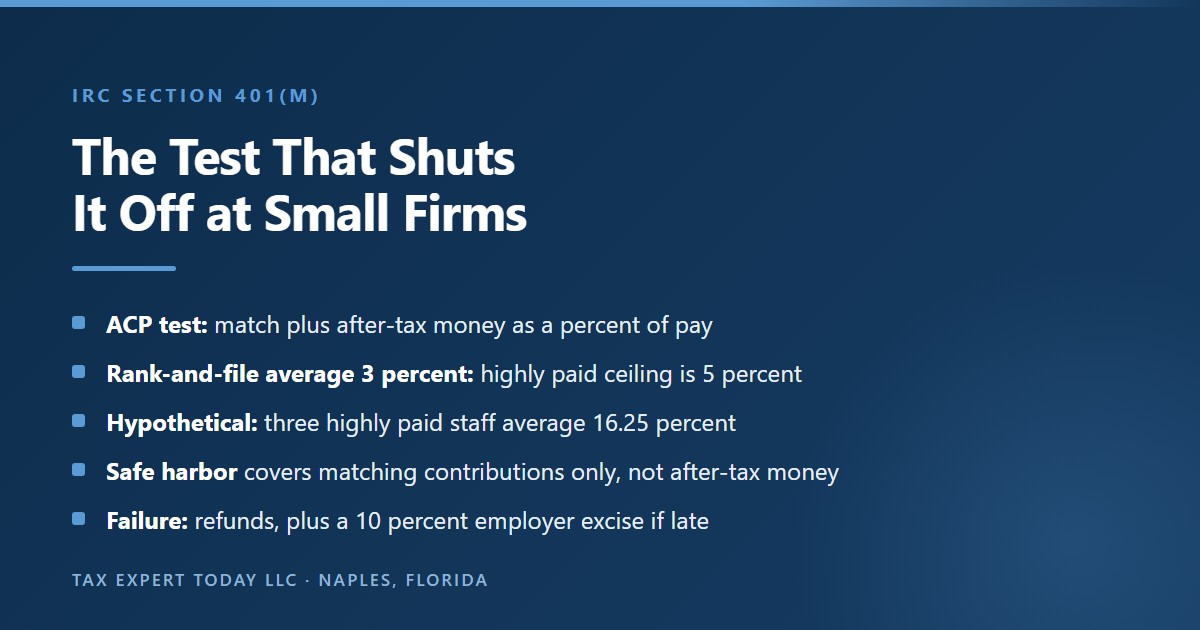
Now look at what one mega backdoor Roth participant does to the highly compensated average. A hypothetical highly compensated employee paid $200,000 who receives a $12,000 match and makes $35,500 of after-tax contributions has an individual percentage of 23.75 percent. In a small company with three highly compensated employees, the hypothetical percentages below average 16.25 percent. If the rank-and-file average is 3 percent, the permitted ceiling is 5 percent, and the plan fails by a wide margin.
| Employee | Compensation | Match | After-tax contributions | Individual percentage |
|---|---|---|---|---|
| A | $200,000 | $12,000 | $35,500 | 23.75 percent |
| B | $250,000 | $15,000 | $32,500 | 19.00 percent |
| C | $180,000 | $10,800 | $0 | 6.00 percent |
| Highly compensated average | 16.25 percent | |||
| Ceiling if the rank-and-file average is 3 percent | 5.00 percent |
This is why the strategy is common at very large employers, where thousands of rank-and-file participants pull the comparison group up, and rare at small firms. It is also why a small business owner who reads about the strategy online and asks the recordkeeper to switch it on is often disappointed.
Does a safe harbor 401(k) avoid the ACP test for after-tax money?
No. The safe harbor in section 401(m)(11) treats a plan as passing the ACP test only with respect to matching contributions. After-tax employee contributions remain subject to the test even in a safe harbor 401(k). This is one of the most frequently missed points in plan design discussions about the strategy.
The statutory language is narrow. Section 401(m)(11)(A) says a defined contribution plan is treated as meeting the requirements of the test “with respect to matching contributions” if it meets the safe harbor contribution and notice rules and limits the match. Employee contributions are not mentioned. A safe harbor plan therefore still needs to run the ACP test whenever anyone makes after-tax contributions, and in a small plan where only the owners and senior staff use the feature, that test will generally fail.
| Contribution type | Tested under ADP or ACP in a traditional plan | Tested in a safe harbor plan |
|---|---|---|
| Elective deferrals | ADP test, section 401(k)(3) | Generally deemed satisfied |
| Matching contributions | ACP test | Deemed satisfied if section 401(m)(11) is met |
| After-tax employee contributions | ACP test | Still tested |
What happens when the plan fails the ACP test?
The plan must distribute the excess aggregate contributions, plus allocable income, before the end of the following plan year to stay qualified under section 401(m)(6). If the correction is not made within two and a half months after the plan year ends, the employer also owes a 10 percent excise tax under section 4979.
Under section 401(m)(6)(C), the corrective distribution goes to the highly compensated employees on the basis of the dollar amount contributed by or for each of them. For a participant who made after-tax contributions, the returned contributions themselves are basis and are not taxed again, while the allocable income is. If the after-tax money was already converted to Roth, the plan and recordkeeper have to unwind it, which can produce a confusing set of Forms 1099-R. The employer bears the excise tax under section 4979, which runs at 10 percent of the excess aggregate contributions unless they are distributed within the first two and a half months of the following plan year, or six months for an eligible automatic contribution arrangement.
- Deadline to avoid the excise tax. Two and a half months after plan year end, or six months for an eligible automatic contribution arrangement.
- Deadline to protect qualification. The end of the following plan year.
- Who pays the 10 percent excise. The employer, under section 4979(b).
- What the participant gets back. The excess contribution, which is basis, plus income, which is taxable.
- Planning fix. Some plans cap after-tax contributions or test midyear so that the excess is limited before it builds.
Who counts as a highly compensated employee in 2026?
For the 2026 plan year, an employee is generally highly compensated under section 414(q) if they owned more than 5 percent of the employer in 2025 or 2026, or if they received more than $160,000 of compensation from the employer in 2025. The employer may elect to limit the pay test to the top 20 percent of earners.
The 2026 limits notice keeps the section 414(q)(1)(B) threshold at $160,000. Because the pay test looks back to the prior year, a new hire or someone who just received a large raise may not be highly compensated in the first year, which can temporarily change the testing picture. Family attribution rules can also make a spouse or child of a 5 percent owner highly compensated regardless of pay.
| Test | Rule | Practical note |
|---|---|---|
| Ownership | More than 5 percent owner in 2025 or 2026 | Section 318 attribution can reach a spouse, children, grandchildren, and parents |
| Compensation | More than $160,000 from the employer in 2025 | Prior year pay, so 2026 raises affect 2027 testing |
| Top-paid group election | Pay test limited to the top 20 percent by pay | Can reduce the number of highly compensated employees in a high-wage workforce |
At a professional practice where most staff earn more than $160,000, many employees can be highly compensated at once. That sometimes makes the ACP test easier to pass, because the non-highly compensated group is small and the highly compensated group includes people who do not use the after-tax feature. It is one of the few situations where a smaller employer can offer the strategy without repeated failures, and it is worth modeling before a plan amendment.
Can a self-employed person use a mega backdoor Roth in a solo 401(k)?
Sometimes. A solo 401(k) can permit after-tax contributions and in-plan Roth rollovers, but many prototype documents do not. When it does, the section 415(c) limit still applies to deferrals, employer profit sharing, and after-tax money combined, and compensation for a self-employed person is earned income after the plan contribution and the deductible half of self-employment tax.
The deductible half of self-employment tax can be estimated with our self-employment tax calculator, and the same earned income figure also caps the self-employed health insurance deduction, so the two computations are usually run together.
Because a one-participant plan generally has no rank-and-file employees, the ACP test is usually not the barrier it is at a small company with staff. The barrier is the document and the provider. A self-employed taxpayer who wants the strategy typically needs a provider whose plan document expressly includes voluntary after-tax contributions and in-plan conversions, and should confirm both in writing before opening the plan.
| Item | Amount | Note |
|---|---|---|
| Earned income used as compensation | $125,000 | Hypothetical, after the plan contribution and half of self-employment tax |
| Employer profit sharing, 25 percent of compensation | $31,250 | The section 404 deduction limit for a defined contribution plan |
| Elective deferral | $24,500 | 2026 section 402(g) limit |
| Section 415(c) limit | $72,000 | Lesser of $72,000 or 100 percent of compensation |
| Remaining after-tax room | $16,250 | $72,000 less $31,250 less $24,500 |
A self-employed owner should compare the after-tax route with making the same dollars Roth deferrals or with a cash balance plan, which, as Publication 560 outlines for small business plans generally, can deliver far larger pretax deductions for an owner in a high bracket. For owners of an S corporation, compensation is W-2 wages, not net profit, so the room depends on the salary set under our S corporation reasonable compensation analysis.
How does the 2026 Roth catch-up rule interact with a mega backdoor Roth?
Beginning in 2026, a participant age 50 or older whose 2025 FICA wages from the employer exceeded $150,000 must make catch-up contributions as Roth. Those catch-ups sit outside section 415(c), so they do not reduce the after-tax room. They do mean the plan must offer Roth deferrals for anyone to make catch-ups.
Section 414(v)(7), added by section 603 of the SECURE 2.0 Act, requires Roth treatment for the catch-up contributions of participants whose prior year wages exceeded the threshold, which Notice 2025-67 sets at $150,000 of 2025 wages for 2026. The administrative transition period in Notice 2023-62 covered only taxable years beginning before January 1, 2026. Final regulations published on September 16, 2025 generally apply to contributions in taxable years beginning after December 31, 2026, so 2026 is a year of statutory compliance under a reasonable, good faith interpretation.
| Contribution | 2026 amount | Tax character | Counts toward $72,000? |
|---|---|---|---|
| Elective deferral | $24,500 | Pretax or Roth, participant’s choice | Yes |
| Catch-up | $8,000 | Must be Roth | No, section 414(v)(3)(A) |
| Employer match | $12,000 | Pretax unless the plan allows Roth employer contributions | Yes |
| After-tax contributions, then converted | $35,500 | Roth after conversion | Yes |
| Total into the plan | $80,000 | $72,000 inside the limit |
In this hypothetical, $43,500 of the year’s contributions end up Roth, and $36,500 can stay pretax if the participant chooses pretax deferrals. A participant who wants the most Roth possible could also make the $24,500 deferral Roth, for $68,000 of Roth money in one year.
Which five-year rules apply to a mega backdoor Roth?
Two clocks can apply. A designated Roth account has its own five-taxable-year period under section 402A(d)(2)(B) for a qualified distribution. A Roth IRA has a separate five-year period. A third rule applies only to the taxable portion of a conversion withdrawn early, which for a fast conversion is usually a few dollars of earnings.
Under section 402A(d)(2)(B), for an in-plan Roth rollover, the qualified distribution clock is the designated Roth account clock, which starts with the first taxable year the participant made a designated Roth contribution to that plan. For a rollover to a Roth IRA, the Roth IRA’s own clock under section 408A(d)(2)(B) governs, as Publication 590-B explains, and money rolled from a designated Roth account into a Roth IRA does not bring its plan clock along. The early withdrawal rule tracked in box 10 of Form 1099-R treats the taxable amount of an in-plan Roth rollover as subject to section 72(t) if withdrawn within five years. With a prompt conversion, that taxable amount is only the small earnings slice, not the basis.
| Rule | Source | What starts the clock | Why it matters here |
|---|---|---|---|
| Qualified distribution, designated Roth account | IRC 402A(d)(2)(B) | First year of a designated Roth contribution to the plan | Tax-free earnings in the plan |
| Qualified distribution, Roth IRA | IRC 408A(d)(2)(B) | First year of any contribution to any Roth IRA | Tax-free earnings after a rollover to a Roth IRA |
| Early withdrawal of converted taxable amounts | IRC 402A(c)(4)(D) and 408A(d)(3)(F) | Year of each conversion | Usually small, because only earnings were taxable |
In-plan Roth rollover or rollover to a Roth IRA: which is better?
Neither is better for everyone. An in-plan Roth rollover is often faster and can be automated, and it works while the participant is still employed even if the plan bars in-service withdrawals. A rollover to a Roth IRA gives a wider investment menu and a Roth IRA clock that may already be running, but needs an in-service withdrawal feature.
One factor deserves more attention than it usually gets: the required minimum distribution rules. Under section 402A(d)(5), added by the SECURE 2.0 Act for years beginning in 2024, designated Roth accounts in employer plans are no longer subject to lifetime required minimum distributions, so the old advantage of moving plan Roth money to a Roth IRA for that reason has largely gone. Creditor protection, the investment menu, and fees now tend to drive the choice.
| Factor | In-plan Roth rollover | Rollover to a Roth IRA |
|---|---|---|
| Speed and automation | Often same day if automatic | Usually slower, request based |
| Requires in-service withdrawal feature | No | Yes |
| Investment choices | Plan menu | Broad |
| Five-year clock | Designated Roth account clock | Roth IRA clock, which may already be satisfied |
| Federal creditor protection | ERISA plan protection | IRA protection rules, which differ by state |
| Paperwork on the return | Form 1099-R code G, lines 5a and 5b | Form 1099-R code G, lines 5a and 5b |
How much is a mega backdoor Roth worth over ten years?
In a hypothetical case of $35,500 contributed and converted every year for ten years at a 6 percent return, the Roth balance reaches about $495,993, of which about $140,993 is growth. In a Roth that growth can be tax free. In a taxable account the same growth could cost about $33,556 at a 23.8 percent rate.
The comparison below is deliberately simple. It assumes level contributions at the start of each year, a constant hypothetical 6 percent return, prompt conversions so that almost nothing is taxed along the way, a qualified Roth distribution at the end, and, for the taxable alternative, a single sale taxed at a combined 23.8 percent long-term capital gain and net investment income tax rate. It ignores annual dividend tax drag in the taxable account, which would widen the gap. Real results will differ, and markets can fall.
| Where the money sits | Ending balance | Tax on the $140,993 of growth | Approximate after-tax value |
|---|---|---|---|
| Converted promptly to Roth, qualified distribution | $495,993 | $0 | $495,993 |
| Taxable brokerage account, sold at year ten | $495,993 | $33,556 at 23.8 percent | $462,437 |
| Left in the after-tax subaccount, never converted | $495,993 | $45,118 at an ordinary 32 percent rate | $450,875 |
The bottom row is the reason conversion matters. After-tax money that is never converted turns capital-gain-type growth into ordinary income. That makes it worse than the taxable account in this hypothetical, even though it grew tax deferred.
What is the downside of a mega backdoor Roth?
The main downsides are cash flow, access, and complexity. The money is after-tax, so it competes with every other use of take-home pay. Withdrawals of earnings before age 59½ and the five-year period can be taxed and penalized. Testing failures can force refunds, and reporting errors are common.
There is also an opportunity cost question that is easy to skip. A participant who is not yet maxing pretax or Roth deferrals, or who has no emergency reserve, usually should address those first. And a participant in a very high bracket now who expects a much lower bracket in retirement may get more value from pretax savings, such as a cash balance plan, than from Roth savings.
- Liquidity. Money inside a plan is harder to reach than a brokerage account.
- Testing refunds. A failed ACP test can return contributions after the fact.
- Reporting. Incorrect Forms 1099-R are common and must be corrected.
- Plan changes. The employer can remove the feature.
- No deduction. Every dollar going in has already been taxed.
Who should use a mega backdoor Roth?
The strategy fits best for a participant who already maxes elective deferrals, has spare cash flow after that, has a plan that offers after-tax contributions with prompt conversion, and expects to stay in a similar or higher tax bracket in retirement. It fits poorly for anyone still building an emergency reserve or carrying high-interest debt.
The profile is narrower than the volume of online interest suggests. Many readers who search for the strategy work for an employer whose plan does not offer it, and others would be better served by maxing a pretax or Roth deferral first. The table below sorts common situations. It is general information; the right order for any household depends on its own facts.
| Situation | General fit | Why |
|---|---|---|
| Maxing the $24,500 deferral with surplus cash flow, plan offers automatic conversion | Strong | Large Roth capacity at almost no tax cost |
| Not yet maxing elective deferrals | Weak for now | Deferrals come first; they are often more flexible |
| Plan offers after-tax contributions but no conversion route | Weak | Growth becomes ordinary income |
| Large pretax IRA balance blocking a backdoor Roth IRA | Strong if the plan allows it | The IRA pro-rata rule does not reach the plan route |
| Small business owner with a few staff | Often blocked | The ACP test, even in a safe harbor plan |
| Expecting a much lower bracket in retirement | Mixed | Pretax savings may be worth more |
What are the most common mega backdoor Roth mistakes?
The most common mistakes are contributing after-tax money without a conversion route, letting it sit unconverted for years, confusing after-tax contributions with Roth deferrals on the payroll election, reporting the whole conversion as taxable, and assuming a safe harbor plan escapes the ACP test. Each one costs tax, time, or both.
| Mistake | Consequence | Fix |
|---|---|---|
| Electing Roth deferrals and thinking it is the mega backdoor Roth | The $24,500 limit is reached and no after-tax room is used | Confirm a separate after-tax source on the payroll election |
| No conversion route | Earnings taxed as ordinary income later | Confirm in-plan Roth rollover or in-service withdrawal before contributing |
| Converting once a year or less | Avoidable taxable earnings | Use automatic conversion or request conversions frequently |
| Box 2a equal to box 1 accepted as filed | Basis taxed twice | Request a corrected Form 1099-R |
| Rolling a mixed distribution entirely to a Roth IRA | Earnings taxed | Use the Notice 2014-54 split to send earnings to a traditional IRA |
| Front-loading after-tax contributions in January | A larger ACP refund if the plan fails at year end | Spread contributions or ask whether midyear testing is run |
| Ignoring employer contributions in the room calculation | Excess annual additions and a correction | Subtract the expected match and profit sharing first |
The front-loading point is easy to overlook. Some participants contribute after-tax money as fast as payroll allows early in the year. If the plan later fails the ACP test, the refund comes out after the money has already been converted, and the correction becomes messier. Plans that cap after-tax percentages or run preliminary testing midyear reduce that risk.
What should you ask the plan administrator before starting?
Ask five things in writing: whether the plan permits voluntary after-tax contributions, the maximum after-tax percentage of pay, whether in-plan Roth rollovers or in-service withdrawals of after-tax money are available and how often, whether conversion can be automatic, and whether the plan passed its ACP test last year.
The summary plan description answers most of these, but the recordkeeper’s procedures often add restrictions the plan document does not show, such as a limit of one conversion per quarter or a processing fee. A written answer is worth having, because the plan’s own reporting will later have to match what the participant expected.
| Question | Answer that supports the strategy |
|---|---|
| Are voluntary after-tax contributions permitted? | Yes, as a separate source from Roth deferrals |
| What is the maximum after-tax percentage? | High enough to reach the room the participant has |
| Is an in-plan Roth rollover of after-tax money available? | Yes, including amounts not otherwise distributable |
| Are in-service withdrawals of after-tax money permitted? | Yes, with a split of basis and earnings allowed |
| Can conversions be automatic? | Yes, or at least monthly on request |
| Did the plan pass the ACP test last year? | Yes, or the plan uses a testing method that keeps refunds small |
| How are after-tax contributions shown on Form 1099-R? | Basis in box 5, earnings only in box 2a, code G |
What does a mega backdoor Roth mean for a Florida resident?
Florida has no personal income tax, so the small amount of earnings taxed at conversion carries only federal tax for a Florida resident. A participant who moved from a high-tax state should check whether the former state claims tax on earnings converted before the move, and should keep the records that date each conversion.
The federal rules described in this guide apply in every state. The state difference matters most for someone who converted a large, long-held after-tax balance near the time of a move. If the conversion happened after residency changed to Florida, the taxable earnings generally carry no state tax. If it happened before, the prior state may tax it. Our guide to establishing Florida residency covers the documentation that supports the date of a move.
Mega Backdoor Roth Help in Naples & Southwest Florida
Mega backdoor Roth help Naples professionals ask for usually starts with a plan document review: does the plan allow after-tax money and a conversion route, and how much room is left after the employer match. Our office in Naples, Florida computes the 2026 room, reviews Forms 1099-R, and corrects mis-reported basis.
Southwest Florida has a large number of executives, physicians, and professionals who work remotely for large national employers, which are the employers most likely to offer the feature. It also has many small business owners who would like to offer it in their own plans and need a realistic view of the ACP test before amending. Both groups benefit from running the numbers before the first contribution rather than after the first Form 1099-R, ideally as part of a wider Naples tax planning review.
- 2026 room calculation. Deferrals, employer money, compensation limits, and catch-ups.
- Form 1099-R review. Box 2a, box 5, and code G for every conversion.
- Notice 2014-54 split planning. At separation from service or for in-service withdrawals.
- Plan design for owners. ACP modeling and alternatives such as a cash balance plan.
- Coordination with a backdoor Roth IRA. Keeping the IRA pro-rata calculation clean.
Tax Expert Today LLC
11983 Tamiami Trail N, Naples FL 34110
Phone: (239) 441-2005
Hours: Monday to Friday, 10:00 to 5:00 ET
Where can I get help with a mega backdoor Roth in Naples, FL? Tax Expert Today LLC, at 11983 Tamiami Trail N in Naples, Florida, helps employees and business owners with the mega backdoor Roth: calculating the 2026 after-tax room, reviewing plan features, checking Form 1099-R reporting, planning Notice 2014-54 rollovers, and modeling the ACP test for owners considering a plan amendment. The firm includes tax advisors, enrolled agents, CPAs, and attorneys, and serves clients in all 50 states. Results depend on each taxpayer’s facts.
When to Engage a Professional
A mega backdoor Roth is simple when a large employer’s plan offers automatic conversion and the Form 1099-R is correct. A professional review becomes worthwhile when the form shows the wrong taxable amount, when a large unconverted balance is involved, when leaving an employer, or when a business owner is considering adding the feature.
- A Form 1099-R with box 2a close to box 1. Basis may have been missed.
- Several years of unconverted after-tax money. The conversion strategy and withholding need planning.
- Separation from service. The Notice 2014-54 split must be requested before the distribution.
- A business owner amending a plan. ACP testing, safe harbor limits, and alternatives.
- A self-employed taxpayer with a solo 401(k). Compensation, document review, and the room calculation.
- A participant age 50 or older with 2025 wages above $150,000. The Roth catch-up rule.
- A recent move to Florida. The timing of conversions against the residency date.
Tax Expert Today LLC is a multidisciplinary practice of tax advisors, enrolled agents, certified public accountants, and attorneys serving clients in all 50 states. To discuss how a mega backdoor Roth fits within a broader Naples tax planning approach, our tax planning services, or our business consulting work for owners reviewing their retirement plan design, call (239) 441-2005. Readers working through related decisions may also find our guides to the backdoor Roth IRA, a cash balance plan for business owners, and the qualified business income deduction useful.
This article is general information about federal tax provisions and is not tax, legal, or investment advice for any specific taxpayer. Figures were verified against primary sources on October 4, 2026 and are hypothetical illustrations, not client outcomes. Plan features vary by employer and can change. Tax laws apply differently to each person’s facts, and results always vary. Consult a qualified professional about your situation before taking any action.
Published October 4, 2026 by Dr. Pellumb Kabashi « Back to Learning Center
Have a question this article touches on?
Tax Expert Today LLC, based in Naples, Florida and serving clients across the United States.
Schedule a Consultation (239) 441-2005