
By Dr. Pellumb Kabashi, DBA, MBA, CES, CFE, EA
Founder, Tax Expert Today LLC · Tax advisors, enrolled agents, CPAs, and attorneys · Serving clients in all 50 states
Quick Answer
The self-employed health insurance deduction lets a sole proprietor, partner, or more-than-2-percent S corporation shareholder deduct medical, dental, vision, and qualified long-term care premiums above the line, up to the earned income of the business that sponsors the plan. It lowers income tax but never self-employment tax. Call (239) 441-2005 for a free consultation.
What is the self-employed health insurance deduction?
The self-employed health insurance deduction is an adjustment to income under IRC section 162(l) for premiums a self-employed person pays for health coverage for themselves, a spouse, dependents, and children under age 27. It is claimed on Schedule 1 of Form 1040, line 17, so it reduces adjusted gross income whether or not the taxpayer itemizes.
The rule sits in IRC section 162(l)(1), which allows a deduction to anyone treated as an employee under section 401(c)(1), which in practice means a person with net earnings from self-employment. Because the deduction is taken in arriving at adjusted gross income under section 62(a)(1), it works for taxpayers who take the standard deduction, and it lowers every figure that is computed from adjusted gross income, including the premium tax credit, the medical expense floor, and several phase-outs.
The deduction does not exist in a vacuum. An employee whose employer pays premiums excludes that coverage from income under section 106. A self-employed person has no employer, so section 162(l) is the parallel route Congress built to put the two on roughly similar footing for income tax purposes. The parallel is not complete, and the gaps are where most of the planning and most of the errors sit.
- Above the line. Claimed on Schedule 1, line 17, so it is available without itemizing.
- Capped by business income. It cannot exceed the earned income of the business under which the plan is established.
- Month by month. Any month of eligibility for a subsidized employer plan is excluded.
- Income tax only. Section 162(l)(4) keeps it out of the self-employment tax computation.
- Figured on Form 7206. Required in several common situations, and the cleanest record in every case.
Who qualifies for the self-employed health insurance deduction?
A taxpayer qualifies if one of four statements is true: a net profit on Schedule C or Schedule F, net earnings from self-employment as a partner on Schedule K-1 box 14 code A, use of an optional method on Schedule SE, or wages from an S corporation in which the taxpayer owns more than 2 percent of the stock.
Those four statements come directly from the Instructions for Form 7206. A second requirement applies to all of them: the insurance plan must be established, or considered established, under the business. For a sole proprietor the policy can be in the name of the business or the individual. For partners and S corporation shareholders, the rule is stricter, and it is covered in its own sections below.
| Taxpayer | Eligible? | Where the income limit comes from |
|---|---|---|
| Sole proprietor or single-member LLC with a profit | Yes | Schedule C net profit, reduced by the deductible half of SE tax and retirement contributions |
| Farmer with a profit | Yes | Schedule F net profit, reduced the same way |
| Partner or multi-member LLC member | Yes, if the plan is established under the partnership | Schedule K-1 (Form 1065), box 14, code A |
| More-than-2-percent S corporation shareholder | Yes, if the corporation pays or reimburses and reports on the W-2 | Medicare wages in box 5 of the W-2 from that corporation |
| 2-percent-or-less S corporation shareholder | Not under 162(l) | Treated as a regular employee, so section 106 governs instead |
| C corporation owner-employee | Not under 162(l) | Employer-paid coverage is generally excluded under section 106 |
| Sole proprietor with a net loss | No for that business | No earned income from that business, so the limit is zero |
| Retiree with no self-employment income | No | Premiums may be a Schedule A medical expense instead |
Self-employed clergy have their own rules in Publication 517, and retired public safety officers who use the $3,000 exclusion for premiums paid from a governmental plan must leave those excluded amounts out of the computation. Both are narrow, and both are flagged in the Form 7206 instructions.
What premiums count toward the self-employed health insurance deduction?
The deduction covers premiums for insurance that constitutes medical care: medical, dental, and vision coverage, qualified long-term care insurance up to an age-based limit, and Medicare premiums a taxpayer voluntarily pays. It does not cover disability income insurance, life insurance, or the share of a Marketplace premium paid by the premium tax credit.
| Payment | Counts? | Authority or note |
|---|---|---|
| Individual or family medical policy | Yes | Section 162(l)(1), insurance constituting medical care |
| Dental and vision policies | Yes | Form 7206 instructions, Purpose of Form |
| Qualified long-term care insurance | Yes, up to the 2026 age limit per person | Section 162(l)(2)(C) and section 213(d)(10) |
| Medicare Part B, Part D, and Medicare Advantage premiums paid voluntarily | Yes | Form 7206 instructions, Additional information |
| Medicare supplement (Medigap) policy | Yes | A private policy constituting medical care |
| Marketplace premium net of the premium tax credit | Yes, only the net amount | Section 280C(g) |
| Disability income insurance | No | Not insurance for medical care |
| Life insurance | No | Not insurance for medical care |
| Health savings account contributions | No, separate deduction | Claimed under section 223 on Form 8889 |
| Premiums for any month of subsidized employer plan eligibility | No | Section 162(l)(2)(B) |
Two lines in that table cause more amended returns than the rest combined. The first is the Marketplace row: a taxpayer cannot deduct the part of a premium the federal government paid, which is the circular problem discussed at length below. The second is the employer plan row, which turns on eligibility, not enrollment, and is applied one calendar month at a time.
How is the self-employed health insurance deduction calculated?
The deduction equals the smaller of the qualifying premiums or the earned income limit. On Form 7206, premiums go on lines 1 through 3. Net profit from the sponsoring business goes on line 4, reduced by its share of the deductible half of self-employment tax and its retirement plan contributions. Line 14 is the deduction.
The Form 7206 layout makes the logic visible. Lines 1 to 3 total the premiums. Lines 4 to 10 build the earned income limit for a sole proprietor or partner. Line 11 replaces that limit with W-2 Medicare wages for an S corporation shareholder. Line 12 removes any foreign earned income excluded on Form 2555, and line 14 takes the smaller of the premiums and the limit, which carries to Schedule 1 (Form 1040), line 17.
| Form 7206 line | What it captures |
|---|---|
| Line 1 | Medical, dental, and vision premiums for the year, excluding months of employer plan eligibility |
| Line 2 | Qualified long-term care premiums, limited per person by age |
| Line 3 | Total qualifying premiums |
| Line 4 | Net profit and other earned income from the business that sponsors the plan |
| Lines 5 to 7 | That business’s share of the deductible half of self-employment tax |
| Lines 8 to 10 | Net profit after that share and after SEP, SIMPLE, or qualified plan contributions for the same business |
| Line 11 | For an S corporation shareholder, Medicare wages from box 5 of the W-2 |
| Line 13 | The earned income limit after any Form 2555 exclusion |
| Line 14 | The deduction: the smaller of line 3 or line 13, carried to Schedule 1, line 17 |
The Form 1040 instructions include a short worksheet that works for the simplest returns. Form 7206 is required when the taxpayer has more than one source of self-employment income, files Form 2555, or includes long-term care premiums, and Publication 974 takes over when the coverage came through the Marketplace with a premium tax credit.
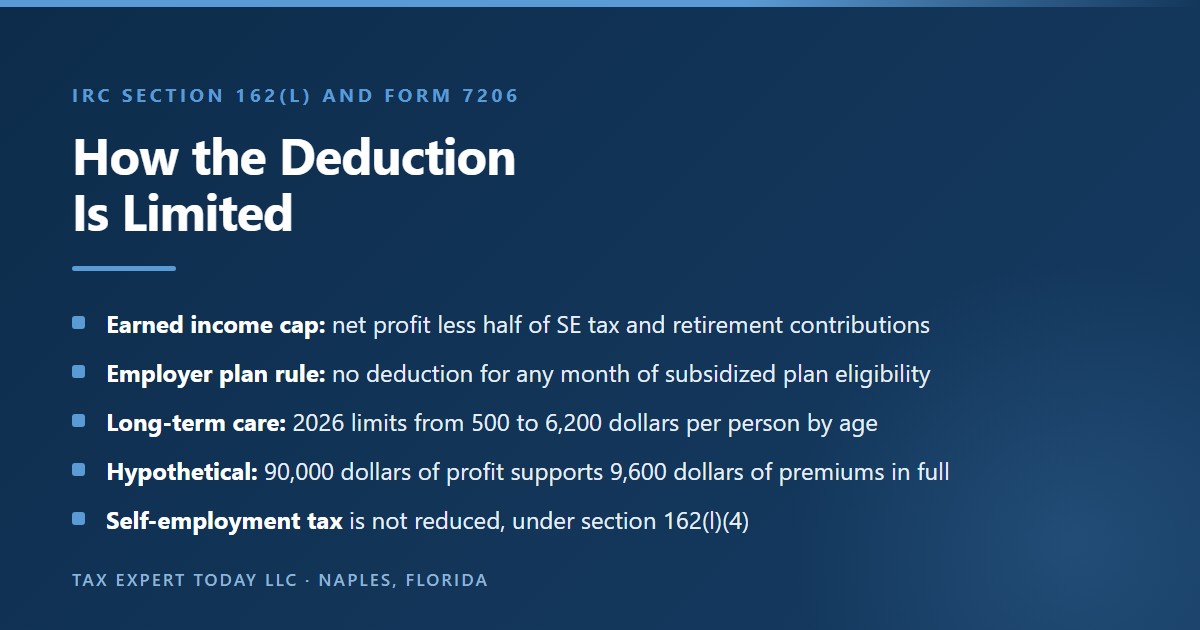
The table below follows a single filer through the computation for 2026. Every figure is hypothetical and rounded to the dollar, and self-employment tax is computed at 15.3 percent of 92.35 percent of net profit, well under the 2026 Social Security wage base of $184,500.
| Item | Amount |
|---|---|
| Schedule C net profit | $90,000 |
| Self-employment tax | $12,717 |
| Deductible half of self-employment tax | $6,358 |
| Earned income limit (line 8, no retirement contributions) | $83,642 |
| Medical and dental premiums paid, no employer plan eligibility | $9,600 |
| Self-employed health insurance deduction (line 14) | $9,600 |
| Federal income tax effect at an assumed 22 percent bracket | About $2,112 less tax |
| Self-employment tax effect | None |
What is the earned income limit for the self-employed health insurance deduction?
The deduction cannot exceed the earned income derived from the trade or business under which the plan is established. For a sole proprietor that is net profit reduced by the deductible half of self-employment tax and by retirement plan contributions for that business. A loss year produces no deduction from that business at all.
Section 162(l)(2)(A) ties the limit to the business, not to the taxpayer. A consultant with a profitable Schedule C and a losing rental activity measures the limit against the consulting income alone. A taxpayer with two profitable businesses but a plan established under only one of them is limited by that one. The Form 7206 instructions require a separate form for each plan and business pair.
| Net profit | Half of SE tax | Earned income limit | Deduction | Premiums not deductible on line 17 |
|---|---|---|---|---|
| $8,000 | $565 | $7,435 | $7,435 | $2,165 |
| $20,000 | $1,413 | $18,587 | $9,600 | $0 |
| $60,000 | $4,239 | $55,761 | $9,600 | $0 |
The $2,165 that does not fit on line 17 in the first row is not lost entirely. The Form 7206 instructions state that premiums not deductible on Schedule 1 can be included as medical expenses on Schedule A for a taxpayer who itemizes, where they face the 7.5 percent of adjusted gross income floor in IRC section 213(a). Retirement plan contributions work against the deduction in the same way: a large SEP or cash balance plan contribution in a thin year reduces the limit dollar for dollar, which is worth testing before the contribution is made.
How does the employer plan rule work month by month?
No deduction is allowed for any calendar month in which the taxpayer was eligible to participate in a subsidized health plan maintained by an employer of the taxpayer, the spouse, a dependent, or a child under 27. Eligibility controls, not enrollment, so declining a spouse’s subsidized plan does not restore the deduction for those months.
The rule is in section 162(l)(2)(B), and the Form 7206 instructions add that eligibility at any time during a month disqualifies the whole month. It is applied separately to plans that include long-term care coverage and plans that do not, so a spouse’s subsidized medical plan does not by itself knock out the deduction for a qualified long-term care policy.
- Eligibility, not enrollment. Being offered a subsidized plan is enough to exclude the month.
- Any part of a month. A spouse who becomes eligible on the 20th removes that whole month.
- Family members count. The employer of a dependent or of a child under 27 can trigger the rule for the premiums covering that person.
- Two separate tests. Long-term care plans and other health plans are tested independently.
- Subsidized means employer-paid. A plan the employee would pay for entirely is generally not subsidized.
| Months | Spouse eligible? | Premiums paid | Counted on Form 7206, line 1 |
|---|---|---|---|
| January to June | No | $6,600 | $6,600 |
| July to December, coverage kept on the private policy | Yes | $6,600 | $0 |
| Full year | $13,200 | $6,600 |
The excluded $6,600 may still be a Schedule A medical expense for a household that itemizes. The more useful step is usually earlier: when a spouse changes jobs, the open enrollment decision and the tax result should be looked at together, because keeping the private policy after a subsidized offer is available usually means paying it with after-tax dollars.
Can I deduct health insurance for my spouse and children?
Yes. Section 162(l)(1) covers premiums for the taxpayer, the spouse, dependents, and any child who has not reached age 27 by the end of the year, even if that child is not a dependent. The child rule follows the definition in section 152(f)(1), which includes stepchildren, adopted children, and eligible foster children.
The under-27 rule is broader than many people expect. A 25-year-old who files a separate return and supports themselves is not a dependent, yet premiums the self-employed parent pays for that child’s coverage still count, subject to the same earned income limit and the same employer plan test applied to the child’s own employer. Rev. Proc. 2014-41 uses exactly this fact pattern in its Example 3, with a non-dependent 26-year-old daughter.
| Person covered | Included? | Watch for |
|---|---|---|
| Taxpayer | Yes | The taxpayer’s own employer plan eligibility, including a second W-2 job |
| Spouse | Yes | The spouse’s employer plan eligibility, month by month |
| Dependent of any age | Yes | The dependent’s employer plan eligibility |
| Child under 27 at year end, not a dependent | Yes | The child’s employer plan eligibility; no premium tax credit for that child’s coverage |
| Child 27 or older, not a dependent | No | Premiums are the child’s own expense |
| Parent or other relative who is not a dependent | No | Possible Schedule A route only if the relative is a dependent for medical purposes |
Does the self-employed health insurance deduction reduce self-employment tax?
No. Section 162(l)(4) states that the deduction is not taken into account in determining net earnings from self-employment. Schedule SE is computed on the full net profit, and the 15.3 percent self-employment tax is owed on income used to pay premiums. The deduction reduces federal income tax and adjusted gross income only.
This is the single most common misunderstanding about the deduction. A sole proprietor who moves premiums onto Schedule C as a business insurance expense lowers net profit, which lowers self-employment tax, which is exactly what the statute prohibits. The Form 7206 instructions say so directly under “Effect on self-employment tax,” and the error tends to surface when the return is examined.
| Treatment | Net profit on Schedule SE | Self-employment tax | Correct? |
|---|---|---|---|
| Premiums on Schedule 1, line 17 | $90,000 | $12,717 | Yes |
| Premiums deducted on Schedule C | $80,400 | $11,360 | No, it understates SE tax by about $1,357 |
The S corporation route is different, and it is the one legitimate way the premium escapes payroll tax for an owner. When the corporation pays the premium for a more-than-2-percent shareholder and the requirements of section 3121(a)(2)(B) are met, Notice 2008-1 states that the amount is wages for income tax withholding but not wages for Social Security and Medicare. The S corporation sections below cover that route. For the self-employment tax side of a sole proprietorship, our self-employment tax calculator shows the figure the premiums do not change.
How does the self-employed health insurance deduction affect the QBI deduction?
It reduces qualified business income. Treas. Reg. section 1.199A-3(b)(1)(vi) treats the self-employed health insurance deduction, the deductible half of self-employment tax, and retirement plan contributions as attributable to the business, so each lowers the income on which the 20 percent qualified business income deduction is computed.
The regulation allocates the deduction to the business in proportion to the gross income from that business used to compute it. In practice that means a taxpayer gets the full benefit of the health insurance deduction but a slightly smaller qualified business income deduction. The net effect is still favorable, but software that skips the reduction overstates the section 199A deduction.
| Computation | QBI | 20 percent QBI deduction |
|---|---|---|
| Net profit less half of SE tax only (incorrect) | $83,642 | $16,728 |
| Net profit less half of SE tax and the $9,600 health insurance deduction | $74,042 | $14,808 |
| Difference in the QBI deduction | $1,920 |
The overall result still favors the taxpayer: $9,600 of deduction against a $1,920 reduction in the qualified business income deduction leaves $7,680 of net reduction in taxable income. Our guide to the qualified business income deduction covers the threshold, wage, and property rules that apply above the income limit.
What are the 2026 limits for long-term care insurance premiums?
For 2026, eligible long-term care premiums are capped per covered person by age at year end: $500 at 40 or under, $930 from 41 to 50, $1,860 from 51 to 60, $4,960 from 61 to 70, and $6,200 over 70. Only a qualified contract under section 7702B(b) counts, and the cap applies per person.
Section 162(l)(2)(C) borrows the medical expense definition in section 213(d)(10), and the figures are indexed each year. The 2026 amounts are in section 3.27 of Rev. Proc. 2025-32; the 2025 Form 7206 still prints the 2025 amounts, which are lower. Long-term care premiums are what force a taxpayer onto Form 7206 rather than the short worksheet in the Form 1040 instructions.
| Age at the end of the year | 2025 limit | 2026 limit |
|---|---|---|
| 40 or under | $480 | $500 |
| 41 to 50 | $900 | $930 |
| 51 to 60 | $1,800 | $1,860 |
| 61 to 70 | $4,810 | $4,960 |
| Over 70 | $6,020 | $6,200 |
A married couple who are 66 and 72 at the end of 2026 and each pay $7,000 for a qualified policy can include $4,960 and $6,200, or $11,160 in total, on line 2, still subject to the earned income limit on line 13. Hybrid life and long-term care policies need care: only the portion that is a qualified long-term care contract under section 7702B can be counted.
Can I deduct Medicare premiums as a self-employed person?
Yes, if the taxpayer still has net self-employment earnings. The Form 7206 instructions allow Medicare premiums voluntarily paid to obtain coverage similar to private health insurance, which generally includes Part B, Part D, and Medicare Advantage premiums, as well as Medigap policies. The earned income limit still applies to the business that sponsors the plan.
For consultants and business owners who keep working past 65, this is one of the more valuable uses of the deduction, because Medicare premiums otherwise land on Schedule A behind the 7.5 percent floor. A spouse’s Medicare premiums count too. The usual employer plan test still applies, so a month in which either spouse could join a subsidized employer plan is excluded.
- Part B and Part D. Includes any income-related adjustment that is part of the premium.
- Medicare Advantage. Premiums for a Part C plan.
- Medigap. A private supplement policy.
- Not Part A for most people. Premium-free Part A involves no premium to deduct.
- Limit unchanged. The deduction still cannot exceed the business earned income.
The deduction also interacts with the temporary senior deduction that Public Law 119-21 added to section 151(d)(5)(C). That deduction is $6,000 per taxpayer who is 65 or older for taxable years beginning before January 1, 2029, reduced by 6 percent of modified adjusted gross income over $75,000, or $150,000 on a joint return. Because the health insurance deduction lowers adjusted gross income, it can also preserve part of the senior deduction.
| Scenario | Modified AGI | Senior deduction after phase-out |
|---|---|---|
| Premiums not deducted on line 17 | $82,000 | $5,580 |
| Premiums deducted on line 17 | $76,600 | $5,904 |
How does the self-employed health insurance deduction interact with the premium tax credit?
The two depend on each other. Section 280C(g) bars a deduction for the part of a premium paid by the premium tax credit, so the deduction depends on the credit. The credit is based on household income, which is computed after the deduction, so the credit depends on the deduction. The IRS calls this a circular relationship.
The disallowance rule is short. IRC section 280C(g) provides that no deduction is allowed for the portion of premiums for a qualified health plan equal to the credit determined under section 36B. The credit itself, under IRC section 36B, is the cost of the benchmark silver plan minus a required contribution set as a percentage of household income. Section 2.05 of Rev. Proc. 2014-41 states the problem in one sentence: the deduction is based on the credit, and the credit is based on the deduction.
- Who it affects. Any self-employed person who buys coverage through the Marketplace and receives advance credit payments or claims the credit.
- What forms are involved. Form 1095-A from the Marketplace, Form 8962 for the credit, and Form 7206 or the Publication 974 worksheets for the deduction.
- The rule that holds it together. Publication 974 requires that the deduction plus the credit not exceed the premiums.
- What software often does. Some programs take one pass and stop, which produces the simplified result or less.
The two most common errors run in opposite directions. One household deducts the full premium and also claims the full credit, which deducts dollars the government paid. Another household skips the deduction entirely because the credit seemed to cover the issue, which leaves both a deduction and some credit unclaimed. The worked table later in this guide shows each one against the correct answer.
What does Rev. Proc. 2014-41 allow?
Rev. Proc. 2014-41 gives two optional methods. The iterative calculation repeats the deduction and credit computation until both change by less than $1 between rounds. The alternative calculation, which Publication 974 calls the simplified method, runs one round. Any other method is allowed if the results satisfy section 36B, section 162(l), and the regulations.
The procedure applies to “specified premiums,” meaning premiums for a qualified health plan covering the taxpayer, a spouse, or a dependent in a coverage month. Premiums for coverage outside the Marketplace, or for a non-dependent child under 27, are nonspecified premiums. Section 4 of the procedure deducts those first, in the ordinary way, before either method starts. Publication 974 implements the same sequence through Worksheet P for nonspecified premiums, then Worksheets W and X.
| Step | Iterative calculation (section 5.01) | Alternative calculation (section 5.02) |
|---|---|---|
| 1 | Take a deduction for all specified premiums, subject to the section 5.03 limits, and compute household income | Same |
| 2 | Compute the credit on that household income | Same, called the initial credit |
| 3 | Deduction equals premiums minus the step 2 credit, subject to the limits | Same |
| 4 | Recompute the credit using the step 3 deduction | Recompute the credit; this is the final credit |
| 5 and 6 | Repeat steps 3 and 4 until both figures change by less than $1 | Not used |
| Result | Usually the most favorable allowable answer | Shorter, but Publication 974 cautions it may be less favorable |
Section 5.03 limits the deduction in both methods to the lesser of the earned income from the business and the sum of the specified premiums not paid through advance credit payments plus the “limitation on additional tax.” That second limit mattered when repayments of excess advance credit were capped. As explained below, the cap no longer exists for 2026, which simplifies that limit considerably.
What does the circular calculation look like in numbers?
For a self-employed couple with $70,000 of household income before the deduction and an $18,000 benchmark silver premium, the simplified method yields a $4,310 deduction and an $11,457 credit. The iterative method converges in seven rounds at a $6,341 deduction and an $11,660 credit, which together equal the full $18,000 premium.
The illustration uses the 2026 applicable percentage table in Rev. Proc. 2025-25 and the 2025 federal poverty line of $21,150 for a household of two in the 48 contiguous states, which the Form 8962 rules use for coverage in the following year. It assumes the couple enrolled in the benchmark plan, received no advance credit payments, and has more than enough business earned income to support the deduction.
| Round | Deduction | Household income | Percent of poverty line | Applicable percentage | Premium tax credit |
|---|---|---|---|---|---|
| 1 | $18,000 | $52,000 | 245.9 | 8.29 | $13,690 |
| 2 | $4,310 | $65,690 | 310.6 | 9.96 | $11,457 |
| 3 | $6,543 | $63,457 | 300.0 | 9.96 | $11,680 |
| 4 | $6,320 | $63,680 | 301.1 | 9.96 | $11,658 |
| 5 | $6,342 | $63,658 | 301.0 | 9.96 | $11,660 |
| 6 and 7 | $6,341 | $63,659 | 301.0 | 9.96 | $11,660 |
Round 2 is where the simplified method stops. Comparing all four possible answers side by side shows why the method matters, and why the two common shortcuts are wrong.
| Approach | Deduction | Premium tax credit | Deduction plus credit | Allowable? |
|---|---|---|---|---|
| Full deduction and full first-round credit | $18,000 | $13,690 | $31,690 | No, it exceeds the premiums and violates section 280C(g) |
| Credit only, no deduction | $0 | $11,028 | $11,028 | Allowed, but leaves value unclaimed |
| Simplified method | $4,310 | $11,457 | $15,767 | Yes |
| Iterative method | $6,341 | $11,660 | $18,000 | Yes, and the most favorable here |
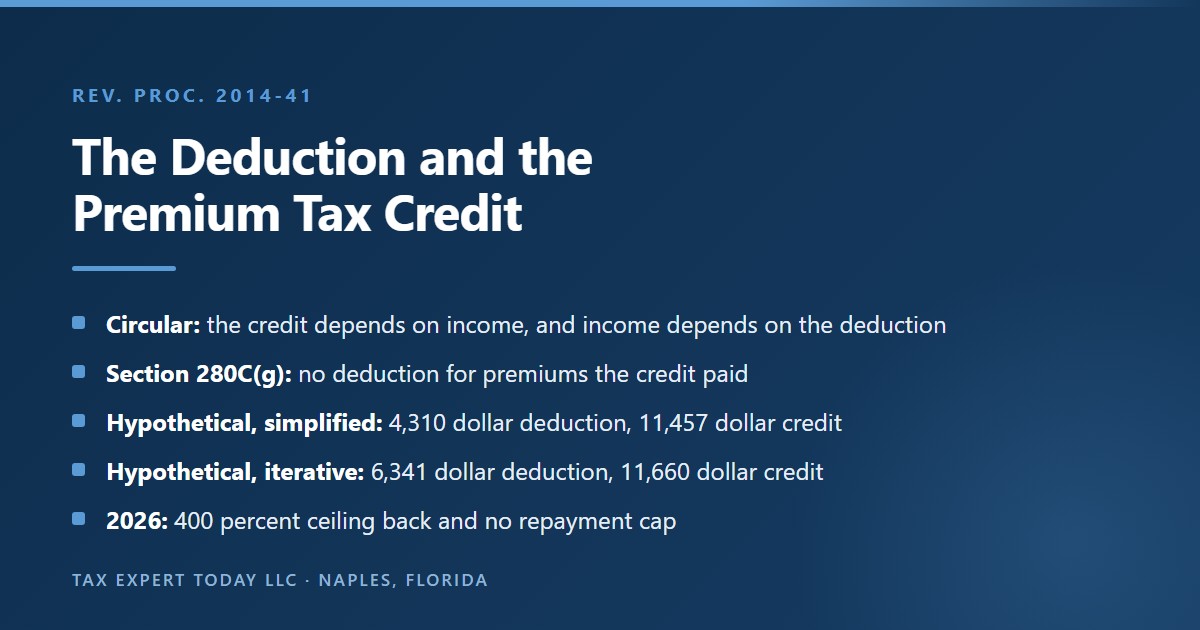
The gap between the simplified and iterative answers here is about $2,031 of deduction and $203 of credit. Whether that is worth the extra rounds depends on the bracket, but it is a computation, not a judgment call, and a preparer can run it in minutes. The months matter too: section 6 of Rev. Proc. 2014-41 prorates the credit when the business operated for only part of the year, as in its Example 4.
What changed for self-employed Marketplace enrollees in 2026?
Three things changed for 2026. The enhanced credit percentages expired for taxable years beginning after 2025, the 400 percent of poverty eligibility ceiling returned, and Public Law 119-21 section 71305 removed the cap on repaying excess advance credit payments. Each raises the stakes of computing the deduction correctly.
As of October 1, 2026, the text of section 36B(b)(3)(A)(iii) and (c)(1)(E) still limits the temporary percentages and the suspension of the 400 percent ceiling to taxable years beginning before January 1, 2026. Legislation to restore them has been debated in Congress, so any change enacted after this guide was written should be checked before a 2026 return is filed. The enrolled text of Public Law 119-21 struck section 36B(f)(2)(B) for taxable years beginning after December 31, 2025.
| Rule | 2025 | 2026 |
|---|---|---|
| Applicable percentage range | Temporary enhanced table, 0 to 8.5 percent | 2.10 to 9.96 percent under Rev. Proc. 2025-25 |
| Household income over 400 percent of the poverty line | Credit still possible | No credit |
| Repayment of excess advance credit payments | Capped for incomes under 400 percent | No cap, full excess is added to tax |
| Rev. Proc. 2014-41 section 5.03 second limit | Depended on the repayment cap | In effect, premiums minus the credit |
| Poverty line used | 2024 guidelines | 2025 guidelines |
The last row of practical interest is the section 5.03 limit. With no limitation on additional tax, the sum of the premiums not paid through advance payments plus the full excess repayment equals the premiums minus the allowed credit, which is the same figure the methods already compute. In our reading, that second limit stops doing independent work for 2026, although the earned income limit still applies.
Can the deduction bring household income under the 400 percent line?
It can. Household income for the credit is measured after the self-employed health insurance deduction, so a household slightly above 400 percent of the poverty line before the deduction may fall below it afterward. When that happens, the circular calculation determines both a credit and a deduction, and the combined result can be far larger than the deduction alone.
The 400 percent line for a household of two using the 2025 poverty guideline is $84,600. The illustration below starts at $90,000, or about 425 percent, with the same $18,000 benchmark premium. On its own, $90,000 produces no credit at all for 2026. The iterative calculation lands at a deduction of $8,152, household income of $81,848, or about 387 percent, and a credit of $9,848.
| Approach | AGI | Federal income tax | Premium tax credit | Net cost of the $18,000 premium |
|---|---|---|---|---|
| No deduction, no credit | $90,000 | $6,440 | $0 | $18,000 |
| Full deduction, no credit | $72,000 | $4,280 | $0 | $15,840 |
| Credit with the iterative deduction | $81,848 | $5,462 | $9,848 | $7,174 |
The figures use the 2026 joint brackets from Rev. Proc. 2025-32 and ignore other credits, so they are only an illustration. The point is structural: near the 400 percent line, the deduction, retirement contributions, and the timing of business income can move a household across a line where a large credit begins or ends. That is a planning question for October and November, not for April. Our quarterly estimated tax calculator helps size the payments once the projection is done.
What happens if advance credit payments were too high in 2026?
For 2026, any excess of advance credit payments over the credit finally allowed is added to tax in full, because Public Law 119-21 removed the repayment cap. A self-employed person whose income ends the year higher than the Marketplace estimate can owe back the entire excess, which makes an accurate deduction and a mid-year income update more important.
Self-employed income is hard to predict, and Marketplace estimates are often set in the prior fall. A strong fourth quarter can raise household income well above the estimate, and above 400 percent of the poverty line the credit for the year is zero, so every dollar of advance payment is repaid on Form 8962. The self-employed health insurance deduction, computed correctly, is one of the few levers that lowers household income after the year closes.
- Report income changes. The Marketplace can adjust advance payments mid-year when income changes.
- Project in the fall. A fourth-quarter projection shows whether the household is near the 400 percent line.
- Use the iterative method. It usually produces the largest allowable deduction and credit together.
- Plan retirement contributions. They lower household income but also reduce the earned income limit for the health insurance deduction.
- Budget for repayment. Without the cap, an underestimate can produce a large balance due.
How do more-than-2-percent S corporation shareholders claim the deduction?
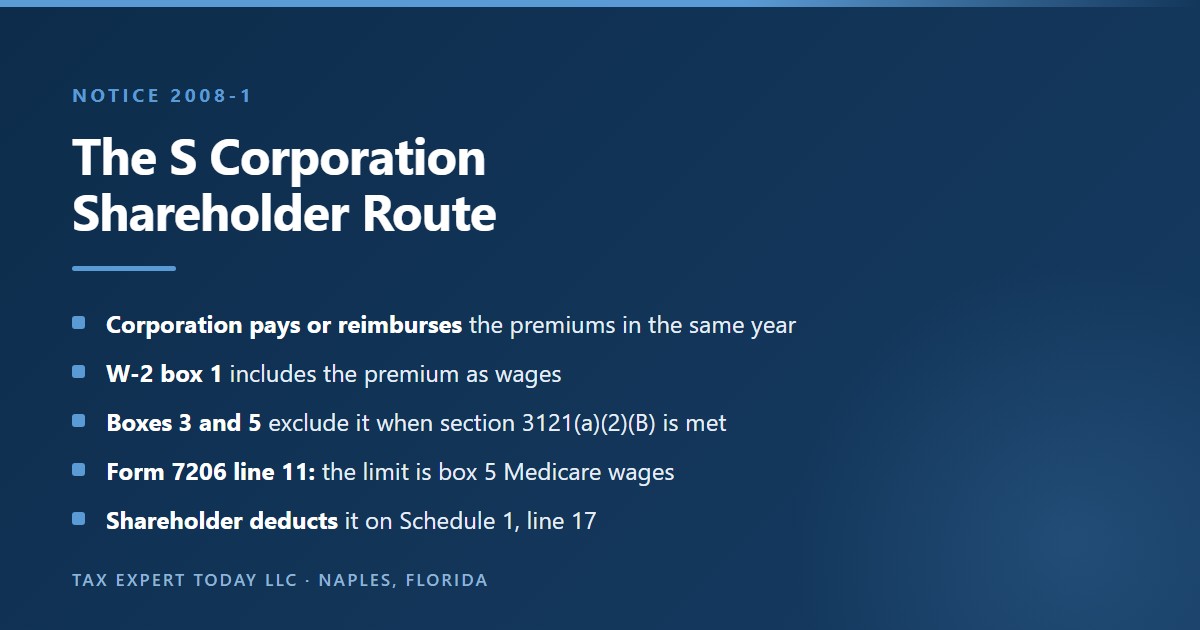
The S corporation must pay the premiums, or reimburse the shareholder who paid them, and must include the amount in the shareholder’s Form W-2 box 1 wages. The shareholder then claims the self-employed health insurance deduction on Schedule 1. Under Notice 2008-1, a plan the corporation neither pays nor reimburses is not established by the corporation.
A more-than-2-percent shareholder is treated as a partner for fringe benefit purposes under IRC section 1372(a), and section 162(l)(5) extends the deduction to that person using wages from the corporation as earned income. Ownership is measured with the section 318 attribution rules on any day of the corporation’s year, so a spouse or child of a more-than-2-percent owner is usually treated the same way. Notice 2008-1 sets out the mechanics, building on Rev. Rul. 91-26.
- Corporation pays or reimburses. In the current tax year, with proof of payment if the shareholder paid first.
- Corporation deducts the premium. As compensation under section 162(a).
- W-2 box 1 includes it. The premium is income tax wages to the shareholder.
- Boxes 3 and 5 exclude it. If the section 3121(a)(2)(B) requirements are met, it is not Social Security or Medicare wages.
- Shareholder deducts it. On Form 7206, using the line 11 wage limit, and on Schedule 1, line 17.
| Form W-2 box | Amount | Why |
|---|---|---|
| Box 1, wages for income tax | $82,000 | Salary plus the premium, per Notice 2008-1 |
| Box 3, Social Security wages | $70,000 | Premium excluded under section 3121(a)(2)(B) |
| Box 5, Medicare wages | $70,000 | Same exclusion |
| Form 7206, line 11 | $70,000 | The box 5 figure is the earned income limit |
| Self-employed health insurance deduction | $12,000 | Smaller of premiums and the limit |
| Payroll tax on the premium | $0 | Compared with about $1,836 if the same $12,000 were paid as extra salary |
The IRS page on S corporation compensation and medical insurance issues summarizes the same treatment. The salary level also sets the deduction limit, as the next section shows, so the salary and the premium are best planned together. Our guide to S corporation reasonable compensation covers that side.
Why is the S corporation limit based on Medicare wages?
Form 7206 line 11 tells a more-than-2-percent shareholder to enter Medicare wages from box 5 of the W-2 issued by the S corporation that established the plan. Because the premium itself is excluded from box 5, the limit is the cash salary, not salary plus premium. A very low salary can therefore cap the deduction below the premiums.
Section 162(l)(5)(A) treats the shareholder’s wages, as defined in section 3121, as earned income, and section 3121 wages exclude a premium that qualifies under section 3121(a)(2)(B). The form follows the statute. A shareholder who takes a token salary of $6,000 to minimize payroll tax and has the corporation pay $12,000 of premiums has a limit of $6,000, so half the premium falls outside line 17.
| Cash salary (box 5) | Box 1 wages | Deduction limit | Deduction | Premium outside line 17 |
|---|---|---|---|---|
| $6,000 | $18,000 | $6,000 | $6,000 | $6,000 |
| $12,000 | $24,000 | $12,000 | $12,000 | $0 |
| $70,000 | $82,000 | $70,000 | $12,000 | $0 |
The low-salary pattern in the first row also invites a reasonable compensation challenge, so the two issues tend to be reviewed together. The fix runs through payroll before year end, not through the individual return afterward.
What happens if the S corporation does not put the premiums on the W-2?
If the corporation neither pays nor reimburses the premiums, or pays them but leaves them out of box 1, the plan is not established under the business and the shareholder cannot claim the self-employed health insurance deduction. Premiums paid personally then become, at most, a Schedule A medical expense subject to the 7.5 percent floor.
This is the most frequent S corporation error, and it usually comes from timing. The shareholder pays the premium from a personal account, nobody tells the payroll provider, and the final W-2 is issued without the premium. By the time the individual return is prepared, the corporation’s year has closed. Notice 2008-1 requires payment or reimbursement in the current taxable year, which is why a December payroll review matters.
| What happened | Plan established by the S corporation? | Result for the shareholder |
|---|---|---|
| Corporation paid premiums, included in box 1 | Yes | Deduction on Schedule 1, line 17 |
| Shareholder paid, corporation reimbursed in the same year and included in box 1 | Yes | Deduction on Schedule 1, line 17 |
| Corporation paid premiums, deducted them, but left them out of box 1 | Reporting defect | A corrected W-2 (Form W-2c) is generally needed before the deduction is supportable |
| Shareholder paid personally, no reimbursement | No | No line 17 deduction; Schedule A only, behind the 7.5 percent floor |
| Owner included in the corporation’s pretax cafeteria plan | A more-than-2-percent shareholder generally cannot participate in a cafeteria plan | The premium belongs in box 1 under Notice 2008-1, and the plan document should be reviewed |
At a 22 percent bracket, the hypothetical $12,000 premium paid personally without reimbursement loses roughly $2,640 of federal income tax benefit compared with the reported route, before any Schedule A recovery. That is a recurring annual cost of a process gap, which is the kind of issue our business consulting work tends to pick up at year-end payroll.
How do partners and LLC members claim the deduction?
For a partner, the plan is established under the partnership if the partnership pays the premiums or reimburses the partner and reports the amount on Schedule K-1 as a guaranteed payment. The partner includes the guaranteed payment in income, pays self-employment tax on it, and claims the deduction on Schedule 1, line 17.
The Form 7206 instructions allow the policy to be in the name of the partnership or the partner, but if the partner pays personally, the partnership must reimburse and report it as a guaranteed payment. Unlike the S corporation route, there is no payroll tax exclusion: the guaranteed payment is net earnings from self-employment, reported in box 14, code A, which is also the figure used for the earned income limit.
| Item | Amount |
|---|---|
| Distributive share of ordinary income | $80,000 |
| Guaranteed payment for premiums | $12,000 |
| Net earnings subject to self-employment tax (box 14, code A) | $92,000 |
| Self-employment tax | $12,999 |
| Self-employed health insurance deduction | $12,000 |
| Net income tax effect of the premium | Included and deducted, so roughly neutral for income tax |
| Net self-employment tax effect of the premium | Added to the SE tax base |
A single-member LLC that has not elected corporate treatment is disregarded, so its owner follows the sole proprietor rules. A multi-member LLC taxed as a partnership follows the partner rules above. An LLC that elected S corporation status follows the S corporation rules, which is one reason the health insurance treatment belongs in any entity choice discussion.
Can a sole proprietor deduct health insurance on Schedule C?
Not for the owner’s own coverage. Premiums for the owner, spouse, and dependents go on Schedule 1, line 17, not on Schedule C, because section 162(l)(4) keeps them out of the self-employment tax computation. Premiums a sole proprietor pays for employees are an ordinary business expense on Schedule C.
The distinction is between the owner and the workforce. Group coverage for employees is deducted under section 162(a) as employee benefits. Coverage for the owner never is. A sole proprietor whose spouse is a genuine employee of the business raises a separate set of rules about employer-provided coverage, medical reimbursement arrangements, and family employment, which turns on the facts and should be reviewed before it is set up.
- Owner’s policy. Schedule 1, line 17, through Form 7206 or the worksheet.
- Employees’ group coverage. Schedule C, employee benefit programs.
- Owner’s policy entered on Schedule C. Understates self-employment tax.
- Policy in the business name or the owner’s name. Either works for a sole proprietor, per the Form 7206 instructions.
What if I have more than one business?
Each plan is measured against the business that established it. The Form 7206 instructions require a separate Form 7206 for each health plan and business pair, each using that business’s net profit or wages as its limit. Long-term care amounts across all forms still cannot exceed the age-based limit for each person.
A common example is a taxpayer with a consulting Schedule C and a separate S corporation. A plan established through the S corporation is limited by that corporation’s box 5 wages. A separate policy bought through the sole proprietorship is limited by the Schedule C profit. Losses in one business do not reduce the limit for the other, but a plan cannot borrow the limit of a business that did not establish it.
| Situation | How the limit is measured |
|---|---|
| One plan, one profitable business | That business’s earned income |
| One plan, two profitable sole proprietorships | Only the business under which the plan is established |
| Two plans, each under a different business | Two Forms 7206, each with its own limit |
| Plan under a business with a net loss | No deduction from that business |
| Self-employment plus a W-2 job with a subsidized plan | Excluded for every month of eligibility for that plan |
Is the self-employed health insurance deduction better than itemizing medical expenses?
Almost always. On Schedule A, medical expenses count only above 7.5 percent of adjusted gross income, and only for taxpayers who itemize. The self-employed health insurance deduction has no floor and is available with the standard deduction. A premium can be claimed in only one place, and line 17 generally comes first.
The Form 7206 instructions forbid using the line 14 amount again on Schedule A, but they allow premiums that did not fit on line 17 to move to Schedule A. Because the 2026 standard deduction is $32,200 for a married couple filing jointly under Rev. Proc. 2025-32, many households never itemize, and for them the Schedule A route is worth nothing.
| Route | Floor | Amount that reduces income | Requires itemizing? |
|---|---|---|---|
| Schedule 1, line 17 | None | $14,400 | No |
| Schedule A medical expenses | $9,000 (7.5 percent of $120,000) | $5,400, and only if total itemized deductions exceed $32,200 | Yes |
Is the self-employed health insurance deduction worth claiming?
For nearly every eligible taxpayer, yes. It reduces federal income tax at the taxpayer’s marginal rate, lowers adjusted gross income for other tests, and can increase a premium tax credit. Its limits are that it never reduces self-employment tax, it slightly reduces the qualified business income deduction, and it requires a profit.
| Effect | Direction |
|---|---|
| Federal income tax | Lower, at the marginal rate |
| Adjusted gross income | Lower, which can help phase-outs and the medical floor |
| Premium tax credit | Can rise, through the circular calculation |
| Senior deduction for taxpayers 65 and older | May be preserved where income is in the phase-out range |
| Self-employment tax | No change |
| Qualified business income deduction | Slightly lower |
| State income tax | Depends on whether the state starts from federal AGI |
Can I have a health savings account and claim the deduction?
Yes. Premiums for a high deductible health plan count toward the self-employed health insurance deduction like any other qualifying premium. Contributions to a health savings account are a separate above-the-line deduction under section 223, claimed on Form 8889. The two do not overlap, and neither one reduces self-employment tax for a sole proprietor.
The combination is common among self-employed people who are healthy and can tolerate a high deductible. The premium goes through Form 7206. The account contribution goes through Form 8889. Neither the premium nor the contribution reduces Schedule SE income, and an S corporation shareholder’s HSA contributions through the corporation follow their own W-2 reporting rules under Notice 2005-8.
What are the most common mistakes with the self-employed health insurance deduction?
The most common mistakes are deducting the owner’s premiums on Schedule C, deducting the full Marketplace premium while also claiming the full credit, ignoring a spouse’s subsidized employer plan, missing the S corporation W-2 step, and claiming the deduction in a year with a business loss. Each one has a predictable fix.
| Mistake | What it causes | Fix |
|---|---|---|
| Owner’s premiums on Schedule C | Understated self-employment tax | Move to Schedule 1, line 17, through Form 7206 |
| Full premium deducted plus full credit | Deduction for dollars the credit paid, contrary to section 280C(g) | Run the Rev. Proc. 2014-41 calculation |
| Credit claimed, deduction skipped | Value left unclaimed | Run the same calculation; deduct premiums net of the credit |
| Spouse’s subsidized plan ignored | Deduction for excluded months | Test eligibility one month at a time |
| S corporation premiums missing from box 1 | Plan not established under the business | Year-end payroll entry; corrected W-2 where needed |
| Deduction claimed in a loss year | No earned income to support it | Use the Schedule A route if itemizing |
| Long-term care premiums above the age limit | Overstated deduction | Apply the 2026 per-person limits |
| QBI computed without the reduction | Overstated section 199A deduction | Reduce QBI under Treas. Reg. section 1.199A-3(b)(1)(vi) |
What records support the self-employed health insurance deduction?
Keep the policy declarations showing who was covered and for which months, proof of each premium payment, Form 1095-A for any Marketplace coverage, employer plan eligibility notices for a spouse or dependents, and, for an S corporation shareholder, the reimbursement records and the W-2 showing the premium in box 1.
- Policy and coverage months. Declarations pages or the insurer’s annual statement.
- Payment proof. Bank or card statements matching each premium.
- Form 1095-A. Monthly enrollment premium, benchmark premium, and advance payments.
- Employer plan facts. Start dates and eligibility for every household member’s job.
- S corporation file. Reimbursement requests, proof of payment furnished to the corporation, and the payroll entry.
The month-by-month record is the piece that is hardest to rebuild later. A household with two earners who changed jobs during the year should note the eligibility dates while they are fresh, because the employer plan test turns on them.
When should the self-employed health insurance deduction be planned?
Most of the value is decided before December 31. Payroll entries for S corporation premiums, retirement contributions that change the earned income limit, Marketplace income updates, and the choice to keep or drop a policy when a spouse gets a subsidized offer all happen during the year. The return only reports what was already set up.
Owners whose books are closed monthly, whether in house or by a fractional CFO, can usually run these checks on time, because the premium, payroll, and income figures are already current when the decisions come due.
| When | Action |
|---|---|
| Open enrollment in the fall | Set the Marketplace income estimate with the deduction in mind |
| Any job change in the household | Check whether a subsidized employer plan becomes available, and from which month |
| Third quarter | Project household income against the 400 percent line |
| November and December | S corporation reimbursement and W-2 box 1 inclusion; retirement contribution sizing |
| Filing season | Form 7206, the Rev. Proc. 2014-41 calculation, Form 8962, and the QBI reduction |
Estimated tax payments should reflect the deduction too. A self-employed person who budgets for tax without it will usually overpay income tax during the year, while one who assumes it also reduces self-employment tax will underpay. Our IRS underpayment penalty calculator shows what a shortfall in those payments can cost.
Does Florida have a state version of the deduction?
Florida has no personal income tax, so for a Florida resident the federal deduction is the whole story. In states that start their income tax from federal adjusted gross income, the deduction usually carries through automatically, but conformity varies, and a few states compute their own figures. A taxpayer filing in another state should check that state’s rules.
Residents who are relocating to Florida, or who still file a part-year return in a former state, may see the deduction treated one way federally and another way in the state they left. Our guide to establishing Florida residency covers the residency side of that change.
Self-Employed Health Insurance Deduction Help in Naples & Southwest Florida
Self-employed health insurance deduction help Naples business owners ask for usually involves one of three things: a Marketplace policy with a premium tax credit, an S corporation that needs the premium on the W-2, or a household near the 400 percent line. Our office in Naples, Florida runs the Form 7206 and Rev. Proc. 2014-41 computations and reviews year-end payroll.
Southwest Florida has a large population of consultants, contractors, real estate professionals, and retirees who still run a business, and many of them buy coverage individually. A good number are over 65 and paying Medicare premiums that can qualify for the deduction while they still have self-employment income. Florida has no personal income tax, so the federal computation is the one that matters for residents, and the federal rules described above apply everywhere.
- Form 7206 preparation. Including long-term care limits and multiple businesses.
- Premium tax credit coordination. The iterative and simplified methods, Form 8962, and Form 1095-A reconciliation.
- S corporation payroll review. Reimbursement, W-2 box 1 inclusion, and the box 5 limit.
- Household income planning. Projections against the 2026 400 percent line.
- Medicare premium review. For self-employed clients 65 and older.
Tax Expert Today LLC
11983 Tamiami Trail N, Naples FL 34110
Phone: (239) 441-2005
Hours: Monday to Friday, 10:00 to 5:00 ET
Where can I get help with the self-employed health insurance deduction in Naples, FL? Tax Expert Today LLC, at 11983 Tamiami Trail N in Naples, Florida, helps self-employed individuals, partners, and S corporation owners with the self-employed health insurance deduction: preparing Form 7206, coordinating the deduction with the premium tax credit, reviewing S corporation payroll reporting, and planning household income for the year. The firm includes tax advisors, enrolled agents, CPAs, and attorneys, and serves clients in all 50 states. Results depend on each taxpayer’s facts.
When to Engage a Professional
The self-employed health insurance deduction is straightforward for a sole proprietor with a private policy and no other coverage options. It becomes worth a professional review when a premium tax credit, an S corporation, a household job change, or a household income near the 400 percent line is involved, because each one changes the computation.
- Marketplace coverage with advance credit payments. The circular calculation and the uncapped 2026 repayment.
- An S corporation that pays or should pay the premiums. The W-2 reporting has to be done before year end.
- A spouse or child with a new employer plan offer. The month-by-month test changes the result.
- Household income near 400 percent of the poverty line. The deduction may decide whether any credit is available.
- More than one business or a loss in one of them. Each plan has its own limit.
- Long-term care or Medicare premiums. Age-based limits and the senior deduction interaction.
- A prior return with premiums on Schedule C. The self-employment tax effect may need to be addressed.
Tax Expert Today LLC is a multidisciplinary practice of tax advisors, enrolled agents, certified public accountants, and attorneys serving clients in all 50 states. To discuss how the self-employed health insurance deduction fits within a broader Naples tax planning approach, our tax planning services, or our business consulting work for owners setting up payroll and benefits, call (239) 441-2005. Owners comparing entity structures may also find our guides to an LLC versus an S corporation, the Augusta rule, and a cash balance plan for business owners useful.
This article is general information about federal tax provisions and is not tax, legal, or insurance advice for any specific taxpayer. Figures were verified against primary sources on October 1, 2026 and are hypothetical illustrations, not client outcomes. Premium tax credit rules for 2026 reflect the Internal Revenue Code as written on that date, and legislation could change them. Tax laws apply differently to each person’s facts, and results always vary. Consult a qualified professional about your situation before taking any action.
Published October 1, 2026 by Dr. Pellumb Kabashi « Back to Learning Center
Have a question this article touches on?
Tax Expert Today LLC, based in Naples, Florida and serving clients across the United States.
Schedule a Consultation (239) 441-2005