
By Dr. Pellumb Kabashi, DBA, MBA, CES, CFE, EA
Founder, Tax Expert Today LLC · Tax advisors, enrolled agents, CPAs, and attorneys · Serving clients in all 50 states
Quick Answer
A qualified charitable distribution is a transfer made directly from an individual retirement account to an eligible charity that is excluded from gross income under section 408(d)(8). For 2026 the annual ceiling is $111,000 per person, and the donor must be at least age 70 1/2 on the date of the transfer. The exclusion replaces a deduction rather than adding to one. Call (239) 441-2005 for a free consultation.
Almost every article written about qualified charitable distributions describes a strategy. Very few describe the paperwork, and the paperwork is where the exclusion is won or lost. A transfer can satisfy every substantive requirement in the statute and still be taxed, because nothing about the custodian’s reporting forces the exclusion onto the return. The taxpayer claims it, or nobody does.
Two things changed for 2026 that are not yet reflected in most of what has been published. The Internal Revenue Service added a distribution code to Form 1099-R specifically to flag these transfers, and it made that code optional for the first year. Separately, Public Law 119-21 rewrote how charitable deductions work for people who itemize, which changes the arithmetic of whether to give from an individual retirement account at all. Both are covered below, with the statutory citations and the current-year figures verified against the source documents rather than carried forward from a prior year.
What is a qualified charitable distribution?
A qualified charitable distribution is an amount paid directly by the trustee of an individual retirement account to an eligible charitable organization, which section 408(d)(8)(A) excludes from the account owner’s gross income. It is an exclusion and not a deduction, so the amount never enters adjusted gross income and never appears as a charitable contribution on Schedule A.
The distinction between an exclusion and a deduction is not a technicality. It determines how many other provisions of the return the gift touches, and in 2026 it determines whether the gift produces any federal benefit at all for a taxpayer who would otherwise claim the standard deduction. The requirements are set out in section 408(d)(8) and each one is independent, meaning a failure on any single element is a failure on the whole transfer.
- Directly by the trustee. Section 408(d)(8)(B)(i) requires the payment to be made by the trustee to the organization. Money that lands in the owner’s bank account first is not a qualified charitable distribution, no matter what the owner does with it afterward.
- Age 70 1/2 on the date of the distribution. Section 408(d)(8)(B)(ii) fixes eligibility at the individual’s actual attainment of age 70 1/2, not at the beginning of the year in which that birthday falls.
- An organization described in section 170(b)(1)(A). The recipient must be a public charity of the type that supports an ordinary charitable deduction, and two categories are carved out by name.
- Otherwise fully deductible. Section 408(d)(8)(C) requires that a deduction for the entire distribution would be allowable under section 170, ignoring the percentage limits. Any benefit received in return breaks this.
- Otherwise includible in income. The flush language of section 408(d)(8)(B) limits the treatment to amounts that would have been taxable, which is what keeps after-tax basis out of the calculation.
Nothing in that list is administered by the custodian. A trustee may rely on reasonable representations from the account owner, as Notice 2007-7 Q&A-40 confirms, which is exactly why the substantive burden sits with the taxpayer and the preparer.
How much can you give through a QCD in 2026?
For 2026 the aggregate annual exclusion is $111,000 per individual, increased from $108,000, and the one-time distribution to a split-interest entity is capped at $55,000, increased from $54,000. Both figures come from Notice 2025-67. A married couple where both spouses qualify may exclude up to $111,000 each from their own accounts.
These amounts are indexed under section 408(d)(8)(G), which measures the cost-of-living adjustment from a 2022 base year and rounds to the nearest multiple of $1,000. That rounding is why the figure moves in $3,000 steps in some years and not at all in others, and it is why any figure carried forward from an older article should be treated as unreliable rather than merely dated.
| Limit | 2025 | 2026 | Statutory source |
|---|---|---|---|
| Aggregate annual exclusion per individual | $108,000 | $111,000 | Section 408(d)(8)(A) |
| One-time split-interest entity election | $54,000 | $55,000 | Section 408(d)(8)(F)(i)(II) |
| Married couple, both spouses qualifying | $216,000 | $222,000 | Applied per individual |
| Is the split-interest amount additive? | No. It is carved out of the annual ceiling, not added to it. | ||
Figures verified 2026-09-10 from IRS Notice 2025-67. Illustrative only; individual results depend on the facts of each account.
That last row is worth stopping on, because the usual phrasing invites the opposite reading. The Instructions for Form 1040 are explicit that the annual total “includes any amount” of a one-time split-interest distribution. A taxpayer who makes a $55,000 split-interest transfer in 2026 has $56,000 of ordinary qualified charitable distribution capacity remaining for that year, not $111,000.
Who is eligible to make a qualified charitable distribution?
Eligibility begins on the day the account owner attains age 70 1/2 and does not depend on being retired, on having begun required minimum distributions, or on the size of the account. A beneficiary of an inherited individual retirement account also qualifies, provided that beneficiary has personally reached age 70 1/2.
The age gap between qualified charitable distribution eligibility and required minimum distribution eligibility is the most commonly missed planning window on this topic. Under section 401(a)(9)(C)(v) as amended, the applicable age for required minimum distributions is 73 for anyone reaching age 72 after 2022 and age 73 before 2033, rising to 75 thereafter. Qualified charitable distribution eligibility still begins at 70 1/2.
- Roughly two and a half years of early access. Someone who turns 70 1/2 in 2026 may make qualified charitable distributions immediately, even though no required minimum distribution is due until 2029 at the earliest.
- Draining the account early has a purpose. Every dollar moved out through a charitable transfer before required distributions begin is a dollar that never inflates the future required distribution calculation.
- Inherited accounts qualify by the beneficiary’s age. Notice 2007-7 Q&A-37 confirms the exclusion is available from an account maintained for a beneficiary after the owner’s death, if the beneficiary has reached age 70 1/2.
- Employment status is irrelevant. Nothing in the statute conditions the exclusion on retirement, although continuing to make deductible contributions triggers an offset discussed further below.
- The date matters, not the year. A transfer made in the calendar year the owner turns 70 1/2, but before the actual half-birthday, is not a qualified charitable distribution.
Which accounts can a qualified charitable distribution come from?
Traditional individual retirement accounts, inherited individual retirement accounts, and dormant employer-sponsored individual retirement accounts qualify. Employer plans such as a 401(k) or 403(b) do not qualify at all. A simplified employee pension or a savings incentive match plan account qualifies only if it is no longer receiving employer contributions.
The distinction for employer-sponsored individual retirement accounts turns on a precise definition. Notice 2007-7 Q&A-36 treats such an account as ongoing, and therefore ineligible, if an employer contribution is made for the plan year ending with or within the owner’s taxable year in which the charitable transfer would be made. A single small employer contribution in the wrong year disqualifies the account for that year.
| Account type | Eligible for a QCD | Practical note |
|---|---|---|
| Traditional individual retirement account | Yes | The ordinary case and the one the statute is written around. |
| Inherited individual retirement account | Yes | Only if the beneficiary has personally reached age 70 1/2. |
| Simplified employee pension account | Only if dormant | Ineligible for any year in which an employer contribution is made. |
| Savings incentive match plan account | Only if dormant | Same ongoing-plan test as above. |
| Roth individual retirement account | Technically yes | Generally pointless, because qualified Roth withdrawals are already tax free. |
| 401(k), 403(b), 457(b), or any employer plan | No | A rollover to an individual retirement account first is the only route. |
Eligibility summarized from section 408(d)(8)(B) and IRS Notice 2007-7. Facts vary; confirm account status before initiating a transfer.
The employer-plan exclusion catches people who assume that money is money. A participant who wants to give from a 401(k) balance has to roll the intended amount to an individual retirement account first, and that rollover has its own timing and withholding considerations. The same sequencing question arises when employer stock sits inside the plan, where a separate election under the net unrealized appreciation rules may be the better use of the same shares.
Which charities can receive a QCD, and which cannot?
The recipient must be an organization described in section 170(b)(1)(A). Section 408(d)(8)(B)(i) then removes two categories by name: supporting organizations described in section 509(a)(3), and donor advised funds described in section 4966(d)(2). A private non-operating foundation is also outside the permitted class.
This is the most consequential restriction in the provision, because the two excluded vehicles are precisely the ones a charitably inclined retiree is most likely to already have. A donor advised fund is an efficient home for appreciated securities and for bunching cash gifts, and it does excellent work in that role, but it cannot receive a qualified charitable distribution. The reason is structural rather than punitive: Congress declined to allow an income exclusion for a transfer that the donor still controls the timing of.
- Operating public charities qualify. Churches, schools, hospitals, and the ordinary run of section 501(c)(3) operating charities are the intended recipients.
- Donor advised funds are excluded by statute. The exclusion is by direct cross-reference to section 4966(d)(2), so there is no facts-and-circumstances argument available. A separate donor advised fund deduction analysis covers where that vehicle does work.
- Supporting organizations are excluded. Organizations described in section 509(a)(3) are named in the carve-out, which surprises donors who support a university foundation structured that way.
- Any benefit received disqualifies the whole transfer. Because section 408(d)(8)(C) requires the entire distribution to be deductible, a gala ticket or an auction item received in exchange does not merely reduce the exclusion. It removes it.
- Verification is the donor’s job. The custodian sends money where it is told. Confirming the recipient’s classification before the transfer is faster than unwinding the consequence afterward.
| Recipient | Permitted | Authority |
|---|---|---|
| Operating public charity, church, school, hospital | Yes | Section 170(b)(1)(A) |
| Donor advised fund | No | Section 408(d)(8)(B)(i), citing section 4966(d)(2) |
| Supporting organization | No | Section 408(d)(8)(B)(i), citing section 509(a)(3) |
| Private non-operating foundation | No | Outside the section 170(b)(1)(A) class |
| Charity providing goods or services in return | No | Section 408(d)(8)(C), full deductibility required |
| Split-interest entity funded solely by QCDs | Once only | Section 408(d)(8)(F) |
Classification should be confirmed for the specific organization before any transfer is initiated.
Does a QCD count toward your required minimum distribution?
Yes. Notice 2007-7 Q&A-42 confirms that a qualified charitable distribution is an amount distributed from the account for purposes of the required minimum distribution rules. The ordering matters, however, because the first dollars withdrawn in a year are the dollars applied against that year’s required amount.
This is a sequencing trap rather than a legal one. A retiree who takes the full required minimum distribution in January and then makes a charitable transfer in December has already recognized the required amount as income. The December transfer is still excluded from income on its own terms, but it cannot retroactively remove income that was already taken.
- Give first, then withdraw the remainder. A charitable transfer made before any other withdrawal absorbs the required amount dollar for dollar.
- Automatic distribution schedules defeat this. A standing monthly withdrawal instruction will have consumed part of the required amount before a year-end charitable decision is ever made.
- The exclusion survives regardless. Poor sequencing costs the required distribution offset, not the exclusion itself, so the transfer is still worth making.
- A transfer may exceed the required amount. Nothing caps a qualified charitable distribution at the required minimum distribution figure, up to the annual ceiling.
- Year-end timing is a real risk. The transfer has to be completed, not merely requested, within the calendar year.
Why does a QCD usually beat a charitable deduction in 2026?
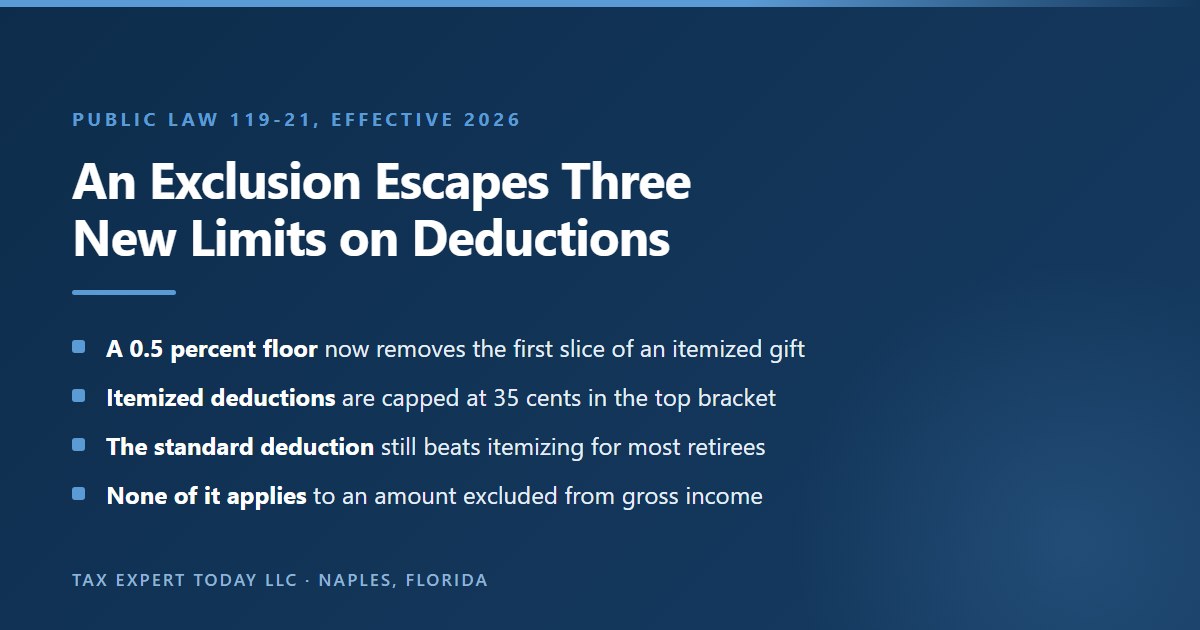
Public Law 119-21 changed three provisions that reduce what an itemized charitable deduction is worth beginning in 2026, and a qualified charitable distribution is subject to none of them, because it is an exclusion rather than a deduction. The gap between the two routes is wider this year than it has been in any prior year.
Each of the three changes applies to taxable years beginning after December 31, 2025, which makes 2026 the first filing year in which any of them applies. They should be read together rather than separately, because their combined effect on a large gift is larger than any one of them suggests.
- A new floor on itemized charitable deductions. Section 170(b)(1)(I) allows a charitable contribution only to the extent the total exceeds 0.5 percent of the contribution base. The first half percent of income given away produces no deduction at all.
- A cap on the value of every itemized deduction. Section 68 as rewritten reduces itemized deductions by 2/37ths of the amount by which income exceeds the 37 percent bracket threshold, which caps the marginal benefit at 35 cents on the dollar for the highest bracket.
- A small deduction for people who do not itemize. Section 170(p) now allows up to $1,000, or $2,000 on a joint return, for cash gifts by non-itemizers. It excludes donor advised funds and supporting organizations on the same terms the charitable distribution rules do.
- The standard deduction remains the binding constraint. For 2026 the standard deduction is $16,100 for an unmarried filer and $32,200 for a joint return, with an additional $1,650 for age, or $2,050 for an unmarried filer. Most retirees never reach those totals through itemizing.
- None of it touches an exclusion. A qualified charitable distribution reduces adjusted gross income before any of these provisions are reached, so the floor, the cap, and the standard deduction comparison are all irrelevant to it.
There is a fourth interaction that is specific to this age group and is rarely mentioned. Section 151(d)(5)(C) allows a deduction of $6,000 for each individual aged 65 or older, reduced by 6 percent of modified adjusted gross income above $75,000, or $150,000 on a joint return. Because that phase-out runs on adjusted gross income, a charitable exclusion partially restores a deduction that a cash gift out of a full withdrawal would have phased away.
How much is the difference worth in real numbers?
The comparison that matters is not the gift against nothing, but the same gift made two ways. Holding the charity, the amount, and the household cash flow identical, the exclusion route produces materially less taxable income than taking the full distribution and writing a check, and the reason is a combination of four separate provisions rather than one.
The illustration below is hypothetical and is offered to show the mechanism. It assumes an unmarried Florida resident aged 75, other taxable income of $60,000, a 2026 required minimum distribution of $80,000, an intended gift of $30,000 to an operating public charity, and $9,000 of other itemized deductions. All statutory figures are the verified 2026 amounts. Individual outcomes depend entirely on the taxpayer’s own facts.
| Line | Full withdrawal, then a cash gift | Qualified charitable distribution |
|---|---|---|
| Other taxable income | $60,000 | $60,000 |
| Required minimum distribution recognized | $80,000 | $50,000 |
| Amount excluded under section 408(d)(8) | $0 | $30,000 |
| Adjusted gross income | $140,000 | $110,000 |
| Charitable deduction before the floor | $30,000 | Not available |
| Section 170(b)(1)(I) floor at 0.5 percent | ($700) | Not applicable |
| Other itemized deductions | $9,000 | $9,000 |
| Deduction actually claimed | $38,300 itemized | $18,150 standard |
| Section 151(d)(5)(C) deduction for age | $2,100 | $3,900 |
| Taxable income | $99,600 | $87,950 |
| Federal tax at 2026 rates | $16,624 | $14,061 |
Hypothetical illustration computed 2026-09-10 using the 2026 rate schedule and standard deduction amounts in Rev. Proc. 2025-32. Not a prediction of any taxpayer’s result.
The difference is roughly $11,650 of taxable income and roughly $2,563 of federal tax, on an identical gift and an identical amount of cash reaching the household. The decomposition is more instructive than the total, because it shows that the exclusion is not simply better by its face amount.
| Component | Effect on taxable income | Provision |
|---|---|---|
| Gift removed from adjusted gross income | Reduces by $30,000 | Section 408(d)(8)(A) |
| Charitable deduction forgone | Increases by $29,300 | Section 408(d)(8)(E) |
| Standard deduction claimed instead of itemizing | Reduces by $9,150 | Section 63(c) |
| Deduction for age partially restored | Reduces by $1,800 | Section 151(d)(5)(C) |
| Net reduction in taxable income | $11,650 | Combined |
Component amounts are illustrative and follow from the assumptions stated above.
Two of those four lines are invisible in the usual framing. The taxpayer who stops itemizing recovers the full standard deduction, which in this illustration is worth more than the other itemized deductions were on their own. The taxpayer whose adjusted gross income falls also recovers part of the age-based deduction, at a rate of 6 cents for every dollar of income removed. Neither effect appears if the analysis stops at comparing an exclusion with a deduction of the same size. This kind of layered interaction is why coordinated tax planning tends to find more than a single-issue review does.
One honest caveat belongs here. The 35 cent cap under section 68 does not bind in this illustration, because the taxpayer is nowhere near the 37 percent bracket. It is a genuine constraint for very high income donors and a non-event for most retirees, and articles that present it as a universal reason to prefer an exclusion are overstating it.
Does a QCD come out of pre-tax dollars or your after-tax basis?
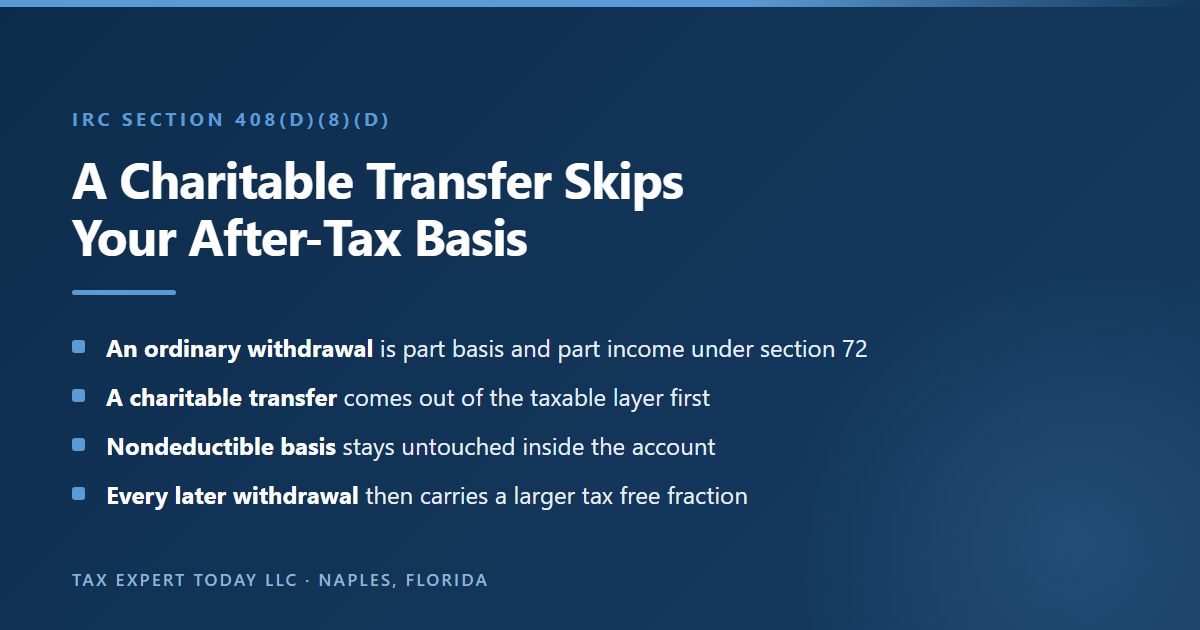
Section 408(d)(8)(D) reverses the ordinary rule. A normal individual retirement account withdrawal is part basis and part income under the pro rata rules of section 72. A qualified charitable distribution is treated as coming entirely out of the amount that would have been taxable, so after-tax basis is left untouched inside the account.
This is the single most favorable mechanical rule in the provision and it is almost never discussed. Nondeductible contributions tracked on Form 8606 create basis that ordinarily dilutes out slowly, a small tax-free fraction at a time. A charitable transfer skips the basis entirely and consumes only the taxable layer.
| Item | Ordinary $30,000 withdrawal | $30,000 qualified charitable distribution |
|---|---|---|
| Account balance before | $500,000 | $500,000 |
| After-tax basis on Form 8606 | $50,000 | $50,000 |
| Basis fraction applied | 10 percent | Not applied |
| Tax-free return of basis | $3,000 | $0 |
| Amount taxed as ordinary income | $27,000 | $0 |
| Basis remaining after the transaction | $47,000 | $50,000 |
| Basis as a share of the remaining account | 10.0 percent | 10.6 percent |
Hypothetical illustration of the ordering rule in section 408(d)(8)(D). Amounts depend on the specific account.
The practical consequence is cumulative. Repeated charitable transfers concentrate the untouched basis in a shrinking account, so every future ordinary withdrawal carries a larger tax-free fraction. Publication 590-B works through a related example in which the basis portion of a transfer that exceeds the taxable balance may still be claimed as an ordinary charitable contribution on Schedule A, which is a rare case in which both treatments appear on the same return.
How does the anti-abuse offset reduce a QCD if you are still contributing?
The second sentence of section 408(d)(8)(A) reduces the excludable amount by the total of all deductible individual retirement account contributions taken for years ending on or after the taxpayer reached age 70 1/2, minus reductions already applied in earlier years. It is cumulative and it does not reset annually.
Congress added this when the SECURE Act removed the old age cap on deductible contributions. Without it, a working taxpayer past 70 1/2 could deduct a contribution going in and exclude the same dollars going out to charity, which would be two benefits for one dollar. The offset is worth understanding precisely because the running total is not shown anywhere on the return and has to be tracked by the preparer.
The illustration below assumes an unmarried consultant who reaches age 70 1/2 in 2026, deducts the full contribution allowed for someone over 50, which is $7,500 plus a $1,100 catch-up for 2026, and makes a $25,000 charitable transfer each year.
| Year | Deductible contribution | Cumulative post-70 1/2 deductions | Offset applied | Amount excluded | Amount taxed |
|---|---|---|---|---|---|
| Year 1 | $8,600 | $8,600 | $8,600 | $16,400 | $8,600 |
| Year 2 | $8,600 | $17,200 | $8,600 | $16,400 | $8,600 |
| Year 3 | $0 | $17,200 | $0 | $25,000 | $0 |
| Year 4 | $0 | $17,200 | $0 | $25,000 | $0 |
| Four-year total | $17,200 | $17,200 | $82,800 | $17,200 |
Hypothetical application of the section 408(d)(8)(A) offset using the 2026 contribution amounts in Notice 2025-67.
The pattern is worth stating plainly. Every dollar deducted after age 70 1/2 costs exactly one dollar of charitable exclusion, once, and the offset then stops. It is not a penalty and it is not permanent, but a taxpayer who does not know about it will find the first year’s exclusion smaller than expected and will have no obvious explanation for it.
How is a qualified charitable distribution reported on your tax return?
The full distribution goes on line 4a of Form 1040, the taxable remainder goes on line 4b, and box 2 on line 4c is checked to identify the transfer. Nothing on the Form 1099-R the custodian issues will compute this for the taxpayer. The exclusion exists only because the return claims it.
This is the point at which correctly executed transfers are lost. A retiree who did everything right, and whose charity has the money, still reports the full amount as taxable if the return simply copies box 2a of the Form 1099-R onto line 4b. Software will not catch it, because nothing in the source document indicates that the distribution went to a charity.
| Where | What goes there | Source |
|---|---|---|
| Form 1040, line 4a | The total distribution, matching box 1 of the Form 1099-R | Instructions for Form 1040, Exception 3 |
| Form 1040, line 4b | Zero if the entire distribution qualified, otherwise the non-qualifying part | Instructions for Form 1040, Exception 3 |
| Form 1040, line 4c | Check box 2 to identify the qualified charitable distribution | Instructions for Form 1040, Exception 3 |
| Form 8606 | Required if the account holds nondeductible basis | About Form 8606 |
| Schedule A | Nothing for the excluded amount | Section 408(d)(8)(E) |
| Attached statement | Required only for the one-time split-interest election | Publication 590-B |
Reporting mechanics current as of the 2025 Instructions for Form 1040. Line references may shift in later revisions.
Two supporting items belong in the file rather than on the return. The first is the contemporaneous written acknowledgment from the charity. Notice 2007-7 Q&A-39 confirms that a qualified charitable distribution must satisfy the requirements of section 170 other than the percentage limits, and that includes the substantiation requirement of section 170(f)(8), the contemporaneous written acknowledgment standard set out in IRS Publication 526. The second is proof that the payment went from the trustee to the charity rather than through the owner’s own account.
What is code Y on Form 1099-R, and can you rely on it?
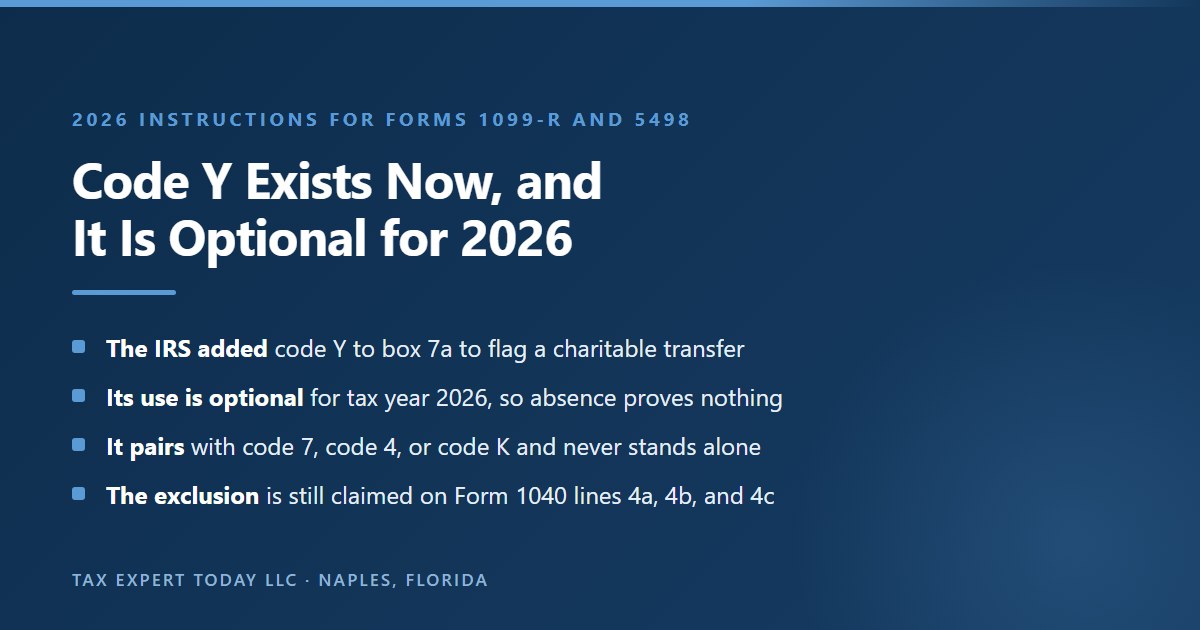
The Internal Revenue Service added code Y to box 7a of Form 1099-R to identify a qualified charitable distribution. For tax year 2026 the use of code Y is optional. A payer may choose to use it and is not required to, which means its absence proves nothing and its presence cannot be assumed.
This is new and it corrects something that has been true for nearly twenty years. Until this change there was no distribution code for these transfers at all, and a great deal of published guidance still says so. The current position is more subtle than either the old rule or a simple announcement that a code now exists.
- The code exists. The 2026 Instructions for Forms 1099-R and 5498 add code Y to the box 7a code list on Form 1099-R for a qualified charitable distribution claimed under section 408(d)(8).
- Its use is optional for 2026. The instructions state that a payer completing a 2026 Form 1099-R may choose, but is not required, to enter code Y.
- It never appears alone. When used, code Y must be entered first and paired with code 7 for a normal distribution, code 4 for an inherited account, or code K where the assets lack a readily available fair market value.
- It reflects intent, not verification. The instructions direct its use where the distribution went to a charity and the taxpayer intends to treat it as qualifying. The custodian is not auditing eligibility.
- The reporting duty does not move. A coded form is helpful evidence and nothing more. The exclusion still has to be claimed on lines 4a, 4b, and 4c.
The practical instruction for the coming filing season is therefore unchanged in substance and sharper in detail. Do not treat a missing code Y as evidence that a transfer failed, and do not treat a present code Y as confirmation that it succeeded. Keep the acknowledgment letter and the trustee’s transfer record, because those are what actually support the position.
What are the most common QCD mistakes?
The recurring failures are procedural rather than conceptual. Money routed through the owner’s own account, a gift to an excluded organization, a benefit accepted in return, a missing acknowledgment letter, and a return that never claims the exclusion account for the overwhelming majority of problems seen in practice.
- Taking the money first. A withdrawal followed by a personal check is a taxable distribution and an ordinary charitable contribution, which is a materially worse result. A check written by the custodian to the charity and hand delivered by the owner does qualify, under Notice 2007-7 Q&A-41.
- Giving to a donor advised fund. The most common substantive error, because the account already exists and feels charitable. It is excluded by direct statutory cross-reference.
- Accepting a benefit in return. A dinner, a ticket, or a premium destroys the exclusion for the entire transfer rather than reducing it, because section 408(d)(8)(C) requires the whole distribution to be deductible.
- No contemporaneous written acknowledgment. The section 170(f)(8) substantiation rule applies in full. A bank record is not sufficient for a gift of this size.
- Reporting the full amount as taxable. The most expensive and the most invisible, because the return is internally consistent and matches the Form 1099-R exactly.
- Missing the sequencing against the required distribution. Costs the offset rather than the exclusion, but it is avoidable with a January conversation instead of a December one.
What happens if a qualified charitable distribution fails?
Notice 2007-7 Q&A-43 sets out the consequence directly. A transfer intended to qualify but failing any requirement is treated as two separate events: a taxable distribution to the account owner, and a contribution by that owner to the charity subject to the ordinary percentage limits of section 170.
That treatment is worse than either alternative taken deliberately, which is why the requirements deserve care rather than optimism. The income is recognized in full, and the offsetting deduction is available only if the taxpayer itemizes, only above the new 0.5 percent floor, and only within the percentage limits that the qualifying route ignores entirely.
| Consequence | Successful QCD | Failed QCD |
|---|---|---|
| Amount in adjusted gross income | Zero | The full distribution |
| Charitable deduction available | None, and none needed | Only if the taxpayer itemizes |
| Section 170(b) percentage limits | Do not apply | Apply in full |
| Section 170(b)(1)(I) 0.5 percent floor | Does not apply | Applies |
| Effect on income-linked thresholds | None | Full, because income rose |
Consequences summarized from IRS Notice 2007-7 Q&A-43 and section 170 as amended for 2026.
Can a QCD satisfy a pledge you already made?
Yes. Notice 2007-7 Q&A-44 addresses this directly and confirms that a distribution made by the trustee to a qualifying organization is treated as a receipt by the account owner for purposes of section 4975(d)(9), so it is not a prohibited transaction even where the owner had an outstanding pledge to that organization.
This answer runs against a persistent belief that using retirement money to satisfy a personal pledge creates a self-dealing problem. The Department of Labor, which holds interpretive jurisdiction over the relevant provision, advised Treasury and the Internal Revenue Service of this position, and the notice records it. A capital campaign commitment made years earlier can therefore be funded this way.
How does the one-time split-interest election work?
Section 408(d)(8)(F) permits a single lifetime election to direct up to $55,000 in 2026 to a charitable remainder annuity trust, a charitable remainder unitrust, or a charitable gift annuity. The vehicle must be funded exclusively by qualified charitable distributions, and the income interest may belong only to the donor, the donor’s spouse, or both.
The conditions are strict enough that the election fits a narrow set of facts. It cannot be added to an existing trust, because exclusive funding is required. It cannot be assigned, and it cannot benefit children. A gift annuity funded this way must begin fixed payments of 5 percent or more within one year of funding.
- Once in a lifetime. An election is unavailable if one is already in effect for any preceding taxable year.
- Not additive to the annual ceiling. The amount counts inside the $111,000, so a full election leaves $56,000 of ordinary capacity for 2026.
- Trust distributions lose the tier system. Section 408(d)(8)(F)(v)(I) overrides section 664(b) and treats payments to the beneficiary as ordinary income, which removes the favorable character ordering a charitable remainder trust normally provides.
- Gift annuities get no investment in the contract. Under section 408(d)(8)(F)(v)(II) the funding amount is not investment in the contract for purposes of section 72(c), so payments are fully ordinary income rather than part tax-free return of principal.
- A statement must be attached. Publication 590-B lists five specific representations the attachment has to contain, and box 3 on line 4c must be checked with “SIE” entered in the space.
Those two character rules are the reason this election is less attractive than its headline suggests. A taxpayer who wants the ordinary benefits of a split-interest vehicle is usually better served funding it with appreciated securities outside a retirement account, where the tier system and the investment in the contract both survive. Coordinating that choice with the rest of an estate and trust plan is worth doing before the one available election is used.
What are the disadvantages of a QCD?
The transfer is irrevocable, it produces no deduction that can be carried forward, it is capped at $111,000 for 2026, it is unavailable before age 70 1/2, and it delivers no federal benefit to a taxpayer whose income is already low enough that the distribution would not have been taxed meaningfully.
- No carryforward. An excess charitable deduction carries forward five years under section 170(d). An amount above the annual ceiling simply becomes a taxable distribution with an ordinary deduction attached.
- Nothing for the under-70 1/2 donor. A taxpayer of 68 with the same charitable intent has no access to this route and has to work within the deduction rules instead.
- Appreciated securities may be better. A gift of long-held appreciated stock avoids the capital gain and produces a fair market value deduction, which can beat an exclusion for a donor who itemizes and holds substantial unrealized gains.
- Low-bracket retirees gain little. If income already sits in the 10 or 12 percent bracket, the exclusion saves at that rate and the sequencing effort may not be worth it.
- It removes future Roth conversion room. Dollars given away are dollars that cannot be converted, which matters where a multi-year conversion plan is running alongside the charitable giving.
- Recordkeeping falls on the taxpayer. The custodian will not track the running offset, will not verify the recipient, and will not claim the exclusion.
What does a qualified charitable distribution do for a Florida retiree?
Florida imposes no individual income tax, so the state side of the analysis is neutral and the entire benefit is federal. That makes the income-linked federal thresholds the whole story, and several of them move with adjusted gross income rather than with taxable income, which is exactly what an exclusion reaches and a deduction does not.
- Medicare premium surcharges. The income-related monthly adjustment amount is set from modified adjusted gross income on a two-year lookback, so a distribution taken today can raise premiums two years from now.
- Taxation of Social Security benefits. The base amounts in section 86 are $25,000 and $32,000, with adjusted base amounts of $34,000 and $44,000, and none of them is indexed for inflation.
- The deduction for age. The $6,000 amount under section 151(d)(5)(C) phases out at 6 percent of modified adjusted gross income above $75,000, or $150,000 jointly, through 2028.
- The net investment income tax threshold. The 3.8 percent surtax turns on modified adjusted gross income, which a charitable exclusion reduces and a charitable deduction does not.
- No offsetting state benefit lost. In a state with an income tax, forgoing a charitable deduction can cost a state deduction as well. In Florida there is nothing to forgo.
For households that recently relocated, the sequencing question is broader than the gift itself. Establishing residency, timing the first full Florida year, and deciding which accounts to draw from all interact, and the analysis in our guides on retiring to Florida and establishing Florida residency covers the parts that come before the charitable decision.
Qualified Charitable Distribution Help in Naples & Southwest Florida
Qualified charitable distribution help Naples residents can use is mostly about execution rather than concept. Our office in Naples, Florida works with retirees and their advisors on sequencing the transfer against the required minimum distribution, confirming the recipient organization qualifies, and making certain the exclusion actually reaches the return.
Southwest Florida has an unusually high concentration of households in exactly the age band this provision serves, and a correspondingly high concentration of the failure modes described above. The most common one we see is not an eligibility problem. It is a correctly executed transfer that was reported as fully taxable because nothing in the source documents flagged it.
- Sequencing review before the first withdrawal of the year. January is the right month for this conversation, not December.
- Recipient verification. Confirming classification before the trustee sends money, particularly where a university or hospital foundation is involved.
- Offset tracking. Maintaining the cumulative post-70 1/2 deduction figure that the offset depends on and that appears nowhere on the return.
- Return preparation. Carrying the exclusion onto lines 4a, 4b, and 4c, and retaining the acknowledgment and transfer records that support it.
- Coordination with the wider plan. Fitting charitable transfers alongside Roth conversions, lifetime gifting, and any existing trust arrangements.
Tax Expert Today LLC
11983 Tamiami Trail N, Naples FL 34110
Phone: (239) 441-2005
Hours: Monday to Friday, 10:00 to 5:00 ET
Do Naples retirees need a local preparer to make a qualified charitable distribution? No. The transfer itself is initiated with the account custodian and requires no local professional. What a local practice adds is the return-side work and the sequencing, which is where the exclusion is usually lost, and familiarity with the Southwest Florida organizations that are structured as supporting organizations and therefore cannot receive one.
When to Engage a Professional
A single transfer to a well-known operating charity, made early in the year and reported correctly, does not require professional help. The situations below involve interactions that are easy to miss and expensive to correct after the calendar year has closed.
- The account holds nondeductible basis. The ordering rule and the Form 8606 mechanics both need attention, and the interaction can produce a deduction and an exclusion on the same return.
- Deductible contributions continue after age 70 1/2. The cumulative offset has to be tracked across years and nothing on the return does it for you.
- The one-time split-interest election is under consideration. It is available once, the character rules are unfavorable, and the attached statement has specific content requirements.
- Roth conversions are running in parallel. Charitable transfers and conversions compete for the same dollars and the same bracket space.
- The recipient’s classification is uncertain. Foundations, supporting organizations, and donor advised funds are easy to confuse and the consequence of guessing wrong is total.
- Gifts exceed the annual ceiling or span multiple accounts. Aggregation is per individual across all accounts, not per account.
Tax Expert Today LLC is a multidisciplinary practice of tax advisors, enrolled agents, certified public accountants, and attorneys serving clients in all 50 states. To discuss how a qualified charitable distribution fits within a broader tax planning or business advisory engagement, or how it interacts with retirement structures such as a cash balance plan or with Florida estate planning after a move, call (239) 441-2005.
This article is general information about federal tax provisions and is not tax advice for any specific taxpayer. Figures were verified against primary sources on September 10, 2026 and are subject to change. Every illustration is hypothetical and outcomes depend entirely on individual facts. Consult a qualified tax professional before acting on any provision described here.
Published September 10, 2026 by Dr. Pellumb Kabashi « Back to Learning Center
Have a question this article touches on?
Tax Expert Today LLC, based in Naples, Florida and serving clients across the United States.
Schedule a Consultation (239) 441-2005