
By Dr. Pellumb Kabashi, DBA, MBA, CES, CFE, EA
Founder, Tax Expert Today LLC · Tax advisors, enrolled agents, CPAs, and attorneys · Serving clients in all 50 states
Quick Answer
A backdoor Roth IRA is a nondeductible contribution to a traditional IRA followed by a conversion of that amount to a Roth IRA. It exists because section 408A(c)(3) caps direct Roth contributions by income while conversions carry no income limit. The conversion is tax free only when the taxpayer holds no other pre-tax IRA money on December 31. Call (239) 441-2005 for a free consultation.
What is a backdoor Roth IRA?
A backdoor Roth IRA is not a type of account. It is a sequence of two ordinary transactions: a nondeductible contribution to a traditional IRA, then a conversion of that amount into a Roth IRA. The strategy works because section 408A(c)(3) limits who may contribute to a Roth directly by income, while the conversion rules in section 408A(d)(3) contain no income limit at all.
The asymmetry is the whole mechanism. Congress capped the front door and left the side door open. A taxpayer whose income is too high to put money into a Roth IRA in one step may still put the same money into a traditional IRA, take no deduction for it, and then move it across. Nothing about the sequence is aggressive or obscure. Both steps are expressly provided for in the statute.
- Step one is a contribution, not a conversion. The money goes into a traditional IRA and no deduction is claimed for it, which creates basis.
- Step two is a conversion, which the statute calls a qualified rollover contribution. Section 408A(e) defines it and section 408A(c)(3)(B) exempts it from the income limits that apply to contributions.
- The tax result depends entirely on step three, which is the return. Form 8606 decides how much of the conversion is taxable, and it is the only place that decision is made.
- The strategy is worth the trouble only for people the income limits actually exclude. A taxpayer under the phase-out should contribute to the Roth directly and skip all of this.
What almost every explanation of this strategy leaves out is the arithmetic. The two steps are simple and every brokerage describes them accurately. The reporting is where the money is won or lost, and the reporting is a preparer function rather than a custodian function, so the people who publish the most about the strategy are the people with the least reason to explain the part that goes wrong.
Who actually needs a backdoor Roth IRA in 2026?
Only taxpayers whose modified adjusted gross income exceeds the section 408A(c)(3) phase-out range need this strategy. For 2026, IRS Notice 2025-67 sets the Roth IRA phase-out at $242,000 to $252,000 for joint filers, $153,000 to $168,000 for single and head of household filers, and $0 to $10,000 for a married person filing separately who lived with their spouse.
Above the top of the range, the permitted direct Roth contribution is zero. Inside the range it is reduced. Below the range there is no reason to use the backdoor at all, because the direct contribution reaches the same account with none of the reporting exposure described in the rest of this article.
| Filing status | 2026 phase-out range | Direct Roth contribution above the range | Source |
|---|---|---|---|
| Married filing jointly or surviving spouse | $242,000 to $252,000 | $0 | Section 408A(c)(3)(B)(ii)(I) |
| Single or head of household | $153,000 to $168,000 | $0 | Section 408A(c)(3)(B)(ii)(II) |
| Married filing separately, lived with spouse | $0 to $10,000 | $0 | Section 408A(c)(3)(B)(ii)(III) |
| Married filing separately, lived apart all year | Uses the single range. This is the exception that sends some taxpayers back through the front door. | ||
That last row deserves more attention than it usually gets. A married person filing separately who did not live with their spouse at any time during the year is treated as single for this purpose, which means the range is $153,000 to $168,000 rather than $0 to $10,000. Taxpayers in a separation year are routinely told they cannot contribute to a Roth at all, and depending on the living arrangements that may simply be wrong.
How much can go through the backdoor in 2026?
The contribution ceiling is the ordinary IRA contribution limit, because the first step is an ordinary IRA contribution. Notice 2025-67 raises the section 219(b)(5)(A) deductible amount to $7,500 for 2026 and the age 50 catch-up under section 219(b)(5)(B)(ii) to $1,100, so the maximum single-year figure is $8,600 for a taxpayer aged 50 or older.
| 2026 limit | Amount | Statutory source |
|---|---|---|
| IRA contribution limit, under age 50 | $7,500 | Section 219(b)(5)(A) |
| Additional catch-up, age 50 and older | $1,100 | Section 219(b)(5)(B)(ii) |
| Maximum for a taxpayer aged 50 or older | $8,600 | Combined |
| Married couple, both under 50, separate IRAs | $15,000 | Applied per individual |
| Income limit on the conversion step | None. Section 408A(d)(3) contains no income ceiling. | |
The limit is a ceiling on the contribution, not on the conversion. A taxpayer who has accumulated nondeductible basis over many years may convert far more than the annual limit in a single year. The annual figure governs only what may be added in that year.
Is a backdoor Roth IRA still legal?
Yes. Every element is expressly authorized: the nondeductible contribution under section 408(o), the conversion under section 408A(d)(3), and the absence of an income limit on conversions under section 408A(c)(3)(B). Proposals to restrict the strategy have been introduced in Congress more than once and none has been enacted, so the rules as written continue to permit it.
The recurring concern is the step transaction doctrine, which asks whether two formally separate steps should be collapsed into the single transaction they resemble. The honest position is narrower than either the promoters or the skeptics usually state. No published ruling, regulation, or decided case applies the doctrine to this sequence. At the same time, the absence of an authority approving something is not the same as an authority approving it.
- Both steps are separately authorized by statute. A doctrine that recharacterizes form into substance has less to work with when the form is the form Congress wrote.
- No published authority has applied the doctrine here. That is a meaningful fact after more than fifteen years of widespread use.
- Legislative proposals to close it have not become law. Repeated unsuccessful attempts to change a rule are evidence about what the current rule is.
- Waiting periods between the steps are a precaution, not a requirement. No provision imposes one, and a delay creates earnings that are taxable on conversion.
That last point cuts against the common advice. Taxpayers are frequently told to let the contribution sit for some period before converting. Nothing in the Code or the regulations requires it, and any growth during the wait becomes taxable income on conversion, so the precaution has a measurable cost and no established benefit.
Who cannot do a backdoor Roth?
Three groups are excluded in practice. A taxpayer with no earned income cannot make the underlying IRA contribution at all, as Publication 590-A explains. A taxpayer already under the Roth phase-out has no reason to use it. And a taxpayer holding substantial pre-tax balances in traditional, SEP, or SIMPLE IRAs can execute it, but the pro rata rule will make most of the conversion taxable.
- No compensation means no contribution. Section 219(b)(1) ties the contribution to includible compensation, though a spousal contribution under section 219(c) can solve this for a married couple.
- Pre-tax IRA balances are the real obstacle. This is not a prohibition. It is a pricing problem, and the rest of this article is about how it is priced.
- Employer plan balances are not an obstacle. A 401(k), 403(b), or 457(b) balance sits outside the computation entirely.
- An inherited IRA is computed separately. The Form 8606 instructions require a separate form for the IRA from each decedent, so it does not contaminate the owner’s own arithmetic.
Can I make a backdoor Roth if I make $500,000 a year?
Yes. Income disqualifies a direct Roth contribution, and it has no effect at all on the conversion. A taxpayer earning $500,000 is barred from contributing to a Roth IRA directly under section 408A(c)(3) but may contribute to a traditional IRA without a deduction and convert that amount, regardless of how high the income is.
The deduction is the part income affects on the traditional side. A high earner covered by a workplace retirement plan will find the traditional IRA deduction phased out entirely, which is convenient rather than harmful here, because the strategy depends on the contribution being nondeductible. A contribution that generated a deduction would create no basis and the conversion would be fully taxable.
There is a quiet irony in the design. The same income that blocks the front door also removes the deduction for a taxpayer covered by a workplace plan, which is precisely the condition the strategy requires.
How does the pro rata rule actually work?
Section 408(d)(2) treats all of a taxpayer’s individual retirement plans as one contract and all distributions in a year as one distribution. Critically, subparagraph (C) requires the value of that contract to be computed as of the close of the calendar year, increased by any distributions made during the year. The fraction is therefore measured at year end, not on the conversion date.
This is the provision that decides whether a backdoor Roth costs nothing or costs thousands, and it is quoted almost nowhere. The statutory language is worth reading directly, because the timing rule is buried in a subparagraph that reads like housekeeping:
- Subparagraph (A) aggregates the accounts. All individual retirement plans are treated as one contract, so a taxpayer cannot convert only the after-tax dollars.
- Subparagraph (B) aggregates the distributions. Every distribution during the year is treated as a single distribution, so multiple small conversions are not separately measured.
- Subparagraph (C) sets the measurement date. The value of the contract is computed as of the close of the calendar year in which the taxable year begins, which for a calendar year taxpayer is December 31.
- The flush language adds distributions back. The year end value is increased by any distributions taken during the calendar year, so converting money out does not remove it from the denominator.
The practical consequence is that a taxpayer cannot know the tax cost of a conversion at the moment of conversion. The inputs are not final until the year closes. Every published description that says the pro rata rule looks at the balance when you convert is describing a rule that does not exist.
Which accounts count in the pro rata denominator, and which do not?
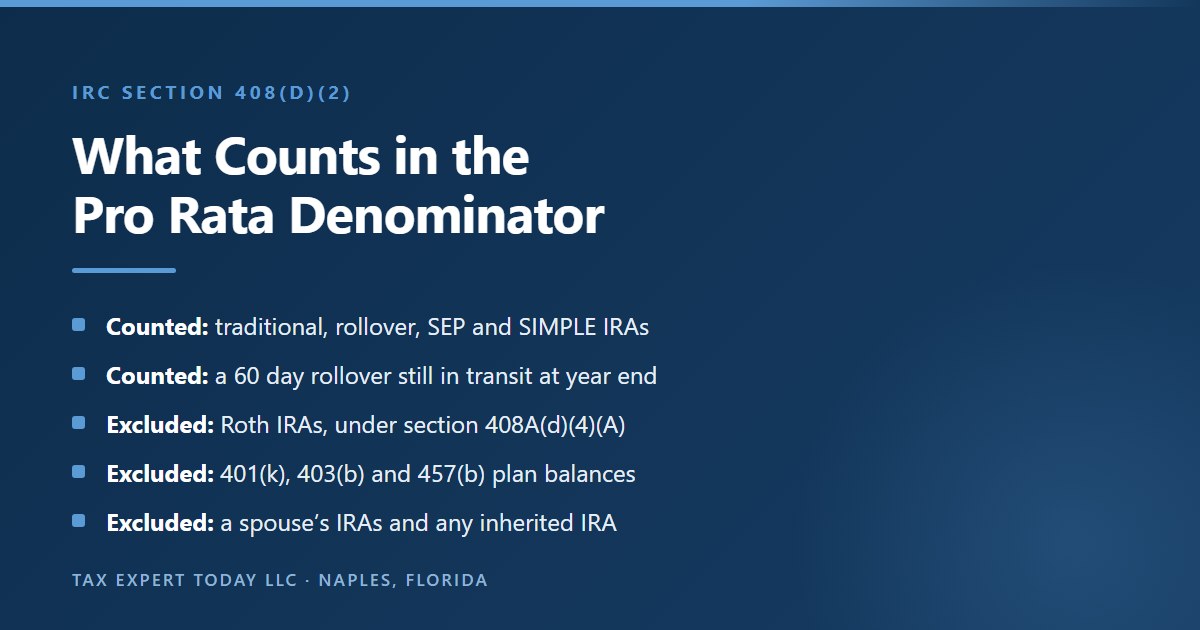
The denominator includes traditional IRAs, SEP IRAs, and SIMPLE IRAs, because Form 8606 states that traditional IRA includes traditional SEP and SIMPLE IRAs. It excludes Roth IRAs under section 408A(d)(4)(A), all employer plans because they are not individual retirement plans, a spouse’s IRAs, and inherited IRAs.
| Account | In the denominator? | Why |
|---|---|---|
| Traditional IRA | Yes | Section 408(d)(2)(A) aggregates all individual retirement plans |
| Rollover IRA | Yes | A rollover IRA is a traditional IRA; the label has no tax significance |
| SEP IRA | Yes | Form 8606 note: traditional IRA includes traditional SEP IRAs |
| SIMPLE IRA | Yes | Form 8606 note: traditional IRA includes traditional SIMPLE IRAs |
| Roth IRA | No | Section 408A(d)(4)(A) applies 408(d)(2) separately to Roth IRAs |
| 401(k), 403(b), 457(b) | No | Not individual retirement plans, so section 408(d)(2) does not reach them |
| Spouse’s IRAs | No | Form 8606 is filed separately for each spouse |
| Inherited IRA | No | A separate Form 8606 is required for the IRA from each decedent |
| An outstanding 60 day rollover | Yes | Form 8606 line 6 adds outstanding rollovers back to the year end value |
The last row is a trap that catches careful people. The Form 8606 instructions define an outstanding rollover as a distribution received after November 1 that was rolled over in the following year within the sixty day window. Money that is in transit on December 31, and therefore shows a zero balance on every statement, is still counted.
The exclusion of employer plans is the most useful line in the table, because it is the basis of the only reliable cure, discussed further below.
How is a backdoor Roth IRA reported on Form 1099-R?
The custodian reports the gross conversion in box 1, repeats it as the taxable amount in box 2a, checks box 2b for taxable amount not determined, and enters code 2 or code 7 in box 7a depending on age. There is no code for a backdoor Roth. The source document therefore describes a fully taxable distribution even when none of it is taxable.
This is the mechanical explanation for the failure the whole strategy is prone to, and it is worth stating precisely because it is so often described loosely. The 2026 Instructions for Forms 1099-R and 5498 direct the payer to report a traditional IRA distribution known to be converted in boxes 1 and 2a, checking box 2b, even where the conversion is a trustee-to-trustee transfer with the same trustee.
| Form 1099-R box | What the custodian enters | What it means |
|---|---|---|
| Box 1, gross distribution | The full converted amount | Correct and uncontroversial |
| Box 2a, taxable amount | The full converted amount again | Not a determination. The custodian does not know the basis. |
| Box 2b, taxable amount not determined | Checked | The custodian is stating that the figure in box 2a is not reliable |
| Box 7a, distribution code | Code 2 under age 59 1/2, code 7 at 59 1/2 or older | No code identifies a conversion as part of a backdoor Roth |
Box 2b is the part to read. A checked box 2b is the custodian saying that it cannot compute the taxable amount because it has no visibility into the taxpayer’s basis or into the other IRAs that drive the pro rata fraction. The only place that computation happens is Form 8606, and the only person who can do it is the taxpayer or the preparer.
- Nothing on the 1099-R flags the contribution as nondeductible. Basis is invisible to the custodian.
- Box 2a is a default, not a conclusion. It is populated because the instructions require a figure there.
- Code 2 is not a warning. It indicates an age based exception applies, not that anything is wrong.
- Software will follow the form unless overridden. A conversion entered from the document alone flows straight to Form 1040 line 4b as fully taxable.
- Form 5498 reports the contribution separately. It arrives in May, after most returns are filed, which is why it rarely corrects anything.
How does Form 8606 compute the taxable amount, line by line?
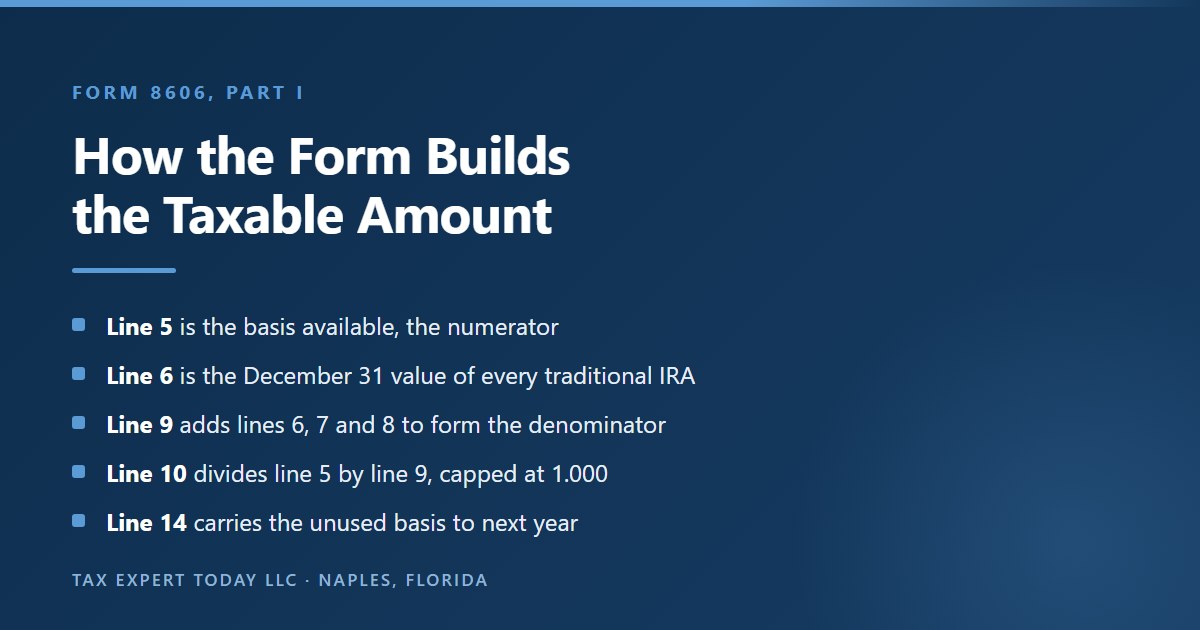
Part I of Form 8606 builds a fraction. Line 5 is the basis available, line 9 is the denominator made up of the December 31 value plus distributions plus the conversion, line 10 divides one by the other, and line 11 multiplies the conversion by that fraction to produce the nontaxable portion. Part II subtracts that from the conversion to reach the taxable amount.
The 2025 Form 8606 is the most recently released version and the line references below are to it. The IRS typically releases each year’s form late in the year, and line numbering can shift between versions, so the arithmetic rather than the line number is the thing to carry forward.
| Line | What it holds | Why it matters |
|---|---|---|
| 1 | Nondeductible contributions for the year | Includes amounts made by the following April 15 for the prior year |
| 2 | Total basis in traditional IRAs | Comes from line 14 of the last Form 8606 filed. This is the carryforward. |
| 3 | Lines 1 plus 2 | Total basis before the current year computation |
| 5 | Line 3 less contributions made in the following calendar year | The numerator of the fraction |
| 6 | Value of all traditional IRAs on December 31, plus outstanding rollovers | The single figure that decides the outcome |
| 7 | Distributions during the year, excluding conversions | Added back so withdrawals do not shrink the denominator |
| 8 | Net amount converted to a Roth IRA | Also carried to line 16 in Part II |
| 9 | Lines 6 plus 7 plus 8 | The denominator |
| 10 | Line 5 divided by line 9, to three decimals, capped at 1.000 | The nontaxable fraction |
| 11 | Line 8 times line 10 | The nontaxable portion of the conversion |
| 14 | Line 3 less line 13 | Basis carried to next year’s line 2 |
| 18 | Line 16 less line 17 | The taxable amount, carried to Form 1040 line 4b |
Two lines carry almost all the weight. Line 6 determines the denominator and therefore the tax. Line 14 determines what survives into the following year, and it is the reason a bad result is usually a deferral rather than a loss.
What does a clean backdoor Roth look like on Form 8606?
When a taxpayer holds no other traditional, SEP, or SIMPLE IRA money on December 31, line 6 is zero, the denominator equals the conversion, the fraction on line 10 is 1.000, and the entire conversion is nontaxable. Line 18 reports zero on Form 1040 line 4b, and line 14 carries zero basis forward because all of it was used.
Consider a hypothetical married couple, both aged 45 and resident in Florida, with 2026 modified adjusted gross income of $460,000. That is well above the $252,000 top of the joint phase-out, so neither may contribute to a Roth IRA directly. Each contributes $7,500 to a traditional IRA, claims no deduction, and converts the full amount. This spouse holds no other IRA money.
| Form 8606 line | Amount | Note |
|---|---|---|
| 1. Nondeductible contribution | $7,500 | No deduction claimed |
| 2. Prior basis | $0 | First year using the strategy |
| 3. Total basis | $7,500 | Lines 1 plus 2 |
| 5. Basis available | $7,500 | Numerator |
| 6. December 31 value of all traditional IRAs | $0 | The decisive figure |
| 7. Other distributions | $0 | None taken |
| 8. Amount converted | $7,500 | Carried to line 16 |
| 9. Denominator | $7,500 | Lines 6 plus 7 plus 8 |
| 10. Fraction | 1.000 | $7,500 divided by $7,500 |
| 11. Nontaxable portion | $7,500 | Line 8 times line 10 |
| 14. Basis carried forward | $0 | Fully used |
| 18. Taxable amount to Form 1040 line 4b | $0 | The intended result |
This is the outcome every article describes. It is also the outcome that depends on a condition most high earners do not satisfy, because a career of job changes tends to leave pre-tax money in rollover IRAs.
How much is the difference worth in real numbers?
Take the identical facts and give this spouse a $242,500 rollover IRA from a prior employer, entirely pre-tax, still held on December 31. The denominator becomes $250,000 rather than $7,500, the fraction falls to 0.030, and only $225 of the $7,500 conversion is nontaxable. The taxable amount is $7,275 on an identical transaction.
| Form 8606 line | Clean case | Rollover IRA present |
|---|---|---|
| 5. Basis available | $7,500 | $7,500 |
| 6. December 31 value | $0 | $242,500 |
| 8. Amount converted | $7,500 | $7,500 |
| 9. Denominator | $7,500 | $250,000 |
| 10. Fraction | 1.000 | 0.030 |
| 11. Nontaxable portion | $7,500 | $225 |
| 18. Taxable amount | $0 | $7,275 |
| 14. Basis carried forward | $0 | $7,275 |
| Federal tax at the 32 percent bracket | $0 | about $2,328 |
The couple’s taxable income after the $32,200 standard deduction for 2026 is roughly $427,800, which falls in the 32 percent bracket under the rate schedule in Rev. Proc. 2025-32 for joint filers. The tax is therefore approximately $2,328 on a contribution the taxpayer reasonably believed would cost nothing. Every figure here is a hypothetical illustration and any actual result depends on the taxpayer’s full facts.
The important half of this table is the last two rows read together. The $7,275 of tax is real, but $7,275 of basis also survives on line 14 and carries into the following year’s line 2. Nothing was destroyed. The tax was accelerated, and the basis remains available to shelter future distributions or conversions.
What is the downside of a backdoor Roth?
The principal downside is that the tax cost cannot be determined at the time of the decision, because the pro rata fraction depends on a December 31 balance that has not yet been fixed. A secondary downside is that section 408A(d)(6)(B)(iii) bars recharacterization of a conversion, so a conversion priced wrongly cannot be unwound.
- The price is set after the purchase. A February conversion is measured against a December 31 balance, so intervening events change the answer.
- The conversion is irreversible. Contributions may still be recharacterized before the due date; conversions may not.
- Earnings between contribution and conversion are taxable. They are not basis, so any growth during a waiting period is converted income.
- The reporting burden does not end. Basis on line 14 has to be tracked for as long as any IRA remains, potentially for decades.
- The benefit is modest per year. At $7,500 a year the strategy is a long horizon accumulation play rather than a material current year saving.
Can a November rollover ruin a February conversion?
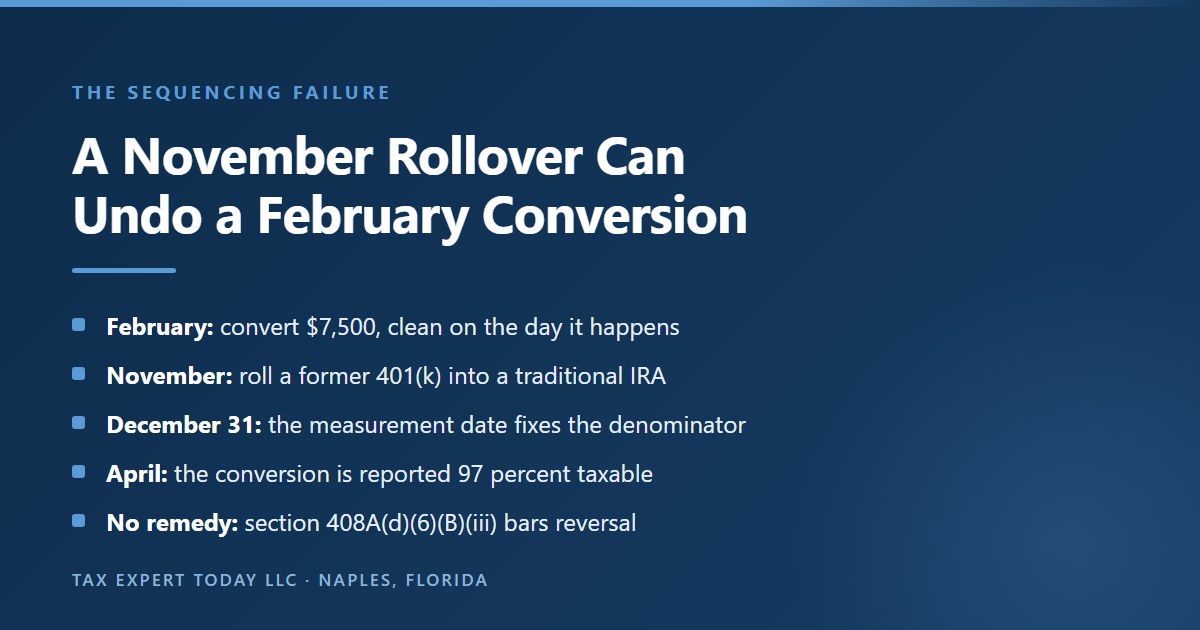
Yes, and this is the failure mode that produces the most surprise. A taxpayer with no IRA balances who converts $7,500 in February has a clean transaction on the day it happens. If that taxpayer then rolls a $242,500 401(k) into a traditional IRA in November, the December 31 value is $242,500 and the February conversion becomes 97 percent taxable retroactively.
Nothing about the conversion changed. The taxpayer did nothing wrong in February and nothing wrong in November. Each transaction is unremarkable on its own. The interaction is created entirely by section 408(d)(2)(C), which measures the contract at the close of the year rather than at the time of the distribution.
| Date | Event | Effect on the year end computation |
|---|---|---|
| February | Convert $7,500 of nondeductible contribution | Line 8 becomes $7,500. Appears tax free on that date. |
| March through October | No IRA activity | None |
| November | Roll $242,500 from a former employer’s 401(k) into a traditional IRA | Line 6 will become $242,500 |
| December 31 | Measurement date under section 408(d)(2)(C) | Denominator is $250,000; fraction is 0.030 |
| The following April | Form 8606 is prepared | $7,275 of unexpected taxable income |
| Any time | Attempt to undo the conversion | Not available. Section 408A(d)(6)(B)(iii) bars it. |
Before the 2017 legislation, a taxpayer in this position had a remedy. Conversions could be recharacterized, which meant an unfavorable outcome discovered at filing time could be reversed. Section 408A(d)(6)(B)(iii) now provides that the adjustment mechanism does not apply to a qualified rollover contribution, which removes that escape. The sequencing has to be right in advance because it cannot be corrected afterward.
How do you clear a pre-tax IRA balance before December 31?
The reliable route is a rollover of the pre-tax IRA money into an employer plan that accepts it. Section 408(d)(3)(A)(ii) permits the rollover into a plan described in section 402(c)(8)(B) and caps it at the portion includible in gross income, and section 408(d)(3)(H)(ii)(II) treats the amount rolled into that plan as coming from income on the contract, meaning pre-tax dollars leave first and basis stays behind.
This pair of provisions is what makes the cure work, and it is rarely cited. Ordinarily section 408(d)(2) would force a proportionate mix of pre-tax and after-tax money out of any distribution. Subparagraph (H) overrides that specifically for rollovers into employer plans, and subparagraph (A)(ii) prohibits basis from going into the plan at all. The two together operate as a filter that separates the pre-tax money from the basis.
- The receiving plan must accept IRA rollovers. This is a plan document question, not a tax question, and not every plan permits it.
- Only pre-tax money may go in. Section 408(d)(3)(A)(ii) caps the rollover at the amount includible in gross income.
- The deadline is December 31, not the conversion date. What matters is the balance on the measurement date.
- SEP and SIMPLE IRAs count too. A SIMPLE IRA additionally has a two year participation requirement before it can be rolled to another plan type.
- Confirm the transfer settled before the year closes. An outstanding rollover in transit on December 31 is added back to line 6.
There is an interaction worth flagging for anyone holding highly appreciated employer stock inside a 401(k). Moving IRA money into that plan is helpful here, but moving company stock out of it is a separate decision governed by the net unrealized appreciation rules, and the two should be sequenced together rather than in isolation.
What happens to the basis when the pro rata rule bites?
It carries forward. Line 14 of Form 8606 subtracts the nontaxable portion used this year from total basis, and the Total Basis Chart in the instructions directs that figure onto line 2 of the next Form 8606 filed. Basis is never forfeited by a partially taxable conversion; it is simply not consumed.
This is the point that changes how a bad year should be read. A taxpayer who converts $7,500 and pays tax on $7,275 has not lost the basis. The $7,275 sits on line 14 and reappears on line 2 the following year, where it enlarges the numerator of the next computation. If the pre-tax balances are cleared in the meantime, that accumulated basis makes the next conversion more favorable, not less.
- Line 14 is the running total. It reflects every nondeductible contribution ever made, less every dollar of basis recovered.
- Line 2 imports it. The instructions chart maps prior year line 14 onto the current year line 2.
- A missed year breaks the chain. If a Form 8606 was never filed, the basis is undocumented and the chain has to be reconstructed.
- The chart reaches back decades. The instructions give the mapping for forms filed as far back as 1987, which is a fair indication of how long this record is expected to survive.
What is the biggest Roth conversion mistake?
Treating the conversion as finished when the money moves. The transaction is not priced until December 31 and it is not reported until Form 8606 is prepared, which may be fourteen months later. The most expensive mistakes are made in the gap, usually by a rollover into an IRA that nobody connected to a conversion made months earlier.
- Rolling an old 401(k) into an IRA in the same year as a conversion. The most common and most costly sequencing error.
- Claiming a deduction for the contribution. A deducted contribution creates no basis and the conversion becomes fully taxable.
- Forgetting a small legacy SEP or SIMPLE IRA. A modest forgotten balance still enters the denominator and dilutes the fraction.
- Assuming the custodian reports the basis. Form 1099-R reports the gross distribution. It does not compute the taxable amount.
- Skipping Form 8606 because nothing was taxable. The form is what establishes basis, and a zero taxable amount is exactly when it is most needed.
That last item is worth restating because it inverts the usual intuition. The years when the form appears unnecessary are the years it matters most, because the form is the only record that the contribution was after-tax.
Do the two five year rules apply to a backdoor Roth?
There are two separate clocks and they do different things. Section 408A(d)(2)(B) sets one five year period running from the first year any Roth contribution was made, which governs whether earnings come out tax free. Section 408A(d)(3)(F) sets a per-conversion five year period for the section 72(t) 10 percent additional tax, but subparagraph (F)(ii) limits it to the amount that was includible in gross income.
That limitation is the part that matters for this strategy specifically. In a clean backdoor Roth the conversion is fully nontaxable, so the amount includible in gross income is zero, and a rule that applies only to the extent of the includible amount has nothing to operate on. The frequently repeated warning that each backdoor conversion starts its own five year penalty clock overstates the position where the conversion produced no income.
| Feature | Section 408A(d)(2)(B) clock | Section 408A(d)(3)(F) clock |
|---|---|---|
| What it governs | Whether a distribution is a qualified distribution | The section 72(t) 10 percent additional tax |
| When it starts | The first taxable year any Roth contribution was made | The taxable year of each conversion |
| How many clocks | One per taxpayer, for life | One per conversion |
| What it reaches | Earnings in the Roth IRA | Only the portion that was includible in gross income |
| Effect on a fully nontaxable backdoor conversion | Applies; the lifetime clock still governs earnings | No includible amount, so nothing for it to reach |
The ordering rules in section 408A(d)(4)(B) complete the picture. A Roth distribution comes first from regular contributions, then from conversions on a first in first out basis, and within any conversion, first from the portion that was included in income. Basis therefore sits at the front of the queue, which is why a Roth IRA funded through the backdoor is more accessible than most descriptions suggest.
How does a mega backdoor Roth differ from a backdoor Roth IRA?
They share a name and almost nothing else. A backdoor Roth IRA moves $7,500 through a traditional IRA and is governed by section 408(d)(2). A mega backdoor Roth moves after-tax contributions inside an employer plan into a Roth, is governed by the plan document and the section 415(c) limit rather than the IRA rules, and is unavailable unless the plan permits both the contributions and the in-plan conversion.
| Feature | Backdoor Roth IRA | Mega backdoor Roth |
|---|---|---|
| Where the money starts | A traditional IRA | After-tax contributions inside a 401(k) |
| 2026 annual amount | $7,500, or $8,600 at age 50 and older | Governed by the section 415(c) overall plan limit |
| Governing rule | Section 408(d)(2) aggregation | The plan document and the section 415(c) limit |
| Does the IRA pro rata rule apply? | Yes | No, while the money remains inside the plan |
| Availability | Anyone with includible compensation | Only if the plan allows after-tax contributions and conversion |
The two are complementary rather than alternative, and a taxpayer whose plan supports the mega version may well do both in the same year. The reason they are worth separating carefully is that the pro rata problem which dominates this article does not reach money inside an employer plan. That is the same distinction that makes the rollover cure described above work.
What happens if you never filed Form 8606?
Section 6693(b)(2) imposes a $50 penalty for each failure to file a required Form 8606, and section 6693(b)(1) imposes a $100 penalty for overstating nondeductible contributions, both subject to a reasonable cause exception. The larger exposure is not the penalty. It is that undocumented basis may be taxed a second time on distribution.
| Failure | Consequence | Source |
|---|---|---|
| Not filing a required Form 8606 | $50 per failure, unless reasonable cause is shown | Section 6693(b)(2) |
| Overstating nondeductible contributions | $100 per overstatement, unless reasonable cause is shown | Section 6693(b)(1) |
| Basis with no supporting form | Difficult to substantiate, and may be taxed again on distribution | Practical consequence |
| Not otherwise required to file a return | Form 8606 is still filed, signed, and sent on its own | Form 8606 instructions |
The standalone filing requirement surprises people. A taxpayer below the return filing threshold who makes a nondeductible IRA contribution is still required to file Form 8606, signed on page 2 and sent to the same address a return would go to. The form has its own signature block precisely because it is sometimes filed by itself.
A missing form from an earlier year can generally be corrected. The instructions contemplate completing a Form 8606 with revised information and filing it with an amended return, and the penalty carries a reasonable cause exception. Whether that route is available on particular facts is a question for a practitioner rather than a general article.
Does a backdoor Roth work for both spouses?
Yes, and the computations are entirely independent. Form 8606 is filed separately for each spouse, and the instructions state that where both are required to file, a separate form is prepared for each. One spouse’s pre-tax IRA balances therefore have no effect on the other spouse’s conversion, even on a joint return.
This produces a result that looks wrong to most people at first. In the hypothetical couple above, the spouse with no IRA balances converts $7,500 tax free while the spouse with the $242,500 rollover IRA reports $7,275 of taxable income, and both results appear on the same joint return. Aggregation operates at the individual level because an IRA is by definition an individual arrangement.
- Two forms, two computations. Neither spouse’s line 6 includes the other’s accounts.
- A spousal contribution is available. Section 219(c) allows a contribution based on the working spouse’s compensation.
- The modified AGI test is joint. Eligibility for a direct Roth contribution uses the joint figure even though the pro rata computation does not.
- Fix one side at a time. Clearing pre-tax balances for the affected spouse alone is sufficient, and cheaper than treating it as a household problem.
What does a backdoor Roth IRA mean for a Florida resident?
Florida imposes no individual income tax, so the entire calculation is federal and the conversion income carries no state layer. That makes the arithmetic simpler than it is for a resident of a taxing state, and it makes the December 31 balance the only variable that genuinely matters.
The timing question does change for someone who moved to Florida during the year. Conversion income is generally sourced to the state of residence when it is recognized, so a taxpayer who established Florida residency before converting faces a different state result than one who converted first. The residency question is covered separately in our discussion of how to establish Florida residency and the broader consequences of retiring to Florida.
Two adjacent decisions deserve to be made in the same conversation. A Roth IRA carries no required minimum distribution for the original owner, which makes it the account most people should spend last and the one that travels best to the next generation, so it belongs inside any estate and trust planning discussion rather than beside it. And a year that includes a liquidity event is the year bracket space is scarcest, so the federal mechanics of selling a business and the decision to convert should be modeled together rather than in sequence.
For business owners in Southwest Florida the strategy is often the smallest piece of a larger picture. An owner with meaningful profits has access to vehicles with far higher limits, and a backdoor Roth at $7,500 a year is complementary to rather than competitive with a cash balance plan or an optimized S corporation compensation structure.
Backdoor Roth IRA Help in Naples & Southwest Florida
Backdoor Roth IRA help Naples residents need is almost never about executing the two steps. Our office in Naples, Florida works with high earners and their advisors on the part that decides the tax: mapping every IRA before the conversion, clearing pre-tax balances into an employer plan when one will accept them, and making certain Form 8606 carries the basis correctly.
Southwest Florida has a high concentration of executives, physicians, and business owners who arrived with retirement accounts accumulated elsewhere. That profile produces the exact fact pattern this article describes: several legacy rollover IRAs, a current employer plan, and a conversion executed on general advice without anyone reconciling the two. Retired households weighing a conversion rather than a contribution face a different set of tradeoffs, which our Sarasota tax preparation guide works through, including the Medicare IRMAA lookback.
- Account inventory before the first conversion. Every traditional, rollover, SEP, and SIMPLE IRA, not only the ones the taxpayer thinks of as retirement money.
- Employer plan acceptance review. Confirming in writing that the receiving plan takes IRA rollovers, before relying on the cure.
- Year end balance confirmation. Verifying the December 31 position, including anything in transit, rather than assuming it.
- Basis reconstruction. Rebuilding the line 14 chain where prior Forms 8606 were not filed, which is common.
- Coordination with the wider plan. Fitting conversions alongside charitable transfers from an IRA and any lifetime gifting already under way.
Tax Expert Today LLC
11983 Tamiami Trail N, Naples FL 34110
Phone: (239) 441-2005
Hours: Monday to Friday, 10:00 to 5:00 ET
Do Naples residents need a local preparer for a backdoor Roth IRA? No. The contribution and the conversion are arranged with the custodian and require no local professional. What a local practice adds is the sequencing decision before the conversion and the Form 8606 work afterward, which is where the strategy is usually won or lost, and continuity across years so the basis chain on line 14 does not break when preparers change.
When to Engage a Professional
A first-time contribution and conversion by someone with no other IRA money is a straightforward transaction that does not require professional help beyond correct reporting. The situations below involve interactions that are easy to miss before the year closes and impossible to reverse afterward.
- Any pre-tax IRA balance exists. The pro rata computation and the possible cure both need to be worked before converting, not after.
- A 401(k) rollover is contemplated in the same year. Sequencing these two events in the wrong order is the most expensive error in this area.
- Prior Forms 8606 were not filed. Basis has to be reconstructed and the correction route assessed.
- The conversion is large or spans several accounts. The aggregation rules apply across every individual retirement plan the taxpayer holds.
- Employer stock sits in a 401(k). The rollover cure and the net unrealized appreciation decision interact and should be sequenced together.
- A move between states occurred during the year. Residency at the time of recognition changes the state result even though the federal computation is unaffected.
Tax Expert Today LLC is a multidisciplinary practice of tax advisors, enrolled agents, certified public accountants, and attorneys serving clients in all 50 states. To discuss how a backdoor Roth IRA fits within a broader Naples tax planning engagement, our wider tax planning services, or a business advisory relationship, call (239) 441-2005.
This article is general information about federal tax provisions and is not tax advice for any specific taxpayer. Figures were verified against primary sources on September 13, 2026 and are subject to change. Every illustration is hypothetical and outcomes depend entirely on individual facts. Consult a qualified professional before acting.
Published September 13, 2026 by Dr. Pellumb Kabashi « Back to Learning Center
Have a question this article touches on?
Tax Expert Today LLC, based in Naples, Florida and serving clients across the United States.
Schedule a Consultation (239) 441-2005