
By Dr. Pellumb Kabashi, DBA, MBA, CES, CFE, EA
Founder, Tax Expert Today LLC · Tax advisors, enrolled agents, CPAs, and attorneys · Serving clients in all 50 states
Quick Answer
Real estate professional status under IRC section 469(c)(7) lets rental losses offset wages and business income, but only if one person performs more than 750 hours in real property businesses, more than half of all working hours, and materially participates in the rentals, usually through a filed aggregation election. Call (239) 441-2005 for a free consultation.
What is real estate professional status?
Real estate professional status is a classification in IRC section 469(c)(7) that removes the automatic passive label from rental real estate. A taxpayer who qualifies, and who materially participates in the rentals, can deduct rental losses against wages, business profits, and investment income instead of carrying them forward unused.
- It is a status, not a license. A real estate license does not grant it and is not required for it.
- It is earned every year. The tests are applied fresh for each taxable year.
- It has two layers. Qualifying as a professional, then materially participating in the rentals.
- It is claimed on the return. There is no application, approval letter, or IRS registration.
The starting point is IRC section 469(c)(2), which says that a rental activity is a passive activity whether or not the owner materially participates. That rule is unusual. For an ordinary business, working in it is enough to make its losses usable. For a rental, the work does not matter, because Congress decided in 1986 that rental losses, especially depreciation, were the core of the tax shelter problem it was trying to end. Section 469(c)(7) is the exception carved out of that rule for people whose actual occupation is real estate.
The term in the statute is not “real estate professional.” The Code describes “taxpayers in real property business,” and the regulations call a person who passes the tests a “qualifying taxpayer.” Practitioners shortened that to real estate professional status, or REPS, and the IRS uses the same phrase in the Instructions for Schedule E. The label causes confusion, because many readers assume a licensed agent automatically has it. A licensed agent who works as an employee of a brokerage and owns no part of it may not count those hours at all, as a later section explains.
Why does real estate professional status matter for rental losses?
Without the status, rental losses are passive and can offset only passive income, so a high earner with a depreciation loss usually carries it forward unused. With the status and material participation, the same loss becomes nonpassive and can reduce wages, business income, and portfolio income in the year it occurs, subject to the excess business loss cap.
Rental real estate commonly produces a tax loss while it produces positive cash flow, because depreciation is a deduction that does not require spending money in the year. A cost segregation study accelerates that further by moving parts of a building into shorter recovery classes that qualify for bonus depreciation. For a taxpayer whose rentals are passive, the result is a large suspended loss that sits on Form 8582 until there is passive income to absorb it or the property is sold. For a qualifying taxpayer who materially participates, the loss is usable now.
| Taxpayer situation | Character of the rental loss | What the loss can offset this year | What happens to the rest |
|---|---|---|---|
| No status, modified AGI under $100,000, active participation | Passive, with the $25,000 allowance | Up to $25,000 of any income | $75,000 suspended |
| No status, modified AGI of $150,000 or more | Passive, allowance fully phased out | Passive income only | Suspended until passive income or sale |
| Qualifies, but does not materially participate | Still passive | Passive income only | Suspended until passive income or sale |
| Qualifies and materially participates | Nonpassive | Wages, business, and portfolio income | Nothing suspended under section 469; the section 461(l) cap still applies |
The third row is the one most explainers skip. Passing the 750-hour and more-than-half tests only removes the automatic passive label. Under Treasury Regulation section 1.469-9(e)(1), a rental real estate activity of a qualifying taxpayer “is a passive activity” unless the taxpayer materially participates in it. That second layer is where the aggregation election, discussed below, decides most cases.
What are the three tests for real estate professional status?
The three tests are the more-than-half test, the 750-hour test, and material participation. More than half of the person’s working hours must be in real property businesses in which they materially participate, those hours must exceed 750, and the person must then materially participate in the rental activity itself, generally after electing to combine all rentals.
| Test | What it requires | Who must pass it on a joint return | Source |
|---|---|---|---|
| More than half | More than 50 percent of personal services in all trades or businesses are performed in real property trades or businesses in which the taxpayer materially participates | One spouse alone | IRC 469(c)(7)(B)(i) |
| 750 hours | More than 750 hours of services in those real property trades or businesses | The same spouse alone | IRC 469(c)(7)(B)(ii) |
| Material participation in the rentals | Regular, continuous, and substantial involvement in each rental activity, or in the combined activity if the election is made | Either spouse, and their hours may be combined | IRC 469(h); Reg. 1.469-5T; Reg. 1.469-9(e) |
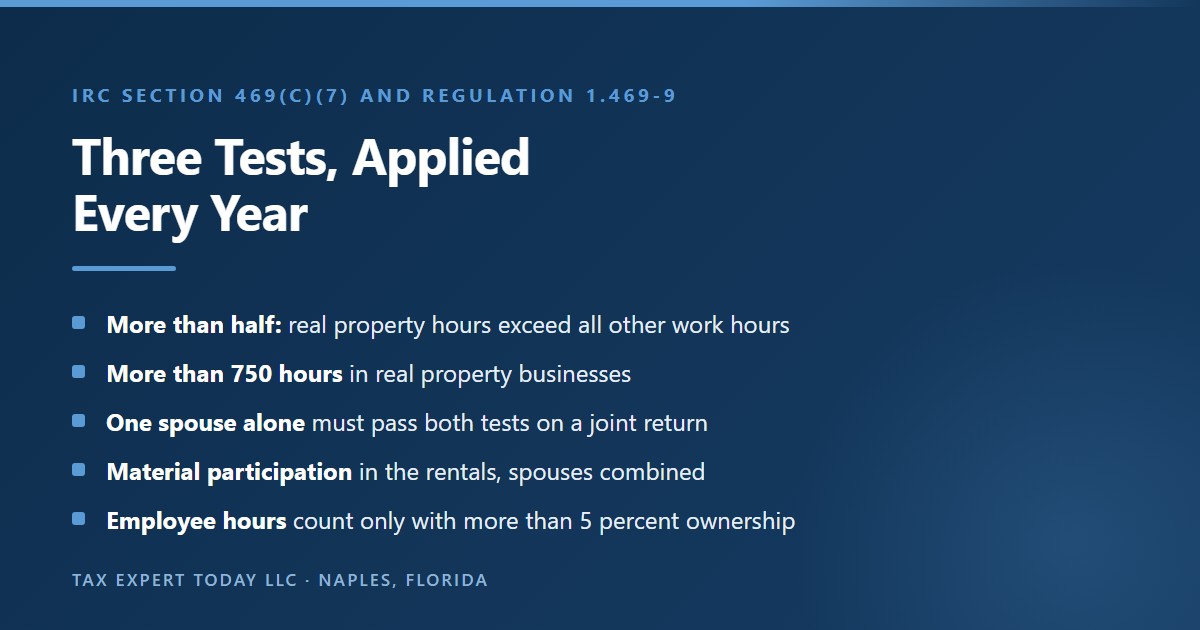
The first two tests are about the person. The third is about the property. Keeping them apart avoids the most common analytical error, which is to add up every hour spent on anything related to real estate and stop once the total passes 750. The statute counts only hours in real property trades or businesses in which the taxpayer materially participates, so even the first two tests contain a material participation requirement inside them. Regulation section 1.469-9(c)(3) states it directly: a taxpayer must materially participate in a real property trade or business for the services in it to count.
How does the more-than-half test work?
The more-than-half test compares hours, not income. Hours in real property businesses where the person materially participates must exceed all other working hours combined, including a salaried job, a consulting practice, or another business. A taxpayer with a full-time job elsewhere generally needs more than 2,080 real estate hours to pass.
- Hours, not dollars. A large salary does not matter; a large number of non-real-estate hours does.
- All trades or businesses count. Self-employment, consulting, and board work for pay all go in the denominator.
- Employee hours count against you. They are personal services in a trade or business.
- Strictly more than half. Exactly 50 percent fails.
| Hypothetical profile | Other work hours | Real property hours | Real property share | More than half | More than 750 | Qualifies |
|---|---|---|---|---|---|---|
| Full-time W-2, rentals on weekends | 2,080 | 1,000 | 32.5% | Fails | Passes | No |
| Full-time W-2, heavy rental year | 2,080 | 1,900 | 47.7% | Fails | Passes | No |
| Part-time W-2 | 1,000 | 1,100 | 52.4% | Passes | Passes | Yes, if the hours are in businesses where they materially participate |
| Self-employed consultant | 900 | 850 | 48.6% | Fails | Passes | No |
| No other work | 0 | 800 | 100% | Passes | Passes | Yes, same condition |
| No other work, light year | 0 | 740 | 100% | Passes | Fails | No |
The second row is the hard case. A taxpayer who works full time and then puts in 1,900 hours on rentals, which is roughly 36 hours a week on top of a full-time job, still fails. The statute does not ask whether the rental work is substantial. It asks whether real estate is the person’s primary occupation measured in hours. That is why the realistic path for most high-earning households, discussed further below, runs through a spouse who does not hold a full-time job elsewhere.
How many hours does the 750-hour test require?
The 750-hour test requires more than 750 hours of personal services during the year in real property trades or businesses in which the taxpayer materially participates. That is about 15 hours a week. Exactly 750 fails, and when other work is substantial the more-than-half test sets a much higher practical floor.
| Other work hours in the year | Minimum real property hours to pass both tests | Approximate weekly average | Which test sets the floor |
|---|---|---|---|
| 0 | 751 | 14.4 | 750-hour test |
| 500 | 751 | 14.4 | 750-hour test |
| 1,000 | 1,001 | 19.3 | More-than-half test |
| 1,500 | 1,501 | 28.9 | More-than-half test |
| 2,080 | 2,081 | 40.0 | More-than-half test |
| 2,400 | 2,401 | 46.2 | More-than-half test |
Once other work passes 750 hours, the 750-hour test stops mattering and the more-than-half test takes over. Hours are counted for the taxable year, so a calendar-year individual counts January 1 through December 31. There is no proration for a partial year of rental ownership. A taxpayer who buys a first property in September has four months to log more than 750 hours across all real property businesses, which is possible for a developer or a broker who owns part of a firm and unlikely for anyone else.
What counts as a real property trade or business?
IRC section 469(c)(7)(C) lists eleven kinds of real property business: development, redevelopment, construction, reconstruction, acquisition, conversion, rental, operation, management, leasing, and brokerage. Hours in those businesses count. Hours in related fields that are not on the list, such as mortgage lending or appraisal, generally do not, even though they touch real estate.
| Listed in the statute | Typical work that may fit | Not listed, generally excluded |
|---|---|---|
| Development and redevelopment | Entitlements, site work coordination, project management | Mortgage origination and lending |
| Construction and reconstruction | General contracting, renovation, rehabilitation | Real estate appraisal |
| Acquisition and conversion | Sourcing, due diligence, converting use | Title insurance and escrow |
| Rental, leasing, and operation | Tenant screening, leasing, operating the property | Real estate law practice |
| Management | Managing your own or others’ properties | Real estate accounting and tax work |
| Brokerage | Brokering sales or leases, as an owner or a self-employed agent | Brokerage as an employee who owns 5 percent or less |
The excluded column is a working list rather than a ruling, and facts can change the answer. Treasury has not added categories by regulation, and Regulation section 1.469-9(d)(1) leaves the grouping of a person’s real property businesses to “all of the relevant facts and circumstances,” using any reasonable method. Once chosen, that grouping must be applied consistently in later years under the consistency rule in 1.469-9(d)(2), unless the original determination was clearly inappropriate or the facts change materially.
Do hours as an employee count toward real estate professional status?
Hours worked as an employee do not count as real property hours unless the employee owns more than 5 percent of the employer. They still count as personal services, though, so they land in the denominator of the more-than-half test. A salaried property manager or an employed agent with no ownership may fail for that reason alone.
The rule is in IRC section 469(c)(7)(D)(ii), which borrows the 5-percent owner definition from IRC section 416(i)(1)(B). Regulation section 1.469-9(c)(5) adds a timing detail: if the employee is a 5-percent owner for only part of the year, only the hours during the ownership period count as real property hours.
| Hypothetical arrangement | Hours treated as real property hours | Hours treated as other work | Result of the two tests |
|---|---|---|---|
| Self-employed agent paid by commission on a 1099 | 2,000 | 0 | Can pass |
| W-2 agent, owns 3 percent of the brokerage | 0 | 2,000 | Fails |
| W-2 agent, owns 10 percent of the brokerage all year | 2,000 | 0 | Can pass |
| W-2 agent, owns 10 percent from July 1 | About 1,000 | About 1,000 | Turns on the exact split; likely fails the more-than-half test |
| Salaried property manager, no ownership | 0 | 2,000 | Fails, unless own-rental hours exceed the 2,000 |
A closely held C corporation has its own route. Under section 469(c)(7)(D)(i), it meets the requirements if more than 50 percent of its gross receipts come from real property trades or businesses in which it materially participates, and Regulation section 1.469-9(c)(2) excludes portfolio income from gross receipts for that purpose. That test is about receipts, not hours, and it applies to the corporation, not to its shareholders.
Can spouses combine hours to qualify?
Spouses cannot combine hours for the more-than-half and 750-hour tests. On a joint return, one spouse must pass both tests alone. Spouses can combine hours for material participation in the rentals, because IRC section 469(h)(5) counts a spouse’s participation. The distinction is written into the statute and the regulations.
- Qualifying is individual. “Either spouse separately,” in the words of section 469(c)(7)(B).
- Material participation is shared. Section 469(h)(5) and Reg. 1.469-5T(f)(3).
- Filing status does not change the spousal attribution. The regulation applies it whether or not a joint return is filed.
- One qualifying spouse is enough. The joint return gets the benefit for the household’s rentals.
| Couple | Spouse A | Spouse B | Real estate professional status | Material participation in the combined rentals |
|---|---|---|---|---|
| One | 2,200 W-2 hours, 0 real property hours | No other work, 820 real property hours | Yes, through Spouse B | 820 hours combined, passes the 500-hour test |
| Two | No other work, 400 real property hours | No other work, 400 real property hours | No, neither spouse exceeds 750 alone | 800 hours combined would pass, but it does not matter without status |
| Three | 2,080 W-2 hours, 300 rental hours | No other work, 760 real property hours | Yes, through Spouse B | 1,060 hours combined, passes |
Couple Two is a common surprise. Between them they spend 800 hours on their properties, which would comfortably meet the 500-hour material participation test, yet neither of them qualifies as a real estate professional. Regulation section 1.469-9(c)(4) limits the spousal attribution to “determining the real property trades or businesses in which a married taxpayer materially participates (but not for any other purpose under this paragraph (c)).” The rentals stay passive.
What is material participation, and why is it a separate test?
Material participation is involvement in an activity that is regular, continuous, and substantial under IRC section 469(h). For a real estate professional it is the second gate: qualifying removes the automatic passive label, but each rental activity stays passive unless the taxpayer also materially participates in it under one of the seven regulatory tests.
Material participation shows up twice in this analysis, and the two uses are easy to blur. The first is inside the qualification tests: only hours in real property businesses where the person materially participates count toward the 750 hours and the more-than-half comparison. The second is the separate requirement for the rentals themselves. A real estate developer who easily qualifies through a construction business can still have passive rentals if those rentals are run entirely by a management company.
| Question | Material participation measured in | Spouse’s hours count | Consequence of failing |
|---|---|---|---|
| Do these hours count toward 750 and more than half? | Each real property trade or business the person works in | Yes, for deciding which businesses the person materially participates in | Those hours drop out of the qualification count |
| Is this rental loss nonpassive? | Each rental activity, or the combined rental activity after the election | Yes | The rental stays passive even though the person qualifies |
What are the seven material participation tests?
Treasury Regulation section 1.469-5T(a) lists seven tests, and meeting any one is enough. For rental real estate the practical ones are more than 500 hours, substantially all of the participation, more than 100 hours and not less than anyone else, five of the last ten years, and the facts and circumstances test.
| Test | Requirement | Fit for a rental activity |
|---|---|---|
| 1 | More than 500 hours during the year | The test most qualifying taxpayers rely on, usually after the aggregation election |
| 2 | Participation is substantially all of the participation of all individuals, including non-owners | Possible for a self-managed property with no manager or regular contractor |
| 3 | More than 100 hours, and not less than any other individual, including non-owners | Common for self-managed single properties; a property manager’s hours usually defeat it |
| 4 | Significant participation activities totaling more than 500 hours | Generally does not fit, because a significant participation activity must be a trade or business activity under Reg. 1.469-1T(e)(2), and rentals are excluded |
| 5 | Material participation in any five of the preceding ten years | Useful for a long-time owner who has scaled back |
| 6 | Personal service activity with material participation in any three prior years | Generally does not fit rentals |
| 7 | Facts and circumstances show regular, continuous, and substantial participation | Weak; unavailable at 100 hours or less, and management hours do not count if someone else is paid to manage |
The limits on test 7 are in Regulation section 1.469-5T(b)(2). Management services are disregarded under the facts and circumstances test if any other person receives compensation for managing the activity, or if any other individual performs more management hours. Because most investors with several properties use a manager for at least some of them, test 7 rarely rescues a weak year. Test 1, more than 500 hours, is the clean path, and the aggregation election is what makes it reachable for a multi-property owner.
What is the election to aggregate rental real estate activities?
The aggregation election under IRC section 469(c)(7)(A) and Regulation section 1.469-9(g) lets a qualifying taxpayer treat all interests in rental real estate as one activity. Without it, each property is a separate activity and must pass a material participation test on its own, which is often impossible for an owner of several properties.
- Default rule: each interest in rental real estate is its own activity under section 469(c)(7)(A)(ii).
- The election combines them for every purpose of section 469, including dispositions.
- It is made by statement attached to the original return for the year.
- It is binding for all later years in which the taxpayer qualifies.
The default is the trap. Section 469(c)(7)(A)(ii) says the rules apply “as if each interest of the taxpayer in rental real estate were a separate activity.” A taxpayer who qualifies as a real estate professional and owns four rental buildings must, without the election, show material participation in each building separately. The grouping rules in Regulation section 1.469-4 do not fix this on their own; paragraph (h) of that regulation sends qualifying taxpayers to section 1.469-9 for the rules on grouping their rental real estate.
| Building | Owner hours | Property manager hours | Test 1: over 500 hours | Test 3: over 100 and not less than anyone | Material participation without the election |
|---|---|---|---|---|---|
| Duplex | 180 | 220 | Fails | Fails, manager has more hours | No |
| Fourplex | 160 | 150 | Fails | Passes | Yes |
| Single-family home | 140 | 90 | Fails | Passes | Yes |
| Condominium | 130 | 60 | Fails | Passes | Yes |
| Total | 610 | 520 | See the comparison below | ||
| Treatment | Activities tested | Result | Practical effect on a duplex loss |
|---|---|---|---|
| No election | Four separate activities | Three nonpassive, the duplex passive | The duplex loss is suspended |
| Election filed | One combined activity with 610 owner hours | Passes test 1 (more than 500 hours) | All four buildings are nonpassive, including the duplex |
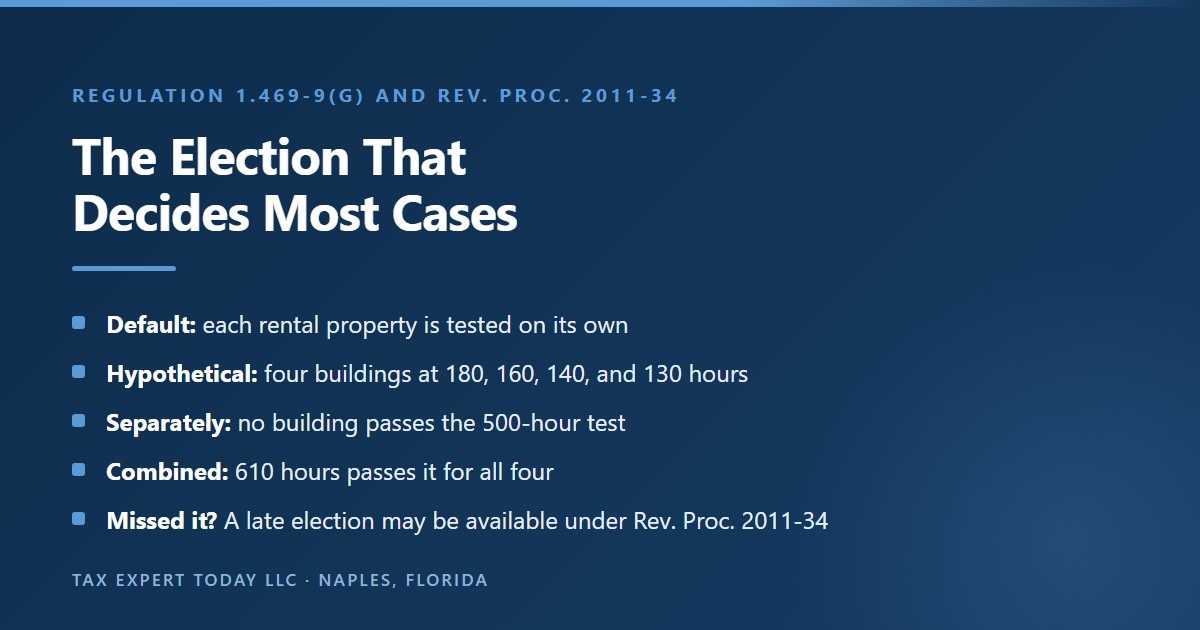
The example is deliberately close. Test 3 depends on a manager’s hours, which the owner rarely tracks and which a manager’s records may later contradict. Once the activities are combined, the owner relies on a single, larger number under test 1, and the manager’s hours no longer matter. That is why the election is standard advice for a qualifying taxpayer with more than one property, unless a specific reason argues against it, such as a planned sale of one building where separate-activity treatment would release suspended losses under section 469(g).
What happens if the aggregation election was never filed?
If the aggregation election was never filed, each rental property is tested separately for material participation, and properties that fail stay passive even though the taxpayer qualifies. This is one of the most frequent defects found when real estate professional returns are examined, because the statement is easy to forget and software does not always attach it automatically.
The election is not made by checking a box on Schedule E. Regulation section 1.469-9(g)(3) requires a statement filed with the taxpayer’s original income tax return, containing “a declaration that the taxpayer is a qualifying taxpayer for the taxable year and is making the election pursuant to section 469(c)(7)(A).” Some preparers report every rental as nonpassive on Schedule E line 43 and never attach the statement. The return looks correct until an examiner asks for the election.
Two facts soften the problem. The election “may be made in any year in which the taxpayer is a qualifying taxpayer,” and failing to make it in one year “does not preclude the taxpayer from making the election in a subsequent year,” both under 1.469-9(g)(1). So a missing election can always be cured going forward on the next original return. For earlier years, the IRS published a dedicated relief procedure.
How do you make a late election under Rev. Proc. 2011-34?
Rev. Proc. 2011-34 allows a late aggregation election without a private letter ruling or user fee. The taxpayer attaches a statement to an amended return for the most recent tax year, headed “FILED PURSUANT TO REV. PROC. 2011-34,” representing four conditions under penalties of perjury, including consistent prior filing and reasonable cause.
| Requirement | What it means in practice |
|---|---|
| Failure was solely a timing failure | The only defect is that the statement was not filed timely under 1.469-9(g) |
| Consistent filing | Every affected return, for the election year and every year after, was filed as if the election had been made; no inconsistent positions |
| Timely filing | Each affected return was filed on time, treating a return filed within 6 months after its due date, excluding extensions, as timely |
| Reasonable cause | The statement explains why the election was not filed on time |
| Where it goes | Attached to an amended return for the most recent tax year, mailed to the service center where the current return is filed |
| What it says | The 1.469-9(g)(3) declaration, the reason for lateness, the four representations, the year the election should take effect, and the heading “FILED PURSUANT TO REV. PROC. 2011-34” |
| Signature | A dated penalties of perjury declaration signed by the taxpayer |
The consistency condition is the one that decides eligibility. A taxpayer who reported each property as nonpassive on separate Schedule E lines in a manner consistent with combined treatment, and carried no suspended losses that only separate treatment would produce, usually fits. A taxpayer who reported one property as passive and suspended its loss on Form 8582 has filed an inconsistent return, and Rev. Proc. 2011-34 sends that taxpayer to the private letter ruling process instead. Section 3.03 adds that the IRS will not ordinarily issue a ruling where the assessment statute has closed for an affected year.
Can the aggregation election be revoked?
The aggregation election can be revoked only in a year of a material change in the taxpayer’s facts and circumstances, or in a later year in which the facts remain materially changed. A year in which the election is less advantageous is not a material change, and neither is a break in qualifying status. Revocation requires its own statement.
The binding effect is broader than many owners expect. Under 1.469-9(g)(1), the election applies “for all future years in which the taxpayer is a qualifying taxpayer,” “even if there are intervening years in which the taxpayer is not a qualifying taxpayer.” In a year the taxpayer does not qualify, the election simply has no effect, and the ordinary grouping rules of 1.469-4 apply. It springs back the next time the taxpayer qualifies.
| Year | Qualifies that year | Election in effect | How the rentals are tested |
|---|---|---|---|
| 2026 | Yes | Yes, made on the original return | One combined rental real estate activity |
| 2027 | Yes | Yes, no new statement needed | One combined activity |
| 2028 | No | Dormant | Ordinary rules: rentals passive under 469(c)(2) |
| 2029 | Yes | Yes, it revives automatically | One combined activity |
| 2030 | Yes | Yes, unless revoked after a material change | One combined activity |
Revocation follows the same filing pattern as the election. Under 1.469-9(g)(3), the taxpayer files a statement with the original return for the year of revocation, declaring that the election is revoked under section 469(c)(7)(A) and explaining the nature of the material change. A planned sale of a single building is a reason some owners would prefer separate treatment, but a disposition alone is not obviously a material change, and the regulation gives no list. That question deserves analysis before the election is first made.
How do limited partnership interests affect the election?
If the aggregation election combines rentals and any one of them is held as a limited partnership interest, the whole combined activity is treated as a limited partnership interest for material participation. Only tests 1, 5, and 6 then apply, unless limited partnership rents are less than 10 percent of total gross rental income.
The rule is in Regulation section 1.469-9(f), and it matters for investors who combine directly owned properties with syndication interests. Limited partners can materially participate only under tests 1, 5, or 6 of Regulation section 1.469-5T(e)(2). Pulling one limited partnership interest into the election can therefore take test 3 away from an owner who was relying on it. The de minimis exception in 1.469-9(f)(2) switches the rule off when the taxpayer’s share of gross rental income from limited partnership interests is under 10 percent of total gross rental income.
| Portfolio | Gross rents from limited partnership interests | Total gross rents | Share | Tests available for the combined activity |
|---|---|---|---|---|
| A | $18,000 | $240,000 | 7.5% | All tests that apply to rentals (de minimis exception applies) |
| B | $30,000 | $240,000 | 12.5% | Tests 1, 5, and 6 only |
What hours count, and what hours do not?
Hours count when they are work an owner customarily does in operating or managing the property. Investor-type work, such as reviewing statements or monitoring finances in a non-managerial role, does not count unless the person is directly involved in day-to-day management. Work done mainly to qualify for the status may also be disregarded.
Regulation section 1.469-5T(f)(2) sets out two exclusions. The first covers work not customarily done by owners when one of its principal purposes is to avoid the passive loss rules. The second covers work in the individual’s capacity as an investor, which includes studying and reviewing financial statements or reports, preparing summaries or analyses for the individual’s own use, and monitoring finances or operations in a non-managerial capacity.
| Task | Generally counts | Reason or caution |
|---|---|---|
| Showing units, screening and selecting tenants, signing leases | Yes | Core operating work of an owner |
| Arranging and supervising repairs, doing repairs yourself | Yes | Operating work; keep invoices that match the dates |
| Collecting rent, handling tenant issues, evictions | Yes | Management work |
| Searching for and negotiating acquisitions | Often yes for the status tests | Acquisition is a listed real property business, but hours may not count toward participation in an existing rental |
| Reviewing monthly statements from a manager | No | Investor work under 1.469-5T(f)(2)(ii) |
| Bookkeeping for your own review | Usually no | Investor work unless part of day-to-day management |
| Driving between properties | Contested | Courts and examiners differ; count only travel tied to a specific task and record it |
| Real estate courses and seminars | Generally no | Education is not operating or managing a property |
| Being on call with nothing happening | Generally no | Count hours worked, not hours available |
How do you prove real estate professional status?
You prove real estate professional status with records that show what work was done, on which property, on which date, and for how long, plus records of all other work hours for the more-than-half test. The regulation accepts any reasonable means, but logs made close to the time are far more persuasive than estimates rebuilt later.
- Both sides of the ratio. Real estate hours and every other working hour.
- Task, property, date, duration. A total for the year is not a record.
- Corroboration. Emails, texts, invoices, mileage logs, and calendar entries that match.
- Each spouse separately. The qualifying spouse’s hours must stand alone.
The text of Regulation section 1.469-5T(f)(4) is more forgiving than its reputation. It says participation “may be established by any reasonable means,” that contemporaneous daily time reports or logs “are not required if the extent of such participation may be established by other reasonable means,” and that reasonable means may include “appointment books, calendars, or narrative summaries.” What the regulation does not do is make an undocumented estimate reasonable. In practice, the Tax Court has repeatedly given little weight to hour totals assembled after an examination begins, particularly when they are round numbers, when they exceed the hours the work could plausibly take, or when they contradict a manager’s records.
Two weak points recur. The first is the denominator. A taxpayer who documents 1,100 real property hours but cannot show how many hours went to a consulting business has not proven the more-than-half test. The second is the qualifying spouse. When a couple keeps one shared log, the examiner cannot tell which spouse did the work, and only one spouse’s hours count toward qualification.
What does an audit-ready hours log look like?
An audit-ready hours log records each work session with the date, the property, the task, who performed it, the start and end times, and a pointer to corroborating evidence such as an email, invoice, or text. It is kept weekly, not annually, and it separates real property hours from other work and from investor-type review.
| Date | Person | Property or business | Task | Hours | Category | Corroboration |
|---|---|---|---|---|---|---|
| Mon 3/2 | Spouse B | Fourplex | Showed unit 3 to two applicants, ran screening | 3.5 | Rental operation | Listing messages, screening report |
| Tue 3/3 | Spouse B | Duplex | Met roofer on site, reviewed scope, approved bid | 2.0 | Rental operation | Signed bid, text thread |
| Wed 3/4 | Spouse B | Acquisition search | Toured two triplexes with listing agent | 4.0 | Acquisition | Showing confirmations |
| Thu 3/5 | Spouse B | All properties | Reviewed bank statements for the month | 1.5 | Investor, not counted | None needed |
| Fri 3/6 | Spouse B | Single-family home | Move-out inspection, deposit accounting | 3.0 | Rental operation | Inspection photos, deposit letter |
| Sat 3/7 | Spouse A | Condominium | Replaced faucet, met HOA manager | 2.5 | Rental operation (participation only) | Hardware receipt |
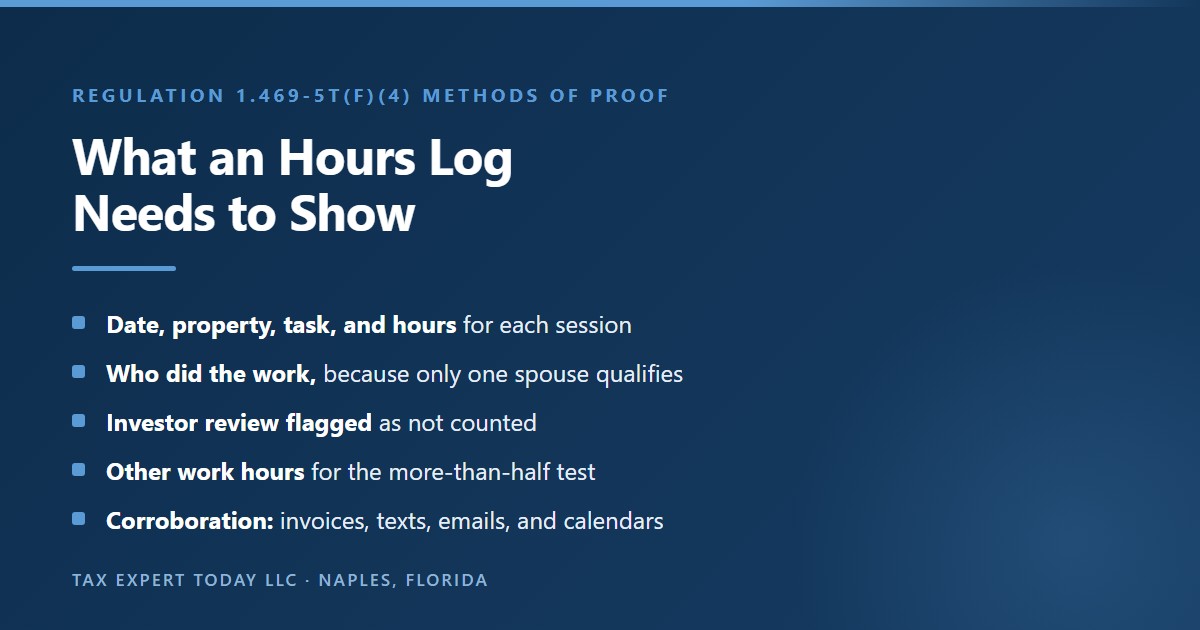
The fifth column is what makes the log usable. In the sample week Spouse B logs 12.5 countable hours and 1.5 hours that are investor work and do not count. Spouse A’s Saturday repair counts toward material participation in the combined rental activity, because spousal hours combine for that purpose, but it does not count toward Spouse B’s 750 hours. A log that keeps those distinctions as it goes saves a reconstruction later. At roughly 12 to 15 countable hours a week, the qualifying spouse would land near the 750-hour line, which is why a log should be totaled monthly against a target rather than once in December.
Is real estate professional status worth it?
Real estate professional status is worth the effort when the household has large rental losses, high ordinary income, and a spouse or owner whose actual occupation is real estate. It is rarely worth restructuring a career to obtain, because the hours are real, the audit exposure is real, and the benefit depends on losses that exist only while depreciation lasts.
| Tends to make it valuable | Tends to make it marginal |
|---|---|
| Large first-year losses from cost segregation and bonus depreciation | Rentals that already produce taxable income |
| A high marginal rate on wages or business income | Modified AGI low enough to use the $25,000 allowance |
| A spouse with no other job who already manages the properties | Both spouses working full time elsewhere |
| Several properties managed directly, without a full-service manager | A portfolio run by managers with the owner reviewing statements |
| Rental income that would otherwise be subject to the 3.8 percent tax | Losses that the excess business loss cap would defer anyway |
| Records that already exist, such as a broker’s calendar | No system for logging hours and no habit of keeping one |
One planning point is easy to miss. The benefit of a nonpassive loss is mostly timing. The depreciation deducted now reduces basis, so it comes back as gain when the property is sold, with the depreciation portion of real estate gain generally taxed at up to 25 percent as unrecaptured section 1250 gain, and personal property identified by a cost segregation study recaptured as ordinary income under section 1245. Our guide to selling rental property after a move walks through that recapture, and a 1031 exchange is the usual way to defer it.
How do cost segregation and bonus depreciation fit with the status?
Cost segregation and bonus depreciation create the large early losses, and real estate professional status is what lets those losses offset other income. For property acquired after January 19, 2025, bonus depreciation is 100 percent, so the shorter-lived components a study identifies can be deducted in full in the first year.
The 100 percent rate comes from the 2025 amendments to IRC section 168(k), which apply to property acquired after January 19, 2025. A study reclassifies parts of a building, such as certain electrical, finishes, cabinetry, and land improvements, into 5-, 7-, and 15-year classes that are eligible for bonus depreciation. The building shell stays in the 27.5-year class for residential rental property. Our guides to the cost segregation study and bonus depreciation in 2026 cover those mechanics in depth.
| Line | Amount | How it is computed |
|---|---|---|
| Depreciable building basis | $1,500,000 | Purchase price allocated to the building, land excluded |
| Reclassified to 5-, 7-, and 15-year property (assumed 25 percent) | $375,000 | Hypothetical study result; actual percentages vary widely |
| Bonus depreciation at 100 percent | $375,000 | Acquired after January 19, 2025 |
| Remaining 27.5-year basis | $1,125,000 | $1,500,000 minus $375,000 |
| First-year 27.5-year depreciation, January, mid-month convention | $39,205 | $1,125,000 x (11.5 / 12) / 27.5, about 3.485 percent |
| Net operating income before depreciation (assumed) | $60,000 | Rents less operating expenses and interest |
| Net rental result for the year | ($354,205) | $60,000 less $375,000 less $39,205 |
For a passive owner, that $354,205 loss is suspended. For a qualifying taxpayer who materially participates, it is a nonpassive loss in 2026. At an assumed 35 percent federal marginal rate it would be worth about $123,972 of current-year federal tax deferral, before considering the excess business loss limit, state tax, and the eventual recapture on sale. The rate is an assumption for illustration; the actual figure depends on the full return.
Does the excess business loss limit cap the benefit?
Yes, it can. Even for a qualifying taxpayer, IRC section 461(l) disallows business losses above income plus a threshold that is $256,000, or $512,000 on a joint return, for 2026. The excess becomes a net operating loss carryforward. Wages do not count as business income in that computation.
- Permanent now. The 2025 amendments removed the sunset that would have ended the limit after 2028.
- Applied per return. Joint filers share one $512,000 threshold.
- Wages excluded. Income from performing services as an employee is ignored on both sides.
- Carried forward. The disallowed amount is treated as a net operating loss.
The 2026 figures are in section .31 of Rev. Proc. 2025-32. The last sentence of IRC section 461(l)(3)(A) says the excess is “determined without regard to any deductions, gross income, or gains attributable to any trade or business of performing services as an employee.” That matters for the classic household this status serves, where one spouse earns large wages and the other qualifies. The wages do not absorb rental losses for 461(l) purposes. Whether a given rental operation is a trade or business for section 461(l) depends on its facts, and a qualifying taxpayer’s actively managed portfolio commonly is.
| Line | Loss of $354,205 | Loss of $700,000 |
|---|---|---|
| Aggregate business deductions over business income | $354,205 | $700,000 |
| 2026 threshold, joint return | $512,000 | $512,000 |
| Loss allowed in 2026 | $354,205 | $512,000 |
| Excess business loss carried forward as a net operating loss | $0 | $188,000 |
The carryforward is not lost, but it is slower. Under IRC section 172, a net operating loss arising in a current-law year generally offsets no more than 80 percent of taxable income in a later year. Larger portfolios and the year a large building is placed in service are where this cap usually binds, and the excess business loss computation is made on Form 461.
What happens without the status: the $25,000 allowance?
Without the status, an owner who actively participates may deduct up to $25,000 of rental losses against other income under IRC section 469(i). The allowance shrinks by 50 cents for every dollar of modified AGI above $100,000 and disappears at $150,000, so most high earners receive nothing from it.
| Modified AGI | Reduction (50 percent of the excess over $100,000) | Allowance available |
|---|---|---|
| $90,000 | $0 | $25,000 |
| $110,000 | $5,000 | $20,000 |
| $130,000 | $15,000 | $10,000 |
| $150,000 | $25,000 | $0 |
| $400,000 | $25,000 (capped) | $0 |
Active participation is a lower bar than material participation. It is generally met by making management decisions such as approving tenants and setting rents, even with a manager in place. The figures in section 469(i) are not indexed for inflation and have been the same since 1986. A qualifying taxpayer can still use the allowance for rentals that fail material participation, and Regulation section 1.469-9(j) keeps losses allowed because of real estate professional status out of the AGI figure used for that phase-out.
Does real estate professional status avoid the 3.8 percent net investment income tax?
It can. Under a safe harbor in Regulation section 1.1411-4(g)(7), a real estate professional who participates in a rental activity for more than 500 hours, or did so in five of the last ten years, may treat the rental income as derived in the ordinary course of a trade or business, outside the 3.8 percent net investment income tax.
The net investment income tax in IRC section 1411 applies 3.8 percent to the lesser of net investment income or modified AGI above $250,000 on a joint return and $200,000 for a single filer. Those thresholds are fixed in the statute. Rental income is net investment income unless it is derived in the ordinary course of a trade or business that is not passive. The safe harbor deems both the rental income and gain on disposing of the property to be trade or business items, and it allows the aggregation election to apply for counting the 500 hours.
| Modified AGI | Amount over the $250,000 threshold | Base for the tax (lesser of income or excess) | Tax if the safe harbor is not met | Tax if the safe harbor is met |
|---|---|---|---|---|
| $350,000 | $100,000 | $80,000 | $3,040 | $0 |
| $280,000 | $30,000 | $30,000 | $1,140 | $0 |
The safe harbor is narrower than the status itself. A taxpayer can be a real estate professional with 800 hours, mostly spent in a brokerage business, and only 300 hours in the rentals. That taxpayer passes the qualification tests but not the 500-hour rental safe harbor. Paragraph (g)(7)(iii) adds that failing the safe harbor does not prevent the taxpayer from showing, on other grounds, that the rental is a nonpassive trade or business. That fallback argument is fact-intensive.
How is real estate professional status reported on the return?
A qualifying taxpayer reports rentals on Schedule E, keeps materially participated rentals off Form 8582, completes Schedule E line 43, and attaches the aggregation election statement in the first year it is made. There is no separate form that claims the status itself, so the return and the records must carry it.
| Item | Where it goes | Source |
|---|---|---|
| Rental income and expenses | Schedule E, Part I, as for any rental | Instructions for Schedule E |
| Net income or loss from rentals in which the qualifying taxpayer materially participated | Schedule E, line 43, reconciliation for real estate professionals | Instructions for Schedule E |
| Materially participated rentals of a qualifying taxpayer | Not entered on Form 8582, because they are not passive | Instructions for Form 8582 |
| Rentals that fail material participation | Form 8582, as passive rental real estate | Instructions for Form 8582 |
| Aggregation election | Statement attached to the original return for the first year | Reg. 1.469-9(g)(3) |
| Late aggregation election | Statement attached to an amended return for the most recent year | Rev. Proc. 2011-34 |
| Excess business loss | Form 461 | IRC 461(l) |
| Net investment income tax | Form 8960, with the rental excluded if the safe harbor or trade or business treatment applies | Reg. 1.1411-4(g)(7) |
The Schedule E instructions repeat the qualification tests in plain language, including that on a joint return “either you or your spouse must meet both of the above conditions without taking into account services performed by the other spouse,” and they point to Rev. Proc. 2011-34 for a late election. The Form 8582 instructions also tell taxpayers to leave “any rental real estate loss allowed to real estate professionals” out of the modified AGI used for the $25,000 phase-out, matching the regulation.
What happens to suspended passive losses once you qualify?
Suspended losses from earlier passive years do not become fully deductible when a taxpayer first qualifies. Under the former passive activity rule in IRC section 469(f), they may offset only future income from the same activity, and any balance is released on a fully taxable disposition of the entire activity under section 469(g).
Regulation section 1.469-9(e)(1) confirms that each separate rental activity, or the combined activity after the election, is an activity “for all purposes of section 469, including the former passive activity rules under section 469(f) and the disposition rules under section 469(g).” A taxpayer who carried $90,000 of suspended losses on a duplex and then qualifies does not deduct $90,000 against wages. The suspended amount waits for net income from that activity, or for a complete disposition in a taxable transaction to an unrelated party.
| Year | Status | Current-year rental result | Treatment | Suspended balance at year end |
|---|---|---|---|---|
| 2025 | Not qualifying | Loss of $30,000 | Passive, suspended | $90,000 |
| 2026 | Qualifying, materially participates | Loss of $40,000 | Current loss nonpassive and usable; prior losses stay suspended | $90,000 |
| 2027 | Qualifying, materially participates | Income of $25,000 | Prior suspended losses may offset this income from the same activity | $65,000 |
| 2028 | Sells the entire activity in a taxable sale | Gain on sale | Remaining suspended losses released under section 469(g) | $0 |
The aggregation election interacts with this rule. Once rentals are combined into a single activity, selling one building is a disposition of part of an activity, not of an entire activity, so it generally does not trigger the section 469(g) release. Owners holding large suspended losses on a single building should model the sale before electing. IRS Publication 925 walks through the disposition rules and the computation of the released amount.
What happens in a year you do not qualify?
In a year a taxpayer does not qualify, rental real estate is passive again under the general rule, any aggregation election goes dormant, and losses for that year are suspended unless the $25,000 allowance applies. Losses already deducted in qualifying years stay deducted. Status is redetermined from scratch every year.
- No carryover of status. Last year’s qualification does not carry to this year.
- The election waits. It revives in the next qualifying year under 1.469-9(g)(1).
- Test 5 can help later. Five years of material participation in the prior ten count for the rentals, though not for qualification.
- The NIIT safe harbor has its own look-back. Five of the last ten years of more than 500 hours.
The year-to-year volatility is a planning risk for households that depend on the deduction. A spouse who returns to full-time work in March may pass 750 hours but fail the more-than-half test for the year. A birth, an illness, or a move can cut hours below the line. Because the loss from a cost segregation study is front-loaded into the first year, failing the test in the purchase year can move most of the benefit into a suspended loss that may take years to use. Where the purchase-year hours are uncertain, the timing of a closing and a placed-in-service date deserves as much thought as the study itself.
Can a full-time W-2 employee qualify as a real estate professional?
A full-time W-2 employee outside real estate generally cannot qualify, because more than half of all working hours must be in real property businesses. At 2,080 job hours, that means more than 2,080 real estate hours in the same year. The household route is usually a spouse who qualifies while the employee keeps the job.
| Path | Who must do the hours | Hours required | Benefit if it works |
|---|---|---|---|
| Employee qualifies personally | The employee | More than 2,080 real estate hours on top of the job | Rental losses nonpassive |
| Spouse qualifies | The spouse, alone | More than 750 real estate hours and more than half of the spouse’s own work | Rental losses nonpassive on the joint return |
| Short-term rental route | Either spouse, combined | Material participation in the short-term rental (for example, more than 100 hours and not less than anyone else) | That property’s losses nonpassive without real estate professional status |
| $25,000 allowance | Either spouse | Active participation only | Up to $25,000, phased out between $100,000 and $150,000 of modified AGI |
A spouse who qualifies has to qualify on genuine hours. Examiners look for the profile in which a spouse with no prior real estate background suddenly reports exactly 760 hours in the year a large cost segregation loss appears. Where the spouse’s hours are real, the records described above usually exist naturally, because tenant messages, contractor texts, and showing confirmations are produced by the work itself.
How is the short-term rental route different from real estate professional status?
A short-term rental with an average guest stay of seven days or less is not a rental activity under Regulation section 1.469-1T(e)(3), so the automatic passive rule does not apply to it. Material participation alone, with spousal hours combined, makes its losses nonpassive. Real estate professional status is not required.
| Feature | Real estate professional status | Short-term rental route | $25,000 allowance |
|---|---|---|---|
| Legal source | IRC 469(c)(7); Reg. 1.469-9 | Reg. 1.469-1T(e)(3)(ii)(A); IRC 469(h) | IRC 469(i) |
| Who it covers | All of a qualifying taxpayer’s long-term rentals | Each property with an average stay of seven days or less (or 30 days or less with significant services) | Long-term rentals with active participation |
| Hours threshold | More than 750 and more than half of work, one spouse alone | A material participation test, spouses combined | None beyond active participation |
| Compatible with a full-time job | Not for the person qualifying | Yes | Yes |
| Income limit | None, though the section 461(l) cap applies | None, though the section 461(l) cap applies | Phases out between $100,000 and $150,000 |
| Dollar limit on loss | None under section 469 | None under section 469 | $25,000 |
Our article on the short-term rental tax loophole covers that route in full, including the seven-day computation and the personal use limits. The two routes can coexist in one household. A spouse who qualifies as a real estate professional can also own a short-term rental, and hours spent operating it are generally hours in a real property trade or business for the qualification count, although the property itself is tested for material participation under the ordinary rules rather than through the aggregation election, because it is not a rental activity.
Is a licensed real estate agent automatically a real estate professional?
No. A license is neither required nor sufficient. An agent qualifies only by passing the hours tests, and an agent who works as an employee of a brokerage and owns 5 percent or less of it cannot count those hours at all. Self-employed agents usually can count them, and must still materially participate in their own rentals.
Most agents are independent contractors paid by commission and issued Forms 1099, which is why the license and the status often travel together in practice. Brokerage hours of a self-employed agent are hours in a listed real property business, so an active agent can pass the 750-hour and more-than-half tests from brokerage work alone. That agent then needs material participation in the rentals, which is a separate count. An agent who logs 1,500 brokerage hours and owns two rentals managed entirely by a property manager qualifies as a real estate professional and still has passive rentals.
| Agent | Arrangement | Brokerage hours count toward qualification | Hours in own rentals | Rental losses nonpassive |
|---|---|---|---|---|
| A | Independent contractor, 1,500 hours | Yes | 40, manager runs the properties | No, fails material participation in the rentals |
| B | Independent contractor, 1,500 hours | Yes | 520, aggregation election filed | Yes |
| C | W-2 employee, owns no part of the firm, 1,800 hours | No, and they count as other work | 600 | No, fails the more-than-half test |
| D | W-2 employee, owns 20 percent of the firm, 1,800 hours | Yes | 520, aggregation election filed | Yes |
What are the most common real estate professional status mistakes?
The most common mistakes are claiming the status without a filed aggregation election, combining spouses’ hours for the 750-hour test, counting investor-type review as participation, ignoring the more-than-half test when another job exists, rebuilding logs after an examination starts, and forgetting that the excess business loss limit still applies.
- No aggregation statement. Each property then stands alone for material participation.
- Combined spousal hours for qualification. The statute requires one spouse alone.
- Employee hours treated as real estate hours. Only with more than 5 percent ownership.
- Counting statement review and education. Investor work and courses generally do not count.
- A missing denominator. No record of the other work hours.
- Assuming suspended losses unlock. Prior passive losses stay tied to their activity.
- Ignoring section 461(l). A large loss can still be deferred as a net operating loss.
- Treating it as permanent. Status is tested every year.
These errors carry penalty exposure, not just a denied deduction. A disallowed loss of this size commonly produces an understatement large enough for the 20 percent accuracy-related penalty under section 6662 to be proposed, and the reasonable cause defense generally depends on showing the records and the advice relied on. The examination itself usually follows the pattern described in our guide to what happens in an IRS audit, with an information document request asking for the hours log, the election statement, and records of other employment.
What does real estate professional status mean for a Florida investor?
For a Florida resident, real estate professional status is purely a federal question, because Florida has no personal income tax. The value of the deduction is the federal tax it defers. Investors who moved from a taxing state should also check whether that state follows the federal treatment for any year of part-year residence.
Florida residents feel the federal effect fully and no state effect at all. Former residents of states such as California, New York, or New Jersey can face a different picture for the year of the move or for rentals located in those states, because a nonresident generally files in the state where rental property sits and each state has its own conformity and passive loss rules. Our guide to establishing Florida residency covers the residency date, which often decides which state, if any, sees a large first-year loss.
Southwest Florida rental markets also tilt the analysis toward the short-term rental route. Many Gulf Coast properties are seasonal rentals with short stays, which may fall outside the rental activity definition entirely. A household that owns a mix of annual leases and vacation rentals may find that real estate professional status matters for the annual leases while the vacation rentals are tested under the ordinary material participation rules.
Real Estate Professional Status Help in Naples & Southwest Florida
Real estate professional status help Naples investors ask for usually starts with a qualification review: whose hours count, whether the more-than-half test is met, and whether the aggregation election is on file. Our office in Naples, Florida reviews hours logs, election statements, and prior returns before a large loss is claimed.
Southwest Florida has a large population of real estate investors, agents, builders, and property managers, and many households where one spouse runs a rental portfolio while the other works elsewhere. It also has a high share of seasonal and vacation rentals, which may fall under the short-term rental rules instead. Sorting which properties belong in which framework is the first step, ideally as part of a wider Naples tax planning review before the purchase year closes.
- Qualification review. The 750-hour and more-than-half tests for the qualifying spouse.
- Aggregation election. Drafting the statement, or a late election under Rev. Proc. 2011-34.
- Hours log design. A weekly format that separates countable, investor, and spousal hours.
- Loss modeling. Cost segregation results against the section 461(l) cap and the 3.8 percent tax.
- Examination support. Responding to requests for hours, elections, and other work records.
Tax Expert Today LLC
11983 Tamiami Trail N, Naples FL 34110
Phone: (239) 441-2005
Hours: Monday to Friday, 10:00 to 5:00 ET
Where can I get help with real estate professional status in Naples, FL? Tax Expert Today LLC, at 11983 Tamiami Trail N in Naples, Florida, helps investors, agents, and their spouses with real estate professional status: testing the 750-hour and more-than-half rules, preparing or correcting the aggregation election, designing hours logs, modeling losses against the excess business loss limit, and supporting examinations. The firm includes tax advisors, enrolled agents, CPAs, and attorneys, and serves clients in all 50 states. Results depend on each taxpayer’s facts.
When to Engage a Professional
Real estate professional status is straightforward when one spouse plainly works in real estate full time and the election is on file. A professional review becomes worthwhile before a large cost segregation loss is claimed, when hours are close to the line, when no election was filed, or when an examination notice arrives.
- A first-year loss from a cost segregation study. The purchase year decides most of the value.
- Hours within about 100 of the 750 line, or close to half of total work.
- Rentals reported as nonpassive with no election statement on any prior return.
- A W-2 agent or property manager with an ownership stake near 5 percent.
- Limited partnership interests mixed with direct ownership. The 10 percent de minimis test.
- Large suspended losses and a planned sale. The election changes what a sale releases.
- An IRS letter asking for hours records. Respond with organized evidence, not estimates.
Tax Expert Today LLC is a multidisciplinary practice of tax advisors, enrolled agents, certified public accountants, and attorneys serving clients in all 50 states. To discuss how real estate professional status fits within a broader Naples tax planning approach, our tax planning services, our business consulting work for investors structuring a growing portfolio, or IRS audit help in Naples when a claim is already under examination, call (239) 441-2005. Readers working through related decisions may also find our guides to the short-term rental tax loophole, the cost segregation study, and the qualified business income deduction useful.
This article is general information about federal tax provisions and is not tax, legal, or investment advice for any specific taxpayer. Figures were verified against primary sources on October 6, 2026 and are hypothetical illustrations, not client outcomes. Qualification depends on hours actually worked and documented in each year. Tax laws apply differently to each person’s facts, and results always vary. Consult a qualified professional about your situation before taking any action.
Published October 6, 2026 by Dr. Pellumb Kabashi « Back to Learning Center
Have a question this article touches on?
Tax Expert Today LLC, based in Naples, Florida and serving clients across the United States.
Schedule a Consultation (239) 441-2005