
By Dr. Pellumb Kabashi, DBA, MBA, CES, CFE, EA
Founder, Tax Expert Today LLC · Tax advisors, enrolled agents, CPAs, and attorneys · Serving clients in all 50 states
Quick Answer: In the Texas LLC vs S corp decision, the S election changes your federal tax and leaves your Texas franchise tax where it was. A Texas LLC is a taxable entity under Tax Code Section 171.0002 however it is classified federally, and owner income sits in the same compensation deduction either way. Any savings are federal payroll tax savings. Call (239) 441-2005 for a free consultation.
Most of what ranks for this question makes the same opening point and then stops. An LLC is an entity created under state law. An S corporation is a federal tax election. You can have both at once, because a Texas LLC can file Form 2553 and be taxed as an S corporation while remaining an LLC for every purpose under Texas law. That is correct, and it is where the useful analysis starts rather than where it ends.
The question a Texas owner actually has is narrower and more practical. Texas has no personal income tax, so the usual state layer of the comparison is missing. What is left is the Texas franchise tax, which applies to LLCs and corporations alike, and a federal payroll tax question that is the same in Texas as it is anywhere else. So the real test is whether the election does anything at the state level at all, and if not, whether the federal benefit is large enough to carry the added cost and paperwork on its own.
The short version is that the election does very little in Texas and a fair amount federally. This guide works through both halves: what stays exactly the same on your Texas franchise tax report, the handful of Texas points that do change (payroll registration, and a community property signature rule that trips up married owners), where the federal savings come from, what they cost, and how to fix a missed or late election. For the full federal salary computation, see our companion guide on S corp reasonable compensation, which this article links to rather than rebuilds.
Texas LLC vs S Corp: What Is the Actual Difference?
A Texas LLC is a legal entity formed with the Secretary of State. An S corporation is a federal tax classification elected on IRS Form 2553. The two are not alternatives, because an LLC can elect S status and remain an LLC under Texas law. The comparison is really between default LLC taxation and S corporation taxation.
- The entity is a Texas question. Liability protection, the company agreement, managers and members, and the certificate of formation all come from Texas law and are untouched by any federal election.
- The tax classification is a federal question. A single-member LLC defaults to a disregarded entity, a multi-member LLC defaults to a partnership, and either can elect to be taxed as a corporation and then as an S corporation.
- The Secretary of State says so directly. Its guidance states that an S corporation is not a matter of state corporate law but a federal tax election, and refers owners to the IRS or tax counsel.
- Texas franchise tax does not follow the federal label. Both an LLC and a corporation are taxable entities for franchise tax, so the state treats the business the same way before and after the election.
It helps to picture three possible federal treatments for the same Texas LLC. With one owner and no election, the business is disregarded, its income lands on Schedule C of the owner’s Form 1040, and the owner pays self-employment tax on the net profit. With two or more owners and no election, it files Form 1065 as a partnership and each active member generally pays self-employment tax on their share. With an S election, it files Form 1120-S, pays each working owner a salary through payroll, and passes the remaining profit through on Schedule K-1 without self-employment tax. The entity under Texas law is the same LLC in all three cases.
The election mechanics reflect that layering. Under Treasury Regulation Section 301.7701-3(c)(1)(v)(C), an eligible entity that timely elects S status is treated as having also elected to be classified as an association taxable as a corporation. The Form 2553 instructions confirm that an LLC making the S election does not need to file a separate Form 8832. One form does both jobs.
| Feature | Texas LLC, default taxation | Texas LLC with S corporation election |
|---|---|---|
| Entity under Texas law | Limited liability company | Still a limited liability company |
| Federal return | Schedule C (one owner) or Form 1065 (two or more) | Form 1120-S, with a Schedule K-1 for each shareholder |
| How the owner is paid | Draws and distributions; no owner payroll | W-2 salary through payroll, then distributions |
| Federal self-employment or payroll tax | Self-employment tax on net earnings from self-employment | Payroll tax on the salary only; no self-employment tax on the K-1 share |
| Texas franchise tax status | Taxable entity under Section 171.0002 | Taxable entity under Section 171.0002 |
| Texas annual report | Franchise tax report or Public Information Report, due May 15 | The same report, due the same May 15 |
| Texas personal income tax on the owner | None | None |
| Ownership limits | None for tax purposes | IRC Section 1361 limits on number and type of shareholders |
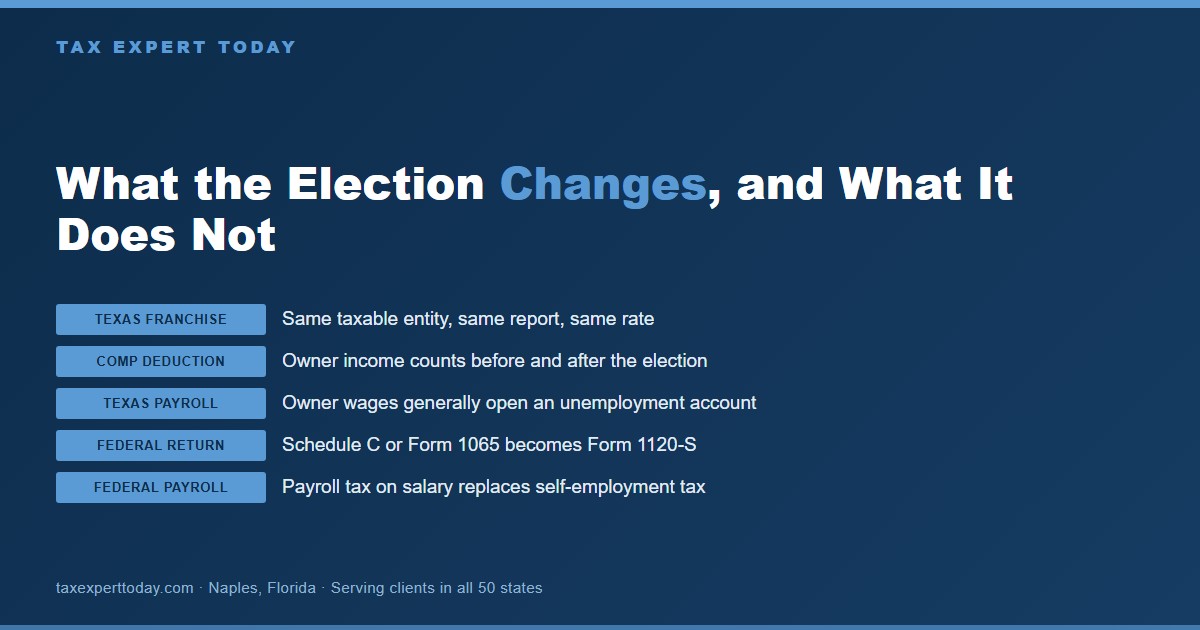
Read the Texas rows in that table and a pattern appears. Every state line is identical. Every line that differs is federal. That is the core of the Texas LLC vs S corp decision, and it is the part most published comparisons never state outright.
Does an S Corp Election Change Texas Franchise Tax?
No. Tex. Tax Code Section 171.0002 lists both the limited liability company and the corporation as taxable entities, and it carves out sole proprietorships, certain general partnerships of natural persons and passive entities, none of which an LLC can become by electing S status. The same entity files the same report, on the same margin rules, at the same rate.
- Same taxable entity. The statutory definition names the LLC and the corporation side by side, and the federal classification plays no part in it.
- Same threshold. For reports originally due in 2026 and 2027, an entity with total revenue at or below $2,650,000 owes no tax and files only its Public Information Report or Ownership Report.
- Same rates. 0.375 percent of taxable margin for retail and wholesale, 0.75 percent for everyone else, or 0.331 percent of revenue under the EZ computation for entities with revenue up to $20 million.
- No Texas S corporation tax. Texas has no counterpart to the California 1.5 percent S corporation franchise tax, so the election adds no state level charge.
That last point is worth dwelling on because it shapes the whole decision. In some states, the S election carries its own state cost. California charges S corporations a 1.5 percent tax on net income with an $800 minimum, which is why our California LLC vs S corp analysis reaches a different break-even than this one. Texas has nothing comparable. The Texas franchise tax is a margin tax on the entity, and it applies in the same way whether the owners are partners, a single disregarded member or S corporation shareholders.
It also means that for most small Texas businesses, the franchise tax is not part of the comparison at all. A business with revenue at or below $2,650,000 owes nothing under either classification. It still files a Public Information Report each year, and missing that report can lead to forfeiture of the right to transact business in Texas, but that filing obligation is identical before and after the election. For owners in that range, which covers a large share of consultants, contractors and professional practices, the Texas side of the question answers itself.
| Texas franchise tax item | 2026 and 2027 report years | Does the S election change it? |
|---|---|---|
| No tax due threshold | Total revenue of $2,650,000 or less | No |
| Rate, retail or wholesale | 0.375 percent of taxable margin | No |
| Rate, all other entities | 0.75 percent of taxable margin | No |
| EZ computation | 0.331 percent, total revenue up to $20 million | No |
| Compensation deduction limit | $480,000 per person per 12 month period | No |
| Annual report due date | May 15, moving to the next business day on a weekend or holiday | No |
| Public Information Report | Required each year for LLCs and corporations | No |
The figures above are the current table on the Comptroller’s franchise tax page. One practical warning: the Comptroller’s separate compensation FAQ page still lists $450,000 as the most recent limit, which was the figure for reports due in 2024 and 2025. Section 171.006 adjusts the limit every even-numbered year, and the main franchise tax page carries the $480,000 figure for 2026 and 2027. Use the current table.
How Does the Texas Compensation Deduction Treat Owner Income?
Section 171.1013 counts W-2 wages and, separately, the net distributive income paid to natural persons from partnerships, S corporations and single-member LLCs. So an owner’s income enters the compensation deduction whether it arrives as partnership income, as a Schedule C profit, or as S corporation salary plus distributions, subject to the same $480,000 per person limit.
- Wages count. The base definition is the amount in the Medicare wages and tips box of Form W-2, which covers the salary an S corporation pays its owner.
- Partnership income counts. Subsection (a)(1) adds net distributive income from an entity taxed as a partnership when the recipient is a natural person.
- S corporation income counts. Subsection (a)(2) adds net distributive income from LLCs and corporations treated as S corporations when the recipient is a natural person.
- Single-member LLC income counts. Subsection (a)(4) adds net distributive income from an LLC treated as a sole proprietorship when the owner is a natural person.
This is the detail that deserves the most care, because it is the one place a reasonable owner might expect the election to matter in Texas. The logic runs like this. The franchise tax lets an entity reduce its revenue by compensation when it computes margin. If only W-2 wages counted as compensation, then converting owner draws into an S corporation salary would create a deduction that did not exist before, and the election would lower the Texas bill for any business above the threshold. That is the intuition. The statute does not work that way.
Section 171.1013(a) deliberately pulls owner income into the definition of wages and cash compensation under every common classification. A partner’s distributive share counts. A single member’s Schedule C profit counts. An S corporation shareholder’s salary counts, and so does that shareholder’s distributive share. The Comptroller’s own compensation guidance describes the deduction as including W-2 wages and cash compensation paid to officers, directors, owners, partners and employees, including net distributive income assigned or disbursed to natural persons. So the pool of owner income available for the deduction is broadly the same before and after the election. The election reshuffles the owner’s income between two lines of that pool rather than adding to it.
The per-person limit applies the same way on both sides. For reports originally due in 2026 and 2027, no more than $480,000 of wages and cash compensation can be counted for any one person in a 12 month period. An owner whose combined salary and distributive income exceeds that figure hits the same ceiling whether the business is a partnership or an S corporation.
| Margin method under Section 171.101 | How it works | Effect of the S election |
|---|---|---|
| 70 percent of total revenue | Margin is 70 percent of total revenue, with no deductions | None; revenue does not depend on federal classification |
| Total revenue minus $1 million | A flat $1 million reduction | None |
| Total revenue minus cost of goods sold | Section 171.1012 cost of goods sold, a Texas definition that differs from the federal one | None; owner pay is not a cost of goods sold item under either classification |
| Total revenue minus compensation | Wages, cash compensation and deductible benefits under Section 171.1013, capped at $480,000 per person | Generally neutral; owner income counts as net distributive income before the election and as salary plus net distributive income after it |
| EZ computation | 0.331 percent of apportioned revenue, for revenue up to $20 million, with no deductions | None |
There are edge cases where the numbers can move a little, mostly around benefits and around how net distributive income is computed from the K-1 line items, and the Comptroller publishes a separate item-by-item method for partnerships and S corporations. Those are worth checking on an actual return for a business near the threshold or near the per-person cap. They are refinements, not a reason to make the election. Nobody should elect S status in Texas expecting a franchise tax saving, and a sound comparison assumes none.
Where Does the S Corp Election Actually Save Money?
The saving is federal and comes from self-employment tax. Without the election, a Texas LLC owner generally pays 15.3 percent self-employment tax on most of the net profit, up to the Social Security wage base. With the election, payroll tax applies only to a reasonable salary, and the remaining profit passes through on the K-1 without self-employment tax.
- The self-employment tax rate is fixed by statute. IRC Section 1401 imposes 12.4 percent for Social Security and 2.9 percent for Medicare on self-employment income.
- The Social Security portion stops at the wage base. For 2026 the wage base is $184,500 under IRS Publication 15, and the Medicare portion has no cap.
- The salary has to be reasonable. The IRS treats payments to a shareholder who performs services as wages to the extent they are reasonable compensation, as its fact sheet on wage compensation for S corporation officers explains.
- The distribution portion is where the saving sits. K-1 income above the salary is subject to federal income tax but not to self-employment tax under Section 1366 pass-through rules.
Because Texas has no personal income tax, this federal payroll tax difference is essentially the entire upside of the election for a Texas owner, and it is the number that settles most Texas LLC vs S corp comparisons. There is no state income tax to shift, no state S corporation tax to pay and no state deduction to gain. That simplicity cuts both ways. It makes the decision easier to model, and it means the benefit has to stand on its own against the costs described in the next section.
The table below is a hypothetical illustration, simplified to show the direction and rough scale of the payroll tax difference. The salary figures are placeholders chosen only to make the arithmetic visible. They are not recommended salaries, and a defensible salary depends on the duties, hours and market pay for the work, which is the subject of our reasonable compensation guide. The comparison ignores income tax effects, the Additional Medicare Tax, benefits and all compliance costs.
| Hypothetical net profit | Self-employment tax, no election | Placeholder salary | Payroll tax on salary (both halves) | Gross payroll tax difference |
|---|---|---|---|---|
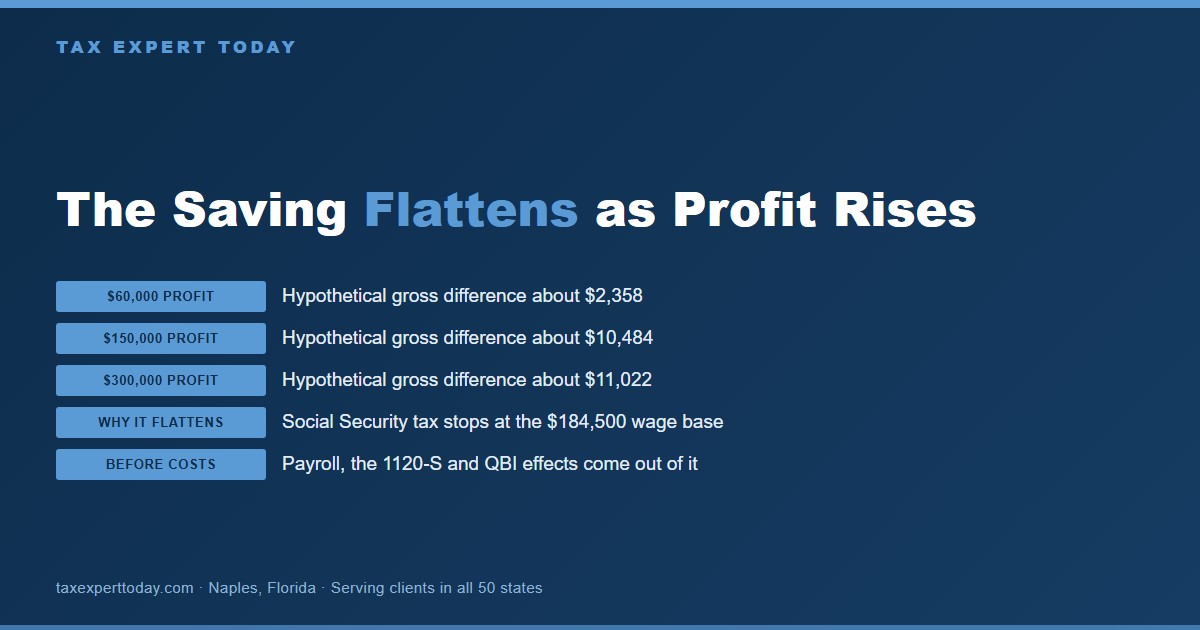
| $60,000 | About $8,478 | $40,000 | $6,120 | About $2,358 |
| $150,000 | About $21,194 | $70,000 | $10,710 | About $10,484 |
| $300,000 | About $30,912 | $130,000 | $19,890 | About $11,022 |
Two things stand out. First, at the lower profit level the gross difference is modest, and once payroll processing, a separate corporate return and the other costs below are subtracted, it can shrink to little or nothing. Second, the difference flattens as profit rises. Above the $184,500 wage base, the Social Security portion of self-employment tax stops growing, so each additional dollar of profit saves only the 2.9 percent Medicare portion. The election does not produce a saving that scales in step with income, which is a point many summaries skip.
For the full federal computation, including how the salary choice interacts with the qualified business income deduction, work through our S corp reasonable compensation analysis, or run the self-employment side on our self-employment tax calculator. Owners who want the Texas background on how self-employment tax applies without a state income tax can read our guide to self-employment tax in Texas.
What Does the S Corp Election Cost a Texas Owner?
The election adds a corporate return on Form 1120-S, a formal payroll for the owner with quarterly and annual payroll filings, federal unemployment tax on the owner’s wages, and in most cases Texas unemployment tax registration. It also adds the obligation to document a reasonable salary. None of these costs exists for an LLC taxed by default.
- A separate federal return. Form 1120-S is due on the 15th day of the third month after year end, which is March 15 for a calendar year entity.
- Payroll for the owner. Withholding, Form 941 quarterly returns, Form 940 for federal unemployment tax and year-end Forms W-2 and W-3.
- Texas unemployment tax. Wages paid by the corporation generally bring the business into the Texas Workforce Commission system, with tax on the first $9,000 of each employee’s wages, as our guide to Texas payroll taxes explains.
- Documentation of the salary. A reasonable compensation position needs support in the records, because an unreasonably low salary is a recognized examination issue.
The Texas unemployment point is the second place the election genuinely touches the state, and it is easy to miss. A single-member LLC taxed as a sole proprietorship does not pay its owner wages, and a partnership does not pay wages to its partners, so the owner’s own pay generally does not create a state unemployment account. Once the business elects S status and runs payroll for the owner, it is paying wages as an employer. That generally brings registration with the Texas Workforce Commission and unemployment tax on the owner’s wages up to the $9,000 state wage base, at the rate the Commission assigns to the account. The dollar amount is small. The registration, the quarterly wage reports and the account maintenance are not nothing, and owners should confirm their status with the Commission rather than assume it.
The costs that are easiest to underestimate are the ongoing ones. A payroll service or payroll software, the added return preparation, the bookkeeping discipline needed to keep salary and distributions distinct, and the time spent on quarterly filings all recur every year. A comparison that sets a one-year payroll tax difference against zero cost will overstate the benefit. The honest comparison sets the recurring payroll tax difference against the recurring cost of running a corporation, and our CFO advisory and bookkeeping work exists partly because that discipline is where S corporations most often fall down.
| Recurring obligation | Texas LLC, default taxation | Texas LLC with S election |
|---|---|---|
| Federal income tax return | Schedule C on Form 1040, or Form 1065 by March 15 | Form 1120-S by March 15, plus each owner’s Form 1040 |
| Owner payroll | None | Form 941 each quarter, Form 940 annually, W-2 and W-3 by January 31 |
| Federal estimated tax | Owner pays quarterly estimates covering income and self-employment tax | Withholding on salary, with estimates for the K-1 income where needed |
| Texas unemployment tax | Generally none for the owner’s own pay | Generally registration and quarterly wage reports once owner wages are paid |
| Texas franchise tax report or PIR | Due May 15 | Due May 15, unchanged |
| Reasonable compensation support | Not applicable | Required and worth documenting each year |
Owners paying estimated tax under either structure can use our quarterly estimated tax calculator to size the payments. The mechanics differ: without the election the owner covers both income and self-employment tax through estimates, while with the election much of the tax can be covered by withholding on the salary.
How Does the Election Affect the Qualified Business Income Deduction?
The owner’s S corporation salary is not qualified business income, so electing S status generally shrinks the income eligible for the 20 percent Section 199A deduction. For owners above the 2026 threshold of $201,750, or $403,500 filing jointly, W-2 wages can also support the deduction, so the salary choice cuts both ways and has to be modeled.
- The deduction is now permanent. The 2025 law removed the sunset from Section 199A, so comparisons written before 2026 that describe it as expiring are out of date.
- The 2026 thresholds are inflation adjusted. Under Rev. Proc. 2025-32, the threshold is $201,750 for most filers and $403,500 for joint filers, with the phase-in range ending at $276,750 and $553,500.
- Salary is excluded from the base. Reasonable compensation paid by an S corporation to a shareholder is not qualified business income, which lowers the base on which the 20 percent is computed.
- Salary can also lift the cap. Above the threshold, the deduction is limited by W-2 wages paid by the business, and the owner’s own salary counts toward that limit.
For owners below the threshold, the effect is simple and runs against the election. Each dollar moved into salary is a dollar that no longer earns the 20 percent deduction, which gives back part of the payroll tax saving. For owners above the threshold, especially in a specified service business, the wage limitation can make a higher salary cheaper overall, which inverts the usual instinct to minimize the salary. Our guides to the qualified business income deduction and to reasonable compensation work through that trade in detail. The Texas point is only that none of this is affected by state law. With no state income tax, the full interaction is federal.
Who Is Eligible to Make the S Election?
Under IRC Section 1361, an S corporation can have no more than 100 shareholders, only individuals, estates and certain trusts and exempt organizations as shareholders, no nonresident alien shareholders and only one class of stock. A Texas LLC has none of these limits under state law, so the election narrows who can own the business.
- No entity owners in general. A partnership, a corporation or a multi-member LLC cannot hold shares, which rules out many holding company and investor structures.
- No nonresident aliens. A single foreign member makes the election unavailable, and admitting one later terminates it.
- One class of stock. Distributions have to follow ownership percentages, which makes the special allocations common in LLC company agreements a problem once the election is in place.
- Family members can count as one. Under Section 1361(c)(1), a married couple and members of a family are treated as a single shareholder for the 100 shareholder count.
The one class of stock rule deserves the most attention in an LLC. Texas company agreements often provide for preferred returns, capital account based distributions, or allocations that differ from percentage ownership. Those provisions are routine in a partnership. In an S corporation they risk creating a second class of stock, which can terminate the election. Before a multi-member Texas LLC elects S status, the company agreement should be reviewed and, where needed, amended so that distribution and liquidation rights are identical across all units. Owners considering a Texas series LLC face an added layer of analysis, because each series has to be examined on its own for classification purposes.
| Ownership feature | Texas LLC, default taxation | Texas LLC with S election |
|---|---|---|
| Number of owners | No limit | No more than 100 shareholders, with family aggregation |
| Corporate or partnership owners | Permitted | Generally not permitted |
| Nonresident alien owners | Permitted | Not permitted |
| Special allocations and preferred returns | Permitted, subject to partnership rules | Risk a second class of stock |
| Trust owners | Permitted | Only grantor trusts, QSSTs, ESBTs and certain others |
| Distributions | As the company agreement provides | Must follow ownership percentages |
Why Do Both Texas Spouses Have to Sign Form 2553?
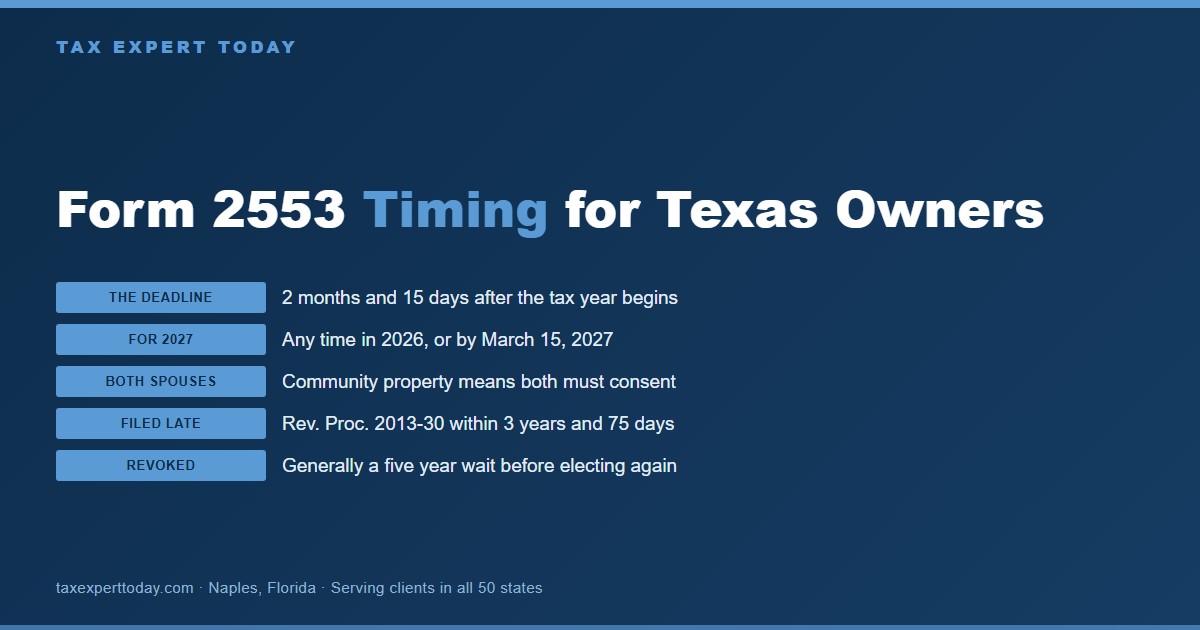
Texas is a community property state. The Form 2553 instructions require that when an individual and a spouse have a community interest in the stock or in the income from it, both must consent to the election. A Texas owner whose spouse does not sign can end up with an election that was never validly made.
- The rule is in the instructions. Each shareholder consents by signing, and a spouse with a community interest in the shares or the income must sign too.
- It applies even when only one spouse is on the paperwork. Ownership interests acquired during marriage are generally community property in Texas regardless of whose name appears on the certificate of formation.
- Relief exists for a missed consent. Rev. Proc. 2004-35 provides a procedure where a community property spouse was a shareholder solely because of state community property law.
- Spouses count as one shareholder. Section 1361(c)(1) treats a married couple as one shareholder for the numerical limit, which is a separate question from consent.
This is the most distinctively Texas point in the whole comparison, and it is almost absent from published material on the subject. Owners in common law states can file a Form 2553 signed only by the named shareholders. A Texas owner who does the same, with a spouse who holds a community interest, may have filed an incomplete election. The problem often surfaces years later, during a sale, a divorce or an examination, when someone asks to see the consents. It is far easier to have both spouses sign at the outset. Where an election has already gone in without the spouse’s consent, the procedures in the instructions and in Rev. Proc. 2004-35 are the route to fixing it, and it is worth fixing before it matters. Owners going through a divorce should also read our guide to business owner divorce taxes.
When Is Form 2553 Due, and What If You Missed It?
Form 2553 is due no more than 2 months and 15 days after the start of the tax year the election is to take effect. A calendar year business electing for 2027 can file during 2026 or by March 15, 2027. A late election may qualify for relief under Rev. Proc. 2013-30 within 3 years and 75 days.
- The period is counted precisely. The instructions start the 2 month period on the day of the month the tax year begins and end it the day before the same numbered day two months later, then add 15 days.
- A new LLC starts its clock early. The first tax year begins when the entity first has shareholders, acquires assets or begins doing business, whichever comes first.
- Late relief has conditions. The entity must have intended S status, have reasonable cause for the late filing, have acted diligently once the problem was found, and have shareholders who reported consistently with the election.
- The form must be marked. A late election is filed with “FILED PURSUANT TO REV. PROC. 2013-30” written at the top of the first page.
| Situation | Intended effective date | Form 2553 deadline |
|---|---|---|
| Existing calendar year LLC, election for next year | January 1, 2027 | Any time during 2026, or by March 15, 2027 |
| New LLC whose first tax year begins April 10 | April 10 | Two months ends June 9; plus 15 days is June 24 |
| Deadline missed, requested within 3 years and 75 days | The date originally intended | File under Rev. Proc. 2013-30 with reasonable cause statement and shareholder statements |
| Deadline missed, beyond 3 years and 75 days | The date originally intended | Generally a private letter ruling request, with a user fee |
Late elections are more common than most owners expect. A business is formed, the owner is told to become an S corporation, payroll starts, and the Form 2553 is never filed or is rejected and nobody notices. The first sign is often an IRS notice about an unfiled partnership return or a mismatch between the 1120-S filed and the entity’s classification on record. Rev. Proc. 2013-30 is the standard relief path, and it can be used for an LLC that needs both the corporate classification and the S election backdated. The key requirement in practice is consistency: every shareholder must have reported income as if the election had been in place. Where an owner filed a Schedule C for a year that was meant to be an S corporation year, that inconsistency has to be addressed as part of the relief request.
The IRS says it will send a letter accepting or rejecting the election. Keep that acceptance letter with the permanent records. It is the document a buyer, a lender or an examiner will ask to see, and replacing a lost one takes time.
Does a Texas LLC Have to Convert to a Corporation to Be an S Corp?
No. A Texas LLC can elect S status directly on Form 2553 and remain an LLC under the Business Organizations Code. Converting to a Texas corporation is a separate state law transaction that is not required for S treatment, although some owners choose it for other reasons, such as investor expectations or a planned sale of stock.
- The election is enough. Treasury Regulation Section 301.7701-3 treats the electing LLC as a corporation for federal tax purposes without any change in its state law form.
- The LLC keeps its flexibility on governance. Managers, members and the company agreement continue to govern, subject to the one class of stock constraint on economics.
- The franchise tax treatment is the same either way. An LLC and a corporation are both taxable entities, so conversion does not change the Texas report.
- A conversion has its own mechanics. A statutory conversion under the Business Organizations Code involves filings with the Secretary of State and should be coordinated with the tax classification.
Staying an LLC is usually the simpler path for a closely held Texas business. The owners keep a familiar governance framework and the Secretary of State filings stay as they are. Where the business expects to take outside investment that a corporation would accommodate more easily, or where a buyer is likely to want to purchase stock rather than assets, converting may make sense on its own merits. That decision belongs in the same conversation as the S election rather than being driven by it. Our Texas LLC taxes guide covers the baseline LLC obligations, and owners relocating an existing entity should see our checklist for moving a business to Texas.
What Happens if You Revoke the Election, Sell or Move?
An S election can be revoked with the consent of shareholders holding more than half of the shares, and after a revocation the business generally cannot elect again for five years without IRS consent. A sale, a move to a state that taxes S corporations differently, or a new ineligible owner can all change the analysis.
- Revocation needs a majority. Section 1362(d)(1) requires consent from shareholders holding more than one-half of the shares on the day of revocation.
- Re-election waits five years. Section 1362(g) bars a new election before the fifth taxable year after termination unless the IRS consents.
- A sale changes the structure question. Asset sales and stock sales produce different results for S corporation shareholders, as our guide to selling a business explains.
- Other states may treat the entity differently. Operating in a state with its own S corporation tax, or one that does not follow the federal election, adds a state layer that Texas does not have.
The five year rule is why the election should not be made casually. An owner who elects, finds the payroll burden not worth it, and revokes, generally cannot come back to S status for several years. It is better to run the numbers carefully for two or three projected years before filing, rather than to elect for a single strong year and unwind it.
Moving adds its own questions. An owner who relocates from Texas to another state may find that the new state imposes income tax on the K-1 income, and in some states taxes the entity itself. An owner moving into Texas from a state that taxed the S corporation will find that state layer disappears, though the old state may still claim income sourced there. Our guides to establishing Texas residency and to Texas vs Florida taxes cover the residency side, and owners winding down an entity should see our steps for closing a business in Texas.
When Does the Election Usually Make Sense for a Texas Owner?
The election tends to fit an owner with steady profit well above a reasonable salary for the work, a simple ownership structure of eligible individuals, and the discipline to run payroll. It tends not to fit an owner with low or volatile profit, foreign or entity owners, special allocations, or a plan to hold appreciating real estate in the entity.
- Profit comfortably above a defensible salary. The saving comes from the gap between the two, so a narrow gap leaves little to save.
- Stable income. A salary has to be paid through payroll in lean years too, which can strain cash flow in a volatile business.
- Clean ownership. Individual owners with equal economic rights per unit fit the one class of stock rule easily.
- Not a real estate holding vehicle. Distributing appreciated property from an S corporation can trigger gain, which is one reason real estate is usually held in an LLC taxed as a partnership.
None of these is a bright line. They are the factors a careful comparison weighs, and the weighting depends on the individual owner. The Texas contribution to a Texas LLC vs S corp decision is small and consistent: no franchise tax change, a Texas unemployment account once owner wages are paid, and a community property consent to get right. Everything else is the federal analysis, and it deserves to be done with real numbers for the specific business.
Texas LLC vs S Corp Help in Naples & Southwest Florida
Tax Expert Today LLC advises business owners on state and federal tax matters nationwide from our office in Naples, Florida. Texas entity questions reach us in two ways. Texas owners who have relocated to Southwest Florida often keep operating their Texas LLCs and want to know whether the election still makes sense after the move. Florida owners who have formed or acquired Texas entities want the Texas franchise tax and payroll obligations mapped alongside their federal returns. Both groups ask the same first question, which is whether the S election is doing anything useful for them.
Our approach starts with the actual books rather than a rule of thumb. We compare the payroll tax difference against the recurring cost of payroll and the corporate return, we test the effect on the qualified business income deduction, we check the company agreement for one class of stock problems, and we confirm that the election on file is valid, including the community property consents that Texas owners frequently miss. Where an election was filed late or never filed, we evaluate the relief options before the problem surfaces in an examination or a sale.
- S corp election help Naples business owners can reach in person. Our office is on Tamiami Trail North in Naples, Florida, and we meet clients locally and remotely.
- Texas LLC tax planning Naples FL and nationwide. We work with clients in all 50 states, and the Texas analysis is the same wherever the owner now lives.
- Late and defective elections reviewed. We examine whether an election was validly made and, where it was not, which relief route fits the facts.
- Franchise tax and payroll mapped together. The Texas report, the Public Information Report and the owner payroll use the same records and are simpler to maintain as one system.
- Relocation coordinated with entity choice. Owners moving between Texas, Florida and other states get the residency and entity analyses built from one set of facts.
Related services include our Texas tax services and our business consulting practice for owners choosing or restructuring an entity. Southwest Florida owners can also review our Naples tax planning work, and owners who need payroll and books maintained to S corporation standards can look at our CFO advisory and bookkeeping service.
Tax Expert Today LLC
11983 Tamiami Trail N, Naples, FL 34110
Phone: (239) 441-2005
Hours: Monday through Friday, 10:00 a.m. to 5:00 p.m. ET
Local question we are asked often: A married couple moved from Houston to Naples and kept their Texas consulting LLC, which elected S status several years ago. Only one spouse signed the Form 2553. Is the election still valid, and does the move change anything? The consent question comes first. Because the shares were very likely community property when the election was made, the other spouse’s consent was generally required, and the missing signature is worth correcting through the available relief procedures. The move itself does not change the Texas LLC vs S corp analysis on the franchise tax side, and because Florida has no personal income tax on individuals, the K-1 income is not picked up by a new state income tax. The federal comparison should still be refreshed, since the move is a natural point to confirm that the salary and the election continue to fit the business.
When Should You Engage a Professional?
Many single-owner Texas businesses can understand the Texas LLC vs S corp decision on their own once the structure is clear, and this guide is written to make that possible. Professional help earns its cost in specific situations rather than as a general rule.
- Profit near the break-even. Where the payroll tax difference and the added costs are close, the qualified business income effect often decides the answer, and it needs to be modeled on real numbers.
- More than one owner. Company agreement terms, special allocations and distributions that do not track ownership can put the election at risk.
- A late, missing or defective election. A Form 2553 that was never accepted, or one signed without a community property spouse, is worth correcting before a sale or an examination.
- Revenue near the franchise tax threshold. A business approaching $2,650,000 of revenue benefits from choosing its margin method deliberately, whatever its federal classification.
- A move, sale or new investor. Each of these can change whether the election still fits, and each is easier to plan for than to repair afterward.
- An IRS question about the salary. Reasonable compensation positions are fact specific, and the documentation assembled before a question arrives matters most.
Tax Expert Today LLC is a multidisciplinary firm of tax advisors, enrolled agents, CPAs and attorneys serving clients in all 50 states. Texas franchise tax and Texas Workforce Commission matters are state tax matters rather than federal ones, and we handle them as part of a broader state and local tax practice. The S election itself, the Form 1120-S and the reasonable compensation position are federal matters, handled by credentialed practitioners in the same engagement so the state and federal records agree.
To discuss a Texas entity or S election question, call (239) 441-2005 or use our contact page to arrange a consultation. You can also read our overview of what Texas does and does not tax for the wider context.
Frequently Asked Questions
Is a Texas LLC or an S corp better for taxes?
Neither is better in general, because they are not alternatives. A Texas LLC can elect to be taxed as an S corporation. The election can reduce federal self-employment tax when profit is well above a reasonable salary, and it does not change Texas franchise tax, so the answer depends on federal numbers and costs for the specific business.
Does an S corp pay Texas franchise tax?
Yes. Tex. Tax Code Section 171.0002 treats corporations and limited liability companies as taxable entities regardless of their federal classification. An S corporation, or an LLC that has elected S status, files the same annual franchise tax report or Public Information Report by May 15 as any other taxable entity, and owes tax only above the $2,650,000 no tax due threshold for 2026 and 2027.
Does the S election lower my Texas franchise tax through the compensation deduction?
Generally no. Section 171.1013 counts net distributive income paid to natural persons from partnerships, S corporations and single-member LLCs, as well as W-2 wages. The owner’s income is in the compensation pool before and after the election, subject to the same $480,000 per person limit for 2026 and 2027.
At what profit should a Texas LLC elect S corp status?
There is no fixed figure. The payroll tax saving depends on the gap between profit and a reasonable salary, and it is reduced by payroll costs, the corporate return, Texas and federal unemployment tax and any loss of the qualified business income deduction. The comparison should be modeled for the specific business over more than one year.
When is Form 2553 due for a Texas LLC?
No more than 2 months and 15 days after the beginning of the tax year the election is to take effect, or at any time during the preceding tax year. For a calendar year entity electing for 2027, that means any time in 2026 or by March 15, 2027. A late election may qualify for relief under Rev. Proc. 2013-30 within 3 years and 75 days.
Does my spouse have to sign Form 2553 in Texas?
Generally yes, if your spouse has a community interest in the shares or the income from them, which is common in Texas because it is a community property state. The Form 2553 instructions require both spouses to consent in that case, and Rev. Proc. 2004-35 provides relief where a community property spouse’s consent was missed.
Do I have to convert my Texas LLC into a corporation to be an S corp?
No. An LLC can file Form 2553 and be taxed as an S corporation while remaining an LLC under Texas law. The regulations treat a timely S election by an eligible entity as also electing corporate classification, so a separate Form 8832 is not required.
Can a Texas LLC with a foreign member elect S corp status?
Not if the foreign member is a nonresident alien. IRC Section 1361 bars nonresident alien shareholders, and it also bars most entity owners and requires a single class of stock, so an LLC with a foreign or corporate member generally cannot make the election.
This article is general information about Texas franchise tax and the federal S corporation election, current as of September 2026. It is not legal or tax advice for any particular situation, and rates, thresholds and deadlines change. The payroll tax figures shown are hypothetical illustrations with placeholder salaries, not recommendations. Please consult a qualified professional regarding your circumstances before acting.
Published September 20, 2026 by Dr. Pellumb Kabashi « Back to Learning Center
Have a question this article touches on?
Tax Expert Today LLC, based in Naples, Florida and serving clients across the United States.
Schedule a Consultation (239) 441-2005