
By Dr. Pellumb Kabashi, DBA, MBA, CES, CFE, EA
Founder, Tax Expert Today LLC · Tax advisors, enrolled agents, CPAs, and attorneys · Serving clients in all 50 states
Quick Answer: A profit sharing plan is an employer funded retirement plan with discretionary annual contributions. For 2026, each participant is limited to the lesser of $72,000 or 100 percent of pay, and the employer deduction is generally limited to 25 percent of participant pay. The allocation formula decides how much reaches the owner. Call (239) 441-2005 for a free consultation.
What is a profit sharing plan?
A profit sharing plan is a qualified retirement plan funded by discretionary employer contributions. The employer decides each year whether to contribute and how much, a written formula divides the money among eligible employees, and each participant holds a separate account. Despite the name, the business does not need profits to contribute.
- Where it lives: a defined contribution plan under IRC section 401(a), with the profit test removed by section 401(a)(27).
- Who funds it: the employer. Employee deferrals exist only if a 401(k) feature is added to the same plan.
- What can vary: the amount each year, including zero, and the formula that allocates it.
- What cannot vary: the plan must follow its written allocation formula and pass the nondiscrimination rules.
The IRS description of a profit sharing plan makes two points that surprise most owners. There is no set amount the law requires the employer to contribute, and the business does not need profits to make a contribution. Section 401(a)(27)(A) says the determination of whether a plan is a profit sharing plan is made without regard to the current or accumulated profits of the employer. The name is a historical label, and the plan is better understood as a discretionary employer contribution plan.
The Department of Labor guide for small businesses adds the practical requirement that the plan needs a set formula to determine how contributions are allocated. That single sentence is the subject of this guide. Most pages that rank for this topic define the plan and stop at the point where an owner’s real decision begins. The contribution amount is a budgeting question. The allocation formula is the design question, and it decides who receives the money.
This guide is written for owners of closely held businesses with a small number of employees: S corporation shareholders, partners, sole proprietors, and professional practices. It walks through the 2026 limits, the deduction cap, each major allocation method with numbers, the testing that makes the owner-favorable formulas possible, and the deadlines that keep a 2026 plan available well into 2027. It is part of the planning material our Naples, Florida tax planning team uses with business owners, and it should be read with an administrator’s actual test results for any specific employee census. Our tax planning services page describes that broader work.
| Feature | Rule | Authority |
|---|---|---|
| Who contributes | Employer only, unless a 401(k) feature is added | IRS plan overview |
| Annual amount | Discretionary, can be zero in any year | DOL small business guide |
| Profit required | No | IRC 401(a)(27)(A) |
| Per person limit, 2026 | Lesser of 100 percent of compensation or $72,000 | Notice 2025-67 |
| Employer deduction limit | 25 percent of compensation paid to participants | IRC 404(a)(3)(A) |
| Compensation counted per person, 2026 | $360,000 | Notice 2025-67 |
| Latest date to adopt for a year | Employer return due date, including extensions | IRC 401(b)(2) |
Why does the allocation formula matter more than the contribution amount?
The formula decides what share of each contribution reaches the owner. With one 55 year old owner and three younger employees, a $72,000 owner allocation can require about $38,000 for staff under a same percentage formula, or about $9,500 under a tested formula that meets the gateway minimum. The law permits both when the required tests pass.
- Same owner result: every illustration below delivers the owner the full $72,000 limit.
- Different staff cost: employee allocations range from about $9,500 to about $38,000.
- Different owner share: the owner receives from about 65 percent to about 89 percent of the total.
- Different complexity: the higher the owner share, the more testing and annual administration the plan needs.
Owners usually ask how much they can put in. A better first question is how much of each plan dollar will land in the owner’s own account, and how much must go to employees to get it there. The answer depends on the owner’s age, the ages and pay of the employees, and the formula written into the plan document.
Consider a hypothetical S corporation with an owner age 55 paid $360,000 and three employees aged 40, 35, and 28 paid $80,000, $60,000, and $50,000. Total covered compensation is $550,000, so the 25 percent deduction ceiling is $137,500. The table compares four formulas, each set to deliver the owner $72,000, which is 20 percent of capped compensation. Sections later in this guide explain how each column is built and why the tested columns are not automatically available to every employer.
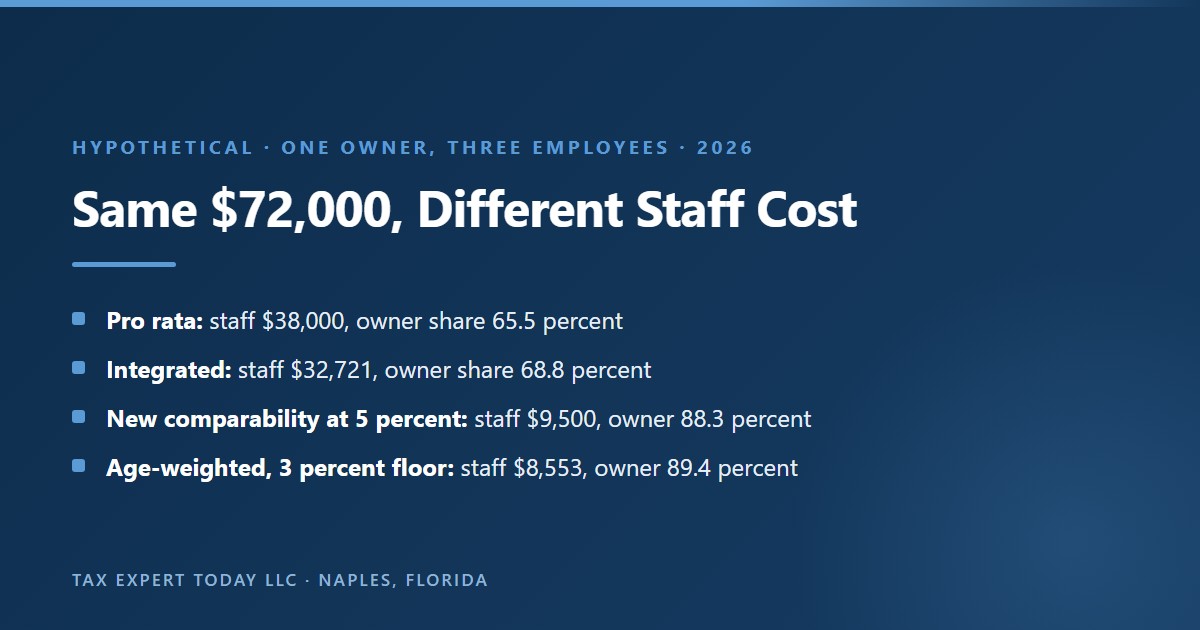
| Participant | Age | Compensation | Pro rata | Integrated | New comparability at gateway | Age-weighted, top-heavy floor |
|---|---|---|---|---|---|---|
| Owner | 55 | $360,000 | $72,000 | $72,000 | $72,000 | $72,000 |
| Employee A | 40 | $80,000 | $16,000 | $13,777 | $4,000 | $4,706 |
| Employee B | 35 | $60,000 | $12,000 | $10,333 | $3,000 | $2,347 |
| Employee C | 28 | $50,000 | $10,000 | $8,611 | $2,500 | $1,500 |
| Total contribution | $550,000 | $110,000 | $104,721 | $81,500 | $80,553 | |
| Staff total | $38,000 | $32,721 | $9,500 | $8,553 | ||
| Owner share of total | 65.5% | 68.8% | 88.3% | 89.4% |
All figures in this table are hypothetical illustrations computed for this guide. They are not client results and they do not predict what any employer’s census would produce. A tested design is only available when the plan actually passes the tests described below for that year’s employees, and the outcome can change as people are hired, leave, or age.
What are the 2026 profit sharing plan limits?
For 2026 the annual additions limit is the lesser of $72,000 or 100 percent of compensation. Compensation counted for each participant is capped at $360,000. The employer deduction is generally limited to 25 percent of participant compensation. If the plan includes a 401(k) feature, elective deferrals are limited to $24,500, plus catch-up contributions.
- Annual additions: $72,000, up from $70,000 for 2025.
- Compensation cap: $360,000, up from $350,000 for 2025.
- Elective deferral limit: $24,500, up from $23,500 for 2025.
- Catch-up, age 50 or older: $8,000, with a higher limit of $11,250 for ages 60 to 63 where the plan allows it.
These figures come from IRS Notice 2025-67 and the IRS cost-of-living table, read on the publication date of this guide. The 2027 figures had not been reviewed for this guide, so a reader planning a 2027 contribution should check the IRS table for the current year. The limits are per person and per year, and the deduction limit is a separate, employer-wide test.
An owner paid exactly $360,000 needs an allocation rate of 20 percent to reach $72,000. An owner paid less needs a higher rate: $288,000 of compensation needs 25 percent, and $200,000 would need 36 percent, which fits only if enough other payroll supports the aggregate deduction limit. An owner paid more than $360,000 still uses only $360,000 in the formula, so $72,000 is 20 percent of the capped figure but a lower percentage of actual pay.
| Item | 2026 | 2025 | Authority |
|---|---|---|---|
| Defined contribution limit | $72,000 | $70,000 | IRC 415(c)(1)(A), Notice 2025-67 |
| Annual compensation limit | $360,000 | $350,000 | IRC 401(a)(17), 404(l) |
| Elective deferrals | $24,500 | $23,500 | IRC 402(g)(1) |
| Age 50 catch-up | $8,000 | $7,500 | IRS COLA table |
| Highly compensated employee threshold | $160,000 | $160,000 | IRC 414(q)(1)(B) |
| Key employee officer threshold | $235,000 | $230,000 | IRC 416(i)(1)(A)(i) |
| Social Security wage base | $184,500 | Not used here | IRS Topic 751 |
The Social Security wage base matters because it is the usual integration level in the formula described below. Each of these figures is adjusted annually, which is why a plan document typically refers to the statutory limit rather than a fixed dollar amount.
How does the IRC 415(c) annual additions limit work?
Section 415(c) limits the total added to one participant’s account in a year to the lesser of the annual dollar limit or 100 percent of compensation. The sum includes employer contributions, employee contributions, and forfeitures reallocated to the account. For 2026 the dollar limit is $72,000. Age-based catch-up contributions are not counted against it.
- Employer contributions: profit sharing, matching, and nonelective amounts all count.
- Employee contributions: elective deferrals and after-tax contributions count, other than catch-up amounts.
- Forfeitures: reallocated forfeitures count as additions under section 415(c)(2)(C).
- The percentage limit: a low-paid employee is limited to 100 percent of pay.
The limit is written in IRC section 415(c). Paragraph (1) sets the lesser-of test and paragraph (2) defines annual additions as the sum of employer contributions, employee contributions, and forfeitures. The statute still shows the original $40,000 base figure, which is adjusted each year, so the current dollar limit must be read from the annual IRS notice rather than from the statute itself.
Two traps follow from the definition. First, forfeitures are not free money. When a departing employee’s unvested balance is reallocated to the remaining participants, that reallocated amount uses up 415(c) room in the receiving accounts. An owner who is already at the limit can be pushed over it by a forfeiture allocation, which is why plan documents usually state a method for handling the overage. Second, the limit is applied per participant across plans of the same employer, so an owner with two plans has one limit to share between them, subject to the aggregation rules.
The limit is also unrelated to the deduction. A participant can receive an allocation that is well within section 415(c), while the employer’s total contribution exceeds the deduction limit, or the reverse. A contribution design has to clear both tests, and the two tests use different measures: one looks at a single account and the other looks at total participant payroll.
| Participant | Compensation | Deferrals | Employer allocation | Forfeitures | Total additions | Result |
|---|---|---|---|---|---|---|
| Owner, age 50 or older | $360,000 | $24,500 | $47,500 | $0 | $72,000 | At the limit, catch-up may be added on top |
| Owner | $360,000 | $0 | $72,000 | $1,500 | $73,500 | $1,500 over the limit |
| Part-time employee | $12,000 | $0 | $12,000 | $0 | $12,000 | At the 100 percent of pay limit |
| Manager | $120,000 | $24,500 | $20,000 | $0 | $44,500 | Within the limit |
How does the 25 percent deduction limit work?
The employer can generally deduct profit sharing contributions up to 25 percent of the compensation paid or accrued during the year to plan beneficiaries. The limit is measured across all participants in total, so one person’s allocation can exceed 25 percent of their own pay as long as the employer’s total contribution stays within the ceiling.
- The rule: IRC section 404(a)(3)(A)(i)(I), covering compensation otherwise paid or accrued to the beneficiaries of the plan.
- Aggregate measure: the test is the plan’s total, not a person by person limit.
- Capped pay: each participant’s pay counts only up to $360,000 for 2026 under section 404(l).
- Excess: amounts over the limit carry over but can trigger a 10 percent excise tax.
Most short descriptions of these plans give the 415(c) figure and never mention the deduction ceiling, even though it is the limit that binds first for many small employers. IRC section 404(a)(3) allows a deduction for contributions to a profit sharing plan in an amount not in excess of 25 percent of the compensation otherwise paid or accrued during the taxable year to the beneficiaries under the plan. The Department of Labor guide states the same 25 percent limit in plain language.
Because the test is aggregate, the owner of a business with several employees has more room than the owner’s own pay would suggest. In the running example, the owner’s $72,000 is exactly 20 percent of capped pay, but the employer’s total under the new comparability column is $81,500, or 14.8 percent of the $550,000 covered payroll, well within the $137,500 ceiling.
The ceiling becomes a real constraint in owner-only or very thin payroll businesses. An owner with no employees and $288,000 of W-2 pay reaches $72,000 at exactly 25 percent. At $200,000 of W-2 pay the ceiling is $50,000 and an owner would need elective deferrals to approach the annual limit, because deferrals are outside the 25 percent test, as the next section explains.
| Owner capped pay | Other covered payroll | Total covered | 25% deduction ceiling | Owner at $72,000, rate needed | Fits within ceiling? |
|---|---|---|---|---|---|
| $360,000 | $190,000 | $550,000 | $137,500 | 20.0% | Yes, if total contribution stays under $137,500 |
| $360,000 | $90,000 | $450,000 | $112,500 | 20.0% | Yes, with room for staff of $40,500 |
| $300,000 | $0 | $300,000 | $75,000 | 24.0% | Yes, one participant |
| $288,000 | $0 | $288,000 | $72,000 | 25.0% | Yes, exactly |
| $200,000 | $60,000 | $260,000 | $65,000 | 36.0% | No, $72,000 exceeds the $65,000 ceiling |
What compensation counts under a profit sharing plan?
Three definitions matter: the plan’s own allocation compensation, section 415(c)(3) compensation for the annual limit, and compensation for the deduction under section 404(a)(12), which includes the 415(c)(3) amounts. For S corporation owners only W-2 wages count, not distributions. Each participant’s pay is capped at $360,000 for 2026 for allocation and deduction purposes.
- W-2 wages: generally the base for corporate employees and S corporation shareholders.
- S corporation distributions: not compensation for plan purposes.
- Self-employed earnings: earned income, reduced as described in the sole proprietor section below.
- The cap: amounts above $360,000 for 2026 are ignored under sections 401(a)(17) and 404(l).
The compensation definition in the plan document drives every percentage in the formula, so it deserves attention before the plan is signed. A plan can define allocation compensation to include or exclude items such as bonuses or overtime within the limits of the nondiscrimination rules, while section 415(c)(3) sets the outer measure for the annual additions test.
Section 404(a)(12) says compensation for the deduction limit includes amounts treated as participant compensation under section 415(c)(3). Section 404(l) applies the annual compensation cap to the deduction test, and Notice 2025-67 confirms the $360,000 figure for 2026 applies under both sections 401(a)(17) and 404(l).
The S corporation owner faces a tradeoff that matters later in this guide. Raising W-2 pay increases the plan base and may be needed for reasonable compensation, but it also increases payroll tax. Our guide to S corporation reasonable compensation covers that separate question, and the plan does not change the answer to it. A plan contribution is not a substitute for paying the shareholder employee a reasonable salary. The same year’s plan decision may also interact with a large business loss under the excess business loss limitation, which is a separate limit.
| Taxpayer | Plan base | Not counted | Practical note |
|---|---|---|---|
| C corporation employee | W-2 wages | Dividends | Plan definition may include or exclude bonuses |
| S corporation shareholder employee | W-2 wages | K-1 income and distributions | Pay must be reasonable independent of plan goals |
| Partner | Earned income from the partnership, net of plan deduction | Passive K-1 income | Contribution reported to the partner on Schedule K-1 |
| Sole proprietor | Net earnings from self-employment, reduced by half of SE tax and the plan deduction | Investment income | Uses the IRS rate table |
| Any participant | Capped at $360,000 for 2026 | Compensation above the cap | Applies to allocation and deduction tests |
Do employee 401(k) deferrals reduce the 25 percent deduction limit?
No. Under IRC section 404(n) elective deferrals are not subject to the 25 percent limit, so a participant’s deferrals do not use up the employer’s deduction room. Deferrals still count against the per-person annual additions limit under section 415(c), which is why an owner often combines deferrals and profit sharing to reach $72,000.
- Deduction test: deferrals are outside the 25 percent ceiling.
- Annual additions: deferrals count, except for catch-up amounts.
- Compensation base: deferrals do not reduce the compensation used for the 25 percent test under section 415(c)(3).
- Practical result: an owner on a smaller salary can reach the limit with a smaller salary base.
Section 404(n) is short and useful: elective deferrals are not subject to any limitation contained in paragraph (3), (7), or (9) of subsection (a). For an owner whose compensation falls below the amount that would support $72,000 through employer contributions alone, this creates a route to the limit that a stand-alone plan with no deferral feature does not offer.
Assume an owner with no employees and $190,000 of W-2 pay. A pure profit sharing plan is limited to 25 percent of pay, or $47,500. Adding a 401(k) feature with $24,500 of elective deferrals brings the owner to $72,000 without exceeding either limit, and an owner age 50 or older may add catch-up contributions on top. The deferrals, however, come from the owner’s own pay rather than from the corporation, so the additional capacity is the deferral itself and not additional employer money.
Employees with a deferral feature bring their own testing, covered in our guide to the safe harbor 401(k) for owners. Where employees are part of the plan, deferrals and profit sharing are tested separately, so a design that passes its profit sharing test can still have a deferral testing problem unless a safe harbor or another solution is used.
| W-2 pay | Profit sharing only, 25% ceiling | With $24,500 of deferrals | Annual additions reached |
|---|---|---|---|
| $100,000 | $25,000 | $49,500 | $49,500 |
| $150,000 | $37,500 | $62,000 | $62,000 |
| $190,000 | $47,500 | $72,000 | $72,000, the limit |
| $200,000 | $50,000 | $72,000 | $72,000, the limit |
| $288,000 | $72,000 | $72,000 | $72,000, the limit |
| $360,000 | $72,000 | $72,000 | $72,000, the limit |
How much W-2 pay does an S corporation owner need for a $72,000 allocation?
From employer contributions alone, an S corporation owner with no employees generally needs $288,000 of W-2 pay to reach $72,000, because the deduction is limited to 25 percent of compensation. With $24,500 of deferrals, about $190,000 of W-2 pay can get there. Employees increase the deduction base but also bring their own allocations.
- Without deferrals: $288,000 of W-2 pay supports $72,000 at the 25 percent rate.
- With deferrals: about $190,000 of W-2 pay supports $47,500 plus $24,500.
- Above the cap: pay above $360,000 adds no capacity and may only add payroll tax.
- Reasonable compensation: the salary must first make sense on its own.
S corporation owners are often told to keep salary low to reduce payroll tax, and then discover that their plan is sized to that same low salary. A $120,000 salary supports at most a $30,000 employer contribution for a one-person plan. If the owner’s goal is to fund a retirement plan near the annual limit, the payroll tax saved on a low salary has to be weighed against the additional retirement capacity a higher salary allows.
That is not a recommendation to set salary to maximize the plan. The salary must be reasonable for the work done, a determination based on facts rather than on plan targets, and a payroll change has its own cost in FICA tax. Plan design should be modeled alongside the salary decision, using our self-employment tax calculator for the sole proprietor comparison, and the reasonable compensation guide for the salary side, so both effects are visible at once.
When the business has employees, the math changes in two directions. Their pay increases the aggregate ceiling, which makes it possible for the owner to receive more than 25 percent of the owner’s own compensation. At the same time, the nondiscrimination rules require that the employees receive something, and the formula determines how much.
| W-2 pay | Employer contribution ceiling | Add deferrals | Total additions | Owner payroll tax note |
|---|---|---|---|---|
| $120,000 | $30,000 | $24,500 | $54,500 | Fully subject to Social Security and Medicare tax |
| $190,000 | $47,500 | $24,500 | $72,000 | Pay above $184,500 is subject to Medicare tax only |
| $288,000 | $72,000 | $0 needed | $72,000 | Medicare tax continues on all wages |
| $360,000 | $72,000 | $0 needed | $72,000 | Compensation cap reached |
| $500,000 | $72,000 | $0 needed | $72,000 | Pay above $360,000 adds no plan capacity |
How is a sole proprietor or partner profit sharing contribution computed?
A self-employed person’s contribution is figured on net earnings after subtracting half of self-employment tax and the plan contribution itself. That circular step turns a 25 percent plan rate into an effective rate of 20 percent of net earnings after the self-employment tax adjustment. Publication 560 provides a rate table and a worksheet for the computation.
- Start with net profit: from Schedule C, or the partner’s self-employment earnings.
- Subtract half of SE tax: the deduction allowed for one-half of self-employment tax.
- Apply the reduced rate: a 25 percent plan rate becomes 20 percent, as shown in the Publication 560 table.
- Check the dollar limit: the result still cannot exceed $72,000 for 2026.
IRS Publication 560 explains the adjustment and includes the Rate Table for Self-Employed, which shows a plan contribution rate of 25 percent corresponding to a self-employed rate of 0.200000. The reason is that a self-employed person’s earned income is defined after the plan deduction, so the contribution reduces the very number it is computed on. Applying the reduced rate solves that circular calculation.
The table below shows how the limit works at several income levels. Each row uses 2026 self-employment tax rates, the $184,500 wage base, and the 20 percent self-employed rate. A self-employed owner at $400,000 of net profit has more than enough computed capacity to reach the annual limit, so $72,000 becomes the binding figure. At $200,000 the computed capacity is about $37,177.
Partners deduct contributions for themselves on their own returns rather than through the partnership. The Form 1065 instructions state that payments for partners to retirement plans are reported in box 13 of Schedule K-1 using code R and deducted by the partners. Contributions for the partnership’s common-law employees are deducted by the partnership. Sole proprietors and partners deduct contributions for themselves on line 16 of Schedule 1 (Form 1040), according to Publication 560.
| Net profit | SE earnings (92.35%) | SE tax | Half of SE tax | Earned income base | 20% rate result | Capacity after limit |
|---|---|---|---|---|---|---|
| $120,000 | $110,820 | $16,955 | $8,478 | $111,522 | $22,304 | $22,304 |
| $200,000 | $184,700 | $28,234 | $14,117 | $185,883 | $37,177 | $37,177 |
| $300,000 | $277,050 | $30,912 | $15,456 | $284,544 | $56,909 | $56,909 |
| $400,000 | $369,400 | $33,591 | $16,795 | $383,205 | $76,641 | $72,000 |
| $500,000 | $461,750 | $36,269 | $18,134 | $481,866 | $96,373 | $72,000 |
A self-employed person with no net earnings for the year has no compensation to base a contribution on, so a business that runs at a loss generally cannot produce an owner allocation for a sole proprietor or partner. Common-law employees of the same business can still receive allocations because their compensation exists regardless of profit. Our self-employment tax calculator can help estimate the self-employment tax figure used in this computation.
What is a pro rata profit sharing allocation?
A pro rata, or comp-to-comp, allocation gives every eligible participant the same percentage of compensation. It automatically satisfies the nondiscrimination requirement for amounts as a design-based safe harbor, requires no annual testing of allocations, and costs the most in employee contributions for each dollar the owner receives when the owner is older than the staff.
- Formula: each person’s share equals their compensation divided by total covered compensation.
- Testing: a uniform percentage is a safe harbor under Treasury Regulation section 1.401(a)(4)-2(b).
- Owner effect: the owner gets a share equal to the owner’s share of capped payroll.
- Common fit: an owner who wants simplicity, or a workforce where owner and staff are about the same age.
The IRS page describes this as the comp-to-comp method, where the employer calculates the sum of all employees’ compensation and divides each employee’s compensation by that total. In the running example the owner’s $360,000 is 65.5 percent of the $550,000 covered payroll, so the owner receives 65.5 percent of every dollar contributed.
That design is simple and easy to explain to employees. Everyone gets the same 20 percent, there is no annual testing of the allocation, and there is little to go wrong operationally. Its cost is that the owner must fund 20 percent of pay for everyone to receive 20 percent. In this hypothetical, $38,000 goes to employees.
Pro rata often remains a reasonable choice when an owner wants to reward employees directly, when employees are about the same age as the owner, or when the employer does not want annual testing costs and the risk of a design failing in a future year. Owners who choose it do not lose flexibility in the amount, because the percentage can be set annually, up to the plan’s limits.
| Rate for all | Owner ($360,000) | A ($80,000) | B ($60,000) | C ($50,000) | Total | Owner share |
|---|---|---|---|---|---|---|
| 5% | $18,000 | $4,000 | $3,000 | $2,500 | $27,500 | 65.5% |
| 10% | $36,000 | $8,000 | $6,000 | $5,000 | $55,000 | 65.5% |
| 15% | $54,000 | $12,000 | $9,000 | $7,500 | $82,500 | 65.5% |
| 20% | $72,000 | $16,000 | $12,000 | $10,000 | $110,000 | 65.5% |
How does an integrated profit sharing plan work?
An integrated plan, also called permitted disparity, gives a higher percentage on pay above an integration level, usually the Social Security wage base. The rule recognizes that employers already pay Social Security tax only up to that base. The higher tier is limited to the lesser of the base percentage or 5.7 percentage points.
- Authority: IRC section 401(l) and Treasury Regulation section 1.401(l)-2.
- Maximum spread: the lesser of the base rate or 5.7 percentage points, when the level equals the full wage base.
- No annual general test: a compliant formula is a safe harbor for amounts.
- Owner effect: only pay above the integration level gets the higher rate, so benefits accrue mainly to higher earners.
Section 401(l)(2) says a defined contribution plan meets the requirement if the excess contribution percentage does not exceed the base contribution percentage by more than the lesser of the base contribution percentage or the greater of 5.7 percentage points or the portion of the employer Social Security tax attributable to old-age insurance. Regulation section 1.401(l)-2 calls the result the maximum excess allowance.
For the running example with a 2026 integration level of $184,500, the owner has $175,500 of pay above the level. To reach $72,000 the formula requires a base rate of 17.22 percent, with the excess rate at 22.92 percent. The employees, none of whom earn above the wage base, each receive the base rate, for a total of $32,721.
Integration saves about $5,279 of staff cost compared with pro rata in this example. It is simple, has no annual age-based test, and fits most naturally when the owner earns well above the wage base and employees earn below it. The cap on the spread at 5.7 percentage points is what limits the benefit, and it is the reason owners with older ages often look at the next two formulas.
| Participant | Compensation | Base at 17.22% | Excess at 5.7% above $184,500 | Total | Rate on compensation |
|---|---|---|---|---|---|
| Owner | $360,000 | $61,997 | $10,003 | $72,000 | 20.00% |
| Employee A | $80,000 | $13,777 | $0 | $13,777 | 17.22% |
| Employee B | $60,000 | $10,333 | $0 | $10,333 | 17.22% |
| Employee C | $50,000 | $8,611 | $0 | $8,611 | 17.22% |
| Total | $550,000 | $94,718 | $10,003 | $104,721 |
What integration level should an integrated plan use?
Most integrated plans use the full Social Security wage base, $184,500 for 2026, because the regulation allows the full 5.7 percent spread at that level. Lower integration levels are permitted, but the regulation reduces the spread for levels in the middle range. An integration level slightly above 80 percent of the wage base can occasionally lower staff cost.
- Wage base level: 5.7 percentage points.
- Above 80 percent of the base but below it: reduced to 5.4 percentage points.
- From the greater of $10,000 or 20 percent of the base up to 80 percent: reduced to 4.3 percentage points.
- At or below the greater of $10,000 or 20 percent: full 5.7 percentage points, but more employees reach the higher tier.
Regulation section 1.401(l)-2(d) contains the table. A level equal to the taxable wage base in effect at the start of the plan year qualifies for 5.7 percent. A single dollar level that does not exceed the greater of $10,000 or 20 percent of the wage base also qualifies for 5.7 percent. A level between those two amounts takes a reduced factor: 4.3 percent up to 80 percent of the wage base and 5.4 percent above it.
The table below runs the running example at several integration levels. The result that surprises many owners is that a level just over 80 percent of the wage base reduces staff cost compared with the wage base itself, because the owner’s excess pay grows faster than the factor falls. The saving is modest. It is also fragile, because the wage base changes each year, so the specific dollar level would be reviewed annually. A level of 20 percent of the wage base produces a near-identical result to the full base in this example, because the employees’ pay above the lower level earns the higher rate too.
| Integration level | Maximum spread | Owner pay above level | Base rate needed | Staff total |
|---|---|---|---|---|
| $36,900 (20% of base) | 5.7 | $323,100 | 14.88% | $32,800 |
| $147,600 (80% of base) | 4.3 | $212,400 | 17.46% | $33,180 |
| $147,601 (just over 80%) | 5.4 | $212,399 | 16.81% | $31,947 |
| $160,000 | 5.4 | $200,000 | 17.00% | $32,300 |
| $184,500 (full base) | 5.7 | $175,500 | 17.22% | $32,721 |
What is an age-weighted profit sharing plan?
An age-weighted plan allocates so each participant receives about the same projected retirement benefit at the plan’s testing age. Older participants need more money per year to reach that benefit because contributions have less time to grow. The method favors an older owner when employees are younger, and it can work against an owner who is younger.
- Method: the allocation rate rises with age because of the longer compounding period for younger people.
- Testing basis: the benefits test under Treasury Regulation section 1.401(a)(4)-8.
- Gateway exception: a formula that meets the regulation’s age-based standards may be excused from the minimum allocation gateway.
- Top-heavy limit: the 3 percent minimum can still apply.
An age-weighted plan is the older, simpler cousin of new comparability. Instead of grouping employees, the formula discounts each person’s contribution to a common testing age and equalizes the projected benefit. Regulation section 1.401(a)(4)-8(b)(1)(i) says a defined contribution plan may test on a benefits basis if it has broadly available allocation rates, age-based allocation rates based on either a gradual age or service schedule or a uniform target benefit allocation, or it satisfies the minimum allocation gateway.
The table below equalizes the projected benefit at age 65 using an 8.5 percent interest assumption, which falls within the regulation’s standard interest range of 7.5 to 8.5 percent. The owner’s 20 percent allocation requires Employee A to receive 5.88 percent, Employee B 3.91 percent, and Employee C 2.21 percent to equalize.
The last column applies the top-heavy minimum, which is discussed later in this guide and which raises Employee C from 2.21 percent to 3 percent of pay. A plan with a true age-weighted formula that also has an older owner and younger employees can produce a staff cost close to the new comparability result. The result depends on real ages at the plan year, and an administrator must confirm that the formula meets the regulation’s age-based definition.
| Participant | Age | Compensation | Years to 65 | Compound factor | Equalized rate | Equalized amount | With 3% top-heavy floor |
|---|---|---|---|---|---|---|---|
| Owner | 55 | $360,000 | 10 | 2.261 | 20.00% | $72,000 | $72,000 |
| Employee A | 40 | $80,000 | 25 | 7.687 | 5.88% | $4,706 | $4,706 |
| Employee B | 35 | $60,000 | 30 | 11.558 | 3.91% | $2,347 | $2,347 |
| Employee C | 28 | $50,000 | 37 | 20.460 | 2.21% | $1,105 | $1,500 |
What is a new comparability profit sharing plan?
A new comparability plan divides participants into groups with different allocation rates, then passes nondiscrimination by testing projected benefits at retirement age instead of current contributions. An older owner in one group can receive 20 percent of pay while younger employees in another group receive at least the gateway minimum, usually 5 percent, when testing passes.
- Also called: cross-tested plan, because allocations are tested as benefits.
- Common structure: each participant or small class in its own allocation group.
- Required floor: the minimum allocation gateway, generally 5 percent of compensation.
- Annual testing: the plan must pass each year on that year’s census.
New comparability is the design that drives most owner interest in profit sharing plans, and the one that most summaries mention by name and never illustrate. The name is not in the regulations. It describes an allocation method that passes the general test on a benefits basis, using the rules in Regulation section 1.401(a)(4)-8.
In the running example, the owner receives 20 percent of capped pay and each employee receives 5 percent. Total contributions are $81,500 and the owner receives 88.3 percent. Compared with the pro rata formula, staff cost falls from $38,000 to $9,500. Compared with an integrated formula, staff cost falls by about $23,221.
This outcome is a function of age, not of how much the owner is paid. A younger employee’s small allocation grows for many more years before age 65 than the owner’s larger allocation grows for ten years. The regulation compares the projected annual benefit each allocation is expected to buy. When a business has an older owner and younger staff, that comparison makes a large difference in current allocations look proportionate in retirement terms.
The design has real limits. It requires a plan document that permits it, annual testing by a third party administrator, and a workforce whose ages support the outcome. Employees who reach their 50s, an older hire, or a new younger owner can each change the result. An employer also should weigh the workplace effect of a plan in which staff receive a lower percentage than the owner, which is a business decision and not a tax one.
| Group | Participant | Compensation | Rate | Allocation |
|---|---|---|---|---|
| Owner group | Owner, age 55 | $360,000 | 20.0% | $72,000 |
| Staff group | Employee A, age 40 | $80,000 | 5.0% | $4,000 |
| Staff group | Employee B, age 35 | $60,000 | 5.0% | $3,000 |
| Staff group | Employee C, age 28 | $50,000 | 5.0% | $2,500 |
| Total | $550,000 | 14.8% | $81,500 |
How does cross-testing work in a profit sharing plan?
Cross-testing converts each person’s current allocation into a projected annual benefit at the testing age, called an equivalent accrual rate. The regulation requires an interest rate between 7.5 and 8.5 percent. The plan then compares those rates by rate group. Younger employees’ small allocations convert into high equivalent rates because of the longer compounding period.
- Normalizing: each allocation is grown to the testing age at the assumed rate and converted to a benefit.
- Standard interest: not less than 7.5 percent and not greater than 8.5 percent, compounded annually.
- Testing age: generally the plan’s normal retirement age.
- Result: a rate for each employee, which is then used for rate group testing.
Regulation section 1.401(a)(4)-12 defines a standard interest rate as neither less than 7.5 percent nor greater than 8.5 percent, compounded annually. A higher assumed rate produces a larger gap between younger and older employees, so administrators often test at the higher end of the range, subject to the plan’s stated assumption.
The table below shows the effect of the 8.5 percent assumption with a testing age of 65. The compound factor is the number by which a dollar contributed today is multiplied by age 65. A 5 percent allocation for a 28 year old produces a normalized rate of over 100 percent of pay, and the same 5 percent for a 60 year old produces about 7.5 percent.
The conversion of a lump sum to a lifetime annuity at age 65 uses the same annuity factor for everyone in this simple illustration, so it does not change the comparison between participants. An actual test uses the plan’s mortality assumption and may differ somewhat. These tests cannot be done reliably with a spreadsheet alone, and an administrator’s results are the operative numbers.
| Age | Compound factor | Rate from 5% allocation | Rate from 20% allocation |
|---|---|---|---|
| 25 | 26.133 | 130.7% | 522.7% |
| 30 | 17.380 | 86.9% | 347.6% |
| 35 | 11.558 | 57.8% | 231.2% |
| 40 | 7.687 | 38.4% | 153.7% |
| 45 | 5.112 | 25.6% | 102.2% |
| 50 | 3.400 | 17.0% | 68.0% |
| 55 | 2.261 | 11.3% | 45.2% |
| 60 | 1.504 | 7.5% | 30.1% |
What is the minimum allocation gateway?
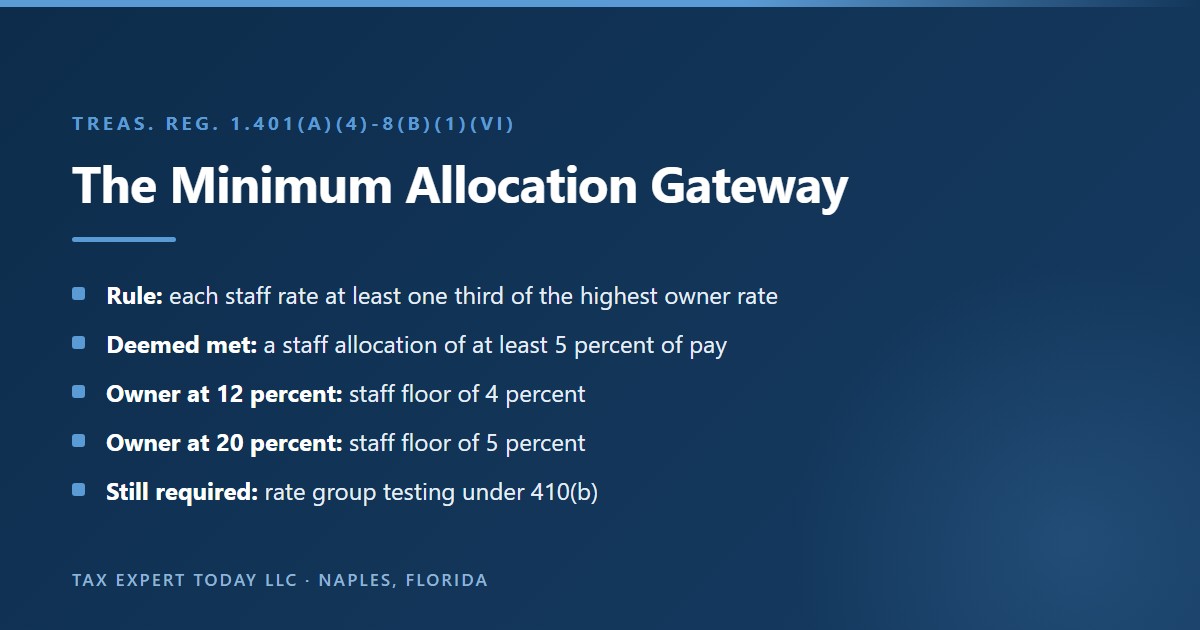
The minimum allocation gateway is a floor that a cross-tested plan generally must meet before it may test on benefits. Each non-highly compensated employee must receive at least one third of the highest allocation rate of any highly compensated employee. A plan is deemed to satisfy it if each receives at least 5 percent of compensation.
- One-third test: based on the highest allocation rate of any highly compensated employee.
- Deemed satisfaction: 5 percent of compensation under section 415(c)(3).
- Who it protects: every non-highly compensated employee benefiting under the plan.
- Effect on the owner: the highest owner rate sets the floor, up to the 5 percent cap.
The rule is in Regulation section 1.401(a)(4)-8(b)(1)(vi). Paragraph (A) requires each non-highly compensated employee to have an allocation rate that is at least one third of the allocation rate of the highly compensated employee with the highest allocation rate. Paragraph (B) deems the gateway satisfied if each receives an allocation of at least 5 percent of compensation within the meaning of section 415(c)(3).
In practical terms, the required floor is the lesser of one third of the owner’s rate or 5 percent. An owner with a 12 percent allocation requires only a 4 percent staff allocation. An owner with a 20 percent allocation requires only 5 percent, not 6.67 percent, because of the deemed-satisfaction rule. Above a 15 percent owner rate, the 5 percent floor no longer rises.
The gateway is often described as the end of the analysis, and it is only the entry requirement. A plan that clears the gateway must still pass rate group testing with its actual census, as the next section explains. Passing the gateway does not by itself mean the plan satisfies section 401(a)(4).
| Highest owner rate | One-third test | 5% deemed test | Required staff floor |
|---|---|---|---|
| 3% | 1.00% | 5% | 1.00% |
| 5% | 1.67% | 5% | 1.67% |
| 9% | 3.00% | 5% | 3.00% |
| 12% | 4.00% | 5% | 4.00% |
| 15% | 5.00% | 5% | 5.00% |
| 20% | 6.67% | 5% | 5.00% |
| 25% | 8.33% | 5% | 5.00% |
How do rate groups and the 70 percent test work?
A rate group exists for each highly compensated employee and includes everyone with an equal or higher equivalent rate. Each rate group must then satisfy section 410(b). The simplest route is a ratio of at least 70 percent. A plan below that ratio may still pass by meeting the nondiscriminatory classification and average benefit tests.
- Rate group: built around each highly compensated employee, with others at or above that rate.
- Ratio percentage: the group’s share of non-highly compensated employees divided by the share of highly compensated employees.
- Classification route: the regulation uses a midpoint between safe and unsafe harbor percentages.
- Average benefit test: average non-highly compensated benefit must be at least 70 percent of the average highly compensated benefit.
Regulation section 1.401(a)(4)-2(c) says a defined contribution plan is nondiscriminatory in amount if each rate group satisfies section 410(b), with each rate group treated as if it were a separate plan. The tests are in section 1.410(b)-2, section 1.410(b)-4, and section 1.410(b)-5.
In the running example, Employee A’s normalized rate of 38.4 percent is below the owner’s 45.2 percent, so A falls outside the owner’s rate group. Two of three employees are included, giving a ratio percentage of 66.7 percent, which misses 70 percent. The plan then looks to the nondiscriminatory classification test. Because non-highly compensated employees are 75 percent of the workforce, the safe harbor percentage is 38.75 percent and the unsafe harbor percentage is 28.75 percent, so the midpoint is 33.75 percent. A ratio of 66.7 percent clears that figure. The plan’s average benefit percentage is about 146 percent, which clears the 70 percent requirement.
An alternative is to raise Employee A to about 5.88 percent, or $4,706, so all three employees reach the owner’s normalized rate. The ratio percentage becomes 100 percent and the plan passes without relying on the classification and average benefit tests. That adds only $706 to the contribution in this illustration. Administrators commonly model both routes, because the second can be more durable from year to year.
| Participant | Age | Allocation rate | Normalized rate | At or above the owner’s 45.2%? |
|---|---|---|---|---|
| Owner | 55 | 20.0% | 45.2% | Owner rate group |
| Employee A | 40 | 5.0% | 38.4% | No |
| Employee B | 35 | 5.0% | 57.8% | Yes |
| Employee C | 28 | 5.0% | 102.3% | Yes |
| Ratio percentage | 66.7% | Below 70%, use classification and average benefit tests | ||
| With A raised to 5.88% | 45.2% | Ratio percentage becomes 100% |
When does a tested formula stop favoring the owner?
A tested formula stops favoring the owner when the owner is not older than the employees. Because projected benefit depends on years to retirement, a 35 year old owner would need the younger staff to receive far higher allocation rates. An older workforce can also remove the advantage. The formula rewards age differences, not ownership or pay.
- Younger owner: a 35 year old owner needs high staff rates to match.
- Older staff: employees near the owner’s age or older need higher rates than the gateway floor.
- Mixed workforce: a single older hire can raise the required allocation for the plan.
- Durability: a design that passes today may need adjustment as the census changes.
The table below applies the same compensation figures and the same $72,000 owner target while changing ages. The staff total column shows the contribution needed to bring every employee to the owner’s normalized rate, with a floor at the 5 percent gateway. A full test might pass with less, as the prior section showed, so this column should be read as a sensitivity measure rather than as a plan’s actual required contribution.
A 60 year old owner with younger employees finds the 5 percent gateway the only real requirement. A 35 year old owner with similar employees would need Employee A, who is older, to receive 30 percent of pay, which is more than the owner’s own rate. An older workforce produces the same effect at any owner age. In those cases, pro rata or integrated formulas typically produce a similar or better owner share without annual testing costs.
Practitioners sometimes call this the demographic test of a plan, and it should be run on actual ages before an owner commits to a document. It should be rerun each year because the census changes. A business expecting to hire experienced staff should run the numbers on the expected workforce, not only the current one.
| Owner age | Staff ages (A, B, C) | Rates to match owner (A, B, C) | Staff total, floored at gateway | Owner share of total |
|---|---|---|---|---|
| 60 | 40, 35, 28 | 3.9%, 2.6%, 1.5% | $9,500 | 88.3% |
| 55 | 40, 35, 28 | 5.9%, 3.9%, 2.2% | $10,206 | 87.6% |
| 45 | 40, 35, 28 | 13.3%, 8.9%, 5.0% | $18,448 | 79.6% |
| 35 | 40, 35, 28 | 30.1%, 20.0%, 11.3% | $41,708 | 63.3% |
| 55 | 58, 52, 60 | 25.6%, 15.7%, 30.1% | $44,868 | 61.6% |
| 45 | 50, 48, 52 | 30.1%, 25.6%, 35.4% | $57,087 | 55.8% |
Which employees must a profit sharing plan cover?
A plan must satisfy the minimum coverage rules of IRC section 410(b), generally by benefiting at least 70 percent of non-highly compensated employees, or a comparable ratio. Employees may be excluded for age, service, or a covered collective bargaining agreement and certain nonresident aliens. Excluding a class of employees to reduce cost can cause the plan to fail.
- Percentage test: at least 70 percent of non-highly compensated employees benefit.
- Ratio test: at least 70 percent of the percentage of highly compensated employees benefiting.
- Excludable employees: those not meeting allowed age and service requirements and certain others.
- Benefiting: in a defined contribution plan, generally receiving an allocation for the year.
IRC section 410(b)(1) sets out the percentage test, the ratio test, and the average benefit test. Regulation section 1.410(b)-6 lists excludable employees, and Regulation section 1.410(b)-3 says an employee is treated as benefiting under a defined contribution plan if and only if the employee receives an allocation taken into account for the year.
A plan can legitimately exclude employees who do not meet its age and service rules, and these exclusions are often the first design decision. An employer can also limit a plan to a business classification, but it must still pass coverage and be a reasonable classification under section 1.410(b)-4. The Department of Labor guide lists the same excludable groups: employees younger than 21, those with less than one year of service (or two years in certain plans), those covered by a qualifying collective bargaining agreement, and certain nonresident aliens.
The practical trap in small businesses is the assumption that a plan can include the owner and leave out everyone else by labeling the plan an owner plan. An employer with common-law employees who meet the age and service requirements has to include them, or test, unless the plan otherwise satisfies coverage. An owner who has hired a part-time assistant may already have a covered employee.
| Employee group | Treatment | Authority |
|---|---|---|
| Under age 21 or under the plan’s service requirement | Excludable when the plan so provides | IRC 410(a)(1), 410(b)(4) |
| Covered by a collective bargaining agreement with retirement bargaining | Excludable from testing | IRC 410(b)(3)(A) |
| Nonresident aliens with no U.S. source earned income | Excludable | Reg. 1.410(b)-6(c) |
| Terminated employees with no more than 500 hours | May be excluded from the test in some cases | Reg. 1.410(b)-6(f) |
| A chosen class of otherwise eligible employees | Counted, and the plan must still pass coverage | IRC 410(b)(1) |
What eligibility and entry rules can a profit sharing plan use?
A plan can generally require age 21 and one year of service before participation. A plan that fully vests contributions immediately may require up to two years of service. Part-time rules may apply to 401(k) deferral features. Tighter eligibility delays employees’ entry into the plan, and can reduce the contribution owed in early years.
- Maximum age requirement: 21.
- Standard service requirement: one year, generally 1,000 hours.
- Two-year option: available when the plan provides immediate full vesting.
- Entry dates: the plan specifies when eligible employees begin participating.
IRC section 410(a)(1)(A) prohibits a plan from requiring service beyond the later of age 21 or one year of service, with a two-year alternative under subparagraph (B) for a plan that provides 100 percent vesting after not more than two years. The choice is significant because it directly controls how many employees benefit from the plan in any year.
A two-year eligibility rule with immediate vesting generally reduces cost in a business with high turnover in early employment, because fewer short-term employees enter the plan, and any employee who does enter is fully vested. A one-year rule with a vesting schedule works the other way, because employees enter sooner and vesting recapture helps with those who leave before vesting.
A new plan can often include service before the plan’s effective date or disregard it, depending on what the document states, and the choice can be significant for a business adopting its first plan. Owners should ask an administrator how prior service is treated and what the first-year census looks like under each option.
| Option | Service required | Vesting needed | General effect |
|---|---|---|---|
| Immediate entry | None | Any allowable schedule | Highest employee cost |
| One year | One year of service, generally 1,000 hours | Graded or cliff schedule allowed | Common choice for small businesses |
| Two years | Two years of service | 100 percent immediate vesting required | Delays entry, removes vesting schedule |
| Age 21 | Up to the later of age 21 | Any allowable schedule | Helps employers with many young workers |
How does profit sharing plan vesting work?
A plan may vest employer contributions immediately or under a schedule. The law allows a cliff schedule of 100 percent after three years, or a graded schedule from 20 percent after two years to 100 percent after six years. Forfeited unvested amounts are generally reallocated to remaining participants or used to reduce employer contributions, as the plan provides.
- Cliff: 100 percent after three years of service.
- Graded: 20, 40, 60, 80, then 100 percent at years two through six.
- Immediate: required if the plan uses a two-year eligibility rule.
- Forfeitures: generally reallocated or used, and count as annual additions when reallocated.
IRC section 411(a)(2)(B) provides the minimum schedules for employer contributions to a defined contribution plan. The three-year rule requires 100 percent vesting after three years. The 2 to 6 year rule follows the table below. A plan may vest faster but not slower.
Vesting has a real effect on staff cost in a tested formula, because contributions forfeited by departing employees can be used to reduce future employer contributions or be reallocated in accordance with the plan. An owner with high staff turnover may reasonably prefer a longer schedule, while an owner competing for employees may prefer a shorter one, or immediate vesting for retention.
Forfeitures that are reallocated to other participants count as annual additions in the receiving accounts under section 415(c)(2)(C), including the owner’s account, so a formula that reallocates forfeitures needs a plan for the owner’s limit. A top-heavy plan must use a minimum vesting schedule, and the schedules permitted for a defined contribution plan already meet that standard.
| Years of service | 3-year cliff | 2 to 6 year graded |
|---|---|---|
| Less than 2 | 0% | 0% |
| 2 | 0% | 20% |
| 3 | 100% | 40% |
| 4 | 100% | 60% |
| 5 | 100% | 80% |
| 6 or more | 100% | 100% |
Do last-day and 1,000-hour rules affect profit sharing plan testing?
Plans often require employees to work on the last day of the plan year or complete 1,000 hours to receive an allocation. These conditions can lower cost, but employees who fail them are generally treated as not benefiting. That can affect the coverage test. Some short-service former employees may be disregarded under a specific regulation.
- Last-day condition: an employee must be employed on the final day of the plan year.
- Hours condition: an employee must work a stated number of hours, often 1,000.
- Testing effect: failing employees generally count as not benefiting.
- Exception: certain terminated employees with no more than 500 hours may be excluded.
A profit sharing plan is allowed to state conditions for receiving an allocation that are stricter than the eligibility conditions. These allocation conditions are useful because they target the contribution to employees who remain with the business. They are distinct from a safe harbor 401(k) design, which generally does not permit such conditions on the safe harbor contribution.
The catch is that Regulation section 1.410(b)-3 says an employee benefits under a defined contribution plan only if the employee receives an allocation. An employee who works most of the year, leaves in November, and receives no allocation counts against the employer in the coverage test. Regulation section 1.410(b)-6(f) permits exclusion of a terminated employee who completes no more than 500 hours and is not employed at the end of the plan year, but only under the conditions the regulation lists.
The practical point is that an employer with moderate turnover should test the effect of allocation conditions on actual employee data before adding them. A plan that fails coverage because of a last-day condition typically needs to provide additional allocations, which can cost more than the rule was intended to save.
| Condition | Cost effect | Testing consequence |
|---|---|---|
| No condition | Highest | Everyone eligible benefits |
| Last day of the plan year | Lower, if employees leave during the year | Employees who leave generally do not benefit |
| 1,000 hours in the plan year | Lower for part-time employees | Employees below 1,000 hours generally do not benefit |
| Last day or 1,000 hours, either condition | Moderate | Fewer employees fail the condition |
| 500-hour terminee exclusion | Testing relief only | Reg. 1.410(b)-6(f) may remove them from testing |
Who is a highly compensated or key employee in a profit sharing plan?
A highly compensated employee is generally a 5 percent owner in the current or prior year, or someone paid more than the threshold in the prior year, which is $160,000 for 2026 testing. A key employee includes a 5 percent owner, certain officers paid over $235,000, and certain 1 percent owners paid over $150,000.
- 5 percent owner: tested in the current or preceding year.
- Pay threshold: more than $160,000 in the lookback year, subject to a top-paid group election.
- Family attribution: spouses, children, and certain relatives can be treated as owners.
- Key employee: used for the top-heavy rule, a separate definition from highly compensated employee.
The highly compensated employee definition is in IRC section 414(q). A 5 percent owner at any time in the year or the preceding year qualifies, and so does anyone whose compensation for the preceding year exceeded the indexed amount, optionally limited to the top-paid 20 percent group. Notice 2025-67 states the threshold remains $160,000.
The key employee definition is in IRC section 416(i)(1). It includes an officer with compensation above $235,000 for 2026, a 5 percent owner, and a 1 percent owner with compensation above $150,000. Officers are capped at the lesser of 50 or the greater of three or 10 percent of employees.
Attribution rules matter for family businesses. An owner’s spouse and children can be treated as owning the stock the owner holds under the attribution rules applied by section 416(i)(1), so a child who works in the business may be highly compensated whatever the child earns. For a 2026 plan year, the pay test looks at 2025 compensation, so a recent raise can change who counts as highly compensated in the following year.
| Test | Highly compensated employee | Key employee |
|---|---|---|
| Ownership | More than 5 percent, current or prior year | More than 5 percent at any time in the plan year |
| Pay test | More than $160,000 in the lookback year | Officer with pay above $235,000 |
| Small owner test | None | More than 1 percent owner with pay above $150,000 |
| Family attribution | Applied | Applied |
| Used for | Coverage and nondiscrimination | Top-heavy minimums |
| Top-paid group election | Available | Not applicable |
What is the top-heavy rule and how much does it cost?
A defined contribution plan is top-heavy when key employees hold more than 60 percent of plan assets on the determination date. In a new plan with a large owner allocation, that is common from the first year. A top-heavy plan generally must give each non-key participant an employer contribution of at least 3 percent of compensation.
- Test: more than 60 percent of plan accounts belong to key employees.
- Determination date: for a first plan year, the last day of that year.
- Minimum: generally 3 percent of compensation for non-key employees.
- Lower case: if the highest key employee rate is below 3 percent, the minimum equals that rate.
IRC section 416(g) defines a top-heavy plan, and section 416(c)(2) sets the minimum contribution. Section 416(g)(4)(C) says the determination date is the last day of the preceding plan year, or in the first plan year the last day of that year. A new plan in the running example would be top-heavy from its first year, since the owner would hold about 88 percent of the assets.
The minimum applies to non-key employees who are participants on the last day of the plan year, regardless of whether they complete 1,000 hours. Its practical cost in a tested design is limited, because a plan that meets the 5 percent gateway has already satisfied the 3 percent minimum for those employees. A design where staff receive less than 3 percent, such as the age-weighted example for Employee C, must be raised to it.
A plan can stop being top-heavy as employee balances grow, and the test is run each year. A 401(k) feature with a safe harbor design and no profit sharing allocation may be exempt from the top-heavy rule, but adding a discretionary profit sharing contribution generally ends that exemption for that year. A plan that adds profit sharing to a safe harbor 401(k) should test for it.
| Non-key participant | Compensation | 3% minimum | Gateway allocation (5%) | Age-weighted equalized allocation |
|---|---|---|---|---|
| Employee A | $80,000 | $2,400 | $4,000 | $4,706 |
| Employee B | $60,000 | $1,800 | $3,000 | $2,347 |
| Employee C | $50,000 | $1,500 | $2,500 | $1,105 raised to $1,500 |
| Total | $190,000 | $5,700 | $9,500 | $8,553 |
Can a profit sharing plan be adopted after the end of the year?
Yes. Under IRC section 401(b)(2), added by section 201 of the SECURE Act, an employer that adopts a profit sharing plan after year-end but before its return due date, including extensions, may elect to treat the plan as adopted on the last day of that year. A 2026 plan can therefore be adopted well into 2027.
- Authority: IRC section 401(b)(2), effective for plans adopted for taxable years beginning after December 31, 2019.
- Deadline: the employer’s return due date, including extensions.
- Applies to: employer contributions in a profit sharing plan, as well as other named plan types.
- Separate rule: elective deferrals are generally not available retroactively, with a limited exception for a sole owner’s first year.
The change was made by section 201 of the SECURE Act of 2019, and it remains one of the least understood planning tools. Section 401(b)(2) says that an employer that adopts a stock bonus, pension, profit sharing, or annuity plan after the close of a taxable year but before the time prescribed by law for filing the return of the employer for the taxable year, including extensions, may elect to treat the plan as having been adopted as of the last day of the taxable year.
Before that change, a new plan generally had to exist by the last day of the tax year. An owner who learned the size of the year’s income in February had no way to adopt a profit sharing plan for the prior year. A SEP IRA was often used for that reason. Now a profit sharing plan can be used, with its wider choice of allocation formulas, as late as the extended due date.
A later adoption date means the owner can see the actual income before deciding on the contribution, but a return extension should be in place before relying on the extended date. A plan adopted late still has to comply with the coverage and allocation rules, and the eligible employees for that year still receive their allocations. The retroactive date does not narrow who must be covered. The second sentence of section 401(b)(2) gives a limited retroactive rule for elective deferrals by an individual who owns the entire interest in an unincorporated business and is its only employee, and that rule uses the return due date without extensions.
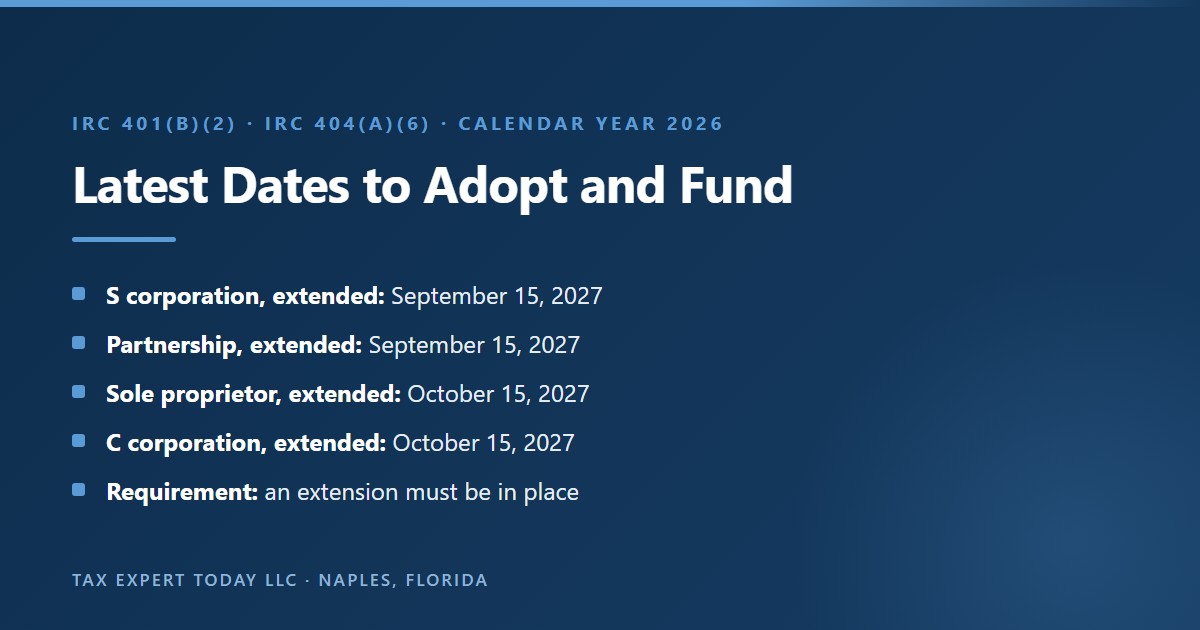
| Entity | Original due date | Extended due date | Latest adoption with extension |
|---|---|---|---|
| Sole proprietor (Form 1040) | April 15, 2027 | October 15, 2027 | October 15, 2027 |
| Partnership (Form 1065) | March 15, 2027 | September 15, 2027 | September 15, 2027 |
| S corporation (Form 1120-S) | March 15, 2027 | September 15, 2027 | September 15, 2027 |
| C corporation (Form 1120) | April 15, 2027 | October 15, 2027 | October 15, 2027 |
These are the standard calendar year dates for 2026 returns. An extension must generally be properly filed for the extended date to apply. Fiscal year filers and any disaster-related relief would have different dates.
When must profit sharing plan contributions be paid to be deductible?
A contribution is treated as made on the last day of the prior taxable year if it is paid on account of that year by the employer’s return due date, including extensions. A 2026 contribution from a calendar year S corporation with a valid extension can generally be deposited as late as September 15, 2027.
- Authority: IRC section 404(a)(6).
- Deemed date: last day of the prior taxable year if paid by the due date with extensions.
- Must be on account of that year: the contribution should be identified for the correct year.
- Cash source: the employer can decide after year-end, using actual results.
Section 404(a)(6) says a taxpayer is deemed to have made a payment on the last day of the preceding taxable year if the payment is on account of that year and is made not later than the time prescribed by law for filing the return for that year, including extensions. This timing rule works together with the late adoption rule above.
Together, the two rules let a calendar year business that files an extension both adopt the plan and fund it after the year ends, once income is known. That can be especially useful in a year with a one-time spike in income, such as an unusual sale or a strong final quarter. The contribution timing does not extend the deadline for any elective deferrals made through payroll, which are subject to separate deposit requirements.
A plan’s documentation should show which year a contribution is for. A contribution made in 2027 on account of 2026 is deducted for 2026, and it counts against the 2026 limit in participant accounts, regardless of the date the bank records it. A clear designation avoids disputes later about which limit it was intended to use.
| Date | Step |
|---|---|
| January through March 2027 | Owner reviews 2026 results and the employee census |
| By March 15, 2027 | File Form 7004 to extend the return |
| Spring through summer 2027 | Administrator runs the allocation and testing for the design |
| Before September 15, 2027 | Plan documents signed, election to treat as adopted December 31, 2026 |
| By September 15, 2027 | Contribution deposited on account of 2026 |
| By September 15, 2027 | Form 1120-S filed, deduction on line 17 |
What happens if contributions exceed the deduction limit?
Contributions above the deduction limit are not lost, but they are nondeductible in the current year. The excess can be carried forward and deducted in later years within that year’s limit. Meanwhile, a 10 percent excise tax under IRC section 4972 can apply to nondeductible amounts remaining in the plan at the end of each year.
- Carryover: excess amounts are deductible in later years within the limit.
- Excise tax: 10 percent of nondeductible contributions determined at year-end.
- Who pays: the employer.
- Repeat exposure: the tax can recur each year the excess remains unabsorbed.
Section 404(a)(3)(A)(ii) allows the excess to be deducted in succeeding taxable years, in order of time, subject to the limit in each later year. Section 4972(a) imposes a tax equal to 10 percent of the nondeductible contributions determined as of the close of the taxable year, and section 4972(b) says the employer is liable for it.
The running example has plenty of room, but a thin payroll can exceed the ceiling quickly. An employer with a total covered payroll of $260,000 has a $65,000 ceiling. If it contributes $85,000, the excess of $20,000 is nondeductible for the year and the 10 percent tax is $2,000. Because section 4972(c)(1) carries the undeducted amount into the following year’s calculation, the tax can apply again if the amount is still not deducted.
Owners who want to contribute above the ceiling should look at combining plans or adjusting compensation rather than simply making a larger deposit. An administrator should determine the allowed deduction before the deposit is made, not after.
| Item | Amount |
|---|---|
| Total covered payroll | $260,000 |
| 25 percent deduction ceiling | $65,000 |
| Actual contribution | $85,000 |
| Excess, not deductible this year | $20,000 |
| 10 percent excise tax under IRC 4972 | $2,000 |
| Carried to next year | $20,000, deductible within that year’s ceiling |
Are profit sharing plan contributions required every year?
No specific annual amount is required, and the employer can skip a year. The Treasury regulations do, however, require contributions to be recurring and substantial for a plan to retain its profit sharing status. A plan that contributes once and never again can raise questions about whether it was a genuine plan.
- Annual amount: discretionary, and zero is permitted in a given year.
- Regulation: Treasury Regulation section 1.401-1(b)(2) refers to recurring and substantial contributions.
- No profits needed: section 401(a)(27)(A) removes any profit requirement.
- Exit: a plan that is discontinued should be properly terminated and vesting addressed.
The IRS says that if an employer can afford to make some amount of contributions for a particular year it can do so, and in other years it does not need to contribute. Regulation section 1.401-1(b)(2) states that there must be recurring and substantial contributions out of profits for the employees, language written before section 401(a)(27) was enacted. The modern reading drops the reference to profits but leaves the recurring and substantial requirement in place.
In practice, an employer with a lean year can reduce or skip a contribution without penalty, and an employer with a strong year can make a larger one. An employer should expect that a pattern of contributions that looks like a one-time use of the plan by an owner shortly before retirement could attract questions. A complete discontinuance of contributions generally triggers full vesting of affected participants.
Owners sometimes confuse flexibility in the amount with flexibility in the formula. A contribution made in any year must follow the allocation formula in the plan document, so an owner cannot decide at the time of the contribution to send more to one employee than the document provides. Changes to the formula require a plan amendment, and timing rules apply.
| Year | Business result | Rate chosen | Total contribution on $550,000 payroll | Owner allocation |
|---|---|---|---|---|
| 2026 | Strong year | 20% | $110,000 | $72,000 |
| 2027 | Average year | 10% | $55,000 | $36,000 |
| 2028 | Loss year | 0% | $0 | $0 |
| 2029 | Recovery | 12% | $66,000 | $43,200 |
How does a profit sharing plan work with a 401(k)?
A profit sharing feature and a 401(k) feature can be combined in one plan. The owner may then make elective deferrals and also receive an employer allocation, together limited to $72,000 for 2026, plus any catch-up amount. A combined plan brings separate testing for deferrals and matching, which a safe harbor design can often resolve.
- One plan: deferrals and employer contributions in one document.
- One limit: $72,000 of annual additions per person, excluding catch-up contributions.
- Age 50 or older: catch-up contributions can raise the total to $80,000, and to $83,250 for ages 60 to 63.
- Deduction: employer amounts are limited at 25 percent, while deferrals are outside that test.
The IRS page on contribution limits states that the total paid to a participant’s account cannot exceed the lesser of 100 percent of compensation or $72,000 in 2026, and $80,000 including catch-up contributions, or up to $83,250 for those age 60 to 63. It also repeats the 25 percent deduction limit.
The usual small business version is a 401(k) with a safe harbor employer contribution and a discretionary profit sharing layer that uses a tested formula. Employees get the deferral option, and the owner may receive deferrals plus employer money up to the limit. Our guide to the safe harbor 401(k) for owners covers the matching and testing rules that this guide does not, and our guide to the mega backdoor Roth covers after-tax contributions, which use the same 415(c) limit. A plan with after-tax or Roth features may also be relevant to the backdoor Roth IRA and to a later Roth conversion ladder.
The owner’s deferrals do not count as the employer allocation for the gateway or for the rate group test, since Regulation section 1.401(a)(4)-2(c)(2) separates those amounts from the allocations it counts. An administrator can explain how a safe harbor nonelective contribution and a profit sharing layer work together for a specific plan.
| Component | Age 45 | Age 50 | Age 61 |
|---|---|---|---|
| Employee deferral | $24,500 | $24,500 | $24,500 |
| Employer profit sharing | $47,500 | $47,500 | $47,500 |
| Annual additions subject to 415(c) | $72,000 | $72,000 | $72,000 |
| Catch-up | $0 | $8,000 | $11,250 |
| Total into the account | $72,000 | $80,000 | $83,250 |
How does a profit sharing plan combine with a cash balance plan?
When an employer sponsors both, IRC section 404(a)(7) applies a combined deduction limit of 25 percent of compensation, or the required minimum funding, whichever is greater. Defined contribution amounts up to 6 percent of compensation are disregarded in the combined limit. That rule is why a cash balance plan is commonly paired with a 6 percent profit sharing contribution.
- Combined ceiling: 25 percent of compensation or the funding minimum, whichever is greater.
- 6 percent rule: defined contribution amounts up to 6 percent are not counted.
- Counted excess: amounts above 6 percent are counted, and they consume the combined ceiling.
- PBGC coverage: a defined benefit plan covered under ERISA section 4021 is not taken into account.
Section 404(a)(7)(A) limits the total deductible amount where an employer maintains one or more defined contribution plans and one or more defined benefit plans. Clause (iii) of subparagraph (C) says that if employer contributions to the defined contribution plans do not exceed 6 percent of compensation, the paragraph does not apply to them or to the related defined benefit contribution, and if they exceed 6 percent, only the excess is counted. Clause (iv) excludes any single-employer plan covered under section 4021 of ERISA from the calculation.
In the running example with $550,000 of payroll, the 6 percent threshold is $33,000. A profit sharing contribution of $33,000 does not reduce the room for the cash balance plan. A contribution of $81,500 has $48,500 of excess counted against the combined ceiling, which then leaves $89,000 for the cash balance plan out of a $137,500 ceiling, unless the funding minimum is higher. The deduction for the combination can reach $170,500 when the defined contribution is held at 6 percent and the cash balance contribution equals 25 percent of compensation, and a cash balance plan may support more than that on its own funding limits.
Our guide to the cash balance plan for business owners explains how those plans work, including the funding and actuarial requirements. This guide only addresses the deduction mechanics that affect how much profit sharing fits alongside one. The actual minimum funding figure must come from the plan’s actuary, and an actuary and an administrator should coordinate on any combined design.
| Profit sharing contribution | 6% disregarded | Counted excess | Combined ceiling (25%) | Remaining room for cash balance |
|---|---|---|---|---|
| $33,000 | $33,000 | $0 | $137,500 | Not limited by the combined ceiling |
| $50,000 | $33,000 | $17,000 | $137,500 | $120,500 |
| $81,500 | $33,000 | $48,500 | $137,500 | $89,000 |
| $110,000 | $33,000 | $77,000 | $137,500 | $60,500 |
What does a profit sharing plan actually cost an owner after tax?
The after-tax cost is the total contribution minus the tax value of the deduction. At a hypothetical 37 percent marginal rate, a new comparability design funding $72,000 for the owner and $9,500 for staff costs about $51,345 after tax. A pro rata design delivering the same owner amount costs about $69,300 after tax, under the same assumptions.
- Deduction value: contribution times the assumed marginal rate.
- Employee amounts: generally deductible, and a real cost of the design.
- Payroll tax: employer plan contributions are generally not wages under section 3121(a)(5)(A).
- State tax: the figure excludes state tax, which varies by state.
This table compares the four designs using a single simplifying assumption, a 37 percent marginal federal rate on the income that passes through to the owner. The table ignores any state income tax, the effect on the qualified business income deduction, and the payroll tax difference. It also treats employee contributions as an ordinary cost of the design.
The most important number is the last column, which shows how much the owner pays after tax for each $1 that lands in the owner’s own account. Under the pro rata formula the owner pays about 96 cents after tax for each $1 in the account. Under the new comparability formula, about 71 cents. The difference reflects the staff allocation that the owner is funding.
An owner should treat the staff allocation as a real cost, and many owners also view it as a real benefit for recruiting and retention. The model does not value that benefit. Money in the plan is also deferred rather than exempt, because distributions in retirement are generally taxed as ordinary income unless a Roth feature applies. The comparison is about the current year cash and deduction effect only, and the Naples tax planning work we do with owners looks at both the deduction now and the tax on the money later.
| Design | Total contribution | Deduction value at 37% | Net cost to owner | Net cost per $1 to owner’s account |
|---|---|---|---|---|
| Pro rata | $110,000 | $40,700 | $69,300 | $0.96 |
| Integrated | $104,720 | $38,746 | $65,974 | $0.92 |
| New comparability at 5% gateway | $81,500 | $30,155 | $51,345 | $0.71 |
| New comparability, A raised to 5.88% | $82,206 | $30,416 | $51,790 | $0.72 |
How does a profit sharing plan affect the qualified business income deduction?
A profit sharing contribution generally reduces qualified business income. For S corporations and partnerships, the deduction reduces business income passing through to the owner. For a self-employed owner, Regulation section 1.199A-3 treats the retirement plan deduction as attributable to the trade or business. The lost deduction can offset part of the benefit, depending on the taxpayer’s position.
- Pass-through entities: the contribution reduces ordinary business income on the return.
- Self-employed owners: the retirement deduction is treated as attributable to the business.
- Thresholds: the QBI deduction may be limited or unavailable at higher income levels.
- Modeling: the tradeoff depends on income level and whether the business is a specified service business.
Regulation section 1.199A-3(b)(1)(vi) says the deduction for contributions to qualified retirement plans under section 404 is considered attributable to a trade or business to the extent the individual’s gross income from the trade or business is taken into account in calculating the allowable deduction. Our qualified business income deduction guide explains how the limits and specified service rules work.
When the QBI deduction applies, every $100 of plan deduction may reduce the QBI deduction base by $100, which reduces the QBI deduction by up to $20 and increases taxable income by that amount. At a 37 percent rate, the effect is about $7.40 of additional tax for each $100 contributed. That reduces the plan’s benefit but does not usually reverse it, and there are also cases in which an owner’s income level means no QBI deduction was available anyway, so the contribution has no such cost.
The interaction should be modeled in the same work that sets the contribution amount. The plan decision and the QBI effect are decided at the same time and can move the owner’s actual benefit substantially.
| Contribution | QBI reduced by | QBI deduction lost (20%) | Added tax at an assumed 37% |
|---|---|---|---|
| $20,000 | $20,000 | $4,000 | $1,480 |
| $50,000 | $50,000 | $10,000 | $3,700 |
| $72,000 | $72,000 | $14,400 | $5,328 |
Where is a profit sharing plan deduction reported?
Corporations deduct contributions on the line for pension and profit sharing plans. S corporations use Form 1120-S line 17, and partnerships use Form 1065 line 18 for employee contributions. Contributions for partners are reported on Schedule K-1, box 13, code R, and deducted by the partner. Sole proprietors deduct their own contributions on Schedule 1, line 16.
- S corporation: Form 1120-S, line 17.
- Partnership employees: Form 1065, line 18.
- Partners: Schedule K-1, box 13, code R.
- Sole proprietors: Schedule 1 (Form 1040), line 16, for the owner’s own contribution.
The Form 1120-S instructions direct the corporation to enter the deductible contributions not claimed elsewhere on the return for its employees under a qualified pension, profit sharing, or similar plan on line 17. The Form 1065 instructions say not to deduct payments for partners to retirement plans on line 18; those amounts go in box 13 of Schedule K-1 using code R and are deducted on the partner’s own return.
Publication 560 states that sole proprietors and partners deduct contributions for themselves on line 16 of Schedule 1 (Form 1040). Contributions a sole proprietor makes for common-law employees go on Schedule C, or Schedule F for a farm. Reporting the contribution on the correct line matters because an owner’s retirement deduction is not a Schedule C business expense, so it does not reduce self-employment income.
An S corporation owner’s employer contribution is deducted by the corporation, so it reduces K-1 income but does not appear on the owner’s W-2 as wages. The owner’s own deferrals are handled through payroll. An accurate record of each contribution, and of the participant and year, supports the return and the plan’s own reporting.
| Taxpayer and contribution | Form and line | Reduces self-employment income? |
|---|---|---|
| S corporation, all employees including owner | Form 1120-S, line 17 | Not applicable |
| C corporation, employees | Form 1120, pension and profit sharing line | Not applicable |
| Partnership, common-law employees | Form 1065, line 18 | Not applicable |
| Partnership, contribution for a partner | Schedule K-1, box 13, code R, then Schedule 1 | No |
| Sole proprietor, common-law employees | Schedule C or F | Yes, as a business expense |
| Sole proprietor, the owner | Schedule 1 (Form 1040), line 16 | No |
What filing requirements apply to a profit sharing plan?
Most plans file a Form 5500 series return annually. Small plans may qualify for Form 5500-SF, and one-participant plans use Form 5500-EZ when assets are at least $250,000. A plan that has employees files through the Department of Labor’s electronic system. The return is generally due the last day of the seventh month after the plan year ends.
- Form 5500 or 5500-SF: filed electronically through EFAST2.
- Form 5500-EZ: for a plan covering only an owner, or the owner and spouse, generally once assets reach $250,000.
- Due date: generally July 31 for a calendar year plan, with an available extension.
- Other records: a written plan document, trust, and employee notices.
The Department of Labor guide says plans must file an annual return, and that most profit sharing plans file Form 5500, Form 5500-SF, or Form 5500-EZ depending on the participants. The IRS Form 5500 corner says plan sponsors must generally file on the last day of the seventh month after the plan year ends. The IRS page on one-participant plans says that such a plan is generally required to file Form 5500-EZ if it has $250,000 or more in assets at the end of the year.
Administrative steps are often where small employers run into trouble. A plan document must be adopted and followed, the employer must give employees required notices, contributions must be deposited on time, and a qualified plan needs a record of each person’s compensation. The IRS guide to common qualified plan requirements sets out the main operational requirements in a useful summary.
An owner with employees should plan for a third party administrator, an annual census, and the testing required by the design. Failure to file or to follow the document can cost more than the deduction is worth, and the IRS and Department of Labor both have correction programs that are generally more favorable when problems are found by the employer before the agencies raise them.
| Plan situation | Form | Electronic filing | Due date |
|---|---|---|---|
| Plan covering employees, generally 100 or more participants | Form 5500 | EFAST2 | July 31 |
| Small plan meeting the eligibility conditions | Form 5500-SF | EFAST2 | July 31 |
| Owner only or owner and spouse, $250,000 or more in assets | Form 5500-EZ, or Form 5500-SF if electing | IRS or EFAST2 as applicable | July 31 |
| Owner only, under $250,000 in assets | Generally no filing | Not applicable | Not applicable |
What controlled group and affiliated service rules affect a profit sharing plan?
Businesses under common ownership are generally treated as one employer for coverage and the annual limits. An owner of two related companies usually cannot cover only the higher-paid company. Controlled group, common control, and affiliated service group rules appear in IRC section 414, and they are among the most common sources of plan failures in small businesses.
- Controlled groups: common ownership can combine employers under sections 414(b) and 414(c).
- Affiliated service groups: section 414(m) can combine related service businesses.
- Family attribution: spouses and children can bring separate businesses together.
- Result: all employees of the combined employer are considered in coverage testing.
IRC section 414 treats businesses that share common ownership or control, or that form an affiliated service group, as a single employer for plan purposes. An owner who runs an operating business and a separately incorporated practice may have one employer in the eyes of the law, even though the businesses have different names, bank accounts, and employees.
The practical consequence is that a plan set up by one business that ignores the employees of a related business may fail coverage. Owners who acquire a second business, form a management company, or add a spouse’s business should revisit plan coverage at that time. The cost of correcting a coverage failure after the fact can be significant.
Attribution rules can create a controlled group where the owner did not expect one. A family with several small businesses should have them reviewed before adopting a plan, and any acquisition should be reviewed before the closing date. Our business advisory services page covers entity and ownership questions of this kind.
| Situation | Likely aggregation issue | What to review |
|---|---|---|
| One owner, two corporations | Controlled group under section 414(b) | Combine employees in testing |
| Owner and spouse own separate businesses | Attribution may create a group | Family attribution and any exceptions |
| Practice plus a management company | Affiliated service group under section 414(m) | Who performs services for whom |
| Acquisition of a company with its own plan | Plan coverage may be affected | Transition relief and plan merger options |
How does a profit sharing plan compare with a SEP IRA and a solo 401(k)?
A SEP IRA is simple but generally requires the same contribution rate for all eligible employees, with no tested allocation formula. A solo 401(k) adds deferrals but works only when the owner has no common-law employees. A profit sharing plan is generally the option that permits allocation formulas that send a larger share to the owner.
- SEP IRA: employer only, simple setup, uniform allocation.
- Solo 401(k): deferrals and employer contributions, only for owner-only businesses.
- Profit sharing plan: flexible allocation formulas, with testing and administration.
- Comparison point: employee count and age differences drive the choice.
Each of these plans has the same $72,000 annual additions limit for 2026. The differences are what they allow an owner to do with it and what they cost to operate. Publication 560 covers SEP and qualified plan rules for small employers, and the IRS page on one-participant plans explains that a solo 401(k) covers a business owner with no employees, or that person and a spouse.
For a business with no employees, a solo 401(k) with its deferral feature may reach the limit on less income than a profit sharing plan, which has no deferrals. For a business with employees, the SEP IRA’s uniform requirement generally requires the same percentage for everyone, so a 20 percent allocation for the owner means 20 percent for all eligible staff. A profit sharing plan can use the formulas described above, which is why owners with staff and a meaningful age difference often consider it.
An owner who chooses a plan based on simplicity alone should recognize the tradeoff. The cost of a simpler plan is an allocation result that may not fit the owner’s actual objective, and the tax planning review is where that tradeoff is usually measured. The correct choice for a business depends on the census, the income level, and how much administrative work the employer is willing to take on each year.
| Feature | SEP IRA | Solo 401(k) | Profit sharing plan |
|---|---|---|---|
| Employees allowed | Yes, generally must be covered | None other than a spouse | Yes |
| Employee deferrals | No | Yes | Only with a 401(k) feature |
| Annual additions limit | $72,000 | $72,000 | $72,000 |
| Uneven owner allocation | Generally no | Not applicable, owner only | Yes, if testing passes |
| Annual testing | No | Generally no | Depends on the formula |
| Form 5500 reporting | Generally no | At $250,000 of assets | Generally yes |
What are the most common profit sharing plan design mistakes?
Common mistakes include assuming a tested formula will pass without a real census, ignoring the 25 percent ceiling on thin payrolls, using W-2 compensation that is too low for the goal, missing related employers, and failing to count forfeitures against the owner’s limit. Each can cause a contribution to be reduced, corrected, or taxed.
- Using the wrong census: real ages and pay decide the result.
- Ignoring the ceiling: 25 percent of total participant pay remains a separate limit.
- Low owner pay: a small W-2 salary can sharply reduce the owner’s reach.
- Forgetting related employers: a controlled group can bring in more employees.
The most costly mistake is treating the allocation column in a sample illustration as if it were a plan’s actual result. Every number in this guide assumes a specific census. Changes in age, new hires, or a new owner can cause a plan that worked last year to need a different allocation this year, or to need additional contributions.
A second category involves timing. An owner relying on the late adoption rule should have the extension in place before the original due date. An owner relying on a contribution made after year-end should confirm the deposit date falls within the extended due date. A plan that requires annual testing should begin that testing early enough to leave time for corrections.
A third category involves the plan document. Allocation methods, compensation definitions, and allocation conditions must be stated in the document and followed. An owner who wants to change how a contribution is divided after a year has closed often cannot do so. Our tax planning services page describes how the firm approaches this kind of review.
| Mistake | Usual consequence | Prevention |
|---|---|---|
| No actual census review | Plan fails, or costs more than expected | Administrator model before adoption |
| Contribution above 25 percent ceiling | Nondeductible amount and possible 10 percent excise tax | Compute the ceiling first |
| Owner pay set too low | Cannot reach the intended allocation | Model salary and plan together |
| Related employer overlooked | Coverage failure and correction cost | Ownership review at setup |
| Forfeitures not considered | Owner account can exceed the 415(c) limit | Check annual additions before reallocation |
| Extension not filed | Later dates unavailable | Calendar the extension date |
What information does an owner need to design a profit sharing plan?
An owner should gather a current employee census with birth dates, hire dates, compensation, hours, and ownership, along with the entity’s tax return and a list of all related businesses. Those items let an administrator model each allocation formula. A plan’s actual cost and the owner’s share can only be estimated from that real information.
- Census: name, birth date, hire date, pay, hours, and ownership.
- Business records: entity type, fiscal year, and any related entities.
- Goals: target owner amount and budget for staff contributions.
- Advisors: tax advisor and third party administrator, with an actuary if a cash balance plan is under review.
Plan design follows a sequence. The first step is a census review, because ages and pay answer most design questions. The second is a comparison of formulas. The third is a review of timing, deductibility, and related entities. The last step is to sign a plan document that matches what was modeled, and then to follow it each year.
Owners who want a higher allocation than a profit sharing plan allows may look to the pairing described above with a cash balance plan, or to other approaches such as a nonqualified deferred compensation plan for a key executive. Those approaches have their own rules and risks. An owner should treat a plan as a long-term commitment even though the annual contribution is discretionary. Employers reviewing benefits more broadly may also find our guide to the QSEHRA for small business owners useful, since health and retirement benefit decisions are often made together.
Our business advisory services and Naples, Florida tax planning team coordinate with plan administrators so the tax return, the contribution, and the plan document agree.
| Step | Item | Who usually provides it |
|---|---|---|
| 1 | Employee census, including ages and pay | Owner or payroll provider |
| 2 | Related business list and ownership | Owner and tax advisor |
| 3 | Target owner contribution and staff budget | Owner |
| 4 | Formula comparison and testing run | Third party administrator |
| 5 | Deduction and timing review | Tax advisor |
| 6 | Plan document, trust, and notices | Administrator or provider |
| 7 | Annual funding, testing, and Form 5500 | Administrator and employer |
Profit Sharing Plan Help in Naples & Southwest Florida
Tax Expert Today LLC works with business owners in Naples, Florida and across Southwest Florida on the tax side of retirement plan design. That can include modeling allocation formulas against an actual employee census, coordinating with a plan administrator, and timing a contribution and deduction with the entity’s return.
- Profit sharing plan help Naples: tax modeling for owners of closely held businesses in Collier and Lee counties.
- Coordination: working alongside a third party administrator and, where relevant, an actuary.
- Scope: tax planning and return treatment, with plan documents provided by the plan provider.
- Service area: an office in Naples, with clients served in all 50 states.
Our office is at 11983 Tamiami Trail N, Naples FL 34110. Call (239) 441-2005, Monday through Friday, 10 a.m. to 5 p.m. ET. Our Naples tax planning page and our tax planning services page describe how the firm works with owners, and the business advisory services page covers entity-level questions that often arise at the same time.
Where can I get help with a profit sharing plan in Naples, FL? Tax Expert Today LLC is based at 11983 Tamiami Trail N in Naples and works with owners on the tax modeling, the deduction, and the timing of a profit sharing plan contribution. A third party administrator generally handles the plan document and annual testing. Results depend on each employer’s facts, and the firm does not promise any particular allocation or tax outcome.
When to Engage a Professional
Consider professional help before adopting a plan when the business has employees, when owners hold more than one company, when the owner’s age or pay is near a limit, or when a contribution is being timed against an extended due date. A plan that looks simple on paper can still fail coverage or testing.
- Before adoption: run a real census, compare formulas, and confirm related businesses.
- Before the deposit: confirm the deduction limit and the deadline.
- After a business change: review coverage if the company adds employees or an entity.
- Each year: test on that year’s data and keep the plan document current.
Tax Expert Today LLC is a Naples, Florida firm of tax advisors, enrolled agents, CPAs, and attorneys serving clients in all 50 states. To discuss a profit sharing plan or how it would fit into a broader plan for your business, contact our Naples, Florida tax planning team, review our tax planning services, or call (239) 441-2005. Readers may also find our guides to the cash balance plan for business owners, the safe harbor 401(k) for owners, S corporation reasonable compensation, the mega backdoor Roth, the excess business loss limitation, and our self-employment tax calculator useful, along with the full learning center.
This article is general information about federal profit sharing plan rules and is not tax, legal, or investment advice for any specific business or person. It does not recommend any plan provider, administrator, or investment. Statutory and regulatory references were checked against the text of IRC sections 401, 404, 410, 411, 414, 415, 416, 3121, and 4972, Treasury Regulation sections 1.199A-3, 1.401-1, 1.401(a)(4)-2, 1.401(a)(4)-8, 1.401(a)(4)-12, 1.401(l)-2, 1.410(b)-2, 1.410(b)-3, 1.410(b)-4, 1.410(b)-5, and 1.410(b)-6, IRS Notice 2025-67, IRS Publication 560, the Form 1065 and Form 1120-S instructions, section 201 of the SECURE Act of 2019, and published IRS and Department of Labor plan guidance on November 8, 2026. All dollar examples, including ages, pay, allocations, and tax amounts, are hypothetical illustrations prepared for this guide and are not client outcomes or predictions for any taxpayer. Plan results depend on actual testing of each employer’s census. Tax laws apply differently to each person’s facts. Consult a qualified professional about your situation before taking any action.
Published November 8, 2026 by Dr. Pellumb Kabashi « Back to Learning Center
Have a question this article touches on?
Tax Expert Today LLC, based in Naples, Florida and serving clients across the United States.
Schedule a Consultation (239) 441-2005