
By Dr. Pellumb Kabashi, DBA, MBA, CES, CFE, EA
Founder, Tax Expert Today LLC · Tax advisors, enrolled agents, CPAs, and attorneys · Serving clients in all 50 states
Quick Answer
A QSEHRA is a qualified small employer health reimbursement arrangement under IRC section 9831(d). An employer with fewer than 50 full-time employees and no group health plan can reimburse employees, tax free, for individual health insurance and other medical costs, up to $6,450 for self-only coverage and $13,100 for family coverage in 2026. Call (239) 441-2005 for a free consultation.
What is a QSEHRA?
A QSEHRA is an employer-funded arrangement that reimburses eligible employees for medical care, including individual health insurance premiums, after each employee proves minimum essential coverage. Federal law excludes it from the definition of a group health plan, so a small employer can offer a fixed allowance without buying a group policy.
- Who funds it: the employer only, with no salary reduction contributions allowed.
- What it pays for: medical care as defined in IRC section 213(d), including premiums.
- What the employee needs: proof of minimum essential coverage for each month.
- What it is not: a group health plan, which is the whole point of the statute.
The QSEHRA was created by the 21st Century Cures Act in December 2016 and placed in IRC section 9831(d), and the IRS issued its main guidance in Internal Revenue Bulletin 2017-47. Before that law, a small employer that simply reimbursed employees for individual health insurance risked being treated as running a group health plan that failed the market reform rules of the Affordable Care Act, with an excise tax under IRC section 4980D of $100 per affected person per day. Section 9831(d)(1) solves that problem directly: for purposes of the Internal Revenue Code, the term “group health plan” does not include a qualified small employer health reimbursement arrangement.
The tax result for the employee comes from two other sections. Reimbursements of medical care under an employer arrangement are excluded from gross income under IRC section 105(b), and IRC section 106(g) adds the condition that matters most for a QSEHRA: the reimbursement is treated as employer-provided coverage only for a month in which the person whose expense is reimbursed has minimum essential coverage. Payroll taxes follow the income tax result, because amounts paid under a plan for medical expenses are excluded from wages under IRC section 3121(a)(2)(B) for Social Security and Medicare tax and under section 3306(b)(2)(B) for federal unemployment tax. IRS Publication 15-B summarizes the same treatment for accident and health benefits.
This guide is written for the business owner rather than the benefits buyer. It explains what the statute requires, what the owner can and cannot receive from their own QSEHRA, how the arrangement is reported on Form W-2, how it changes an employee’s premium tax credit, and what it saves compared with paying the same dollars as wages. It does not recommend any plan, administrator, or insurance product, and it does not decide whether a QSEHRA is right for any particular business. Readers who want the broader planning picture can start with our learning center and our Naples, Florida tax planning overview. That depends on the workforce, the local individual market, and the owner’s own tax position.
| Condition | What the statute requires | Statutory reference |
|---|---|---|
| Employer funding only | Funded solely by an eligible employer; no salary reduction contributions | IRC 9831(d)(2)(B)(i) |
| Proof of coverage first | Pays or reimburses medical care after the employee provides proof of coverage | IRC 9831(d)(2)(B)(ii) |
| Annual dollar cap | Payments and reimbursements may not exceed the indexed limit for the year | IRC 9831(d)(2)(B)(iii) and (D) |
| Same terms for all | Provided on the same terms to all eligible employees, with limited variation | IRC 9831(d)(2)(A)(ii) and (C) |
| Eligible employer | Not an applicable large employer and offers no group health plan to any employee | IRC 9831(d)(3)(B) |
| Written notice | Given at least 90 days before the year, or when an employee first becomes eligible | IRC 9831(d)(4) |
Two of those rows deserve emphasis because they are the ones small employers most often miss. The first is that a QSEHRA is “provided,” not “offered.” The second is that the notice requirement is separate from the definition, which affects what happens when a notice is late. Both are covered in detail below.
What are the 2026 QSEHRA limits?
For 2026, the QSEHRA limit is $6,450 for self-only coverage and $13,100 for an arrangement that also reimburses family members, according to section 4.63 of Rev. Proc. 2025-32. That equals $537.50 and about $1,091.67 per month. Employers may set any permitted benefit at or below these caps.
- Self-only cap for 2026: $6,450 a year.
- Family cap for 2026: $13,100 a year.
- Floor: none; the employer chooses the amount, subject to the same terms rule.
- Indexing: annual, rounded down to the next lowest multiple of $50.
The statute set the original limits at $4,950 and $10,000 and indexes both each year using the cost-of-living adjustment in IRC section 1(f)(3), with any result that is not a multiple of $50 rounded down to the next lowest multiple of $50, as section 9831(d)(2)(D)(ii) provides. The IRS publishes the indexed amounts in its annual inflation adjustment revenue procedure, and HealthCare.gov’s small employer QSEHRA page repeats them for employers. For 2026 that is Rev. Proc. 2025-32, section 4.63, which states that the total amount of payments and reimbursements for any year cannot exceed $6,450 ($13,100 for family coverage). The 2026 Form W-2 instructions repeat the same two figures.
| Year | Self-only limit | Family limit | Source |
|---|---|---|---|
| Statute as enacted | $4,950 | $10,000 | IRC 9831(d)(2)(B)(iii) |
| 2017 | $4,950 | $10,050 | Notice 2017-67, footnote 5 |
| 2018 | $5,050 | $10,250 | Notice 2017-67, Q&A-27 |
| 2025 | $6,350 | $12,800 | Rev. Proc. 2024-40, section 3.63 |
| 2026 | $6,450 | $13,100 | Rev. Proc. 2025-32, section 4.63 |
| 2026 monthly equivalent | $537.50 | about $1,091.67 | Annual limit divided by 12 |
Because the limits for a calendar year are usually published in October or November of the year before, and the employee notice is due 90 days before the year begins, employers frequently set permitted benefits before they know the new caps. Notice 2017-67 addresses this in Q&A-26 and Q&A-27: an arrangement may rely on the prior year’s limits to set the current year’s benefits. The 2025 figures in the table come from Rev. Proc. 2024-40, section 3.63, which an employer could have used when it prepared notices in the fall of 2025.
The limit applies to payments and reimbursements, not to a balance that sits in an account. A QSEHRA is a notional arrangement. The employer does not set money aside in a trust; it pays claims as employees submit them, up to each employee’s permitted benefit. That is why the employer’s real cost depends on how much employees actually claim, which is modeled later in this guide.
Which employers can offer a QSEHRA?
An eligible employer is one that is not an applicable large employer under IRC section 4980H, meaning it generally had fewer than 50 full-time employees including full-time equivalents in the prior calendar year, and that does not offer a group health plan to any employee, including a dental, vision, or other excepted benefit plan.
- Size test: fewer than 50 full-time and full-time equivalent employees in the prior year.
- No other group plan: not even a standalone dental or vision plan.
- No old HRA balances: prior HRA amounts must be suspended.
- Entity type: any form, including sole proprietorships, partnerships, and corporations.
The size test borrows the applicable large employer definition from IRC section 4980H(c)(2). An employer is an applicable large employer for a calendar year if it employed an average of at least 50 full-time employees, counting full-time equivalent employees, on business days during the preceding calendar year. A full-time employee for this purpose generally works an average of at least 30 hours a week, and part-time hours are converted into full-time equivalents by dividing total monthly part-time hours by 120. The IRS explanation of the applicable large employer test walks through the calculation and the aggregation rules that combine commonly controlled businesses.
The aggregation point matters for owners with more than one company, a structure common among families that also use a family limited partnership or a separate management entity. If two businesses are treated as a single employer under the controlled group or affiliated service group rules, their employees are counted together. An owner who runs a 30-person operating company and a 25-person management company under common control may have an applicable large employer even though neither business alone is near 50.
| Prior-year workforce (monthly average) | Full-time equivalents | Total for the test | Eligible employer for QSEHRA purposes? |
|---|---|---|---|
| 12 full-time, no part-time | 0 | 12 | Yes, if no group plan is offered |
| 30 full-time, 20 part-time at 60 hours a month each | 1,200 / 120 = 10 | 40 | Yes, if no group plan is offered |
| 40 full-time, 30 part-time at 80 hours a month each | 2,400 / 120 = 20 | 60 | No; applicable large employer |
| Two commonly controlled firms of 30 and 25 full-time | 0 | 55 combined | No, if aggregated as one employer |
| 45 full-time and a dental plan for all staff | 0 | 45 | No; a group plan is offered |
The “no group health plan” condition is broader than many owners expect. The eligible employer section of Notice 2017-67 says that a group health plan for this purpose includes a plan that provides only excepted benefits, such as a standalone dental or vision plan, if the employer offers it. An employer that keeps a small group dental policy cannot add a QSEHRA beside it. Q&A-2 adds that an employer that lets employees keep using amounts accumulated in a prior health reimbursement arrangement, or carryover amounts in a health flexible spending arrangement, is not an eligible employer, unless access to those amounts is suspended while the QSEHRA is provided.
There is a narrow exception that comes up with S corporations. Q&A-3 says an S corporation does not fail to be an eligible employer merely because, separate from the QSEHRA, it reimburses the health insurance premiums of a 2 percent shareholder who is an employee. That rule is what allows an S corporation owner to keep the familiar premium arrangement for themselves while offering a QSEHRA to the staff.
Which employees must be covered, and who can be excluded?
A QSEHRA must be provided to every employee of the eligible employer, except that the plan terms may exclude employees with fewer than 90 days of service, employees under age 25, part-time or seasonal employees, employees covered by a collective bargaining agreement that addressed health benefits, and certain nonresident aliens with no United States earned income.
- Default: every employee is an eligible employee.
- Optional exclusions: five categories, chosen in the plan document.
- Applied uniformly: an exclusion chosen must apply to everyone in that category.
- Owners: some owners are not employees at all, a separate question covered below.
The exclusion categories come from section 9831(d)(3)(A), which cross-references the categories in IRC section 105(h)(3)(B) and substitutes 90 days for three years in the service clause. The eligible employee section of Notice 2017-67 lists the categories, and Q&A-8 defines part-time and seasonal employees by reference to Treasury Regulation section 1.105-11(c)(2)(iii)(C). In general, a part-time employee is one whose customary weekly employment is less than 35 hours, when other employees in similar work have substantially more hours, and a seasonal employee is one whose customary annual employment is less than nine months, again measured against similar work.
| Category | General test | Practical note |
|---|---|---|
| Short service | Fewer than 90 days of service | Eligibility begins once the 90 days are complete |
| Age | Has not reached age 25 before the start of the plan year | Measured at the beginning of the plan year |
| Part-time | Customary weekly employment under 35 hours, compared with similar work | Definition from Reg. 1.105-11(c)(2)(iii)(C) |
| Seasonal | Customary annual employment under nine months, compared with similar work | Common in hospitality and landscaping |
| Collective bargaining | Covered by an agreement where health benefits were bargained in good faith | Rare in very small firms |
| Nonresident alien | No earned income from sources within the United States | Uncommon for domestic staff |
An employee who was excluded and later leaves the excluded category becomes eligible. Notice 2017-67, Q&A-10, says the QSEHRA must be provided to that employee no later than the day immediately following the date the employee is no longer in any excludable category. A new hire who completes 90 days of service on March 20, for example, would generally become eligible on March 21 under a plan that uses the 90-day exclusion, and Q&A-37 says the written notice for a newly eligible employee is due on or before the first day of eligibility.
What does “same terms” mean for a QSEHRA?
The same terms requirement means every eligible employee receives the same permitted benefit, except that the benefit may vary with the price of a single baseline individual insurance policy based on the employee’s age and the number of family members covered. Variation by job title, salary, tenure, or location within the business is not allowed.
- Allowed: variation by age, using one baseline policy for everyone.
- Allowed: variation by number of covered family members.
- Allowed: separate self-only and family amounts.
- Not allowed: richer benefits for managers, owners’ relatives, or long-tenured staff.
Section 9831(d)(2)(C) permits variation only “in accordance with the variation in the price of an insurance policy in the relevant individual health insurance market” based on age and family size, and it requires that the variation be determined by reference to the same insurance policy for all eligible employees. Notice 2017-67, Q&A-13, calls that policy the baseline policy and says it must be minimum essential coverage and available for purchase by at least one eligible employee. Q&A-14 confirms that a single dollar amount for self-only coverage and a single dollar amount for family coverage is also acceptable.
| Design choice | Result under the same terms rule | Reason |
|---|---|---|
| $400 a month for every eligible employee | Permitted | Identical benefit for all |
| $400 self-only and $800 family | Permitted | Variation by family coverage is allowed |
| Benefit set as a percentage of one baseline policy’s age-rated premium | Permitted | Age variation tied to the same policy |
| $600 for managers and $300 for other staff | Not permitted | Job class is not an allowed variable |
| Higher amount after five years of service | Not permitted | Tenure is not an allowed variable |
| Different amount by office location in two states | Not permitted under a QSEHRA | Location classes are an ICHRA feature, not a QSEHRA feature |
The same terms rule is also measured in operation. Q&A-12 says an arrangement can fail the requirement if it is not operated on a uniform and consistent basis, even when the written terms are fine. A practice of approving one employee’s claims quickly and slow-walking another’s, or reimbursing some expenses for favored employees that the plan document does not cover, can cause a problem that the plan document never shows. The consequence of failing is serious, because an arrangement that fails to be a QSEHRA becomes a group health plan exposed to the excise tax described later in this guide.
One practical design point follows. Because the permitted benefit may be set from the prior year’s limits, an employer that wants the maximum each year usually sets a benefit at or below the published cap for the coming year. An employer that sets the benefit as a percentage of the cap avoids rewriting the amount every fall, but it must still state a dollar amount in each employee’s notice.
Can an employee turn down a QSEHRA?
No. Notice 2017-67, Q&A-11, says an eligible employee may not waive participation, because the statute requires the employer to provide, rather than offer, the QSEHRA to all eligible employees. An employee who has no qualifying coverage simply submits no claims, but the permitted benefit still exists and still affects the premium tax credit.
- Cannot waive: the QSEHRA is provided to every eligible employee.
- Can decline to claim: an employee who submits no proof of coverage receives nothing.
- Still reported: the permitted benefit appears in Box 12 with code FF.
- Still counts: the permitted benefit enters the premium tax credit calculation.
This is one of the least understood features of the arrangement and one of the most consequential for employees. Because the QSEHRA is provided whether or not the employee wants it, the employee’s premium tax credit is computed with the QSEHRA in the picture. An employee who would have received a larger credit through the Health Insurance Marketplace than the QSEHRA pays can end up worse off, and the employee cannot fix that by declining. The premium tax credit sections below show the arithmetic.
| Arrangement | Can an eligible employee opt out? | Source |
|---|---|---|
| QSEHRA | No; it is provided, not offered | IRC 9831(d)(2)(A)(ii); Notice 2017-67, Q&A-11 |
| Individual coverage HRA (ICHRA) | Yes; the regulations require an annual opt-out opportunity | Treas. Reg. 54.9802-4(c)(4) |
| Small group health insurance | Yes; employees may decline enrollment | Plan and insurer terms |
| Taxable wage increase | Not applicable; it is pay | Not a health arrangement |
The comparison with the individual coverage HRA is useful. The individual coverage HRA rules in Treasury Regulation section 54.9802-4 require that employees be allowed to opt out of and waive future reimbursements at least annually, precisely so that an employee can keep the premium tax credit when the employer’s offer is unaffordable. The QSEHRA statute contains no equivalent. An employer weighing the two designs for a low-wage workforce should keep that difference in view.
What expenses can a QSEHRA reimburse?
A QSEHRA may reimburse medical care as defined in IRC section 213(d), which includes individual health insurance premiums and out-of-pocket costs such as deductibles, copays, and prescriptions. The employer chooses the scope in the plan document; many arrangements reimburse premiums only, and the choice affects health savings account eligibility.
- Premiums: individual market and Marketplace policies, and in some cases Medicare.
- Cost sharing: deductibles, copays, coinsurance, if the plan allows them.
- Family members: only if the arrangement provides family coverage.
- Documentation: each reimbursement must be substantiated.
IRC section 213(d) defines medical care to include amounts paid for the diagnosis, cure, mitigation, treatment, or prevention of disease, and for insurance covering that care. IRS Publication 502 gives the long list of items that qualify. Within that universe, the plan document sets the scope. Notice 2017-67 answers several practical questions about what a QSEHRA may reimburse.
| Expense | May a QSEHRA reimburse it? | Notice 2017-67 reference |
|---|---|---|
| Individual health insurance premium | Yes | Background; Q&A-44 on direct premium payment |
| Separate policy covering a family member | Yes, under family coverage | Q&A-47 |
| Premiums for a spouse’s employer group plan | Yes, but taxable to the extent the spouse paid pre-tax | Q&A-48 |
| Medicare or Medigap premiums | Yes, though a Medicare-only design may fail same terms | Q&A-22 |
| Expenses in a month without minimum essential coverage | No; any mistaken payment is taxable | Q&A-40 and Q&A-43 |
| Fixed payment regardless of expenses | No; the whole arrangement becomes taxable wages | Q&A-73, Example 2 |
The last row is the most common design error in practice. An example under Q&A-73 describes an employer that pays 1/52 of the permitted benefit with each weekly paycheck whether or not the employee incurred any medical expense. The conclusion is that the arrangement is not an accident or health plan at all, and every amount paid to every employee is included in gross income and wages. A health stipend that is not tied to substantiated expenses is just pay, and calling it a QSEHRA does not change that.
The spouse group plan row also deserves a note. If an employee’s spouse is enrolled in a group plan through the spouse’s own employer and pays the premium through a cafeteria plan on a pre-tax basis, reimbursing that premium again through a QSEHRA would give two exclusions for the same dollars. Q&A-48 allows the reimbursement but makes it taxable to the extent the spouse’s share was paid pre-tax.
Why does minimum essential coverage matter for every QSEHRA reimbursement?
A QSEHRA reimbursement is tax free only for a month in which the person whose expense is reimbursed has minimum essential coverage. The employee must prove coverage before the first reimbursement and attest to it with each claim. A mistaken reimbursement for a month without coverage is taxable income, reported on Form W-2.
- Statutory condition: IRC section 106(g) ties the exclusion to monthly coverage.
- Before the first payment: proof of coverage for the employee and any family member.
- With each claim: an attestation that coverage continues.
- If coverage lapsed: the reimbursement is income, but not subject to payroll tax.
Minimum essential coverage is defined in IRC section 5000A(f) and includes Marketplace and other individual market policies, Medicare Part A, Medicaid, most employer group coverage, and several other categories. It does not include coverage consisting only of excepted benefits, such as a standalone dental policy, and it does not include many short-term limited duration policies. The individual shared responsibility payment under section 5000A has been reduced to zero since 2019, but the definition of minimum essential coverage still controls the QSEHRA exclusion.
Notice 2017-67, Q&A-41 and Q&A-42, sets out the proof steps. The employee provides proof of coverage before the first reimbursement each year, and an attestation that coverage continues with each subsequent claim. The notice includes model attestation language. Separately, every reimbursement must be substantiated with documentation of the expense, under the same standards that apply to other medical reimbursement arrangements under section 105.
| Situation | Box 1 wages | Boxes 3 and 5 | Box 12 code FF |
|---|---|---|---|
| Reimbursement for a month with minimum essential coverage | Not included | Not included | Full permitted benefit |
| Mistaken reimbursement for a month without coverage | Included as other compensation | Not included; excluded under IRC 3121(a)(2)(B) | Same permitted benefit as if no lapse |
| Income tax withholding on the mistaken amount | Not required; excluded from wages for withholding under IRC 3401(a)(20) | ||
That middle row is a narrow but helpful rule. Even when the employee loses the income tax exclusion because coverage lapsed, the payment was still made under a plan for medical expenses, so it stays outside Social Security and Medicare wages. Contrast that with a reimbursement of a spouse’s pre-tax group premium under Q&A-63, which the notice treats as included in both income and payroll tax wages. The difference is a reminder that the label on the payment matters less than the reason it is taxable.
Can the business owner participate in their own QSEHRA?
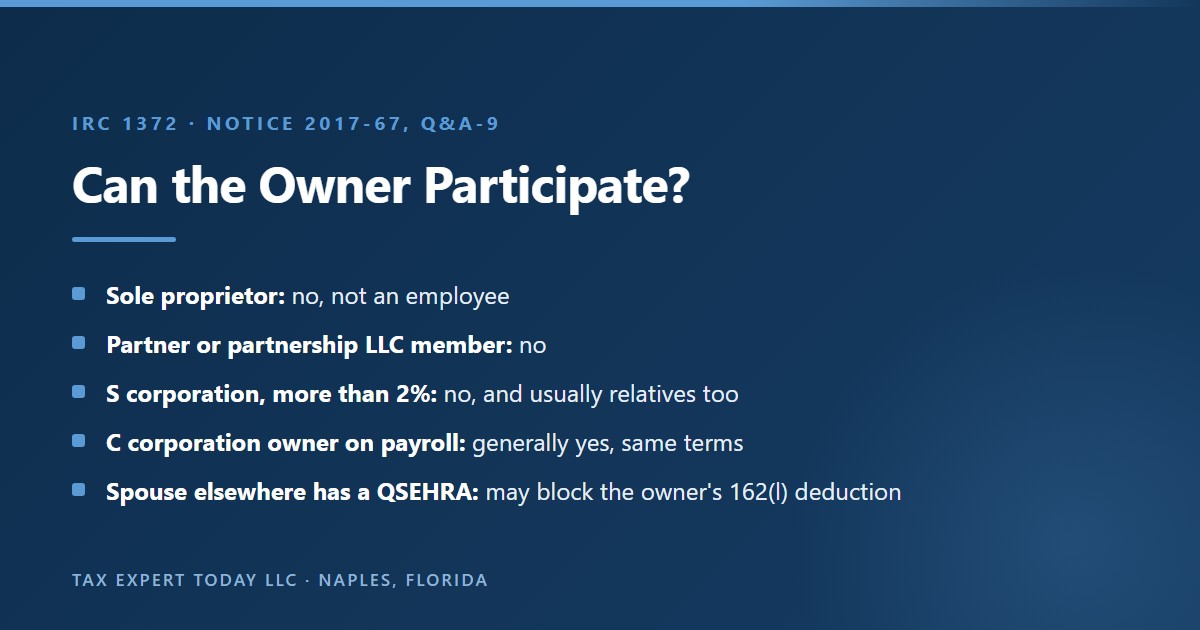
It depends on the entity. A QSEHRA may cover only employees. Sole proprietors and partners are not employees, and Notice 2017-67, Q&A-9, says a more than 2 percent S corporation shareholder is not an employee for QSEHRA purposes. A C corporation owner who works for the corporation is generally an employee and can participate.
- Sole proprietor: not an employee of their own business.
- Partner or LLC member taxed as a partnership: not an employee.
- More than 2 percent S corporation shareholder: treated like a partner under IRC section 1372.
- C corporation owner-employee: generally an employee who can participate on the same terms.
This is the question every owner asks first, and the answer surprises many of them. A QSEHRA is an employee benefit. Notice 2017-67, Q&A-9, says a QSEHRA may be provided only to employees, may not be provided to retirees, other former employees, or non-employee owners, and that “a 2% shareholder who is otherwise an employee is not an employee for purposes of a QSEHRA,” citing IRC section 1372. Section 1372 treats an S corporation as a partnership, and a more than 2 percent shareholder as a partner, for fringe benefit purposes.
The 2 percent test is broader than direct ownership. Section 1372(b) defines a 2 percent shareholder as a person who owns, or is considered to own under the attribution rules of IRC section 318, more than 2 percent of the outstanding stock or voting power on any day of the year. Under section 318, stock owned by a spouse, children, grandchildren, and parents is attributed to the individual. The practical result is that a spouse or child of a more than 2 percent shareholder who works in the S corporation is usually treated as a 2 percent shareholder too, and is also outside the QSEHRA.
| Entity and owner | Employee for QSEHRA purposes? | Basis for the rule |
|---|---|---|
| Sole proprietor (including a single-member LLC taxed as a disregarded entity) | No | A proprietor is not their own employee |
| Partner or LLC member taxed as a partnership | No | Partners are not employees of the partnership |
| S corporation shareholder owning more than 2 percent | No | IRC 1372; Notice 2017-67, Q&A-9 |
| Relative of a more than 2 percent S corporation shareholder who works in the business | Usually no | Attribution under IRC 318 |
| S corporation shareholder owning 2 percent or less who is on payroll | Yes, generally | Treated as an ordinary employee |
| C corporation owner who is on payroll | Yes, generally, on the same terms as staff | A corporate officer who performs services is an employee |
The C corporation row is the one owners of growing companies sometimes overlook. A shareholder-employee of a C corporation is an employee of the corporation and can receive QSEHRA reimbursements on the same terms as everyone else, subject to the same permitted benefit and the same proof of coverage. The S corporation election, by contrast, trades away that ability for the owner and the owner’s family, which is one of many factors in the entity decision, along with the qualified small business stock rules for C corporations, discussed in our guide to S corporation reasonable compensation.
How does an S corporation owner get health insurance tax benefits instead?
A more than 2 percent S corporation shareholder cannot use the QSEHRA, but the corporation can pay or reimburse the shareholder’s own health insurance premiums. Those amounts are included in the shareholder’s W-2 wages for income tax but excluded from Social Security and Medicare wages, and the shareholder may then claim the self-employed health insurance deduction.
- Corporation pays the premium: separate from the QSEHRA, allowed by Notice 2017-67, Q&A-3.
- W-2 Box 1: premium included in wages.
- W-2 Boxes 3 and 5: premium excluded from Social Security and Medicare wages.
- Owner’s Form 1040: self-employed health insurance deduction, if the conditions are met.
This route exists side by side with a QSEHRA for the staff, and it is a regular part of setting reasonable compensation for the owner. Notice 2017-67, Q&A-3, says the S corporation does not lose eligible employer status because it reimburses the premiums of a 2 percent shareholder who is an employee. The detailed mechanics, including Notice 2008-1, the earned income limit, and the months in which the deduction is blocked, are covered in our guide to the self-employed health insurance deduction. This article does not repeat that analysis. The table below only places the owner’s route next to the staff QSEHRA so the two can be seen together.
| Feature | Owner (more than 2 percent shareholder) | Staff (eligible employees) |
|---|---|---|
| Arrangement | Corporation pays or reimburses the owner’s own premiums | QSEHRA under IRC 9831(d) |
| Annual cap | No QSEHRA cap; limited by the actual premium | $6,450 self-only or $13,100 family in 2026 |
| Federal income tax | Included in W-2 wages, then deductible above the line if conditions are met | Excluded under IRC 105 and 106 |
| Social Security and Medicare tax | Excluded under IRC 3121(a)(2)(B) | Excluded under IRC 3121(a)(2)(B) |
| Corporation’s deduction | Deductible as compensation | Deductible as an employee benefit |
| Where it is explained in depth | Self-employed health insurance deduction guide | This guide |
One planning point does belong here. Because the owner’s premium is outside the QSEHRA, it does not count against the staff’s same terms requirement. The owner may carry a richer individual policy than the staff permitted benefit would reimburse without violating the QSEHRA rules, because the owner is simply not a participant. The corporation still has to document the owner arrangement properly and report it on the owner’s W-2, and the owner’s reasonable compensation analysis should include the premium amount in total pay.
Can an owner’s spouse be covered as an employee?
Sometimes. In an S corporation, attribution under IRC section 318 usually makes a working spouse a 2 percent shareholder too, so the spouse is excluded. In a sole proprietorship or C corporation, a spouse who is a bona fide employee on payroll is generally an employee and may be eligible on the same terms as other staff.
- S corporation: spouse usually attributed the owner’s shares, so usually excluded.
- Sole proprietorship: a spouse with real duties and real wages is generally an employee.
- Partnership: a spouse who is also a partner is not an employee.
- C corporation: a spouse on payroll is generally an employee.
The spouse question is where several administrators’ marketing pages and the statute meet, and the details matter. Notice 2017-67 does not address the sole proprietor’s spouse directly. What it does say is that only employees may participate and that more than 2 percent S corporation shareholders are not employees. Whether a spouse is an employee of a sole proprietorship is decided under the ordinary employment tax rules: the spouse must perform real services under the owner’s direction, be paid reasonable wages through payroll, and receive a Form W-2. A spouse who is listed on payroll but does no real work is a weak foundation for any benefit plan, and the IRS has long examined these arrangements. Spousal compensation also comes up in business owner divorce matters, where payroll records are read closely.
When the spouse is a bona fide employee and the QSEHRA provides family coverage, the spouse’s family benefit can reimburse premiums for a policy that also covers the owner as a family member. That is the route some sole proprietors use to bring their own household’s premium inside an employer arrangement. It is lawful only if every other eligible employee receives the same terms, and only if the spouse’s employment is genuine. Because the arrangement benefits the owner’s household directly, it deserves careful documentation and a professional review before adoption.
| Entity | Spouse works in the business as a W-2 employee | Usual result | Key condition |
|---|---|---|---|
| Sole proprietorship | Yes | Generally eligible on the same terms as staff | Real services and reasonable wages |
| Partnership, spouse not a partner | Yes | Generally eligible | Spouse holds no partnership interest |
| Partnership, spouse is a partner | Not applicable | Not eligible | Partners are not employees |
| S corporation, other spouse owns more than 2 percent | Yes | Usually not eligible | Attribution under IRC 318 and 1372 |
| C corporation | Yes | Generally eligible | Same terms as other employees |
Owners sometimes ask whether a QSEHRA that covers only the owner’s spouse is possible when the business has no other employees. A plan with fewer than two participants who are current employees on the first day of the plan year is outside most of the group health plan rules anyway under section 9831(a)(2), a point footnote 6 of Notice 2017-67 notes. Whether a one-employee spouse arrangement is better designed as a QSEHRA or as a different reimbursement plan is a question for a professional with the full facts.
How does a QSEHRA affect the owner’s self-employed health insurance deduction?
Notice 2017-67 says coverage under a QSEHRA is participation in a subsidized health plan maintained by an employer for purposes of IRC section 162(l). An owner who is eligible to participate in a QSEHRA through their own job or a spouse’s job loses the self-employed health insurance deduction for those months.
- The rule: IRC section 162(l)(2)(B) denies the deduction for months with eligibility for a subsidized employer plan.
- The QSEHRA link: Notice 2017-67 treats a QSEHRA as such a plan.
- Who it reaches: owners whose spouse works for a business that provides a QSEHRA.
- The test: eligibility, not actual reimbursement.
This interaction appears in none of the administrator pages that rank for the term, but it can matter more than any other point to an owner’s own return. IRC section 162(l)(2)(B) says the self-employed health insurance deduction does not apply to any calendar month for which the taxpayer is eligible to participate in any subsidized health plan maintained by any employer of the taxpayer or of the taxpayer’s spouse. In the coordination section of Notice 2017-67, the IRS states that “coverage under a QSEHRA constitutes participation in a subsidized health plan maintained by an employer” for purposes of section 162(l).
The usual fact pattern is a sole proprietor or partner whose spouse works for a different small employer that provides a QSEHRA with family coverage. The owner’s own premium deduction is blocked for those months, even though the spouse’s QSEHRA may reimburse far less than the household’s premium. The household may still come out ahead, depending on the amounts, because the QSEHRA dollars are tax free. The example below is a hypothetical illustration only.
| Item | Spouse has no QSEHRA | Spouse eligible for family QSEHRA all year |
|---|---|---|
| Household premium paid by the owner | $9,000 | $9,000 |
| Self-employed health insurance deduction | $9,000 | $0 (blocked by IRC 162(l)(2)(B)) |
| Federal tax value of the deduction at a 24 percent rate | $2,160 | $0 |
| Tax-free QSEHRA reimbursement, assuming a $6,000 family benefit | $0 | $6,000 |
| Combined federal benefit to the household | $2,160 | $6,000 |
In that hypothetical the household is better off, but the result reverses when the spouse’s permitted benefit is small. With a $1,200 family benefit and a 32 percent marginal rate, the deduction lost on a $9,000 premium is worth $2,880, more than double the reimbursement. Owners in this position should model it before the spouse’s employer adopts the plan, and should remember that the employee cannot waive a QSEHRA. Medical expenses that are not deductible above the line may still be claimed as an itemized deduction to the extent they exceed 7.5 percent of adjusted gross income under section 213(a), though few households clear that floor.
What does a QSEHRA save compared with a raise?
In a hypothetical S corporation with six full-time employees, reimbursing $500 a month each through a QSEHRA costs $36,000 a year if fully used, while a $500 monthly raise costs $38,754 after the employer’s 7.65 percent payroll tax. The employer saves $2,754, and each employee keeps about $1,179 more than the raise would leave after tax.
- Employer side: no Social Security, Medicare, or federal unemployment tax on qualifying reimbursements.
- Employee side: no income tax and no employee payroll tax on qualifying reimbursements.
- Condition: the employee must have qualifying expenses and coverage to claim the money.
- Trade-off: a raise is cash the employee may spend on anything.
The comparison owners usually want, and the one a small business financial review tends to surface, is simple: if the business is going to spend money on its people, what does it cost to spend it through a QSEHRA rather than through wages? The answer turns on three exclusions. Qualifying QSEHRA reimbursements are excluded from income under sections 105 and 106, from Social Security and Medicare wages under section 3121(a)(2)(B), and from federal unemployment wages under section 3306(b)(2)(B). A raise carries all three taxes.
The example assumes each employee is single, earns $45,000 of wages before the change, takes the 2026 standard deduction of $16,100, and therefore sits in the 12 percent bracket, which runs from $12,400 to $50,400 of taxable income for single filers under Rev. Proc. 2025-32. It assumes Florida residence, a status explained in our guide to establishing Florida residency, so there is no state income tax, and that each employee’s wages already exceed the $7,000 federal and Florida unemployment wage bases, so unemployment tax does not change at the margin. Every figure is hypothetical.
| Item | $6,000 raise | $6,000 QSEHRA, fully used |
|---|---|---|
| Employer cash paid to or for the employee | $6,000 | $6,000 |
| Employer Social Security and Medicare tax (7.65 percent) | $459 | $0 |
| Total employer cost | $6,459 | $6,000 |
| Employee Social Security and Medicare tax (7.65 percent) | $459 | $0 |
| Employee federal income tax at 12 percent | $720 | $0 |
| Amount the employee keeps or receives | $4,821 | $6,000 |
| Difference in the employee’s favor under the QSEHRA | $1,179 | |
| Item | Raises for six employees | QSEHRA for six employees | Difference |
|---|---|---|---|
| Total employer cost | $38,754 | $36,000 | $2,754 lower under the QSEHRA |
| Total kept or received by employees | $28,926 | $36,000 | $7,074 more under the QSEHRA |
| Combined tax that does not arise | $2,754 employer plus $7,074 employee | $9,828 in total | |
Those figures describe a ceiling, not a forecast. They assume every employee has individual coverage and submits claims for the whole $6,000. They also assume the employees value $6,000 of reimbursed premiums as much as $6,000 of cash, which is true only for employees who would have bought coverage anyway. An employee who is young, healthy, and uninsured gets nothing from the QSEHRA until they buy a policy, while the raise would have paid them regardless. And the premium tax credit effect, covered below, can turn the employee column negative for some households. The table answers one narrow question: for dollars that do flow through as qualifying reimbursements, how much tax disappears.
What happens to the math when employees do not use the full allowance?
The employer pays only the reimbursements employees actually claim, so the QSEHRA cost falls as usage falls, while a raise is paid in full. In the six-employee hypothetical, an 85 percent claim rate costs $30,600 and a 70 percent rate costs $25,200, against $38,754 for the raises.
- Unused amounts: stay with the employer; they are never paid.
- Cash-out of unused amounts: not allowed, and would taint the whole plan.
- Carryover: optional, within the annual cap.
- Budgeting: the permitted benefit is a maximum, not a committed spend.
Because a QSEHRA pays claims rather than salaries, the employer’s budget is a cap. Notice 2017-67 addresses the budgeting rules directly. Notice 2017-67, Q&A-50, also allows an arrangement to make the permitted benefit available ratably month by month instead of all at once on January 1, which limits the employer’s exposure when an employee leaves early in the year. What the employer may not do is pay out the unused balance at year end. Q&A-46 says a cash-out of unused permitted benefits causes all payments to all eligible employees under the QSEHRA for the year to be included in income and wages.
| Share of permitted benefit actually claimed | Employer QSEHRA cost | Cost of $500 monthly raises | QSEHRA cost below raises by |
|---|---|---|---|
| 100 percent | $36,000 | $38,754 | $2,754 |
| 85 percent | $30,600 | $38,754 | $8,154 |
| 70 percent | $25,200 | $38,754 | $13,554 |
| 50 percent | $18,000 | $38,754 | $20,754 |
Lower usage is not automatically good news. If employees claim little because the permitted benefit does not fit their situation, for example because the premium tax credit would have paid more, the business may be spending less while delivering less value than it intends. A QSEHRA designed with the workforce’s actual coverage in mind tends to be used. A QSEHRA adopted only for the payroll tax savings, without looking at the employees’ Marketplace position, tends to disappoint everyone.
How does the business deduct QSEHRA reimbursements?
QSEHRA reimbursements are generally deductible by the business as ordinary and necessary employee benefit expenses under IRC section 162(a) in the year paid, the same as wages would be. The tax advantage is not a larger deduction but the absence of payroll tax on the employer side and income and payroll tax on the employee side.
- Deduction: employee benefit expense, not wages.
- Timing: generally when paid for a cash-method business.
- S corporation flow-through: the deduction reduces the ordinary income on the owners’ Schedules K-1.
- Payroll forms: reimbursements stay off Form 941 wage lines.
Both a raise and a QSEHRA reimbursement are deductible business expenses, so the deduction does not distinguish them. What changes is the payroll tax that sits above wages and never arises on qualifying reimbursements. In a pass-through entity, the payroll tax that is avoided would itself have been deductible, so the owner’s after-tax saving is somewhat smaller than the gross figure. In the six-employee hypothetical, $2,754 of employer payroll tax avoided is worth about $2,093 after a 24 percent owner-level federal rate and about $1,873 after a 32 percent rate.
| Owner’s marginal federal rate on pass-through income | Gross employer payroll tax avoided | Lost deduction for that tax | Net saving to the owner |
|---|---|---|---|
| 22 percent | $2,754 | $606 | $2,148 |
| 24 percent | $2,754 | $661 | $2,093 |
| 32 percent | $2,754 | $881 | $1,873 |
| 37 percent | $2,754 | $1,019 | $1,735 |
On the books, a QSEHRA is usually tracked in its own expense account so the reimbursements, the administrator’s fees if any, and the W-2 reporting all reconcile. The reimbursements do not appear on Form 941 as wages and do not enter Social Security wages. If a business uses a third-party administrator, the fee is a separate deductible expense under IRC section 162(a) and does not count against the permitted benefit. The business should keep the plan document, each year’s notices, each employee’s proof of coverage, and the substantiation for each claim, because those records are what show the arrangement met the statute.
How do the employer payroll tax savings scale with headcount?
The employer payroll tax saving grows in a straight line with headcount, at 7.65 percent of the reimbursements actually paid. In the hypothetical, it is $918 a year for two employees, $4,590 for ten, and $9,180 for twenty, all at $500 a month per employee and full use.
- Rate: 7.65 percent of qualifying reimbursements, for employees below the Social Security wage base.
- Scale: no economies of scale; each employee adds the same saving.
- Ceiling: the employer must stay below 50 full-time and equivalent employees.
- Offsets: administrator fees and the employees’ premium tax credit position.
| Employees | Annual QSEHRA reimbursements | Employer payroll tax avoided | Employee income and payroll tax avoided |
|---|---|---|---|
| 2 | $12,000 | $918 | $2,358 |
| 4 | $24,000 | $1,836 | $4,716 |
| 6 | $36,000 | $2,754 | $7,074 |
| 10 | $60,000 | $4,590 | $11,790 |
| 20 | $120,000 | $9,180 | $23,580 |
| 40 | $240,000 | $18,360 | $47,160 |
The employee column assumes every employee is single, in the 12 percent bracket, and below the Social Security wage base, which will not be true of every workforce. Employees in higher brackets save more per dollar; employees with low income who would otherwise receive a large premium tax credit may save nothing or lose ground. The employer column is more reliable because the employer rate is the same for everyone below the wage base. The 40-employee row is the practical upper edge: an employer at that size must watch the applicable large employer count carefully each year, because crossing 50 full-time and equivalent employees ends QSEHRA eligibility as of January 1 of the following year, as Notice 2017-67, Q&A-7, explains for non-calendar plans.
Owners who are comparing benefit spending across several tools should also look at retirement plan design, including a cash balance plan for owners with high income and nonqualified deferred compensation for key employees. The payroll tax logic is the same for employer contributions to a safe harbor 401(k), which are not wages for Social Security and Medicare purposes either, and the two can coexist because a retirement plan is not a group health plan.
How does a QSEHRA interact with the premium tax credit?
Under IRC section 36B(c)(4), an employee provided a QSEHRA that is affordable gets no premium tax credit for that month, and neither do the employee’s spouse and dependents. If the QSEHRA is not affordable, the employee may still claim the credit, but it is reduced by one twelfth of the annual permitted benefit for each month.
- Affordable QSEHRA: no premium tax credit for the employee or family for that month.
- Unaffordable QSEHRA: credit allowed, reduced by the monthly permitted benefit.
- No double benefit: the statute’s own heading for the reduction rule.
- No waiver: the employee cannot decline the QSEHRA to restore the credit.
The premium tax credit under IRC section 36B helps people who buy coverage through the Health Insurance Marketplace pay their premiums. Section 36B(c)(4) contains special rules for QSEHRAs. Subparagraph (A) says a month is not a “coverage month” for the employee, spouse, or dependents if the employee is provided a QSEHRA that constitutes affordable coverage. Subparagraph (B), titled “denial of double benefit,” says that for any other month in which the employee is provided a QSEHRA, the credit is reduced, but not below zero, by one twelfth of the employee’s permitted benefit.
The employee’s notice from the employer is what makes this work at the Marketplace. Section 9831(d)(4)(B)(ii) requires the notice to tell employees to give the permitted benefit amount to any exchange where they apply for advance payments of the credit. HealthCare.gov’s QSEHRA page for employees asks for that information during the application so that advance payments are computed correctly. If the employee does not report it, the difference is reconciled on Form 8962 when the return is filed, and excess advance payments must be repaid within the limits that apply, as the Instructions for Form 8962 explain.
| QSEHRA status for the month | Premium tax credit for the employee | Credit for spouse and dependents | Statutory reference |
|---|---|---|---|
| Affordable | None; not a coverage month | None; not a coverage month | IRC 36B(c)(4)(A) |
| Not affordable | Allowed, reduced by 1/12 of the permitted benefit | Allowed within the same family credit, subject to the reduction | IRC 36B(c)(4)(B) |
| Employee not provided a QSEHRA (excluded category) | Unaffected by the QSEHRA | Unaffected by the QSEHRA | IRC 9831(d)(3)(A) |
| Household income above 400 percent of the poverty line in 2026 | None, regardless of the QSEHRA | None | IRC 36B(c)(1)(A) |
When is a QSEHRA affordable for an employee in 2026?
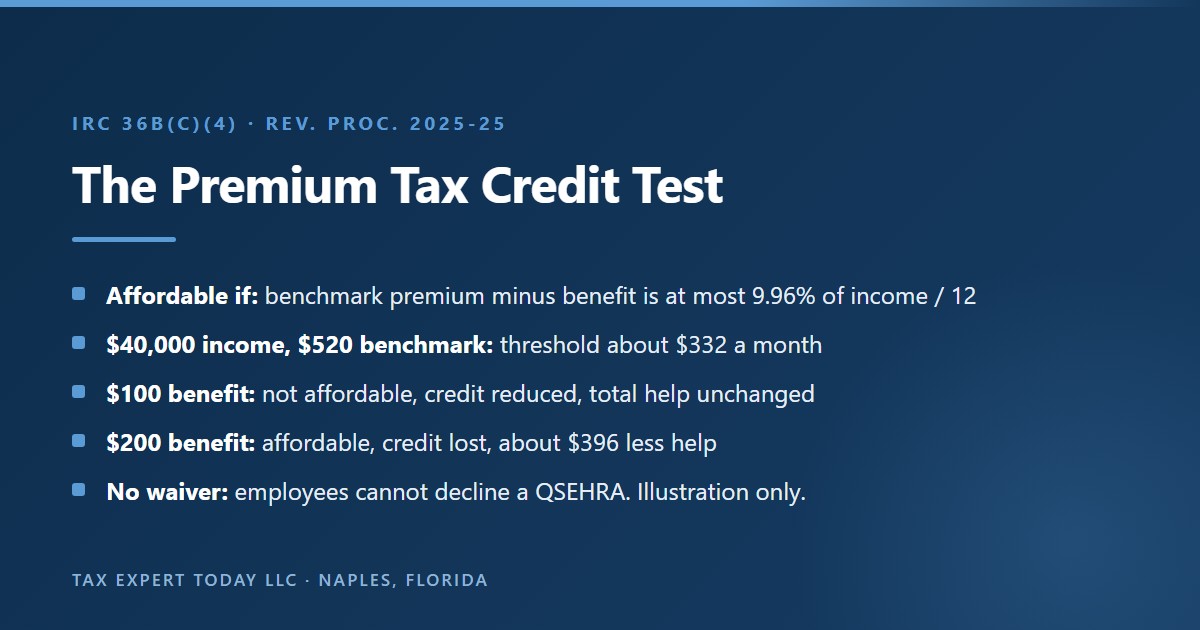
A QSEHRA is affordable for a month if the monthly premium for the self-only second lowest cost silver plan, minus one twelfth of the employee’s self-only permitted benefit, does not exceed one twelfth of 9.96 percent of household income. The 9.96 percent figure is the 2026 required contribution percentage from Rev. Proc. 2025-25.
- Benchmark: self-only second lowest cost silver plan where the employee lives.
- Subtract: one twelfth of the self-only permitted benefit.
- Compare with: one twelfth of 9.96 percent of household income for 2026.
- Self-only amount used: even when the employee has family coverage, per Notice 2017-67, Q&A-65.
Section 36B(c)(4)(C) sets the test in terms of 9.5 percent of household income, and that percentage is indexed each year. For plan years beginning in 2026, Rev. Proc. 2025-25 sets the required contribution percentage at 9.96 percent. Notice 2017-67 describes the test as one twelfth of 9.5 percent “(adjusted annually)” of household income. The benchmark plan is the second lowest cost silver plan in the employee’s rating area for self-only coverage, priced at the employee’s age. The table below is a hypothetical single employee with $40,000 of household income and a $520 monthly benchmark premium.
| Monthly permitted benefit | Benchmark minus benefit | Threshold (9.96% of income / 12) | Affordable? |
|---|---|---|---|
| $100 | $420 | $332 | No |
| $150 | $370 | $332 | No |
| $200 | $320 | $332 | Yes |
| $300 | $220 | $332 | Yes |
| $537.50 (the 2026 self-only cap) | Below zero | $332 | Yes |
The threshold depends on each employee’s household income, which the employer usually does not know. Household income includes the income of a spouse and of dependents required to file, so two employees with the same wage can face different answers. The benchmark premium depends on age and on where the employee lives. That is why the same QSEHRA can be affordable for one employee and unaffordable for the next, and why the affordability result is computed by the employee and the Marketplace, not by the employer.
The affordability test also differs from the one employers may know from the applicable large employer rules. The affordability safe harbors under Treasury Regulation section 54.4980H-5(e), which the IRS applicable large employer guidance addresses for larger employers, apply only to an applicable large employer’s own liability under section 4980H. Footnote 7 of Notice 2017-67 points out that they do not determine an individual’s eligibility for the credit. A QSEHRA employer is by definition not an applicable large employer, so those safe harbors have no role here.
Can a QSEHRA leave an employee worse off than the premium tax credit?
Yes. When a modest QSEHRA is just large enough to be affordable, it eliminates the employee’s premium tax credit for the month while paying less than the credit would have. In the hypothetical, a $200 monthly QSEHRA replaces a $233 monthly credit, so the employee receives $396 less help over the year.
- The cliff: crossing from unaffordable to affordable removes the whole credit.
- Below the cliff: credit plus QSEHRA equals the credit alone, so total help is unchanged.
- Above the cliff: help equals the QSEHRA alone.
- Worst zone: a QSEHRA that is barely affordable.
The arithmetic starts with what the employee would receive with no QSEHRA at all. For 2026 coverage, the credit uses the prior year’s federal poverty guidelines, which the HealthCare.gov federal poverty level table lists at $15,650 for a household of one. Household income of $40,000 is about 255.6 percent of that line. Rev. Proc. 2025-25 sets the 2026 applicable percentage for the 250 to 300 percent band as rising from 8.44 to 9.96 percent, which puts this employee at about 8.61 percent. The expected contribution is about $3,444 a year, or $287 a month, and the credit is the $520 benchmark minus $287, about $233 a month or $2,796 a year.
| Monthly permitted benefit | Affordable? | Monthly credit after QSEHRA rules | Annual credit plus QSEHRA | Change from no QSEHRA |
|---|---|---|---|---|
| None | Not applicable | $233 | $2,796 | Baseline |
| $100 | No | $133 | $2,796 | $0 |
| $150 | No | $83 | $2,796 | $0 |
| $200 | Yes | $0 | $2,400 | $396 less |
| $300 | Yes | $0 | $3,600 | $804 more |
| $537.50 | Yes | $0 | $6,450 | $3,654 more |
Two lessons follow from the table. Below the affordability line, the reduction in section 36B(c)(4)(B) takes away one dollar of credit for each QSEHRA dollar, so the employee is no better off and the employer has spent money for nothing from that employee’s point of view. Just above the line, the employee loses the whole credit and receives a smaller QSEHRA. Only at higher benefit levels does the QSEHRA clearly add value for a lower-income employee. The figures assume the employee buys the benchmark plan, use rounded monthly amounts, and are hypothetical illustrations, not predictions for any person.
How does a QSEHRA affect a family’s premium tax credit?
Affordability is tested with the self-only permitted benefit and the self-only benchmark premium, even for an employee with family coverage. If that test shows the QSEHRA is affordable, the whole family loses the premium tax credit for the month, which can exceed what the family QSEHRA pays.
- Test uses: self-only benchmark and self-only permitted benefit (Notice 2017-67, Q&A-65).
- Reduction uses: the family permitted benefit when the employee has family coverage (Q&A-66).
- Effect if affordable: no credit for the employee, spouse, or dependents.
- Risk group: moderate-income families with expensive family coverage.
Notice 2017-67, Q&A-65, says the self-only permitted benefit reported in the written notice decides affordability “regardless of whether the permitted benefit provided to a particular eligible employee” is for self-only or family coverage. Q&A-66 says the credit reduction, when it applies, uses the maximum permitted benefit for the type of coverage the employee actually has. Because the self-only benchmark is relatively low, the self-only test is often passed even when the family’s total premium is far higher, and section 36B(c)(4)(A) then removes the credit for every family member.
The example is a hypothetical family of four with $70,000 of household income, a self-only benchmark of $520 a month, and a family benchmark premium of $1,700 a month. The 2025 poverty line for a household of four is $32,150 on the HealthCare.gov table, so the family is at about 217.7 percent, and the applicable percentage is about 7.25 percent. The family’s expected contribution is about $423 a month.
| Item | No QSEHRA | With the QSEHRA |
|---|---|---|
| Self-only affordability test (benchmark $520 minus $500) | Not applicable | $20, below the $581 threshold, so affordable |
| Monthly premium tax credit for the family | About $1,277 | $0 |
| Annual premium tax credit | About $15,323 | $0 |
| Annual QSEHRA family reimbursement | $0 | $12,000 |
| Total annual federal help | About $15,323 | $12,000 |
| Difference | About $3,323 less with the QSEHRA | |
For this family, even a much smaller QSEHRA would be affordable: a $100 self-only benefit leaves $420 against the $581 threshold. A QSEHRA designed for a workforce of single employees can therefore remove a large credit from one employee’s family. That is not a reason to avoid the arrangement, but it is a reason to understand the workforce before choosing the amounts, and it is one of the reasons the individual coverage HRA, with its opt-out, exists.
What changed for the premium tax credit in 2026?
The temporary rules that capped the credit contribution at 8.5 percent of income and allowed credits above 400 percent of the poverty line applied only to taxable years beginning before January 1, 2026. For 2026, IRC section 36B returns to its original table, with applicable percentages from 2.10 to 9.96 percent and no credit above 400 percent.
- 2021 through 2025: 0 to 8.5 percent of income, with no 400 percent ceiling.
- 2026: 2.10 to 9.96 percent of income, under Rev. Proc. 2025-25.
- 400 percent line: back in effect, at $62,600 for one person and $128,600 for four using 2025 guidelines.
- QSEHRA effect: fewer employees qualify for large credits, so more QSEHRAs add value.
The text of section 36B(b)(3)(A)(iii), titled “temporary percentages for 2021 through 2025,” applies only to taxable years beginning after December 31, 2020, and before January 1, 2026. The related temporary removal of the 400 percent ceiling in section 36B(c)(1)(E) carries the same end date. As of the date this article was checked, the statute had not been extended. Congress has changed these rules before, so readers should confirm the current law before relying on the 2026 figures below.
| Household income as a percent of the poverty line | 2025 temporary range | 2026 range |
|---|---|---|
| Less than 133 percent | 0.0 percent | 2.10 percent |
| 133 to under 150 percent | 0.0 percent | 3.14 to 4.19 percent |
| 150 to under 200 percent | 0.0 to 2.0 percent | 4.19 to 6.60 percent |
| 200 to under 250 percent | 2.0 to 4.0 percent | 6.60 to 8.44 percent |
| 250 to under 300 percent | 4.0 to 6.0 percent | 8.44 to 9.96 percent |
| 300 to 400 percent | 6.0 to 8.5 percent | 9.96 percent |
| Above 400 percent | 8.5 percent | No credit |
For QSEHRA design, the 2026 change cuts both ways. Smaller credits mean that more employees will find the QSEHRA worth more than the credit they give up. At the same time, the employer’s notice must still be prepared, and employees with household income just under 400 percent of the poverty line may still have significant credits at stake. Employees above 400 percent receive no credit in 2026, so for them the QSEHRA is pure value, subject only to having coverage and expenses to claim.
What must the written QSEHRA notice say?
The written notice must state the employee’s permitted benefit for the year, tell the employee to give that amount to any health insurance exchange where they apply for advance premium tax credit payments, and explain that reimbursements may be taxable for any month without minimum essential coverage. Notice 2017-67, Q&A-38, adds further required content.
- Statutory content: three items in IRC section 9831(d)(4)(B).
- Additional IRS content: listed in Notice 2017-67, Q&A-38.
- Delivery: paper or electronic, following the rules in Reg. 1.401(a)-21.
- Recipients: every eligible employee, including those who will never claim.
Section 9831(d)(4)(B) lists three required statements. Notice 2017-67, Q&A-38, describes the full content the IRS expects, which also includes the date the QSEHRA is first provided to the employee, any prorated amount for a newly eligible employee, and a statement that the employee should keep the notice because it may be needed to calculate the premium tax credit. Q&A-36 allows electronic delivery if the employer follows the electronic media rules in Treasury Regulation section 1.401(a)-21.
| Item | Source | Why it matters |
|---|---|---|
| The employee’s permitted benefit for the year | IRC 9831(d)(4)(B)(i) | Used to test affordability and reduce the credit |
| Instruction to give the permitted benefit to the exchange | IRC 9831(d)(4)(B)(ii) | Keeps advance credit payments accurate |
| Warning about months without minimum essential coverage | IRC 9831(d)(4)(B)(iii) | Reimbursements may be taxable for those months |
| Date the QSEHRA is first provided | Notice 2017-67, Q&A-38(a) | Needed for monthly credit calculations |
| Instruction to keep the notice | Notice 2017-67, Q&A-38(b) | Supports the employee’s Form 8962 |
Section 9831(d)(4)(B)(iii) still refers to the individual shared responsibility tax under section 5000A. That tax has been zero since 2019, but the notice language in the statute has not changed, and the second half of the statement, that reimbursements may be includible in income for months without coverage, remains fully in force.
When is the QSEHRA notice due for a 2027 plan year?
For a calendar 2027 plan year, the notice to current eligible employees was due by October 3, 2026, which is 90 days before January 1, 2027. For an employee who becomes eligible later, such as a new hire, the notice is due on or before the first day of that employee’s eligibility.
- Current employees: at least 90 days before the plan year begins.
- Newly eligible employees: on or before the first day of eligibility, under Q&A-37.
- Each year: a new notice is due for each plan year.
- Late notice: triggers the section 6652(o) penalty.
The 90-day rule in section 9831(d)(4)(A) is measured from the beginning of the year. An employer reading this in November 2026 and hoping to start a QSEHRA for its current staff on January 1, 2027, has already passed the date for that start. The statute does not place the notice inside the definition of a QSEHRA in section 9831(d)(2); the consequence it names for a missed notice is the penalty in section 6652(o). Whether a late start or a later plan year is the better path depends on the facts and on the business’s tax planning calendar, and an employer in that position should get advice before acting rather than assume either answer.
| Plan year or event | Eligibility begins | Notice due |
|---|---|---|
| Calendar 2027 plan year, current employees | January 1, 2027 | October 3, 2026 |
| Calendar 2028 plan year, current employees | January 1, 2028 | October 3, 2027 |
| New hire under a plan with no waiting period, hired March 15, 2027 | March 15, 2027 | On or before March 15, 2027 |
| New hire under a 90-day exclusion, 90 days completed March 20, 2027 | March 21, 2027 | On or before March 21, 2027 |
| Employee turns 25 under a plan with an age exclusion | Start of the next plan year after reaching 25 | On or before the first day of eligibility |
The age row reflects the wording of the exclusion: an employee may be excluded if they have not attained age 25 before the beginning of the plan year, so eligibility usually begins with the next plan year. The new-hire rows show the practical point that new employees can join throughout the year without waiting for the next annual cycle, as long as the employer delivers the notice on time and prorates the benefit for the partial year.
What is the penalty for a missed QSEHRA notice?
IRC section 6652(o) imposes $50 per employee for each failure to provide the required written notice, capped at $2,500 per calendar year, unless the failure is due to reasonable cause and not willful neglect. For a six-employee business that misses every notice, the hypothetical penalty is $300.
- Amount: $50 per employee per incident.
- Annual cap: $2,500 per employer.
- Defense: reasonable cause and not willful neglect.
- Bigger exposure: design or operating failures, covered below, carry far larger penalties.
Section 6652(o) reads, in part, that for each failure to provide a written notice as required by section 9831(d)(4), the person failing to provide it pays “$50 per employee per incident of failure to provide such notice, but the total amount imposed on such person for all such failures during any calendar year shall not exceed $2,500.” The penalty is assessed on notice and demand, in the same manner as tax. Reasonable cause is decided on the facts, and the general standards are the same ones described in our guide to reasonable cause penalty abatement.
| Eligible employees not given a notice | $50 per employee | Annual cap | Penalty |
|---|---|---|---|
| 3 | $150 | $2,500 | $150 |
| 6 | $300 | $2,500 | $300 |
| 20 | $1,000 | $2,500 | $1,000 |
| 45 | $2,250 | $2,500 | $2,250 |
| 60 (possible with many part-time staff) | $3,000 | $2,500 | $2,500 |
The notice penalty is modest by design. The more important reason to deliver notices on time is the employee’s premium tax credit. An employee who never learns the permitted benefit cannot report it to the Marketplace, may receive advance payments that are too large, and may owe a repayment at filing time. That repayment is the employee’s problem on paper, but it tends to become the employer’s problem in practice, especially in a tight labor market such as Southwest Florida.
How is a QSEHRA reported on Form W-2?
The employer reports each eligible employee’s permitted benefit for the year in Box 12 of Form W-2 with code FF, as IRC section 6051(a)(15) requires. The amount is the benefit the employee was entitled to receive, not the amount actually reimbursed, and qualifying reimbursements are not included in Boxes 1, 3, or 5.
- Box 12, code FF: the permitted benefit, whether or not it was used.
- Boxes 1, 3, and 5: no qualifying reimbursements.
- Carryover amounts: excluded from the code FF figure.
- Coverage change during the year: prorated amount reported.
IRC section 6051(a)(15) requires the W-2 to show the total amount of permitted benefit for the year under a QSEHRA. The General Instructions for Forms W-2 and W-3 implement that with code FF, described as “permitted benefits under a qualified small employer health reimbursement arrangement,” and state the 2026 maximum reimbursement of $6,450, or $13,100 for family coverage. Notice 2017-67, Q&A-57, adds that the amount is reported “without regard to the amount of payments or reimbursements actually received.”
Code FF exists for the employee’s benefit. The Marketplace and the IRS use it when the employee reconciles advance credit payments on Form 8962. That is the gap in most of the QSEHRA pages that rank for the term: they explain the reimbursements, but not the one number that flows from the employer’s payroll system into the employee’s credit calculation. An employer that forgets code FF, or reports the amount actually reimbursed instead of the permitted benefit, can leave employees with a credit computed on the wrong figure.
| Situation | Box 12 code FF | Box 1 |
|---|---|---|
| Permitted benefit $6,000; employee claimed $4,200 | $6,000 | $0 from the QSEHRA |
| Permitted benefit $6,000; employee claimed nothing | $6,000 | $0 from the QSEHRA |
| Permitted benefit $6,000 plus $1,000 carried over from the prior year | $6,000 (carryover excluded) | $0 from the QSEHRA |
| Self-only $500 a month January to June, family $1,000 a month July to December | $9,000 (prorated) | $0 from the QSEHRA |
| New hire eligible April 1, $500 a month | $4,500 | $0 from the QSEHRA |
Payroll software usually handles code FF if the QSEHRA is set up as its own benefit type, a setup issue that also appears in our review of Texas payroll taxes, but the setup is often done once and never checked. A year-end review of each employee’s code FF amount against the notices issued that year is a simple control that catches most errors before the forms go out.
What goes on the W-2 when a QSEHRA reimbursement was taxable?
It depends on why it was taxable. A mistaken reimbursement for a month without minimum essential coverage goes in Box 1 only. A reimbursement of a spouse’s pre-tax group premium or of nonprescription drugs goes in Boxes 1, 3, and 5. A design failure, such as a cash-out, makes every payment to every employee taxable wages.
- Coverage lapse: income tax only, Notice 2017-67, Q&A-62.
- Spouse’s pre-tax premium or nonprescription drugs: income and payroll tax, Q&A-63.
- Unsubstantiated claims or cash-outs: all payments become wages, Q&A-46 and Q&A-73.
- Code FF: unchanged in each case.
Notice 2017-67 draws careful lines between these situations. Q&A-62 covers a reimbursement mistakenly made for a month in which the individual lacked minimum essential coverage: the amount goes in Box 1 as other compensation, is not included in Boxes 3 or 5 because it is still excluded from Social Security and Medicare wages under section 3121(a)(2)(B), and is excluded from wages for income tax withholding under section 3401(a)(20). Q&A-63 covers taxable reimbursements of nonprescription drugs purchased without a prescription and of a spouse’s pre-tax group premium: those amounts go in Boxes 1, 3, and 5 and are subject to withholding.
| Reason the payment is taxable | Box 1 | Boxes 3 and 5 | Scope |
|---|---|---|---|
| No minimum essential coverage that month | Included | Not included | That payment only (Q&A-62) |
| Reimbursed a spouse’s pre-tax group premium | Included | Included | That payment only (Q&A-63) |
| Nonprescription drugs bought without a prescription, where the plan allows taxable reimbursement | Included | Included | That payment only (Q&A-63) |
| Cash-out of unused benefits | Included | Included | All payments to all employees for the year (Q&A-46) |
| Reimbursement without substantiation, or of non-medical expenses | Included | Included | All payments to all employees (Q&A-73) |
The scope column is the one that should concern an owner. Most mistakes stay contained to the payment involved. A design or operating failure that touches the substantiation rule, or a year-end cash-out, reaches back to every dollar paid to every employee. Q&A-45 adds that even a single mistaken reimbursement of an unsubstantiated expense fails the exclusion for that payment, and the operating failure described in Q&A-73 can turn the whole arrangement into taxable compensation.
How are partial-year employees and new hires prorated?
The statutory limit is prorated by the number of months an employee is provided the QSEHRA during the year, under IRC section 9831(d)(2)(D)(i). An employee eligible for nine months of 2026 has a self-only limit of $4,837.50 and a family limit of $9,825. A month counts if the employee is eligible on its first day.
- Rule: the annual limit times the covered months divided by 12.
- Month counting: a full month if eligible for expenses incurred on the first day.
- Termination: reimbursements properly made before termination are not clawed back.
- Notice: must state the prorated benefit or how to compute it.
Section 9831(d)(2)(D)(i) provides that for an individual not covered by the arrangement for the entire year, the limit is the annual limit multiplied by the ratio of covered months to 12. Notice 2017-67, Q&A-30, says an employee is treated as having been provided the QSEHRA for an entire month if the employee is eligible for reimbursement of expenses incurred on the first day of that month. Q&A-31 covers the reverse case: an employee who received the full annual amount and then left the job early does not cause the arrangement to fail the limit, because the arrangement satisfied the limit when the expenses were incurred and reimbursed.
| Months provided in 2026 | Self-only limit | Family limit |
|---|---|---|
| 12 | $6,450.00 | $13,100.00 |
| 9 (eligible April 1) | $4,837.50 | $9,825.00 |
| 6 (eligible July 1) | $3,225.00 | $6,550.00 |
| 3 (eligible October 1) | $1,612.50 | $3,275.00 |
An employer that sets its permitted benefit well below the cap does not need to prorate down to the statutory figure, only to make sure the prorated benefit stays within the prorated limit. A $400 monthly benefit for nine months, $3,600, is well under the $4,837.50 prorated self-only limit. Notice 2017-67, Q&A-52, adds that a QSEHRA may not reimburse expenses incurred before the employee was provided the arrangement, so a new hire cannot submit premiums from before the eligibility date.
Can unused QSEHRA money carry over?
A QSEHRA may allow unused permitted benefits to carry over to later years, but the total of the carryover and the new year’s benefit may not exceed the statutory limit for that year. Unused amounts may never be paid out in cash, and carryover amounts are left out of the W-2 code FF figure.
- Carryover: optional plan design, Notice 2017-67, Q&A-23 and Q&A-29.
- Cap: carryover plus new benefit cannot exceed the year’s statutory limit.
- Cash-out: prohibited; it taxes everyone’s payments for the year.
- Deductible or cost sharing: not allowed, Q&A-51.
Q&A-23 says a difference in benefits caused only by carryover does not break the same terms requirement. Q&A-29 explains the cap with an example: an employee with a $3,000 newly available amount and a $2,500 carryover, under a $5,000 statutory limit, may use only $2,000 of the carryover. For the premium tax credit, the notice adds that if the cap restricts the total, the carryover is reduced first, so the newly available amount remains the figure used to test affordability. Q&A-60 confirms that only newly available amounts go in Box 12 with code FF.
| New 2026 permitted benefit | Carryover from 2025 | Total available before the cap | Usable after the $6,450 cap | Box 12 code FF |
|---|---|---|---|---|
| $4,800 | $1,000 | $5,800 | $5,800 | $4,800 |
| $5,400 | $1,500 | $6,900 | $6,450 ($1,050 of carryover) | $5,400 |
| $6,450 | $2,000 | $8,450 | $6,450 (no carryover usable) | $6,450 |
Carryover helps employees with uneven medical costs, but it adds tracking work and can make the employer’s annual cost less predictable. A plan that sets its benefit at the cap gains nothing from carryover, as the last row shows. Q&A-51 adds a design limit that surprises some owners: a QSEHRA may not impose a deductible or other cost sharing before it reimburses expenses, so an employer cannot require employees to spend their own money first.
What happens if an arrangement fails to qualify as a QSEHRA?
An arrangement that fails any QSEHRA requirement is a group health plan subject to the Affordable Care Act market reforms, and a reimbursement arrangement for individual policies generally cannot satisfy them. The excise tax under IRC section 4980D is $100 per affected individual per day of noncompliance, before any reduction or exception the statute provides.
- Consequence: group health plan status under chapter 100 of the Code.
- Excise tax: $100 per affected person per day under IRC section 4980D.
- Common triggers: unequal terms, a parallel group plan, unsubstantiated claims, exceeding the limit.
- Self-reporting: on Form 8928 when a failure occurs.
Notice 2017-67, in its section on failures, says an arrangement that fails to be a QSEHRA “is a group health plan subject to chapter 100,” and that any violation of chapter 100 is subject to the excise tax under section 4980D, $100 per affected person per day. Q&A-72 lists the causes, including an employer that is not eligible, an arrangement not provided on the same terms, reimbursements without proof of coverage, and payments above the statutory limit. Employers report the tax on Form 8928. Section 4980D contains limits and exceptions, including for failures corrected within a period and for certain small employers, so the hypothetical figures below are ceilings for illustration, not predictions.
| Affected employees | Days of noncompliance | $100 per person per day |
|---|---|---|
| 6 | 30 | $18,000 |
| 6 | 90 | $54,000 |
| 6 | 365 | $219,000 |
The comparison with the notice penalty is instructive. A missed notice costs at most $2,500 a year. A design failure can produce exposure that dwarfs the payroll tax the arrangement saved. Q&A-34 offers one correction path for a mistake in the dollar limit: if an employee timely repays a mistaken excess reimbursement with after-tax funds, generally by March 15 of the following year, the arrangement is treated as satisfying the limit. Most other failures do not have a clean correction route, which is why plan documents and claims procedures deserve attention before the first payment, not after the first audit letter.
Can an employee have an HSA and a QSEHRA?
Only if the QSEHRA is limited. Notice 2017-67, Q&A-75, says a QSEHRA that may reimburse any medical expense, including cost sharing, makes the employee ineligible to contribute to a health savings account. A QSEHRA that reimburses only premiums, or only permitted or disregarded coverage, does not, under Q&A-76 and Q&A-77.
- Full-scope QSEHRA: blocks health savings account contributions.
- Premium-only QSEHRA: compatible with a health savings account.
- Design choice: made by the employer for all eligible employees.
- Employee check: the individual policy must also be a high deductible health plan.
Health savings account eligibility under IRC section 223 requires coverage under a high deductible health plan and no other disqualifying coverage. A QSEHRA that reimburses deductibles and copays is other health coverage that pays before the deductible is met, so it disqualifies the employee. A QSEHRA limited to premiums does not reimburse any cost sharing, so it does not.
| QSEHRA reimburses | Employee with a high deductible plan may contribute to an HSA? | Reference |
|---|---|---|
| Any medical expense, including deductibles and copays | No | Q&A-75 |
| Premiums only | Yes | Q&A-76 |
| Premiums plus permitted insurance or disregarded coverage, such as dental and vision | Yes | Q&A-77 |
Employers whose staff use high deductible policies often choose a premium-only design for this reason. State tax treatment of health savings accounts differs in a few states; Florida has no personal income tax, while California, for example, does not follow the federal exclusion, as our guide to California HSA tax explains.
How does a QSEHRA compare with an ICHRA?
Both reimburse individual coverage, but an individual coverage HRA under Treasury Regulation section 54.9802-4 has no dollar cap, is open to employers of any size, can vary by employee class, and must allow employees to opt out each year. A QSEHRA is limited to small employers, has an annual cap, and cannot be waived.
- Employer size: QSEHRA under 50; ICHRA any size.
- Dollar limit: QSEHRA capped; ICHRA uncapped.
- Classes: QSEHRA same terms for all; ICHRA same terms within each class.
- Opt-out: QSEHRA no; ICHRA yes, once each plan year.
The individual coverage HRA was created by regulation in 2019, not by statute, and HealthCare.gov describes both arrangements for small employers. Treasury Regulation section 54.9802-4 lets an employer reimburse premiums for individual coverage if it follows a list of conditions: participants must be enrolled in individual health insurance coverage or Medicare, the same class may not be offered both a traditional group plan and an individual coverage HRA, the HRA must be offered on the same terms within each class, employees must be allowed to opt out once each plan year, and a written notice is due at least 90 calendar days before each plan year. The classes include full-time and part-time employees, salaried and hourly employees, and employees in different rating areas, among others.
| Feature | QSEHRA | Individual coverage HRA |
|---|---|---|
| Legal source | IRC 9831(d), by statute | Treas. Reg. 54.9802-4, by regulation |
| Employer size | Fewer than 50 full-time and equivalent employees | Any size |
| Annual limit | $6,450 self-only, $13,100 family for 2026 | None set by law |
| Who must be covered | All eligible employees on the same terms | Chosen classes, same terms within each class |
| Coverage the employee must have | Minimum essential coverage | Individual health insurance coverage or Medicare |
| Employee opt-out | Not allowed | Required once each plan year |
| Premium tax credit affordability benchmark | Second lowest cost silver plan | Lowest cost silver plan, under Reg. 1.36B-2(c)(5) |
| Written notice | 90 days before the year; code FF on the W-2 | 90 calendar days before the plan year |
| Applicable large employer status | Not allowed | Allowed; may satisfy the employer mandate if affordable |
For most businesses under 50 employees, often reviewed with the help of a fractional CFO, the choice turns on four questions: whether the owner needs different amounts for different groups of employees, whether a cap of $6,450 or $13,100 is enough, whether lower-income employees need the right to opt out to keep their credit, and whether the business expects to grow past 50. The affordability benchmark difference also matters: the individual coverage HRA test under Treasury Regulation section 1.36B-2(c)(5) uses the lowest cost silver plan, while the QSEHRA test in the statute uses the second lowest. Neither arrangement is better in general, and this article does not recommend one over the other.
How does a QSEHRA compare with a small group health plan?
A small group plan gives employees one employer-chosen policy, with the employer paying part of the premium on a pre-tax basis and no annual dollar cap. A QSEHRA gives a fixed tax-free allowance that employees apply to their own individual policies. The tax exclusion is similar; the cost control and choice differ.
- Tax result: both are excluded from income and payroll tax for employees.
- Employer cost: group premiums rise with claims and age; a QSEHRA is capped.
- Participation rules: insurers often require minimum enrollment; a QSEHRA does not.
- Choice: one network under a group plan; any individual policy under a QSEHRA.
The employer premium contribution to a group plan is excluded from employee income under section 106(a) and from payroll tax under section 3121(a)(2), the same exclusions that make a QSEHRA work. Small employers that buy group coverage may also be eligible for the small business health care tax credit under IRC section 45R in some years, which is not available for a QSEHRA. The two cannot run side by side: offering any group health plan makes the employer ineligible for a QSEHRA.
| Feature | Small group health insurance | QSEHRA |
|---|---|---|
| Employer cost control | Premium set by the insurer each year | Employer sets a fixed maximum |
| Employee plan choice | Plans the employer selects | Any individual policy that is minimum essential coverage |
| Minimum participation | Often required by the insurer | None; all eligible employees are provided it |
| Owner coverage | Owners can usually enroll | Sole proprietors, partners, and more than 2 percent S corporation shareholders cannot participate |
| Premium tax credit for employees | Blocked if the offer is affordable under 36B(c)(2) | Blocked or reduced under 36B(c)(4) |
| Small business health care credit | Possible under IRC 45R | Not available |
How does a QSEHRA compare with an accountable plan and other reimbursement tools?
A QSEHRA reimburses medical care only. An accountable plan under IRC section 62(c) reimburses business expenses such as mileage and a home office. A health care flexible spending arrangement uses employee salary reduction. Each has its own rules, and a business can usually run an accountable plan alongside a QSEHRA.
- QSEHRA: medical care and premiums, employer funded, capped.
- Accountable plan: business expenses, substantiated and returned if unused.
- Health care FSA: a group health plan, so it rules out a QSEHRA.
- Taxable stipend: simple, but it is wages.
Owners sometimes confuse these tools because all of them reimburse something tax free. The accountable plan covers ordinary business expenses an employee pays, such as travel and a home office, and has nothing to do with health care. A health care flexible spending arrangement is a group health plan funded through a cafeteria plan; offering one makes the employer ineligible for a QSEHRA under Notice 2017-67. A taxable health stipend is the simplest of all and the least tax efficient, because it is ordinary wages.
| Tool | What it reimburses | Funding | Tax result for the employee | Compatible with a QSEHRA? |
|---|---|---|---|---|
| QSEHRA | Medical care and premiums | Employer only | Excluded if the conditions are met | Not applicable |
| Accountable plan | Business expenses | Employer | Excluded if substantiated and excess returned | Yes |
| Health care FSA | Medical expenses | Employee salary reduction | Excluded | No; it is a group health plan |
| Group dental or vision plan | Dental or vision care | Employer and employee | Excluded | No; it is a group health plan |
| Taxable health stipend | Nothing specific | Employer | Wages, fully taxable | Yes, but it is not a benefit plan |
| Owner premium payment in an S corporation | Owner’s health insurance | Corporation | W-2 wages, then possible deduction | Yes, under Notice 2017-67, Q&A-3 |
The Augusta rule and other owner-side strategies are separate again, as is the self-employed health insurance deduction; they concern the owner’s own income, not employee benefits. For owners building out a benefit package, the sequence that often makes sense is to settle the entity and compensation structure first, then the retirement plan, then the health arrangement, because each decision changes the arithmetic of the next one.
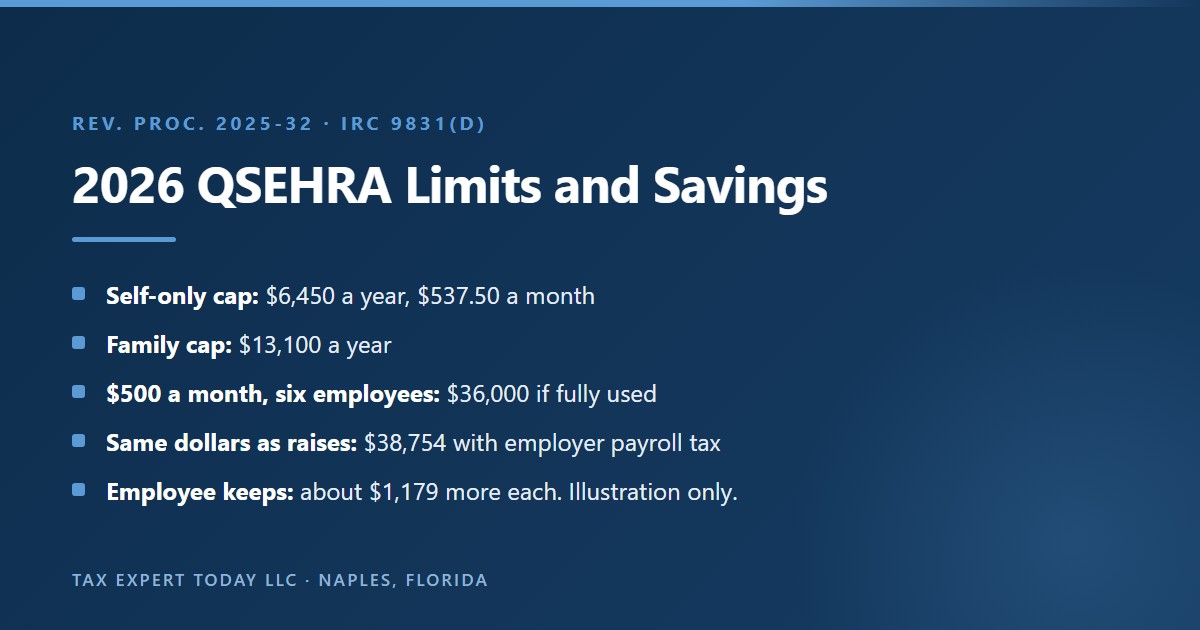
What should an owner model before adopting a QSEHRA?
Before adopting a QSEHRA, an owner should confirm eligible employer status, list who is and is not an eligible employee, compare the payroll tax saving with a raise, test the premium tax credit effect on lower-income employees and families, check the owner’s own deduction position, and fix the notice calendar for the plan year.
- Eligibility: applicable large employer count and any other group plan.
- Workforce: who is excluded, who has family coverage, who uses Marketplace credits.
- Economics: claim rates, administrator fees, and the payroll tax saving.
- Owner position: entity type, spouse employment, and section 162(l).
The checklist below follows the order in which problems usually appear, and each step points back to IRC section 9831(d) or the guidance under it. Eligibility questions come first because a failure there turns the arrangement into a group health plan. Workforce and premium tax credit questions come next because they decide whether employees actually value the benefit. The owner’s own position comes last only because it is the easiest to forget, not because it matters least. A fractional CFO or outside tax advisor often runs this model as part of an annual benefits and compensation review.
| Step | Question to answer | Where the rule is |
|---|---|---|
| 1 | Fewer than 50 full-time and equivalent employees last year, counting related businesses? | IRC 4980H(c)(2); 9831(d)(3)(B)(i) |
| 2 | Any group health, dental, vision, or FSA plan offered, or old HRA balances still accessible? | IRC 9831(d)(3)(B)(ii); Notice 2017-67, Q&A-2 |
| 3 | Which exclusions will the plan use, and who is left as an eligible employee? | IRC 9831(d)(3)(A) |
| 4 | What permitted benefit, self-only and family, and will it vary by age? | IRC 9831(d)(2)(B)(iii) and (C) |
| 5 | Premiums only, or all medical care, given any HSA users? | Notice 2017-67, Q&A-75 to Q&A-77 |
| 6 | Which employees or families lose more credit than the QSEHRA pays? | IRC 36B(c)(4); Rev. Proc. 2025-25 |
| 7 | What is the payroll tax saving at realistic claim rates, net of fees? | IRC 3121(a)(2)(B); 3306(b)(2)(B) |
| 8 | Can the owner participate, and does a spouse’s QSEHRA block the owner’s deduction? | IRC 1372; 162(l)(2)(B); Notice 2017-67, Q&A-9 |
| 9 | When are the notices due, and who delivers them? | IRC 9831(d)(4); 6652(o) |
| 10 | Is payroll set up to report code FF and keep reimbursements out of wages? | IRC 6051(a)(15); W-2 instructions |
Step 6 is the one most often skipped, and the rule behind it is IRC section 36B(c)(4), because the employer cannot see employees’ household income. The usual approach is to give employees enough information in the notice, and in plain conversation, to check their own Marketplace position before the plan year starts, and to set the benefit at a level that is clearly worth more than the credit for the typical employee. Where the workforce includes many lower-income families, the individual coverage HRA’s opt-out may be a better fit, which is a judgment for the owner after a full comparison.
What are common QSEHRA mistakes?
Common QSEHRA mistakes include paying a flat health stipend without substantiation, keeping a dental or vision group plan, giving managers a richer benefit, including the S corporation owner or the owner’s attributed family, missing the 90-day notice, reporting the amount used instead of the permitted benefit in code FF, and cashing out unused amounts at year end.
- Design errors: unequal terms, parallel group plans, owner participation.
- Operating errors: no proof of coverage, no substantiation, cash-outs.
- Reporting errors: wrong or missing code FF, reimbursements in Box 1.
- Timing errors: late notices, reimbursing expenses from before eligibility.
| Mistake | Likely consequence | Reference |
|---|---|---|
| Flat monthly payment regardless of expenses | All payments are taxable wages for all employees | Notice 2017-67, Q&A-73 |
| Keeping a group dental or vision plan | Employer is not eligible; arrangement is a group health plan | IRC 9831(d)(3)(B)(ii) |
| Higher benefit for managers | Fails the same terms requirement | IRC 9831(d)(2)(A)(ii) |
| Reimbursing a more than 2 percent S corporation shareholder through the QSEHRA | Owner is not an eligible employee | Notice 2017-67, Q&A-9; IRC 1372 |
| Late or missing notice | $50 per employee, up to $2,500 a year | IRC 6652(o) |
| Code FF shows the amount used | Employees’ credit reconciled on the wrong figure | Notice 2017-67, Q&A-57 |
| Year-end cash-out of unused amounts | All payments for the year become taxable wages | Notice 2017-67, Q&A-46 |
| Reimbursing expenses incurred before eligibility | Not permitted | Notice 2017-67, Q&A-52 |
| Requiring employees to meet a deductible first | Not permitted | Notice 2017-67, Q&A-51 |
Several of these mistakes come from treating a QSEHRA as a payroll item rather than a benefit plan, and the W-2 instructions assume the plan is set up as a benefit. A QSEHRA has a plan document, an eligibility rule, a claims process, and an annual reporting cycle, even when a business has only three employees. Owners who have used an accountable plan will recognize the pattern: the tax result depends on running the arrangement the way the written rules say, every time, for everyone.
Another recurring problem is the endorsement of a particular insurance policy. The eligible employer section of Notice 2017-67 warns that if an employer endorses a particular policy, form, or issuer of individual health insurance, the coverage may itself become a group health plan. Giving employees general information about the Marketplace or the premium tax credit is not an endorsement. Steering everyone to one carrier’s product can be.
QSEHRA Help in Naples & Southwest Florida
Tax Expert Today LLC, based in Naples, Florida, helps small business owners decide whether a QSEHRA fits their workforce, models the payroll tax and premium tax credit effects, coordinates the owner’s own health insurance deduction, and checks the plan’s W-2 reporting, alongside each client’s benefits administrator and insurance agent.
- QSEHRA help Naples: a side-by-side model of a QSEHRA, an individual coverage HRA, a group plan, and a raise.
- Owner position: entity type, spouse employment, and the self-employed health insurance deduction.
- Payroll reporting: code FF and reimbursements kept out of wages.
- Annual review: the applicable large employer count and the notice calendar.
Southwest Florida’s economy runs on small employers: medical and dental practices, contractors, restaurants, property managers, marine businesses, and professional firms, many with fewer than 50 employees and many with no group plan. Because Florida has no personal income tax, a point covered in our Florida tax services overview, the employee side of the QSEHRA comparison is purely federal, which makes the payroll tax and premium tax credit arithmetic in this guide unusually close to the real answer for a Florida workforce. Businesses in Naples, Bonita Springs, Fort Myers, Estero, and Marco Island face the same decision as any small employer, with the added factor that many of their employees buy coverage through the Marketplace. The firm’s Naples tax planning practice and its business consulting services handle these reviews, typically in the fall, when the next year’s limits are published and the 90-day notice window is approaching.
Tax Expert Today LLC
11983 Tamiami Trail N, Naples FL 34110
Phone: (239) 441-2005
Hours: Monday to Friday, 10:00 to 5:00 ET
Where can I get help with a QSEHRA in Naples, FL? Tax Expert Today LLC, at 11983 Tamiami Trail N in Naples, Florida, helps small business owners confirm QSEHRA eligibility, compare it with an individual coverage HRA, a group plan, and taxable wages, model the premium tax credit effect on employees, coordinate the owner’s own premium arrangement and deduction, and review W-2 code FF reporting. The firm includes tax advisors, enrolled agents, CPAs, and attorneys, and serves clients in all 50 states. Results depend on each business’s facts.
| Item | Why it helps |
|---|---|
| Prior-year payroll register with hours by employee | Supports the applicable large employer count |
| List of any current group, dental, vision, FSA, or HRA plans | Shows whether the employer is eligible |
| Employee census with ages and coverage tier | Needed to set and test the permitted benefit |
| Entity documents and ownership percentages | Determines whether owners and relatives can participate |
| Owner’s current health insurance arrangement | Coordinates the owner’s premium and deduction |
| Prior W-2s and payroll benefit setup | Confirms code FF and wage reporting |
When to Engage a Professional
A QSEHRA looks simple, but its value depends on the owner’s entity, the workforce’s income and family size, and the premium tax credit rules for the year. A professional review is worthwhile before adopting one, before changing the benefit amount, when the business approaches 50 employees, and whenever the owner’s own coverage changes.
- Before adoption, to confirm eligibility and model the employee credit effect.
- Before each plan year, to set the benefit and deliver notices on time.
- When the workforce grows, to watch the applicable large employer count.
- When the entity changes, because an S election changes the owner’s position.
- When a spouse’s job changes, because of the section 162(l) rule.
- When an IRS letter arrives, about W-2 reporting or an excise tax; see our IRS audit help page.
Tax Expert Today LLC is a multidisciplinary practice of tax advisors, enrolled agents, certified public accountants, and attorneys serving clients in all 50 states. To discuss how a QSEHRA fits into a small business benefits and compensation plan, contact our Naples, Florida tax planning team, review our tax planning services and business consulting services, or call (239) 441-2005. Owners may also find our guides to the self-employed health insurance deduction, the accountable plan, S corporation reasonable compensation, the safe harbor 401(k), and what a fractional CFO does useful.
This article is general information about federal tax provisions affecting qualified small employer health reimbursement arrangements and is not tax, legal, insurance, or benefits advice for any specific business or person. It does not recommend any plan design, administrator, insurer, or insurance product. Statutory and regulatory references were checked against the text of IRC sections 36B, 105, 106, 162, 213, 223, 318, 1372, 3121, 3306, 4980D, 4980H, 5000A, 6051, 6652, and 9831, Treasury Regulation sections 1.36B-2, 1.105-11, and 54.9802-4, IRS Notice 2017-67, Rev. Proc. 2024-40, Rev. Proc. 2025-25, Rev. Proc. 2025-32, the 2026 General Instructions for Forms W-2 and W-3, IRS Publication 502, and the HealthCare.gov federal poverty level table on November 3, 2026. The premium tax credit discussion reflects the statute as published on that date; Congress has changed that rule before, so confirm the current rule before acting. All dollar examples, including wages, headcounts, claim rates, household incomes, benchmark premiums, permitted benefits, and tax rates, are hypothetical illustrations, not client outcomes and not predictions for any business or person. Tax laws apply differently to each person’s facts. Consult a qualified professional about your situation before taking any action.
Published November 3, 2026 by Dr. Pellumb Kabashi « Back to Learning Center
Have a question this article touches on?
Tax Expert Today LLC, based in Naples, Florida and serving clients across the United States.
Schedule a Consultation (239) 441-2005