
By Dr. Pellumb Kabashi, DBA, MBA, CES, CFE, EA
Founder, Tax Expert Today LLC · Tax advisors, enrolled agents, CPAs, and attorneys · Serving clients in all 50 states
Quick Answer: The Augusta Rule is the common name for IRC 280A(g), which allows an owner to rent a personal residence for fewer than 15 days in a tax year and exclude that rental income from gross income. A business owner may rent a home to a company the owner controls, deduct the rent under IRC 162, and exclude the same rent personally, provided the rate is defensible and the use is genuinely business related.
What Is the Augusta Rule?
The Augusta Rule is the practitioner nickname for IRC 280A(g). The statute says that if a dwelling unit is used by the taxpayer as a residence and is actually rented for fewer than 15 days during the tax year, no deduction attributable to that rental use is allowed, and the income from that use is not included in gross income under IRC 61. The rent is simply invisible on the owner’s return.
The nickname comes from Augusta, Georgia, where homeowners rent their houses to visitors during the Masters golf tournament each spring. Congress added the provision in 1976 so that a homeowner who rents out a residence for a handful of days each year is not pushed into the full residential rental regime, with its allocations, depreciation schedules, and passive activity tracking, over a trivial amount of activity.
What made the provision interesting to business owners is that the statute does not care who the tenant is. If a company the owner controls has a genuine business reason to use the residence, and the company pays a defensible rent for fewer than 15 days, the company may claim an ordinary and necessary business expense deduction under IRC 162 while the owner excludes the same dollars personally. That is the planning idea, and it is legitimate when the facts support it.
How Does the Augusta Rule Work Under IRC 280A(g)?
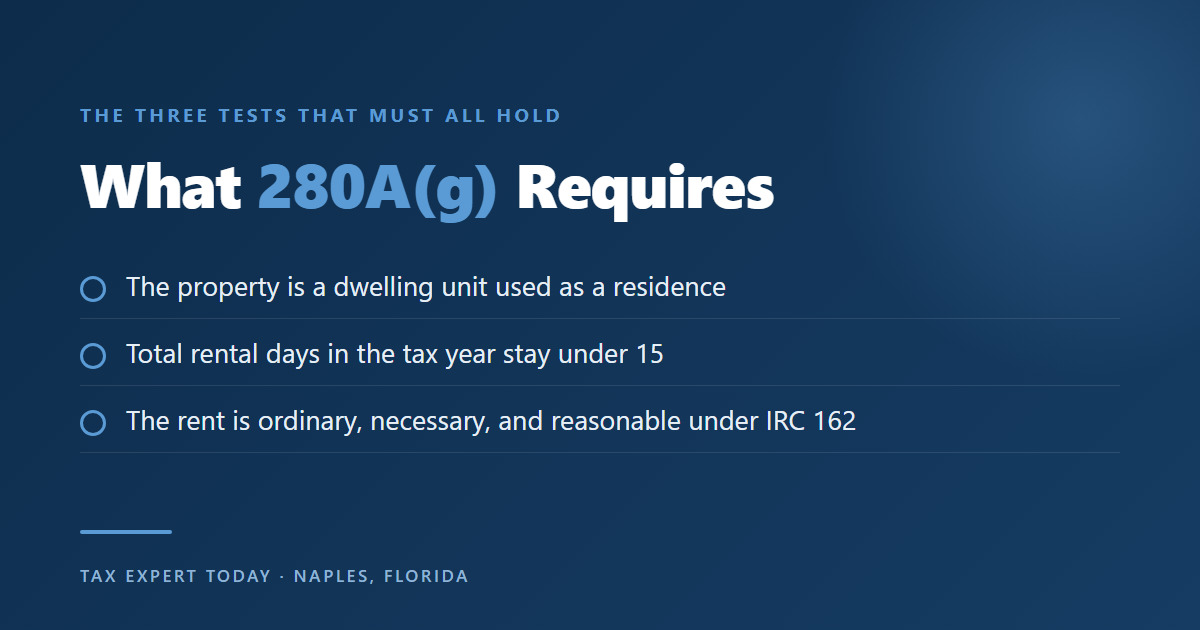
The mechanics rest on three separate tests that must all hold. First, the property must be a dwelling unit the taxpayer uses as a residence. Second, the total days actually rented during the tax year must be fewer than 15. Third, the rent the business deducts must independently satisfy IRC 162, meaning it must be ordinary, necessary, and reasonable in amount for the business purpose served.
The 14-day count is a hard ceiling, not a safe harbor with rounding. Renting for a fifteenth day does not cost the taxpayer one day of exclusion. It moves the entire arrangement out of 280A(g) and into the ordinary rental rules described in IRS Publication 527, where all of the rent becomes reportable income and expense allocations apply. The count is per dwelling unit per tax year, and it includes every rental day, not only the days rented to the owner’s own business.
The two sides of the transaction are also tested separately. The exclusion on the personal side is governed by 280A(g) and turns almost entirely on the day count. The deduction on the business side is governed by IRC 162 and turns on business purpose and reasonableness. A taxpayer can win the first test and lose the second, which is precisely what happened in the leading Tax Court case discussed below.
Who Can Use the Augusta Rule?
The strategy generally fits an owner who has a separate taxable entity, typically an S corporation, C corporation, or partnership, that can pay rent to the owner as a third party would. The entity takes the deduction, the owner excludes the receipt, and the two are separate taxpayers for this purpose. Facts vary, so eligibility should be confirmed before any payment is made.
A sole proprietor filing Schedule C is generally the poor fit. A sole proprietorship is not a separate taxpayer from its owner, so there is no arm’s length payment to make. Paying rent to yourself produces a deduction and an offsetting item on the same return, and the home office rules of IRC 280A(c) are the intended path for that fact pattern instead. Single-member LLCs treated as disregarded entities sit in the same position unless an entity election changes the analysis.
The arrangement also assumes the residence is genuinely suitable for the business use claimed. A company that holds quarterly strategy sessions, a board meeting, an annual planning retreat, a client appreciation event, or a recorded content day may have a real reason to use a large home rather than a hotel conference room. A company with no meeting cadence at all, that suddenly documents fourteen meetings in December, is describing a tax result rather than a business practice.
How Much Can You Charge Under the Augusta Rule?
The rate must be what an unrelated party would pay for comparable space in the same market on the same date. The accepted substantiation method is to gather written quotes from hotels, conference centers, event venues, or short-term rental listings that could host the same function, keep the quotes in the file, and set the daily rate inside that range rather than at the top of it.
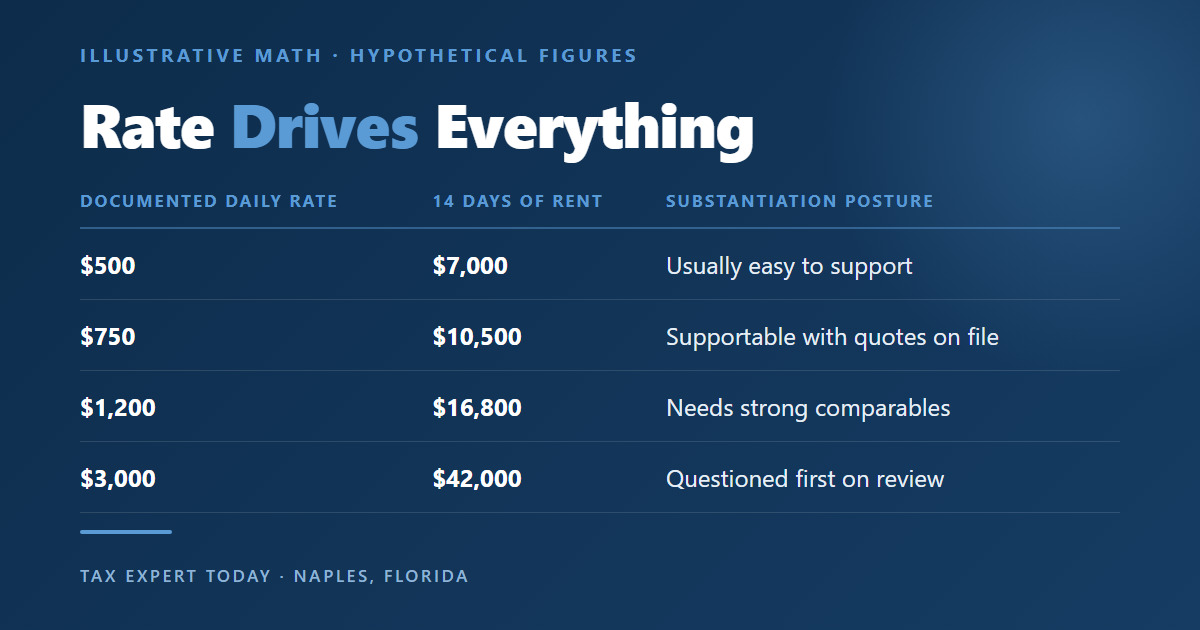
The table below illustrates the arithmetic at several documented daily rates. The figures are hypothetical and are shown only to demonstrate how the calculation works. Actual results depend on the taxpayer’s entity type, marginal rates, state tax posture, and the strength of the comparable-rate file.
| Documented daily rate | Days rented | Rent paid by the business | Illustrative federal benefit at a 32% effective rate | Substantiation posture |
|---|---|---|---|---|
| $500 | 14 | $7,000 | $2,240 | Usually easy to support with local venue quotes |
| $750 | 14 | $10,500 | $3,360 | Supportable in most metropolitan markets with quotes on file |
| $1,200 | 14 | $16,800 | $5,376 | Requires strong comparables, such as a full event-venue buyout |
| $3,000 | 14 | $42,000 | $13,440 | Difficult to defend absent unusual facts, and the range examiners question first |
Two points about the table deserve emphasis. The benefit is a function of the rate, so the temptation is always to push the rate up, and the rate is exactly the element the IRS examines. A modest, well-documented number that survives review is worth more than an aggressive number that is reduced on audit and carries penalty exposure with it.
What Documentation Does the Augusta Rule Require?
Documentation is the whole ballgame. The statute gives the exclusion automatically once the day count holds, so an examination almost never argues about 280A(g) itself. It argues about whether the business meeting happened, whether the rent was reasonable, and whether the payment was a genuine rent rather than a disguised distribution to the owner.
| Item | What it should show | Why an examiner asks for it |
|---|---|---|
| Written rental agreement | Parties, specific dates, daily rate, description of the space and purpose | Establishes that a rental, rather than a distribution, occurred |
| Comparable-rate file | Dated quotes or listings from venues that could host the same function | Supports the IRC 162 reasonableness of the amount |
| Meeting minutes or agenda | Date, attendees, topics covered, decisions made | Establishes a genuine business purpose for each day claimed |
| Proof of payment | Company check or transfer to the owner, dated near the use | Shows the transaction was actually carried out, not merely journaled |
| Day count log | Every rental day of the residence in the tax year, all tenants included | Proves the fewer-than-15-days condition of 280A(g) |
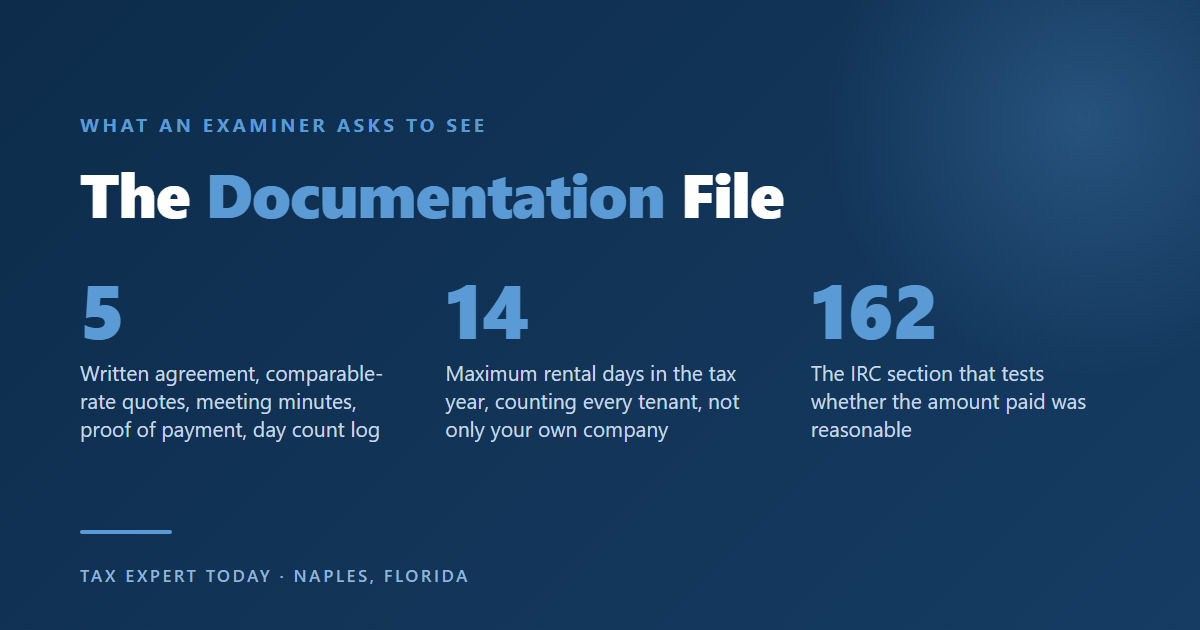
A practical standard is to ask whether the file would persuade a reader who assumes the arrangement is a tax maneuver. Contemporaneous minutes carry far more weight than minutes reconstructed at filing time, and a single year-end journal entry moving money with no supporting agreement is the weakest possible position.
What Breaks the Augusta Rule?
The leading authority is Sinopoli v. Commissioner, T.C. Memo. 2023-105. An S corporation deducted a large amount of rent over three years for meetings held at the shareholders’ homes. The Tax Court did not reject the Augusta Rule concept. It examined the rate, found the amounts far above what comparable space commanded, and allowed only the portion supported by local comparables while disallowing the rest, treating the excess as a distribution of earnings dressed up as rent.
That outcome maps onto the recurring failure modes. Charging a rate no comparable supports is the first. Claiming days on which nothing identifiable as a business meeting occurred is the second. Crossing the fourteen-day ceiling, including days rented to unrelated parties, is the third. Deducting rent for space that a home office deduction under IRC 280A(c) already covers, or for routine daily work rather than a discrete event, is the fourth.
Two structural mistakes also appear often. Using the strategy inside a sole proprietorship, where no separate payer exists, does not work. Documenting the rent as a fixed monthly figure that happens to be paid twelve or fourteen times is another, because the pattern reads as compensation or distribution rather than as event-based rent, and a pattern of payments that tracks the owner’s cash needs rather than the company’s meeting calendar invites exactly that characterization.
Does the Business Issue a Form 1099 for Augusta Rule Rent?
Generally the paying business follows the normal information reporting rules for rents, because 280A(g) changes how the recipient treats the income and does not exempt the payer from reporting. For tax years beginning after 2025, the Instructions for Forms 1099-MISC and 1099-NEC set the reporting threshold for rents in box 1 at $2,000, raised from the long-standing $600 figure by Public Law 119-21 and subject to inflation adjustment beginning in calendar year 2027.
That change matters here because most Augusta Rule arrangements land above the threshold either way, but the older $600 figure is still repeated across the internet and in stale software defaults. Confirm the current-year threshold before concluding that no filing is required.
When a Form 1099-MISC is issued, the IRS receives a matching document showing rent paid to the owner, so the owner’s return needs to account for it even though the income is excluded. Practitioners commonly report the gross rent and then show an offsetting entry that identifies the 280A(g) exclusion, so the matching program reconciles rather than generating an automated notice. The presentation should be handled by the preparer who signs the return, since the mechanics vary with the entity structure and the software.
How Does the Augusta Rule Fit With Other Planning?
The Augusta Rule is a modest, precise tool rather than a foundation. Fourteen days at a defensible rate produces a real but bounded deduction, and it works best as one item inside a coordinated plan rather than as the plan itself. Owners who are looking for larger structural deductions generally get further with retirement plan design, such as the cash balance plan approach, entity and compensation structuring, or depreciation planning on business real estate, including a cost segregation study on an owned building. Owners who hold a rental rather than an operating building sometimes reach further still through the short term rental tax loophole, which turns on the same Section 280A statute read from the opposite direction.
It also pairs naturally with the operating discipline a company already needs. A business that runs a real quarterly planning cadence, keeps minutes, and reviews its numbers on a schedule has the documentation for this strategy as a byproduct. That is one reason the strategy tends to be cleaner in companies with structured financial oversight, whether internal or through outside CFO-level support, than in companies where the meeting record is assembled after the fact.
Coordination matters in the other direction as well. Rent paid to an owner reduces the entity’s income, which can affect reasonable compensation analysis in an S corporation, qualified business income calculations, retirement plan contribution capacity that is tied to compensation, and state level filings. Those interactions should be modeled together as part of a broader tax planning engagement rather than evaluated in isolation.
Augusta Rule Planning Help in Naples and Southwest Florida
Tax Expert Today LLC advises business owners on the Augusta Rule and related owner-level planning from an office at 11983 Tamiami Trail N, Naples, FL 34110. The firm is multidisciplinary, with tax advisors, enrolled agents, CPAs, and attorneys, and it works with clients across Naples, Bonita Springs, Estero, Fort Myers, Marco Island, and the wider Southwest Florida market as well as all 50 states. Engagements typically cover entity and compensation structure, documentation standards, and the interaction between owner-level strategies and the company’s overall position. Reach the office at (239) 441-2005, Monday through Friday, 10am to 5pm ET, or review the firm’s Naples tax planning overview.
When to Engage a Professional
Professional involvement is worth considering before the first rental day rather than after the return is filed. The elements that decide the outcome, meaning the comparable-rate file, the meeting record, the written agreement, and the day count, are created during the year and cannot be manufactured convincingly later. A preparer who receives a year-end journal entry and nothing else has very little to work with.
Situations that warrant a closer look include an entity structure that has not been confirmed as workable for this strategy, a proposed daily rate that no local venue quote supports, a residence that is also rented to unrelated parties during the year, an existing home office deduction that may overlap, and any arrangement carried over from a prior adviser without a documentation file behind it. Whether a given arrangement holds up depends on the specific facts and on IRS review, and this article is educational rather than advice on any particular situation. To discuss a specific set of facts, contact Tax Expert Today LLC at (239) 441-2005 or review the firm’s business advisory services.
Augusta Rule FAQ
Is the Augusta Rule legal?
Yes. The Augusta Rule is IRC 280A(g), a statutory provision enacted in 1976 and still in force. The exclusion applies when a dwelling unit used as a residence is rented for fewer than 15 days in the tax year. What draws IRS challenge is not the provision itself but unreasonable rental rates and undocumented business purpose, both of which are tested under IRC 162 on the paying entity’s side.
Can a sole proprietor use the Augusta Rule?
Generally no. A sole proprietorship is not a separate taxpayer from its owner, so there is no arm’s length party to pay the rent and no meaningful deduction to claim. Owners in that position typically look to the home office rules under IRC 280A(c) instead. An entity election or restructuring may change the analysis, and that decision should be evaluated on its own merits.
What happens if the home is rented for 15 days or more?
The 280A(g) exclusion is lost entirely, not reduced proportionally. All of the rental income becomes reportable, the residential rental rules described in IRS Publication 527 apply, and expense allocation between personal and rental use becomes necessary. The day count includes every rental day of the residence in the tax year, including days rented to parties unrelated to the business.
How does the IRS decide whether the rental rate is reasonable?
Examiners compare the claimed daily rate to what comparable space in the same market would command for the same type of function, using hotel meeting rooms, conference centers, event venues, and short-term rental listings as reference points. In Sinopoli v. Commissioner, the Tax Court accepted only the portion of the claimed rent that local comparables supported and disallowed the excess.
Where can I get help with the Augusta Rule in Naples, FL?
Tax Expert Today LLC advises Southwest Florida business owners on the Augusta Rule and owner-level tax planning from 11983 Tamiami Trail N, Naples, FL 34110. The firm includes tax advisors, enrolled agents, CPAs, and attorneys, serves clients in Naples and across all 50 states, and can be reached at (239) 441-2005 Monday through Friday, 10am to 5pm ET.
Published July 19, 2026 by Dr. Pellumb Kabashi « Back to Learning Center
Have a question this article touches on?
Tax Expert Today LLC, based in Naples, Florida and serving clients across the United States.
Schedule a Consultation (239) 441-2005