
By Dr. Pellumb Kabashi, DBA, MBA, CES, CFE, EA
Founder, Tax Expert Today LLC · Tax advisors, enrolled agents, CPAs, and attorneys · Serving clients in all 50 states
Quick Answer
An accountable plan is a reimbursement arrangement under IRC section 62(c) and Regulation 1.62-2 that lets an S corporation pay its owner-employee back, tax free, for business costs such as a home office, mileage, and a phone. It must require a business connection, timely substantiation, and the return of any excess. Call (239) 441-2005 for a free consultation.
What is an accountable plan?
An accountable plan is an employer’s written or established arrangement for advancing or reimbursing business expenses that meets three tests in Regulation 1.62-2: the expense has a business connection, the employee substantiates it within a reasonable period, and any excess is returned. Payments that meet the tests are not wages and are not taxed.
- It is an employer arrangement. It exists only where there is an employer and an employee.
- It covers business costs the employee pays first. Home office, car, phone, travel, supplies.
- It changes the character of the payment. A qualifying reimbursement is not income at all.
- It is a set of rules, not a form. Nothing is filed with the IRS to create one.
The phrase comes from the regulations rather than the statute. IRC section 62(a)(2)(A) allows an employee to deduct business expenses paid “under a reimbursement or other expense allowance arrangement” with the employer, and section 62(c) says an arrangement does not count if it fails to require the employee to substantiate the expenses or lets the employee keep any amount in excess of what was substantiated. Regulation 1.62-2(c)(2) then gives the name: an arrangement that satisfies the business connection, substantiation, and return-of-excess rules is an “accountable plan,” and an arrangement that misses any one of them is a “nonaccountable plan.”
In practice the two halves cancel out. The reimbursement is excluded from the employee’s income, and the employee claims no deduction for the expense, so nothing appears on the employee’s individual return. The employer deducts the expense as its own business expense. That clean result is the entire point, and it matters most for one group of taxpayers: owners of S corporations who are also on the corporation’s payroll.
| Requirement | Where it is in the regulation | What the plan must do | What happens if it is missing |
|---|---|---|---|
| Business connection | Reg. 1.62-2(d) | Pay only for deductible business expenses the employee incurs in performing services | The arrangement, or the part that covers nondeductible items, is nonaccountable |
| Substantiation | Reg. 1.62-2(e) | Require each expense to be documented to the employer within a reasonable period | Unsubstantiated amounts are treated as wages |
| Return of excess | Reg. 1.62-2(f) | Require any advance or allowance above substantiated expenses to be returned within a reasonable period | The unreturned excess is treated as wages |
| Reasonable period | Reg. 1.62-2(g) | Use a timeline, with two optional safe harbors (fixed date and periodic statement) | Late items may fall outside the plan |
| No pattern of abuse | Reg. 1.62-2(k) | Operate the plan as written, year after year | All payments under the arrangement are treated as nonaccountable |
Why does an accountable plan matter so much for S corporation owners?
An S corporation owner who works in the business is usually an employee for tax purposes, and employees can no longer deduct unreimbursed business expenses on their own return. Section 67(h), made permanent in 2025, closed that door. An accountable plan is the remaining route for the owner’s home office, car, and phone costs to become deductible.
- Owner-employees draw a salary. The reasonable compensation rule puts the owner on the W-2 payroll.
- Employee expenses are miscellaneous itemized deductions. Those are disallowed for every year after 2017.
- The disallowance no longer expires. Pub. L. 119-21 removed the end date that had been set for 2025.
- Reimbursement moves the deduction to the corporation. The corporation can deduct what the owner cannot.
A sole proprietor deducts a home office, vehicle costs, and a phone directly on Schedule C, as Publication 587 describes. An S corporation owner cannot, because the business belongs to the corporation and the owner, in the role that generates those costs, is the corporation’s employee. The owner who pays for the corporation’s business costs out of a personal account is paying an employer’s bills as an employee, and until 2017 the remedy was a miscellaneous itemized deduction on Schedule A for unreimbursed employee business expenses, subject to the 2 percent of adjusted gross income floor.
The 2017 tax act suspended miscellaneous itemized deductions in section 67 for 2018 through 2025. The 2025 legislation, Public Law 119-21, did not let that suspension lapse. According to the editorial notes to IRC section 67, section 70110 of that law struck the 2026 end date and redesignated the rule as section 67(h), which now reads that no miscellaneous itemized deduction “shall be allowed for any taxable year beginning after December 31, 2017.” The new section 67(b)(13) carved out educator expenses, which does not help a business owner. For an S corporation owner, the unreimbursed employee expense deduction is therefore gone for good, and the accountable plan is no longer a timing convenience. It is the mechanism that decides whether these costs are deductible at all.
The same reasoning is why an accountable plan sits next to reasonable compensation in almost every S corporation planning conversation. Our guide to S corp reasonable compensation explains why the owner must be on payroll in the first place; the accountable plan is what keeps the owner’s business costs from being trapped by that employee status.
| Tax years | Unreimbursed employee expenses | Reimbursed under an accountable plan | Practical result for an S corporation owner |
|---|---|---|---|
| Before 2018 | Miscellaneous itemized deduction above 2 percent of AGI, if itemizing | Excluded from income, deducted by the corporation | Partial benefit without a plan, full benefit with one |
| 2018 through 2025 | Not deductible (section 67(g), temporary) | Excluded from income, deducted by the corporation | No benefit without a plan |
| 2026 and later | Not deductible (section 67(h), permanent after Pub. L. 119-21) | Excluded from income, deducted by the corporation | No benefit without a plan, and no scheduled change |
What are the three requirements of an accountable plan?
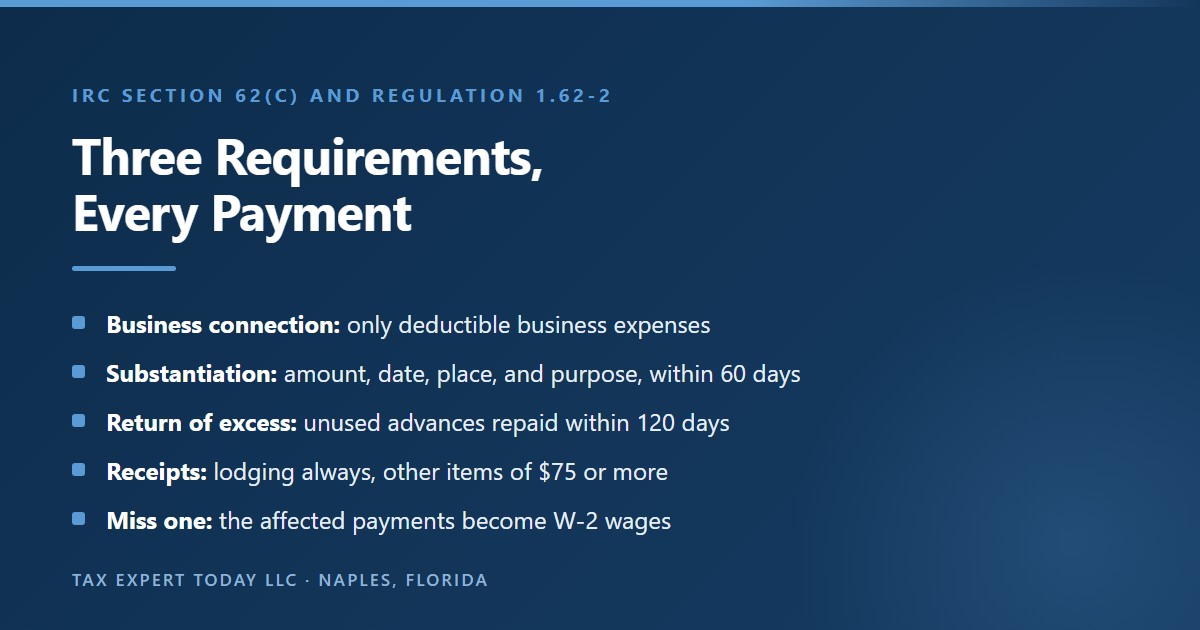
The three requirements are a business connection, adequate substantiation, and the return of any excess amount. Regulation 1.62-2(c)(1) defines a reimbursement arrangement as one that meets all three, and a plan that misses any one of them is nonaccountable. Each test is applied to how the plan actually operates, not only to what the document says.
- Business connection. Only deductible business expenses incurred while performing services as an employee.
- Substantiation. Each expense documented to the employer, with the detail the law requires for its type.
- Return of excess. Advances or allowances above documented costs repaid within a reasonable period.
- All three, every time. Passing two of three is a nonaccountable plan for the affected payments.
The three tests are drawn directly from the statute. Section 62(c)(1) disqualifies an arrangement that “does not require the employee to substantiate the expenses,” and section 62(c)(2) disqualifies one that “provides the employee the right to retain any amount in excess of the substantiated expenses.” The business connection requirement comes from section 62(a)(2)(A) itself, which only reaches expenses the employee incurs “in connection with the performance of services as an employee.” Regulation 1.62-2 turns those three phrases into paragraphs (d), (e), and (f), and then adds the timing rules in paragraph (g) and the anti-abuse rule in paragraph (k).
One sentence in Regulation 1.62-2(c)(3)(i) surprises many owners: if a payor provides a nonaccountable plan, “an employee who receives payments under the plan cannot compel the payor to treat the payments as paid under an accountable plan by voluntarily substantiating the expenses and returning any excess.” In other words, the design of the arrangement controls. Producing receipts after the fact does not convert a monthly allowance that never required them.
What does the business connection requirement mean?
The business connection requirement means the plan may only pay for expenses that would be deductible business expenses under the Code and that the employee pays or incurs while performing services for the employer. A reimbursement for a personal cost, such as commuting, fails the test, and the payments for that cost are treated as wages.
- Deductible type. The expense must be allowable under part VI of the Code, chiefly section 162.
- Incurred as an employee. It must arise from the employee’s work for this employer.
- Real expense required. Paying an amount regardless of whether an expense occurs fails the test.
- Separate treatment for bad items. Nondeductible items become a second, nonaccountable arrangement.
Regulation 1.62-2(d)(1) says an arrangement meets the requirement if it provides advances, allowances, or reimbursements “only for business expenses that are allowable as deductions by part VI” of subchapter B, which begins with section 161 and includes the ordinary and necessary expense rule of IRC section 162(a). The practical consequence is that every limitation that would apply to the expense if the employee deducted it directly still applies when the employer reimburses it. A home office reimbursement must satisfy the home office rules of section 280A. A meal reimbursement is a meal for purposes of the section 274 limits at the employer level. A commute between home and a regular office is personal and cannot be made deductible by running it through the plan.
Paragraph (d)(2) deals with plans that cover some deductible and some nondeductible items. The payments for nondeductible items are treated “as a second arrangement that does not satisfy this paragraph (d),” and those amounts are treated as paid under a nonaccountable plan. Paragraph (d)(3) is the provision that defeats a flat allowance: if a payor “arranges to pay an amount to an employee regardless of whether the employee incurs (or is reasonably expected to incur) business expenses,” the whole arrangement fails and every payment is nonaccountable.
| Expense the owner pays personally | Business connection? | Rule that usually decides it |
|---|---|---|
| Dedicated home office used regularly and exclusively for the business | Usually yes, if the section 280A tests are met | IRC 280A(c)(1); Pub. 587 |
| Driving from the office to a client site | Yes | IRC 162(a); Pub. 463, chapter 4 |
| Driving from home to a regular office | No, commuting is personal | Pub. 463, chapter 4 |
| Business share of a personal cell phone plan | Yes, for the documented business share | IRC 162(a) |
| Airfare and lodging for an out-of-town conference | Yes, if the trip is primarily for business | IRC 162(a)(2); IRC 274(d) |
| Gym membership, personal clothing, family meals | No | IRC 262 (personal expenses) |
| Business meal with a client | Yes, with a 50 percent limit at the corporate level | IRC 274(k) and 274(n) |
What does adequate substantiation require?
Adequate substantiation means the employee gives the employer enough information to show the amount, the date, the place, and the business purpose of each expense. Travel, vehicle, and gift expenses must meet the stricter section 274(d) standard, while other expenses need enough detail to identify their business character. Lumping costs into vague categories does not qualify.
- Amount. What was spent, ideally from a receipt or statement.
- Time. The date or dates of the expense or the trip.
- Place. Where the travel or business use happened.
- Business purpose. Why the cost served the employer’s business.
Regulation 1.62-2(e)(2) applies to travel, use of a passenger automobile or other listed property, and other expenses governed by IRC section 274(d). For those, the employee must submit “information sufficient to satisfy the substantiation requirements of section 274(d),” which is the standard set out in Regulation 1.274-5: the amount, time, place, and business purpose of each expenditure or use. Regulation 1.62-2(e)(3) covers everything else, such as a home office, supplies, or a phone. For those, the employee must give enough information for the employer to identify “the specific nature of each expense” and conclude it is a business expense. The regulation adds that it is not sufficient to aggregate expenses “into broad categories (such as ‘travel’)” or to report them with vague terms such as “miscellaneous business expenses.”
| Expense type | Standard | What the owner should hand the corporation |
|---|---|---|
| Business mileage in a personal car | Section 274(d) | A log with date, destination, business purpose, and miles for each trip |
| Travel away from home | Section 274(d) | Dates of departure and return, destination, purpose, lodging receipts, and receipts for items of $75 or more |
| Business meals | Section 274(d) for travel meals; general standard otherwise | Receipt, date, place, attendees, and business discussed |
| Home office | General standard | Square footage measurement, list of home costs with statements, and the business percentage |
| Phone and internet | General standard | Monthly bills and a reasonable basis for the business percentage |
| Supplies, software, small equipment | General standard | Receipts or invoices with a description of the business use |
What is the $75 receipt rule?
The $75 receipt rule is the part of Regulation 1.274-5(c)(2)(iii) that requires documentary evidence, such as a receipt or paid bill, for any lodging while traveling and for any other covered expenditure of $75 or more. Below $75, a contemporaneous record of amount, date, place, and purpose can be enough, except that lodging always needs a receipt.
- Lodging always needs a receipt. The $75 threshold does not apply to hotel stays.
- $75 or more needs documentary evidence. A receipt, paid bill, or similar record.
- Transportation charges have an exception. Receipts are not required if not readily available.
- A record is still required below $75. The threshold removes the receipt, not the log entry.
The rule reads that documentary evidence “is required for (1) Any expenditure for lodging while traveling away from home, and (2) Any other expenditure of $75 or more except, for transportation charges, documentary evidence will not be required if not readily available.” The regulation also says documentary evidence will ordinarily be considered adequate if it shows “the amount, date, place, and the essential character of the expenditure.” A card statement alone often shows the amount and date but not what was bought or why, which is why most well-run plans ask for the itemized receipt plus a one-line purpose note.
| Item on the expense report | Amount | Receipt required? | Still needs a log entry? |
|---|---|---|---|
| Hotel, two nights | $412 | Yes, lodging always | Yes |
| Hotel, one night at a budget property | $68 | Yes, lodging always | Yes |
| Client dinner | $146 | Yes, $75 or more | Yes, with attendees and purpose |
| Airport parking | $54 | No | Yes |
| Taxi from the airport | $38 | No | Yes |
| Conference registration | $595 | Yes | Yes |
How must excess reimbursements be returned?
Any advance or allowance that exceeds the expenses the employee substantiates must be returned to the employer within a reasonable period. If the employee keeps the excess, only the excess is treated as wages, and the properly substantiated part stays inside the accountable plan, as long as the plan required the return in the first place.
- The plan must require repayment. A plan that lets the employee keep the difference fails section 62(c)(2).
- Only the unreturned amount converts. Regulation 1.62-2(c)(2)(ii) protects the substantiated portion.
- Per diem and mileage allowances have their own rule. Unsubstantiated days or miles must be returned.
- Reimbursement after the fact avoids the issue. No advance means no excess to return.
Regulation 1.62-2(f)(1) says an arrangement meets the requirement if it “requires the employee to return to the payor within a reasonable period of time” any amount paid in excess of substantiated expenses. Paragraph (f)(2) applies the same idea to per diem and mileage allowances: the employee must return the portion of the allowance that relates to days or miles that were not substantiated. The consequence of a missed return is narrower than many summaries suggest. Under Regulation 1.62-2(c)(2)(ii), when an arrangement meets all three requirements but the employee fails to return an excess in time, “only the amounts paid under the arrangement that are not in excess of the substantiated expenses are treated as paid under an accountable plan,” and the excess alone becomes wages.
Most closely held corporations sidestep the issue by never advancing money. The owner pays with a personal card, submits a report, and the corporation reimburses the documented total. There is nothing to return. Advances still make sense for a long trip or a large purchase, and in that case the plan should state how and when unused amounts come back.
| Step | Amount | Treatment under Reg. 1.62-2 |
|---|---|---|
| Corporation advances the owner for a conference trip | $6,000 | Advance under the plan |
| Owner substantiates airfare, lodging, registration, and meals within 60 days | $4,700 | Accountable plan, not wages |
| Excess the owner must return | $1,300 | Must be repaid within a reasonable period |
| If the $1,300 is not returned within 120 days | $1,300 | Treated as wages, subject to withholding and payroll taxes |
| Combined employer and employee payroll tax on the $1,300, below the wage base | About $199 | 15.3 percent, plus income tax on the wages |
What are the 60-day and 120-day safe harbors?
Regulation 1.62-2(g)(2) treats timing as reasonable if an advance is made within 30 days of the expense, the expense is substantiated within 60 days after it is paid or incurred, and any excess is returned within 120 days. A periodic statement method, with statements at least quarterly and 120 days to respond, is the alternative safe harbor.
- Advance within 30 days. Money should go out close to when it will be spent.
- Substantiate within 60 days. The expense report follows the expense, not the year end.
- Return within 120 days. Unused advances come back within four months.
- Or quarterly statements. The employer reports outstanding amounts and allows 120 days to clear them.
The general rule in Regulation 1.62-2(g)(1) is that a reasonable period “will depend on the facts and circumstances.” The safe harbors remove that uncertainty. Under the fixed date method in (g)(2)(i), “an advance made within 30 days of when an expense is paid or incurred, an expense substantiated to the payor within 60 days after it is paid or incurred, or an amount returned to the payor within 120 days after an expense is paid or incurred will be treated as having occurred within a reasonable period of time.” Under the periodic statement method in (g)(2)(ii), the payor sends statements “no less frequently than quarterly” showing any amount paid in excess of substantiated expenses and asks the employee to substantiate or return it “within 120 days of the statement.”
Paragraph (g)(3) takes the safe harbors away from a payor that “has a plan or practice to provide amounts to employees in excess of expenses substantiated” and to avoid reporting and withholding on them. That rule targets exactly the pattern an owner-run corporation can slip into, where reimbursements become a convenient way to move cash out of the company.
| Event | Fixed date method | Periodic statement method |
|---|---|---|
| Advance paid to the employee | Within 30 days of when the expense is paid or incurred | No specific limit stated; the statement process controls |
| Expense substantiated to the employer | Within 60 days after the expense is paid or incurred | Within 120 days of the employer’s statement |
| Excess returned to the employer | Within 120 days after the expense is paid or incurred | Within 120 days of the employer’s statement |
| Employer action required | None beyond tracking dates | Statements at least quarterly listing unsubstantiated amounts |
| Lost if | A pattern of overreimbursement exists (Reg. 1.62-2(g)(3)) | A pattern of overreimbursement exists (Reg. 1.62-2(g)(3)) |
| Expense paid by the owner | Date paid | Substantiate by (60 days) | Return any excess by (120 days) |
|---|---|---|---|
| January home office costs | January 31, 2026 | April 1, 2026 | May 31, 2026 |
| March client trip | March 12, 2026 | May 11, 2026 | July 10, 2026 |
| June mileage (72.5 cents period) | June 30, 2026 | August 29, 2026 | October 28, 2026 |
| September conference | September 15, 2026 | November 14, 2026 | January 13, 2027 |
| December phone bill | December 20, 2026 | February 18, 2027 | April 19, 2027 |
What is the difference between an accountable plan and a nonaccountable plan?
Payments under an accountable plan are not wages, are not reported on Form W-2, and are not subject to income tax withholding or payroll taxes. Payments under a nonaccountable plan are wages: they go in box 1 of Form W-2, carry withholding and Social Security and Medicare tax, and the employee cannot deduct the underlying expenses.
- Accountable. Excluded from income, no W-2 reporting, no payroll tax, employer deducts the expense.
- Nonaccountable. Taxable wages, W-2 reporting, full payroll tax, employer deducts it as wages.
- The employee side is the difference. The employer gets a deduction either way.
- The deduction is gone for the employee. Section 67(h) blocks any offset on the individual return.
Regulation 1.62-2(h)(1) states that amounts paid under an arrangement meeting paragraphs (d), (e), and (f), up to the substantiated expenses, “are not wages and are not subject to withholding and payment of employment taxes.” Paragraph (h)(2) sends everything else to wages. IRS Publication 15 (2026) carries the same rule for employers, and IRS Publication 463 explains the employee side in its chapter on reimbursements.
| Feature | Accountable plan | Nonaccountable plan |
|---|---|---|
| Included in the employee’s income | No | Yes |
| Reported on Form W-2 | No (box 1, 3, and 5 unaffected) | Yes, as wages |
| Federal income tax withholding | No | Yes |
| Social Security and Medicare tax | No | Yes, employer and employee shares |
| Federal unemployment tax | No | Yes, up to the FUTA wage base |
| Employer deduction | As the underlying business expense, subject to limits such as 50 percent for meals | As compensation |
| Employee deduction for the expense | Not needed | None, after section 67(h) |
What happens when an accountable plan fails?
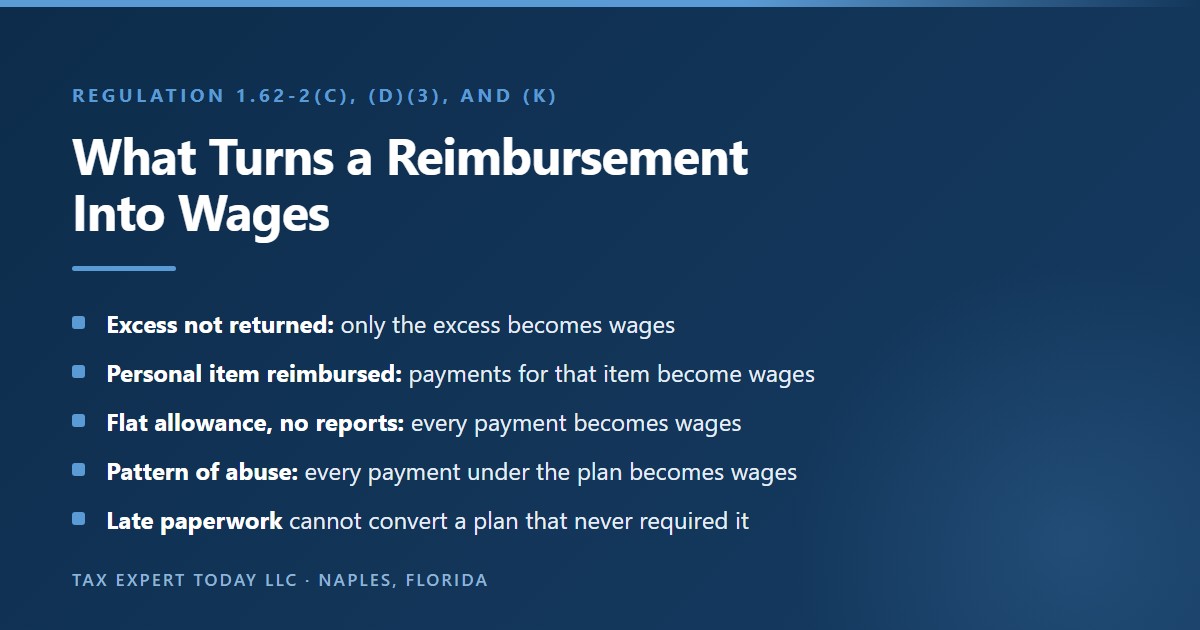
The result depends on which rule fails. An unreturned excess converts only that excess to wages. A reimbursement of a nondeductible item converts the payments for that item. A flat allowance paid regardless of expenses, or a pattern of abuse, converts every payment under the arrangement to wages, with withholding, payroll taxes, and possibly a corrected Form W-2.
- Narrow failure. An unreturned advance affects only the excess amount.
- Item failure. Nondeductible items become a separate nonaccountable arrangement.
- Design failure. No substantiation requirement makes the whole arrangement nonaccountable.
- Operational failure. A pattern of abuse under Reg. 1.62-2(k) taints all payments.
Summaries of the rule often say a failed plan converts everything to wages. That is accurate for some failures and overstated for others, and the difference matters when an examiner reviews three years of reimbursements. The anti-abuse sentence in Regulation 1.62-2(k) is the broadest: “If a payor’s reimbursement or other expense allowance arrangement evidences a pattern of abuse of the rules of section 62(c) and this section, all payments made under the arrangement will be treated as made under a nonaccountable plan.” A corporation that reimburses its owner each December for a round number with no reports behind it is the kind of fact pattern that invites that conclusion.
When reimbursements are recharacterized as wages after the fact, the corporation generally owes, under the employer rules in Publication 15, the employer share of Social Security and Medicare tax, the employee share it should have withheld, and federal unemployment tax, and it may face failure-to-deposit and accuracy-related penalties. Our guide to the accuracy-related penalty explains how the 20 percent penalty is applied when an examination adjusts a return. The owner, meanwhile, has additional wage income and no deduction to offset it.
| Failure | Regulation | Payments that become wages |
|---|---|---|
| Excess advance not returned in a reasonable period | 1.62-2(c)(2)(ii) and (c)(3)(ii) | Only the unreturned excess |
| Single expense never substantiated | 1.62-2(h)(2)(i)(A) | The unsubstantiated amount |
| Plan reimburses a nondeductible item, such as commuting | 1.62-2(d)(2) | All payments for that item, treated as a second arrangement |
| Fixed amount paid regardless of expenses | 1.62-2(d)(3)(i) | All payments under the arrangement |
| Arrangement never required substantiation or allows keeping the excess | IRC 62(c); 1.62-2(c)(3)(i) | All payments under the arrangement |
| Pattern of abuse in operation | 1.62-2(k) | All payments under the arrangement |
Can a flat monthly allowance be part of an accountable plan?
A flat allowance paid whether or not expenses occur is not an accountable plan. A fixed monthly car or phone allowance with no reports and no repayment is wages under Regulation 1.62-2(d)(3). Allowances can work only in specific forms, such as a mileage allowance tied to substantiated miles or a federal per diem rate tied to substantiated days.
- Fixed stipend with no reporting. Wages.
- Mileage allowance per substantiated mile. Can be accountable, at or below the IRS rate.
- Per diem per substantiated travel day. Can be accountable, with limits for owners over 10 percent.
- Allowance above the federal rate. The excess must be returned or it is wages.
A “$1,000 a month car allowance” is the most common version of the mistake. The corporation thinks of it as a reimbursement; the regulation treats it as pay, because the amount does not depend on whether the owner drives for business at all. The difference in tax cost is not small.
| Item | Flat $1,000 monthly allowance, no reports | Mileage reimbursement for 7,800 logged business miles |
|---|---|---|
| Annual payment | $12,000 | $5,788 |
| Treatment | Wages under Reg. 1.62-2(d)(3) | Accountable plan, excluded from income |
| Combined payroll tax at 15.3 percent | About $1,836 | $0 |
| Owner’s income tax at an assumed 32 percent marginal rate | About $3,840 | $0 |
| Owner may deduct the car costs personally | No, section 67(h) | Not needed |
Who can use an accountable plan?
Any employer can maintain an accountable plan for its employees, including an S corporation or C corporation that employs its own shareholder. A sole proprietor and a single-member LLC taxed as a disregarded entity have no employer to reimburse them, and partners in a partnership are not employees, so they use different rules.
- S corporation owner on payroll. The primary use case.
- C corporation owner on payroll. Same rules, same benefit.
- Staff employees of any business. The classic use, for travel and mileage.
- Sole proprietors and disregarded LLCs. Deduct directly on Schedule C instead.
- Partners and multi-member LLC members. Partnership reimbursement policy or the partnership agreement controls.
| Structure | Is the owner an employee? | Where the owner’s business costs are deducted |
|---|---|---|
| S corporation, owner on payroll | Yes | By the corporation, through an accountable plan |
| C corporation, owner on payroll | Yes | By the corporation, through an accountable plan |
| Sole proprietorship | No | Directly on Schedule C (home office on Form 8829 or the simplified method) |
| Single-member LLC, disregarded | No | Directly on Schedule C, or Schedule E for rentals |
| Partnership or multi-member LLC | No, partners are not employees | By the partnership if it reimburses, or by the partner on Schedule E if the partnership agreement requires the partner to bear them |
| Employee of an unrelated employer | Yes | Only if that employer offers a plan; otherwise not deductible |
Can an S corporation owner reimburse themselves for a home office?
Yes, if the home office qualifies under section 280A for an employee. The space must be used regularly and exclusively for the business, it must be the principal place of business or a place to meet clients, and the exclusive use must be for the convenience of the corporation. The corporation then reimburses the business share of actual home costs.
- Regular and exclusive use. A dedicated room or area, not a kitchen table.
- Principal place of business or client meetings. Administrative work counts if there is no other fixed location for it.
- Convenience of the employer. The extra test that applies only to employees.
- Actual costs, business share. Square footage is the usual allocation method.
IRC section 280A(c)(1) allows home office expenses for a portion of the home used exclusively and regularly as the principal place of business, as a place to meet patients, clients, or customers, or as a separate structure used in the business. It then adds: “In the case of an employee, the preceding sentence shall apply only if the exclusive use referred to in the preceding sentence is for the convenience of his employer.” Because the owner is the corporation’s employee, that extra test applies. It is usually supportable when the corporation has no office space for the owner to use, or when the owner manages the business from home and the corporation benefits from not leasing space. It is much harder to support when the corporation already leases an office where the owner has a desk.
The statute also defines principal place of business to include a place “used by the taxpayer for the administrative or management activities of any trade or business” if there is no other fixed location where the taxpayer conducts substantial administrative or management activities. Many owners of field service, consulting, and professional businesses fit that description. IRS Publication 587 walks through each test with examples.
| Test | What it asks | Evidence that usually supports it |
|---|---|---|
| Exclusive use | Is the space used only for the business? | Photos, a floor plan, no personal furniture or guest bed |
| Regular use | Is it used on a continuing basis, not occasionally? | Calendar, work schedule, correspondence from the home address |
| Principal place of business | Is it the main location, or the only fixed place for administration? | No other corporate office, or no desk there for the owner |
| Convenience of the employer | Does the corporation need the space, rather than the owner preferring it? | Board minutes or plan language noting the corporation provides no office |
| Measurement | What share of the home is used? | Square footage of the office and of the whole home |
How do you calculate a home office reimbursement?
Measure the office and the whole home, divide to find the business percentage, and apply that percentage to the actual costs of the home for the period, such as mortgage interest, real estate taxes, insurance, utilities, association dues, and whole-home repairs. The owner submits the calculation with statements, and the corporation reimburses the result.
- Business percentage. Office square feet divided by total home square feet.
- Indirect costs. Costs of the whole home are multiplied by the percentage.
- Direct costs. Costs only for the office, such as painting that room, are reimbursed in full.
- Unrelated costs. Costs for other rooms, such as a kitchen remodel, are excluded.
Publication 587 describes the square footage method and the alternative of comparing the number of rooms when the rooms are of similar size. The simplified method of $5 per square foot under Rev. Proc. 2013-13 that Schedule C filers can elect is a method for figuring a deduction on the taxpayer’s own return; for a reimbursement, most practitioners compute the business share of actual costs, because the plan reimburses expenses the employee actually paid. A monthly or quarterly calculation keeps each report inside the 60-day safe harbor.
| Home cost paid by the owner in 2026 | Annual amount | Business percentage | Reimbursable share |
|---|---|---|---|
| Mortgage interest | $14,400 | 10% | $1,440 |
| Real estate taxes | $6,000 | 10% | $600 |
| Homeowners and windstorm insurance | $7,200 | 10% | $720 |
| Electricity and water | $4,800 | 10% | $480 |
| HOA or condominium dues | $3,600 | 10% | $360 |
| Repairs to the whole home | $1,200 | 10% | $120 |
| Total | $37,200 | 10% | $3,720 |
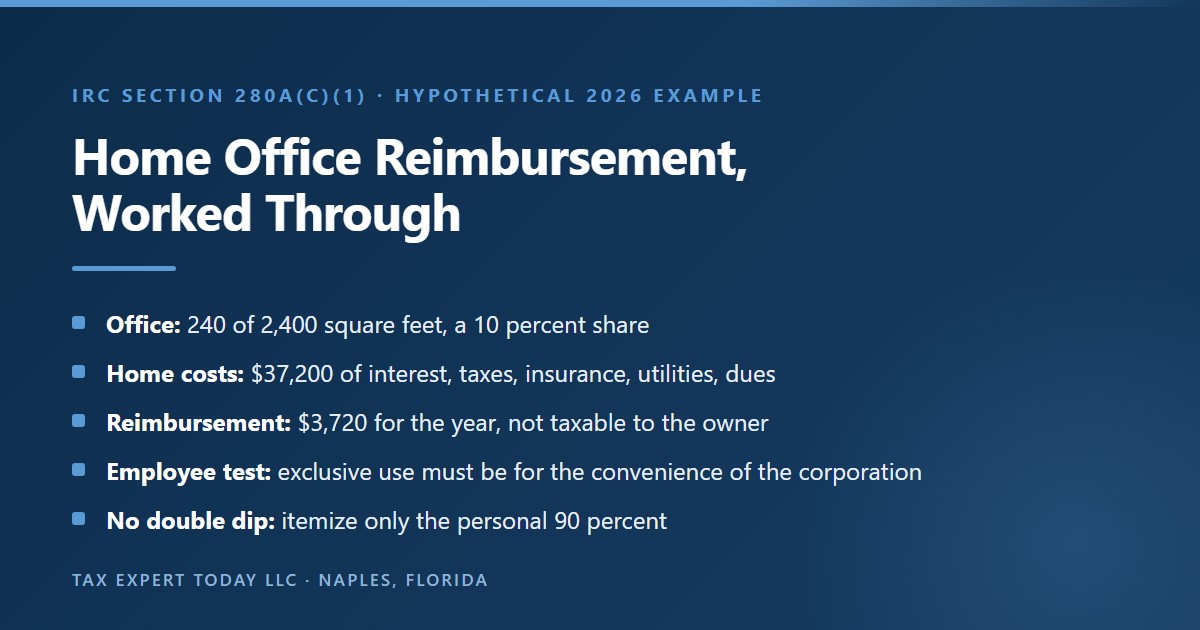
Two cautions apply to the table. First, the 10 percent of mortgage interest and real estate taxes that the corporation reimburses cannot also be claimed by the owner as an itemized deduction on Schedule A. The owner itemizes only the remaining 90 percent. Second, the reimbursement is not taxable to the owner, so the owner reports nothing for it, and the corporation records the $3,720 as an expense of the business. If the business percentage changes, for example because the owner moves or converts a second room, the calculation should change with it in the month the change occurs.
| Cost | Type | How it is reimbursed |
|---|---|---|
| Mortgage interest, real estate taxes, insurance | Indirect | Business percentage |
| Utilities for the whole home | Indirect | Business percentage |
| Association or condominium dues | Indirect | Business percentage |
| Roof repair or exterior painting | Indirect | Business percentage |
| Painting or flooring in the office only | Direct | 100 percent |
| Lawn care, kitchen remodel, pool service | Unrelated | Not reimbursed |
| Rent, if the owner rents the home | Indirect | Business percentage |
| Depreciation of the home | Indirect | Optional, and often left out (see the next section) |
Should depreciation be included in a home office reimbursement?
Depreciation on the office portion of the home may be included, but many owners leave it out. Including it adds a modest annual amount, while it can create depreciation recapture and reduce the home sale exclusion picture when the home is sold. The decision should be made deliberately, documented in the plan, and applied consistently each year.
- The annual amount is usually small. The office share of the building, spread over 39 years.
- Recapture follows a sale. Depreciation allowed after May 6, 1997 is generally taxed on sale.
- The owner must track basis. Depreciation adjusts the basis of the home.
- Consistency matters. Switching methods year to year invites questions.
Publication 587 explains that the business part of a home is depreciated as nonresidential real property over 39 years, and that depreciation allowed or allowable after May 6, 1997 is generally not covered by the home sale exclusion when the home is sold. In the hypothetical above, a home with a $400,000 building basis would produce about $1,026 of annual depreciation on a 10 percent office share. Some owners decide that roughly $1,000 a year is not worth the later recapture and the basis tracking; others want every dollar the rules allow. A professional review of the expected holding period of the home usually settles the question. The plan document should say which approach the corporation follows.
| Approach | Annual reimbursement | Effect when the home is sold |
|---|---|---|
| Exclude depreciation | $3,720 | No home office depreciation to recapture |
| Include depreciation | $3,720 plus about $1,026 | About $1,026 per year of depreciation generally taxable on sale |
How does mileage reimbursement work under an accountable plan in 2026?
The corporation can reimburse business miles driven in the owner’s personal vehicle at the IRS standard mileage rate, which for 2026 is 72.5 cents per mile from January 1 through June 30 and 76 cents per mile from July 1 through December 31. The owner keeps a log of each trip’s date, destination, purpose, and miles.
- Two 2026 rates. The IRS raised the business rate at midyear, so miles must be split by date.
- Log every business trip. Section 274(d) applies to vehicle use.
- Commuting is excluded. Home to a regular office is personal driving.
- Rate covers all costs. Gas, insurance, repairs, and depreciation are built into the rate.
The IRS standard mileage rates page, read on the publication date of this article, lists 2026 business use at 72.5 cents per mile for January 1 through June 30 under IR-2025-128, and 76 cents per mile for July 1 through December 31 under IR-2026-29. Federal per diem and mileage substantiation rules are set out in Rev. Proc. 2019-46. A plan that reimburses at “the IRS rate” therefore needs to apply two rates to 2026 miles. Reimbursing every 2026 mile at 76 cents would overpay the January through June miles by 3.5 cents each, and that excess would need to be returned or treated as wages.
| Period | Logged business miles | IRS business rate | Reimbursement |
|---|---|---|---|
| January 1 through June 30, 2026 | 4,000 | 72.5 cents | $2,900 |
| July 1 through December 31, 2026 | 3,800 | 76 cents | $2,888 |
| Total 2026 | 7,800 | Blended | $5,788 |
| Field | Example entry | Why it matters |
|---|---|---|
| Date | March 4, 2026 | Time element of section 274(d), and which 2026 rate applies |
| Start and destination | Corporate office to client site, Bonita Springs | Place element; separates business trips from commuting |
| Business purpose | Site inspection for a proposal | Purpose element |
| Miles | 36 round trip | Amount element |
| Odometer at year start and year end | Total miles for the year | Supports the business percentage of total use |
Can the plan reimburse actual vehicle costs instead of mileage?
An accountable plan can reimburse the business share of actual vehicle costs, such as fuel, insurance, repairs, and depreciation, instead of using the standard mileage rate. Actual costs require receipts for every expense plus a full mileage log to prove the business percentage, so most owner plans use the standard rate unless the vehicle is expensive to operate.
- Standard rate. One number per mile, simple to administer.
- Actual costs. Business share of every cost, more records.
- Corporate-owned vehicle. A different regime: personal use becomes a taxable fringe benefit.
- Choose before the year starts. Switching mid-year complicates the records.
When the corporation owns the vehicle instead, there is nothing to reimburse for the vehicle itself. The corporation deducts its costs and depreciation, possibly including bonus depreciation for a qualifying vehicle (see our guide to bonus depreciation in 2026), and the owner’s personal use, including commuting, is a fringe benefit valued under IRS Publication 15-B and included in wages. The choice between a corporate vehicle and a personal vehicle with mileage reimbursement is a planning decision in its own right, and it should be modeled rather than assumed.
| Approach | Who owns the car | Records | Personal use |
|---|---|---|---|
| Standard mileage reimbursement | Owner | Mileage log | Owner’s own cost; never reimbursed |
| Actual cost reimbursement | Owner | Mileage log plus every receipt | Owner’s own cost; excluded by the business percentage |
| Corporate vehicle | Corporation | Mileage log plus corporate records | Taxable fringe benefit included in the owner’s W-2 |
How are cell phone and internet costs reimbursed?
The corporation can reimburse the business share of a personal cell phone and home internet plan, based on a reasonable allocation the owner documents, such as a review of a representative month of usage. The monthly bill supports the amount, and the allocation supports the percentage. A corporate-provided phone is a separate fringe benefit question.
- Bill supports the amount. Keep each monthly statement.
- Allocation supports the percentage. A sample month or usage review.
- Consistent percentage. Reassess if work patterns change.
- Equipment purchases. A laptop or printer bought for the business can be reimbursed in full with a receipt.
| Cost | Annual bill | Documented business share | Reimbursement |
|---|---|---|---|
| Personal cell phone plan | $1,200 | 70% | $840 |
| Home internet | $960 | 50% | $480 |
| Business software paid on a personal card | $600 | 100% | $600 |
How do travel, meals, and per diem work for an owner?
Travel and business meals can be reimbursed at actual cost with receipts. Per diem is more limited for an owner: Publication 463 treats an employee who owns more than 10 percent of the corporation as related to the employer, and a related employee must still be able to prove the expenses to the IRS even after accounting to the corporation.
- Actual cost is the cleanest route for owners. Receipts for lodging and items of $75 or more.
- Per diem has a related-party limit. Owners above 10 percent should keep actual records anyway.
- Meals are 50 percent at the corporate level. The reimbursement is not taxable to the owner.
- Entertainment is not deductible. Reimbursing it does not create a deduction.
Publication 463 says a per diem or car allowance satisfies the adequate accounting rules for the amount of expenses only if, among other conditions, the employee is not related to the employer. It defines related to include an employee of “a corporation in which you own, directly or indirectly, more than 10% in value of the outstanding stock,” with attribution from family members and entities. It then states that a related employee “must be able to prove your expenses to the IRS even if you have already adequately accounted to your employer and returned any excess reimbursement.” For most S corporation owners, the practical answer is to reimburse actual travel costs with receipts rather than relying on a per diem rate to substantiate the amount.
At the corporate level, reimbursing a business meal does not change the meal’s deduction limit. Under section 274(n), the corporation generally deducts 50 percent of the meal cost, and under section 274(a) entertainment remains nondeductible. Regulation 1.62-2(h)(1) contains a helpful rule here: amounts that are nondeductible to the employer solely because of the section 274(n) limit are still not income to the employee.
| Reimbursed item | Taxable to the owner? | Corporation’s deduction |
|---|---|---|
| Airfare and lodging on a business trip | No | 100 percent |
| Business meal with a client, $900 for the year | No | 50 percent, $450 |
| Meals while traveling away from home | No | 50 percent |
| Entertainment, such as event tickets | Usually kept out of the plan; treatment is unsettled and can raise a wage question | None under section 274(a) |
| Home office, mileage, phone, supplies | No | 100 percent of the business share |
Which expenses should an accountable plan not reimburse?
An accountable plan should not reimburse personal or nondeductible costs, such as commuting, personal meals, everyday clothing, family travel, personal portions of the home, or health insurance premiums, which follow their own rules. Reimbursing them does not make them deductible, and the payments for those items are treated as wages under a separate nonaccountable arrangement.
- Commuting. Home to a regular workplace is personal.
- Personal share of mixed costs. The non-business part of the phone or home.
- Health insurance for a 2 percent shareholder. Handled through wages, not this plan.
- Costs the corporation already paid. Double reimbursement is a pattern that invites abuse findings.
Health insurance deserves a specific mention because owners often ask to run it through the reimbursement plan. For a more than 2 percent S corporation shareholder, under Notice 2008-1, premiums paid or reimbursed by the corporation are reported as wages in box 1 of Form W-2 and the shareholder may then claim the self-employed health insurance deduction if the requirements are met. That is a separate mechanism with its own reporting, explained in our guide to the self-employed health insurance deduction, and it should not be mixed into the accountable plan.
How much can an accountable plan save an S corporation owner?
The saving equals the tax on the owner’s reimbursable business costs that would otherwise be nondeductible. In a hypothetical with $13,828 of 2026 home office, mileage, phone, internet, software, and travel costs and an assumed 32 percent federal rate, the plan saves about $4,425 of income tax, while a flat allowance would cost about $1,777 more than doing nothing.
- Route A, accountable plan. The corporation deducts $13,828 and the owner receives it tax free.
- Route B, no plan. The owner pays personally and deducts nothing under section 67(h).
- Route C, flat allowance. The payment becomes wages and adds payroll tax.
- Florida has no personal income tax. The saving shown is federal only.
The worked example below follows one hypothetical Naples owner of a consulting S corporation through a full year. The owner is paid a salary below the 2026 Social Security wage base of $184,500 confirmed in IRS Publication 15 (2026), is in an assumed 32 percent federal bracket, and pays the following costs personally.
| Category | Basis of the amount | Annual amount |
|---|---|---|
| Home office | 10 percent of $37,200 of home costs, depreciation excluded | $3,720 |
| Mileage | 4,000 miles at 72.5 cents plus 3,800 miles at 76 cents | $5,788 |
| Cell phone | 70 percent of $1,200 | $840 |
| Home internet | 50 percent of $960 | $480 |
| Business software on a personal card | 100 percent | $600 |
| Conference travel | Airfare, lodging, and registration with receipts | $2,400 |
| Total | $13,828 |
| Item | A. Accountable plan | B. No plan, owner pays personally | C. Flat allowance, no reports |
|---|---|---|---|
| Corporation’s deduction | $13,828 as business expenses | $0 | $13,828 as wages plus $1,058 employer payroll tax |
| Owner’s W-2 wages added | $0 | $0 | $13,828 |
| Owner’s deduction for the costs | Not needed | $0 under section 67(h) | $0 under section 67(h) |
| Net change in the owner’s taxable income | Down $13,828 | None | Down $1,058 |
| Income tax effect at 32 percent | About $4,425 less tax (hypothetical) | $0 | About $339 less tax (hypothetical) |
| Payroll tax, both shares, at 15.3 percent | $0 | $0 | About $2,116 paid |
| Net federal effect compared with doing nothing | About $4,425 better | Baseline | About $1,777 worse |
Route C is the surprising one. A flat allowance feels like a reimbursement, but because the owner cannot deduct the underlying costs, it simply converts money that would have flowed through to the owner as S corporation income into wages, and wages carry payroll tax. For a closely held S corporation, a nonaccountable plan can be worse than no plan at all.
The 32 percent rate is an assumption for illustration. The actual effect depends on the owner’s bracket, whether the owner’s salary is above the Social Security wage base, and the qualified business income deduction. Because the reimbursement reduces the corporation’s pass-through income, it can also reduce the owner’s section 199A deduction, which trims the benefit. Our guide to the qualified business income deduction explains that calculation.
| Assumption changed | Approximate income tax saved by Route A | Note |
|---|---|---|
| 32 percent bracket, no QBI effect | $4,425 | Base case |
| 32 percent bracket, full 20 percent QBI deduction reduced | $3,540 | $13,828 times 80 percent times 32 percent |
| 24 percent bracket, no QBI effect | $3,319 | Lower bracket, smaller saving |
| 35 percent bracket, no QBI effect | $4,840 | Higher bracket, larger saving |
| Salary above the $184,500 wage base (Route C only) | Route C payroll tax falls to about $401 plus 0.9 percent Additional Medicare Tax where it applies | Route C remains worse than Route B |
How does the corporation deduct and report reimbursements?
The corporation records each reimbursement in the expense account that matches its nature, such as rent or occupancy for the home office, auto for mileage, and travel for trips, and deducts it on Form 1120-S. Accountable plan reimbursements are not reported on the owner’s Form W-2 or on any Form 1099, and the owner reports nothing.
- Book by nature. Office, auto, phone, travel, meals at 50 percent.
- No W-2 entry. Boxes 1, 3, and 5 are unaffected.
- No Form 1099. The owner is an employee, not a vendor.
- Keep the support with the corporation. The reports and receipts are corporate records.
| Item | Corporate books | Form 1120-S | Owner’s Form W-2 | Owner’s Form 1040 |
|---|---|---|---|---|
| Home office $3,720 | Occupancy or office expense | Other deductions | Not reported | Not reported; only 90 percent of interest and taxes itemized |
| Mileage $5,788 | Auto and travel | Other deductions | Not reported | Not reported |
| Phone, internet, software $1,920 | Telephone and software | Other deductions | Not reported | Not reported |
| Conference travel $2,400 | Travel | Other deductions | Not reported | Not reported |
| Flat allowance, if paid instead | Officer compensation | Compensation of officers | Boxes 1, 3, and 5 | Wages on line 1a |
The Instructions for Form 1120-S list where each type of deduction is reported. A clean set of books makes the difference between an examination that ends with a document request and one that expands. A fractional CFO or controller who closes the books monthly will usually run the reimbursement process as part of that close; our guide to what a fractional CFO does describes that monthly cadence, and the 13 week cash flow forecast shows how reimbursements fit into cash planning.
Does an accountable plan need to be in writing?
Neither section 62(c) nor Regulation 1.62-2 states in so many words that the plan must be a signed written document. A written plan adopted by corporate resolution is still the practical standard, because it proves that substantiation and repayment were required from the start, which the regulation says cannot be fixed after the fact.
- The rules test the arrangement. Requirements must exist before the payments are made.
- A writing proves the requirements existed. Without it, the evidence is only the payments.
- A board resolution dates the plan. It shows when the plan took effect.
- Operation still controls. A perfect document does not save a plan that is not followed.
The regulation speaks of an “arrangement” that “requires” substantiation and repayment. An examiner reviewing an owner’s reimbursements will ask what required them. In a one-owner corporation, the owner is both the person approving the reimbursement and the person receiving it, and a written plan adopted before the expenses is the cleanest answer. Because Regulation 1.62-2(c)(3)(i) says an employee cannot convert a nonaccountable plan by voluntarily substantiating later, a plan adopted in December to cover the previous eleven months is weak evidence for those months.
How do you set up an accountable plan?
Adopt a written plan by corporate resolution, define the covered expenses and the substantiation and repayment deadlines, set up a reimbursement report and a separate account or ledger, and then run the process on a fixed schedule. The plan should be in place before the expenses it covers are incurred.
- Step 1. Decide which expenses the plan covers.
- Step 2. Adopt the written plan by board or member resolution.
- Step 3. Create the expense report and mileage log templates.
- Step 4. Calculate the home office percentage and document it.
- Step 5. Reimburse monthly or quarterly from the corporate account.
| Step | Action | Output to keep |
|---|---|---|
| 1 | List the owner’s business costs paid personally | Expense inventory |
| 2 | Confirm the home office meets section 280A for an employee | Measurement, photos, convenience of employer statement |
| 3 | Adopt the plan by corporate resolution, dated | Signed resolution and plan document |
| 4 | Choose standard mileage or actual vehicle costs | Election noted in the plan |
| 5 | Decide whether home depreciation is included | Statement in the plan |
| 6 | Set up the report form, mileage log, and receipt folder | Templates |
| 7 | Submit and pay the first report within 60 days of the expenses | Approved report and bank record |
| 8 | Review the plan each January for rate and percentage changes | Annual review note |
What should an accountable plan document include?
The document should name the employer and covered employees, list the categories of reimbursable business expenses, require substantiation within 60 days with the detail section 274(d) requires, require repayment of any excess within 120 days, state the mileage rate and home office method, and prohibit reimbursement of personal costs.
| Clause | What it says | Why it matters |
|---|---|---|
| Effective date and adoption | Date and resolution adopting the plan | Shows the plan existed before the expenses |
| Covered employees | All employees, including shareholder-employees | Brings the owner inside the plan |
| Covered expenses | Ordinary and necessary business expenses incurred for the corporation | Business connection, Reg. 1.62-2(d) |
| Excluded expenses | Commuting, personal items, entertainment | Prevents a second, nonaccountable arrangement |
| Substantiation | Amount, date, place, purpose; receipts for lodging and items of $75 or more | Reg. 1.62-2(e) and Reg. 1.274-5 |
| Deadlines | Report within 60 days; return excess within 120 days | Fixed date safe harbor, Reg. 1.62-2(g)(2)(i) |
| Vehicle method | IRS standard mileage rate in effect on the date driven | Handles the 2026 midyear rate change |
| Home office method | Square footage percentage of actual costs; depreciation included or excluded | Consistent calculation |
| Approval | Who reviews reports, including a second reviewer where one exists | Shows the reports are actually checked |
| Record retention | Reports and receipts kept with corporate records | Supports the corporation’s deductions |
What is a good monthly or quarterly reimbursement routine?
A monthly routine works well for most owners: the owner submits a report with receipts, the mileage log, and the home office calculation within the first weeks of the next month, the corporation reviews and pays by transfer, and the bookkeeper posts it to the right accounts. Quarterly works if every report still lands within 60 days.
| When | Who | Task |
|---|---|---|
| Day 1 to 10 of the following month | Owner | Submit the expense report, receipts, mileage log, and home office worksheet |
| Day 10 to 15 | Reviewer or bookkeeper | Check each item against the plan; reject personal items |
| Day 15 to 20 | Corporation | Pay the approved total by transfer, with the report attached to the payment record |
| Month-end close | Bookkeeper | Post to the expense accounts by nature |
| Each January | Owner and advisor | Update mileage rates, home costs, and percentages |
Can expenses from earlier in the year be reimbursed late?
Expenses submitted more than 60 days after they were paid fall outside the fixed date safe harbor, so they are tested under the general facts and circumstances standard. Catching up a few months late may still be reasonable; reimbursing a full year in one December payment is hard to defend and can look like a pattern of abuse.
- Inside 60 days. Safe harbor protection.
- Somewhat late. Facts and circumstances; explain the delay.
- A year at once. High risk of wage treatment for the late items.
- Before the plan existed. Weakest position of all.
| Expenses incurred | Plan in place when incurred? | Days late beyond 60 | General risk |
|---|---|---|---|
| October 2026 | Yes | None | Low, inside the safe harbor |
| July 2026 | Yes | About 90 | Moderate; facts and circumstances |
| February 2026 | Yes | About 240 | High |
| February 2026 | No, plan adopted in December | About 240 | Very high; the arrangement did not require substantiation when paid |
How did the 2025 tax law change affect accountable plans?
Public Law 119-21 did not change the accountable plan rules themselves. It changed their stakes. By making the suspension of miscellaneous itemized deductions permanent in section 67(h), it removed any prospect that unreimbursed employee expenses would become deductible again in 2026, so the plan is now the permanent route for an owner-employee.
- Section 62(c) and Regulation 1.62-2. Unchanged.
- Section 67(h). The suspension no longer ends after 2025.
- Section 199A. The QBI deduction continues, so the QBI interplay remains part of the math.
- 2026 figures. Two mileage rates and a $184,500 Social Security wage base.
Before the 2025 legislation, which amended section 67, some owners took the view that the end of the suspension after 2025 would let them deduct unreimbursed costs again starting in 2026 and that setting up a plan could wait. The amended section 67 forecloses that. A plan adopted now is not a bridge to a future rule; it is the rule.
| Item | 2025 | 2026 |
|---|---|---|
| Unreimbursed employee business expenses | Not deductible (temporary suspension) | Not deductible (permanent, section 67(h)) |
| Accountable plan requirements | Reg. 1.62-2 | Reg. 1.62-2, unchanged |
| Business standard mileage rate | 70 cents | 72.5 cents through June 30; 76 cents from July 1 |
| Social Security wage base | $176,100 | $184,500 |
| Combined Social Security and Medicare rate below the wage base | 15.3 percent | 15.3 percent |
How does an accountable plan fit with reasonable compensation and the Augusta rule?
They are three separate tools that S corporation owners often use together. Reasonable compensation sets the owner’s salary, the accountable plan reimburses business costs the owner pays personally, and the Augusta rule under section 280A(g) covers short rentals of the owner’s home to the corporation. Each has its own rules, and none substitutes for another.
- Reasonable compensation. Wages for services, with payroll tax.
- Accountable plan. Tax-free reimbursement of documented business costs.
- Augusta rule. Rent for up to 14 days of home use, excluded by the owner.
- No overlap allowed. The same room and day cannot be both home office and rented meeting space without care.
| Tool | Authority | What it moves to the corporation | Owner’s tax on the payment |
|---|---|---|---|
| Reasonable compensation | IRC 3121; case law and IRS guidance | A wage deduction | Taxable wages with payroll tax |
| Accountable plan | IRC 62(c); Reg. 1.62-2 | The owner’s documented business costs | None |
| Augusta rule | IRC 280A(g) | Fair rental for up to 14 days of home use | None, if 14 days or fewer |
The interaction that needs the most care is between the home office and the Augusta rule. A dedicated home office already reimbursed through the plan is used exclusively, as section 280A(c)(1) requires for the business; renting the whole home, including that office, to the corporation for a meeting raises the question of whether the exclusive-use space is being paid for twice. Our guides to the Augusta rule and reasonable compensation cover the other two tools in detail.
Does an accountable plan work for a partnership or LLC owner?
Not in the same form. Partners, including members of a multi-member LLC taxed as a partnership, are not employees of the partnership, so the employee reimbursement rules do not apply to them. A partnership can reimburse a partner’s business costs under its own policy, or the partnership agreement can require partners to bear them and deduct them on Schedule E.
- Partnership reimbursement. The partnership deducts the cost; the partner does not.
- Unreimbursed partnership expenses. Deductible by the partner only if the agreement requires the partner to pay them.
- Home office for a partner. Publication 587 has a separate worksheet path for partners.
- LLC taxed as an S corporation. Treated like any S corporation; the accountable plan applies.
Publication 587 states that its worksheets cover a partner whose use of the home produced unreimbursed ordinary and necessary trade or business expenses “that you are required to pay under the partnership agreement.” That language is why a partnership agreement clause on partner-borne expenses matters. An LLC that elected S corporation treatment is an S corporation for these purposes, and its owner-employees use the accountable plan described in this guide.
What does the IRS look for when it examines an accountable plan?
An examiner usually asks for the plan document and its adoption date, the expense reports and receipts behind each reimbursement, the mileage logs, the home office calculation, and evidence that the payments track actual expenses. Round-number payments, year-end lump sums, and reimbursed personal costs are the facts that most often lead to wage treatment.
- Existence. A plan that predates the reimbursements.
- Substance. Reports that match receipts and bank records.
- Timing. Reports and payments close to the expenses.
- Pattern. Payments that vary with actual costs, not round numbers.
| Supports the plan | Weakens the plan |
|---|---|
| Dated resolution adopting a written plan | No document, or one created after the period |
| Monthly reports with receipts and logs | One December payment for the whole year |
| Amounts that vary month to month | Identical round payments every month |
| Mileage log written as trips occur | A log reconstructed from memory |
| Home office percentage from measurements | A percentage with no support |
| Personal items rejected on review | Personal items paid alongside business ones |
If an examination has already started, the reports and logs that exist at that point are what matter. Our overview of what happens if you get audited by the IRS describes the process, and IRS audit help in Naples is available when reimbursements are under review.
What are the most common accountable plan mistakes?
The most common mistakes are paying a flat allowance with no reports, reimbursing a full year at once, using one mileage rate for all of 2026, reimbursing commuting or personal costs, claiming a home office that fails the convenience of the employer test, and itemizing the same mortgage interest and taxes the corporation already reimbursed.
| Mistake | Rule involved | Usual correction going forward |
|---|---|---|
| Flat monthly car or phone allowance | Reg. 1.62-2(d)(3) | Replace with mileage and bill-based reimbursement |
| Year-end lump-sum reimbursement | Reg. 1.62-2(g) and (k) | Monthly or quarterly reports within 60 days |
| One mileage rate for all of 2026 | IRS mileage rates, IR-2026-29 | 72.5 cents through June 30, 76 cents after |
| Commuting miles in the log | Pub. 463, chapter 4 | Log only business trips from the business location |
| Home office while the corporation leases an office with a desk for the owner | IRC 280A(c)(1), employee rule | Review the convenience of the employer facts first |
| Double counting interest and taxes | No double deduction | Itemize only the personal share |
| Health insurance run through the plan | 2 percent shareholder rules | Report through wages and use the separate deduction |
| Per diem used to prove an owner’s travel costs | Pub. 463, related employer rule | Reimburse actual costs with receipts |
What does an accountable plan mean for a Florida business owner?
Florida has no personal income tax, so for a Florida S corporation owner the benefit of an accountable plan is federal: income tax and, where a flat allowance is avoided, payroll tax. Florida homes also carry high insurance and association costs, which raises the home office share of actual expenses that a plan can reimburse.
- No state income tax effect. The saving is federal income and payroll tax.
- Insurance costs feed the home office share. Homeowners and windstorm premiums are indirect costs.
- Association dues count. Condominium and HOA dues are indirect costs.
- Corporate tax remains. Florida taxes C corporations, not S corporations in most cases.
Many Southwest Florida owners moved their businesses here from higher-tax states, and some still have a former state’s rules to deal with for prior years. Our guide on how to establish Florida residency covers that side. Owners who expect to sell the business later may also want to read our guide to selling a business and taxes, because clean expense records also make due diligence easier.
Accountable Plan Help in Naples & Southwest Florida
Accountable plan help Naples business owners ask for usually starts with a review of what the owner pays personally, whether the home office meets the employee rules, and whether any existing allowance is really wages. Our office in Naples, Florida drafts plan documents, builds the home office and mileage calculations, and sets up a monthly reimbursement routine.
Southwest Florida has a large population of owner-operated S corporations: consultants, contractors, medical and professional practices, real estate businesses, and family companies, many run partly from home. The accountable plan is usually part of a wider Naples tax planning review that also covers reasonable compensation, retirement contributions, and the QBI deduction.
- Plan drafting. A written plan and corporate resolution suited to the business.
- Home office review. Section 280A tests, measurement, and the calculation.
- Vehicle approach. Standard mileage, actual costs, or a corporate vehicle, modeled.
- Allowance cleanup. Replacing flat allowances with a substantiated process.
- Examination support. Organizing reports, logs, and receipts when reimbursements are questioned.
Tax Expert Today LLC
11983 Tamiami Trail N, Naples FL 34110
Phone: (239) 441-2005
Hours: Monday to Friday, 10:00 to 5:00 ET
Where can I get help setting up an accountable plan in Naples, FL? Tax Expert Today LLC, at 11983 Tamiami Trail N in Naples, Florida, helps S corporation and C corporation owners set up and run accountable plans: drafting the plan and resolution, testing the home office under section 280A, calculating mileage at the correct 2026 rates, replacing flat allowances, and supporting examinations. The firm includes tax advisors, enrolled agents, CPAs, and attorneys, and serves clients in all 50 states. Results depend on each taxpayer’s facts.
When to Engage a Professional
A simple accountable plan for mileage and a phone is manageable for many owners. A professional review is worthwhile when a home office is involved, when the corporation has been paying a flat allowance, when reimbursements have been made without reports, when the vehicle approach is unsettled, or when an examination notice arrives.
- A home office claimed by an owner-employee, especially with a corporate office elsewhere.
- A flat car or phone allowance that has been paid without reports.
- Year-end lump-sum reimbursements in prior years.
- A vehicle decision, personal car with mileage or a corporate vehicle.
- Multiple owners or family employees covered by one plan.
- An IRS letter asking about reimbursements or officer compensation.
Tax Expert Today LLC is a multidisciplinary practice of tax advisors, enrolled agents, certified public accountants, and attorneys serving clients in all 50 states. To discuss how an accountable plan fits within a broader Naples tax planning approach, our tax planning services, or our business consulting work for owners organizing how the corporation pays them, call (239) 441-2005. Readers working through related decisions may also find our guides to fractional CFO cost and how to improve gross margin useful.
This article is general information about federal tax provisions and is not tax, legal, or investment advice for any specific taxpayer. Figures were verified against primary sources on October 11, 2026 and are hypothetical illustrations, not client outcomes. Whether a plan qualifies depends on how it is written and operated in each year. Tax laws apply differently to each person’s facts, and results always vary. Consult a qualified professional about your situation before taking any action.
Published October 11, 2026 by Dr. Pellumb Kabashi « Back to Learning Center
Have a question this article touches on?
Tax Expert Today LLC, based in Naples, Florida and serving clients across the United States.
Schedule a Consultation (239) 441-2005