
By Dr. Pellumb Kabashi, DBA, MBA, CES, CFE, EA
Founder, Tax Expert Today LLC · Tax advisors, enrolled agents, CPAs, and attorneys · Serving clients in all 50 states
Quick Answer
An irrevocable life insurance trust (ILIT) owns a life insurance policy so the death benefit stays outside the insured’s taxable estate under IRC section 2042. In 2026 the work is annual: Crummey notices against the $19,000 exclusion, a Form 709 when required, GST exemption allocation, and the three-year rule for transferred policies. Call (239) 441-2005 for a free consultation.
What is an irrevocable life insurance trust?
An irrevocable life insurance trust is a trust that the insured cannot amend or revoke, created to own one or more life insurance policies on the insured’s life. Because the trust, not the insured, owns the policy and is its beneficiary, the death benefit is generally kept out of the insured’s gross estate for federal estate tax purposes.
- The trust is the owner. It applies for or receives the policy and holds every ownership right.
- The trust is the beneficiary. The insurer pays the death benefit to the trustee, not to the family directly.
- The insured gives up control. That surrender is what keeps the proceeds out of the estate.
- The trust document sets the rules. It decides who benefits, when, and on what terms.
The structure exists because of a single estate tax rule. IRC section 2042 includes life insurance proceeds in the gross estate in two situations: when the proceeds are receivable by the executor, and when they are receivable by any other beneficiary but the insured “possessed at his death any of the incidents of ownership” in the policy. A person who owns a policy on his or her own life holds every incident of ownership, so the entire death benefit lands in the estate, even though the insured never touched the money. An irrevocable life insurance trust removes both triggers at once: the proceeds are payable to the trust rather than the estate, and the insured holds no ownership rights.
The word “irrevocable” is the price of the result. A revocable trust leaves the insured with the power to take the policy back, and that power is itself an incident of ownership. A trust that the insured can change, revoke, or direct does not do the job. Readers comparing this structure with other estate tools may find our guide to the lifetime gift tax exemption in 2026 a useful starting point, because the irrevocable life insurance trust is usually one part of a plan that also uses that exemption.
| Feature | How it works in an ILIT | Governing rule |
|---|---|---|
| Policy owner | The trustee, on behalf of the trust | IRC 2042(2), incidents of ownership |
| Policy beneficiary | The trust | IRC 2042(1), proceeds receivable by the executor |
| Premium source | Gifts from the insured to the trust each year | IRC 2503(b), annual exclusion |
| Present interest for gifts | Crummey withdrawal powers held by beneficiaries | Crummey v. Commissioner, 397 F.2d 82 (9th Cir. 1968) |
| Existing policy transferred in | Included in the estate if the insured dies within three years | IRC 2035(a) |
| Grandchildren as later beneficiaries | GST exemption allocated to the premium gifts | IRC 2631, 2632, 2642 |
| Income tax status | Often a grantor trust when trust income can pay premiums | IRC 677(a)(3) |
How does an irrevocable life insurance trust work, step by step?
An attorney drafts the trust and the insured signs it, the trustee obtains a taxpayer identification number and opens an account, and the trust applies for and owns the policy. Each year the insured gives cash to the trust, the trustee sends withdrawal notices, and the trustee pays the premium. At death the trustee collects the proceeds.
- Draft and sign. The trust document names the trustee, the beneficiaries, and the withdrawal rights.
- Open the account. The trust needs its own taxpayer identification number and bank account.
- Acquire the policy. Ideally the trust is the original applicant and owner.
- Fund each year. Gift, notice, waiting period, then the premium payment.
- Administer at death. Collect, invest, and distribute under the trust terms.
The order of events matters more than most families expect. The trust should exist before the policy is issued, so the trustee can sign the application as owner. If the insured applies personally and then assigns the policy to the trust, the policy becomes a transferred policy and the three-year rule in IRC section 2035 applies, which is explained in detail below.
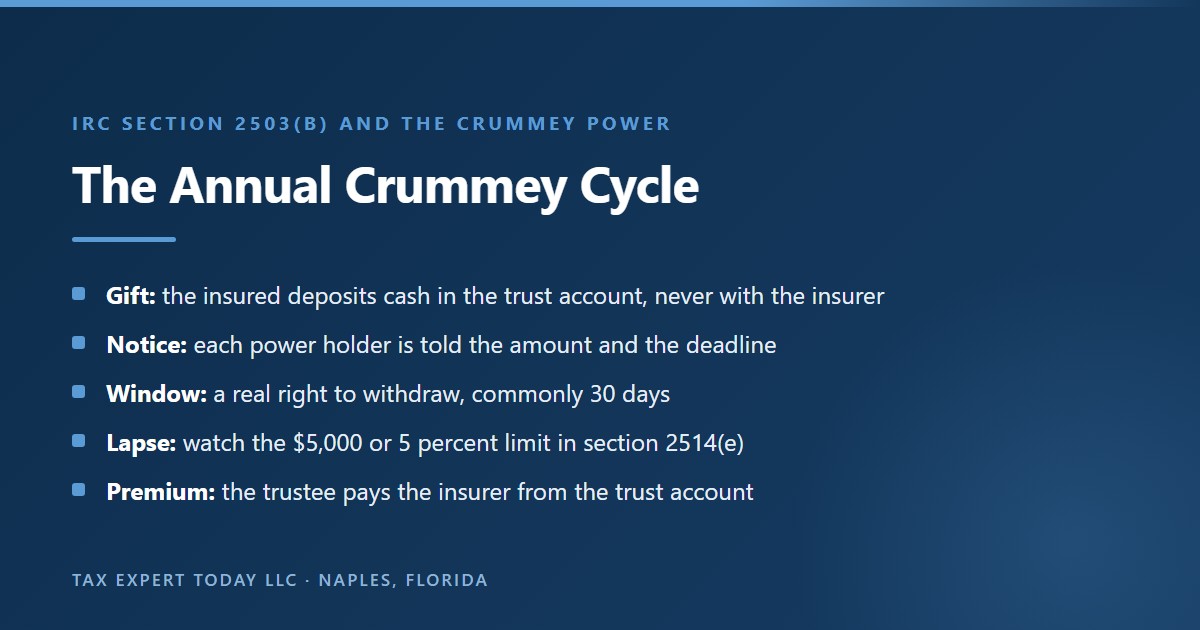
The annual cycle is where most of the tax work sits, and it is the part that insurer explainers usually describe in a sentence. Each premium is a gift by the insured to the trust. For that gift to qualify for the annual exclusion, the beneficiaries must hold a present right to withdraw it, which is why the trustee sends written notice and waits before paying the insurer. After the window closes, the unexercised withdrawal rights lapse and the cash is used for the premium. The same steps repeat every year the policy is in force.
| Stage | Who acts | What happens | Tax touchpoint |
|---|---|---|---|
| 1. Formation | Insured and attorney | Trust signed, trustee accepts | Irrevocability fixed at signing |
| 2. Setup | Trustee | EIN obtained, bank account opened | Trust becomes a separate taxpayer for reporting |
| 3. Policy issue | Trustee and insurer | Trust applies as owner and beneficiary | No section 2035 exposure for a new policy |
| 4. Annual gift | Insured | Cash transferred to the trust account | Gift subject to the gift tax rules |
| 5. Notice and window | Trustee | Crummey notices sent, withdrawal period runs | Creates a present interest under section 2503(b) |
| 6. Premium payment | Trustee | Premium paid from the trust account | Lapse of withdrawal rights measured under section 2514(e) |
| 7. Reporting | Insured and preparer | Form 709 filed when required | Gift splitting and GST allocation made on the return |
| 8. Death of insured | Trustee | Claim filed, proceeds collected | Proceeds excluded from income under section 101(a) |
| 9. Administration | Trustee | Proceeds held or distributed under the terms | Trust income reporting on Form 1041 if required |
Why keep life insurance out of the taxable estate in 2026?
Life insurance often doubles as the largest single item in an estate at death, and section 2042 counts the full death benefit, not the premiums paid. For a family already near or above the 2026 basic exclusion of $15,000,000 per person, including a policy can push the estate into the 40 percent bracket for every dollar of coverage.
- The full face amount counts. A policy that cost a fraction of its face still adds the full benefit.
- The rate is 40 percent at the margin. IRC 2001(c) taxes amounts above $1,000,000 in the base at that rate.
- Insurance is often bought for liquidity. Taxing the liquidity defeats its purpose.
- Exemption is finite. Every dollar of insurance in the estate uses exemption that could shelter other assets.
The IRS estate and gift tax page lists a basic exclusion amount of $15,000,000 for 2026, up from $13,990,000 for 2025. That figure comes from the 2025 tax law, which amended IRC section 2010(c)(3) to set the basic exclusion at $15,000,000 with inflation adjustments for decedents dying after 2026. Revenue Procedure 2025-32 confirms the same 2026 figure. Above the exclusion, the rate table in IRC section 2001(c) reaches 40 percent of the excess over $1,000,000 of the tentative base, which in practice means 40 percent of each additional dollar of taxable estate.
Insurance is unusual among estate assets because its value jumps at the moment of death. A brokerage account worth $5,000,000 the day before death is worth about the same the day after. A $5,000,000 policy with a cash value of $300,000 is worth $300,000 the day before and $5,000,000 the day after, and the estate tax looks at the day after. That gap is why families who would not otherwise think of themselves as estate tax payers sometimes are, once the insurance is counted.
| Item | 2025 | 2026 | Source |
|---|---|---|---|
| Basic exclusion amount, per person | $13,990,000 | $15,000,000 | IRC 2010(c)(3); IRS estate and gift tax updates |
| Annual exclusion, per donee | $19,000 | $19,000 | IRC 2503(b); Rev. Proc. 2025-32 |
| Annual exclusion, gifts to a noncitizen spouse | $190,000 | $194,000 | IRC 2523(i); Rev. Proc. 2025-32 |
| GST exemption, per person | $13,990,000 | $15,000,000 | IRC 2631(c), tied to the basic exclusion |
| Highest estate, gift, and GST rate | 40 percent | 40 percent | IRC 2001(c); IRC 2641 |
| Lapse safe harbor for withdrawal powers | Greater of $5,000 or 5 percent | Greater of $5,000 or 5 percent | IRC 2514(e); IRC 2041(b)(2) |
How much estate tax can an ILIT avoid?
In a simple hypothetical, the estate tax effect equals the death benefit multiplied by the 40 percent marginal rate, as long as the estate is already above the available exemption. A $5,000,000 policy kept out of a taxable estate removes about $2,000,000 of federal estate tax in that case. Below the exemption, the federal effect may be zero.
- Above the exemption: roughly 40 cents of federal tax per dollar of excluded coverage.
- Straddling the exemption: only the portion of the policy above the exemption is taxed.
- Below the exemption: the federal benefit may be nil, though control and creditor benefits remain.
- State estate taxes: some states tax at much lower thresholds; Florida has no estate tax.
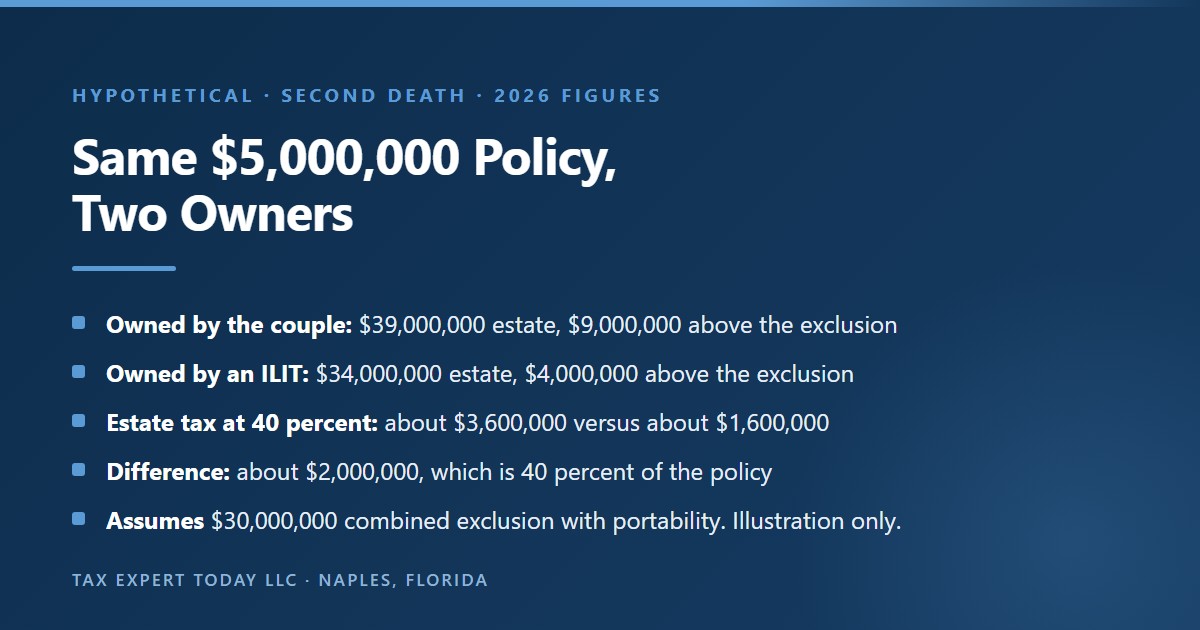
The table below works through a hypothetical married couple with $34,000,000 of other assets and a $5,000,000 second-to-die policy. It assumes both spouses are United States citizens, no prior taxable gifts, full portability of the first spouse’s unused exclusion under IRC section 2010(c)(4), a combined available exclusion of $30,000,000 at the second death, and no state estate tax. It ignores deductions, expenses, and growth to isolate the insurance effect.
| Line | Policy owned by the couple | Policy owned by an irrevocable life insurance trust |
|---|---|---|
| Other assets | $34,000,000 | $34,000,000 |
| Life insurance included under section 2042 | $5,000,000 | $0 |
| Gross estate | $39,000,000 | $34,000,000 |
| Exclusion available (own plus ported) | $30,000,000 | $30,000,000 |
| Amount above the exclusion | $9,000,000 | $4,000,000 |
| Federal estate tax at 40 percent | $3,600,000 | $1,600,000 |
| Passing to heirs, including the insurance | $35,400,000 | $37,400,000 |
| Difference | About $2,000,000 of federal estate tax, equal to 40 percent of the policy | |
A second, simpler case shows the straddle effect. An unmarried individual with $18,000,000 of other assets and a $3,000,000 policy would have a $21,000,000 gross estate with personal ownership, $6,000,000 above the $15,000,000 exclusion, and about $2,400,000 of tax. With the policy in an ILIT the estate is $18,000,000, $3,000,000 above the exclusion, and the tax is about $1,200,000. The difference is again about 40 percent of the policy, because the whole policy sits above the exclusion. If the same individual had only $10,000,000 of other assets, the personally owned policy would bring the estate to $13,000,000, below the exclusion, and the federal estate tax difference would be zero. These are hypothetical illustrations; actual results depend on deductions, prior gifts, portability elections, valuation, and future law.
Does an ILIT still matter after the 2025 tax law made the exemption permanent?
Yes, for the families it was designed for. The 2025 law removed the scheduled 2026 cut in the exclusion, so fewer estates face federal tax, but the exclusion remains finite. Couples with combined estates near or above $30,000,000, families in states with their own estate tax, and anyone who wants control and creditor protection still use ILITs.
- The sunset is gone. The exclusion did not fall to roughly half on January 1, 2026.
- The ceiling still exists. Estates above it are still taxed at 40 percent at the margin.
- Insurance growth is fast. A death benefit can move an estate across the line overnight.
- Non-tax reasons remain. Control of proceeds, spendthrift protection, and blended-family planning.
For three years, much of the estate planning press assumed the exclusion would fall to roughly half its prior level at the start of 2026. Public Law 119-21, enacted in July 2025, amended IRC section 2010(c)(3) to set a basic exclusion of $15,000,000 with annual inflation indexing after 2026, and it did not include a sunset. Some pages that still rank for this topic describe the pre-2025 sunset as if it were current law. It is not. A planner advising in 2026 should start from $15,000,000 per person and the portability rules, not from the old scheduled reduction.
The practical effect is a narrower but sharper audience. A married couple with $12,000,000 and a $2,000,000 policy has no federal estate tax problem today, and an irrevocable life insurance trust for that couple is a control and creditor decision more than a tax one. A married couple with a $40,000,000 business and a $10,000,000 policy has a very large federal problem, and the irrevocable life insurance trust is often the first tool considered. Our guide to the lifetime gift tax exemption in 2026 explains how the permanent exclusion changes the timing question for other lifetime gifts.
| Situation | Federal estate tax relevance | Other reasons an ILIT may be considered |
|---|---|---|
| Combined estate well above $30,000,000 | High: coverage sits in the 40 percent bracket | Liquidity to pay the tax without selling a business or real estate |
| Combined estate between $20,000,000 and $30,000,000 | Moderate: growth and the policy may cross the line | Protects against future growth and law changes |
| Residents of states with an estate tax | State tax at lower thresholds | State exemption can be far below the federal figure |
| Blended families | Varies | Directs proceeds to children of a prior marriage on fixed terms |
| Beneficiaries with creditor or spending concerns | Varies | Spendthrift terms and trustee discretion over distributions |
| Estates well below the exclusion | Low | Often a revocable plan or a direct beneficiary designation is simpler |
Who are the parties to an ILIT and what does each one do?
An irrevocable life insurance trust has four roles: the grantor, who signs the trust and makes the gifts; the insured, usually the same person or a married couple; the trustee, who owns and manages the policy; and the beneficiaries, who hold the withdrawal rights during life and receive the proceeds after death. Each role carries tax consequences.
- Grantor: creates the trust, makes the annual gifts, files the Form 709.
- Insured: the person whose death triggers the payout, and the person who must hold no ownership rights.
- Trustee: applies for the policy, sends notices, pays premiums, files returns, invests proceeds.
- Beneficiaries: hold Crummey rights now and the beneficial interest later.
The trustee role is where most practical problems arise. The trustee is the legal owner of the policy, and section 2042 looks at who holds the power to change beneficiaries, surrender or cancel the policy, assign it, pledge it for a loan, or borrow against its cash value. Treasury Regulation 20.2042-1(c)(4) states that an insured is treated as holding an incident of ownership in a policy held in trust if the insured has the power, “as trustee or otherwise,” to change the beneficial ownership in the policy or its proceeds, or the time or manner of enjoyment, even with no beneficial interest in the trust. That is why the insured is generally not named as trustee.
Beneficiaries are typically the insured’s spouse, children, or descendants. Each beneficiary who holds a Crummey withdrawal right adds one annual exclusion of capacity for each donor, which is why some trusts give withdrawal rights to grandchildren or other contingent beneficiaries. The Tax Court accepted withdrawal rights held by contingent beneficiaries in Estate of Cristofani v. Commissioner, 97 T.C. 74 (1991), though the IRS has challenged arrangements where the power holders had no real economic interest in the trust. Adding power holders only to multiply exclusions is an area that deserves professional review.
| Role | Typical person | Key responsibility | Tax rule to watch |
|---|---|---|---|
| Grantor | The insured, or both spouses | Signs the trust, makes gifts | Form 709 filing; gift splitting under IRC 2513 |
| Insured | Grantor, or both spouses for a second-to-die policy | Holds no ownership rights | IRC 2042(2), incidents of ownership |
| Trustee | A trusted individual or a corporate trustee | Owns the policy, sends notices, pays premiums | Reg. 20.2042-1(c)(4); fiduciary duties under state law |
| Current beneficiaries | Spouse, children | Hold Crummey withdrawal rights | IRC 2503(b); IRC 2514(e) lapse rule |
| Remainder beneficiaries | Children, grandchildren | Receive proceeds after death | GST exemption allocation under IRC 2631 and 2632 |
Should the trust buy a new policy or receive an existing one?
When underwriting allows it, a new policy owned by the trust from day one is cleaner, because there is no transfer and the three-year rule in section 2035 does not apply. Transferring an existing policy can suit an older or less insurable person, but it starts a three-year clock and creates a gift that must be valued.
- New policy: no section 2035 exposure, no valuation of an existing contract.
- Existing policy: preserves coverage that may be costly or unavailable to replace.
- Health matters: an insured who no longer qualifies for new coverage may need to transfer.
- Cost matters: an older policy may carry lower premiums than a new one at the current age.
The difference comes down to one statutory sentence. IRC section 2035(a) includes in the gross estate any property the decedent transferred during the three years ending at death, if the value would have been included under section 2042 had the decedent kept the transferred interest. A policy that the trust buys directly was never owned by the insured, so there is nothing to pull back. A policy the insured owned and then gave to the trust was, so if the insured dies within three years the death benefit is included as if the transfer had not happened.
A related and frequent mistake is the “preapplication” problem. If the insured signs the application as owner and the policy is later assigned to the trust, the insured was the owner, even briefly, and the transfer starts the clock. The usual practice is to have the trust signed and the trustee in place before the application, with the trustee signing as applicant and owner. An insurer’s internal forms do not change the tax analysis; what matters is who owned the contract.
| Factor | New policy issued to the trust | Existing policy transferred to the trust |
|---|---|---|
| Three-year rule under IRC 2035(a) | Does not apply | Applies for three years after the transfer |
| Gift on the transfer | None beyond the premium gifts | Gift equal to the policy’s value on the transfer date |
| Valuation evidence | Not needed | Form 712 from the insurer, often interpolated terminal reserve |
| Underwriting | Required at the current age and health | Not required |
| Transfer-for-value analysis | Not relevant | Relevant if anything is paid for the policy |
| Typical fit | Insurable clients planning early | Older clients or those with health changes |
What is the three-year rule under IRC section 2035?
The three-year rule says that if an insured gives away a policy on his or her own life, or gives up an incident of ownership in it, and dies within three years, the death benefit is included in the gross estate as if no transfer happened. It reaches transferred policies, not policies the trust buys directly.
- Trigger: a transfer of a policy, or a release of an ownership right, within three years of death.
- Effect: the full death benefit is included, not the value on the transfer date.
- Exposure ends: on the third anniversary of the transfer.
- Gift tax gross-up: gift tax paid within three years of death is also added back under section 2035(b).
The rule is narrow but strict. Section 2035(a) applies only to property that would have been included under sections 2036, 2037, 2038, or 2042 had the decedent kept it, and life insurance on the decedent’s own life is the classic example. Section 2035(b) separately adds back any gift tax paid on gifts made during the three years before death, which matters when a large policy is transferred and gift tax is actually paid.
A worked timeline helps. Suppose an insured assigns an existing $4,000,000 policy to an irrevocable life insurance trust on March 2, 2026. If the insured dies on or before March 2, 2029, the $4,000,000 is included in the estate. If the insured dies after that date, it is not. Some trusts are drafted so that, if the insured dies within the three years, the proceeds pass in a way that qualifies for the marital deduction under IRC section 2056, which can defer the tax to the surviving spouse’s death rather than eliminate it. That drafting choice should be made with counsel.
| Date of death | Inside the three-year window? | Estate inclusion of the $4,000,000 death benefit |
|---|---|---|
| December 1, 2026 | Yes | Included under IRC 2035(a) |
| June 15, 2028 | Yes | Included under IRC 2035(a) |
| March 1, 2029 | Yes | Included under IRC 2035(a) |
| March 3, 2029 or later | No | Not included, assuming no retained incidents of ownership |
What are incidents of ownership under IRC section 2042?
Incidents of ownership are the economic rights in a policy: changing the beneficiary, surrendering or cancelling the policy, assigning it, pledging it for a loan, borrowing against the cash value, and a reversionary interest worth more than 5 percent. Holding any one of them at death, alone or with another person, pulls the proceeds into the estate.
- Beneficiary change: the most common incident, and the easiest to retain by mistake.
- Surrender or cancellation: the right to cash the policy in.
- Loans and pledges: borrowing against cash value or using the policy as collateral.
- Reversionary interest: counted only if worth more than 5 percent of the policy value.
Section 2042(2) uses the phrase “exercisable either alone or in conjunction with any other person,” which closes the obvious workaround of sharing a power with a friendly co-trustee. The statute adds that a reversionary interest counts as an incident of ownership only if its value exceeded 5 percent of the policy value immediately before death. The regulations at Treasury Regulation 20.2042-1(c) list the economic rights that count and explain how powers held in a fiduciary capacity are treated.
The practical checklist is short. The insured should not be the trustee, should not hold a power to remove and replace the trustee with himself or herself or with someone related or subordinate in a way that gives the insured control, should not be able to borrow against the policy, and should not be the person who signs insurer forms. The trust document should also prevent the trustee from using proceeds for the insured’s estate in a way that makes them “receivable by the executor,” which is discussed further below.
| Incident | Why it matters | Typical ILIT approach |
|---|---|---|
| Power to change the beneficiary | Classic incident under Reg. 20.2042-1(c)(2) | Trust is owner and beneficiary; insured holds no power |
| Power to surrender or cancel | Economic control of the policy | Vested only in the independent trustee |
| Power to borrow or pledge | Access to cash value | Insured excluded from any loan rights |
| Insured serving as trustee | Reg. 20.2042-1(c)(4), powers held as trustee count | Independent trustee named |
| Reversionary interest | Counts if above 5 percent of value | Trust terms prevent any return to the insured or estate |
| Power to remove the trustee | Can be attributed to the insured | Limited so any replacement is independent |
Can the insured or the spouse serve as trustee?
The insured generally should not serve, because powers held as trustee can be incidents of ownership under the regulations. A spouse who is not insured can serve in many single-life ILITs if the spouse’s powers are limited by an ascertainable standard, but a spouse cannot safely serve on a second-to-die policy, where both spouses are insured.
- Insured as trustee: generally avoided.
- Non-insured spouse: possible with limited powers, but watch the spouse’s own estate.
- Second-to-die policy: neither spouse should hold trustee powers.
- Independent trustee: a family member, friend, or corporate trustee without ties that give the insured control.
The regulation at 20.2042-1(c)(4) is broad, and the IRS has addressed fiduciary powers in several rulings. In Revenue Ruling 84-179 the IRS concluded that powers a decedent held only as a fiduciary were not incidents of ownership where the decedent had not transferred the policy into that trust or paid for it, and could not use the powers for personal benefit. That ruling does not cover the usual ILIT, where the insured is also the person who funded the trust. The conservative approach used by most practitioners is to keep the insured off the trustee slate entirely.
A spouse as trustee raises a second question: the spouse’s own estate. If the spouse holds a power to distribute to himself or herself that is not limited by a standard relating to health, education, maintenance, or support, the power can be a general power of appointment under IRC section 2041, and trust assets could be taxed in the spouse’s estate. Drafting limits those powers. For a second-to-die policy, both spouses are insureds, so neither can hold incidents of ownership without risk.
| Trustee | Single-life policy | Second-to-die policy | Main concern |
|---|---|---|---|
| The insured | Generally avoided | Generally avoided | Reg. 20.2042-1(c)(4) |
| Non-insured spouse | Possible with limited powers | Not applicable; both spouses are insured | IRC 2041 general power if distribution powers are broad |
| Adult child | Common | Common | Conflict of interest as a beneficiary; administrative reliability |
| Trusted friend or advisor | Common | Common | Continuity and record keeping over decades |
| Corporate trustee | Common for larger trusts | Common for larger trusts | Fees, minimums, investment policy |
How are premiums paid into an ILIT?
The insured gives cash to the trust, and the trustee pays the insurer from the trust account. The insured should not pay the insurer directly. Each transfer is a gift to the trust’s beneficiaries, so it is measured against the $19,000 annual exclusion per beneficiary in 2026 and, above that, against the insured’s lifetime exclusion.
- Gift first, premium second. Cash goes to the trust account, then to the insurer.
- Timing: leave time for the withdrawal window before the premium due date.
- Records: a deposit record, a copy of each notice, and the premium payment record.
- Large premiums: may need lifetime exclusion, split-dollar, or loan arrangements.
Paying the insurer directly from a personal account is a common shortcut and a poor one. The payment is still a gift to the trust, but it skips the step that gives beneficiaries a present right to the money, so the gift may not qualify for the annual exclusion, and the trail that shows the trust paid its own premium is lost. In an examination, the cleanest file shows a deposit into the trust account, the notices, the expiration of the withdrawal period, and a trust check or transfer to the insurer.
Very large premiums sometimes outrun what annual exclusions can carry. Families in that position use part of the lifetime exclusion for a lump-sum gift to the trust, or use financing structures such as split-dollar arrangements or loans to the trust. Those arrangements have their own income and gift tax rules and are outside the scope of this guide, but they share one point with the simple case: every dollar the trust uses for premiums must reach the trust in a way that is reported correctly.
| Step | Typical timing | Record to keep |
|---|---|---|
| Insured transfers cash to the trust account | 45 to 60 days before the premium due date | Bank deposit record showing the amount and date |
| Trustee sends Crummey notices | Promptly after the deposit | Copy of each notice and proof of delivery |
| Withdrawal period runs | Period stated in the trust, often 30 days | Calendar entry; any waiver or withdrawal request |
| Withdrawal rights lapse | At the end of the period | Trustee memo noting no withdrawals |
| Trustee pays the premium | Before the due date or grace period ends | Trust check or transfer to the insurer |
| Preparer reviews for Form 709 | Early the following year | Summary of gifts by beneficiary and any GST allocation |
What is a Crummey power and why does it matter?
A Crummey power is a beneficiary’s temporary right to withdraw a contribution to the trust. The annual exclusion under section 2503(b) applies only to gifts of present interests, and a gift to a trust that holds a policy is otherwise a future interest. The withdrawal right turns the gift into a present interest, so it can qualify for the exclusion.
- Named for a case: Crummey v. Commissioner, 397 F.2d 82 (9th Cir. 1968).
- Present interest: the beneficiary can take the money now, even if nobody expects that.
- One exclusion per power holder per donor: three children with powers give a single donor $57,000 of 2026 capacity.
- The right must be real: notice, a reasonable window, and cash available to honor a withdrawal.
Section 2503(b)(1) excludes the first $10,000, inflation adjusted to $19,000 for 2026 by Revenue Procedure 2025-32, of gifts “other than gifts of future interests in property” to any person during the year. A beneficiary of an ordinary trust cannot use the money until the trustee distributes it, so a gift to the trust is a future interest and the exclusion does not apply. In the Crummey case, the Ninth Circuit held that a beneficiary’s legal right to demand the contribution was enough to make the gift a present interest, even though the beneficiaries were minors who were unlikely to exercise the right.
The IRS has accepted the principle but polices how it is carried out. In Revenue Ruling 81-7, the IRS denied the exclusion where the donor made the contribution so late in the year, and the beneficiary had no knowledge of the withdrawal right before it lapsed, that the right was illusory. The lesson drawn by most practitioners is that the beneficiary must know about the right and have a reasonable time to use it, and the trust must have the cash to pay if the right is exercised.
| Element | Supports the annual exclusion | Weakens the annual exclusion |
|---|---|---|
| Knowledge | Written notice to each power holder, or a guardian for a minor | No notice, or notice after the window closed (Rev. Rul. 81-7) |
| Time to act | A stated window, commonly 30 days | A window of a day or two, or one that ends before notice arrives |
| Liquidity | Cash held in the trust during the window | Cash paid straight to the insurer, leaving nothing to withdraw |
| Economic interest | Power holders who are real trust beneficiaries | Power holders added only to multiply exclusions |
| Understandings | No agreement not to withdraw | A side understanding that powers will never be used |
What must a Crummey notice say and when must it go out?
No statute prescribes the form of a Crummey notice. A sound notice identifies the trust, the date and amount of the contribution, the beneficiary’s withdrawal amount, the period during which the right can be exercised, and how to exercise it. It should be delivered promptly after each contribution, with a copy kept in the trust file.
- Trust name and date of the contribution.
- Amount the beneficiary may withdraw, as defined in the trust document.
- Deadline for exercising the right.
- How to exercise, usually a written request to the trustee.
- Delivery record, such as a signed acknowledgment or email receipt.
Some trusts allow a beneficiary to sign a standing acknowledgment that covers future contributions, and some families use one notice per year that lists all expected contributions. Whether a standing waiver is respected depends on the facts and on the trust terms, and conservative practice is to send a notice for each contribution. For a minor beneficiary, the notice is usually sent to a parent or guardian who could act for the child, other than the donor where that can be avoided.
The notice is also the document an examiner asks for first. A preparer reviewing an irrevocable life insurance trust for a Form 709 should request the notices for each year at issue before relying on the annual exclusion. A missing notice does not always defeat the exclusion, but it removes the clearest evidence that the present interest existed.
| Item | Example wording topic | Why it matters |
|---|---|---|
| Identification | Name of the trust and trustee | Ties the notice to the right trust |
| Contribution | Date and amount received | Shows when the right arose |
| Withdrawal amount | Beneficiary’s share as the trust defines it | Supports the exclusion for that beneficiary |
| Window | Start and end dates | Shows a reasonable time to act |
| Method | Written request delivered to the trustee | Shows the right was usable |
| Delivery proof | Acknowledgment or receipt | Shows the beneficiary knew |
How much can be contributed each year without using lifetime exemption?
In 2026, each donor can contribute up to $19,000 per Crummey power holder without using lifetime exclusion, if the powers are respected. With three power holders, one donor can give $57,000. With gift splitting, a married couple can give $114,000. Contributions above that capacity use the donor’s lifetime exclusion and must be reported on Form 709.
- One donor, three power holders: $57,000 of 2026 capacity.
- Two donors or gift splitting, three power holders: $114,000 of capacity.
- Other gifts count: direct gifts to the same beneficiary use the same $19,000.
- Trust terms limit the power: many trusts cap each withdrawal right at a lower amount.
The capacity is shared with every other gift the donor makes to the same person during the year. A grandparent who gives a grandchild $19,000 directly in June and contributes to an irrevocable life insurance trust where that grandchild holds a Crummey power has used the grandchild’s exclusion before the irrevocable life insurance trust gift arrives. A preparer should total all gifts by donee for the calendar year before deciding how much of an ILIT contribution is excluded.
The table assumes three children as Crummey power holders, each with an equal withdrawal right, no other gifts to them during the year, and powers that are respected. It shows how much of each annual premium would be a taxable gift that uses lifetime exclusion. A taxable gift under the lifetime exclusion usually produces no gift tax payment, but it does require a Form 709 and reduces the exclusion left for the estate.
| Annual premium contributed | One donor: excluded | One donor: taxable gift using lifetime exclusion | Split between spouses: taxable gift per spouse |
|---|---|---|---|
| $25,000 | $25,000 | $0 | $0 |
| $57,000 | $57,000 | $0 | $0 |
| $60,000 | $57,000 | $3,000 | $0 |
| $90,000 | $57,000 | $33,000 | $0 |
| $114,000 | $57,000 | $57,000 | $0 |
| $150,000 | $57,000 | $93,000 | $18,000 |
Can spouses split gifts to an ILIT?
Often yes, under IRC section 2513, which lets a married couple treat a gift by one spouse as made half by each. The election is made on Form 709 and requires both spouses to consent. A key limit applies when the consenting spouse is also a trust beneficiary: splitting works only if the spouse’s interest is ascertainable and severable.
- Election is annual and covers all gifts to third parties made by either spouse that year.
- Both spouses consent on the Form 709.
- Spouse as beneficiary can block splitting unless the spouse’s interest can be valued separately.
- Splitting does not change ownership: it only changes whose exclusions are used.
IRC section 2513 allows a gift made by one spouse to a third party to be treated as made one half by each spouse if both consent. Many single-life ILITs name the non-insured spouse as a discretionary beneficiary during life. Treasury Regulation 25.2513-1(b)(4) provides that when a spouse transfers property partly to the other spouse and partly to third parties, the consent is effective for the third-party interest only to the extent it is ascertainable and severable. A discretionary interest for the spouse is usually not severable, which can prevent splitting for the contribution.
Families who want both a spouse as beneficiary and full use of two sets of exclusions sometimes have each spouse contribute separately from his or her own funds rather than relying on gift splitting. That approach raises its own questions about the source of funds and should be planned with counsel. Our guide to the spousal lifetime access trust addresses similar spouse-as-beneficiary issues in a broader context.
| Trust design | Gift splitting available? | Reason |
|---|---|---|
| Children and descendants only | Generally yes | All gifts are to third parties |
| Spouse with a discretionary interest | Often no for the contribution | Spouse’s interest is not ascertainable and severable, Reg. 25.2513-1(b)(4) |
| Spouse with a fixed, valuable interest | Possibly, for the third-party portion | Only the severable third-party interest can be split |
| Second-to-die policy funded by both spouses | Often unnecessary | Each spouse can contribute separately |
What is the five and five lapse problem?
When a beneficiary lets a withdrawal right lapse, the lapse is treated as the release of a general power of appointment, which can be a gift by that beneficiary to the others. Sections 2514(e) and 2041(b)(2) excuse lapses up to the greater of $5,000 or 5 percent of trust assets each year. Any excess can be a taxable gift.
- A Crummey power is a general power while it is open.
- Lapse equals release to the extent above the five and five amount.
- The beneficiary becomes a donor of the excess to the remainder beneficiaries.
- The excess can also be included in the beneficiary’s own estate in some cases.
Section 2514(e) says the lapse of a power of appointment during the holder’s life is a release, but only to the extent the property that could have been appointed exceeds the greater of $5,000 or 5 percent of the value of the assets out of which the power could have been satisfied. Section 2041(b)(2) applies the same limit for estate tax purposes. The annual exclusion is $19,000, but the lapse safe harbor is still $5,000 or 5 percent. That gap is the source of the problem.
Using the hypothetical $60,000 premium shared equally among three children, each child’s withdrawal right is $20,000. If the trust owns a term policy and holds only the $60,000 of cash, the 5 percent figure is $3,000, so the $5,000 floor applies, and $15,000 of each child’s lapse exceeds the safe harbor. Each child has made a $15,000 gift to the other beneficiaries. If the trust holds a whole life policy with significant cash value, 5 percent of the trust assets may be large enough to cover the lapse.
| Trust assets at lapse | 5 percent of assets | Safe harbor (greater of $5,000 or 5 percent) | Excess lapse per child |
|---|---|---|---|
| $60,000 (term policy, cash only) | $3,000 | $5,000 | $15,000 |
| $400,000 (cash value policy) | $20,000 | $20,000 | $0 |
| $1,000,000 (cash value policy) | $50,000 | $50,000 | $0 |
What is a hanging power?
A hanging power is a drafting technique that limits each year’s lapse to the five and five amount and carries the rest of the withdrawal right forward to later years. It keeps the beneficiary from making a taxable gift on the lapse, but the unlapsed balance stays withdrawable and can be taxed in the beneficiary’s estate.
- Annual lapse limited to $5,000 or 5 percent.
- Carryforward balance remains subject to withdrawal.
- Balance shrinks as later years allow more to lapse.
- Estate exposure for the beneficiary while the balance remains.
Hanging powers are common in ILITs with large annual contributions and few assets other than a term policy. Other approaches include giving each beneficiary a withdrawal right capped at the five and five amount, which reduces annual exclusion capacity, or giving each power holder a separate share so that a lapse benefits only that power holder, which can avoid a completed gift. Each choice trades exclusion capacity against complexity, and the trust document fixes the choice when it is signed.
A preparer should know which design the trust uses, because it affects the beneficiary’s own reporting. Where a lapse exceeds the safe harbor and is not protected by a hanging power or separate shares, the beneficiary may have a reportable gift of his or her own. Families are often surprised that a child who never received anything from the trust can have a Form 709 question.
| Approach | Annual exclusion capacity | Beneficiary gift on lapse | Main trade-off |
|---|---|---|---|
| Withdrawal right capped at five and five | Lower: at most $5,000 per holder in many cases | None | Less exclusion capacity |
| Full $19,000 right with a hanging power | Full | None in the year of lapse | Carryforward balance in the holder’s estate |
| Separate share for each power holder | Full | Often none, because the lapse benefits the holder | More complex administration |
| Full right, no protection | Full | Excess over five and five is a gift | Beneficiary reporting and possible exclusion use |
When does an ILIT require a Form 709 gift tax return?
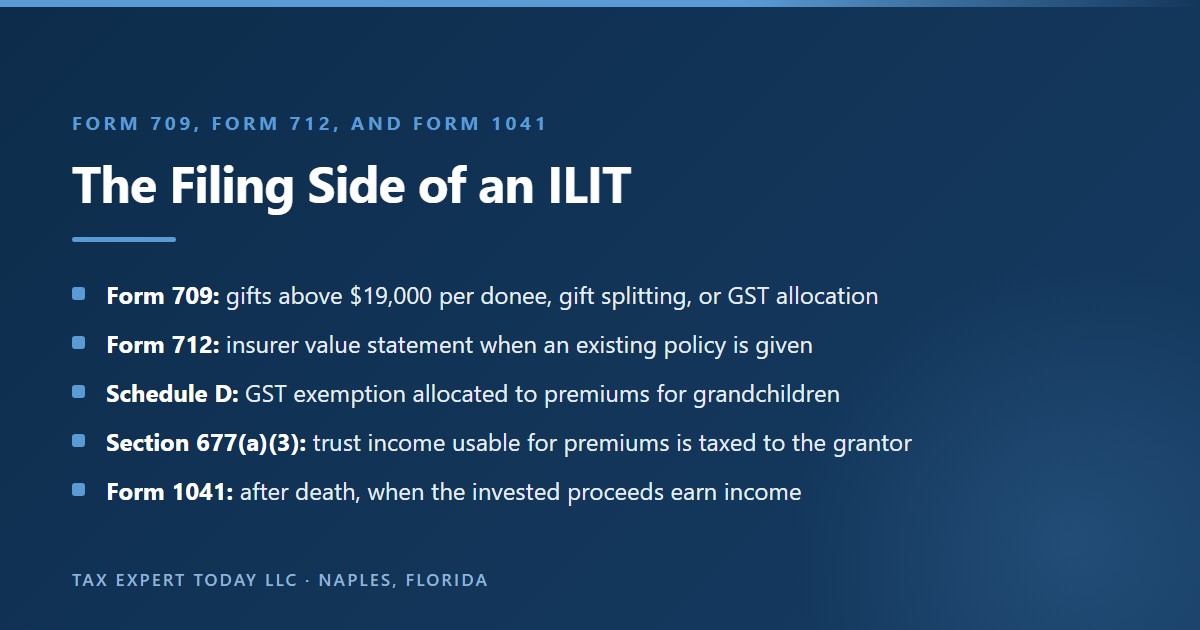
A Form 709 is required when contributions to any beneficiary exceed the $19,000 annual exclusion, when any part of the gift is a future interest, when spouses elect to split gifts, and when the donor wants to allocate GST exemption or elect out of automatic allocation. Many ILIT donors file every year even when no tax is due.
- Over the exclusion: any donee whose gifts for the year exceed $19,000.
- Future interests: a gift not covered by a valid withdrawal right.
- Gift splitting: the election is made only on Form 709.
- GST allocation or election out: made on a timely Form 709.
- Policy transfer: a gift of an existing policy usually exceeds the exclusion.
The Instructions for Form 709 state that a return is required for gifts to any person totaling more than the annual exclusion, and that gifts of future interests require a return “even if the gift was under” the exclusion. Spouses may not file a joint gift tax return; each spouse who is required to file files separately. The return is due April 15 of the year after the gift, and it is extended automatically when the donor extends the income tax return, or separately with Form 8892. The current form and any updates are posted on the IRS About Form 709 page.
The instructions add a requirement specific to trusts: on the return reporting the first transfer to a trust, attach a certified or verified copy of the trust instrument. For later transfers, a brief description of the trust terms or a copy of the instrument may be attached. Adequate disclosure on the return also starts the statute of limitations on the valuation of the gift, which matters most in the year an existing policy is transferred.
| Event in the year | Form 709 required? | What is reported |
|---|---|---|
| Contributions within $19,000 per power holder, valid powers, no GST issue | Generally no | Nothing, though some donors file to document GST positions |
| Contributions above the annual exclusion for any donee | Yes | The gift on Schedule A; exclusion and lifetime exclusion used |
| Contribution without a valid withdrawal right | Yes | Gift of a future interest, no annual exclusion |
| Spouses elect to split gifts | Yes, for each spouse who must file | Consent on the return |
| Allocation of GST exemption, or election out | Yes | Schedule D and any election statement |
| Transfer of an existing policy | Usually yes | Policy value from Form 712; trust instrument attached for a first transfer |
How is an existing policy valued when it is given to the trust?
A gift of an existing policy is valued at fair market value, which for a policy still paying premiums is usually approximated by the interpolated terminal reserve plus the unearned portion of the last premium. The insurer reports the figures on Form 712, which is attached to the Form 709. A paid-up or single premium policy may be valued differently.
- Form 712: the insurer’s life insurance statement, requested by the owner.
- Interpolated terminal reserve: the reserve value adjusted to the gift date.
- Plus unearned premium: the part of the last premium covering time after the gift.
- Not cash surrender value: the surrender value can understate the gift.
Treasury Regulation 25.2512-6 values a gift of a policy on which further premiums are due by adding to the interpolated terminal reserve at the date of the gift the proportionate part of the last gross premium that covers the period after that date, unless the contract’s unusual nature makes that approximation unreasonable. The Form 712 provides those figures. The Form 709 instructions caution that for single-premium or paid-up policies, where the surrender value exceeds replacement cost, the full economic value should be reported.
For a hypothetical whole life policy with an interpolated terminal reserve of $180,000 and $4,000 of unearned premium on the transfer date, the gift would be about $184,000. With three Crummey power holders and a respected withdrawal right over the transferred policy, some of that may be covered by annual exclusions; in many trusts the withdrawal right applies only to cash, and the full $184,000 uses lifetime exclusion. A term policy with no cash value typically has a small gift value, which is one reason transferred term policies are less costly to move from a gift tax standpoint.
| Policy type | Interpolated terminal reserve | Unearned premium | Approximate gift value |
|---|---|---|---|
| Whole life, premiums continuing | $180,000 | $4,000 | $184,000 |
| No-lapse universal life with a low reserve | $25,000 | $6,000 | $31,000, subject to the unusual contract caution |
| Term policy | Minimal | Unearned premium only | Usually small |
| Paid-up policy | Not applicable | None | Full economic value, which may exceed surrender value |
Does an ILIT need GST exemption allocated?
If grandchildren or later generations can benefit, usually yes. Annual exclusion gifts to a trust with several beneficiaries do not automatically receive a zero GST inclusion ratio. Section 2642(c)(2) gives that result only to a trust for a single individual whose assets would be taxed in that individual’s estate, which most ILITs are not.
- Nontaxable gift is not GST exempt in a multi-beneficiary trust.
- Inclusion ratio of zero requires an allocation equal to the transfers.
- Allocation is irrevocable once made.
- Leverage: exemption is applied to premiums, while the protected value is the death benefit.
Section 2642(c)(1) gives a zero inclusion ratio to a direct skip that is a nontaxable gift, but section 2642(c)(2) withdraws that relief for transfers to a trust unless, during the life of the individual, no portion of the trust may be distributed to anyone else, and the trust assets will be included in that individual’s estate if the trust has not ended at death. An irrevocable life insurance trust for children and grandchildren generally fails both conditions. The premium gifts can be free of gift tax under the annual exclusion and still be fully exposed to the generation-skipping transfer tax when the proceeds later pass to grandchildren.
The solution is to allocate GST exemption under IRC section 2631. Section 2631(c) sets the GST exemption equal to the basic exclusion amount, which is $15,000,000 for 2026. Allocating exemption equal to each year’s contributions keeps the inclusion ratio at zero, and section 2631(b) makes each allocation irrevocable. Our guide to the dynasty trust covers the GST framework in more depth for trusts designed to last for several generations.
| Trust type | Annual exclusion gift | Automatic zero GST inclusion ratio? | Allocation needed? |
|---|---|---|---|
| Single-beneficiary trust taxed in the beneficiary’s estate | Yes, if a present interest | Yes, under IRC 2642(c)(1) | Generally no |
| ILIT for children only, with no skip person who can benefit | Yes, with Crummey powers | Not relevant | No GST exposure |
| ILIT for children, then grandchildren | Yes, with Crummey powers | No, IRC 2642(c)(2) | Yes, to protect the later generations |
| ILIT for grandchildren directly | Yes, with Crummey powers | No, unless the single-beneficiary rules are met | Yes |
How does automatic GST allocation work for an ILIT?
Section 2632(c) automatically allocates unused GST exemption to an indirect skip to a “GST trust.” Some irrevocable life insurance trusts qualify, but many do not, because the definition excludes trusts in which children may withdraw more than 25 percent before age 46. A preparer should decide each year whether to rely on the rule or elect out.
- GST trust definition: a trust that could have a generation-skipping transfer, with listed exceptions.
- Crummey powers within the exclusion are disregarded in applying the estate-inclusion exception.
- Age 46 rule: trusts that distribute more than 25 percent to children before age 46 are excluded.
- Elections: to opt out, or to treat a trust as a GST trust, on a timely Form 709.
Section 2632(c)(1) provides that if an individual makes an indirect skip during life, unused GST exemption is allocated to the extent needed to make the inclusion ratio zero. Section 2632(c)(3)(B) then defines a GST trust by listing exceptions, including a trust in which more than 25 percent of the corpus must be distributed to, or may be withdrawn by, non-skip persons before age 46. The flush language of that subparagraph adds that a non-skip person’s right to withdraw no more than the annual exclusion amount is disregarded in deciding whether the property would be included in that person’s estate. Ordinary Crummey powers therefore do not, by themselves, disqualify an irrevocable life insurance trust.
Because the answer depends on the trust’s distribution terms, the safest practice is an affirmative decision documented on the return. The Form 709 instructions explain that a donor who wants to elect out of the automatic allocation must file Form 709 and attach a statement describing the transaction and the extent to which the automatic allocation is not to apply. A donor who wants allocation, and is unsure whether the trust is a GST trust, can make an affirmative allocation on Schedule D or elect under section 2632(c)(5)(A)(ii) to treat the trust as a GST trust for future transfers.
| Trust facts | Likely GST trust status | Common approach on Form 709 |
|---|---|---|
| Children receive their shares outright at age 35 | Often not a GST trust (age 46 exception) | Affirmative allocation if grandchildren may benefit |
| Lifetime trusts for children, remainder to grandchildren | Often a GST trust | Confirm automatic allocation on Schedule D, or allocate affirmatively |
| Children only, no possible skip transfer | Not a GST trust | Consider electing out to preserve exemption |
| Uncertain distribution terms | Unclear | Elect to treat as a GST trust, or allocate affirmatively each year |
How much leverage does GST exemption get inside an ILIT?
Because exemption is allocated to the premiums while the protected value is the death benefit, an irrevocable life insurance trust stretches GST exemption unusually far. In a hypothetical, $1,200,000 of exemption allocated to 20 years of $60,000 premiums could protect a $5,000,000 death benefit from GST tax for later generations, a ratio of about four to one.
- Allocated: exemption equal to each premium gift.
- Protected: the death benefit and its growth, if the inclusion ratio stays zero.
- Without allocation: a later taxable termination or distribution can be taxed at 40 percent.
- Timing matters: late allocations are valued at the trust’s value when made.
The leverage comes from the inclusion ratio mechanics in IRC section 2642(a). A trust with an inclusion ratio of zero is permanently exempt, regardless of how much it later grows. If exemption is allocated on a timely Form 709 to each premium gift, the trust stays at zero. If the allocation is late, it is valued at the trust’s value at the time of the late allocation, which, for an irrevocable life insurance trust holding a cash value policy, may be higher than the premiums, and after death would be the full proceeds.
The table uses a hypothetical $60,000 annual premium, a $5,000,000 death benefit received in year 20, and a later distribution of the full amount to grandchildren. It ignores growth after death and assumes a 40 percent GST rate on an inclusion ratio of one.
| Line | Timely allocation each year | No allocation |
|---|---|---|
| Total premiums contributed over 20 years | $1,200,000 | $1,200,000 |
| GST exemption allocated | $1,200,000 | $0 |
| Inclusion ratio | Zero | One |
| Death benefit later passing to grandchildren | $5,000,000 | $5,000,000 |
| GST tax at 40 percent | $0 | About $2,000,000 |
| Exemption used per dollar protected | About $0.24 | Not applicable |
Is an ILIT a grantor trust for income tax?
Often yes, in part. Section 677(a)(3) treats the grantor as owner of trust income that may be applied, without an adverse party’s consent, to pay premiums on insurance on the life of the grantor or the grantor’s spouse. Many ILITs have little income, so the practical effect is small, but trust income can be taxed to the grantor.
- Section 677(a)(3): income usable for premiums on the grantor’s or spouse’s life.
- Grantor taxed: on the trust’s income to the extent the rule applies.
- Little income: a trust holding only a term policy and cash may have nothing to report.
- Drafted grantor trusts: some ILITs add other powers to make the whole trust a grantor trust.
IRC section 677(a)(3) treats the grantor as owner of any portion of a trust whose income, without the approval or consent of an adverse party, may be applied to the payment of premiums on policies of insurance on the life of the grantor or the grantor’s spouse, other than policies irrevocably payable to charity. Because nearly every ILIT authorizes the trustee to pay premiums from trust income, the income portion of most ILITs is a grantor trust under IRC section 671 and the related sections.
Some ILITs are drafted as full grantor trusts on purpose, often with a power of substitution held in a nonfiduciary capacity. Full grantor trust status lets the trust buy an existing policy from the insured without triggering the transfer-for-value rule, as discussed next, and lets the insured pay the trust’s income tax without making an additional gift. Any power used for that purpose must be reviewed against section 2042, because the power must not give the insured an incident of ownership in the policy.
| Design | Income tax status | Who reports trust income |
|---|---|---|
| Trustee may use income to pay premiums on the grantor’s life | Grantor trust as to income, IRC 677(a)(3) | The grantor, for that income |
| Trust drafted with a nonfiduciary substitution power | Grantor trust as to the whole trust | The grantor |
| After the grantor’s death | Non-grantor trust | The trust on Form 1041, or beneficiaries through distributions |
| Trust with no income during the year | Grantor status has no practical effect | Nothing to report in many cases |
Does an ILIT need an EIN and a Form 1041?
An irrevocable life insurance trust generally obtains its own employer identification number so the trustee can open an account. Whether it files Form 1041 depends on its income and status. A non-grantor trust must file if it has any taxable income or gross income of $600 or more. A grantor trust may use optional reporting methods.
- EIN: needed for the trust bank account and the policy ownership records.
- Non-grantor trust: files Form 1041 at $600 of gross income or any taxable income.
- Grantor trust: may use an optional filing method under Regulation 1.671-4.
- After death: invested proceeds usually produce income that must be reported.
The Instructions for Form 1041 require the fiduciary of a domestic trust taxable under section 641 to file if the trust has any taxable income, gross income of $600 or more regardless of taxable income, or a nonresident alien beneficiary. The same instructions explain that grantor type trusts have reporting requirements that differ significantly from other trusts and have optional filing methods available. Regulation 1.671-4 sets out those methods, including furnishing the grantor’s identification number to payers in some cases.
During the insured’s life, a typical ILIT that holds a term policy and moves cash through its account in a few weeks each year has little or no income, so there is often no return to file. After the death benefit is paid, the picture changes. The proceeds themselves are generally excluded from income, but interest on delayed payment and investment income on the invested proceeds are taxable, and the trust is a non-grantor trust once the grantor has died.
| Stage | Typical income | Filing position |
|---|---|---|
| During life, term policy, cash passes through quickly | None or minimal interest | Often no Form 1041 required |
| During life, grantor trust with investment income | Interest or dividends | Grantor reporting, possibly under an optional method |
| Year of death, proceeds received | Interest on proceeds, investment income after receipt | Form 1041 if $600 of gross income or any taxable income |
| Ongoing administration after death | Investment income | Annual Form 1041 and Schedules K-1 for distributions |
Does the transfer-for-value rule apply to an ILIT?
A gift of a policy to an irrevocable life insurance trust is not a transfer for value, so the death benefit generally stays income tax free. A sale can be, which can make part of the death benefit taxable. The IRS treats a sale to a fully grantor trust as a transfer to the insured, which is an exception.
- Gift: carryover basis, so the exception in section 101(a)(2)(A) applies.
- Part gift, part sale: generally still within the carryover basis exception.
- Sale to a non-grantor ILIT: the death benefit above consideration and later premiums can be taxable.
- Sale to a grantor trust: treated as a transfer to the insured under Rev. Rul. 2007-13.
Section 101(a)(2) limits the income exclusion for a policy transferred for valuable consideration to the consideration paid plus later premiums, unless the transferee’s basis is determined in whole or in part by reference to the transferor’s basis, or the transfer is to the insured, a partner of the insured, a partnership in which the insured is a partner, or a corporation in which the insured is a shareholder or officer. A gift qualifies under the first exception. A sale does not, unless another exception applies.
In Revenue Ruling 2007-13, the IRS concluded that a grantor who is treated as the owner of a trust is treated as the owner of the policy for income tax purposes, so a transfer to that grantor trust is a transfer to the insured. This matters when an existing policy is sold to the trust rather than given, for example to avoid a large gift. A sale does not avoid the three-year rule question in every case, and the estate tax analysis of a sale for full value differs from a gift; that interplay deserves careful review.
| How the policy moves | Transfer for value? | Death benefit income tax result |
|---|---|---|
| Gift to the irrevocable life insurance trust | No, carryover basis exception | Generally excluded |
| Trust buys a new policy | No transfer | Generally excluded |
| Sale to a fully grantor ILIT | Treated as a transfer to the insured | Generally excluded |
| Sale to a non-grantor ILIT | Yes, unless another exception applies | Excess over consideration and premiums can be taxable |
Is the death benefit taxable to the trust or the beneficiaries?
Generally no. Section 101(a)(1) excludes amounts received under a life insurance contract by reason of the insured’s death, and the exclusion applies to the irrevocable life insurance trust as beneficiary. What becomes taxable is what the proceeds earn afterward: interest on delayed payments, investment income, and gains realized after the trust reinvests the money.
- Death benefit: generally excluded from gross income.
- Interest on proceeds: taxable when the insurer holds funds and pays interest.
- Investment income: taxable to the trust or to beneficiaries who receive distributions.
- Estate tax: not imposed if section 2042 and section 2035 are both avoided.
IRC section 101(a)(1) excludes from gross income amounts received under a life insurance contract if paid by reason of the death of the insured, subject to the transfer-for-value limits discussed above and to reporting rules for certain policy sales. The exclusion applies whether the recipient is an individual or a trust. Settlement options that pay the proceeds over time include an interest component that is taxable as it is paid.
Once the trustee invests the proceeds, the trust is an ordinary non-grantor trust for income tax purposes. Trusts reach the highest federal income tax bracket at a far lower income level than individuals, so many trustees distribute income to beneficiaries, who report it on their own returns through Schedule K-1. The trust document determines how much discretion the trustee has to do that.
| Amount | Income tax treatment | Rule |
|---|---|---|
| Lump-sum death benefit | Generally excluded | IRC 101(a)(1) |
| Interest paid by the insurer on delayed proceeds | Taxable | IRC 61; IRC 101(c) |
| Installment settlement option, interest element | Taxable as received | IRC 101(d) |
| Investment income after reinvestment | Taxable to the trust or distributees | Subchapter J; Form 1041 |
How does the ILIT pay estate tax without pulling the proceeds back in?
The trustee may lend money to the estate or buy assets from it, but the trust should not be required to pay the estate’s taxes or debts. Proceeds that must be used for the estate’s obligations are treated as receivable by the executor under the regulations and can be included in the gross estate. Permissive authority is the usual approach.
- Purchase of assets: the trust buys estate assets at fair value, giving the estate cash.
- Loan to the estate: on commercially reasonable terms.
- Permissive, not mandatory: the trustee may, but is not required to, help the estate.
- Same beneficiaries: works most smoothly when the trust and the estate benefit the same people.
Regulation 20.2042-1(b) treats proceeds as receivable by or for the benefit of the estate if they are subject to an obligation, legally binding on the other beneficiary, to pay taxes, debts, or other charges enforceable against the estate. A trust provision directing the trustee to pay the estate’s tax is such an obligation. A provision that only allows the trustee to buy assets from the estate or lend to it, in the trustee’s discretion and for adequate value, is the structure most commonly used to provide liquidity without inclusion.
Liquidity is often the reason the policy was bought. Estates that consist of a closely held business, rental real estate, or a family property can owe a large tax with little cash. An irrevocable life insurance trust that buys a building interest or lends to the estate lets the estate pay the tax on time without a forced sale, while the value stays within the family’s plan. Our guide on selling a business and taxes covers related liquidity questions for business owners planning an exit.
| Mechanism | Inclusion risk under Reg. 20.2042-1(b) | Key condition |
|---|---|---|
| Mandatory direction to pay estate tax | High | Avoided in most ILIT drafting |
| Discretionary purchase of estate assets | Low | Fair market value paid |
| Discretionary loan to the estate | Low | Adequate interest and repayment terms |
| Distribution to beneficiaries who then help the estate | Low, if not required | No binding obligation |
What is a second-to-die policy in an ILIT?
A second-to-die or survivorship policy insures two lives, usually spouses, and pays at the second death. It is common in ILITs because the marital deduction often defers estate tax until the second death, which is exactly when the policy pays. Premiums are often lower than for two separate policies with the same total coverage.
- Pays at the second death, when the estate tax is usually due.
- Both spouses are insureds, so neither should hold incidents of ownership.
- Both spouses may contribute from their own funds.
- Underwriting: may be available where one spouse is not insurable alone.
The fit comes from the unlimited marital deduction in IRC section 2056. A plan that leaves everything to the surviving spouse, outright or in a qualifying trust, usually owes no federal estate tax at the first death, and portability of the first spouse’s unused exclusion moves that exclusion to the survivor. The tax arrives at the second death, and a survivorship policy is designed to pay at that moment. Both spouses are insureds, so the trust must keep both out of any incident of ownership.
Gift tax planning is somewhat simpler for a survivorship ILIT that names only descendants, because both spouses can contribute directly and each uses his or her own exclusions without relying on gift splitting. Where the spouses’ assets are unequal, the source of each contribution should be documented. A survivorship ILIT is also frequently paired with other lifetime trusts; our guides to the grantor retained annuity trust and the qualified personal residence trust describe two of the most common companions.
| Factor | Single-life policy | Second-to-die policy |
|---|---|---|
| When it pays | At the insured’s death | At the second death |
| Match to estate tax timing | Good for an unmarried insured | Good for married couples using the marital deduction |
| Trustee options | Non-insured spouse possible with limits | Neither spouse |
| Contribution sources | The insured, often with gift splitting | Either or both spouses |
| Premium level | Based on one life | Often lower for the same face amount |
What happens to an ILIT if the policy is no longer needed?
The trust cannot simply be revoked, but it is not frozen. The trustee may let a policy lapse, surrender it for its cash value, exchange it, or sell it, within the trust terms. State law may allow decanting into a new trust or modification with beneficiary consent or court approval. Each route has tax consequences that should be reviewed first.
- Stop contributions: the policy may lapse or convert to reduced paid-up coverage.
- Surrender: cash value stays in the trust for the beneficiaries.
- Exchange: a section 1035 exchange into a different policy held by the trust.
- Decanting or modification: available under some state laws and trust terms.
The most common change is not legal at all. A family whose estate tax exposure has fallen, perhaps because the exclusion is now $15,000,000 per person, may decide the premiums are no longer worth paying. The grantor stops contributing, and the trustee chooses among letting the policy lapse, taking reduced paid-up coverage, or surrendering it. The cash stays in the trust, because the grantor gave it away. Families should be aware that a surrender can produce taxable gain inside the trust if the cash value exceeds the premiums paid.
Divorce raises harder questions. A spouse named as a beneficiary may remain one after divorce unless the trust document or state law provides otherwise, and the insured cannot unilaterally change that. Many modern ILITs define “spouse” as the person married to the grantor at the relevant time, which addresses the problem in advance. Where the document does not, modification options under state trust law are worth reviewing with counsel.
| Option | What happens to the coverage | Main tax issue |
|---|---|---|
| Stop contributing | Policy may lapse or go paid up | None at the grantor level; possible trust-level gain on lapse with a loan |
| Surrender for cash value | Coverage ends | Gain above basis taxable to the trust |
| Section 1035 exchange | New policy owned by the trust | Tax-deferred if requirements are met; new policy is not a transfer by the insured |
| Sale of the policy | Coverage transferred to the buyer | Gain and reporting rules for policy sales |
| Decanting or modification | Policy moves to a new trust or terms change | Possible gift by beneficiaries; GST status review |
What does the trustee do every year?
Each year the trustee receives the contribution, sends Crummey notices, waits out the withdrawal period, pays the premium, reviews the policy’s performance, and gives the grantor’s preparer the information needed for any Form 709 or Form 1041. Good records for each step are what make the tax positions defensible decades later.
- Contribution received and recorded.
- Notices sent and acknowledgments filed.
- Premium paid from the trust account.
- Policy reviewed for performance and lapse risk.
- Information sent to the preparer for the gift and income tax returns.
Trustees of ILITs are often family members with no trust experience, and the role can last 30 or 40 years. The policy review is easy to overlook. Universal life policies in particular can lapse if credited rates fall below what was illustrated, and an in-force illustration every few years shows whether the current premium will carry the policy. A lapse late in life can mean the coverage is lost when it is most needed, with no way to replace it.
The table below is a general calendar for a trust with a single annual premium due in the spring. Trusts with monthly or quarterly premiums repeat the notice cycle more often, which is one reason some families move to an annual premium.
| Month | Task | Responsible party |
|---|---|---|
| January | Gather prior year gift records and notices for the Form 709 review | Trustee and preparer |
| February 1 | Grantor transfers the premium amount to the trust account | Grantor |
| February 2 to 5 | Crummey notices sent to each power holder | Trustee |
| March 7 | Withdrawal period ends; trustee records that no withdrawals were made | Trustee |
| March 10 | Premium paid from the trust account | Trustee |
| April 15 | Form 709 filed or extended for the prior year, if required | Grantor and preparer |
| Fall | In-force illustration and policy review | Trustee and insurance advisor |
What are the most common ILIT mistakes?
The most frequent problems are paying premiums directly to the insurer, skipping Crummey notices, the insured signing the application as owner, failing to allocate GST exemption, ignoring the five and five lapse limit, naming the insured as trustee, and requiring the trust to pay estate taxes. Most of these are fixed by process rather than by a new document.
- Direct premium payments that bypass the trust account.
- Missing notices that leave the annual exclusion undocumented.
- Insured as applicant that turns a new policy into a transferred one.
- No GST decision on returns for trusts that will reach grandchildren.
- Mandatory estate tax payment clauses.
Several of these mistakes are silent for years. A missing Form 709 does not produce a notice from the IRS while the grantor is alive and no tax is due. The problem surfaces when the estate tax return is prepared and the preparer must reconstruct decades of gifts, notices, and allocations. Late allocation of GST exemption is possible, but it is valued at the trust’s value when made, which can be far higher than the premiums.
An irrevocable life insurance trust that has run for years without a review can easily have at least one gap. Often the forward fix is straightforward: route all premiums through the trust account, send notices for every contribution, and file a Form 709 that documents the GST position. Earlier years may need a separate review with counsel and a decision about whether late allocations or relief requests are worthwhile.
| Mistake | Rule involved | Usual fix going forward |
|---|---|---|
| Grantor pays the insurer directly | IRC 2503(b) present interest | All gifts to the trust account, then premiums by the trustee |
| No Crummey notices | Crummey; Rev. Rul. 81-7 | Notice for each contribution, with delivery records |
| Insured applied as owner, then assigned | IRC 2035(a) | Trust as applicant for any new coverage |
| Insured serves as trustee | Reg. 20.2042-1(c)(4) | Resignation and an independent successor, reviewed with counsel |
| No GST allocation for a multigenerational trust | IRC 2632, 2642 | Affirmative allocation on Form 709; review late allocation for prior years |
| Withdrawal rights exceed five and five with no protection | IRC 2514(e) | Review beneficiary gift reporting; consider trust design in new trusts |
| Trust required to pay estate taxes | Reg. 20.2042-1(b) | Counsel review of modification options |
How does an ILIT compare with a SLAT, a dynasty trust, and a GRAT?
An irrevocable life insurance trust holds insurance to create or replace wealth outside the estate. A SLAT moves existing assets out while a spouse can still benefit. A dynasty trust holds assets for several generations with GST exemption. A GRAT shifts growth above a set rate. They often work together, and an ILIT can be drafted as a dynasty trust.
- ILIT: insurance, leverage on premiums.
- SLAT: existing assets, indirect spousal access.
- Dynasty trust: long-term, GST exempt structure.
- GRAT: growth transfer with little or no gift.
The tools differ mainly in what goes in and when the value arrives. An ILIT receives modest annual gifts and produces a large value at death. A spousal lifetime access trust receives a large gift now and keeps a spouse in the beneficiary class. A dynasty trust is designed to stay exempt from GST tax for as long as state law allows. A grantor retained annuity trust moves appreciation above the section 7520 rate. Charitable families may also use a charitable remainder trust paired with an ILIT that replaces, for the children, the value given to charity, or a charitable lead trust.
The ILIT is the one tool whose value depends on an insurance contract, so it carries a risk the others do not: the policy can lapse. It is also the one tool where the transferred value at death can be many times the gifts made, which is why it is so efficient for GST exemption. A plan that combines tools typically decides first how much liquidity the estate will need at death and whether insurance is the most efficient way to provide it.
| Trust | Typical asset | Main tax lever | Grantor or spouse access | Main risk |
|---|---|---|---|---|
| ILIT | Life insurance | Proceeds outside the estate; GST leverage | Generally none for the insured | Policy lapse; administrative errors |
| SLAT | Investments, business interests | Uses lifetime exclusion now; growth outside the estate | Indirect, through the spouse | Divorce or death of the spouse |
| Dynasty trust | Any asset | GST exempt for many generations | Usually none | Long-term administration and state law limits |
| GRAT | Appreciating assets | Growth above the section 7520 rate passes free of gift tax | Annuity for the term | Death during the term; flat performance |
| Charitable remainder trust | Appreciated assets | Income stream, charitable deduction | Income for life or a term | Value passes to charity, not heirs |
What does an irrevocable life insurance trust mean for a Florida family?
Florida has no estate tax or inheritance tax, so for a Florida resident the estate tax reason for an irrevocable life insurance trust is federal only. Florida law already shields a resident’s cash value and most death proceeds from the insured’s creditors, so the trust’s value lies in federal tax, control, and protection after proceeds reach the family.
- No Florida estate tax: the federal $15,000,000 exclusion is the relevant threshold.
- Cash value protected: Florida Statutes section 222.14.
- Proceeds protected from the insured’s creditors: section 222.13, when payable to a named beneficiary.
- Former residents: a prior state’s estate tax may still matter if domicile is unclear.
Florida Statutes section 222.14 provides that the cash surrender values of life insurance policies issued on the lives of Florida citizens or residents are not liable to attachment, garnishment, or legal process in favor of a creditor of the insured, with a narrow exception for policies effected for the creditor’s benefit. Section 222.13 provides that proceeds of insurance on the life of a Florida resident inure to the named beneficiary and are exempt from the claims of the insured’s creditors unless the policy or an assignment provides otherwise. Once paid to a beneficiary, though, the money is the beneficiary’s and is exposed to that beneficiary’s creditors and divorces. An irrevocable life insurance trust with spendthrift terms keeps it in trust.
Many Southwest Florida families arrived from states that impose their own estate taxes at thresholds far below the federal exclusion. Until Florida domicile is clearly established and the prior state ties are cut, a prior state may still claim the right to tax. Our guide on how to establish Florida residency explains that process. Families with charitable goals may also find our guide to the donor-advised fund tax deduction useful alongside an irrevocable life insurance trust plan.
| Issue | Florida position | What an ILIT adds |
|---|---|---|
| State estate or inheritance tax | None | Federal estate tax planning only |
| Cash value and the insured’s creditors | Protected under section 222.14 | Removes the policy from the insured’s estate as well |
| Proceeds and the insured’s creditors | Protected under section 222.13 when payable to a named beneficiary | Same protection, with trust terms on how proceeds are used |
| Proceeds after they reach a beneficiary | Beneficiary’s own property | Spendthrift protection while held in trust |
| Prior residence in a state with an estate tax | Domicile must be established | Keeps proceeds outside any state’s taxable estate |
Irrevocable Life Insurance Trust Help in Naples & Southwest Florida
ILIT help Naples families ask for usually starts with three questions: whether the estate is large enough for federal tax to matter, whether an existing policy should be transferred or replaced, and whether the trust has been run correctly each year. Our office in Naples, Florida reviews the trust, the notices, and the gift tax filings.
Southwest Florida has a large population of business owners, retirees, and families with significant real estate, many of whom bought life insurance years ago for liquidity. An irrevocable life insurance trust review is usually part of a wider Naples tax planning engagement that also covers lifetime gifts, trusts, and the estate’s liquidity needs. The tax side of that work, including the Form 709 filings, GST allocations, and trust income tax returns, is where most ILITs need attention after the documents are signed.
- Trust and policy review. Ownership, beneficiary designations, and incidents of ownership.
- Crummey process review. Notices, timing, and records for each contribution.
- Form 709 preparation. Gifts, gift splitting, Form 712 values, and GST allocation.
- Trust income tax filings. Grantor trust reporting and Form 1041 after death.
- Coordination with counsel. Working with the family’s estate planning attorney and insurance advisor.
Tax Expert Today LLC
11983 Tamiami Trail N, Naples FL 34110
Phone: (239) 441-2005
Hours: Monday to Friday, 10:00 to 5:00 ET
Where can I get help with an irrevocable life insurance trust in Naples, FL? Tax Expert Today LLC, at 11983 Tamiami Trail N in Naples, Florida, helps families with the tax side of irrevocable life insurance trusts: reviewing ownership and trustee arrangements, organizing Crummey notices, preparing Form 709 gift tax returns with gift splitting and GST allocation, valuing transferred policies with Form 712, and filing trust income tax returns. The firm includes tax advisors, enrolled agents, CPAs, and attorneys, and serves clients in all 50 states. Results depend on each family’s facts.
When to Engage a Professional
An irrevocable life insurance trust is a document drafted by an attorney, but its tax results depend on what happens every year after it is signed. A professional review is worthwhile before a policy is transferred, when premiums exceed the annual exclusions, when grandchildren are beneficiaries, when no Form 709 has ever been filed, or when the insured’s health changes.
- Before transferring an existing policy, to weigh the three-year rule and the gift value.
- When premiums exceed annual exclusion capacity, so the Form 709 is filed correctly.
- When grandchildren can benefit, so GST exemption is allocated on time.
- When no notices or returns exist for prior years.
- When the policy may lapse or no longer fits the plan.
- At the insured’s death, for the estate tax return and the trust’s income tax filings.
Tax Expert Today LLC is a multidisciplinary practice of tax advisors, enrolled agents, certified public accountants, and attorneys serving clients in all 50 states. To discuss how an irrevocable life insurance trust fits within a broader Naples tax planning approach, our estate and trust planning services, or our tax planning services, call (239) 441-2005. Readers working through related decisions may also find our guides to the lifetime gift tax exemption and the qualified personal residence trust useful.
This article is general information about federal tax provisions and is not tax, legal, insurance, or investment advice for any specific person. Figures were verified against primary sources on October 13, 2026 and are hypothetical illustrations, not client outcomes. Whether a trust achieves the results described depends on how it is drafted and administered in each year, and on future changes in law. Tax laws apply differently to each person’s facts, and results always vary. Consult a qualified professional about your situation before taking any action.
Published October 13, 2026 by Dr. Pellumb Kabashi « Back to Learning Center
Have a question this article touches on?
Tax Expert Today LLC, based in Naples, Florida and serving clients across the United States.
Schedule a Consultation (239) 441-2005