
By Dr. Pellumb Kabashi, DBA, MBA, CES, CFE, EA
Founder, Tax Expert Today LLC · Tax advisors, enrolled agents, CPAs, and attorneys · Serving clients in all 50 states
Quick answer: Pennsylvania inheritance tax does not end when you move to Florida, but it narrows sharply. For a nonresident decedent, Pennsylvania taxes only real estate and tangible personal property located in Pennsylvania, including property held in a living trust. Stocks, bonds, IRAs and bank accounts are exempt. Rates run from 0 percent for a spouse to 15 percent for nieces, nephews and friends. Call (239) 441-2005 for a free consultation.
Published: September 2026
Does Pennsylvania Inheritance Tax Apply After You Move to Florida?
Yes, but only to part of the estate. Once you are domiciled in Florida, Pennsylvania inheritance tax reaches only real property and tangible personal property located in Pennsylvania. Your brokerage accounts, IRAs, bank deposits and other intangible assets fall outside it, because the statute exempts the intangible property of a nonresident decedent entirely.
- Still taxable after the move. A Pennsylvania house, a vacation cabin, farmland, rental buildings and the furniture, cars, boats and art kept at those properties.
- No longer taxable. Stocks, bonds, mutual funds, retirement accounts, bank and brokerage accounts, and business interests held as shares or membership units.
- Taxable only if domicile is disputed. If Pennsylvania later concludes you never really left, every asset you own comes back into the calculation.
- Florida adds nothing. Florida has no inheritance tax and no estate tax of its own, so the Pennsylvania return is the only state death tax filing in most of these estates.
The rule sits in the definitions section of the statute. Article XXI of the Tax Reform Code of 1971, codified at 72 P.S. §9102, defines taxable “property” for a resident decedent as Pennsylvania real and tangible property plus “all intangible personal property” wherever it is. For a nonresident decedent, the same definition covers only “real property and all tangible personal property … having its situs in this Commonwealth, including property held in trust.” Section 2111(h) of the Code (72 P.S. §9111(h)) then removes any doubt: intangible personal property of a decedent who was a nonresident at death “is exempt from inheritance tax.”
That is a large change for a typical Pennsylvania household that relocates to Southwest Florida. For a retired couple whose wealth sits mostly in investment and retirement accounts, the move takes most of the estate outside the Pennsylvania tax base. What it does not do is reach back and untax the house in Bucks County, the lake place in the Poconos or the family farm in Lancaster County. Those assets are taxed because of where they sit, not because of where the owner lived.
| Asset | Pennsylvania resident decedent | Florida domiciliary (nonresident decedent) | Authority |
|---|---|---|---|
| Pennsylvania real estate | Taxable | Taxable | 72 P.S. §9102, “property” (1) and (4) |
| Furniture, vehicles, boats and art located in Pennsylvania | Taxable | Taxable | 72 P.S. §9102, “property” (1) and (4) |
| Pennsylvania real estate held in a revocable living trust | Taxable | Taxable (“including property held in trust”) | 72 P.S. §9102 and §9107(c)(7) |
| Brokerage accounts, stocks and bonds | Taxable | Exempt | 72 P.S. §9111(h) |
| IRAs and other retirement accounts | Generally taxable, with exceptions | Exempt as intangible property | 72 P.S. §9111(h) |
| Bank accounts, including Pennsylvania banks | Taxable | Exempt | 72 P.S. §9111(h) and REV-1737-A instructions |
| Life insurance proceeds | Exempt | Exempt | 72 P.S. §9111(d) |
| Real estate in Florida or another state | Not taxable unless under contract of sale in a state that does not tax it | Not taxable | 72 P.S. §9102, “property” (3) |
If you are still deciding when and how to complete the move, our guide to how to establish Florida residency covers the domicile steps, and our guide to Florida estate planning for new residents covers the arrival side of the estate plan. This article stays on the Pennsylvania departure side: what the old state can still reach and how its nonresident return works, the same departure side approach we took for the New Jersey exit tax and the Illinois exit tax.
What Pennsylvania Property Is Still Taxed for a Nonresident?
Pennsylvania taxes the real estate and tangible personal property that sit in Pennsylvania on the date of death. That means land, buildings, condominium units and leaseholds, plus physical items located there such as furniture, vehicles, boats, equipment and collections. The property is taxed whether it passes by will, by trust, by joint title or by the law of another state.
- Real property. The house you kept, a seasonal home, rental property, undeveloped land and farm acreage.
- Tangible personal property. Contents of the Pennsylvania home, a car registered and garaged there, a boat on a Pennsylvania lake, and art or collectibles left behind.
- Property in a trust. The nonresident definition expressly includes Pennsylvania property “held in trust.”
- Jointly titled property. A share of property held with anyone other than a spouse, as the joint tenancy section explains below.
Location is judged at death, which gives the tangible property rule a practical edge. The contents of a Pennsylvania house are Pennsylvania tangible property. The same furniture, paintings and jewelry shipped to Naples are Florida tangible property and are outside the Pennsylvania tax. The REV-1737-A instructions state the rule plainly: all real property and all tangible personal property located within Pennsylvania is taxable, and intangible property located in Pennsylvania, “such as bank accounts, stocks, bonds, etc.,” should not be reported when the flat rate method is used.
Business interests need a closer look. An interest in a corporation, partnership or limited liability company is generally intangible personal property, which the statute exempts for a nonresident. A sole proprietorship is different, because the owner holds the underlying assets directly, so a Pennsylvania farm or shop run as a sole proprietorship brings its real and tangible assets into the return. Whether a single member LLC that holds nothing except a Pennsylvania vacation home will be respected as intangible property, or examined for substance, is a question to settle with Pennsylvania counsel before anyone relies on it. Do not treat a recent transfer into an entity as a settled answer.

Two exemptions matter to many families who own Pennsylvania land. Farmland and other agricultural property transferred to eligible family recipients has been exempt for deaths after June 30, 2012, under the conditions described in the Department’s Informational Notice 2012-01. And a qualified family owned business interest can be exempt under 72 P.S. §9111(t) where the entity has fewer than fifty full-time equivalent employees, a net book value under $5,000,000, five years of existence and family ownership. For a Florida domiciliary, the business exemption matters mainly where the business is a sole proprietorship, since an entity interest is already intangible.
What Pennsylvania Inheritance Tax Rates Apply in 2026?
The rate depends on who receives the property, not on the size of the estate. Transfers to a surviving spouse are taxed at 0 percent, transfers to children, grandchildren and other lineal heirs at 4.5 percent, transfers to siblings at 12 percent, and transfers to everyone else at 15 percent. There is no exemption amount.
- Spouse: 0 percent. Section 2116(a)(1.1) for deaths on or after January 1, 1995.
- Lineal heirs: 4.5 percent. Parents, grandparents, children, stepchildren, grandchildren and the spouse or widow of a child.
- Siblings: 12 percent. Anyone sharing at least one parent with the decedent.
- Everyone else: 15 percent. Nieces, nephews, cousins, friends, unmarried partners and non-charitable organizations.
Two narrow categories also carry a 0 percent rate: property passing from a child aged 21 or younger to a parent, and, for deaths after December 31, 2019, property passing from a parent to a child aged 21 or younger. Charities, exempt institutions and government bodies take free of tax. The rate schedule is the same for a nonresident estate as for a resident one; what changes is only the property the rates apply to.
| Beneficiary | Rate | Tax on $400,000 of Pennsylvania property | Statute |
|---|---|---|---|
| Surviving spouse | 0% | $0 | 72 P.S. §9116(a)(1.1) |
| Parent inheriting from a child aged 21 or younger, or a child aged 21 or younger inheriting from a parent | 0% | $0 | 72 P.S. §9116(a)(1.2) and (1.4) |
| Child, grandchild, parent, stepchild | 4.5% | $18,000 | 72 P.S. §9116(a)(1) |
| Brother or sister | 12% | $48,000 | 72 P.S. §9116(a)(1.3) |
| Niece, nephew, friend, partner | 15% | $60,000 | 72 P.S. §9116(a)(2) |
| Qualifying charity | Exempt | $0 | 72 P.S. §9111(c) |
The practical effect for a Florida household is that the Pennsylvania bill turns on two decisions: which property is left in Pennsylvania, and who inherits it. A childless couple who plan to leave the Pennsylvania cottage to a niece face a 15 percent rate on its full value after liened debt. The same cottage left to a surviving spouse is taxed at nothing, and the question returns only when the surviving spouse dies. For comparison, New Jersey’s inheritance tax works through beneficiary classes rather than a single schedule, and our separate guide to the New Jersey inheritance tax for nonresidents covers that state.
How Is the Tax Computed for a Nonresident Decedent?
The estate chooses between two methods on Form REV-1737-A. Under the flat rate method, the rates apply to the Pennsylvania real and tangible property, reduced only by liened mortgages and unpaid property taxes. Under the proportionate method, the whole estate is taxed as if the decedent were a resident, and Pennsylvania keeps the share its property represents.
- Flat rate deductions are narrow. Only mortgages, liens and taxes that encumbered the Pennsylvania property at death.
- Proportionate reporting is broad. Every asset of the estate, wherever located, goes on the return.
- Proportionate deductions are fuller. Funeral costs, administration expenses and unsecured debts all reduce the tax, then the Pennsylvania ratio applies.
- No family exemption. The instructions state that the family exemption is not allowed to a nonresident estate under either method.
The authority is 72 P.S. §9116(b)(2). It computes the nonresident tax on the value of Pennsylvania real and tangible property “in excess of unpaid property taxes assessed on the property and any indebtedness for which it is liened, mortgaged or pledged.” It then lets the person filing the return elect to compute the tax “as if the decedent was a resident and his entire estate was property having its situs in this Commonwealth,” with the tax due being the same fraction of that figure as the Pennsylvania real and tangible property bears to the entire estate. Section III of Form REV-1737-A asks the filer to check one box, Flat Rate or Proportionate Rate, and Section X on page 3 carries the proportionate computation.
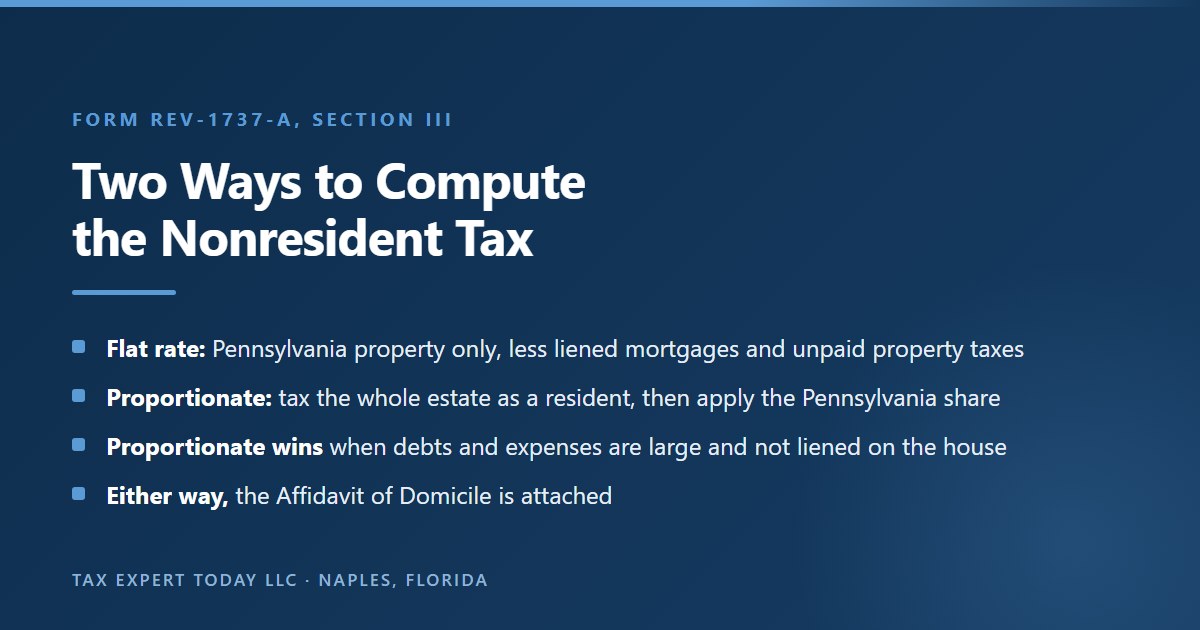
Which method produces less tax depends on the debts. The two illustrative examples below use the same estate: a Florida domiciliary who owns a Pocono Mountains house worth $600,000 with $25,000 of furniture and a boat kept there, so $625,000 of Pennsylvania real and tangible property, and $2,375,000 of investment and retirement accounts, for a gross estate of $3,000,000. Everything passes to two adult children at the 4.5 percent lineal rate. The figures are illustrations of the arithmetic, not a prediction for any particular estate.
| Step | Example A: $100,000 mortgage on the house, $60,000 of funeral and administration costs | Example B: no mortgage, $1,200,000 of unsecured debts and expenses |
|---|---|---|
| Flat rate base | $625,000 less $100,000 mortgage = $525,000 | $625,000, since nothing is liened on the property |
| Flat rate tax at 4.5% | $23,625 | $28,125 |
| Proportionate: whole estate net of all deductions | $3,000,000 less $160,000 = $2,840,000 | $3,000,000 less $1,200,000 = $1,800,000 |
| Tax as if a resident at 4.5% | $127,800 | $81,000 |
| Pennsylvania share of gross estate | $625,000 / $3,000,000 = 20.83% | $625,000 / $3,000,000 = 20.83% |
| Proportionate tax | $26,625 | $16,875 |
| Better method | Flat rate, by $3,000 | Proportionate, by $11,250 |
The pattern generalizes. When the only meaningful debt is a mortgage on the Pennsylvania property, the flat rate method usually wins, because it deducts that mortgage in full against the Pennsylvania value while the proportionate method spreads it across the whole estate. When the estate carries large debts or expenses that are not secured by the Pennsylvania property, such as a margin loan, unpaid income tax or substantial administration costs, the proportionate method lets a share of them reduce the Pennsylvania tax, which the flat rate method never does. The proportionate method also puts the entire estate in front of the Department, which is a disclosure cost worth weighing, and it should be modeled rather than assumed.
Does a Living Trust or Joint Ownership Avoid Pennsylvania Inheritance Tax?
No, not for the tax itself. A revocable living trust can avoid a separate Pennsylvania probate proceeding for the house, but the statute taxes Pennsylvania property of a nonresident “including property held in trust.” Joint ownership with a spouse is exempt, while joint ownership with a child or anyone else exposes the decedent’s fractional share to tax.
- Revocable trust. Property in a trust the decedent could revoke is taxed at death under section 2107(c)(7).
- Retained life estate. A deed that keeps the right to live in the house for life is taxed under section 2107(c)(5).
- Joint with spouse. Property passing by survivorship between spouses is outside the tax under section 2108(b).
- Joint with anyone else. The decedent’s fraction is taxed, and a joint title created within a year of death is taxed in full above $3,000.
The trust point surprises many families because the living trust does real work in a multistate estate. A Florida domiciliary who owns a Pennsylvania house in individual name typically needs an ancillary estate proceeding in the Pennsylvania county where the property sits, in addition to the Florida probate. Titling the house in a revocable trust can avoid that ancillary proceeding. It does not change the inheritance tax, because the nonresident property definition in 72 P.S. §9102 reaches Pennsylvania real and tangible property “including property held in trust,” and section 2107(c)(7) taxes a transfer over which the decedent kept a power to alter, amend or revoke. Form REV-1737-A reflects this with a specific box, “Decedent Maintained Living Trust,” and requires a copy of the trust.
Joint tenancy is governed by section 2108. When property is held by two or more people with a right of survivorship, the death of one is treated as a taxable transfer of a fractional share, found by dividing the value by the number of joint tenants. A Pennsylvania cabin titled to a Florida widow and her two sons as joint tenants would therefore produce a taxable transfer of one third of its value at her death. The exclusion for husband and wife in section 2108(b) does not apply if the joint title was created within one year before death. Anyone considering a trust or retitling for Pennsylvania property should coordinate the estate plan with a Pennsylvania or Florida trusts and estates attorney. Our overview of trust situs after moving to Florida covers the separate income tax question of which state can tax a trust, and our guide to decanting a trust covers the federal cost of changing an older trust.
Can Gifting the Pennsylvania House Before Death Avoid the Tax?
It can, if the gift is complete and made more than one year before death. Pennsylvania taxes gifts made within one year of death above $3,000 per recipient per calendar year. A gift that keeps the right to live in the house is taxed regardless of timing, and the federal basis consequences often outweigh the savings.
- One year lookback. Section 2107(c)(3) taxes gifts made within one year of death above $3,000 per transferee per calendar year.
- No retained use. A reserved life estate or continued use of the house brings the transfer back under section 2107(c)(5).
- Federal gift reporting. A gift above the $19,000 federal annual exclusion for 2026 requires a federal gift tax return, though no tax is usually due.
- Basis tradeoff. Gifted property keeps the donor’s basis, while inherited property generally receives a stepped up basis at death.
The Pennsylvania rule works only for a gift that is real. Section 2107(c)(1) makes lifetime transfers taxable to the extent they are made without adequate consideration and fall within one of the listed categories. Subclause (3) catches transfers within a year of death, subject to the $3,000 annual allowance per transferee. Subclauses (4) through (7) catch transfers where the donor kept a reversion worth more than 5 percent, kept possession, enjoyment or income for life, received a promise of lifetime support, or kept a power to revoke. A deed of the Pennsylvania house to the children, followed by the parents continuing to spend every summer there as before, invites the argument that possession was retained.
The federal side often decides the question. Under IRC §1015, a recipient of a gift generally takes the donor’s adjusted basis. Under IRC §1014, property acquired from a decedent generally takes a basis equal to its value at death. A Pennsylvania house bought decades ago for $150,000 and now worth $600,000 carries $450,000 of built in gain. Giving it away may save $20,250 of Pennsylvania tax at the 4.5 percent rate, but it can leave the children with a much larger capital gains bill when they sell than they would have faced after inheriting. The comparison needs actual numbers, including whether the children plan to keep or sell the property and whether the federal estate tax applies at all. For a 2026 death, the federal basic exclusion amount is $15,000,000 according to the IRS, so most estates owe no federal estate tax.
How Does Pennsylvania Decide Whether You Were Still Domiciled There?
Through the Affidavit of Domicile, Form REV-1737-1, which every nonresident return must include. It asks where the decedent lived and worked for five years before death, which documents described the decedent as a Pennsylvania resident, where income tax was paid, where the car was registered, and why the Pennsylvania property was kept.
- Five year residence history. Every place of residence, whether owned or rented, and time spent in Pennsylvania.
- Documents naming Pennsylvania. Any will, codicil, trust, deed, mortgage or lease that called the decedent a Pennsylvania resident.
- Tax and registration trail. Where income or intangible taxes were paid, and where the car was registered.
- Purpose of the property. Why the decedent owned real estate in Pennsylvania at all.
Domicile is the whole game for a Pennsylvania estate. If the decedent was domiciled in Florida, only the Pennsylvania real and tangible property is taxed. If the Department concludes the decedent remained domiciled in Pennsylvania, the resident definition applies and every intangible asset, including the investment and retirement accounts that made the move worthwhile, is added back. The REV-1737-A instructions state that the affidavit “must be submitted to support the estate’s contention that the decedent was legally domiciled outside of Pennsylvania,” that it should be completed by someone with personal knowledge, preferably a surviving spouse or immediate family member, and that the Department may request more information to determine domicile.
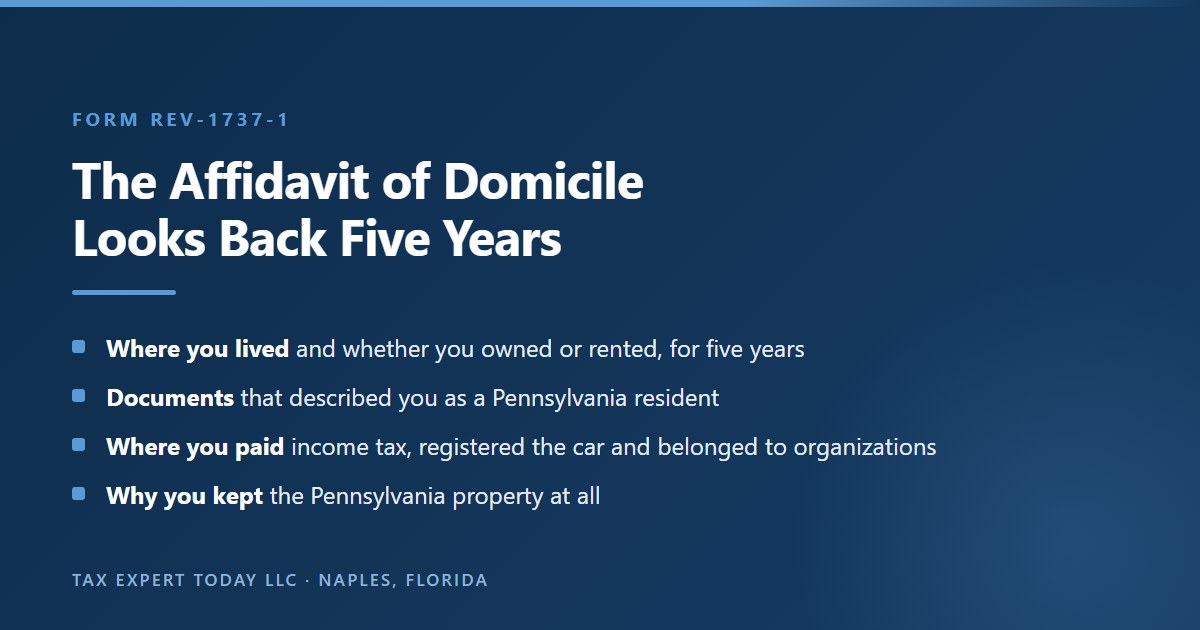
The questions on the affidavit are a practical checklist for anyone who has moved. Question 8 asks whether, in the last five years, the decedent signed a will, codicil, trust, deed, mortgage, lease or other document describing the decedent as a Pennsylvania resident. A will signed in Pennsylvania years ago that opens “I, of Montgomery County, Pennsylvania” is exactly that document, which is one of several reasons to update the estate plan after the move. Question 9 asks where income taxes were paid, which picks up a Pennsylvania resident return or a local earned income tax filed out of habit. Question 14 asks where the car was registered, question 15 asks about church and organization memberships, and question 16 asks the purpose of the Pennsylvania property.
| Affidavit question | What helps a Florida domicile claim | What undercuts it |
|---|---|---|
| Residences in the five years before death | A Florida home used as the principal residence, with a Florida homestead exemption | The Pennsylvania house described as the main home, with the Florida property used only in winter |
| Documents naming Pennsylvania residence | A will and trust re-signed in Florida that recite Florida residence | An old Pennsylvania will never updated, or a recent deed or loan document reciting a Pennsylvania address |
| Income and intangible taxes paid | Part-year Pennsylvania return for the move year, then nonresident filings only where Pennsylvania income exists | Pennsylvania resident returns or local earned income tax returns after the move |
| Vehicle registration | Florida title and registration | A car still registered and garaged in Pennsylvania |
| Memberships and affiliations | Florida congregation, clubs and physicians | Pennsylvania memberships kept active as the primary ones |
| Declaration of domicile | A sworn declaration filed under Fla. Stat. §222.17 | No filing, or a filing contradicted by the other evidence |
A Florida declaration of domicile under Fla. Stat. §222.17 is useful evidence, but it is one fact among many, and Pennsylvania weighs the pattern of the decedent’s life rather than any single filing. If the Department and the estate disagree, section 2148 allows the Department, with the approval of the Attorney General, to compromise the tax on the estate of a decedent alleged to have been a nonresident. The separate interstate arbitration procedure in sections 2156 through 2163 applies only between states with substantially similar laws, and because Florida imposes no inheritance tax, a Pennsylvania and Florida disagreement is in practice a Pennsylvania claim that the estate answers. The evidence that wins that argument is the same evidence covered in our guide to a Florida residency audit, and our dual-state residency guide explains why a split year is where most of these disputes start.
Who Files the Nonresident Return and When Is It Due?
The personal representative, or anyone holding the Pennsylvania property if there is none, files Form REV-1737-A within nine months of death. The tax is due at death and becomes delinquent after nine months, with interest from that point. Paying within three months earns a 5 percent discount, and a filing extension never extends the payment date.
- Form. REV-1737-A, Inheritance Tax Return, Nonresident Decedent, with the REV-1737-1 affidavit attached.
- Where. The Department’s Inheritance Tax Division for nonresidents in Harrisburg, per the form instructions.
- When. Nine months after death, with a discretionary six month filing extension.
- Discount. 5 percent of tax paid within three calendar months of death, under 72 P.S. §9142.
Section 2136 of the Code places the filing duty on the personal representative and on transferees who receive property not reported by the personal representative, including a trustee. The REV-1737-A instructions add that if there is no personal representative, every person in actual or constructive possession of the decedent’s property is treated as a fiduciary for the tax and must file. That matters for the common Florida pattern in which the house passes through a revocable trust and no Pennsylvania estate is ever opened: the trustee is the person who files. Under section 2136(f), a nonresident return goes to the register of wills that issued Pennsylvania letters, if any, and otherwise to the Department; the form instructions direct the return, the affidavit, the schedules and the deeds to the Department’s Bureau of Individual Taxes, Inheritance Tax Division, Nonresident, PO Box 280601, Harrisburg, PA 17128-0601.
The timing rules come from sections 2142 and 2143. Tax is due at the date of death, becomes delinquent nine months later, and accrues interest from the first day of delinquency at the rate set under the Fiscal Code. Paying within three months of death earns a 5 percent discount on the amount paid. In Example A above, a $23,625 bill paid in full within three months would earn a discount of $1,181.25. The instructions also allow a prepayment by mail before the return is filed, which is how estates capture the discount while appraisals are still being completed. The Department may grant a six month extension of time to file, but it expressly does not extend the time to pay, so an estate that expects to owe should consider an estimated prepayment.
The tax is also a lien. Section 2167 makes the tax and interest a lien on the Pennsylvania real property included in the transfer until it is paid. In practice a buyer’s title company will look for evidence that the inheritance tax has been paid before a sale by the heirs closes, so an unpaid Pennsylvania return often surfaces only when the family tries to sell the house. Our guide to selling your home after moving to Florida covers the separate income tax side of that sale while the owner is still living.
What Planning Steps Reduce Pennsylvania Inheritance Tax for a Florida Resident?
The effective steps change what is located in Pennsylvania or who receives it. Selling Pennsylvania real estate during life converts it into exempt intangible proceeds. Moving tangible property to Florida takes it out of the base. Leaving Pennsylvania property to a spouse defers the tax, and choosing lineal heirs over siblings or friends lowers the rate.
- Sell during life if the property is no longer used. Cash and investments held by a Florida domiciliary are intangible and exempt.
- Move valuables south. Art, jewelry, collections and vehicles located in Florida at death are outside the Pennsylvania return.
- Match property to beneficiaries. Where the will allows, direct Pennsylvania property to heirs at the lowest rate.
- Complete the domicile record. A thin Florida record puts the whole portfolio at risk, not just the house.
Selling the Pennsylvania property is the most direct route, and it interacts with income tax planning. A principal residence sale may qualify for the IRC §121 exclusion within the three year window after the move, while a vacation home or rental property carries its own income tax cost, which our guide to selling rental property after moving addresses. Where the family intends to keep the property for the next generation, the question becomes how to hold it, and the options, including an LLC or a long term trust, involve legal and tax judgments that should be made with Pennsylvania counsel rather than by a quick retitling late in life.
Beneficiary choice deserves more attention than it usually receives. Because Pennsylvania taxes by relationship, an estate plan that leaves the Pennsylvania cottage to a niece and the Florida investment account to a son produces a 15 percent tax on the cottage and nothing on the account. Reversing those gifts, where the family is comfortable with the result, lowers the Pennsylvania bill without changing the total each person receives. Life insurance proceeds are exempt under section 2111(d), and property left to a qualifying charity is exempt under section 2111(c), so both can be used to shape the result. The asset protection side of these choices, including homestead and tenancy by the entirety, is covered in our guide to Florida asset protection for new residents.
Is Pennsylvania Repealing Its Inheritance Tax in 2026?
Not as of September 26, 2026. Senate Bill 100 would exempt the first $100,000 inherited by family members. It was reported out of the Senate Finance Committee 11 to 0 on March 18, 2026, and re-referred to the Appropriations Committee on March 23, 2026. It has not passed the Senate or the House, so current rates remain law.
- Senate Bill 100. A $100,000 exemption for family members, pending in Senate Appropriations.
- Senate Bills 750 and 751. Sponsor proposals to phase the tax out for direct descendants and siblings, described in March 2026 as still under committee consideration.
- Rates in force. The Department of Revenue page still lists 0, 4.5, 12 and 15 percent.
- Planning point. Plan on current law, and revisit if a bill is enacted.
The General Assembly bill page for Senate Bill 100 shows its last action as the March 23, 2026 re-referral, with third consideration, House action and executive action all still ahead of it. Repeal efforts in Pennsylvania have advanced in committee in earlier sessions without becoming law, so a pending bill is not a reason to change a plan. It is a reason to check the bill page again before relying on any date in this article. If a reduction is enacted, it will apply according to its own effective date, which typically ties to the date of death, and estates of earlier decedents will not benefit.
Does Florida or the Federal Government Add Tax on the Same Transfer?
Florida does not. Florida has no inheritance tax and no estate tax, so the Pennsylvania return is usually the only state death tax filing. The federal estate tax applies only above a $15,000,000 basic exclusion for 2026, and for an estate that does owe it, IRC section 2058 allows a deduction for state inheritance taxes actually paid.
- Florida. No state death tax on residents, nonresidents or beneficiaries.
- Federal exclusion. $15,000,000 per individual for 2026, per the IRS.
- State death tax deduction. IRC §2058 deducts Pennsylvania inheritance tax actually paid from the federal gross estate.
- Heir’s state. Pennsylvania taxes by the decedent’s domicile and the property’s location, not by where the heir lives.
Under IRC §2058, the federal taxable estate is reduced by estate, inheritance, legacy or succession taxes actually paid to any state in respect of property included in the gross estate. For the small share of estates above the federal exclusion reported by the IRS, that deduction softens the combined cost. For the much larger group below it, the Pennsylvania return is the whole state and federal death tax story, which is why a modest Pennsylvania vacation property can produce the only estate tax bill a Florida family ever sees. Beneficiaries who live outside Pennsylvania are not spared: the tax attaches to the transfer, so a son in Texas and a daughter in Naples inheriting the same Pennsylvania house pay at the same lineal rate.
What Should a Former Pennsylvania Resident Do Now?
Inventory what is still located in Pennsylvania, update the will and trust so they recite Florida residence, close the gaps the Affidavit of Domicile will probe, and decide deliberately whether to keep, sell or retitle the Pennsylvania property. Then model the tax under both computation methods so the family knows the likely bill.
- List Pennsylvania situs assets. Real estate, contents, vehicles, boats and any sole proprietorship assets.
- Re-sign estate documents in Florida. Replace documents that describe you as a Pennsylvania resident.
- Clean up the paper trail. Florida driver license, vehicle registration, voter registration and the §222.17 declaration.
- Estimate the bill. Flat rate and proportionate, at the rates your actual beneficiaries would pay.
The work is not complicated, but it is easy to leave half done. Households that move from Pennsylvania to Southwest Florida often keep the northern house for several years, keep a Pennsylvania bank relationship, and keep the will they signed before the move. None of those facts makes the move ineffective on its own, but together they are what an affidavit of domicile reveals. A short annual review, done while everyone who knows the facts is available, is much easier than reconstructing five years of history for an estate. Our Florida 183 day rule calculator is a practical way to keep the day count honest, and our guide to the nonresident state tax return covers the income tax filings that continue while Pennsylvania property produces income. The income tax side of the move year itself is covered in our guide to snowbird taxes in year one, and pensions and IRA withdrawals after the move are covered in our guide to retiring to Florida.
Pennsylvania Inheritance Tax Help in Naples & Southwest Florida
Tax Expert Today LLC works with individuals and families who have moved to Southwest Florida from Pennsylvania and other high tax states and who still hold property, trusts or family connections in the state they left. The firm brings together tax advisors, enrolled agents, CPAs and attorneys, and handles residency and tax matters nationwide. Philadelphia, Pittsburgh and the Lehigh Valley send a steady stream of new residents to Collier and Lee counties, so the retained Pennsylvania house, the old Pennsylvania will and the nonresident inheritance tax return are familiar ground here.
Our office is located at 11983 Tamiami Trail N, Naples, Florida 34110. You can reach us at (239) 441-2005, Monday through Friday, 10am to 5pm ET. We also work with clients across all 50 states.
- Pennsylvania inheritance tax help Naples: identifying what Pennsylvania can still reach in your estate and estimating the bill under both computation methods.
- PA inheritance tax Naples FL: preparing Form REV-1737-A and the Affidavit of Domicile for a Florida domiciliary’s estate, and planning the discount window.
- Tax planning Naples FL: coordinating the move with the wider plan described on our Naples tax planning page and in our guide to Florida tax services.
- Estate and trust planning Naples: matching Pennsylvania property to beneficiaries and coordinating trusts with counsel through our estate and trust planning practice.
- Tax resolution Naples: responding when the Department questions a claimed Florida domicile, through our resolution and audit support practice and our Naples tax resolution page.
A local question we are asked often: we live in Naples most of the year and keep our house near Philadelphia for the summers. Will our children owe Pennsylvania inheritance tax on everything? No, provided you are genuinely domiciled in Florida. Your children would owe the 4.5 percent lineal rate on the Pennsylvania house and its contents, less any mortgage under the flat rate method, while your investment and retirement accounts would be exempt. The risk is a weak domicile record, which could let Pennsylvania claim the whole estate.
When to Engage a Professional
A Pennsylvania nonresident estate is straightforward when the only Pennsylvania asset is a modest house left to a spouse, the domicile record is clean and the estate is well below the federal exclusion. Many families who ask about Pennsylvania inheritance tax are not in that position. The combination that makes it complicated is specific: Pennsylvania property passing to siblings, nieces, nephews or friends at 12 or 15 percent, large unsecured debts that make the proportionate method worth modeling, property held in trust or joint title with children, a gift of the house under consideration, or a split year pattern that could invite a domicile challenge.
Consider engaging an advisor when any of the following is present: you still own Pennsylvania real estate after the move; your will or trust was signed while you lived in Pennsylvania; the Pennsylvania property is intended for someone other than a spouse or a child; you are thinking about deeding the property to your children; a death has occurred and the three month discount window is open; or you spend a large part of each year in Pennsylvania. Coordinating the Pennsylvania side with the Florida plan is part of what our Florida residency and Florida estate planning guidance covers, and trust and title changes should be made with a trusts and estates attorney.
The firm brings together tax advisors, enrolled agents, CPAs and attorneys and works with clients nationwide from its Naples office. If you have moved from Pennsylvania to Southwest Florida and still hold Pennsylvania property, or you are handling the estate of someone who did, call (239) 441-2005 or use our contact page to arrange a consultation. Outcomes depend on the specific facts of each estate, and nothing here is a prediction about any particular return.
This article is educational and general in nature. It is not legal, tax or accounting advice, and it does not create a professional relationship. Pennsylvania statutes, forms and pending legislation change, and the figures cited here were verified against primary sources on the date of publication. Please consult a qualified advisor about your own situation.
Published September 26, 2026 by Dr. Pellumb Kabashi « Back to Learning Center
Have a question this article touches on?
Tax Expert Today LLC, based in Naples, Florida and serving clients across the United States.
Schedule a Consultation (239) 441-2005