
By Dr. Pellumb Kabashi, DBA, MBA, EA, CFE, CES
Founder, Tax Expert Today LLC · Tax advisors, enrolled agents, CPAs, and attorneys · Serving clients in all 50 states
Quick Answer: Georgia Form 501 is the Fiduciary Income Tax Return that estates and trusts file with the Georgia Department of Revenue. A resident estate or trust files it when a federal Form 1041 is required, and a nonresident one files when it has Georgia source income. It is due the 15th day of the 4th month after year end. Call (239) 441-2005 for a free consultation.
Georgia Form 501 tends to arrive in someone’s life without warning. A parent in Decatur dies, a daughter is named executor, and the estate’s brokerage account keeps paying dividends for a year and a half while the house is sold. A grandfather in Macon set up a trust for his grandchildren twenty years ago, and the bank that served as trustee resigned, leaving a family member to take over the annual filings. A widow in Athens holds her late husband’s assets in a credit shelter trust and is told by her preparer that the trust needs its own Georgia return. Each of them ends up typing the same search: Georgia Form 501.
The search results are not much help. Page one is mostly Department of Revenue portal pages, a forms list, a mailing address page, a 2020 forum thread from someone asking what an “executor’s five position PIN” is, and a question and answer site where a reader in April 2026 wrote that they needed help with Form 501 for an estate. The official instruction booklet is accurate, but it is written line by line, and it assumes you already know whether you have to file, which schedule applies to you, and how the Georgia return connects to the federal Form 1041.
This guide fills that gap, and it is part of our Georgia tax services library for families and fiduciaries. It explains who files Georgia Form 501 and who does not, how the return starts from the federal Form 1041 and moves through Schedules 1 through 7, how resident and nonresident fiduciaries differ, how a grantor trust reports, what the Kaestner decision changed for trusts with Georgia beneficiaries, when the return is due, how extensions and estimated tax work, and what happens when a fiduciary files late. It uses the 2025 Fiduciary Instructions Booklet, the Department’s Policy Bulletin IT-2019-02, the Georgia regulations, and the federal Code, all read on October 21, 2026, and it works through several hypothetical returns with the arithmetic shown.
Everything below is general education about Georgia Form 501 as it stands in October 2026. Nothing here is advice for a specific estate or trust, and every example is hypothetical.
What Is Georgia Form 501?
Georgia Form 501 is the Fiduciary Income Tax Return. Executors, administrators, and trustees use it to report the income of an estate or trust to the Georgia Department of Revenue, compute Georgia tax on income the entity keeps, and show the share passed to beneficiaries. Form 501X is the amended version of the same return.
- Who signs it: the fiduciary, meaning the executor, administrator, trustee, or guardian.
- What it starts from: adjusted total income on the federal Form 1041.
- What it taxes: income the estate or trust keeps rather than distributes.
- What it attaches: a copy of the federal return and supporting schedules.
- Amended version: Form 501X, which uses the same booklet.
Georgia does not tax an estate or a trust as if it were a person with wages and a W-2. It taxes the fiduciary, the person or institution that holds and manages property for someone else. The authority is O.C.G.A. 48-7-22, which the Department quotes in full in Policy Bulletin IT-2019-02: the Georgia income tax is imposed upon resident fiduciaries and upon certain nonresident fiduciaries, at the rates provided for single individuals, with respect to the part of the net income of an estate or trust that has not become distributable during the year. The Department’s own rule on fiduciaries, Ga. Comp. R. & Regs. 560-7-3-.07, adds that regardless of whether income is taxable to the fiduciary or to the person who receives it, the fiduciary is primarily responsible for reporting all of the income.
Georgia Form 501 is the document that carries that report. Page 1 identifies the estate or trust, the fiduciary, the federal employer identification number, the date of the decedent’s death or the date the trust was created, and the residency status, and it holds the first half of Schedule 1, the tax computation. Page 2 finishes Schedule 1 with payments, penalties, and the refund or balance due, and carries the signatures. The pages that follow hold Schedule 2 (adjustments), Schedule 3 (beneficiaries), Schedule 4 (part year and nonresident fiduciaries), Schedules 5, 5B, and 6 (credits), and Schedule 7 (net operating losses). The fiduciary must attach a copy of its federal return, a requirement printed in capital letters on page 2 of the 2025 form.
The regulation that lists Georgia’s income tax forms, Ga. Comp. R. & Regs. 560-7-8-.31, names Form 501 as the Fiduciary Income Tax Return and Form 501X as the Amended Fiduciary Income Tax Return. Both are covered by a single instruction booklet, the 2025 version of which is titled the 2025 Fiduciary Instructions Booklet.
Who Must File Georgia Form 501?
Under O.C.G.A. 48-7-50, a resident estate or trust must file Georgia Form 501 if it must file a federal income tax return, and a nonresident estate or trust must file if it has federal gross income from Georgia sources. The booklet adds fiduciaries managing funds or property for the benefit of a Georgia resident, subject to the Kaestner limits.
- Resident estate or trust: files when a federal Form 1041 is required.
- Nonresident estate or trust: files when it has Georgia source gross income.
- Georgia beneficiaries: may create a filing duty for a nonresident trustee.
- Grantor trusts: file a short form return with the grantor statement attached.
- Bankruptcy estates: file under their own gross income test.
Two Georgia statutes work together here. O.C.G.A. 48-7-22(a)(1) says who is taxed: resident fiduciaries, and nonresident fiduciaries who receive income from business done in Georgia, manage funds or property located in Georgia, or manage funds or property for the benefit of a Georgia resident. O.C.G.A. 48-7-50(a) says who files. The two subsections that matter for Georgia Form 501 are (a)(3), a resident estate or trust that is required to file a federal income tax return, and (a)(4), a nonresident estate or trust that has federal gross income from sources within Georgia. Subsection (a)(5) adds a catch all for anyone with Georgia taxable income who has no federal taxable income for the same year.
The instructions printed with the Department’s 2023 Form 501 example put the rule in one sentence: every resident and nonresident fiduciary having income from sources within Georgia or managing funds or property for the benefit of a resident of Georgia is required to file a Georgia income tax return on Form 501, with a pointer to the Department’s guidance on the Kaestner decision. That pointer matters, and the Kaestner section of this guide explains why a nonresident trust with Georgia beneficiaries does not always have to file.
Because the resident test borrows the federal filing requirement, the federal threshold sets the floor. Under 26 U.S.C. 6012(a), a federal Form 1041 is required for every estate with gross income of $600 or more for the year, and for every trust that has any taxable income or has gross income of $600 or more. An estate with $450 of interest in its first year owes no federal return and, as a resident estate, no Georgia Form 501. A trust with $700 of dividends must file both.
| Entity | Federal Form 1041 required? | Georgia Form 501 required? |
|---|---|---|
| Resident estate, $600 or more of gross income | Yes, IRC 6012(a)(3) | Yes, O.C.G.A. 48-7-50(a)(3) |
| Resident trust, any taxable income or $600 or more gross income | Yes, IRC 6012(a)(4) | Yes, O.C.G.A. 48-7-50(a)(3) |
| Resident estate, $450 of interest only | No | No |
| Nonresident estate with rent from a Georgia property | Yes, if over the federal threshold | Yes, Georgia source gross income, O.C.G.A. 48-7-50(a)(4) |
| Nonresident trust, Georgia beneficiary who receives distributions | Depends on federal income | Generally yes, under 48-7-22 and Policy Bulletin IT-2019-02 |
| Nonresident trust whose facts match Kaestner | Depends on federal income | No Georgia tax and no return, per IT-2019-02 |
| Grantor trust | Grantor reporting under IRC 671 | Check the grantor trust box and attach the activity schedule |
A point that confuses many families: the Georgia Form 501 filing duty belongs to the estate or trust, not to the beneficiaries. A beneficiary who receives a distribution reports it on their own Georgia Form 500. The estate or trust reports everything on Form 501, takes a deduction for what it passed out, and pays tax on what it kept.
What Makes an Estate or Trust a Georgia Resident Fiduciary?
Georgia Form 501 asks for one of three residency codes: 1 for a full year resident fiduciary, 2 for part year, and 3 for nonresident. Residency generally follows where the estate is administered or the trust is managed, and it decides whether all income is reported or only Georgia source income on Schedule 4.
- Code 1, full year resident: complete Schedule 1 using all income.
- Code 2, part year resident: enter the residency dates and complete Schedule 4.
- Code 3, nonresident: leave Schedule 1 Lines 1 through 6 blank and complete Schedule 4.
- Common resident estate: a decedent domiciled in Georgia with a Georgia probate.
- Common change: a trust that moves when its trustee or administration moves.
The 2025 booklet tells the fiduciary how to report residency but does not define it. The definitions come from the statute, the regulations, and the facts of the particular estate or trust. In practice, an estate of a decedent who was domiciled in Georgia and whose will is probated in a Georgia county is treated as a resident estate. A trust is harder, because a trust has no body and no home. Georgia looks at the statutory tests in O.C.G.A. 48-7-22 (a resident fiduciary, or a nonresident fiduciary with Georgia business, Georgia property, or a Georgia beneficiary), so the trustee’s location and where the trust is administered carry weight, and the facts of each trust need to be checked against the current statute and regulations before a residency code is chosen.
Residency can change. A trust whose individual trustee moves from Roswell to Naples, Florida, or whose corporate trustee moves administration out of an Atlanta office, may change its Georgia status in the middle of a year. That is what the part year code is for: enter 2, write in the dates of Georgia residency, and use Schedule 4 to split the income. Our separate guide to trust situs after moving to Florida walks through the planning side of a trust relocation, including why moving the trustee alone does not always move the trust.
| Residency code on Georgia Form 501 | Which lines to complete | Income reported |
|---|---|---|
| 1, Full year resident | Schedule 1, Lines 1 through 7c, using Schedule 2 and Schedule 3 | All income, wherever earned |
| 2, Part year resident | Schedule 4, with residency dates on page 1; Schedule 1 from Line 7a | All income in Column A, Georgia source and resident period income in Column B |
| 3, Nonresident | Schedule 4; Schedule 1 Lines 1 through 6 left blank | Georgia source income in Column B, total in Column A |
Nonresident estates and trusts most often reach Georgia Form 501 through real estate. A decedent who lived in Florida and owned a rental house in Savannah leaves an estate that collects Georgia rent. A trust administered in North Carolina that owns an interest in a Georgia partnership receives Georgia source business income. Both are nonresident fiduciaries with Georgia source gross income, and both file.
How Did the Kaestner Decision Change Georgia Trust Filing?
In Kaestner (2019), the U.S. Supreme Court held that in state beneficiaries alone could not support a tax on undistributed trust income where they received nothing, could not demand income, and were uncertain ever to receive it. Georgia’s Policy Bulletin IT-2019-02 applies that holding narrowly: only trusts with facts like Kaestner escape Georgia Form 501.
- Kaestner facts: no distributions to the Georgia beneficiary during the year.
- No right to demand: the beneficiary could not demand income or control trust assets.
- Uncertain future: it was unclear the beneficiary would ever receive income.
- Georgia position: facts like those mean no Georgia tax for a nonresident trustee.
- Everything else: the trustee remains taxable under 48-7-22 and files Form 501.
Georgia’s statute reaches a nonresident fiduciary who manages funds or property “for the benefit of a resident of this state.” Read alone, that clause would require a trustee in Delaware to file Georgia Form 501 any time one beneficiary lived in Georgia. On June 21, 2019, the Supreme Court decided North Carolina Department of Revenue v. Kimberley Rice Kaestner 1992 Family Trust and held that the presence of in state beneficiaries alone does not allow a state to tax trust income that has not been distributed to them, where the beneficiaries have no right to demand that income and are uncertain ever to receive it.
The Department of Revenue responded with Policy Bulletin IT-2019-02, effective for all years open under the statute of limitations. The bulletin lists the three facts the Court relied on, says that the Department must follow the decision but that the decision is limited to its facts, and concludes that a nonresident trust fiduciary with facts specifically like those in Kaestner is not subject to Georgia tax. Otherwise, the bulletin says, the fiduciary is taxable under O.C.G.A. 48-7-22 and must file a return. It also notes that the Court expressly declined to approve or disapprove taxes based on beneficiaries whose relationship to the trust assets differs from the Kaestner beneficiaries.
| Facts for a nonresident trustee with a Georgia beneficiary | Likely Georgia result under IT-2019-02 |
|---|---|
| Discretionary trust, no distributions this year, beneficiary cannot demand income, future distributions uncertain | Matches Kaestner; no Georgia tax and no Form 501 |
| Same trust, but the trustee distributed income to the Georgia beneficiary this year | Does not match; the trustee generally files Georgia Form 501 |
| Beneficiary has a current right to all income (a mandatory income trust) | Does not match; generally taxable and files |
| Beneficiary holds a withdrawal power over trust assets | Does not match; generally taxable and files |
| Trust also owns Georgia real estate or a Georgia business interest | Georgia source income creates a separate filing basis under 48-7-50(a)(4) |
The bulletin also explains that a policy bulletin does not have the force of law and is not binding on the public, but it is the Department’s position and binds Department personnel until changed. For a trustee, that is useful: it tells you how the Department will read a nonresident trust with Georgia beneficiaries. It does not settle every set of facts, and a trust that sits close to the line should be reviewed against the current statute, the bulletin, and any later guidance before deciding not to file Georgia Form 501.
One more statutory rule cuts the other way for resident trustees. O.C.G.A. 48-7-22(a)(3)(A) provides that income received by a resident fiduciary is not taxed when it is accumulated for, distributed to, or becomes distributable to a nonresident of Georgia, and the income came from business done outside Georgia, property held outside Georgia, or intangible property (other than from licensing it), including gains on selling it. The statute adds that no return is required for income exempt under that paragraph. A Georgia trustee holding a stock portfolio for a beneficiary who lives in Tennessee may therefore owe no Georgia tax on that portfolio income.
How Does Georgia Form 501 Connect to the Federal Form 1041?
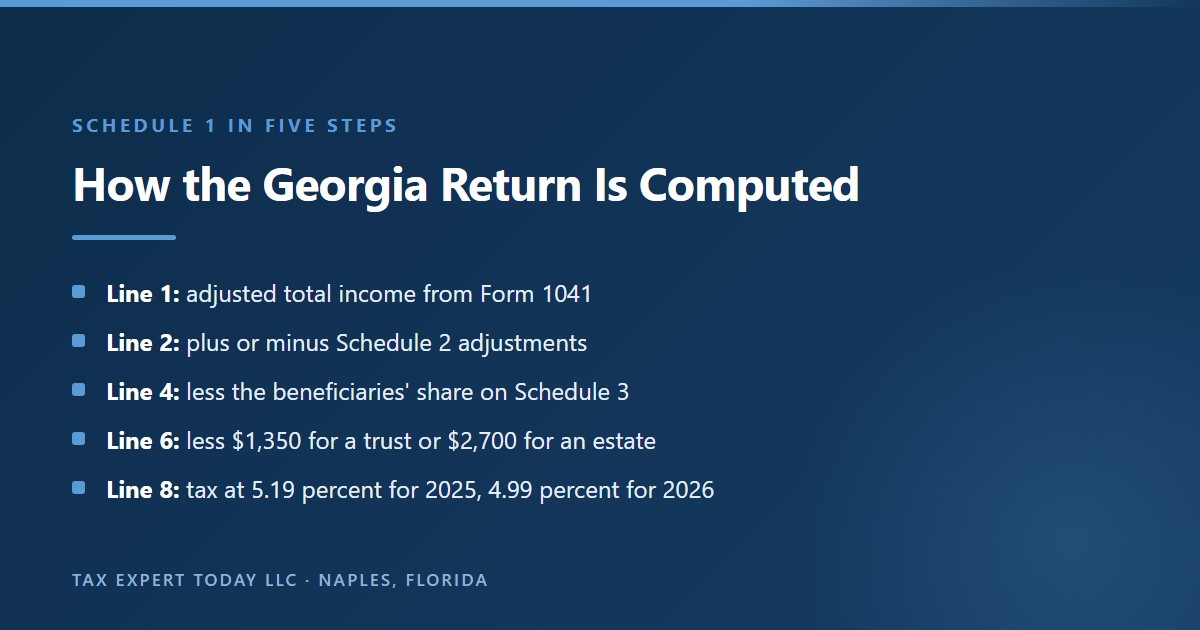
Georgia Form 501 starts where the federal Form 1041 leaves off. Line 1 of Schedule 1 is adjusted total income from the 1041, meaning gross income less the itemized deductions on the federal return. Georgia then adds and subtracts its own adjustments, removes the beneficiaries’ share, and subtracts a Georgia exemption.
- Starting point: federal adjusted total income, Form 501 Schedule 1, Line 1.
- Georgia changes: additions and subtractions on Schedule 2.
- Distribution deduction: the beneficiaries’ share on Schedule 3, entered on Line 4.
- Georgia exemption: $1,350 for a trust or $2,700 for an estate.
- Attachment: a copy of the federal Form 1041 and its schedules.
The Department’s booklet defines Line 1 precisely: adjusted total income, which is the amount of gross income less the itemized deductions shown on the federal Form 1041. Those itemized deductions include items such as interest, taxes, fiduciary fees, attorney and accountant fees, and other deductions that the federal return allows. Georgia does not recompute them. It takes the federal figure and adjusts it on Schedule 2 for the specific differences between Georgia and federal law.
Georgia’s conformity date matters for what the federal starting figure means. The summary of changes at the front of the 2025 booklet says Georgia conforms to the Internal Revenue Code as amended by federal law enacted on or before January 1, 2025, and that Georgia has not adopted the federal changes in the 2025 law known as the One Big Beautiful Bill Act, because it was signed on July 4, 2025. Where a 2025 federal change alters an estate or trust’s federal income, the fiduciary must check whether Georgia follows it before relying on the federal number. The booklet points to the Department’s federal tax changes page for details.
The federal return also drives the distribution deduction. Under the federal rules, an estate or trust deducts income it distributes or must distribute to beneficiaries, limited by distributable net income as defined in 26 U.S.C. 643, and the beneficiaries report that income on their own returns from a Schedule K-1. Georgia Form 501 handles the same idea through Schedule 3 and Line 4: the portion of income distributable to all beneficiaries comes off the Georgia computation, so the fiduciary pays Georgia tax only on what is left.
| Item | Federal Form 1041 | Georgia Form 501 |
|---|---|---|
| Who is taxed | The estate or trust on retained income | The fiduciary on income not distributable, O.C.G.A. 48-7-22 |
| Starting point | Gross income | Federal adjusted total income, Schedule 1, Line 1 |
| Exemption | $600 estate; $300 trust required to distribute all income; $100 other trusts (IRC 642(b)) | $2,700 estate; $1,350 trust |
| Distribution deduction | Income distribution deduction, limited by DNI | Beneficiaries’ share of income, Schedule 3 and Line 4 |
| Rate structure | Compressed graduated brackets for estates and trusts | Rates for single individuals; 5.19 percent for 2025 |
| Return due date | 15th day of the 4th month after year end | 15th day of the 4th month after year end |
The exemption difference is worth noting. The federal personal exemption substitute for estates and trusts under 26 U.S.C. 642(b) is $600 for an estate, $300 for a trust required to distribute all income currently, and $100 for other trusts. Georgia allows a larger flat amount on Line 6 of Georgia Form 501: $2,700 for an estate and $1,350 for a trust, with no distinction between simple and complex trusts.
What Rate Does Georgia Apply on Form 501?
O.C.G.A. 48-7-22 taxes fiduciaries at the rates provided for single individuals. The 2025 booklet instructs fiduciaries to multiply Line 7c by 5.19 percent, and the Department reports a flat 4.99 percent individual rate for 2026, so Georgia Form 501 for 2026 should follow that rate, subject to the 2026 booklet.
- Tax year 2025: 5.19 percent of Line 7c, rounded to the nearest dollar.
- Tax year 2026: the flat individual rate is 4.99 percent, per the Department.
- Tax year 2023: a graduated schedule from 1 percent to 5.75 percent.
- No compressed brackets: unlike the federal return, the Georgia rate is flat.
- Check each year: Georgia has reduced the rate on a rolling basis.
The rate on Georgia Form 501 is not set separately for fiduciaries. The statute, as quoted in the Department’s bulletin, imposes the tax on fiduciaries “at the rates provided in this article for single individuals.” When Georgia moved from graduated brackets to a flat rate, fiduciaries moved with it. The 2023 Form 501 instructions still printed the old schedule, from 1 percent on the first $750 up to 5.75 percent on income over $7,000. The 2025 booklet’s instruction for Line 8 reads simply: multiply the amount on Line 7c by 5.19 percent and round to the nearest dollar.
For 2026, the Department’s Important Tax Updates page states that the Georgia income tax rate has been reduced to a flat rate of 4.99 percent. Because fiduciaries pay at the single individual rate, a calendar year 2026 trust filing Georgia Form 501 in April 2027 should expect to apply 4.99 percent to Line 7c. The 2026 form and booklet have not been released as of this writing, so the fiduciary should confirm the rate printed in the 2026 booklet before filing, and should not assume any further reduction until the Department publishes it.
The practical effect of the flat rate is a sharp contrast with the federal side. Federal estate and trust brackets are compressed, so a trust reaches the highest federal bracket at a fairly modest level of retained income. Georgia applies the same single flat rate whether the trust keeps $5,000 or $500,000. A trustee deciding whether to distribute or accumulate income will usually find the federal brackets drive that decision far more than Georgia Form 501 does, although the Georgia tax is still a real cost on retained income.
| Tax year | Rate on Georgia Form 501, Line 8 | Source |
|---|---|---|
| 2023 | Graduated, 1 percent to 5.75 percent (over $7,000) | 2023 Form 501 instructions |
| 2025 | 5.19 percent flat | 2025 Fiduciary Instructions Booklet, Line 8 |
| 2026 | 4.99 percent flat individual rate | Department of Revenue Important Tax Updates; confirm in the 2026 booklet |
How Do You Complete Schedule 1 of Georgia Form 501?
Schedule 1 is the tax computation. A full year resident fiduciary starts with federal adjusted total income on Line 1, adds the Schedule 2 adjustments, subtracts the beneficiaries’ share and the exemption, applies any net operating loss, multiplies by the rate, subtracts credits and payments, and arrives at the refund or the balance due.
- Lines 1 to 3: federal adjusted total income plus or minus Schedule 2.
- Lines 4 to 6: less the beneficiaries’ share and the exemption.
- Lines 7a to 7c: Georgia taxable income before and after any net operating loss.
- Lines 8 to 10: tax, credits, and tax after credits.
- Lines 11 to 20: payments, interest, penalties, balance due or refund.
The line by line flow below follows the 2025 Georgia Form 501 and the 2025 booklet. A part year or nonresident fiduciary leaves Lines 1 through 6 blank, completes Schedule 4 instead, and enters the Schedule 4 result on Line 7a.
| Line on Georgia Form 501 | What goes there |
|---|---|
| 1 | Income of fiduciary: adjusted total income from the attached Form 1041 |
| 2 | Net adjustment from Schedule 2 |
| 3 | Net total of Lines 1 and 2 |
| 4 | Beneficiaries’ share of income, total of Schedule 3 |
| 5 | Line 3 less Line 4 |
| 6 | Exemption: $1,350 trust or $2,700 estate |
| 7a | Georgia taxable income before the Georgia NOL (Line 5 less Line 6, or Schedule 4, Line 14) |
| 7b | Georgia NOL used, limited to 80 percent for losses from 2018 and later |
| 7c | Net taxable income, Line 7a less Line 7b |
| 8 | Tax: Line 7c times the rate, 5.19 percent for 2025 |
| 9a, 9b, 9c | Other state tax credit, Schedule 5 credits, total credits (cannot exceed Line 8) |
| 10 | Tax less credits, not below zero |
| 11a to 11d | Estimated tax paid, Georgia withholding, Schedule 5B refundable credits, total |
| 12 and 13 | Balance of tax due or overpayment |
| 14 | Overpayment credited to next year’s estimated tax |
| 15 to 18 | Interest, late payment penalty, late filing penalty, estimated tax penalty |
| 19 and 20 | Amount owed or refund |
Two lines deserve extra attention. Line 9b and Line 11c carry credits from Schedules 5 and 5B, and the form warns that those credits cannot be claimed unless the return is filed electronically. A fiduciary that holds a K-1 carrying a Georgia tax credit cannot paper file Georgia Form 501 and still claim it. Line 11b carries Georgia tax withheld, including withholding on distributions from pass through entities to nonresident members and withholding on a nonresident’s sale of Georgia real property under O.C.G.A. 48-7-128 and 48-7-129. The booklet requires the G2-RP, G2-A, G2-LP, 1099, or closing statement showing the withholding to be included, and warns that amounts may not be allowed if the statements are missing.
Our guide to Georgia withholding tax explains the forms an estate is likely to see when it sells a Georgia property or receives a partnership distribution. If the estate is a member of a partnership that filed a Georgia composite return, check the K-1 and the G2-LP before claiming the payment on Line 11b.
What Adjustments Go on Schedule 2 of Georgia Form 501?
Schedule 2 converts federal adjusted total income into the Georgia figure. Common additions are interest on other states’ municipal bonds, non Georgia income taxes deducted on the 1041, expenses tied to exempt income, and a federal NOL carryover. Common subtractions are U.S. obligation interest, net of related interest expense, and non Georgia income tax refunds.
- Add: municipal bond interest from states other than Georgia.
- Add: income tax other than Georgia’s that was deducted on Form 1041.
- Add: any net operating loss carryover deducted on the federal return.
- Subtract: interest on U.S. Treasury and other U.S. obligations, reduced by allocable interest expense.
- Subtract: income tax refunds other than Georgia included on Form 1041.
The booklet explains that Georgia taxable income of a fiduciary is its federal adjusted total income with certain adjustments provided in O.C.G.A. 48-7-27, and it lists the more common ones. The full Schedule 2 on the 2025 Georgia Form 501 has additions on Lines 1 through 6 and subtractions on Lines 7 through 11, with the net adjustment on Line 12 carried to Schedule 1, Line 2, or Schedule 4, Line 7.
| Schedule 2 line | Adjustment | Direction |
|---|---|---|
| 1 | Municipal bond interest from other states | Addition |
| 2 | Income tax deduction other than Georgia | Addition |
| 3 | Expense allocable to exempt income (other than U.S. obligations) | Addition |
| 4 | Net operating loss carryover deducted on the federal return | Addition |
| 5 | Other additions, including deductions tied to certain Georgia credits | Addition |
| 7 | Interest on U.S. Government obligations, reduced by direct and indirect interest expense | Subtraction |
| 8 | Income tax refund other than Georgia | Subtraction |
| 10 | Other subtractions, such as Build America Bond interest and specially exempt Georgia municipal interest | Subtraction |
The U.S. obligation subtraction has two traps. First, it must be reduced by direct and indirect interest expense. The booklet’s method multiplies the total interest expense by a fraction: the average adjusted basis of the U.S. obligations over the average adjusted basis of all assets. A trust with no borrowing has nothing to reduce, but a trust with a margin loan does. Second, not every bond with a federal agency name qualifies. The booklet states that interest from the Federal National Mortgage Association, the Government National Mortgage Association, the Federal Home Loan Mortgage Corporation, and repurchase agreements is not treated as interest on U.S. obligations and stays taxable. A trust holding a mortgage backed bond fund should check what it actually owns before subtracting.
The “other” addition line also catches deductions tied to Georgia credits. If the estate or trust claimed a Georgia credit for a donation, such as the qualified education expense credit, the rural hospital credit, the qualified education donation credit, the foster child donation credit, or the law enforcement donation credit, the booklet requires the related federal deduction to be added back, citing the specific regulation for each. Our guides to the Georgia qualified education expense credit and the Georgia rural hospital tax credit explain the credits themselves.
The booklet says the more common adjustments are shown and points the reader to O.C.G.A. 48-7-27 for the rest. A trust with an unusual income item should check the statute rather than assume the list is complete.
How Does Schedule 3 Report the Beneficiaries’ Share?
Schedule 3 lists each beneficiary’s name, address, identification number, and share of income, and the total goes to Schedule 1, Line 4, or Schedule 4, Line 12. That total comes off the Georgia computation, so Georgia Form 501 taxes only what the estate or trust keeps, while beneficiaries report their shares themselves.
- Room for three: attach a list if there are more than three beneficiaries.
- Total must match: Line D equals Schedule 1, Line 4, or Schedule 4, Line 12.
- Zero share: do not include the beneficiary list when the share is $0.
- Federal tie: shares generally follow the distribution deduction and the K-1s.
- Beneficiary side: each beneficiary reports the income on their own return.
The 2025 Georgia Form 501 has space for three beneficiaries on page 3 and a Line D total. The booklet says to attach a list showing the same information for each additional beneficiary, that the Schedule 3 total must equal Schedule 1, Line 4, and that when the beneficiaries’ share is zero the list should not be included. For a trust that accumulated all of its income, Schedule 3 stays blank and Line 4 is zero.
The Department’s fiduciary rule, Ga. Comp. R. & Regs. 560-7-3-.07, describes the logic. Income of an estate or trust that is distributable currently to a beneficiary, or that the fiduciary properly pays or credits to a beneficiary, is deductible by the fiduciary and taxed to the person who receives it. Income the fiduciary accumulates is taxed to the fiduciary. Schedule 3 is where that split becomes a number on Georgia Form 501.
Beneficiaries need to see the other half of the transaction. A Georgia resident who receives a K-1 from a trust reports the income on their own Georgia Form 500, through the federal adjusted gross income that the Georgia return starts from. A nonresident beneficiary of a Georgia trust may not owe Georgia tax on some types of income, as the 48-7-22(a)(3)(A) exception for income from intangibles and from property and business outside Georgia shows. Our guide to the Georgia state income tax explains how the beneficiary’s own return works.
A practical point for executors: Schedule 3 asks for the share of income, not the value of property distributed. When an estate distributes a house or a block of stock to an heir, the property itself is not income on Schedule 3. Only the income that the federal rules carry out to the beneficiary through the distribution deduction belongs on the schedule. Mixing the two is one of the more common reasons a Georgia Form 501 shows a beneficiary share that does not reconcile to the 1041.
How Do Part Year and Nonresident Fiduciaries Use Schedule 4?
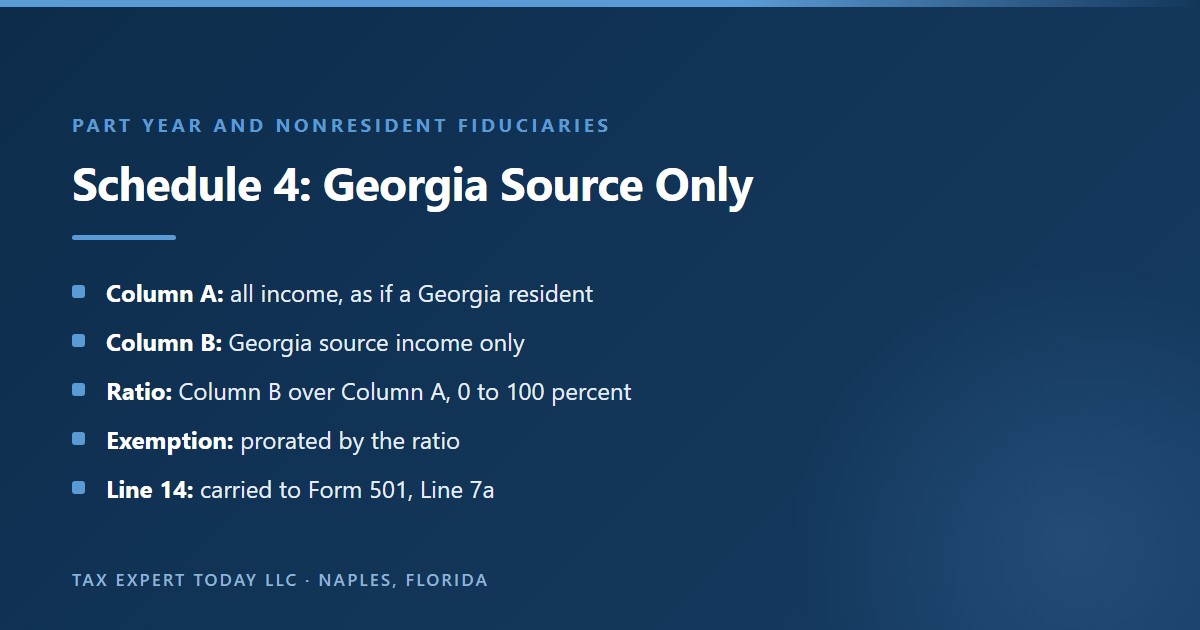
Schedule 4 computes Georgia taxable income for part year and nonresident fiduciaries. Column A lists income as if the fiduciary were a Georgia resident, Column B lists Georgia source income, and the ratio of the two prorates the exemption. The beneficiaries’ Georgia share comes off, and Line 14 goes to Georgia Form 501, Line 7a.
- Lines 1 to 5: interest, dividends, business income, other income, total.
- Line 6: deductions from Form 1041, with Column B limited to those tied to Georgia income.
- Line 9: the ratio of Georgia income to total, between zero and 100 percent.
- Lines 10 and 11: the exemption times the ratio.
- Lines 12 to 14: beneficiaries’ Georgia share, total deductions, Georgia taxable income.
The 2025 booklet’s Schedule 4 instructions are short. On Lines 1 through 4, Column A, the fiduciary lists income as if it were a Georgia resident; in Column B it lists Georgia source income. Line 6 takes the deductions used to reach adjusted total income on the federal Form 1041, with Column B limited to deductions that relate to Georgia source income. Line 7 carries net Schedule 2 adjustments, again split. Line 8 is Line 5 minus Line 6, plus or minus Line 7. Line 9 divides Column B by Column A, and the form says the percentage cannot be negative and cannot exceed 100 percent.
The exemption is prorated, not the income. A nonresident estate with 30 percent Georgia income gets 30 percent of the $2,700 estate exemption, or $810. The beneficiaries’ share of Georgia income from Schedule 3 is added to the prorated exemption on Line 13, and Line 14, Column B income less Line 13, is the Georgia taxable income before any net operating loss. That figure goes to Line 7a on page 1, and the computation continues from there exactly as it does for a resident.
| Schedule 4 line | Column A (all sources) | Column B (Georgia source) |
|---|---|---|
| 1 to 4 | Interest, dividends, business, other income as if a Georgia resident | Georgia source portion of each |
| 5 | Total of Lines 1 to 4 | Total of Lines 1 to 4 |
| 6 | All deductions from Form 1041 | Deductions related to Georgia source income |
| 7 | Net Schedule 2 adjustments | Adjustments related to Georgia source income |
| 8 | Line 5 less Line 6, plus or minus Line 7 | Same computation |
| 9 | Ratio: Line 8, Column B divided by Line 8, Column A (0 to 100 percent) | |
| 10 and 11 | Exemption ($1,350 trust, $2,700 estate) times the ratio | |
| 12 to 14 | Beneficiaries’ Georgia share, total deductions, and Georgia taxable income carried to Line 7a | |
Georgia source income for a fiduciary usually means rent and gain from Georgia real estate, income from a business carried on in Georgia, and a share of Georgia partnership or S corporation income. Interest and dividends on a brokerage account are generally sourced to the owner’s residence, which is why a nonresident estate’s Column B often holds only the Georgia rental. The same sourcing ideas appear in our guide to the Georgia part year resident tax return, which covers the individual version of this computation on Form 500 Schedule 3.
How Does a Grantor Trust File Georgia Form 501?
A grantor trust checks the Grantor Trust box on page 1 of Georgia Form 501, attaches the schedule showing the trust’s activity as it does for federal purposes, and leaves the rest of the return blank. The exception is credits: if the trust generates or receives Georgia credits, it completes Schedules 5, 5B, and 6.
- Check the box: Grantor Trust on page 1.
- Attach the activity: the same grantor statement used federally.
- Leave the computation blank: the grantor reports the income.
- Credits: Schedules 5 and 5B to report, Schedule 6 to pass them to the owner.
- Partial grantor trusts: do not check the box.
Under 26 U.S.C. 671, when the grantor or another person is treated as the owner of a trust, the income, deductions, and credits of the trust are included in computing that owner’s taxable income. A revocable living trust is the most common example. Georgia follows the federal treatment: the grantor reports the income on their own Georgia Form 500, and the trust itself owes no fiduciary tax.
The 2025 booklet still asks for a Georgia Form 501 filing in many cases. Its grantor trust instruction says that, in addition to checking the Grantor Trust box, the trust should attach the schedule showing the activity and leave the rest of the return blank, except when the grantor trust generates credits or has credits assigned, allocated, or transferred to it. In that case Schedules 5 and 5B are completed and Schedule 6 transfers the credit to the owner, which the booklet says is necessary so that the credits flow to the proper taxpayer. The booklet also states that partial grantor trusts should not check the grantor trust box; they complete the return for the nongrantor portion.
The grantor trust treatment ends at the grantor’s death. A revocable trust becomes irrevocable, a new taxpayer comes into existence with its own identification number, and the trustee files a regular Georgia Form 501 from that date forward, using the full Schedule 1 computation. Families are often caught by this change, because the trust looked the same for years and suddenly needs its own returns, its own estimated tax analysis, and its own beneficiary reporting.
What About Bankruptcy Estates and Qualified Funeral Trusts?
Georgia Form 501 has checkboxes for two special filers. A qualified funeral trust that has made the federal election checks its box, enters the correct tax on Line 8, and attaches support. An individual’s Chapter 7 or Chapter 11 bankruptcy estate files Form 501 when its gross income reaches the threshold printed in the booklet.
- Qualified funeral trust: a trust funded under a preneed funeral contract that elected the status.
- Bankruptcy estate: a separate taxable entity for an individual debtor in Chapter 7 or 11.
- Filer: the bankruptcy trustee or the debtor in possession.
- Threshold in the 2025 booklet: gross income of $13,850 or more.
- Not covered: partnership and corporate bankruptcies create no separate entity.
The 2025 booklet defines a qualified funeral trust by four requirements: the trust arises from a contract with a person in the business of providing funeral or burial services or property, its sole purpose is to hold and invest funds for those services, its only beneficiaries are the individuals for whom the services will be provided, and its only contributions are made by or for those beneficiaries. The trustee must elect the status, and absent the election the trust would be treated as owned by the purchaser under the grantor trust rules. A qualifying trust checks the box on page 1 of Georgia Form 501, fills in the correct tax on Line 8, and attaches documentation.
For bankruptcy estates, the booklet says the bankruptcy trustee or debtor in possession must file Form 501 for the estate of an individual in Chapter 7 or Chapter 11 if the estate has gross income for the year of $13,850 or more. It explains that the estate created by the petition is a separate taxable entity, that a dismissed case is treated as if the petition were never filed, and that no separate entity is created when a partnership or corporation files. It refers the reader to IRS Publication 908 for the federal rules.
Both situations are uncommon, and both usually involve a professional already, a funeral home’s trust administrator or a bankruptcy trustee. The point for most families is simply that the boxes exist, and that checking one changes how the Georgia Form 501 is read.
When Is Georgia Form 501 Due?
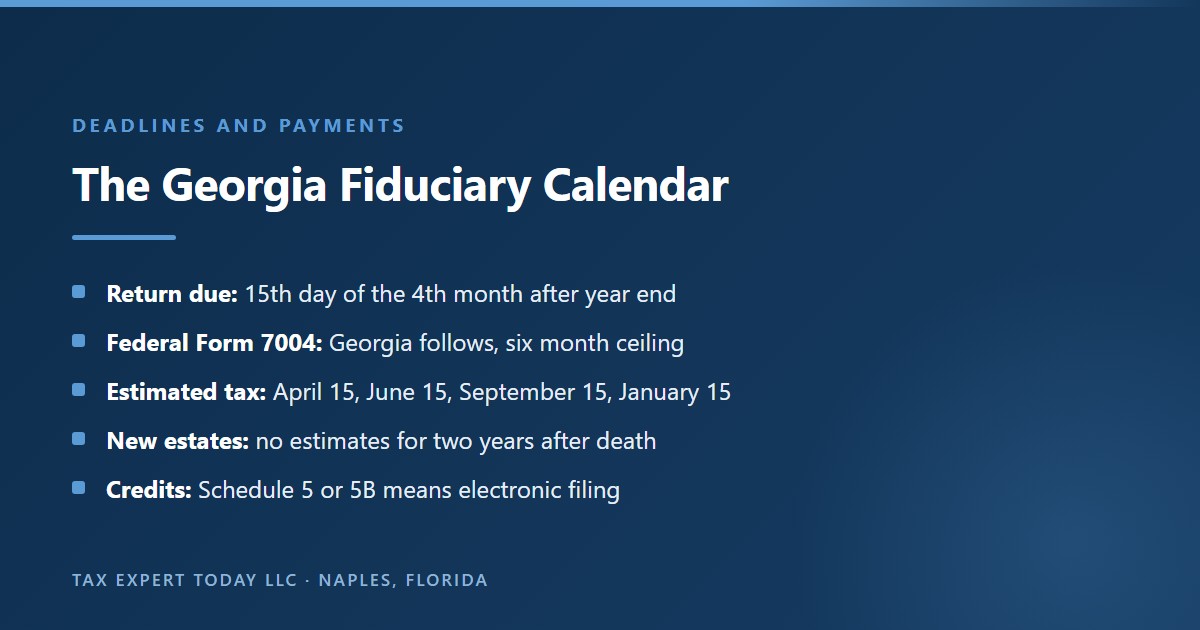
Georgia Form 501 is due on the 15th day of the 4th month after the close of the estate’s or trust’s tax year. For a calendar year, that is April 15. A 2025 calendar year return was due April 15, 2026, and a 2026 return is due April 15, 2027, moved to the next business day if needed.
- Calendar year trusts: April 15 of the following year.
- Fiscal year estates: the 15th day of the 4th month after the chosen year end.
- Same as federal: the Form 1041 due date follows the same rule.
- Weekend or holiday: the next business day.
- Payment: due by the original date even with an extension.
The Department’s instructions printed with its Form 501 example state that returns are required to be filed by the 15th day of the 4th month following the close of the taxable year, and give the calendar year 2023 example: due April 15, 2024. The federal Form 1041 follows the same timing, which is convenient because Georgia Form 501 requires a copy of the federal return.
Estates often use a fiscal year. A decedent who died on June 10, 2026, leaves an estate whose executor may choose a tax year ending May 31, 2027, or the last day of any other month within twelve months of death, under the federal rules. Georgia follows the federal year. If the estate’s first year ends May 31, 2027, its first Georgia Form 501 is due September 15, 2027, the 15th day of the 4th month after year end. The fiscal year boxes at the head of page 1 are where that choice is reported.
Trusts, by contrast, are generally required to use a calendar year under the federal rules, so nearly every trust’s Georgia Form 501 is due April 15. A trust that was revocable during the grantor’s life and became irrevocable at death may join the estate’s fiscal year if the trustee and executor make the federal election that allows it, and Georgia follows that federal choice.
| Tax year | Georgia Form 501 due date | Extended due date with a federal Form 7004 |
|---|---|---|
| Calendar 2025 | April 15, 2026 | September 30, 2026 |
| Calendar 2026 | April 15, 2027 | September 30, 2027 |
| Fiscal year ending May 31, 2027 | September 15, 2027 | Five and one half months later, within Georgia’s six month ceiling |
How Does an Extension Work for Georgia Form 501?
Georgia honors the federal automatic extension. Under Ga. Comp. R. & Regs. 560-7-8-.08, an automatic extension accepted by the IRS extends the Georgia return for the same number of months, and Georgia law caps extensions at six months. A fiduciary without a federal extension can request a Georgia extension on Form IT-303.
- Federal Form 7004: gives a Form 1041 filer an automatic five and one half months.
- Georgia follows: the same number of months from the Georgia due date.
- Six month ceiling: Georgia law does not allow more in the aggregate.
- Georgia only: Form IT-303 when no federal extension is needed.
- Payment not extended: interest and late payment penalty run from the original date.
The rule appears in Ga. Comp. R. & Regs. 560-7-8-.08: the automatic extension for filing a return accepted by the Internal Revenue Service is honored by Georgia for the same number of months from the statutory due date of the Georgia return, and Georgia law prohibits granting an extension of over six months in the aggregate. On the federal side, Treas. Reg. 1.6081-6 gives an estate or trust filing Form 1041 an automatic five and one half month extension when it files Form 7004. The same regulation notes that the trust’s extension does not extend the beneficiaries’ own returns or their payment dates.
A calendar year trust that files Form 7004 by April 15 therefore has until September 30 to file both the 1041 and Georgia Form 501. It is good practice to attach a copy of the federal extension to the Georgia return when it is filed, so the Department can see why the return arrived after April 15. Where no federal extension is needed, for example because the federal return will be filed on time but the Georgia return will not, the fiduciary can file Georgia Form IT-303. Our guide to Georgia Form IT-303 explains how that form works and when it is required.
An extension is time to file, not time to pay. The 2025 booklet describes the failure to pay penalty as 0.5 percent of the tax due for each month or part of a month, up to 25 percent, and interest runs from the original due date. A trustee who expects a balance due should estimate the Georgia tax and pay it by April 15. The booklet’s instruction for Line 11a refers to payments made electronically or with Form IT-560, the Georgia payment voucher, and payments can also be made through the Georgia Tax Center.
Do Estates and Trusts Have to Pay Georgia Estimated Tax?
Yes, in many cases. O.C.G.A. 48-7-114 requires fiduciaries to pay Georgia estimated tax when expected gross income exceeds the exemption, plus estimated deductions, plus $1,000 of income not subject to withholding. Estates and certain testamentary trusts are excused for tax years ending within two years after the decedent’s death.
- Threshold: exemption plus estimated deductions plus $1,000 not subject to withholding.
- Two year relief: for decedents’ estates and testamentary trusts under IRC 6654(l)(2)(B).
- Due dates: April 15, June 15, September 15, and January 15.
- Voucher: Form 500-ES, or payment through the Georgia Tax Center.
- Underpayment charge: 9 percent a year, computed on Form 500 UET.
The 2025 booklet’s estimated tax section quotes the rule: each fiduciary subject to Georgia income tax that reasonably expects gross income for the year to exceed the estate or trust exemption, plus estimated deductions, plus $1,000 of income not subject to withholding, is required to file estimated tax. It then adds an important exception. A fiduciary is not required to pay estimated tax for any taxable year ending before the date two years after the decedent’s death, in the case of the estate of a decedent, or a testamentary trust as defined in IRC 6654(l)(2)(B).
That two year window is a real planning benefit for executors. An estate that sells appreciated stock in its first fiscal year does not have to make quarterly Georgia payments, although it still owes the tax when Georgia Form 501 is due. A living trust that becomes irrevocable at death and receives the residue of a pour over will may also fall within the exception, depending on how the federal definition applies. A trust created during life that was never a grantor trust gets no such relief.
The booklet gives the installment schedule: on or before April 15 of the tax year, with later dates of June 15, September 15, and January 15 of the following year if the requirement is first met later in the year, moved to the next business day if needed. Fiscal year fiduciaries use the corresponding dates. The voucher is Form 500-ES, which the booklet says should be mailed to the Department of Revenue, Processing Center, P.O. Box 740319, Atlanta, GA 30374-0319, and GTC accepts fiduciary estimated payments directly. Our guide to Georgia Form 500-ES covers the voucher and the safe harbor approach in more detail.
| When the estimated tax requirement is first met | Payment due |
|---|---|
| Before April 1 | April 15 of the tax year |
| April 1 to May 31 | June 15 |
| June 1 to August 31 | September 15 |
| On or after September 1 | January 15 of the following year |
Underpayment is charged at 9 percent a year for the period of underpayment, according to the booklet and the Department’s penalty table, which cites O.C.G.A. 48-7-120. The penalty is computed on Form 500 UET and entered on Georgia Form 501, Line 18. If the fiduciary qualifies for an exception on Form 500 UET, it checks the “500 UET Exception Attached” box on page 1, enters the revised penalty (zero if it is zero), and includes the form.
Where Do You Mail or E-File Georgia Form 501?
The Department’s mailing address page lists P.O. Box 740316, Atlanta, GA 30374-0316 for paper Forms 501 and 501X, which matches page 2 of the 2025 form. A return that claims a Georgia tax credit on Schedule 5 or 5B must be filed electronically, and many fiduciaries e-file through approved software.
- Paper Form 501 and 501X: P.O. Box 740316, Atlanta, GA 30374-0316.
- Estimated tax vouchers: P.O. Box 740319, Atlanta, GA 30374-0319.
- Credits: any series 100 credit requires electronic filing.
- Attach: the federal return and supporting schedules.
- Avoid certified mail: the booklet says it delays processing.
The mailing address page on the Department’s site lists the address for Forms 501 and 501X as Georgia Department of Revenue, P.O. Box 740316, Atlanta, GA 30374-0316, the same address printed on the 2025 Georgia Form 501. The general mailing section of the 2025 booklet lists a different processing center box for tax returns. When two official sources differ, follow the address printed on the form for the year you are filing and confirm it on the Department’s page on the day you mail.
| Document | Where it goes | Source |
|---|---|---|
| Georgia Form 501 and 501X (paper) | P.O. Box 740316, Atlanta, GA 30374-0316 | Department mailing address page and the 2025 form, page 2 |
| Form 500-ES estimated tax voucher | P.O. Box 740319, Atlanta, GA 30374-0319 | 2025 booklet, estimated tax section |
| Returns with Schedule 5 or 5B credits | Electronic filing only | 2025 booklet, Line 9 and Schedules 5 and 5B |
| Payments | Georgia Tax Center (gtc.dor.ga.gov) or check payable to the Georgia Department of Revenue | 2025 booklet, payment options |
The electronic filing rule for credits is strict. The booklet says a return is required to be filed electronically if it generates, allocates, claims, utilizes, or includes in any manner a series 100 tax credit claimed on Schedule 5 or 5B. Schedule 5 and 5B pages of the form carry the warning “credits must be filed electronically” in large type. A trust that owns a partnership interest passing through a Georgia film credit, for example, cannot paper file.
The booklet also lists practical details: paid preparers must sign the return; a first time Georgia filer, or one that has not filed for five or more years, receives a paper refund check even when direct deposit is requested; and to prevent fraud, refunds of electronically made payments go only to the account the payment came from. The 2025 booklet also notes that sending a return by certified mail delays processing.
How Are Georgia Tax Credits Claimed on Form 501?
Georgia credits that belong to an estate or trust, or that reach it through an S corporation, LLC, LLP, or partnership K-1, go on Schedule 5, refundable credits go on Schedule 5B, and Schedule 6 allocates credits to beneficiaries. Any series 100 credit requires electronic filing. The credit for tax paid to another state goes on Line 9a instead.
- Schedule 5: one schedule per credit code, showing carryovers, credits generated, and credits used.
- Schedule 5B: refundable credits; currently only the timber tax credit, and not if purchased.
- Schedule 6: allocation of credits to beneficiaries by code.
- Not allocable: codes 125, 136, 140, 150, and 151 stay with the fiduciary.
- Line 9a: the other state tax credit, with a copy of the other state’s return.
The 2025 booklet explains that credits on Georgia Form 501 come either from the fiduciary itself or from the fiduciary’s ownership of an S corporation, LLC, LLP, or partnership interest, as shown on the fiduciary’s K-1. Each credit code gets its own Schedule 5. Lines 2 through 9 show the carryover from earlier years and the credit generated this year, with the company name, identification number, and credit certificate number where one exists. Line 10 totals the available credit, Line 11 shows any amount sold (only certain credits may be sold), Line 12 shows the amount allocated to beneficiaries, Line 13 shows the credit used, which goes to Georgia Form 501, Line 9b, and Line 14 shows the potential carryover.
Schedule 6 allocates credits to beneficiaries. The 2025 form states that credits are apportioned between the fiduciary and its beneficiaries on the basis of the income of the fiduciary and the income distributed to the beneficiaries. The booklet makes an exception for donation type credits: codes 125 (qualified education expense), 136 (qualified rural hospital organization expense), 140 (qualified education donation), 150 (qualified law enforcement donation), and 151 (qualified foster child donation) cannot be allocated to beneficiaries, and the fiduciary enters its own identification number rather than the organization’s.
| Selected credit codes from the 2025 booklet | Credit |
|---|---|
| 103 and 157 | Employer’s jobs tax credit, and its 2025 version |
| 112 | Research tax credit |
| 122, 133, 138, 139 | Film, interactive entertainment, postproduction, and small production film credits |
| 124 | Land conservation credit |
| 125 | Qualified education expense credit (not allocable to beneficiaries) |
| 136 | Qualified rural hospital organization expense credit (not allocable) |
| 145 and 155 | Timber tax credit, and its 2025 version (refundable on Schedule 5B unless purchased) |
| 149, 152, 153 | Historic rehabilitation credits |
The booklet says credit codes are subject to change each year, and the Department’s tax credit summaries are the place to confirm a code before filing. Our guides to the Georgia film tax credit and the Georgia R&D tax credit cover two credits that often reach trusts through partnership interests.
The other state tax credit works differently. It goes on Line 9a, not on Schedule 5. The Department’s worksheet, printed with its Form 501 example, explains that Georgia allows a credit for tax paid to another state on income taxable to both Georgia and that state, that the credit is for state and U.S. local income tax imposed on net income, and that foreign taxes and other kinds of tax do not qualify. The fiduciary includes a copy of the other state’s return. A resident Georgia trust that owns a rental in North Carolina and pays North Carolina tax on it is the typical case.
How Does Schedule 7 Handle a Net Operating Loss on Georgia Form 501?
For tax years beginning in 2023 and later, fiduciaries compute a Georgia net operating loss on Schedule 7 of Georgia Form 501, not on Form 500-NOL. The Georgia loss is computed separately from the federal one, losses from 2018 forward generally carry forward only, and their use is limited to 80 percent of Georgia income before the deduction.
- Separate computation: a federal NOL does not automatically mean a Georgia NOL.
- Normal loss: carried forward until used up, no carryback.
- Farm loss: two year carryback, then forward until used up.
- Insurance loss: two year carryback and twenty year carryforward.
- Filing window: Schedule 7 is due within three years of the loss year’s due date, with extensions.
The 2025 booklet devotes several pages to Schedule 7. It explains that a Georgia NOL must be computed separately from any federal NOL, that it is possible to have a federal NOL but no Georgia NOL, and that only amounts attributable to Georgia can be used. Schedule 7 must be completed and filed with the 501 or 501X no later than three years from the due date of the loss year return, including extensions. For taxable years beginning in 2023 and later, Schedule 7 replaces Form 500-NOL for fiduciaries, and pages 1 and 2 of Form 501 or 501X must be included with it.
The 80 percent limit appears both in the summary of changes at the front of the booklet and in the Line 7b instruction: NOLs for tax years 2018 and later that are applied to Georgia income cannot exceed 80 percent of Georgia income before NOLs. The booklet’s Line 7b worksheet separates losses from years before 2018, which are not subject to the limit, from 2018 and later losses, which are. Georgia did not adopt the revised NOL provisions in the 2020 CARES Act or the CARES Act change to the IRC 461(l) excess business loss limitation, so the Georgia computation keeps the 461(l) adjustment, and Schedule 7, Line 29 carries an IRC 461(l) loss forward separately.
Carrybacks have their own procedure. The booklet says a fiduciary wanting a refund from a farm or insurance loss carryback must use Schedule 7’s Part II on page 9 and must not file Form 501X for the earlier years. Schedule 7 itself is treated as a claim for credit or refund. Within 90 days from the last day of the month in which it is filed, the Commissioner makes a limited examination and may disallow a form with computational errors or material omissions. The attachment list is specific: the federal Form 1041 for the loss year with the schedules that produced the loss, the federal returns for the carryback years, the Georgia returns for the carryback or carryforward years, and Form 1045 for a carryback.
A hypothetical shows the 80 percent limit. A trust has a 2024 Georgia NOL carryforward of $50,000. In 2025, its Georgia taxable income before the NOL, Line 7a, is $30,000. Eighty percent of $30,000 is $24,000, so Line 7b is $24,000 and Line 7c is $6,000. Georgia tax at 5.19 percent is $311.40, entered as $311. The remaining $26,000 of loss carries forward. Our guide to the Georgia net operating loss explains the individual and corporate versions of these rules, including the trap for losses trapped inside a composite return.
How Do You Amend Georgia Form 501 With Form 501X?
An estate or trust corrects a filed Georgia Form 501 on Form 501X, the Amended Fiduciary Income Tax Return. Form 501X follows the same booklet for Lines 1 through 11b, then adds lines for amounts paid with the original return and refunds already received. Do not use Form 501X to carry back a net operating loss.
- Lines 1 to 11b: the corrected figures, using the Form 501 instructions.
- Line 11c: payments made with or after the original return.
- Line 12: refunds already received on earlier returns.
- Lines 14 to 22: additional tax or refund, interest, and penalties.
- NOL carrybacks: use Schedule 7, Part II, not Form 501X.
The 2025 booklet’s Form 501X instructions say to refer to the Form 501 instructions for Lines 1 through 11b. Line 11c holds the amount paid with the original return plus any later payments, Line 11d holds Schedule 5B refundable credits (again requiring electronic filing), Line 11e totals Lines 11a through 11d, and Line 12 shows any refund already received. The rest of the form computes the additional tax or refund, with interest, late payment and late filing penalties, and the estimated tax penalty.
Amended fiduciary returns usually follow a late K-1, a corrected 1099 from a brokerage, a federal adjustment after an IRS examination of the 1041, or a beneficiary allocation that was wrong the first time. The booklet notes that the failure to pay penalty does not apply when a return is being amended because of an IRS audit, and directs the fiduciary to check the box at the head of page 1. Our guide to the Georgia amended tax return covers the timing rules for refunds and the reporting of federal changes, which apply to fiduciaries as well as individuals.
When an amended Georgia Form 501 changes the beneficiaries’ share, the beneficiaries’ returns may need to change too. A corrected Schedule 3 that moves $8,000 of income from the trust to a beneficiary lowers the trust’s Georgia tax and raises the beneficiary’s federal and Georgia income. The fiduciary should send corrected K-1s and let each beneficiary decide, with their own preparer, whether to amend.
What Penalties and Interest Apply to a Late Georgia Form 501?
The 2025 booklet applies the individual penalty rules to fiduciaries: 5 percent a month for late filing, 0.5 percent a month for late payment, each capped at 25 percent and together capped at 25 percent of the unpaid tax. Negligence adds 5 percent, fraud 50 percent, and interest runs at the prime rate plus 3 percent.
- Late filing: 5 percent of unpaid tax per month or part of a month, to 25 percent.
- Late payment: 0.5 percent per month or part of a month, to 25 percent.
- Combined cap: 25 percent of the tax not paid by the original due date.
- Negligence and fraud: 5 percent and 50 percent of the underpayment.
- Interest: the Federal Reserve prime rate plus 3 percent, reviewed each January.
The general information section of the 2025 booklet lists the penalties, and the Department’s Penalty and Interest Rates page gives the statutes: late filing under O.C.G.A. 48-7-57, late payment and negligent and fraudulent underpayment under 48-7-86, frivolous returns under 48-7-57.1, and underpayment of estimated tax under 48-7-120. Lines 16 and 17 of Georgia Form 501 say the late payment and late filing penalties are calculated the same way as for individual income taxpayers.
| Charge | Rate | Maximum or basis | O.C.G.A. |
|---|---|---|---|
| Late filing | 5 percent of tax unpaid at the original due date, per month or part | 25 percent | 48-7-57 |
| Late payment | 0.5 percent per month or part | 25 percent | 48-7-86 |
| Late filing and late payment together | Cannot exceed 25 percent of tax not paid by the original due date | 48-7-86 | |
| Negligent underpayment | 5 percent of the underpayment | None stated | 48-7-86 |
| Fraudulent underpayment | 50 percent of the underpayment | None stated | 48-7-86 |
| Frivolous return | $1,000 | $1,000 | 48-7-57.1 |
| Estimated tax underpayment | 9 percent a year | Period of underpayment, Form 500 UET | 48-7-120 |
| Interest | Prime rate plus 3 percent (12 percent for months before July 1, 2016) | Reviewed each January | See the Department’s annual notice |
Late Georgia Form 501 filings tend to cluster in two situations. The first is the estate that nobody realized had income: a decedent’s IRA paid out to the estate, or a house sat unsold for two years and was rented in the meantime. The second is the trust whose corporate trustee resigned and whose family successor trustee did not know a Georgia return existed. In both, the Georgia penalties are percentages of tax, so a year with little or no tax produces little or no penalty, but a year with a large gain can produce a significant one. The Department’s Georgia Tax Center lists penalty waiver requests among its features, and our guide to a Georgia Department of Revenue payment plan explains the options when a balance cannot be paid at once.
Who Files When a Georgia Resident Dies: Form 500 or Georgia Form 501?
Often both. The decedent’s final individual return for the year of death is a Georgia Form 500, filed by the executor or administrator for income received before death. Income received after death by the estate goes on Georgia Form 501. A revocable trust that becomes irrevocable starts filing Form 501 as well.
- Before death: the decedent’s wages, pension, and investment income go on the final Form 500.
- After death: income paid to the estate goes on the estate’s Form 501.
- After death, trust assets: income of a formerly revocable trust goes on the trust’s Form 501.
- New identification numbers: the estate and the irrevocable trust each need an EIN.
- Same person may sign: the executor signs the final Form 500 and the estate’s Form 501.
O.C.G.A. 48-7-22(a)(3)(B), quoted in the Department’s bulletin, makes the fiduciary responsible for the taxable net income received during the taxable year by a deceased individual who died during or after the year without having filed a return. In practice the executor files the decedent’s final Georgia Form 500 for the period from January 1 to the date of death, and the surviving spouse may file jointly for that year if the rules allow. Our guide to the Georgia state income tax covers the individual return.
Income that arrives after the date of death belongs to a different taxpayer. A dividend paid on June 20 to a stock account in the decedent’s name, after a June 10 death, is income of the estate. A required minimum distribution paid to the estate as beneficiary of an IRA is income of the estate. Rent collected on a house in the estate is income of the estate. All of it goes on Georgia Form 501 for the estate’s first tax year, if the estate meets the filing threshold.
| Income item, decedent died June 10, 2026 | Return |
|---|---|
| Pension payments January through June 1 | Final Georgia Form 500 for 2026 |
| Dividend paid June 20 to the decedent’s brokerage account | Estate’s Georgia Form 501 |
| Rent on a house held in the estate, July through December | Estate’s Georgia Form 501 |
| Interest on assets held in a revocable trust, after June 10 | The trust’s Georgia Form 501 (or the estate’s, if the federal election to combine is made) |
| Gain on the estate’s sale of the house in October | Estate’s Georgia Form 501, using the stepped up basis |
Basis is the reason many estates owe little Georgia tax on a quick sale. Property included in a decedent’s estate generally takes a basis equal to its value at death, so a house sold a few months later for about its date of death value produces little gain. If the estate holds the property longer and it appreciates, the later gain is taxable on Georgia Form 501 at the fiduciary rate, unless it is carried out to beneficiaries. Our guides to the Georgia inheritance tax and the Georgia capital gains tax explain the estate and gain sides in more detail, and the Georgia gift tax guide shows how the basis rules differ for property given during life.
For executors who need help sorting out which Georgia returns an estate owes, our Georgia tax help for estates and trusts starts with that inventory. Georgia itself has no estate tax for deaths after July 1, 2014, under O.C.G.A. 48-12-1, so Georgia Form 501 is often the only Georgia return an estate files apart from the decedent’s final Form 500. That makes it easy to overlook, and it is one reason executors are surprised by a Department notice two years later.
What Does a Nonresident Estate Selling Georgia Property Report on Form 501?
A nonresident estate or trust that sells Georgia real estate has Georgia source gain, so it files Georgia Form 501 using Schedule 4. Georgia may require withholding at closing under O.C.G.A. 48-7-128, and the amount withheld is claimed as a credit on Line 11b with the withholding statement or closing statement attached.
- Georgia source: gain on Georgia real property is Georgia income.
- Schedule 4: the gain goes in Column B; other income stays in Column A only.
- Withholding at closing: may apply to nonresident sellers under 48-7-128.
- Credit: claimed on Georgia Form 501, Line 11b.
- Attach: the G2-RP or the closing statement showing the amount withheld.
This is the most common way a Florida executor meets Georgia Form 501. The decedent lived in Naples, Florida, and kept a cabin in Blue Ridge or a condominium in Atlanta. The estate sells it. The buyer’s closing attorney withholds Georgia tax from the proceeds because the seller is a nonresident, and the estate now needs to file a Georgia return to report the gain and recover any excess withholding.
The 2025 booklet’s Line 11b instruction tells the fiduciary to include the credit for nonresident withholding on the sale of property by nonresidents, citing O.C.G.A. 48-7-128 and 48-7-129, and to include a copy of the G2-RP or G2-A or the closing statement showing the amount withheld. It warns that all withholding statements must be included or the amounts may not be allowed. Because a stepped up basis often leaves little gain on a sale soon after death, withholding computed on the sale price can exceed the actual Georgia tax, and Georgia Form 501 is how the estate asks for the difference back.
Our guide to the 1031 exchange in Georgia covers the nonresident withholding rules and the exemption affidavits in more detail, and the same mechanics apply to an estate seller. A worked example of a nonresident estate’s Schedule 4 appears later in this guide.
What Records Should a Fiduciary Keep for Georgia Form 501?
Keep the federal Form 1041 and every schedule, the K-1s issued and received, brokerage and bank statements, closing statements and withholding forms, the trust instrument or letters testamentary, residency facts for the fiduciary and beneficiaries, and the worksheets behind Schedules 2, 4, and 7. Georgia requires several of these to be attached.
- Federal return: required as an attachment to every Georgia Form 501.
- Withholding proof: G2-RP, G2-A, G2-LP, 1099, or closing statement.
- Other state returns: required for the Line 9a credit.
- NOL support: loss year and carryback year federal and Georgia returns.
- Residency file: where the trust is administered and where beneficiaries live.
Fiduciary returns are often prepared years after the events they report, by someone who was not involved when the trust was created or the decedent died. A well organized file makes each year’s Georgia Form 501 faster and makes any Department inquiry easier to answer. The governing documents matter as much as the tax forms: whether a beneficiary has a right to income or only a discretionary interest decides both the federal distribution deduction and, for a nonresident trust, whether the Kaestner analysis applies.
The residency file deserves special care because it rarely appears on any form. Record where the trustee lives, where the trust’s books are kept, where investment decisions are made, and where each beneficiary lives at year end. If any of those changes during the year, note the date. That record is what supports a residency code of 1, 2, or 3 on page 1 of Georgia Form 501, and it is the first thing a reviewer will ask about if the Department questions the filing.
Paper Georgia Form 501 filings with the 2D barcode produced by approved software process faster, according to the booklet, and the Department publishes the list of approved software providers. The booklet is careful to say it neither supports nor recommends any particular software.
What Mistakes Are Common on Georgia Form 501?
The errors that recur on Georgia Form 501 are forgetting to file at all, using the federal exemption instead of Georgia’s, subtracting agency bonds that are not U.S. obligations, missing withholding credits for lack of attachments, paper filing a return with credits, and treating a former revocable trust as if it were still a grantor trust.
- No return filed: the estate or trust met the threshold but nobody knew.
- Wrong exemption: $600 or $100 instead of $2,700 or $1,350.
- Agency bond interest: FNMA, GNMA, and FHLMC interest stays taxable.
- Missing attachments: withholding credits may be denied without the statements.
- Grantor box after death: the trust is no longer a grantor trust.
Each of these comes straight from a rule in the booklet or the statute. The exemption mistake happens because tax software carries the federal figure forward and a preparer copies it. The bond mistake happens because brokerage statements label agency interest as “government” interest. The attachment mistake happens because the closing statement sits with the probate file rather than the tax file. The grantor box mistake happens because the same trust name and the same bank account continue after death.
Two more problems show up in practice. One is a Schedule 3 total that does not match Line 4, which the booklet says it must. The other is a residency code that does not match the schedules: a nonresident fiduciary that enters code 3 but completes Schedule 1, Lines 1 through 6, instead of Schedule 4. Both are easy to check before the return goes in, and both are the kind of error the Department’s processing catches first.
Does a Trust That Distributes All Its Income Still File Georgia Form 501?
Usually yes. A resident trust that must file a federal Form 1041 must file Georgia Form 501, even if it distributes all of its income and owes no Georgia tax. The return reports the income, deducts the beneficiaries’ share on Schedule 3, and shows little or no tax on the amount left.
- Filing follows the federal duty: O.C.G.A. 48-7-50(a)(3) for resident trusts.
- Tax follows retained income: distributed income is deducted on Line 4.
- Capital gains: often retained in principal and taxed to the trust.
- Exemption: $1,350 for a trust, regardless of type.
- Zero tax is not zero filing: the return still reports the activity.
A simple trust that must distribute all of its income each year is a common example. Under the federal rules, it deducts the income it distributes, so its federal taxable income is often limited to capital gains allocated to principal. Georgia Form 501 mirrors that result. The trust reports adjusted total income on Line 1, applies Schedule 2, deducts the beneficiaries’ share on Line 4, subtracts the $1,350 exemption on Line 6, and pays Georgia tax on whatever remains, which for many simple trusts is the capital gain kept in the trust.
The federal threshold under IRC 6012(a)(4) requires a trust return when the trust has any taxable income or gross income of $600 or more, and a resident trust that meets it files Georgia Form 501 under 48-7-50(a)(3), even with no Georgia tax due. Filing protects the fiduciary: it starts the statute of limitations on the Georgia year and documents the beneficiary allocation that each beneficiary will rely on.
Example: A Resident Complex Trust on Georgia Form 501
In this hypothetical, a Georgia trust has $60,000 of federal adjusted total income for 2025, $3,000 of Ohio municipal bond interest to add back, and $5,000 of Treasury interest to subtract. It distributes $20,000 to beneficiaries. Georgia taxable income is $36,650, and the 2025 tax is $1,902.
- Line 1: $60,000 federal adjusted total income.
- Line 2: plus $3,000 and minus $5,000, a net adjustment of minus $2,000.
- Line 4: $20,000 beneficiaries’ share.
- Line 6: $1,350 trust exemption.
- Line 8: $36,650 times 5.19 percent, rounded to $1,902.
The trust in this illustrative Georgia Form 501 example is administered in Atlanta by an individual trustee who lives in Georgia, so it files as a full year resident, residency code 1. The trust holds a balanced portfolio, has no borrowing, and paid fiduciary and accounting fees that are already reflected in the federal adjusted total income. Its Ohio municipal bond interest is exempt federally but taxable in Georgia, so it is added back on Schedule 2, Line 1. Its Treasury interest is taxable federally but exempt in Georgia, and because the trust has no interest expense, the full $5,000 is subtracted on Schedule 2, Line 7.
| Line | Description | Amount |
|---|---|---|
| 1 | Adjusted total income from Form 1041 | $60,000 |
| 2 | Schedule 2 net adjustment ($3,000 addition less $5,000 subtraction) | ($2,000) |
| 3 | Total | $58,000 |
| 4 | Beneficiaries’ share, Schedule 3 | $20,000 |
| 5 | Balance | $38,000 |
| 6 | Trust exemption | $1,350 |
| 7a and 7c | Georgia taxable income (no NOL) | $36,650 |
| 8 | Tax at 5.19 percent ($1,902.14, rounded) | $1,902 |
If the trust paid $1,500 of Georgia estimated tax during 2025, Line 11a would show $1,500 and Line 12 would show a balance due of $402, payable by April 15, 2026. Because the trust’s expected gross income clearly exceeded the exemption plus deductions plus $1,000 of income not subject to withholding, and the trust is not within the two year post death exception, the estimated tax requirement applied, and any shortfall in the installments would be measured on Form 500 UET. The two beneficiaries who shared the $20,000 report it on their own returns from their K-1s.
Example: A Nonresident Estate With a Georgia Rental on Schedule 4
In this hypothetical, a Florida executor administers an estate that collected $30,000 of rent on a Savannah house and $10,000 of interest in 2025. Schedule 4 produces a 75 percent Georgia ratio and a prorated exemption of $2,025, so Georgia taxable income is $21,975 and the 2025 tax is $1,141.
- Residency code: 3, nonresident; Schedule 1 Lines 1 to 6 left blank.
- Column A income: $40,000 of rent and interest.
- Column B income: $30,000 of Georgia rent only.
- Ratio: $24,000 divided by $32,000, or 75 percent.
- Exemption: $2,700 times 75 percent, or $2,025.
The decedent in this illustrative Georgia Form 501 example lived in Naples, Florida, and owned a rental house in Savannah. The will was probated in Collier County, and the executor lives in Florida, so the estate is a nonresident fiduciary. The estate’s federal Form 1041 shows $40,000 of income, $30,000 of net rent before deductions and $10,000 of interest on a Florida bank account, and $8,000 of deductions in arriving at adjusted total income, of which $6,000 relate to the Savannah rental. No income was distributed during the year, and there are no Schedule 2 adjustments.
| Schedule 4 line | Column A | Column B |
|---|---|---|
| 1. Interest | $10,000 | $0 |
| 4. Other income (rent) | $30,000 | $30,000 |
| 5. Total income | $40,000 | $30,000 |
| 6. Deductions | $8,000 | $6,000 |
| 8. Total | $32,000 | $24,000 |
| 9. Ratio | 75 percent | |
| 10 and 11. Exemption, prorated | $2,700 times 75 percent = $2,025 | |
| 12. Beneficiaries’ Georgia share | $0 | |
| 14. Georgia taxable income, to Line 7a | $24,000 less $2,025 = $21,975 | |
| Form 501, Line 8 | $21,975 times 5.19 percent = $1,140.50, entered as $1,141 | |
Because this is the estate’s first tax year and it ends within two years of the decedent’s death, the estate owed no Georgia estimated tax for the year, and the full $1,141 is due with the return. If the estate sells the Savannah house in 2026, the gain is Georgia source income in Column B of the 2026 Schedule 4, and any withholding at closing goes on Line 11b with the closing statement attached.
Example: Estimated Tax for a Trust in 2026
In this hypothetical, a lifetime irrevocable trust expects about $50,000 of Georgia taxable income for 2026. At the 4.99 percent flat rate, the expected Georgia tax is about $2,495, so the trustee pays roughly $624 on each of April 15, June 15, and September 15, 2026, and January 15, 2027.
- Trust type: created during the grantor’s life, not a grantor trust.
- Two year relief: not available, because there is no decedent’s death involved.
- Expected tax: $50,000 times 4.99 percent, about $2,495.
- Installments: four equal payments of about $624.
- Underpayment: 9 percent a year on any shortfall, computed on Form 500 UET.
The trust in this illustrative example was created by a Georgia couple for their grandchildren and is administered in Georgia. It retains most of its income for future education costs. Because its expected gross income exceeds the $1,350 exemption plus estimated deductions plus $1,000 of income not subject to withholding, O.C.G.A. 48-7-114 requires estimated payments. The trustee projects $50,000 of Georgia taxable income after deductions and the exemption, multiplies by the 2026 rate of 4.99 percent, and divides by four. If the trust’s income turns out higher than projected, for example because of a large capital gain distribution in December, the trustee can increase the January 15, 2027 payment.
Our guide to Georgia Form 500-ES explains the voucher and the safe harbor approach in detail. The final 2026 Georgia Form 501, due April 15, 2027, reconciles the estimated payments on Line 11a and computes any balance due or refund. The 2026 form and booklet had not been released when this guide was written, so confirm the rate on the 2026 booklet before filing.
Example: A Revocable Trust That Becomes Irrevocable
In this hypothetical, an Augusta resident’s revocable trust reported as a grantor trust for years. After the grantor’s death on March 1, 2026, the trust becomes irrevocable, obtains its own EIN, and files a regular 2026 Georgia Form 501 for income from March 1 forward, while the final Form 500 covers income before death.
- Before death: the grantor reported everything on Form 500.
- Any Georgia Form 501 before death: grantor box checked, activity schedule attached.
- After death: a new irrevocable trust and a full Schedule 1 computation.
- Estimated tax: the two year relief may apply to the trust under the federal definition.
- Beneficiaries: K-1s for distributions from the trust after death.
The grantor in this illustrative example placed a brokerage account and a lake house on Lake Oconee in a revocable living trust. During the grantor’s life, the trust was a grantor trust under IRC 671, and the grantor reported its income. After the March 1, 2026 death, the successor trustee obtains a new federal identification number for the now irrevocable trust and begins tracking income separately. The dividends paid on February 15 belong on the grantor’s final 2026 Georgia Form 500. The dividends paid on March 15 and after belong on the trust’s 2026 Georgia Form 501.
Whether the trust can skip 2026 estimated payments turns on whether it fits the federal definition of a trust that receives the residue of the estate under the will, or is otherwise treated like a testamentary trust for this purpose under IRC 6654(l)(2)(B). If it does, the two year relief described in the booklet applies to tax years ending before March 1, 2028. If the trust distributes the brokerage account and the lake house to the children in 2027, it may also distribute its income for that year, and Schedule 3 will carry that income out to the children.
Does Moving a Trust Out of Georgia End Georgia Form 501?
Not automatically. A trust that moves administration and its trustee out of Georgia becomes a nonresident fiduciary, but O.C.G.A. 48-7-22 still reaches it if it has Georgia source income, holds Georgia property, or benefits a Georgia resident outside the narrow Kaestner facts. The year of the move is often a part year Georgia Form 501.
- Year of the move: residency code 2, with the dates of Georgia residency.
- Later years: residency code 3 if a filing basis remains, or no return if none does.
- Georgia real estate: keeps a Georgia source filing basis.
- Georgia beneficiaries: may keep a filing basis unless Kaestner facts apply.
- Documentation: record the date and facts of the change.
Families who move from Georgia to Florida often want their trusts to move too, because Florida has no personal income tax on trusts. Moving the trustee to Florida is the usual first step, but the Georgia analysis does not end there. If the trust still owns a Georgia rental, it still has Georgia source income. If a Georgia resident child receives distributions from it, the trust does not match the Kaestner facts, and Policy Bulletin IT-2019-02 indicates the Department will treat the trustee as taxable. Our guide to trust situs after moving to Florida and our overview of estate and trust planning discuss the planning steps, and a trust decanting is sometimes part of that conversation.
The 48-7-22(a)(3)(A) exception also matters in reverse. A trust that stays in Georgia but whose beneficiaries all live elsewhere may owe no Georgia tax on intangible income accumulated for or distributed to them, and the statute says no return is required for income exempt under that paragraph. Whether a given trust meets that test depends on its income and its terms, and the analysis should be done in writing each year rather than assumed.
Georgia Form 501 Help in Naples & Southwest Florida
Tax Expert Today LLC prepares Georgia Form 501 and Form 501X for estates and trusts, and the related federal Form 1041, from its office at 11983 Tamiami Trail N, Naples, FL 34110. Georgia executors and trustees are served nationwide from Naples, Florida, by phone and secure document exchange. Call (239) 441-2005.
- Georgia Form 501 help Naples: annual fiduciary returns for Georgia estates and trusts.
- Nonresident estates: Schedule 4 for Florida executors with Georgia property.
- Trust residency: Kaestner and trust situs reviews before a filing decision.
- Late and amended returns: Form 501X and catch up filings for prior years.
- Estimated tax: Form 500-ES planning for trusts and estates.
Tax Expert Today LLC is based at 11983 Tamiami Trail N, Naples, FL 34110, and our office is open Monday through Friday, 10 a.m. to 5 p.m. Eastern time. You can reach us at (239) 441-2005. Many of the Georgia fiduciary questions we see come from executors in Collier and Lee County settling the estate of a parent who kept a Georgia home, and from Georgia families whose trusts now have a trustee in Southwest Florida. We work with Georgia clients remotely, and there is no need to visit Naples to work with us.
For the full range of our Georgia work, see our Georgia tax services page. Related topics include the Georgia pass through entity tax, which affects trusts that own partnership or S corporation interests, the Georgia retirement income exclusion for beneficiaries, and, for a dispute with the Department, the Georgia Tax Tribunal. For trust design questions, see our guides to the dynasty trust and the NING trust.
A point of scope, stated plainly: Georgia Form 501 is a Georgia Department of Revenue matter, and our team of tax advisors, enrolled agents, CPAs, and attorneys handles state tax matters nationwide, including fiduciary income tax returns, Department notices, and the federal Form 1041 that the Georgia return is built on. Probate administration, will and trust drafting, and court filings are legal work for the estate’s attorney, and we coordinate with that attorney where one is involved.
When to Engage a Professional
Consider professional help with Georgia Form 501 if you are a first time executor or successor trustee, the estate or trust has Georgia property but you live elsewhere, a trust has Georgia beneficiaries and an out of state trustee, there is a net operating loss or a Georgia credit, or returns for earlier years were never filed.
- New fiduciaries: to set up the first year, the fiscal year choice, and the estimated tax analysis.
- Nonresident estates: to complete Schedule 4 and recover excess closing withholding.
- Multistate trusts: to apply 48-7-22, the Kaestner bulletin, and the trust terms.
- Losses and credits: to file Schedule 7 on time and e-file Schedules 5 and 5B.
- Prior years: to file late Georgia Form 501 returns and address penalties.
A resident estate with a few thousand dollars of interest and a straightforward distribution can often be handled with the booklet and standard software. The questions get harder when the estate or trust crosses state lines, when its income is large enough that the timing of distributions matters, or when the fiduciary is not sure a Georgia return was ever required. If any of the situations above applies, talk with us before the April 15 due date or before a Georgia property is sold. You can learn more about our Georgia state tax services or call (239) 441-2005 for a free consultation.
This article is general educational information about Georgia Form 501 as of October 21, 2026, based on the 2025 Georgia Form 501 and the 2025 Fiduciary Instructions Booklet for Forms 501 and 501X, the instructions printed with the Department’s 2023 Form 501 example, Policy Bulletin IT-2019-02 and the text of O.C.G.A. 48-7-22 and 48-7-50 it quotes, Ga. Comp. R. & Regs. 560-7-3-.07, 560-7-8-.08, and 560-7-8-.31, the Department’s Important Tax Updates, Penalty and Interest Rates, and mailing address pages, and the cited Internal Revenue Code sections and Treasury regulations, read on that date. It is not tax or legal advice for any specific estate, trust, or return. All examples are hypothetical. Georgia rates, forms, and filing rules change; confirm current requirements with the Georgia Department of Revenue or a qualified professional before filing.
Frequently Asked Questions About Georgia Form 501
What is Georgia Form 501?
Georgia Form 501 is the Fiduciary Income Tax Return. Executors, administrators, and trustees use it to report the income of an estate or trust to the Georgia Department of Revenue, deduct the share passed to beneficiaries, and pay Georgia tax on income the estate or trust keeps. Form 501X is the amended version.
Who has to file Georgia Form 501?
Under O.C.G.A. 48-7-50, a resident estate or trust files Georgia Form 501 if it must file a federal Form 1041, and a nonresident estate or trust files if it has federal gross income from Georgia sources. A nonresident trustee managing property for a Georgia beneficiary may also have to file unless the Kaestner facts apply.
When is Georgia Form 501 due?
Georgia Form 501 is due on the 15th day of the 4th month after the close of the tax year, which is April 15 for a calendar year estate or trust. A calendar year 2026 return is due April 15, 2027, or the next business day if that date falls on a weekend or holiday.
What is the exemption on Georgia Form 501?
The 2025 booklet allows an exemption of $1,350 for a trust and $2,700 for an estate on Schedule 1, Line 6. Part year and nonresident fiduciaries multiply the exemption by their Georgia income ratio on Schedule 4. The federal amounts under IRC 642(b) are smaller, so do not copy them onto the Georgia return.
What tax rate applies on Georgia Form 501?
Georgia taxes fiduciaries at the rates for single individuals under O.C.G.A. 48-7-22. The 2025 booklet applies 5.19 percent to Line 7c. The Department reports a flat 4.99 percent individual rate for 2026, so the 2026 return should use that rate, subject to confirmation in the 2026 booklet.
Does Georgia accept a federal extension for Form 501?
Yes. Under Ga. Comp. R. and Regs. 560-7-8-.08, Georgia honors an automatic extension accepted by the IRS for the same number of months, with a six month ceiling. A federal Form 7004 gives an estate or trust five and one half months. The extension does not extend the time to pay.
Does a grantor trust file Georgia Form 501?
A grantor trust that files checks the Grantor Trust box on page 1, attaches the schedule showing its activity, and leaves the rest of Georgia Form 501 blank, because the grantor reports the income. If the trust generates or receives Georgia credits, it completes Schedules 5, 5B, and 6. Partial grantor trusts do not check the box.
Do estates have to pay Georgia estimated tax?
Not at first. The 2025 booklet says a decedent’s estate, and a testamentary trust as defined in IRC 6654(l)(2)(B), need not pay estimated tax for tax years ending before two years after the date of death. Other fiduciaries pay when expected gross income exceeds the exemption, deductions, and $1,000 not subject to withholding.
Can I paper file Georgia Form 501?
Yes, unless the return claims a Georgia tax credit. Paper Forms 501 and 501X go to P.O. Box 740316, Atlanta, GA 30374-0316, according to the Department’s mailing address page. A return that generates, claims, or allocates any series 100 credit on Schedule 5 or 5B must be filed electronically.
I am an executor in Naples, Florida, and the estate owns a Georgia house. Can you help with Georgia Form 501?
Yes. Tax Expert Today LLC prepares Georgia Form 501 for nonresident estates from its Naples, Florida office at 11983 Tamiami Trail N, including Schedule 4, the federal Form 1041, and the withholding credit after a Georgia sale. Georgia clients work with us remotely. Call (239) 441-2005 for a free consultation.
Published October 21, 2026 by Dr. Pellumb Kabashi « Back to Learning Center
Have a question this article touches on?
Tax Expert Today LLC, based in Naples, Florida and serving clients across the United States.
Schedule a Consultation (239) 441-2005