
By Dr. Pellumb Kabashi, DBA, MBA, EA, CFE, CES
Founder, Tax Expert Today LLC · Tax advisors, enrolled agents, CPAs, and attorneys · Serving clients in all 50 states
Quick Answer: There is no Georgia gift tax, and the Department of Revenue administers no gift tax return. Georgia families answer only to the federal gift tax: for 2026 the annual exclusion is $19,000 per recipient and the lifetime basic exclusion is $15,000,000 per person, so most gifts owe nothing but some still require IRS Form 709. Call (239) 441-2005 for a free consultation.
The short answer to the Georgia gift tax question takes one sentence: there is no Georgia gift tax, because Georgia does not tax gifts. The longer answer is why people keep searching for it. A parent in Marietta wants to help a daughter with a down payment. A grandmother in Savannah wants to put money into college accounts for four grandchildren before December 31. A couple in Alpharetta is thinking about deeding a lake house on Lake Lanier to their son while they are still alive, or handing a paid off car to a grandson. Each of them has heard the words “gift tax” and wants to know whether Georgia is going to send a bill.
Georgia will not send a gift tax bill, because no Georgia statute imposes one, and a search for a Georgia gift tax form will come up empty. But the Georgia gift tax question rarely ends there, for three reasons. First, the federal gift tax applies to every Georgia resident, and it carries a filing requirement that catches people who will never owe a dollar of tax. Second, a gift moves the donor’s tax basis to the recipient, and that basis decides how much Georgia income tax the recipient pays at 4.99 percent when the property is later sold. Third, Georgia does tax some gifted property in other ways: a car titled to a family member still pays a reduced title ad valorem tax, and real estate passes through the county recording system. This Georgia gift tax guide covers each of those, with the 2026 figures dated and sourced, and with hypothetical examples that show the arithmetic.
Everything below is general education about the Georgia gift tax rules and the federal rules behind them as they stand in October 2026. Nothing here is advice for a specific gift, and the examples are hypothetical.
Does Georgia Have a Gift Tax in 2026?
No. There is no Georgia gift tax in 2026. No Georgia statute taxes lifetime gifts, the Department of Revenue publishes no gift tax return, and a Georgia resident who gives cash, stock, or property owes Georgia nothing for the gift. The only gift tax that reaches Georgia residents is the federal gift tax.
- No state return: there is no Georgia form to report a gift, at any amount.
- No state rate: Georgia applies no percentage to the value given away.
- Federal rules still apply: the annual exclusion, the lifetime exemption, and Form 709.
- Georgia income tax still matters: the recipient pays it on a later sale, using the donor’s basis.
- Some Georgia transfer taxes remain: the title ad valorem tax on vehicles and the county recording process for real estate.
The absence of a Georgia gift tax is a matter of what the Georgia Code does not contain, not of an exemption or a repeal. Georgia’s income tax, found in Chapter 7 of Title 48, taxes income, and a gift is not income to the person who receives it. Georgia’s estate tax, which was only ever a “pickup” tax tied to the old federal credit for state death taxes, was formally eliminated by O.C.G.A. 48-12-1, which the Department of Revenue quotes on its Estate Tax FAQ: on and after July 1, 2014, there are no estate taxes levied by the state and no estate tax returns required. Georgia never adopted a freestanding gift tax to sit beside it.
On the Georgia gift tax point, that puts Georgia in the large majority of states. Florida, where many Georgia families eventually retire, also has no gift tax. The one state that still imposes a standalone gift tax is Connecticut, which our guide to the Connecticut estate tax for nonresidents explains. A Georgia resident who owns no Connecticut property and has never lived there has no state gift tax exposure anywhere.
So the Georgia gift tax question becomes a federal question, plus a set of Georgia income tax and transfer consequences that follow the gift. The rest of this guide walks through both.
Has Georgia Ever Taxed Gifts or Estates?
Georgia has not imposed a gift tax in modern law. It did impose an estate tax, but only as a pickup tax equal to the old federal credit for state death taxes, which phased out after 2004. O.C.G.A. 48-12-1 then eliminated Georgia estate taxes and estate tax returns on and after July 1, 2014.
- Before 2005: Georgia collected an estate tax measured by the federal state death tax credit.
- 2002 to 2004: that federal credit was reduced in steps under EGTRRA, shrinking the Georgia tax.
- 2005 onward: the federal credit became a deduction, so no Georgia estate tax applied.
- July 1, 2014: O.C.G.A. 48-12-1 ended Georgia estate taxes and returns outright.
- Gifts: no Georgia gift tax in that period, before it, or since.
The Department of Revenue’s Estate Tax FAQ lays out the history plainly. Georgia’s estate tax was “based on federal estate tax law” and equal to the amount allowable as a credit for state death taxes on the federal return. When the Economic Growth and Tax Relief Reconciliation Act of 2001 cut that federal credit by 25 percent for 2002 deaths, 50 percent for 2003, and 75 percent for 2004, and then replaced it with a deduction for 2005 and later, the Georgia tax went with it. The FAQ states that for estates of decedents dying after December 31, 2004, Georgia estate tax does not apply in any year for which the Internal Revenue Code allows no credit for state death taxes. The 2014 statute made the result permanent.
The Department also notes that Georgia has no inheritance tax, “but some people refer to estate tax as inheritance tax.” The same confusion shows up with the Georgia gift tax. People hear that “Georgia has no estate tax,” assume a gift tax must exist to fill the gap, and go looking for it. It does not exist. Our guide to the Georgia inheritance tax covers what heirs owe after a death, including income tax on inherited retirement accounts, which is a separate question from lifetime gifts.
| Period | Georgia estate tax | Georgia gift tax | Source |
|---|---|---|---|
| Deaths before January 1, 2005 | Pickup tax equal to the federal state death tax credit | None | DOR Estate Tax FAQ |
| Deaths 2005 to June 30, 2014 | No tax, because no federal credit was allowed | None | DOR Estate Tax FAQ |
| On and after July 1, 2014 | Eliminated, no returns required | None | O.C.G.A. 48-12-1 |
| Tax year 2026 | None | None | O.C.G.A. 48-12-1; no Georgia gift tax statute |
The practical Georgia gift tax point for 2026 is simple. A Georgia family planning gifts does not need a Georgia transfer tax return, a Georgia valuation, or a Georgia exemption calculation. The planning work is federal on the transfer side and Georgia on the income tax side.
Which Gift Tax Rules Apply to Georgia Residents Instead?
Georgia residents follow the federal gift tax in Chapter 12 of the Internal Revenue Code. IRC 2501 imposes the tax on transfers by gift, IRC 2503 excludes the first $19,000 per recipient in 2026, and IRC 2505 credits the tax against a lifetime basic exclusion of $15,000,000 per person. The donor, not the recipient, files and pays.
- The tax: IRC 2501(a) imposes a tax on the transfer of property by gift by any individual.
- The annual exclusion: IRC 2503(b), $19,000 per recipient for 2026 under Rev. Proc. 2025-32.
- The lifetime exclusion: IRC 2010(c) and 2505, $15,000,000 per person for 2026.
- The return: IRC 6019 and Form 709, filed by the donor for each calendar year.
- The rate: the IRC 2001(c) schedule, reaching 40 percent above $1,000,000 of taxable transfers.
The federal gift tax, the one that stands in for a Georgia gift tax, is a tax on the giver. IRC 2501(a) imposes it “for each calendar year on the transfer of property by gift during such calendar year by any individual resident or nonresident.” A Georgia resident who is a U.S. citizen or resident is subject to it on gifts of any kind of property, anywhere in the world. The person who receives the gift owes no federal gift tax and, as covered below, no federal or Georgia income tax on the gift itself.
The federal system is unified. The same lifetime exclusion covers gifts made during life and the estate left at death. Every taxable gift a Georgia resident makes, meaning every gift above the annual exclusion that is not otherwise excluded, uses part of that single lifetime amount. Tax is due only after the cumulative total of taxable gifts passes the basic exclusion. Because the 2026 basic exclusion is $15,000,000 per person, set by the One Big Beautiful Bill Act and confirmed in section 3.14 of Revenue Procedure 2025-32, very few Georgia families will ever pay federal gift tax. Many more will have a filing obligation.
Our guide to the lifetime gift tax exemption for 2026 covers the federal exemption in depth, including portability of a deceased spouse’s unused exclusion and the generation skipping transfer exemption. This Georgia gift tax article stays with the parts that matter most to a Georgia family making ordinary gifts, and with the Georgia consequences that a federal summary leaves out.
| Item for 2026 | Amount or rule | Authority |
|---|---|---|
| Georgia gift tax | None | No Georgia gift tax statute; O.C.G.A. 48-12-1 for estates |
| Federal annual exclusion per recipient | $19,000 | IRC 2503(b); Rev. Proc. 2025-32 sec. 4.42(1) |
| Annual exclusion, spouse who is not a U.S. citizen | $194,000 | IRC 2523(i)(2); Rev. Proc. 2025-32 sec. 4.42(2) |
| Federal basic exclusion per person | $15,000,000 | IRC 2010(c)(3); Rev. Proc. 2025-32 sec. 3.14 |
| Generation skipping transfer exemption | $15,000,000 | IRC 2631(c); Rev. Proc. 2025-32 sec. 3.14 |
| Rate above $1,000,000 of taxable transfers | 40 percent | IRC 2001(c) |
| Who files | The donor, on Form 709 | IRC 6019; Form 709 instructions |
| Georgia income tax rate on a later sale | 4.99 percent flat | DOR Important Tax Updates |

What Is the 2026 Annual Exclusion in Georgia Gift Tax Planning?
For 2026 a Georgia resident can give up to $19,000 to each recipient without using any lifetime exclusion and, in most cases, without filing Form 709. The limit applies per recipient, so gifts to several people each get their own $19,000. Married couples who elect gift splitting can give $38,000 per recipient. Unused exclusion does not carry forward.
- Per recipient: $19,000 to each person, not $19,000 in total.
- Present interest only: the recipient must be able to use the gift now.
- Calendar year: the exclusion resets every January 1.
- Couples: $38,000 per recipient with a gift splitting election on Form 709.
- Unchanged from 2025: the amount was also $19,000 for 2025.
Section 4.42(1) of Revenue Procedure 2025-32 states that “for calendar year 2026, the first $19,000 of gifts to any person (other than gifts of future interests in property) are not included in the total amount of taxable gifts” under IRC 2503. Two phrases in that sentence do the work. “To any person” means the exclusion is counted recipient by recipient. “Other than gifts of future interests” means the gift must be a present interest, something the recipient can use, possess, or enjoy right away. An outright gift of cash, stock, or a deed qualifies. A transfer into a trust where the beneficiary cannot reach the money until a later date generally does not, unless the trust is drafted to create a present interest.
The per recipient structure is what makes the annual exclusion powerful for Georgia families with several children or grandchildren. A grandparent with five grandchildren can give each of them $19,000 in 2026, a total of $95,000, without using a dollar of lifetime exclusion. A married couple who split gifts can give each grandchild $38,000, a total of $190,000. The following January, the full exclusion is available again.
The exclusion does not accumulate. A Georgia parent who gives nothing in 2025 cannot give $38,000 to one child in 2026 and call it two years of exclusions. Each year stands alone. That is why year end is the busy season for Georgia gift tax questions and federal gift returns, and why search interest for the topic peaks in October and November. Families that plan annual gifts want them completed, and the checks deposited or the stock transferred, before December 31.
The annual exclusion has held at $19,000 for 2025 and 2026. It is indexed for inflation in $1,000 steps, so it moves only when the inflation adjustment crosses the next threshold. Confirm the 2027 figure when the IRS publishes the revenue procedure for that year rather than assuming it will change.
| Donor situation, 2026 | Recipients | Annual exclusion available | Form 709 needed for the exclusion alone? |
|---|---|---|---|
| Single parent | 2 children | $38,000 ($19,000 each) | No, if each gift is $19,000 or less and a present interest |
| Married couple, no splitting | 2 children, each spouse gives from own funds | $76,000 ($19,000 from each spouse to each child) | No, if each spouse stays within $19,000 per child |
| Married couple, splitting | 3 grandchildren, one spouse writes the checks | $114,000 ($38,000 each) | Yes, splitting requires Form 709 |
| Grandparent | 5 grandchildren | $95,000 ($19,000 each) | No, if each gift is $19,000 or less and a present interest |
How Much Can a Georgia Resident Give Over a Lifetime in 2026?
A Georgia resident can make taxable gifts up to the federal basic exclusion of $15,000,000 in 2026 before any gift tax is due, and a married couple has $30,000,000 between them. Taxable gifts above the annual exclusion reduce that amount, and whatever remains at death shelters the estate. Georgia adds no lifetime limit of its own.
- Per person: $15,000,000 basic exclusion for 2026 under IRC 2010(c)(3).
- Per couple: $30,000,000 combined, with portability available at the first death.
- Unified: lifetime taxable gifts and the estate share one exclusion.
- Indexed: the amount is adjusted for inflation for 2027 and later years.
- No Georgia layer: Georgia imposes no separate lifetime cap or exemption.
The basic exclusion is the number most people mean when they talk about the “lifetime gift tax exemption.” The One Big Beautiful Bill Act, Public Law 119-21, amended IRC 2010(c)(3) to set it at $15,000,000 for 2026, and Revenue Procedure 2025-32 confirms that figure and states that it will be adjusted for inflation for 2027 and future years. That change removed the scheduled drop to roughly half the prior level that many Georgia families had been planning around in 2024 and 2025.
Here is how the lifetime exclusion is used. Suppose a Georgia resident gives a child $219,000 in 2026. The first $19,000 is covered by the annual exclusion. The remaining $200,000 is a taxable gift. No tax is paid. Instead, the donor files Form 709, reports the $200,000 taxable gift, and applies part of the unified credit under IRC 2505 against the tentative tax. The donor’s remaining basic exclusion falls from $15,000,000 to $14,800,000. If the donor dies with an estate of $14,800,000 or less, ignoring inflation adjustments and other transfers, no federal estate tax is due either.
For married Georgia couples, the federal system gives each spouse a separate basic exclusion. Gift splitting, covered later, lets a couple treat a gift from one spouse as made half by each. At the first death, the executor can elect portability to carry the deceased spouse’s unused exclusion to the survivor, which our lifetime exemption guide covers in detail, including the requirement to file a federal estate tax return to make the election even when no tax is due.
For most Georgia families, and for most Georgia gift tax questions, the lifetime exclusion is not a limit they will reach. It is a ledger. Each Form 709 that reports a taxable gift updates the ledger, and the IRS uses the total to compute the estate tax at death. The ledger only works if the returns are filed, which is why the filing rules in the next section matter more in practice than the dollar limits.
When Does a Georgia Gift Tax Question Require Form 709?
A Georgia resident must file federal Form 709 for any year in which gifts to one recipient exceed $19,000, any gift is a future interest, the couple elects gift splitting, gifts to a noncitizen spouse exceed $194,000, or the donor makes the five year 529 election. Owing no tax does not remove the filing requirement.
- Above $19,000: total gifts to any one person in 2026 exceed the annual exclusion.
- Future interests: any gift the recipient cannot use now, at any amount.
- Gift splitting: required to elect splitting, regardless of the amounts.
- Jointly owned property: each spouse files when a gift comes from property held as joint tenants.
- 529 election: spreading a large 529 contribution over five years.
The Form 709 instructions describe who does not need to file, and the test is narrow. A donor is excused only if all of these are true: the donor made no gifts during the year to a spouse, did not give more than $19,000 to any one donee, and made only gifts of present interests. Gifts that qualify for the tuition and medical exclusion do not count toward the $19,000, and gifts to a U.S. citizen spouse generally need no return unless they are terminable interests or the donor wants to make a qualified terminable interest property election. Gifts entirely to qualifying charities can also be excused, as long as the donor transferred the entire interest.
The instructions are equally direct about the cases that do require a return. A donor “must file a gift tax return to split gifts with your spouse (regardless of their amount).” Each spouse must file if they made a gift of community property or “of property held by them as joint tenants or tenants by the entirety.” And a donor who elects to spread a large 529 plan contribution over five years makes the election on Form 709.
Form 709 is an annual, calendar year return. The instructions require all reportable gifts for a year to be listed on one return, filed no earlier than January 1 and no later than April 15 of the following year. Gifts made during 2026 are reported on a 2026 Form 709, due April 15, 2027. An extension of the donor’s federal income tax return also extends Form 709; a donor who is not extending the income tax return uses Form 8892. Neither extension extends the time to pay any gift tax due.
Georgia plays no part in this filing, because there is no Georgia gift tax to report. There is no Georgia copy, no Georgia attachment, and no Georgia schedule. A Georgia donor files Form 709 with the IRS alone. The donor’s Georgia Form 500 for the same year reports nothing about the gift.
| Georgia donor situation in 2026 | File Form 709? | Gift tax likely owed? |
|---|---|---|
| $15,000 cash to each of three children | No | No |
| $40,000 cash to one child, single donor | Yes, $21,000 taxable gift | No, uses lifetime exclusion |
| $30,000 to one child, couple elects splitting | Yes, to elect splitting | No, $15,000 per spouse is within the exclusion |
| $60,000 tuition paid directly to Georgia Tech | No, if paid directly as tuition | No |
| $95,000 to a grandchild’s 529 plan with the five year election | Yes, to make the election | No |
| A Lake Lanier house worth $600,000 deeded to a son | Yes | No, unless lifetime gifts exceed $15,000,000 |
| $10,000 into a trust the grandchild cannot reach until age 30 | Yes, future interest | No, uses lifetime exclusion |
Can My Parents Give Me $100,000 Without Paying Tax?
Yes. Georgia parents can give a child $100,000 tax free, as long as their lifetime taxable gifts stay under the $15,000,000 per person exclusion. The child owes no income tax on the gift. What changes is paperwork: a gift above the annual exclusion requires Form 709 from the giving parent, and splitting requires Form 709 from both.
- Recipient: the child owes no federal or Georgia tax on receiving $100,000.
- One parent gives: $81,000 is a taxable gift, reported on that parent’s Form 709.
- Both parents give from joint funds: each files, each reports a gift above $19,000.
- Splitting elected: $50,000 each, $31,000 taxable per parent, both returns filed.
- Tax due: none until lifetime taxable gifts pass $15,000,000.
This is the most common Georgia gift tax question in practice, and it is the first question Google lists beside a Georgia gift tax search, and the answer surprises people in both directions. It surprises those who expected a tax, because none is due. It surprises those who expected no paperwork, because a return usually is due.
Work it through with a hypothetical family in Roswell. One parent writes a $100,000 check from an account in that parent’s name alone and gives it to an adult daughter in 2026. The first $19,000 is excluded. The remaining $81,000 is a taxable gift. The parent files a 2026 Form 709 by April 15, 2027, reports the $81,000, and applies the unified credit. No tax is paid, and the parent’s remaining basic exclusion falls by $81,000. The daughter reports nothing on her federal Form 1040 or her Georgia Form 500.
Now change one fact. The check comes from a joint account the parents own together. The Form 709 instructions say each spouse must file a return if they made a gift of property held as joint tenants. In that case each parent has given $50,000, each has a $31,000 taxable gift after the $19,000 exclusion, and each files. If instead the parents use a single parent’s separate account and elect gift splitting, the gift is treated as made half by each under IRC 2513, which also produces $50,000 per parent and $31,000 taxable each, and both returns are needed so that the consenting spouse can sign the consent.
One planning variation avoids the return entirely, at the cost of time. A couple who gives the daughter $38,000 in December 2026 and another $38,000 in January 2027, each from the spouse’s own funds in $19,000 pieces, stays within the annual exclusion in both years and uses no lifetime exclusion. Whether that is worth the delay depends on why the daughter needs the money and when. A home closing in Gwinnett County will not wait for January because a return is inconvenient, and in that case filing Form 709 is the ordinary, correct result.
How Does Gift Splitting Work for Georgia Gift Tax Planning?
Married Georgia couples can elect gift splitting under IRC 2513, which treats a gift by either spouse as made half by each. Splitting doubles the annual exclusion to $38,000 per recipient in 2026. Both spouses must be U.S. citizens or residents, the election covers all gifts that year, and Form 709 is required even when no tax results.
- Statute: IRC 2513 treats the gift as made half by each spouse.
- Doubles the exclusion: $38,000 per recipient for 2026.
- All or nothing: the election applies to all gifts to third parties for the year.
- Consent: the other spouse signs a consent on the Form 709.
- Citizenship: both spouses must be U.S. citizens or residents at the time of the gift.
IRC 2513 provides that a gift made by one spouse to any person other than the other spouse “shall, for the purposes of this chapter, be considered as made one-half by him and one-half by his spouse, but only if at the time of the gift each spouse is a citizen or resident of the United States.” The spouses must be married at the time of the gift, and the consenting spouse must not remarry during the rest of the year.
For Georgia gift tax planning, splitting matters more than in a community property state such as Texas. In Texas, community property is already owned half by each spouse, so a gift of community property is automatically a gift of half by each. Georgia is a common law property state. A brokerage account in one spouse’s name belongs to that spouse, and a gift from it is a gift by that spouse alone unless the couple elects splitting. Our guide to the Texas gift tax shows how differently the same gift works under community property. Many Georgia households keep significant assets in one spouse’s name, often the higher earner or the spouse who inherited the money, which makes splitting the tool that lets both spouses’ exclusions do their work.
The election carries obligations that couples should weigh before relying on it. It applies to all gifts either spouse makes to third parties during the calendar year, not to one gift selectively. Both spouses become jointly and severally liable for the entire gift tax for that year if any tax is owed. And each spouse who is treated as a donor above the annual exclusion must file a return, which in practice often means two Form 709 filings, one from each spouse. The Form 709 instructions walk through the consent in Part III of the return and how the gifts are reported on Schedule A.
For couples making only annual exclusion gifts, there is often a simpler route: each spouse gives $19,000 from that spouse’s own separate funds. That reaches the same $38,000 per recipient without an election and, if every gift is a present interest within $19,000 per spouse per recipient, without a return. The tradeoff is administrative. Two checks, from two accounts that each spouse actually owns, are needed, and a check drawn on one spouse’s account signed by the other does not change whose gift it is.
Couples who move to Georgia from a community property state should take particular care. Property acquired while domiciled in a community property state may keep its community character after the move, which changes who the donor is. Those situations call for a review of title history before any significant gift.
Why Does Joint Ownership Matter for Georgia Couples?
Joint ownership matters because a gift from property a Georgia couple holds as joint tenants is treated as a gift by both spouses. The Form 709 instructions require each spouse to file a return when a gift of jointly held property exceeds the annual exclusion, so a single gift from a joint account can produce two federal gift tax returns.
- Joint bank and brokerage accounts: a gift from them is usually a gift by both owners.
- Jointly titled real estate: a deed signed by both spouses is a gift by each of a half interest.
- Each spouse files: when each spouse’s share exceeds $19,000 to one recipient.
- No election needed: the half and half result follows from ownership, not from splitting.
- Separate accounts: a gift from one spouse’s own account is that spouse’s gift.
The Form 709 instructions state that “each spouse must file a gift tax return if they have made a gift of property held by them as joint tenants or tenants by the entirety.” That rule comes up constantly in Georgia gift tax work, where married couples routinely hold the family home, a lake property, and their main brokerage account as joint tenants with right of survivorship. When those assets are given away, each spouse is a donor of that spouse’s share.
Consider a hypothetical couple in Athens who deed a jointly owned mountain cabin in Blue Ridge, worth $400,000, to their two adult children in equal shares. Each spouse has given a $100,000 interest to each child, a total of $200,000 per spouse. Each spouse excludes $19,000 per child, $38,000 in all, and has a $162,000 taxable gift. Both spouses file a 2026 Form 709. No tax is owed, and each spouse’s remaining basic exclusion falls by $162,000.
A common misunderstanding runs the other way. A spouse who adds the other spouse’s name to an account or a deed has, in federal terms, made a gift to that spouse. Gifts between spouses who are both U.S. citizens qualify for the unlimited marital deduction under IRC 2523, so no tax results and generally no return is required. But adding a child’s name to a Georgia deed or a brokerage account is a gift to the child, and it can exceed the annual exclusion without anyone noticing. Adding an adult son to the title of a house worth $500,000 as a joint tenant can be a gift of a half interest, $250,000, which requires Form 709. Bank accounts work differently, because a joint owner of a bank account who contributed nothing typically makes a gift only when that owner withdraws funds for personal use. The title form decides the answer, and it is worth checking before the paperwork is signed.
The joint ownership rule also changes the basis picture after a death, which affects the Georgia income tax a survivor or child pays on a later sale. That is covered in the sections on carryover basis and on lifetime gifts versus inheritance below.
Which Transfers Are Not Gifts Under the Georgia Gift Tax Rules?
Several transfers are not taxable gifts and do not count against the annual exclusion: tuition paid directly to a school, medical care paid directly to the provider, gifts to a spouse who is a U.S. citizen, gifts to qualified charities, and transfers to political organizations. Paying a child’s or grandparent’s bills directly can move large amounts with no Form 709.
- Tuition: paid directly to a qualifying educational organization, unlimited, under IRC 2503(e).
- Medical care: paid directly to the provider, unlimited, under IRC 2503(e).
- Spouse: unlimited marital deduction for a U.S. citizen spouse under IRC 2523.
- Charity: qualifying charitable gifts, with no return if the entire interest passes to charity.
- Political organizations: transfers for the organization’s use are excluded.
IRC 2503(e) provides that any “qualified transfer shall not be treated as a transfer of property by gift.” A qualified transfer is an amount paid on behalf of an individual as tuition to an educational organization that maintains a regular faculty, curriculum, and student body, or paid to any person who provides medical care to that individual. Two conditions control the result. The payment must go directly to the school or provider, not to the student or patient. And for education, it must be tuition. The Form 709 instructions state that no educational exclusion is allowed for books, supplies, room and board, or similar expenses that are not direct tuition costs.
For Georgia families, this exclusion is often the most useful tool in Georgia gift tax planning, and it is underused. A grandparent who pays a grandchild’s tuition directly to the University of Georgia, Emory, Georgia Tech, or a private high school in Atlanta makes no gift at all for federal purposes, at any amount, and can still give the same grandchild $19,000 in cash in the same year. A child who pays a parent’s assisted living or hospital charges directly to the provider, for amounts that qualify as medical care, likewise makes no gift. The same payments routed through the student’s or parent’s own bank account are gifts subject to the annual exclusion.
The other categories are more familiar. Gifts to a spouse who is a U.S. citizen are fully deductible under IRC 2523, and the Form 709 instructions say no return is needed for them unless the gift is a terminable interest or the donor is making a QTIP election. Gifts to qualified charities are deductible, and a donor whose only gifts for the year went entirely to charity generally does not file. Transfers to political organizations for their use are not subject to the gift tax.
| Transfer by a Georgia resident | Taxable gift? | Counts against $19,000? | Condition |
|---|---|---|---|
| Tuition paid to the school for a grandchild | No | No | Paid directly to the school; tuition only |
| Dormitory and meal plan paid to the school | Yes | Yes | Room and board is not tuition |
| Hospital bill paid to the hospital for a parent | No | No | Paid directly to the provider; qualifying medical care |
| Cash to a parent who then pays the hospital | Yes | Yes | Not paid directly to the provider |
| Cash to a spouse who is a U.S. citizen | No tax | Not applicable | Unlimited marital deduction |
| Stock to a qualified charity | No tax | Not applicable | Charitable deduction; entire interest to charity |
What If a Georgia Resident Gives to a Spouse Who Is Not a U.S. Citizen?
Gifts to a spouse who is not a U.S. citizen do not qualify for the unlimited marital deduction. Instead, IRC 2523(i) allows a larger annual exclusion, $194,000 for 2026 under Rev. Proc. 2025-32. Gifts above that amount are taxable gifts that use the donor’s lifetime exclusion and require Form 709. Georgia imposes no tax either way.
- No unlimited deduction: the marital deduction is denied when the recipient spouse is not a citizen.
- Special exclusion: $194,000 per year for 2026 for present interest gifts.
- Above the limit: a taxable gift, reported on Form 709.
- Joint property: titling property jointly with a noncitizen spouse can be a gift.
- Estate side: a qualified domestic trust may be used at death.
Section 4.42(2) of Revenue Procedure 2025-32 provides that for calendar year 2026 “the first $194,000 (instead of the amount provided in paragraph (1) of this section 4.42) of gifts to a spouse who is not a citizen of the United States (other than gifts of future interests in property) are not included in the total amount of taxable gifts.” The rule matters for many Georgia households asking a Georgia gift tax question. Metro Atlanta has a large international population, and couples where one spouse holds a green card or a work visa are common.
Two traps deserve attention. First, the citizen spouse often makes gifts to the noncitizen spouse without realizing it, by paying down a mortgage on a home titled to both, by adding the noncitizen spouse to a deed, or by funding an account in the noncitizen spouse’s name. Each of those can be a gift, and over $194,000 in a year, a reportable one. Second, gift splitting is not available unless both spouses are citizens or residents at the time of the gift, so a nonresident noncitizen spouse cannot consent to split gifts to children.
At death, the marital deduction for property passing to a noncitizen spouse generally requires a qualified domestic trust. Our guide to the qualified domestic trust explains that structure. On the lifetime side, the $194,000 exclusion is the planning figure, and staying within it each year avoids both the return and any use of lifetime exclusion. Gifts received from a foreign person are a separate federal reporting question, covered in our Form 3520 guide.
Does the Person Receiving a Gift Owe Georgia Income Tax?
No. A gift is excluded from the recipient’s gross income under IRC 102, so it never enters federal adjusted gross income. Georgia taxable income starts from federal adjusted gross income on Form 500, so the gift is not taxed by Georgia either. Income the gifted property earns afterward, and gain on a later sale, is taxable to the recipient.
- Federal exclusion: IRC 102(a) excludes property acquired by gift from gross income.
- Georgia follows: Form 500 begins with federal adjusted gross income.
- Later income is taxable: interest, dividends, and rent on the gifted property.
- Later sale is taxable: gain measured from the donor’s basis, at 4.99 percent in Georgia.
- Not a gift: payments for services, even from family, are income.
IRC 102(a) provides that gross income does not include the value of property acquired by gift, bequest, devise, or inheritance. The same section goes on to say that the exclusion does not cover the income from that property. A Georgia daughter who receives $100,000 in cash pays no tax on the $100,000. If she invests it and earns $4,000 of interest, that interest is her income, reported on her federal return and on her Georgia return.
The Georgia side follows automatically, which is one more reason the Georgia gift tax question is really an income tax question for the recipient. The 2025 IT-511 instructions, the booklet for Form 500, start the Georgia computation from federal adjusted gross income, then apply Georgia additions and subtractions on Schedule 1. A gift excluded at the federal level is never part of federal adjusted gross income, and no Georgia addition brings it back. For a full walk through the Form 500 computation, see our guide to the Georgia state income tax.
The exclusion applies to genuine gifts, which the courts describe as transfers made out of detached and disinterested generosity. A payment from a parent to an adult child who works in the family business is not a gift merely because they are related, if the payment is really for work performed. A transfer from an employer to an employee is generally not a gift. These distinctions matter in family businesses, which are common across Georgia, and they cut the other way too: calling a wage payment a gift does not take it out of income.

How Does Carryover Basis Change the Georgia Tax on a Later Sale?
Under IRC 1015, a person who receives a gift generally takes the donor’s tax basis. When the recipient later sells, the gain is measured from that carried over basis, and Georgia taxes the gain as ordinary income at the 2026 flat rate of 4.99 percent. Gifting highly appreciated property moves a built in Georgia income tax bill to the recipient.
- Carryover basis: the recipient’s basis for gain is the donor’s basis.
- Loss limit: if value is below basis at the gift, loss is measured from that lower value.
- Holding period tacks: the donor’s holding period carries over for long term treatment.
- Georgia rate: 4.99 percent for 2026, with no separate capital gains rate.
- Gift tax paid: can add to basis in part under IRC 1015(d)(6).
IRC 1015(a) provides that the basis of property acquired by gift is the same as it would be in the hands of the donor. There is one exception. If the property’s fair market value at the time of the gift is less than the donor’s basis, then for purposes of determining loss the basis is that lower fair market value. The result is a dual basis rule: the donor’s basis for gains, the lower value for losses, and in between neither gain nor loss.
That rule is where the Georgia gift tax conversation turns into a Georgia income tax conversation, and where most Georgia gift tax planning is actually decided. Georgia does not give long term capital gains a lower rate. The Georgia flat rate for 2026, which the Department of Revenue’s Important Tax Updates page confirms at 4.99 percent, applies to capital gains the same way it applies to wages. Our guide to the Georgia capital gains tax covers the Georgia treatment in full, and our Georgia tax planning services page describes how we review a gift before it is made. For gift planning, the point is that every dollar of built in gain the donor hands over becomes a dollar the recipient will pay Georgia tax on at sale, along with federal tax.
Here is a hypothetical. A parent in Peachtree City bought shares of a company decades ago for $20,000. They are worth $220,000 today. The parent gives the shares to a son, who sells them a month later. The son’s basis is $20,000, his holding period includes the parent’s, and he has a $200,000 long term gain. At 4.99 percent, the Georgia tax on that gain is $9,980, before federal tax. The gift avoided nothing. It moved the gain from the parent’s return to the son’s.
When the gift does help, it is because the recipient is in a better position than the donor. A recipient in a lower federal capital gains bracket pays less federal tax on the same gain, though Georgia’s flat rate means the Georgia tax is the same 4.99 percent either way. A recipient who lives in a state with no income tax, such as Florida, may pay no state tax on a gain from stock, because a nonresident generally owes Georgia tax only on Georgia source income. But a gain on Georgia real estate stays Georgia source income no matter where the recipient lives, as the real estate section below explains.
IRC 1015(d)(6) adds a refinement for the rare gift that actually pays gift tax: the recipient’s basis increases by the portion of the gift tax attributable to the net appreciation in the gift. With a $15,000,000 exclusion, few Georgia families will need that rule, but it is part of the basis computation when it applies.
| Facts at the time of the gift | Recipient’s basis for gain | Recipient’s basis for loss | Georgia tax on later sale |
|---|---|---|---|
| Donor basis $20,000; value $220,000; sold for $220,000 | $20,000 | $20,000 | $200,000 gain x 4.99 percent = $9,980 |
| Donor basis $80,000; value $50,000; sold for $40,000 | $80,000 | $50,000 | $10,000 loss measured from $50,000 |
| Donor basis $80,000; value $50,000; sold for $65,000 | $80,000 | $50,000 | No gain and no loss |
| Donor basis $80,000; value $50,000; sold for $90,000 | $80,000 | $50,000 | $10,000 gain x 4.99 percent = $499 |
Is a Lifetime Gift or an Inheritance Better for Georgia Families?
For appreciated property, an inheritance is often better because IRC 1014 generally resets the basis to fair market value at death, erasing built in gain before the heir sells. A lifetime gift carries the donor’s basis over. With no Georgia estate or gift tax and a $15,000,000 federal exclusion, the step up often outweighs the benefits of giving early.
- Gift: carryover basis under IRC 1015; built in gain moves to the recipient.
- Inheritance: basis generally equals value at death under IRC 1014.
- Georgia impact: a step up can eliminate Georgia tax at 4.99 percent on pre death gain.
- Cash and high basis assets: carry little built in gain, so gifting costs little.
- Large estates: moving future growth out of the estate can still favor gifts.
IRC 1014(a) provides that the basis of property acquired from a decedent is generally its fair market value at the date of death. Use the Peachtree City example again. If the parent holds the $220,000 of shares until death and the son inherits them, his basis is generally $220,000. If he sells for $220,000, he has no gain, no federal tax, and no Georgia tax. The $9,980 of Georgia tax in the gift version disappears.
That comparison drives a large share of Georgia gift tax planning. Before 2026, families with estates near the federal exclusion had a reason to give appreciated assets early, to use an exclusion that was scheduled to shrink. With the basic exclusion set at $15,000,000 and indexed, most Georgia families face no federal estate tax at all, and Georgia has had none since 2014. For those families, the income tax value of the step up is often the larger number, and appreciated property is usually better held until death while cash and high basis assets are given during life.
Gifts still make sense in many situations. A family business interest expected to grow sharply can be given early so that the growth happens outside the donor’s estate, which matters for estates that may exceed the exclusion. A gift of cash to a child buying a first home in Cobb County carries no built in gain at all. A gift to a grandchild’s 529 plan moves money into tax free growth. The question is not whether to give, but what to give: cash and recently purchased assets during life, highly appreciated assets at death, is the pattern that often follows from the basis rules.
There are also non tax reasons to give during life that this guide does not attempt to weigh, such as seeing the gift used, or helping a child at the moment the help matters. Medicaid eligibility rules can also treat recent gifts unfavorably; those rules are outside the tax code and need separate advice from an elder law attorney. Our Georgia inheritance tax guide covers how heirs are taxed after a death, including the income in respect of a decedent rules for retirement accounts, which do not receive a step up.
| Asset given by a Georgia parent | Built in gain | Lifetime gift effect | Inheritance effect |
|---|---|---|---|
| Cash | None | No income tax cost | No income tax difference |
| Stock bought last year | Small | Small built in gain moves to the child | Minor step up |
| Stock held for decades | Large | Child pays federal tax and 4.99 percent Georgia tax on old gain | Gain generally erased by the step up |
| Rental house held for decades, depreciated | Large | Child takes low basis, including depreciation history | Basis generally resets to value at death |
| Traditional IRA | Not applicable | Cannot be given while the owner is alive without a taxable distribution | No step up; withdrawals are income to the heir |
What Is the Georgia Tax on a Vehicle Given to a Family Member?
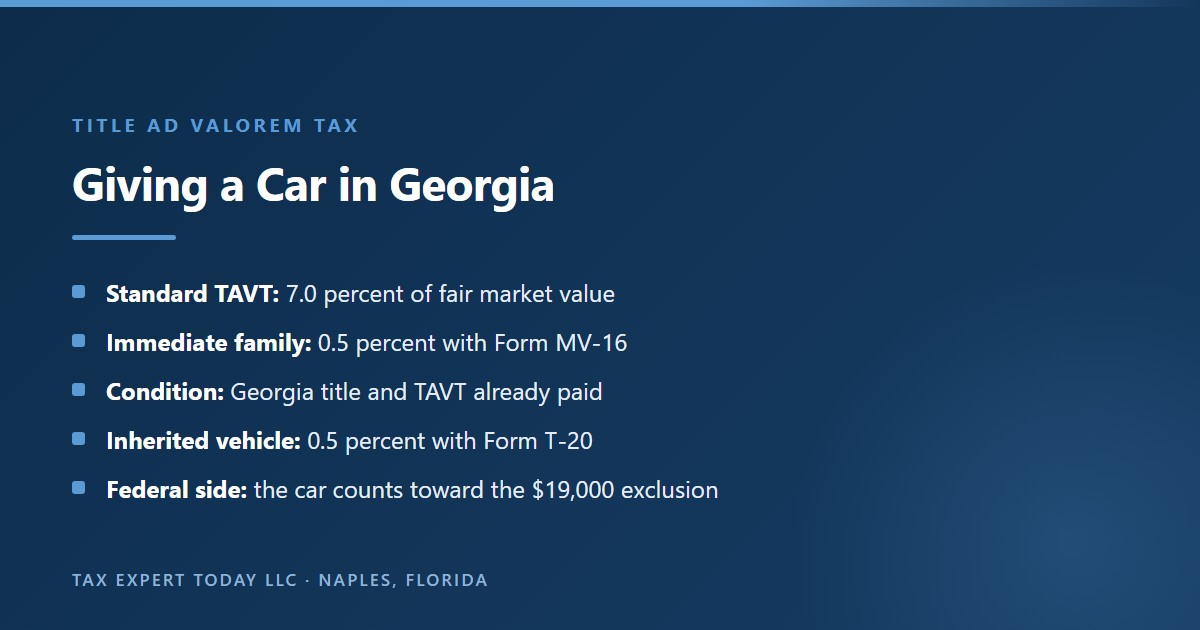
Georgia charges title ad valorem tax, not gift tax, on a vehicle transfer. The standard TAVT rate is 7.0 percent of fair market value. For a gift to an immediate family member, the recipient can pay a reduced 0.5 percent if the vehicle has a Georgia title and TAVT was paid, filing Form MV-16 to certify the family relationship.
- Standard rate: 7.0 percent of fair market value under the TAVT system.
- Family transfer rate: 0.5 percent, with Form MV-16.
- Condition: the vehicle has a Georgia title and the related TAVT was paid.
- Older vehicles: if still under annual ad valorem tax, the family member chooses that or full TAVT.
- Inheritance: a similar 0.5 percent rate applies with Form T-20.
This is the closest thing to a Georgia gift tax, and it is not one. The Department of Revenue’s Title Ad Valorem Tax page explains that TAVT became effective March 1, 2013, replaced sales tax and annual ad valorem tax on most vehicles, and “is paid every time vehicle ownership is transferred or a new resident registers the vehicle in Georgia for the first time.” The current rate is 7.0 percent of the vehicle’s fair market value. A gift changes ownership, so TAVT applies to a gifted car unless an exception fits.
The family transfer exception is the one that matters for Georgia families. The Department’s page lists a “Family transfer,” which requires Form MV-16, the Affidavit to Certify Immediate Family Relationship. “If the vehicle has a Georgia title, and related TAVT was paid, the family member can pay a reduced TAVT rate of 0.5 percent of the fair market value of the vehicle.” If the vehicle is old enough that it is still taxed under the annual ad valorem system, the family member can stay in that system or pay the full one time TAVT. The page lists a separate inheritance exception using Form T-20, also at 0.5 percent for vehicles in the TAVT system.
Here is the hypothetical arithmetic. A grandmother in Macon gives her grandson a paid off sedan with a fair market value of $18,000, titled in Georgia, on which TAVT was paid when she bought it. Without the family exception, TAVT at 7.0 percent would be $1,260. With Form MV-16 and the 0.5 percent rate, it is $90. The federal side of the same transfer is a gift of $18,000, which is within the $19,000 annual exclusion, so no Form 709 is required if she makes no other gifts to him that year.
Two cautions apply. The Department defines which relatives qualify as immediate family on the MV-16 form itself, so read the form before assuming that a niece, nephew, or in law qualifies. And the reduced rate depends on the vehicle’s TAVT history; a vehicle brought in from another state by a new resident follows a different rule, which the same page sets at 3 percent for new residents.
| Vehicle transfer in Georgia | TAVT rate | Form | Federal gift tax treatment |
|---|---|---|---|
| Sale or gift to an unrelated person | 7.0 percent of fair market value | Standard title application | Gift if below value; counts toward $19,000 |
| Gift to immediate family, Georgia title, TAVT paid | 0.5 percent | MV-16 | Gift; counts toward $19,000 |
| Gift to immediate family, vehicle under annual ad valorem | Stay annual or pay full TAVT | MV-16 | Gift; counts toward $19,000 |
| Inherited vehicle in the TAVT system | 0.5 percent | T-20 | Not a gift; part of the estate |
| New Georgia resident registering a vehicle | 3 percent | Standard title application | Not a gift |
What Happens When You Gift Georgia Real Estate?
A gift of Georgia real estate triggers no Georgia gift tax, but it is a federal gift at fair market value, usually requiring Form 709. The recipient takes the donor’s basis, so a later sale is taxed by Georgia at 4.99 percent on the built in gain. The deed is still recorded with the county Clerk of Superior Court.
- Federal gift: the full fair market value, less any exclusions, often over $19,000.
- Valuation: a qualified appraisal supports the value reported on Form 709.
- Carryover basis: includes the donor’s depreciation history on a rental.
- Recording: transfer tax questions and exemptions go to the county Clerk of Superior Court.
- Later sale: Georgia source gain, taxed even if the recipient lives outside Georgia.
Real estate is where Georgia gift tax questions get expensive if they are handled casually. On the federal side, a gift of a house, a lot, or a share of a family farm is a gift of its fair market value. Almost every real estate gift exceeds the $19,000 annual exclusion, so Form 709 is required. The Form 709 instructions ask donors to attach an explanation when a gift’s value includes a discount, such as for a fractional interest in real estate, and an appraisal is the normal way to support the value reported. Adequate disclosure on the return also starts the IRS’s time to challenge that value, as covered later.
On the Georgia side, there is no Georgia gift tax, but the deed still moves through the county recording system. The Department of Revenue’s Real Estate Transfer Tax page describes the tax as an excise on transactions involving the sale of real property, computed on the property’s sale price at $1 for the first $1,000 and 10 cents for each additional $100, and says it must be paid before a deed is recorded. The page directs questions about taxability and exemptions to the Clerk of Superior Court in the county, and describes the Form PT-61 Real Estate Transfer Tax Declaration, filed electronically through the Georgia Superior Court Clerks’ Cooperative Authority. Because a gift has no sale price, the transfer tax result for a deed of gift is a question to confirm with the clerk’s office or the closing attorney before recording, rather than one to assume.
The larger Georgia consequence comes later, at sale. The recipient takes the donor’s basis under IRC 1015, and for a rental property that basis has been reduced by every year of depreciation the donor claimed. A son who receives a Savannah rental house that his mother bought for $150,000 and depreciated by $60,000 takes a basis of $90,000. If he sells it for $400,000, his gain is $310,000, part of it taxed federally as unrecaptured depreciation, and all of it taxed by Georgia at 4.99 percent, which is $15,469. If he had inherited the house instead, his basis would generally be its value at his mother’s death.
Georgia real estate also keeps its Georgia source character. A recipient who lives in Florida or another state still owes Georgia income tax on the gain from selling Georgia real property, and the buyer may be required to withhold Georgia tax at closing unless an exemption or affidavit applies. Our guide to the 1031 exchange in Georgia covers the nonresident seller withholding rules and affidavits in detail. A family that is planning to gift Georgia property to a child who has moved away should understand both the federal gift and the later Georgia sale before the deed is signed.
How Do Gifts to a Path2College 529 Plan Work in Georgia?
A 529 contribution is a federal gift to the beneficiary. A Georgia donor can give $19,000 per beneficiary in 2026, or elect on Form 709 to spread up to $95,000 over five years. On the Georgia return, the 2025 IT-511 allows a deduction for Path2College 529 contributions of up to $4,000 per beneficiary, or $8,000 on a joint return.
- Federal gift: a 529 contribution is a completed present interest gift to the beneficiary.
- Five year election: up to $95,000 in 2026, treated as made ratably over five years.
- Form 709 required: the election is made on the return, even with no tax due.
- Georgia deduction: Path2College contributions, capped per beneficiary on Schedule 1.
- Georgia cap for 2025: $4,000 per beneficiary, $8,000 on a joint return.
A 529 plan contribution is unusual among gifts because the donor keeps control of the account while the gift counts as complete for gift tax purposes. That makes 529 plans a favorite year end Georgia gift tax planning tool for grandparents. The federal annual exclusion applies to each contribution, so a grandparent can put $19,000 into a grandchild’s account in 2026 with no return.
The Form 709 instructions describe a special election for larger contributions. A donor who contributes more than the annual exclusion to a 529 plan for one beneficiary can elect to treat up to five times the exclusion as made ratably over five years. The instructions illustrate it with a donor who contributed in 2025 and elected to spread $95,000 over five years, reporting $19,000 for each year, and who did not need to file again in later years solely to report the spread portion. For a 2026 contribution, five times the $19,000 exclusion is also $95,000. A married couple who splits gifts can make the election for $190,000 per beneficiary. The election is made by checking the box on line B of Schedule A, so the donor must file Form 709 for the year of the contribution.
The five year election has a cost worth knowing. Each year of the five uses that year’s annual exclusion for the beneficiary, so the donor cannot also make other annual exclusion gifts to the same grandchild during those years without exceeding the exclusion. If the donor dies before the five years end, the portion allocated to later years is generally included in the donor’s estate.
On the Georgia side, the 2025 IT-511 instruction booklet lists, among the subtractions on Schedule 1, the “deductible portion of contributions to the Path2College 529 Plan.” The booklet states that the deduction “is limited on a return to the amount contributed but cannot exceed $4,000 per beneficiary,” and that on a married filing joint return “the amount cannot exceed $8,000 per beneficiary.” Taxable withdrawals from the plan are an addition to income. Our guide to the Georgia 529 plan tax deduction covers who can claim it, the timing rules, and the recapture rules for nonqualified withdrawals. The 2026 limits should be confirmed against the 2026 booklet when the Department of Revenue releases it.
Put together, a Georgia couple with three grandchildren could contribute $8,000 to each grandchild’s Path2College account, deduct up to $24,000 on their joint Georgia return, and stay well inside the $38,000 per grandchild split annual exclusion federally. At 4.99 percent, a $24,000 Georgia deduction is worth roughly $1,198 in Georgia income tax. The federal gift tax side requires a return only if they split gifts or exceed $19,000 per spouse per grandchild.
| 529 contribution by a Georgia donor, 2026 | Federal gift tax treatment | Form 709? | Georgia deduction (2025 IT-511 limits) |
|---|---|---|---|
| $8,000 by a couple, joint return, one grandchild | Within the annual exclusion | No | Up to $8,000 |
| $19,000 by a single grandparent, one grandchild | Within the annual exclusion | No | Up to $4,000 |
| $95,000 by a single grandparent, five year election | $19,000 per year for five years | Yes, to elect | Up to $4,000 for the year |
| $190,000 by a couple, splitting and five year election | $38,000 per year for five years | Yes, both spouses | Up to $8,000 for the year |
How Should Georgia Families Handle Gifts to Minors?
Gifts to a minor are federal gifts like any other, and the $19,000 exclusion applies only if the gift is a present interest. An outright gift to a custodial account under Georgia’s Uniform Transfers to Minors Act generally qualifies. A trust qualifies only if drafted to create a present interest. Investment income in the account is the child’s income.
- Custodial accounts: a completed gift to the child, managed by a custodian.
- Present interest: required for the annual exclusion; a plain trust may not qualify.
- Trust drafting: withdrawal rights or minor’s trust terms can create a present interest.
- Income: earnings belong to the child, and federal rules can tax part at the parents’ rate.
- Control: the child takes control of a custodial account at the age the statute sets.
A Georgia grandparent who wants to give money to a young grandchild has to decide how the grandchild will hold it. A minor cannot manage investments directly, so the choices are usually a custodial account under the Georgia Uniform Transfers to Minors Act, a 529 plan, or a trust. Each counts as a gift for federal purposes, but they differ on the present interest test.
Custodial accounts are generally treated as present interest gifts, so they qualify for the $19,000 annual exclusion. The tradeoff is control. The money belongs to the child, the custodian must use it for the child’s benefit, and the child takes control at the age set by the statute. A grandparent who wants the money held longer, or used only for particular purposes, often turns to a trust.
A trust raises the future interest problem. If the beneficiary cannot use the money now, the gift is a future interest, which does not qualify for the annual exclusion and requires Form 709 at any amount. Trusts can be drafted to qualify, most commonly by giving the beneficiary a temporary right to withdraw each contribution, often called a Crummey power, or by using the specific trust for minors permitted by IRC 2503(c). Those are drafting questions for an estate planning attorney, and the gift tax result depends on the exact language and on how the trust is administered.
Once the money is in the child’s name, its income is the child’s income. Federal rules can tax part of a child’s unearned income at the parents’ rate, and the child may need to file both a federal return and a Georgia Form 500 if the income is large enough. A gift does not make investment income disappear; it changes whose return reports it.
Are Intrafamily Loans Treated as Gifts?
A family loan is not a gift if it has a written note, a repayment schedule, and interest at or above the applicable federal rate. A below market loan can create a deemed gift of foregone interest under IRC 7872. Small loans up to $10,000 are generally exempt, and forgiving the loan later is a gift.
- Bona fide loan: written note, interest, schedule, and actual repayments.
- Below market loans: foregone interest can be a gift under IRC 7872.
- De minimis: loans between individuals of $10,000 or less are generally excepted.
- Up to $100,000: a special limit can cap the deemed interest based on investment income.
- Forgiveness: canceling principal or interest is a gift in the year forgiven.
In Georgia gift tax planning, many parents prefer to lend rather than give, especially for a home purchase, so that the money comes back if circumstances change. A loan is not a gift if it is real. The IRS looks for the features of a genuine debt: a signed note, a fixed repayment schedule, interest, a realistic expectation of repayment, and payments actually made.
IRC 7872 addresses loans with interest below the applicable federal rate. For a gift loan, the foregone interest can be treated as transferred from the lender to the borrower as a gift, and then back from the borrower to the lender as interest income. The statute provides a $10,000 de minimis exception for gift loans directly between individuals, which does not apply if the loan is used to buy or carry income producing assets, and a special rule for loans up to $100,000 that can limit the amount treated as interest by reference to the borrower’s net investment income.
A common pattern in Georgia families is a loan that is forgiven in annual exclusion amounts: the parent lends $150,000 at the applicable federal rate and then forgives $19,000 of principal each year. Each forgiveness is a gift that the annual exclusion covers. The pattern works only if the loan is genuine from the start, and an arrangement where forgiveness was always intended can be recharacterized as a gift of the full amount in the first year. Documentation and actual payments are what support the loan treatment.
Interest the parent receives on a family loan is income, reported on the parent’s federal return and Georgia return. A Georgia parent who charges the applicable federal rate on a $150,000 loan will report that interest each year at the Georgia rate of 4.99 percent, and a large loan can make Georgia estimated tax payments on Form 500-ES necessary.
How Are Gifts of Georgia Business Interests and LLC Units Valued?
A gift of a Georgia LLC, partnership, or closely held corporation interest is valued at fair market value, which often reflects discounts for lack of control and lack of marketability. Form 709 requires disclosure of any discount claimed, and a qualified appraisal supports it. The recipient takes the donor’s basis, and future income flows to the recipient’s Georgia return.
- Fair market value: what a willing buyer would pay a willing seller for the interest.
- Discounts: minority and marketability discounts can reduce the reported value.
- Disclosure: Form 709 asks whether any discount is claimed and requires an explanation.
- Appraisal: supports the value and helps establish adequate disclosure.
- Income shifts: pass through income follows the units to the recipient’s Georgia return.
Georgia gift tax questions often involve family businesses, and Georgia is home to many organized as LLCs and S corporations, and gifting ownership to the next generation is a common planning step. The gift tax treats an LLC unit or a share of stock as property like any other, valued at fair market value. For a minority interest in a closely held entity, an appraiser often applies discounts because a buyer of a small, non controlling, unlisted interest would pay less than its share of the underlying assets.
The Form 709 instructions require a donor who reports a value that includes a discount for lack of marketability, a minority interest, a fractional interest in real estate, blockage, market absorption, or any other reason to answer “Yes” to the discount question on Schedule A and attach an explanation of the basis for the discount and its amount. A qualified appraisal is the usual support, and it also matters for adequate disclosure, which starts the IRS’s time to challenge the value.
After the gift, the recipient is an owner, and the Georgia income tax consequences follow. For a pass through entity, the recipient reports a share of the income on the recipient’s own Georgia return, and if the entity has made the Georgia pass through entity tax election, the treatment of that income changes. Our guides to Georgia LLC taxes and the Georgia pass through entity tax cover those rules. For larger family holdings, a family limited partnership is one structure some families use to centralize management while transferring ownership over time.
The operating agreement matters too. Many Georgia LLC agreements restrict transfers of units, require consent of the other members, or give the company a right to buy back units. A gift that violates those terms can be ineffective under the agreement even if a Form 709 was filed. Review the governing documents before transferring any business interest. Our Georgia tax services team can coordinate the Form 709, the valuation, and the Georgia returns that follow.
Do Gifts of Cryptocurrency Count for Georgia Gift Tax Purposes?
Yes, for federal purposes. The Form 709 instructions state that the gift tax applies to transfers of digital assets, including cryptocurrencies, stablecoins, and NFTs. A gift is valued at fair market value on the date of the gift, the recipient takes the donor’s basis, and Georgia taxes the recipient’s later gain at 4.99 percent. Georgia imposes no gift tax.
- Covered: digital assets on a cryptographically secured ledger are property for gift tax purposes.
- Valuation: fair market value on the date the transfer is complete.
- Basis: carryover under IRC 1015, with the same dual basis rule for losses.
- Records: the donor’s purchase records are needed for the recipient’s basis.
- Georgia: no gift tax; later gains are taxed as income.
The Form 709 instructions add a specific paragraph on digital assets: “The gift tax applies to transfers of digital assets,” defined as digital representations of value recorded on a cryptographically secured distributed ledger or similar technology, including NFTs and virtual currencies such as cryptocurrencies and stablecoins. There is no Georgia gift tax on crypto either, but a Georgia resident who transfers bitcoin worth $50,000 to a child has made a $50,000 federal gift, with $31,000 above the annual exclusion reported on Form 709.
The basis issue is often harder than the gift tax issue. The recipient inherits the donor’s basis and holding period, and many crypto holders have incomplete purchase records spread across exchanges. Without the donor’s records, the recipient may be unable to prove basis when selling, which can lead to tax on more gain than actually exists. A donor planning a crypto gift should assemble the acquisition history first and hand it over with the gift.
When Is Form 709 Due, and How Do Extensions Work for Georgia Donors?
Form 709 for 2026 gifts is due April 15, 2027, or the next business day if April 15 falls on a weekend or holiday. Extending the donor’s federal income tax return with Form 4868 also extends Form 709; otherwise Form 8892 extends it. No extension delays payment of any tax due. Georgia has no gift tax return or deadline.
- Due date: no earlier than January 1 and no later than April 15 of the following year.
- One return per year: all reportable gifts for a calendar year on one Form 709.
- Extension by income tax return: Form 4868 extends Form 709 as well.
- Separate extension: Form 8892 when the income tax return is not being extended.
- Payment: any tax is due by April 15 regardless of the extension.
The Form 709 instructions describe the return as an annual return filed no earlier than January 1 and no later than April 15 of the year after the gift. They also require all reportable gifts made during the calendar year to be reported on one Form 709, and a separate return for each calendar year in which a reportable gift is made. A donor cannot combine several years on one return.
There are two ways to extend. Any extension of time granted for filing the donor’s calendar year federal income tax return automatically extends the time to file the gift tax return for the same year. A donor who is not extending the income tax return can use Form 8892, the application for an automatic extension of time to file Form 709. The instructions are explicit that neither method extends the time to pay.
Each spouse files a separate Form 709. There is no joint gift tax return, even when a couple elects gift splitting. If a donor dies, the executor files the donor’s final Form 709, and the instructions set a due date tied to the estate tax return when that is earlier.
For Georgia purposes, nothing is due, because there is no Georgia gift tax return. A Georgia resident’s Form 500 for the same year makes no reference to gifts made or received, and the Department of Revenue has no deadline for gifts. The only Georgia tax deadlines that touch a gift are the ones that would apply anyway, such as the deadline for the recipient’s Georgia return in a year the recipient sells gifted property.
| Gift made | Federal Form 709 due | Extended due date | Georgia filing |
|---|---|---|---|
| During calendar year 2026 | April 15, 2027 | With Form 4868 or Form 8892 | None |
| Gift splitting elected for 2026 | April 15, 2027, each spouse | Each spouse extends separately | None |
| 529 five year election made for 2026 | April 15, 2027 | With Form 4868 or Form 8892 | Georgia deduction claimed on the 2026 Form 500, if eligible |
| Donor died during 2026 | Earlier of the estate tax return due date or April 15, 2027 | As provided in the instructions | None |
What Happens If a Required Form 709 Is Never Filed?
If a required Form 709 is never filed, the IRS can assess gift tax at any time, because the limitation period never starts. Under IRC 6501(c)(9), even a filed return leaves the period open for any gift not adequately disclosed. Late filing penalties apply only when tax is due, but the open year can surface at the donor’s death.
- No return: the assessment period does not begin.
- Inadequate disclosure: a gift not adequately disclosed can be assessed at any time.
- Penalties: generally computed on tax due, so a no tax return carries little penalty.
- Estate impact: unreported taxable gifts still reduce the lifetime exclusion at death.
- Fix: file the late return with full disclosure and an appraisal where needed.
IRC 6501(c)(9) provides that if a gift required to be shown on a gift tax return is not shown on the return, the gift tax on that gift may be assessed “at any time.” The same paragraph says the rule does not apply to an item disclosed on the return, or in a statement attached to it, in a manner adequate to apprise the IRS of the nature of the item. Adequate disclosure is the trigger that starts the ordinary assessment period running for a gift.
In practice, many Georgia families, told there is no Georgia gift tax, skip Form 709 for a gift that owes no tax, reasoning that a return showing zero tax does not matter. It matters in two ways. First, the year stays open indefinitely, so the IRS can revisit the value of the gift decades later, often at the donor’s death, when the estate tax return must account for prior taxable gifts. Second, the executor has to reconstruct the gift history from bank records, deeds, and memory, which is far harder than filing at the time.
A late Form 709 that discloses the gift fully, with an appraisal for property other than cash or listed securities, starts the clock. Because penalties for late filing and late payment are generally figured on the tax due, a late return that owes no tax usually carries little or no penalty. The practical cost of filing late is small; the practical cost of never filing can be large.
A related problem appears with real estate. A parent who deeded a house to a child years ago and never filed Form 709 has an open gift, and the value the IRS might assert is the value at the date of the gift, which may now be hard to prove. A retrospective appraisal can establish the date of gift value, and filing a late return with that appraisal is usually the cleanest way to close the question.
Does Moving From Georgia to Florida Change Georgia Gift Tax Planning?
Moving from Georgia to Florida does not change the gift tax, because neither state has one and the federal rules follow the donor everywhere. The move changes the income tax side: a Florida resident owes no state tax on most investment gains, but gains on Georgia real estate remain Georgia source income taxed at 4.99 percent, whoever holds the property.
- Gift tax: federal only, before and after the move.
- Stock and funds: after a genuine move, generally not taxed by Georgia on sale.
- Georgia real estate: Georgia source gain, taxed by Georgia even for a Florida resident.
- Move year: a part year Georgia return allocates income between the two periods.
- Residency proof: a gift timed around a move depends on a well documented change of domicile.
Many Georgia retirees move to Southwest Florida, and many ask whether to make gifts before or after the move. For the gift tax itself, timing does not matter, since there is no Georgia gift tax to avoid. The federal annual exclusion, the lifetime exclusion, and Form 709 work the same way for a resident of Atlanta or a resident of Naples, and Florida, like Georgia, has no gift tax.
Timing matters for income tax. A Georgia resident who sells appreciated stock owes Georgia tax at 4.99 percent on the gain. After a genuine change of domicile to Florida, a sale of the same stock is generally not taxed by Georgia, because intangible investment income is sourced to the seller’s residence. That makes the order of events worth planning: a parent who intends to give appreciated stock to a child who lives in Georgia hands the child a Georgia tax bill at sale, while the same parent who keeps the stock, moves, and later sells it may face no state tax at all. Our guide to the Georgia part year resident tax return explains how the move year is split and what Georgia looks for when it tests a change of residence.
Georgia real estate does not follow the owner. A gain on a sale of Georgia real property is Georgia source income for a nonresident, so neither the parent’s move nor a gift to a child in another state removes Georgia tax on that gain. A family that owns a cabin in the North Georgia mountains or a rental in Savannah should plan for the Georgia tax at sale regardless of where everyone lives.
| Asset or income | Donor lives in Georgia | Donor has moved to Florida | Gift planning note |
|---|---|---|---|
| Appreciated stock or mutual funds | Georgia tax at 4.99 percent on the gain | Generally not taxed by Georgia after a genuine move | Gift to a Georgia resident child brings Georgia tax at sale |
| Georgia rental house or land | Georgia tax at 4.99 percent on the gain | Still taxed by Georgia as Georgia source income | Gift does not change the Georgia source rule |
| Cash | No tax on the gift | No tax on the gift | No income tax effect for either party |
| Interest from a family loan | Georgia income to the lender | Generally not Georgia income after the move | Interest follows the lender’s residence |
Which States Could Still Tax a Georgia Family’s Gift?
For most Georgia families, no state taxes gifts. Connecticut is the one state that still imposes a standalone gift tax, unified with its estate tax. A Georgia family can be affected only through a Connecticut connection, such as a donor who lived there or owns Connecticut real estate or tangible property. Some states also tax estates or inheritances.
- Georgia: no gift, estate, or inheritance tax.
- Florida: no gift, estate, or inheritance tax.
- Connecticut: a standalone gift tax unified with its estate tax.
- Estate and inheritance tax states: may reach property located there at death.
- Prior residence: a donor who moved from Connecticut should review that state’s rules.
As our guide to the Connecticut estate tax for nonresidents explains, Connecticut is the only state that still imposes a standalone gift tax, and it unifies that tax with its estate tax under one lifetime exemption. On the Georgia gift tax question, a Georgia resident whose gifts consist of cash, securities, and Georgia property, with no Connecticut ties, is outside that system.
Estate and inheritance taxes are a different matter. Some states tax property located there at the owner’s death, and a few tax heirs on what they inherit. A Georgia resident who owns a vacation home in a state with an estate tax may face that state’s tax at death, and a lifetime gift of the property may change the answer. Those rules vary state by state, so the property’s location is the first question to ask.
What Georgia Gift Tax Records Should a Donor Keep?
A Georgia donor should keep a dated record of each gift, its value, the recipient, the donor’s basis and purchase date, any appraisal, and a copy of every Form 709 filed. The recipient needs the basis and holding period to report a later sale on federal and Georgia returns. Records for real estate and business interests should be kept permanently.
- Gift log: date, recipient, description, and value of each gift, by calendar year.
- Basis records: purchase price, improvements, and depreciation for real estate.
- Appraisals: for real estate, business interests, and other hard to value property.
- Returns: every Form 709, with proof of filing.
- Vehicle and deed records: MV-16, title transfers, recorded deeds, and PT-61 copies.
Gift records serve three people: the donor, who must file accurate returns; the recipient, who needs the basis to compute gain at sale; and the donor’s executor, who must report prior taxable gifts on the estate tax return. IRC 1015(a) addresses the situation where the recipient does not know the donor’s basis, and the outcome is uncertain enough that it is better avoided by handing the records over with the gift.
A simple Georgia gift tax record keeping practice works for most families. Keep a one page summary for each calendar year listing every gift above a token amount, with copies of the checks, transfer confirmations, or deeds behind it. Attach the appraisal for any non cash gift. Keep the Form 709 for every year one was filed. Give the recipient a letter stating the basis, the acquisition date, and, for real estate, the depreciation claimed.
What Are Common Georgia Gift Tax Mistakes?
The common Georgia gift tax mistakes are assuming no tax means no return, adding a child to a deed without realizing it is a gift, paying tuition to the student instead of the school, ignoring jointly owned property, gifting highly appreciated property that would receive a step up at death, and losing basis records.
- Skipping Form 709: a required return left unfiled keeps the gift open indefinitely.
- Adding a child to a deed: often a gift of a half interest, well above $19,000.
- Indirect tuition: money given to the student instead of paid to the school.
- Joint accounts: a gift from a joint account is a gift by both spouses.
- Appreciated assets: giving away a future step up and a Georgia tax saving.
Each of these mistakes is easy to make because there is no Georgia gift tax return to prompt the question. Georgia’s Form 500 never asks about gifts, so the only reminder comes from the federal side, and only if someone knows to look. The deed mistake is the most frequent with older Georgia homeowners, who add a child to the title of the family home as a simple way to pass it on. That step can be a reportable gift, it gives up the step up in basis on the child’s share, and it exposes the house to the child’s creditors and divorce. A will, a trust, or other estate planning tools often reach the same goal without those costs.
The appreciated property mistake is the most expensive in tax dollars. With no Georgia estate tax and a federal exclusion of $15,000,000, a gift of low basis stock or land made only to “get it out of the estate” can cost the family Georgia income tax at 4.99 percent on gain that a step up would have erased. The benefit of a lifetime gift has to be weighed against that cost case by case.
| Mistake | Consequence | Better approach |
|---|---|---|
| No Form 709 for a gift above $19,000 | Assessment period never starts | File, even with no tax due |
| Adding a child to the deed | Possible gift of a half interest; lost step up on that share | Review estate planning alternatives first |
| Tuition paid to the grandchild | Uses the $19,000 annual exclusion | Pay the school directly |
| Gift from a joint account by one spouse | Both spouses may need to file | Use separate funds or plan for two returns |
| Gift of decades old stock | Recipient pays tax on the old gain, including 4.99 percent Georgia tax | Give cash or high basis assets; hold low basis assets |
| Vehicle gift without MV-16 | TAVT at 7.0 percent instead of 0.5 percent | File MV-16 for an eligible family transfer |
Hypothetical Example: Grandparents in Alpharetta Funding College Accounts
A married couple in Alpharetta gives each of four grandchildren $8,000 through Path2College in December 2026, pays $30,000 of one grandchild’s tuition directly to the university, and gives each grandchild $10,000 in cash. No Form 709 is required, no gift tax is owed, and the couple may deduct up to $32,000 on their joint Georgia return.
- 529 contributions: $8,000 per grandchild, $32,000 in total.
- Direct tuition: $30,000, excluded under IRC 2503(e).
- Cash: $10,000 per grandchild, $40,000 in total.
- Per grandchild total, excluding tuition: $18,000.
- Georgia deduction: up to $8,000 per beneficiary on a joint return, if 2026 limits match 2025.
Every figure in this Georgia gift tax hypothetical is illustrative. Assume each spouse contributes half of each gift from that spouse’s own funds, so no gift splitting election is needed. Per grandchild, each spouse has given $4,000 to the 529 plan and $5,000 in cash, a total of $9,000, well inside that spouse’s $19,000 exclusion. The $30,000 of tuition paid directly to the university is not a gift at all under IRC 2503(e) and does not count toward anyone’s exclusion. Because every gift is a present interest and no spouse exceeded $19,000 to any grandchild, neither spouse files Form 709.
On the couple’s joint 2026 Georgia return, the Path2College contributions may be deductible up to $8,000 per beneficiary, or $32,000 for four grandchildren, if the 2026 booklet keeps the 2025 limits. At 4.99 percent, that deduction would reduce Georgia tax by about $1,597. The cash gifts and the tuition produce no Georgia deduction and no Georgia tax. Total moved to the next generation in one year: $102,000, with no gift tax, no gift tax return, and a Georgia income tax benefit.
Hypothetical Example: A Savannah Rental House, Gift or Inheritance
A widowed parent in Savannah owns a rental house bought for $150,000, depreciated by $60,000, and now worth $400,000. Gifting it to a son requires Form 709 and leaves him a $90,000 basis, so a sale at $400,000 brings $310,000 of gain and about $15,469 of Georgia tax. Inheriting it would generally reset basis to $400,000.
- Gift value: $400,000; $381,000 taxable after the $19,000 exclusion.
- Federal tax: none, unless lifetime taxable gifts exceed $15,000,000.
- Son’s basis after gift: $90,000 carried over.
- Georgia tax on a $400,000 sale: $310,000 x 4.99 percent = $15,469.
- Inheritance instead: basis generally $400,000, so little or no gain.
This hypothetical shows why the basis rules often dominate Georgia gift tax planning. The parent’s gift triggers no tax for the parent, but it transfers a built in gain of $310,000 to the son. If the son sells, he owes federal tax, including tax on the depreciation portion, and Georgia tax of $15,469 at the 2026 rate. If the parent holds the house until death, the son’s basis generally becomes its value at that time, and a prompt sale produces little or no gain. The Georgia tax difference alone is about $15,469, before the larger federal difference.
The gift version can still be the right Georgia gift tax answer, for example if the parent needs to move the property for reasons that outweigh the tax, or if the son will keep the house for decades and use it as a rental. But the comparison should be made with the numbers in front of the family, not assumed.
Hypothetical Example: A Couple Moving From Atlanta to Naples
A couple moving from Atlanta to Naples gives their daughter a Georgia titled car worth $22,000 and $40,000 in cash from a joint account before the move. TAVT at 0.5 percent with Form MV-16 is $110. Each spouse gave $31,000, so each files Form 709 reporting a $12,000 taxable gift, and no gift tax or Georgia tax is owed.
- Car: $22,000 fair market value, jointly owned, given to the daughter.
- TAVT: 0.5 percent of $22,000 = $110 with MV-16, instead of $1,540 at 7.0 percent.
- Cash: $40,000 from a joint account.
- Per spouse: $11,000 car plus $20,000 cash = $31,000; $12,000 above the exclusion.
- Returns: two Form 709 filings for 2026; no Georgia filing for the gift.
In this illustrative Georgia gift tax example, the couple owns both the car and the account jointly, so each spouse is a donor of half. Each spouse gave the daughter $31,000 in total, exceeded the $19,000 exclusion by $12,000, and files a 2026 Form 709 by April 15, 2027. Each spouse’s remaining basic exclusion falls by $12,000. No federal gift tax is due.
The daughter titles the car in Georgia and, with Form MV-16 certifying the immediate family relationship, pays TAVT at 0.5 percent, or $110. The reduced rate depends on the car having a Georgia title with TAVT paid, which is one reason families often complete vehicle gifts before a move rather than after. After the move, the couple files a part year Georgia return for 2026 and a Florida residence going forward. None of the gifts appears on either Georgia return.
Georgia Gift Tax Help in Naples & Southwest Florida
Tax Expert Today LLC helps Georgia families with Georgia gift tax questions, federal Form 709 filings, and the Georgia income tax that follows a gift, from its office at 11983 Tamiami Trail N, Naples, FL 34110. Georgia clients are served nationwide from Naples, by phone and secure document exchange. Call (239) 441-2005.
- Georgia gift tax help Naples: Form 709 preparation for Georgia donors and couples.
- Gift splitting and joint property: deciding who the donor is and who files.
- Basis planning: comparing a lifetime gift with an inheritance before a transfer.
- Real estate gifts: carryover basis and the later Georgia sale.
- Late returns: filing past due Form 709 returns with adequate disclosure.
Tax Expert Today LLC is based at 11983 Tamiami Trail N, Naples, FL 34110, and our office is open Monday through Friday, 10 a.m. to 5 p.m. Eastern time. You can reach us at (239) 441-2005. Many of the Georgia gift questions we see come from families who have moved from Georgia to Collier or Lee County and still own Georgia property, and from Georgia residents planning year end gifts to children and grandchildren. We work with Georgia clients remotely, and there is no need to visit Naples to work with us.
For the full range of our Georgia work, see our Georgia tax services page. Related topics include the Georgia inheritance tax, the Georgia retirement income exclusion, and, for federal estate planning, an irrevocable life insurance trust.
A point of scope, stated plainly: there is no Georgia gift tax, so a Georgia gift is a federal gift tax matter plus Georgia income tax consequences. Our role covers Form 709, the Georgia returns, and the planning around both. Drafting deeds, trusts, and wills is legal work for an estate planning attorney, and we coordinate with the family’s attorney where one is involved. Our team of tax advisors, enrolled agents, CPAs, and attorneys handles state tax matters nationwide.
When to Engage a Professional
Consider professional help with the Georgia gift tax if you plan to give more than $19,000 to anyone in a year, want to split gifts with a spouse, are gifting real estate or a business, are adding a child to a deed, have a spouse who is not a U.S. citizen, or skipped a Form 709 in an earlier year.
- Large gifts: to prepare Form 709 and track the lifetime exclusion.
- Real estate and business interests: to coordinate appraisal, disclosure, and basis.
- Appreciated property: to compare a gift with an inheritance before acting.
- Noncitizen spouses: to stay within the $194,000 exclusion.
- Prior years: to file late returns and close open gifts.
Under the Georgia gift tax rules, a gift of cash under $19,000 to each recipient needs no professional help and no return. The questions become harder when the gift is large, when the property has a long tax history, or when the family’s goals involve the estate as well as the gift. If any of the situations above applies, talk with us before the end of the calendar year, when the annual exclusion resets, or before a deed is signed. You can learn more about our Georgia state tax services or call (239) 441-2005 for a free consultation.
This article is general educational information about the Georgia gift tax as of October 20, 2026, based on Revenue Procedure 2025-32, the Instructions for Form 709, the cited Internal Revenue Code sections, the Georgia Department of Revenue Estate Tax FAQ, Title Ad Valorem Tax, Real Estate Transfer Tax, and Important Tax Updates pages, and the 2025 IT-511 instruction booklet, read on that date. It is not tax or legal advice for any specific gift or return. All examples are hypothetical. Federal exclusion amounts are adjusted annually and Georgia rules change; confirm current requirements with the IRS, the Georgia Department of Revenue, or a qualified professional before making a gift or filing a return.
Frequently Asked Questions About the Georgia Gift Tax
Does Georgia have a gift tax?
No. There is no Georgia gift tax, and the Georgia Department of Revenue administers no gift tax return. Georgia residents are subject only to the federal gift tax, which for 2026 allows $19,000 per recipient each year and a lifetime basic exclusion of $15,000,000 per person before any tax is due.
How much can I give someone in Georgia without paying gift tax?
In 2026 you can give $19,000 to each recipient with no gift tax and usually no return. Larger gifts are still tax free until your lifetime taxable gifts exceed the $15,000,000 federal basic exclusion, but a gift above $19,000 to one person requires federal Form 709.
Can my parents give me $100,000 tax free in Georgia?
Yes. No gift tax is due on a $100,000 gift unless the parents have already used their $15,000,000 lifetime exclusions, and the recipient owes no federal or Georgia income tax on it. The parent or parents who made the gift must file Form 709 for the amount above the annual exclusion.
Do I pay Georgia income tax on a gift I receive?
No, and there is no Georgia gift tax on receiving it. Gifts are excluded from gross income under IRC 102, and Georgia taxable income starts from federal adjusted gross income, so a gift is not taxed by Georgia. Interest, dividends, or rent earned on the gift afterward, and gain on a later sale, are taxable to the recipient.
Does Georgia tax a car given to a family member?
There is no Georgia gift tax on a car, but Georgia charges title ad valorem tax. The standard rate is 7.0 percent of fair market value, but an immediate family member can pay a reduced 0.5 percent if the vehicle has a Georgia title and TAVT was paid, using Form MV-16, according to the Department of Revenue.
What basis does someone get on property given to them in Georgia?
Under IRC 1015 the recipient generally takes the donor’s basis, so built in gain moves with the gift. When the recipient sells, Georgia taxes the gain as income at the 2026 flat rate of 4.99 percent. Property inherited at death generally receives a basis equal to its value at death under IRC 1014.
When is Form 709 due for 2026 gifts?
Form 709 for gifts made during 2026 is due April 15, 2027, or the next business day if that date falls on a weekend or holiday. An extension of the federal income tax return extends Form 709, and Form 8892 extends it separately. No extension delays payment of tax due.
Does paying a grandchild’s tuition count as a gift?
Not if you pay the tuition directly to the school. IRC 2503(e) excludes tuition paid directly to a qualifying educational organization, at any amount, and it does not count against the $19,000 annual exclusion. Room, board, books, and money given to the student are gifts.
Does Georgia have an estate tax or inheritance tax?
No, and there is no Georgia gift tax either. O.C.G.A. 48-12-1 eliminated Georgia estate taxes and estate tax returns on and after July 1, 2014, and the Department of Revenue states that Georgia has no inheritance tax. Large estates may still owe federal estate tax above the $15,000,000 basic exclusion for 2026.
I live in Naples, Florida, but own property in Georgia. Can you help with a gift of it?
Yes. Tax Expert Today LLC handles state tax matters nationwide from its Naples, Florida office at 11983 Tamiami Trail N, including Form 709 for gifts of Georgia property and the Georgia income tax on a later sale. Georgia clients work with us remotely. Call (239) 441-2005 for a free consultation.
Published October 20, 2026 by Dr. Pellumb Kabashi « Back to Learning Center
Have a question this article touches on?
Tax Expert Today LLC, based in Naples, Florida and serving clients across the United States.
Schedule a Consultation (239) 441-2005