
By Dr. Pellumb Kabashi, DBA, MBA, EA, CFE, CES
Founder, Tax Expert Today LLC · Tax advisors, enrolled agents, CPAs, and attorneys · Serving clients in all 50 states
The Georgia R&D tax credit equals 10 percent of Georgia qualified research expenses above a base amount tied to Georgia gross receipts, and the company must also claim the federal research credit. It can offset up to 50 percent of the remaining Georgia income tax. Any excess can reduce Georgia payroll withholding through Form IT-WH, now filed within three years. Call (239) 441-2005 for a free consultation.
What Is the Georgia R&D Tax Credit?
The Georgia R&D tax credit is a state income tax credit for research conducted in Georgia by businesses in qualifying industries. It equals 10 percent of Georgia qualified research expenses above a base amount, requires a federal research credit for the same year, and can reach payroll withholding when income tax is too small to absorb it.
- Statute: O.C.G.A. 48-7-40.12, first enacted in 1997 and amended most recently for years beginning in 2025.
- Regulation: Ga. Comp. R. & Regs. 560-7-8-.42, which sets out how to claim the credit and how the withholding election works.
- Form: Form IT-RD, filed with the Georgia return together with federal Form 6765.
- Administrator: the Georgia Department of Revenue, through the Georgia Tax Center, known as GTC.
The Department’s research tax credit summary describes the credit in one paragraph: a credit is allowed for research expenses for research conducted within Georgia by a business, or the headquarters of a business, engaged in manufacturing, warehousing and distribution, processing, telecommunications, tourism, broadcasting, or research and development. The credit is 10 percent of the additional research expense over the base amount, it cannot exceed 50 percent of the business’s Georgia net income tax liability after all other credits, and excess credit may be used to offset withholding.
Two features make the Georgia credit different from most state research credits. The first is the base amount, which is measured against Georgia gross receipts rather than against prior research spending alone, so a company with growing research and flat Georgia sales can generate a large credit. The second is the payroll withholding offset, which lets a company with little or no Georgia income tax still turn the credit into cash flow. That second feature is the reason this credit matters to startups, pre-revenue manufacturers, and loss years, and it is where most of the practical questions sit.
This article covers the Georgia credit only. The federal research credit under IRC Section 41 is a separate federal credit with its own base, its own rates, and its own payroll tax election, and a federal claim is a precondition to the Georgia one. Where the two interact, this article says so and stops there.
How Much Is the Georgia R&D Tax Credit Worth in 2026?
The Georgia R&D tax credit is worth 10 percent of the amount by which Georgia qualified research expenses exceed the base amount. The base amount is current Georgia gross receipts multiplied by the lower of the three year average research ratio or 0.300. The value used each year is capped at half of the remaining Georgia income tax.
- Rate: 10 percent of the excess over the base amount, under O.C.G.A. 48-7-40.12(c).
- Base: Georgia gross receipts times a research ratio, capped at 0.300.
- Annual cap: 50 percent of the remaining Georgia net income tax after all other credits.
- Excess: carried forward, or elected against payroll withholding.
The rate itself did not change in 2026. Georgia moved its income tax rate to a flat 4.99 percent for 2026, which the Department’s Important Tax Updates page confirms, and that lower rate matters indirectly: the 50 percent cap is measured against the tax, so a lower tax rate means less room each year to use the credit against income tax. Our article on the Georgia corporate tax rate explains how the 4.99 percent rate applies to fiscal year corporations.
A quick sense of scale helps. A company spending $1,000,000 on Georgia research above its base amount earns a $100,000 credit. At the 4.99 percent rate, using $100,000 of credit against income tax within the 50 percent cap requires $200,000 of Georgia tax, which means roughly $4 million of Georgia taxable income. Many research-heavy companies never get there in the carryforward period, which is why the withholding election is often the only realistic way to use the credit.
The credit is also not refundable in the ordinary sense. The Department does not send a check for unused credit. The withholding election is a credit against future withholding deposits, and the regulation says in terms that the Department will not refund withholding already paid. That distinction shapes the planning in every section below.
Who Qualifies as a Business Enterprise for the Georgia Research Credit?
A qualifying business enterprise is a business, or the headquarters of a business, engaged in manufacturing, warehousing and distribution, processing, telecommunications, broadcasting, tourism, or research and development. Retail businesses are excluded, but a company does not become retail merely because an affiliate has retail activities. The industry test is applied before any research is counted.
- Included industries: manufacturing, warehousing and distribution, processing, telecommunications, broadcasting, tourism, and research and development.
- Excluded: retail businesses, under O.C.G.A. 48-7-40.12(a)(3).
- Headquarters: the headquarters of a qualifying business can qualify on its own.
- Broadcasting: limited to NAICS codes 512, 515, 517, and 519.
The definition in O.C.G.A. 48-7-40.12(a)(3) is the gate. A software developer, a contract laboratory, or a product design firm will usually look to the research and development category, while a manufacturer or processor fits one of the named industries directly. The regulation cross-references Regulation 560-7-8-.46 for the meaning of business enterprise, which is the same definition used for other Georgia job and investment credits, so classification questions tend to be answered consistently across credits.
The retail exclusion is narrower than it first appears. The statute says a business that otherwise meets the definition is not treated as retail because of the retail activities of its affiliates. A manufacturer with a sister company that runs retail stores can still qualify. What the statute does not do is let a retailer qualify by pointing to research it performs, so a company whose own principal activity is retail sales should expect the credit to be unavailable.
Regulation 560-7-8-.46 explains how the industry test is applied in practice. The Department uses the 2017 edition of the North American Industry Classification System to decide whether a business is in a qualifying industry, taxpayers self-select their NAICS code, and the regulation says the Department may determine on review that a self-selected code does not match the taxpayer’s primary activity. The same regulation excludes child care businesses and retail businesses. The practical point is that the NAICS code on the return is a claim the Department can test, and the test looks at what the business primarily does.
Classification is a place to be careful rather than optimistic. The Form IT-RD asks for the business NAICS code on its first line, and the Department reviews credit claims when a company later files Form IT-WH. A classification that is wrong on the face of the form is an easy reason to deny a withholding benefit, and it is better settled before the claim than defended after it.
Why Must You Claim the Federal Research Credit First?
Georgia allows the credit only if the business claims and is allowed a federal research credit under IRC Section 41 for the same taxable year. A company that skips the federal credit, or has it disallowed, loses the Georgia credit for that year as well. Federal Form 6765 must be attached to the Georgia claim.
- Same year: the federal and Georgia credits are tied to the same taxable year.
- Claimed and allowed: the statute uses both words, so a federal disallowance undercuts the Georgia claim.
- Attachment: Form IT-RD states that a copy of federal Form 6765 must be attached.
- Definitions: Georgia borrows the federal definition of qualified research expenses.
O.C.G.A. 48-7-40.12(b) allows the credit to a business enterprise with Georgia qualified research expenses above the base amount “provided that the business enterprise for the same taxable year claims and is allowed a research credit under Section 41.” The regulation repeats the condition and requires the business to submit Form IT-RD and federal Form 6765 from the entity generating the credit with its Georgia return for each year in which the expenses were incurred.
This link has practical consequences. A company that decides the federal credit is not worth the documentation effort has also decided against the Georgia credit. A company whose federal credit is later reduced on examination should expect Georgia to follow, because the Georgia credit rests on the federal allowance. And a company claiming the federal credit only as a payroll tax offset under the qualified small business election still claims a Section 41 credit, which is the point that matters for Georgia.
The IRS maintains a research credit resource page and publishes instructions for Form 6765, which now ask for more detail about business components than older versions did. A Georgia claim built on a Form 6765 that meets the current federal instructions starts from a stronger position, because the Department’s review of the Georgia credit begins with the federal claim.
The federal credit also brings its own documentation standard. The four part test for qualified research, the business component analysis, and the contemporaneous records that the federal credit requires are the same records that support the Georgia claim. There is no separate Georgia definition of research to satisfy. There is only the additional requirement that the wages, services, and supplies relate to research performed in Georgia.
What Counts as a Qualified Research Expense in Georgia?
Georgia uses the federal definition of qualified research expenses under IRC Section 41, with one change: all wages, purchased services, and supplies must be for research conducted within Georgia. Research performed in other states, even by the same company, is left out of the Georgia numerator. The research location, not the employer location, controls.
- Wages: taxable wages for employees performing, directly supervising, or directly supporting qualified research in Georgia.
- Supplies: supplies used and consumed in Georgia research.
- Contract research: amounts paid for research performed in Georgia, following the federal contract research rules.
- Not included: research performed outside Georgia, even if paid from a Georgia office.
O.C.G.A. 48-7-40.12(a)(4) defines qualified research expenses as the Section 41 amount “except that all wages paid and all purchases of services and supplies must be for research conducted within the State of Georgia.” That single sentence imports the whole federal framework, including the four part test for qualified research set out in Treasury Regulation 1.41-4, and then narrows it by location. Under that test the activity must relate to a new or improved business component, be technological in nature, be intended to eliminate uncertainty about capability, method, or design, and involve a process of experimentation for substantially all of the work.
For a single state company the Georgia and federal figures may match. For a multistate company they will not, and the Georgia figure must be built from records that show where the research actually took place. An engineer based in Atlanta who spends two months on a product trial in Texas contributes Georgia wages for the time spent on Georgia research and not for the Texas trial. A contract laboratory in North Carolina produces a federal contract research expense and no Georgia expense at all.
Remote work has made this harder. A company with a distributed engineering team needs a defensible method for assigning research wages to the state where each person worked. Payroll records that already track the employee’s work state for withholding, which our guide to Georgia withholding tax explains, are usually the starting point, but they measure where the employee worked, not whether the work was research. Both facts are needed.
How Is the Georgia Research Credit Base Amount Calculated?
The base amount equals current year Georgia gross receipts multiplied by the lower of two numbers: the average of the research to gross receipts ratios for the three preceding years, or 0.300. The credit is 10 percent of current Georgia research expenses above that base. Georgia gross receipts are the numerator of the Georgia apportionment factor.
- Step 1: for each of the three prior years, divide Georgia research expenses by Georgia gross receipts.
- Step 2: average the three ratios.
- Step 3: multiply current Georgia gross receipts by that average or 0.300, whichever is less.
- Step 4: subtract the base amount from current Georgia research expenses and multiply by 10 percent.
The formula comes from O.C.G.A. 48-7-40.12(a)(1), and Form IT-RD walks through it in five sections. Georgia gross receipts are defined as the numerator of the gross receipts factor under O.C.G.A. 48-7-31(d), which is the same figure a company already computes to apportion its income to Georgia. That means the credit base moves with Georgia sales, not with worldwide sales, and a company that sells mostly outside Georgia can have a small base even with large total revenue.
The Department’s own example on the 2025 Form IT-RD shows the arithmetic. It assumes 2025 Georgia gross receipts of $800,000, 2025 Georgia research expenses of $325,000, and three prior years with rising research ratios.
| Step on Form IT-RD | Department example figure |
|---|---|
| 2024 ratio: $300,000 research over $750,000 receipts | 0.4000 |
| 2023 ratio: $200,000 research over $600,000 receipts | 0.3333 |
| 2022 ratio: $150,000 research over $500,000 receipts | 0.3000 |
| Average research ratio (1.0333 divided by 3) | 0.3444 |
| Lower of the average or 0.300 | 0.300 |
| Base amount: $800,000 times 0.300 | $240,000 |
| Excess: $325,000 minus $240,000 | $85,000 |
| Credit: 10 percent of the excess | $8,500 |
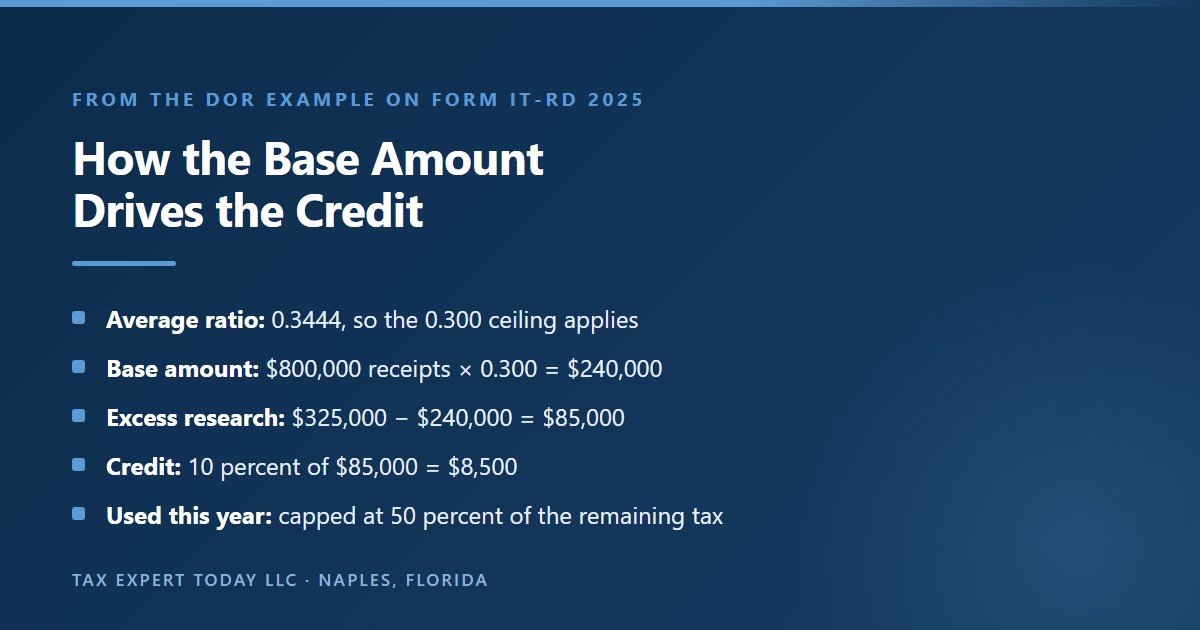
The 0.300 ceiling does real work here. The company’s own history averaged 0.3444, which would have produced a base of about $275,520 and a credit of about $4,950. The ceiling lowers the base to $240,000, so the credit is $8,500. For research-intensive companies whose research spending is large relative to Georgia sales, the ceiling is usually the number that applies, and the credit becomes a function of how far research exceeds 30 percent of Georgia receipts.
The reverse is also true. A company whose Georgia sales grow quickly while research stays flat will see its base rise and its credit shrink, because the base is always measured against current receipts. The credit rewards research intensity relative to Georgia sales, not research growth in the abstract.
What Happens When a Company Has No Georgia Gross Receipts History?
If a business had no Georgia gross receipts in any one or more of the three preceding years, the regulation and Form IT-RD set the base amount at current year Georgia gross receipts times 0.300. A company with no receipts at all in the current year therefore has a base of zero, and every dollar of Georgia research counts.
- Missing history: any prior year with zero Georgia receipts triggers the 0.300 rule.
- Zero current receipts: the base is zero, so the credit is 10 percent of all Georgia research.
- Losses do not matter: the statute says positive prior year income is not required.
- Startups: this is why early stage research companies often generate a credit before they have revenue.
Regulation 560-7-8-.42(2)(a) says that if a business enterprise had no Georgia gross receipts during any one or more of the three preceding tax years, the base amount is the product of current year Georgia gross receipts and 0.300. Form IT-RD repeats the instruction below Section 6. The rule avoids a division by zero in the ratio calculation, and it has a useful side effect: a pre-revenue company has a base of zero.
The statute also removed an old barrier. In 2004 the Georgia Court of Appeals upheld an earlier regulation that required a business to have positive Georgia taxable net income in each of the three preceding years before claiming the credit, in Georgia Department of Revenue v. Georgia Chemistry Council, Inc., 270 Ga. App. 615 (2004). The General Assembly later changed the statute itself, and the current text of O.C.G.A. 48-7-40.12(a)(1) states that a business enterprise need not have had positive taxable net income for the preceding three years to claim the credit. Older summaries that still mention a profitability requirement are describing law that no longer applies.
A zero base is not the same as a usable credit. A pre-revenue company usually has no Georgia income tax, so the 50 percent cap allows nothing against income tax. Without the withholding election, the credit would simply carry forward. The combination of a zero base and the withholding election is what makes the Georgia credit valuable to early stage companies, and it is covered in detail below.
How Does the 50 Percent Income Tax Limit Work?
The research credit used in any year cannot exceed 50 percent of the business’s remaining Georgia net income tax after all other credits have been applied. The research credit therefore comes last in the ordering. Other credits shrink the remaining tax first, and the research credit can take at most half of what is left.
- Start: Georgia income tax before any credits.
- Subtract: every other credit claimed that year.
- Halve: the result is the most research credit usable against income tax.
- Remainder: unused credit carries forward or can be elected against withholding.
O.C.G.A. 48-7-40.12(d) sets the cap, and Section 6 of Form IT-RD applies it line by line. The Department’s example continues from the base amount calculation above with $48,000 of Georgia income tax, $30,000 of other credits, and a $10,000 research credit carried over from the prior year.
| Form IT-RD, Section 6 line | Department example |
|---|---|
| 1. Current tax liability without any credits | $48,000 |
| 2. Value of all other credits claimed | $30,000 |
| 3. Remaining tax liability | $18,000 |
| 4. 50 percent of line 3, the maximum credit allowed | $9,000 |
| 5. Current year research credit | $8,500 |
| 5a. Carryover from the prior year | $10,000 |
| 6. Total available research credit | $18,500 |
| 7. Credit claimed on the return, the lesser of line 4 or line 6 | $9,000 |
| 8. Unused credit or carryforward | $9,500 |
Two things stand out. First, other credits reduce the room for the research credit before it is measured. A company that also claims a jobs credit, a film credit it purchased, or a contribution credit such as the Georgia rural hospital tax credit will find less space for research credit, because the statute measures the research cap after all other credits. Second, the cap is a percentage of tax, so it shrinks when the tax shrinks. The move to a 4.99 percent rate for 2026 reduces Georgia tax on the same income and therefore reduces the research credit that can be used against it.
The $9,500 on line 8 is the amount that either carries forward or, if the business makes the election described below, can be applied against payroll withholding. For a profitable company, carrying it forward may be enough. For a company with little Georgia tax, line 8 is the number that matters most.
How Long Can an Unused Georgia R&D Credit Be Carried Forward?
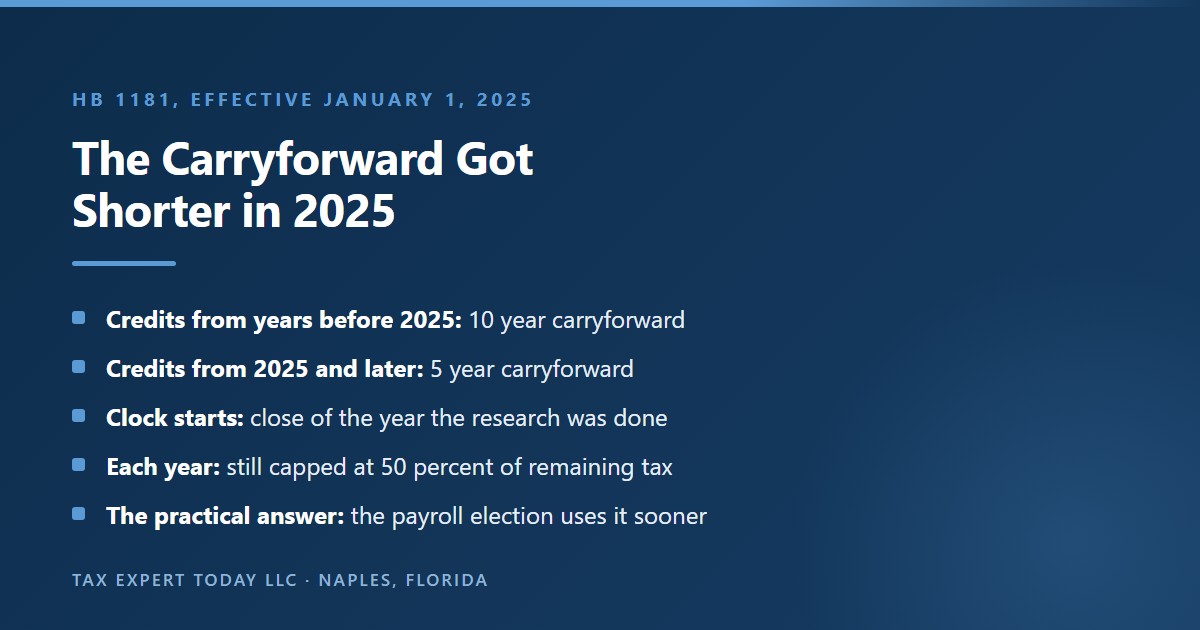
Credits generated in taxable years beginning on or after January 1, 2025 carry forward five years from the close of the year in which the research expenses were incurred. Credits generated in earlier years keep the former ten year carryforward. The change came from HB 1181 and applies only to credits generated in 2025 and later years.
- Credits from 2024 and earlier: 10 year carryforward.
- Credits from 2025 and later: 5 year carryforward.
- Clock: runs from the close of the taxable year in which the research was performed.
- Annual cap: each carryforward year is still limited to 50 percent of the remaining tax.
The current text of O.C.G.A. 48-7-40.12(d) says unused credit “may be carried forward five years from the close of the taxable year in which the qualified research expenses were made.” The code annotations show that HB 1181, Ga. L. 2024, p. 794, substituted five years for ten effective January 1, 2025, and that the act applies the change only to unused credits generated in taxable years beginning on or after that date. The Department’s summary page states the same split, and the 2025 Form IT-RD instructs that the line 8 carryforward may be carried forward for five years.
| Year the credit was generated | Carryforward period | Last year to use, calendar year taxpayer |
|---|---|---|
| 2022 | 10 years | 2032 |
| 2024 | 10 years | 2034 |
| 2025 | 5 years | 2030 |
| 2026 | 5 years | 2031 |
| 2027 | 5 years | 2032 |
The table shows an odd result that is worth noticing. A calendar year company holding both a 2024 credit and a 2025 credit will see the older credit outlive the newer one. The 2024 credit can be used through 2034, while the 2025 credit expires after 2030. When both are available, the order in which carryforwards are absorbed matters, and a company should track each year’s credit separately rather than as one pooled balance. The statute and form do not state an absorption order, so the tracking schedule should show which year’s credit was treated as used and why.
The shorter period also changes the value of the withholding election. A credit that sits for five years against a small income tax may expire unused. The same credit elected against payroll withholding is used as fast as the company pays withholding. For most companies with credit in excess of the cap, the carryforward change is a reason to look at the election, not a reason to wait.
How Does the Georgia R&D Tax Credit Offset Payroll Withholding?
When the research credit exceeds 50 percent of the remaining Georgia income tax, the excess can be taken against the business’s Georgia payroll withholding payments. The business files Form IT-WH, the Department reviews the credit, and a letter then authorizes the company to reduce future withholding deposits by the approved amount.
- What qualifies: only the credit above the 50 percent income tax cap.
- What it reduces: the company’s own payroll withholding deposits under O.C.G.A. 48-7-103.
- Timing: future deposits only, never withholding already paid.
- Nature: an irrevocable election for each tax year’s credit.
O.C.G.A. 48-7-40.12(e) provides that where the credit exceeds 50 percent of the remaining Georgia net income tax, “the excess may be taken as a credit against such taxpayer’s quarterly or monthly payment under Code Section 48-7-103.” Section 48-7-103 is the provision under which employers remit the tax withheld from wages. In practical terms, the employer keeps withholding from employees exactly as before, reports the withholding exactly as before, and pays the Department less cash until the approved credit is used up.
Regulation 560-7-8-.42(5)(a) adds the conditions. The benefit may only be applied against the withholding tax account the business uses for payroll. For a single member LLC that is disregarded for income tax, the benefit applies only to withholding attributable to wages the LLC itself paid. The election is irrevocable, it may be made one time for each tax year in which the credit is earned, and it may cover all or part of the excess remaining at the time of the election.
The Department lists research credit among the credits that can be claimed this way. Its IT-WH filing page states that there are currently 19 withholding tax credits in the qualifying credit list in the Georgia Tax Center, and it singles out the jobs and research credits for additional limitation information. Our article on Georgia withholding tax explains the deposit schedules the offset reduces.
What Changed in the Form IT-WH Election Deadline?
For taxable years beginning on or after January 1, 2025, the amended regulation allows Form IT-WH to be filed within the three year statute of limitations period after the due date of the Georgia income tax return, including extensions. The earlier rule required the notice within 30 days after filing a timely return, and many companies missed it.
- Old rule: 30 days after filing a timely Georgia return.
- Current rule: within three years after the return due date, including extensions.
- Effective: taxable years beginning on or after January 1, 2025, under Regulation 560-7-8-.42(8).
- Penalty for missing it: the withholding benefit is disallowed.
The regulation now reads that the business “must file Revenue Form IT-WH Notice of Intent through the Georgia Tax Center within the three-year statute of limitations period after the due date of the Georgia income tax return (including extensions). Failure to file this form as provided in this subparagraph will result in disallowance of the withholding tax benefit.” That is a large change from a 30 day window that closed shortly after the return went in, often before anyone had looked at the credit position.
The effective date deserves careful reading. Regulation 560-7-8-.42(8) says the amended regulation applies to taxable years beginning on or after January 1, 2025, and that earlier years are governed by the regulations as they existed before that date. Read literally, that keeps the 30 day rule for credits generated in 2024 and earlier. A September 15, 2026 practitioner note published by Cherry Bekaert reports that the three year window reaches credits generated before 2025 and that the Department has been approving such filings. That report is useful, but it is a practitioner account rather than published guidance, so a company with older unused credits should confirm the Department’s position for its own years before relying on it. The regulation text is the controlling source for 2025 and later credits.
AI summaries and many search results still state the 30 day rule without any date qualifier. For 2025 and later credits, that statement is out of date. For older credits, it may still be the literal rule, subject to the Department’s current practice. The difference is worth real money for a company with several years of unused credit.
How Do You File Form IT-WH in the Georgia Tax Center?
Form IT-WH must be filed electronically in the Georgia Tax Center from the corporate income tax account. The withholding account must be valid and current, with no missing returns and no outstanding liabilities. The business selects the credit, enters the amount, and submits; paper filing is not accepted for years beginning in 2017 and later.
- Access: a GTC login with access to the corporate income tax account.
- Compliance: every withholding return filed and every balance paid.
- Path: Summary tab, then Manage My Credits, then Claim Withholding Tax Benefit.
- Information: legal name, FEIN, Georgia account number, and owner or officer details.
The Department’s IT-WH page lists the requirements and the steps. A corporate account is required because the request is made from the corporate account level. The withholding account must be valid and in compliance with filing requirements, with no missing returns and no outstanding liabilities. The filer logs in, opens the Summary tab, selects Manage My Credits next to the corporate income tax account, chooses Claim Withholding Tax Benefit, enters the taxpayer and contact information, selects the credit type, reviews the credit limitation information shown for research and jobs credits, and submits.
The compliance requirement is the step that most often stalls a claim. A single missing zero return on a withholding account, or a small unpaid penalty from an old quarter, can prevent the request from going forward. It is worth reviewing the withholding account in GTC before starting, and clearing anything open first. The same is true of the income tax account, because the credit being claimed must appear on a filed return.
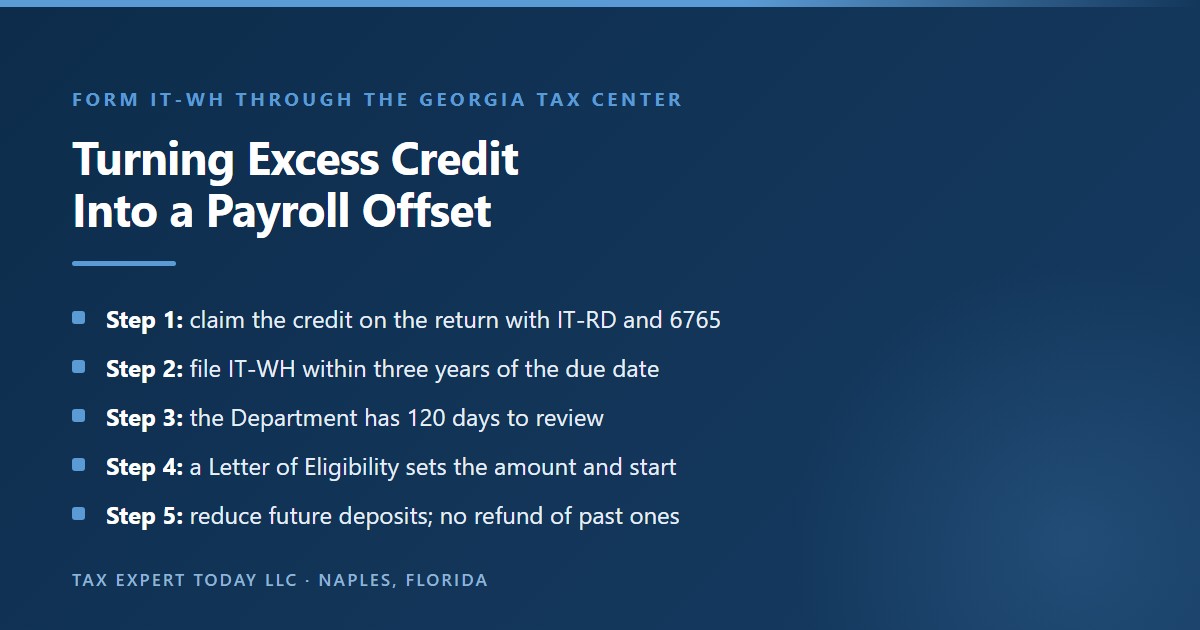
| Stage | What happens | Source |
|---|---|---|
| Claim the credit | File Form IT-RD and federal Form 6765 with the Georgia return | Reg. 560-7-8-.42(5) |
| Elect the offset | File Form IT-WH in GTC within three years after the return due date, including extensions | Reg. 560-7-8-.42(5)(a)1 |
| Department review | Up to 120 days from receipt of Form IT-WH | Reg. 560-7-8-.42(5)(a)2 |
| Letter of Eligibility | States the approved amount and when the offset may begin | Reg. 560-7-8-.42(5)(a)3 |
| Use the offset | Reduce future withholding payments; no refund of earlier deposits | Reg. 560-7-8-.42(5)(a)3 |
What Does the Letter of Eligibility Do?
After reviewing Form IT-WH, the Department sends a Letter of Eligibility stating how much credit may be applied against withholding and when the business may begin. The Department has 120 days from receipt of Form IT-WH to review the credit. The letter authorizes credits against future withholding payments only and does not refund earlier deposits.
- Review period: 120 days from the date the Department receives Form IT-WH.
- Letter content: the approved amount and the start date.
- Effect: the business reduces future withholding payments by the approved amount.
- Limit: no refund of withholding payments already made.
Regulation 560-7-8-.42(5)(a)2 gives the Department 120 days to review the credit and determine the amount eligible for use against withholding. Paragraph (5)(a)3 then provides that a letter will be sent stating the amount that may be applied and when the business may begin to claim it, and that the Department “shall treat this amount as a credit against future withholding tax payments and will not refund any previous withholding payments.”
The letter is the operative document. A company should not start reducing deposits on the strength of its own calculation or a filed IT-WH. It waits for the letter, then instructs its payroll provider to apply the approved credit to deposits from the stated start date. Payroll providers handle this differently, and some require the letter itself before they will change the Georgia deposit amount, so it helps to ask the provider how it processes a Georgia withholding credit before the letter arrives.
The approved amount can be lower than the amount claimed. The review is a review of the credit itself, including the business enterprise classification, the base amount, the Georgia location of the research, and the federal credit. A claim with thin support can be reduced at this stage, and the review is effectively a desk audit of the credit before any cash benefit flows. The records described later in this article are what make that review routine.
Do Employees Lose Anything When the Employer Uses the Offset?
No. The statute gives each employee full credit on the employee’s own Georgia return for the tax withheld, as if the employer had paid it all to the Department. The employer reports withholding on Forms W-2 exactly as before, and the credit against the employer’s payments is not income to the employer.
- Employee credit: full credit for the amount withheld from wages.
- W-2 reporting: unchanged.
- Employer income: the credit is not income to the employer under the statute.
- Employee withholding rates: unchanged, the employer still withholds normally.
O.C.G.A. 48-7-40.12(e) addresses this directly. Each employee whose employer receives a credit against its withholding payments “shall receive a credit against his or her income tax liability under Code Section 48-7-20 for the corresponding taxable year for the full amount which would be credited against such liability prior to the application of the credit.” The same subsection says the credits against withholding payments, and the credits against employee liability, “shall not constitute income to the taxpayer.”
This is why the offset works as a cash benefit without changing anything for staff. Employees see the same paychecks and the same W-2 withholding. The employer’s cash deposit to the Department is smaller, and the difference is funded by the research credit. From the employee’s side, nothing about the Georgia return changes.
How Does the Credit Work for S Corporations, Partnerships, and LLCs?
A pass-through entity computes the credit and files Form IT-RD with its own return, then passes the credit to its owners by year end profit and loss percentages. Owners use it against their own Georgia income tax but cannot elect it against their own withholding. Only the entity can make the payroll election, which keeps the excess at entity level.
- Default: credit passes through to owners in profit and loss percentages.
- Owners: use it against Georgia income tax, subject to the 50 percent cap.
- Owners cannot: elect their share against their own withholding.
- Entity election: if the entity elects the withholding offset, that excess does not pass through.
Regulation 560-7-8-.42(7) sets the default rule. When the business enterprise is a pass-through entity with no income tax liability of its own, the credit passes to members, shareholders, or partners based on the year ending profit and loss percentage. The forms are first filed with the entity’s return to establish the credit, and owners then apply their shares against the tax on their own returns for the owner’s tax year in which the entity’s year ends. The regulation states plainly that owners “may not claim any excess research tax credit against their withholding tax liabilities.”
Paragraph (5)(a) of the same regulation covers the other path. When a pass-through entity makes the irrevocable withholding election, “the excess research tax credit will not pass through to the shareholders, partners, or members.” The entity must choose, for each year’s excess, between pushing credit out to owners and keeping it inside to reduce payroll deposits.
| Question | C corporation | S corporation, partnership, or LLC taxed as one |
|---|---|---|
| Who files Form IT-RD | The corporation | The entity, to establish the credit |
| Who uses the credit against income tax | The corporation, up to 50 percent of remaining tax | Any entity level tax first, then owners by profit and loss percentages |
| Who can elect the payroll offset | The corporation | The entity only, never the owners |
| Effect of the election on owners | Not applicable | The elected excess does not pass through |
| Disregarded single member LLC | Not applicable | Offset limited to withholding on wages the LLC itself paid |
The choice usually follows the owners’ tax position. Owners with substantial Georgia income from other sources may be able to use a passed-through credit against their own Georgia tax, subject to the same 50 percent cap on their returns. Owners who are nonresidents with little Georgia income, or owners in loss positions, may get little from a passed-through credit. In those cases, keeping the excess inside the entity and reducing payroll deposits can be the more useful path. Nonresident owners raise their own Georgia filing questions, which our article on the Georgia composite return covers.
How Does the Pass Through Entity Tax Election Interact With the Credit?
An S corporation or partnership that elects to pay Georgia income tax at the entity level has its own Georgia tax, and Form IT-RD says the credit is first applied to any income tax at the entity level before being apportioned to owners. The election therefore creates entity level room for the research credit, still within the 50 percent cap.
- Entity tax first: Form IT-RD applies the credit to entity level tax before owners.
- Cap still applies: 50 percent of the remaining entity level tax.
- Rate for 2026: an electing entity pays at 4.99 percent.
- Election years: credits stay with the entity unless it separately elects to pass them through.
The note at the end of the 2025 Form IT-RD example states that for an S corporation or other pass-through entity, the credit on line 7 “would first be applied to any income tax at the entity level and then apportioned to shareholders or partners.” For an entity that has made the Georgia pass-through entity tax election, the entity level tax is real and can absorb credit, up to the 50 percent cap. Our article on the Georgia pass through entity tax explains how that election works and who it helps.
The election also changes where the credit lives. As our pass through entity tax article explains, credits generated in an election year are earned and used at the entity level on C corporation principles and stay with the entity, unless the entity makes a separate irrevocable election to pass credits through on the credit allocation schedule of Form 600S or Form 700. For an electing entity, then, the choice is among using the credit against entity level tax, electing it against payroll withholding, and passing it through by that separate election.
The interaction is a planning question rather than a rule to memorize. Using research credit against entity level tax reduces the Georgia tax that the entity pays, which also reduces the federal deduction the entity was seeking through the election in the first place. Whether the research credit is better used at entity level, passed to owners, or elected against payroll depends on the owners’ federal and Georgia positions. The numbers need to be run for the specific entity, and the answer can differ from year to year.
How Does the Georgia Credit Compare With the Federal Research Credit?
The federal research credit under IRC Section 41 and the Georgia credit share a definition of qualified research but differ in almost everything else: the base, the rate, the use limits, and the payroll offset. A company claims both, computes each separately, and should not assume a federal figure transfers to Georgia unchanged.
- Base: federal methods use prior research and receipts; Georgia uses Georgia gross receipts.
- Rate: federal regular credit 20 percent or alternative simplified credit 14 percent; Georgia 10 percent.
- Location: federal counts US research; Georgia counts Georgia research only.
- Payroll offset: federal against employer payroll taxes for qualified small businesses; Georgia against state withholding.
| Feature | Federal credit, IRC Section 41 | Georgia credit, O.C.G.A. 48-7-40.12 |
|---|---|---|
| Research counted | Qualified research in the United States | The same definition, limited to research in Georgia |
| Rate | 20 percent regular credit, or 14 percent alternative simplified credit | 10 percent |
| Base | Fixed base percentage, or 50 percent of the three year average research | Georgia gross receipts times the lower of the average ratio or 0.300 |
| Annual use limit | General business credit limits | 50 percent of remaining Georgia tax after other credits |
| Payroll offset | Qualified small businesses, up to $500,000 a year against employer payroll taxes for years beginning after 2022 | Any qualifying business, excess over the cap, against Georgia withholding |
| Carryforward | Under the general business credit rules | 5 years for 2025 and later credits, 10 years for earlier credits |
The federal figures come from the statute itself. IRC Section 41(c)(4) sets the alternative simplified credit at 14 percent of qualified research expenses above 50 percent of the prior three year average, and Section 41(h) allows a qualified small business to elect the credit against payroll taxes, with a $250,000 limit increased by another $250,000 for taxable years beginning after December 31, 2022. The federal payroll election has its own eligibility tests based on gross receipts and the age of the business.
The two payroll offsets are separate and can be used together. A young company may elect part of its federal credit against the employer’s federal payroll taxes and, separately, elect its excess Georgia credit against Georgia withholding. Neither election affects the other, but the federal election still counts as claiming a Section 41 credit, which is the condition for the Georgia credit.
What Did the 2025 Federal Law Change for Research Expenses?
Federal law now allows domestic research and experimental expenditures to be deducted currently under IRC Section 174A for amounts paid or incurred in taxable years beginning after December 31, 2024. That change affects federal taxable income and the federal research credit computation, but it does not change the Georgia credit formula.
- Federal deduction: domestic research expenditures deductible in the year paid or incurred.
- Effective: taxable years beginning after December 31, 2024.
- Georgia credit: still 10 percent of Georgia research above the base amount.
- Georgia income: whether Georgia taxable income follows depends on Georgia’s conformity rules.
IRC Section 174A(a) provides that, notwithstanding Section 263, a deduction is allowed for domestic research or experimental expenditures paid or incurred during the taxable year, and the effective date note applies it to amounts paid or incurred in taxable years beginning after December 31, 2024. This reversed, for domestic research, the five year amortization that had applied since 2022.
The federal credit and the new deduction are coordinated by IRC Section 280C(c). As now written, it reduces the domestic research expenditures otherwise taken into account as a deduction by the amount of the Section 41 credit, unless the taxpayer elects a reduced credit instead. That election changes the federal credit amount, and a company should see how the choice flows into the federal Form 6765 before assuming the federal credit it reports will match an earlier estimate. The Georgia credit itself is computed on Georgia expenses and is not reduced by the federal election, but a Georgia claim must still rest on a federal credit that is claimed and allowed.
The Georgia credit formula does not depend on how research costs are deducted. It depends on Georgia qualified research expenses, which follow the Section 41 definition, and on Georgia gross receipts. Where the federal change matters for Georgia is taxable income: a larger current deduction lowers income, lowers tax, and lowers the room under the 50 percent cap. Whether Georgia follows Section 174A in computing Georgia taxable income turns on Georgia’s annual Internal Revenue Code conformity legislation and any Georgia adjustments, which should be confirmed for the specific year rather than assumed. For a broader look at the 2026 federal cost recovery changes, see our article on bonus depreciation in 2026.
Can a Startup With No Income Use the Georgia R&D Tax Credit?
Yes, often more usefully than a profitable company. A startup with limited Georgia receipts history has a base of current receipts times 0.300, so most of its Georgia research counts, and with no income tax the entire credit is excess over the cap. Through the IT-WH election, that excess can reduce Georgia payroll deposits.
- Base: low or zero when Georgia receipts history is thin.
- Income tax use: none, because 50 percent of zero tax is zero.
- Excess: the full credit, eligible for the withholding election.
- Condition: Georgia employees on payroll, so there is withholding to offset.
Consider a hypothetical medical device company in Peachtree Corners organized as a C corporation with a calendar tax year. It had no Georgia gross receipts in 2022, $150,000 in 2023, and $400,000 in 2024. In 2025 it had $1,200,000 of Georgia gross receipts, $1,500,000 of Georgia qualified research expenses, a federal research credit on Form 6765, a Georgia net loss, and about 30 Georgia employees with roughly $20,000 of Georgia income tax withheld each month.
| Item, hypothetical 2025 company | Amount |
|---|---|
| Base amount: no Georgia receipts in 2022, so $1,200,000 times 0.300 | $360,000 |
| Excess research: $1,500,000 minus $360,000 | $1,140,000 |
| Credit at 10 percent | $114,000 |
| Georgia income tax, net loss year | $0 |
| Usable against income tax at 50 percent of $0 | $0 |
| Excess eligible for the IT-WH election | $114,000 |
| Approximate months of Georgia deposits covered at $20,000 a month | About 5.7 |
Without the election, the $114,000 would carry forward five years, through 2030, and could be used each year only against half of the company’s Georgia income tax. To absorb all of it within that window, the company would need about $228,000 of Georgia income tax, which at 4.99 percent is roughly $4.57 million of Georgia taxable income across those years. For a company that expects to be in losses for several more years, much of the credit could expire.
With the election, the company files its 2025 Georgia return with Form IT-RD and Form 6765, then files Form IT-WH in GTC after confirming that its withholding account is current. It has until three years after the 2025 return due date, including extensions, to file the notice. The Department has 120 days to review. If the Department approves the full amount, the Letter of Eligibility sets a start date, and the company’s payroll provider reduces Georgia deposits by about $20,000 a month until the $114,000 is used. Employees see no change. These figures are illustrations only; an actual claim depends on the company’s records, its classification, and the Department’s review.
How Do Extensions and Estimated Payments Affect the Georgia Research Credit?
An extension lengthens the Form IT-WH window, because the three years run from the Georgia return due date including extensions. The credit also reduces the income tax that estimated payments are meant to cover. A company expecting a large credit should factor it into its estimates, but only to the extent the 50 percent cap allows.
- Extension: the IT-WH window is measured from the extended due date.
- Estimates: only the credit usable under the cap reduces income tax.
- Excess credit: does not reduce income tax estimates, because it is used against withholding.
- Timing: the credit is known only after year end research costs are totaled.
Because the regulation measures the IT-WH window from “the due date of the Georgia income tax return (including extensions),” a valid extension gives more time for the election as well as for the return. Our article on Georgia Form IT-303 explains how Georgia extensions work and when a federal extension carries over. The extension does not extend the time to pay tax, and it does not make an incomplete credit claim acceptable; it only moves the dates.
Estimated payments are a separate question. A corporation computes Georgia estimates on the tax it expects to owe, and the research credit reduces that tax only to the extent of the 50 percent cap. An owner of a pass-through entity who expects a passed-through credit can reflect it in personal estimates on the same limited basis, which our article on Georgia Form 500-ES estimated payments covers for individuals. The excess credit elected against withholding does not reduce income tax estimates at all, because it is applied to payroll deposits after the Department’s review.
Both the return and the IT-WH request are filed through the Georgia Tax Center, and the Department’s corporate income and net worth tax page lists the corporate forms and booklets that the credit schedule attaches to. Keeping the GTC user access current for whoever prepares the return avoids a delay when the election is ready to file.
What Records Support a Georgia R&D Tax Credit Claim?
A Georgia claim needs the federal research credit file plus proof that the research happened in Georgia and a clean Georgia gross receipts history. The core records are project documentation, time records by employee and location, payroll records, supply and contract invoices, the Form 6765, and the apportionment workpapers behind Georgia gross receipts.
- Project records: what was researched, the technical uncertainty, and the process of experimentation.
- Time and location: who worked on which project, and where the work was performed.
- Costs: payroll registers, supply invoices, and contract research agreements.
- Receipts: Georgia gross receipts for the current year and the three prior years.
The federal records establish that the activity is qualified research and that the costs are qualified research expenses. The Georgia records add two things the federal file may not show: where the work took place, and what Georgia gross receipts were in each year used in the base. The prior year receipts figures should tie to the apportionment schedules on the Georgia returns already filed, because a mismatch between the base calculation and the filed returns is an obvious point for a reviewer.
Contract research needs particular care. Payments to a contractor count only if the research was performed in Georgia and the federal contract research rules are met. A contract that does not say where the work will be performed, or who owns the results, can leave the Georgia portion hard to support. Adding a location clause and a results clause to research contracts is a small change that makes later claims easier.
Can You Claim a Missed Georgia Research Credit on an Amended Return?
The regulation requires Form IT-RD and Form 6765 with the Georgia return for each year the expenses were incurred, and an amended return within Georgia’s refund limitations period is the usual way to add a credit that was missed. The federal credit for that year must also be claimed and allowed. The payroll election follows its own window.
- Vehicle: an amended Georgia return with Form IT-RD and Form 6765 attached.
- Federal side: the federal credit for the same year must be claimed as well.
- Timing: Georgia refund limitations periods apply to the amended claim.
- Payroll election: counted from the original return due date, including extensions.
Adding a research credit after the fact is common, because many companies discover the federal credit late. The Georgia credit follows the federal claim, so the federal amended return or claim usually comes first. Our article on the Georgia amended tax return explains how Georgia amended returns work and how the limitations period is measured. Note that the IT-WH window in the regulation is measured from the due date of the original Georgia return, not from the date of an amended return, so a late discovered credit can have less time for the payroll election than it first appears.
The amended claim also resets the Department’s attention. A credit added by amendment is reviewed like any other, and if the company later files Form IT-WH for the same year, the Department reviews the credit again as part of the 120 day process. The same records that support the amendment support the election.
How Does the Georgia R&D Tax Credit Fit With Other Georgia Credits?
The research credit is applied after all other Georgia credits, so other credits reduce the room under its 50 percent cap. Several Georgia credits share the IT-WH withholding path, including the jobs tax credit in some areas. A company claiming more than one credit should plan the order and the elections together, year by year.
- Ordering: the research cap is measured after all other credits.
- Shared path: IT-WH covers 19 qualifying credit types in GTC.
- Purchased credits: transferable credits bought from others also reduce the remaining tax.
- Net worth tax: the research credit is an income tax credit and does not reduce the separate net worth tax.
Because the statute measures the research cap “after all other credits have been applied,” a company that buys a transferable credit, such as the credits described in our article on the Georgia film tax credit, may reduce its income tax to the point where little or no research credit fits under the cap. That is not necessarily a bad result, because the unused research credit becomes excess eligible for the withholding election. It does mean the two decisions should be made together.
The research credit is an income tax credit. It does not reduce the Georgia corporate net worth tax, which is a separate tax computed on capital, and it does not reduce sales tax. Our article on the Georgia net worth tax covers that return, and our article on Georgia sales tax exemptions covers the separate sales and use tax side. Individual owners who also claim contribution credits, such as the Georgia qualified education expense credit, should remember that on their own returns the research credit is again measured after those credits. For a full picture of a company’s Georgia credits, the Georgia tax services page describes how we review them together.
Employers that are also adding well paid Georgia jobs should look at a second credit that can use the same Form IT-WH path. The quality jobs credit pays $2,500 to $5,000 per new job each year for five years once the job count test is met. Our Georgia quality jobs tax credit guide explains the 50 job test, the county wage tiers, and how that credit reaches payroll withholding.
What Are the Most Common Georgia R&D Tax Credit Mistakes?
The common mistakes are claiming Georgia without the federal credit, counting research performed outside Georgia, using worldwide rather than Georgia gross receipts in the base, missing the IT-WH election, starting payroll offsets before the letter arrives, and tracking carryforwards as one pooled balance despite the 2025 change.
- No federal claim: the Georgia credit requires a federal credit for the same year.
- Wrong location: out of state research included in Georgia expenses.
- Wrong receipts: total sales used instead of the Georgia apportionment numerator.
- Early offset: reducing deposits before the Letter of Eligibility.
- Pooled carryforward: ignoring that 2025 and later credits expire sooner.
Several quieter errors also recur. Pass-through entities sometimes allocate credit to owners and also attempt a withholding election for the same excess, which the regulation does not allow. Companies with a disregarded LLC payroll entity sometimes try to apply the offset to withholding on wages paid by a different entity. And companies with open withholding filings discover at the IT-WH stage that GTC will not accept the request until every withholding return is filed and every balance is paid.
A final mistake is relying on an old summary. Pages written before 2025 describe a ten year carryforward and a 30 day election window for every credit. For credits generated in 2025 and later, both statements are wrong. For older credits, the ten year carryforward remains correct and the election window depends on the Department’s current practice, as explained above.
Georgia R&D Tax Credit Help in Naples & Southwest Florida
Tax Expert Today LLC works from Naples, Florida and handles state tax matters nationwide, including Georgia research credit computations, Form IT-RD preparation, Form IT-WH elections, pass-through credit planning, and Department reviews of credit claims. Georgia clients are served from the Naples office and do not need to travel to Georgia or Florida.
- R&D tax credit help Naples covers Georgia companies with Southwest Florida owners and Florida companies with Georgia research teams.
- Georgia payroll offset reviews start with the withholding account in GTC and the credit history by year.
- Pass-through planning compares owner level use, entity level use, and the payroll election.
- Remote engagement is standard. Documents are exchanged through a secure client portal rather than by email.
Tax Expert Today LLC
11983 Tamiami Trail N, Naples, FL 34110
Telephone: (239) 441-2005
Hours: Monday through Friday, 10:00 a.m. to 5:00 p.m. Eastern Time
A local question we are asked often: I live in Naples and own part of a Georgia engineering company that earns research credits. Can I use the credit on my Florida taxes? No, because Florida has no personal income tax for the credit to offset. If the company is a pass-through entity, your share of the Georgia credit can reduce Georgia tax on your Georgia nonresident return, subject to the 50 percent cap, and if you have little Georgia income it may do little for you personally. That is often the situation in which the company’s own payroll withholding election is the more practical use of the credit. The full range of Georgia engagements is described on our Georgia tax services page, and planning for Southwest Florida business owners is covered on our Naples tax planning services page.
When to Engage a Professional
A single location Georgia company with an established federal research credit file can often prepare Form IT-RD directly. Review is worth it for multistate research teams, pass-through entities choosing between owner use and the payroll election, companies with unused credits from several years, and any company whose credit is under Department review.
- A research company with no Georgia income tax deciding whether and when to file Form IT-WH.
- A multistate company that needs research wages assigned to Georgia on a defensible basis.
- An S corporation or partnership weighing owner level use against the entity level election.
- A company with pre-2025 credits that never made the withholding election.
- A company whose claim was reduced in the Department’s 120 day review.
Dr. Pellumb Kabashi is an enrolled agent and the founder of Tax Expert Today LLC, and the firm includes tax advisors, enrolled agents, certified public accountants, and attorneys. Georgia Department of Revenue matters are state tax matters rather than federal ones, and they are handled under Georgia procedure and Georgia authority. Nothing in this article is advice for a particular taxpayer, and the result in any specific case depends on facts that a general article cannot know. Business owners who want the research credit reviewed as part of a broader Georgia plan can start with our Georgia tax planning and business advisory page. Call (239) 441-2005 for a free consultation, or reach the Naples, Florida office during business hours.
Frequently Asked Questions
What is the Georgia R&D tax credit rate?
The credit is 10 percent of Georgia qualified research expenses above a base amount. The base amount is current Georgia gross receipts multiplied by the lower of the three year average research ratio or 0.300, under O.C.G.A. 48-7-40.12.
Do I have to claim the federal research credit to get the Georgia credit?
Yes. Georgia allows the credit only if the business claims and is allowed a federal research credit under IRC Section 41 for the same taxable year, and a copy of federal Form 6765 must be attached to the Georgia claim.
How much of the Georgia research credit can I use each year?
The credit used against income tax in any year cannot exceed 50 percent of the remaining Georgia net income tax after all other credits have been applied. Any excess carries forward or can be elected against payroll withholding.
How long does an unused Georgia R&D credit carry forward?
Credits generated in taxable years beginning on or after January 1, 2025 carry forward five years from the close of the year the research was performed. Credits generated in earlier years keep the former ten year carryforward.
What is the deadline to file Form IT-WH?
For taxable years beginning on or after January 1, 2025, Form IT-WH must be filed in the Georgia Tax Center within the three year statute of limitations period after the Georgia return due date, including extensions. The earlier rule was 30 days after a timely return.
Will the Department refund payroll withholding I already paid?
No. The regulation says the approved amount is a credit against future withholding payments and that the Department will not refund previous withholding payments. The offset begins on the date stated in the Letter of Eligibility.
How long does the Department take to review Form IT-WH?
The Department has 120 days from receiving Form IT-WH to review the credit and determine the amount eligible for use against withholding. It then sends a Letter of Eligibility stating the amount and the start date.
Can owners of an S corporation use the research credit against their own withholding?
No. Owners may use a passed-through credit against their Georgia income tax, but the regulation says they may not claim excess research credit against their own withholding. Only the entity can make the payroll election, and the elected excess does not pass through.
Can a company with no revenue claim the Georgia research credit?
Often yes. If the company had no Georgia gross receipts in any of the three prior years, the base amount is current receipts times 0.300, which is zero when there are no current receipts. The statute also says prior year profits are not required.
Does the Georgia research credit reduce the net worth tax or sales tax?
No. It is a credit against Georgia income tax, with an optional offset against payroll withholding. It does not reduce the separate Georgia corporate net worth tax or sales and use tax.
Published September 25, 2026 by Dr. Pellumb Kabashi « Back to Learning Center
Have a question this article touches on?
Tax Expert Today LLC, based in Naples, Florida and serving clients across the United States.
Schedule a Consultation (239) 441-2005