
By Dr. Pellumb Kabashi, DBA, MBA, CES, CFE, EA
Founder, Tax Expert Today LLC · Tax advisors, enrolled agents, CPAs, and attorneys · Serving clients in all 50 states
Quick Answer: California Form 3853 reports health coverage, claims exemptions, and figures any Individual Shared Responsibility Penalty. If you moved out of California during the year, the penalty applies only to months you were a California resident without coverage. Code each month after your move with exemption code E, attach Form 3853 to Form 540NR, and keep proof of your move date. Call (239) 441-2005 for a free consultation.
California Form 3853 is the page of the state return that most people leaving California never think about until their tax software asks a question they cannot answer: did everyone in your household have qualifying health coverage for all twelve months? For a family that moved from San Diego to Naples in the middle of the year, the honest answer is often no. The California employer plan ended with the job, the Florida plan started weeks or months later, and somewhere in between there were months with no coverage at all. California is one of the few places in the country that still charges a tax penalty for that gap, and the form that decides whether you pay it is Form FTB 3853, Health Coverage Exemptions and Individual Shared Responsibility Penalty.
The good news for anyone who has left is that the California mandate follows residency, not citizenship of the state forever. Government Code section 100705 imposes the coverage requirement on California residents, and it exempts any individual who is a bona fide resident of another state for the month. The form handles that exemption with a single letter, code E, entered month by month. The difficulty is in the details: which months count as California months, how the month of the move is coded, why the penalty computation still uses income you earned after you arrived in Florida, and how a short coverage gap before the move interacts with the uninsured months after it.
This guide is written for the taxpayer who moved out of California, not for a preparer clicking through software screens. It explains who has to file Form 3853 in the move year, how each part of the form works, every exemption code and which ones matter to a mover, the 2025 penalty figures, a fully worked part-year example, the spouse and dependent situations that trip people up, how the Franchise Tax Board checks coverage, and what happens if it disagrees. Every example is a hypothetical illustration, not a description of any client. Figures are the 2025 amounts published by the FTB, which apply to returns filed in 2026.
The Individual Shared Responsibility Penalty is a California rule administered by the Franchise Tax Board. The federal penalty under Internal Revenue Code section 5000A has been zero since 2019, so nothing in this guide concerns a federal health coverage penalty. If you are still sorting out the bigger picture of the move year, start with our overview of leaving California taxes and our guide to the California part-year resident tax return, because Form 3853 depends on the same residency dates you report there.
What is California Form 3853 and who has to file it?
California Form 3853 is the Franchise Tax Board form that reports which household members had qualifying health coverage, claims exemptions from the state mandate, and computes any Individual Shared Responsibility Penalty. You file it with Form 540, Form 540NR, or Form 540 2EZ whenever you cannot check the full-year health care coverage box on the return.
- Full title: Form FTB 3853, Health Coverage Exemptions and Individual Shared Responsibility Penalty.
- Attached to: Form 540, Form 540NR, or Form 540 2EZ, one form per applicable household.
- Trigger: anyone in the household lacked qualifying coverage for any month of the year.
- Result: either a confirmed exemption or a penalty amount carried to the return.
The 2025 Form 3853 instructions state the filing rule in three conditions. You file Form 3853 if you are filing a Form 540, Form 540NR, or Form 540 2EZ, you cannot be claimed as a dependent by another taxpayer, and you are unable to check the full-year health care coverage box on the return. If all three apply, the form is required, even if the end result is that no penalty is due because every uncovered month is exempt.
The full-year box is the gate. On the 2025 Form 540NR it sits on line 91: “If you and your household had full-year health care coverage, check the box.” You check it only if you, your spouse or registered domestic partner on a joint return, and anyone you can or do claim as a dependent had qualifying coverage that covered all of 2025. The form notes that Medicare Part A or Part C coverage counts. If the box is checked, you do not owe the penalty and you do not file Form 3853. If it is not checked, the 540NR instructions send you to Form 3853 to determine whether a penalty applies.
The form is filed once per applicable household. A married couple filing jointly files one Form 3853 that lists both spouses and every dependent. A dependent who can be claimed by someone else does not file the form and does not owe a penalty, because under Revenue and Taxation Code section 61010(c) the taxpayer who claims the dependent is solely liable for any penalty attributable to that dependent.
| Question | If yes | If no |
|---|---|---|
| Can someone claim you as a dependent? | Stop. No Form 3853 and no penalty for you. | Continue. |
| Did everyone in the household have coverage all 12 months? | Check the full-year box. No Form 3853. | Continue. |
| Did anyone have coverage or an exemption for any month? | File Form 3853, complete Parts I and III, then Worksheet A. | Continue to the age question and Part IV. |
| Are you required to file a California return at all? | Form 3853 travels with the return. | The household is exempt and nothing is filed for the mandate. |
That last row matters for people who left California completely. If you were a nonresident for all of 2025 and had no California source income that created a filing requirement, you do not file a California return, and there is nothing to attach Form 3853 to. The mandate never applied to you for any month, because you were not a California resident in any month.
Does California still have a health insurance mandate in 2026?
Yes. California has required residents to maintain qualifying health coverage for every month beginning on or after January 1, 2020, and the requirement remains in force. The federal penalty is zero, but California still charges its own Individual Shared Responsibility Penalty through the state income tax return for each uncovered, unexempt month.
- State law: Government Code sections 100700 through 100725 create the mandate.
- Penalty law: Revenue and Taxation Code sections 61000 through 61050 impose and administer the penalty.
- Federal penalty: reduced to zero for months after December 31, 2018.
- Where it shows up: Form 540NR line 91, reducing your refund or increasing your balance due.
The mandate itself is in Government Code section 100705. Subdivision (a) says that for each month beginning on or after January 1, 2020, “a California resident shall be enrolled in and maintain minimum essential coverage for that month.” Subdivision (b) extends the duty to a resident’s applicable spouse and applicable dependents. The Legislature added the mandate in 2019 after Congress reduced the federal shared responsibility payment to zero, and California’s findings in section 100700 tie it to the stability of the state’s own insurance market.
On the federal side, Internal Revenue Code section 5000A still exists, but its penalty amounts were reduced to zero for months beginning after December 31, 2018. California’s penalty statute anticipated a possible federal revival: section 61015(e) says that if a federal shared responsibility penalty applies for a year, the California penalty is reduced by the federal amount for the same months. With the federal amount at zero, that offset has nothing to subtract.
Florida, by contrast, has no state individual mandate and no state income tax return on which one could be charged. Once you are a bona fide Florida resident, no state penalty attaches to an uninsured month. That is why the residency date is the single most important fact on a mover’s Form 3853, and why the form has to agree with the residency dates on the rest of the return.
| Item | California | Federal | Florida |
|---|---|---|---|
| Individual coverage mandate | Yes, for residents, from January 1, 2020 | Requirement remains in the code, penalty is zero | None |
| Penalty for an uncovered month | Yes, unless an exemption applies | Zero since 2019 | None |
| Form used | Form FTB 3853 | None currently required | None |
| Where the penalty is reported | Form 540 line 92, Form 540NR line 91, Form 540 2EZ line 27 | Not applicable | Not applicable |
| Who enforces it | Franchise Tax Board | Not applicable | Not applicable |
Who has to file Form 3853 in the year you leave California?
A part-year resident files Form 3853 with Form 540NR when any household member lacked qualifying coverage for any month of the year, including months after the move. The form is required even when every uncovered month is exempt, because the exemption, usually code E for the months after the move, has to be claimed on the form.
- Filing return: Form 540NR, the California Nonresident or Part-Year Resident Income Tax Return.
- Common trigger: an uninsured stretch between the California plan ending and the Florida plan starting.
- Required even at zero: claiming code E for Florida months is itself a reason to file.
- Not required: if everyone had coverage every month, check the line 91 box instead.
A part-year resident is, in the words of FTB Publication 1031, “any individual who is a California resident for part of the year and a nonresident for part of the year.” That person files Form 540NR, and Form 540NR carries the same line 91 checkbox as the resident return. The checkbox does not ask whether you had coverage while you lived in California. It asks whether you and your household had coverage that covered all of 2025. A household that was fully covered in California and then went without coverage for two months in Florida cannot check it.
That is the point many movers miss. The months after the move are never penalized, because a bona fide resident of another state is exempt under Government Code section 100705(c)(8). But the exemption is not automatic on the return. It is claimed on Form 3853, Part III, by entering code E in the months it applies. If you leave the box unchecked and do not attach Form 3853, the return is incomplete, and the FTB’s processing may treat the uncovered months as unexplained.
The reverse situation is just as common. A household can have a California resident month with no coverage, which is penalized unless another exemption applies, while every Florida month is fully covered. The form is required there too, and the penalty, if any, is computed only on the California months.
| Move year situation (hypothetical) | Check line 91 box? | File Form 3853? | Penalty possible? |
|---|---|---|---|
| Covered all 12 months in both states | Yes | No | No |
| Covered in California, uninsured for some Florida months | No | Yes, to claim code E | No, if the code E months are correct |
| Uninsured for some California months, covered in Florida | No | Yes | Yes, for the California months unless an exemption applies |
| Uninsured in both states | No | Yes | Yes, for the California months unless an exemption applies |
| Spouse or dependent uninsured for any month | No | Yes | Depends on that person’s months and codes |
Do full-year nonresidents filing Form 540NR need Form 3853?
A full-year nonresident is never subject to the California mandate, because the requirement applies only to California residents. If a nonresident files Form 540NR, for example to report California rental income, and cannot check the full-year coverage box, the FTB instructions still call for Form 3853, with code E claimed for every month.
- Typical filer: a Florida resident who owns a California rental or sold California property.
- Mandate status: not an applicable individual for any month of the year.
- How to show it: code E in Part III, column (a), for the entire year.
- Penalty: none, provided the nonresident status is correct.
Government Code section 100710 defines an applicable individual as someone “subject to the Minimum Essential Coverage Individual Mandate, pursuant to Section 100705,” and section 100705 applies only to a “California resident,” a term defined by reference to Revenue and Taxation Code section 17014. A person who was a resident of Florida for every month of the year is outside the mandate. The FTB’s form logic, however, keys on the checkbox rather than on residency. The 540NR line 91 instructions say that if you did not have full-year coverage, you go to Form 3853 to determine whether you have a penalty.
The clean way to show a full-year nonresident’s position is to complete Part I for each household member and enter code E in Part III, column (a), the full-year column, for each person who was a bona fide resident of another state all year. The penalty worksheet then produces zero. This is a small amount of paperwork that prevents a later inquiry about why a 540NR filer left the box blank. For the rest of the nonresident return, our guide to California source income explains which income keeps a Florida resident filing in California at all, and our nonresident state tax return guide covers the mechanics.
What are the four parts of Form 3853?
Form 3853 has four parts. Part I lists every applicable household member with identification, date of birth, modified adjusted gross income, and any exemption certificate number. Part II claims the household exemption for income below the filing threshold. Part III codes coverage or exemptions month by month. Part IV reports the penalty.
- Part I: one line per household member, in the same order as the return.
- Part II: a single checkbox when household income or gross income is below the filing threshold.
- Part III: columns (a) through (m), full year or January through December.
- Part IV: the penalty amount carried to the return.
Part I is the roster. The instructions require the responsible individual whose name appears on the return on line 1, followed by everyone else listed on the return, in the same order, plus any individual you can claim as a dependent but do not, unless someone else claims them. Each line carries a Social Security number, or an ITIN, an ATIN, or “No ID” where none exists, a date of birth, and three exemption certificate number fields. If Covered California did not grant the person an exemption, you enter “No ECN” in the first field. For a joint return, the spouses’ modified adjusted gross income is added together and entered on line 1, leaving the spouse’s field blank.
Part II is the low-income exemption for the whole household. Part III is where a mover does nearly all of the work. Part IV is the arithmetic, which the instructions spread across five steps and two worksheets. The form is only two pages, but the 2025 Form 3853 instructions run to nineteen.
| Part | What it records | Mover’s focus |
|---|---|---|
| Part I, Applicable Household Members | Name, SSN or ITIN, date of birth, MAGI, up to three ECNs per person | List everyone on the return, even those covered all year |
| Part II, Coverage Exemption for Your Household | One box for household income or gross income below the filing threshold | Rarely applies in a move year with a full year of income |
| Part III, Coverage and Exemptions for Individuals | Codes in column (a) for the full year, or columns (b) through (m) by month, two fields per month | Code Z for covered months, code E for months as a resident of another state |
| Part IV, Individual Shared Responsibility Penalty | The result of Steps 1 through 5 and Worksheets A and B | Computed only on months coded X |
Part III has a rule that catches people: if no code goes in column (a), a code must be entered in every month from January through December. A blank month is not read as covered. Each month has two fields, and you enter one code per field, so a month in which a person had coverage for part of the month and was a resident of another state for part of it can carry both Z and E.
Which exemption codes matter most when you move out of California?
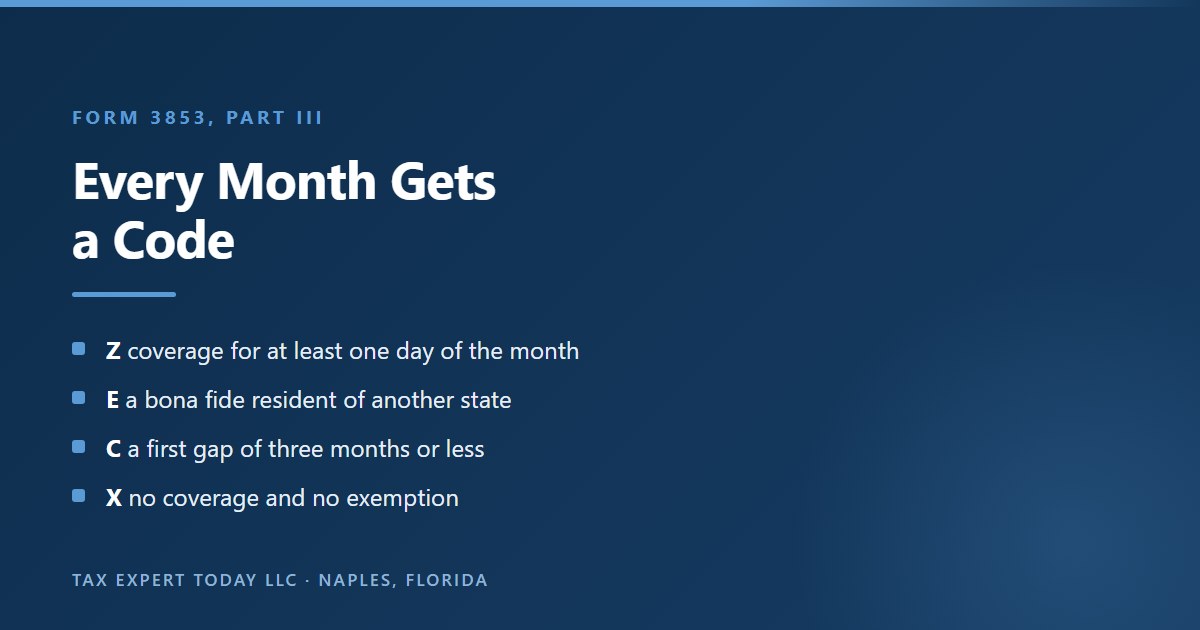
For a mover, the codes that matter most are Z for months with qualifying coverage, E for months as a bona fide resident of another state, C for a short coverage gap of three continuous months or less, and X for months with neither coverage nor an exemption. Codes A, D, and F come up in specific situations.
- Code Z: qualifying coverage for at least one day of the month.
- Code E: bona fide resident of another state for the month.
- Code C: a gap of three continuous months or less, first gap only.
- Code X: no coverage and no exemption, which is what produces a penalty.
The FTB publishes a Types of Coverage Exemptions chart on page 3 of the instructions that lists every code, says whether the exemption is granted by Covered California or claimed directly on the return, and gives the letter to enter. Fourteen exemption letters exist, A through N, with no letter for the Part II income exemption. Two more codes describe coverage status rather than an exemption: Z for coverage and X for none. Only three exemptions, K for general hardship, L for certain religious sects, and M for coverage considered unaffordable based on projected income, require an exemption certificate number from Covered California, which explains the process on its Form FTB 3853 page. Everything else is claimed on the return.
| Code | Exemption or status | Where obtained | Relevance to a mover |
|---|---|---|---|
| Z | Had minimum essential coverage for the month | Reported on the return | Every covered month, in either state |
| X | No coverage and no exemption | Reported on the return | California months only; this is what is penalized |
| A | Coverage considered unaffordable, required contribution above 7.28 percent of household income | Tax return | Occasionally, for lower income years |
| B | Aggregate self-only employer coverage considered unaffordable | Tax return | Two-earner households with separate employer offers |
| C | Short coverage gap of 3 continuous months or less | Tax return | Very often, for the gap before or around the move |
| D | Citizens living abroad and certain noncitizens | Tax return | Moves abroad rather than to another state |
| E | Nonresident or part-year resident, a bona fide resident of another state for that month | Tax return | Every month after the move |
| F | Member of a health care sharing ministry | Tax return | Households using a qualifying ministry |
| G | Members of Indian tribes or eligible for Indian Health Service | Tax return | Situation specific |
| H | Incarceration after disposition of charges | Tax return | Situation specific |
| I | Member born or adopted during the year, months before and including the month added | Tax return | A child born in the move year |
| J | Member died during the year, months after the death | Tax return | Situation specific |
| K | General hardship | Covered California, ECN required | Rare; application needed before filing |
| L | Members of certain religious sects | Covered California, ECN required | Situation specific |
| M | Coverage unaffordable based on projected income | Covered California, ECN required | Rare |
| N | Certain limited scope or share of cost Medi-Cal programs | Tax return | Situation specific |
The letters are not interchangeable. The instructions warn that using a code that is not on the chart is one of the common mistakes that delays processing. If the Covered California application for an exemption is still pending when you file, you enter “pending” in the first ECN field, and if the exemption is later denied, the FTB may contact you to collect the penalty or you can amend.
How does exemption code E work for a part-year resident?
Code E exempts any household member for a month in which that person was a bona fide resident of another state. For a part-year resident, you enter Z or X for each California month as the facts require and E for each month after the move. Residency is decided under the FTB’s ordinary residency rules, person by person.
- Statutory source: Government Code section 100705(c)(8).
- Entry: code E in each applicable month in Part III, columns (b) through (m).
- Residency test: the same facts and circumstances analysis used for the income tax.
- Per person: each household member’s residency is coded separately.
The statute is short. Section 100705(c)(8) exempts “An individual who is a bona fide resident of another state for that month.” The FTB’s instructions for code E say the same thing and send you to Publication 1031 for the residency rules. There is no separate health coverage definition of residency. Whether you were a California resident in a given month is decided exactly as it is for the income tax: you are a resident if you were in California for other than a temporary or transitory purpose, or if you were domiciled in California and outside the state only for a temporary or transitory purpose.
That has two consequences. First, code E is only as good as your change of residency. If the FTB later concludes that you remained a California resident after your claimed move date, the months you coded E become California months, and any of them without coverage become X months. Second, residency is personal. If one spouse moved to Naples in March and the other stayed in California until the house sold in September, each spouse’s months are coded according to that spouse’s own residency. Our guide to how to establish Florida residency covers the steps that make a move date defensible, and our discussion of the dual state residency tax trap explains what happens when the evidence points both ways.
One more statutory detail is worth knowing. Revenue and Taxation Code section 17016 presumes that anyone who spends more than nine months of the taxable year in California is a resident, although the presumption can be overcome. A mover who left in late October has spent more than nine months in the state, so the residency date has to be supported by evidence rather than assumed. Publication 1031 lists the factors the FTB weighs, from where your spouse and children live to where you are registered to vote and where your doctors are.
How is the month you move coded on Form 3853?
Under the FTB instructions, an exemption that can apply for less than a full year applies to any month in which the person was eligible for at least one day. A month in which you became a bona fide Florida resident on any day can therefore carry code E. Coverage follows the same one day rule.
- Coverage rule: coverage for at least one day counts as coverage for the month.
- Exemption rule: eligibility for at least one day counts for the month.
- Move month: typically coded E, or Z if coverage existed for any day.
- Evidence: the exact move date has to be documented, not estimated.
The instructions state the coverage rule under the Timing heading: “You are considered to have MEC for a month if you have it for at least 1 day during that month.” The example is a new employee whose employer plan starts June 26, who is treated as covered for all of June. The exemption rule appears in the Part III instructions: “Coverage exemptions that may be granted for less than a full tax year apply to each month in which an individual was eligible for the coverage exemption for at least one day in that month.” The example there is an incarceration from June 28 to July 28 that exempts both June and July.
Applied to a move, the month in which you became a bona fide resident of another state is a month in which you were eligible for code E for at least one day. A person who moved on July 20 and had no coverage in July can, on that reading, enter E for July. A person who had coverage on July 1 through July 3 can enter Z. Because there are two fields per month, you can enter both if both are true. The decisive fact is the date your Florida residency began, which is why the evidence for that date carries more weight on Form 3853 than almost anywhere else on the return.
| Move month facts (hypothetical) | Code for that month | Reason |
|---|---|---|
| California plan in force July 1 to 3, moved July 20, no coverage after July 3 | Z (and E if you wish) | Coverage for at least one day |
| No coverage at any point in July, Florida residency began July 20 | E | Resident of another state for at least one day of July |
| Florida plan started July 26, residency began July 20 | Z and E | Both conditions met for part of the month |
| Physically left July 20, but residency did not change until August 15 on the facts | X for July unless another code applies | The residency date, not the moving truck date, controls |
The last row is the one that matters in an audit. A residency date is a legal conclusion about where you lived, not the day the furniture arrived. If you kept your California home, your California job, and your California driver license into August, the FTB may see July as a California month no matter when you drove east. Our Florida 183 day rule calculator and the residency guides linked above help line up the dates before you code the form.
What counts as qualifying health coverage after you move?
Qualifying coverage, called minimum essential coverage, includes employer plans, COBRA, retiree coverage, individual market plans bought directly or through any state’s marketplace, Medicare Part A or Medicare Advantage, most Medicaid, CHIP, most TRICARE, and VA comprehensive care. Stand-alone dental, vision, and specified-disease plans do not count.
- Counts: employer group plans, COBRA, and retiree coverage.
- Counts: individual market and marketplace plans, including a Florida plan.
- Counts: Medicare Part A or Part C, but not Part B alone.
- Does not count: excepted benefits such as stand-alone vision or dental.
The definition is not California-specific in practice. Government Code section 100710(g) borrows it from Health and Safety Code section 1345.5, and page 4 of the FTB instructions lists the categories. A plan purchased on the federal marketplace in Florida is individual market coverage and counts for any month it was in force, which matters if a California month and a Florida plan overlap. A plan does not have to be California-issued to qualify.
| Coverage type | Minimum essential coverage? | Note for movers |
|---|---|---|
| California employer group plan | Yes | Covers the month in which it ends, under the one day rule |
| COBRA continuation of that plan | Yes | Bridges the gap if elected and paid |
| Covered California plan | Yes | Coverage generally ends when you are no longer a California resident |
| Florida or other state marketplace plan | Yes | Individual market coverage |
| Plan bought directly from an insurer | Yes | Individual market coverage |
| Medicare Part A or Medicare Advantage | Yes | Medicare Part B alone does not qualify |
| Most Medi-Cal or other Medicaid | Yes, generally | Limited scope programs may instead fall under code N |
| Most TRICARE and VA comprehensive care | Yes | Check the specific program |
| Student health plan | Yes | Relevant for a dependent at school |
| Stand-alone dental or vision, workers’ compensation, specified disease policies | No | Excepted benefits |
| Coverage bought directly from a foreign insurer or a foreign government plan | No, unless recognized by HHS | Relevant for moves abroad |
| Health care sharing ministry | Not coverage, but an exemption | Claimed with code F if the ministry qualifies |
Proof of coverage arrives on federal Form 1095-A from a marketplace, Form 1095-B from an insurer or government program, or Form 1095-C Part III from a large employer. Covered California also issues Form FTB 3895, the California Health Insurance Marketplace Statement. A mover may receive several of these from different sources for the same year, and they should be kept together, because each one documents a different set of months.
Federal guidance on foreign coverage is kept by the Centers for Medicare and Medicaid Services, and the FTB instructions point to the CMS minimum essential coverage page for plans that HHS has recognized. That rarely matters for a Florida move, but it matters a great deal for a family that relocates abroad, which is covered later in this guide.
How is the California health coverage penalty calculated?
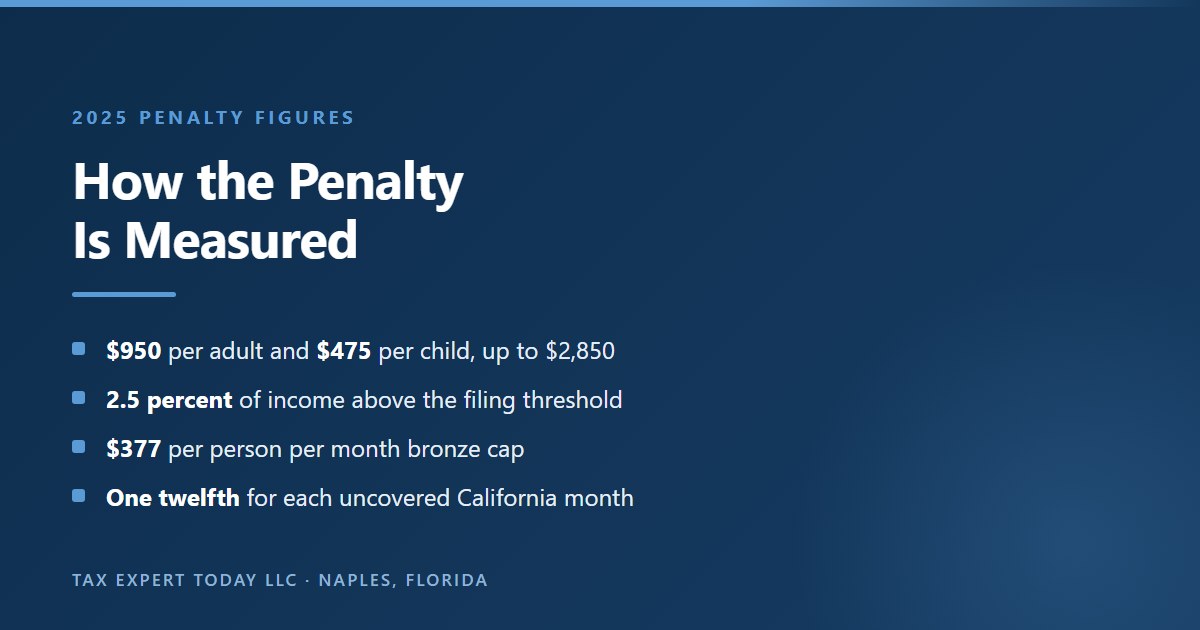
The penalty for each uncovered month is one twelfth of the greater of a flat dollar amount per person or 2.5 percent of household income above the filing threshold. The total is capped at one twelfth of the state average bronze premium for each uncovered month. Only months coded X enter the computation.
- Flat amount: $950 per adult and $475 per child for 2025, capped at $2,850 per month line.
- Percentage amount: 2.5 percent of applicable household income above the filing threshold.
- Cap: $377 per uncovered person per month, the 2025 state average bronze premium.
- Proration: each X month contributes one twelfth of the annual figure.
The structure comes straight from Revenue and Taxation Code section 61015. Subdivision (a) sets the penalty at the lesser of two amounts: the sum of the monthly penalty amounts for the months in which a failure occurred, or one twelfth of the state average bronze premium for the household size multiplied by the number of failure months. Subdivision (b) defines each monthly penalty amount as one twelfth of the greater of a flat amount, limited to 300 percent of the per-adult figure, or 2.5 percent of the excess of applicable household income over the filing threshold. The statute set the base flat amount at $695 and indexes it to the California Consumer Price Index in $50 steps, which is how it reached $950 for 2025.
The FTB turns that into five steps in Part IV of the instructions. Step 1 screens out dependents and fully covered households. Step 2 computes the flat dollar amount. Step 3 computes applicable household income. Step 4 computes the percentage income amount. Step 5 sets the bronze premium cap. Worksheets A and B do the month-by-month version whenever anyone in the household had coverage or an exemption for at least one month, which is true of virtually every mover.
| Step | What it does | 2025 figure or source |
|---|---|---|
| Step 1, All filers | Screens out dependents and full-year coverage, routes everyone else to Worksheet A | Dependents and fully covered households stop here |
| Step 2, Flat dollar amount | $950 per adult, $475 per person under 18, capped | Maximum $2,850 |
| Step 3, Applicable household income | Form 540NR line 17 plus California tax-exempt interest, plus filing dependents | Income from all sources, not only California income |
| Step 4, Percentage income amount | Household income minus filing threshold, times 2.5 percent | Threshold from the Do I Have to File chart |
| Step 5, Bronze premium cap | $377 times the number of uncovered person months | $4,524 per person for a full year |
| Worksheet A | Counts X months by person and applies the flat amount month by month | Line 7 is the flat amount, line 8 the total X count |
| Worksheet B | Compares flat and percentage amounts for each X month | Line 14 is the percentage based amount |
Two features of this structure explain most of the results movers see. First, the percentage amount is computed once on a full year of income and then applied one twelfth at a time, so a household with high income pays much more per uncovered month than a household with low income. Second, the bronze cap is also a per month figure, so it limits the damage from any single month but never removes the penalty entirely. If you want a quick estimate before working the form, the FTB keeps a health care penalty estimator on its site.
Why does income earned after the move still count in the penalty?
Because the penalty is measured by applicable household income, which the FTB instructions take from Form 540NR line 17, adjusted gross income from all sources. For a part-year resident that figure includes income earned after becoming a Florida resident, even though California does not tax that income. Only the penalty months are prorated.
- Income base: Form 540NR line 17, not the California adjusted gross income on line 32.
- Additions: California tax-exempt interest and the MAGI of dependents required to file.
- Effect: a large post-move bonus or gain can raise the per month penalty.
- Limit: the bronze cap and the number of X months still bound the result.
This is the part of Form 3853 that surprises people who understand the rest of the part-year return. Form 540NR separates income into two columns: total income from all sources, and the California portion. California tax is computed on all income and then prorated to the California share. The health coverage penalty does not use the California column. Step 3 of the instructions says to start with “the amount from Form 540, line 17; Form 540NR, line 17; or Form 540 2EZ, line 16,” and the Form 540NR booklet describes line 17 as “Adjusted Gross Income From All Sources,” which should match Schedule CA (540NR), Part II, line 27, column D.
The statute points the same way. Section 61000(c) defines applicable household income as the sum of the modified adjusted gross income of the household members required to file, and section 61000(j) defines modified adjusted gross income as adjusted gross income under section 17072, increased by tax-exempt interest other than interest exempt under the federal or California constitution, and by the foreign earned income and housing exclusions under Internal Revenue Code section 911. None of those definitions carves out income earned while a resident of another state.
The practical result is that a move-year bonus, a stock vesting event after the move, or a large capital gain recognized in Florida can increase the penalty for an uncovered California month. It cannot create a penalty for a Florida month, because those months are coded E. Our guides to California RSU tax when leaving and California source income explain how that same income is sourced for the tax itself, which is a separate question from how it enters the penalty base.
| Figure on the part-year return | Used for California tax? | Used for the Form 3853 penalty? |
|---|---|---|
| Form 540NR line 17, AGI from all sources | Yes, to set the tax rate before proration | Yes, as the starting point of applicable household income |
| California AGI from Schedule CA (540NR) Part IV | Yes, for the California share | No |
| California tax-exempt interest | Not taxed | Yes, added to MAGI |
| A dependent’s MAGI, if the dependent must file | On the dependent’s own return | Yes, added to household income |
| Income earned after becoming a Florida resident | Included in the rate base only | Yes, through line 17 |
What are the 2025 penalty amounts and caps?
For 2025 the flat amount is $950 per adult and $475 per child under 18, with a $2,850 maximum. The percentage amount is 2.5 percent of household income above the filing threshold. The cap is the state average bronze premium of $377 per person per month, from $4,524 a year for one person to $22,620 for five or more.
- Adult flat amount: $950 for 2025.
- Child flat amount: $475, half the adult figure, for anyone under 18.
- Flat amount maximum: $2,850, three times the adult figure.
- Bronze premium: $377 per person per month, with households of five or more capped at five.
Every figure in this section is taken from the 2025 instructions, which govern returns filed in 2026. The age rule has one detail worth knowing: a person is treated as 18 for the entire month if the 18th birthday falls on the first day of that month. Section 61015(c)(3) also caps the household at five people, so a family of seven pays no more than a family of five.
| Household size | Flat amount (all adults) | Annual bronze cap | Monthly bronze cap |
|---|---|---|---|
| 1 person | $950 | $4,524 | $377 |
| 2 people | $1,900 | $9,048 | $754 |
| 3 people | $2,850 | $13,572 | $1,131 |
| 4 people | $2,850 (capped) | $18,096 | $1,508 |
| 5 or more people | $2,850 (capped) | $22,620 | $1,885 |
The filing threshold used in Step 4 comes from the Do I Have to File chart on page 18 of the instructions, looked up by gross income, filing status, age, and number of dependents. The 2025 California gross income thresholds below are the figures most movers will use.
| Filing status on 12/31/2025 and age | 0 dependents | 1 dependent | 2 or more dependents |
|---|---|---|---|
| Single or head of household, under 65 | $22,941 | $38,774 | $50,649 |
| Single or head of household, 65 or older | $30,591 | $42,466 | $51,966 |
| Married or RDP filing jointly, both under 65 | $45,887 | $61,720 | $73,595 |
| Married or RDP filing jointly, one 65 or older | $53,537 | $65,412 | $74,912 |
| Married or RDP filing jointly, both 65 or older | $61,187 | $73,062 | $82,562 |
Part II uses the same chart for a different purpose. If applicable household income is below the adjusted gross income threshold, or gross income is below the gross income threshold, the whole household is exempt and you check the Part II box. In a move year with a full year of earnings that rarely happens, but it can for a retiree household whose income is mostly nontaxable.
What does a worked part-year Form 3853 example look like?
In a hypothetical case, a single filer under 65 with $180,000 of income from all sources lost employer coverage on April 30, moved to Naples on July 20, and stayed uninsured through December. If May and June are penalty months, the 2025 penalty is about $654. If they qualify as a short coverage gap, it is zero.
- Codes: Z for January through April, E for July through December.
- Open months: May and June, either X or C depending on the gap analysis.
- Percentage amount: 2.5 percent of $157,059, or $3,926 a year.
- Result if X: two twelfths of $3,926, about $654.
Assume a hypothetical taxpayer, Dana, single, age 41, no dependents, who left a Los Angeles employer on April 30, 2025. Her employer plan ran through April 30. She did not elect COBRA. She moved to Naples and became a bona fide Florida resident on July 20, and she enrolled in a Florida plan effective January 1, 2026. Her 2025 Form 540NR line 17 shows $180,000 of adjusted gross income from all sources, including a sign-on bonus she received in Florida in September. She has no tax-exempt interest.
| Month | Status | Code |
|---|---|---|
| January to April | California resident, employer coverage | Z |
| May | California resident, no coverage | X or C |
| June | California resident, no coverage | X or C |
| July | Florida resident from July 20, no coverage | E |
| August to December | Florida resident, no coverage | E |
If May and June are X months, the arithmetic runs as follows. Worksheet A shows one X in each of May and June. Line 5 is $950 for each of those months, line 6 is $1,900, and line 7, divided by 12 and rounded, is a flat amount of $158. Line 8, the total number of Xs, is 2. Step 4 subtracts the $22,941 filing threshold for a single filer under 65 with no dependents from $180,000, leaving $157,059, and multiplies by 2.5 percent for a percentage income amount of $3,926. Worksheet B compares, for each X month, the $950 from Worksheet A with the $3,926 from Step 4 and takes the larger, so $3,926 for May and $3,926 for June, a total of $7,852, divided by 12 for about $654.
| Penalty Worksheet line | Computation | Amount |
|---|---|---|
| Line 1, flat dollar amount | Worksheet A line 7, $1,900 divided by 12 | $158 |
| Line 2, percentage income amount | Worksheet B line 14, $7,852 divided by 12 | About $654 |
| Line 3, larger of line 1 or line 2 | About $654 | |
| Line 4, bronze premium cap | $377 times 2 X months | $754 |
| Line 5, penalty, smaller of line 3 or line 4 | Carried to Form 540NR line 91 | About $654 |
For comparison, the same income with no coverage for all twelve months as a full-year resident would produce a penalty of $3,926: the larger of $950 and $3,926, which is below the $4,524 single person bronze cap. The move cut the exposure to two months at most, and code E did all of that work. Whether the remaining two months are penalized depends on the short coverage gap rule, which is the subject of the next section. Had Dana elected COBRA through June, or started any qualifying plan by June 30, May and June would have been Z or C months and the penalty would have been zero.
Can the short coverage gap exemption cover the months before a move?
Often, yes. California exempts each month of a gap in coverage of three continuous months or less, but only the first gap in the year. When a California gap runs straight into uninsured Florida months, the FTB instructions do not say whether the exempt Florida months end the gap or extend it, so document the position.
- California rule: three continuous months or less, under section 61023.
- First gap only: a second gap in the same year is not exempt.
- Prior year months count: a gap that began in December of the prior year includes that month.
- Open question: how uninsured code E months affect the length of the gap.
The statute is Revenue and Taxation Code section 61023. No penalty is imposed for a month “if the last day of the month occurred during a period in which the applicable household member did not maintain minimum essential coverage for a continuous period of three months or less.” If the continuous period is longer, no month in it is exempt. If there is more than one such period in a calendar year, only the first one qualifies. The length of a period is measured without regard to calendar years, which is why the instructions count December of the prior year when a gap carries into January.
California is slightly more generous than the old federal rule. The federal regulation, Treasury Regulation section 1.5000A-3(j), exempted a continuous period of less than three months, so a three month gap failed federally. California’s statute and the FTB instructions both say three months or less, so a three month gap qualifies in California.
The difficult case is Dana’s. Her coverage ended April 30, and she stayed uninsured into the Florida months. Counting every month without coverage, the continuous period runs from May through December, eight months, and no part of it is a short gap. But the federal regulation contains a coordination rule: an individual “is treated as having minimum essential coverage for a month in which an individual is exempt” under the other listed exemptions, and its own Example 3 shows a person exempt for incarceration whose later two month gap still qualified. California’s section 61030(b) states the Legislature’s intent that the federal section 5000A regulations apply where they do not conflict with California law. Treating Dana’s code E months the same way would make her gap May and June only, two months, and both would be coded C.
The FTB instructions do not address this combination directly, and the federal list of coordinated exemptions did not include a resident of another state exemption, because federal law had none. A reasoned position exists in both directions. The practical steps are to code the months consistently with the position taken, keep the residency and coverage evidence, and, where the dollar difference matters, have the position reviewed before filing rather than after a notice.
| Gap facts (hypothetical) | Continuous uninsured months | California result |
|---|---|---|
| Uninsured March, April, May; covered from June 1 | 3 | Code C for all three months |
| Uninsured March through June; covered from July 1 | 4 | No short gap; all four are X unless another code applies |
| Uninsured February and March, then again October and November | 2 and 2 | Code C for February and March only |
| Uninsured April 5 through July 25 | May and June only, under the one day rule | Code C for May and June |
| Uninsured from December of the prior year through March | 4, counting the prior December | No short gap for January through March |
| Uninsured May and June in California, then uninsured as a Florida resident | 2 or 8, depending on the coordination question | Code C, or X for May and June |
A household that has already used its first gap earlier in the year cannot use code C again. That can turn a small pre-move gap into a penalty. Our moving from California to Florida taxes guide includes the coverage handoff in its move checklist for that reason.
How should spouses who move on different dates fill out Form 3853?
Each spouse gets a separate line in Part I and a separate row of codes in Part III. The spouse who became a Florida resident first codes E from that month on, while the spouse who stayed behind codes California months as Z, X, or another exemption until that spouse’s own residency changed.
- One form: a joint return still files one Form 3853 for the household.
- Separate codes: each person’s months follow that person’s own residency.
- Joint liability: spouses filing jointly are jointly and severally liable under section 61010(d).
- Consistency: the dates must match the residency dates on Schedule CA (540NR).
Staggered moves are common. One spouse starts a Florida job in March while the other stays to finish a school year or sell the house. For the income tax, that can create two different residency periods on one joint return. Form 3853 follows each person the same way, because section 100705(c)(8) exempts “an individual” who is a bona fide resident of another state for the month, not a household.
Consider a hypothetical couple filing a joint 2025 Form 540NR. Both were covered by the wife’s California employer plan through May 31. She moved to Naples and became a Florida resident on March 10. He stayed in California until August 31 to sell the house and became a Florida resident on September 1, the same day both enrolled in a Florida plan. He was uninsured in California for June, July, and August.
| Months | Wife (Florida resident from March 10) | Husband (Florida resident from September 1) |
|---|---|---|
| January and February | Z | Z |
| March to May | Z (E also available) | Z |
| June to August | E | C, a three month gap ended by coverage |
| September to December | Z | Z |
| Penalty | None | None, because California allows a three month gap |
Under the old federal less-than-three-months rule, the husband’s three month gap would not have qualified. Under California’s three months or less rule, it does. If he had stayed one more month without coverage, the gap would have been four months and all of it would have been X. A spouse who remains in California to close out the house should treat health coverage as part of that plan, not an afterthought, and our selling your home after moving to Florida guide covers the tax side of that same delay.
What about a child who stays in California for college?
A dependent’s months are coded on the parents’ Form 3853. If the student had qualifying coverage, such as a parent’s plan or a university student health plan, every month is Z and residency does not matter. If not, the student’s own residency decides whether code E applies, and attending school does not automatically change residency.
- Listed in Part I: every claimed dependent, even one covered all year.
- Student plans: student health insurance is minimum essential coverage.
- Residency: a student’s residency is a facts and circumstances question.
- Liability: the parent who claims the dependent owes any penalty for that dependent.
The FTB is explicit that school attendance is not a residency shortcut. Publication 1031 says students who are California residents leaving to attend an out-of-state school do not automatically become nonresidents, and students who are nonresidents coming to a California school do not automatically become residents. A child who stays at a California university after the parents move to Florida may or may not have changed residency, depending on the same factors that apply to adults.
The simplest protection is coverage. If the child stays on a parent’s employer or individual plan, or enrolls in the university’s student health plan, every month is Z and the residency question never reaches Form 3853. The penalty statute itself names the University of California as a provider of minimum essential coverage under its student health insurance program in section 61000(a)(5). If the child has no coverage and is still a California resident, the parents’ Form 3853 carries X months for the child, computed at the $475 child amount if the child is under 18 and the $950 adult amount if 18 or older.
| Dependent situation (hypothetical) | Likely coding | Note |
|---|---|---|
| Student at a California university, on a parent’s plan all year | Z, column (a) | Residency irrelevant |
| Student on a university student health plan | Z for covered months | Student plans are individual market coverage |
| Student uninsured, residency followed the parents to Florida | E for those months | Needs facts supporting the student’s own Florida residency |
| Student uninsured, still a California resident | X unless another code applies | Parents owe the penalty under section 61010(c) |
| Child living with the other parent and claimed by that parent | Not on your form | The parent who claims the child is the responsible individual |
Does keeping COBRA from a California employer protect you?
Yes, for every month it is in force. COBRA continuation coverage is employer-sponsored minimum essential coverage, so each month with at least one day of COBRA is coded Z, whether you are still in California or already in Florida. It is often the simplest bridge between a California job and a Florida plan.
- Classification: the FTB lists COBRA under employer-sponsored coverage.
- Location: coverage need not be issued in the state where you live.
- One day rule: any day of COBRA in a month counts for the month.
- Cost: COBRA can be expensive, which is a planning decision, not a tax one.
The FTB’s list of minimum essential coverage on page 4 of the instructions includes “COBRA coverage” and “Retiree coverage” among employer-sponsored plans. For a mover, COBRA’s value on Form 3853 is that it removes the California months from the penalty without relying on the short gap rule at all. A month of COBRA that overlaps the move month also settles how that month is coded.
COBRA is not the only bridge. A plan bought directly from an insurer, a Florida marketplace plan once you are a Florida resident, or a new employer’s plan all count for any month in which they are in force. The point is not that COBRA is required. It is that the California months before the move are the only months Form 3853 can penalize, so those are the months worth covering. For self-employed movers who buy their own plan, our guide to the self-employed health insurance deduction covers how those premiums are treated on the income tax side, and our California HSA tax guide explains the separate California treatment of health savings accounts.
Is a health care sharing ministry enough to avoid the penalty?
It can be. A health care sharing ministry is not insurance and is not minimum essential coverage, but California exempts members of a qualifying ministry. The ministry must have existed and shared medical expenses continuously since December 31, 1999, and you claim the exemption with code F for each month of membership.
- Statutory source: Government Code section 100705(c)(2).
- Test date: the ministry, or a predecessor, sharing expenses since December 31, 1999.
- One day rule: membership for at least one day of a month counts.
- Code: F, not Z, because a ministry is an exemption rather than coverage.
Section 100705(c)(2) exempts a member of a health care sharing ministry “for that month,” using the definition in Internal Revenue Code section 5000A(d)(2)(B) as it stood on January 1, 2017. The FTB instructions describe the ministry as a tax-exempt organization whose members share a common set of ethical or religious beliefs and share medical expenses in accordance with them, and they tell anyone unsure whether a ministry qualifies to contact the ministry. Several ministries publish California filing guidance for members, which is why their pages appear in search results for this form.
For a mover the distinction between F and Z is technical but real. A ministry membership is coded F in Part III. If the ministry does not meet the 1999 test, the months are X, not F. And because a ministry is not coverage, it does not satisfy a Florida employer’s or lender’s insurance requirement, which is a separate matter outside the tax return.
What if you move abroad instead of to another state?
Code E covers residents of another state. A move abroad is handled by code D, which exempts a U.S. citizen or resident alien physically present abroad at least 330 full days in a 12 month period, or a citizen who is a bona fide resident of a foreign country for a period including the entire tax year.
- Physical presence: 330 full days in any 12 consecutive months, for months in that period.
- Bona fide residence: a foreign residence covering the entire tax year.
- Territories: a bona fide resident of a U.S. territory is also exempt.
- Foreign plans: generally not coverage unless recognized by HHS.
Government Code section 100705(c)(6) ties this exemption to the periods described in Internal Revenue Code section 911(d)(1), the same physical presence and bona fide residence tests used for the foreign earned income exclusion. The FTB instructions point to federal Publication 54 for those tests. Note that the code D months must be months included in the qualifying 12 month period, so a person who left California in September may not yet have a qualifying period when the return is due.
A move abroad also changes the income side. Section 61000(j) adds the section 911 exclusions back into modified adjusted gross income, so excluded foreign earnings still count in applicable household income for the penalty. That is the same principle that brings post-move Florida income into the computation. For the broader California rules on leaving the country, see our guide to the California exit tax and how the state treats departures.
| Destination | Exemption code | Test |
|---|---|---|
| Florida or any other state | E | Bona fide resident of that state for the month |
| A U.S. territory | D | Bona fide resident of the territory under IRC section 937(a) |
| A foreign country, physical presence | D | 330 full days in a 12 month period that includes the month |
| A foreign country, bona fide residence | D | U.S. citizen, foreign residence covering the entire tax year |
What if you move to another state with its own mandate?
California’s code E applies to any other state, so California will not penalize those months. But a few jurisdictions, including Massachusetts, New Jersey, Rhode Island, and the District of Columbia, run their own coverage requirements, and moving there can trade a California penalty for a local one.
- California months: governed by Form 3853 and California law.
- Other state months: exempt in California, but subject to that state’s own rules.
- Florida and Texas: no state individual mandate.
- Action: check the new state’s own form before filing there.
Most corridor moves from California go to states without a mandate, including Florida, Texas, Nevada, Arizona, and Tennessee, so code E ends the question. A household moving to New Jersey or Massachusetts should not assume the same, because those states have their own coverage requirements reported on their own returns. California’s Form 3853 does not compute or report another state’s penalty, and nothing on it satisfies another state’s form. Our guides to the New Jersey exit tax and Texas vs Florida taxes cover the wider tax picture of those destinations.
How does the FTB know whether you had coverage?
Coverage providers must report to the Franchise Tax Board. Insurers, employers with self-insured plans, Medi-Cal, and Covered California file annual returns listing who was covered and for which months, much like federal Forms 1095. The FTB can compare those reports with the codes on your Form 3853.
- Reporting statute: Revenue and Taxation Code section 61005.
- Deadline: returns to the FTB by March 31 and statements to individuals by January 31.
- Format: the same information as the federal section 6055 return.
- Gap in the data: out-of-state coverage may not appear in California reporting.
Section 61005 requires every “applicable entity” that provides minimum essential coverage to file a return with the FTB on or before March 31 of the following year, and to give each primary subscriber a statement by January 31. The Legislature’s own findings in that section call third-party reporting “the only widespread source” for verifying coverage. The return may be satisfied by filing the same information required under federal section 6055, which is why California coverage reporting looks like the federal Form 1095-B.
That reporting is built around California coverage. A Florida marketplace plan or a Florida employer’s plan may never report to the FTB, because the carrier has no California obligation for a Florida resident. That is one more reason the residency date matters: for the months after the move, code E does the work, and the FTB’s question becomes whether the residency date is right rather than whether the Florida plan existed. For the months before the move, California reporting usually exists, and the codes on your form should match it.
| Document | Issued by | What it shows |
|---|---|---|
| Federal Form 1095-A | Health insurance marketplace | Marketplace enrollment by month |
| Federal Form 1095-B | Insurers, government programs, some employers | Covered individuals and months |
| Federal Form 1095-C, Part III | Large self-insured employers | Covered individuals and months |
| Form FTB 3895 | Covered California | California marketplace coverage by month |
| Covered California exemption notice | Covered California | The ECN and the months it covers |
| Ministry membership statement | Health care sharing ministry | Membership months for code F |
What happens if the FTB disagrees with your Form 3853?
The penalty is assessed and collected under the same procedures as the personal income tax, so a disagreement usually arrives as a notice proposing additional penalty or adjusting your refund. You can respond, protest a proposed assessment within the stated period, and support your codes with coverage and residency records.
- Procedure: section 61025(b) applies the Part 10.2 assessment and collection rules.
- Common triggers: unchecked box with no form, codes that conflict with coverage reports, or a residency date the FTB questions.
- Response: the deadline printed on the notice controls.
- Bigger issue: a code E dispute is really a residency dispute.
Section 61025 says the FTB’s “civil authority and procedures for purposes of compliance with notice and other due process requirements imposed by law to collect income taxes shall be applicable” to the penalty, and that the penalty “shall be assessed and collected pursuant to Part 10.2,” the code’s administration chapter for the income tax. In practice that means the same notices, the same protest rights, and the same appeal path as any other income tax adjustment.
If the FTB issues a notice proposing to assess an additional penalty, the protest clock runs from the date the notice is mailed. Our guide to the FTB notice of proposed assessment explains the 60 day protest window and why a Florida mailing address does not extend it. Where the disagreement is about the move date, the penalty is the smallest part of the problem, because the same date controls how much income California taxes. Our California residency audit guide covers how those reviews unfold. If you want a representative to handle FTB correspondence, the FTB power of attorney guide explains the authorization California requires.
Can the California health coverage penalty be collected like a tax?
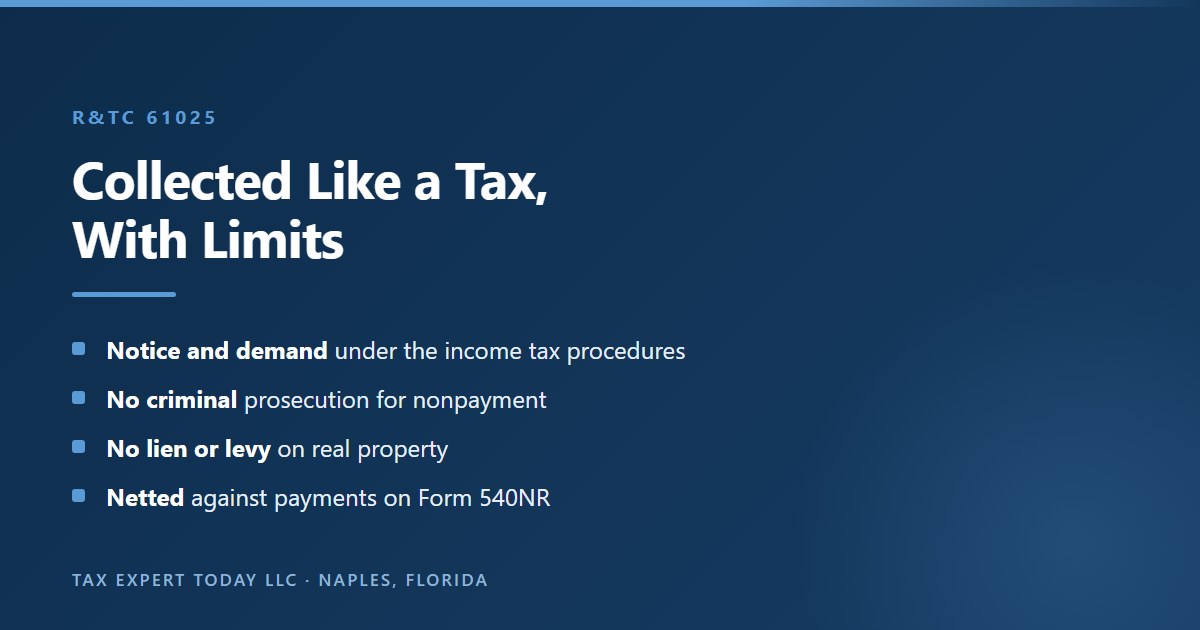
Largely, yes, with limits. The penalty is due on notice and demand and is collected under the income tax rules, but the statute bars criminal prosecution for failing to pay it, bars a lien on real property, and bars a levy on real property. It does not list other assets.
- No criminal exposure: section 61025(b)(1).
- No real property lien or levy: section 61025(b)(2).
- Excluded article: section 61025(b)(3) makes the article beginning at section 19201 inapplicable.
- Refund effect: the penalty is netted against payments on Form 540NR lines 92 and 93.
The protections are narrower than they first appear. Section 61025(b)(2) says the FTB “shall not file a notice of lien with respect to any real property” or “levy any real property” by reason of a failure to pay the penalty. The statute does not extend that language to bank accounts, wages, or refunds, and it otherwise applies the ordinary income tax collection rules. The safer reading is that an unpaid penalty can follow the same path as an unpaid balance on any California return for assets other than real property. The return itself handles the most common case: Form 540NR line 92 subtracts the penalty from your payments, and line 93 shows any penalty balance, so the penalty simply reduces a refund or increases the amount due.
| Collection feature | Ordinary California income tax | Individual Shared Responsibility Penalty |
|---|---|---|
| Assessed on notice and demand | Yes | Yes |
| Protest and appeal rights | Yes | Yes, through the same Part 10.2 procedures |
| Criminal prosecution for nonpayment | Possible in limited circumstances | No, under section 61025(b)(1) |
| Lien on real property | Possible | No, under section 61025(b)(2) |
| Levy on real property | Possible | No, under section 61025(b)(2) |
| Netted against refund on the return | Not applicable | Yes, on Form 540NR lines 92 and 93 |
A balance that cannot be paid in full is handled the same way as other California balances. Our guides to FTB installment agreements and the California late payment penalty explain the payment options and the additions that apply when a balance is not paid on time, and our FTB levy guide covers what collection looks like for other California balances.
What records prove the residency months on Form 3853?
Keep two sets of records: proof of coverage for every month coded Z, and proof of residency for every month coded E. Coverage proof is the Form 1095 series and plan statements. Residency proof is the same evidence used for the income tax: lease or deed, driver license, voter registration, and similar records.
- Coverage: Forms 1095-A, 1095-B, 1095-C, and FTB 3895, plus COBRA notices and premium receipts.
- Residency: Florida deed or lease, declaration of domicile, driver license, and vehicle registration.
- Exemptions: Covered California ECN letters and ministry membership statements.
- Timing: keep them with the return for as long as the year can be examined.
Publication 1031 lists the factors the FTB weighs in a residency determination, including the location of your spouse and children, your principal residence, where your vehicles are registered, where you hold professional licenses, where you are registered to vote, where your bank accounts and doctors are, and where you spend your time. A mover who keeps the documents that establish each of those facts for the move date has, in the same file, the support for the first code E month. Our snowbird taxes in year one and retiring to Florida taxes guides show how those records are usually assembled.
| Code | What it claims | Records to keep |
|---|---|---|
| Z | Coverage for at least one day of the month | Form 1095-A, 1095-B, 1095-C, Form FTB 3895, plan cards, premium receipts, COBRA election notice |
| E | Bona fide resident of another state for the month | Closing statement or lease, Florida declaration of domicile, driver license issue date, voter registration, utility start dates |
| C | Short gap of three months or less | Termination letter for the old plan and enrollment letter for the new one |
| F | Health care sharing ministry membership | Ministry membership statement showing months |
| K, L, M | Exemptions granted by Covered California | The exemption approval notice with the ECN and months |
Does claiming code E create a residency audit risk?
Code E does not create a separate risk, but it repeats your residency date in a second place on the return. If the date on Form 3853 differs from the date used on Schedule CA (540NR), the inconsistency itself invites questions. The residency position should be decided once and reported identically everywhere.
- Same date everywhere: Form 540NR, Schedule CA (540NR), and Form 3853.
- Per person: spouses with different dates need consistent dates on every schedule.
- No shortcuts: coding E earlier than the facts support saves little and can cost a great deal.
- Presumption: more than nine months in California is presumed residency under section 17016.
The financial stakes of the two questions are very different. A wrong code E date on Form 3853 might move a few hundred dollars of penalty. The same wrong date on Schedule CA (540NR) can move California tax on months of wages, bonuses, or gains. The FTB knows this, and a residency review that starts with one schedule will look at the others. Choosing an early date for Form 3853 to avoid a penalty month, while using a later date elsewhere, is the kind of inconsistency that turns a routine return into a file.
The better approach is to settle the residency date first, using the residency guides referenced above, and then let Form 3853 follow it. If the date that the facts support leaves one or two uncovered California months, the short gap rule or a modest penalty is usually the cost of an accurate return. For the mental health services tax on very high incomes, which is another California surcharge tied to the same residency months, see our California mental health tax guide.
What are the most common Form 3853 mistakes for movers?
The most common mistakes are leaving the full-year box unchecked without attaching Form 3853, leaving months blank in Part III, coding E for months before the residency change, using the California AGI instead of line 17 income, and forgetting that only the first short gap in a year is exempt.
- Blank months: without a column (a) code, every month needs a code.
- Wrong income: the penalty uses income from all sources.
- Wrong household: every claimed dependent belongs in Part I.
- Software defaults: some programs ask only about California months.
The FTB’s own How To Avoid Common Mistakes section, on page 19 of the instructions, lists the errors it sees: filing Form 3853 when the full-year box could have been checked, using codes that are not on the chart, paying a penalty when a dependent could be claimed by someone else, overlooking an available exemption, paying a penalty when household income is below the filing threshold, a flat dollar amount above $2,850, and a penalty above the bronze premium cap. Movers add a few of their own.
| Mistake | Consequence | Fix |
|---|---|---|
| Box unchecked, Form 3853 not attached | Uncovered months unexplained | Attach Form 3853 with Part I and Part III completed |
| Florida months left blank in Part III | Form incomplete | Enter E, or Z if covered, for each month |
| Code E before the residency date | Inconsistent with Schedule CA (540NR) | Use one residency date for every schedule |
| California AGI used in Step 3 | Penalty understated | Use Form 540NR line 17, AGI from all sources |
| Second gap coded C | Exemption not available | Only the first gap in the year qualifies |
| Four month gap coded C | Exemption not available | A gap must be three continuous months or less |
| Dependent omitted from Part I | Household incomplete | List every person on the return and anyone you can claim |
| Ministry coded Z | Wrong code | Use F, and confirm the 1999 test |
| Penalty above the bronze cap | Overpayment | Apply Step 5 and Penalty Worksheet line 4 |
How do you fix a Form 3853 mistake after filing?
An error on Form 3853 is corrected by amending the California return, which for a part-year resident means an amended Form 540NR with a corrected Form 3853 attached. If the FTB has already sent a notice, respond to the notice by its deadline instead of filing a separate amendment that may cross in the mail.
- Before any notice: amend the return with a corrected Form 3853.
- After a notice: answer the notice with the corrected codes and records.
- Pending ECN: if Covered California later denies a pending exemption, amend or expect contact.
- Refund claims: a penalty paid in error can be recovered within the refund limitation period.
The instructions describe one specific situation: if you entered “pending” for an ECN and Covered California ultimately denies the exemption, “the FTB may contact you to collect your Individual Shared Responsibility Penalty, or you may choose to file an amended tax return to report your Individual Shared Responsibility Penalty or claim another exemption for which you are eligible.” The same logic applies to any other error. If you overpaid because you missed code E for the Florida months or did not apply the short gap rule, an amended return can claim the difference back, subject to the usual refund deadlines. If a notice has already arrived, its deadline governs, and the response should include the corrected Part III codes and the records behind them.
What changes for the 2026 tax year?
The mandate and the structure of the penalty continue for 2026, but the dollar figures change each year. The flat amount is indexed to the California Consumer Price Index in $50 steps, and the bronze premium and filing thresholds are reset annually. As of October 2026, the FTB had not posted the 2026 Form 3853 instructions.
- Indexed: the flat dollar amount under section 61015(d).
- Reset yearly: the state average bronze premium and the filing thresholds.
- Affordability percentage: 7.28 percent for 2025, adjusted for later years.
- For 2026 movers: the same coding rules apply; use the 2026 figures when published.
Section 61015(d) indexes the base $695 flat amount by the percentage increase in the California Consumer Price Index over 2016, rounded down to the next multiple of $50, using figures the Department of Industrial Relations transmits to the FTB by August 1 each year. Section 61020(a)(4) adjusts the affordability percentage for code A by reference to premium and income growth. None of those adjustments changes how a move is coded. A household moving in 2026 codes California months Z, X, or another exemption and Florida months E, exactly as described above, and applies the 2026 dollar figures when the FTB publishes them, typically with the next filing season’s forms.
| Item | 2025 figure (returns filed in 2026) | 2026 treatment |
|---|---|---|
| Flat amount per adult | $950 | Indexed in $50 steps, published with the 2026 instructions |
| Flat amount per child | $475 | Half of the adult figure |
| Flat amount maximum | $2,850 | Three times the adult figure |
| Percentage of income over threshold | 2.5 percent | Fixed by statute |
| State average bronze premium | $377 per person per month | Reset annually |
| Affordability threshold for code A | 7.28 percent | Adjusted annually |
| Short gap length | 3 continuous months or less | Fixed by statute |
California Form 3853 Help in Naples & Southwest Florida
Tax Expert Today LLC is a multidisciplinary firm of tax advisors, enrolled agents, CPAs, and attorneys, based in Naples, Florida, that advises on state residency and tax matters nationwide, including the part-year California return that new Florida residents file in the year they leave. Our office is at 11983 Tamiami Trail N, Naples FL 34110, and you can reach us at (239) 441-2005, Monday through Friday, 10:00 to 5:00 Eastern Time.
- California Form 3853 help Naples: review of Part I and Part III coding for the move year, month by month.
- California part-year return review Naples FL: a single residency date applied consistently across Form 540NR, Schedule CA (540NR), and Form 3853.
- Short gap and code E analysis: the documented position for months that straddle the move.
- FTB notice response: answering a penalty or residency notice with the records behind each code.
For the broader California picture, our California tax services page describes the work we do for former residents, and our Naples tax planning page covers the Florida side of a relocation. When you are ready to talk through your own move year, you can contact our Naples office to set up a consultation.
Local FAQ: We moved from Sacramento to Naples last summer and had no health coverage for two months before the move. Can a Naples advisor prepare our California Form 3853? Yes. Form 3853 is attached to the California Form 540NR, which is filed with the Franchise Tax Board electronically or by mail, so the location of your advisor does not limit the process. Bring the Forms 1095 for every household member, the termination and enrollment letters for each plan, and the records that show your Florida residency date, and we can code each month in Part III, test whether the short coverage gap exemption applies, and compute any penalty before you file.
Frequently Asked Questions
What is California Form 3853?
California Form 3853, Health Coverage Exemptions and Individual Shared Responsibility Penalty, is the Franchise Tax Board form that reports health coverage by month, claims exemptions from the state mandate, and computes any penalty. It is attached to Form 540, Form 540NR, or Form 540 2EZ when the full-year coverage box cannot be checked.
Do I owe the California health insurance penalty for months after I moved to Florida?
No. Government Code section 100705(c)(8) exempts any individual who is a bona fide resident of another state for the month. You claim the exemption by entering code E on Form 3853, Part III, for each month after your residency changed. The date must match the residency date on the rest of your return.
Do I have to file Form 3853 if I had coverage in California but not in Florida?
Yes, if you file a California return. The full-year box on Form 540NR line 91 can be checked only if the household had coverage for all of the year. If you went without coverage in Florida, you attach Form 3853 and claim code E for those months, which produces no penalty.
How is the month I moved coded on Form 3853?
The FTB instructions apply exemptions to any month in which a person was eligible for at least one day, and coverage to any month with at least one day of coverage. A month in which you became a Florida resident can carry code E, and a month with any day of coverage can carry code Z.
How much is the California health coverage penalty for 2025?
For 2025 it is the greater of $950 per adult and $475 per child, up to $2,850, or 2.5 percent of household income above the filing threshold, prorated for the uncovered months. It is capped at $377 per uncovered person per month, the state average bronze premium.
Does income I earned in Florida increase the penalty?
It can. The penalty is based on applicable household income taken from Form 540NR line 17, adjusted gross income from all sources, so post-move income is included. It cannot create a penalty for a Florida month, because those months are exempt under code E.
Does the short coverage gap exemption apply in California?
Yes. Under Revenue and Taxation Code section 61023, no penalty applies for months in a gap of three continuous months or less, but only for the first such gap in the year. A gap longer than three months is not exempt for any of its months.
Can the FTB put a lien on my house for an unpaid health coverage penalty?
No. Section 61025 bars the FTB from filing a lien on real property or levying real property for failure to pay the penalty, and it bars criminal prosecution. The penalty is otherwise assessed and collected under the ordinary income tax procedures.
Can a Naples, Florida advisor help with California Form 3853?
Yes. Form 3853 is filed with the California return, electronically or by mail, so the work does not depend on where the advisor is located. A Naples, Florida advisor can review the household’s coverage and residency records, code each month, and prepare the part-year return.
When to Engage a Professional
Many households can complete Form 3853 from the instructions, particularly when everyone had coverage in every California month and only the Florida months need code E. Professional review is worth considering when the move year involves any of the following: an uninsured stretch that begins in California and continues into Florida, spouses or dependents with different residency dates, a large post-move bonus, vesting, or gain that raises the penalty base, a dependent who stayed in California, a move abroad, a Covered California exemption that is still pending, or a notice from the Franchise Tax Board about coverage or residency. In each of those situations the codes on Form 3853 depend on judgments about residency and coverage that also affect the rest of the California return.
A review typically starts with the coverage documents for every household member, the residency evidence for each person’s move date, and the draft Form 540NR. From there, the work is to settle one defensible residency date per person, code every month in Part III, test whether the short gap rule applies, and compute the penalty, if any, with the correct income base. Results depend on each household’s facts, and no particular outcome can be promised. If you would like a second set of eyes on your move-year California return, call (239) 441-2005 or reach us through the contact page.
This article is general information about California law as of the date of publication and is not tax or legal advice for any particular situation. The examples are hypothetical illustrations. Figures are the 2025 amounts published by the Franchise Tax Board and change annually. Consult a qualified professional about your own circumstances.
Published October 24, 2026 by Dr. Pellumb Kabashi « Back to Learning Center
Have a question this article touches on?
Tax Expert Today LLC, based in Naples, Florida and serving clients across the United States.
Schedule a Consultation (239) 441-2005