
By Dr. Pellumb Kabashi, DBA, MBA, CES, CFE, EA
Founder, Tax Expert Today LLC · Tax advisors, enrolled agents, CPAs, and attorneys · Serving clients in all 50 states
Quick Answer: The California HSA tax rule is simple to state and easy to get wrong: California does not recognize health savings accounts, so payroll and direct contributions, employer contributions, and every year of interest, dividends, and gains inside the account are taxed by California. Those amounts build a California basis in the account. After a genuine move to Florida, later growth is generally outside California tax. Call (239) 441-2005 for a free consultation.
Most people learn about the California HSA tax the hard way. They open a health savings account through an employer, see the federal triple tax advantage described in the enrollment materials, and assume the same treatment applies on the state return. Then the California return shows more income than the W-2 suggests, or a tax program asks for HSA interest the custodian never reported, or a notice arrives because an amount was left off. The explanation is a short statute and a long chain of consequences.
This guide is written for the California resident with a funded HSA and for anyone who is leaving California with one. It explains the statutes behind California’s position, confirms what happened to the 2026 conformity bill, shows how each kind of contribution and each kind of HSA income is reported on Schedule CA, explains the California basis that builds up inside the account and why it matters, sets out what the 2025 federal HSA expansions mean in California, and then walks through what changes when the account owner becomes a Florida resident. Every rule is drawn from the Revenue and Taxation Code or from Franchise Tax Board instructions, and every example is a hypothetical illustration rather than a description of any client.
How does the California HSA tax rule work?
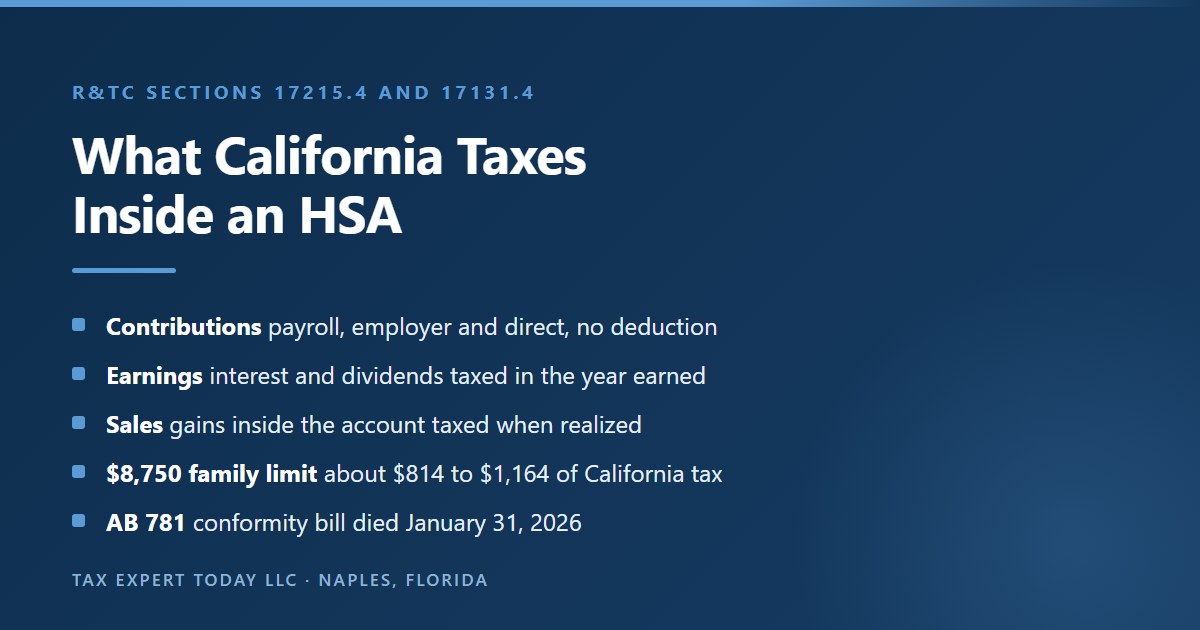
California treats a health savings account as an ordinary taxable investment account. Contributions get no deduction or exclusion, the account’s interest, dividends, and gains are taxed in the year earned, and distributions are generally not taxed again because the money inside has already been taxed. The federal triple tax advantage simply does not exist on the California return.
- Contributions: no California deduction for money you deposit and no California exclusion for money deposited through payroll or by your employer.
- Earnings: interest and taxable dividends are California income every year, even though no federal Form 1099 is issued for them.
- Gains: a sale of a fund or stock inside the HSA is a California capital gain or loss in the year of the sale.
- Distributions: generally not California income, whether or not they are used for medical expenses, because the contributions and earnings were taxed going in.
- Result: the account builds a California basis that differs from its federal basis of zero.
The federal rules run the other way. Under Internal Revenue Code section 223, an eligible individual deducts contributions, the account’s earnings accumulate without current tax, and distributions used for qualified medical expenses are tax free. That combination is the triple tax advantage the account is known for. California removes the first two legs and, because it removes them, has no reason to tax the third.
| Event | Federal treatment | California treatment |
|---|---|---|
| Your own deposit | Deductible above the line on Form 8889 | Not deductible; federal deduction reversed |
| Payroll deposit through a cafeteria plan | Excluded from federal wages | Included in California wages |
| Employer deposit | Excluded from federal wages | Included in California wages |
| Interest and dividends inside the account | Not taxed while in the account | Taxed in the year earned |
| Gain on a sale inside the account | Not taxed while in the account | Taxed in the year of the sale |
| Distribution for qualified medical expenses | Tax free | Not taxed |
| Distribution for other purposes | Taxable plus a 20 percent additional tax unless an exception applies | Not taxed, and no additional tax |
Why does California not recognize HSAs?
California does not recognize HSAs because three short statutes switch off the federal rules. Revenue and Taxation Code section 17215.4 says section 223 does not apply, section 17131.4(a) says the exclusion for employer contributions in section 106(d) does not apply, and section 17131.5 says the cafeteria plan exception for HSAs does not apply.
- Section 17215.4: “Section 223 of the Internal Revenue Code, relating to health savings accounts, shall not apply.” Added in 2005 and unchanged since.
- Section 17131.4(a): the federal exclusion for employer contributions to an HSA does not apply, so those contributions are California wages.
- Section 17131.5: the federal rule that lets an HSA be funded through a cafeteria plan without losing the exclusion does not apply.
- Section 17215.1: the federal rule allowing a tax free rollover from an Archer medical savings account into an HSA does not apply.
California generally adopts the Internal Revenue Code as of a fixed date under section 17024.5 and then lists the federal provisions it rejects. The HSA statutes are on that list. Because section 17215.4 rejects section 223 as a whole rather than a single subsection, it does not matter which version of the federal code California has adopted for a given year. Any federal change to HSAs, including the expansions enacted in 2025, is outside California law unless the Legislature acts.
The text of section 17131.5 and section 17215.1 is a single sentence each, both added by the same 2005 legislation. Section 17131.4 was most recently amended in 2025 by Senate Bill 711, which added a subdivision (b) on qualified small employer health reimbursement arrangements; subdivision (a) on HSAs was not changed.
| California statute | Federal provision it switches off | Practical effect |
|---|---|---|
| R&TC 17215.4 | IRC 223 (the HSA itself) | No deduction; no tax deferral on earnings |
| R&TC 17131.4(a) | IRC 106(d) (employer contributions) | Employer deposits are California wages |
| R&TC 17131.5 | IRC 125(d)(2)(D) (cafeteria plan HSA exception) | Pre-tax payroll deposits are California wages |
| R&TC 17215.1 | IRC 220(f)(5) (Archer MSA rollover) | An MSA to HSA rollover is a taxable California distribution |
Did California pass HSA conformity for 2026?
No. The most recent conformity bill, Assembly Bill 781 of the 2025 to 2026 session, would have allowed a California HSA deduction for tax years 2026 through 2030. It never received a committee hearing and died on January 31, 2026 under the constitutional deadline for bills introduced in the first year of a session.
- What AB 781 proposed: amendments to sections 17131.4, 17131.5, 17215.1, and 17215.4 and a temporary new section 17217, giving a deduction matching the federal one for tax years beginning in 2026 through 2030.
- What happened: its first hearing in the Assembly Revenue and Taxation Committee was canceled at the author’s request on April 21, 2025; it died on January 31, 2026 and was filed with the Chief Clerk on February 2, 2026.
- What it means for 2026: the nonconformity statutes remain in force, so 2026 contributions and earnings are California taxable.
- Earlier attempts: similar bills have been introduced in many sessions, including AB 727 in 2021, and none has been enacted.
The official record is on the Legislature’s AB 781 bill status page, which lists the bill as inactive and dead. The Franchise Tax Board’s own analysis of AB 781 as amended March 28, 2025 remains online and is still cited by search results and by some summaries as if the bill were pending. It is not. Several pages that rank for this subject were written while the bill was alive and have not been updated.
A new conformity bill could be introduced in a later session. Until one is enacted and signed, any statement that California “now allows” an HSA deduction should be treated as wrong. If conformity is ever enacted, the effective date will matter, because earlier contributions and earnings would remain taxed under the law in force when they occurred.
| Bill | Session | Proposal | Outcome |
|---|---|---|---|
| AB 781 (DeMaio) | 2025 to 2026 | Deduction for tax years 2026 through 2030 | Died January 31, 2026 |
| AB 727 | 2021 to 2022 | Deduction for tax years 2021 through 2025 | Not enacted |
| Earlier bills | Various sessions since 2005 | Full or income limited conformity | Not enacted |
How are payroll HSA contributions taxed in California?
Payroll HSA contributions, whether you elect them from salary or your employer adds them, are excluded from federal wages but are California wages. Federal Form W-2 reports the total in box 12 with code W, and California adds that amount back on Schedule CA (540), line 1h, column C.
- Your salary deferral: made through the employer’s cafeteria plan, excluded federally, but California wages because section 17131.5 switches off the cafeteria plan exception.
- Employer deposits: any seed money or matching amount, excluded federally under section 106(d), but California wages under section 17131.4(a).
- Box 12, code W: under the federal Form W-2 instructions, code W reports employer contributions to an HSA, including amounts the employee elected through a cafeteria plan.
- The California entry: the 2025 Schedule CA instructions direct the code W amount to line 1h, column C.
A common surprise is that California withholding does not account for the add-back as precisely as people expect. Payroll systems calculate California withholding on California wages, which should include the HSA deferral, but an employer with a payroll configuration error can understate box 16. Schedule CA starts from federal wages, not from box 16, so the code W adjustment on line 1h captures the HSA amount on the return either way. Box 16 serves as a cross check on whether the employer reported California wages correctly and withheld on them.
The add-back also explains why a California return can show wages higher than the federal return without anything being wrong. The difference between box 1 and box 16 on a typical W-2 for a California employee with an HSA is the code W amount, plus any other items California treats differently.
How do you read W-2 box 1, box 12 code W, and box 16?
Box 1 shows federal wages after the HSA exclusion, box 12 code W shows the HSA amount that was excluded, and box 16 shows California wages, which should include the HSA amount. On a correctly prepared W-2 for a California resident, box 16 minus box 1 roughly equals the code W amount, absent other differences.
- Box 1: federal taxable wages, already reduced by the HSA deferral and employer HSA deposits.
- Box 12, code W: the combined employee cafeteria plan deferral and employer HSA deposit for the year.
- Box 16: state wages; for California, the HSA amount should be included.
- Other differences: items such as certain fringe benefits can also make box 16 differ from box 1, so the comparison is a check, not a formula.
| Hypothetical W-2 line | Amount | What it shows |
|---|---|---|
| Gross salary | $220,000 | Before any pre-tax deductions |
| 401(k) deferral | $24,500 | Excluded for both federal and California |
| HSA salary deferral (cafeteria plan) | $7,750 | Excluded federally only |
| Employer HSA deposit | $1,000 | Excluded federally only |
| Box 1, federal wages | $187,750 | $220,000 less $24,500 less $7,750 |
| Box 12, code W | $8,750 | $7,750 plus $1,000 |
| Box 16, California wages | $196,500 | Box 1 plus the $8,750 HSA amount |
| Schedule CA (540), line 1h, column C | $8,750 | The California add-back |
In this example the employee has family coverage, and the $8,750 total equals the 2026 federal family limit set by Revenue Procedure 2025-19. The $1,000 employer deposit counts toward that limit, which is why the employee elected $7,750 rather than $8,750. California does not care about the federal limit for its own purposes, but the federal limit still controls how much can go into the account.
How are direct HSA contributions added back on Schedule CA?
A contribution you make yourself, outside payroll, is deducted federally on Form 8889 and flows to Schedule 1 (Form 1040), line 13. California reverses it: the 2025 Schedule CA instructions say to enter the line 13 amount from column A in column B, which removes the deduction from California adjusted gross income.
- Where it starts: the federal HSA deduction on Schedule 1, line 13, computed on Form 8889.
- Where it is reversed: Schedule CA (540), Part I, Section B, line 13, column B.
- Self-employed owners: an owner who funds an HSA personally has only this route, because there is no W-2 code W amount.
- Prior year contributions: a contribution made by the April deadline for the prior year is reversed on the return for the year it is deducted federally.
Self-employed individuals are the group most likely to miss this adjustment, because the deduction sits in the adjustments section rather than in wages. Our guide to the self-employed health insurance deduction covers the related premium deduction, which California does follow, and why the two are treated differently on the state return.
S corporation owners who hold more than 2 percent of the stock follow a different federal path that ends in the same California place. Under IRS Notice 2005-8, an HSA contribution the corporation makes for a more than 2 percent shareholder is included in the shareholder’s federal wages in box 1 rather than excluded, and the shareholder then claims the HSA deduction personally on Form 8889 and Schedule 1, line 13. Because the contribution is already in box 1, there is generally no code W exclusion to reverse on line 1h. The California adjustment is instead the line 13 reversal in column B, exactly as for a direct contribution. Reviewing a shareholder W-2 for this treatment is worth doing each year, because a payroll provider that codes the deposit as an ordinary employee HSA contribution, with code W and no box 1 inclusion, produces a federal error first and a California error second. Partners and LLC members taxed as partnerships face a similar pattern, since contributions made for them by the partnership are generally treated as distributions or payments to the partner rather than excluded employer contributions, and the partner claims any deduction personally.
How much does the California HSA tax cost each year?
The California HSA tax cost is the contribution times your California marginal rate, plus the same rate on the account’s annual earnings. For a family contribution of $8,750 in 2026 and a marginal rate of 9.3 percent, the cost on contributions alone is about $814 a year; at 13.3 percent it is about $1,164.
- On contributions: the full federal contribution limit is California taxable, so the cost scales with your bracket.
- On earnings: interest and dividends are taxed every year; gains are taxed when realized inside the account.
- Above $1,000,000 of taxable income: the 1 percent behavioral health services tax on top of the 12.3 percent bracket brings the marginal rate to 13.3 percent.
- No offset later: because distributions are not taxed, the cost is not recovered on withdrawal; it is the price of the account in California.
| California marginal rate | Self-only $4,400 | Self-only plus catch-up $5,400 | Family $8,750 | Family plus catch-up $9,750 |
|---|---|---|---|---|
| 9.3 percent | $409 | $502 | $814 | $907 |
| 10.3 percent | $453 | $556 | $901 | $1,004 |
| 11.3 percent | $497 | $610 | $989 | $1,102 |
| 12.3 percent | $541 | $664 | $1,076 | $1,199 |
| 13.3 percent | $585 | $718 | $1,164 | $1,297 |
The catch-up amount is $1,000 a year for an account holder age 55 or older under section 223(b)(3). Figures in the table are rounded and assume the full amount is California taxable at the marginal rate shown. They do not include the tax on earnings, which grows with the balance. A family with a $60,000 HSA earning a hypothetical 6 percent a year has about $3,600 of California taxable HSA income annually, roughly $335 of additional California tax at 9.3 percent, whether or not a dollar is withdrawn.
None of this means the California HSA tax makes an HSA a poor choice for a California resident. The federal deduction and federal tax free growth remain, and the federal benefit is usually larger than the California cost. The point is that the California cost is real, recurs every year, and must be reported correctly.
Are HSA earnings taxable in California every year?
Yes. The 2025 Schedule CA instructions state that interest or other earnings from an HSA are not treated as tax deferred and are taxable in the year earned. Interest is added on line 2, column C and taxable dividends on line 3, column C, even though the HSA custodian issues no Form 1099 for them.
- Interest: cash sweep or savings interest credited to the HSA goes on Schedule CA (540), line 2, column C.
- Dividends: fund and stock dividends, including those reinvested automatically, go on line 3, column C.
- No 1099: custodians report HSA activity on Forms 5498-SA and 1099-SA, which do not show interest or dividends, so the figures come from year-end statements.
- Reinvested amounts: a reinvested dividend is still income in the year paid and adds to California basis.
FTB Publication 1001 gives the same instruction and adds the sentence that explains the rest of this guide: “As a result of this tax treatment, the taxpayer has a California basis in the HSA account.” Each year of taxed earnings adds to that basis.
The practical problem with the California HSA tax on earnings is reporting. A custodian’s annual tax packet often shows contributions and distributions but not income. The income appears on monthly or quarterly statements, sometimes as a separate dividend and interest summary, sometimes only as transactions. The account holder, or a preparer, has to add it up. When an HSA is invested in several mutual funds, each fund’s dividends and capital gain distributions must be captured.
| HSA income item | Where it appears | Schedule CA (540) line | Column |
|---|---|---|---|
| Interest on cash balance | Custodian statement | Line 2 | C (addition) |
| Ordinary dividends | Fund or brokerage statement | Line 3 | C (addition) |
| Capital gain distributions from a fund | Fund statement | Line 7 through Schedule D (540) | C (addition) |
| Gain or loss on a sale inside the HSA | Brokerage trade confirmations | Line 7 through Schedule D (540) | B or C |
How are capital gains inside an HSA reported to California?
A sale of an investment inside the HSA produces a California capital gain or loss in the year of the sale. The 2025 Schedule CA instructions list “gain or loss from the sale of investments inside an HSA” among the items computed on Schedule D (540) and carried to line 7. California taxes capital gains as ordinary income, with no special rate.
- The computation: sale proceeds less the California basis of the investment sold, which includes reinvested dividends already taxed.
- The form: Schedule D (540), California Capital Gain or Loss Adjustment, with the result on Schedule CA, line 7.
- Losses: a loss on a sale inside the HSA is a California capital loss, subject to the usual limits.
- Rebalancing: exchanging one fund for another inside the HSA is a sale for California even though nothing leaves the account.
This is the item most often missed. A person who rebalances an HSA once a year, or whose target date fund sells and buys internally, can have California gains every year without noticing. The fund level capital gain distributions are visible on statements; the account holder’s own sales require the trade confirmations and a record of what was paid for the shares, including reinvested dividends.
The basis question is where the California and federal records part ways. Federally, nothing inside the HSA has basis that matters, because qualified withdrawals are tax free and nonqualified withdrawals are taxed in full. For California, every share has a cost that determines the gain on sale. An account that has been invested for many years without California records requires a reconstruction from historical statements, which most custodians keep available online for a limited period.
What is California basis in an HSA, and why track it?
California basis in an HSA is the total of everything California has already taxed: contributions that were added back, plus interest, dividends, and net gains that were reported each year. It matters because it is the reason California does not tax distributions, and because it sets the California gain or loss when investments inside the account are sold.
- Contributions: every payroll, employer, and direct deposit that California taxed adds to basis.
- Taxed earnings: interest and dividends reported on Schedule CA each year add to basis.
- Investment level basis: each fund or stock position carries its own California cost for computing gains.
- Federal basis: effectively zero, because federal law never taxed the money going in.
- Proof: the FTB can ask for it, and the burden of supporting a reported figure is on the taxpayer.
Think of the HSA as two ledgers. The federal ledger has no basis and taxes nonqualified withdrawals in full. The California ledger has basis equal to everything taxed so far, and withdrawals are a return of that basis. Because of how the rules are written, California does not need an ordering rule for distributions: the instructions simply say distributions included in federal income are not taxable for California, and qualified distributions are not federal income in the first place.
| Hypothetical year | Contributions taxed by California | Earnings taxed by California | Distributions | Running California basis |
|---|---|---|---|---|
| 2022 | $7,300 | $120 | $0 | $7,420 |
| 2023 | $7,750 | $610 | $1,500 | $14,280 |
| 2024 | $8,300 | $1,140 | $0 | $23,720 |
| 2025 | $8,550 | $1,590 | $2,200 | $31,660 |
| 2026 | $8,750 | $2,050 | $0 | $42,460 |
The contribution column in this illustration follows the federal family limit for each year, which was $7,300 for 2022, $7,750 for 2023, $8,300 for 2024, $8,550 for 2025, and $8,750 for 2026. The earnings column is hypothetical. Unrealized appreciation is not in the ledger, because California taxes gains only when an investment inside the account is sold. If the account above were worth $50,000 at the end of 2026, the $7,540 difference between value and California basis would be unrealized gain that California would tax only on a sale while the owner is a California resident.
The ledger is worth keeping even for people who never plan to leave California, because without it the gain on a sale cannot be computed. For someone who is leaving, it becomes the record that shows exactly where California’s claim stopped.
Are HSA distributions taxable in California?
Generally no. Qualified medical distributions are not federal income and are not California income. A distribution not used for qualified medical expenses is federal income, but the 2025 Schedule CA instructions say it is not taxable for California and is removed on line 8f, column B. The federal 20 percent additional tax has no California equivalent.
- Qualified distribution: no federal tax and no California tax, and no Schedule CA entry for the distribution itself.
- Nonqualified distribution: included in federal income through Form 8889 and Schedule 1, line 8f, then subtracted on Schedule CA, line 8f, column B.
- Federal additional tax: 20 percent under section 223(f)(4) unless the account holder is 65 or older, disabled, or the distribution follows death.
- California additional tax: none for an HSA, because California does not recognize the account.
This is the one place the California rule works in the taxpayer’s favor. Because California taxed the money going in, it does not tax it coming out, regardless of how the money is spent. A Californian who withdraws HSA money for a non-medical purpose pays federal income tax and the federal additional tax, but owes nothing further to California on the withdrawal.
| Distribution type | Federal income | Federal 20 percent tax | California income | Schedule CA (540) |
|---|---|---|---|---|
| Qualified medical expense | No | No | No | No entry |
| Non-medical, under age 65 | Yes | Yes, unless disabled | No | Line 8f, column B |
| Non-medical, age 65 or older | Yes | No | No | Line 8f, column B |
| Excess contribution withdrawn with earnings | Earnings only | No, if timely | Earnings already taxed yearly | Review the year earned |
Can you deduct medical expenses paid with HSA money in California?
Yes, if you itemize on the California return. Federal law does not allow a medical expense deduction for expenses paid with tax free HSA money. California does not conform, so the 2025 Schedule CA instructions allow the qualified expenses paid from the HSA that exceed 7.5 percent of federal AGI to be added on Part II, line 4, column C.
- Federal rule: expenses paid with tax free HSA distributions cannot also be deducted on Schedule A.
- California rule: because the HSA money was California taxed, the expenses it paid can count toward the California medical deduction.
- Threshold: only the portion above 7.5 percent of federal AGI produces a deduction, so the benefit is limited to large medical years.
- Itemizing required: the deduction helps only if California itemized deductions exceed the California standard deduction.
For most high earners this adjustment produces nothing, because 7.5 percent of a large AGI is a high bar. It becomes valuable in a year with surgery, extended care, or a long hospital stay paid substantially from the HSA. It is easy to miss because the federal return shows no medical deduction at all.
What happens to an Archer MSA rolled into an HSA?
California treats it as a taxable distribution. Because California does not recognize HSAs, the 2025 Schedule CA instructions and FTB Publication 1001 treat a rollover from an Archer medical savings account to an HSA as a distribution not used for medical expenses, included in California income and subject to the 12.5 percent additional tax under R&TC section 17215.
- Federal: a tax free rollover under section 220(f)(5).
- California: section 17215.1 switches that rule off, so the rollover is a distribution.
- Additional tax: 12.5 percent, reported on form FTB 3805P.
- Relief for taxed earnings: Publication 1001 says to enter the amount rolled over less interest or dividend earnings previously taxed by California.
Few people still hold Archer MSAs, which have been closed to most new participants since 2007, but the rule matters for an older self-employed owner or small business employee who still has one and is considering consolidating it into an HSA while a California resident. Waiting until after a genuine change of residence changes the analysis.
Do the 2025 federal HSA expansions apply in California?
No. The 2025 federal reconciliation act expanded HSA eligibility: telehealth before the deductible permanently, bronze and catastrophic plans treated as qualifying plans from 2026, and direct primary care arrangements allowed from 2026. All three change section 223, which California does not follow, so none changes the California treatment.
- Telehealth: remote care before meeting the deductible no longer disqualifies HSA eligibility, for plan years beginning on or after January 1, 2025.
- Bronze and catastrophic plans: treated as HSA compatible from January 1, 2026; IRS Notice 2026-05 says they do not have to be bought through an Exchange to qualify.
- Direct primary care: eligible individuals in arrangements with fees up to $150 a month, or $300 for more than one person, can contribute, and HSA money can pay the fees.
- California effect: more Californians can now open HSAs, and every new account is California taxable from the first deposit.
The IRS summarized these changes in its announcement of Notice 2026-05, and the notice itself sets out the direct primary care fee limits. Because section 17215.4 rejects section 223 in full, there is no California question about whether these expansions conform. The practical consequence is a larger group of Californians with HSAs and the same set of state adjustments.
| 2026 federal HSA figure | Amount | Source | California effect |
|---|---|---|---|
| Contribution limit, self-only | $4,400 | Rev. Proc. 2025-19 | Fully California taxable |
| Contribution limit, family | $8,750 | Rev. Proc. 2025-19 | Fully California taxable |
| Catch-up, age 55 or older | $1,000 | IRC 223(b)(3) | Fully California taxable |
| Minimum deductible, self-only and family | $1,700 and $3,400 | Rev. Proc. 2025-19 | None |
| Out-of-pocket maximum, self-only and family | $8,500 and $17,000 | Rev. Proc. 2025-19 | None |
| Direct primary care fee limit | $150 a month, $300 for more than one person | Notice 2026-05 | None |
What happens to your HSA when you move to Florida?
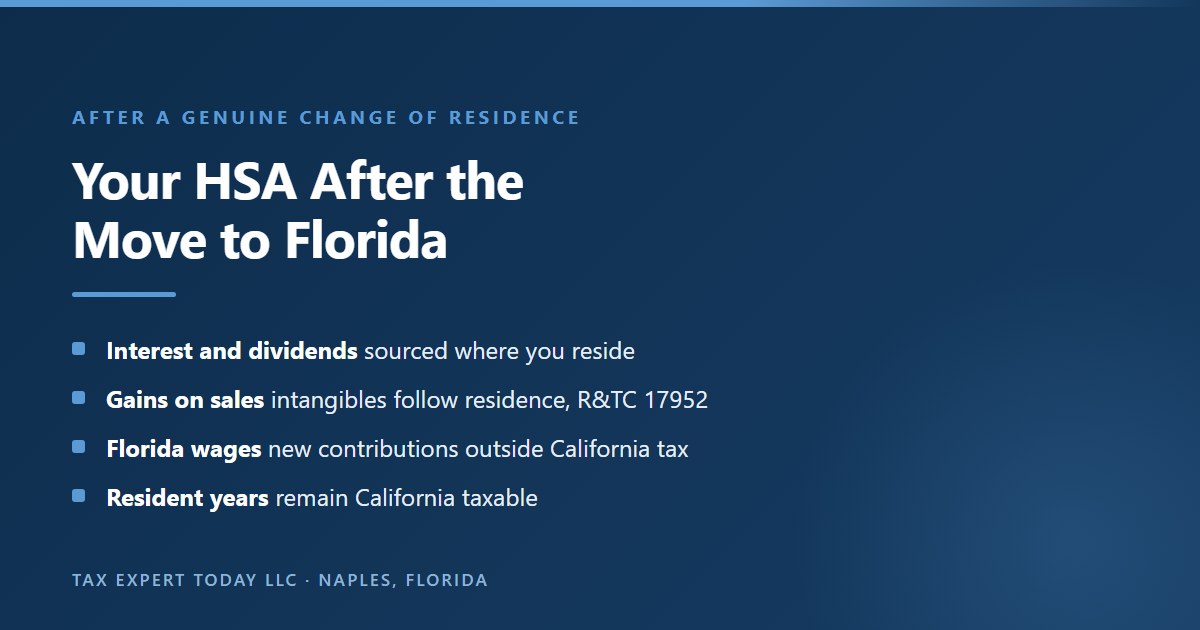
Once you are a Florida resident, California generally stops taxing your HSA. Interest and dividends earned after the move have their source where you live, so they are outside California tax, and gains on sales inside the account after the move are generally not California source. Contributions from Florida wages are also outside California tax. Florida has no personal income tax.
- Earnings after the move: under FTB Publication 1031, interest and dividends generally have a source where you are a resident.
- Sales after the move: gain from the sale of stock or fund shares, which are intangible property, is generally sourced to the seller’s residence at the time of sale under R&TC section 17952.
- Contributions after the move: payroll and employer deposits from wages for work performed in Florida are not California source.
- Federal treatment: unchanged; the full federal triple tax advantage continues.
- What does not change: earnings and gains realized while you were a California resident remain California taxable for those years.
Florida does not tax HSAs because Florida has no personal income tax, so the California HSA tax is the only state layer the account ever had. So after a genuine change of domicile, the account works the way it was designed to work, with no state layer at all. The key word is genuine. Every rule in this section assumes that California would agree you are no longer a resident, which turns on domicile and the closer connection analysis described in our guides to leaving California taxes and the California residency audit.
The example in Publication 1031 is drawn for bank interest: a Texas resident with a California bank account has Texas source interest that California does not tax. The same logic applies to interest and dividends credited inside an HSA held by a Florida resident, regardless of where the custodian is located. The detail on how intangibles are sourced is in our guide to California source income.
How is an HSA reported on Form 540NR in the move year?
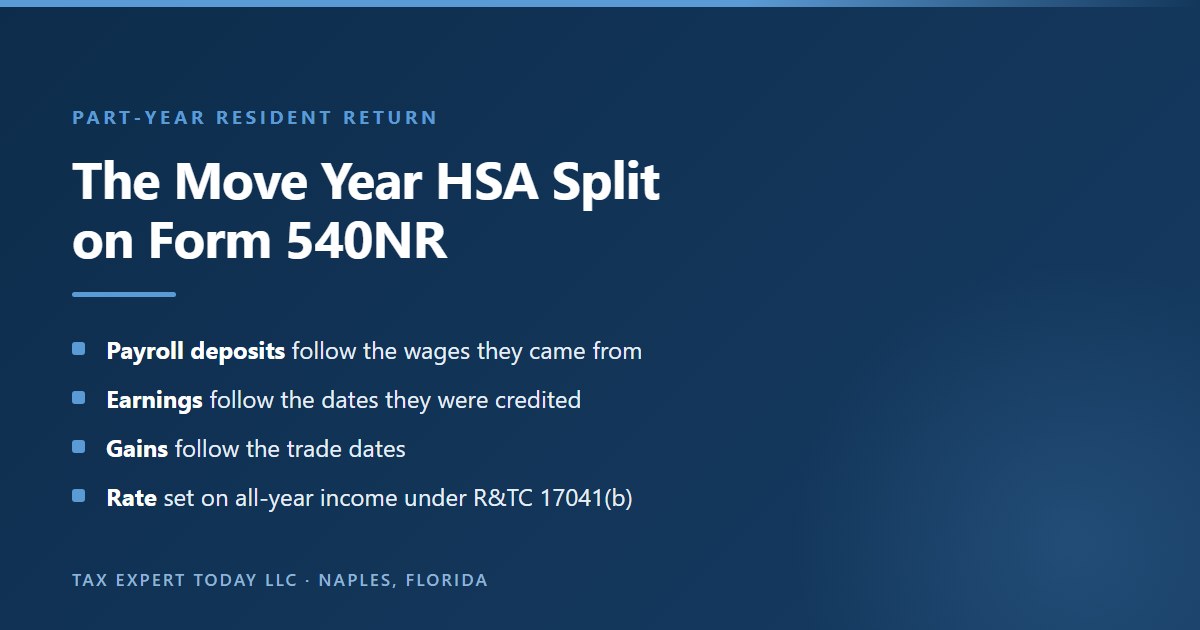
In the move year you file Form 540NR as a part-year resident. Schedule CA (540NR) first computes total income as if you were a California resident all year, including the full HSA add-back, then isolates California amounts: HSA items from the residency period plus any California source items after it. The tax on total income is prorated by the ratio of California income to total income.
- Total income columns: the HSA adjustments on lines 1h, 2, 3, 7, 8f, and 13 apply as they would for a full-year resident.
- California column: only the HSA contributions, earnings, and gains from the residency period, plus any California source amounts after the move.
- The rate effect: under R&TC section 17041, tax is computed on all income and then prorated, so post-move HSA amounts can raise the rate without being taxed directly.
- Timing evidence: pay stubs and statements dated before and after the move date carry the allocation.
The 2025 Schedule CA (540NR) instructions repeat the same HSA rules as the resident instructions, line for line. What they do not do is walk through the split for each HSA item. That is where a practical allocation is needed, and the cleanest approach follows the calendar: payroll contributions follow the wages they came from, earnings follow the dates they were credited, and gains follow the trade dates.
| Hypothetical move year HSA item | Amount | Total income (all-year basis) | California amount |
|---|---|---|---|
| Payroll HSA deposits, January to May (California work) | $3,650 | $3,650 | $3,650 |
| Payroll HSA deposits, June to December (Florida work) | $5,100 | $5,100 | $0 |
| Dividends credited before June 1 | $700 | $700 | $700 |
| Dividends credited after June 1 | $1,050 | $1,050 | $0 |
| Gain on a fund exchange in March | $2,400 | $2,400 | $2,400 |
| Gain on a fund exchange in October | $3,100 | $3,100 | $0 |
| Totals | $16,000 | $16,000 | $6,750 |
In this illustration the move date is June 1. Of $16,000 of HSA amounts California would have taxed for a full-year resident, $6,750 is California income. The other $9,250 still appears in the total income used to set the rate, which is how California’s part-year computation works for every type of income, not only HSA items. Our guide to the California part-year resident tax explains the proration in detail.
Tax programs handle this unevenly. User reports on tax software support forums describe programs that carry the full year’s HSA add-back into the California column unless the preparer allocates it, which overstates California income. Others never ask. The return should reflect the allocation actually supported by the records, and the records should be kept with the return.
Does California tax HSA growth after you become a Florida resident?
Generally no. After a genuine change of residence, interest, dividends, and gains inside the HSA are not California source income, so California has no claim on them. The exception would be an HSA investment with a business situs in California, which is unusual for an individual account holding funds or securities.
- Interest and dividends: sourced to residence under the rules in Publication 1031.
- Gains on sales: sourced to residence at the time of sale under section 17952 for intangible property.
- Distributions: not California income even for residents, so not California income for nonresidents.
- Business situs exception: an intangible used in a California business can have a California source; ordinary HSA investments do not.
The same principle explains why the sale date controls for stock sales around a move, discussed in our guide to the California exit tax. California does not tax unrealized appreciation when a resident leaves. It taxes realized income while you are a resident and California source income after. For HSA investments, almost all post-move income falls outside California’s reach.
Should you sell HSA investments before or after the move?
If an HSA holds investments with large unrealized gains, the timing of a sale changes the California result. A sale while you are a California resident is a California capital gain. The same sale after a genuine change of residence is generally not California source. Where a rebalance can wait, waiting until after the move usually removes the California tax on it.
- Before the move: the gain is California income, taxed as ordinary income at your California rate.
- After the move: the gain is generally not California source; federal treatment is unchanged either way.
- Losses: a sale at a loss while a resident produces a California capital loss, which may have value in the move year.
- Automatic sales: target date funds and managed portfolios sell internally; those fund level distributions follow the date paid.
- Do not let tax drive investment risk: holding an unsuitable position for months to defer a modest state tax can cost more than it saves.
| Hypothetical HSA position | California basis | Value | Sold before the move | Sold after the move |
|---|---|---|---|---|
| Total market index fund | $28,000 | $46,000 | $18,000 California gain | No California gain |
| Bond fund | $9,000 | $8,600 | $400 California loss | No California loss |
| Cash | $5,000 | $5,000 | None | None |
At a 9.3 percent marginal rate, the $18,000 gain in this illustration is about $1,674 of California tax if realized before the move. The same rebalance after a genuine change of residence would generally produce none. This is a timing observation, not a recommendation to defer any particular sale, and it depends entirely on the move being one California would accept.
What happens to California basis after the move?
After a genuine move, California basis stops changing and stops mattering for current returns, because California no longer taxes the account’s income and never taxes distributions. It remains worth keeping as a record of what California already taxed, which matters if you return to California or if the FTB later questions the residency period.
- No new additions: post-move contributions and earnings are not California taxed, so they do not add California basis.
- No current use: distributions are not California income in any case, and post-move sales are not California source.
- Residency review: the ledger shows exactly what was reported for the resident period if the move year is examined.
- Return to California: if you become a resident again, the cost of each investment still sets the gain on a later sale.
A California HSA tax record that took years to build is easy to lose in a move. Download the HSA statements for the resident years and keep them with the move year return. Custodians do not always keep old statements online indefinitely, and some HSA plans change custodians when an employer changes benefit providers.
What if you move back to California or keep California income?
If you become a California resident again, the California HSA tax rules apply again from the date you return: new contributions are added back, and earnings and gains are taxed as they occur. Earnings and gains realized while you were a Florida resident generally stay outside California tax. California source income you keep after the move does not pull the HSA back in.
- Returning residents: HSA income from the date residency resumes is California taxable, reported on a part-year return for the return year.
- Cost of investments: when you sell after returning, the cost of each investment sets the gain, which is one reason to keep the earlier records.
- California rental or business income: taxed as California source, but it does not make HSA earnings California source.
- Nonresident returns: a Florida resident who files Form 540NR for California source income reports HSA amounts in the total income columns only.
The second point deserves care. California has no specific rule for the cost of HSA investments held through a period of nonresidency, so the general principle applies: gain is proceeds less cost. Appreciation that built up while you lived in Florida and is realized after you return is, in that framework, realized while a resident. Anyone planning a return should review the HSA before the return date for the same reason as before the departure.
Many Florida residents keep California rental property or business interests after the move. Those produce California source income and a continuing nonresident state tax return. The HSA is not affected by that filing, apart from the rate effect of including HSA items in total income on the nonresident return.
What mistakes are common on California HSA reporting?
The most common mistakes are omitting HSA earnings because no Form 1099 was issued, missing gains on sales inside the account, failing to reverse a direct contribution on line 13, adding the full year’s HSA amounts to the California column in a move year, and losing the records that support California basis.
- Missing earnings: interest and dividends inside the HSA never appear on a 1099, so they are omitted unless someone looks at the statements.
- Missing gains: rebalancing and fund exchanges inside the account create California gains that do not show on any tax form.
- Missing line 13 reversal: a direct contribution deducted federally but not reversed understates California income.
- Move year over-reporting: post-move contributions and earnings placed in the California column overstate California income.
- Taxing distributions: a nonqualified distribution carried into California income when it should be subtracted on line 8f.
| Error | Effect on the California return | How it is usually caught |
|---|---|---|
| HSA interest and dividends omitted | Understated income every year | FTB review, or a later reconstruction of basis |
| Gain on a sale inside the HSA omitted | Understated income in the sale year | Rarely caught, which is why basis records matter |
| Line 13 deduction not reversed | Understated income | Comparison of federal and California returns |
| Code W not added on line 1h | Understated wages | Mismatch between W-2 box 16 and the return |
| Post-move HSA items in the California column | Overstated California income | Review of the move year Form 540NR |
| Nonqualified distribution taxed by California | Overstated income | Review of line 8f |
Understatements carry interest and potential penalties, and an FTB notice proposing additional tax comes with its own deadlines, covered in our guide to the California late payment penalty. Overstatements can be corrected by an amended return within the refund claim period. Neither is unusual. The California HSA tax is one of the most frequently misreported items on California returns precisely because the federal forms say so little about it.
How does California treat an HSA compared with an FSA, HRA, and 401(k)?
California follows federal law for health flexible spending accounts, ordinary health reimbursement arrangements, and 401(k) deferrals, so those reduce California income just as they reduce federal income. The HSA is the exception. For a California employee choosing between an HSA and a health FSA, that difference is part of the comparison.
- Health FSA: salary reductions through a cafeteria plan are excluded for both federal and California purposes.
- Health reimbursement arrangement: employer funded reimbursements of medical expenses are generally excluded for both.
- 401(k): elective deferrals are excluded from both federal and California wages.
- HSA: excluded or deducted federally, taxed by California.
- Small employer HRA: since a 2025 amendment, section 17131.4(b) also switches off the federal exclusion in section 106(g) for qualified small employer health reimbursement arrangements.
| Account | Federal contribution treatment | California contribution treatment | California tax on growth | Carries over after a move |
|---|---|---|---|---|
| HSA | Deducted or excluded | Taxed | Yes, yearly | Yes, account is portable |
| Health FSA | Excluded | Excluded | No growth | Generally use it or lose it |
| Health reimbursement arrangement | Excluded | Generally excluded | No growth | Tied to the employer |
| 401(k) | Excluded | Excluded | Deferred | Yes, account is portable |
| Traditional IRA | Deductible if eligible | Deductible if eligible | Deferred | Yes |
The comparison does not make an HSA a poor choice. A Californian in a 32 percent federal bracket who contributes $8,750 saves roughly $2,800 of federal income tax, before payroll tax effects on salary deferrals, and pays roughly $814 of California tax at 9.3 percent. Federal tax free growth also continues. For someone who expects to leave California, the account’s value increases further after the move. For retirement accounts and the move, our guide to retiring to Florida covers the broader picture, and the mega backdoor Roth guide covers another account California treats differently in practice.
What should a departing Californian do with an HSA before the move?
Before the move, reconcile the HSA’s California history, decide whether any planned sales inside the account can wait until after the change of residence, update the address and payroll work location, and download every statement from the California years. After the move, keep the HSA records with the move year return.
- Reconcile: confirm that past returns reported HSA earnings, gains, contributions, and code W amounts.
- Review planned sales: identify positions with large unrealized gains and whether rebalancing can wait without undue risk.
- Update records: change the custodian address and make sure payroll records the new work location on the right date.
- Download statements: keep every annual and monthly statement for the California years.
- Document the date: the HSA allocation in the move year follows the same date that governs every other item.
The California HSA tax is a small part of a California departure for most people, and it should not drive the timing of the move. It is a useful part of a pre-move review because it is one of the few accounts where both past reporting and future treatment change with residence. Our California to Florida tax guide covers the larger items, including equity compensation discussed in our guide to RSU tax when leaving California, and the payroll side covered in our guide to the California SDI tax.
What records should you keep for a California HSA?
Keep every HSA statement for each year you were a California resident, your W-2s showing box 12 code W and box 16, Forms 5498-SA and 1099-SA, trade confirmations for sales inside the account, and a running ledger of California basis by investment. Keep the move year records with the Form 540NR.
- Statements: monthly or quarterly custodian and brokerage statements showing interest, dividends, and trades.
- Tax forms: W-2, 5498-SA, 1099-SA, and Form 8889 for each year.
- Basis ledger: contributions taxed, earnings taxed, distributions, and the cost of each position.
- Move records: the date of the change of residence and the payroll and custodian records that line up with it.
| Record | Supports annual California reporting | Supports California basis | Supports the move year allocation |
|---|---|---|---|
| W-2 box 12 code W and box 16 | Yes | Yes | Yes |
| Custodian statements | Yes | Yes | Yes |
| Trade confirmations | Yes | Yes | Yes |
| Forms 5498-SA and 1099-SA | Partly | Partly | Partly |
| Basis ledger | Yes | Yes | Yes |
| Florida declaration of domicile and residency records | No | No | Yes |
Residency itself is a separate inquiry with its own evidence. Our guides to establishing Florida residency, Florida domicile for executives, and the dual state residency trap cover the domicile side, and the Florida 183 day rule calculator helps track days.
Frequently Asked Questions
Does California tax HSA contributions?
Yes. Revenue and Taxation Code section 17215.4 provides that Internal Revenue Code section 223 does not apply in California, and section 17131.4 makes employer contributions taxable. Payroll and employer deposits are added back from W-2 box 12 code W, and direct contributions are reversed on Schedule CA line 13.
Is HSA interest taxable in California?
Yes. The Franchise Tax Board instructions say interest or other earnings from an HSA are not tax deferred and are taxable in the year earned. Interest is added on Schedule CA line 2, column C and dividends on line 3, column C, even though no Form 1099 is issued.
Are HSA withdrawals taxable in California?
Generally no. Qualified medical distributions are not taxable federally or in California. A nonqualified distribution is federal income, but California does not tax it and it is subtracted on Schedule CA line 8f, column B. California has no equivalent of the federal 20 percent additional tax.
Did California pass the HSA deduction bill AB 781?
No. Assembly Bill 781 would have allowed a California HSA deduction for tax years 2026 through 2030. Its committee hearing was canceled at the author’s request, and it died on January 31, 2026. California HSA contributions and earnings remain taxable for 2026.
What is California basis in an HSA?
It is the total of HSA contributions and earnings that California has already taxed. FTB Publication 1001 says that because HSA earnings are taxed each year, the taxpayer has a California basis in the account. Basis explains why distributions are not taxed and sets the gain on sales inside the account.
Does California tax my HSA after I move to Florida?
Generally not after a genuine change of residence. Interest and dividends generally have a source where you reside, and gains on sales of intangible property are sourced to residence at the time of sale. Contributions from Florida wages are also outside California tax. Amounts from the resident period remain taxable.
How do I report an HSA on Form 540NR in the year I move?
Schedule CA (540NR) applies the HSA adjustments to total income as if you were a resident all year, then includes only the HSA contributions, earnings, and gains from the residency period in the California amounts. Allocating by payroll dates, credit dates, and trade dates follows the records.
Can a Naples, Florida advisor help with California HSA tax after a move?
Yes. The California HSA rules depend on residency dates and account records, not on where the advisor works. A Naples, Florida advisor can review HSA statements and prior California returns, allocate the move year amounts on Form 540NR, and document the result.
California HSA Tax Help in Naples & Southwest Florida
California HSA tax help Naples residents can use starts with the account statements and the move date, not with the tax return. Tax Expert Today LLC advises on state residency and tax matters nationwide, including California departures and Florida arrivals, from our office in Naples, Florida. Our team includes tax advisors, enrolled agents, CPAs, and attorneys, and we review whether HSA contributions, earnings, and gains were reported correctly in the California years, how they should be allocated on the move year return, and what records support the result.
We are located at 11983 Tamiami Trail N, Naples FL 34110. Call (239) 441-2005, Monday through Friday, 10:00 to 5:00 Eastern Time. Clients across Naples, Bonita Springs, Estero, Fort Myers, Marco Island, and the wider Southwest Florida region engage us on California part-year returns, equity compensation after a move, and residency questions. Our California tax services page describes the state engagements we take, Naples tax planning covers our local advisory work, and our tax planning services page explains how a planning engagement is structured.
- California HSA review Naples FL: reconciling HSA statements with the California returns filed while you lived there.
- Move year Form 540NR: allocating HSA contributions, earnings, and gains between the resident and nonresident periods.
- Basis reconstruction: rebuilding a California basis ledger from historical statements when none was kept.
- Pre-move planning: reviewing the HSA alongside equity compensation and other accounts before the change of residence.
Local FAQ: I moved from San Diego to Naples last year and my HSA is invested in index funds. Can a Naples advisor sort out the California side? Yes. The California treatment of an HSA depends on the dates of your residency and on what the account statements show, not on where your advisor is located. Bring your HSA statements for the California years and the move year, your W-2s, Forms 5498-SA and 1099-SA, and the California returns you filed, and we can review what was reported, how the move year should be allocated, and what records support it.
When to Engage a Professional
Engage a professional when your HSA is invested and has never been reported to California, when you are planning a move and the account holds large unrealized gains, when you are preparing a move year Form 540NR, or when the FTB questions HSA amounts on a return. The California rules are short, but applying them to years of statements is detailed work.
- Your HSA is invested and past California returns did not report its dividends or gains.
- You are moving to Florida and the account holds positions with significant unrealized gains.
- You are preparing a part-year return and your software placed the full year’s HSA amounts in the California column.
- You have an Archer MSA and are considering a rollover while still a California resident.
- You have received an FTB notice about HSA amounts; our guide to the FTB power of attorney explains how a representative is authorized for the FTB.
This article explains the law as it stands for 2026. It is not legal or tax advice for any specific situation, and outcomes depend on the dates and facts of the move, the account’s investments, the records available, and facts that only a full review can establish. The examples are hypothetical illustrations, not client results. Call (239) 441-2005 to arrange a review.
Published October 8, 2026 by Dr. Pellumb Kabashi « Back to Learning Center
Have a question this article touches on?
Tax Expert Today LLC, based in Naples, Florida and serving clients across the United States.
Schedule a Consultation (239) 441-2005