
By Dr. Pellumb Kabashi, DBA, MBA, CES, CFE, EA
Founder, Tax Expert Today LLC · Tax advisors, enrolled agents, CPAs, and attorneys · Serving clients in all 50 states
Quick Answer: The Texas mixed beverage tax is really two taxes on the same drink. A bar or restaurant holding a mixed beverage permit pays a 6.7 percent gross receipts tax out of its own receipts, and it collects a separate 8.25 percent mixed beverage sales tax from the customer. Both apply to alcohol served for on premises consumption and are filed monthly by the 20th. Call (239) 441-2005 for a free consultation.
Ask a Texas bar owner what the Texas mixed beverage tax is and the answer is often a single number. Some say 6.7 percent. Some say 8.25 percent. Some add the two together and say 14.95 percent, which is the figure that now appears at the top of the search results. Each answer captures part of the picture, and each one can lead a business to price drinks, build its point of sale system or file its monthly reports in a way that does not match the law.
The reason is structural. Texas imposes two separate taxes on the same alcoholic drink when it is served by a mixed beverage permittee for consumption on the premises. The first is the mixed beverage gross receipts tax under Chapter 183, Subchapter B of the Tax Code. It is a tax on the business, measured by what the business receives, and it may not be charged to the customer. The second is the mixed beverage sales tax under Subchapter B-1. It is a tax on the customer’s purchase, collected by the business and passed through to the state. The two taxes have different rates, different bases, different rules for what may appear on a receipt, different exemption rules, different bad debt rules and separate monthly reports.
The ranking pages on this subject list both rates and stop there. That is why the most visible public discussion of the topic is a forum thread in which restaurant operators ask how to book the two taxes in their point of sale software, and why a community group thread asks why a beer drinker saw a “mixed drink tax” on a receipt. This guide separates the two taxes, states who bears each one, and then works the arithmetic on one drink, priced two different ways, so the difference shows up in dollars. It then follows the drink through the special situations that produce most errors: complimentary drinks, meal packages, gratuities, cover charges, to go sales, catering, nonprofits, monthly reporting and the Comptroller’s depletion audit.
This guide covers Texas mixed beverage taxes only. Ordinary Texas sales tax on food and other items is covered in our guide to Texas taxable services, and the certificate a bar uses to buy its liquor, beer and wine without paying tax to the wholesaler is covered in our guide to the Texas resale certificate.
What Is the Texas Mixed Beverage Tax?
The Texas mixed beverage tax is the common name for two taxes in Tax Code Chapter 183 that apply when a mixed beverage permittee sells alcohol for on premises consumption: a 6.7 percent gross receipts tax the permittee pays, and an 8.25 percent mixed beverage sales tax the customer pays and the permittee collects.
- Two taxes, one drink. Both taxes apply to the same serving, along with the ice and mixers that go into it.
- Different payers. The gross receipts tax is the permittee’s own cost; the sales tax is a debt of the customer until collected.
- On premises only. Alcohol sold to go, for pickup or for delivery is outside both taxes and carries ordinary sales tax instead.
- Permit driven. The type of permit the business holds from the Texas Alcoholic Beverage Commission decides whether the taxes apply at all.
Section 183.021 imposes the gross receipts tax “on the gross receipts of a permittee received from the sale, preparation, or service of mixed beverages,” together with ice and nonalcoholic beverages sold, prepared or served to be mixed with alcohol and consumed on the permittee’s premises. Section 183.041 imposes the mixed beverage sales tax “on each mixed beverage sold, prepared, or served by a permittee in this state,” on the same ice and mixers, at 8.25 percent of the sales price. The word “mixed” is misleading. Under the Comptroller’s rules a mixed beverage is any serving that is composed in whole or in part of an alcoholic beverage, in a sealed or unsealed container, for consumption on the premises. A bottle of beer, a glass of wine and a shot of tequila are all mixed beverages when a mixed beverage permittee serves them at the table. That is why the beer drinker in the community group thread saw the tax on the receipt.
The two taxes did not always look like this. Until the end of 2013, Texas imposed a single 14 percent gross receipts tax on the permittee. Rule 3.1001 records that effective January 1, 2014, the gross receipts rate was reduced from 14 percent to 6.7 percent, and the 8.25 percent mixed beverage sales tax was imposed in addition. The legislative design shifted part of the burden from the business to the customer and made it visible on the receipt. Many owners who were in business before 2014, and many point of sale configurations built from older templates, still treat the subject as a single tax, and that is the root of several of the mistakes described later in this guide.
An alcoholic beverage, for these purposes, is any beverage containing more than 0.5 percent alcohol by volume that is capable of use for beverage purposes. The Comptroller administers both mixed beverage taxes. The Texas Alcoholic Beverage Commission, known as TABC, issues the permits and regulates alcohol itself, including the separate excise taxes that manufacturers, distributors and wholesalers pay by the gallon. Those excise taxes are built into the wholesale price, so most bars and restaurants never file them. This guide deals with the two taxes the retail permittee does file.
Who Is a Permittee Subject to Texas Mixed Beverage Taxes?
A permittee is a business holding one of the TABC permits listed in Tax Code Section 183.001(b)(1): a mixed beverage permit, a private club registration permit, a private club exemption certificate, versions of those with late hours or food and beverage certificates, a nonprofit entity temporary event permit, or a distiller’s and rectifier’s permit.
- The permit, not the drink, decides. A beer sold by a mixed beverage permittee carries both taxes; the same beer sold under a wine and malt beverage retailer’s permit carries only sales tax.
- Private clubs are included. Country clubs, veterans posts and other clubs holding the listed private club permits are permittees.
- Temporary events are included. A nonprofit entity temporary event permit makes the nonprofit a permittee for that event.
- Distilleries are included. A distiller’s and rectifier’s permittee that serves tastings for on premises consumption is a permittee.
Tax Code Section 183.001(b)(1) defines a permittee as “a mixed beverage permittee, a private club registration permittee, a private club exemption certificate permittee, a private club registration permittee with a retailer late hours certificate, a nonprofit entity temporary event permittee, a private club registration permittee holding a food and beverage certificate, a mixed beverage permittee with a retailer late hours certificate, a mixed beverage permittee holding a food and beverage certificate, or a distiller’s and rectifier’s permittee.” Rule 3.1001(a)(8) uses the same list and adds that the term includes an agent, servant or employee of the permittee, which matters when a bartender or event staff member makes the sale.
The definition matters because the Comptroller’s position, stated plainly in its frequently asked questions, is that the type of TABC permit or license determines whether sales of beer and wine are subject to sales tax or to mixed beverage taxes. A restaurant that holds only a wine and malt beverage retailer’s permit is not a mixed beverage permittee. Its sales of beer and wine are subject to ordinary limited sales and use tax, at 6.25 percent state plus up to 2 percent local, and it files nothing under Chapter 183. A restaurant that holds a mixed beverage permit pays both mixed beverage taxes on every alcoholic drink it serves for consumption on the premises, including beer and wine, and including drinks served at an event it caters away from its own location.
| Business and permit | Mixed beverage gross receipts tax (6.7%) | Mixed beverage sales tax (8.25%) | Ordinary sales tax on alcohol |
|---|---|---|---|
| Bar or restaurant with a mixed beverage permit, drinks served on premises | Yes | Yes | No |
| Same permittee, unopened wine or cocktails sold to go or delivered | No | No | Yes |
| Restaurant with only a wine and malt beverage retailer’s permit | No | No | Yes |
| Private club with a private club registration permit | Yes | Yes | No |
| Nonprofit with a temporary event permit selling beer and wine | Yes | Yes, unless a qualifying fundraiser exemption applies | No |
| Distillery serving a paid tasting on premises | Yes | Yes | No |
| Distillery selling a bottle to take home | No | No | Yes |
| Package store selling sealed bottles | No | No | Yes |
The Comptroller’s frequently asked questions work through several of these combinations. A brewpub that also sells liquor under a mixed beverage permit owes both mixed beverage taxes on all alcohol it serves for consumption on the premises, including its own beer. A veterans post holding a private club exemption certificate that sells beer to nonmembers in its community hall collects mixed beverage taxes on those sales. A distillery that charges a tasting fee owes mixed beverage taxes on the tasting, but ordinary sales tax on a discounted commemorative bottle the visitor takes home. The pattern is consistent: identify the permit first, then ask whether the alcohol is consumed on the premises.
Holding a mixed beverage permit also brings obligations that start before the first drink is poured. The Comptroller’s mixed beverage taxes page states that a sales tax permit is required for the location whether or not the permittee sells food or other items, that the Comptroller’s enforcement division must certify the TABC application packet, that the name and address must match the sales tax permit exactly, and that the applicant may not be delinquent in state taxes. The Comptroller also requires security bonds: one for the mixed beverage gross receipts tax and one for the mixed beverage sales tax. A business planning a Texas location should build these steps into its opening timeline, along with the registration steps covered in our moving your business to Texas checklist.
How Does the Mixed Beverage Gross Receipts Tax Work?
The mixed beverage gross receipts tax is a 6.7 percent tax on what the permittee receives from selling, preparing or serving alcohol, ice and mixers for on premises consumption. The permittee owes it from its own receipts. It may not be added to the customer’s bill or deducted from the price, and it has no exemptions.
- Base. Gross receipts from alcoholic beverages and from ice and mixers served to be mixed with alcohol, excluding the mixed beverage sales tax itself.
- Payer. The permittee, never the customer.
- No exemptions. Governmental entities and nonprofits that are exempt from sales tax still pay it.
- Report. Form 67-100 with the Form 67-101 location supplement, monthly, by the 20th.
The Comptroller’s page on the gross receipts tax states the core rule directly: the person or organization holding the mixed beverage permit, and not the customer, must pay the mixed beverage gross receipts tax. The permittee “may not add it to the selling price as a separate charge or deduct it from the amount received.” Rule 3.1001(b)(1) adds that the tax “may not be separately charged to or paid by the customer and cannot be considered included in the gross receipts amount,” and that a receipt may not include a charge labeled a “Tax Reimbursement.”
Two consequences follow. First, the gross receipts tax is a cost of doing business, in the same way rent and payroll are. It reduces the permittee’s margin on every drink, and it has to be recovered through menu prices like any other cost. Second, because the tax cannot be considered included in gross receipts, the permittee cannot later argue that some portion of what the customer paid was really gross receipts tax. The base is the full amount received for the alcohol, after removing only the mixed beverage sales tax.
There is a sharper consequence as well. The Comptroller’s page warns that “An amount identified on an invoice as a ‘tax’ is fully due to the state, in addition to the mixed beverage gross receipts tax.” A business that tries to pass the 6.7 percent through to customers by adding a line labeled “MB tax” or “liquor tax” at 6.7 percent does not shift the burden. It collects an amount represented as tax that must be remitted, and it still owes its own 6.7 percent on top. The only lawful ways to mention the gross receipts tax on a receipt are the informational disclosures described later in this guide, which tell the customer what the business will pay without charging it to them.
The gross receipts tax has no exemptions. The Comptroller states that entities and organizations exempt from sales tax under Sections 151.309 and 151.310, which include governmental entities and qualifying nonprofits, “must report and pay mixed beverage gross receipts tax.” Rule 3.1002(f)(7) repeats the point: a governmental entity or nonprofit organization is not exempt from the gross receipts tax, including on alcohol sold during a fundraising sale or auction.
How Does the Mixed Beverage Sales Tax Work?
The mixed beverage sales tax is an 8.25 percent tax on the sales price of each alcoholic drink, and of ice and mixers served with alcohol, sold by a permittee for on premises consumption. The customer owes it, the permittee collects and remits it, and the permittee may add it to the bill or include it in the menu price.
- Base. The sales price of each mixed beverage and each mixer or serving of ice to be mixed with alcohol.
- Payer. The customer; Rule 3.1002 calls it a debt of the purchaser to the permittee until collected.
- Replaces ordinary sales tax on the drink. The drink is reported on the mixed beverage sales tax report, not the regular sales tax return.
- Report. Form 67-103 with the Form 67-104 location supplement, monthly, by the 20th.
The Comptroller describes the split in one sentence: “The permittee (seller) pays the mixed beverage gross receipts tax to the state, and the customer pays the seller the mixed beverage sales tax, which the seller remits to the state.” Unlike the gross receipts tax, the mixed beverage sales tax may be passed to the customer. The Comptroller’s mixed beverage sales tax page lists two methods: a separate line item for the mixed beverage sales tax on the bill, or including the tax in the sales price, in which case “A permittee’s records must show that the sales price of alcohol includes mixed beverage sales tax.”
Section 183.043 makes the mixed beverage sales tax behave like ordinary sales tax in most respects. It is “administered, collected, and enforced in the same manner as the tax under Chapter 151,” and Chapter 151 applies to it as it applies to the general sales tax, with three stated exceptions that matter in practice. The permittee may not keep any part of the tax as a reimbursement for collecting it under Section 151.423, it may not take a prepayment discount under Section 151.424, and the confidentiality protection of Section 151.027(a) does not apply. The Comptroller’s frequently asked questions confirm the first two exceptions in plain terms: there are no timely filing or prepayment discounts for mixed beverage taxes. The third exception means a permittee’s mixed beverage reports are not treated as confidential tax information, which is one reason the Comptroller publishes mixed beverage receipts by location.
Section 183.043(d) adds that an item subject to the mixed beverage sales tax “is exempt from the taxes imposed under Subtitle C, Title 3,” the subtitle that contains the local sales and use taxes. Combined with the Comptroller’s instruction that sales subject to mixed beverage sales tax are reported on a separate mixed beverage sales tax report rather than on the limited sales and use tax return, the practical result is that a drink served by a permittee carries the 8.25 percent mixed beverage sales tax instead of ordinary state and local sales tax, not in addition to it. The 8.25 percent rate is the same everywhere in Texas. There is no local mixed beverage tax rate; instead, under Section 183.051, counties and cities receive a share of the state’s mixed beverage revenue from establishments within their boundaries, which the statute and the Comptroller describe as not less than 10.7143 percent.
How Are the Two Texas Mixed Beverage Taxes Different?
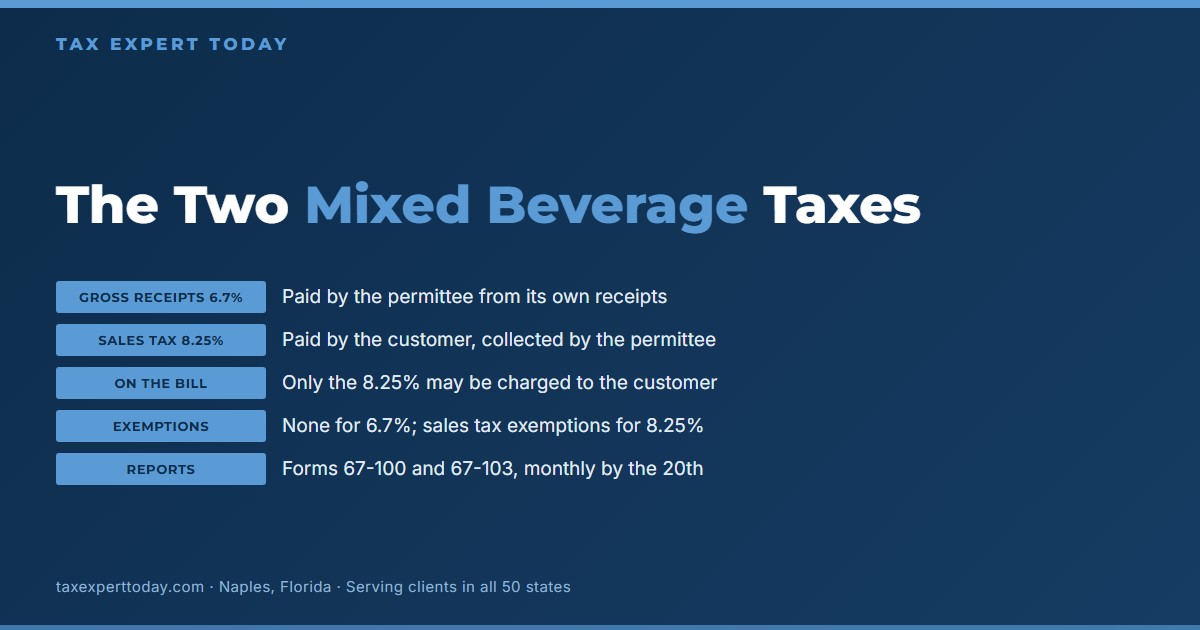
The gross receipts tax is a 6.7 percent cost the permittee bears and cannot charge to customers, with no exemptions. The mixed beverage sales tax is an 8.25 percent tax the customer bears, which the permittee collects, may itemize or include in price, and which follows sales tax exemptions and procedures.
- Who bears it is the first difference and drives every other rule.
- What the receipt may show differs: one may be charged, the other may only be disclosed.
- Exemptions exist for the sales tax and do not exist for the gross receipts tax.
- Bad debts are handled under different rules for each.
| Feature | Mixed beverage gross receipts tax | Mixed beverage sales tax |
|---|---|---|
| Statute | Tax Code Chapter 183, Subchapter B (Section 183.021) | Tax Code Chapter 183, Subchapter B-1 (Section 183.041) |
| Comptroller rule | 34 TAC Section 3.1001 | 34 TAC Section 3.1002 |
| Rate | 6.7 percent of gross receipts | 8.25 percent of the sales price |
| Who bears the tax | The permittee | The customer |
| May it be charged to the customer? | No; it may only be disclosed for information | Yes, as a line item or included in the price |
| Is the other tax in its base? | No; the mixed beverage sales tax is removed first | No; the gross receipts tax is never charged |
| Exemptions | None | Generally the sales tax exemptions, such as governmental entities and qualifying fundraisers |
| Bad debts | Rule 3.1001(n), tied to a federal bad debt deduction | Rule 3.302, the sales tax bad debt rules |
| Monthly report | Form 67-100 and Form 67-101 | Form 67-103 and Form 67-104 |
| Due date | 20th day of the following month | 20th day of the following month |
| Security bond | Required | Required, separately |
The table explains why the two taxes cannot be booked as one line in a point of sale system. A single “mixed beverage tax” line at 14.95 percent would either overcharge customers, by charging them the business’s own tax, or would leave the business unable to show which part of what it collected belongs on which report. It would also break the exemption logic. When a qualifying governmental entity buys drinks for an official function, the mixed beverage sales tax does not apply but the gross receipts tax still does. A system that cannot separate the two cannot get that sale right.
The bad debt difference is easy to miss. Rule 3.1002(c)(5) states that bad debt deductions from the mixed beverage sales tax are treated in the same manner as bad debt deductions from ordinary sales tax under Rule 3.302, and that the bad debt exclusion from the gross receipts tax base in Rule 3.1001(n) “does not apply to mixed beverage sales tax.” A permittee with house accounts or event invoices that go unpaid therefore runs two separate bad debt analyses, one for each tax, each with its own documentation.
How Much Tax Does One Drink Actually Carry?
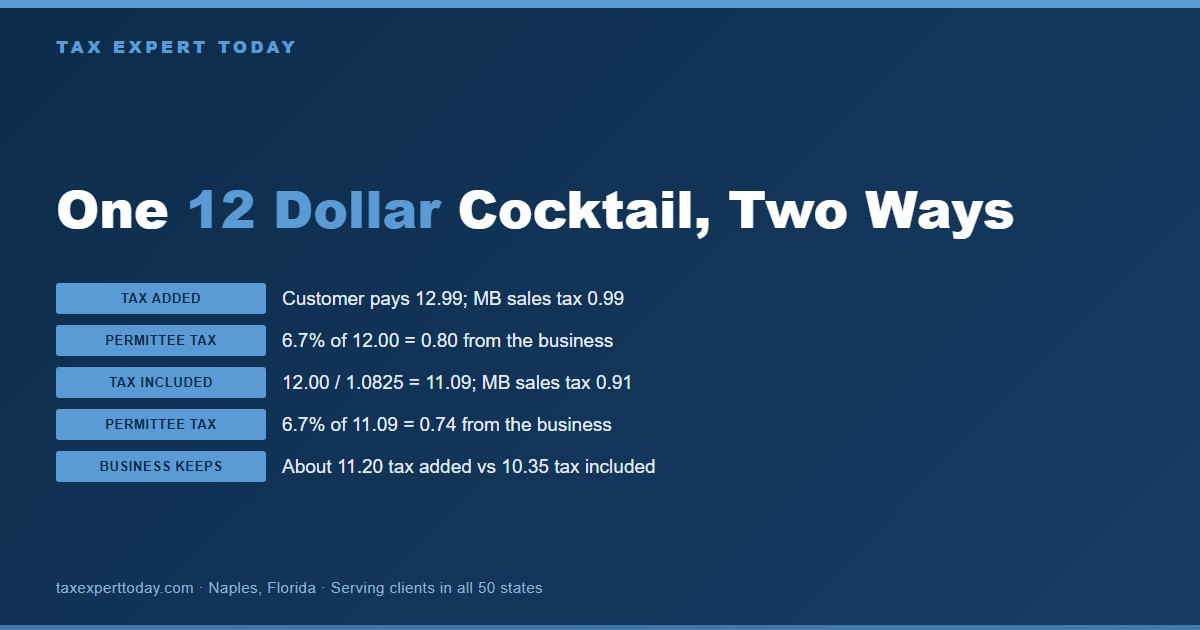
On a 12 dollar cocktail priced tax added, the customer pays 99 cents of mixed beverage sales tax and the permittee pays about 80 cents of gross receipts tax from its own 12 dollars. Priced tax included at 12 dollars, both taxes come out of the 12 dollars, and the permittee keeps about 10.35 dollars.
- Tax added: customer pays 12.99 dollars; the business keeps about 11.20 dollars after its gross receipts tax.
- Tax included: customer pays 12.00 dollars; the business keeps about 10.35 dollars.
- The 14.95 percent figure is the sum of two rates applied to the pre tax price, not a rate charged to the customer.
- The difference between methods is roughly 85 cents a drink in this illustration.
The fastest way to see the two taxes as two taxes is to follow a single drink. The illustration below is hypothetical, uses round numbers chosen for clarity, and is not based on any client. It assumes a mixed beverage permittee serving a cocktail for consumption on the premises, and it follows the computation the Comptroller uses in its own reporting examples, which remove the mixed beverage sales tax before computing the gross receipts tax.
| Step | Tax added to a 12.00 dollar menu price | Tax included in a 12.00 dollar menu price |
|---|---|---|
| Amount the customer pays for the drink | 12.99 dollars | 12.00 dollars |
| Sales price before mixed beverage sales tax | 12.00 dollars | 12.00 / 1.0825 = 11.09 dollars |
| Mixed beverage sales tax at 8.25 percent (customer’s tax) | 0.99 dollars | 0.91 dollars |
| Gross receipts tax base | 12.00 dollars | 11.09 dollars |
| Gross receipts tax at 6.7 percent (permittee’s tax) | 0.80 dollars | 0.74 dollars |
| Total sent to the state on this drink | 1.79 dollars | 1.65 dollars |
| Amount the permittee keeps after both taxes | 11.20 dollars | 10.35 dollars |
| Total tax as a share of what the customer paid | About 13.8 percent | About 13.75 percent |
Three lessons come out of the table. The first is that the customer never pays the gross receipts tax as a charge. Even under the tax added method, the line on the customer’s bill is the 8.25 percent mixed beverage sales tax only. The 80 cents of gross receipts tax comes out of the 12 dollars the business receives for the drink.
The second lesson is that the popular figure of 14.95 percent describes the state’s combined take as a percentage of the pre tax drink price under the tax added method, and nothing more. No customer is charged 14.95 percent, and a point of sale system configured to add 14.95 percent to the drink is charging the customer a tax the law says the customer may not be charged. As a share of what the customer actually pays, the combined tax in this illustration is a little under 14 percent under either method.
The third lesson is commercial rather than legal. Under the tax included method, the permittee absorbs both taxes from the menu price, and in this illustration it keeps about 85 cents less per drink than it would under the tax added method at the same menu price. At a few thousand drinks a month, that difference is a material line on the profit and loss statement. Neither method is better as a matter of tax law. They are two lawful ways to present the same tax, and the choice is a pricing decision the owner should make deliberately, with the arithmetic in front of them, rather than inherit from a point of sale template.
The Comptroller’s own frequently asked questions work the same computation at the reporting level. For a permittee with 1,000 dollars of taxable mixed beverage sales and the sales tax added to the price, the report shows 1,000 dollars of taxable sales, 82.50 dollars of mixed beverage sales tax and 67 dollars of gross receipts tax. For a permittee with 1,000 dollars received and the sales tax included in the price, the permittee divides by 1.0825 to arrive at taxable sales of 924 dollars, reports 76.23 dollars of mixed beverage sales tax, and then computes the gross receipts tax of 61.91 dollars on the 924 dollar base. The method that matters is the order: remove the mixed beverage sales tax first, then apply 6.7 percent to what remains.
Should a Bar Price Drinks Tax Included or Tax Added?
Either is lawful, but a permittee must choose one method and cannot alternate between them, according to the Comptroller. If tax is included, the records must prove it, because Rule 3.1002 presumes that the amount on a receipt is the price without tax, and a statement that “all taxes” are included is not enough.
- One method, consistently. The Comptroller states that a permittee “must choose one method and cannot alternate between the two methods.”
- Presumption against inclusion. The amount shown is presumed to be the sales price without tax included.
- Records overcome the presumption. The permittee may show from its records that tax was included.
- “All taxes included” is insufficient. Rule 3.1002(c)(3) says such a statement does not relieve the customer or the permittee.
Rule 3.1002(c)(3) sets out the presumption: the total amount shown on a customer’s invoice, service check, ticket or other receipt “is presumed to be the sales price, without tax included.” The permittee “may overcome the presumption by using the permittee’s records to show that tax was included in the sales price.” Contracts, bills, invoices or receipts that “merely state that ‘all taxes’ are included are not sufficient to relieve either the customer or the permittee of their tax responsibilities on the transaction.”
The presumption is the reason the pricing choice has audit consequences. Suppose a bar prices drinks as tax included, prints “all taxes included” at the bottom of its menu, and reports its taxable sales by dividing receipts by 1.0825. If its records do not otherwise show that the menu prices include the mixed beverage sales tax, an auditor may treat the full receipts as the sales price, compute the mixed beverage sales tax on top, and assess the difference. The fix is documentary and simple: menus, price lists and point of sale settings that state the inclusion clearly, receipts that use one of the statutory statements, and a consistent reporting method month after month.
The consistency requirement has a practical side as well. A permittee that runs tax included pricing in the dining room and tax added pricing at the bar, or that switches methods during a promotion, makes its own reports difficult to reconcile and gives an auditor reason to question both. Where different pricing is genuinely needed, for example at a separately permitted location, the cleanest approach is to keep each location on a single method and document it.
What Can and Cannot Appear on the Customer’s Receipt?
A receipt may state that mixed beverage sales tax is included, show the mixed beverage sales tax as a separate amount, show combined state taxes, or disclose for information the gross receipts tax the business will pay. It may never charge the customer the gross receipts tax or label any charge a tax reimbursement.
- Allowed: “Sales and MB sales taxes are included in sales price.”
- Allowed: a separate “MB Sales Tax” line at 8.25 percent.
- Allowed, for information only: a note that the business pays 6.7 percent gross receipts tax on the sale, shown as not included in the bill.
- Not allowed: any charge to the customer for the 6.7 percent, however it is labeled.
Section 183.042 lists the four statements a permittee may place on a receipt for an item subject to the mixed beverage sales tax: a statement that mixed beverage sales tax is included in the sales price; a separate statement of the amount of mixed beverage sales tax on that item; a statement of the combined mixed beverage taxes, consisting of the gross receipts tax the permittee will pay and the sales tax imposed on the item; or a statement of the combined mixed beverage sales tax and ordinary sales tax on all items listed on the receipt. Rule 3.1002(d) repeats those options and adds two conditions. A receipt showing the combined mixed beverage taxes “must clearly show that the customer is not being charged mixed beverage gross receipts tax.” And where a receipt shows a single combined line for mixed beverage sales tax and ordinary sales tax, “the permittee’s books and records must clearly show the amount of mixed beverage sales tax and sales and use tax on each sale of alcohol.”
The Comptroller’s published receipt examples show what the informational disclosure looks like. On a check with a cheeseburger, fries and two cocktails, the bill shows ordinary sales tax of 0.62 dollars on the food and mixed beverage sales tax of 0.58 dollars on the 7 dollars of drinks. Below the total, outside the charges, it reads in substance that the customer pays 0.58 dollars on the alcohol, that the business pays 6.7 percent, or 0.47 dollars, which is not included in the bill, and that the total paid to the state on the alcohol is 1.05 dollars. That disclosure is how a business can tell customers that it pays more tax than they see, without charging them for it.
The receipt also shows a point that confuses customers and some managers: the food on the same check carries ordinary sales tax, and the drinks carry mixed beverage sales tax. They are different taxes reported on different returns, even though in many Texas cities both rates come to 8.25 percent. A point of sale system that lumps them together on the receipt may do so lawfully under the fourth statutory option, but only if the underlying records still separate them, because the two amounts go to two different reports.
What Receipts Are in the Taxable Base?
The base for both taxes includes receipts from alcohol and from ice and mixers served to be mixed with alcohol, plus related charges such as bartender fees, set up fees and corkage fees, coupons and tickets redeemed for drinks, the portion of mandatory gratuities not paid to qualified staff, and all alcohol served by caterers.
- Service charges tied to drinks are in the base, even when the customer supplies the alcohol.
- Drink coupons and tokens are in the base when sold and redeemed for alcohol.
- Meal inclusive drinks are taxed at the normal selling price of the drink.
- Theft of cash does not reduce the base.
Rule 3.1001(c)(1) lists what the gross receipts tax base “includes, but is not limited to,” and Rule 3.1002(b) applies the same list to the mixed beverage sales tax. The table summarizes it alongside the exclusions in Rule 3.1001(f), which also carry over to the mixed beverage sales tax for items (f)(1) through (8).
| Receipt or event | In the mixed beverage tax base? | Source and note |
|---|---|---|
| Sale or service of alcoholic beverages for on premises consumption | Yes | Rule 3.1001(c)(1)(A) |
| Mixers and ice served to be mixed with alcohol | Yes | Rule 3.1001(c)(1)(B); a coffee served alone is ordinary sales tax only |
| Bar set up, bartender, corkage and similar fees | Yes | Rule 3.1001(c)(1)(G); taxable even when the customer provides the alcohol |
| Coupons, tokens and tickets sold and redeemed for drinks | Yes | Rule 3.1001(c)(1)(I) |
| Alcohol included with a meal at no separate charge | Yes, at the normal selling price of the drink | Rule 3.1001(c)(1)(D); a reduced price applies if the drink is sold at that reduced price at the same time |
| All alcohol sold or served by a permittee as caterer | Yes | Rule 3.1001(c)(1)(H) |
| Reasonable mandatory gratuity paid to qualified employees | No | Rule 3.1001(f)(5) and (i)(1) |
| Portion of a reasonable gratuity kept by the house | Yes | Rule 3.1001(c)(1)(E) |
| Mandatory gratuity above 20 percent | Yes, the entire gratuity | Rule 3.1001(c)(1)(F) and (i)(2) |
| Voluntary tips added by the customer | No | Rule 3.1001(f)(4) |
| Complimentary drinks with no consideration | No mixed beverage tax; use tax on ingredients | Rule 3.1001(f)(1) and Rule 3.1002(e) |
| Cover charges for entertainment | No mixed beverage tax; amusement sales tax | Rule 3.1001(f)(7), unless TABC finds the charge violates its rules |
| Walked checks and tabs | No | Rule 3.1001(f)(6) |
| Alcohol sold for off premises consumption | No mixed beverage tax; ordinary sales tax | Rule 3.1001(f)(8) |
| Stolen cash from drink sales | Yes; theft of money is not deductible | Rule 3.1001(c)(2) |
The bartender fee rule deserves emphasis because it surprises event businesses. The Comptroller’s frequently asked questions state that when a permittee provides bartenders or wait staff who prepare or serve alcoholic beverages, “even when the customer provides the alcohol,” the related fees are subject to both mixed beverage taxes. A permittee booking a private event at which the host brings its own wine and pays a corkage fee and bartender charges is selling a taxable mixed beverage service, and the invoice should be built that way from the start.
How Are Complimentary Drinks, Happy Hours and Drink Coupons Taxed?
A drink given away with no consideration is outside both mixed beverage taxes, but the permittee owes use tax on the ingredients. A drink is not complimentary if anything is paid in connection with it, such as food, an entry fee that includes drink tickets, or a package price, and then both taxes apply at the normal price.
- True comps: no mixed beverage tax, but use tax on the liquor, mixers, ice, napkins and straws.
- Recorded as a sale: each comp is rung on a service check at the normal price and marked complimentary.
- Not a comp: a “free” drink tied to a purchase or an entry fee is taxable at its normal price.
- Hotel happy hours: if room rates rise for the promotion, the Comptroller may tax the room rate increase instead.
Rule 3.1001(f)(1) excludes complimentary alcoholic beverages from the gross receipts tax base, and Rule 3.1002 carries the exclusion to the mixed beverage sales tax. The exclusion comes with a cost. The liquor, beer and wine a bar buys for resale is normally bought tax free on a resale certificate. Section 183.043(c) provides that a sale to a permittee of an item that becomes part of a mixed beverage “served without any consideration paid to the permittee” is not a sale for resale. Rule 3.1002(e) completes the picture: the permittee owes sales and use tax on the alcoholic beverages, ice and nonalcoholic beverages that are ingredients of a complimentary drink, and on “taxable items that are furnished with a complimentary alcoholic beverage, such as napkins and straws.” The Comptroller’s frequently asked questions describe the reporting: complimentary drinks are reported on the gross receipts tax report for information only, and the cost of their taxable ingredients is reported on the ordinary sales and use tax return as a taxable purchase.
In a hypothetical illustration, a bar comps a cocktail that normally sells for 12 dollars and contains 2.40 dollars of liquor and mixers bought tax free for resale. No mixed beverage tax is due on the 12 dollar value, but the bar owes use tax on the 2.40 dollar ingredient cost at its location’s combined rate, which at 8.25 percent is about 20 cents. Multiplied across a month of comps for regulars, staff and promotions, the use tax is modest, but it is frequently missed altogether because nobody reports it.
The definition of complimentary is narrow. Under Rule 3.1001(f)(1), a serving is not complimentary “if any consideration is paid to the permittee,” including where the drink “is served in connection with food or any other thing sold to the recipient or an entertainment or entry fee is charged that includes one or more drink coupons or tickets.” In those situations both taxes apply, computed on the normal charge for the drink. A “free glass of champagne with any entree” is therefore a taxable sale of the champagne at its normal price, not a comp. Free drink cards or tokens for which no consideration was paid remain complimentary under Rule 3.1001(f)(3).
Recording is part of the rule. Rule 3.1001(k)(1)(E) requires complimentary drinks to be recorded on service checks only, with a check prepared for each individual or party “as if the service of the complimentary alcoholic beverage was a normal sale and then clearly marked as being complimentary,” grouped daily and filed with the daily summary. A comp that is poured but never rung is, from an auditor’s point of view, simply missing alcohol, and missing alcohol is presumed sold.
Hotels and motels that run complimentary happy hours have an additional rule. Rule 3.1001(f)(2) excludes those drinks, but if there is an increase in guest room rates attributable to the promotional period, the Comptroller may either tax the increase in the room rate under the hotel occupancy tax or assess use tax on the ingredients, and may compare room rates at similar properties in the area to decide whether the increase is attributable to the drinks. The room side of that question is covered in our guide to the Texas hotel occupancy tax.
How Are Drinks Sold With Meals or Packages Taxed?
When alcohol is included in a meal price with no separate charge, both mixed beverage taxes are computed on the normal selling price of the drink. At clubs and special events with a lump sum charge, the permittee may allocate the package by documented normal prices or use the normal drink prices as the base.
- Prix fixe with wine: the wine is taxed at what it normally sells for by the glass.
- Same day discount: if that drink is being sold at a reduced price at the same time, the reduced price is the base.
- Golf and club events: allocate the lump sum by the share of normal prices attributable to alcohol, with documentation.
- Auditor review: unreasonable allocations may be adjusted.
Rule 3.1001(c)(1)(D) puts “the normal selling price of alcoholic beverages served with meals with no separate charge” into the gross receipts tax base, and Rule 3.1002(g)(1) directs permittees to compute the mixed beverage sales tax on those drinks the same way. If the specific alcoholic beverage is being sold or served at a reduced price at the same time as the meal, the tax base for that drink is the reduced price. A restaurant offering a holiday dinner with a glass of wine included cannot treat the wine as having no value. It identifies the normal price of that pour and reports both mixed beverage taxes on it, while the food portion of the package follows the ordinary sales tax rules.
Rule 3.1001(d) addresses private clubs, special events and functions where a lump sum charge entitles the member or guest to several items, such as green fees, food, alcoholic beverages and cart rentals. The permittee may maintain documentation of the normal cost of each item, compute the percentage attributable to alcohol, and apply that percentage to the lump sum actually paid. The rule’s own example uses items that would normally cost 300 dollars, of which 30 dollars is alcohol, or 10 percent; on a 200 dollar lump sum, the mixed beverage gross receipts tax base is 20 dollars. Alternatively, the permittee may use the normal sales or service prices of the alcoholic beverages as the base. Rule 3.1002(g)(2) applies the same methods to the mixed beverage sales tax. The documentation is subject to review, and the rule states that amounts “determined to be inaccurate or unreasonable may be adjusted.”
The practical point for clubs and event venues is that the allocation needs to exist before the event, in writing, using prices that the club actually charges in ordinary circumstances. An allocation reconstructed after an auditor asks for it, or one that assigns an implausibly low share to an open bar at a tournament, invites adjustment.
How Do Mandatory Gratuities and Service Charges Affect Mixed Beverage Taxes?
A mandatory gratuity of 20 percent or less is outside both mixed beverage taxes if it is separately stated, identified as a tip or service charge, and paid to qualified employees such as servers and bartenders. Any portion kept by the house is taxable, and a mandatory gratuity above 20 percent is taxable in full.
- Twenty percent ceiling. Rule 3.1001 defines a reasonable mandatory gratuity as one that does not exceed 20 percent.
- Qualified employees only. Servers, bartenders, busers, wine stewards and maitres d’hotel qualify; chefs, cashiers, dishwashers, janitorial staff and owners do not.
- Above 20 percent, all of it. The entire charge is taxable regardless of how it is paid out.
- Voluntary tips. Tips the customer adds are not taxable and are not recorded on the source record.
Rule 3.1001(i)(1) excludes a reasonable mandatory gratuity charge from the gross receipts tax base if it is separated from the sales price of the drink, identified as a tip or gratuity “by any reasonable means, including such terms as service fee or service charge,” and disbursed to qualified employees. Any portion retained by the employer is included in the base. Under Rule 3.1001(i)(2), if a mandatory gratuity charge exceeds 20 percent, “the entire mandatory gratuity charge is included in the mixed beverage gross receipts tax base regardless of how the gratuity is disbursed.” The Comptroller’s frequently asked questions answer the obvious follow up: for a charge above 20 percent, the tax is not limited to the excess; the whole charge is taxable.
In a hypothetical illustration, a private party runs up a 200 dollar bar tab. A 20 percent service charge of 40 dollars, separately stated and paid in full to the bartenders and servers who worked the event, is outside both mixed beverage taxes. A 22 percent service charge of 44 dollars is taxable in full, adding about 2.95 dollars of gross receipts tax and 3.63 dollars of mixed beverage sales tax. A 20 percent charge of which the house keeps a quarter as an “administrative fee” puts that retained quarter into the base. The difference between 20 and 22 percent is small on the invoice and meaningful on the return.
The same gratuity rules apply under ordinary sales tax through Rule 3.337, which the Comptroller cites as the parallel policy. Mandatory service charges also matter on the federal side, where the IRS treats automatic service charges as wages rather than tips under Revenue Ruling 2012-18, with consequences for payroll reporting and for the federal credit for employer social security taxes paid on tips. Texas payroll obligations for restaurants and bars are covered in our guide to Texas payroll taxes.
Are Cover Charges Subject to the Texas Mixed Beverage Tax?
Generally no. Cover charges, door charges, entry fees and admission fees for entertainment or food specials are subject to ordinary sales tax on amusement services, not mixed beverage taxes. How Texas taxes amusement and other services generally is covered in our guide to Texas taxable services. The exception is a charge that TABC determines violates its rules, in which case the whole charge joins the mixed beverage base.
- Ordinary cover charge: amusement services sales tax under Rule 3.298.
- Temporary club memberships: receipts are excluded from the mixed beverage base and handled under amusement tax rules.
- Charge that disguises drink prices: if TABC finds the charge violates its rules, the full charge plus the reduced drink prices are taxed.
- Daily summary: cover charges must still be recorded.
Rule 3.1001(f)(7) excludes from the gross receipts tax base “receipts from cover charges, door charges, entry fees, or admission fees that are for entertainment, food specials, and other purposes, and receipts from the sale of temporary membership cards,” and directs that sales tax under Rule 3.298, the amusement services rule, is due on those receipts. Rule 3.1001(c)(1)(C) supplies the exception: when TABC has determined that collecting the cover charge violates its rules, the tax base becomes “the entire receipts from the cover charge, door charge, entry fee, or admission fee plus the reduced sales or service prices received for the alcoholic beverages.”
The exception targets arrangements in which the door charge is really the price of the drinks, for example a high entry fee paired with nominal drink prices. A venue that sets its cover charges and drink prices independently, records the cover charges on its daily summary as Rule 3.1001(l)(8) requires, and reports them as amusement receipts is following the general rule. A venue whose model depends on an entry fee that includes drinks should review the arrangement against TABC rules before relying on the exclusion. Where an entry fee includes drink coupons or tickets, those drinks are not complimentary under Rule 3.1001(f)(1), and they are taxed at the normal drink price.
Do To Go, Delivery and Catering Sales Owe Mixed Beverage Taxes?
Alcohol a mixed beverage permittee sells for consumption off the premises, including pickup, to go and delivery sales and unopened wine, is outside both mixed beverage taxes and is reported with ordinary sales tax. Alcohol a permittee serves at a catered event is consumed on premises and carries both mixed beverage taxes.
- To go and delivery: ordinary sales tax at the state rate plus applicable local rates, on the regular sales tax return.
- Unopened wine to take home: ordinary sales tax, not mixed beverage taxes.
- Catered events: both mixed beverage taxes, even if only beer and wine are served.
- TABC rules govern whether to go and delivery sales are allowed at all.
The Comptroller’s frequently asked questions state that pickup, delivery or to go sales of alcohol, “including unopened wine, that are not consumed on the premises are not subject to mixed beverage taxes,” that they are subject only to limited sales and use tax, and that they “must be reported on your sales tax return.” Rule 3.1001(f)(8) excludes alcoholic beverages sold by a permittee for off premises consumption from the gross receipts tax base. Whether a particular to go or delivery sale is permitted is a TABC question with its own requirements, and the Comptroller directs permittees to TABC on that point.
Catering runs the other way. The Comptroller’s example is a restaurant with a mixed beverage permit hired to cater an event away from the restaurant at which it serves only beer and wine. The answer is that the restaurant collects mixed beverage taxes on all of those sales, because its permit is listed in the definition of a permittee. Rule 3.1001(c)(1)(H) puts “all sales or services of alcoholic beverages by caterers” into the base. For a restaurant that runs both a dining room and an event business, this means the event invoice for drinks follows the mixed beverage rules, and the delivery order for a bottle of wine follows the sales tax rules, even though both are sales by the same business on the same day.
Where a business delivers into other jurisdictions or ships products, the local rate and collection questions shift to the ordinary sales tax system. Those questions, including when a seller has a duty to collect in the first place, are covered in our guide to Texas sales tax nexus.
Are There Any Exemptions From Texas Mixed Beverage Taxes?
There are no exemptions from the gross receipts tax. The mixed beverage sales tax follows the sales tax exemptions, so qualifying governmental entities and holders of diplomatic exemption cards may buy drinks without it, and qualifying nonprofits may sell drinks without it during authorized tax free fundraisers. Nonprofits buying drinks generally owe it.
- Governmental entities: exempt from the mixed beverage sales tax on purchases, with an exemption certificate or purchase voucher; employees’ personal purchases are not exempt.
- Diplomats: exempt from the mixed beverage sales tax with a qualifying State Department card, unless the card excludes alcohol.
- Nonprofit purchases: generally not exempt, because buying alcohol does not normally relate to the organization’s purpose.
- Nonprofit fundraisers: qualifying organizations may sell drinks without the mixed beverage sales tax during authorized tax free sales, but still owe the gross receipts tax.
The Comptroller states that “There is no exemption on mixed beverage gross receipts tax,” and that entities exempt from sales tax under Sections 151.309 and 151.310 must still report and pay it. The mixed beverage sales tax is different because Section 183.043 makes it follow the sales tax system. Rule 3.1002(f)(1) allows a governmental entity to claim exemption from the mixed beverage sales tax on purchases of alcohol in the same manner as under Section 151.309. The Comptroller’s guidance adds that the exemption covers federal agencies, Texas state and local governments, public schools and state institutions of higher education, that it does not extend to personal purchases by employees even when they are traveling on official business and will be reimbursed, and that there is no separate mixed beverage exemption certificate: the entity issues the standard Form 01-339 exemption certificate or a purchase voucher. The general rules for accepting that certificate in good faith are covered in our guide to the Texas sales tax exemption certificate.
Nonprofits are treated differently on the two sides of the bar. As purchasers, Rule 3.1002(f)(2) states that a nonprofit organization “cannot claim an exemption from the mixed beverage sales tax on the purchase of alcohol.” As sellers, a nonprofit that qualifies under Section 151.310(a)(1) or (2) may sell alcohol free of the mixed beverage sales tax during a qualifying fundraising sale or auction authorized by Section 151.310(c), and Rule 3.1002(f) extends similar treatment to certified university and college student organizations under Section 151.321 and to volunteer fire departments under Section 151.310(c-1). Each must hold the appropriate TABC permit, license or certificate. None of them is exempt from the gross receipts tax, including during the fundraiser.
Rule 3.1001(e) sets out how a nonprofit permittee computes the gross receipts tax at events where all of the net profit goes to the organization. If tickets are sold to an event with an open bar, the tax is computed on the organization’s cost of the alcohol it purchased. If the alcohol at such an event is donated, no gross receipts tax or use tax is due on the donated alcohol, but tax is due on any alcohol purchased. If the event has a cash or ticket bar, the tax is due on the total receipts from alcohol. If the event has no entry fee and an open bar, no gross receipts tax is due, but use tax is due on the alcohol the organization bought. A charity planning a gala should decide which of these four structures it is using before it prints the tickets.
How and When Are Mixed Beverage Tax Reports Filed?
Each permittee files two monthly reports, one for each tax, due on or before the 20th day of the following month, even in a month with no sales. The gross receipts tax uses Forms 67-100 and 67-101, and the mixed beverage sales tax uses Forms 67-103 and 67-104. Food and to go alcohol go on the ordinary sales tax return.
- Three returns, not one. A typical bar files the gross receipts report, the mixed beverage sales tax report and the regular sales tax return.
- Monthly, always. Reports are due even when no alcohol was sold.
- Business day ends at 3 a.m. A business day that spans two months is reported in the month it began.
- Location detail. Liquor, beer and wine receipts are reported separately for each location on the gross receipts report.
Section 183.022 requires a permittee to file a gross receipts tax return with the Comptroller not later than the 20th day of each month, stating the total gross taxable receipts for the preceding month. Rule 3.1001(b)(2) and Rule 3.1002(i) confirm that both reports are due monthly “even if no sales or services of alcoholic beverages were made during the month,” and that each is due in addition to the ordinary Texas sales and use tax report. The Comptroller identifies the forms as Form 67-100, Texas Mixed Beverage Gross Receipts Tax Report, with Form 67-101 as the business location supplement, and Form 67-103, Texas Mixed Beverage Sales Tax Report, with Form 67-104 as the location supplement. If the 20th falls on a weekend or legal holiday, the due date moves to the next business day. Both reports can be filed through the Comptroller’s Webfile system.
Section 183.001(b)(2) defines a business day as the period from 3 a.m. one day to 3 a.m. the next, and Section 183.022(c) allocates tax for a business day that falls in two months to the month in which the business day begins. A bar open until 2 a.m. on the night of the 31st reports those late sales in the month that is ending, not the month that has just begun. Point of sale systems that close the day at midnight need to be set to match.
| Item | Rule as stated by the Comptroller |
|---|---|
| Filing frequency | Monthly for both mixed beverage taxes |
| Due date | 20th day of the month after the reporting period; next business day if on a weekend or holiday |
| Late report | 50 dollar penalty on each report filed late, even if no tax was due |
| Payment 1 to 30 days late | 5 percent penalty |
| Payment more than 30 days late | 10 percent penalty |
| Interest | Begins on the 61st day after the due date |
| Report not filed | The Comptroller estimates the tax and issues a Notice of Tax/Fee Due; an additional 10 percent penalty applies if the report is not filed or the tax paid within 20 days |
| Timely filing or prepayment discount | None for mixed beverage taxes |
| Prior fiscal year tax under 10,000 dollars | Webfile or paper forms; Webfile payment, TEXNET or check |
| 10,000 to 49,999 dollars | Webfile or paper forms; Webfile payment or TEXNET |
| 50,000 to 499,999 dollars | Webfile only; Webfile payment or TEXNET |
| 500,000 dollars or more | Webfile only; TEXNET only |
The absence of a timely filing discount is worth stating plainly because ordinary Texas sales tax has one, and owners who are familiar with the sales tax return sometimes assume the same discount appears on the mixed beverage reports. It does not. Section 183.043(b) removes Section 151.423 and Section 151.424 from the mixed beverage sales tax, and the Comptroller confirms that no timely filing or prepayment discounts apply to either mixed beverage tax. The payment method thresholds are based on the amount of tax paid in the preceding state fiscal year, which runs from September 1 to August 31.
Late reporting has consequences beyond the penalty. TABC permits depend on the permittee remaining current with the Comptroller, and the Comptroller’s certification of TABC applications requires that the applicant not be delinquent in state taxes. A business that falls behind on mixed beverage reports can find the issue surfacing at a permit renewal or a change of ownership, which is a poor time to discover it.
What Records Must a Mixed Beverage Permittee Keep?
A permittee must keep contemporaneous records for at least four years, including source records showing each serving, its kind and price, the date, comps and large gratuities; daily summaries covering comps, losses, cooking withdrawals, cover charges and recipe or pour changes; and purchase invoices for all alcohol received.
- Source records: each serving or unit, the kind of drink or class of beverage, the price and the date.
- Daily summaries: comps, thefts, disasters, breakage, line cleaning losses, cooking withdrawals and cover charges.
- Change log: prices, glass sizes, machine recipes, ounces per serving, parties and promotions.
- Purchase invoices: every alcohol purchase by date, supplier, quantity, brand, class and price.
Rule 3.1001(j) requires records to be kept “for a minimum of four years and throughout any period in which any tax, penalty, or interest may be assessed, collected, or refunded,” or in which a hearing or court proceeding is pending, and states that the records “must be contemporaneous.” Rule 3.1002(c)(4) applies the same requirements to the mixed beverage sales tax. The detail required is unusual for a sales tax. Under Rule 3.1001(k), each source record must show each individual serving and its price, with permitted shortcuts for identical servings on a service check, the unit and price for servings larger than an individual drink such as pitchers, the kind of drink or class of beverage, and the date, with the date running from 3 a.m. to 3 a.m.
The daily summary under Rule 3.1001(l) is where many small operators fall short. It must include all source record information, plus the number, type and normal price of complimentary drinks; alcohol lost through theft, supported by a police report; alcohol lost through a disaster, reported to the Comptroller; breakage and spillage, with a written report prepared at the time; losses from cleaning, servicing or repairing dispensing lines, supported by contemporaneous reports or repair invoices; alcohol withdrawn for cooking; cover charges and similar fees; and changes during the month to prices, glass sizes, bulk machine recipes such as a margarita machine, ounces per serving, parties or promotions. Under Rule 3.1001(m), purchase invoices must show the supplier, the shipping and receiving locations, the quantity and kind of beverage by brand and class, and the price, and secondary ingredients such as vermouth or triple sec must be clearly identified on the invoice.
The reason these records matter becomes clear in an audit. They are the permittee’s only evidence against the presumption described in the next section.
How Does the Comptroller Audit the Texas Mixed Beverage Tax?
The Comptroller presumes that all alcohol a permittee buys is sold and taxable until shown otherwise. Auditors can compare purchases reported by wholesalers and distributors with the receipts the permittee reported, and where records are missing they may apply standard pour sizes of 1.25 ounces of liquor, 16 ounces of beer and 6 ounces of wine.
- Presumption of sale: Rule 3.1001(o)(1) presumes the disposition of all alcohol purchased is taxable.
- Third party data: the Comptroller may use records from any seller who furnished alcohol to the permittee.
- Default pours: 1.25 ounces for liquor, 16 ounces for a malt beverage, 6 ounces for wine, absent evidence to the contrary.
- Broad access: auditors may request operating manuals, ledgers, bank statements, federal income tax returns and employment tax returns.
Rule 3.1001(o)(1) allows the Comptroller to determine gross receipts tax liability from the permittee’s reports and records, from “records or information obtained from any seller who furnished alcoholic beverages to the permittee,” or from other information, and states that “The comptroller presumes that the disposition of all alcoholic beverages purchased by the permittee is taxable until established otherwise.” The supply side of that data exists because wholesalers, distributors, wineries, package stores holding local distributor’s permits and certain brewers file a monthly Alcohol Sales Report with the Comptroller. Under Rule 3.1001(o)(3), if records are not maintained or made available, the Comptroller may estimate the liability from any available source, “will presume all alcohol purchased was sold,” and may use the default pour sizes.
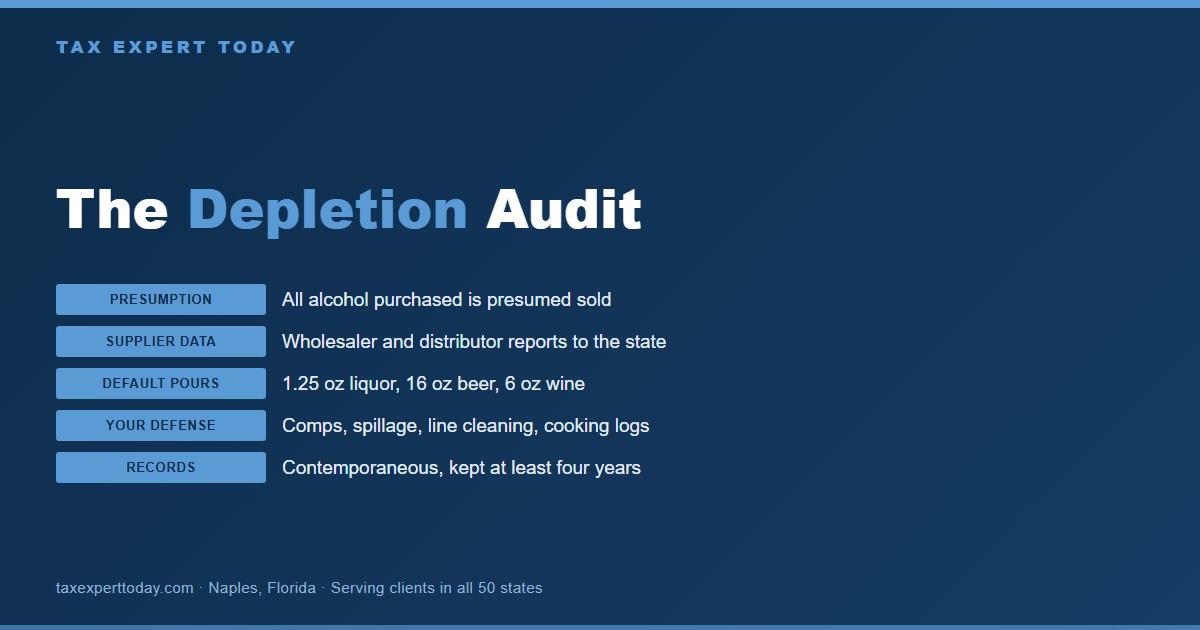
The method is often described as a depletion audit. The auditor starts with the alcohol that came in, converts it to servings, prices the servings, and compares the result with what was reported. The illustration below is hypothetical, uses simplified figures, and is not based on any client.
| Step | Hypothetical quarter |
|---|---|
| Liquor purchased, per supplier records | 120 one liter bottles, about 4,058 ounces |
| Servings at the 1.25 ounce default pour | About 3,246 servings |
| Average liquor drink price from menus and checks | 9.00 dollars |
| Implied liquor receipts | About 29,214 dollars |
| Liquor receipts the permittee reported | 21,000 dollars |
| Unreported receipts asserted | About 8,214 dollars |
| Gross receipts tax at 6.7 percent | About 550 dollars |
| Mixed beverage sales tax at 8.25 percent | About 678 dollars |
| Before penalty and interest, for one quarter | About 1,228 dollars |
Most of the variables in that computation can be challenged with records, and only with records. A bar that pours 1.5 ounces as a standard measure, and can show it through recipes, the change log and staff training materials, has fewer servings per bottle than the default assumes. A bar with documented comps, spillage reports, line cleaning logs, cooking withdrawals and police reports for theft can remove those quantities from the alcohol presumed sold. A bar with a weighted average price drawn from its actual product mix, including happy hour pricing, can challenge an average taken from the full price menu. A bar without those records has very little to offer against the presumption, and because the audit period can run back several years, an error repeated every month compounds.
Rule 3.1001(o)(2) gives the Comptroller access to “all books, records, papers, documents, supplies, and equipment of a permittee,” including procedure and operation manuals, ledgers and journals, internally or externally prepared financial statements, bank statements, federal income tax returns, and state and federal employment tax returns. Inconsistencies between those documents, for example liquor sales on the federal return that differ from the mixed beverage reports, are a common starting point for questions. How a Texas audit moves from the engagement letter to the assessment, and the options available afterward, is covered in our guide to the Texas Comptroller audit.
How Are Bad Debts, Walked Tabs, Spillage and Theft Treated?
Walked tabs are excluded from the gross receipts base, documented spillage and breakage owe no tax, and alcohol used in cooking is exempt from both taxes with records. Theft of cash does not reduce the base. Bad debts on house accounts follow one rule for each tax, and the gross receipts version requires a federal bad debt deduction.
- Walked checks: a customer who leaves without paying, with no credit extended, is excluded from the gross receipts base.
- Spillage and breakage: no gross receipts tax, supported by a written report at the time of the loss.
- Cooking: no mixed beverage tax and no use tax, if purchases, storage and withdrawals are documented.
- Stolen product: recorded on the daily summary and supported by a police report; stolen cash is still taxable.
Rule 3.1001 draws careful lines between events that look alike. A walked check or tab is a drink the business intended to sell but was never paid for, where no credit was extended; it is excluded from the base under Rule 3.1001(f)(6). A bad debt is an unpaid amount on credit the permittee did extend, such as a house account or an event invoice. A complimentary drink is one the business intended to give away. Each is recorded differently, and each has different evidence requirements.
For the gross receipts tax, Rule 3.1001(n) allows a credit or refund for bad debts only if the permittee determines the unpaid portion will be uncollectible, writes it off on its books, and claims it as a deduction for federal tax purposes in the same or a later reporting period. The permittee’s records must show the date of sale, the purchaser’s name and address, the source records, evidence that the gross receipts tax was paid, all payments and credits, the bad debt designation, and evidence of the federal deduction. Payments on a mixed account are applied ratably between alcohol and other items, later collections are reported as taxable receipts in the period collected, and the rule states that accounts may not be labeled as bad debts “for the purpose of delaying the payment” of the tax. For the mixed beverage sales tax, Rule 3.1002(c)(5) applies the ordinary sales tax bad debt rules in Rule 3.302 instead.
Under Rule 3.1001(g), no gross receipts tax is due on alcohol destroyed through spillage or breakage, but the daily summary must record the loss by container size, brand and class or type of drink, with a written report prepared at the time. Under Rule 3.1001(h) and Rule 3.1002(h), alcohol used in cooking is exempt from both mixed beverage taxes and from ordinary sales and use tax, provided the purchases are identified on invoices, the withdrawals are recorded on a service check or other permanent record at the time they are made, and the daily summary reflects them. Rule 3.1001(c)(2) states that thefts of money received from alcohol sales are not deductible from the base. The rules are generous to a business that writes things down and unforgiving to one that does not.
How Do Mixed Beverage Taxes Fit With Other Texas and Federal Taxes?
A Texas bar or restaurant typically files three monthly transaction tax reports, pays franchise tax if it exceeds the no tax due threshold, and handles federal income and payroll taxes. The gross receipts tax is a business cost, while the mixed beverage sales tax is a collection obligation, and the books should treat them differently.
- Ordinary sales tax on food, nonalcoholic drinks served alone, and to go alcohol.
- Use tax on comp ingredients and on taxable items bought without tax for the business’s own use.
- Franchise tax on the entity, measured separately under Chapter 171.
- Federal income tax treatment of the gross receipts tax as an expense, and payroll treatment of tips and service charges.
The three transaction tax reports cover different items: the gross receipts tax report and the mixed beverage sales tax report cover alcohol and mixers served for on premises consumption, and the ordinary sales and use tax return covers food, nonalcoholic drinks sold on their own, alcohol sold to go or delivered, amusement receipts such as cover charges, and use tax on complimentary drink ingredients and other taxable purchases made without tax. The entity that owns the bar is separately subject to the Texas franchise tax, which is a margin tax with its own no tax due threshold and reporting rules explained in our guide to the Texas franchise tax. How an owner’s choice of entity affects that tax and federal tax is covered in our guide to Texas LLC taxes.
For federal income tax purposes, the gross receipts tax is a tax the business pays on its own receipts and is generally deductible as a business expense in the year it is paid or accrued, depending on the business’s accounting method. The mixed beverage sales tax is a tax the business collects from customers and owes to the state. Businesses commonly record it as a liability rather than as revenue, so that it does not inflate gross receipts on the federal return or in financial statements used for lending. Owners deciding how the business itself should be taxed federally can review our comparison of a Texas LLC vs S corp. Either treatment should be applied consistently and reconciled with the monthly reports. The consistency matters because, as noted above, Comptroller auditors may request federal returns and compare them with the mixed beverage filings.
A permittee that sells the business, closes a location or changes ownership has final mixed beverage reports to file and bonds and permits to address, alongside the federal questions covered in our guide to selling a business and taxes and the general wind down steps covered in our guide to closing a business in Texas.
What Are Common Texas Mixed Beverage Tax Mistakes?
The recurring errors are treating the two taxes as one, charging customers the gross receipts tax, computing the gross receipts tax on a base that still includes the sales tax, switching between tax included and tax added pricing, missing use tax on comps, mishandling service charges above 20 percent, and keeping records too thin to rebut a depletion audit.
- Configuration errors in the point of sale system repeat every day until they are found.
- Classification errors involve comps, packages, gratuities, cover charges and to go sales.
- Record errors leave the presumption of sale unanswered.
- Calendar errors include missed zero reports and midnight day closes.
| Mistake | What the rule says | Typical consequence |
|---|---|---|
| Adding a 14.95 percent “MB tax” line to drinks | The 6.7 percent may not be charged to the customer; an amount labeled tax is due to the state | Overcollection remitted to the state plus the business’s own 6.7 percent still owed |
| Computing 6.7 percent on receipts that include the mixed beverage sales tax | Rule 3.1001(f)(10): remove the sales tax first | Overpayment of the gross receipts tax every month |
| Dividing receipts by 1.0825 without records showing tax included pricing | Rule 3.1002(c)(3): amounts are presumed to exclude tax | Assessment of mixed beverage sales tax on the full receipts |
| Alternating between tax included and tax added pricing | The Comptroller requires one method | Reports that cannot be reconciled in an audit |
| Reporting drinks on the ordinary sales tax return | Drinks served by a permittee go on the mixed beverage sales tax report | Underreported mixed beverage tax and mismatched returns |
| Not reporting use tax on comp ingredients | Section 183.043(c) and Rule 3.1002(e) | Use tax, penalty and interest on ingredients |
| Treating a drink with an entree or entry fee as a comp | Rule 3.1001(f)(1): consideration makes it taxable | Both taxes on the normal drink price |
| A 22 percent automatic service charge | Rule 3.1001(i)(2): over 20 percent, all of it is taxable | Both taxes on the entire charge |
| House keeps part of a mandatory gratuity | Rule 3.1001(i)(1): the retained portion is taxable | Both taxes on the retained portion |
| No written spillage, line cleaning or comp records | Rule 3.1001(l) daily summary requirements | Losses presumed to be sales in a depletion audit |
| Closing the business day at midnight | Section 183.022(c): the business day runs to 3 a.m. | Sales reported in the wrong month |
| Skipping the report in a month with no sales | Reports are due even with no sales | 50 dollar late filing penalty per report |
| Assuming a nonprofit owes nothing | No exemption from the gross receipts tax | Gross receipts tax, penalty and interest on event sales |
Most of these mistakes are not deliberate. They come from point of sale templates, from habits formed before the 2014 restructuring, from managers who learned ordinary sales tax and assume the same rules apply, or from event staff who label giveaways inconsistently. Because they are systematic, they tend to repeat in every month of an audit period, which is why a configuration review is often more valuable than any single month’s reconciliation.
How Should a Bar or Restaurant Review Its Texas Mixed Beverage Tax Setup?
Start with the permit and the point of sale configuration, then test one week of checks against the rules: the pricing method, the receipt statements, the order of computation, the handling of comps, packages, gratuities and to go sales, and whether the daily summary and purchase records would answer a depletion audit.
- Permit check: confirm which TABC permit each location holds and whether it is a listed permittee.
- System check: two separate tax codes for the two mixed beverage taxes and a third for ordinary sales tax.
- Sample test: recompute a week of checks by hand and compare them with the reports filed.
- Depletion test: convert one quarter’s purchases to servings and compare them with reported receipts.
A practical review follows the order of this guide. First, confirm the permit for each location and whether the business is a permittee under Section 183.001(b)(1). Second, examine the point of sale configuration: whether drinks, mixers, food, nonalcoholic drinks, to go alcohol and cover charges are mapped to the correct tax treatment, whether the mixed beverage sales tax is added or included and whether that choice is consistent, and whether the business day closes at 3 a.m. Third, read the receipts and menus against Section 183.042 and Rule 3.1002(d) to confirm that the customer is never charged the gross receipts tax and that any tax included statement is clear. Fourth, recompute a sample of checks and one month’s reports to confirm that the mixed beverage sales tax is removed before the gross receipts tax is computed. Fifth, review how comps, package prices, private events, service charges and nonprofit events are recorded. Finally, perform a simple depletion comparison for a recent quarter using the business’s own pour sizes and product mix, and see whether the records would explain any gap.
A review of this kind often finds both underpayments and overpayments. Overpaid gross receipts tax, for example from computing 6.7 percent on a base that included the sales tax, may be recoverable through a refund claim within the limitation period, which for most Texas taxes is four years, as described in the refund section of our Texas Comptroller audit guide. Underpayments found in a review can be corrected going forward and, depending on the facts, addressed for past periods through amended reports or other arrangements with the Comptroller. Which approach is appropriate depends on the facts and should be considered before any filing is changed.
Texas Mixed Beverage Tax Help in Naples & Southwest Florida
Tax Expert Today LLC advises businesses on state tax matters nationwide from our office in Naples, Florida. Southwest Florida owners reach the Texas mixed beverage tax more often than they expect. Florida restaurant groups open locations in Texas, following the registration steps in our moving your business to Texas checklist, Naples investors buy into Texas bars, breweries and event venues, and owners who moved from Texas to Florida often keep their Texas hospitality businesses. In each case the Texas mixed beverage rules apply to the Texas location regardless of where the owner lives.
Our work on this topic follows the sequence in this guide. We confirm the permit position, review the point of sale configuration and receipt language, recompute sample reports, test the treatment of comps, packages, gratuities, events and to go sales, and run a depletion comparison against purchase records. Where a Comptroller audit is under way, we organize the records so the presumption of sale can be answered item by item.
- Texas mixed beverage tax Naples FL owners can reach in person. Our office is on Tamiami Trail North in Naples, Florida, and we work with clients locally and remotely.
- Texas sales tax help Naples and nationwide. We serve clients in all 50 states, and the Texas rules apply the same way wherever the owner lives.
- Setup reviews before opening. Point of sale tax codes, receipt statements and record systems are easiest to get right before the first night of service.
- Refund and exposure reviews. We look for overpaid gross receipts tax and for systematic underpayments within the limitation period.
- Coordinated with your other obligations. Mixed beverage taxes, ordinary sales tax, franchise tax, payroll and federal positions are reviewed together.
Related services include our Texas tax services for businesses with Texas obligations and our Naples tax planning work for Southwest Florida owners.
Tax Expert Today LLC
11983 Tamiami Trail N, Naples, FL 34110
Phone: (239) 441-2005
Hours: Monday through Friday, 10:00 a.m. to 5:00 p.m. ET
Local question we are asked often: A Naples restaurant group is opening its first Texas location and plans to serve cocktails in the dining room, sell bottled wine to go, and host private events with a 22 percent service charge. Which taxes apply? With a mixed beverage permit, the cocktails and any beer or wine served at the tables or at events carry both mixed beverage taxes, while bottles sold to go carry ordinary sales tax. The 22 percent service charge exceeds the 20 percent ceiling in Rule 3.1001, so the entire charge on the drinks would be taxable. Setting the event charge at 20 percent or less, paid to qualified staff, is a decision worth making before the first contract is signed.
When Should You Engage a Professional?
A single location bar with a simple menu, one pricing method and good records can often apply the Texas mixed beverage tax correctly using this guide and the Comptroller’s frequently asked questions. Professional review becomes worthwhile when the business has several locations or permit types, runs a catering or private event business, uses package pricing or membership models, charges mandatory service fees, operates as or with a nonprofit, has changed point of sale systems, is buying or selling a permitted business, or has received an audit notice or a depletion analysis. The Texas mixed beverage tax is a state tax matter administered by the Texas Comptroller, not an IRS matter, and our multidisciplinary team of tax advisors, enrolled agents, CPAs and attorneys advises on state tax matters nationwide. Permit questions are governed by the Texas Alcoholic Beverage Commission, and contested matters that proceed to a formal hearing or to court may call for Texas licensed counsel; we coordinate with those professionals where appropriate.
If you would like a review of your mixed beverage tax setup, help preparing for an audit, or an analysis of possible overpayments, contact Tax Expert Today at (239) 441-2005 or visit our Texas tax services page. Businesses dealing with a federal examination at the same time can also review our IRS resolution and audit support services.
Frequently Asked Questions
What is the Texas mixed beverage tax rate?
There are two rates for two taxes. The mixed beverage gross receipts tax is 6.7 percent of the permittee’s gross receipts from alcohol, ice and mixers served for on premises consumption. The mixed beverage sales tax is 8.25 percent of the sales price of each drink. Both apply to the same drink when a mixed beverage permittee serves it.
Who pays the Texas mixed beverage gross receipts tax?
The permittee pays it from its own receipts. The Comptroller states that the permit holder, not the customer, must pay it, and that it may not be added to the selling price as a separate charge or deducted from the amount received. Any amount labeled a tax on the customer’s invoice is fully due to the state in addition.
Can a Texas bar include the mixed beverage sales tax in the drink price?
Yes. A permittee may add the 8.25 percent mixed beverage sales tax to the bill or include it in the menu price, but it must choose one method and cannot alternate. Receipts are presumed to show the price without tax, so the permittee’s records must show that tax was included, and a general “all taxes included” statement is not sufficient.
Do beer and wine count as mixed beverages in Texas?
Yes, when a mixed beverage permittee serves them for consumption on the premises. A mixed beverage includes any serving composed in whole or in part of an alcoholic beverage. A business holding only a wine and malt beverage retailer’s permit is not a permittee, and its beer and wine sales carry ordinary sales tax instead.
Are complimentary drinks taxable under the Texas mixed beverage tax?
A drink given away with no consideration is excluded from both mixed beverage taxes, but the permittee owes use tax on the ingredients and items such as napkins and straws. A drink served in connection with food or an entry fee that includes drink tickets is not complimentary and is taxed at its normal price.
Are to go cocktails and delivered wine subject to mixed beverage taxes?
No. The Comptroller states that pickup, delivery and to go sales of alcohol, including unopened wine, that are not consumed on the premises are not subject to mixed beverage taxes. They are subject to ordinary sales and use tax and are reported on the regular sales tax return. Whether those sales are permitted is a TABC question.
Are there exemptions from the mixed beverage gross receipts tax?
No. The Comptroller states there are no exemptions from the gross receipts tax, and governmental entities and nonprofits exempt from sales tax must still pay it. The mixed beverage sales tax follows the sales tax exemptions, so qualifying governmental purchasers and certain nonprofit fundraisers may be exempt from that tax only.
Can a Naples, Florida restaurant owner with a Texas location get help with mixed beverage taxes?
Yes. The Texas mixed beverage tax depends on the permit and the sales at the Texas location, not on where the owner lives. Tax Expert Today advises on state tax matters nationwide from Naples, Florida, including point of sale setup, monthly reporting, record systems and Comptroller audits for Texas hospitality businesses.
Published October 23, 2026 by Dr. Pellumb Kabashi « Back to Learning Center
Have a question this article touches on?
Tax Expert Today LLC, based in Naples, Florida and serving clients across the United States.
Schedule a Consultation (239) 441-2005